×
  • Cat-intel
  • MedIntelliX
  • Resources
  • About Us
  • Hero Background
    English
    Chinese
    French
    Japanese
    Korean
    German
    Spanish

    Asia Pacific Aluminum Market Trends

    ID: MRFR/CnM/16269-HCR
    128 Pages
    Anshula Mandaokar
    October 2025

    Asia Pacific Aluminum Market Research Report Information By Type (Secondary/Recycled Aluminum and Primary Aluminum), By Product (Flat Rolled, Pigment & Powder, Forgings, Extrusions, Castings, Rod & Bar and Others), By Application (Building & Construction, Consumer Goods, Electrical, Foil & Packaging, Hardware & Accessories, Machinery & Equipment, Solar Industry, Transpor...

    Share:
    Download PDF ×

    We do not share your information with anyone. However, we may send you emails based on your report interest from time to time. You may contact us at any time to opt-out.

    Asia Pacific Aluminum Market Infographic
    Purchase Options

    Market Trends

    Key Emerging Trends in the Asia Pacific Aluminum Market

    Notable trends are underway in the Asia Pacific Aluminum Market which illustrate a myriad of dynamics found in the industrial and economic environment. Aluminum, a versatile material renowned for its lightweight properties, has been widely used across sectors leading to changing market trends. One major trend in the Asia pacific aluminum market is robustness from the automobile industry. Additionally, there is an increased use of aluminum in manufacturing lightweight components that enhance fuel efficiency and reduce emissions as it’s a major hub for auto manufacturing.

    Infrastructure development is another significant factor shaping the market trends in the Asia Pacific Aluminum Market. This region has seen rapid industrialization and urbanization consequently leading to demand for construction materials with high strength and durability. In this regard, corrugated iron sheets are increasingly being replaced by aluminum made windows, doors, walls among other structural elements due to their non corrosive nature and light weight. This changes in the construction industry have led to an increase in demand for aluminium driven by sustainable building practices that save energy.

    Likewise, packaging industry within Asia pacific region contributes into these market trends on Aluminum Market. Because of its lightweight property also durable nature of it makes Aluminium more suitable packaging material thus it has been adopted by many industries including food processing pharmaceuticals and cosmetics. The adoption of recyclable packing materials especially those with low carbon content has gained popularity among customers over time hence making them prefer using Aluminium as compared to other packages.

    Geopolitical factors including trade policies and global economic trends also influence the Asia Pacific Aluminum Market. Thereby area’s aluminum producers position themselves strategically as they adapt to changing trading patterns while looking for new markets their products can be sold at competitive prices thereby overcoming competition from developed world companies. Apart from this government policies regarding sustainability Industrialisation Issues play a very important role on this one since most countries within this region are putting efforts into increasing their capacity of producing aluminum as well as investment downstream industries.

    Furthermore, technological advancements are driving innovation in the Asia Pacific Aluminum Market. Advanced manufacturing processes and alloys have improved the performance and versatility of aluminum for different applications. The adoption of smart manufacturing or automation, a principle under Industry 4.0, is enhancing efficiency through higher production rates at lower costs contributing to the overall growth of the aluminum industry in the region.

    Concerns regarding sustainable development are central themes observed on market trends within the Asia Pacific Aluminum Market. Other activities done by industry that promote recycling are actively being addressed to mitigate environmental concerns. On top of that, aluminum products can recycle in a closed loop system where old aluminium products can be collected and converted into new ones. In this regard, aluminum producers in Asia-Pacific are increasingly looking for sustainability practices which would help them reduce their carbon footprints as well as manufacture more eco-friendly products considering tightening environmental controls.

    However, there may be several challenges encountered by the Asia Pacific Aluminum Market due to volatile raw material prices; energy-intensive production and global economic uncertainties among others. Addressing these issues will require a strategic approach that includes continuous adaptation with changing markets forces, innovation and partnership among others.

    Author
    Anshula Mandaokar
    Team Lead - Research

    Anshula Mandaokar holds an academic degree in Chemical Engineering and has been contributing to the field for more than 5 years. She has expertise in Market Research and Business Consulting and serves as a Team Lead for a reputed Market Research firm under the Chemicals and Materials domain spectrum. She has worked on multiple projects, generating explicit results in a quick turnaround time. Her understanding of data interpretation justifies her role as a leader.

    Leave a Comment

    FAQs

    What is the current valuation of the Asia Pacific Aluminum Market in 2025?

    The Asia Pacific Aluminum Market is valued at approximately 82.04 USD Billion in 2024.

    What is the projected market size for the Asia Pacific Aluminum Market by 2035?

    The market is projected to reach around 187.46 USD Billion by 2035.

    What is the expected CAGR for the Asia Pacific Aluminum Market during the forecast period?

    The expected CAGR for the Asia Pacific Aluminum Market from 2025 to 2035 is 7.8%.

    Which segments are included in the Asia Pacific Aluminum Market analysis?

    The market analysis includes segments such as Type, Product, and Application.

    What are the projected revenues for Primary Aluminum and Secondary/Recycled Aluminum by 2035?

    By 2035, Primary Aluminum is projected to generate revenues between 52.04 and 117.46 USD Billion, while Secondary/Recycled Aluminum is expected to range from 30.0 to 70.0 USD Billion.

    Market Summary

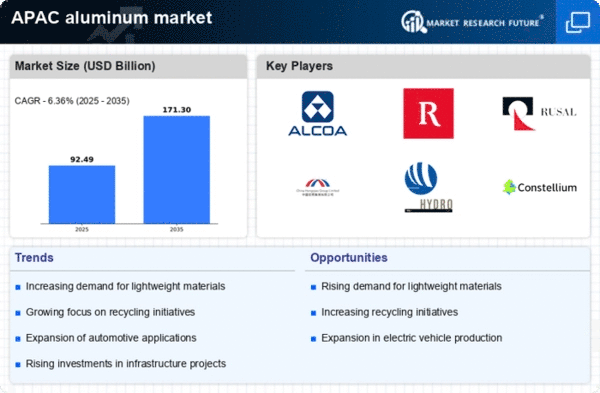
    As per MRFR analysis, the APAC aluminum market Size was estimated at 86.96 USD Billion in 2024. The APAC aluminum market is projected to grow from 92.49 USD Billion in 2025 to 171.3 USD Billion by 2035, exhibiting a compound annual growth rate (CAGR) of 6.36% during the forecast period 2025 - 2035.

    Key Market Trends & Highlights

    The APAC aluminum market is experiencing robust growth driven by sustainability and technological advancements.

    • Sustainable production practices are increasingly prioritized across the APAC aluminum market, particularly in China.
    • The automotive sector is witnessing a rising demand for aluminum, contributing to market expansion in India.
    • Renewable energy applications are driving innovation and growth within the aluminum industry in the region.
    • Infrastructure development initiatives and government regulations on emissions are key drivers propelling the market forward.

    Market Size & Forecast

    2024 Market Size 86.96 (USD Billion)
    2035 Market Size 171.3 (USD Billion)
    CAGR (2025 - 2035) 6.36%

    Major Players

    <p>Alcoa Corporation (US), Rio Tinto (GB), Rusal (RU), China Hongqiao Group (CN), Norsk Hydro ASA (NO), Constellium SE (NL), Novelis Inc. (US), South32 Limited (AU), Kaiser Aluminum Corporation (US)</p>

    Market Trends

    The aluminum market in the APAC region is currently experiencing a dynamic phase characterized by evolving demand and supply dynamics. The region's robust industrial growth, particularly in sectors such as automotive, construction, and packaging, drives the need for aluminum products. Additionally, the increasing focus on lightweight materials to enhance energy efficiency in transportation and construction applications appears to be a significant factor influencing market trends. Furthermore, the rise of electric vehicles and renewable energy technologies is likely to bolster the demand for aluminum, as it is a preferred material for battery casings and structural components. Moreover, the aluminum market is also witnessing shifts in production practices, with a growing emphasis on sustainability and recycling. Governments in the APAC region are implementing stricter regulations aimed at reducing carbon emissions, which may lead to increased investments in green technologies. This shift towards sustainable practices could potentially reshape the competitive landscape, as companies that adopt eco-friendly methods may gain a competitive edge. Overall, the aluminum market in APAC is poised for growth, driven by both demand-side factors and a transition towards more sustainable production methods.

    Sustainable Production Practices

    The aluminum market is increasingly influenced by a shift towards sustainable production methods. Companies are adopting eco-friendly technologies to reduce carbon footprints, aligning with government regulations aimed at environmental protection. This trend may enhance competitiveness for firms that prioritize sustainability.

    Rising Demand in Automotive Sector

    The automotive industry in APAC is experiencing a surge in demand for aluminum components. Lightweight materials are essential for improving fuel efficiency and reducing emissions in vehicles. This trend suggests a growing reliance on aluminum as manufacturers seek to meet regulatory standards.

    Growth in Renewable Energy Applications

    The aluminum market is benefiting from the expansion of renewable energy technologies. Aluminum is a key material in solar panels and wind turbines, indicating a potential increase in demand as countries invest in clean energy solutions. This trend may further solidify aluminum's role in the energy transition.

    Asia Pacific Aluminum Market Market Drivers

    Rising Consumer Electronics Market

    The rapid expansion of the consumer electronics market in APAC is poised to drive demand for aluminum in the aluminum market. With the proliferation of smartphones, laptops, and other electronic devices, manufacturers are increasingly utilizing aluminum for its lightweight and durable properties. In 2025, the consumer electronics market in APAC is projected to reach approximately $1 trillion, with aluminum playing a crucial role in product design and functionality. The aesthetic appeal of aluminum, combined with its thermal conductivity, makes it a preferred choice for high-end electronic devices. This trend is likely to continue, as consumers increasingly seek products that are both functional and visually appealing, thereby enhancing the demand for aluminum in the electronics sector.

    Government Regulations on Emissions

    Government regulations aimed at reducing carbon emissions are likely to influence the aluminum market in APAC. Many countries in the region are implementing stricter environmental policies that encourage the use of low-emission materials, including aluminum. For instance, initiatives to limit carbon footprints in manufacturing processes may lead to increased investments in cleaner production technologies. This shift could result in a higher demand for aluminum, as it is often viewed as a more sustainable alternative to other metals. Additionally, the potential for government incentives for companies adopting greener practices may further stimulate growth in the aluminum market, as businesses seek to comply with regulations while enhancing their market competitiveness.

    Growth in Electric Vehicle Production

    The growth in electric vehicle (EV) production in APAC is expected to be a significant driver for the aluminum market. As automakers increasingly shift towards electric mobility, aluminum is becoming a preferred material due to its lightweight nature, which enhances vehicle efficiency and range. In 2025, the EV market in APAC is projected to account for over 50% of global EV sales, with aluminum playing a critical role in vehicle design and manufacturing. The use of aluminum in battery enclosures, chassis, and body structures not only reduces weight but also improves performance. This trend is likely to continue, as both manufacturers and consumers prioritize sustainability and efficiency in the automotive sector, thereby driving demand for aluminum.

    Infrastructure Development Initiatives

    The ongoing infrastructure development initiatives across APAC are likely to bolster the aluminum market. Governments are investing heavily in transportation, housing, and urban development projects, which require substantial amounts of aluminum for construction and manufacturing. For instance, the Asian Development Bank has projected that infrastructure investments in the region could reach $26 trillion by 2030. This surge in demand for aluminum in construction materials, such as windows, doors, and roofing, is expected to drive growth in the aluminum market. Furthermore, the increasing focus on sustainable building practices may lead to a preference for aluminum due to its recyclability and lightweight properties, further enhancing its appeal in the infrastructure sector.

    Technological Advancements in Production

    Technological advancements in aluminum production processes are anticipated to significantly impact the aluminum market in APAC. Innovations such as advanced smelting techniques and recycling technologies are improving efficiency and reducing production costs. For example, the implementation of inert anode technology has the potential to decrease greenhouse gas emissions by up to 90%, making aluminum production more environmentally friendly. As a result, manufacturers are likely to adopt these technologies to meet regulatory standards and consumer preferences for sustainable products. The increased efficiency not only lowers costs but also enhances the competitiveness of aluminum against alternative materials, thereby stimulating demand in various sectors, including construction and automotive.

    Market Segment Insights

    By Type: Primary (Largest) vs. Secondary (Fastest-Growing)

    <p>In the APAC aluminum market, the 'Primary' segment dominates the landscape, holding the largest share among the types available. This segment is characterized by its high demand driven by extensive applications in construction, transportation, and consumer goods. In contrast, the 'Secondary' segment, while smaller in market share, is rapidly gaining traction due to increased recycling initiatives and sustainability trends. As industries pivot towards eco-friendly practices, the emergence of the Secondary segment is creating new opportunities for growth. The growth trends in the APAC aluminum market reveal a robust demand for Secondary aluminum as businesses seek to reduce their carbon footprint and adhere to stricter environmental regulations. This shift is further propelled by advancements in recycling technologies that enhance the quality and efficiency of secondary aluminum production. As a result, this segment is expected to expand rapidly, supported by market dynamics emphasizing sustainability and resource efficiency.</p>

    <p>Primary (Dominant) vs. Secondary (Emerging)</p>

    <p>The 'Primary' aluminum segment stands as the dominant force in the market, primarily due to its extensive use in various sectors, ensuring consistent demand. Its production is driven by large-scale manufacturing operations, which cater to both local and international markets. On the other hand, the 'Secondary' aluminum segment is classified as emerging, fueled by the increasing emphasis on recycling and recovery processes. This segment leverages technology to repurpose aluminum waste, significantly contributing to material sustainability. While Primary aluminum remains crucial for high-demand applications, Secondary aluminum is poised to capture attention with its environmentally friendly appeal, appealing to a growing segment of consumers and manufacturers focused on sustainability initiatives.</p>

    By Product Type: Flat Rolled (Largest) vs. Castings (Fastest-Growing)

    <p>In the APAC aluminum market, the product type segment is characterized by various applications, with Flat Rolled products commanding the largest market share. This segment benefits from extensive use in construction, automotive, and packaging industries, leading to significant demand throughout the region. Conversely, Castings have emerged as the fastest-growing segment, driven by the increasing need for lightweight and durable materials in various manufacturing processes, especially in automotive and aerospace sectors. Growth trends in the aluminum market are influenced by several key factors, including an uptick in industrial production and technological advancements in aluminum processing. The shift towards electric vehicles is also propelling demand for Extrusion and Castings, as manufacturers seek to produce lightweight components. Additionally, government initiatives promoting sustainability are encouraging the use of aluminum in green technologies, thus enhancing market prospects for all product types.</p>

    <p>Flat Rolled (Dominant) vs. Castings (Emerging)</p>

    <p>Flat Rolled products have established themselves as the dominant segment in the APAC aluminum market due to their versatility and broad application scope, making them essential for numerous industries, including automotive and construction. The continuous innovation in manufacturing processes has further enhanced their performance and cost-effectiveness. On the other hand, Castings are emerging as a vital segment, especially with the rising demand from the automotive and consumer goods sectors for customized solutions. This segment is witnessing rapid technological advancements, which are enhancing the quality and efficiency of cast products, making them increasingly appealing to manufacturers seeking to reduce weight and improve performance in various applications.</p>

    By Application: Building & Construction (Largest) vs. Automotive & Transportation (Fastest-Growing)

    <p>The application segment in the aluminum market reveals a diverse distribution of market shares across various sectors. The Building & Construction sector holds the largest share, driven by increasing urbanization and infrastructure development. Meanwhile, the Automotive & Transportation sector is gaining momentum, propelled by rising demands for lightweight materials that enhance fuel efficiency in vehicles. These dynamics are shaping the competitive landscape within the market. Looking towards the future, demand from the Automotive & Transportation sector is forecasted to grow the fastest due to trends such as electric vehicle production and stringent emission regulations. Innovations in aluminum processing and recycling also play a significant role in bolstering the overall growth of aluminum applications. These factors indicate a strong upward trajectory for this segment, promising robust opportunities for market participants.</p>

    <p>Building & Construction (Dominant) vs. Power (Emerging)</p>

    <p>The Building & Construction segment represents the dominant force within the aluminum market, characterized by its extensive application in residential and commercial projects due to its lightweight and durability properties. This sector is not only pivotal for structural integrity but also offers aesthetic versatility, making aluminum a preferred choice in design and architecture. Conversely, the Power segment is emerging rapidly, driven by the transition towards renewable energy sources and the need for efficient conductors in power transmission. This growth in the Power sector reflects broader energy trends and the increasing reliance on aluminum for sustainable energy solutions, as it provides benefits such as corrosion resistance and conductivity.</p>

    Get more detailed insights about Asia Pacific Aluminum Market Research Report—Forecast till 2035

    Regional Insights

    China : Unmatched Production and Demand Growth

    China holds a commanding 40.0% share of the APAC aluminum market, valued at approximately $XX billion. Key growth drivers include rapid industrialization, urbanization, and government initiatives promoting green technologies. Demand trends show a significant rise in automotive and construction sectors, supported by favorable regulatory policies aimed at reducing carbon emissions. Infrastructure development, particularly in transportation and energy, further fuels consumption patterns.

    India : Strong Growth in Manufacturing Sector

    India accounts for 15.0% of the APAC aluminum market, with a value of around $XX billion. The growth is propelled by the Make in India initiative, which encourages local manufacturing and infrastructure projects. Demand is surging in sectors like automotive, packaging, and construction, with government policies favoring sustainable practices. The increasing focus on renewable energy sources also boosts aluminum consumption.

    Japan : High-Quality Production Standards

    Japan holds a 10.0% share of the APAC aluminum market, valued at approximately $XX billion. The market is driven by advanced technology and high-quality production standards, particularly in the automotive and electronics sectors. Demand trends indicate a shift towards lightweight materials for fuel efficiency. Regulatory policies emphasize recycling and sustainability, aligning with global environmental goals.

    South Korea : Focus on High-Tech Applications

    South Korea represents 8.0% of the APAC aluminum market, valued at around $XX billion. The growth is fueled by the country's focus on high-tech applications, particularly in electronics and automotive industries. Demand is increasing for lightweight and durable materials, supported by government initiatives promoting innovation. The competitive landscape features major players investing in R&D to enhance product offerings.

    Malaysia : Investment in Infrastructure Development

    Malaysia captures 4.0% of the APAC aluminum market, valued at approximately $XX billion. The growth is driven by significant investments in infrastructure and industrial development, particularly in the construction sector. Demand trends show an increase in aluminum usage for packaging and automotive applications. Government policies support local production and sustainability initiatives, enhancing the business environment.

    Thailand : Diverse Applications Driving Demand

    Thailand holds a 3.0% share of the APAC aluminum market, valued at around $XX billion. The market is experiencing growth due to diverse applications in automotive, construction, and packaging sectors. Demand is supported by government initiatives aimed at boosting local manufacturing and exports. The competitive landscape includes both local and international players, fostering a dynamic business environment.

    Indonesia : Focus on Sustainable Practices

    Indonesia accounts for 2.0% of the APAC aluminum market, valued at approximately $XX billion. The growth is driven by increasing demand in construction and automotive sectors, supported by government policies promoting sustainable practices. Infrastructure development is a key focus area, enhancing market potential. The competitive landscape features both domestic and international players, contributing to a vibrant market.

    Rest of APAC : Varied Growth Across Sub-Regions

    The Rest of APAC captures 4.96% of the aluminum market, valued at around $XX billion. Growth is driven by diverse applications across various industries, including construction, automotive, and packaging. Demand trends vary significantly by country, influenced by local regulations and market conditions. The competitive landscape includes a mix of local and international players, each adapting to regional dynamics.

    Key Players and Competitive Insights

    The aluminum market exhibits a dynamic competitive landscape characterized by a blend of established players and emerging challengers. Key growth drivers include increasing demand for lightweight materials in automotive and aerospace sectors, alongside a heightened focus on sustainability. Major companies such as China Hongqiao Group (CN), Alcoa Corporation (US), and Rusal (RU) are strategically positioned to leverage these trends. China Hongqiao Group (CN) emphasizes vertical integration and cost leadership, while Alcoa Corporation (US) focuses on innovation and sustainability initiatives. Rusal (RU) is enhancing its operational efficiency through digital transformation, collectively shaping a competitive environment that prioritizes technological advancement and environmental responsibility.

    In terms of business tactics, companies are increasingly localizing manufacturing to reduce logistics costs and enhance supply chain resilience. The market structure appears moderately fragmented, with a few dominant players exerting considerable influence. This fragmentation allows for niche players to thrive, yet the collective strategies of key companies drive significant market dynamics, fostering competition that is both innovative and responsive to consumer demands.

    In October 2025, China Hongqiao Group (CN) announced a major investment in a new aluminum smelting facility in Inner Mongolia, aimed at increasing production capacity by 1 million tonnes annually. This strategic move is likely to bolster its market share and enhance its competitive edge, particularly in the rapidly growing electric vehicle sector, where lightweight materials are crucial. The investment underscores the company's commitment to meeting rising demand while optimizing production efficiency.

    In September 2025, Alcoa Corporation (US) launched a new line of low-carbon aluminum products, targeting the growing market for sustainable materials. This initiative not only aligns with global sustainability goals but also positions Alcoa as a leader in the green aluminum segment. The introduction of these products is expected to attract environmentally conscious consumers and businesses, potentially increasing Alcoa's market penetration.

    In August 2025, Rusal (RU) entered a strategic partnership with a leading technology firm to develop AI-driven solutions for optimizing aluminum production processes. This collaboration aims to enhance operational efficiency and reduce energy consumption, which is critical in an industry facing increasing pressure to lower its carbon footprint. The integration of AI technologies may provide Rusal with a competitive advantage in terms of cost reduction and sustainability.

    As of November 2025, current competitive trends in the aluminum market are increasingly defined by digitalization, sustainability, and the integration of advanced technologies. Strategic alliances are becoming pivotal, enabling companies to pool resources and expertise to address complex challenges. The competitive differentiation is likely to evolve from traditional price-based competition towards a focus on innovation, technological advancement, and supply chain reliability. This shift suggests that companies prioritizing sustainable practices and technological integration will be better positioned to thrive in the future.

    Key Companies in the Asia Pacific Aluminum Market market include

    Industry Developments

    July 2023: Three of the immune-boosting lemonades from GUNNA Drinks, a soda brand that advocates against plastic use, come in a range of aluminum bottles. This action aims to address the rising demand for functional food and drink items while reducing the amount of plastic waste generated.

    December 2021: An agreement was signed by Hindalco Industries Limited to purchase the Indian operations of Norsk Hydro ASA's Al extrusions division. Hindalco will benefit from this acquisition by gaining an integrated plant in Andhra Pradesh, a skilled workforce, and knowledge of value-added, bespoke products. Additionally, this action will increase the company's presence in South India.

    In July 2024, ATK, a Chinese peripheral manufacturer, introduced a new mechanical keyboard called the ATK Z87 Pro. This keyboard offers a range of features that appeal to consumers who are mindful of their budget as well as those who prioritize performance. The Z87 Pro features a tiny 87-key layout, eliminating the numeric keypad to create a space-efficient design that is popular among both gamers and minimalists. The keyboard features a stylish semi-aluminum casing with a CNC anodized metal top cover, providing a combination of sturdiness and high-quality visual appeal.

    The keyboard is equipped with integrated PVD ornamental light strips that illuminate in conjunction with the keyboard's backlighting. The Z87 Pro provides users with a selection of two switch options: Kailh Blueberry Ice Cream switches and Aniya switches. Both switches are linear in nature and are renowned for their seamless keypress and emphasis on rapidity. The keyboard offers many keycap profile choices, such as MDA and OEM profile, with high-quality PBT keycaps, guaranteeing a pleasant typing experience.

    The Z87 Pro features a Gasket structure that use silicone pads to separate the plate from the keyboard's base, reducing typing noise and providing a more pleasant keystroke sensation. This function is commonly seen on keyboards of higher quality and enhances the overall typing experience, giving it a more luxurious feel.

    Future Outlook

    Asia Pacific Aluminum Market Future Outlook

    <p>The aluminum market is projected to grow at a 6.36% CAGR from 2024 to 2035, driven by increasing demand in construction, automotive, and packaging sectors.</p>

    New opportunities lie in:

    • <p>Investment in advanced recycling technologies to reduce costs and enhance sustainability.</p>
    • <p>Development of lightweight aluminum alloys for electric vehicle applications.</p>
    • <p>Expansion of aluminum product lines for renewable energy infrastructure projects.</p>

    <p>By 2035, the aluminum market is expected to achieve robust growth, driven by innovation and strategic investments.</p>

    Market Segmentation

    Asia Pacific Aluminum Market Type Outlook

    • Primary
    • Secondary

    Asia Pacific Aluminum Market Application Outlook

    • Building & Construction
    • Automotive & Transportation
    • Foil & Packaging
    • Power
    • Machinery & Equipment (Industrial)
    • Consumer Goods
    • Others

    Asia Pacific Aluminum Market Product Type Outlook

    • Flat Rolled
    • Castings
    • Extrusion
    • Rod & Bar
    • Forgings
    • Others

    Report Scope

    MARKET SIZE 202486.96(USD Billion)
    MARKET SIZE 202592.49(USD Billion)
    MARKET SIZE 2035171.3(USD Billion)
    COMPOUND ANNUAL GROWTH RATE (CAGR)6.36% (2024 - 2035)
    REPORT COVERAGERevenue Forecast, Competitive Landscape, Growth Factors, and Trends
    BASE YEAR2024
    Market Forecast Period2025 - 2035
    Historical Data2019 - 2024
    Market Forecast UnitsUSD Billion
    Key Companies Profiled["Alcoa Corporation (US)", "Rio Tinto (GB)", "Rusal (RU)", "China Hongqiao Group (CN)", "Norsk Hydro ASA (NO)", "Constellium SE (NL)", "Novelis Inc. (US)", "South32 Limited (AU)", "Kaiser Aluminum Corporation (US)"]
    Segments CoveredType, Product Type, Application
    Key Market OpportunitiesAdoption of lightweight aluminum solutions in automotive and aerospace sectors drives growth in the aluminum market.
    Key Market DynamicsRising demand for lightweight materials drives innovation and competition in the aluminum market across the APAC region.
    Countries CoveredChina, India, Japan, South Korea, Malaysia, Thailand, Indonesia, Rest of APAC

    FAQs

    What is the current valuation of the Asia Pacific Aluminum Market in 2025?

    The Asia Pacific Aluminum Market is valued at approximately 82.04 USD Billion in 2024.

    What is the projected market size for the Asia Pacific Aluminum Market by 2035?

    The market is projected to reach around 187.46 USD Billion by 2035.

    What is the expected CAGR for the Asia Pacific Aluminum Market during the forecast period?

    The expected CAGR for the Asia Pacific Aluminum Market from 2025 to 2035 is 7.8%.

    Which segments are included in the Asia Pacific Aluminum Market analysis?

    The market analysis includes segments such as Type, Product, and Application.

    What are the projected revenues for Primary Aluminum and Secondary/Recycled Aluminum by 2035?

    By 2035, Primary Aluminum is projected to generate revenues between 52.04 and 117.46 USD Billion, while Secondary/Recycled Aluminum is expected to range from 30.0 to 70.0 USD Billion.

    1. SECTION I: EXECUTIVE SUMMARY AND KEY HIGHLIGHTS
      1. EXECUTIVE SUMMARY
        1. Market Overview
        2. Key Findings
        3. Market Segmentation
        4. Competitive Landscape
        5. Challenges and Opportunities
        6. Future Outlook
    2. SECTION II: SCOPING, METHODOLOGY AND MARKET STRUCTURE
      1. MARKET INTRODUCTION
        1. Definition
        2. Scope of the study
      2. RESEARCH METHODOLOGY
        1. Overview
        2. Data Mining
        3. Secondary Research
        4. Primary Research
        5. Forecasting Model
        6. Market Size Estimation
        7. Data Triangulation
        8. Validation
    3. SECTION III: QUALITATIVE ANALYSIS
      1. MARKET DYNAMICS
        1. Overview
        2. Drivers
        3. Restraints
        4. Opportunities
      2. MARKET FACTOR ANALYSIS
        1. Value chain Analysis
        2. Porter's Five Forces Analysis
        3. COVID-19 Impact Analysis
    4. SECTION IV: QUANTITATIVE ANALYSIS
      1. Medical Device, BY Type (USD Billion)
        1. Primary
        2. Secondary
      2. Medical Device, BY Product Type (USD Billion)
        1. Flat Rolled
        2. Castings
        3. Extrusion
        4. Rod & Bar
        5. Forgings
        6. Others
      3. Medical Device, BY Application (USD Billion)
        1. Building & Construction
        2. Automotive & Transportation
        3. Foil & Packaging
        4. Power
        5. Machinery & Equipment (Industrial)
        6. Consumer Goods
        7. Others
    5. SECTION V: COMPETITIVE ANALYSIS
      1. Competitive Landscape
        1. Overview
        2. Competitive Analysis
        3. Market share Analysis
        4. Major Growth Strategy in the Medical Device
        5. Competitive Benchmarking
        6. Leading Players in Terms of Number of Developments in the Medical Device
        7. Key developments and growth strategies
        8. Major Players Financial Matrix
      2. Company Profiles
        1. Alcoa Corporation (US)
        2. Rio Tinto (GB)
        3. Rusal (RU)
        4. China Hongqiao Group (CN)
        5. Norsk Hydro ASA (NO)
        6. Constellium SE (NL)
        7. Novelis Inc. (US)
        8. South32 Limited (AU)
        9. Kaiser Aluminum Corporation (US)
      3. Appendix
        1. References
        2. Related Reports
    6. LIST OF FIGURES
      1. MARKET SYNOPSIS
      2. APAC MARKET ANALYSIS BY TYPE
      3. APAC MARKET ANALYSIS BY PRODUCT TYPE
      4. APAC MARKET ANALYSIS BY APPLICATION
      5. KEY BUYING CRITERIA OF MEDICAL DEVICE
      6. RESEARCH PROCESS OF MRFR
      7. DRO ANALYSIS OF MEDICAL DEVICE
      8. DRIVERS IMPACT ANALYSIS: MEDICAL DEVICE
      9. RESTRAINTS IMPACT ANALYSIS: MEDICAL DEVICE
      10. SUPPLY / VALUE CHAIN: MEDICAL DEVICE
      11. MEDICAL DEVICE, BY TYPE, 2024 (% SHARE)
      12. MEDICAL DEVICE, BY TYPE, 2024 TO 2035 (USD Billion)
      13. MEDICAL DEVICE, BY PRODUCT TYPE, 2024 (% SHARE)
      14. MEDICAL DEVICE, BY PRODUCT TYPE, 2024 TO 2035 (USD Billion)
      15. MEDICAL DEVICE, BY APPLICATION, 2024 (% SHARE)
      16. MEDICAL DEVICE, BY APPLICATION, 2024 TO 2035 (USD Billion)
      17. BENCHMARKING OF MAJOR COMPETITORS
    7. LIST OF TABLES
      1. LIST OF ASSUMPTIONS
      2. 7.1.1
      3. APAC MARKET SIZE ESTIMATES; FORECAST
        1. BY TYPE, 2025-2035 (USD Billion)
        2. BY PRODUCT TYPE, 2025-2035 (USD Billion)
        3. BY APPLICATION, 2025-2035 (USD Billion)
      4. PRODUCT LAUNCH/PRODUCT DEVELOPMENT/APPROVAL
      5. 7.3.1
      6. ACQUISITION/PARTNERSHIP
      7. 7.4.1

    APAC Medical Device Market Segmentation

    Medical Device By Type (USD Billion, 2025-2035)

    • Primary
    • Secondary

    Medical Device By Product Type (USD Billion, 2025-2035)

    • Flat Rolled
    • Castings
    • Extrusion
    • Rod & Bar
    • Forgings
    • Others

    Medical Device By Application (USD Billion, 2025-2035)

    • Building & Construction
    • Automotive & Transportation
    • Foil & Packaging
    • Power
    • Machinery & Equipment (Industrial)
    • Consumer Goods
    • Others
    Infographic

    Free Sample Request

    Kindly complete the form below to receive a free sample of this Report

    Get Free Sample

    Customer Strories

    “I am very pleased with how market segments have been defined in a relevant way for my purposes (such as "Portable Freezers & refrigerators" and "last-mile"). In general the report is well structured. Thanks very much for your efforts.”

    Victoria Milne

    Founder
    Case Study
    Chemicals and Materials

    Compare Licence

    ×
    Features License Type
    Single User Multiuser License Enterprise User
    Price $4,950 $5,950 $7,250
    Maximum User Access Limit 1 User Upto 10 Users Unrestricted Access Throughout the Organization
    Free Customization
    Direct Access to Analyst
    Deliverable Format
    Platform Access
    Discount on Next Purchase 10% 15% 15%
    Printable Versions