×
  • Cat-intel
  • MedIntelliX
  • Resources
  • About Us
  • Hero Background
    English
    Chinese
    French
    Japanese
    Korean
    German
    Spanish

    Asia Pacific Aluminum Market Size

    ID: MRFR/CnM/16269-HCR
    128 Pages
    Anshula Mandaokar
    October 2025

    Asia Pacific Aluminum Market Research Report Information By Type (Secondary/Recycled Aluminum and Primary Aluminum), By Product (Flat Rolled, Pigment & Powder, Forgings, Extrusions, Castings, Rod & Bar and Others), By Application (Building & Construction, Consumer Goods, Electrical, Foil & Packaging, Hardware & Accessories, Machinery & Equipment, Solar Industry, Transpor...

    Share:
    Download PDF ×

    We do not share your information with anyone. However, we may send you emails based on your report interest from time to time. You may contact us at any time to opt-out.

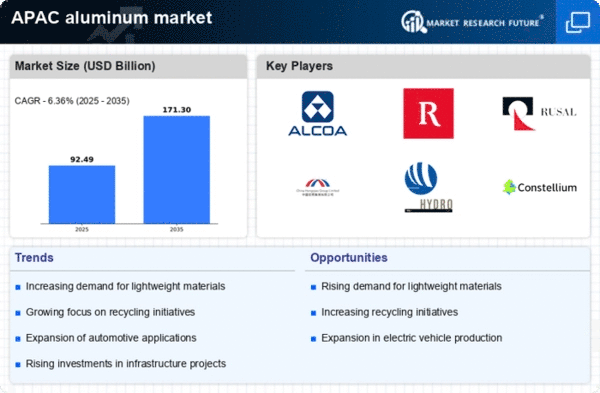
    Asia Pacific Aluminum Market Infographic
    Purchase Options

    Asia Pacific Aluminum Size

    Asia Pacific Aluminum Market Growth Projections and Opportunities

    There are many things that determine the dynamics and growth of the Aluminum Market in Asia-Pacific. A leading factor among these is the ever-increasing rate of industrialization and urbanization in many countries within this region. Infrastructure construction projects and development have caused a tremendous demand for aluminum with use ranging from building and construction, transportation to packaging among others. For instance, the lightweight nature coupled with anti-corrosion property has made aluminum to be a favorite material in such sectors driving its overall demand in the whole region.

    Regulations by governments also shape the Asia Pacific Aluminum Market very much because environmental regulations influence aluminum industry production processes as well as emission standards. Given most countries sustainability drives and need to preserve its environment, there is growing emphasis on use of cleaner technologies that are energy efficient when it comes to manufacturing aluminum products. The increased desire for green policies has also led to advancement in technology usage as well seeking more alternative ways of power generation during production process` of aluminum.

    Asia Pacific Aluminium market is impacted by worldwide trading and economic conditions as well. This area is a key player in international trade thus factors like tariffs, trade agreements, geopolitical tensions can all influence raw material costs, affect market competition or even impact on overall aluminium product supply chain. Economic stability plus currency exchange rate fluctuation also adds further volatility in these markets thereby influencing decisions regarding investment as well as pricing strategies applied by aluminium manufacturers or producers who are based within Asia.

    Consumer preferences and trends are changing affecting how much people buy aluminium products across Asian pacific area, especially those sold into automobile industry so that they can help make cars lighter hence improve fuel efficiency while cutting down pollution levels at same time through reduced emissions. Additionally, due to their weight-to-strength ratio being favourable light vehicles have turned out be very popular amongst them which increases aluminum manufacture. Moreover, due to its recyclability aluminium materials seem to be increasingly demanded by those consumers who are keen on using sustainable ones.

    The Asia Pacific Aluminium Market is significantly influenced by technological advances and research in the aluminum industry. The use of advanced manufacturing techniques has resulted in better production processes, new alloy formulations and end-products made from aluminum. As technology continues to advance there are new emerging applications for aluminum which increase both its quality and performance as a metal. Such technologies are vital for maintaining competitiveness within the market as the needs of different industries also change.

    Raw materials availability, energy costs and transportation logistics are all supply chain issues that shape the Asia Pacific Aluminum Market. Bauxite extraction which is the main raw material for making aluminium has to consider environmental as well as social impacts associated with it. Furthermore, electricity cost has a significant impact on overall cost structure for aluminium manufacturers because it represents such a large portion of total expenditures during production process. In Asia-Pacific, a reliable supply chain is crucial to guaranteeing an affordable market price thus sustainability of aluminum.”
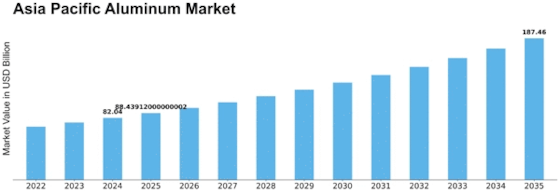
    Asia Pacific Aluminum Market Size Graph
    Author
    Anshula Mandaokar
    Team Lead - Research

    Anshula Mandaokar holds an academic degree in Chemical Engineering and has been contributing to the field for more than 5 years. She has expertise in Market Research and Business Consulting and serves as a Team Lead for a reputed Market Research firm under the Chemicals and Materials domain spectrum. She has worked on multiple projects, generating explicit results in a quick turnaround time. Her understanding of data interpretation justifies her role as a leader.

    Leave a Comment

    FAQs

    How much is the aluminum market?

    The Asia Pacific Aluminum market size was valued at USD 70.5 Billion in 2022.

    What is the growth rate of the aluminum market?

    Aluminum Market is expected to grow with a CAGR of 5.2% in the period 2025-2035

    Who are the key players in the aluminum market?

    The key players in the market are Alcoa Corporation (U.S.), Aluminum Bahrain (Bahrain), Century Aluminum Company (U.S.), Aluminum Corporation of China (China), Norsk Hydro ASA (Norway), Rio Tinto Alcan Inc. (Canada), China Hongqiao Group (China), Emirates Asia Pacific Aluminum PJSC (UAE), Hindalco Industries Limited (India), Rio Tinto Australia (Australia), BHP Billiton Aluminum Australia Pty Ltd. (Australia), RUSAL (Russia), and Vedanta Ltd. (India).

    Which type led the aluminum market?

    The secondary/recycled aluminum category dominated the market in 2022.

    Which product had the largest market share in the aluminum market?

    The extrusions category had the largest share in the market.

    Market Summary

    As per Market Research Future Analysis, the Asia Pacific Aluminum Market was valued at USD 82.04 Billion in 2024 and is projected to grow from USD 82.04 Billion in 2024 to USD 187.46 Billion by 2035, with a CAGR of 7.80% during the forecast period. Key drivers include a focus on sustainability, advancements in aluminum processing technologies, and rising demand from the construction and packaging sectors. The secondary/recycled aluminum segment led the market in 2022, while extrusions dominated product types. The building and construction application generated the most revenue, driven by rapid urbanization and infrastructure development in countries like India and China.

    Key Market Trends & Highlights

    The Asia Pacific Aluminum Market is witnessing significant growth driven by various factors.

    • Market Size in 2024: USD 82.04 Billion.
    • Projected Market Size by 2035: USD 187.46 Billion.
    • CAGR from 2025 to 2035: 7.80%.
    • India's real estate sector expected to reach USD 1 trillion by 2030.

    Market Size & Forecast

    2024 Market Size USD 82.04 Billion
    2035 Market Size USD 187.46 Billion
    CAGR 7.80%

    Major Players

    Key players include Alcoa Corporation, Vedanta Ltd., Norsk Hydro ASA, and China Hongqiao Group.

    Market Trends

    Rising Building Sector in Asia-Pacific to Accelerate Market Growth

    India and the ASEAN region's construction industries are among the fastest-growing, and it is projected that they will hold a sizable portion of the global construction market. Building activity has grown significantly in the Asia-Pacific region, which includes Indonesia, Singapore, Thailand, Vietnam, the Philippines, and India. By 2030, the real estate sector in India is expected to grow to a GDP of USD 1 trillion, or roughly 13% of the total.

    Additionally, between April 2000 and June 2020, the construction development and infrastructure activities sectors received foreign direct investment (FDI) of USD 25.69 billion and USD 16.97 billion, respectively, according to the Department for Promotion of Industry and Internal Trade (DPIIT). In the initial phase of its 300,000-unit housing project, which was finished by 2018, the South Korean government had stated plans to build 35,000 housing units. The region's demand for aluminum from the construction industry is expected to rise over the course of the projection period due to the previously mentioned factors.

    Moreover, since aluminum is non-toxic, it preserves food for extended periods of time and prevents the spread of microbes. These factors are the main drivers of the aluminum market's growth, particularly from the food and packaging and pharmaceutical industries. In the manufacturing industry, packaging is one of the most crucial considerations for ensuring that their products are aesthetically pleasing to customers. Manufacturing, food processing, and industrial production facilities are growing quickly, which is driving up the worldwide packaging market. In addition, the e-retail sector and the food and beverage industry's demand have resulted in a large rise in packaging requirements.

    The need for aluminum is also being fueled by the expansion of retail pharmacies in emerging nations and the pharmaceutical industry's rising emphasis on product differentiation and brand promotion. Furthermore, the demand for medicines is rising as a result of different governments' emphasis on bolstering healthcare infrastructure and insurance coverage, which is itself driving market expansion. Thus, driving the aluminum market revenue.

    In February 2024, Vedanta Aluminium, the biggest aluminium manufacturer in India, introduces Vedanta Metal Bazaar, a groundbreaking online store for primary aluminium. This platform aims to revolutionize the purchasing and selling process of aluminium in India. During its inception, the superstore provides more than 750 different product variations, which include a wide range of items from Vedanta Aluminium. Additionally, it incorporates AI-driven price determination, providing clients with unparalleled value even when confronted with volatile commodity prices. Vedanta Aluminium has introduced Vedanta Metal Bazaar, an innovative e-commerce platform aimed at improving the customer experience and making it easier to conduct business.

    This platform has the potential to transform the way customers purchase aluminium. This solution guarantees to streamline the entire procurement process, allowing buyers to concentrate on their business expansion instead of spending time on transactional follow-ups and monitoring the uncertainties of commodity pricing and order fulfillment. Vedanta Metal Bazaar provides buyers with timely delivery, AI-driven pricing discovery, and complete visibility of their purchase process, from placing the order to receiving the delivery. This enables the implementation of a strong and reliable production planning system, while also releasing their cash for other important expenditures.

    Additionally, it empowers customers to make well-informed buying selections by considering their order history, dynamic market situations, and comparative prices with only a few simple clicks.

    Asia Pacific Aluminum Market Market Drivers

    Market Segment Insights

    Aluminum Type Insights

    The Asia Pacific Aluminum market segmentation, based on type includes Secondary/Recycled Aluminum and Primary Aluminum. The secondary/recycled aluminum category led the market in 2022. It is a real closed-loop process that turns scrap aluminum into new aluminum. There have been favorable environmental and economic effects on consumers as well as various businesses from the increased use of recycled aluminum in production and manufacturing. Additionally, the fabrication of secondary aluminum uses only 5% of the energy needed to produce primary aluminum, reducing greenhouse gas emissions and landfill trash.

    Figure 1: Asia Pacific Aluminum Market, by Type, 2022 & 2032 (USD Billion)

    Source: Secondary Research, Primary Research, Market Research Future Database and Analyst Review

    Aluminum Product Insights

    The Asia Pacific Aluminum market segmentation, based on product includes Flat Rolled, Pigment & Powder, Forgings, Extrusions, Castings, Rod & Bar and Others. The extrusions category led the market in 2022. There are countless uses for extrusion in the fields of architecture, automotive, electronics, aerospace, and energy. The major market for extruded aluminum is building and construction. It is present in aluminum panels, stairways, railings, and framing elements. They are gradually taking the place of conventional iron, concrete, and wood building materials.

    Aluminum Resin Application Insights

    The Asia Pacific Aluminum market segmentation, based on resin application, includes Building & Construction, Consumer Goods, Electrical, Foil & Packaging, Hardware & Accessories, Machinery & Equipment, Solar Industry, Transportation, Utensils and Others. The building & construction category generated the most income. The building and construction industries are expanding favorably as a result of rapid urbanization and the expansion of the service sector. Aluminum production costs were lowered by over 80% through the use of the electrolysis method, which boosted the use of aluminum in the building sector.

    Because aluminum can withstand temperatures between –80 °C and +300 °C, its minimum design service life is typically around 80 years. As a result, aluminum is predicted to become more popular in the building industry.

    Aluminum Country Insights

    During the projection period, the Asia-Pacific region is anticipated to hold the greatest market share for aluminum. The building and construction, electronics, aerospace, and other industries are expanding in nations like China, India, and Japan. The world's largest car manufacturing sector is found in China. The China Association of Automobile Manufacturers reports that the nation manufactured 27.02 million automobiles in 2022, up almost 3.4% from 26.08 million in 2021.

    Source: Secondary Research, Primary Research, Market Research Future Database and Analyst Review

    Get more detailed insights about Asia Pacific Aluminum Market Research Report—Forecast till 2035

    Regional Insights

    Key Players and Competitive Insights

    Leading market players are investing heavily in research and development in order to expand their product lines, which will help the aluminum market, grow even more. Market participants are also undertaking a variety of strategic activities to expand their  footprint, with important market developments including new product launches, contractual agreements, mergers and acquisitions, higher investments, and collaboration with other organizations. To expand and survive in a more competitive and rising market climate, aluminum industry must offer cost-effective items.

    Major players in the aluminum market are attempting to increase market demand by investing in research and development operations includes Alcoa Corporation (U.S.), Aluminum Bahrain (Bahrain), Century Aluminum Company (U.S.), Aluminum Corporation of China (China), Norsk Hydro ASA (Norway), Rio Tinto Alcan Inc. (Canada), China Hongqiao Group (China), Emirates Asia Pacific Aluminum PJSC (UAE), Hindalco Industries Limited (India), Rio Tinto Australia (Australia), BHP Billiton Aluminum Australia Pty Ltd. (Australia), RUSAL (Russia), and Vedanta Ltd. (India).

    Key Companies in the Asia Pacific Aluminum Market market include

    Industry Developments

    July 2023: Three of the immune-boosting lemonades from GUNNA Drinks, a soda brand that advocates against plastic use, come in a range of aluminum bottles. This action aims to address the rising demand for functional food and drink items while reducing the amount of plastic waste generated.

    December 2021: An agreement was signed by Hindalco Industries Limited to purchase the Indian operations of Norsk Hydro ASA's Al extrusions division. Hindalco will benefit from this acquisition by gaining an integrated plant in Andhra Pradesh, a skilled workforce, and knowledge of value-added, bespoke products. Additionally, this action will increase the company's presence in South India.

    In July 2024, ATK, a Chinese peripheral manufacturer, introduced a new mechanical keyboard called the ATK Z87 Pro. This keyboard offers a range of features that appeal to consumers who are mindful of their budget as well as those who prioritize performance. The Z87 Pro features a tiny 87-key layout, eliminating the numeric keypad to create a space-efficient design that is popular among both gamers and minimalists. The keyboard features a stylish semi-aluminum casing with a CNC anodized metal top cover, providing a combination of sturdiness and high-quality visual appeal.

    The keyboard is equipped with integrated PVD ornamental light strips that illuminate in conjunction with the keyboard's backlighting. The Z87 Pro provides users with a selection of two switch options: Kailh Blueberry Ice Cream switches and Aniya switches. Both switches are linear in nature and are renowned for their seamless keypress and emphasis on rapidity. The keyboard offers many keycap profile choices, such as MDA and OEM profile, with high-quality PBT keycaps, guaranteeing a pleasant typing experience.

    The Z87 Pro features a Gasket structure that use silicone pads to separate the plate from the keyboard's base, reducing typing noise and providing a more pleasant keystroke sensation. This function is commonly seen on keyboards of higher quality and enhances the overall typing experience, giving it a more luxurious feel.

    Market Segmentation

    Aluminum Type Outlook

    • Secondary/Recycled Aluminum
    • Primary Aluminum

    Aluminum Product Outlook

    • Flat Rolled
    • Pigment & Powder
    • Forgings
    • Extrusions
    • Castings
    • Rod & Bar
    • Others

    Aluminum Regional Outlook

    Asia-Pacific
    • China
    • Japan
    • India
    • Australia
    • South Korea
    • Indonesia
    • Thailand
    • Vietnam
    • Malaysia
    • Singapore
    • Rest of Asia-Pacific

    Aluminum Application Outlook

    • Building & Construction
    • Consumer Goods
    • Electrical
    • Foil & Packaging
    • Hardware & Accessories
    • Machinery & Equipment
    • Solar Industry
    • Transportation
    • Utensils
    • Others

    Report Scope

    Report Attribute/Metric Details
    Market Size 2035 187.46 (Value (USD Billion))
    Compound Annual Growth Rate (CAGR) 7.80% (2025 - 2035)
    Base Year 2024
    Market Forecast Period 2025 - 2035
    Historical Data 2018- 2022
    Market Forecast Units Value (USD Billion)
    Report Coverage Revenue Forecast, Market Competitive Landscape, Growth Factors, and Trends
    Segments Covered Type, Product, Application, and Region
    Region Covered Asia Pacific
    Countries Covered China, Japan, India, Australia, South Korea, Indonesia, Thailand, Vietnam, Malaysia, Singapore, and Rest of Asia-Pacific
    Key Companies Profiled Alcoa Corporation (U.S.), Aluminum Bahrain (Bahrain), Century Aluminum Company (U.S.), Aluminum Corporation of China (China), Norsk Hydro ASA (Norway), Rio Tinto Alcan Inc. (Canada), China Hongqiao Group (China), Emirates Asia Pacific Aluminum PJSC (UAE), Hindalco Industries Limited (India), Rio Tinto Australia (Australia), BHP Billiton Aluminum Australia Pty Ltd. (Australia), RUSAL (Russia), and Vedanta Ltd. (India)
    Key Market Opportunities ·       Rising Aluminum Consumption in Evs ·       Growing Aluminum Demand from the Pharmaceutical and Food & Packaging Sectors
    Key Market Dynamics ·       Asia-Pacific's Building Industry is Booming ·       Growing Use of Aluminum in the Electronics Sector
    Market Size 2024 82.04 (Value (USD Billion))
    Market Size 2025 88.44 (Value (USD Billion))

    FAQs

    How much is the aluminum market?

    The Asia Pacific Aluminum market size was valued at USD 70.5 Billion in 2022.

    What is the growth rate of the aluminum market?

    Aluminum Market is expected to grow with a CAGR of 5.2% in the period 2025-2035

    Who are the key players in the aluminum market?

    The key players in the market are Alcoa Corporation (U.S.), Aluminum Bahrain (Bahrain), Century Aluminum Company (U.S.), Aluminum Corporation of China (China), Norsk Hydro ASA (Norway), Rio Tinto Alcan Inc. (Canada), China Hongqiao Group (China), Emirates Asia Pacific Aluminum PJSC (UAE), Hindalco Industries Limited (India), Rio Tinto Australia (Australia), BHP Billiton Aluminum Australia Pty Ltd. (Australia), RUSAL (Russia), and Vedanta Ltd. (India).

    Which type led the aluminum market?

    The secondary/recycled aluminum category dominated the market in 2022.

    Which product had the largest market share in the aluminum market?

    The extrusions category had the largest share in the market.

    1. SECTION I: EXECUTIVE SUMMARY AND KEY HIGHLIGHTS
      1. | 1.1 EXECUTIVE SUMMARY
      2. | | 1.1.1 Market Overview
      3. | | 1.1.2 Key Findings
      4. | | 1.1.3 Market Segmentation
      5. | | 1.1.4 Competitive Landscape
      6. | | 1.1.5 Challenges and Opportunities
      7. | | 1.1.6 Future Outlook
    2. SECTION II: SCOPING, METHODOLOGY AND MARKET STRUCTURE
      1. | 2.1 MARKET INTRODUCTION
      2. | | 2.1.1 Definition
      3. | | 2.1.2 Scope of the study
      4. | | | 2.1.2.1 Research Objective
      5. | | | 2.1.2.2 Assumption
      6. | | | 2.1.2.3 Limitations
      7. | 2.2 RESEARCH METHODOLOGY
      8. | | 2.2.1 Overview
      9. | | 2.2.2 Data Mining
      10. | | 2.2.3 Secondary Research
      11. | | 2.2.4 Primary Research
      12. | | | 2.2.4.1 Primary Interviews and Information Gathering Process
      13. | | | 2.2.4.2 Breakdown of Primary Respondents
      14. | | 2.2.5 Forecasting Model
      15. | | 2.2.6 Market Size Estimation
      16. | | | 2.2.6.1 Bottom-Up Approach
      17. | | | 2.2.6.2 Top-Down Approach
      18. | | 2.2.7 Data Triangulation
      19. | | 2.2.8 Validation
    3. SECTION III: QUALITATIVE ANALYSIS
      1. | 3.1 MARKET DYNAMICS
      2. | | 3.1.1 Overview
      3. | | 3.1.2 Drivers
      4. | | 3.1.3 Restraints
      5. | | 3.1.4 Opportunities
      6. | 3.2 MARKET FACTOR ANALYSIS
      7. | | 3.2.1 Value chain Analysis
      8. | | 3.2.2 Porter's Five Forces Analysis
      9. | | | 3.2.2.1 Bargaining Power of Suppliers
      10. | | | 3.2.2.2 Bargaining Power of Buyers
      11. | | | 3.2.2.3 Threat of New Entrants
      12. | | | 3.2.2.4 Threat of Substitutes
      13. | | | 3.2.2.5 Intensity of Rivalry
      14. | | 3.2.3 COVID-19 Impact Analysis
      15. | | | 3.2.3.1 Market Impact Analysis
      16. | | | 3.2.3.2 Regional Impact
      17. | | | 3.2.3.3 Opportunity and Threat Analysis
    4. SECTION IV: QUANTITATIVE ANALYSIS
      1. | 4.1 Chemicals and Materials, BY Type (USD Billion)
      2. | | 4.1.1 Secondary/Recycled Aluminum
      3. | | 4.1.2 Primary Aluminum
      4. | 4.2 Chemicals and Materials, BY Product (USD Billion)
      5. | | 4.2.1 Flat Rolled
      6. | | 4.2.2 Pigment & Powder
      7. | | 4.2.3 Forgings
      8. | | 4.2.4 Extrusions
      9. | | 4.2.5 Castings
      10. | | 4.2.6 Rod & Bar
      11. | | 4.2.7 Others
      12. | 4.3 Chemicals and Materials, BY Application (USD Billion)
      13. | | 4.3.1 Building & Construction
      14. | | 4.3.2 Consumer Goods
      15. | | 4.3.3 Electrical
      16. | | 4.3.4 Foil & Packaging
      17. | | 4.3.5 Hardware & Accessories
      18. | | 4.3.6 Machinery & Equipment
      19. | | 4.3.7 Solar Industry
      20. | | 4.3.8 Transportation
      21. | | 4.3.9 Utensils
      22. | | 4.3.10 Others
      23. | 4.4 Chemicals and Materials, BY Region (USD Billion)
      24. | | 4.4.1 North America
      25. | | | 4.4.1.1 US
      26. | | | 4.4.1.2 Canada
      27. | | 4.4.2 Europe
      28. | | | 4.4.2.1 Germany
      29. | | | 4.4.2.2 UK
      30. | | | 4.4.2.3 France
      31. | | | 4.4.2.4 Russia
      32. | | | 4.4.2.5 Italy
      33. | | | 4.4.2.6 Spain
      34. | | | 4.4.2.7 Rest of Europe
      35. | | 4.4.3 APAC
      36. | | | 4.4.3.1 China
      37. | | | 4.4.3.2 India
      38. | | | 4.4.3.3 Japan
      39. | | | 4.4.3.4 South Korea
      40. | | | 4.4.3.5 Malaysia
      41. | | | 4.4.3.6 Thailand
      42. | | | 4.4.3.7 Indonesia
      43. | | | 4.4.3.8 Rest of APAC
      44. | | 4.4.4 South America
      45. | | | 4.4.4.1 Brazil
      46. | | | 4.4.4.2 Mexico
      47. | | | 4.4.4.3 Argentina
      48. | | | 4.4.4.4 Rest of South America
      49. | | 4.4.5 MEA
      50. | | | 4.4.5.1 GCC Countries
      51. | | | 4.4.5.2 South Africa
      52. | | | 4.4.5.3 Rest of MEA
    5. SECTION V: COMPETITIVE ANALYSIS
      1. | 5.1 Competitive Landscape
      2. | | 5.1.1 Overview
      3. | | 5.1.2 Competitive Analysis
      4. | | 5.1.3 Market share Analysis
      5. | | 5.1.4 Major Growth Strategy in the Chemicals and Materials
      6. | | 5.1.5 Competitive Benchmarking
      7. | | 5.1.6 Leading Players in Terms of Number of Developments in the Chemicals and Materials
      8. | | 5.1.7 Key developments and growth strategies
      9. | | | 5.1.7.1 New Product Launch/Service Deployment
      10. | | | 5.1.7.2 Merger & Acquisitions
      11. | | | 5.1.7.3 Joint Ventures
      12. | | 5.1.8 Major Players Financial Matrix
      13. | | | 5.1.8.1 Sales and Operating Income
      14. | | | 5.1.8.2 Major Players R&D Expenditure. 2023
      15. | 5.2 Company Profiles
      16. | | 5.2.1 China Hongqiao Group (CN)
      17. | | | 5.2.1.1 Financial Overview
      18. | | | 5.2.1.2 Products Offered
      19. | | | 5.2.1.3 Key Developments
      20. | | | 5.2.1.4 SWOT Analysis
      21. | | | 5.2.1.5 Key Strategies
      22. | | 5.2.2 Alcoa Corporation (US)
      23. | | | 5.2.2.1 Financial Overview
      24. | | | 5.2.2.2 Products Offered
      25. | | | 5.2.2.3 Key Developments
      26. | | | 5.2.2.4 SWOT Analysis
      27. | | | 5.2.2.5 Key Strategies
      28. | | 5.2.3 Rio Tinto (GB)
      29. | | | 5.2.3.1 Financial Overview
      30. | | | 5.2.3.2 Products Offered
      31. | | | 5.2.3.3 Key Developments
      32. | | | 5.2.3.4 SWOT Analysis
      33. | | | 5.2.3.5 Key Strategies
      34. | | 5.2.4 Norsk Hydro ASA (NO)
      35. | | | 5.2.4.1 Financial Overview
      36. | | | 5.2.4.2 Products Offered
      37. | | | 5.2.4.3 Key Developments
      38. | | | 5.2.4.4 SWOT Analysis
      39. | | | 5.2.4.5 Key Strategies
      40. | | 5.2.5 South32 Limited (AU)
      41. | | | 5.2.5.1 Financial Overview
      42. | | | 5.2.5.2 Products Offered
      43. | | | 5.2.5.3 Key Developments
      44. | | | 5.2.5.4 SWOT Analysis
      45. | | | 5.2.5.5 Key Strategies
      46. | | 5.2.6 Vedanta Limited (IN)
      47. | | | 5.2.6.1 Financial Overview
      48. | | | 5.2.6.2 Products Offered
      49. | | | 5.2.6.3 Key Developments
      50. | | | 5.2.6.4 SWOT Analysis
      51. | | | 5.2.6.5 Key Strategies
      52. | | 5.2.7 UACJ Corporation (JP)
      53. | | | 5.2.7.1 Financial Overview
      54. | | | 5.2.7.2 Products Offered
      55. | | | 5.2.7.3 Key Developments
      56. | | | 5.2.7.4 SWOT Analysis
      57. | | | 5.2.7.5 Key Strategies
      58. | | 5.2.8 Kaiser Aluminum Corporation (US)
      59. | | | 5.2.8.1 Financial Overview
      60. | | | 5.2.8.2 Products Offered
      61. | | | 5.2.8.3 Key Developments
      62. | | | 5.2.8.4 SWOT Analysis
      63. | | | 5.2.8.5 Key Strategies
      64. | | 5.2.9 Shandong Nanshan Aluminum Co., Ltd. (CN)
      65. | | | 5.2.9.1 Financial Overview
      66. | | | 5.2.9.2 Products Offered
      67. | | | 5.2.9.3 Key Developments
      68. | | | 5.2.9.4 SWOT Analysis
      69. | | | 5.2.9.5 Key Strategies
      70. | 5.3 Appendix
      71. | | 5.3.1 References
      72. | | 5.3.2 Related Reports
    6. LIST OF FIGURES
      1. | 6.1 MARKET SYNOPSIS
      2. | 6.2 NORTH AMERICA MARKET ANALYSIS
      3. | 6.3 US MARKET ANALYSIS BY TYPE
      4. | 6.4 US MARKET ANALYSIS BY PRODUCT
      5. | 6.5 US MARKET ANALYSIS BY APPLICATION
      6. | 6.6 CANADA MARKET ANALYSIS BY TYPE
      7. | 6.7 CANADA MARKET ANALYSIS BY PRODUCT
      8. | 6.8 CANADA MARKET ANALYSIS BY APPLICATION
      9. | 6.9 EUROPE MARKET ANALYSIS
      10. | 6.10 GERMANY MARKET ANALYSIS BY TYPE
      11. | 6.11 GERMANY MARKET ANALYSIS BY PRODUCT
      12. | 6.12 GERMANY MARKET ANALYSIS BY APPLICATION
      13. | 6.13 UK MARKET ANALYSIS BY TYPE
      14. | 6.14 UK MARKET ANALYSIS BY PRODUCT
      15. | 6.15 UK MARKET ANALYSIS BY APPLICATION
      16. | 6.16 FRANCE MARKET ANALYSIS BY TYPE
      17. | 6.17 FRANCE MARKET ANALYSIS BY PRODUCT
      18. | 6.18 FRANCE MARKET ANALYSIS BY APPLICATION
      19. | 6.19 RUSSIA MARKET ANALYSIS BY TYPE
      20. | 6.20 RUSSIA MARKET ANALYSIS BY PRODUCT
      21. | 6.21 RUSSIA MARKET ANALYSIS BY APPLICATION
      22. | 6.22 ITALY MARKET ANALYSIS BY TYPE
      23. | 6.23 ITALY MARKET ANALYSIS BY PRODUCT
      24. | 6.24 ITALY MARKET ANALYSIS BY APPLICATION
      25. | 6.25 SPAIN MARKET ANALYSIS BY TYPE
      26. | 6.26 SPAIN MARKET ANALYSIS BY PRODUCT
      27. | 6.27 SPAIN MARKET ANALYSIS BY APPLICATION
      28. | 6.28 REST OF EUROPE MARKET ANALYSIS BY TYPE
      29. | 6.29 REST OF EUROPE MARKET ANALYSIS BY PRODUCT
      30. | 6.30 REST OF EUROPE MARKET ANALYSIS BY APPLICATION
      31. | 6.31 APAC MARKET ANALYSIS
      32. | 6.32 CHINA MARKET ANALYSIS BY TYPE
      33. | 6.33 CHINA MARKET ANALYSIS BY PRODUCT
      34. | 6.34 CHINA MARKET ANALYSIS BY APPLICATION
      35. | 6.35 INDIA MARKET ANALYSIS BY TYPE
      36. | 6.36 INDIA MARKET ANALYSIS BY PRODUCT
      37. | 6.37 INDIA MARKET ANALYSIS BY APPLICATION
      38. | 6.38 JAPAN MARKET ANALYSIS BY TYPE
      39. | 6.39 JAPAN MARKET ANALYSIS BY PRODUCT
      40. | 6.40 JAPAN MARKET ANALYSIS BY APPLICATION
      41. | 6.41 SOUTH KOREA MARKET ANALYSIS BY TYPE
      42. | 6.42 SOUTH KOREA MARKET ANALYSIS BY PRODUCT
      43. | 6.43 SOUTH KOREA MARKET ANALYSIS BY APPLICATION
      44. | 6.44 MALAYSIA MARKET ANALYSIS BY TYPE
      45. | 6.45 MALAYSIA MARKET ANALYSIS BY PRODUCT
      46. | 6.46 MALAYSIA MARKET ANALYSIS BY APPLICATION
      47. | 6.47 THAILAND MARKET ANALYSIS BY TYPE
      48. | 6.48 THAILAND MARKET ANALYSIS BY PRODUCT
      49. | 6.49 THAILAND MARKET ANALYSIS BY APPLICATION
      50. | 6.50 INDONESIA MARKET ANALYSIS BY TYPE
      51. | 6.51 INDONESIA MARKET ANALYSIS BY PRODUCT
      52. | 6.52 INDONESIA MARKET ANALYSIS BY APPLICATION
      53. | 6.53 REST OF APAC MARKET ANALYSIS BY TYPE
      54. | 6.54 REST OF APAC MARKET ANALYSIS BY PRODUCT
      55. | 6.55 REST OF APAC MARKET ANALYSIS BY APPLICATION
      56. | 6.56 SOUTH AMERICA MARKET ANALYSIS
      57. | 6.57 BRAZIL MARKET ANALYSIS BY TYPE
      58. | 6.58 BRAZIL MARKET ANALYSIS BY PRODUCT
      59. | 6.59 BRAZIL MARKET ANALYSIS BY APPLICATION
      60. | 6.60 MEXICO MARKET ANALYSIS BY TYPE
      61. | 6.61 MEXICO MARKET ANALYSIS BY PRODUCT
      62. | 6.62 MEXICO MARKET ANALYSIS BY APPLICATION
      63. | 6.63 ARGENTINA MARKET ANALYSIS BY TYPE
      64. | 6.64 ARGENTINA MARKET ANALYSIS BY PRODUCT
      65. | 6.65 ARGENTINA MARKET ANALYSIS BY APPLICATION
      66. | 6.66 REST OF SOUTH AMERICA MARKET ANALYSIS BY TYPE
      67. | 6.67 REST OF SOUTH AMERICA MARKET ANALYSIS BY PRODUCT
      68. | 6.68 REST OF SOUTH AMERICA MARKET ANALYSIS BY APPLICATION
      69. | 6.69 MEA MARKET ANALYSIS
      70. | 6.70 GCC COUNTRIES MARKET ANALYSIS BY TYPE
      71. | 6.71 GCC COUNTRIES MARKET ANALYSIS BY PRODUCT
      72. | 6.72 GCC COUNTRIES MARKET ANALYSIS BY APPLICATION
      73. | 6.73 SOUTH AFRICA MARKET ANALYSIS BY TYPE
      74. | 6.74 SOUTH AFRICA MARKET ANALYSIS BY PRODUCT
      75. | 6.75 SOUTH AFRICA MARKET ANALYSIS BY APPLICATION
      76. | 6.76 REST OF MEA MARKET ANALYSIS BY TYPE
      77. | 6.77 REST OF MEA MARKET ANALYSIS BY PRODUCT
      78. | 6.78 REST OF MEA MARKET ANALYSIS BY APPLICATION
      79. | 6.79 KEY BUYING CRITERIA OF CHEMICALS AND MATERIALS
      80. | 6.80 RESEARCH PROCESS OF MRFR
      81. | 6.81 DRO ANALYSIS OF CHEMICALS AND MATERIALS
      82. | 6.82 DRIVERS IMPACT ANALYSIS: CHEMICALS AND MATERIALS
      83. | 6.83 RESTRAINTS IMPACT ANALYSIS: CHEMICALS AND MATERIALS
      84. | 6.84 SUPPLY / VALUE CHAIN: CHEMICALS AND MATERIALS
      85. | 6.85 CHEMICALS AND MATERIALS, BY TYPE, 2024 (% SHARE)
      86. | 6.86 CHEMICALS AND MATERIALS, BY TYPE, 2024 TO 2035 (USD Billion)
      87. | 6.87 CHEMICALS AND MATERIALS, BY PRODUCT, 2024 (% SHARE)
      88. | 6.88 CHEMICALS AND MATERIALS, BY PRODUCT, 2024 TO 2035 (USD Billion)
      89. | 6.89 CHEMICALS AND MATERIALS, BY APPLICATION, 2024 (% SHARE)
      90. | 6.90 CHEMICALS AND MATERIALS, BY APPLICATION, 2024 TO 2035 (USD Billion)
      91. | 6.91 BENCHMARKING OF MAJOR COMPETITORS
    7. LIST OF TABLES
      1. | 7.1 LIST OF ASSUMPTIONS
      2. | | 7.1.1
      3. | 7.2 North America MARKET SIZE ESTIMATES; FORECAST
      4. | | 7.2.1 BY TYPE, 2025-2035 (USD Billion)
      5. | | 7.2.2 BY PRODUCT, 2025-2035 (USD Billion)
      6. | | 7.2.3 BY APPLICATION, 2025-2035 (USD Billion)
      7. | 7.3 US MARKET SIZE ESTIMATES; FORECAST
      8. | | 7.3.1 BY TYPE, 2025-2035 (USD Billion)
      9. | | 7.3.2 BY PRODUCT, 2025-2035 (USD Billion)
      10. | | 7.3.3 BY APPLICATION, 2025-2035 (USD Billion)
      11. | 7.4 Canada MARKET SIZE ESTIMATES; FORECAST
      12. | | 7.4.1 BY TYPE, 2025-2035 (USD Billion)
      13. | | 7.4.2 BY PRODUCT, 2025-2035 (USD Billion)
      14. | | 7.4.3 BY APPLICATION, 2025-2035 (USD Billion)
      15. | 7.5 Europe MARKET SIZE ESTIMATES; FORECAST
      16. | | 7.5.1 BY TYPE, 2025-2035 (USD Billion)
      17. | | 7.5.2 BY PRODUCT, 2025-2035 (USD Billion)
      18. | | 7.5.3 BY APPLICATION, 2025-2035 (USD Billion)
      19. | 7.6 Germany MARKET SIZE ESTIMATES; FORECAST
      20. | | 7.6.1 BY TYPE, 2025-2035 (USD Billion)
      21. | | 7.6.2 BY PRODUCT, 2025-2035 (USD Billion)
      22. | | 7.6.3 BY APPLICATION, 2025-2035 (USD Billion)
      23. | 7.7 UK MARKET SIZE ESTIMATES; FORECAST
      24. | | 7.7.1 BY TYPE, 2025-2035 (USD Billion)
      25. | | 7.7.2 BY PRODUCT, 2025-2035 (USD Billion)
      26. | | 7.7.3 BY APPLICATION, 2025-2035 (USD Billion)
      27. | 7.8 France MARKET SIZE ESTIMATES; FORECAST
      28. | | 7.8.1 BY TYPE, 2025-2035 (USD Billion)
      29. | | 7.8.2 BY PRODUCT, 2025-2035 (USD Billion)
      30. | | 7.8.3 BY APPLICATION, 2025-2035 (USD Billion)
      31. | 7.9 Russia MARKET SIZE ESTIMATES; FORECAST
      32. | | 7.9.1 BY TYPE, 2025-2035 (USD Billion)
      33. | | 7.9.2 BY PRODUCT, 2025-2035 (USD Billion)
      34. | | 7.9.3 BY APPLICATION, 2025-2035 (USD Billion)
      35. | 7.10 Italy MARKET SIZE ESTIMATES; FORECAST
      36. | | 7.10.1 BY TYPE, 2025-2035 (USD Billion)
      37. | | 7.10.2 BY PRODUCT, 2025-2035 (USD Billion)
      38. | | 7.10.3 BY APPLICATION, 2025-2035 (USD Billion)
      39. | 7.11 Spain MARKET SIZE ESTIMATES; FORECAST
      40. | | 7.11.1 BY TYPE, 2025-2035 (USD Billion)
      41. | | 7.11.2 BY PRODUCT, 2025-2035 (USD Billion)
      42. | | 7.11.3 BY APPLICATION, 2025-2035 (USD Billion)
      43. | 7.12 Rest of Europe MARKET SIZE ESTIMATES; FORECAST
      44. | | 7.12.1 BY TYPE, 2025-2035 (USD Billion)
      45. | | 7.12.2 BY PRODUCT, 2025-2035 (USD Billion)
      46. | | 7.12.3 BY APPLICATION, 2025-2035 (USD Billion)
      47. | 7.13 APAC MARKET SIZE ESTIMATES; FORECAST
      48. | | 7.13.1 BY TYPE, 2025-2035 (USD Billion)
      49. | | 7.13.2 BY PRODUCT, 2025-2035 (USD Billion)
      50. | | 7.13.3 BY APPLICATION, 2025-2035 (USD Billion)
      51. | 7.14 China MARKET SIZE ESTIMATES; FORECAST
      52. | | 7.14.1 BY TYPE, 2025-2035 (USD Billion)
      53. | | 7.14.2 BY PRODUCT, 2025-2035 (USD Billion)
      54. | | 7.14.3 BY APPLICATION, 2025-2035 (USD Billion)
      55. | 7.15 India MARKET SIZE ESTIMATES; FORECAST
      56. | | 7.15.1 BY TYPE, 2025-2035 (USD Billion)
      57. | | 7.15.2 BY PRODUCT, 2025-2035 (USD Billion)
      58. | | 7.15.3 BY APPLICATION, 2025-2035 (USD Billion)
      59. | 7.16 Japan MARKET SIZE ESTIMATES; FORECAST
      60. | | 7.16.1 BY TYPE, 2025-2035 (USD Billion)
      61. | | 7.16.2 BY PRODUCT, 2025-2035 (USD Billion)
      62. | | 7.16.3 BY APPLICATION, 2025-2035 (USD Billion)
      63. | 7.17 South Korea MARKET SIZE ESTIMATES; FORECAST
      64. | | 7.17.1 BY TYPE, 2025-2035 (USD Billion)
      65. | | 7.17.2 BY PRODUCT, 2025-2035 (USD Billion)
      66. | | 7.17.3 BY APPLICATION, 2025-2035 (USD Billion)
      67. | 7.18 Malaysia MARKET SIZE ESTIMATES; FORECAST
      68. | | 7.18.1 BY TYPE, 2025-2035 (USD Billion)
      69. | | 7.18.2 BY PRODUCT, 2025-2035 (USD Billion)
      70. | | 7.18.3 BY APPLICATION, 2025-2035 (USD Billion)
      71. | 7.19 Thailand MARKET SIZE ESTIMATES; FORECAST
      72. | | 7.19.1 BY TYPE, 2025-2035 (USD Billion)
      73. | | 7.19.2 BY PRODUCT, 2025-2035 (USD Billion)
      74. | | 7.19.3 BY APPLICATION, 2025-2035 (USD Billion)
      75. | 7.20 Indonesia MARKET SIZE ESTIMATES; FORECAST
      76. | | 7.20.1 BY TYPE, 2025-2035 (USD Billion)
      77. | | 7.20.2 BY PRODUCT, 2025-2035 (USD Billion)
      78. | | 7.20.3 BY APPLICATION, 2025-2035 (USD Billion)
      79. | 7.21 Rest of APAC MARKET SIZE ESTIMATES; FORECAST
      80. | | 7.21.1 BY TYPE, 2025-2035 (USD Billion)
      81. | | 7.21.2 BY PRODUCT, 2025-2035 (USD Billion)
      82. | | 7.21.3 BY APPLICATION, 2025-2035 (USD Billion)
      83. | 7.22 South America MARKET SIZE ESTIMATES; FORECAST
      84. | | 7.22.1 BY TYPE, 2025-2035 (USD Billion)
      85. | | 7.22.2 BY PRODUCT, 2025-2035 (USD Billion)
      86. | | 7.22.3 BY APPLICATION, 2025-2035 (USD Billion)
      87. | 7.23 Brazil MARKET SIZE ESTIMATES; FORECAST
      88. | | 7.23.1 BY TYPE, 2025-2035 (USD Billion)
      89. | | 7.23.2 BY PRODUCT, 2025-2035 (USD Billion)
      90. | | 7.23.3 BY APPLICATION, 2025-2035 (USD Billion)
      91. | 7.24 Mexico MARKET SIZE ESTIMATES; FORECAST
      92. | | 7.24.1 BY TYPE, 2025-2035 (USD Billion)
      93. | | 7.24.2 BY PRODUCT, 2025-2035 (USD Billion)
      94. | | 7.24.3 BY APPLICATION, 2025-2035 (USD Billion)
      95. | 7.25 Argentina MARKET SIZE ESTIMATES; FORECAST
      96. | | 7.25.1 BY TYPE, 2025-2035 (USD Billion)
      97. | | 7.25.2 BY PRODUCT, 2025-2035 (USD Billion)
      98. | | 7.25.3 BY APPLICATION, 2025-2035 (USD Billion)
      99. | 7.26 Rest of South America MARKET SIZE ESTIMATES; FORECAST
      100. | | 7.26.1 BY TYPE, 2025-2035 (USD Billion)
      101. | | 7.26.2 BY PRODUCT, 2025-2035 (USD Billion)
      102. | | 7.26.3 BY APPLICATION, 2025-2035 (USD Billion)
      103. | 7.27 MEA MARKET SIZE ESTIMATES; FORECAST
      104. | | 7.27.1 BY TYPE, 2025-2035 (USD Billion)
      105. | | 7.27.2 BY PRODUCT, 2025-2035 (USD Billion)
      106. | | 7.27.3 BY APPLICATION, 2025-2035 (USD Billion)
      107. | 7.28 GCC Countries MARKET SIZE ESTIMATES; FORECAST
      108. | | 7.28.1 BY TYPE, 2025-2035 (USD Billion)
      109. | | 7.28.2 BY PRODUCT, 2025-2035 (USD Billion)
      110. | | 7.28.3 BY APPLICATION, 2025-2035 (USD Billion)
      111. | 7.29 South Africa MARKET SIZE ESTIMATES; FORECAST
      112. | | 7.29.1 BY TYPE, 2025-2035 (USD Billion)
      113. | | 7.29.2 BY PRODUCT, 2025-2035 (USD Billion)
      114. | | 7.29.3 BY APPLICATION, 2025-2035 (USD Billion)
      115. | 7.30 Rest of MEA MARKET SIZE ESTIMATES; FORECAST
      116. | | 7.30.1 BY TYPE, 2025-2035 (USD Billion)
      117. | | 7.30.2 BY PRODUCT, 2025-2035 (USD Billion)
      118. | | 7.30.3 BY APPLICATION, 2025-2035 (USD Billion)
      119. | 7.31 PRODUCT LAUNCH/PRODUCT DEVELOPMENT/APPROVAL
      120. | | 7.31.1
      121. | 7.32 ACQUISITION/PARTNERSHIP
      122. | | 7.32.1

    Asia Pacific Aluminum Market Segmentation

    Market Segmentation Overview

    • Detailed segmentation data will be available in the full report
    • Comprehensive analysis by multiple parameters
    • Regional and country-level breakdowns
    • Market size forecasts by segment
    Infographic

    Free Sample Request

    Kindly complete the form below to receive a free sample of this Report

    Get Free Sample

    Customer Strories

    “I am very pleased with how market segments have been defined in a relevant way for my purposes (such as "Portable Freezers & refrigerators" and "last-mile"). In general the report is well structured. Thanks very much for your efforts.”

    Victoria Milne

    Founder
    Case Study
    Chemicals and Materials

    Compare Licence

    ×
    Features License Type
    Single User Multiuser License Enterprise User
    Price $4,950 $5,950 $7,250
    Maximum User Access Limit 1 User Upto 10 Users Unrestricted Access Throughout the Organization
    Free Customization
    Direct Access to Analyst
    Deliverable Format
    Platform Access
    Discount on Next Purchase 10% 15% 15%
    Printable Versions