×
Request Free Sample ×

Kindly complete the form below to receive a free sample of this Report

* Please use a valid business email

Leading companies partner with us for data-driven Insights

clients tt-cursor
Hero Background
English
Chinese
French
Japanese
Korean
German
Spanish

Artificial Intelligence Market Size

ID: MRFR/ICT/0633-HCR
200 Pages
Aarti Dhapte
October 2025

Artificial Intelligence Market Size, Share and Trends Analysis Research Report By Technology (Machine Learning, Natural Language Processing, Computer Vision, Robotics, Expert Systems), By Application (Healthcare, Finance, Retail, Automotive, Manufacturing), By Deployment Model (Cloud, On-Premises, Hybrid), By End Use (Small and Medium Enterprises, Large Enterprises) and By Regional (North America, Europe, South America, Asia Pacific, Middle East and Africa) - Forecast to 2035

Share:
Download PDF ×

We do not share your information with anyone. However, we may send you emails based on your report interest from time to time. You may contact us at any time to opt-out.

Artificial Intelligence Market Infographic
Purchase Options

Artificial Intelligence Size

Artificial Intelligence Market Growth Projections and Opportunities

A major factor driving the artificial intelligence industry's growth is the increased demand across numerous industries for cutting-edge technologies. Companies see how AI can revolutionize operations by increasing efficiency, optimizing procedures, and giving insightful data. The digital age that is driving market advancement necessitates organizations to use AI technologies to remain competitive. Innovation in technology has a big impact on the AI market. The sector is stimulated by the faster deployment of AI solutions, which may be attributed to the creation of AI hardware such as specialized processors designed for neural network processing.

Considered by many to be the "fuel" of artificial intelligence, data is an essential industry component. The proliferation of data that powers the artificial intelligence industry is a result of the growth of Internet of Things (IoT) devices, connected gadgets, and increased information digitalization. For machine learning algorithms to be trained and for AI applications to be more reliable, large amounts of data must be easily accessible. The AI ecosystem has been significantly impacted by the need for robust data governance, privacy legislation, and ethical issues, even with the abundance of data already accessible. These laws may affect stock dynamics, the development and application of AI solutions, and the responsible use of AI, even though they are required for it.

Businesses' success is largely dependent on their capacity to successfully negotiate this highly competitive environment, adjust to new trends, and provide value through their AI products. The state of the world economy has a significant impact on the AI market as well. The rate and scope of AI adoption are influenced by investment patterns, the state of the economy, and general business sentiment. Economic downturns could cause a brief halt in AI investment, while stable and growing economies might hasten the acceptance of AI solutions as businesses look to gain a competitive advantage.

Artificial Intelligence Market Size Graph
Author
Aarti Dhapte
Team Lead - Research

She holds an experience of about 6+ years in Market Research and Business Consulting, working under the spectrum of Information Communication Technology, Telecommunications and Semiconductor domains. Aarti conceptualizes and implements a scalable business strategy and provides strategic leadership to the clients. Her expertise lies in market estimation, competitive intelligence, pipeline analysis, customer assessment, etc.

Leave a Comment

FAQs

What was the market size of the Artificial Intelligence (AI) Market in 2024?

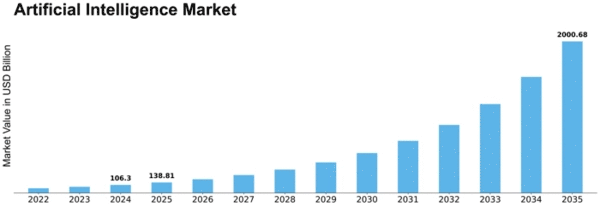
The Artificial Intelligence (AI) Market was valued at 106.3 USD Billion in 2024.

What will the market size of the Artificial Intelligence (AI) Market be in 2035?

By 2035, the market size is anticipated to reach 2000.0 USD Billion.

What is the expected compound annual growth rate (CAGR) for the Artificial Intelligence (AI) Market between 2025 and 2035?

The expected CAGR for the market from 2025 to 2035 is 30.58%.

Which region dominated the Artificial Intelligence (AI) Market in 2024?

North America dominated the market with a value of 42.5 USD Billion in 2024.

What was the market value for Europe in the Artificial Intelligence (AI) Market in 2024?

In 2024, Europe's market value was valued at 30.0 USD Billion.

What is the expected growth rate for the Artificial Intelligence (AI) Market in Asia Pacific from 2024 to 2035?

The market in Asia Pacific is expected to grow from 20.0 USD Billion in 2024 to 380.0 USD Billion by 2035.

What will be the market value of Machine Learning in the Artificial Intelligence (AI) Market in 2035?

Machine Learning is projected to reach a market value of 800.0 USD Billion by 2035.

Who are the key players in the Artificial Intelligence (AI) Market?

Major players include Baidu, Facebook, Alphabet, Microsoft, NVIDIA, Oracle, and IBM.

What is the projected market size for Natural Language Processing by 2035?

Natural Language Processing is expected to reach a market size of 500.0 USD Billion by 2035.

What are the forecasted market values for Robotics in the Artificial Intelligence (AI) Market for 2024 and 2035?

Robotics is expected to be valued at 15.0 USD Billion in 2024 and grow to 300.0 USD Billion by 2035.

Market Summary

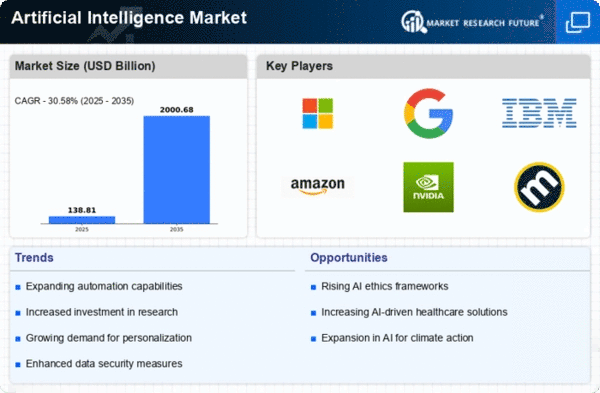
As per Market Research Future analysis, the Artificial Intelligence Market Size was estimated at 106.3 USD Billion in 2024. The Artificial Intelligence industry is projected to grow from 138.81 in 2025 to 2000.68 by 2035, exhibiting a compound annual growth rate (CAGR) of 30.58% during the forecast period 2025 - 2035

Key Market Trends & Highlights

The artificial intelligence market is experiencing robust growth driven by diverse sectoral demands and technological advancements.

  • Investment in AI startups is surging, indicating a vibrant entrepreneurial ecosystem. Healthcare remains the largest segment, with AI integration enhancing patient care and operational efficiency. Natural Language Processing is the largest AI application, while Machine Learning is the fastest-growing segment in Canada. Government support and funding, along with the growing demand for AI solutions, are key drivers propelling market expansion.

Market Size & Forecast

2024 Market Size 106.3 (USD Billion)
2035 Market Size 2000.68 (USD Billion)
CAGR (2025 - 2035) 30.58%

Major Players

<a title="Microsoft" href="https://www.microsoft.com/en-us/federal/artificialintelligence" target="_blank" rel="noopener">Microsoft</a> (US), Google (US), <a title="IBM" href="https://www.ibm.com/think/topics/artificial-intelligence" target="_blank" rel="noopener">IBM</a> (US), Amazon (US), NVIDIA (US), Meta (US), Salesforce (US), Baidu (CN), Alibaba (CN), Tencent (CN)

Market Trends

The Artificial Intelligence Market growth is currently experiencing a transformative phase characterized by rapid advancements and widespread adoption across various sectors. Organizations are increasingly integrating AI technologies to enhance operational efficiency, improve customer experiences, and drive innovation. This trend is evident in industries such as healthcare, finance, and manufacturing, where AI applications are revolutionizing traditional processes. The growing emphasis on data-driven decision-making further propels the demand for AI solutions, as businesses seek to leverage vast amounts of information to gain competitive advantages. Moreover, the emergence of ethical considerations surrounding AI deployment is shaping regulatory frameworks, prompting companies to adopt responsible practices in their AI initiatives. The global artificial intelligence industry is witnessing unprecedented expansion, driven by the rising demand for artificial intelligence across healthcare, finance, retail, and manufacturing, as highlighted in this artificial intelligence market research and AI market analysis.

This rapid expansion reflects strong artificial intelligence industry growth, supported by increasing enterprise adoption worldwide. In addition, the Artificial Intelligence Market is witnessing a surge in investment from both public and private sectors, indicating a strong belief in the potential of AI technologies. Startups and established firms alike are focusing on developing cutting-edge AI tools and platforms, which could lead to innovative applications and services. This artificial intelligence market analysis highlights strong demand across software and cloud deployments, reinforcing growth in the global AI tools market. Collaboration between technology providers and industry players is becoming increasingly common, fostering an ecosystem that encourages knowledge sharing and accelerates the pace of AI development. As the market evolves, it appears poised for sustained growth, driven by continuous advancements in machine learning, natural language processing, and computer vision, among other areas. Looking ahead, AI market growth 2026 is expected to accelerate as enterprises scale cloud-based and generative AI deployments. Industry projections suggest that the AI market size forecast 2030 will reflect exponential expansion, supported by the rising generative AI market size.

Increased Automation in Business Processes

The trend towards automation is gaining momentum within the AI market trends. Organizations are increasingly utilizing AI to automate repetitive tasks, thereby enhancing productivity and allowing human resources to focus on more strategic initiatives. This shift not only streamlines operations but also reduces the likelihood of human error, leading to improved overall efficiency. Regional AI industry statistics reveal that North America continues to dominate the market, supported by strong investment and innovation ecosystems. Recent acquisitions and partnerships reflect the surging demand for artificial intelligence, further accelerating artificial intelligence market growth globally.

AI-Driven Personalization

Personalization is becoming a key focus in the Artificial Intelligence Market, as businesses strive to tailor their offerings to individual customer preferences. AI technologies enable companies to analyze consumer behavior and preferences, facilitating the creation of customized experiences. This trend is particularly evident in sectors such as retail and entertainment, where personalized recommendations can significantly enhance customer satisfaction. Current AI industry trends indicate a growing focus on automation, personalization, and ethical AI, shaping long-term AI business trends across industries. These AI market trends highlight the increasing use of data-driven technologies, offering valuable AI marketing insights for enterprises and investors.

Ethical AI Development

The growing awareness of ethical implications surrounding AI technologies is influencing the Artificial Intelligence Market. Stakeholders are increasingly prioritizing responsible AI development, focusing on transparency, fairness, and accountability. This trend is likely to shape the future landscape of AI, as organizations seek to build trust with consumers and comply with emerging regulatory standards.

Artificial Intelligence Market Market Drivers

Government Support and Funding

The Canada artificial intelligence ai market benefits significantly from robust government support and funding initiatives. The Canadian government has committed substantial resources to foster AI development, with investments exceeding CAD 1 billion in recent years. This funding is directed towards research institutions, startups, and collaborative projects that aim to enhance AI capabilities. Furthermore, the Strategic Innovation Fund and the Innovation Superclusters Initiative are pivotal in promoting AI innovation across various sectors. Such government backing not only stimulates growth but also attracts international talent and investment, positioning Canada as a global leader in AI technology. The ongoing commitment to AI research and development indicates a favorable environment for the expansion of the Canada artificial intelligence ai market.

Collaboration Between Academia and Industry

Collaboration between academia and industry plays a crucial role in advancing the Canada artificial intelligence ai market. Canadian universities are at the forefront of AI research, producing a skilled workforce equipped with cutting-edge knowledge. Partnerships between academic institutions and private companies facilitate the transfer of research findings into practical applications, driving innovation. Notable collaborations, such as those between the University of Toronto and various tech firms, have led to breakthroughs in machine learning and natural language processing. This synergy not only enhances the capabilities of the Canada artificial intelligence ai market but also ensures that the workforce is prepared to meet the evolving demands of the AI landscape.

Emergence of AI Ethics and Governance Frameworks

The emergence of AI ethics and governance frameworks is increasingly shaping the Canada artificial intelligence ai market. As AI technologies proliferate, concerns regarding privacy, bias, and accountability have prompted stakeholders to establish ethical guidelines. The Canadian government, alongside industry leaders, is actively developing frameworks to ensure responsible AI deployment. These initiatives aim to build public trust and promote transparency in AI applications. By addressing ethical considerations, the Canada artificial intelligence ai market can foster sustainable growth and innovation. The establishment of these frameworks not only mitigates risks but also positions Canada as a leader in ethical AI practices on the global stage.

Advancements in AI Technologies and Infrastructure

Advancements in AI technologies and infrastructure are pivotal in driving the Canada artificial intelligence ai market forward. The rapid evolution of machine learning algorithms, natural language processing, and computer vision technologies has opened new avenues for innovation. Additionally, the development of robust data infrastructure, including cloud computing and big data analytics, supports the deployment of AI solutions across various sectors. Canadian companies are increasingly investing in AI research and development, with expenditures reaching CAD 1.5 billion in 2025. This investment in technology and infrastructure not only enhances the capabilities of the Canada artificial intelligence ai market but also positions it for future growth and competitiveness in the global AI landscape.

Growing Demand for AI Solutions in Various Sectors

The demand for AI solutions across diverse sectors is a key driver of the Canada artificial intelligence ai market. Industries such as finance, retail, and manufacturing are increasingly adopting AI technologies to enhance operational efficiency and customer experience. For instance, the financial sector is leveraging AI for fraud detection and risk management, while retailers utilize AI for personalized marketing and inventory management. According to recent data, the AI market in Canada is projected to grow at a compound annual growth rate (CAGR) of 25% over the next five years, reflecting the escalating need for AI-driven solutions. This growing demand underscores the potential for innovation and investment within the Canada artificial intelligence ai market.

Market Segment Insights

By Application: Natural Language Processing (Largest) vs. Machine Learning (Fastest-Growing)

The Artificial Intelligence Market is significantly influenced by its diverse application segments, with Natural Language Processing (NLP) commanding a majority share. This is attributed to the growing demand for AI-powered solutions that can understand and generate human language, making it integral in industries such as customer service and content creation. Additionally, Machine Learning has emerged as a critical player, showcasing rapid growth driven by advancements in data analytics and predictive modeling. Companies increasingly adopt machine learning technologies to enhance processes, leading to an expanding market presence.

 <br>Technology: Natural Language Processing (Dominant) vs. Machine Learning (Emerging)

Natural Language Processing (NLP) stands out as a dominant player in the AI application segment, showcasing its capabilities in text analysis, sentiment detection, and conversational agents. Enterprises utilize NLP to enhance customer interaction and automate numerous tasks, significantly improving productivity. In contrast, Machine Learning is the emerging force, characterized by its adaptive algorithms that learn from data patterns to make predictions. With applications ranging from recommendation systems to autonomous vehicles, machine learning is becoming indispensable in varied industries. Both segments play critical roles, with NLP currently leading, whereas machine learning is set to reshape business functions with its innovative approaches.

By End Use: Healthcare (Largest) vs. Automotive (Fastest-Growing)

In the Artificial Intelligence Market, the distribution of market share among various end-use segments reveals that healthcare stands as the largest contributor, leveraging AI for diagnostic tools, personalized medicine, and operational efficiency. Other significant segments include automotive, finance, retail, and manufacturing, each employing AI technologies for transformations within their operations. The healthcare sector’s robust integration of AI-driven solutions allows for improved patient outcomes and management efficiencies, thus solidifying its market position. On the growth trajectory, the automotive sector is recognized as the fastest-growing segment within the AI landscape, propelled by advancements in autonomous vehicles, driver-assistance systems, and predictive analytics. Innovations in machine learning and computer vision are enhancing automotive safety and performance, resulting in increased investment and interest. The overall AI market is witnessing a convergence of technologies, further driving growth across sectors as organizations identify opportunities for automation and smart systems.

 <br>Healthcare (Dominant) vs. Automotive (Emerging)

The healthcare segment in the Artificial Intelligence Market is characterized by its significant adoption of AI technologies for enhancing patient care, precision medicine, and operational efficiency. This segment is dominated by applications related to diagnostic imaging, data analysis, and patient monitoring systems, which utilize AI algorithms to provide actionable insights for healthcare professionals. Conversely, the automotive sector, while considered emerging, is rapidly integrating AI capabilities focused on enhancing vehicle safety and navigation. AI applications such as computer vision and sensor fusion are transforming traditional driving experiences and laying the groundwork for fully autonomous vehicles. Both segments reflect distinct market dynamics but are united in their reliance on cutting-edge AI technologies to drive innovation and operational excellence.

By Technology: Natural Language Processing (Largest) vs. Deep Learning (Fastest-Growing)

The Artificial Intelligence market is broadly segmented into several technologies, with Natural Language Processing (NLP) and Deep Learning leading in market share. Natural Language Processing accounts for a significant portion of the market due to its extensive applications in chatbots, customer service automation, and advanced text analytics. Deep Learning follows closely, utilized primarily in image and speech recognition, indicating its widespread relevance across various industries.

 <br>Technology: Natural Language Processing (Dominant) vs. Deep Learning (Emerging)

Natural Language Processing has established itself as a dominant technology in the Artificial Intelligence landscape, primarily due to its capacity to understand and respond to human language with remarkable accuracy. It plays a critical role in enhancing user interactions through voice assistants and sentiment analysis tools, making it indispensable for businesses seeking to improve customer experience. Conversely, Deep Learning is emerging rapidly, driven by its ability to process vast amounts of data through artificial neural networks. As industries increasingly adopt automation and advanced analytics, it is poised to reshape business operations significantly, making its growth trajectory one of the fastest in the AI sector.

By Deployment Mode: Cloud (Largest) vs. On-Premises (Fastest-Growing)

The Artificial Intelligence marketing deployment mode segment is characterized by a significant distribution among key values: Cloud, On-Premises, and Hybrid. The Cloud deployment mode stands out as the largest segment, driven by its flexibility, scalability, and the rapid adoption of AI services across various industries. Conversely, On-Premises deployment is gaining traction, becoming the fastest-growing mode as organizations prioritize data security and compliance, opting for on-site solutions for sensitive AI applications.

 <br>Cloud (Dominant) vs. On-Premises (Emerging)

Cloud-based deployment for AI solutions continues to dominate the market, offering organizations the ability to access advanced technologies without heavy upfront investments. This model supports scalability and facilitates faster deployments, which are particularly beneficial for startups and tech-savvy firms. In contrast, On-Premises deployment caters to industries with stringent regulatory requirements, where businesses prefer to maintain control over their data and AI systems. This segment is emerging rapidly as companies realize the drawbacks of fully cloud-based solutions, leading to a blend of both cloud and on-premises strategies to meet diverse operational needs.

By Component: Software (Largest) vs. Services (Fastest-Growing)

In the Artificial Intelligence Market, the 'Component' segment is primarily dominated by the software category, which holds the largest market share. This dominance is attributed to the widespread integration of AI technologies in various industries, leading to a significant investment in software solutions that enhance operational efficiencies and decision-making capabilities. Following closely are the services, which, while currently having a smaller share, show promising trends due to the increasing need for customized solutions and ongoing support from AI service providers.

 <br>AI Solutions: Software (Dominant) vs. Services (Emerging)

The software component of the Artificial Intelligence Market remains dominant, enabling various applications such as machine learning, natural language processing, and data analytics. Organizations are investing heavily in AI software to automate processes and enhance data-driven insights. Conversely, the services sector is emerging rapidly, characterized by the growing demand for consulting, implementation, and support services. As businesses seek tailored AI solutions, the service providers play a crucial role in bridging the gap between advanced technologies and practical applications, ensuring clients can harness AI's potential effectively.

Get more detailed insights about Artificial Intelligence Market Research Report - Global Forecast to 2035

Regional Insights

North America : Innovation and Leadership Hub

North America continues to lead The Artificial Intelligence, holding a significant share of 53.78% as of December 2025. The region's growth is driven by robust investments in technology, a strong startup ecosystem, and increasing demand for AI solutions across various sectors, including healthcare, finance, and retail. Regulatory support and initiatives from government bodies further catalyze innovation and adoption of AI technologies. The competitive landscape is dominated by major players such as Microsoft, Google, and IBM, which are continuously pushing the boundaries of AI capabilities. The presence of these tech giants fosters a vibrant ecosystem, encouraging collaboration and innovation. Additionally, the U.S. government's focus on AI research and development ensures that North America remains at the forefront of AI advancements, attracting global talent and investment.

Europe : Emerging AI Powerhouse

Europe's Artificial Intelligence market trends are rapidly evolving, with a market size of €25.89 billion projected for December 2025. The region benefits from strong regulatory frameworks that promote ethical AI development and usage, driving demand across various industries. Initiatives like the European Commission's AI strategy aim to enhance AI capabilities while ensuring compliance with privacy and data protection regulations, fostering a conducive environment for growth. Leading countries such as Germany, France, and the UK are at the forefront of AI innovation, supported by significant investments in research and development. The competitive landscape features both established companies and startups, with key players like SAP and Siemens leading the charge. The collaborative efforts between governments, academia, and industry stakeholders are crucial in positioning Europe as a significant player in The Artificial Intelligence.

Asia-Pacific : Rapidly Growing AI Market

The Asia-Pacific region is witnessing a surge in Artificial Intelligence adoption, with a market size of $22.0 billion expected by December 2025. Key growth drivers include increasing digital transformation initiatives, a growing tech-savvy population, and substantial investments in AI research. Countries like China and Japan are leading the charge, supported by government policies that encourage innovation and technological advancement, creating a favorable landscape for AI development. China, in particular, is home to major players like Baidu, Alibaba, and Tencent, which are heavily investing in AI technologies. The competitive landscape is characterized by a mix of established firms and emerging startups, all vying for market share. As the region continues to embrace AI across various sectors, including manufacturing, healthcare, and finance, the potential for growth remains significant, positioning Asia-Pacific as a key player in The Artificial Intelligence.

Middle East and Africa : Emerging AI Frontier

The Middle East and Africa region is gradually emerging as a significant player in the Artificial Intelligence market, with a projected market size of $4.63 billion by December 2025. The growth is driven by increasing investments in technology infrastructure, government initiatives promoting digital transformation, and a rising demand for AI solutions across various sectors. Countries like the UAE and South Africa are leading the way, implementing strategies to harness AI for economic growth and development. The competitive landscape is evolving, with both local and international players entering the market. Key initiatives, such as the UAE's National AI Strategy, aim to position the region as a global hub for AI innovation. As awareness of AI's potential grows, more businesses are adopting AI technologies, paving the way for future advancements and opportunities in the region.

Key Players and Competitive Insights

The Artificial Intelligence Market is characterized by intense competition and rapid innovation, driven by advancements in machine learning, natural language processing, and automation technologies. Major players such as Microsoft (US), Google (US), and NVIDIA (US) are at the forefront, leveraging their technological prowess to enhance product offerings and expand market reach. Microsoft (US) has focused on integrating AI capabilities into its cloud services, while Google (US) emphasizes AI-driven solutions across its product ecosystem. NVIDIA (US) continues to dominate the hardware segment, providing essential infrastructure for AI applications, thereby shaping a competitive landscape that is increasingly reliant on technological integration and strategic partnerships.
Key business tactics within the market include localized manufacturing and supply chain optimization, which are essential for meeting the diverse needs of global customers. The competitive structure appears moderately fragmented, with a mix of established giants and emerging players. This fragmentation allows for a dynamic interplay of innovation and competition, as companies strive to differentiate themselves through unique offerings and strategic collaborations.
In November 2025, Microsoft (US) announced a partnership with a leading healthcare provider to develop AI-driven diagnostic tools. This strategic move is likely to enhance Microsoft's position in the healthcare sector, showcasing its commitment to leveraging AI for improving patient outcomes. Such collaborations not only expand market opportunities but also reinforce the importance of sector-specific solutions in the broader AI landscape.
In October 2025, Google (US) unveiled a new AI platform aimed at small and medium-sized enterprises (SMEs), designed to democratize access to advanced AI tools. This initiative reflects Google's strategy to penetrate underserved markets, potentially increasing its user base and fostering innovation among SMEs. By focusing on accessibility, Google (US) positions itself as a leader in promoting AI adoption across various business segments.
In September 2025, NVIDIA (US) launched a new line of AI chips optimized for edge computing applications. This development is significant as it addresses the growing demand for real-time data processing in sectors such as automotive and manufacturing. By enhancing its product portfolio, NVIDIA (US) not only solidifies its market leadership but also responds to the evolving needs of industries increasingly reliant on AI technologies.
As of December 2025, current competitive trends indicate a strong emphasis on digitalization, sustainability, and the integration of AI across various sectors. Strategic alliances are becoming increasingly pivotal, as companies recognize the value of collaboration in driving innovation and enhancing operational efficiency. Looking ahead, competitive differentiation is expected to evolve, shifting from price-based competition to a focus on innovation, technological advancement, and supply chain reliability. This transition underscores the necessity for companies to adapt and innovate continuously in a rapidly changing Artificial intelligence industry analysis.

Key Companies in the Artificial Intelligence Market include

Industry Developments

The Artificial Intelligence Market (AI) Market has experienced significant developments recently, especially with leading companies such as Baidu, Facebook, Alphabet, Microsoft, and NVIDIA actively pushing boundaries. A notable event is Microsoft's acquisition of Nuance Communications in April 2021, strengthening their AI capabilities in healthcare. In July 2021, Salesforce announced the acquisition of Slack, further enhancing its AI integration for customer relationship management. IBM has also been expanding its AI offerings, particularly in enterprise solutions, while Alphabet continues to innovate through its AI research initiatives. Leading players such as Microsoft, Google, and NVIDIA collectively command a significant AI company market share, strengthening their position in the global AI market share landscape.

The market valuation of AI has seen remarkable growth, projected to reach USD 390.9 billion by 2025 according to global industry standards, indicating the rising importance of AI in various sectors. Companies like Amazon and Alibaba are investing heavily in AI-driven logistics and cloud services. Current affairs highlight ethical considerations and regulations regarding AI deployment, with governments worldwide focusing on frameworks that ensure the responsible use of AI technologies. The past few years, especially since the onset of the COVID-19 pandemic, have accelerated AI adoption across industries, fostering a robust ecosystem for AI development and application globally.

Future Outlook

Artificial Intelligence Market Future Outlook

The Artificial Intelligence Market analysis is projected to grow at a 30.58% CAGR from 2024 to 2035, driven by advancements in machine learning, data analytics, and automation technologies.<br>By 2035, the Artificial Intelligence Market is expected to be a cornerstone of global technological advancement.

New opportunities lie in:

  • <p>Development of AI-driven healthcare diagnostics solutions. Implementation of AI in supply chain optimization tools. Creation of personalized AI marketing platforms for businesses.</p>

By 2035, the market is expected to be robust, driven by innovation and strategic investments.

Market Segmentation

Artificial Intelligence Market End Use Outlook

  • Healthcare
  • Finance
  • Retail
  • Manufacturing
  • Transportation

Artificial Intelligence Market Technology Outlook

  • Deep Learning
  • Neural Networks
  • Reinforcement Learning
  • Computer Vision Technologies
  • Natural Language Processing Technologies

Artificial Intelligence Market Application Outlook

  • Natural Language Processing
  • Machine Learning
  • Computer Vision
  • Robotics
  • Expert Systems

Artificial Intelligence Market Deployment Model Outlook

  • Cloud-Based
  • On-Premises
  • Hybrid

Artificial Intelligence Market Industry Vertical Outlook

  • Automotive
  • Telecommunications
  • Education
  • Government

Report Scope

MARKET SIZE 2024 106.3 (USD Billion)
MARKET SIZE 2025 138.81 (USD Billion)
MARKET SIZE 2035 2000.68 (USD Billion)
COMPOUND ANNUAL GROWTH RATE (CAGR) 30.58% (2024 - 2035)
REPORT COVERAGE Revenue Forecast, Competitive Landscape, Growth Factors, and Trends
BASE YEAR 2024
Market Forecast Period 2025 - 2035
Historical Data 2019 - 2024
Market Forecast Units USD Billion
Key Companies Profiled Shopify (CA), Element AI (CA), Thales Group (CA), IBM (CA), Google (CA), Microsoft (CA), Amazon (CA), NVIDIA (CA), Cerebras Systems (CA)
Segments Covered Application, End Use, Technology, Deployment Model, Industry Vertical
Key Market Opportunities Expansion of artificial intelligence applications in healthcare and finance sectors within the Canada artificial intelligence ai market.
Key Market Dynamics Growing investment in Research and Development drives innovation in Canada's artificial intelligence market.
Countries Covered Canada

FAQs

What was the market size of the Artificial Intelligence (AI) Market in 2024?

The Artificial Intelligence (AI) Market was valued at 106.3 USD Billion in 2024.

What will the market size of the Artificial Intelligence (AI) Market be in 2035?

By 2035, the market size is anticipated to reach 2000.0 USD Billion.

What is the expected compound annual growth rate (CAGR) for the Artificial Intelligence (AI) Market between 2025 and 2035?

The expected CAGR for the market from 2025 to 2035 is 30.58%.

Which region dominated the Artificial Intelligence (AI) Market in 2024?

North America dominated the market with a value of 42.5 USD Billion in 2024.

What was the market value for Europe in the Artificial Intelligence (AI) Market in 2024?

In 2024, Europe's market value was valued at 30.0 USD Billion.

What is the expected growth rate for the Artificial Intelligence (AI) Market in Asia Pacific from 2024 to 2035?

The market in Asia Pacific is expected to grow from 20.0 USD Billion in 2024 to 380.0 USD Billion by 2035.

What will be the market value of Machine Learning in the Artificial Intelligence (AI) Market in 2035?

Machine Learning is projected to reach a market value of 800.0 USD Billion by 2035.

Who are the key players in the Artificial Intelligence (AI) Market?

Major players include Baidu, Facebook, Alphabet, Microsoft, NVIDIA, Oracle, and IBM.

What is the projected market size for Natural Language Processing by 2035?

Natural Language Processing is expected to reach a market size of 500.0 USD Billion by 2035.

What are the forecasted market values for Robotics in the Artificial Intelligence (AI) Market for 2024 and 2035?

Robotics is expected to be valued at 15.0 USD Billion in 2024 and grow to 300.0 USD Billion by 2035.

  1. SECTION I: EXECUTIVE SUMMARY AND KEY HIGHLIGHTS |
    1. EXECUTIVE SUMMARY |
      1. Market Overview |
      2. Key Findings |
      3. Market Segmentation |
      4. Competitive Landscape |
      5. Challenges and Opportunities |
      6. Future Outlook 2
  2. SECTION II: SCOPING, METHODOLOGY AND MARKET STRUCTURE |
    1. MARKET INTRODUCTION |
      1. Definition |
      2. Scope of the study |--
    2. RESEARCH METHODOLOGY |
      1. Overview |
      2. Data Mining |
      3. Secondary Research |
      4. Primary Research |--
      5. Forecasting Model |
      6. Market Size Estimation |--
      7. Data Triangulation |
      8. Validation 3
  3. SECTION III: QUALITATIVE ANALYSIS |
    1. MARKET DYNAMICS |
      1. Overview |
      2. Drivers |
      3. Restraints |
      4. Opportunities |
    2. MARKET FACTOR ANALYSIS |
      1. Value chain Analysis |
      2. Porter's Five Forces Analysis |--
      3. COVID-19 Impact Analysis |--
  4. SECTION IV: QUANTITATIVE ANALYSIS |
    1. Information and Communications Technology, BY Application (USD Billion) |
      1. Natural Language Processing |
      2. Machine Learning |
      3. Computer Vision |
      4. Robotics |
      5. Expert Systems |
    2. Information and Communications Technology, BY End Use (USD Billion) |
      1. Healthcare |
      2. Automotive |
      3. Finance |
      4. Retail |
      5. Manufacturing |
    3. Information and Communications Technology, BY Technology (USD Billion) |
      1. Deep Learning |
      2. Neural Networks |
      3. Reinforcement Learning |
      4. Natural Language Processing |
      5. Computer Vision |
    4. Information and Communications Technology, BY Deployment Mode (USD Billion) |
      1. Cloud |
      2. On-Premises |
      3. Hybrid |
    5. Information and Communications Technology, BY Component (USD Billion) |
      1. Hardware |
      2. Software |
      3. Services |
    6. Information and Communications Technology, BY Region (USD Billion) |
      1. North America |--
      2. Europe |--
      3. APAC |--
      4. South America |--
      5. MEA |--
  5. SECTION V: COMPETITIVE ANALYSIS |
    1. Competitive Landscape |
      1. Overview |
      2. Competitive Analysis |
      3. Market share Analysis |
      4. Major Growth Strategy in the Information and Communications Technology |
      5. Competitive Benchmarking |
      6. Leading Players in Terms of Number of Developments in the Information and Communications Technology |
      7. Key developments and growth strategies |--
      8. Major Players Financial Matrix |--
    2. Company Profiles |
      1. Microsoft (US) |--
      2. Google (US) |--
      3. IBM (US) |--
      4. Amazon (US) |--
      5. NVIDIA (US) |--
      6. Meta (US) |--
      7. Salesforce (US) |--
      8. Baidu (CN) |--
      9. Alibaba (CN) |--
      10. Tencent (CN) |--
    3. Appendix |
      1. References |
      2. Related Reports

Information and Communications Technology Market Segmentation

Information and Communications Technology By Application (USD Billion, 2025-2035)

  • Natural Language Processing
  • Machine Learning
  • Computer Vision
  • Robotics
  • Expert Systems

Information and Communications Technology By End Use (USD Billion, 2025-2035)

  • Healthcare
  • Automotive
  • Finance
  • Retail
  • Manufacturing

Information and Communications Technology By Technology (USD Billion, 2025-2035)

  • Deep Learning
  • Neural Networks
  • Reinforcement Learning
  • Natural Language Processing
  • Computer Vision

Information and Communications Technology By Deployment Mode (USD Billion, 2025-2035)

  • Cloud
  • On-Premises
  • Hybrid

Information and Communications Technology By Component (USD Billion, 2025-2035)

  • Hardware
  • Software
  • Services
Infographic

Free Sample Request

Kindly complete the form below to receive a free sample of this Report

Get Free Sample

Customer Strories

Compare Licence

×
Features License Type
Single User Multiuser License Enterprise User
Price $4,950 $5,950 $7,250
Maximum User Access Limit 1 User Upto 10 Users Unrestricted Access Throughout the Organization
Free Customization
Direct Access to Analyst
Deliverable Format
Platform Access
Discount on Next Purchase 10% 15% 15%
Printable Versions