
Request Free Sample ×

Kindly complete the form below to receive a free sample of this Report

* Please use a valid business email

Leading companies partner with us for data-driven Insights

clients tt-cursor
Hero Background
English
Chinese
French
Japanese
Korean
German
Spanish

Artificial Intelligence In Retail Market Trends

ID: MRFR/ICT/3574-HCR
200 Pages
Aarti Dhapte
March 2026

Artificial Intelligence in Retail Market Size, Share & Trends Analysis Research Report By Application (Customer Service, Inventory Management, Sales and Marketing, Fraud Detection, Supply Chain Optimization), By Deployment Mode (Cloud-Based, On-Premises, Hybrid), By Technology (Machine Learning, Natural Language Processing, Computer Vision, Robotic Process Automation), By End Use (E-commerce, Brick-and-Mortar Stores, Wholesale and Distribution) and By Regional (North America, Europe, South America, Asia Pacific, Middle East and Africa) - Forecast to 2035

Share:
Download PDF ×

We do not share your information with anyone. However, we may send you emails based on your report interest from time to time. You may contact us at any time to opt-out.

Artificial Intelligence In Retail Market Infographic
Purchase Options

Market Trends

Key Emerging Trends in the Artificial Intelligence In Retail Market

Artificial Intelligence (AI) market trends in the retail sector show how quickly this field is changing and embracing new technologies to improve productivity and consumer experiences. The growing use of AI to provide individualized consumer experiences is one such development. Retailers are using artificial intelligence (AI) algorithms to evaluate large datasets, which include consumer preferences and habits. This allows them to offer customized marketing campaigns and personalized product suggestions.

This pattern shows a move toward customized buying experiences where consumers connect and engage with businesses on a more personal level. In the AI retail industry, supply chain optimization and inventory management are major trends. Retailers are using AI-driven solutions more often to improve inventory levels, estimate demand properly, and expedite supply chain procedures. By reducing the difficulties associated with overstock or stockouts, this trend seeks to increase operational performance and cost-effectiveness. The capacity of AI to improve inventory management is consistent with the industry's overarching objective of developing flexible and adaptable supply chains. AI-driven automation is still a major trend that is changing many facets of retail operations.

Workflows are becoming more efficient thanks to automation enabled by AI, which is being used in chatbots for customer care as well as backend tasks like order processing and data input. This trend improves overall operational efficiency by relieving the strain on human resources while also speeding up the response time for merchants to consumer questions, order processing, and day-to-day management. With the use of AI technology, the trend towards omnichannel shopping experiences is gaining steam. Retailers are using artificial intelligence (AI) to build streamlined and uniform online, mobile, and in-store buying experiences. This trend acknowledges the value of providing a seamless, cross-channel buying experience to customers at every stage of their journey. AI integration helps create a cohesive strategy that improves consumer happiness and makes it easier to launch more focused marketing campaigns.


Author
Author Profile
Aarti Dhapte
AVP - Research

A consulting professional focused on helping businesses navigate complex markets through structured research and strategic insights. I partner with clients to solve high-impact business problems across market entry strategy, competitive intelligence, and opportunity assessment. Over the course of my experience, I have led and contributed to 100+ market research and consulting engagements, delivering insights across multiple industries and geographies, and supporting strategic decisions linked to $500M+ market opportunities. My core expertise lies in building robust market sizing, forecasting, and commercial models (top-down and bottom-up), alongside deep-dive competitive and industry analysis. I have played a key role in shaping go-to-market strategies, investment cases, and growth roadmaps, enabling clients to make confident, data-backed decisions in dynamic markets.

Leave a Comment

FAQs

What is the projected market valuation of Artificial Intelligence in Retail by 2035?

<p>The projected market valuation of Artificial Intelligence in Retail is expected to reach 76.96 USD Billion by 2035.</p>

What was the market valuation of Artificial Intelligence in Retail in 2024?

<p>The overall market valuation of Artificial Intelligence in Retail was 8.13 USD Billion in 2024.</p>

What is the expected CAGR for the Artificial Intelligence in Retail Market from 2025 to 2035?

<p>The expected CAGR for the Artificial Intelligence in Retail Market during the forecast period 2025 - 2035 is 22.67%.</p>

Which companies are considered key players in the Artificial Intelligence in Retail Market?

<p>Key players in the market include Amazon, Google, IBM, Microsoft, Salesforce, SAP, NVIDIA, Oracle, Alibaba, and C3.ai.</p>

What are the main applications of Artificial Intelligence in Retail and their market values?

<p>Main applications include Customer Service (15.12 USD Billion), Inventory Management (14.88 USD Billion), and Sales and Marketing (22.36 USD Billion).</p>

How is the deployment mode of Artificial Intelligence in Retail segmented?

<p>The deployment mode is segmented into Cloud-Based (32.0 USD Billion), On-Premises (24.0 USD Billion), and Hybrid (20.96 USD Billion).</p>

What technologies are driving the Artificial Intelligence in Retail Market?

<p>Technologies driving the market include Machine Learning (25.0 USD Billion), Natural Language Processing (15.0 USD Billion), and Computer Vision (20.0 USD Billion).</p>

What is the market value of Artificial Intelligence in E-commerce as of 2025?

<p>The market value of Artificial Intelligence in E-commerce is 25.0 USD Billion as of 2025.</p>

How does the market value of Artificial Intelligence in Brick-and-Mortar Stores compare to other segments?

<p>The market value for Brick-and-Mortar Stores is 30.0 USD Billion, which is higher than E-commerce and Wholesale segments.</p>

What role does fraud detection play in the Artificial Intelligence in Retail Market?

<p>Fraud Detection accounts for a market value of 13.27 USD Billion, indicating its critical role in enhancing security within retail operations.</p>

Market Summary

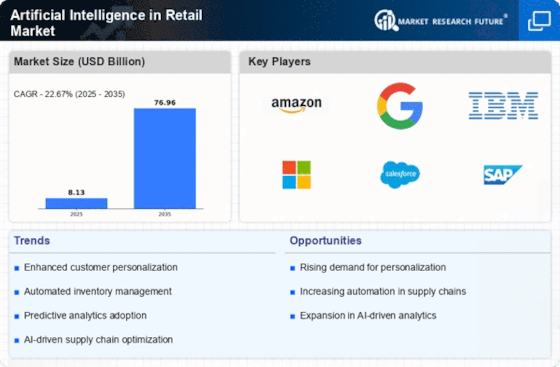
As per Market Research Future analysis, the Artificial Intelligence in Retail Market Size was estimated at 8.13 USD Billion in 2024. The Artificial Intelligence in Retail industry is projected to grow from 9.973 USD Billion in 2025 to 76.96 USD Billion by 2035, exhibiting a compound annual growth rate (CAGR) of 22.67% during the forecast period 2025 - 2035

Key Market Trends & Highlights

The Artificial Intelligence in Retail Market is experiencing robust growth driven by technological advancements and evolving consumer expectations.

  • Personalization of customer experience is becoming a pivotal trend, enhancing engagement and loyalty. Supply chain optimization is increasingly prioritized, particularly in North America, to improve efficiency and reduce costs. Enhanced customer service capabilities are being adopted widely, with the customer service segment leading the market. Data-driven decision making and automation of retail operations are key drivers propelling growth in both North America and Asia-Pacific.

Market Size & Forecast

2024 Market Size 8.13 (USD Billion)
2035 Market Size 76.96 (USD Billion)
CAGR (2025 - 2035) 22.67%
Largest Regional Market Share in 2024 North America

Major Players

Amazon (US), Google (US), IBM (US), Microsoft (US), Salesforce (US), SAP (DE), NVIDIA (US), Oracle (US), Alibaba (CN), C3.ai (US)

Market Trends

The Artificial Intelligence in Retail Market is currently experiencing a transformative phase, characterized by the integration of advanced technologies that enhance customer experiences and streamline operations. Retailers are increasingly adopting AI-driven solutions to analyze consumer behavior, optimize inventory management, and personalize marketing strategies. 

This shift appears to be driven by the need for businesses to remain competitive in a rapidly evolving landscape, where consumer expectations are continuously rising. As a result, AI technologies are becoming indispensable tools for retailers aiming to improve efficiency and foster customer loyalty. Moreover, the market seems to be influenced by the growing emphasis on data analytics and machine learning capabilities. Retailers are leveraging these technologies to gain insights into purchasing patterns and preferences, which may lead to more informed decision-making. Emerging technologies such as generative AI in retail are enhancing content creation, personalized marketing, and conversational commerce, while AI for operational efficiency is driving automation across retail workflows. The potential for AI to automate routine tasks and enhance operational efficiency is also noteworthy, as it allows businesses to allocate resources more effectively. Overall, the Artificial Intelligence in Retail Market is poised for continued growth, driven by innovation and the increasing demand for personalized shopping experiences. Key AI use cases in retail include customer service automation, demand forecasting, fraud detection, and inventory optimization, highlighting real-world AI in retail examples.

Among the trends in the artificial intelligence market, retailers are increasingly leveraging machine learning, natural language processing, and computer vision technologies to deliver seamless shopping experiences and data‑driven decision making, marking a shift toward AI‑enabled retail transformation. The rapid adoption of artificial intelligence in retail is transforming how businesses manage operations, engage customers, and optimize supply chains across the AI in the retail industry. The convergence of artificial intelligence and retail is enabling data-driven decision-making, automation, and real-time customer insights across global retail ecosystems. The future of AI in retail will be shaped by advanced personalization engines, generative AI capabilities, and autonomous decision-making systems that enhance scalability and profitability.

Personalization of Customer Experience

Retailers are increasingly utilizing AI to tailor shopping experiences to individual preferences. By analyzing customer data, businesses can offer personalized recommendations, targeted promotions, and customized content, thereby enhancing customer satisfaction and loyalty.

Supply Chain Optimization

AI technologies are being employed to streamline supply chain processes. Through predictive analytics and real-time data processing, retailers can improve inventory management, reduce waste, and ensure timely delivery of products, ultimately leading to cost savings. Retailers are increasingly adopting AI retail solutions and AI solutions for retail to improve demand planning, pricing strategies, and customer engagement. Advanced retail AI analytics and retail AI optimization tools are enabling retailers to reduce costs, improve forecasting accuracy, and maximize operational performance.

Enhanced Customer Service

The integration of AI-powered chatbots and virtual assistants is transforming customer service in retail. These tools provide instant support, answer queries, and assist with transactions, thereby improving overall customer engagement and operational efficiency. The deployment of AI in retail stores, such as smart checkout systems and AI-powered customer assistants, is redefining in-store shopping experiences.

Artificial Intelligence In Retail Market Market Drivers

Enhanced Customer Insights

The ability to gain enhanced customer insights is a crucial driver within the Artificial Intelligence in Retail Market. AI technologies enable retailers to analyze customer interactions across multiple channels, providing a comprehensive view of consumer behavior. This insight allows for more targeted marketing strategies and personalized shopping experiences. Retailers utilizing AI-driven insights have reported a 15% increase in customer retention rates. By understanding customer preferences and behaviors, businesses can tailor their offerings, thereby fostering loyalty and driving sales.

Data-Driven Decision Making

The integration of Artificial Intelligence in Retail Market facilitates data-driven decision making, allowing retailers to analyze vast amounts of consumer data. This capability enables businesses to identify trends, preferences, and purchasing behaviors with remarkable accuracy. For instance, predictive analytics can forecast demand, optimize inventory levels, and enhance pricing strategies. According to recent estimates, retailers leveraging AI-driven analytics have seen a 20% increase in operational efficiency. This trend underscores the importance of data in shaping retail strategies, as companies increasingly rely on AI to make informed decisions that align with consumer expectations.

Automation of Retail Operations

Automation stands as a pivotal driver in the Artificial Intelligence in Retail Market, streamlining various operational processes. Retailers are increasingly adopting AI technologies to automate tasks such as inventory management, order fulfillment, and customer service. This shift not only reduces labor costs but also enhances accuracy and speed. For example, AI-powered chatbots can handle customer inquiries 24/7, improving response times and customer satisfaction. Reports indicate that automation can lead to a 30% reduction in operational costs, making it a compelling reason for retailers to invest in AI solutions.

Improved Supply Chain Management

Improved supply chain management is increasingly recognized as a vital driver in the Artificial Intelligence in Retail Market. AI technologies facilitate real-time tracking of inventory and shipments, enabling retailers to respond swiftly to market changes. By employing machine learning algorithms, businesses can predict supply chain disruptions and optimize logistics. Studies suggest that retailers implementing AI in their supply chains can reduce costs by up to 25%. This efficiency not only enhances operational performance but also ensures that products are available when and where customers need them.

Personalized Marketing Strategies

Personalized marketing strategies represent a significant driver in the Artificial Intelligence in Retail Market. AI enables retailers to analyze customer data and segment audiences effectively, allowing for tailored marketing campaigns. By leveraging machine learning algorithms, businesses can deliver personalized recommendations and promotions that resonate with individual consumers. This approach has been shown to increase conversion rates by as much as 30%. As retailers continue to embrace AI-driven personalization, they are likely to see enhanced customer engagement and improved sales performance.

Market Segment Insights

By Application: Customer Service (Largest) vs. Sales and Marketing (Fastest-Growing)

In the Artificial Intelligence in Retail Market, customer service is the most significant segment due to its critical role in enhancing customer experience and retention. Retailers are increasingly employing AI-driven chatbots and virtual assistants to provide 24/7 support, leading to improved customer satisfaction rates. Meanwhile, sales and marketing applications are swiftly gaining traction, leveraging AI algorithms for targeted advertising and personalization, which is essential as retailers strive to enhance customer outreach and engagement.

Customer Service (Dominant) vs. Fraud Detection (Emerging)

Customer service has emerged as a dominant application area in the Artificial Intelligence in Retail Market, transforming how retailers engage with their customers. AI technologies such as chatbots and virtual assistants enable real-time customer support, ensuring a seamless shopping experience. Conversely, <a href="https://www.marketresearchfuture.com/reports/fraud-detection-prevention-market-2985">fraud detection</a> has gained ground as an emerging application, employing machine learning algorithms to identify and mitigate fraudulent activities effectively. This sector is driven by increasing online transactions and the need for robust security measures. Retailers are prioritizing these advanced AI solutions to protect both their business and their customers, fostering trust and loyalty in the marketplace.

By Deployment Mode: Cloud-Based (Largest) vs. On-Premises (Fastest-Growing)

In the Artificial Intelligence in Retail Market, the deployment mode significantly influences the adoption and implementation of AI solutions. Cloud-Based deployment currently holds the largest share, favored for its scalability, flexibility, and lower upfront costs. On the other hand, the On-Premises model is witnessing a surge in demand as retailers prioritize data security and compliance, leading to a more balanced market distribution between these two deployment types. The growth trends in this segment reflect the evolving preferences of retailers. While Cloud-Based solutions continue to dominate due to their cost-effectiveness and ease of deployment, the On-Premises model is becoming increasingly attractive, especially for larger retailers with stringent data protection needs. Moreover, the Hybrid deployment mode is also gaining traction, allowing businesses to leverage the benefits of both models for a more customized approach to their AI strategies.

Cloud-Based (Dominant) vs. On-Premises (Emerging)

The Cloud-Based deployment mode remains dominant in the Artificial Intelligence in Retail Market, primarily due to its wide-ranging benefits, including accessible infrastructure, enhanced collaboration, and cost efficiency. It enables retailers to quickly deploy and scale AI applications without significant investment in hardware. Conversely, the On-Premises model, while emerging and less prevalent, is steadily gaining traction for businesses requiring enhanced security, control over data, and regulatory compliance. This model suits larger organizations and those in sensitive sectors, as it provides a more secure environment for handling customer information and retail analytics.

By Technology: Machine Learning (Largest) vs. Natural Language Processing (Fastest-Growing)

In the Artificial Intelligence in Retail Market, the 'Technology' segment is dominated by Machine Learning, as it significantly contributes to various applications such as personalized recommendations and inventory management solutions. Machine learning in retail plays a central role in analyzing consumer behavior, optimizing pricing, and enhancing supply chain efficiency. The integration of machine learning for retail and machine learning and retail analytics enables retailers to predict demand trends and improve decision accuracy. In physical outlets, machine learning for retail stores supports applications such as shelf monitoring and dynamic inventory replenishment. Following closely is <a href="https://www.marketresearchfuture.com/reports/natural-language-processing-market-1288">Natural Language Processing</a>, which also plays a critical role in enhancing customer interactions through chatbots and virtual assistants, reflecting its growing importance in the retail landscape.

Technology: Machine Learning (Dominant) vs. Natural Language Processing (Emerging)

Machine Learning serves as the dominant force in the Artificial Intelligence in Retail Market, providing retailers with the tools to analyze customer behavior, optimize pricing strategies, and improve supply chain efficiency. On the other hand, Natural Language Processing is emerging as a critical technology that enables businesses to understand and respond to customer inquiries more efficiently, driving engagement and satisfaction. As consumers demand seamless interaction, the integration of NLP into retail strategies is being prioritized, showcasing its potential for rapid growth in the coming years.

By End Use: E-commerce (Largest) vs. Brick-and-Mortar Stores (Fastest-Growing)

In the Artificial Intelligence in Retail Market, E-commerce holds the largest share among all end-use segments, propelled largely by the increasing online shopping trend that has gained momentum in recent years. E-commerce leverages AI for personalized experiences, predictive analytics, and efficient inventory management, outperforming traditional channels. Brick-and-Mortar Stores, while representing a smaller segment, are swiftly adopting AI technologies, thereby growing at the fastest rate. This shift is a result of the need to enhance customer experiences and streamline operations with automation and data-driven insights.

E-commerce (Dominant) vs. Brick-and-Mortar Stores (Emerging)

E-commerce remains the dominant end-use segment in the Artificial Intelligence in Retail Market, thanks to its extensive integration of AI solutions that optimize various processes, such as consumer engagement and supply chain management. Through AI, e-commerce platforms can offer personalized recommendations, dynamic pricing, and enhanced customer service, leading to higher conversion rates and customer retention. Conversely, Brick-and-Mortar Stores are emerging as significant players in this space as they increasingly incorporate AI to improve in-store experiences. Innovations such as smart checkout systems, inventory management, and tailored marketing strategies are transforming these traditional stores into agile retail environments that can compete effectively with their online counterparts.

Get more detailed insights about Artificial Intelligence in Retail Market Research Report - Global Forecast to 2035

Regional Insights

North America : Innovation and Leadership Hub

North America is the largest market for Artificial Intelligence in Retail, holding approximately 45% of the global share. The region's growth is driven by rapid technological advancements, increasing consumer demand for personalized shopping experiences, and significant investments in AI technologies. Regulatory support from government initiatives further catalyzes market expansion, fostering innovation and competition. The United States leads the market, with major players like Amazon, Google, and IBM driving advancements in AI applications for retail. The competitive landscape is characterized by a mix of established tech giants and emerging startups, all vying for market share. The presence of robust infrastructure and a skilled workforce enhances the region's attractiveness for AI investments, ensuring continued growth in the retail sector.

Europe : Emerging AI Adoption Region

Europe is witnessing a significant rise in the adoption of Artificial Intelligence in Retail, accounting for about 30% of the global market share. The growth is fueled by increasing consumer expectations for enhanced shopping experiences and the need for operational efficiency. Regulatory frameworks, such as the EU's Digital Strategy, promote innovation while ensuring consumer protection, creating a conducive environment for AI deployment. Leading countries in this region include Germany, the UK, and France, where companies like SAP and various local startups are making strides in AI solutions. The competitive landscape is diverse, with a mix of established firms and innovative newcomers. The European market is characterized by a strong emphasis on ethical AI practices, which influences the development and implementation of retail technologies.

Asia-Pacific : Rapid Growth and Innovation

Asia-Pacific is emerging as a powerhouse in the Artificial Intelligence in Retail market, holding approximately 20% of the global share. The region's growth is driven by rapid urbanization, increasing internet penetration, and a tech-savvy consumer base. Countries like China and India are at the forefront, with government initiatives supporting AI research and development, thus accelerating market growth. China is the largest market in the region, with significant contributions from companies like Alibaba and local startups. The competitive landscape is vibrant, with numerous players focusing on AI-driven retail solutions. The region's unique blend of traditional retail and e-commerce creates opportunities for innovative AI applications, enhancing customer engagement and operational efficiency.

Middle East and Africa : Emerging Market Potential

The Middle East and Africa region is gradually recognizing the potential of Artificial Intelligence in Retail, currently holding about 5% of the global market share. The growth is driven by increasing investments in technology and a growing middle class that demands enhanced retail experiences. Government initiatives aimed at digital transformation are also catalyzing market development, creating a favorable environment for AI adoption. Leading countries in this region include South Africa and the UAE, where local companies are beginning to explore AI solutions for retail. The competitive landscape is still developing, with a mix of local and international players entering the market. As infrastructure improves and consumer awareness grows, the region is poised for significant growth in AI-driven retail solutions.

Key Players and Competitive Insights

The Artificial Intelligence in Retail Market is experiencing significant growth as retailers leverage advanced technologies to enhance customer experiences, streamline operations, and develop personalized marketing strategies. This burgeoning market is rife with competitive dynamics as businesses seek to differentiate themselves through innovative solutions powered by artificial intelligence. Companies in this space are increasingly investing in machine learning, data analytics, and automation technologies to drive efficiency and improve decision-making processes. As the industry evolves, insights into the competitive landscape become crucial for understanding market trends, emerging players, and opportunities for growth. The adoption of AI is being propelled by the need for retailers to respond to changing consumer behaviors and preferences, paving the way for fierce competition among market participants.Shopify has established a strong foothold in the Artificial Intelligence in Retail Market by providing a robust e-commerce platform that integrates AI-driven tools to empower retailers of all sizes. The company's strengths lie in its user-friendly interface, seamless integrations with third-party applications, and emphasis on customer support, making it an attractive option for businesses looking to harness the power of AI. Shopify's capabilities include AI-enhanced customer insights, automated inventory management, and personalized product recommendations, which enable retailers to enhance overall efficiency and drive sales. The company's widespread presence across various regions facilitates its role as a key player in advancing AI solutions within the retail sector. Moreover, its ecosystem approach allows partners to contribute additional services, creating a rich environment that fosters innovation and collaboration.Oracle, as a major entity in the Artificial Intelligence in Retail Market, offers a comprehensive suite of AI-based solutions tailored for retail operations. Known for its cloud-based services, Oracle delivers tools that optimize inventory management, enhance customer engagement, and enable predictive analytics. The strength of Oracle lies in its extensive product portfolio, combining advanced data capabilities and machine learning technologies to meet the dynamic needs of retailers worldwide. The company has developed key products, such as its Retail Cloud and Customer Experience platforms, which streamline processes and improve decision-making. Oracle's strategic initiatives, including acquisitions aimed at augmenting its AI capabilities, have fortified its market presence and positioned it as a leader in the sector. These efforts, coupled with a focus on continuous innovation, solidify Oracle's significance in shaping the future of AI applications in retail on a global scale.

Key Companies in the Artificial Intelligence In Retail Market include

Industry Developments

The Artificial Intelligence in Retail Market has seen significant developments recently, with numerous companies enhancing their offerings. Shopify, Oracle, Microsoft, and Amazon are increasingly integrating AI-driven solutions to optimize customer experiences and streamline supply chains. In August 2023, NVIDIA announced an expansion of its AI services tailored for retail, which is projected to enhance inventory management and customer interaction. Additionally, IBM's partnership with Fractal Analytics aims to leverage AI for predictive analytics in retail. Notably, Oracle completed its acquisition of a leading AI startup in July 2023, further strengthening its capabilities in retail analytics.

Alibaba and Google have also made strides by adopting machine learning for personalized marketing, showcasing a commitment to sophisticated retail technologies. The market’s growth trajectory is notable, with reports indicating that the segment is expected to surpass USD 30 billion by 2025, driven by heightened demand for AI solutions. In past years, developments such as the launch of Amazon Go in December 2016 revolutionized the retail space, and ongoing advancements reflect a robust commitment to integrating AI across the sector for enhanced operational efficiency and customer engagement.


Future Outlook

Artificial Intelligence In Retail Market Future Outlook

The Artificial Intelligence in Retail Market is projected to grow at a 22.67% CAGR from 2025 to 2035, driven by enhanced customer experiences, operational efficiencies, and data analytics advancements.<br> <br>Emerging trends in the artificial intelligence market point to faster adoption of agentic AI, advanced personalization engines, and AI‑powered customer service platforms that will shape the next wave of innovation in retail through 2035 and beyond.

New opportunities lie in:

  • <p>Personalized AI-driven marketing automation tools Advanced inventory management systems utilizing predictive analytics AI-powered customer service chatbots for 24/7 support</p>

By 2035, the market is expected to be robust, driven by innovative AI applications and strategic implementations.

Market Segmentation

Artificial Intelligence In Retail Market End Use Outlook

  • E-commerce
  • Brick-and-Mortar Stores
  • Wholesale
  • Distribution

Artificial Intelligence In Retail Market Technology Outlook

  • Machine Learning
  • Natural Language Processing
  • Computer Vision
  • Robotic Process Automation

Artificial Intelligence In Retail Market Application Outlook

  • Customer Service
  • Inventory Management
  • Sales and Marketing
  • Fraud Detection
  • Supply Chain Optimization

Artificial Intelligence In Retail Market Deployment Mode Outlook

  • Cloud-Based
  • On-Premises
  • Hybrid

Report Scope

MARKET SIZE 2024 8.13(USD Billion)
MARKET SIZE 2025 9.973(USD Billion)
MARKET SIZE 2035 76.96(USD Billion)
COMPOUND ANNUAL GROWTH RATE (CAGR) 22.67% (2025 - 2035)
REPORT COVERAGE Revenue Forecast, Competitive Landscape, Growth Factors, and Trends
BASE YEAR 2024
Market Forecast Period 2025 - 2035
Historical Data 2019 - 2024
Market Forecast Units USD Billion
Key Companies Profiled Amazon (US), Google (US), IBM (US), Microsoft (US), Salesforce (US), SAP (DE), NVIDIA (US), Oracle (US), Alibaba (CN), C3.ai (US)
Segments Covered Application, Deployment Mode, Technology, End Use, Regional
Key Market Opportunities Integration of advanced analytics and personalized shopping experiences in the Artificial Intelligence in Retail Market.
Key Market Dynamics Rising consumer demand for personalized shopping experiences drives innovation in Artificial Intelligence applications within retail.
Countries Covered North America, Europe, APAC, South America, MEA

FAQs

What is the projected market valuation of Artificial Intelligence in Retail by 2035?

<p>The projected market valuation of Artificial Intelligence in Retail is expected to reach 76.96 USD Billion by 2035.</p>

What was the market valuation of Artificial Intelligence in Retail in 2024?

<p>The overall market valuation of Artificial Intelligence in Retail was 8.13 USD Billion in 2024.</p>

What is the expected CAGR for the Artificial Intelligence in Retail Market from 2025 to 2035?

<p>The expected CAGR for the Artificial Intelligence in Retail Market during the forecast period 2025 - 2035 is 22.67%.</p>

Which companies are considered key players in the Artificial Intelligence in Retail Market?

<p>Key players in the market include Amazon, Google, IBM, Microsoft, Salesforce, SAP, NVIDIA, Oracle, Alibaba, and C3.ai.</p>

What are the main applications of Artificial Intelligence in Retail and their market values?

<p>Main applications include Customer Service (15.12 USD Billion), Inventory Management (14.88 USD Billion), and Sales and Marketing (22.36 USD Billion).</p>

How is the deployment mode of Artificial Intelligence in Retail segmented?

<p>The deployment mode is segmented into Cloud-Based (32.0 USD Billion), On-Premises (24.0 USD Billion), and Hybrid (20.96 USD Billion).</p>

What technologies are driving the Artificial Intelligence in Retail Market?

<p>Technologies driving the market include Machine Learning (25.0 USD Billion), Natural Language Processing (15.0 USD Billion), and Computer Vision (20.0 USD Billion).</p>

What is the market value of Artificial Intelligence in E-commerce as of 2025?

<p>The market value of Artificial Intelligence in E-commerce is 25.0 USD Billion as of 2025.</p>

How does the market value of Artificial Intelligence in Brick-and-Mortar Stores compare to other segments?

<p>The market value for Brick-and-Mortar Stores is 30.0 USD Billion, which is higher than E-commerce and Wholesale segments.</p>

What role does fraud detection play in the Artificial Intelligence in Retail Market?

<p>Fraud Detection accounts for a market value of 13.27 USD Billion, indicating its critical role in enhancing security within retail operations.</p>

  1. SECTION I: EXECUTIVE SUMMARY AND KEY HIGHLIGHTS
    1. | 1.1 EXECUTIVE SUMMARY
    2. | | 1.1.1 Market Overview
    3. | | 1.1.2 Key Findings
    4. | | 1.1.3 Market Segmentation
    5. | | 1.1.4 Competitive Landscape
    6. | | 1.1.5 Challenges and Opportunities
    7. | | 1.1.6 Future Outlook
  2. SECTION II: SCOPING, METHODOLOGY AND MARKET STRUCTURE
    1. | 2.1 MARKET INTRODUCTION
    2. | | 2.1.1 Definition
    3. | | 2.1.2 Scope of the study
    4. | | | 2.1.2.1 Research Objective
    5. | | | 2.1.2.2 Assumption
    6. | | | 2.1.2.3 Limitations
    7. | 2.2 RESEARCH METHODOLOGY
    8. | | 2.2.1 Overview
    9. | | 2.2.2 Data Mining
    10. | | 2.2.3 Secondary Research
    11. | | 2.2.4 Primary Research
    12. | | | 2.2.4.1 Primary Interviews and Information Gathering Process
    13. | | | 2.2.4.2 Breakdown of Primary Respondents
    14. | | 2.2.5 Forecasting Model
    15. | | 2.2.6 Market Size Estimation
    16. | | | 2.2.6.1 Bottom-Up Approach
    17. | | | 2.2.6.2 Top-Down Approach
    18. | | 2.2.7 Data Triangulation
    19. | | 2.2.8 Validation
  3. SECTION III: QUALITATIVE ANALYSIS
    1. | 3.1 MARKET DYNAMICS
    2. | | 3.1.1 Overview
    3. | | 3.1.2 Drivers
    4. | | 3.1.3 Restraints
    5. | | 3.1.4 Opportunities
    6. | 3.2 MARKET FACTOR ANALYSIS
    7. | | 3.2.1 Value chain Analysis
    8. | | 3.2.2 Porter's Five Forces Analysis
    9. | | | 3.2.2.1 Bargaining Power of Suppliers
    10. | | | 3.2.2.2 Bargaining Power of Buyers
    11. | | | 3.2.2.3 Threat of New Entrants
    12. | | | 3.2.2.4 Threat of Substitutes
    13. | | | 3.2.2.5 Intensity of Rivalry
    14. | | 3.2.3 COVID-19 Impact Analysis
    15. | | | 3.2.3.1 Market Impact Analysis
    16. | | | 3.2.3.2 Regional Impact
    17. | | | 3.2.3.3 Opportunity and Threat Analysis
  4. SECTION IV: QUANTITATIVE ANALYSIS
    1. | 4.1 Information and Communications Technology, BY Application (USD Billion)
    2. | | 4.1.1 Customer Service
    3. | | 4.1.2 Inventory Management
    4. | | 4.1.3 Sales and Marketing
    5. | | 4.1.4 Fraud Detection
    6. | | 4.1.5 Supply Chain Optimization
    7. | 4.2 Information and Communications Technology, BY Deployment Mode (USD Billion)
    8. | | 4.2.1 Cloud-Based
    9. | | 4.2.2 On-Premises
    10. | | 4.2.3 Hybrid
    11. | 4.3 Information and Communications Technology, BY Technology (USD Billion)
    12. | | 4.3.1 Machine Learning
    13. | | 4.3.2 Natural Language Processing
    14. | | 4.3.3 Computer Vision
    15. | | 4.3.4 Robotic Process Automation
    16. | 4.4 Information and Communications Technology, BY End Use (USD Billion)
    17. | | 4.4.1 E-commerce
    18. | | 4.4.2 Brick-and-Mortar Stores
    19. | | 4.4.3 Wholesale
    20. | | 4.4.4 Distribution
    21. | 4.5 Information and Communications Technology, BY Region (USD Billion)
    22. | | 4.5.1 North America
    23. | | | 4.5.1.1 US
    24. | | | 4.5.1.2 Canada
    25. | | 4.5.2 Europe
    26. | | | 4.5.2.1 Germany
    27. | | | 4.5.2.2 UK
    28. | | | 4.5.2.3 France
    29. | | | 4.5.2.4 Russia
    30. | | | 4.5.2.5 Italy
    31. | | | 4.5.2.6 Spain
    32. | | | 4.5.2.7 Rest of Europe
    33. | | 4.5.3 APAC
    34. | | | 4.5.3.1 China
    35. | | | 4.5.3.2 India
    36. | | | 4.5.3.3 Japan
    37. | | | 4.5.3.4 South Korea
    38. | | | 4.5.3.5 Malaysia
    39. | | | 4.5.3.6 Thailand
    40. | | | 4.5.3.7 Indonesia
    41. | | | 4.5.3.8 Rest of APAC
    42. | | 4.5.4 South America
    43. | | | 4.5.4.1 Brazil
    44. | | | 4.5.4.2 Mexico
    45. | | | 4.5.4.3 Argentina
    46. | | | 4.5.4.4 Rest of South America
    47. | | 4.5.5 MEA
    48. | | | 4.5.5.1 GCC Countries
    49. | | | 4.5.5.2 South Africa
    50. | | | 4.5.5.3 Rest of MEA
  5. SECTION V: COMPETITIVE ANALYSIS
    1. | 5.1 Competitive Landscape
    2. | | 5.1.1 Overview
    3. | | 5.1.2 Competitive Analysis
    4. | | 5.1.3 Market share Analysis
    5. | | 5.1.4 Major Growth Strategy in the Information and Communications Technology
    6. | | 5.1.5 Competitive Benchmarking
    7. | | 5.1.6 Leading Players in Terms of Number of Developments in the Information and Communications Technology
    8. | | 5.1.7 Key developments and growth strategies
    9. | | | 5.1.7.1 New Product Launch/Service Deployment
    10. | | | 5.1.7.2 Merger & Acquisitions
    11. | | | 5.1.7.3 Joint Ventures
    12. | | 5.1.8 Major Players Financial Matrix
    13. | | | 5.1.8.1 Sales and Operating Income
    14. | | | 5.1.8.2 Major Players R&D Expenditure. 2023
    15. | 5.2 Company Profiles
    16. | | 5.2.1 Amazon (US)
    17. | | | 5.2.1.1 Financial Overview
    18. | | | 5.2.1.2 Products Offered
    19. | | | 5.2.1.3 Key Developments
    20. | | | 5.2.1.4 SWOT Analysis
    21. | | | 5.2.1.5 Key Strategies
    22. | | 5.2.2 Google (US)
    23. | | | 5.2.2.1 Financial Overview
    24. | | | 5.2.2.2 Products Offered
    25. | | | 5.2.2.3 Key Developments
    26. | | | 5.2.2.4 SWOT Analysis
    27. | | | 5.2.2.5 Key Strategies
    28. | | 5.2.3 IBM (US)
    29. | | | 5.2.3.1 Financial Overview
    30. | | | 5.2.3.2 Products Offered
    31. | | | 5.2.3.3 Key Developments
    32. | | | 5.2.3.4 SWOT Analysis
    33. | | | 5.2.3.5 Key Strategies
    34. | | 5.2.4 Microsoft (US)
    35. | | | 5.2.4.1 Financial Overview
    36. | | | 5.2.4.2 Products Offered
    37. | | | 5.2.4.3 Key Developments
    38. | | | 5.2.4.4 SWOT Analysis
    39. | | | 5.2.4.5 Key Strategies
    40. | | 5.2.5 Salesforce (US)
    41. | | | 5.2.5.1 Financial Overview
    42. | | | 5.2.5.2 Products Offered
    43. | | | 5.2.5.3 Key Developments
    44. | | | 5.2.5.4 SWOT Analysis
    45. | | | 5.2.5.5 Key Strategies
    46. | | 5.2.6 SAP (DE)
    47. | | | 5.2.6.1 Financial Overview
    48. | | | 5.2.6.2 Products Offered
    49. | | | 5.2.6.3 Key Developments
    50. | | | 5.2.6.4 SWOT Analysis
    51. | | | 5.2.6.5 Key Strategies
    52. | | 5.2.7 NVIDIA (US)
    53. | | | 5.2.7.1 Financial Overview
    54. | | | 5.2.7.2 Products Offered
    55. | | | 5.2.7.3 Key Developments
    56. | | | 5.2.7.4 SWOT Analysis
    57. | | | 5.2.7.5 Key Strategies
    58. | | 5.2.8 Oracle (US)
    59. | | | 5.2.8.1 Financial Overview
    60. | | | 5.2.8.2 Products Offered
    61. | | | 5.2.8.3 Key Developments
    62. | | | 5.2.8.4 SWOT Analysis
    63. | | | 5.2.8.5 Key Strategies
    64. | | 5.2.9 Alibaba (CN)
    65. | | | 5.2.9.1 Financial Overview
    66. | | | 5.2.9.2 Products Offered
    67. | | | 5.2.9.3 Key Developments
    68. | | | 5.2.9.4 SWOT Analysis
    69. | | | 5.2.9.5 Key Strategies
    70. | | 5.2.10 C3.ai (US)
    71. | | | 5.2.10.1 Financial Overview
    72. | | | 5.2.10.2 Products Offered
    73. | | | 5.2.10.3 Key Developments
    74. | | | 5.2.10.4 SWOT Analysis
    75. | | | 5.2.10.5 Key Strategies
    76. | 5.3 Appendix
    77. | | 5.3.1 References
    78. | | 5.3.2 Related Reports
  6. LIST OF FIGURES
    1. | 6.1 MARKET SYNOPSIS
    2. | 6.2 NORTH AMERICA MARKET ANALYSIS
    3. | 6.3 US MARKET ANALYSIS BY APPLICATION
    4. | 6.4 US MARKET ANALYSIS BY DEPLOYMENT MODE
    5. | 6.5 US MARKET ANALYSIS BY TECHNOLOGY
    6. | 6.6 US MARKET ANALYSIS BY END USE
    7. | 6.7 CANADA MARKET ANALYSIS BY APPLICATION
    8. | 6.8 CANADA MARKET ANALYSIS BY DEPLOYMENT MODE
    9. | 6.9 CANADA MARKET ANALYSIS BY TECHNOLOGY
    10. | 6.10 CANADA MARKET ANALYSIS BY END USE
    11. | 6.11 EUROPE MARKET ANALYSIS
    12. | 6.12 GERMANY MARKET ANALYSIS BY APPLICATION
    13. | 6.13 GERMANY MARKET ANALYSIS BY DEPLOYMENT MODE
    14. | 6.14 GERMANY MARKET ANALYSIS BY TECHNOLOGY
    15. | 6.15 GERMANY MARKET ANALYSIS BY END USE
    16. | 6.16 UK MARKET ANALYSIS BY APPLICATION
    17. | 6.17 UK MARKET ANALYSIS BY DEPLOYMENT MODE
    18. | 6.18 UK MARKET ANALYSIS BY TECHNOLOGY
    19. | 6.19 UK MARKET ANALYSIS BY END USE
    20. | 6.20 FRANCE MARKET ANALYSIS BY APPLICATION
    21. | 6.21 FRANCE MARKET ANALYSIS BY DEPLOYMENT MODE
    22. | 6.22 FRANCE MARKET ANALYSIS BY TECHNOLOGY
    23. | 6.23 FRANCE MARKET ANALYSIS BY END USE
    24. | 6.24 RUSSIA MARKET ANALYSIS BY APPLICATION
    25. | 6.25 RUSSIA MARKET ANALYSIS BY DEPLOYMENT MODE
    26. | 6.26 RUSSIA MARKET ANALYSIS BY TECHNOLOGY
    27. | 6.27 RUSSIA MARKET ANALYSIS BY END USE
    28. | 6.28 ITALY MARKET ANALYSIS BY APPLICATION
    29. | 6.29 ITALY MARKET ANALYSIS BY DEPLOYMENT MODE
    30. | 6.30 ITALY MARKET ANALYSIS BY TECHNOLOGY
    31. | 6.31 ITALY MARKET ANALYSIS BY END USE
    32. | 6.32 SPAIN MARKET ANALYSIS BY APPLICATION
    33. | 6.33 SPAIN MARKET ANALYSIS BY DEPLOYMENT MODE
    34. | 6.34 SPAIN MARKET ANALYSIS BY TECHNOLOGY
    35. | 6.35 SPAIN MARKET ANALYSIS BY END USE
    36. | 6.36 REST OF EUROPE MARKET ANALYSIS BY APPLICATION
    37. | 6.37 REST OF EUROPE MARKET ANALYSIS BY DEPLOYMENT MODE
    38. | 6.38 REST OF EUROPE MARKET ANALYSIS BY TECHNOLOGY
    39. | 6.39 REST OF EUROPE MARKET ANALYSIS BY END USE
    40. | 6.40 APAC MARKET ANALYSIS
    41. | 6.41 CHINA MARKET ANALYSIS BY APPLICATION
    42. | 6.42 CHINA MARKET ANALYSIS BY DEPLOYMENT MODE
    43. | 6.43 CHINA MARKET ANALYSIS BY TECHNOLOGY
    44. | 6.44 CHINA MARKET ANALYSIS BY END USE
    45. | 6.45 INDIA MARKET ANALYSIS BY APPLICATION
    46. | 6.46 INDIA MARKET ANALYSIS BY DEPLOYMENT MODE
    47. | 6.47 INDIA MARKET ANALYSIS BY TECHNOLOGY
    48. | 6.48 INDIA MARKET ANALYSIS BY END USE
    49. | 6.49 JAPAN MARKET ANALYSIS BY APPLICATION
    50. | 6.50 JAPAN MARKET ANALYSIS BY DEPLOYMENT MODE
    51. | 6.51 JAPAN MARKET ANALYSIS BY TECHNOLOGY
    52. | 6.52 JAPAN MARKET ANALYSIS BY END USE
    53. | 6.53 SOUTH KOREA MARKET ANALYSIS BY APPLICATION
    54. | 6.54 SOUTH KOREA MARKET ANALYSIS BY DEPLOYMENT MODE
    55. | 6.55 SOUTH KOREA MARKET ANALYSIS BY TECHNOLOGY
    56. | 6.56 SOUTH KOREA MARKET ANALYSIS BY END USE
    57. | 6.57 MALAYSIA MARKET ANALYSIS BY APPLICATION
    58. | 6.58 MALAYSIA MARKET ANALYSIS BY DEPLOYMENT MODE
    59. | 6.59 MALAYSIA MARKET ANALYSIS BY TECHNOLOGY
    60. | 6.60 MALAYSIA MARKET ANALYSIS BY END USE
    61. | 6.61 THAILAND MARKET ANALYSIS BY APPLICATION
    62. | 6.62 THAILAND MARKET ANALYSIS BY DEPLOYMENT MODE
    63. | 6.63 THAILAND MARKET ANALYSIS BY TECHNOLOGY
    64. | 6.64 THAILAND MARKET ANALYSIS BY END USE
    65. | 6.65 INDONESIA MARKET ANALYSIS BY APPLICATION
    66. | 6.66 INDONESIA MARKET ANALYSIS BY DEPLOYMENT MODE
    67. | 6.67 INDONESIA MARKET ANALYSIS BY TECHNOLOGY
    68. | 6.68 INDONESIA MARKET ANALYSIS BY END USE
    69. | 6.69 REST OF APAC MARKET ANALYSIS BY APPLICATION
    70. | 6.70 REST OF APAC MARKET ANALYSIS BY DEPLOYMENT MODE
    71. | 6.71 REST OF APAC MARKET ANALYSIS BY TECHNOLOGY
    72. | 6.72 REST OF APAC MARKET ANALYSIS BY END USE
    73. | 6.73 SOUTH AMERICA MARKET ANALYSIS
    74. | 6.74 BRAZIL MARKET ANALYSIS BY APPLICATION
    75. | 6.75 BRAZIL MARKET ANALYSIS BY DEPLOYMENT MODE
    76. | 6.76 BRAZIL MARKET ANALYSIS BY TECHNOLOGY
    77. | 6.77 BRAZIL MARKET ANALYSIS BY END USE
    78. | 6.78 MEXICO MARKET ANALYSIS BY APPLICATION
    79. | 6.79 MEXICO MARKET ANALYSIS BY DEPLOYMENT MODE
    80. | 6.80 MEXICO MARKET ANALYSIS BY TECHNOLOGY
    81. | 6.81 MEXICO MARKET ANALYSIS BY END USE
    82. | 6.82 ARGENTINA MARKET ANALYSIS BY APPLICATION
    83. | 6.83 ARGENTINA MARKET ANALYSIS BY DEPLOYMENT MODE
    84. | 6.84 ARGENTINA MARKET ANALYSIS BY TECHNOLOGY
    85. | 6.85 ARGENTINA MARKET ANALYSIS BY END USE
    86. | 6.86 REST OF SOUTH AMERICA MARKET ANALYSIS BY APPLICATION
    87. | 6.87 REST OF SOUTH AMERICA MARKET ANALYSIS BY DEPLOYMENT MODE
    88. | 6.88 REST OF SOUTH AMERICA MARKET ANALYSIS BY TECHNOLOGY
    89. | 6.89 REST OF SOUTH AMERICA MARKET ANALYSIS BY END USE
    90. | 6.90 MEA MARKET ANALYSIS
    91. | 6.91 GCC COUNTRIES MARKET ANALYSIS BY APPLICATION
    92. | 6.92 GCC COUNTRIES MARKET ANALYSIS BY DEPLOYMENT MODE
    93. | 6.93 GCC COUNTRIES MARKET ANALYSIS BY TECHNOLOGY
    94. | 6.94 GCC COUNTRIES MARKET ANALYSIS BY END USE
    95. | 6.95 SOUTH AFRICA MARKET ANALYSIS BY APPLICATION
    96. | 6.96 SOUTH AFRICA MARKET ANALYSIS BY DEPLOYMENT MODE
    97. | 6.97 SOUTH AFRICA MARKET ANALYSIS BY TECHNOLOGY
    98. | 6.98 SOUTH AFRICA MARKET ANALYSIS BY END USE
    99. | 6.99 REST OF MEA MARKET ANALYSIS BY APPLICATION
    100. | 6.100 REST OF MEA MARKET ANALYSIS BY DEPLOYMENT MODE
    101. | 6.101 REST OF MEA MARKET ANALYSIS BY TECHNOLOGY
    102. | 6.102 REST OF MEA MARKET ANALYSIS BY END USE
    103. | 6.103 KEY BUYING CRITERIA OF INFORMATION AND COMMUNICATIONS TECHNOLOGY
    104. | 6.104 RESEARCH PROCESS OF MRFR
    105. | 6.105 DRO ANALYSIS OF INFORMATION AND COMMUNICATIONS TECHNOLOGY
    106. | 6.106 DRIVERS IMPACT ANALYSIS: INFORMATION AND COMMUNICATIONS TECHNOLOGY
    107. | 6.107 RESTRAINTS IMPACT ANALYSIS: INFORMATION AND COMMUNICATIONS TECHNOLOGY
    108. | 6.108 SUPPLY / VALUE CHAIN: INFORMATION AND COMMUNICATIONS TECHNOLOGY
    109. | 6.109 INFORMATION AND COMMUNICATIONS TECHNOLOGY, BY APPLICATION, 2024 (% SHARE)
    110. | 6.110 INFORMATION AND COMMUNICATIONS TECHNOLOGY, BY APPLICATION, 2024 TO 2035 (USD Billion)
    111. | 6.111 INFORMATION AND COMMUNICATIONS TECHNOLOGY, BY DEPLOYMENT MODE, 2024 (% SHARE)
    112. | 6.112 INFORMATION AND COMMUNICATIONS TECHNOLOGY, BY DEPLOYMENT MODE, 2024 TO 2035 (USD Billion)
    113. | 6.113 INFORMATION AND COMMUNICATIONS TECHNOLOGY, BY TECHNOLOGY, 2024 (% SHARE)
    114. | 6.114 INFORMATION AND COMMUNICATIONS TECHNOLOGY, BY TECHNOLOGY, 2024 TO 2035 (USD Billion)
    115. | 6.115 INFORMATION AND COMMUNICATIONS TECHNOLOGY, BY END USE, 2024 (% SHARE)
    116. | 6.116 INFORMATION AND COMMUNICATIONS TECHNOLOGY, BY END USE, 2024 TO 2035 (USD Billion)
    117. | 6.117 BENCHMARKING OF MAJOR COMPETITORS
  7. LIST OF TABLES
    1. | 7.1 LIST OF ASSUMPTIONS
    2. | | 7.1.1
    3. | 7.2 North America MARKET SIZE ESTIMATES; FORECAST
    4. | | 7.2.1 BY APPLICATION, 2025-2035 (USD Billion)
    5. | | 7.2.2 BY DEPLOYMENT MODE, 2025-2035 (USD Billion)
    6. | | 7.2.3 BY TECHNOLOGY, 2025-2035 (USD Billion)
    7. | | 7.2.4 BY END USE, 2025-2035 (USD Billion)
    8. | 7.3 US MARKET SIZE ESTIMATES; FORECAST
    9. | | 7.3.1 BY APPLICATION, 2025-2035 (USD Billion)
    10. | | 7.3.2 BY DEPLOYMENT MODE, 2025-2035 (USD Billion)
    11. | | 7.3.3 BY TECHNOLOGY, 2025-2035 (USD Billion)
    12. | | 7.3.4 BY END USE, 2025-2035 (USD Billion)
    13. | 7.4 Canada MARKET SIZE ESTIMATES; FORECAST
    14. | | 7.4.1 BY APPLICATION, 2025-2035 (USD Billion)
    15. | | 7.4.2 BY DEPLOYMENT MODE, 2025-2035 (USD Billion)
    16. | | 7.4.3 BY TECHNOLOGY, 2025-2035 (USD Billion)
    17. | | 7.4.4 BY END USE, 2025-2035 (USD Billion)
    18. | 7.5 Europe MARKET SIZE ESTIMATES; FORECAST
    19. | | 7.5.1 BY APPLICATION, 2025-2035 (USD Billion)
    20. | | 7.5.2 BY DEPLOYMENT MODE, 2025-2035 (USD Billion)
    21. | | 7.5.3 BY TECHNOLOGY, 2025-2035 (USD Billion)
    22. | | 7.5.4 BY END USE, 2025-2035 (USD Billion)
    23. | 7.6 Germany MARKET SIZE ESTIMATES; FORECAST
    24. | | 7.6.1 BY APPLICATION, 2025-2035 (USD Billion)
    25. | | 7.6.2 BY DEPLOYMENT MODE, 2025-2035 (USD Billion)
    26. | | 7.6.3 BY TECHNOLOGY, 2025-2035 (USD Billion)
    27. | | 7.6.4 BY END USE, 2025-2035 (USD Billion)
    28. | 7.7 UK MARKET SIZE ESTIMATES; FORECAST
    29. | | 7.7.1 BY APPLICATION, 2025-2035 (USD Billion)
    30. | | 7.7.2 BY DEPLOYMENT MODE, 2025-2035 (USD Billion)
    31. | | 7.7.3 BY TECHNOLOGY, 2025-2035 (USD Billion)
    32. | | 7.7.4 BY END USE, 2025-2035 (USD Billion)
    33. | 7.8 France MARKET SIZE ESTIMATES; FORECAST
    34. | | 7.8.1 BY APPLICATION, 2025-2035 (USD Billion)
    35. | | 7.8.2 BY DEPLOYMENT MODE, 2025-2035 (USD Billion)
    36. | | 7.8.3 BY TECHNOLOGY, 2025-2035 (USD Billion)
    37. | | 7.8.4 BY END USE, 2025-2035 (USD Billion)
    38. | 7.9 Russia MARKET SIZE ESTIMATES; FORECAST
    39. | | 7.9.1 BY APPLICATION, 2025-2035 (USD Billion)
    40. | | 7.9.2 BY DEPLOYMENT MODE, 2025-2035 (USD Billion)
    41. | | 7.9.3 BY TECHNOLOGY, 2025-2035 (USD Billion)
    42. | | 7.9.4 BY END USE, 2025-2035 (USD Billion)
    43. | 7.10 Italy MARKET SIZE ESTIMATES; FORECAST
    44. | | 7.10.1 BY APPLICATION, 2025-2035 (USD Billion)
    45. | | 7.10.2 BY DEPLOYMENT MODE, 2025-2035 (USD Billion)
    46. | | 7.10.3 BY TECHNOLOGY, 2025-2035 (USD Billion)
    47. | | 7.10.4 BY END USE, 2025-2035 (USD Billion)
    48. | 7.11 Spain MARKET SIZE ESTIMATES; FORECAST
    49. | | 7.11.1 BY APPLICATION, 2025-2035 (USD Billion)
    50. | | 7.11.2 BY DEPLOYMENT MODE, 2025-2035 (USD Billion)
    51. | | 7.11.3 BY TECHNOLOGY, 2025-2035 (USD Billion)
    52. | | 7.11.4 BY END USE, 2025-2035 (USD Billion)
    53. | 7.12 Rest of Europe MARKET SIZE ESTIMATES; FORECAST
    54. | | 7.12.1 BY APPLICATION, 2025-2035 (USD Billion)
    55. | | 7.12.2 BY DEPLOYMENT MODE, 2025-2035 (USD Billion)
    56. | | 7.12.3 BY TECHNOLOGY, 2025-2035 (USD Billion)
    57. | | 7.12.4 BY END USE, 2025-2035 (USD Billion)
    58. | 7.13 APAC MARKET SIZE ESTIMATES; FORECAST
    59. | | 7.13.1 BY APPLICATION, 2025-2035 (USD Billion)
    60. | | 7.13.2 BY DEPLOYMENT MODE, 2025-2035 (USD Billion)
    61. | | 7.13.3 BY TECHNOLOGY, 2025-2035 (USD Billion)
    62. | | 7.13.4 BY END USE, 2025-2035 (USD Billion)
    63. | 7.14 China MARKET SIZE ESTIMATES; FORECAST
    64. | | 7.14.1 BY APPLICATION, 2025-2035 (USD Billion)
    65. | | 7.14.2 BY DEPLOYMENT MODE, 2025-2035 (USD Billion)
    66. | | 7.14.3 BY TECHNOLOGY, 2025-2035 (USD Billion)
    67. | | 7.14.4 BY END USE, 2025-2035 (USD Billion)
    68. | 7.15 India MARKET SIZE ESTIMATES; FORECAST
    69. | | 7.15.1 BY APPLICATION, 2025-2035 (USD Billion)
    70. | | 7.15.2 BY DEPLOYMENT MODE, 2025-2035 (USD Billion)
    71. | | 7.15.3 BY TECHNOLOGY, 2025-2035 (USD Billion)
    72. | | 7.15.4 BY END USE, 2025-2035 (USD Billion)
    73. | 7.16 Japan MARKET SIZE ESTIMATES; FORECAST
    74. | | 7.16.1 BY APPLICATION, 2025-2035 (USD Billion)
    75. | | 7.16.2 BY DEPLOYMENT MODE, 2025-2035 (USD Billion)
    76. | | 7.16.3 BY TECHNOLOGY, 2025-2035 (USD Billion)
    77. | | 7.16.4 BY END USE, 2025-2035 (USD Billion)
    78. | 7.17 South Korea MARKET SIZE ESTIMATES; FORECAST
    79. | | 7.17.1 BY APPLICATION, 2025-2035 (USD Billion)
    80. | | 7.17.2 BY DEPLOYMENT MODE, 2025-2035 (USD Billion)
    81. | | 7.17.3 BY TECHNOLOGY, 2025-2035 (USD Billion)
    82. | | 7.17.4 BY END USE, 2025-2035 (USD Billion)
    83. | 7.18 Malaysia MARKET SIZE ESTIMATES; FORECAST
    84. | | 7.18.1 BY APPLICATION, 2025-2035 (USD Billion)
    85. | | 7.18.2 BY DEPLOYMENT MODE, 2025-2035 (USD Billion)
    86. | | 7.18.3 BY TECHNOLOGY, 2025-2035 (USD Billion)
    87. | | 7.18.4 BY END USE, 2025-2035 (USD Billion)
    88. | 7.19 Thailand MARKET SIZE ESTIMATES; FORECAST
    89. | | 7.19.1 BY APPLICATION, 2025-2035 (USD Billion)
    90. | | 7.19.2 BY DEPLOYMENT MODE, 2025-2035 (USD Billion)
    91. | | 7.19.3 BY TECHNOLOGY, 2025-2035 (USD Billion)
    92. | | 7.19.4 BY END USE, 2025-2035 (USD Billion)
    93. | 7.20 Indonesia MARKET SIZE ESTIMATES; FORECAST
    94. | | 7.20.1 BY APPLICATION, 2025-2035 (USD Billion)
    95. | | 7.20.2 BY DEPLOYMENT MODE, 2025-2035 (USD Billion)
    96. | | 7.20.3 BY TECHNOLOGY, 2025-2035 (USD Billion)
    97. | | 7.20.4 BY END USE, 2025-2035 (USD Billion)
    98. | 7.21 Rest of APAC MARKET SIZE ESTIMATES; FORECAST
    99. | | 7.21.1 BY APPLICATION, 2025-2035 (USD Billion)
    100. | | 7.21.2 BY DEPLOYMENT MODE, 2025-2035 (USD Billion)
    101. | | 7.21.3 BY TECHNOLOGY, 2025-2035 (USD Billion)
    102. | | 7.21.4 BY END USE, 2025-2035 (USD Billion)
    103. | 7.22 South America MARKET SIZE ESTIMATES; FORECAST
    104. | | 7.22.1 BY APPLICATION, 2025-2035 (USD Billion)
    105. | | 7.22.2 BY DEPLOYMENT MODE, 2025-2035 (USD Billion)
    106. | | 7.22.3 BY TECHNOLOGY, 2025-2035 (USD Billion)
    107. | | 7.22.4 BY END USE, 2025-2035 (USD Billion)
    108. | 7.23 Brazil MARKET SIZE ESTIMATES; FORECAST
    109. | | 7.23.1 BY APPLICATION, 2025-2035 (USD Billion)
    110. | | 7.23.2 BY DEPLOYMENT MODE, 2025-2035 (USD Billion)
    111. | | 7.23.3 BY TECHNOLOGY, 2025-2035 (USD Billion)
    112. | | 7.23.4 BY END USE, 2025-2035 (USD Billion)
    113. | 7.24 Mexico MARKET SIZE ESTIMATES; FORECAST
    114. | | 7.24.1 BY APPLICATION, 2025-2035 (USD Billion)
    115. | | 7.24.2 BY DEPLOYMENT MODE, 2025-2035 (USD Billion)
    116. | | 7.24.3 BY TECHNOLOGY, 2025-2035 (USD Billion)
    117. | | 7.24.4 BY END USE, 2025-2035 (USD Billion)
    118. | 7.25 Argentina MARKET SIZE ESTIMATES; FORECAST
    119. | | 7.25.1 BY APPLICATION, 2025-2035 (USD Billion)
    120. | | 7.25.2 BY DEPLOYMENT MODE, 2025-2035 (USD Billion)
    121. | | 7.25.3 BY TECHNOLOGY, 2025-2035 (USD Billion)
    122. | | 7.25.4 BY END USE, 2025-2035 (USD Billion)
    123. | 7.26 Rest of South America MARKET SIZE ESTIMATES; FORECAST
    124. | | 7.26.1 BY APPLICATION, 2025-2035 (USD Billion)
    125. | | 7.26.2 BY DEPLOYMENT MODE, 2025-2035 (USD Billion)
    126. | | 7.26.3 BY TECHNOLOGY, 2025-2035 (USD Billion)
    127. | | 7.26.4 BY END USE, 2025-2035 (USD Billion)
    128. | 7.27 MEA MARKET SIZE ESTIMATES; FORECAST
    129. | | 7.27.1 BY APPLICATION, 2025-2035 (USD Billion)
    130. | | 7.27.2 BY DEPLOYMENT MODE, 2025-2035 (USD Billion)
    131. | | 7.27.3 BY TECHNOLOGY, 2025-2035 (USD Billion)
    132. | | 7.27.4 BY END USE, 2025-2035 (USD Billion)
    133. | 7.28 GCC Countries MARKET SIZE ESTIMATES; FORECAST
    134. | | 7.28.1 BY APPLICATION, 2025-2035 (USD Billion)
    135. | | 7.28.2 BY DEPLOYMENT MODE, 2025-2035 (USD Billion)
    136. | | 7.28.3 BY TECHNOLOGY, 2025-2035 (USD Billion)
    137. | | 7.28.4 BY END USE, 2025-2035 (USD Billion)
    138. | 7.29 South Africa MARKET SIZE ESTIMATES; FORECAST
    139. | | 7.29.1 BY APPLICATION, 2025-2035 (USD Billion)
    140. | | 7.29.2 BY DEPLOYMENT MODE, 2025-2035 (USD Billion)
    141. | | 7.29.3 BY TECHNOLOGY, 2025-2035 (USD Billion)
    142. | | 7.29.4 BY END USE, 2025-2035 (USD Billion)
    143. | 7.30 Rest of MEA MARKET SIZE ESTIMATES; FORECAST
    144. | | 7.30.1 BY APPLICATION, 2025-2035 (USD Billion)
    145. | | 7.30.2 BY DEPLOYMENT MODE, 2025-2035 (USD Billion)
    146. | | 7.30.3 BY TECHNOLOGY, 2025-2035 (USD Billion)
    147. | | 7.30.4 BY END USE, 2025-2035 (USD Billion)
    148. | 7.31 PRODUCT LAUNCH/PRODUCT DEVELOPMENT/APPROVAL
    149. | | 7.31.1
    150. | 7.32 ACQUISITION/PARTNERSHIP
    151. | | 7.32.1

Information and Communications Technology Market Segmentation

Information and Communications Technology By Application (USD Billion, 2025-2035)

  • Customer Service
  • Inventory Management
  • Sales and Marketing
  • Fraud Detection
  • Supply Chain Optimization

Information and Communications Technology By Deployment Mode (USD Billion, 2025-2035)

  • Cloud-Based
  • On-Premises
  • Hybrid

Information and Communications Technology By Technology (USD Billion, 2025-2035)

  • Machine Learning
  • Natural Language Processing
  • Computer Vision
  • Robotic Process Automation

Information and Communications Technology By End Use (USD Billion, 2025-2035)

  • E-commerce
  • Brick-and-Mortar Stores
  • Wholesale
  • Distribution
Infographic

Free Sample Request

Kindly complete the form below to receive a free sample of this Report

Get Free Sample

Customer Strories

Compare Licence

×
Features License Type
Single User Multiuser License Enterprise User
Price $4,950 $5,950 $7,250
Maximum User Access Limit 1 User Upto 10 Users Unrestricted Access Throughout the Organization
Free Customization
Direct Access to Analyst
Deliverable Format
Platform Access
Discount on Next Purchase 10% 15% 15%
Printable Versions