Artificial Intelligence in Education Market (2026 - 2035)

ID: MRFR/ICT/4904-CR 100 Pages Ankit Gupta Last Updated: November 06, 2026
Artificial Intelligence in Education Market Size, Share and Research Report By Component (Solutions, and Services), By Deployment Mode (Cloud, On-Premises, and Hybrid), By End-User (K-12 Schools, Higher Education Institutions, Corporate Training and Skill Development, Educational Publishers, and Other End-Users), By Application (Intelligent Tutoring Systems, Virtual Facilitators and Learning Environments, Learning Analytics and Recommendation Engines, Automated Administration and Proctoring, Content Delivery Systems, and Adaptive Assessment and Grading), By Technology (Machine Learning, Natural Language Processing, Computer Vision, Speech Recognition, Deep Learning and Generative AI, and Edge AI and On-device Inference) And By Region (North America, Europe, Asia-Pacific, And Rest Of The World) – Industry Forecast Till 2035
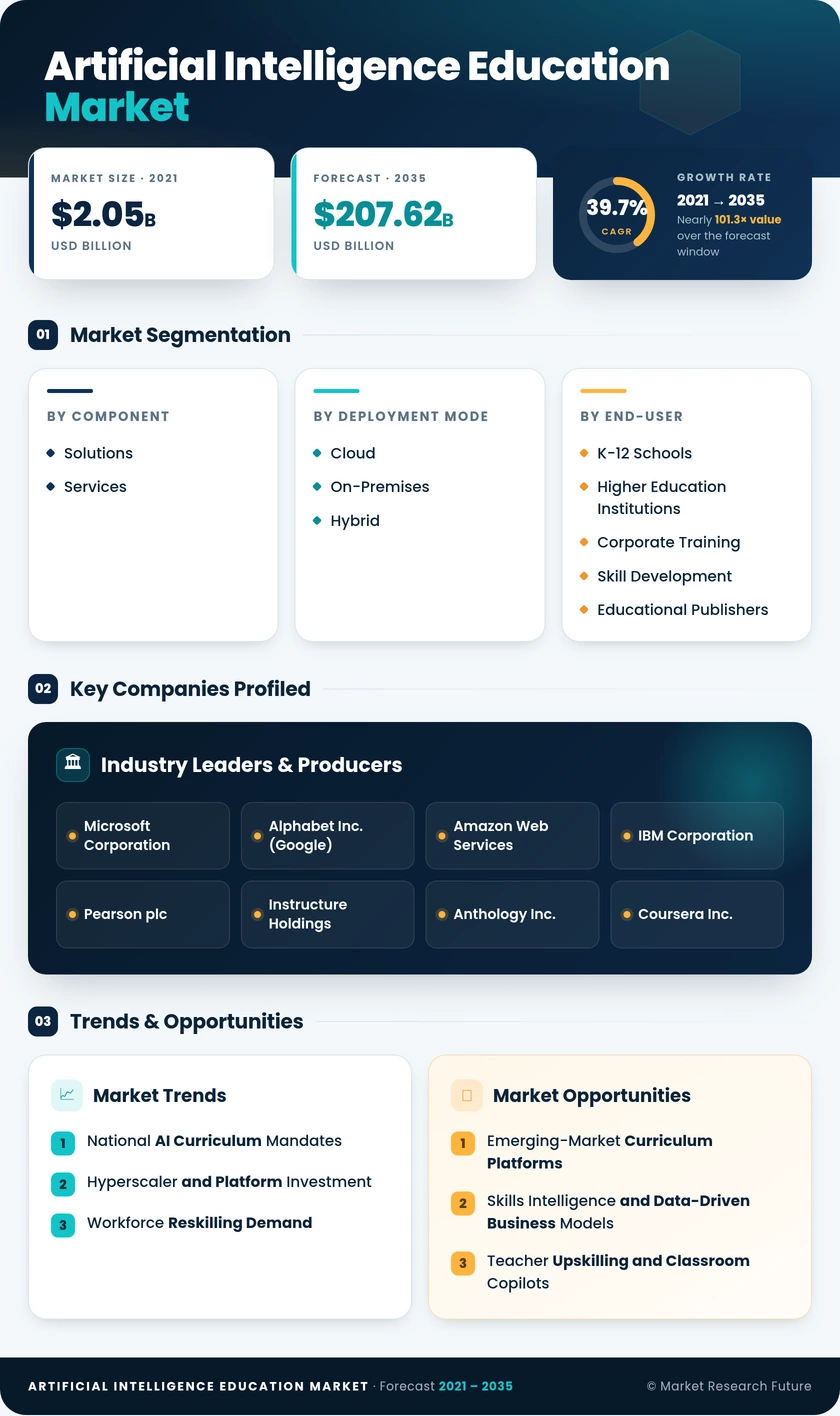
Artificial Intelligence in Education Market
Market Size
Forecast Period2026-2035
CAGR (2026-2035)39.7%
2025 Market SizeUSD 7.35 Billion
2035 Market SizeUSD 207.62 Billion
Key Players
Microsoft Corporation
Alphabet Inc.
Amazon Web Services
IBM Corporation
Pearson plc
Instructure Holdings
Opportunities
  • Emerging-Market Curriculum Platforms
  • Skills Intelligence and Data-Driven Business Models
  • Teacher Upskilling and Classroom Copilots
  1. 1 Market Summary | |
  2. 2 Key Report Takeaways | |
    1. 2.1 By Component | |
    2. 2.2 By Deployment Mode | |
    3. 2.3 By End-User | |
    4. 2.4 By Application | |
    5. 2.5 By Technology | |
    6. 2.6 By Region | |
  3. 3 Market Size and Forecast (2021–2035) | |
    1. 3.1 Historical Market Size (2021–2024) | |
    2. 3.2 Base Year Market Size (2025) | |
    3. 3.3 Forecast Market Size (2026–2035) | |
  4. 4 Driver Impact Analysis | |
    1. 4.1 National AI Curriculum Mandates | |
    2. 4.2 Hyperscaler and Platform Investment | |
    3. 4.3 Workforce Reskilling Demand | |
    4. 4.4 Assessment and Teacher-Workload Automation | |
    5. 4.5 Government Digital-Skilling Programs | |
    6. 4.6 Enterprise Generative AI Licenses for Campuses | |
    7. 4.7 Cloud Adoption and Falling Inference Costs | |
  5. 5 Restraints Impact Analysis | |
    1. 5.1 Student Data Protection Rules | |
    2. 5.2 High-Risk AI Compliance Obligations | |
    3. 5.3 Academic Integrity and Accuracy Concerns | |
    4. 5.4 Connectivity and Device Gaps | |
    5. 5.5 Funding Cliffs and Policy Reversals | |
  6. 6 Opportunities | |
    1. 6.1 Emerging-Market Curriculum Platforms | |
    2. 6.2 Skills Intelligence and Data-Driven Business Models | |
    3. 6.3 Teacher Upskilling and Classroom Copilots | |
    4. 6.4 Compliance-Ready Assessment Products | |
    5. 6.5 On-Device Learning for Low-Connectivity Regions | |
  7. 7 Regional Market Share and Country-Level Analysis | |
    1. 7.1 North America | | |
      1. 7.1.1 United States | | |
      2. 7.1.2 Canada | | |
      3. 7.1.3 Mexico | |
    2. 7.2 Europe | | |
      1. 7.2.1 Germany | | |
      2. 7.2.2 United Kingdom | | |
      3. 7.2.3 France | | |
      4. 7.2.4 Italy | | |
      5. 7.2.5 Spain | | |
      6. 7.2.6 Russia | | |
      7. 7.2.7 Rest of Europe | |
    3. 7.3 Asia-Pacific | | |
      1. 7.3.1 China | | |
      2. 7.3.2 Japan | | |
      3. 7.3.3 India | | |
      4. 7.3.4 South Korea | | |
      5. 7.3.5 Australia and New Zealand | | |
      6. 7.3.6 Rest of Asia-Pacific | |
    4. 7.4 South America | | |
      1. 7.4.1 Brazil | | |
      2. 7.4.2 Argentina | | |
      3. 7.4.3 Rest of South America | |
    5. 7.5 Middle East and Africa | | |
      1. 7.5.1 Middle East | | |
      2. 7.5.2 Saudi Arabia | | |
      3. 7.5.3 UAE | | |
      4. 7.5.4 Turkey | | |
      5. 7.5.5 Rest of Middle East | | |
      6. 7.5.6 Africa | | |
      7. 7.5.7 South Africa | | |
      8. 7.5.8 Nigeria | | |
      9. 7.5.9 Egypt | | |
      10. 7.5.10 Rest of Africa | |
  8. 8 Future Outlook (2026–2035) | |
    1. 8.1 Agentic Learning Systems | |
    2. 8.2 Platform Consolidation | |
    3. 8.3 Skills-Based Economies | |
    4. 8.4 Responsible AI and Evidence of Impact | |
  9. 9 Segmentation Analysis | |
    1. 9.1 By Component | | |
      1. 9.1.1 Solutions | | |
      2. 9.1.2 Services | |
    2. 9.2 By Deployment Mode | | |
      1. 9.2.1 Cloud | | |
      2. 9.2.2 On-Premises | | |
      3. 9.2.3 Hybrid | |
    3. 9.3 By End-User | | |
      1. 9.3.1 K-12 Schools | | |
      2. 9.3.2 Higher Education Institutions | | |
      3. 9.3.3 Corporate Training and Skill Development | | |
      4. 9.3.4 Educational Publishers | | |
      5. 9.3.5 Other End-Users | |
    4. 9.4 By Application | | |
      1. 9.4.1 Intelligent Tutoring Systems | | |
      2. 9.4.2 Virtual Facilitators and Learning Environments | | |
      3. 9.4.3 Learning Analytics and Recommendation Engines | | |
      4. 9.4.4 Automated Administration and Proctoring | | |
      5. 9.4.5 Content Delivery Systems | | |
      6. 9.4.6 Adaptive Assessment and Grading | |
    5. 9.5 By Technology | | |
      1. 9.5.1 Machine Learning | | |
      2. 9.5.2 Natural Language Processing | | |
      3. 9.5.3 Computer Vision | | |
      4. 9.5.4 Speech Recognition | | |
      5. 9.5.5 Deep Learning and Generative AI | | |
      6. 9.5.6 Edge AI and On-device Inference | |
  10. 10 Competitive Landscape | |
    1. 10.1 Market Concentration Analysis | |
    2. 10.2 Competitive Benchmarking Matrix | |
    3. 10.3 Company Profiles | | |
      1. 10.3.1 Microsoft Corporation | | |
      2. 10.3.2 Alphabet Inc. (Google) | | |
      3. 10.3.3 Amazon Web Services | | |
      4. 10.3.4 IBM Corporation | | |
      5. 10.3.5 Pearson plc | | |
      6. 10.3.6 Instructure Holdings | | |
      7. 10.3.7 Anthology Inc. | | |
      8. 10.3.8 Coursera Inc. | | |
      9. 10.3.9 Duolingo Inc. | | |
      10. 10.3.10 Carnegie Learning | | |
      11. 10.3.11 Squirrel AI | | |
      12. 10.3.12 Century Tech | |
  11. 11 Recent News & Developments | |
  12. 12 Report Scope and Methodology | |
  13. 13 Detailed Sources and Citations | |
  14. 14 Frequently Asked Questions (FAQs) | | LIST OF TABLES | |
  15. TABLE 1 Global Market Size & Forecast, by Revenue (USD Billion), 2021–2035 | |
  16. TABLE 2 Driver Impact Analysis | |
  17. TABLE 3 Restraints Impact Analysis | |
  18. TABLE 4 Global Market Size, by Region, 2025 | |
  19. TABLE 5 North America Market, by Country, 2025 | |
  20. TABLE 6 Europe Market, by Country, 2025 | |
  21. TABLE 7 Asia-Pacific Market, by Country, 2025 | |
  22. TABLE 8 South America Market, by Country, 2025 | |
  23. TABLE 9 Middle East and Africa Market, by Country, 2025 | |
  24. TABLE 10 Global Market, by Component, 2025 | |
  25. TABLE 11 Global Market, by Deployment Mode, 2025 | |
  26. TABLE 12 Global Market, by End-User, 2025 | |
  27. TABLE 13 Global Market, by Application, 2025 | |
  28. TABLE 14 Global Market, by Technology, 2025 | |
  29. TABLE 15 Competitive Benchmarking Matrix, 2025 | |
  30. TABLE 16 Report Scope and Methodology | |
  31. TABLE 17 Detailed Sources and Citations | | LIST OF FIGURES | |
  32. FIGURE 1 Market Dynamics Overview (Drivers, Restraints, Opportunities) | |
  33. FIGURE 2 Industry Value Chain Analysis | |
  34. FIGURE 3 Porter's Five Forces Analysis | |
  35. FIGURE 4 Global Market Size Trend, 2021–2035 (USD Billion) | |
  36. FIGURE 5 Market Share, by Component, 2025 | |
  37. FIGURE 6 Market Share, by Deployment Mode, 2025 | |
  38. FIGURE 7 Market Share, by End-User, 2025 | |
  39. FIGURE 8 Market Share, by Application, 2025 | |
  40. FIGURE 9 Market Share, by Technology, 2025 | |
  41. FIGURE 10 Regional Market Share, 2025 | |
  42. FIGURE 11 Competitive Landscape Positioning, 2025

Segmentation Quick Reference

DimensionSub-SegmentsDominant SegmentFastest Growing Segment
By ComponentSolutions; ServicesSolutions (65.0% share)Services (41.2% CAGR)
By Deployment ModeCloud; On-Premises; HybridCloud (63.2% share)Hybrid (42.4% CAGR)
By End-UserK-12 Schools; Higher Education Institutions; Corporate Training and Skill Development; Educational Publishers; Other End-UsersHigher Education Institutions (42.2% share)Corporate Training and Skill Development (41.8% CAGR)
By ApplicationIntelligent Tutoring Systems; Virtual Facilitators and Learning Environments; Learning Analytics and Recommendation Engines; Automated Administration and Proctoring; Content Delivery Systems; Adaptive Assessment and GradingVirtual Facilitators and Learning Environments (33.1% share)Adaptive Assessment and Grading (43.6% CAGR)
By TechnologyMachine Learning; Natural Language Processing; Computer Vision; Speech Recognition; Deep Learning and Generative AI; Edge AI and On-device InferenceMachine Learning (36.4% share)Deep Learning and Generative AI (46.2% CAGR)
By RegionNorth America; Europe; Asia-Pacific; South America; Middle East and AfricaNorth America (38.4% share)Asia-Pacific (44.1% CAGR)

Market Segmentation Overview

By Component

Sub-SegmentKey Trend
SolutionsConsolidation into single platforms covering tutoring, grading, and analytics
ServicesRising demand for data architecture, governance, and faculty training

Solutions lead because institutions want one contract and one security review for tutoring, feedback, and analytics. Services grow fastest as deployment complexity, from data migration to model governance, exceeds what internal IT teams can handle.

By Deployment Mode

Sub-SegmentKey Trend
CloudDefault for large-model inference and peak exam loads
On-PremisesRetained for secure exams and sovereign data
HybridLocal records with cloud-based model calls

Cloud leads on the strength of elastic compute for large models. Hybrid grows fastest because it lets ministries and universities keep identifiable student records local while still accessing cloud models, which suits European and Gulf data rules better than On-Premises alone.

By End-User

Sub-SegmentKey Trend
K-12 SchoolsTeacher-facing tools under strict child privacy rules
Higher Education InstitutionsCampus-wide generative AI licenses
Corporate Training and Skill DevelopmentAI coaching tied to certifications
Educational PublishersAI-enhanced courseware
Other End-UsersGovernment and professional academies

Higher Education Institutions lead as universities sign campus-wide licenses for writing support, advising, and grading. Corporate Training and Skill Development grows fastest because employers fund reskilling from operating budgets and measure returns directly, while K-12 Schools move more cautiously under child privacy rules.

By Application

Sub-SegmentKey Trend
Intelligent Tutoring SystemsGuided step-by-step practice
Virtual Facilitators and Learning EnvironmentsConversational assistants embedded in courses
Learning Analytics and Recommendation EnginesRetention and early-warning models
Automated Administration and ProctoringEnrollment automation and remote exam integrity
Content Delivery SystemsSequenced, personalized content
Adaptive Assessment and GradingInstant rubric-aligned feedback

Virtual Facilitators and Learning Environments lead because conversational assistants slot easily into existing courses. Adaptive Assessment and Grading grows fastest, driven by clear instructor time savings, though EU AI Act high-risk rules will shape how these tools are built and audited.

By Technology

Sub-SegmentKey Trend
Machine LearningCore prediction and recommendation layer
Natural Language ProcessingWriting feedback and dialogue
Computer VisionHandwriting recognition and proctoring
Speech RecognitionLanguage and reading fluency practice
Deep Learning and Generative AIOn-demand content and tutoring dialogue
Edge AI and On-device InferenceOffline, privacy-preserving deployments.

Machine Learning leads as the prediction engine inside most learning platforms. Deep Learning and Generative AI grow fastest as institutions adopt tools that write practice items and explanations on demand, while Edge AI and On-device Inference open low-connectivity classrooms.


Download PDF ×

We do not share your information with anyone. However, we may send you emails based on your report interest from time to time. You may contact us at any time to opt-out.