Artificial Intelligence in Education Market (2026 - 2035)

Artificial Intelligence in Education Market Size, Share and Research Report By Component (Solutions, and Services), By Deployment Mode (Cloud, On-Premises, and Hybrid), By End-User (K-12 Schools, Higher Education Institutions, Corporate Training and Skill Development, Educational Publishers, and Other End-Users), By Application (Intelligent Tutoring Systems, Virtual Facilitators and Learning Environments, Learning Analytics and Recommendation Engines, Automated Administration and Proctoring, Content Delivery Systems, and Adaptive Assessment and Grading), By Technology (Machine Learning, Natural Language Processing, Computer Vision, Speech Recognition, Deep Learning and Generative AI, and Edge AI and On-device Inference) And By Region (North America, Europe, Asia-Pacific, And Rest Of The World) โ€“ Industry Forecast Till 2035
ID: MRFR/ICT/4904-CR 100 Pages Ankit Gupta, Shubham Munde Last Updated: November 06, 2026
Artificial Intelligence in Education Market
Market Size
Forecast Period2026-2035
CAGR (2026-2035)39.7%
2025 Market SizeUSD 7.35 Billion
2035 Market SizeUSD 207.62 Billion
Key Players
Microsoft Corporation
Alphabet Inc.
Amazon Web Services
IBM Corporation
Pearson plc
Instructure Holdings
Opportunities
  • Emerging-Market Curriculum Platforms
  • Skills Intelligence and Data-Driven Business Models
  • Teacher Upskilling and Classroom Copilots

Artificial Intelligence in Education Market Summary

The Artificial Intelligence in Education Market was valued at USD 7.35 billion in 2025 and is projected to reach USD 10.26 billion in 2026, rising to USD 207.62 billion by 2035 at a CAGR of 39.7% over 2026โ€“2035. Two catalysts set the pace. The April 2025 U.S. executive order on AI education for American youth directed federal agencies to fund AI literacy and teacher training [3], and Microsoft committed USD 4 billion over five years to AI education and skilling through its Elevate program [16]. Public mandates and private capital are now pulling in the same direction.

Classrooms are moving away from static learning management systems, paper-based testing, and one-size-fits-all textbooks. Replacing them are large language model assistants, real-time learning dashboards, and assessment engines that score open-ended work in seconds. The shift is funded at national scale: India's IndiaAI Mission carries an outlay of INR 10,371.92 crore for compute, datasets, and skilling [23], and the U.S. Department of Education confirmed in July 2025 that federal grant funds may support AI-enabled instruction [17]. Institutions now treat personalized learning as an operating requirement rather than a pilot.

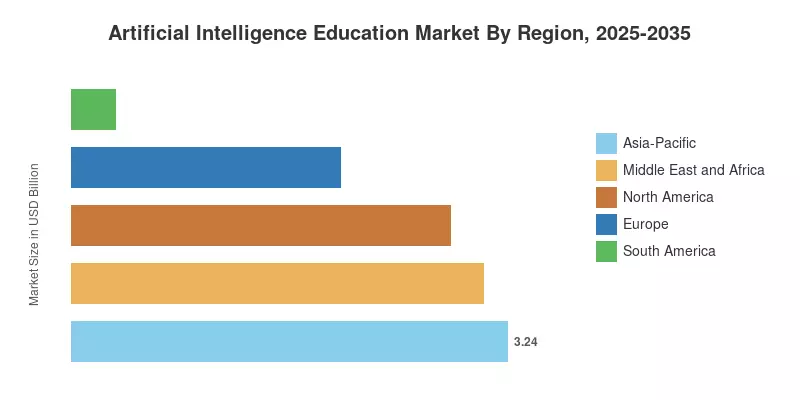
North America dominates with a 38.4% revenue share in 2025, backed by deep cloud infrastructure and early university adoption. Asia-Pacific is the fastest-growing region at a 44.1% CAGR, driven by curriculum mandates in China, India, and South Korea. Europe ranks second with a 27.2% share, shaped by the compliance discipline of the EU AI Act [4]. Over the next decade, the gap between leaders and followers will be defined by data governance as much as by model quality.

Key Report Takeaways

โ€ข By Component

  • Solutions held a 65.0% share of the Artificial Intelligence In Education Market in 2025, reflecting buyer preference for integrated tutoring, grading, and analytics stacks.
  • Services is set to expand at a 41.2% CAGR through 2035 as institutions buy integration and change-management support.

โ€ข By Deployment Mode

  • Cloud accounted for a 63.2% share in 2025, the default for elastic model inference.
  • Hybrid is the fastest-growing mode at a 42.4% CAGR, favored where data residency rules apply.

โ€ข By End-User

  • Higher Education Institutions led with a 42.2% share in 2025
  • Corporate Training and Skill Development is forecast to grow at a 41.8% CAGR, the fastest end-user pace in the Artificial Intelligence In Education Market

โ€ข By Application

  • Virtual Facilitators and Learning Environments captured a 33.1% share in 2025
  • Adaptive Assessment and Grading is projected to post a 43.6% CAGR through 2035

โ€ข By Technology

  • Machine Learning held a 36.4% share in 2025 as the foundation of recommendation and prediction engines
  • Deep Learning and Generative AI is the fastest-growing technology at a 46.2% CAGR

โ€ข By Region

  • North America led with a 38.4% revenue share in 2025
  • Asia-Pacific is forecast to grow at a 44.1% CAGR, the fastest regional pace
  • South America generated USD 0.33 billion in 2025, led by Brazil

Market Size and Forecast (2021โ€“2035)

Historical values for the Artificial Intelligence in Education Market for 2021โ€“2024 were built from vendor disclosures, public procurement records, and annual reports of listed education and cloud providers, then reconciled against institution-level adoption surveys. The 2025 base year combines bottom-up revenue mapping across components and end-users with top-down validation against public cloud and education software spending. Forecasts apply scenario-weighted adoption curves by region and segment.
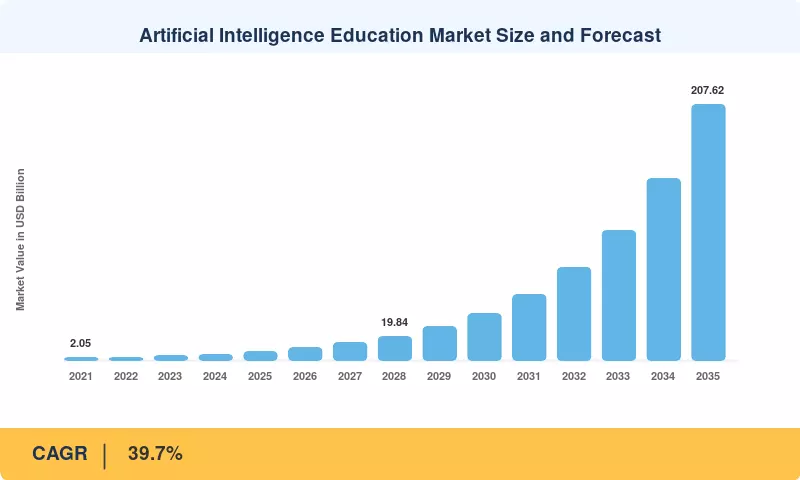
Artificial Intelligence Education Market Size and Forecast
Our Impact

Enabled $4.3B Revenue Impact for Fortune 500 and Leading Multinationals

Partnering with 2000+ Global Organizations Each Year

30K+ Citations by Top-Tier Firms in the Industry

Driver Impact Analysis

Driver ~% Impact on CAGR Geographic Relevance Impact Timeline
National AI curriculum mandates +7.2% Global; strongest in Asia-Pacific and the Gulf Medium-term (2โ€“4 yr)
Hyperscaler and platform investment in AI education +6.5% Global Short-term (โ‰ค2 yr)
Workforce reskilling demand +6.1% North America, Europe Long-term (โ‰ฅ4 yr)
Assessment and teacher-workload automation +5.4% North America, Europe, Asia-Pacific Short-term (โ‰ค2 yr)
Government digital-skilling programs +4.8% India, Asia-Pacific Medium-term (2โ€“4 yr)
Enterprise generative AI licenses for campuses +4.3% North America, Europe Short-term (โ‰ค2 yr)
Cloud adoption and falling inference costs +3.9% Global Long-term (โ‰ฅ4 yr)

National AI Curriculum Mandates

Governments have moved AI from elective to required. The April 2025 U.S. executive order created a White House task force on AI education and directed grant priorities toward AI literacy [3]. Beijing requires at least eight class hours of AI instruction per year in primary and secondary schools from autumn 2025 [20], and the UAE introduced AI as a subject from kindergarten to grade 12 for the 2025โ€“26 academic year [24]. Mandates create recurring, budgeted demand for curriculum platforms, teacher tools, and assessment.

Hyperscaler and Platform Investment

Large technology vendors are subsidizing adoption to lock in the next generation of users. Microsoft's Elevate program commits USD 4 billion over five years to AI education and skilling for schools, colleges, and nonprofits [16]. Cloud providers bundle education-specific credits and model access with productivity suites [8]. This investment lowers acquisition costs for institutions and compresses the sales cycle for vendors, which accelerates the move from pilots to campus-wide licenses.

Workforce Reskilling Demand

Employers expect 39% of workers' core skills to change by 2030 [7]. That gap pushes companies to fund continuous learning platforms that diagnose skill deficits and assign targeted modules. Corporate academies now buy AI coaching, simulation, and credentialing tools on multi-year contracts. Because reskilling budgets sit outside public education funding cycles, this driver adds stable, recession-resistant demand and explains why corporate buyers grow faster than traditional institutions.

Assessment and Teacher-Workload Automation

Teacher time is the scarcest resource in most school systems. The U.S. Department of Education's 2023 report on AI in teaching and learning highlighted feedback generation and administrative relief as near-term use cases, while insisting on a human in the loop [2]. AI scoring engines return rubric-aligned feedback in seconds, and districts are funding them to reduce burnout. Clear productivity returns make assessment tools one of the easiest AI line items to justify.

Government Digital-Skilling Programs

India's National Education Policy 2020 calls for coding, computational thinking, and technology-enabled personalization across school levels [5]. The IndiaAI Mission adds INR 10,371.92 crore for compute capacity, datasets, and AI skilling [23]. These programs fund infrastructure and teacher preparation at the same time, which removes two common adoption blockers. Similar programs across Southeast Asia and the Gulf extend demand well beyond OECD markets.

Enterprise Generative AI Licenses for Campuses

Model developers now sell institution-wide licenses with data protections designed for universities. OpenAI launched ChatGPT Edu in May 2024 with enterprise-grade security and administrative controls [13]. Anthropic followed with Claude for Education in April 2025, including a learning mode built around guided reasoning [14]. These offers convert scattered student usage into governed, budgeted contracts, adding a high-value revenue layer on top of existing learning platforms.

Cloud Adoption and Falling Inference Costs

As model efficiency increases, inference costs per token have drastically decreased, making AI capabilities accessible at pricing points per student. In fiscal 2025, Microsoft reported significant growth in its cloud business, with AI services accounting for a large portion of this expansion [8]. Institutions can grow coaching and grading during exam peaks without purchasing hardware thanks to elastic cloud capacity. Long-term, reduced unit costs extend the viable market to lower-income regions and nations.

Restraints Impact Analysis

Restraint ~% Impact on CAGR Geographic Relevance Impact Timeline
Student data protection rules -4.6% North America, Europe Medium-term (2โ€“4 yr)
High-risk AI compliance obligations -3.8% Europe Medium-term (2โ€“4 yr)
Academic integrity and accuracy concerns -3.2% Global Short-term (โ‰ค2 yr)
Connectivity and device gaps -2.9% Africa, South America, South Asia Long-term (โ‰ฅ4 yr)
Funding cliffs and policy reversals -2.4% United States, South Korea Short-term (โ‰ค2 yr)

Student Data Protection Rules

Vendors must abide by the FTC's updated COPPA Rule, which was approved in January 2025 and strengthens consent and data-retention obligations for children under 13, as well as FERPA for school records [10]. Additional layers are added by state laws. Procurement cycles are now months longer due to student data protection evaluations, and smaller vendors find it difficult to pay for the legal and security work required to pass district assessments.

High-Risk AI Compliance Obligations

The EU AI Act classifies AI systems used for admissions, learning-outcome evaluation, and exam proctoring as high-risk [4]. Providers face conformity assessments, risk management, logging, and human-oversight duties. Emotion recognition in educational institutions is prohibited outright. Compliance costs fall hardest on start-ups and may delay launches of assessment products in Europe until obligations bed in.

Academic Integrity and Accuracy Concerns

UNESCO's 2023 guidance urged age limits and validation of generative AI before classroom use, citing risks of fabricated content and bias [1]. Faculty remain wary of unchecked essay generation and unreliable outputs. Institutions respond with restrictive policies or detection tools, which slows broad deployment. Until accuracy and attribution improve, many buyers will limit AI to low-stakes tasks.

Connectivity and Device Gaps

About 2.6 billion people remained offline in 2024. UNESCO's 2023 Global Education Monitoring Report warned that technology can widen learning inequality when access is uneven. Cloud-dependent AI tools have little reach where schools lack reliable broadband or devices. This gap caps near-term adoption across much of Africa and rural South Asia.

Funding Cliffs and Policy Reversals

U.S. districts lost access to federal pandemic relief funds after the September 2024 obligation deadline, removing a major source of technology spending [18]. South Korea scaled back its AI digital textbook program in 2025, reclassifying the books as supplementary materials after teacher and parent pushback [25]. Such reversals show that public demand can stall quickly when evidence or funding falls short.

Artificial Intelligence in Education Market Opportunities

Emerging-Market Curriculum Platforms

AI is being incorporated into national curricula by Gulf governments, India, and Southeast Asian economies more quickly than local content providers can react [5][24]. Artificial Intelligence Vendors: Multi-year ministry contracts can be obtained in the education market by localizing content into regional languages and aligning with national test systems. In these situations, offline options and low-bandwidth delivery will be crucial.

Skills Intelligence and Data-Driven Business Models

Learning systems produce detailed proof of what students are capable of. Employers, credentialing organizations, and workforce agencies generate additional revenue when that evidence is packaged into validated skills profiles. The market may move away from seat licensing through subscription analytics and outcome-based pricing, in which suppliers are compensated for measured competence gains.

Teacher Upskilling and Classroom Copilots

In July 2025, the American Federation of Teachers launched the National Academy for AI Instruction with USD 23 million in support from Microsoft, OpenAI, and Anthropic [15]. Large-scale teacher training opens a market for lesson-planning copilots, differentiation tools, and grading assistants built around teacher workflows rather than student-facing chat.

Compliance-Ready Assessment Products

EU AI Act obligations for high-risk education systems will reward vendors that ship audit logs, bias testing, and human-review controls by design [4]. Assessment and proctoring providers that certify early can turn regulation into a competitive moat and sell compliance tooling to institutions that build their own systems.

On-Device Learning for Low-Connectivity Regions

Smaller models running on low-cost tablets and phones can deliver tutoring without constant connectivity. This approach addresses the access gap documented by the ITU and opens donor-funded and government-funded programs in Africa and South America. Edge deployments also reduce data transfer, which eases privacy approvals.

Artificial Intelligence in Education Market Future Outlook

Agentic Learning Systems

By the early 2030s, AI will act less like a chatbot and more like an agent that plans study sequences, schedules practice, and flags at-risk learners to advisers. UNESCO's guidance calls for human oversight in exactly these decisions [1]. Vendors that pair autonomy with transparent teacher controls will capture the largest institutional contracts.

Platform Consolidation

Private equity and strategic buyers are assembling full-stack platforms across the Artificial Intelligence In Education Market. KKR's roughly USD 4.8 billion take-private of Instructure in 2024 shows how learning management systems are being repositioned as AI distribution channels [12]. Expect fewer, larger suites with marketplaces for third-party tutoring and assessment modules.

Skills-Based Economies

With 39% of core skills expected to shift by 2030 [7], employers will increasingly hire on verified skills rather than degrees. AI-generated skills evidence will connect schools, universities, and employers, blurring the line between education and workforce development.

Responsible AI and Evidence of Impact

Buyers will demand proof of learning gains, not just engagement metrics. The OECD's Digital Education Outlook stresses that governance and evidence frameworks determine whether digital tools improve outcomes [6]. Independent efficacy studies and audit trails will become standard procurement requirements across the Artificial Intelligence in Education Market.

Regional Market Share Analysis

Region Key Metric (2025) Primary Investment Themes
North America 38.4% share Campus-wide generative AI licenses, assessment automation
Europe 27.2% share Compliance-ready platforms, national digital strategies
Asia-Pacific 44.1% CAGR (2026โ€“2035) Curriculum mandates, exam-preparation platforms
South America USD 0.33 Billion Public school digitization, language learning
Middle East and Africa 41.6% CAGR (2026โ€“2035) National AI curricula, mobile-first delivery
Total USD 7.35 Billion โ€”

North America, Europe, and Asia-Pacific together account for more than 90% of Artificial Intelligence in Education Market revenue in 2025, but growth leadership has shifted east. The summary below discloses one metric per region.

North America

Country Key Metric (2025) Key Driver
United States 86.5% share of region Federal AI literacy priorities and campus-wide licenses
Canada USD 0.27 Billion Provincial digital-learning strategies
Mexico 44.0% CAGR (2026โ€“2035) Private university cloud adoption

The United States anchors the Artificial Intelligence in Education Market through dense cloud infrastructure, large university systems, and an active venture ecosystem. Federal guidance in July 2025 cleared the use of grant funds for AI-enabled instruction, while the April 2025 executive order set national AI literacy priorities [3][17]. Canada advances through provincial digital-learning strategies, and Mexico shows the fastest growth as private universities adopt cloud tutoring platforms.

Europe

Country Key Metric (2025) Key Driver
Germany 21.4% share of region Digital-education infrastructure funding
United Kingdom USD 0.46 Billion Teacher-facing AI tools backed by government
France 38.9% CAGR (2026โ€“2035) National digital strategy for schools
Italy 9.8% share of region Recovery-plan school digitization
Spain USD 0.15 Billion University adoption of virtual campuses
Russia 5.2% share of region Domestic platform development
Rest of Europe 37.6% CAGR (2026โ€“2035) Nordic and Benelux early adoption

European demand in the Artificial Intelligence in Education Market is shaped by the EU AI Act, which entered into force in August 2024 and classifies most assessment uses as high-risk [4]. Buyers therefore favor vendors with documented governance. The United Kingdom has funded AI content tools for teachers through the Department for Education [22], and Germany and France invest through national digital-education programs. Russia remains a largely domestic market served by local providers.

Asia-Pacific

Country Key Metric (2025) Key Driver
China 38.6% share of region Mandatory AI instruction in schools
Japan USD 0.29 Billion GIGA School device base and university adoption
India 49.8% CAGR (2026โ€“2035) NEP 2020 and national AI mission funding
South Korea 9.1% share of region Digital learning materials and exam preparation
Australia and New Zealand USD 0.12 Billion State-level AI frameworks for schools
Rest of Asia-Pacific 45.3% CAGR (2026โ€“2035) Southeast Asian digital-skilling programs

Asia-Pacific is the fastest-growing region in the Artificial Intelligence in Education Market. China leads on scale, with Beijing requiring a minimum of eight AI class hours per year from autumn 2025 [20]. India's growth rate stands out, supported by NEP 2020 and the IndiaAI Mission [5][23]. South Korea's 2025 rollback of AI textbooks tempers near-term demand there [25], while Japan and Australia and New Zealand adopt steadily through university and K-12 programs.

South America

Country Key Metric (2025) Key Driver
Brazil 54.2% share of region Private distance-learning groups
Argentina 38.2% CAGR (2026โ€“2035) University cloud assessment adoption
Rest of South America USD 0.09 Billion Connectivity and language-learning programs

Brazil dominates South America's share of the Artificial Intelligence in Education Market, with large private higher-education groups using AI to scale distance learning. Argentina grows from a smaller base as universities adopt cloud assessment tools. Across the rest of the region, adoption depends on public connectivity programs and language-learning demand. Uneven broadband remains the main constraint on deployment beyond major cities.

Middle East and Africa

Country Key Metric (2025) Key Driver
Middle East 61.5% share of region Gulf national AI strategies
Saudi Arabia USD 0.08 Billion Vision 2030 human capability programs
UAE 46.4% CAGR (2026โ€“2035) K-12 AI curriculum mandate
Turkey 9.7% share of region National digital-education platform
Rest of Middle East USD 0.03 Billion Qatar and Kuwait school digitization
Africa 38.5% share of region Mobile-first learning access
South Africa 41.0% CAGR (2026โ€“2035) University and corporate training adoption
Nigeria USD 0.02 Billion Youth digital-skills programs
Egypt 43.5% CAGR (2026โ€“2035) Public education digital transformation
Rest of Africa 9.1% share of region Donor-funded learning programs

Gulf states drive regional spending in the Artificial Intelligence in Education Market. The UAE made AI a subject from kindergarten to grade 12 starting in the 2025โ€“26 school year [24], and Saudi Arabia funds AI skills under its Vision 2030 human capability agenda. Turkey adopts through national digital-education platforms. In Africa, South Africa, Nigeria, and Egypt lead uptake of mobile-first tutoring, though device access limits scale.

Artificial Intelligence Education Market By Region, 2025-2035

Artificial Intelligence in Education Market Segmentation

By Component

Segment Key Metric (2025) Primary Demand Driver
Solutions 65.0% share Integrated tutoring, grading, and analytics suites
Services 41.2% CAGR (2026โ€“2035) Integration, data architecture, and change management

Solutions lead the Artificial Intelligence in Education Market because institutions prefer one platform that covers tutoring, feedback, and analytics under a single contract and security review. Services grow faster as schools discover that deployment is the hard part. Data migration, model governance, and faculty training require outside expertise that most IT departments lack. Consulting partners also design pilot-to-scale programs, which makes services a gateway to larger solution sales over time.

By Deployment Mode

Segment Key Metric (2025) Primary Demand Driver
Cloud 63.2% share Elastic inference capacity and operating-expense budgets
On-Premises USD 1.62 Billion Data sovereignty and exam security requirements
Hybrid 42.4% CAGR (2026โ€“2035) Local data control with cloud model access

Cloud dominates the Artificial Intelligence in Education Market because large models need elastic compute that few institutions can host themselves. On-Premises remains relevant for ministries and universities bound by strict residency rules and for secure examinations. Hybrid is growing fastest as buyers keep identifiable records locally while calling cloud models for inference. This architecture also eases compliance with European and Gulf data rules.

By End-User

Segment Key Metric (2025) Primary Demand Driver
K-12 Schools USD 1.98 Billion Teacher workload relief and differentiated instruction
Higher Education Institutions 42.2% share Advising, research support, and grading automation
Corporate Training and Skill Development 41.8% CAGR (2026โ€“2035) Reskilling and certification needs
Educational Publishers 38.4% CAGR (2026โ€“2035) AI-enhanced digital courseware
Other End-Users 6.9% share Government academies and professional bodies

Higher Education Institutions hold the largest share of the Artificial Intelligence in Education Market, using AI for advising, writing support, and assessment at scale. Corporate Training and Skill Development grows fastest because employers fund reskilling directly and measure returns in productivity. K-12 Schools focus on teacher tools under tighter privacy rules. Educational Publishers embed AI into courseware to defend margins, while Other End-Users include government academies and professional bodies.

By Application

Segment Key Metric (2025) Primary Demand Driver
Intelligent Tutoring Systems USD 1.54 Billion One-to-one guided practice at scale
Virtual Facilitators and Learning Environments 33.1% share Conversational assistants and immersive simulations
Learning Analytics and Recommendation Engines 39.9% CAGR (2026โ€“2035) Early-warning and retention analytics
Automated Administration and Proctoring 11.8% share Enrollment workflows and remote exam integrity
Content Delivery Systems USD 0.71 Billion Personalized content sequencing
Adaptive Assessment and Grading 43.6% CAGR (2026โ€“2035) Instant rubric-aligned feedback

Virtual Facilitators and Learning Environments lead the Artificial Intelligence in Education Market as institutions deploy conversational assistants inside existing courses. Adaptive Assessment and Grading grows fastest because it delivers measurable time savings for instructors. Intelligent Tutoring Systems and Learning Analytics and Recommendation Engines support retention goals, while Automated Administration and Proctoring and Content Delivery Systems streamline operations and course delivery.

By Technology

Segment Key Metric (2025) Primary Demand Driver
Machine Learning 36.4% share Prediction and recommendation models
Natural Language Processing USD 1.69 Billion Writing feedback and conversational support
Computer Vision 37.2% CAGR (2026โ€“2035) Handwriting recognition and proctoring
Speech Recognition 8.1% share Language learning and reading fluency
Deep Learning and Generative AI 46.2% CAGR (2026โ€“2035) Content generation and tutoring dialogue
Edge AI and On-device Inference USD 0.29 Billion Offline and privacy-preserving use

Machine Learning holds the largest technology share of the Artificial Intelligence in Education Market, powering the prediction and recommendation layers inside most platforms. Deep Learning and Generative AI grow fastest as institutions adopt tools that create practice items, explanations, and feedback on demand. Natural Language Processing and Speech Recognition support writing and language instruction. Computer Vision serves handwriting and proctoring, while Edge AI and On-device Inference target low-connectivity classrooms.

Competitive Benchmarking

The Artificial Intelligence in Education Market is moderately concentrated. Market Research Future estimates the top five vendors hold about 34โ€“40% of 2025 revenue, implying an HHI in the 600โ€“900 range, which signals a fragmented-to-moderately concentrated structure. Hyperscalers control model access and cloud distribution, while education specialists own content, workflows, and institutional relationships. Partnerships between the two groups define most competitive moves.

Company Est. Revenue Share Range Key Offerings for Artificial Intelligence In Education Market Strategic Positioning
Microsoft Corporation ~9โ€“12% Copilot for Education, Teams for Education, Azure AI Productivity-suite distribution and skilling investment
Alphabet Inc. (Google) ~7โ€“10% Gemini for Education, Google Classroom, NotebookLM Classroom footprint and free-tier reach
Amazon Web Services ~5โ€“8% Cloud infrastructure, Amazon Bedrock, AWS Educate Infrastructure partner for education software vendors
IBM Corporation ~3โ€“5% watsonx, IBM SkillsBuild Enterprise skilling and AI governance
Pearson plc ~4โ€“6% AI study tools, Pearson+, assessment services Content depth and assessment authority
Instructure Holdings ~3โ€“5% Canvas LMS with AI features LMS installed base as AI distribution layer
Anthology Inc. ~2โ€“4% Blackboard Learn with AI Design Assistant Higher education workflow integration
Coursera Inc. ~2โ€“4% Coursera Coach, enterprise reskilling catalog Corporate and government skilling
Duolingo Inc. ~2โ€“4% Duolingo Max, AI-generated courses Consumer scale and AI-first content production
Carnegie Learning ~1โ€“3% MATHia, K-12 math tutoring software Research-backed K-12 tutoring
Squirrel AI ~1โ€“3% Adaptive tutoring centers and platforms China-focused intelligent tutoring
Century Tech ~0.5โ€“2% AI-driven teaching and learning platform UK and international school market

Recent News & Developments

  • Duolingo (March 2023): Launched Duolingo Max with generative AI features for role-play and answer explanations, showing how consumer apps monetize AI tiers [9]
  • OpenAI (May 2024): Introduced ChatGPT Edu for universities with enterprise security and admin controls, formalizing campus-wide licensing [13]
  • EU (August 2024): The AI Act entered into force, classifying key education uses as high-risk and setting compliance timelines for vendors [4]
  • KKR (November 2024): Completed its take-private acquisition of Instructure, signaling investor appetite for LMS platforms as AI channels [12]
  • Anthropic (April 2025): Launched Claude for Education with a learning mode that guides student reasoning, expanding vendor choice for universities [14]
  • U.S. Government (April 2025): Executive order on advancing AI education for American youth set federal priorities for AI literacy and teacher training [3]
  • Microsoft (July 2025): Announced Microsoft Elevate with a USD 4 billion commitment to AI education and skilling over five years [16]
  • American Federation of Teachers (July 2025): Opened the National Academy for AI Instruction with USD 23 million in industry support to train educators [15]

Artificial Intelligence in Education Market Report Scope

Parameter Details
Market Scope AI solutions and services, deployed via cloud, on-premises, and hybrid models, for K-12, higher education, corporate training, publishers, and other education end-users
Study Period 2021โ€“2035
Base Year 2025
Historical Data 2021โ€“2024
Forecast Period 2026โ€“2035
Market Size in 2025 USD 7.35 Billion
Market Size in 2035 USD 207.62 Billion
CAGR (2026โ€“2035) 39.7%
Fastest Growing Segments Deep Learning and Generative AI (46.2% CAGR); Adaptive Assessment and Grading (43.6% CAGR); Hybrid (42.4% CAGR); Corporate Training and Skill Development (41.8% CAGR)
Regions Covered North America, Europe, South America, Asia Pacific, Middle East and Africa and ROW
Companies Profiled Microsoft Corporation, Alphabet Inc. (Google), Amazon Web Services, IBM Corporation, Pearson plc, Instructure Holdings, Anthology Inc., Coursera Inc., Duolingo Inc., Carnegie Learning, Squirrel AI, Century Tech
Valuation Currency USD Billion
Methodology 350+ primary expert interviews; bottom-up market sizing; top-down validation; data triangulation; scenario-based forecasting; real-time project tracking

FAQs

How should a university evaluate vendors in the Artificial Intelligence in Education Market?
Prioritize data handling terms, model-training opt-outs, and integration with the existing LMS. Ask for independent learning-outcome evidence rather than engagement metrics [6].
Which pricing models are emerging for AI education tools?
Per-seat licenses still dominate the Artificial Intelligence in Education Market, but campus-wide flat fees are spreading. Some vendors now test outcome-based contracts tied to measured proficiency gains.
What compliance deadline matters most for assessment vendors in Europe?
High-risk obligations under the EU AI Act apply from August 2026. Vendors selling grading or admissions tools need conformity assessments, logging, and human oversight in place before then [4].
Is building in-house AI cheaper than buying a platform in the Artificial Intelligence In Education Market?
Rarely, outside the largest university systems. Ongoing costs for model updates, security reviews, and compliance usually exceed license fees within two to three years.
How do LMS providers compete with model developers?
They control the daily workflow where teachers and students already work. Embedding third-party models inside the LMS keeps them central even as model choice widens [12].
What emerging use case could reshape the Artificial Intelligence In Education Market by 2030?
Verified skills records generated from everyday coursework. They could let employers hire on demonstrated ability instead of degrees [7].
What is the biggest integration challenge for K-12 districts?
Connecting AI tools to student information systems without exposing protected records. Districts need single sign-on, rostering standards, and signed data-privacy agreements before rollout [10].
Author
Author Author Profile Ankit Gupta LinkedIn Team Lead - Research
Ankit Gupta is a seasoned market intelligence and strategic research professional with over six plus years of experience in the ICT and Semiconductor industries. With academic roots in Telecom, Marketing, and Electronics, he blends technical insight with business strategy. Ankit has led 200+ projects, including work for Fortune 500 clients like Microsoft and Rio Tinto, covering market sizing, tech forecasting, and go-to-market strategies. Known for bridging engineering and enterprise decision-making, his insights support growth, innovation, and investment planning across diverse technology markets.
Co-Author Co-Author Profile Shubham Munde LinkedIn Team Lead - Research
Shubham brings over 7 years of expertise in Market Intelligence and Strategic Consulting, with a strong focus on the Automotive, Aerospace, and Defense sectors. Backed by a solid foundation in semiconductors, electronics, and software, he has successfully delivered high-impact syndicated and custom research on a global scale. His core strengths include market sizing, forecasting, competitive intelligence, consumer insights, and supply chain mapping. Widely recognized for developing scalable growth strategies, Shubham empowers clients to navigate complex markets and achieve a lasting competitive edge. Trusted by start-ups and Fortune 500 companies alike, he consistently converts challenges into strategic opportunities that drive sustainable growth.

Research Approach

ย 

Secondary Research

The secondary research process involved comprehensive analysis of regulatory databases, peer-reviewed educational technology journals, technical publications, and authoritative education and technology organizations. Key sources included the US Department of Education Office of Educational Technology, European Commission Digital Education Action Plan, UNESCO Institute for Statistics (UIS), OECD Education and Skills Directorate, National Center for Education Statistics (NCES), Institute of Education Sciences (IES), National Science Foundation (NSF), IEEE Technical Committee on Learning Technology, Association for Computing Machinery (ACM) Digital Library, National Center for Biotechnology Information (NCBI/PubMed) for EdTech efficacy studies, World Bank Education Global Practice, International Association for K-12 Online Learning (iNACOL), EDUCAUSE Higher Education Research, and national digital education strategies from key markets including China's Ministry of Education AI initiatives, UK Department for Education, and India's National Education Policy digital frameworks.

These sources were employed to compile data on the adoption of EdTech, AI implementation metrics in schools and universities, regulatory compliance data for educational software, funding allocation patterns, and competitive landscape analysis for machine learning tutoring systems, natural language processing assessment tools, learning management systems, and intelligent content delivery platforms.

ย 

Primary Research

Qualitative and quantitative insights were obtained by interviewing supply-side and demand-side stakeholders during the primary research process. The supply-side sources consisted of CEOs, CTOs of AI divisions, VPs of Product Development, chief learning scientists, and regulatory compliance leaders from EdTech companies, adaptive learning platform developers, AI tutoring system manufacturers, and educational software OEMs. Chief information officers (CIOs) of universities, superintendents of K-12 districts, academic technology directors, curriculum directors, procurement leads from educational institutions, corporate learning and development (L&D) heads, and educational content publishers constituted demand-side sources. The market segmentation was validated across deployment models, the AI product pipeline timelines were confirmed, and insights were gathered on institutional adoption barriers, student data privacy compliance (FERPA/GDPR), pricing models for SaaS vs. perpetual licenses, and budget allocation shifts toward personalized learning technologies through primary research.

Primary Respondent Breakdown:

By Designation: C-level Primaries (28%), Director Level (35%), Others (37%)

By Region: North America (38%), Europe (32%), Asia-Pacific (25%), Rest of World (5%)

ย 

Market Size Estimation

Revenue mapping and deployment volume analysis were employed to determine global market valuation in the educational institutions and enterprise learning sectors. The methodology comprised the following:

Identification of over 40 significant developers and platform providers in North America, Europe, Asia-Pacific, and Latin America

Product mapping encompasses adaptive learning platforms, intelligent tutoring systems, learning management system AI modules, computer vision assessment tools, and machine learning algorithms.

An examination of the annual revenues that have been reported and modeled for AI education portfolios, which include software licenses, cloud subscriptions, and professional services

In 2024, the coverage of developers will account for 70-75% of the global market share.

For the K-12, higher education, and corporate training verticals, segment-specific valuations are derived through extrapolation using bottom-up (institutional deployment count ร— average contract values by country and segment) and top-down (provider revenue validation and venture capital funding analysis) approaches.

Download Free Sample

Kindly complete the form below to receive a free sample of this Report

Download PDF ×

We do not share your information with anyone. However, we may send you emails based on your report interest from time to time. You may contact us at any time to opt-out.


















