Request Free Sample ×

Kindly complete the form below to receive a free sample of this Report

* Please use a valid business email

Leading companies partner with us for data-driven Insights

clients tt-cursor
Hero Background
English
Chinese
French
Japanese
Korean
German
Spanish

Artificial Heart Market Trends

ID: MRFR/HC/6513-HCR
90 Pages
Vikita Thakur
March 2026

Artificial Heart Market Research Report Information by Type (Heart-Lung Machine, Mechanical Heart, Total Artificial Hearts, Ventricular Assist Devices (VADs)), End User (Hospitals & Clinics, Specialty Centers) and Region (Americas, Europe, Asia-Pacific, Middle East Africa) - Forecast till 2035

Share:
Download PDF ×

We do not share your information with anyone. However, we may send you emails based on your report interest from time to time. You may contact us at any time to opt-out.

Artificial Heart Market Infographic
Purchase Options

Market Trends

Key Emerging Trends in the Artificial Heart Market

The artificial heart market is experiencing a surge in technological advancements, with ongoing research and development focusing on enhancing the efficiency and durability of artificial heart devices. Miniaturization, improved materials, and sophisticated control mechanisms are contributing to more reliable and effective artificial heart solutions. It is technological innovation that has opened the market for artificial heart; it forms a vital factor of this market. This research and development targets at improving the resistance capacity, effectiveness, and biocompatibility of artificial hearts. The fusion of substances as titanium, and advanced pumping technologies contribute to the emergence of even more advanced artificial heart designs. The market dynamics are profoundly affected by the growing cardiovascular disease and particularly, heart failure incidences. The growing number of aging population and the heart related factors spilling over from life style diseases, the need for artificial hearts as a therapeutic alternative is quickly moving. The rising target population drives market growth. The feature with regard to the competitive landscape of this market is that a few leading companies are engaged in investing significant amount on research and development to get an advantage. Collaborations, mergers and acquisitions are the most widely used means to increase market presence of the companies and enrich their product lines which are helping in giving thrust to overall dynamism of artificial heart market. Geographic differences in the quality of infrastructure related to healthcare, patient populations and surrounding regulatory environment also impact on existing market dynamics. Better medical facilities in the developed regions and poor accessibility or awareness towards HIV AIDS problems, as observed in developing countries, can be factors that hinder adoption comparatively with less rapidly than developed nations. Artificial hearths combined with digital health technologies in major developments that change the market dynamics rapidly. Telemonitoring, data analytics solutions for patient care based on connectivity solutions are gradually improving patients’ lifestyle and provide valuable insight to the health professionals which in turn is pushing the field of telehealth. The trends within the market indicate a move in consumer orientation. Customization of artificial heart solutions according to needs and preferences of individual patients is becoming a more important issue in this topic. This patient-centered approach does more than just improve the satisfaction of patients, but also becomes a factor that brings better clinical results. The integration of artificial intelligence in cardiac care, including artificial hearts, is a notable trend. AI algorithms are being used for real-time monitoring, predictive analysis, and personalized treatment plans. This integration enhances the efficiency of artificial heart devices and contributes to better patient outcomes.


Author
Author Profile
Vikita Thakur
Senior Research Analyst

She holds an experience of about 5+ years in market research and business consulting projects for sectors such as life sciences, medical devices, and healthcare IT. She possesses a robust background in data analysis, market estimation, competitive intelligence, pipeline analysis market trend identification, and consumer behavior insights. Her expertise lies in technical Sales support, client interaction and project management, designing and implementing market research studies, conducting competitive analysis, and synthesizing complex data into actionable recommendations that drive business growth.

Leave a Comment

FAQs

What is the current valuation of the Artificial Heart Market as of 2024?

<p>The overall market valuation was 2581.55 USD Million in 2024.</p>

What is the projected market valuation for the Artificial Heart Market in 2035?

<p>The projected valuation for 2035 is 6635.94 USD Million.</p>

What is the expected CAGR for the Artificial Heart Market during the forecast period 2025 - 2035?

<p>The expected CAGR for the Artificial Heart Market during the forecast period 2025 - 2035 is 8.92%.</p>

Which companies are considered key players in the Artificial Heart Market?

<p>Key players in the market include Abbott Laboratories, Medtronic, Boston Scientific, Cleveland Heart, Carmen Health, SynCardia Systems, Jarvik Heart, Aortech International, and CorWave.</p>

What are the main applications of artificial hearts in the market?

<p>The main applications include Cardiac Replacement, Cardiac Support, Heart Valve Replacement, and Heart Failure Management.</p>

What was the market size for Cardiac Support applications in 2024?

The market size for Cardiac Support applications was 800.0 USD Million in 2024.

How does the market for Ventricular Assist Devices compare to other types?

The market for Ventricular Assist Devices was 1032.62 USD Million in 2024, indicating a strong position compared to other types.

What is the projected market size for Home Care Settings by 2035?

The projected market size for Home Care Settings is expected to reach 1840.94 USD Million by 2035.

Which end-user segment had the highest market size in 2024?

In 2024, the Hospitals segment had the highest market size at 1036.62 USD Million.

What is the anticipated growth for Partial Artificial Hearts from 2025 to 2035?

The market for Partial Artificial Hearts is projected to grow from 774.46 USD Million in 2024 to 2000.0 USD Million by 2035.

Market Summary

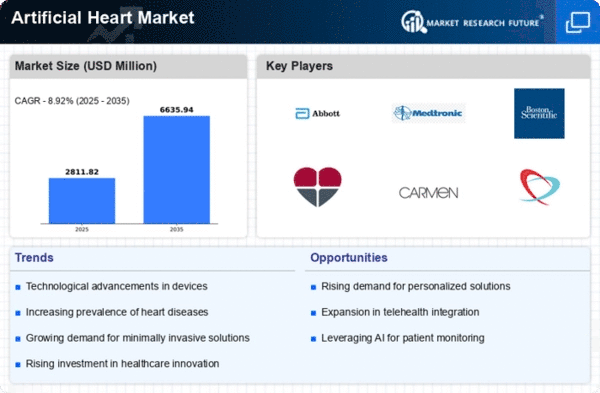
As per MRFR analysis, the Artificial Heart Market Size was estimated at 2581.55 USD Million in 2024. The Artificial Heart industry is projected to grow from 2841.4 USD Million in 2025 to 6635.94 USD Million by 2035, exhibiting a compound annual growth rate (CAGR) of 8.92% during the forecast period 2025 - 2035.

Key Market Trends & Highlights

The Artificial Heart Market is poised for substantial growth driven by technological advancements and increasing demand for heart solutions.

  • North America remains the largest market for artificial hearts, driven by advanced healthcare infrastructure and high patient awareness. The Asia-Pacific region is emerging as the fastest-growing market, fueled by rising healthcare investments and a growing aging population. Heart Failure Management is the largest segment, while the Partial Artificial Heart segment is experiencing the fastest growth due to innovative designs and improved patient outcomes. Technological advancements and increased demand for heart solutions are key drivers propelling market expansion.

Market Size & Forecast

2024 Market Size 2581.55 (USD Million)
2035 Market Size 6635.94 (USD Million)
CAGR (2025 - 2035) 8.92%
Largest Regional Market Share in 2024 North America

Major Players

<p>Abbott Laboratories (US), Medtronic (US), Boston Scientific (US), Cleveland Heart (US), Carmen (DE), SynCardia Systems (US), Jarvik Heart (US), Aortech International (GB), Terumo Corporation (JP)</p>

Market Trends

The Artificial Heart Market is currently experiencing a transformative phase, driven by advancements in technology and increasing demand for innovative cardiac solutions. As healthcare systems evolve, the focus on improving patient outcomes has intensified, leading to a surge in research and development activities. This market is characterized by a growing interest in biocompatible materials and miniaturized devices, which are designed to enhance the quality of life for individuals suffering from severe heart conditions. Furthermore, the integration of artificial intelligence and machine learning into cardiac devices is paving the way for more personalized treatment options, potentially revolutionizing patient care. In addition to technological advancements, the Artificial Heart Market is influenced by demographic shifts and rising awareness regarding heart diseases. An aging population, coupled with lifestyle changes, has resulted in an increased prevalence of cardiovascular disorders. This trend underscores the necessity for effective interventions, thereby propelling the demand for artificial hearts. Moreover, collaborations between medical device manufacturers and healthcare providers are likely to foster innovation and streamline the adoption of these life-saving technologies. As the market continues to evolve, it appears poised for substantial growth, driven by a confluence of factors that prioritize patient-centric solutions and technological integration.

Technological Advancements

The Artificial Heart Market is witnessing rapid technological innovations, particularly in the development of smaller, more efficient devices. These advancements are aimed at improving patient comfort and enhancing device longevity, which may lead to better health outcomes.

Increased Demand for Heart Solutions

There is a growing demand for artificial hearts due to the rising incidence of heart diseases. This trend is likely to drive market expansion as healthcare providers seek effective solutions to address the needs of patients with severe cardiac conditions.

Collaborative Efforts in Research

Collaborations between various stakeholders, including medical device companies and research institutions, are becoming more prevalent. These partnerships may facilitate the development of cutting-edge technologies and promote the integration of artificial hearts into standard treatment protocols.

Artificial Heart Market Market Drivers

Rising Prevalence of Cardiovascular Diseases

The increasing incidence of cardiovascular diseases globally is a primary driver for the Global Artificial Heart Market Industry. As heart-related ailments continue to escalate, the demand for advanced cardiac solutions, including artificial hearts, is likely to rise. In 2024, the market is projected to reach 5 USD Billion, reflecting the urgent need for innovative treatments. This trend is expected to persist as the World Health Organization indicates that cardiovascular diseases remain the leading cause of death worldwide. Consequently, healthcare systems are compelled to invest in artificial heart technologies to address this growing health crisis.

Market Segment Insights

By Application: Cardiac Replacement (Largest) vs. Heart Failure Management (Fastest-Growing)

<p>The Artificial Heart Market shows a diverse application distribution among its core segments. Currently, Cardiac Replacement holds the largest share, primarily due to its established technology and widespread adoption across healthcare facilities. Other segments like Cardiac Support and Heart Valve Replacement also play critical roles, but they do not match the dominant position of Cardiac Replacement, which benefits from ongoing innovations and extensive clinical use. Heart Failure Management, while smaller traditionally, is witnessing rapid adoption as new therapies and devices emerge to address this chronic condition.</p>

<p>Cardiac Replacement: Dominant vs. Heart Failure Management: Emerging</p>

<p>Cardiac Replacement technology remains at the forefront of the Artificial Heart Market, representing a well-established category characterized by advanced implantable devices designed to replace the failing heart. Major manufacturers have invested heavily in research and development to enhance the efficiency and longevity of these devices, ensuring their dominance. On the other hand, Heart Failure Management is an emerging segment that is rapidly gaining traction as awareness about heart diseases increases. Innovations such as wearable devices and telehealth solutions are propelling this segment forward, making it an important area of growth for future developments in the artificial heart field.</p>

By Type: Total Artificial Heart (Largest) vs. Ventricular Assist Device (Fastest-Growing)

<p>The Artificial Heart Market is marked by a diverse range of segment values, including Total Artificial Heart, Partial Artificial Heart, <a href="https://www.marketresearchfuture.com/reports/ventricular-assist-devices-market-9777" target="_blank" title="ventricular assist devices">Ventricular Assist Devices</a> (VAD), and Biventricular Assist Devices (BiVAD). Among these, the Total Artificial Heart stands out as the largest segment, commanding significant attention due to increasing patient needs globally. Moreover, the Ventricular Assist Device segment is rapidly gaining traction, driven by technological advancements and an expanding base of heart failure patients requiring mechanical circulatory support. Growth trends within this market reveal that the demand for both Total Artificial Hearts and VADs is rising, as healthcare providers recognize their essential roles in treating severe heart conditions. The aging population and higher incidence rates of cardiovascular diseases are pivotal drivers fueling market expansion. Additionally, innovations in device technology aim to improve patient outcomes and prolong device longevity, further enhancing their appeal to both clinicians and patients alike.</p>

<p>Device: Total Artificial Heart (Dominant) vs. Ventricular Assist Device (Emerging)</p>

<p>The Total Artificial Heart represents a dominant force within the Artificial Heart Market, providing a comprehensive solution for patients with end-stage heart failure. Its design allows for a complete replacement of the heart, ensuring essential functions are maintained. On the other hand, Ventricular Assist Devices are emerging as critical tools for patients awaiting <a href="https://www.marketresearchfuture.com/reports/heart-transplant-market-1836" target="_blank" title="heart transplant">heart transplants</a> or those not candidates for transplant altogether. These devices assist the heart’s function, thus enabling patients to maintain a better quality of life. As innovations continue to evolve in both areas, the classification of Ventricular Assist Devices as an emerging segment underscores the potential for significant growth driven by technological enhancements, increased investment, and heightened awareness among healthcare professionals.</p>

By End User: Hospitals (Largest) vs. Ambulatory Surgical Centers (Fastest-Growing)

<p>In the Artificial Heart Market, the primary end user segment is dominated by hospitals, which account for the largest share due to their comprehensive cardiac care facilities and advanced technology. These institutions are equipped to handle complex surgical procedures, and the necessity for emergency services further cements their position. Following closely are ambulatory surgical centers, which are gaining traction as a cost-effective and patient-friendly option for less critical procedures, enhancing accessibility and convenience for patients seeking artificial heart interventions.</p>

<p>Hospitals (Dominant) vs. Ambulatory Surgical Centers (Emerging)</p>

<p>Hospitals serve as the dominant end user in the Artificial Heart Market, primarily due to their extensive resources, specialized healthcare professionals, and ability to provide a wide range of cardiac interventions. They are typically equipped with advanced imaging and monitoring technologies, facilitating complex surgical procedures that are essential for effective patient care. Conversely, ambulatory surgical centers are emerging as a preferred alternative for many patients, offering minimally invasive procedures with shorter recovery times and lower costs. This growth is attributed to the increasing demand for outpatient services and advancements in medical technology, which make it feasible to perform sophisticated interventions outside traditional hospital settings.</p>

Get more detailed insights about Artificial Heart Market Research Report - Forecast till 2035

Regional Insights

North America : Market Leader in Innovation

North America continues to lead the artificial heart market, holding a significant share of approximately 1290.78 million in 2024. The region's growth is driven by advanced healthcare infrastructure, increasing prevalence of cardiovascular diseases, and robust investment in medical technology. Regulatory support from agencies like the FDA further catalyzes innovation and market expansion, ensuring that cutting-edge solutions are rapidly adopted to meet patient needs. The competitive landscape in North America is characterized by the presence of major players such as Abbott Laboratories, Medtronic, and Boston Scientific. These companies are at the forefront of technological advancements, offering a range of artificial heart solutions. The U.S. remains the largest market, with a strong focus on research and development, while Canada and Mexico are also emerging as key players in the adoption of artificial heart technologies. The region's commitment to improving patient outcomes drives continuous growth in this sector.

Europe : Emerging Market with Potential

Europe's artificial heart market is valued at 780.93M, reflecting a growing demand for advanced cardiac solutions. Factors such as an aging population, rising healthcare investments, and increasing awareness of heart diseases are driving market growth. Regulatory frameworks in countries like Germany and France are becoming more supportive, facilitating faster approvals for new technologies. Leading countries include Germany, France, and the UK, where major players like Aortech International and CorWave are making significant strides. The competitive landscape is evolving, with a mix of established artificial heart companies and innovative startups. The European market is poised for growth as healthcare systems adapt to new technologies and patient needs.

Asia-Pacific : Rapidly Growing Market

The Asia-Pacific region, with a market size of 400.0M, is experiencing rapid growth in the artificial heart sector. Key drivers include increasing urbanization, rising disposable incomes, and a growing prevalence of heart diseases. Governments are investing in healthcare infrastructure, which is expected to enhance access to advanced medical technologies. Regulatory bodies are also working to streamline approval processes for new devices. Artificial heart market Japan, China, and India are leading the charge, with a mix of local and international players entering the market. However, the artificial heart transplant cost in India is currently much higher and cannot be afforded by common people. Artificial heart companies such as SynCardia Systems and Jarvik Heart are expanding their presence, contributing to a competitive landscape that is becoming increasingly dynamic and innovative.

Middle East and Africa : Emerging Market Opportunities

The Middle East and Africa (MEA) region is gradually emerging in the artificial heart market, with a market size of approximately 99.22 million projected for 2025. The growth is driven by increasing healthcare investments, rising awareness of cardiovascular diseases, and the establishment of specialized cardiac care facilities. Governments in the region are focusing on improving healthcare infrastructure, which is expected to enhance access to advanced medical technologies, including artificial hearts. Countries like South Africa and the UAE are leading the market, with a growing number of healthcare initiatives aimed at improving patient outcomes. The competitive landscape is evolving, with both local and international players seeking to establish a foothold in this emerging market. As healthcare systems in the MEA region continue to develop, the demand for artificial heart solutions is anticipated to grow significantly, presenting numerous opportunities for market players.

Key Players and Competitive Insights

The Artificial Heart Market is currently characterized by a dynamic competitive landscape, driven by technological advancements, increasing prevalence of cardiovascular diseases, and a growing aging population. Key players such as Abbott Laboratories (US), Medtronic (US), and SynCardia Systems (US) are at the forefront, each adopting distinct strategies to enhance their market positioning. Abbott Laboratories (US) focuses on innovation through the development of next-generation heart devices, while Medtronic (US) emphasizes strategic partnerships to expand its product offerings. SynCardia Systems (US) is leveraging its expertise in total artificial hearts to capture a larger market share, indicating a trend towards specialization among leading firms.


The business tactics employed by these companies include localizing manufacturing to reduce cost of artificial heart and optimize supply chains, which is particularly crucial in a moderately fragmented market. This competitive structure allows for a diverse range of products and solutions, fostering innovation while also presenting challenges in terms of market share distribution. The collective influence of these key players shapes the market dynamics, as they vie for leadership through differentiated offerings and strategic collaborations.


In November Medtronic (US) announced a strategic partnership with a leading research institution to develop AI-driven algorithms for optimizing heart pump performance. This collaboration is poised to enhance patient monitoring and device efficiency, reflecting a broader trend towards integrating artificial intelligence in medical devices. Such initiatives may not only improve clinical outcomes but also position Medtronic as a leader in the digital transformation of cardiac care.


In October 2025, Abbott Laboratories (US) launched a new line of minimally invasive heart pumps designed to cater to a wider range of patients, including those with complex medical histories. This initiative underscores Abbott's commitment to expanding access to life-saving technologies, potentially increasing their market share in the artificial heart segment. The focus on minimally invasive solutions aligns with current healthcare trends that prioritize patient comfort and recovery times. The company also emphasizes the reduction of artificial heart cost.


In September 2025, SynCardia Systems (US) received FDA approval for its latest total artificial heart model, which features enhanced biocompatibility and durability. This approval not only validates SynCardia's innovative approach but also positions the company to capture a larger segment of the market as demand for reliable artificial heart solutions continues to grow. The strategic importance of this approval lies in its potential to significantly improve patient quality of life and reduce long-term artificial heart price.


As of December the Artificial Heart Market is witnessing trends that emphasize digitalization, sustainability, and the integration of AI technologies. Strategic alliances are becoming increasingly pivotal, as companies collaborate to enhance their technological capabilities and market reach. The competitive differentiation is likely to evolve from traditional price-based competition to a focus on innovation, technological advancements, and supply chain reliability, suggesting a transformative phase for the industry.

Key Companies in the Artificial Heart Market include

Industry Developments

  • Q2 2024: SynCardia Announces FDA Approval for Next-Generation Total Artificial Heart Market SynCardia Systems received FDA approval for its next-generation Total Artificial Heart Market, designed to improve patient outcomes and device durability. The approval marks a significant milestone for the artificial heart company and expands treatment options for patients with end-stage heart failure.
  • Q1 2024: Carmat Receives CE Mark Extension for Aeson Artificial Heart Market Carmat announced that it has received an extension of its CE Mark for the Aeson artificial heart, allowing continued commercial sales and use in European markets. The extension supports ongoing adoption of the device for patients with advanced heart failure.
  • Q2 2024: Carmat Resumes Aeson Artificial Heart Market Production After Manufacturing Suspension Carmat resumed production of its Aeson artificial heart following a temporary suspension due to quality control issues. The artificial heart company implemented corrective actions and received regulatory clearance to restart manufacturing and distribution.
  • Q2 2024: SynCardia Systems Appoints New CEO to Drive Global Expansion SynCardia Systems announced the appointment of a new Chief Executive Officer, aiming to accelerate the company's global expansion and commercialization of its artificial heart technologies.
  • Q1 2024: Carmat Raises €30 Million to Fund Artificial Heart Market Commercialization Carmat completed a €30 million funding round to support the commercialization and scale-up of its Aeson artificial heart in Europe and other markets.
  • Q2 2024: Carmat Signs Distribution Agreement for Aeson Artificial Heart Market in Italy Carmat entered into a distribution agreement with a leading Italian medical device distributor to expand the availability of the Aeson artificial heart in Italy.
  • Q1 2024: FDA Grants Breakthrough Device Designation to BiVACOR Total Artificial Heart Market The FDA granted Breakthrough Device Designation to BiVACOR's Total Artificial Heart Market, recognizing its potential to provide more effective treatment for patients with severe heart failure. This elevates BiVACOR stocks in the market.
  • Q2 2024: BiVACOR stock surges, as BiVACOR Announces First Human Implantation of Total Artificial Heart Market in U.S. Clinical Trial BiVACOR announced the successful first human implantation of its Total Artificial Heart Market as part of a U.S. clinical trial, marking a major milestone in the development of next-generation artificial heart technology.
  • Q2 2024: Carmat Opens New Manufacturing Facility for Aeson Artificial Heart Market Carmat inaugurated a new manufacturing facility dedicated to the production of its Aeson artificial heart, aiming to increase capacity and meet growing demand in Europe.
  • Q1 2024: SynCardia Systems Expands Distribution Network in Asia-Pacific SynCardia Systems announced the expansion of its distribution network in the Asia-Pacific region, partnering with local medical device companies to increase access to its Total Artificial Heart Market.
  • Q2 2024: Carmat Signs Strategic Partnership with Leading U.S. Cardiac Center Carmat entered into a strategic partnership with a major U.S. cardiac center to advance clinical research and adoption of the Aeson artificial heart in the United States.
  • Q1 2024: BiVACOR Secures $22 Million in Series B Funding to Advance Artificial Heart Market Development BiVACOR raised $22 million in Series B funding to accelerate the development and clinical testing of its Total Artificial Heart Market, supporting ongoing trials and regulatory submissions.

Future Outlook

Artificial Heart Market Future Outlook

<p>The Artificial Heart Market is projected to grow at an 8.92% CAGR from 2025 to 2035, driven by technological advancements, increasing prevalence of heart diseases, and rising healthcare expenditure.</p>

New opportunities lie in:

  • <p>Development of miniaturized artificial hearts for outpatient care Integration of AI for personalized patient monitoring Expansion into emerging markets with tailored financing options</p>

<p>By 2035, the market is expected to achieve substantial growth, driven by innovation and strategic expansion.</p>

Market Segmentation

Artificial Heart Market Type Outlook

  • Total Artificial Heart
  • Partial Artificial Heart
  • Ventricular Assist Device
  • Biventricular Assist Device

Artificial Heart Market End User Outlook

  • Hospitals
  • Ambulatory Surgical Centers
  • Specialty Clinics
  • Home Care Settings

Artificial Heart Market Application Outlook

  • Cardiac Replacement
  • Cardiac Support
  • Heart Valve Replacement
  • Heart Failure Management

Report Scope

MARKET SIZE 2024 2581.55(USD Million)
MARKET SIZE 2025 2841.4(USD Million)
MARKET SIZE 2035 6635.94(USD Million)
COMPOUND ANNUAL GROWTH RATE (CAGR) 8.92% (2025 - 2035)
REPORT COVERAGE Revenue Forecast, Competitive Landscape, Growth Factors, and Trends
BASE YEAR 2024
Market Forecast Period 2025 - 2035
Historical Data 2019 - 2024
Market Forecast Units USD Million
Key Companies Profiled Abbott Laboratories (US), Medtronic (US), Boston Scientific (US), Cleveland Heart (US), Carmen (DE), SynCardia Systems (US), Jarvik Heart (US), Aortech International (GB), Terumo Corporation (JP)
Segments Covered Application, Type, End User
Key Market Opportunities Advancements in biocompatible materials enhance performance and patient outcomes in the Artificial Heart Market.
Key Market Dynamics Technological advancements and regulatory changes drive innovation and competition in the Artificial Heart Market.
Countries Covered North America, Europe, APAC, South America, MEA

FAQs

What is the current valuation of the Artificial Heart Market as of 2024?

<p>The overall market valuation was 2581.55 USD Million in 2024.</p>

What is the projected market valuation for the Artificial Heart Market in 2035?

<p>The projected valuation for 2035 is 6635.94 USD Million.</p>

What is the expected CAGR for the Artificial Heart Market during the forecast period 2025 - 2035?

<p>The expected CAGR for the Artificial Heart Market during the forecast period 2025 - 2035 is 8.92%.</p>

Which companies are considered key players in the Artificial Heart Market?

<p>Key players in the market include Abbott Laboratories, Medtronic, Boston Scientific, Cleveland Heart, Carmen Health, SynCardia Systems, Jarvik Heart, Aortech International, and CorWave.</p>

What are the main applications of artificial hearts in the market?

<p>The main applications include Cardiac Replacement, Cardiac Support, Heart Valve Replacement, and Heart Failure Management.</p>

What was the market size for Cardiac Support applications in 2024?

The market size for Cardiac Support applications was 800.0 USD Million in 2024.

How does the market for Ventricular Assist Devices compare to other types?

The market for Ventricular Assist Devices was 1032.62 USD Million in 2024, indicating a strong position compared to other types.

What is the projected market size for Home Care Settings by 2035?

The projected market size for Home Care Settings is expected to reach 1840.94 USD Million by 2035.

Which end-user segment had the highest market size in 2024?

In 2024, the Hospitals segment had the highest market size at 1036.62 USD Million.

What is the anticipated growth for Partial Artificial Hearts from 2025 to 2035?

The market for Partial Artificial Hearts is projected to grow from 774.46 USD Million in 2024 to 2000.0 USD Million by 2035.

  1. SECTION I: EXECUTIVE SUMMARY AND KEY HIGHLIGHTS
    1. | 1.1 EXECUTIVE SUMMARY
    2. | | 1.1.1 Market Overview
    3. | | 1.1.2 Key Findings
    4. | | 1.1.3 Market Segmentation
    5. | | 1.1.4 Competitive Landscape
    6. | | 1.1.5 Challenges and Opportunities
    7. | | 1.1.6 Future Outlook
  2. SECTION II: SCOPING, METHODOLOGY AND MARKET STRUCTURE
    1. | 2.1 MARKET INTRODUCTION
    2. | | 2.1.1 Definition
    3. | | 2.1.2 Scope of the study
    4. | | | 2.1.2.1 Research Objective
    5. | | | 2.1.2.2 Assumption
    6. | | | 2.1.2.3 Limitations
    7. | 2.2 RESEARCH METHODOLOGY
    8. | | 2.2.1 Overview
    9. | | 2.2.2 Data Mining
    10. | | 2.2.3 Secondary Research
    11. | | 2.2.4 Primary Research
    12. | | | 2.2.4.1 Primary Interviews and Information Gathering Process
    13. | | | 2.2.4.2 Breakdown of Primary Respondents
    14. | | 2.2.5 Forecasting Model
    15. | | 2.2.6 Market Size Estimation
    16. | | | 2.2.6.1 Bottom-Up Approach
    17. | | | 2.2.6.2 Top-Down Approach
    18. | | 2.2.7 Data Triangulation
    19. | | 2.2.8 Validation
  3. SECTION III: QUALITATIVE ANALYSIS
    1. | 3.1 MARKET DYNAMICS
    2. | | 3.1.1 Overview
    3. | | 3.1.2 Drivers
    4. | | 3.1.3 Restraints
    5. | | 3.1.4 Opportunities
    6. | 3.2 MARKET FACTOR ANALYSIS
    7. | | 3.2.1 Value chain Analysis
    8. | | 3.2.2 Porter's Five Forces Analysis
    9. | | | 3.2.2.1 Bargaining Power of Suppliers
    10. | | | 3.2.2.2 Bargaining Power of Buyers
    11. | | | 3.2.2.3 Threat of New Entrants
    12. | | | 3.2.2.4 Threat of Substitutes
    13. | | | 3.2.2.5 Intensity of Rivalry
    14. | | 3.2.3 COVID-19 Impact Analysis
    15. | | | 3.2.3.1 Market Impact Analysis
    16. | | | 3.2.3.2 Regional Impact
    17. | | | 3.2.3.3 Opportunity and Threat Analysis
  4. SECTION IV: QUANTITATIVE ANALYSIS
    1. | 4.1 Healthcare, BY Application (USD Million)
    2. | | 4.1.1 Cardiac Replacement
    3. | | 4.1.2 Cardiac Support
    4. | | 4.1.3 Heart Valve Replacement
    5. | | 4.1.4 Heart Failure Management
    6. | 4.2 Healthcare, BY Type (USD Million)
    7. | | 4.2.1 Total Artificial Heart
    8. | | 4.2.2 Partial Artificial Heart
    9. | | 4.2.3 Ventricular Assist Device
    10. | | 4.2.4 Biventricular Assist Device
    11. | 4.3 Healthcare, BY End User (USD Million)
    12. | | 4.3.1 Hospitals
    13. | | 4.3.2 Ambulatory Surgical Centers
    14. | | 4.3.3 Home Care Settings
    15. | 4.4 Healthcare, BY Region (USD Million)
    16. | | 4.4.1 North America
    17. | | | 4.4.1.1 US
    18. | | | 4.4.1.2 Canada
    19. | | 4.4.2 Europe
    20. | | | 4.4.2.1 Germany
    21. | | | 4.4.2.2 UK
    22. | | | 4.4.2.3 France
    23. | | | 4.4.2.4 Russia
    24. | | | 4.4.2.5 Italy
    25. | | | 4.4.2.6 Spain
    26. | | | 4.4.2.7 Rest of Europe
    27. | | 4.4.3 APAC
    28. | | | 4.4.3.1 China
    29. | | | 4.4.3.2 India
    30. | | | 4.4.3.3 Japan
    31. | | | 4.4.3.4 South Korea
    32. | | | 4.4.3.5 Malaysia
    33. | | | 4.4.3.6 Thailand
    34. | | | 4.4.3.7 Indonesia
    35. | | | 4.4.3.8 Rest of APAC
    36. | | 4.4.4 South America
    37. | | | 4.4.4.1 Brazil
    38. | | | 4.4.4.2 Mexico
    39. | | | 4.4.4.3 Argentina
    40. | | | 4.4.4.4 Rest of South America
    41. | | 4.4.5 MEA
    42. | | | 4.4.5.1 GCC Countries
    43. | | | 4.4.5.2 South Africa
    44. | | | 4.4.5.3 Rest of MEA
  5. SECTION V: COMPETITIVE ANALYSIS
    1. | 5.1 Competitive Landscape
    2. | | 5.1.1 Overview
    3. | | 5.1.2 Competitive Analysis
    4. | | 5.1.3 Market share Analysis
    5. | | 5.1.4 Major Growth Strategy in the Healthcare
    6. | | 5.1.5 Competitive Benchmarking
    7. | | 5.1.6 Leading Players in Terms of Number of Developments in the Healthcare
    8. | | 5.1.7 Key developments and growth strategies
    9. | | | 5.1.7.1 New Product Launch/Service Deployment
    10. | | | 5.1.7.2 Merger & Acquisitions
    11. | | | 5.1.7.3 Joint Ventures
    12. | | 5.1.8 Major Players Financial Matrix
    13. | | | 5.1.8.1 Sales and Operating Income
    14. | | | 5.1.8.2 Major Players R&D Expenditure. 2023
    15. | 5.2 Company Profiles
    16. | | 5.2.1 Abbott Laboratories (US)
    17. | | | 5.2.1.1 Financial Overview
    18. | | | 5.2.1.2 Products Offered
    19. | | | 5.2.1.3 Key Developments
    20. | | | 5.2.1.4 SWOT Analysis
    21. | | | 5.2.1.5 Key Strategies
    22. | | 5.2.2 Medtronic (US)
    23. | | | 5.2.2.1 Financial Overview
    24. | | | 5.2.2.2 Products Offered
    25. | | | 5.2.2.3 Key Developments
    26. | | | 5.2.2.4 SWOT Analysis
    27. | | | 5.2.2.5 Key Strategies
    28. | | 5.2.3 Boston Scientific (US)
    29. | | | 5.2.3.1 Financial Overview
    30. | | | 5.2.3.2 Products Offered
    31. | | | 5.2.3.3 Key Developments
    32. | | | 5.2.3.4 SWOT Analysis
    33. | | | 5.2.3.5 Key Strategies
    34. | | 5.2.4 Cleveland Heart (US)
    35. | | | 5.2.4.1 Financial Overview
    36. | | | 5.2.4.2 Products Offered
    37. | | | 5.2.4.3 Key Developments
    38. | | | 5.2.4.4 SWOT Analysis
    39. | | | 5.2.4.5 Key Strategies
    40. | | 5.2.5 Carmen Health (US)
    41. | | | 5.2.5.1 Financial Overview
    42. | | | 5.2.5.2 Products Offered
    43. | | | 5.2.5.3 Key Developments
    44. | | | 5.2.5.4 SWOT Analysis
    45. | | | 5.2.5.5 Key Strategies
    46. | | 5.2.6 SynCardia Systems (US)
    47. | | | 5.2.6.1 Financial Overview
    48. | | | 5.2.6.2 Products Offered
    49. | | | 5.2.6.3 Key Developments
    50. | | | 5.2.6.4 SWOT Analysis
    51. | | | 5.2.6.5 Key Strategies
    52. | | 5.2.7 Jarvik Heart (US)
    53. | | | 5.2.7.1 Financial Overview
    54. | | | 5.2.7.2 Products Offered
    55. | | | 5.2.7.3 Key Developments
    56. | | | 5.2.7.4 SWOT Analysis
    57. | | | 5.2.7.5 Key Strategies
    58. | | 5.2.8 Aortech International (GB)
    59. | | | 5.2.8.1 Financial Overview
    60. | | | 5.2.8.2 Products Offered
    61. | | | 5.2.8.3 Key Developments
    62. | | | 5.2.8.4 SWOT Analysis
    63. | | | 5.2.8.5 Key Strategies
    64. | | 5.2.9 CorWave (FR)
    65. | | | 5.2.9.1 Financial Overview
    66. | | | 5.2.9.2 Products Offered
    67. | | | 5.2.9.3 Key Developments
    68. | | | 5.2.9.4 SWOT Analysis
    69. | | | 5.2.9.5 Key Strategies
    70. | 5.3 Appendix
    71. | | 5.3.1 References
    72. | | 5.3.2 Related Reports
  6. LIST OF FIGURES
    1. | 6.1 MARKET SYNOPSIS
    2. | 6.2 NORTH AMERICA MARKET ANALYSIS
    3. | 6.3 US MARKET ANALYSIS BY APPLICATION
    4. | 6.4 US MARKET ANALYSIS BY TYPE
    5. | 6.5 US MARKET ANALYSIS BY END USER
    6. | 6.6 CANADA MARKET ANALYSIS BY APPLICATION
    7. | 6.7 CANADA MARKET ANALYSIS BY TYPE
    8. | 6.8 CANADA MARKET ANALYSIS BY END USER
    9. | 6.9 EUROPE MARKET ANALYSIS
    10. | 6.10 GERMANY MARKET ANALYSIS BY APPLICATION
    11. | 6.11 GERMANY MARKET ANALYSIS BY TYPE
    12. | 6.12 GERMANY MARKET ANALYSIS BY END USER
    13. | 6.13 UK MARKET ANALYSIS BY APPLICATION
    14. | 6.14 UK MARKET ANALYSIS BY TYPE
    15. | 6.15 UK MARKET ANALYSIS BY END USER
    16. | 6.16 FRANCE MARKET ANALYSIS BY APPLICATION
    17. | 6.17 FRANCE MARKET ANALYSIS BY TYPE
    18. | 6.18 FRANCE MARKET ANALYSIS BY END USER
    19. | 6.19 RUSSIA MARKET ANALYSIS BY APPLICATION
    20. | 6.20 RUSSIA MARKET ANALYSIS BY TYPE
    21. | 6.21 RUSSIA MARKET ANALYSIS BY END USER
    22. | 6.22 ITALY MARKET ANALYSIS BY APPLICATION
    23. | 6.23 ITALY MARKET ANALYSIS BY TYPE
    24. | 6.24 ITALY MARKET ANALYSIS BY END USER
    25. | 6.25 SPAIN MARKET ANALYSIS BY APPLICATION
    26. | 6.26 SPAIN MARKET ANALYSIS BY TYPE
    27. | 6.27 SPAIN MARKET ANALYSIS BY END USER
    28. | 6.28 REST OF EUROPE MARKET ANALYSIS BY APPLICATION
    29. | 6.29 REST OF EUROPE MARKET ANALYSIS BY TYPE
    30. | 6.30 REST OF EUROPE MARKET ANALYSIS BY END USER
    31. | 6.31 APAC MARKET ANALYSIS
    32. | 6.32 CHINA MARKET ANALYSIS BY APPLICATION
    33. | 6.33 CHINA MARKET ANALYSIS BY TYPE
    34. | 6.34 CHINA MARKET ANALYSIS BY END USER
    35. | 6.35 INDIA MARKET ANALYSIS BY APPLICATION
    36. | 6.36 INDIA MARKET ANALYSIS BY TYPE
    37. | 6.37 INDIA MARKET ANALYSIS BY END USER
    38. | 6.38 JAPAN MARKET ANALYSIS BY APPLICATION
    39. | 6.39 JAPAN MARKET ANALYSIS BY TYPE
    40. | 6.40 JAPAN MARKET ANALYSIS BY END USER
    41. | 6.41 SOUTH KOREA MARKET ANALYSIS BY APPLICATION
    42. | 6.42 SOUTH KOREA MARKET ANALYSIS BY TYPE
    43. | 6.43 SOUTH KOREA MARKET ANALYSIS BY END USER
    44. | 6.44 MALAYSIA MARKET ANALYSIS BY APPLICATION
    45. | 6.45 MALAYSIA MARKET ANALYSIS BY TYPE
    46. | 6.46 MALAYSIA MARKET ANALYSIS BY END USER
    47. | 6.47 THAILAND MARKET ANALYSIS BY APPLICATION
    48. | 6.48 THAILAND MARKET ANALYSIS BY TYPE
    49. | 6.49 THAILAND MARKET ANALYSIS BY END USER
    50. | 6.50 INDONESIA MARKET ANALYSIS BY APPLICATION
    51. | 6.51 INDONESIA MARKET ANALYSIS BY TYPE
    52. | 6.52 INDONESIA MARKET ANALYSIS BY END USER
    53. | 6.53 REST OF APAC MARKET ANALYSIS BY APPLICATION
    54. | 6.54 REST OF APAC MARKET ANALYSIS BY TYPE
    55. | 6.55 REST OF APAC MARKET ANALYSIS BY END USER
    56. | 6.56 SOUTH AMERICA MARKET ANALYSIS
    57. | 6.57 BRAZIL MARKET ANALYSIS BY APPLICATION
    58. | 6.58 BRAZIL MARKET ANALYSIS BY TYPE
    59. | 6.59 BRAZIL MARKET ANALYSIS BY END USER
    60. | 6.60 MEXICO MARKET ANALYSIS BY APPLICATION
    61. | 6.61 MEXICO MARKET ANALYSIS BY TYPE
    62. | 6.62 MEXICO MARKET ANALYSIS BY END USER
    63. | 6.63 ARGENTINA MARKET ANALYSIS BY APPLICATION
    64. | 6.64 ARGENTINA MARKET ANALYSIS BY TYPE
    65. | 6.65 ARGENTINA MARKET ANALYSIS BY END USER
    66. | 6.66 REST OF SOUTH AMERICA MARKET ANALYSIS BY APPLICATION
    67. | 6.67 REST OF SOUTH AMERICA MARKET ANALYSIS BY TYPE
    68. | 6.68 REST OF SOUTH AMERICA MARKET ANALYSIS BY END USER
    69. | 6.69 MEA MARKET ANALYSIS
    70. | 6.70 GCC COUNTRIES MARKET ANALYSIS BY APPLICATION
    71. | 6.71 GCC COUNTRIES MARKET ANALYSIS BY TYPE
    72. | 6.72 GCC COUNTRIES MARKET ANALYSIS BY END USER
    73. | 6.73 SOUTH AFRICA MARKET ANALYSIS BY APPLICATION
    74. | 6.74 SOUTH AFRICA MARKET ANALYSIS BY TYPE
    75. | 6.75 SOUTH AFRICA MARKET ANALYSIS BY END USER
    76. | 6.76 REST OF MEA MARKET ANALYSIS BY APPLICATION
    77. | 6.77 REST OF MEA MARKET ANALYSIS BY TYPE
    78. | 6.78 REST OF MEA MARKET ANALYSIS BY END USER
    79. | 6.79 KEY BUYING CRITERIA OF HEALTHCARE
    80. | 6.80 RESEARCH PROCESS OF MRFR
    81. | 6.81 DRO ANALYSIS OF HEALTHCARE
    82. | 6.82 DRIVERS IMPACT ANALYSIS: HEALTHCARE
    83. | 6.83 RESTRAINTS IMPACT ANALYSIS: HEALTHCARE
    84. | 6.84 SUPPLY / VALUE CHAIN: HEALTHCARE
    85. | 6.85 HEALTHCARE, BY APPLICATION, 2024 (% SHARE)
    86. | 6.86 HEALTHCARE, BY APPLICATION, 2024 TO 2035 (USD Million)
    87. | 6.87 HEALTHCARE, BY TYPE, 2024 (% SHARE)
    88. | 6.88 HEALTHCARE, BY TYPE, 2024 TO 2035 (USD Million)
    89. | 6.89 HEALTHCARE, BY END USER, 2024 (% SHARE)
    90. | 6.90 HEALTHCARE, BY END USER, 2024 TO 2035 (USD Million)
    91. | 6.91 BENCHMARKING OF MAJOR COMPETITORS
  7. LIST OF TABLES
    1. | 7.1 LIST OF ASSUMPTIONS
    2. | | 7.1.1
    3. | 7.2 North America MARKET SIZE ESTIMATES; FORECAST
    4. | | 7.2.1 BY APPLICATION, 2025-2035 (USD Million)
    5. | | 7.2.2 BY TYPE, 2025-2035 (USD Million)
    6. | | 7.2.3 BY END USER, 2025-2035 (USD Million)
    7. | 7.3 US MARKET SIZE ESTIMATES; FORECAST
    8. | | 7.3.1 BY APPLICATION, 2025-2035 (USD Million)
    9. | | 7.3.2 BY TYPE, 2025-2035 (USD Million)
    10. | | 7.3.3 BY END USER, 2025-2035 (USD Million)
    11. | 7.4 Canada MARKET SIZE ESTIMATES; FORECAST
    12. | | 7.4.1 BY APPLICATION, 2025-2035 (USD Million)
    13. | | 7.4.2 BY TYPE, 2025-2035 (USD Million)
    14. | | 7.4.3 BY END USER, 2025-2035 (USD Million)
    15. | 7.5 Europe MARKET SIZE ESTIMATES; FORECAST
    16. | | 7.5.1 BY APPLICATION, 2025-2035 (USD Million)
    17. | | 7.5.2 BY TYPE, 2025-2035 (USD Million)
    18. | | 7.5.3 BY END USER, 2025-2035 (USD Million)
    19. | 7.6 Germany MARKET SIZE ESTIMATES; FORECAST
    20. | | 7.6.1 BY APPLICATION, 2025-2035 (USD Million)
    21. | | 7.6.2 BY TYPE, 2025-2035 (USD Million)
    22. | | 7.6.3 BY END USER, 2025-2035 (USD Million)
    23. | 7.7 UK MARKET SIZE ESTIMATES; FORECAST
    24. | | 7.7.1 BY APPLICATION, 2025-2035 (USD Million)
    25. | | 7.7.2 BY TYPE, 2025-2035 (USD Million)
    26. | | 7.7.3 BY END USER, 2025-2035 (USD Million)
    27. | 7.8 France MARKET SIZE ESTIMATES; FORECAST
    28. | | 7.8.1 BY APPLICATION, 2025-2035 (USD Million)
    29. | | 7.8.2 BY TYPE, 2025-2035 (USD Million)
    30. | | 7.8.3 BY END USER, 2025-2035 (USD Million)
    31. | 7.9 Russia MARKET SIZE ESTIMATES; FORECAST
    32. | | 7.9.1 BY APPLICATION, 2025-2035 (USD Million)
    33. | | 7.9.2 BY TYPE, 2025-2035 (USD Million)
    34. | | 7.9.3 BY END USER, 2025-2035 (USD Million)
    35. | 7.10 Italy MARKET SIZE ESTIMATES; FORECAST
    36. | | 7.10.1 BY APPLICATION, 2025-2035 (USD Million)
    37. | | 7.10.2 BY TYPE, 2025-2035 (USD Million)
    38. | | 7.10.3 BY END USER, 2025-2035 (USD Million)
    39. | 7.11 Spain MARKET SIZE ESTIMATES; FORECAST
    40. | | 7.11.1 BY APPLICATION, 2025-2035 (USD Million)
    41. | | 7.11.2 BY TYPE, 2025-2035 (USD Million)
    42. | | 7.11.3 BY END USER, 2025-2035 (USD Million)
    43. | 7.12 Rest of Europe MARKET SIZE ESTIMATES; FORECAST
    44. | | 7.12.1 BY APPLICATION, 2025-2035 (USD Million)
    45. | | 7.12.2 BY TYPE, 2025-2035 (USD Million)
    46. | | 7.12.3 BY END USER, 2025-2035 (USD Million)
    47. | 7.13 APAC MARKET SIZE ESTIMATES; FORECAST
    48. | | 7.13.1 BY APPLICATION, 2025-2035 (USD Million)
    49. | | 7.13.2 BY TYPE, 2025-2035 (USD Million)
    50. | | 7.13.3 BY END USER, 2025-2035 (USD Million)
    51. | 7.14 China MARKET SIZE ESTIMATES; FORECAST
    52. | | 7.14.1 BY APPLICATION, 2025-2035 (USD Million)
    53. | | 7.14.2 BY TYPE, 2025-2035 (USD Million)
    54. | | 7.14.3 BY END USER, 2025-2035 (USD Million)
    55. | 7.15 India MARKET SIZE ESTIMATES; FORECAST
    56. | | 7.15.1 BY APPLICATION, 2025-2035 (USD Million)
    57. | | 7.15.2 BY TYPE, 2025-2035 (USD Million)
    58. | | 7.15.3 BY END USER, 2025-2035 (USD Million)
    59. | 7.16 Japan MARKET SIZE ESTIMATES; FORECAST
    60. | | 7.16.1 BY APPLICATION, 2025-2035 (USD Million)
    61. | | 7.16.2 BY TYPE, 2025-2035 (USD Million)
    62. | | 7.16.3 BY END USER, 2025-2035 (USD Million)
    63. | 7.17 South Korea MARKET SIZE ESTIMATES; FORECAST
    64. | | 7.17.1 BY APPLICATION, 2025-2035 (USD Million)
    65. | | 7.17.2 BY TYPE, 2025-2035 (USD Million)
    66. | | 7.17.3 BY END USER, 2025-2035 (USD Million)
    67. | 7.18 Malaysia MARKET SIZE ESTIMATES; FORECAST
    68. | | 7.18.1 BY APPLICATION, 2025-2035 (USD Million)
    69. | | 7.18.2 BY TYPE, 2025-2035 (USD Million)
    70. | | 7.18.3 BY END USER, 2025-2035 (USD Million)
    71. | 7.19 Thailand MARKET SIZE ESTIMATES; FORECAST
    72. | | 7.19.1 BY APPLICATION, 2025-2035 (USD Million)
    73. | | 7.19.2 BY TYPE, 2025-2035 (USD Million)
    74. | | 7.19.3 BY END USER, 2025-2035 (USD Million)
    75. | 7.20 Indonesia MARKET SIZE ESTIMATES; FORECAST
    76. | | 7.20.1 BY APPLICATION, 2025-2035 (USD Million)
    77. | | 7.20.2 BY TYPE, 2025-2035 (USD Million)
    78. | | 7.20.3 BY END USER, 2025-2035 (USD Million)
    79. | 7.21 Rest of APAC MARKET SIZE ESTIMATES; FORECAST
    80. | | 7.21.1 BY APPLICATION, 2025-2035 (USD Million)
    81. | | 7.21.2 BY TYPE, 2025-2035 (USD Million)
    82. | | 7.21.3 BY END USER, 2025-2035 (USD Million)
    83. | 7.22 South America MARKET SIZE ESTIMATES; FORECAST
    84. | | 7.22.1 BY APPLICATION, 2025-2035 (USD Million)
    85. | | 7.22.2 BY TYPE, 2025-2035 (USD Million)
    86. | | 7.22.3 BY END USER, 2025-2035 (USD Million)
    87. | 7.23 Brazil MARKET SIZE ESTIMATES; FORECAST
    88. | | 7.23.1 BY APPLICATION, 2025-2035 (USD Million)
    89. | | 7.23.2 BY TYPE, 2025-2035 (USD Million)
    90. | | 7.23.3 BY END USER, 2025-2035 (USD Million)
    91. | 7.24 Mexico MARKET SIZE ESTIMATES; FORECAST
    92. | | 7.24.1 BY APPLICATION, 2025-2035 (USD Million)
    93. | | 7.24.2 BY TYPE, 2025-2035 (USD Million)
    94. | | 7.24.3 BY END USER, 2025-2035 (USD Million)
    95. | 7.25 Argentina MARKET SIZE ESTIMATES; FORECAST
    96. | | 7.25.1 BY APPLICATION, 2025-2035 (USD Million)
    97. | | 7.25.2 BY TYPE, 2025-2035 (USD Million)
    98. | | 7.25.3 BY END USER, 2025-2035 (USD Million)
    99. | 7.26 Rest of South America MARKET SIZE ESTIMATES; FORECAST
    100. | | 7.26.1 BY APPLICATION, 2025-2035 (USD Million)
    101. | | 7.26.2 BY TYPE, 2025-2035 (USD Million)
    102. | | 7.26.3 BY END USER, 2025-2035 (USD Million)
    103. | 7.27 MEA MARKET SIZE ESTIMATES; FORECAST
    104. | | 7.27.1 BY APPLICATION, 2025-2035 (USD Million)
    105. | | 7.27.2 BY TYPE, 2025-2035 (USD Million)
    106. | | 7.27.3 BY END USER, 2025-2035 (USD Million)
    107. | 7.28 GCC Countries MARKET SIZE ESTIMATES; FORECAST
    108. | | 7.28.1 BY APPLICATION, 2025-2035 (USD Million)
    109. | | 7.28.2 BY TYPE, 2025-2035 (USD Million)
    110. | | 7.28.3 BY END USER, 2025-2035 (USD Million)
    111. | 7.29 South Africa MARKET SIZE ESTIMATES; FORECAST
    112. | | 7.29.1 BY APPLICATION, 2025-2035 (USD Million)
    113. | | 7.29.2 BY TYPE, 2025-2035 (USD Million)
    114. | | 7.29.3 BY END USER, 2025-2035 (USD Million)
    115. | 7.30 Rest of MEA MARKET SIZE ESTIMATES; FORECAST
    116. | | 7.30.1 BY APPLICATION, 2025-2035 (USD Million)
    117. | | 7.30.2 BY TYPE, 2025-2035 (USD Million)
    118. | | 7.30.3 BY END USER, 2025-2035 (USD Million)
    119. | 7.31 PRODUCT LAUNCH/PRODUCT DEVELOPMENT/APPROVAL
    120. | | 7.31.1
    121. | 7.32 ACQUISITION/PARTNERSHIP
    122. | | 7.32.1

Healthcare Market Segmentation

Healthcare By Application (USD Million, 2025-2035)

  • Cardiac Replacement
  • Cardiac Support
  • Heart Valve Replacement
  • Heart Failure Management

Healthcare By Type (USD Million, 2025-2035)

  • Total Artificial Heart
  • Partial Artificial Heart
  • Ventricular Assist Device
  • Biventricular Assist Device

Healthcare By End User (USD Million, 2025-2035)

  • Hospitals
  • Ambulatory Surgical Centers
  • Home Care Settings
Infographic

Free Sample Request

Kindly complete the form below to receive a free sample of this Report

Get Free Sample

Customer Strories

Compare Licence

×
Features License Type
Single User Multiuser License Enterprise User
Price $4,950 $5,950 $7,250
Maximum User Access Limit 1 User Upto 10 Users Unrestricted Access Throughout the Organization
Free Customization
Direct Access to Analyst
Deliverable Format
Platform Access
Discount on Next Purchase 10% 15% 15%
Printable Versions