Request Free Sample ×

Kindly complete the form below to receive a free sample of this Report

* Please use a valid business email

Leading companies partner with us for data-driven Insights

clients tt-cursor
Hero Background
English
Chinese
French
Japanese
Korean
German
Spanish

Arthroscopy Instruments Market Analysis

ID: MRFR/MED/4610-HCR
100 Pages
Rahul Gotadki
April 2026

Arthroscopy Instruments Market Research Report Information By Products (Arthroscope, Arthroscopy Implants, Fluid Management Systems, Visualization Systems, Other), by Applications (Knee, Hip, Spine Arthroscopy, Other), By End-User-Forecast Till 2035

Share:
Download PDF ×

We do not share your information with anyone. However, we may send you emails based on your report interest from time to time. You may contact us at any time to opt-out.

Arthroscopy Instruments Market Infographic
Purchase Options

Market Analysis

In-depth Analysis of Arthroscopy Instruments Market Industry Landscape

Within the healthcare sector, the Arthroscopy Instruments market is a dynamic area that focuses on cutting-edge instruments and equipment used for minimally invasive joint procedures. Because arthroscopy operations involve less risk and need shorter recovery periods than open surgeries, they are becoming more and more common. Growing Prevalence of Musculoskeletal illnesses: The growing incidence of musculoskeletal illnesses worldwide is one of the major reasons propelling the market. The prevalence of diseases like osteoarthritis and injuries from sports has increased, making arthroscopy tools necessary for both therapeutic and diagnostic purposes. technical Developments: The dynamics of the market are greatly impacted by the ongoing technical developments in arthroscopy equipment. Advances in imaging technology, such 3D visualization and high-definition cameras, increase the tools' accuracy and improve surgical results. Increasingly Elderly Population The market is expected to rise due in part to the aging population, as joint-related problems are more common among the elderly. In this population, arthroscopy operations become essential for both diagnosis and therapy, increasing the need for specialist tools. Growing Sports Injuries: As more people participate in sports, there has been an increase in the frequency of sports-related injuries. Instruments used in arthroscopy are essential for treating injuries such as torn ligaments and cartilage damage. Market development in Emerging Economies: As a result of improved healthcare awareness and infrastructure, emerging economies are seeing significant market development. The need for arthroscopy tools rises in tandem with these areas' investments in medical facilities, creating new business prospects for industry participants. Competitive Landscape: Innovation and price competitiveness are driven by fierce rivalry among major market competitors. To obtain a competitive advantage in the market, companies are concentrating on creating instruments with enhanced ergonomics, durability, and adaptability. Regulatory Obstacles: Market dynamics are impacted by strict regulations and approval procedures for arthroscopy equipment. Adherence to regulatory requirements by manufacturers is vital to guarantee the safety and effectiveness of their goods; nonetheless, this can occasionally impede the adoption of novel technology.


Author
Author Profile
Rahul Gotadki
Research Manager

He holds an experience of about 9+ years in Market Research and Business Consulting, working under the spectrum of Life Sciences and Healthcare domains. Rahul conceptualizes and implements a scalable business strategy and provides strategic leadership to the clients. His expertise lies in market estimation, competitive intelligence, pipeline analysis, customer assessment, etc.

Leave a Comment

FAQs

What is the projected market valuation of the Arthroscopy Instruments Market by 2035?

<p>The projected market valuation for the Arthroscopy Instruments Market by 2035 is 8149.31 USD Million.</p>

What was the market valuation of the Arthroscopy Instruments Market in 2024?

<p>The overall market valuation of the Arthroscopy Instruments Market in 2024 was 4309.98 USD Million.</p>

What is the expected CAGR for the Arthroscopy Instruments Market during the forecast period 2025 - 2035?

<p>The expected CAGR for the Arthroscopy Instruments Market during the forecast period 2025 - 2035 is 5.92%.</p>

Which companies are considered key players in the Arthroscopy Instruments Market?

<p>Key players in the Arthroscopy Instruments Market include Smith & Nephew, Arthrex, Stryker, Medtronic, Johnson & Johnson, Olympus, Conmed, Zimmer Biomet, and Karl Storz.</p>

What segment of the Arthroscopy Instruments Market had the highest valuation in 2024?

<p>In 2024, the Knee Surgery segment had the highest valuation at 1200.0 USD Million.</p>

How does the valuation of Arthroscopes compare to other product types in 2024?

In 2024, Arthroscopes were valued at 1200.0 USD Million, which is higher than Shavers at 900.0 USD Million and lower than Electrosurgical Devices at 800.0 USD Million.

What is the projected growth for the Ambulatory Surgical Centers segment by 2035?

The Ambulatory Surgical Centers segment is projected to grow from 1000.0 USD Million in 2024 to 2000.0 USD Million by 2035.

Which end user segment is expected to show the most growth in the Arthroscopy Instruments Market?

The Hospitals segment, valued at 1500.0 USD Million in 2024, is expected to show substantial growth by 2035.

What is the valuation range for the Elbow Surgery segment in 2024?

The valuation range for the Elbow Surgery segment in 2024 was between 600.0 USD Million and 1200.0 USD Million.

How does the market for Sports Medicine Clinics compare to Orthopedic Clinics in 2024?

In 2024, Sports Medicine Clinics were valued at approximately 1009.98 USD Million, which is higher than the Orthopedic Clinics' valuation of 800.0 USD Million.

Market Summary

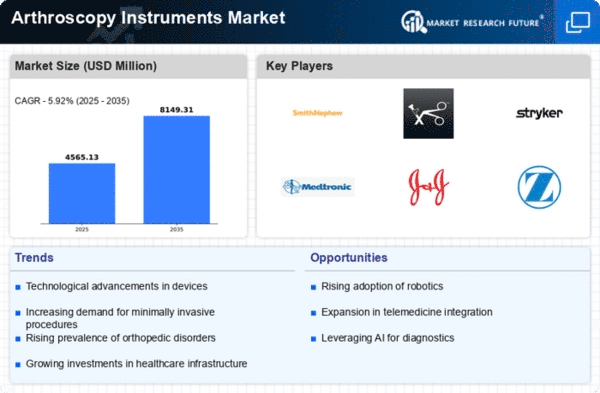
As per MRFR analysis, the Arthroscopy Instruments Market Size was estimated at 4309.98 USD Million in 2024. The Arthroscopy Instruments industry is projected to grow from 4614.52 USD Million in 2025 to 8149.31 USD Million by 2035, exhibiting a compound annual growth rate (CAGR) of 5.92% during the forecast period 2025 - 2035.

Key Market Trends & Highlights

The Arthroscopy Instruments Market is poised for substantial growth driven by technological advancements and increasing demand for minimally invasive procedures.

  • Technological advancements are enhancing the efficacy and precision of arthroscopy instruments, thereby driving market growth.
  • The rising demand for minimally invasive procedures is significantly influencing the adoption of arthroscopy instruments in surgical settings.
  • North America remains the largest market for arthroscopy instruments, while the Asia-Pacific region is emerging as the fastest-growing market.
  • Key market drivers include the growing prevalence of joint disorders and the surge in sports-related injuries, which are propelling the demand for surgical and diagnostic arthroscopy instruments.

Market Size & Forecast

2024 Market Size 4309.98 (USD Million)
2035 Market Size 8149.31 (USD Million)
CAGR (2025 - 2035) 5.92%
Largest Regional Market Share in 2024 North America

Major Players

Smith & Nephew (GB), Arthrex (US), Stryker (US), Medtronic (IE), Johnson & Johnson (US), Zimmer Biomet (US), Conmed (US), Olympus (JP), Karl Storz (DE)

Market Trends

The Arthroscopy Instruments Market is currently experiencing a notable evolution, driven by advancements in technology and an increasing demand for minimally invasive surgical procedures. Surgeons and healthcare providers are increasingly adopting arthroscopic techniques due to their benefits, such as reduced recovery times and lower risk of complications. This shift towards minimally invasive methods appears to be reshaping the landscape of orthopedic surgery, as patients seek quicker and less painful recovery options. Furthermore, the growing prevalence of orthopedic disorders and sports-related injuries is likely to propel the market forward, as healthcare systems strive to enhance patient outcomes through innovative surgical solutions. In addition, the Arthroscopy Instruments Market is witnessing a surge in research and development activities aimed at improving existing instruments and creating new ones. Manufacturers are focusing on integrating advanced technologies, such as robotics and artificial intelligence, into their products. This trend suggests a future where surgical procedures could become even more precise and efficient, potentially leading to better patient outcomes. As the market continues to evolve, collaboration between medical professionals and device manufacturers may play a crucial role in driving innovation and addressing the specific needs of surgeons and patients alike.

Technological Advancements

The integration of cutting-edge technologies into arthroscopy instruments is transforming surgical practices. Innovations such as enhanced imaging systems and robotic-assisted devices are likely to improve precision and efficiency during procedures, thereby elevating patient care.

Rising Demand for Minimally Invasive Procedures

There is a growing preference for minimally invasive surgeries among patients and healthcare providers. This trend is expected to drive the adoption of arthroscopy instruments, as they offer reduced recovery times and lower complication rates compared to traditional surgical methods.

Increased Focus on Research and Development

Manufacturers are placing a strong emphasis on research and development to create advanced arthroscopy instruments. This focus on innovation may lead to the introduction of new products that cater to the evolving needs of surgeons and enhance surgical outcomes.

Arthroscopy Instruments Market Market Drivers

Market Growth Projections

The Global Arthroscopy Instruments Market Industry is poised for substantial growth, with projections indicating a market value of 3.21 USD Billion in 2024 and an anticipated increase to 7.69 USD Billion by 2035. This growth trajectory suggests a compound annual growth rate (CAGR) of 8.26% from 2025 to 2035. Such figures underscore the increasing adoption of arthroscopic techniques and the continuous advancements in surgical instruments, reflecting a robust market environment.

Rising Awareness and Education

The Global Arthroscopy Instruments Market Industry is benefiting from increased awareness and education regarding arthroscopic procedures among both healthcare professionals and patients. Educational programs and workshops are being organized to inform surgeons about the latest techniques and instruments available. Additionally, patients are becoming more informed about their treatment options, leading to a higher demand for arthroscopic surgeries. This growing awareness is likely to drive market growth, as more individuals seek out these advanced surgical options.

Government Initiatives and Funding

Government initiatives aimed at improving healthcare infrastructure and funding for surgical innovations are pivotal for the Global Arthroscopy Instruments Market Industry. Many countries are investing in advanced medical technologies to enhance surgical outcomes and reduce healthcare costs. For instance, various health departments are providing grants and subsidies for the development of arthroscopic instruments and training programs for surgeons. Such initiatives not only promote the adoption of arthroscopy but also ensure that healthcare systems are equipped with the latest technologies, thereby fostering market growth.

Rising Prevalence of Orthopedic Disorders

The Global Arthroscopy Instruments Market Industry is experiencing growth due to the increasing prevalence of orthopedic disorders, such as osteoarthritis and sports injuries. As populations age and engage in more physical activities, the demand for minimally invasive surgical procedures rises. For instance, the World Health Organization indicates that musculoskeletal disorders affect millions globally, leading to a surge in arthroscopic surgeries. This trend is expected to contribute to the market's expansion, with projections estimating the market value to reach 3.21 USD Billion in 2024, and potentially 7.69 USD Billion by 2035, reflecting a robust CAGR of 8.26% from 2025 to 2035.

Technological Advancements in Arthroscopy

Technological innovations play a crucial role in the Global Arthroscopy Instruments Market Industry. The introduction of advanced imaging techniques, such as 3D visualization and robotic-assisted surgery, enhances surgical precision and patient outcomes. These advancements not only improve the efficiency of arthroscopic procedures but also reduce recovery times, thereby increasing patient satisfaction. For example, the integration of augmented reality in surgical planning is becoming more prevalent. As these technologies evolve, they are likely to attract more healthcare providers to adopt arthroscopic techniques, further driving market growth.

Increasing Demand for Minimally Invasive Procedures

The Global Arthroscopy Instruments Market Industry is significantly influenced by the rising demand for minimally invasive surgical procedures. Patients increasingly prefer surgeries that promise reduced pain, shorter recovery times, and minimal scarring. Arthroscopy, being a minimally invasive technique, aligns perfectly with these patient preferences. The growing awareness of the benefits associated with such procedures is prompting healthcare providers to adopt arthroscopic techniques more widely. This shift is expected to bolster the market, as more patients opt for arthroscopic interventions over traditional open surgeries.

Market Segment Insights

By Application: Knee Surgery (Largest) vs. Shoulder Surgery (Fastest-Growing)

<p>In the Arthroscopy Instruments Market, the application segments reveal a diverse distribution of market share. Knee Surgery stands out as the largest segment, driven by a high prevalence of knee injuries and the growing aging population. Following closely is Shoulder Surgery, which has gained traction due to a rise in sports-related injuries and increased awareness about minimally invasive surgical options. Other segments like Hip Surgery, Elbow Surgery, and Ankle Surgery contribute to the market, but to a lesser extent.</p>

<p>Knee Surgery (Dominant) vs. Shoulder Surgery (Emerging)</p>

<p>Knee Surgery is the dominant segment in the Arthroscopy Instruments Market, representing a significant portion due to the high volume of procedures performed annually. This segment benefits from advancements in surgical techniques and instrumentation that enhance recovery times and patient outcomes. In contrast, Shoulder Surgery is emerging rapidly, fueled by trends in sports medicine and physical therapy advancements. As surgical techniques become more sophisticated and patient demands for effective treatments rise, this segment is increasingly gaining attention, pushing it toward becoming a more substantial share of the market.</p>

By Product Type: Arthroscopes (Largest) vs. Electrosurgical Devices (Fastest-Growing)

<p>In the Arthroscopy Instruments Market, the distribution of market share among product types reflects significant variances in usage and demand. <a href="https://www.marketresearchfuture.com/reports/arthroscopes-market-29745" target="_blank" title="arthroscopes">Arthroscopes</a> currently hold the largest share, being integral to minimally invasive surgical procedures. Other products, such as Shavers and Suction Devices, contribute meaningfully to the market, though they reflect a smaller share compared to Arthroscopes. <a href="https://www.marketresearchfuture.com/reports/electrosurgical-devices-market-43719" target="_blank" title="electrosurgical devices">Electrosurgical Devices</a>, while not leading in share, are gaining traction due to advancements in surgical technology and technique improvements that enhance their use in joint surgeries.</p>

<p>Arthroscopes (Dominant) vs. Shavers (Emerging)</p>

<p>Arthroscopes serve as the dominant player in the market, utilized extensively for joint examination and operative interventions. Their design has evolved to enable more precise procedures with minimal patient recovery time. This dominance is complemented by Shavers, which though considered emerging, are becoming increasingly important in arthroscopic surgeries. Shavers assist in the resection of tissues during procedures, and as surgical techniques advance, their efficacy is proving vital. They are increasingly adopted in conjunction with arthroscopes, underscoring their significance within the surgical toolkit.</p>

By End User: Hospitals (Largest) vs. Ambulatory Surgical Centers (Fastest-Growing)

<p>In the Arthroscopy Instruments Market, hospitals represent the largest segment due to their comprehensive surgical services and facilities. They typically have the highest number of surgical procedures and a wide variety of arthroscopy instruments, resulting in a significant market share. Following closely are Ambulatory Surgical Centers (ASCs), which are rapidly gaining traction in the market. ASCs cater to outpatient surgeries, offering cost-effective and efficient alternatives for patients, thereby increasing their market presence.</p>

<p>Hospitals (Dominant) vs. Ambulatory Surgical Centers (Emerging)</p>

<p>Hospitals remain the dominant end-user in the Arthroscopy Instruments Market, as they are equipped with advanced technologies and skilled professionals necessary for intricate surgical procedures. Their ability to offer a range of services, from diagnostics to post-operative care, ensures a steady demand for arthroscopy instruments. Conversely, Ambulatory Surgical Centers are considered emerging players. These centers are becoming increasingly popular due to their efficiency and reduced patient wait times. They focus on outpatient procedures, which allow for quicker recovery and lower overall healthcare costs, contributing to their rapid growth in the market.</p>

By Technology: Optical Technology (Largest) vs. Radiofrequency Technology (Fastest-Growing)

The technological advancements in arthroscopy instruments have diversified the market into various segements, with optical technology leading in market share. Optical technology facilitates superior visualization and accuracy during procedures, thereby ensuring better patient outcomes and lower complication rates. Meanwhile, radiofrequency technology, although smaller in share, is rapidly gaining traction among healthcare professionals due to its effectiveness in soft tissue applications and minimally invasive procedures, making it the fastest-growing segment in this landscape.

Technology: Optical Technology (Dominant) vs. Radiofrequency Technology (Emerging)

Optical technology in the arthroscopy instruments market is characterized by its ability to provide high-resolution imaging and enhanced visualization for surgical procedures. This technology dominates the market due to its adoption in various arthroscopic surgeries, boosting surgical accuracy and patient safety. On the other hand, radiofrequency technology is emerging as a vital component in arthroscopy, known for its utility in tissue ablation and reduction of intraoperative bleeding. The growth of radiofrequency technology is fueled by increasing demand for minimally invasive treatment options and advances in energy-based technologies, positioning it as a key player in the evolving landscape of arthroscopy.

Get more detailed insights about Arthroscopy Instruments Market Research Report – Forecast to 2035

Regional Insights

North America : Market Leader in Innovation

North America continues to lead the Arthroscopy Instruments Market, holding a significant share of approximately 2150.0 million in 2024. The growth is driven by increasing incidences of orthopedic surgeries, advancements in minimally invasive techniques, and a robust healthcare infrastructure. Regulatory support and favorable reimbursement policies further catalyze market expansion, making it a hub for innovation in medical technology. The United States is the primary contributor to this market, with key players like Smith & Nephew, Arthrex, and Stryker dominating the landscape. The competitive environment is characterized by continuous product development and strategic partnerships. The presence of advanced healthcare facilities and a high demand for arthroscopic procedures solidify North America's position as a leader in this sector.

Europe : Emerging Market with Growth Potential

Europe's Arthroscopy Instruments Market is valued at approximately 1200.0 million, reflecting a growing demand for advanced surgical solutions. Factors such as an aging population, rising sports-related injuries, and increasing healthcare expenditure are driving this growth. Regulatory frameworks in the region are becoming more supportive, facilitating the introduction of innovative products and technologies in the market. Leading countries like Germany, France, and the UK are at the forefront of this market, with significant contributions from companies such as Karl Storz and Olympus. The competitive landscape is marked by a mix of established players and emerging startups, all striving to enhance surgical outcomes through innovative arthroscopic solutions. The European market is poised for further growth as healthcare systems adapt to new technologies and patient needs.

Asia-Pacific : Rapidly Growing Market Segment

The Asia-Pacific region is witnessing a burgeoning Arthroscopy Instruments Market, currently valued at around 800.0 million. This growth is fueled by rising healthcare investments, increasing awareness of minimally invasive surgeries, and a growing prevalence of orthopedic conditions. Government initiatives aimed at improving healthcare access and quality are also contributing to market expansion, making it a focal point for future growth. Countries like Japan, China, and India are leading the charge, with a mix of local and international players such as Medtronic and Conmed establishing a strong presence. The competitive landscape is evolving, with companies focusing on innovation and affordability to cater to the diverse needs of the population. As healthcare infrastructure improves, the demand for arthroscopic procedures is expected to rise significantly in this region.

Middle East and Africa : Emerging Market with Challenges

The Middle East and Africa (MEA) region's Arthroscopy Instruments Market is valued at approximately 159.98 million, reflecting a nascent but growing sector. The market is driven by increasing healthcare investments, a rise in sports injuries, and a growing awareness of advanced surgical techniques. However, regulatory challenges and varying healthcare standards across countries pose hurdles to rapid growth, necessitating strategic approaches from market players. Countries like South Africa and the UAE are leading the market, with key players such as Johnson & Johnson and Zimmer Biomet making significant inroads. The competitive landscape is characterized by a mix of established companies and new entrants, all vying to capture market share. As healthcare systems evolve and improve, the demand for arthroscopic solutions is expected to rise, presenting opportunities for growth in this region.

Key Players and Competitive Insights

The Arthroscopy Instruments Market is characterized by a dynamic competitive landscape, driven by technological advancements and an increasing demand for minimally invasive surgical procedures. Key players such as Smith & Nephew (GB), Arthrex (US), and Stryker (US) are at the forefront, each adopting distinct strategies to enhance their market presence. Smith & Nephew (GB) focuses on innovation through the development of advanced imaging technologies, while Arthrex (US) emphasizes a robust portfolio of surgical instruments and training programs. Stryker (US) is leveraging its extensive distribution network to expand its global reach, indicating a trend towards regional diversification among competitors.In terms of business tactics, companies are increasingly localizing manufacturing to reduce costs and improve supply chain efficiency. The market appears moderately fragmented, with several players vying for market share, yet the collective influence of major companies shapes competitive dynamics significantly. This fragmentation allows for niche players to emerge, although the dominance of established firms remains evident.

In November Smith & Nephew (GB) announced the launch of a new line of arthroscopic instruments designed to enhance surgical precision and reduce recovery times. This strategic move underscores the company's commitment to innovation and positions it favorably against competitors by addressing the growing demand for effective surgical solutions. The introduction of these instruments is likely to strengthen Smith & Nephew's market position and attract new clientele.

In October Arthrex (US) expanded its partnership with leading orthopedic hospitals to enhance training programs for surgeons. This initiative not only reinforces Arthrex's reputation as a leader in surgical education but also fosters loyalty among healthcare professionals. By investing in training, Arthrex is likely to ensure that its products are utilized effectively, thereby enhancing patient outcomes and solidifying its market presence.

In September Stryker (US) completed the acquisition of a robotics company specializing in surgical navigation systems. This acquisition is pivotal as it integrates advanced technology into Stryker's existing product line, potentially revolutionizing arthroscopic procedures. The move reflects a broader trend towards the integration of robotics and AI in surgical practices, positioning Stryker as a frontrunner in this evolving landscape.

As of December the competitive trends in the Arthroscopy Instruments Market are increasingly defined by digitalization, sustainability, and the integration of AI technologies. Strategic alliances among key players are shaping the landscape, fostering innovation and enhancing product offerings. The shift from price-based competition to a focus on technological advancement and supply chain reliability is evident, suggesting that future competitive differentiation will hinge on the ability to innovate and adapt to changing market demands.

Key Companies in the Arthroscopy Instruments Market include

Industry Developments

Titan Medical Inc., a medical device startup focused on the development and commercialization of new surgical technologies for single access robotic-assisted surgery (RAS), has received a $2.6 million purchase order from Medtronic plc, a worldwide healthcare technology leader. The deal comprises the procurement of preclinical instruments and cameras, as well as a review of Titan Medical as a possible manufacturing and supply partner for Medtronic. Titan will produce instruments and cameras for Medtronic's evaluation and testing as well as our own single-access RAS platform, Enos, with this contract.

An estimated $42,042,577 fixed-price with economic-price-adjustment, indefinite-delivery/indefinite-quantity contract for craniomaxillofacial and trauma orthopedic procedure packages and supplies has been awarded to Johnson & Johnson Health Care Systems DePuy Synthes, Piscataway, New Jersey. The contract has a one-year base year and four one-year option periods. Army, Navy, Air Force, Marine Corps, and federal civilian agencies are among the consumers. Defense working capital funds are the type of appropriation for fiscal years 2022-2023.

Intended Audience

  • Medical Devices Companies
  • Research and Development (R&D) Companies
  • Government Research Institutes
  • Academic Institutes and Universities

Future Outlook

Arthroscopy Instruments Market Future Outlook

The Arthroscopy Instruments Market is projected to grow at a 5.92% CAGR from 2025 to 2035, driven by technological advancements, increasing sports injuries, and rising demand for minimally invasive surgeries.

New opportunities lie in:

  • Development of smart arthroscopy tools with integrated AI for enhanced precision.
  • Expansion into emerging markets with tailored product offerings.
  • Partnerships with healthcare providers for bundled service packages.

By 2035, the market is expected to achieve robust growth, positioning itself as a leader in minimally invasive surgical solutions.

Market Segmentation

Arthroscopy Instruments Market End Use Outlook

  • Hospitals
  • Ambulatory Surgical Centers
  • Orthopedic Clinics
  • Sports Medicine Clinics

Arthroscopy Instruments Market Technology Outlook

  • Optical Technology
  • Radiofrequency Technology
  • Ultrasound Technology
  • Robotic-Assisted Technology

Arthroscopy Instruments Market Application Outlook

  • Diagnostic
  • Surgical
  • Rehabilitation
  • Therapeutic

Arthroscopy Instruments Market Product Type Outlook

  • Arthroscopes
  • Shavers
  • Electrosurgical Devices
  • Fluid Management Systems

Report Scope

MARKET SIZE 2024 4309.98(USD Million)
MARKET SIZE 2025 4614.52(USD Million)
MARKET SIZE 2035 8149.31(USD Million)
COMPOUND ANNUAL GROWTH RATE (CAGR) 5.92% (2025 - 2035)
REPORT COVERAGE Revenue Forecast, Competitive Landscape, Growth Factors, and Trends
BASE YEAR 2024
Market Forecast Period 2025 - 2035
Historical Data 2019 - 2024
Market Forecast Units USD Million
Key Companies Profiled Smith & Nephew (GB), Arthrex (US), Stryker (US), Medtronic (IE), Johnson & Johnson (US), Zimmer Biomet (US), Conmed (US), Olympus (JP), Karl Storz (DE)
Segments Covered Application, End Use, Product Type, Technology
Key Market Opportunities Integration of advanced imaging technologies enhances precision in the Arthroscopy Instruments Market.
Key Market Dynamics Technological advancements and regulatory changes drive innovation and competition in the Arthroscopy Instruments Market.
Countries Covered North America, Europe, APAC, South America, MEA

FAQs

What is the projected market valuation of the Arthroscopy Instruments Market by 2035?

<p>The projected market valuation for the Arthroscopy Instruments Market by 2035 is 8149.31 USD Million.</p>

What was the market valuation of the Arthroscopy Instruments Market in 2024?

<p>The overall market valuation of the Arthroscopy Instruments Market in 2024 was 4309.98 USD Million.</p>

What is the expected CAGR for the Arthroscopy Instruments Market during the forecast period 2025 - 2035?

<p>The expected CAGR for the Arthroscopy Instruments Market during the forecast period 2025 - 2035 is 5.92%.</p>

Which companies are considered key players in the Arthroscopy Instruments Market?

<p>Key players in the Arthroscopy Instruments Market include Smith & Nephew, Arthrex, Stryker, Medtronic, Johnson & Johnson, Olympus, Conmed, Zimmer Biomet, and Karl Storz.</p>

What segment of the Arthroscopy Instruments Market had the highest valuation in 2024?

<p>In 2024, the Knee Surgery segment had the highest valuation at 1200.0 USD Million.</p>

How does the valuation of Arthroscopes compare to other product types in 2024?

In 2024, Arthroscopes were valued at 1200.0 USD Million, which is higher than Shavers at 900.0 USD Million and lower than Electrosurgical Devices at 800.0 USD Million.

What is the projected growth for the Ambulatory Surgical Centers segment by 2035?

The Ambulatory Surgical Centers segment is projected to grow from 1000.0 USD Million in 2024 to 2000.0 USD Million by 2035.

Which end user segment is expected to show the most growth in the Arthroscopy Instruments Market?

The Hospitals segment, valued at 1500.0 USD Million in 2024, is expected to show substantial growth by 2035.

What is the valuation range for the Elbow Surgery segment in 2024?

The valuation range for the Elbow Surgery segment in 2024 was between 600.0 USD Million and 1200.0 USD Million.

How does the market for Sports Medicine Clinics compare to Orthopedic Clinics in 2024?

In 2024, Sports Medicine Clinics were valued at approximately 1009.98 USD Million, which is higher than the Orthopedic Clinics' valuation of 800.0 USD Million.

  1. SECTION I: EXECUTIVE SUMMARY AND KEY HIGHLIGHTS
    1. | 1.1 EXECUTIVE SUMMARY
    2. | | 1.1.1 Market Overview
    3. | | 1.1.2 Key Findings
    4. | | 1.1.3 Market Segmentation
    5. | | 1.1.4 Competitive Landscape
    6. | | 1.1.5 Challenges and Opportunities
    7. | | 1.1.6 Future Outlook
  2. SECTION II: SCOPING, METHODOLOGY AND MARKET STRUCTURE
    1. | 2.1 MARKET INTRODUCTION
    2. | | 2.1.1 Definition
    3. | | 2.1.2 Scope of the study
    4. | | | 2.1.2.1 Research Objective
    5. | | | 2.1.2.2 Assumption
    6. | | | 2.1.2.3 Limitations
    7. | 2.2 RESEARCH METHODOLOGY
    8. | | 2.2.1 Overview
    9. | | 2.2.2 Data Mining
    10. | | 2.2.3 Secondary Research
    11. | | 2.2.4 Primary Research
    12. | | | 2.2.4.1 Primary Interviews and Information Gathering Process
    13. | | | 2.2.4.2 Breakdown of Primary Respondents
    14. | | 2.2.5 Forecasting Model
    15. | | 2.2.6 Market Size Estimation
    16. | | | 2.2.6.1 Bottom-Up Approach
    17. | | | 2.2.6.2 Top-Down Approach
    18. | | 2.2.7 Data Triangulation
    19. | | 2.2.8 Validation
  3. SECTION III: QUALITATIVE ANALYSIS
    1. | 3.1 MARKET DYNAMICS
    2. | | 3.1.1 Overview
    3. | | 3.1.2 Drivers
    4. | | 3.1.3 Restraints
    5. | | 3.1.4 Opportunities
    6. | 3.2 MARKET FACTOR ANALYSIS
    7. | | 3.2.1 Value chain Analysis
    8. | | 3.2.2 Porter's Five Forces Analysis
    9. | | | 3.2.2.1 Bargaining Power of Suppliers
    10. | | | 3.2.2.2 Bargaining Power of Buyers
    11. | | | 3.2.2.3 Threat of New Entrants
    12. | | | 3.2.2.4 Threat of Substitutes
    13. | | | 3.2.2.5 Intensity of Rivalry
    14. | | 3.2.3 COVID-19 Impact Analysis
    15. | | | 3.2.3.1 Market Impact Analysis
    16. | | | 3.2.3.2 Regional Impact
    17. | | | 3.2.3.3 Opportunity and Threat Analysis
  4. SECTION IV: QUANTITATIVE ANALYSIS
    1. | 4.1 Healthcare, BY Application (USD Million)
    2. | | 4.1.1 Knee Surgery
    3. | | 4.1.2 Shoulder Surgery
    4. | | 4.1.3 Hip Surgery
    5. | | 4.1.4 Elbow Surgery
    6. | | 4.1.5 Ankle Surgery
    7. | 4.2 Healthcare, BY Product Type (USD Million)
    8. | | 4.2.1 Arthroscopes
    9. | | 4.2.2 Shavers
    10. | | 4.2.3 Suction Devices
    11. | | 4.2.4 Electrosurgical Devices
    12. | | 4.2.5 Other Instruments
    13. | 4.3 Healthcare, BY End User (USD Million)
    14. | | 4.3.1 Hospitals
    15. | | 4.3.2 Ambulatory Surgical Centers
    16. | | 4.3.3 Orthopedic Clinics
    17. | | 4.3.4 Sports Medicine Clinics
    18. | 4.4 Healthcare, BY Region (USD Million)
    19. | | 4.4.1 North America
    20. | | | 4.4.1.1 US
    21. | | | 4.4.1.2 Canada
    22. | | 4.4.2 Europe
    23. | | | 4.4.2.1 Germany
    24. | | | 4.4.2.2 UK
    25. | | | 4.4.2.3 France
    26. | | | 4.4.2.4 Russia
    27. | | | 4.4.2.5 Italy
    28. | | | 4.4.2.6 Spain
    29. | | | 4.4.2.7 Rest of Europe
    30. | | 4.4.3 APAC
    31. | | | 4.4.3.1 China
    32. | | | 4.4.3.2 India
    33. | | | 4.4.3.3 Japan
    34. | | | 4.4.3.4 South Korea
    35. | | | 4.4.3.5 Malaysia
    36. | | | 4.4.3.6 Thailand
    37. | | | 4.4.3.7 Indonesia
    38. | | | 4.4.3.8 Rest of APAC
    39. | | 4.4.4 South America
    40. | | | 4.4.4.1 Brazil
    41. | | | 4.4.4.2 Mexico
    42. | | | 4.4.4.3 Argentina
    43. | | | 4.4.4.4 Rest of South America
    44. | | 4.4.5 MEA
    45. | | | 4.4.5.1 GCC Countries
    46. | | | 4.4.5.2 South Africa
    47. | | | 4.4.5.3 Rest of MEA
  5. SECTION V: COMPETITIVE ANALYSIS
    1. | 5.1 Competitive Landscape
    2. | | 5.1.1 Overview
    3. | | 5.1.2 Competitive Analysis
    4. | | 5.1.3 Market share Analysis
    5. | | 5.1.4 Major Growth Strategy in the Healthcare
    6. | | 5.1.5 Competitive Benchmarking
    7. | | 5.1.6 Leading Players in Terms of Number of Developments in the Healthcare
    8. | | 5.1.7 Key developments and growth strategies
    9. | | | 5.1.7.1 New Product Launch/Service Deployment
    10. | | | 5.1.7.2 Merger & Acquisitions
    11. | | | 5.1.7.3 Joint Ventures
    12. | | 5.1.8 Major Players Financial Matrix
    13. | | | 5.1.8.1 Sales and Operating Income
    14. | | | 5.1.8.2 Major Players R&D Expenditure. 2023
    15. | 5.2 Company Profiles
    16. | | 5.2.1 Smith & Nephew (GB)
    17. | | | 5.2.1.1 Financial Overview
    18. | | | 5.2.1.2 Products Offered
    19. | | | 5.2.1.3 Key Developments
    20. | | | 5.2.1.4 SWOT Analysis
    21. | | | 5.2.1.5 Key Strategies
    22. | | 5.2.2 Arthrex (US)
    23. | | | 5.2.2.1 Financial Overview
    24. | | | 5.2.2.2 Products Offered
    25. | | | 5.2.2.3 Key Developments
    26. | | | 5.2.2.4 SWOT Analysis
    27. | | | 5.2.2.5 Key Strategies
    28. | | 5.2.3 Stryker (US)
    29. | | | 5.2.3.1 Financial Overview
    30. | | | 5.2.3.2 Products Offered
    31. | | | 5.2.3.3 Key Developments
    32. | | | 5.2.3.4 SWOT Analysis
    33. | | | 5.2.3.5 Key Strategies
    34. | | 5.2.4 Medtronic (IE)
    35. | | | 5.2.4.1 Financial Overview
    36. | | | 5.2.4.2 Products Offered
    37. | | | 5.2.4.3 Key Developments
    38. | | | 5.2.4.4 SWOT Analysis
    39. | | | 5.2.4.5 Key Strategies
    40. | | 5.2.5 Johnson & Johnson (US)
    41. | | | 5.2.5.1 Financial Overview
    42. | | | 5.2.5.2 Products Offered
    43. | | | 5.2.5.3 Key Developments
    44. | | | 5.2.5.4 SWOT Analysis
    45. | | | 5.2.5.5 Key Strategies
    46. | | 5.2.6 Olympus (JP)
    47. | | | 5.2.6.1 Financial Overview
    48. | | | 5.2.6.2 Products Offered
    49. | | | 5.2.6.3 Key Developments
    50. | | | 5.2.6.4 SWOT Analysis
    51. | | | 5.2.6.5 Key Strategies
    52. | | 5.2.7 Conmed (US)
    53. | | | 5.2.7.1 Financial Overview
    54. | | | 5.2.7.2 Products Offered
    55. | | | 5.2.7.3 Key Developments
    56. | | | 5.2.7.4 SWOT Analysis
    57. | | | 5.2.7.5 Key Strategies
    58. | | 5.2.8 Zimmer Biomet (US)
    59. | | | 5.2.8.1 Financial Overview
    60. | | | 5.2.8.2 Products Offered
    61. | | | 5.2.8.3 Key Developments
    62. | | | 5.2.8.4 SWOT Analysis
    63. | | | 5.2.8.5 Key Strategies
    64. | | 5.2.9 Karl Storz (DE)
    65. | | | 5.2.9.1 Financial Overview
    66. | | | 5.2.9.2 Products Offered
    67. | | | 5.2.9.3 Key Developments
    68. | | | 5.2.9.4 SWOT Analysis
    69. | | | 5.2.9.5 Key Strategies
    70. | 5.3 Appendix
    71. | | 5.3.1 References
    72. | | 5.3.2 Related Reports
  6. LIST OF FIGURES
    1. | 6.1 MARKET SYNOPSIS
    2. | 6.2 NORTH AMERICA MARKET ANALYSIS
    3. | 6.3 US MARKET ANALYSIS BY APPLICATION
    4. | 6.4 US MARKET ANALYSIS BY PRODUCT TYPE
    5. | 6.5 US MARKET ANALYSIS BY END USER
    6. | 6.6 CANADA MARKET ANALYSIS BY APPLICATION
    7. | 6.7 CANADA MARKET ANALYSIS BY PRODUCT TYPE
    8. | 6.8 CANADA MARKET ANALYSIS BY END USER
    9. | 6.9 EUROPE MARKET ANALYSIS
    10. | 6.10 GERMANY MARKET ANALYSIS BY APPLICATION
    11. | 6.11 GERMANY MARKET ANALYSIS BY PRODUCT TYPE
    12. | 6.12 GERMANY MARKET ANALYSIS BY END USER
    13. | 6.13 UK MARKET ANALYSIS BY APPLICATION
    14. | 6.14 UK MARKET ANALYSIS BY PRODUCT TYPE
    15. | 6.15 UK MARKET ANALYSIS BY END USER
    16. | 6.16 FRANCE MARKET ANALYSIS BY APPLICATION
    17. | 6.17 FRANCE MARKET ANALYSIS BY PRODUCT TYPE
    18. | 6.18 FRANCE MARKET ANALYSIS BY END USER
    19. | 6.19 RUSSIA MARKET ANALYSIS BY APPLICATION
    20. | 6.20 RUSSIA MARKET ANALYSIS BY PRODUCT TYPE
    21. | 6.21 RUSSIA MARKET ANALYSIS BY END USER
    22. | 6.22 ITALY MARKET ANALYSIS BY APPLICATION
    23. | 6.23 ITALY MARKET ANALYSIS BY PRODUCT TYPE
    24. | 6.24 ITALY MARKET ANALYSIS BY END USER
    25. | 6.25 SPAIN MARKET ANALYSIS BY APPLICATION
    26. | 6.26 SPAIN MARKET ANALYSIS BY PRODUCT TYPE
    27. | 6.27 SPAIN MARKET ANALYSIS BY END USER
    28. | 6.28 REST OF EUROPE MARKET ANALYSIS BY APPLICATION
    29. | 6.29 REST OF EUROPE MARKET ANALYSIS BY PRODUCT TYPE
    30. | 6.30 REST OF EUROPE MARKET ANALYSIS BY END USER
    31. | 6.31 APAC MARKET ANALYSIS
    32. | 6.32 CHINA MARKET ANALYSIS BY APPLICATION
    33. | 6.33 CHINA MARKET ANALYSIS BY PRODUCT TYPE
    34. | 6.34 CHINA MARKET ANALYSIS BY END USER
    35. | 6.35 INDIA MARKET ANALYSIS BY APPLICATION
    36. | 6.36 INDIA MARKET ANALYSIS BY PRODUCT TYPE
    37. | 6.37 INDIA MARKET ANALYSIS BY END USER
    38. | 6.38 JAPAN MARKET ANALYSIS BY APPLICATION
    39. | 6.39 JAPAN MARKET ANALYSIS BY PRODUCT TYPE
    40. | 6.40 JAPAN MARKET ANALYSIS BY END USER
    41. | 6.41 SOUTH KOREA MARKET ANALYSIS BY APPLICATION
    42. | 6.42 SOUTH KOREA MARKET ANALYSIS BY PRODUCT TYPE
    43. | 6.43 SOUTH KOREA MARKET ANALYSIS BY END USER
    44. | 6.44 MALAYSIA MARKET ANALYSIS BY APPLICATION
    45. | 6.45 MALAYSIA MARKET ANALYSIS BY PRODUCT TYPE
    46. | 6.46 MALAYSIA MARKET ANALYSIS BY END USER
    47. | 6.47 THAILAND MARKET ANALYSIS BY APPLICATION
    48. | 6.48 THAILAND MARKET ANALYSIS BY PRODUCT TYPE
    49. | 6.49 THAILAND MARKET ANALYSIS BY END USER
    50. | 6.50 INDONESIA MARKET ANALYSIS BY APPLICATION
    51. | 6.51 INDONESIA MARKET ANALYSIS BY PRODUCT TYPE
    52. | 6.52 INDONESIA MARKET ANALYSIS BY END USER
    53. | 6.53 REST OF APAC MARKET ANALYSIS BY APPLICATION
    54. | 6.54 REST OF APAC MARKET ANALYSIS BY PRODUCT TYPE
    55. | 6.55 REST OF APAC MARKET ANALYSIS BY END USER
    56. | 6.56 SOUTH AMERICA MARKET ANALYSIS
    57. | 6.57 BRAZIL MARKET ANALYSIS BY APPLICATION
    58. | 6.58 BRAZIL MARKET ANALYSIS BY PRODUCT TYPE
    59. | 6.59 BRAZIL MARKET ANALYSIS BY END USER
    60. | 6.60 MEXICO MARKET ANALYSIS BY APPLICATION
    61. | 6.61 MEXICO MARKET ANALYSIS BY PRODUCT TYPE
    62. | 6.62 MEXICO MARKET ANALYSIS BY END USER
    63. | 6.63 ARGENTINA MARKET ANALYSIS BY APPLICATION
    64. | 6.64 ARGENTINA MARKET ANALYSIS BY PRODUCT TYPE
    65. | 6.65 ARGENTINA MARKET ANALYSIS BY END USER
    66. | 6.66 REST OF SOUTH AMERICA MARKET ANALYSIS BY APPLICATION
    67. | 6.67 REST OF SOUTH AMERICA MARKET ANALYSIS BY PRODUCT TYPE
    68. | 6.68 REST OF SOUTH AMERICA MARKET ANALYSIS BY END USER
    69. | 6.69 MEA MARKET ANALYSIS
    70. | 6.70 GCC COUNTRIES MARKET ANALYSIS BY APPLICATION
    71. | 6.71 GCC COUNTRIES MARKET ANALYSIS BY PRODUCT TYPE
    72. | 6.72 GCC COUNTRIES MARKET ANALYSIS BY END USER
    73. | 6.73 SOUTH AFRICA MARKET ANALYSIS BY APPLICATION
    74. | 6.74 SOUTH AFRICA MARKET ANALYSIS BY PRODUCT TYPE
    75. | 6.75 SOUTH AFRICA MARKET ANALYSIS BY END USER
    76. | 6.76 REST OF MEA MARKET ANALYSIS BY APPLICATION
    77. | 6.77 REST OF MEA MARKET ANALYSIS BY PRODUCT TYPE
    78. | 6.78 REST OF MEA MARKET ANALYSIS BY END USER
    79. | 6.79 KEY BUYING CRITERIA OF HEALTHCARE
    80. | 6.80 RESEARCH PROCESS OF MRFR
    81. | 6.81 DRO ANALYSIS OF HEALTHCARE
    82. | 6.82 DRIVERS IMPACT ANALYSIS: HEALTHCARE
    83. | 6.83 RESTRAINTS IMPACT ANALYSIS: HEALTHCARE
    84. | 6.84 SUPPLY / VALUE CHAIN: HEALTHCARE
    85. | 6.85 HEALTHCARE, BY APPLICATION, 2024 (% SHARE)
    86. | 6.86 HEALTHCARE, BY APPLICATION, 2024 TO 2035 (USD Million)
    87. | 6.87 HEALTHCARE, BY PRODUCT TYPE, 2024 (% SHARE)
    88. | 6.88 HEALTHCARE, BY PRODUCT TYPE, 2024 TO 2035 (USD Million)
    89. | 6.89 HEALTHCARE, BY END USER, 2024 (% SHARE)
    90. | 6.90 HEALTHCARE, BY END USER, 2024 TO 2035 (USD Million)
    91. | 6.91 BENCHMARKING OF MAJOR COMPETITORS
  7. LIST OF TABLES
    1. | 7.1 LIST OF ASSUMPTIONS
    2. | | 7.1.1
    3. | 7.2 North America MARKET SIZE ESTIMATES; FORECAST
    4. | | 7.2.1 BY APPLICATION, 2025-2035 (USD Million)
    5. | | 7.2.2 BY PRODUCT TYPE, 2025-2035 (USD Million)
    6. | | 7.2.3 BY END USER, 2025-2035 (USD Million)
    7. | 7.3 US MARKET SIZE ESTIMATES; FORECAST
    8. | | 7.3.1 BY APPLICATION, 2025-2035 (USD Million)
    9. | | 7.3.2 BY PRODUCT TYPE, 2025-2035 (USD Million)
    10. | | 7.3.3 BY END USER, 2025-2035 (USD Million)
    11. | 7.4 Canada MARKET SIZE ESTIMATES; FORECAST
    12. | | 7.4.1 BY APPLICATION, 2025-2035 (USD Million)
    13. | | 7.4.2 BY PRODUCT TYPE, 2025-2035 (USD Million)
    14. | | 7.4.3 BY END USER, 2025-2035 (USD Million)
    15. | 7.5 Europe MARKET SIZE ESTIMATES; FORECAST
    16. | | 7.5.1 BY APPLICATION, 2025-2035 (USD Million)
    17. | | 7.5.2 BY PRODUCT TYPE, 2025-2035 (USD Million)
    18. | | 7.5.3 BY END USER, 2025-2035 (USD Million)
    19. | 7.6 Germany MARKET SIZE ESTIMATES; FORECAST
    20. | | 7.6.1 BY APPLICATION, 2025-2035 (USD Million)
    21. | | 7.6.2 BY PRODUCT TYPE, 2025-2035 (USD Million)
    22. | | 7.6.3 BY END USER, 2025-2035 (USD Million)
    23. | 7.7 UK MARKET SIZE ESTIMATES; FORECAST
    24. | | 7.7.1 BY APPLICATION, 2025-2035 (USD Million)
    25. | | 7.7.2 BY PRODUCT TYPE, 2025-2035 (USD Million)
    26. | | 7.7.3 BY END USER, 2025-2035 (USD Million)
    27. | 7.8 France MARKET SIZE ESTIMATES; FORECAST
    28. | | 7.8.1 BY APPLICATION, 2025-2035 (USD Million)
    29. | | 7.8.2 BY PRODUCT TYPE, 2025-2035 (USD Million)
    30. | | 7.8.3 BY END USER, 2025-2035 (USD Million)
    31. | 7.9 Russia MARKET SIZE ESTIMATES; FORECAST
    32. | | 7.9.1 BY APPLICATION, 2025-2035 (USD Million)
    33. | | 7.9.2 BY PRODUCT TYPE, 2025-2035 (USD Million)
    34. | | 7.9.3 BY END USER, 2025-2035 (USD Million)
    35. | 7.10 Italy MARKET SIZE ESTIMATES; FORECAST
    36. | | 7.10.1 BY APPLICATION, 2025-2035 (USD Million)
    37. | | 7.10.2 BY PRODUCT TYPE, 2025-2035 (USD Million)
    38. | | 7.10.3 BY END USER, 2025-2035 (USD Million)
    39. | 7.11 Spain MARKET SIZE ESTIMATES; FORECAST
    40. | | 7.11.1 BY APPLICATION, 2025-2035 (USD Million)
    41. | | 7.11.2 BY PRODUCT TYPE, 2025-2035 (USD Million)
    42. | | 7.11.3 BY END USER, 2025-2035 (USD Million)
    43. | 7.12 Rest of Europe MARKET SIZE ESTIMATES; FORECAST
    44. | | 7.12.1 BY APPLICATION, 2025-2035 (USD Million)
    45. | | 7.12.2 BY PRODUCT TYPE, 2025-2035 (USD Million)
    46. | | 7.12.3 BY END USER, 2025-2035 (USD Million)
    47. | 7.13 APAC MARKET SIZE ESTIMATES; FORECAST
    48. | | 7.13.1 BY APPLICATION, 2025-2035 (USD Million)
    49. | | 7.13.2 BY PRODUCT TYPE, 2025-2035 (USD Million)
    50. | | 7.13.3 BY END USER, 2025-2035 (USD Million)
    51. | 7.14 China MARKET SIZE ESTIMATES; FORECAST
    52. | | 7.14.1 BY APPLICATION, 2025-2035 (USD Million)
    53. | | 7.14.2 BY PRODUCT TYPE, 2025-2035 (USD Million)
    54. | | 7.14.3 BY END USER, 2025-2035 (USD Million)
    55. | 7.15 India MARKET SIZE ESTIMATES; FORECAST
    56. | | 7.15.1 BY APPLICATION, 2025-2035 (USD Million)
    57. | | 7.15.2 BY PRODUCT TYPE, 2025-2035 (USD Million)
    58. | | 7.15.3 BY END USER, 2025-2035 (USD Million)
    59. | 7.16 Japan MARKET SIZE ESTIMATES; FORECAST
    60. | | 7.16.1 BY APPLICATION, 2025-2035 (USD Million)
    61. | | 7.16.2 BY PRODUCT TYPE, 2025-2035 (USD Million)
    62. | | 7.16.3 BY END USER, 2025-2035 (USD Million)
    63. | 7.17 South Korea MARKET SIZE ESTIMATES; FORECAST
    64. | | 7.17.1 BY APPLICATION, 2025-2035 (USD Million)
    65. | | 7.17.2 BY PRODUCT TYPE, 2025-2035 (USD Million)
    66. | | 7.17.3 BY END USER, 2025-2035 (USD Million)
    67. | 7.18 Malaysia MARKET SIZE ESTIMATES; FORECAST
    68. | | 7.18.1 BY APPLICATION, 2025-2035 (USD Million)
    69. | | 7.18.2 BY PRODUCT TYPE, 2025-2035 (USD Million)
    70. | | 7.18.3 BY END USER, 2025-2035 (USD Million)
    71. | 7.19 Thailand MARKET SIZE ESTIMATES; FORECAST
    72. | | 7.19.1 BY APPLICATION, 2025-2035 (USD Million)
    73. | | 7.19.2 BY PRODUCT TYPE, 2025-2035 (USD Million)
    74. | | 7.19.3 BY END USER, 2025-2035 (USD Million)
    75. | 7.20 Indonesia MARKET SIZE ESTIMATES; FORECAST
    76. | | 7.20.1 BY APPLICATION, 2025-2035 (USD Million)
    77. | | 7.20.2 BY PRODUCT TYPE, 2025-2035 (USD Million)
    78. | | 7.20.3 BY END USER, 2025-2035 (USD Million)
    79. | 7.21 Rest of APAC MARKET SIZE ESTIMATES; FORECAST
    80. | | 7.21.1 BY APPLICATION, 2025-2035 (USD Million)
    81. | | 7.21.2 BY PRODUCT TYPE, 2025-2035 (USD Million)
    82. | | 7.21.3 BY END USER, 2025-2035 (USD Million)
    83. | 7.22 South America MARKET SIZE ESTIMATES; FORECAST
    84. | | 7.22.1 BY APPLICATION, 2025-2035 (USD Million)
    85. | | 7.22.2 BY PRODUCT TYPE, 2025-2035 (USD Million)
    86. | | 7.22.3 BY END USER, 2025-2035 (USD Million)
    87. | 7.23 Brazil MARKET SIZE ESTIMATES; FORECAST
    88. | | 7.23.1 BY APPLICATION, 2025-2035 (USD Million)
    89. | | 7.23.2 BY PRODUCT TYPE, 2025-2035 (USD Million)
    90. | | 7.23.3 BY END USER, 2025-2035 (USD Million)
    91. | 7.24 Mexico MARKET SIZE ESTIMATES; FORECAST
    92. | | 7.24.1 BY APPLICATION, 2025-2035 (USD Million)
    93. | | 7.24.2 BY PRODUCT TYPE, 2025-2035 (USD Million)
    94. | | 7.24.3 BY END USER, 2025-2035 (USD Million)
    95. | 7.25 Argentina MARKET SIZE ESTIMATES; FORECAST
    96. | | 7.25.1 BY APPLICATION, 2025-2035 (USD Million)
    97. | | 7.25.2 BY PRODUCT TYPE, 2025-2035 (USD Million)
    98. | | 7.25.3 BY END USER, 2025-2035 (USD Million)
    99. | 7.26 Rest of South America MARKET SIZE ESTIMATES; FORECAST
    100. | | 7.26.1 BY APPLICATION, 2025-2035 (USD Million)
    101. | | 7.26.2 BY PRODUCT TYPE, 2025-2035 (USD Million)
    102. | | 7.26.3 BY END USER, 2025-2035 (USD Million)
    103. | 7.27 MEA MARKET SIZE ESTIMATES; FORECAST
    104. | | 7.27.1 BY APPLICATION, 2025-2035 (USD Million)
    105. | | 7.27.2 BY PRODUCT TYPE, 2025-2035 (USD Million)
    106. | | 7.27.3 BY END USER, 2025-2035 (USD Million)
    107. | 7.28 GCC Countries MARKET SIZE ESTIMATES; FORECAST
    108. | | 7.28.1 BY APPLICATION, 2025-2035 (USD Million)
    109. | | 7.28.2 BY PRODUCT TYPE, 2025-2035 (USD Million)
    110. | | 7.28.3 BY END USER, 2025-2035 (USD Million)
    111. | 7.29 South Africa MARKET SIZE ESTIMATES; FORECAST
    112. | | 7.29.1 BY APPLICATION, 2025-2035 (USD Million)
    113. | | 7.29.2 BY PRODUCT TYPE, 2025-2035 (USD Million)
    114. | | 7.29.3 BY END USER, 2025-2035 (USD Million)
    115. | 7.30 Rest of MEA MARKET SIZE ESTIMATES; FORECAST
    116. | | 7.30.1 BY APPLICATION, 2025-2035 (USD Million)
    117. | | 7.30.2 BY PRODUCT TYPE, 2025-2035 (USD Million)
    118. | | 7.30.3 BY END USER, 2025-2035 (USD Million)
    119. | 7.31 PRODUCT LAUNCH/PRODUCT DEVELOPMENT/APPROVAL
    120. | | 7.31.1
    121. | 7.32 ACQUISITION/PARTNERSHIP
    122. | | 7.32.1

Healthcare Market Segmentation

Healthcare By Application (USD Million, 2025-2035)

  • Knee Surgery
  • Shoulder Surgery
  • Hip Surgery
  • Elbow Surgery
  • Ankle Surgery

Healthcare By Product Type (USD Million, 2025-2035)

  • Arthroscopes
  • Shavers
  • Suction Devices
  • Electrosurgical Devices
  • Other Instruments

Healthcare By End User (USD Million, 2025-2035)

  • Hospitals
  • Ambulatory Surgical Centers
  • Orthopedic Clinics
  • Sports Medicine Clinics
Infographic

Free Sample Request

Kindly complete the form below to receive a free sample of this Report

Get Free Sample

Customer Strories

Compare Licence

×
Features License Type
Single User Multiuser License Enterprise User
Price $4,950 $5,950 $7,250
Maximum User Access Limit 1 User Upto 10 Users Unrestricted Access Throughout the Organization
Free Customization
Direct Access to Analyst
Deliverable Format
Platform Access
Discount on Next Purchase 10% 15% 15%
Printable Versions
%>