Request Free Sample ×

Kindly complete the form below to receive a free sample of this Report

* Please use a valid business email

Leading companies partner with us for data-driven Insights

clients tt-cursor
Hero Background
English
Chinese
French
Japanese
Korean
German
Spanish

Armoured Civilian Vehicles Market Analysis

ID: MRFR/AT/10751-CR
150 Pages
Shubham Munde
September 2023

Armoured Civilian Vehicles Market Research Report: Information By Drive Type (Wheel and Track), By Vehicle Type (Sedan, Trucks & Buses, SUV, Limousine and Others) and By Region (North America, Europe, Asia-Pacific, Rest of the World - Growth & Industry Forecast to 2035

Share:
Download PDF ×

We do not share your information with anyone. However, we may send you emails based on your report interest from time to time. You may contact us at any time to opt-out.

Armoured Civilian Vehicles Market Infographic
Purchase Options

Market Analysis

In-depth Analysis of Armoured Civilian Vehicles Market Industry Landscape

The demand for armoured vehicles is significantly influenced by the prevailing political unrest witnessed in many regions worldwide. The escalation of political upheaval and violence, including civil wars, coups, and similar events, has rendered road travel increasingly perilous. In areas characterized by a high risk of assault, the deployment of armoured vehicles emerges as a crucial means of ensuring secure transportation.

Notably, individuals operating in challenging environments, such as humanitarian workers, journalists, and diplomats, routinely rely on armoured vehicles to navigate safely through dangerous terrain. Nations grappling with political instability, like Iraq, Afghanistan, and Syria, see an increased usage of these vehicles to mitigate the risks associated with travel. Armoured vehicles serving in these capacities incorporate advanced security measures, including GPS tracking, satellite phones, and emergency communications systems. These features enable occupants to stay connected with the outside world and swiftly alert authorities in the event of an assault or other emergencies.

The heightened political unrest in various parts of the world has underscored the need for secure transportation options. Civil wars and coups often lead to unpredictable and volatile situations, making traditional travel methods vulnerable to attacks. Armoured vehicles, with their reinforced structures and advanced security technologies, provide a shield against potential threats, ensuring the safety of individuals navigating through regions marked by political instability.

In regions like Iraq, Afghanistan, and Syria, where political turmoil has become a persistent challenge, armoured vehicles play a pivotal role in facilitating essential operations. Humanitarian workers engaged in delivering aid, journalists reporting on unfolding events, and diplomats involved in delicate negotiations rely on these vehicles to carry out their duties in high-risk environments. The incorporation of cutting-edge security features in these armoured vehicles goes beyond physical protection; it encompasses a comprehensive approach to safeguarding individuals operating in politically unstable regions.

The security measures integrated into armoured vehicles extend beyond the physical fortification of the vehicle itself. GPS tracking ensures precise navigation through potentially hazardous areas, while satellite phones establish reliable communication links, even in remote locations with limited infrastructure. Emergency communication systems serve as a vital lifeline, allowing occupants to quickly and efficiently communicate with external authorities in the event of an unforeseen threat.

In essence, the demand for armoured vehicles in the context of political unrest reflects a strategic response to the evolving challenges faced by individuals operating in high-risk regions. These vehicles act as indispensable tools, not only providing physical protection but also equipping occupants with the means to stay connected, navigate safely, and promptly respond to emergencies. As political instability continues to pose threats to conventional travel, armoured vehicles emerge as a vital solution, ensuring the security and effectiveness of operations in complex and unpredictable environments.

Author
Author Profile
Shubham Munde
Team Lead - Research

Shubham brings over 7 years of expertise in Market Intelligence and Strategic Consulting, with a strong focus on the Automotive, Aerospace, and Defense sectors. Backed by a solid foundation in semiconductors, electronics, and software, he has successfully delivered high-impact syndicated and custom research on a global scale. His core strengths include market sizing, forecasting, competitive intelligence, consumer insights, and supply chain mapping. Widely recognized for developing scalable growth strategies, Shubham empowers clients to navigate complex markets and achieve a lasting competitive edge. Trusted by start-ups and Fortune 500 companies alike, he consistently converts challenges into strategic opportunities that drive sustainable growth.

Leave a Comment

FAQs

What is the projected market valuation for the Armoured Civilian Vehicles Market in 2035?

<p>The projected market valuation for the Armoured Civilian Vehicles Market in 2035 is 7328.85 USD Million.</p>

What was the overall market valuation for the Armoured Civilian Vehicles Market in 2024?

<p>The overall market valuation for the Armoured Civilian Vehicles Market in 2024 was 3658.33 USD Million.</p>

What is the expected CAGR for the Armoured Civilian Vehicles Market during the forecast period 2025 - 2035?

<p>The expected CAGR for the Armoured Civilian Vehicles Market during the forecast period 2025 - 2035 is 6.52%.</p>

Which companies are considered key players in the Armoured Civilian Vehicles Market?

<p>Key players in the Armoured Civilian Vehicles Market include Armored Group (AE), Oshkosh Defense (US), and General Dynamics (US), among others.</p>

What are the main segments of the Armoured Civilian Vehicles Market based on drive type?

<p>The main segments based on drive type include Wheel vehicles valued at 4450.0 USD Million and Track vehicles valued at 2878.85 USD Million.</p>

How do the vehicle types segment the Armoured Civilian Vehicles Market?

The vehicle types segment includes SUVs valued at 2920.0 USD Million, Trucks &amp; Buses at 1460.0 USD Million, and Sedans at 1460.0 USD Million.

What is the valuation range for SUVs in the Armoured Civilian Vehicles Market?

The valuation range for SUVs in the Armoured Civilian Vehicles Market is between 1460.0 USD Million and 2920.0 USD Million.

What is the valuation for Trucks & Buses in the Armoured Civilian Vehicles Market?

The valuation for Trucks &amp; Buses in the Armoured Civilian Vehicles Market is between 730.0 USD Million and 1460.0 USD Million.

What does the market data suggest about the growth potential of the Armoured Civilian Vehicles Market?

The market data suggests a robust growth potential, with a projected increase from 3658.33 USD Million in 2024 to 7328.85 USD Million by 2035.

What are the projected valuations for the 'Others' category in the vehicle type segment?

The projected valuations for the 'Others' category in the vehicle type segment range from 8.33 USD Million to 8.85 USD Million.

Market Summary

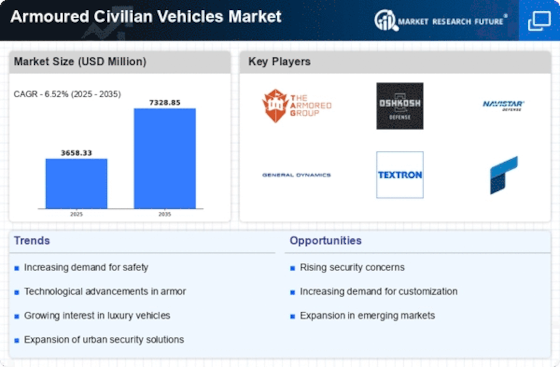
As per Market Research Future analysis, the Armoured Civilian Vehicles Market Size was estimated at 3658.33 USD Million in 2024. The Armoured Civilian Vehicles industry is projected to grow from 3896.86 USD Million in 2025 to 7328.85 USD Million by 2035, exhibiting a compound annual growth rate (CAGR) of 6.5% during the forecast period 2025 - 2035.

Key Market Trends & Highlights

The Armoured Civilian Vehicles Market is experiencing robust growth driven by heightened security concerns and technological advancements.

  • North America remains the largest market for armoured civilian vehicles, reflecting a strong demand for enhanced security solutions. The Asia-Pacific region is emerging as the fastest-growing market, propelled by urbanization and increasing disposable incomes. The SUV segment dominates the market, while the sedan segment is witnessing rapid growth due to changing consumer preferences. Rising threat levels and government regulations are key drivers fueling the demand for armoured vehicles, particularly among high-net-worth individuals.

Market Size & Forecast

2024 Market Size 3658.33 (USD Million)
2035 Market Size 7328.85 (USD Million)
CAGR (2025 - 2035) 6.52%
Largest Regional Market Share in 2024 North America

Major Players

Armored Group (AE), Oshkosh Defense (US), Navistar Defense (US), General Dynamics (US), Textron (US), Rheinmetall (DE), Bae Systems (GB), Mitsubishi Heavy Industries (JP), Krauss-Maffei Wegmann (DE)

Market Trends

The Armoured Civilian Vehicles Market is currently experiencing a notable evolution, driven by various factors including rising security concerns and increasing demand for personal safety. As geopolitical tensions persist and crime rates fluctuate, individuals and organizations are increasingly seeking protective solutions. This trend is particularly evident in regions where threats to personal safety are more pronounced.

Consequently, manufacturers are innovating to enhance the features and capabilities of these vehicles, integrating advanced technologies to meet the growing expectations of consumers. Furthermore, the market is witnessing a shift towards customization, as clients desire vehicles tailored to their specific security needs and preferences. In addition to heightened security awareness, the Armoured Civilian Vehicles Market is also influenced by advancements in materials and manufacturing processes. The introduction of lightweight yet durable materials allows for improved vehicle performance without compromising safety.

This development is crucial, as consumers often prioritize both protection and mobility. Moreover, the increasing acceptance of armoured vehicles in non-traditional sectors, such as corporate transportation and luxury travel, suggests a broadening of the market's scope. As these trends continue to unfold, the Armoured Civilian Vehicles Market appears poised for sustained growth, reflecting a dynamic interplay between consumer demand and technological innovation.

Rising Security Awareness

The growing concern for personal safety is driving demand for armoured vehicles. Individuals and organizations are increasingly prioritizing protection, particularly in regions with heightened threats. This trend is prompting manufacturers to enhance vehicle features and capabilities.

Technological Advancements

Innovations in materials and manufacturing processes are transforming the Armoured Civilian Vehicles Market. Lightweight materials are being utilized to improve performance while maintaining safety standards, appealing to consumers who seek both protection and mobility.

Customization Trends

There is a noticeable shift towards personalized armoured vehicles, as clients seek tailored solutions that meet their specific security needs. This trend indicates a broader acceptance of armoured vehicles across various sectors, including corporate and luxury transportation.

Armoured Civilian Vehicles Market Market Drivers

Increasing Threat Levels

The Armoured Civilian Vehicles Market is experiencing growth due to rising threat levels across various regions. As geopolitical tensions escalate and crime rates increase, individuals and corporations are increasingly prioritizing personal safety. This heightened awareness has led to a surge in demand for armoured vehicles, which are perceived as essential for protection against potential threats. In 2025, the market is projected to reach a valuation of approximately USD 5 billion, reflecting a compound annual growth rate of around 7%. This trend indicates that consumers are willing to invest in advanced security measures, thereby driving the Armoured Civilian Vehicles Market forward.

Technological Innovations

Technological innovations are significantly influencing the Armoured Civilian Vehicles Market. Advancements in materials science, such as the development of lightweight composite materials, are enabling manufacturers to produce vehicles that offer enhanced protection without compromising mobility. Furthermore, the integration of smart technologies, including advanced surveillance systems and real-time tracking, is becoming increasingly common in armoured vehicles. These innovations not only improve safety but also appeal to a broader consumer base, including high-net-worth individuals and corporate clients. As technology continues to evolve, the Armoured Civilian Vehicles Market is expected to witness a transformation, attracting new players and expanding its reach.

Emerging Markets and Urbanization

Emerging markets and urbanization are contributing to the growth of the Armoured Civilian Vehicles Market. As urban areas expand and populations increase, so do the challenges related to safety and security. In many developing regions, the rise in urban crime rates has prompted individuals and businesses to seek protective measures, including armoured vehicles. The market is expected to see substantial growth in these areas, as more consumers recognize the value of investing in security. By 2025, emerging markets are projected to represent a significant share of the Armoured Civilian Vehicles Market, indicating a shift in demand dynamics.

Government Regulations and Support

Government regulations and support play a pivotal role in shaping the Armoured Civilian Vehicles Market. Many countries are implementing stricter safety standards and regulations for civilian vehicles, which inadvertently boosts the demand for armoured options. Additionally, some governments provide incentives for businesses and individuals to invest in security measures, including armoured vehicles. This regulatory environment not only enhances consumer confidence but also encourages manufacturers to innovate and improve their offerings. As a result, the Armoured Civilian Vehicles Market is likely to benefit from a favorable policy landscape, fostering growth and expansion.

Rising Demand from High-Net-Worth Individuals

The Armoured Civilian Vehicles Market is witnessing a notable increase in demand from high-net-worth individuals (HNWIs). This demographic is increasingly concerned about personal safety and is willing to invest in armoured vehicles as a status symbol and a protective measure. The luxury segment of the market is expanding, with manufacturers offering bespoke armoured vehicles tailored to the specific needs of affluent clients. In 2025, it is estimated that HNWIs will account for a significant portion of the market share, further driving the growth of the Armoured Civilian Vehicles Market. This trend suggests a shift in consumer preferences towards personalized security solutions.

Market Segment Insights

By Drive Type: Wheel (Largest) vs. Track (Fastest-Growing)

In the Armoured Civilian Vehicles Market, the drive type segment showcases a varied distribution, with wheel drive systems commanding a significant share due to their versatility and established presence in the market. Wheel-driven armoured vehicles are favored for their maneuverability and suitability for urban environments, making them a popular choice among government and private sector buyers. Track systems, while currently comprising a smaller market portion, are gaining attention for their unique advantages in off-road conditions, leading to an increase in adoption particularly for specialized applications.

Drive Type: Wheel (Dominant) vs. Track (Emerging)

Wheel drive systems for armoured civilian vehicles are characterized by their remarkable adaptability and efficiency, making them the dominant choice in the market. These systems offer superior mobility on paved surfaces and are often equipped with advanced technologies enhancing performance and comfort. On the other hand, track systems are emerging as a significant alternative, particularly in scenarios requiring enhanced stability and off-road capability. Though currently less prevalent, the development of specialized track vehicles for unique missions is driving interest and investment, positioning them as a noteworthy contender in the evolving armoured civilian vehicle landscape.

By Vehicle Type: SUV (Largest) vs. Sedan (Fastest-Growing)

In the Armoured Civilian Vehicles Market, SUVs have established themselves as the largest segment, driven by their versatility, safety features, and higher demand among luxury buyers. This segment not only commands a substantial market share but also appeals to a wide range of customers looking for both protection and performance. Sedans, while traditionally popular, have seen a significant rise in their share due to a growing preference for compact vehicles that offer armored configurations without compromising on maneuverability.

SUV (Dominant) vs. Sedan (Emerging)

The SUV segment currently dominates the Armoured Civilian Vehicles Market, characterized by its robust engineering and higher demand for off-road capabilities combined with luxury features. Buyers are attracted to SUVs for their spacious interiors and advanced safety technologies, making them ideal for individuals and corporate clients. In contrast, the sedan segment is emerging due to changing consumer preferences leaning towards smaller, more efficient vehicles that still provide essential protection. This shift is driven by urbanization and the need for agility in urban settings, making sedans a growing choice despite the dominance of SUVs.

Get more detailed insights about Armoured Civilian Vehicles Market Research Report—Global Forecast till 2035

Regional Insights

North America : Defense and Security Leader

North America is the largest market for armoured civilian vehicles, holding approximately 45% of the global market share. The region's growth is driven by increasing security concerns, government investments in defense, and a rising demand for personal protection. Regulatory support, including federal contracts and military collaborations, further catalyzes market expansion. The U.S. government’s focus on enhancing domestic security measures is a significant driver of this growth. The United States dominates the North American market, with key players like Oshkosh Defense, General Dynamics, and Textron leading the competitive landscape. These companies benefit from advanced technology and strong government ties, ensuring a steady demand for their products. The presence of established manufacturers and ongoing innovations in vehicle design and protection features contribute to the region's robust market dynamics.

Europe : Emerging Market Dynamics

Europe is witnessing a significant rise in the demand for armoured civilian vehicles, holding about 30% of the global market share. The growth is fueled by geopolitical tensions, increased terrorist threats, and a focus on enhancing public safety. Regulatory frameworks across various European nations are evolving to support the procurement of advanced security vehicles, which is expected to further boost market growth. Countries like Germany and France are at the forefront, driving innovation and investment in this sector. Germany is the leading market in Europe, with key players such as Rheinmetall and Krauss-Maffei Wegmann shaping the competitive landscape. The presence of established defense contractors and a strong emphasis on research and development are pivotal for market expansion. Additionally, collaborations between governments and private sectors are fostering advancements in vehicle technology, ensuring that Europe remains a competitive player in The Armoured Civilian Vehicles Market.

Asia-Pacific : Rapidly Expanding Market

The Asia-Pacific region is emerging as a significant player in the armoured civilian vehicles market, accounting for approximately 20% of the global share. The growth is driven by increasing urbanization, rising crime rates, and government initiatives aimed at enhancing public safety. Countries like India and Japan are investing heavily in security infrastructure, which is expected to propel market demand. Regulatory support for defense procurement is also a key factor in this growth trajectory. India is leading the market in this region, with a growing number of local manufacturers entering the space. The competitive landscape is characterized by both domestic and international players, including Mitsubishi Heavy Industries. The focus on indigenous production and technology transfer is shaping the market dynamics, ensuring that the Asia-Pacific region becomes a formidable competitor in the global armoured civilian vehicle sector.

Middle East and Africa : Security and Defense Focus

The Middle East and Africa region is witnessing a growing demand for armoured civilian vehicles, holding around 5% of the global market share. The growth is primarily driven by ongoing conflicts, security threats, and a rising need for personal protection among civilians. Governments in this region are increasingly investing in defense and security measures, which is expected to further stimulate market growth. Countries like the UAE and South Africa are leading the charge in this sector, focusing on enhancing their security capabilities. The competitive landscape in the Middle East and Africa is characterized by a mix of local and international players, with companies like Armored Group and Bae Systems making significant inroads. The presence of these key players, along with government contracts and partnerships, is crucial for market expansion. As security concerns continue to rise, the demand for advanced armoured vehicles is expected to grow, positioning this region as a vital market in the global landscape.

Key Players and Competitive Insights

The Armoured Civilian Vehicles Market is currently characterized by a dynamic competitive landscape, driven by increasing security concerns and the demand for enhanced protection in various sectors, including government, corporate, and private use. Key players such as Armored Group (AE), Oshkosh Defense (US), and General Dynamics (US) are strategically positioned to leverage their technological advancements and operational efficiencies. Armored Group (AE) focuses on innovation in vehicle design and customization, while Oshkosh Defense (US) emphasizes partnerships with government entities to secure long-term contracts. General Dynamics (US) is enhancing its digital transformation initiatives to improve operational capabilities, collectively shaping a competitive environment that prioritizes advanced technology and customer-centric solutions.

The market structure appears moderately fragmented, with several players vying for market share through localized manufacturing and supply chain optimization. Companies are increasingly localizing their production to reduce costs and enhance responsiveness to regional demands. This strategy not only strengthens their market presence but also allows for better alignment with local regulations and customer preferences. The collective influence of these key players fosters a competitive atmosphere where innovation and operational excellence are paramount.

In August 2025, Oshkosh Defense (US) announced a strategic partnership with a leading technology firm to integrate AI-driven analytics into their armoured vehicle systems. This move is significant as it positions Oshkosh to enhance the operational efficiency and safety of its vehicles, potentially setting a new standard in the industry. The integration of AI is likely to provide real-time data analysis, improving decision-making processes for users in high-risk environments.

In September 2025, General Dynamics (US) unveiled a new line of hybrid-electric armoured vehicles, showcasing its commitment to sustainability and innovation. This development is crucial as it aligns with global trends towards environmentally friendly technologies, potentially attracting a broader customer base concerned with sustainability. The hybrid-electric technology may also reduce operational costs for users, further enhancing General Dynamics' competitive edge.

In July 2025, Armored Group (AE) expanded its manufacturing capabilities by establishing a new facility in Eastern Europe. This strategic move is indicative of the company's intent to tap into the growing demand for armoured vehicles in that region, particularly in response to geopolitical tensions. By localizing production, Armored Group (AE) can better serve its clients while also mitigating supply chain risks associated with global logistics.

As of October 2025, the Armoured Civilian Vehicles Market is witnessing trends that emphasize digitalization, sustainability, and the integration of advanced technologies such as AI. Strategic alliances are increasingly shaping the competitive landscape, enabling companies to pool resources and expertise to innovate more effectively. Looking ahead, competitive differentiation is likely to evolve from traditional price-based competition towards a focus on technological innovation, reliability in supply chains, and the ability to meet diverse customer needs in a rapidly changing security environment.

Key Companies in the Armoured Civilian Vehicles Market include

Industry Developments

September 2022 - Mahindra Emirates Vehicle Armouring, UAE and Jordan, has launched their Mahindra MAXIMUS 4*4 armoured personal carrier with B6 and B7 level bulletproof capabilities for police/paramilitary/troops.

Future Outlook

Armoured Civilian Vehicles Market Future Outlook

The Armoured Civilian Vehicles Market is projected to grow at a 6.52% CAGR from 2025 to 2035, driven by rising security concerns and increasing demand for personal safety.

New opportunities lie in:

  • <p>Development of advanced lightweight armouring materials Integration of smart technology for real-time threat assessment Expansion into emerging markets with rising security needs</p>

By 2035, the market is expected to solidify its position as a leader in personal security solutions.

Market Segmentation

Armoured Civilian Vehicles Market Drive Type Outlook

  • Wheel
  • Track

Armoured Civilian Vehicles Market Vehicle Type Outlook

  • Sedan
  • Trucks & Buses
  • SUV
  • Limousine
  • Others

Report Scope

MARKET SIZE 2024 3658.33(USD Million)
MARKET SIZE 2025 3896.86(USD Million)
MARKET SIZE 2035 7328.85(USD Million)
COMPOUND ANNUAL GROWTH RATE (CAGR) 6.52% (2025 - 2035)
REPORT COVERAGE Revenue Forecast, Competitive Landscape, Growth Factors, and Trends
BASE YEAR 2024
Market Forecast Period 2025 - 2035
Historical Data 2019 - 2024
Market Forecast Units USD Million
Key Companies Profiled Armored Group (AE), Oshkosh Defense (US), Navistar Defense (US), General Dynamics (US), Textron (US), Rheinmetall (DE), Bae Systems (GB), Mitsubishi Heavy Industries (JP), Krauss-Maffei Wegmann (DE)
Segments Covered Drive Type, Vehicle Type, Region
Key Market Opportunities Growing demand for enhanced security solutions drives innovation in the Armoured Civilian Vehicles Market.
Key Market Dynamics Rising demand for enhanced security features drives innovation and competition in the armoured civilian vehicles market.
Countries Covered North America, Europe, APAC, South America, MEA

FAQs

What is the projected market valuation for the Armoured Civilian Vehicles Market in 2035?

<p>The projected market valuation for the Armoured Civilian Vehicles Market in 2035 is 7328.85 USD Million.</p>

What was the overall market valuation for the Armoured Civilian Vehicles Market in 2024?

<p>The overall market valuation for the Armoured Civilian Vehicles Market in 2024 was 3658.33 USD Million.</p>

What is the expected CAGR for the Armoured Civilian Vehicles Market during the forecast period 2025 - 2035?

<p>The expected CAGR for the Armoured Civilian Vehicles Market during the forecast period 2025 - 2035 is 6.52%.</p>

Which companies are considered key players in the Armoured Civilian Vehicles Market?

<p>Key players in the Armoured Civilian Vehicles Market include Armored Group (AE), Oshkosh Defense (US), and General Dynamics (US), among others.</p>

What are the main segments of the Armoured Civilian Vehicles Market based on drive type?

<p>The main segments based on drive type include Wheel vehicles valued at 4450.0 USD Million and Track vehicles valued at 2878.85 USD Million.</p>

How do the vehicle types segment the Armoured Civilian Vehicles Market?

The vehicle types segment includes SUVs valued at 2920.0 USD Million, Trucks &amp; Buses at 1460.0 USD Million, and Sedans at 1460.0 USD Million.

What is the valuation range for SUVs in the Armoured Civilian Vehicles Market?

The valuation range for SUVs in the Armoured Civilian Vehicles Market is between 1460.0 USD Million and 2920.0 USD Million.

What is the valuation for Trucks & Buses in the Armoured Civilian Vehicles Market?

The valuation for Trucks &amp; Buses in the Armoured Civilian Vehicles Market is between 730.0 USD Million and 1460.0 USD Million.

What does the market data suggest about the growth potential of the Armoured Civilian Vehicles Market?

The market data suggests a robust growth potential, with a projected increase from 3658.33 USD Million in 2024 to 7328.85 USD Million by 2035.

What are the projected valuations for the 'Others' category in the vehicle type segment?

The projected valuations for the 'Others' category in the vehicle type segment range from 8.33 USD Million to 8.85 USD Million.

  1. SECTION I: EXECUTIVE SUMMARY AND KEY HIGHLIGHTS
    1. | 1.1 EXECUTIVE SUMMARY
    2. | | 1.1.1 Market Overview
    3. | | 1.1.2 Key Findings
    4. | | 1.1.3 Market Segmentation
    5. | | 1.1.4 Competitive Landscape
    6. | | 1.1.5 Challenges and Opportunities
    7. | | 1.1.6 Future Outlook
  2. SECTION II: SCOPING, METHODOLOGY AND MARKET STRUCTURE
    1. | 2.1 MARKET INTRODUCTION
    2. | | 2.1.1 Definition
    3. | | 2.1.2 Scope of the study
    4. | | | 2.1.2.1 Research Objective
    5. | | | 2.1.2.2 Assumption
    6. | | | 2.1.2.3 Limitations
    7. | 2.2 RESEARCH METHODOLOGY
    8. | | 2.2.1 Overview
    9. | | 2.2.2 Data Mining
    10. | | 2.2.3 Secondary Research
    11. | | 2.2.4 Primary Research
    12. | | | 2.2.4.1 Primary Interviews and Information Gathering Process
    13. | | | 2.2.4.2 Breakdown of Primary Respondents
    14. | | 2.2.5 Forecasting Model
    15. | | 2.2.6 Market Size Estimation
    16. | | | 2.2.6.1 Bottom-Up Approach
    17. | | | 2.2.6.2 Top-Down Approach
    18. | | 2.2.7 Data Triangulation
    19. | | 2.2.8 Validation
  3. SECTION III: QUALITATIVE ANALYSIS
    1. | 3.1 MARKET DYNAMICS
    2. | | 3.1.1 Overview
    3. | | 3.1.2 Drivers
    4. | | 3.1.3 Restraints
    5. | | 3.1.4 Opportunities
    6. | 3.2 MARKET FACTOR ANALYSIS
    7. | | 3.2.1 Value chain Analysis
    8. | | 3.2.2 Porter's Five Forces Analysis
    9. | | | 3.2.2.1 Bargaining Power of Suppliers
    10. | | | 3.2.2.2 Bargaining Power of Buyers
    11. | | | 3.2.2.3 Threat of New Entrants
    12. | | | 3.2.2.4 Threat of Substitutes
    13. | | | 3.2.2.5 Intensity of Rivalry
    14. | | 3.2.3 COVID-19 Impact Analysis
    15. | | | 3.2.3.1 Market Impact Analysis
    16. | | | 3.2.3.2 Regional Impact
    17. | | | 3.2.3.3 Opportunity and Threat Analysis
  4. SECTION IV: QUANTITATIVE ANALYSIS
    1. | 4.1 Automobile, BY Drive Type (USD Million)
    2. | | 4.1.1 Wheel
    3. | | 4.1.2 Track
    4. | 4.2 Automobile, BY Vehicle Type (USD Million)
    5. | | 4.2.1 Sedan
    6. | | 4.2.2 Trucks & Buses
    7. | | 4.2.3 SUV
    8. | | 4.2.4 Limousine
    9. | | 4.2.5 Others
    10. | 4.3 Automobile, BY Region (USD Million)
    11. | | 4.3.1 North America
    12. | | | 4.3.1.1 US
    13. | | | 4.3.1.2 Canada
    14. | | 4.3.2 Europe
    15. | | | 4.3.2.1 Germany
    16. | | | 4.3.2.2 UK
    17. | | | 4.3.2.3 France
    18. | | | 4.3.2.4 Russia
    19. | | | 4.3.2.5 Italy
    20. | | | 4.3.2.6 Spain
    21. | | | 4.3.2.7 Rest of Europe
    22. | | 4.3.3 APAC
    23. | | | 4.3.3.1 China
    24. | | | 4.3.3.2 India
    25. | | | 4.3.3.3 Japan
    26. | | | 4.3.3.4 South Korea
    27. | | | 4.3.3.5 Malaysia
    28. | | | 4.3.3.6 Thailand
    29. | | | 4.3.3.7 Indonesia
    30. | | | 4.3.3.8 Rest of APAC
    31. | | 4.3.4 South America
    32. | | | 4.3.4.1 Brazil
    33. | | | 4.3.4.2 Mexico
    34. | | | 4.3.4.3 Argentina
    35. | | | 4.3.4.4 Rest of South America
    36. | | 4.3.5 MEA
    37. | | | 4.3.5.1 GCC Countries
    38. | | | 4.3.5.2 South Africa
    39. | | | 4.3.5.3 Rest of MEA
  5. SECTION V: COMPETITIVE ANALYSIS
    1. | 5.1 Competitive Landscape
    2. | | 5.1.1 Overview
    3. | | 5.1.2 Competitive Analysis
    4. | | 5.1.3 Market share Analysis
    5. | | 5.1.4 Major Growth Strategy in the Automobile
    6. | | 5.1.5 Competitive Benchmarking
    7. | | 5.1.6 Leading Players in Terms of Number of Developments in the Automobile
    8. | | 5.1.7 Key developments and growth strategies
    9. | | | 5.1.7.1 New Product Launch/Service Deployment
    10. | | | 5.1.7.2 Merger & Acquisitions
    11. | | | 5.1.7.3 Joint Ventures
    12. | | 5.1.8 Major Players Financial Matrix
    13. | | | 5.1.8.1 Sales and Operating Income
    14. | | | 5.1.8.2 Major Players R&D Expenditure. 2023
    15. | 5.2 Company Profiles
    16. | | 5.2.1 Armored Group (AE)
    17. | | | 5.2.1.1 Financial Overview
    18. | | | 5.2.1.2 Products Offered
    19. | | | 5.2.1.3 Key Developments
    20. | | | 5.2.1.4 SWOT Analysis
    21. | | | 5.2.1.5 Key Strategies
    22. | | 5.2.2 Oshkosh Defense (US)
    23. | | | 5.2.2.1 Financial Overview
    24. | | | 5.2.2.2 Products Offered
    25. | | | 5.2.2.3 Key Developments
    26. | | | 5.2.2.4 SWOT Analysis
    27. | | | 5.2.2.5 Key Strategies
    28. | | 5.2.3 Navistar Defense (US)
    29. | | | 5.2.3.1 Financial Overview
    30. | | | 5.2.3.2 Products Offered
    31. | | | 5.2.3.3 Key Developments
    32. | | | 5.2.3.4 SWOT Analysis
    33. | | | 5.2.3.5 Key Strategies
    34. | | 5.2.4 General Dynamics (US)
    35. | | | 5.2.4.1 Financial Overview
    36. | | | 5.2.4.2 Products Offered
    37. | | | 5.2.4.3 Key Developments
    38. | | | 5.2.4.4 SWOT Analysis
    39. | | | 5.2.4.5 Key Strategies
    40. | | 5.2.5 Textron (US)
    41. | | | 5.2.5.1 Financial Overview
    42. | | | 5.2.5.2 Products Offered
    43. | | | 5.2.5.3 Key Developments
    44. | | | 5.2.5.4 SWOT Analysis
    45. | | | 5.2.5.5 Key Strategies
    46. | | 5.2.6 Rheinmetall (DE)
    47. | | | 5.2.6.1 Financial Overview
    48. | | | 5.2.6.2 Products Offered
    49. | | | 5.2.6.3 Key Developments
    50. | | | 5.2.6.4 SWOT Analysis
    51. | | | 5.2.6.5 Key Strategies
    52. | | 5.2.7 Bae Systems (GB)
    53. | | | 5.2.7.1 Financial Overview
    54. | | | 5.2.7.2 Products Offered
    55. | | | 5.2.7.3 Key Developments
    56. | | | 5.2.7.4 SWOT Analysis
    57. | | | 5.2.7.5 Key Strategies
    58. | | 5.2.8 Mitsubishi Heavy Industries (JP)
    59. | | | 5.2.8.1 Financial Overview
    60. | | | 5.2.8.2 Products Offered
    61. | | | 5.2.8.3 Key Developments
    62. | | | 5.2.8.4 SWOT Analysis
    63. | | | 5.2.8.5 Key Strategies
    64. | | 5.2.9 Krauss-Maffei Wegmann (DE)
    65. | | | 5.2.9.1 Financial Overview
    66. | | | 5.2.9.2 Products Offered
    67. | | | 5.2.9.3 Key Developments
    68. | | | 5.2.9.4 SWOT Analysis
    69. | | | 5.2.9.5 Key Strategies
    70. | 5.3 Appendix
    71. | | 5.3.1 References
    72. | | 5.3.2 Related Reports
  6. LIST OF FIGURES
    1. | 6.1 MARKET SYNOPSIS
    2. | 6.2 NORTH AMERICA MARKET ANALYSIS
    3. | 6.3 US MARKET ANALYSIS BY DRIVE TYPE
    4. | 6.4 US MARKET ANALYSIS BY VEHICLE TYPE
    5. | 6.5 CANADA MARKET ANALYSIS BY DRIVE TYPE
    6. | 6.6 CANADA MARKET ANALYSIS BY VEHICLE TYPE
    7. | 6.7 EUROPE MARKET ANALYSIS
    8. | 6.8 GERMANY MARKET ANALYSIS BY DRIVE TYPE
    9. | 6.9 GERMANY MARKET ANALYSIS BY VEHICLE TYPE
    10. | 6.10 UK MARKET ANALYSIS BY DRIVE TYPE
    11. | 6.11 UK MARKET ANALYSIS BY VEHICLE TYPE
    12. | 6.12 FRANCE MARKET ANALYSIS BY DRIVE TYPE
    13. | 6.13 FRANCE MARKET ANALYSIS BY VEHICLE TYPE
    14. | 6.14 RUSSIA MARKET ANALYSIS BY DRIVE TYPE
    15. | 6.15 RUSSIA MARKET ANALYSIS BY VEHICLE TYPE
    16. | 6.16 ITALY MARKET ANALYSIS BY DRIVE TYPE
    17. | 6.17 ITALY MARKET ANALYSIS BY VEHICLE TYPE
    18. | 6.18 SPAIN MARKET ANALYSIS BY DRIVE TYPE
    19. | 6.19 SPAIN MARKET ANALYSIS BY VEHICLE TYPE
    20. | 6.20 REST OF EUROPE MARKET ANALYSIS BY DRIVE TYPE
    21. | 6.21 REST OF EUROPE MARKET ANALYSIS BY VEHICLE TYPE
    22. | 6.22 APAC MARKET ANALYSIS
    23. | 6.23 CHINA MARKET ANALYSIS BY DRIVE TYPE
    24. | 6.24 CHINA MARKET ANALYSIS BY VEHICLE TYPE
    25. | 6.25 INDIA MARKET ANALYSIS BY DRIVE TYPE
    26. | 6.26 INDIA MARKET ANALYSIS BY VEHICLE TYPE
    27. | 6.27 JAPAN MARKET ANALYSIS BY DRIVE TYPE
    28. | 6.28 JAPAN MARKET ANALYSIS BY VEHICLE TYPE
    29. | 6.29 SOUTH KOREA MARKET ANALYSIS BY DRIVE TYPE
    30. | 6.30 SOUTH KOREA MARKET ANALYSIS BY VEHICLE TYPE
    31. | 6.31 MALAYSIA MARKET ANALYSIS BY DRIVE TYPE
    32. | 6.32 MALAYSIA MARKET ANALYSIS BY VEHICLE TYPE
    33. | 6.33 THAILAND MARKET ANALYSIS BY DRIVE TYPE
    34. | 6.34 THAILAND MARKET ANALYSIS BY VEHICLE TYPE
    35. | 6.35 INDONESIA MARKET ANALYSIS BY DRIVE TYPE
    36. | 6.36 INDONESIA MARKET ANALYSIS BY VEHICLE TYPE
    37. | 6.37 REST OF APAC MARKET ANALYSIS BY DRIVE TYPE
    38. | 6.38 REST OF APAC MARKET ANALYSIS BY VEHICLE TYPE
    39. | 6.39 SOUTH AMERICA MARKET ANALYSIS
    40. | 6.40 BRAZIL MARKET ANALYSIS BY DRIVE TYPE
    41. | 6.41 BRAZIL MARKET ANALYSIS BY VEHICLE TYPE
    42. | 6.42 MEXICO MARKET ANALYSIS BY DRIVE TYPE
    43. | 6.43 MEXICO MARKET ANALYSIS BY VEHICLE TYPE
    44. | 6.44 ARGENTINA MARKET ANALYSIS BY DRIVE TYPE
    45. | 6.45 ARGENTINA MARKET ANALYSIS BY VEHICLE TYPE
    46. | 6.46 REST OF SOUTH AMERICA MARKET ANALYSIS BY DRIVE TYPE
    47. | 6.47 REST OF SOUTH AMERICA MARKET ANALYSIS BY VEHICLE TYPE
    48. | 6.48 MEA MARKET ANALYSIS
    49. | 6.49 GCC COUNTRIES MARKET ANALYSIS BY DRIVE TYPE
    50. | 6.50 GCC COUNTRIES MARKET ANALYSIS BY VEHICLE TYPE
    51. | 6.51 SOUTH AFRICA MARKET ANALYSIS BY DRIVE TYPE
    52. | 6.52 SOUTH AFRICA MARKET ANALYSIS BY VEHICLE TYPE
    53. | 6.53 REST OF MEA MARKET ANALYSIS BY DRIVE TYPE
    54. | 6.54 REST OF MEA MARKET ANALYSIS BY VEHICLE TYPE
    55. | 6.55 KEY BUYING CRITERIA OF AUTOMOBILE
    56. | 6.56 RESEARCH PROCESS OF MRFR
    57. | 6.57 DRO ANALYSIS OF AUTOMOBILE
    58. | 6.58 DRIVERS IMPACT ANALYSIS: AUTOMOBILE
    59. | 6.59 RESTRAINTS IMPACT ANALYSIS: AUTOMOBILE
    60. | 6.60 SUPPLY / VALUE CHAIN: AUTOMOBILE
    61. | 6.61 AUTOMOBILE, BY DRIVE TYPE, 2024 (% SHARE)
    62. | 6.62 AUTOMOBILE, BY DRIVE TYPE, 2024 TO 2035 (USD Million)
    63. | 6.63 AUTOMOBILE, BY VEHICLE TYPE, 2024 (% SHARE)
    64. | 6.64 AUTOMOBILE, BY VEHICLE TYPE, 2024 TO 2035 (USD Million)
    65. | 6.65 BENCHMARKING OF MAJOR COMPETITORS
  7. LIST OF TABLES
    1. | 7.1 LIST OF ASSUMPTIONS
    2. | | 7.1.1
    3. | 7.2 North America MARKET SIZE ESTIMATES; FORECAST
    4. | | 7.2.1 BY DRIVE TYPE, 2025-2035 (USD Million)
    5. | | 7.2.2 BY VEHICLE TYPE, 2025-2035 (USD Million)
    6. | 7.3 US MARKET SIZE ESTIMATES; FORECAST
    7. | | 7.3.1 BY DRIVE TYPE, 2025-2035 (USD Million)
    8. | | 7.3.2 BY VEHICLE TYPE, 2025-2035 (USD Million)
    9. | 7.4 Canada MARKET SIZE ESTIMATES; FORECAST
    10. | | 7.4.1 BY DRIVE TYPE, 2025-2035 (USD Million)
    11. | | 7.4.2 BY VEHICLE TYPE, 2025-2035 (USD Million)
    12. | 7.5 Europe MARKET SIZE ESTIMATES; FORECAST
    13. | | 7.5.1 BY DRIVE TYPE, 2025-2035 (USD Million)
    14. | | 7.5.2 BY VEHICLE TYPE, 2025-2035 (USD Million)
    15. | 7.6 Germany MARKET SIZE ESTIMATES; FORECAST
    16. | | 7.6.1 BY DRIVE TYPE, 2025-2035 (USD Million)
    17. | | 7.6.2 BY VEHICLE TYPE, 2025-2035 (USD Million)
    18. | 7.7 UK MARKET SIZE ESTIMATES; FORECAST
    19. | | 7.7.1 BY DRIVE TYPE, 2025-2035 (USD Million)
    20. | | 7.7.2 BY VEHICLE TYPE, 2025-2035 (USD Million)
    21. | 7.8 France MARKET SIZE ESTIMATES; FORECAST
    22. | | 7.8.1 BY DRIVE TYPE, 2025-2035 (USD Million)
    23. | | 7.8.2 BY VEHICLE TYPE, 2025-2035 (USD Million)
    24. | 7.9 Russia MARKET SIZE ESTIMATES; FORECAST
    25. | | 7.9.1 BY DRIVE TYPE, 2025-2035 (USD Million)
    26. | | 7.9.2 BY VEHICLE TYPE, 2025-2035 (USD Million)
    27. | 7.10 Italy MARKET SIZE ESTIMATES; FORECAST
    28. | | 7.10.1 BY DRIVE TYPE, 2025-2035 (USD Million)
    29. | | 7.10.2 BY VEHICLE TYPE, 2025-2035 (USD Million)
    30. | 7.11 Spain MARKET SIZE ESTIMATES; FORECAST
    31. | | 7.11.1 BY DRIVE TYPE, 2025-2035 (USD Million)
    32. | | 7.11.2 BY VEHICLE TYPE, 2025-2035 (USD Million)
    33. | 7.12 Rest of Europe MARKET SIZE ESTIMATES; FORECAST
    34. | | 7.12.1 BY DRIVE TYPE, 2025-2035 (USD Million)
    35. | | 7.12.2 BY VEHICLE TYPE, 2025-2035 (USD Million)
    36. | 7.13 APAC MARKET SIZE ESTIMATES; FORECAST
    37. | | 7.13.1 BY DRIVE TYPE, 2025-2035 (USD Million)
    38. | | 7.13.2 BY VEHICLE TYPE, 2025-2035 (USD Million)
    39. | 7.14 China MARKET SIZE ESTIMATES; FORECAST
    40. | | 7.14.1 BY DRIVE TYPE, 2025-2035 (USD Million)
    41. | | 7.14.2 BY VEHICLE TYPE, 2025-2035 (USD Million)
    42. | 7.15 India MARKET SIZE ESTIMATES; FORECAST
    43. | | 7.15.1 BY DRIVE TYPE, 2025-2035 (USD Million)
    44. | | 7.15.2 BY VEHICLE TYPE, 2025-2035 (USD Million)
    45. | 7.16 Japan MARKET SIZE ESTIMATES; FORECAST
    46. | | 7.16.1 BY DRIVE TYPE, 2025-2035 (USD Million)
    47. | | 7.16.2 BY VEHICLE TYPE, 2025-2035 (USD Million)
    48. | 7.17 South Korea MARKET SIZE ESTIMATES; FORECAST
    49. | | 7.17.1 BY DRIVE TYPE, 2025-2035 (USD Million)
    50. | | 7.17.2 BY VEHICLE TYPE, 2025-2035 (USD Million)
    51. | 7.18 Malaysia MARKET SIZE ESTIMATES; FORECAST
    52. | | 7.18.1 BY DRIVE TYPE, 2025-2035 (USD Million)
    53. | | 7.18.2 BY VEHICLE TYPE, 2025-2035 (USD Million)
    54. | 7.19 Thailand MARKET SIZE ESTIMATES; FORECAST
    55. | | 7.19.1 BY DRIVE TYPE, 2025-2035 (USD Million)
    56. | | 7.19.2 BY VEHICLE TYPE, 2025-2035 (USD Million)
    57. | 7.20 Indonesia MARKET SIZE ESTIMATES; FORECAST
    58. | | 7.20.1 BY DRIVE TYPE, 2025-2035 (USD Million)
    59. | | 7.20.2 BY VEHICLE TYPE, 2025-2035 (USD Million)
    60. | 7.21 Rest of APAC MARKET SIZE ESTIMATES; FORECAST
    61. | | 7.21.1 BY DRIVE TYPE, 2025-2035 (USD Million)
    62. | | 7.21.2 BY VEHICLE TYPE, 2025-2035 (USD Million)
    63. | 7.22 South America MARKET SIZE ESTIMATES; FORECAST
    64. | | 7.22.1 BY DRIVE TYPE, 2025-2035 (USD Million)
    65. | | 7.22.2 BY VEHICLE TYPE, 2025-2035 (USD Million)
    66. | 7.23 Brazil MARKET SIZE ESTIMATES; FORECAST
    67. | | 7.23.1 BY DRIVE TYPE, 2025-2035 (USD Million)
    68. | | 7.23.2 BY VEHICLE TYPE, 2025-2035 (USD Million)
    69. | 7.24 Mexico MARKET SIZE ESTIMATES; FORECAST
    70. | | 7.24.1 BY DRIVE TYPE, 2025-2035 (USD Million)
    71. | | 7.24.2 BY VEHICLE TYPE, 2025-2035 (USD Million)
    72. | 7.25 Argentina MARKET SIZE ESTIMATES; FORECAST
    73. | | 7.25.1 BY DRIVE TYPE, 2025-2035 (USD Million)
    74. | | 7.25.2 BY VEHICLE TYPE, 2025-2035 (USD Million)
    75. | 7.26 Rest of South America MARKET SIZE ESTIMATES; FORECAST
    76. | | 7.26.1 BY DRIVE TYPE, 2025-2035 (USD Million)
    77. | | 7.26.2 BY VEHICLE TYPE, 2025-2035 (USD Million)
    78. | 7.27 MEA MARKET SIZE ESTIMATES; FORECAST
    79. | | 7.27.1 BY DRIVE TYPE, 2025-2035 (USD Million)
    80. | | 7.27.2 BY VEHICLE TYPE, 2025-2035 (USD Million)
    81. | 7.28 GCC Countries MARKET SIZE ESTIMATES; FORECAST
    82. | | 7.28.1 BY DRIVE TYPE, 2025-2035 (USD Million)
    83. | | 7.28.2 BY VEHICLE TYPE, 2025-2035 (USD Million)
    84. | 7.29 South Africa MARKET SIZE ESTIMATES; FORECAST
    85. | | 7.29.1 BY DRIVE TYPE, 2025-2035 (USD Million)
    86. | | 7.29.2 BY VEHICLE TYPE, 2025-2035 (USD Million)
    87. | 7.30 Rest of MEA MARKET SIZE ESTIMATES; FORECAST
    88. | | 7.30.1 BY DRIVE TYPE, 2025-2035 (USD Million)
    89. | | 7.30.2 BY VEHICLE TYPE, 2025-2035 (USD Million)
    90. | 7.31 PRODUCT LAUNCH/PRODUCT DEVELOPMENT/APPROVAL
    91. | | 7.31.1
    92. | 7.32 ACQUISITION/PARTNERSHIP
    93. | | 7.32.1

Automobile Market Segmentation

Automobile By Drive Type (USD Million, 2025-2035)

  • Wheel
  • Track

Automobile By Vehicle Type (USD Million, 2025-2035)

  • Sedan
  • Trucks & Buses
  • SUV
  • Limousine
  • Others
Infographic

Free Sample Request

Kindly complete the form below to receive a free sample of this Report

Get Free Sample

Customer Strories

Compare Licence

×
Features License Type
Single User Multiuser License Enterprise User
Price $4,950 $5,950 $7,250
Maximum User Access Limit 1 User Upto 10 Users Unrestricted Access Throughout the Organization
Free Customization
Direct Access to Analyst
Deliverable Format
Platform Access
Discount on Next Purchase 10% 15% 15%
Printable Versions