
Request Free Sample ×

Kindly complete the form below to receive a free sample of this Report

* Please use a valid business email

Leading companies partner with us for data-driven Insights

clients tt-cursor
Hero Background
English
Chinese
French
Japanese
Korean
German
Spanish

AR VR Smart Glasses Market Share

ID: MRFR/SEM/3410-HCR
100 Pages
Nirmit Biswas
April 2026

AR and VR Smart Glasses Market Size, Share and Research Report By Device Type (Binocular, Monocular), By Product (Mobile phone smart glasses, Integrated Smart glasses, External Smart glasses), By Application (Education, Gaming, Industrial, Military)- Industry Forecast Till 2035

Share:
Download PDF ×

We do not share your information with anyone. However, we may send you emails based on your report interest from time to time. You may contact us at any time to opt-out.

AR VR Smart Glasses Market Infographic
Purchase Options

Market Share

AR VR Smart Glasses Market Share Analysis

For businesses looking to get a firm footing in the highly competitive AR and VR smart glasses industry, market share positioning tactics are essential. Using technical innovation to differentiate oneself is a crucial strategy. Businesses may differentiate themselves by providing distinctive features, enhanced performance, and other benefits by investing in cutting-edge hardware and software technology. This tactic not only draws in early adopters but also establishes a business as a pioneer in expanding the capabilities of smart eyewear. A crucial approach that is often overlooked is affordable and sensible pricing. In a market where a major driver is consumer acceptance, attracting a wider audience in the smart glasses industry requires competitive pricing. Companies may reach a larger customer base by finding the ideal mix between cost and cutting-edge features, particularly as the industry moves from specialty applications to more general use. Cooperatives and strategic alliances are important for positioning market share. Creating partnerships with leaders in the technological sector, content creators, and business partners can result in mutually beneficial synergies. Businesses can provide consumers a more engaging and all-encompassing experience, increasing the allure and functionality of their smart eyewear, by building a strong ecosystem. These kinds of partnerships may also aid in obtaining exclusive material, which can serve as a potent differentiator in the cutthroat industry. Especially in the business category, customization and meeting industry-specific demands are successful techniques for gaining market share positions. Businesses may obtain a competitive advantage by customizing their AR and VR smart glasses to meet the demands of certain sectors like manufacturing, logistics, and healthcare. A corporation may establish itself as a dependable provider of solutions in certain industries by comprehending and addressing industry-specific difficulties through specialized features and functions. This approach can lead to increased market share and client loyalty. Market share strategy must include marketing and brand positioning. Customer perceptions may be greatly impacted by developing a strong brand image that represents dependability, innovation, and customer happiness. Successful marketing initiatives that emphasize the features and practical uses of smart glasses raise brand awareness and have the power to sway consumer decisions. When customer trust is paramount in a market, brand awareness becomes an extremely potent asset.


Author
Author Profile
Nirmit Biswas
Senior Research Analyst

With 5+ years of expertise in Market Intelligence and Strategic Research, Nirmit Biswas specializes in ICT, Semiconductors, and BFSI. Backed by an MBA in Financial Services and a Computer Science foundation, Nirmit blends technical depth with business acumen. He has successfully led 100+ projects for global enterprises and startups, including Amazon, Cisco, L&T and Huawei, delivering market estimations, competitive benchmarking, and GTM strategies. His focus lies in transforming complex data into clear, actionable insights that drive growth, innovation, and investment decisions. Recognized for bridging engineering innovation with executive strategy, Nirmit helps businesses navigate dynamic markets with confidence.

Leave a Comment

FAQs

What is the current valuation of the AR and VR Smart Glasses Market in 2025?

<p>The AR and VR Smart Glasses Market is valued at approximately 17.8 USD Billion in 2024.</p>

What is the projected market size for AR and VR Smart Glasses by 2035?

<p>The market is expected to reach a valuation of 87.71 USD Billion by 2035.</p>

What is the expected CAGR for the AR and VR Smart Glasses Market from 2025 to 2035?

<p>The market is anticipated to grow at a CAGR of 15.6% during the forecast period from 2025 to 2035.</p>

Which companies are leading the AR and VR Smart Glasses Market?

<p>Key players in the market include Meta Platforms, Microsoft, Google, Apple, Sony, Samsung, Snap Inc., Vuzix, Magic Leap, and Nreal.</p>

What are the main device types in the AR and VR Smart Glasses Market?

<p>The primary device types are monocular and binocular smart glasses, with binocular glasses projected to grow significantly.</p>

How do the product segments of AR and VR Smart Glasses break down?

<p>Product segments include external smart glasses, mobile phone smart glasses, and integrated smart glasses, with integrated smart glasses showing substantial growth.</p>

What applications are driving the demand for AR and VR Smart Glasses?

<p>Key applications include gaming, military, industrial, and education, with education expected to see notable growth.</p>

Which end-user sectors are most engaged with AR and VR Smart Glasses?

<p>The end-user sectors include hospitality, technology investors, consultancy firms, retailers, and the government sector, with the government sector likely to expand significantly.</p>

What was the market valuation for integrated smart glasses in 2024?

<p>In 2024, the market valuation for integrated smart glasses was approximately 8.34 USD Billion.</p>

What is the projected growth for the military application of AR and VR Smart Glasses by 2035?

<p>The military application is expected to grow from 4.0 USD Billion in 2024 to 20.0 USD Billion by 2035.</p>

Market Summary

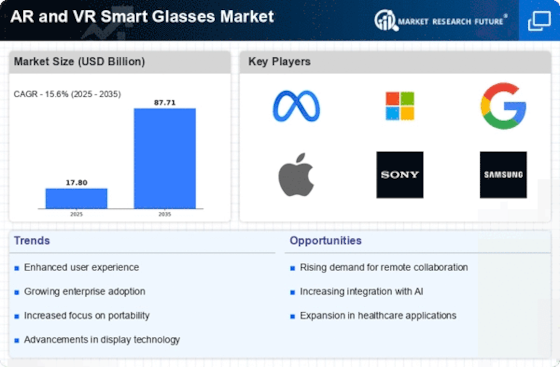
As per Market Research Future analysis, the AR and VR Smart Glasses Market Size was estimated at 17.8 USD Billion in 2024. The AR and VR Smart Glasses industry is projected to grow from 20.58 USD Billion in 2025 to 87.71 USD Billion by 2035, exhibiting a compound annual growth rate (CAGR) of 15.6% during the forecast period 2025 - 2035

Key Market Trends & Highlights

The AR and VR Smart Glasses Market is poised for substantial growth driven by technological advancements and increasing applications across various sectors.

  • North America remains the largest market for AR and VR smart glasses, showcasing robust demand across multiple industries. The Asia-Pacific region is emerging as the fastest-growing market, fueled by rising consumer interest and technological adoption. Binocular smart glasses dominate the market, while monocular smart glasses are rapidly gaining traction due to their compact design and functionality. Key market drivers include the growing demand for immersive entertainment and advancements in technology and hardware, which are propelling innovation in both external and integrated smart glasses.

Market Size & Forecast

2024 Market Size 17.8 (USD Billion)
2035 Market Size 87.71 (USD Billion)
CAGR (2025 - 2035) 15.6%
Largest Regional Market Share in 2024 North America

Major Players

Meta Platforms (US), Microsoft (US), Google (US), Apple (US), Sony (JP), Samsung (KR), Snap Inc. (US), Vuzix (US), Magic Leap (US), Nreal (CN)

Market Trends

The AR and VR Smart Glasses Market is currently experiencing a transformative phase, characterized by rapid technological advancements and increasing consumer interest. Companies are investing heavily in research and development to enhance the functionality and user experience of smart glasses. This market is not only appealing to tech enthusiasts but also to various industries such as healthcare, education, and entertainment, which are exploring innovative applications. As a result, the demand for augmented and virtual reality solutions is likely to grow, driven by the need for immersive experiences and improved productivity. Moreover, the integration of artificial intelligence and machine learning into AR and VR smart glasses is becoming more prevalent. This integration appears to enhance the capabilities of these devices, allowing for more intuitive interactions and personalized experiences. Additionally, the growing emphasis on remote collaboration tools suggests that businesses are increasingly recognizing the potential of smart glasses to facilitate communication and training. Overall, the AR and VR Smart Glasses Market seems poised for substantial growth, with various sectors likely to adopt these technologies to improve efficiency and engagement.

Increased Adoption in Healthcare

The healthcare sector is increasingly utilizing AR and VR smart glasses for training, surgical assistance, and patient education. These technologies provide immersive simulations that enhance learning and improve surgical precision, indicating a shift towards more innovative medical practices.

Expansion in Remote Work Solutions

As remote work becomes more prevalent, AR and VR smart glasses are emerging as valuable tools for virtual collaboration. These devices facilitate real-time communication and interactive meetings, suggesting a potential transformation in how teams engage and collaborate from different locations.

Focus on Enhanced User Experience

Manufacturers are prioritizing user experience by developing lighter, more comfortable designs with improved battery life and functionality. This focus on ergonomics and usability indicates a commitment to making smart glasses more accessible and appealing to a broader audience.

AR VR Smart Glasses Market Market Drivers

Integration with IoT and Smart Devices

The integration of AR and VR smart glasses with Internet of Things (IoT) and other smart devices is emerging as a vital driver for the AR and VR Smart Glasses Market. As smart homes and connected devices become more prevalent, the ability to interact with these technologies through augmented and virtual reality is gaining traction. This integration allows users to visualize data, control devices, and access information seamlessly through their smart glasses. Market forecasts suggest that the convergence of AR and VR with IoT could lead to a substantial increase in user engagement and functionality, potentially expanding the market reach. As consumers seek more interconnected experiences, the synergy between AR and VR smart glasses and IoT devices is likely to propel growth in the AR and VR Smart Glasses Market.

Advancements in Technology and Hardware

Technological advancements play a crucial role in shaping the AR and VR Smart Glasses Market. Innovations in hardware, such as improved display technologies, enhanced processing power, and lighter materials, are making smart glasses more appealing to consumers. For instance, the introduction of high-resolution displays and advanced sensors has significantly enhanced the user experience, allowing for more realistic and interactive applications. Market data suggests that the hardware segment is expected to witness substantial growth, with a compound annual growth rate projected to exceed 20% over the next few years. This rapid evolution in technology not only attracts new users but also encourages existing users to upgrade their devices, thereby fueling the overall market growth. As such, advancements in technology and hardware are likely to remain a key driver for the AR and VR Smart Glasses Market.

Growing Demand for Immersive Entertainment

The AR and VR Smart Glasses Market is witnessing a surge in demand for immersive entertainment experiences. As consumers increasingly seek engaging content, the integration of augmented and virtual reality into gaming, movies, and live events becomes more prevalent. According to recent estimates, the entertainment sector is projected to contribute significantly to the overall market growth, with revenues expected to reach several billion dollars by 2026. This trend indicates a shift in consumer preferences towards interactive and immersive experiences, which AR and VR smart glasses can effectively deliver. As technology advances, the quality of content and user experience is likely to improve, further driving adoption in this sector. Consequently, the entertainment industry's evolution appears to be a pivotal driver for the AR and VR Smart Glasses Market.

Increased Investment in AR and VR Startups

Investment in AR and VR startups is becoming a prominent driver for the AR and VR Smart Glasses Market. Venture capitalists and tech giants are increasingly recognizing the potential of augmented and virtual reality technologies, leading to a surge in funding for innovative startups. This influx of capital is facilitating the development of cutting-edge applications and solutions that leverage smart glasses technology. Recent reports indicate that investment in AR and VR sectors has reached unprecedented levels, with billions of dollars allocated to various projects. This financial backing not only accelerates technological advancements but also fosters a competitive landscape that encourages innovation. As a result, the growth of AR and VR startups is likely to have a lasting impact on the AR and VR Smart Glasses Market, driving new applications and expanding market reach.

Rising Applications in Education and Training

The AR and VR Smart Glasses Market is experiencing a notable increase in applications within the education and training sectors. Educational institutions and corporate training programs are increasingly adopting augmented and virtual reality technologies to enhance learning experiences. By providing immersive simulations and interactive environments, smart glasses facilitate better retention of information and practical skills. Market analysis indicates that the education segment is expected to grow significantly, with projections suggesting a doubling of investment in AR and VR educational tools over the next few years. This trend reflects a broader recognition of the effectiveness of experiential learning methods. Consequently, the rising applications in education and training are poised to be a substantial driver for the AR and VR Smart Glasses Market, as more organizations seek to leverage these technologies for improved outcomes.

Market Segment Insights

By Device Type: Binocular (Largest) vs. Monocular (Fastest-Growing)

<p>The AR and VR Smart Glasses Market showcases a diverse segmentation with Binocular devices leading in market share. This is attributed to their enhanced immersive experiences, which make them highly preferable for consumers and businesses. Binocular devices offer a broader field of view and improved depth perception, contributing to their dominance in the market. Meanwhile, Monocular devices are increasingly gaining traction, especially among specific user groups looking for lightweight, compact solutions that still deliver augmented and virtual experiences.</p>

<p>Binocular (Dominant) vs. Monocular (Emerging)</p>

<p>In the AR and VR Smart Glasses market, Binocular devices are characterized by their dual lens setup, which provides a more immersive and engaging user experience. These devices are primarily utilized in gaming, professional training, and industrial applications due to their ability to deliver rich visuals and depth perception. On the other hand, Monocular devices are emerging as a popular choice for users who prioritize portability and convenience. They are ideal for applications like augmented reality in retail and navigation, allowing for an unobtrusive overlay of information onto the real world, catering to a growing demand for practical and accessible AR solutions.</p>

By Product: External Smart Glasses (Largest) vs. Integrated Smart Glasses (Fastest-Growing)

<p>The AR and VR Smart Glasses Market is currently dominated by external smart glasses, which have captured a significant portion of the market share due to their versatility and compatibility with various devices. These smart glasses provide users with augmented reality experiences without the need for specialized hardware, making them a preferred choice among consumers and enterprises alike. Meanwhile, integrated smart glasses are gaining traction, carving out a niche for themselves owing to their standalone functionality, which appeals to a growing demographic looking for seamless AR experiences.</p>

<p>External Smart Glasses (Dominant) vs. Integrated Smart Glasses (Emerging)</p>

<p>External smart glasses represent the dominant segment in the AR and VR market, characterized by their ability to connect with existing devices like smartphones and tablets, thereby providing a broader appeal. They are particularly popular among gamers and tech enthusiasts who seek enhanced experiences without investing in entirely new systems. On the other hand, integrated smart glasses are emerging as an innovative solution, packing AR functionalities into compact designs. This segment is rapidly evolving, driven by advancements in display technology and battery efficiency, attracting attention from users looking for hands-free operation and immersive experiences in various applications, including industrial and medical fields.</p>

By Applications: Gaming (Largest) vs. Education (Fastest-Growing)

<p>The AR and VR Smart Glasses Market has diverse applications, with gaming capturing the most significant market share due to its high consumer demand and immersive experiences offered by these technologies. Following gaming, sectors like industrial and military use also hold considerable portions of the market, focusing on training and operational enhancements. Education, while currently smaller in share, is rapidly gaining traction as institutions recognize the potential for innovative learning experiences through augmented and virtual reality.</p>

<p>Gaming: Dominant vs. Education: Emerging</p>

<p>In the AR and VR Smart Glasses Market, gaming stands out as the dominant application, driven by the increasing popularity of immersive video games that offer unparalleled experiences. The gaming segment leverages high-quality displays, real-time interactions, and social engagement, marking its significance. Conversely, the education sector is emerging as a forceful player, utilizing AR and VR technologies to create interactive and engaging learning environments. Educational institutions are increasingly adopting these tools for training and teaching, making education one of the fastest-growing segments. The potential for enhancing understanding through virtual simulations positions education as a vital future market opportunity.</p>

By End-users: Hospitality (Largest) vs. Government sector (Fastest-Growing)

<p>In the AR and VR Smart Glasses Market, the hospitality sector holds a significant portion as the largest end-user segment. This is primarily due to the adoption of immersive technologies for enhancing customer experiences, such as virtual tours and interactive services. The government sector, while smaller in share, has been emerging rapidly as a critical end-user, leveraging AR and VR technologies for training and operational efficiencies. As we look forward, the growth trends suggest that the hospitality sector will continue to expand its use of AR and VR for personalized customer engagement, while the government sector is projected to grow at a faster pace. With advancements in technology and increased funding for digital initiatives, adoption rates in the government sector are expected to surge, reflecting its need for innovative solutions in various applications.</p>

<p>Hospitality (Dominant) vs. Government sector (Emerging)</p>

<p>The hospitality sector is dominating the AR and VR Smart Glasses Market as it integrates immersive technologies to enhance guest experiences. Hotels and tourism companies are utilizing these technologies for virtual tours, interactive concierge services, and personalized guest engagement. This sector's focus on customer satisfaction and differentiation drives significant investment in AR and VR solutions. On the other hand, the government sector is an emerging player, increasingly adopting AR and VR technologies for training simulations, public safety, and military applications. This sector’s rapid growth is attributed to the pressing need for efficiency and innovation in public services and training programs, positioning it as a key player in the evolution of AR and VR technologies.</p>

Get more detailed insights about AR and VR Smart Glasses Market Research Report- Global Forecast till 2035

Regional Insights

North America : Innovation and Market Leadership

North America is the largest market for AR and VR smart glasses, holding approximately 45% of the global market share. The region's growth is driven by rapid technological advancements, increasing investments in AR/VR applications across various sectors, and supportive government initiatives. The demand for immersive experiences in gaming, education, and healthcare is propelling market expansion, with a focus on enhancing user engagement and productivity. The United States is the leading country in this market, home to major players like Meta Platforms, Microsoft, and Google. The competitive landscape is characterized by continuous innovation and strategic partnerships among key players. Canada also plays a significant role, contributing to the market with its growing tech ecosystem. The presence of established companies and startups fosters a vibrant environment for AR and VR development, ensuring sustained growth in the region.

Europe : Emerging Market with Potential

Europe is witnessing significant growth in the AR and VR smart glasses market, holding around 30% of the global market share. The region's expansion is fueled by increasing consumer interest in immersive technologies, coupled with supportive regulations aimed at fostering innovation. Countries like Germany and the UK are at the forefront, driving demand through investments in research and development, particularly in sectors like automotive and healthcare. Germany leads the European market, with a strong presence of key players such as Sony and Samsung. The competitive landscape is evolving, with numerous startups emerging alongside established companies. The European Union's commitment to digital transformation and technology integration in various industries further enhances the market's potential. This collaborative environment encourages innovation and the development of cutting-edge AR and VR solutions.

Asia-Pacific : Rapid Growth and Adoption

Asia-Pacific is rapidly emerging as a significant player in the AR and VR smart glasses market, accounting for approximately 20% of the global market share. The region's growth is driven by increasing smartphone penetration, rising disposable incomes, and a growing interest in gaming and entertainment. Countries like China and Japan are leading the charge, supported by government initiatives aimed at promoting technological advancements and digital transformation. China is particularly noteworthy, with companies like Nreal and other local players making substantial contributions to the market. The competitive landscape is marked by a mix of established firms and innovative startups, fostering a dynamic environment for AR and VR development. Japan's focus on integrating AR/VR in various sectors, including education and healthcare, further enhances the region's market potential, ensuring robust growth in the coming years.

Middle East and Africa : Emerging Market with Challenges

The Middle East and Africa region is gradually emerging in the AR and VR smart glasses market, holding about 5% of the global market share. The growth is primarily driven by increasing investments in technology and a rising interest in digital solutions across various sectors. However, challenges such as limited infrastructure and varying levels of technological adoption across countries hinder rapid expansion. Countries like the UAE and South Africa are leading the market, focusing on enhancing user experiences in tourism and education. The UAE is particularly proactive in adopting AR and VR technologies, with government initiatives promoting innovation and digital transformation. The competitive landscape is still developing, with a mix of local and international players entering the market. As the region continues to invest in technology and infrastructure, the potential for growth in the AR and VR sector remains promising, albeit gradual.

Key Players and Competitive Insights

The AR and VR Smart Glasses Market is currently characterized by a dynamic competitive landscape, driven by rapid technological advancements and increasing consumer demand for immersive experiences. Major players such as Meta Platforms (US), Microsoft (US), and Apple (US) are at the forefront, each adopting distinct strategies to enhance their market positioning. Meta Platforms (US) focuses on integrating social experiences into its offerings, while Microsoft (US) emphasizes enterprise solutions through its HoloLens technology. Apple (US), on the other hand, appears to be leveraging its ecosystem to create seamless user experiences, suggesting a multifaceted approach to innovation that collectively shapes the competitive environment.

In terms of business tactics, companies are increasingly localizing manufacturing and optimizing supply chains to enhance efficiency and reduce costs. The market structure is moderately fragmented, with a mix of established giants and emerging players. This fragmentation allows for diverse innovation pathways, as smaller firms like Vuzix (US) and Nreal (CN) introduce niche products that cater to specific consumer needs, thereby influencing the overall competitive dynamics.

In August 2025, Microsoft (US) announced a strategic partnership with a leading automotive manufacturer to integrate its HoloLens technology into vehicle design processes. This collaboration is poised to revolutionize how automotive companies visualize and prototype new designs, indicating a significant shift towards augmented reality applications in industrial settings. Such partnerships not only enhance Microsoft's product offerings but also expand its reach into new markets, reinforcing its competitive edge.

Similarly, in September 2025, Apple (US) unveiled its latest AR headset, which incorporates advanced AI capabilities for real-time object recognition and interaction. This launch is particularly noteworthy as it aligns with the growing trend of AI integration in consumer electronics, potentially setting a new standard for user engagement in AR experiences. The strategic importance of this development lies in Apple's ability to leverage its existing ecosystem, thereby enhancing user retention and attracting new customers.

In October 2025, Meta Platforms (US) revealed a new initiative aimed at enhancing user privacy and data security within its AR applications. This move appears to be a direct response to increasing consumer concerns regarding data protection, suggesting that Meta is keen on building trust and loyalty among its user base. By prioritizing privacy, Meta not only differentiates itself from competitors but also positions itself as a responsible leader in the AR space.

As of October 2025, current competitive trends indicate a strong emphasis on digitalization, sustainability, and the integration of AI technologies. Strategic alliances are increasingly shaping the landscape, as companies recognize the value of collaboration in driving innovation. Looking ahead, it seems that competitive differentiation will evolve from traditional price-based strategies to a focus on technological innovation, user experience, and supply chain reliability. This shift underscores the importance of adaptability and foresight in navigating the complexities of the AR and VR Smart Glasses Market.

Key Companies in the AR VR Smart Glasses Market include

Industry Developments

Recent innovations include Samsung’s exploration of AR wearables, Meta’s expansion into meta ar glasses, meta camera glasses, and advanced smart glasses with camera integrated with AI assistants. New releases include devices categorized as camera glasses, glasses camera, and multi-functional smart spectacles enabling enhanced user experiences.

November 2023, Samsung is showing signs of a major investment in augmented and virtual reality technology. Fresh trademarks and partnerships imply that the company might launch multiple devices soon. On November 24th, SamMobile claimed that the “Samsung Glasses” U.K. trademark had been secured by the organization. Augmented reality headsets, smart glasses, and virtual reality headsets could all be labeled with this term. Samsung could be making A.R. smart glasses, which might compete against Meta’s RayBan Smart Glasses and Google Glass for enterprise customers within a few years.

Meta has disclosed plans to merge artificial intelligence (A.I.) with augmented reality (A.R.) and virtual reality (V.R.), among other new products such as its Meta X Ray-Ban smart glasses and a new generation of Meta Quest. Facebook/Meta alone unveiled A.I. WhatsApp, FaceBook, and Instagram assistants in September 2023.

Mark Zuckerberg unveiled a slew of new AI-driven consumer products on Wednesday this week, including bots that generate photo-realistic images, responsive-reactive smart glasses, an updated V.R. headset that emphasized a convergence between the real world and digital spaces -- all designed to offer low-cost or free A.I. solutions "that live at the intersection of our daily lives."

With Apple Inc.’s official launch of its extended reality (X.R.) headset expected in early 2024, Samsung’s technology arms are also preparing to release their X.R. products next year by applying for rights with the U.S. patent authority. As per records from Thursday at the U. S Patent and Trademark Office, Samsung Display Co. applied for a trademark 'Flex Magic' speculated to be used on its next-generation X.R. headset. The company universalized its application use in display panels such as 3D glasses, virtual reality (V.R.) headsets, goggles, and glasses, among others.

The same was filed with the European patent authority in November 2023.

September 2023 - In partnership with EssilorLuxottica, Meta announced their new second generation of Ray-Ban Meta smart glasses. The new glasses feature improved audio and also include a new ultra-wide 12 MP camera with capabilities of 1080p videos for up to 60 seconds , over 150 different custom frame and lens combinations, IPX4 water-resistance, and lighter and more comfortable design over the first-generation glasses. The glasses are powered by the Qualcomm Snapdragon AR1 Gen1 platform which allows high quality photography and video processing capabilities.

The smart glasses also come integrated with Meta AI conversational assistant for hands free control features for users. 

Future Outlook

AR VR Smart Glasses Market Future Outlook

The AR and VR Smart Glasses Market is projected to grow at a 15.6% CAGR from 2024 to 2035, driven by technological advancements, increased adoption in various sectors, and enhanced user experiences.

New opportunities lie in:

  • Development of enterprise-focused AR solutions for training and maintenance.
  • Integration of AI-driven analytics for personalized user experiences.
  • Expansion into healthcare applications for remote diagnostics and telemedicine.

By 2035, the market is expected to be robust, driven by innovation and diverse applications.

Market Segmentation

AR VR Smart Glasses Market Product Outlook

  • External smart glasses
  • Mobile phone smart glasses
  • Integrated smart glasses

AR VR Smart Glasses Market End-users Outlook

  • Hospitality sector
  • Technology investors
  • Consultancy firm
  • Retailers
  • Government sector

AR VR Smart Glasses Market Device Type Outlook

  • Monocular
  • Binocular

AR VR Smart Glasses Market Applications Outlook

  • Gaming
  • Military
  • Industrial
  • Education

Report Scope

MARKET SIZE 202417.8(USD Billion)
MARKET SIZE 202520.58(USD Billion)
MARKET SIZE 203587.71(USD Billion)
COMPOUND ANNUAL GROWTH RATE (CAGR)15.6% (2024 - 2035)
REPORT COVERAGERevenue Forecast, Competitive Landscape, Growth Factors, and Trends
BASE YEAR2024
Market Forecast Period2025 - 2035
Historical Data2019 - 2024
Market Forecast UnitsUSD Billion
Key Companies ProfiledMarket analysis in progress
Segments CoveredMarket segmentation analysis in progress
Key Market OpportunitiesIntegration of artificial intelligence enhances user experience in the AR and VR Smart Glasses Market.
Key Market DynamicsTechnological advancements and consumer demand drive competitive dynamics in the AR and VR Smart Glasses Market.
Countries CoveredNorth America, Europe, APAC, South America, MEA

FAQs

What is the current valuation of the AR and VR Smart Glasses Market in 2025?

<p>The AR and VR Smart Glasses Market is valued at approximately 17.8 USD Billion in 2024.</p>

What is the projected market size for AR and VR Smart Glasses by 2035?

<p>The market is expected to reach a valuation of 87.71 USD Billion by 2035.</p>

What is the expected CAGR for the AR and VR Smart Glasses Market from 2025 to 2035?

<p>The market is anticipated to grow at a CAGR of 15.6% during the forecast period from 2025 to 2035.</p>

Which companies are leading the AR and VR Smart Glasses Market?

<p>Key players in the market include Meta Platforms, Microsoft, Google, Apple, Sony, Samsung, Snap Inc., Vuzix, Magic Leap, and Nreal.</p>

What are the main device types in the AR and VR Smart Glasses Market?

<p>The primary device types are monocular and binocular smart glasses, with binocular glasses projected to grow significantly.</p>

How do the product segments of AR and VR Smart Glasses break down?

<p>Product segments include external smart glasses, mobile phone smart glasses, and integrated smart glasses, with integrated smart glasses showing substantial growth.</p>

What applications are driving the demand for AR and VR Smart Glasses?

<p>Key applications include gaming, military, industrial, and education, with education expected to see notable growth.</p>

Which end-user sectors are most engaged with AR and VR Smart Glasses?

<p>The end-user sectors include hospitality, technology investors, consultancy firms, retailers, and the government sector, with the government sector likely to expand significantly.</p>

What was the market valuation for integrated smart glasses in 2024?

<p>In 2024, the market valuation for integrated smart glasses was approximately 8.34 USD Billion.</p>

What is the projected growth for the military application of AR and VR Smart Glasses by 2035?

<p>The military application is expected to grow from 4.0 USD Billion in 2024 to 20.0 USD Billion by 2035.</p>

  1. SECTION I: EXECUTIVE SUMMARY AND KEY HIGHLIGHTS
    1. | 1.1 EXECUTIVE SUMMARY
    2. | | 1.1.1 Market Overview
    3. | | 1.1.2 Key Findings
    4. | | 1.1.3 Market Segmentation
    5. | | 1.1.4 Competitive Landscape
    6. | | 1.1.5 Challenges and Opportunities
    7. | | 1.1.6 Future Outlook
  2. SECTION II: SCOPING, METHODOLOGY AND MARKET STRUCTURE
    1. | 2.1 MARKET INTRODUCTION
    2. | | 2.1.1 Definition
    3. | | 2.1.2 Scope of the study
    4. | | | 2.1.2.1 Research Objective
    5. | | | 2.1.2.2 Assumption
    6. | | | 2.1.2.3 Limitations
    7. | 2.2 RESEARCH METHODOLOGY
    8. | | 2.2.1 Overview
    9. | | 2.2.2 Data Mining
    10. | | 2.2.3 Secondary Research
    11. | | 2.2.4 Primary Research
    12. | | | 2.2.4.1 Primary Interviews and Information Gathering Process
    13. | | | 2.2.4.2 Breakdown of Primary Respondents
    14. | | 2.2.5 Forecasting Model
    15. | | 2.2.6 Market Size Estimation
    16. | | | 2.2.6.1 Bottom-Up Approach
    17. | | | 2.2.6.2 Top-Down Approach
    18. | | 2.2.7 Data Triangulation
    19. | | 2.2.8 Validation
  3. SECTION III: QUALITATIVE ANALYSIS
    1. | 3.1 MARKET DYNAMICS
    2. | | 3.1.1 Overview
    3. | | 3.1.2 Drivers
    4. | | 3.1.3 Restraints
    5. | | 3.1.4 Opportunities
    6. | 3.2 MARKET FACTOR ANALYSIS
    7. | | 3.2.1 Value chain Analysis
    8. | | 3.2.2 Porter's Five Forces Analysis
    9. | | | 3.2.2.1 Bargaining Power of Suppliers
    10. | | | 3.2.2.2 Bargaining Power of Buyers
    11. | | | 3.2.2.3 Threat of New Entrants
    12. | | | 3.2.2.4 Threat of Substitutes
    13. | | | 3.2.2.5 Intensity of Rivalry
    14. | | 3.2.3 COVID-19 Impact Analysis
    15. | | | 3.2.3.1 Market Impact Analysis
    16. | | | 3.2.3.2 Regional Impact
    17. | | | 3.2.3.3 Opportunity and Threat Analysis
  4. SECTION IV: QUANTITATIVE ANALYSIS
    1. | 4.1 Semiconductor & Electronics, BY Device Type (USD Billion)
    2. | | 4.1.1 Monocular
    3. | | 4.1.2 Binocular
    4. | 4.2 Semiconductor & Electronics, BY Product (USD Billion)
    5. | | 4.2.1 External smart glasses
    6. | | 4.2.2 Mobile phone smart glasses
    7. | | 4.2.3 Integrated smart glasses
    8. | 4.3 Semiconductor & Electronics, BY Applications (USD Billion)
    9. | | 4.3.1 Gaming
    10. | | 4.3.2 Military
    11. | | 4.3.3 Industrial
    12. | | 4.3.4 Education
    13. | 4.4 Semiconductor & Electronics, BY End-users (USD Billion)
    14. | | 4.4.1 Hospitality sector
    15. | | 4.4.2 Technology investors
    16. | | 4.4.3 Consultancy firm
    17. | | 4.4.4 Retailers
    18. | | 4.4.5 Government sector
    19. | 4.5 Semiconductor & Electronics, BY Region (USD Billion)
    20. | | 4.5.1 North America
    21. | | | 4.5.1.1 US
    22. | | | 4.5.1.2 Canada
    23. | | 4.5.2 Europe
    24. | | | 4.5.2.1 Germany
    25. | | | 4.5.2.2 UK
    26. | | | 4.5.2.3 France
    27. | | | 4.5.2.4 Russia
    28. | | | 4.5.2.5 Italy
    29. | | | 4.5.2.6 Spain
    30. | | | 4.5.2.7 Rest of Europe
    31. | | 4.5.3 APAC
    32. | | | 4.5.3.1 China
    33. | | | 4.5.3.2 India
    34. | | | 4.5.3.3 Japan
    35. | | | 4.5.3.4 South Korea
    36. | | | 4.5.3.5 Malaysia
    37. | | | 4.5.3.6 Thailand
    38. | | | 4.5.3.7 Indonesia
    39. | | | 4.5.3.8 Rest of APAC
    40. | | 4.5.4 South America
    41. | | | 4.5.4.1 Brazil
    42. | | | 4.5.4.2 Mexico
    43. | | | 4.5.4.3 Argentina
    44. | | | 4.5.4.4 Rest of South America
    45. | | 4.5.5 MEA
    46. | | | 4.5.5.1 GCC Countries
    47. | | | 4.5.5.2 South Africa
    48. | | | 4.5.5.3 Rest of MEA
  5. SECTION V: COMPETITIVE ANALYSIS
    1. | 5.1 Competitive Landscape
    2. | | 5.1.1 Overview
    3. | | 5.1.2 Competitive Analysis
    4. | | 5.1.3 Market share Analysis
    5. | | 5.1.4 Major Growth Strategy in the Semiconductor & Electronics
    6. | | 5.1.5 Competitive Benchmarking
    7. | | 5.1.6 Leading Players in Terms of Number of Developments in the Semiconductor & Electronics
    8. | | 5.1.7 Key developments and growth strategies
    9. | | | 5.1.7.1 New Product Launch/Service Deployment
    10. | | | 5.1.7.2 Merger & Acquisitions
    11. | | | 5.1.7.3 Joint Ventures
    12. | | 5.1.8 Major Players Financial Matrix
    13. | | | 5.1.8.1 Sales and Operating Income
    14. | | | 5.1.8.2 Major Players R&D Expenditure. 2023
    15. | 5.2 Company Profiles
    16. | | 5.2.1 Meta Platforms (US)
    17. | | | 5.2.1.1 Financial Overview
    18. | | | 5.2.1.2 Products Offered
    19. | | | 5.2.1.3 Key Developments
    20. | | | 5.2.1.4 SWOT Analysis
    21. | | | 5.2.1.5 Key Strategies
    22. | | 5.2.2 Microsoft (US)
    23. | | | 5.2.2.1 Financial Overview
    24. | | | 5.2.2.2 Products Offered
    25. | | | 5.2.2.3 Key Developments
    26. | | | 5.2.2.4 SWOT Analysis
    27. | | | 5.2.2.5 Key Strategies
    28. | | 5.2.3 Google (US)
    29. | | | 5.2.3.1 Financial Overview
    30. | | | 5.2.3.2 Products Offered
    31. | | | 5.2.3.3 Key Developments
    32. | | | 5.2.3.4 SWOT Analysis
    33. | | | 5.2.3.5 Key Strategies
    34. | | 5.2.4 Apple (US)
    35. | | | 5.2.4.1 Financial Overview
    36. | | | 5.2.4.2 Products Offered
    37. | | | 5.2.4.3 Key Developments
    38. | | | 5.2.4.4 SWOT Analysis
    39. | | | 5.2.4.5 Key Strategies
    40. | | 5.2.5 Sony (JP)
    41. | | | 5.2.5.1 Financial Overview
    42. | | | 5.2.5.2 Products Offered
    43. | | | 5.2.5.3 Key Developments
    44. | | | 5.2.5.4 SWOT Analysis
    45. | | | 5.2.5.5 Key Strategies
    46. | | 5.2.6 Samsung (KR)
    47. | | | 5.2.6.1 Financial Overview
    48. | | | 5.2.6.2 Products Offered
    49. | | | 5.2.6.3 Key Developments
    50. | | | 5.2.6.4 SWOT Analysis
    51. | | | 5.2.6.5 Key Strategies
    52. | | 5.2.7 Snap Inc. (US)
    53. | | | 5.2.7.1 Financial Overview
    54. | | | 5.2.7.2 Products Offered
    55. | | | 5.2.7.3 Key Developments
    56. | | | 5.2.7.4 SWOT Analysis
    57. | | | 5.2.7.5 Key Strategies
    58. | | 5.2.8 Vuzix (US)
    59. | | | 5.2.8.1 Financial Overview
    60. | | | 5.2.8.2 Products Offered
    61. | | | 5.2.8.3 Key Developments
    62. | | | 5.2.8.4 SWOT Analysis
    63. | | | 5.2.8.5 Key Strategies
    64. | | 5.2.9 Magic Leap (US)
    65. | | | 5.2.9.1 Financial Overview
    66. | | | 5.2.9.2 Products Offered
    67. | | | 5.2.9.3 Key Developments
    68. | | | 5.2.9.4 SWOT Analysis
    69. | | | 5.2.9.5 Key Strategies
    70. | | 5.2.10 Nreal (CN)
    71. | | | 5.2.10.1 Financial Overview
    72. | | | 5.2.10.2 Products Offered
    73. | | | 5.2.10.3 Key Developments
    74. | | | 5.2.10.4 SWOT Analysis
    75. | | | 5.2.10.5 Key Strategies
    76. | 5.3 Appendix
    77. | | 5.3.1 References
    78. | | 5.3.2 Related Reports
  6. LIST OF FIGURES
    1. | 6.1 MARKET SYNOPSIS
    2. | 6.2 NORTH AMERICA MARKET ANALYSIS
    3. | 6.3 US MARKET ANALYSIS BY DEVICE TYPE
    4. | 6.4 US MARKET ANALYSIS BY PRODUCT
    5. | 6.5 US MARKET ANALYSIS BY APPLICATIONS
    6. | 6.6 US MARKET ANALYSIS BY END-USERS
    7. | 6.7 CANADA MARKET ANALYSIS BY DEVICE TYPE
    8. | 6.8 CANADA MARKET ANALYSIS BY PRODUCT
    9. | 6.9 CANADA MARKET ANALYSIS BY APPLICATIONS
    10. | 6.10 CANADA MARKET ANALYSIS BY END-USERS
    11. | 6.11 EUROPE MARKET ANALYSIS
    12. | 6.12 GERMANY MARKET ANALYSIS BY DEVICE TYPE
    13. | 6.13 GERMANY MARKET ANALYSIS BY PRODUCT
    14. | 6.14 GERMANY MARKET ANALYSIS BY APPLICATIONS
    15. | 6.15 GERMANY MARKET ANALYSIS BY END-USERS
    16. | 6.16 UK MARKET ANALYSIS BY DEVICE TYPE
    17. | 6.17 UK MARKET ANALYSIS BY PRODUCT
    18. | 6.18 UK MARKET ANALYSIS BY APPLICATIONS
    19. | 6.19 UK MARKET ANALYSIS BY END-USERS
    20. | 6.20 FRANCE MARKET ANALYSIS BY DEVICE TYPE
    21. | 6.21 FRANCE MARKET ANALYSIS BY PRODUCT
    22. | 6.22 FRANCE MARKET ANALYSIS BY APPLICATIONS
    23. | 6.23 FRANCE MARKET ANALYSIS BY END-USERS
    24. | 6.24 RUSSIA MARKET ANALYSIS BY DEVICE TYPE
    25. | 6.25 RUSSIA MARKET ANALYSIS BY PRODUCT
    26. | 6.26 RUSSIA MARKET ANALYSIS BY APPLICATIONS
    27. | 6.27 RUSSIA MARKET ANALYSIS BY END-USERS
    28. | 6.28 ITALY MARKET ANALYSIS BY DEVICE TYPE
    29. | 6.29 ITALY MARKET ANALYSIS BY PRODUCT
    30. | 6.30 ITALY MARKET ANALYSIS BY APPLICATIONS
    31. | 6.31 ITALY MARKET ANALYSIS BY END-USERS
    32. | 6.32 SPAIN MARKET ANALYSIS BY DEVICE TYPE
    33. | 6.33 SPAIN MARKET ANALYSIS BY PRODUCT
    34. | 6.34 SPAIN MARKET ANALYSIS BY APPLICATIONS
    35. | 6.35 SPAIN MARKET ANALYSIS BY END-USERS
    36. | 6.36 REST OF EUROPE MARKET ANALYSIS BY DEVICE TYPE
    37. | 6.37 REST OF EUROPE MARKET ANALYSIS BY PRODUCT
    38. | 6.38 REST OF EUROPE MARKET ANALYSIS BY APPLICATIONS
    39. | 6.39 REST OF EUROPE MARKET ANALYSIS BY END-USERS
    40. | 6.40 APAC MARKET ANALYSIS
    41. | 6.41 CHINA MARKET ANALYSIS BY DEVICE TYPE
    42. | 6.42 CHINA MARKET ANALYSIS BY PRODUCT
    43. | 6.43 CHINA MARKET ANALYSIS BY APPLICATIONS
    44. | 6.44 CHINA MARKET ANALYSIS BY END-USERS
    45. | 6.45 INDIA MARKET ANALYSIS BY DEVICE TYPE
    46. | 6.46 INDIA MARKET ANALYSIS BY PRODUCT
    47. | 6.47 INDIA MARKET ANALYSIS BY APPLICATIONS
    48. | 6.48 INDIA MARKET ANALYSIS BY END-USERS
    49. | 6.49 JAPAN MARKET ANALYSIS BY DEVICE TYPE
    50. | 6.50 JAPAN MARKET ANALYSIS BY PRODUCT
    51. | 6.51 JAPAN MARKET ANALYSIS BY APPLICATIONS
    52. | 6.52 JAPAN MARKET ANALYSIS BY END-USERS
    53. | 6.53 SOUTH KOREA MARKET ANALYSIS BY DEVICE TYPE
    54. | 6.54 SOUTH KOREA MARKET ANALYSIS BY PRODUCT
    55. | 6.55 SOUTH KOREA MARKET ANALYSIS BY APPLICATIONS
    56. | 6.56 SOUTH KOREA MARKET ANALYSIS BY END-USERS
    57. | 6.57 MALAYSIA MARKET ANALYSIS BY DEVICE TYPE
    58. | 6.58 MALAYSIA MARKET ANALYSIS BY PRODUCT
    59. | 6.59 MALAYSIA MARKET ANALYSIS BY APPLICATIONS
    60. | 6.60 MALAYSIA MARKET ANALYSIS BY END-USERS
    61. | 6.61 THAILAND MARKET ANALYSIS BY DEVICE TYPE
    62. | 6.62 THAILAND MARKET ANALYSIS BY PRODUCT
    63. | 6.63 THAILAND MARKET ANALYSIS BY APPLICATIONS
    64. | 6.64 THAILAND MARKET ANALYSIS BY END-USERS
    65. | 6.65 INDONESIA MARKET ANALYSIS BY DEVICE TYPE
    66. | 6.66 INDONESIA MARKET ANALYSIS BY PRODUCT
    67. | 6.67 INDONESIA MARKET ANALYSIS BY APPLICATIONS
    68. | 6.68 INDONESIA MARKET ANALYSIS BY END-USERS
    69. | 6.69 REST OF APAC MARKET ANALYSIS BY DEVICE TYPE
    70. | 6.70 REST OF APAC MARKET ANALYSIS BY PRODUCT
    71. | 6.71 REST OF APAC MARKET ANALYSIS BY APPLICATIONS
    72. | 6.72 REST OF APAC MARKET ANALYSIS BY END-USERS
    73. | 6.73 SOUTH AMERICA MARKET ANALYSIS
    74. | 6.74 BRAZIL MARKET ANALYSIS BY DEVICE TYPE
    75. | 6.75 BRAZIL MARKET ANALYSIS BY PRODUCT
    76. | 6.76 BRAZIL MARKET ANALYSIS BY APPLICATIONS
    77. | 6.77 BRAZIL MARKET ANALYSIS BY END-USERS
    78. | 6.78 MEXICO MARKET ANALYSIS BY DEVICE TYPE
    79. | 6.79 MEXICO MARKET ANALYSIS BY PRODUCT
    80. | 6.80 MEXICO MARKET ANALYSIS BY APPLICATIONS
    81. | 6.81 MEXICO MARKET ANALYSIS BY END-USERS
    82. | 6.82 ARGENTINA MARKET ANALYSIS BY DEVICE TYPE
    83. | 6.83 ARGENTINA MARKET ANALYSIS BY PRODUCT
    84. | 6.84 ARGENTINA MARKET ANALYSIS BY APPLICATIONS
    85. | 6.85 ARGENTINA MARKET ANALYSIS BY END-USERS
    86. | 6.86 REST OF SOUTH AMERICA MARKET ANALYSIS BY DEVICE TYPE
    87. | 6.87 REST OF SOUTH AMERICA MARKET ANALYSIS BY PRODUCT
    88. | 6.88 REST OF SOUTH AMERICA MARKET ANALYSIS BY APPLICATIONS
    89. | 6.89 REST OF SOUTH AMERICA MARKET ANALYSIS BY END-USERS
    90. | 6.90 MEA MARKET ANALYSIS
    91. | 6.91 GCC COUNTRIES MARKET ANALYSIS BY DEVICE TYPE
    92. | 6.92 GCC COUNTRIES MARKET ANALYSIS BY PRODUCT
    93. | 6.93 GCC COUNTRIES MARKET ANALYSIS BY APPLICATIONS
    94. | 6.94 GCC COUNTRIES MARKET ANALYSIS BY END-USERS
    95. | 6.95 SOUTH AFRICA MARKET ANALYSIS BY DEVICE TYPE
    96. | 6.96 SOUTH AFRICA MARKET ANALYSIS BY PRODUCT
    97. | 6.97 SOUTH AFRICA MARKET ANALYSIS BY APPLICATIONS
    98. | 6.98 SOUTH AFRICA MARKET ANALYSIS BY END-USERS
    99. | 6.99 REST OF MEA MARKET ANALYSIS BY DEVICE TYPE
    100. | 6.100 REST OF MEA MARKET ANALYSIS BY PRODUCT
    101. | 6.101 REST OF MEA MARKET ANALYSIS BY APPLICATIONS
    102. | 6.102 REST OF MEA MARKET ANALYSIS BY END-USERS
    103. | 6.103 KEY BUYING CRITERIA OF SEMICONDUCTOR & ELECTRONICS
    104. | 6.104 RESEARCH PROCESS OF MRFR
    105. | 6.105 DRO ANALYSIS OF SEMICONDUCTOR & ELECTRONICS
    106. | 6.106 DRIVERS IMPACT ANALYSIS: SEMICONDUCTOR & ELECTRONICS
    107. | 6.107 RESTRAINTS IMPACT ANALYSIS: SEMICONDUCTOR & ELECTRONICS
    108. | 6.108 SUPPLY / VALUE CHAIN: SEMICONDUCTOR & ELECTRONICS
    109. | 6.109 SEMICONDUCTOR & ELECTRONICS, BY DEVICE TYPE, 2024 (% SHARE)
    110. | 6.110 SEMICONDUCTOR & ELECTRONICS, BY DEVICE TYPE, 2024 TO 2035 (USD Billion)
    111. | 6.111 SEMICONDUCTOR & ELECTRONICS, BY PRODUCT, 2024 (% SHARE)
    112. | 6.112 SEMICONDUCTOR & ELECTRONICS, BY PRODUCT, 2024 TO 2035 (USD Billion)
    113. | 6.113 SEMICONDUCTOR & ELECTRONICS, BY APPLICATIONS, 2024 (% SHARE)
    114. | 6.114 SEMICONDUCTOR & ELECTRONICS, BY APPLICATIONS, 2024 TO 2035 (USD Billion)
    115. | 6.115 SEMICONDUCTOR & ELECTRONICS, BY END-USERS, 2024 (% SHARE)
    116. | 6.116 SEMICONDUCTOR & ELECTRONICS, BY END-USERS, 2024 TO 2035 (USD Billion)
    117. | 6.117 BENCHMARKING OF MAJOR COMPETITORS
  7. LIST OF TABLES
    1. | 7.1 LIST OF ASSUMPTIONS
    2. | | 7.1.1
    3. | 7.2 North America MARKET SIZE ESTIMATES; FORECAST
    4. | | 7.2.1 BY DEVICE TYPE, 2025-2035 (USD Billion)
    5. | | 7.2.2 BY PRODUCT, 2025-2035 (USD Billion)
    6. | | 7.2.3 BY APPLICATIONS, 2025-2035 (USD Billion)
    7. | | 7.2.4 BY END-USERS, 2025-2035 (USD Billion)
    8. | 7.3 US MARKET SIZE ESTIMATES; FORECAST
    9. | | 7.3.1 BY DEVICE TYPE, 2025-2035 (USD Billion)
    10. | | 7.3.2 BY PRODUCT, 2025-2035 (USD Billion)
    11. | | 7.3.3 BY APPLICATIONS, 2025-2035 (USD Billion)
    12. | | 7.3.4 BY END-USERS, 2025-2035 (USD Billion)
    13. | 7.4 Canada MARKET SIZE ESTIMATES; FORECAST
    14. | | 7.4.1 BY DEVICE TYPE, 2025-2035 (USD Billion)
    15. | | 7.4.2 BY PRODUCT, 2025-2035 (USD Billion)
    16. | | 7.4.3 BY APPLICATIONS, 2025-2035 (USD Billion)
    17. | | 7.4.4 BY END-USERS, 2025-2035 (USD Billion)
    18. | 7.5 Europe MARKET SIZE ESTIMATES; FORECAST
    19. | | 7.5.1 BY DEVICE TYPE, 2025-2035 (USD Billion)
    20. | | 7.5.2 BY PRODUCT, 2025-2035 (USD Billion)
    21. | | 7.5.3 BY APPLICATIONS, 2025-2035 (USD Billion)
    22. | | 7.5.4 BY END-USERS, 2025-2035 (USD Billion)
    23. | 7.6 Germany MARKET SIZE ESTIMATES; FORECAST
    24. | | 7.6.1 BY DEVICE TYPE, 2025-2035 (USD Billion)
    25. | | 7.6.2 BY PRODUCT, 2025-2035 (USD Billion)
    26. | | 7.6.3 BY APPLICATIONS, 2025-2035 (USD Billion)
    27. | | 7.6.4 BY END-USERS, 2025-2035 (USD Billion)
    28. | 7.7 UK MARKET SIZE ESTIMATES; FORECAST
    29. | | 7.7.1 BY DEVICE TYPE, 2025-2035 (USD Billion)
    30. | | 7.7.2 BY PRODUCT, 2025-2035 (USD Billion)
    31. | | 7.7.3 BY APPLICATIONS, 2025-2035 (USD Billion)
    32. | | 7.7.4 BY END-USERS, 2025-2035 (USD Billion)
    33. | 7.8 France MARKET SIZE ESTIMATES; FORECAST
    34. | | 7.8.1 BY DEVICE TYPE, 2025-2035 (USD Billion)
    35. | | 7.8.2 BY PRODUCT, 2025-2035 (USD Billion)
    36. | | 7.8.3 BY APPLICATIONS, 2025-2035 (USD Billion)
    37. | | 7.8.4 BY END-USERS, 2025-2035 (USD Billion)
    38. | 7.9 Russia MARKET SIZE ESTIMATES; FORECAST
    39. | | 7.9.1 BY DEVICE TYPE, 2025-2035 (USD Billion)
    40. | | 7.9.2 BY PRODUCT, 2025-2035 (USD Billion)
    41. | | 7.9.3 BY APPLICATIONS, 2025-2035 (USD Billion)
    42. | | 7.9.4 BY END-USERS, 2025-2035 (USD Billion)
    43. | 7.10 Italy MARKET SIZE ESTIMATES; FORECAST
    44. | | 7.10.1 BY DEVICE TYPE, 2025-2035 (USD Billion)
    45. | | 7.10.2 BY PRODUCT, 2025-2035 (USD Billion)
    46. | | 7.10.3 BY APPLICATIONS, 2025-2035 (USD Billion)
    47. | | 7.10.4 BY END-USERS, 2025-2035 (USD Billion)
    48. | 7.11 Spain MARKET SIZE ESTIMATES; FORECAST
    49. | | 7.11.1 BY DEVICE TYPE, 2025-2035 (USD Billion)
    50. | | 7.11.2 BY PRODUCT, 2025-2035 (USD Billion)
    51. | | 7.11.3 BY APPLICATIONS, 2025-2035 (USD Billion)
    52. | | 7.11.4 BY END-USERS, 2025-2035 (USD Billion)
    53. | 7.12 Rest of Europe MARKET SIZE ESTIMATES; FORECAST
    54. | | 7.12.1 BY DEVICE TYPE, 2025-2035 (USD Billion)
    55. | | 7.12.2 BY PRODUCT, 2025-2035 (USD Billion)
    56. | | 7.12.3 BY APPLICATIONS, 2025-2035 (USD Billion)
    57. | | 7.12.4 BY END-USERS, 2025-2035 (USD Billion)
    58. | 7.13 APAC MARKET SIZE ESTIMATES; FORECAST
    59. | | 7.13.1 BY DEVICE TYPE, 2025-2035 (USD Billion)
    60. | | 7.13.2 BY PRODUCT, 2025-2035 (USD Billion)
    61. | | 7.13.3 BY APPLICATIONS, 2025-2035 (USD Billion)
    62. | | 7.13.4 BY END-USERS, 2025-2035 (USD Billion)
    63. | 7.14 China MARKET SIZE ESTIMATES; FORECAST
    64. | | 7.14.1 BY DEVICE TYPE, 2025-2035 (USD Billion)
    65. | | 7.14.2 BY PRODUCT, 2025-2035 (USD Billion)
    66. | | 7.14.3 BY APPLICATIONS, 2025-2035 (USD Billion)
    67. | | 7.14.4 BY END-USERS, 2025-2035 (USD Billion)
    68. | 7.15 India MARKET SIZE ESTIMATES; FORECAST
    69. | | 7.15.1 BY DEVICE TYPE, 2025-2035 (USD Billion)
    70. | | 7.15.2 BY PRODUCT, 2025-2035 (USD Billion)
    71. | | 7.15.3 BY APPLICATIONS, 2025-2035 (USD Billion)
    72. | | 7.15.4 BY END-USERS, 2025-2035 (USD Billion)
    73. | 7.16 Japan MARKET SIZE ESTIMATES; FORECAST
    74. | | 7.16.1 BY DEVICE TYPE, 2025-2035 (USD Billion)
    75. | | 7.16.2 BY PRODUCT, 2025-2035 (USD Billion)
    76. | | 7.16.3 BY APPLICATIONS, 2025-2035 (USD Billion)
    77. | | 7.16.4 BY END-USERS, 2025-2035 (USD Billion)
    78. | 7.17 South Korea MARKET SIZE ESTIMATES; FORECAST
    79. | | 7.17.1 BY DEVICE TYPE, 2025-2035 (USD Billion)
    80. | | 7.17.2 BY PRODUCT, 2025-2035 (USD Billion)
    81. | | 7.17.3 BY APPLICATIONS, 2025-2035 (USD Billion)
    82. | | 7.17.4 BY END-USERS, 2025-2035 (USD Billion)
    83. | 7.18 Malaysia MARKET SIZE ESTIMATES; FORECAST
    84. | | 7.18.1 BY DEVICE TYPE, 2025-2035 (USD Billion)
    85. | | 7.18.2 BY PRODUCT, 2025-2035 (USD Billion)
    86. | | 7.18.3 BY APPLICATIONS, 2025-2035 (USD Billion)
    87. | | 7.18.4 BY END-USERS, 2025-2035 (USD Billion)
    88. | 7.19 Thailand MARKET SIZE ESTIMATES; FORECAST
    89. | | 7.19.1 BY DEVICE TYPE, 2025-2035 (USD Billion)
    90. | | 7.19.2 BY PRODUCT, 2025-2035 (USD Billion)
    91. | | 7.19.3 BY APPLICATIONS, 2025-2035 (USD Billion)
    92. | | 7.19.4 BY END-USERS, 2025-2035 (USD Billion)
    93. | 7.20 Indonesia MARKET SIZE ESTIMATES; FORECAST
    94. | | 7.20.1 BY DEVICE TYPE, 2025-2035 (USD Billion)
    95. | | 7.20.2 BY PRODUCT, 2025-2035 (USD Billion)
    96. | | 7.20.3 BY APPLICATIONS, 2025-2035 (USD Billion)
    97. | | 7.20.4 BY END-USERS, 2025-2035 (USD Billion)
    98. | 7.21 Rest of APAC MARKET SIZE ESTIMATES; FORECAST
    99. | | 7.21.1 BY DEVICE TYPE, 2025-2035 (USD Billion)
    100. | | 7.21.2 BY PRODUCT, 2025-2035 (USD Billion)
    101. | | 7.21.3 BY APPLICATIONS, 2025-2035 (USD Billion)
    102. | | 7.21.4 BY END-USERS, 2025-2035 (USD Billion)
    103. | 7.22 South America MARKET SIZE ESTIMATES; FORECAST
    104. | | 7.22.1 BY DEVICE TYPE, 2025-2035 (USD Billion)
    105. | | 7.22.2 BY PRODUCT, 2025-2035 (USD Billion)
    106. | | 7.22.3 BY APPLICATIONS, 2025-2035 (USD Billion)
    107. | | 7.22.4 BY END-USERS, 2025-2035 (USD Billion)
    108. | 7.23 Brazil MARKET SIZE ESTIMATES; FORECAST
    109. | | 7.23.1 BY DEVICE TYPE, 2025-2035 (USD Billion)
    110. | | 7.23.2 BY PRODUCT, 2025-2035 (USD Billion)
    111. | | 7.23.3 BY APPLICATIONS, 2025-2035 (USD Billion)
    112. | | 7.23.4 BY END-USERS, 2025-2035 (USD Billion)
    113. | 7.24 Mexico MARKET SIZE ESTIMATES; FORECAST
    114. | | 7.24.1 BY DEVICE TYPE, 2025-2035 (USD Billion)
    115. | | 7.24.2 BY PRODUCT, 2025-2035 (USD Billion)
    116. | | 7.24.3 BY APPLICATIONS, 2025-2035 (USD Billion)
    117. | | 7.24.4 BY END-USERS, 2025-2035 (USD Billion)
    118. | 7.25 Argentina MARKET SIZE ESTIMATES; FORECAST
    119. | | 7.25.1 BY DEVICE TYPE, 2025-2035 (USD Billion)
    120. | | 7.25.2 BY PRODUCT, 2025-2035 (USD Billion)
    121. | | 7.25.3 BY APPLICATIONS, 2025-2035 (USD Billion)
    122. | | 7.25.4 BY END-USERS, 2025-2035 (USD Billion)
    123. | 7.26 Rest of South America MARKET SIZE ESTIMATES; FORECAST
    124. | | 7.26.1 BY DEVICE TYPE, 2025-2035 (USD Billion)
    125. | | 7.26.2 BY PRODUCT, 2025-2035 (USD Billion)
    126. | | 7.26.3 BY APPLICATIONS, 2025-2035 (USD Billion)
    127. | | 7.26.4 BY END-USERS, 2025-2035 (USD Billion)
    128. | 7.27 MEA MARKET SIZE ESTIMATES; FORECAST
    129. | | 7.27.1 BY DEVICE TYPE, 2025-2035 (USD Billion)
    130. | | 7.27.2 BY PRODUCT, 2025-2035 (USD Billion)
    131. | | 7.27.3 BY APPLICATIONS, 2025-2035 (USD Billion)
    132. | | 7.27.4 BY END-USERS, 2025-2035 (USD Billion)
    133. | 7.28 GCC Countries MARKET SIZE ESTIMATES; FORECAST
    134. | | 7.28.1 BY DEVICE TYPE, 2025-2035 (USD Billion)
    135. | | 7.28.2 BY PRODUCT, 2025-2035 (USD Billion)
    136. | | 7.28.3 BY APPLICATIONS, 2025-2035 (USD Billion)
    137. | | 7.28.4 BY END-USERS, 2025-2035 (USD Billion)
    138. | 7.29 South Africa MARKET SIZE ESTIMATES; FORECAST
    139. | | 7.29.1 BY DEVICE TYPE, 2025-2035 (USD Billion)
    140. | | 7.29.2 BY PRODUCT, 2025-2035 (USD Billion)
    141. | | 7.29.3 BY APPLICATIONS, 2025-2035 (USD Billion)
    142. | | 7.29.4 BY END-USERS, 2025-2035 (USD Billion)
    143. | 7.30 Rest of MEA MARKET SIZE ESTIMATES; FORECAST
    144. | | 7.30.1 BY DEVICE TYPE, 2025-2035 (USD Billion)
    145. | | 7.30.2 BY PRODUCT, 2025-2035 (USD Billion)
    146. | | 7.30.3 BY APPLICATIONS, 2025-2035 (USD Billion)
    147. | | 7.30.4 BY END-USERS, 2025-2035 (USD Billion)
    148. | 7.31 PRODUCT LAUNCH/PRODUCT DEVELOPMENT/APPROVAL
    149. | | 7.31.1
    150. | 7.32 ACQUISITION/PARTNERSHIP
    151. | | 7.32.1

Semiconductor & Electronics Market Segmentation

Semiconductor & Electronics By Device Type (USD Billion, 2025-2035)

  • Monocular
  • Binocular

Semiconductor & Electronics By Product (USD Billion, 2025-2035)

  • External smart glasses
  • Mobile phone smart glasses
  • Integrated smart glasses

Semiconductor & Electronics By Applications (USD Billion, 2025-2035)

  • Gaming
  • Military
  • Industrial
  • Education

Semiconductor & Electronics By End-users (USD Billion, 2025-2035)

  • Hospitality sector
  • Technology investors
  • Consultancy firm
  • Retailers
  • Government sector
Infographic

Free Sample Request

Kindly complete the form below to receive a free sample of this Report

Get Free Sample

Customer Strories

Compare Licence

×
Features License Type
Single User Multiuser License Enterprise User
Price $4,950 $5,950 $7,250
Maximum User Access Limit 1 User Upto 10 Users Unrestricted Access Throughout the Organization
Free Customization
Direct Access to Analyst
Deliverable Format
Platform Access
Discount on Next Purchase 10% 15% 15%
Printable Versions
%>