×
Hero Background
English
Chinese
French
Japanese
Korean
German
Spanish

Applied AI Market Size

ID: MRFR/ICT/10700-HCR
215 Pages
Ankit Gupta
October 2025

Applied AI Market Research Report: Information By Components (Software and Services), By Application (Healthcare, Finance, Retail and E-commerce, Predictive maintenance, Industrial robotics, Natural Language Processing (NLP), Energy and Utilities, Agriculture, Cybersecurity, Education, Entertainment and Media, Real Estate, Transportation and Logistics, Environmental Monitoring, Human Resources, and Others), By Region (North America, Europe, Asia-Pacific, Middle East and Africa and South America) - Forecast Till 2035

Share:
Download PDF ×

We do not share your information with anyone. However, we may send you emails based on your report interest from time to time. You may contact us at any time to opt-out.

Applied AI Market Infographic
Purchase Options

Applied Ai Size

Applied AI Market Growth Projections and Opportunities

The market dynamics of Applied AI are complex and these reflect the profound impact of AI technologies across diverse industries. Among the many areas where it is applicable, machine learning and natural language processing to computer vision and predictive analytics are some examples of applied AI. This dynamic nature of the Applied AI market is manifested by several key drivers which show that innovation, efficiency, and problem-solving transformation solutions drive this industry. One major driver that shapes the market dynamics of Applied AI is the continual push for automation and productivity gains in different sectors. By automating repetitive and labor-intensive tasks, artificial intelligence (AI) technologies enhance productivity while at the same time reducing costs. For instance, AI has become useful in such fields as manufacturing, logistics, customer service or data analysis among others because they allow humans to concentrate on other strategic aspects of their work which requires more brain power unlike repeating tasks without much thinking involved. Widespread adoption of applied artificial intelligence can be attributed to improved operational efficiency in various industries.

Moreover, the demand for personalized experiences and services significantly influences the market dynamics of Applied AI. Personal assistants as well as recommendation engines analyze user behavior thus ensuring user-centered experiences are achieved through customization. The likes ecommerce, streaming services or marketing benefit from a personalization approach driven by artificial intelligence hence better results can be achieved when it comes to interaction with prospects, retention rate as well as overall brand loyalty. Therefore, with such advanced technology like artificial intelligence systems understanding individual preferences leading to custom interactions; consumers’ expectations for personalized real-time encounters have been addressed.

This dynamic environment within the applied AI landscape includes providers offering specialized industry-specific platforms or general-purpose software tools amongst other differentiated solutions. Specialized applications, scalability issues related to particular ML algorithms used for modeling purposes including interpretability concerns around why certain decisions were made make up a large part differentiation among providers in this market space; addition is integration capabilities too whereby specific platforms may give room for third parties who expand functionalities. Innovations in AI are spurred by competition among AI providers who aim to develop solutions that enhance efficiency, insights, and overall operational performance across industries.

Applied AI’s market dynamics are influenced by interoperability with existing systems and seamless integration with various technologies. There is a wide range of software, hardware, and data infrastructures within organizations. For this reason, applications which can be integrated into the existing workflow making it easier to adopt should be recommended among others features like interoperability. In this way, businesses can continue using their current technology investments while adding AI applications that boost their ability as companies.
Applied AI Market Size Graph
Author
Ankit Gupta
Senior Research Analyst

Ankit Gupta is an analyst in market research industry in ICT and SEMI industry. With post-graduation in "Telecom and Marketing Management" and graduation in "Electronics and Telecommunication" vertical he is well versed with recent development in ICT industry as a whole. Having worked on more than 150+ reports including consultation for fortune 500 companies such as Microsoft and Rio Tinto in identifying solutions with respect to business problems his opinions are inclined towards mixture of technical and managerial aspects.

Leave a Comment

FAQs

What is the current valuation of the Applied AI Market as of 2024?

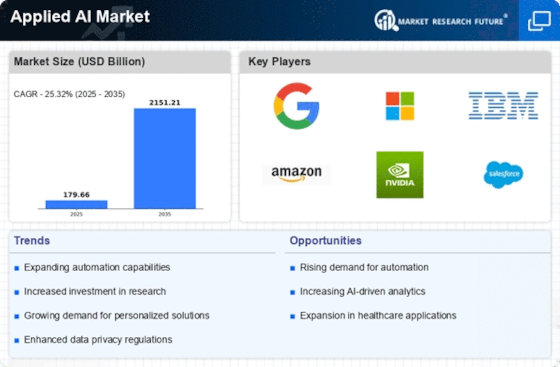
The Applied AI Market was valued at 179.66 USD Billion in 2024.

What is the projected market size for the Applied AI Market in 2035?

The market is projected to reach 2151.21 USD Billion by 2035.

What is the expected CAGR for the Applied AI Market during the forecast period 2025 - 2035?

The expected CAGR for the Applied AI Market during 2025 - 2035 is 25.32%.

Which companies are considered key players in the Applied AI Market?

Key players in the market include Google, Microsoft, IBM, Amazon, NVIDIA, Salesforce, Baidu, Alibaba, SAP, and Oracle.

How do software and services compare in terms of market valuation within the Applied AI Market?

In 2024, software was valued at 71.86 USD Billion, while services reached 107.8 USD Billion.

Market Summary

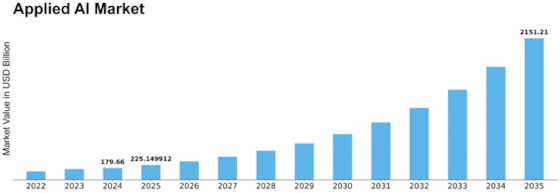
As per MRFR analysis, the Applied AI Market Size was estimated at 179.66 USD Billion in 2024. The Applied AI industry is projected to grow from 225.15 USD Billion in 2025 to 2151.21 USD Billion by 2035, exhibiting a compound annual growth rate (CAGR) of 25.32 during the forecast period 2025 - 2035.

Key Market Trends & Highlights

The Applied AI Market is experiencing robust growth driven by technological advancements and increasing adoption across various sectors.

  • The healthcare sector is witnessing increased adoption of applied AI technologies to enhance patient care and operational efficiency.
  • Ethical AI practices are gaining traction, reflecting a growing awareness of the societal implications of AI deployment.
  • Integration with IoT technologies is becoming prevalent, facilitating smarter and more connected environments across industries.
  • Rising demand for automation and advancements in machine learning algorithms are key drivers propelling growth, particularly in North America and among large enterprises.

Market Size & Forecast

2024 Market Size 179.66 (USD Billion)
2035 Market Size 2151.21 (USD Billion)
CAGR (2025 - 2035) 25.32%
Largest Regional Market Share in 2024 Asia Pacific

Major Players

<p>Google (US), Microsoft (US), IBM (US), Amazon (US), NVIDIA (US), Salesforce (US), Baidu (CN), Alibaba (CN), SAP (DE), Oracle (US)</p>

Market Trends

The Applied AI Market is currently experiencing a transformative phase, characterized by rapid advancements in technology and increasing integration across various sectors. Organizations are increasingly recognizing the potential of artificial intelligence to enhance operational efficiency, improve decision-making, and drive innovation. This trend is evident in industries such as healthcare, finance, and manufacturing, where AI applications are being utilized to streamline processes and deliver personalized services. As businesses strive to remain competitive, the demand for AI-driven solutions continues to grow, prompting investments in research and development. Moreover, the ethical implications of AI deployment are becoming a focal point of discussion. Stakeholders are increasingly aware of the need for responsible AI practices, which may influence regulatory frameworks and corporate policies. This heightened awareness could lead to the establishment of guidelines that ensure transparency and accountability in AI applications. As the Applied AI Market evolves, it appears poised to play a crucial role in shaping the future of technology and society, fostering a landscape where innovation and ethical considerations coexist harmoniously.

Increased Adoption in Healthcare

The healthcare sector is witnessing a notable surge in the adoption of applied AI technologies. These innovations are being utilized for diagnostics, patient management, and personalized treatment plans. By leveraging AI, healthcare providers aim to enhance patient outcomes and streamline operations, indicating a shift towards more data-driven decision-making.

Focus on Ethical AI Practices

There is a growing emphasis on ethical considerations surrounding AI technologies. Organizations are increasingly prioritizing transparency, fairness, and accountability in their AI initiatives. This trend suggests a potential shift in how companies approach AI development, with a focus on building trust among users and stakeholders.

Integration with IoT Technologies

The convergence of applied AI and Internet of Things (IoT) technologies is becoming more pronounced. This integration allows for enhanced data collection and analysis, leading to smarter systems and improved operational efficiencies. As industries adopt this synergy, the potential for innovation and improved service delivery appears promising.

Applied AI Market Market Drivers

Rising Demand for Automation

The Applied AI Market experiences a notable surge in demand for automation across various sectors. Organizations are increasingly adopting AI-driven solutions to enhance operational efficiency and reduce costs. According to recent data, the automation market is projected to reach a valuation of approximately 200 billion dollars by 2026, indicating a robust growth trajectory. This trend is particularly evident in manufacturing, logistics, and customer service, where AI applications streamline processes and improve productivity. As businesses seek to remain competitive, the integration of AI technologies becomes essential, driving further investment in the Applied AI Market. The potential for automation to transform traditional workflows suggests that companies are likely to prioritize AI solutions in their strategic planning.

Growing Investment in AI Startups

Investment in AI startups is a critical driver of growth within the Applied AI Market. Venture capital funding for AI-related ventures has seen exponential growth, with billions of dollars being funneled into innovative companies. In 2025, it is estimated that investment in AI startups could surpass 100 billion dollars, reflecting the increasing confidence of investors in the potential of AI technologies. This influx of capital not only accelerates the development of new applications but also fosters a vibrant ecosystem of innovation. As startups introduce novel solutions and disrupt traditional industries, established companies are compelled to adapt, further propelling the growth of the Applied AI Market. The dynamic interplay between investment and innovation suggests a promising future for AI technologies.

Expansion of AI in Financial Services

The financial services sector is witnessing a rapid expansion of AI applications, significantly impacting the Applied AI Market. Financial institutions are leveraging AI for various purposes, including fraud detection, risk assessment, and personalized customer service. Recent studies indicate that the adoption of AI in finance could lead to cost savings of up to 20 billion dollars annually by 2025. This trend is driven by the need for enhanced efficiency and improved customer experiences in a highly competitive market. As banks and financial firms increasingly integrate AI technologies into their operations, the demand for specialized AI solutions is expected to rise. The expansion of AI in financial services not only highlights the versatility of AI applications but also underscores the transformative potential of the Applied AI Market.

Advancements in Machine Learning Algorithms

The Applied AI Market is significantly influenced by advancements in machine learning algorithms. These innovations enhance the capabilities of AI systems, enabling them to process vast amounts of data with greater accuracy and speed. Recent developments in deep learning and neural networks have led to breakthroughs in various applications, including natural language processing and image recognition. As organizations increasingly rely on data-driven decision-making, the demand for sophisticated machine learning solutions is expected to rise. Market analysts indicate that the machine learning segment alone could account for over 50% of the overall AI market by 2025. This trend underscores the importance of continuous research and development in the Applied AI Market, as companies strive to leverage cutting-edge technologies to gain a competitive edge.

Increased Focus on Data Privacy and Security

The Applied AI Market faces growing scrutiny regarding data privacy and security. As AI systems become more integrated into everyday operations, concerns about the ethical use of data have intensified. Regulatory frameworks are evolving to address these issues, with governments implementing stricter guidelines to protect consumer information. This shift is likely to influence how companies develop and deploy AI solutions, as compliance with data protection regulations becomes paramount. Organizations that prioritize data privacy are expected to gain a competitive advantage, as consumers increasingly favor businesses that demonstrate a commitment to ethical practices. Consequently, the emphasis on data security is shaping the strategies of companies within the Applied AI Market, driving innovation in secure AI technologies.

Market Segment Insights

By Components: Software (Largest) vs. Services (Fastest-Growing)

<p>In the Applied AI Market, the components segment is predominantly led by software solutions, which capture the largest share due to their crucial role in driving AI functionalities across various applications. As businesses increasingly invest in intelligent systems, software has established itself as the backbone for AI deployment, ranging from data analytics to machine learning algorithms. Conversely, the services component, while currently smaller in market share, is witnessing rapid expansion as organizations pivot towards AI adoption and require robust support services for implementation, maintenance, and optimization. The growth trajectory for the services component is particularly noteworthy, fueled by the rising demand for customized AI solutions, consulting services, and training. Organizations are increasingly recognizing the importance of specialized services in maximizing the effectiveness of AI technologies. Additionally, trends such as the proliferation of AI in industry verticals and the necessity for ethical AI practices are catalyzing investments in services, positioning this segment for significant growth as more entities look to bolster their AI capabilities with strategic support.</p>

<p>Software (Dominant) vs. Services (Emerging)</p>

<p>The software segment in the Applied AI Market is characterized by a wide array of applications that enhance business processes, decision-making, and overall operational efficiency. This dominance stems from the ability of software solutions to integrate seamlessly with existing systems, enabling users to harness data-driven insights effectively. Popular categories within the software segment include machine learning platforms, natural language processing tools, and automation software. In contrast, the services segment is emerging as a vital component supporting AI implementation through consulting, training, and managed services. Companies are increasingly looking towards services to ensure that their AI initiatives are successful and sustainable. As the market continues to evolve, the collaboration between software and services will be essential in facilitating more complex and tailored AI deployments.</p>

By Organization Size: Large Enterprise (Largest) vs. Small & Medium Enterprise (Fastest-Growing)

<p>In the Applied AI Market, the share of Large Enterprises is significantly higher as they have the resources and infrastructure to implement advanced AI solutions. These organizations leverage AI for various applications, ranging from data analysis to customer engagement, contributing to their larger market presence. Conversely, Small & Medium Enterprises, while collectively on the rise, hold a smaller portion of the market share but are rapidly adopting AI, driven by the need for competitiveness and operational efficiency. The growth trends in this segment highlight a fascinating shift. Large Enterprises continue to dominate due to their established technology frameworks and investment capacity. On the other hand, the Small & Medium Enterprise segment is emerging as the fastest-growing, fueled by a surge in accessible AI solutions and support from government initiatives aimed at digital transformation. This growth is further propelled by the increasing recognition of AI's potential to enhance productivity and innovation among SMEs.</p>

<p>Large Enterprise (Dominant) vs. Small & Medium Enterprise (Emerging)</p>

<p>Large Enterprises in the Applied AI Market represent a dominant force, characterized by their extensive resources, strategic focus on technology integration, and strong data analytics capabilities. These companies are able to invest heavily in research and development, allowing them to stay at the forefront of AI innovations. Their scale and expertise enable them to implement complex AI solutions effectively. In contrast, Small & Medium Enterprises are emerging as key players, capturing attention due to their agility and willingness to innovate. They are increasingly adopting Machine Learning and AI technologies to optimize operations, enhance customer experience, and remain competitive. This transition is bolstered by the rise of affordable AI tools and platforms that level the playing field, allowing SMEs to harness the power of AI without the extensive capital required by larger firms.</p>

By Application: Healthcare (Largest) vs. Finance (Fastest-Growing)

<p>The Applied AI Market is witnessing a diverse distribution across various applications. Notably, the healthcare sector holds the largest share due to its increasing reliance on AI for diagnostics, treatment planning, and patient monitoring. In contrast, finance is emerging rapidly, fueled by the demand for fraud detection, algorithmic trading, and personalized banking services. Both sectors are significantly transforming their operational landscapes through AI-driven innovations.</p>

<p>Healthcare (Dominant) vs. Finance (Emerging)</p>

<p>Healthcare stands as a dominant segment in the Applied AI Market, driven by advancements such as AI-powered diagnostics and personalized treatment plans, which significantly enhance patient outcomes and operational efficiencies. In contrast, the finance sector, while currently smaller in comparison, is growing quickly due to increasing adoption of AI technologies for risk assessment and predictive analytics. As financial institutions strive to remain competitive, the application of AI for automation, customer insights, and compliance management is paving the way for new opportunities and innovations, making finance a critical emerging segment.</p>

Get more detailed insights about Applied AI Market Research Report - Global Forecast till 2035

Regional Insights

North America : Innovation and Leadership Hub

North America leads the Applied AI Market, driven by robust technological infrastructure, significant investments in AI research, and a strong presence of tech giants. The region holds approximately 45% of the global market share, with the United States being the largest contributor, followed by Canada at around 10%. Regulatory support from government initiatives further fuels growth, emphasizing ethical AI practices and innovation. The competitive landscape is characterized by major players such as Google, Microsoft, and IBM, which are continuously advancing their AI capabilities. The U.S. government also plays a crucial role in fostering AI development through funding and partnerships. This environment encourages startups and established companies alike to innovate, ensuring North America's position as a leader in the Applied AI Market sector.

Europe : Regulatory Framework and Growth

Europe is rapidly evolving as a significant player in the Applied AI Market, driven by stringent regulations and a focus on ethical AI. The region holds approximately 25% of the global market share, with Germany and the UK being the largest markets, contributing around 10% and 8% respectively. The European Union's commitment to AI regulations, such as the AI Act, is a key driver for growth, ensuring safety and accountability in AI applications. Leading countries like Germany, France, and the UK are at the forefront of AI innovation, supported by a strong ecosystem of research institutions and tech companies. Major players such as SAP and Oracle are investing heavily in AI solutions tailored to various industries. The competitive landscape is marked by collaboration between public and private sectors, fostering an environment conducive to AI advancements.

Asia-Pacific : Rapid Growth and Adoption

The Asia-Pacific region is witnessing a remarkable surge in the Applied AI Market, driven by rapid digital transformation and increasing investments in technology. This region holds approximately 20% of the global market share, with China being the largest market at around 15%, followed by Japan at 4%. Government initiatives in countries like China and India are propelling AI adoption across various sectors, including healthcare, finance, and manufacturing. China's tech giants, such as Baidu and Alibaba, are leading the charge in AI innovation, supported by substantial government backing. Japan is also making strides with its focus on robotics and automation. The competitive landscape is characterized by a mix of established players and emerging startups, creating a dynamic environment for AI development and application across the region.

Middle East and Africa : Emerging Market Potential

The Middle East and Africa region is emerging as a potential growth market for Applied AI Market, driven by increasing investments in technology and digital infrastructure. The region holds approximately 10% of the global market share, with South Africa and the UAE being the largest contributors, accounting for around 4% and 3% respectively. Government initiatives aimed at fostering innovation and attracting foreign investment are key drivers of growth in this sector. Countries like the UAE are investing heavily in AI as part of their national strategies, focusing on sectors such as healthcare and smart cities. The competitive landscape is evolving, with both local startups and international players seeking to establish a foothold. The presence of key players and supportive government policies are paving the way for a promising future in the Applied AI Market.

Key Players and Competitive Insights

The Applied AI Market is currently characterized by a dynamic competitive landscape, driven by rapid technological advancements and increasing demand for AI-driven solutions across various sectors. Major players such as Google (US), Microsoft (US), and NVIDIA (US) are at the forefront, leveraging their extensive resources and expertise to innovate and expand their market presence. Google (US) focuses on enhancing its AI capabilities through strategic partnerships and investments in cloud computing, while Microsoft (US) emphasizes integrating AI into its existing software products, thereby enhancing user experience and operational efficiency. NVIDIA (US) continues to dominate the hardware segment, providing powerful GPUs that facilitate AI processing, which collectively shapes a competitive environment that is increasingly reliant on technological prowess and strategic collaborations.

The business tactics employed by these companies reflect a concerted effort to optimize operations and enhance market positioning. The Applied AI Market appears moderately fragmented, with a mix of established giants and emerging players. Key players are increasingly localizing their operations and optimizing supply chains to respond to regional demands and regulatory requirements. This collective influence of major companies fosters a competitive structure that encourages innovation and rapid adaptation to market changes.

In September 2025, Google (US) announced a significant partnership with a leading healthcare provider to develop AI-driven diagnostic tools. This strategic move is poised to enhance Google's foothold in the healthcare sector, aligning with the growing trend of utilizing AI for improved patient outcomes. The collaboration not only showcases Google's commitment to leveraging AI for societal benefits but also positions it as a key player in a lucrative market segment.

In August 2025, Microsoft (US) unveiled its new AI-enhanced cloud services aimed at small and medium-sized enterprises (SMEs). This initiative is strategically important as it addresses the increasing demand for accessible AI solutions among SMEs, thereby expanding Microsoft's customer base and reinforcing its market leadership. By democratizing access to advanced AI tools, Microsoft is likely to foster innovation across various industries, further solidifying its competitive edge.

In July 2025, NVIDIA (US) launched a new line of AI-focused hardware designed specifically for autonomous vehicles. This development underscores NVIDIA's commitment to maintaining its leadership in AI hardware, particularly in the rapidly evolving automotive sector. The strategic importance of this launch lies in its potential to drive advancements in autonomous driving technology, positioning NVIDIA as a critical enabler of future mobility solutions.

As of October 2025, the competitive trends within the Applied AI Market are increasingly defined by digitalization, sustainability, and the integration of AI into everyday business processes. Strategic alliances are becoming more prevalent, as companies recognize the value of collaboration in enhancing technological capabilities and market reach. Looking ahead, competitive differentiation is likely to evolve from traditional price-based competition to a focus on innovation, technological advancement, and supply chain reliability, suggesting a transformative shift in how companies position themselves in the market.

Key Companies in the Applied AI Market market include

Industry Developments

November 2022, Applied AI Market Company (AAICO), a machine learning (ML) firm, has raised USD 42 million in funding to assist organizations in Europe and the United States in reducing their dependency on human business processes.

Future Outlook

Applied AI Market Future Outlook

<p>The Applied AI Market is projected to grow at a 25.32% CAGR from 2024 to 2035, driven by advancements in machine learning, increased automation, and demand for data-driven decision-making.</p>

New opportunities lie in:

  • <p>Development of AI-driven predictive maintenance solutions for manufacturing sectors.</p>
  • <p>Integration of AI in personalized customer experience platforms.</p>
  • <p>Creation of AI-enhanced cybersecurity systems for real-time threat detection.</p>

<p>By 2035, the Applied AI Market is expected to be a cornerstone of technological innovation and business efficiency.</p>

Market Segmentation

Applied AI Market Components Outlook

  • Software
  • Services

Applied AI Market Application Outlook

  • Healthcare
  • Finance
  • Retail and E-commerce
  • Predictive Maintenance
  • Industrial Robotics
  • Natural Language Processing (NLP)
  • Energy and Utilities
  • Agriculture
  • Cybersecurity
  • Education
  • Entertainment and Media
  • Real Estate
  • Transportation and Logistics
  • Environmental Monitoring
  • Human Resources
  • Others

Applied AI Market Organization Size Outlook

  • Small & Medium Enterprise
  • Large Enterprise

Report Scope

MARKET SIZE 2024179.66(USD Billion)
MARKET SIZE 2025225.15(USD Billion)
MARKET SIZE 20352151.21(USD Billion)
COMPOUND ANNUAL GROWTH RATE (CAGR)25.32% (2024 - 2035)
REPORT COVERAGERevenue Forecast, Competitive Landscape, Growth Factors, and Trends
BASE YEAR2024
Market Forecast Period2025 - 2035
Historical Data2019 - 2024
Market Forecast UnitsUSD Billion
Key Companies ProfiledMarket analysis in progress
Segments CoveredMarket segmentation analysis in progress
Key Market OpportunitiesIntegration of advanced machine learning algorithms in diverse industries enhances efficiency and decision-making processes.
Key Market DynamicsRising demand for automation drives innovation and competition in the Applied Artificial Intelligence sector.
Countries CoveredNorth America, Europe, APAC, South America, MEA

FAQs

What is the current valuation of the Applied AI Market as of 2024?

The Applied AI Market was valued at 179.66 USD Billion in 2024.

What is the projected market size for the Applied AI Market in 2035?

The market is projected to reach 2151.21 USD Billion by 2035.

What is the expected CAGR for the Applied AI Market during the forecast period 2025 - 2035?

The expected CAGR for the Applied AI Market during 2025 - 2035 is 25.32%.

Which companies are considered key players in the Applied AI Market?

Key players in the market include Google, Microsoft, IBM, Amazon, NVIDIA, Salesforce, Baidu, Alibaba, SAP, and Oracle.

How do software and services compare in terms of market valuation within the Applied AI Market?

In 2024, software was valued at 71.86 USD Billion, while services reached 107.8 USD Billion.

  1. SECTION I: EXECUTIVE SUMMARY AND KEY HIGHLIGHTS
    1. EXECUTIVE SUMMARY
      1. Market Overview
      2. Key Findings
      3. Market Segmentation
      4. Competitive Landscape
      5. Challenges and Opportunities
      6. Future Outlook
  2. SECTION II: SCOPING, METHODOLOGY AND MARKET STRUCTURE
    1. MARKET INTRODUCTION
      1. Definition
      2. Scope of the study
    2. RESEARCH METHODOLOGY
      1. Overview
      2. Data Mining
      3. Secondary Research
      4. Primary Research
      5. Forecasting Model
      6. Market Size Estimation
      7. Data Triangulation
      8. Validation
  3. SECTION III: QUALITATIVE ANALYSIS
    1. MARKET DYNAMICS
      1. Overview
      2. Drivers
      3. Restraints
      4. Opportunities
    2. MARKET FACTOR ANALYSIS
      1. Value chain Analysis
      2. Porter's Five Forces Analysis
      3. COVID-19 Impact Analysis
  4. SECTION IV: QUANTITATIVE ANALYSIS
    1. Information and Communications Technology, BY Components (USD Billion)
      1. Software
      2. Services
    2. Information and Communications Technology, BY Organization Size (USD Billion)
      1. Small & Medium Enterprise
      2. Large Enterprise
    3. Information and Communications Technology, BY Application (USD Billion)
      1. Healthcare
      2. Finance
      3. Retail and E-commerce
      4. Predictive Maintenance
      5. Industrial Robotics
      6. Natural Language Processing (NLP)
      7. Energy and Utilities
      8. Agriculture
      9. Cybersecurity
      10. Education
      11. Entertainment and Media
      12. Real Estate
      13. Transportation and Logistics
      14. Environmental Monitoring
      15. Human Resources
      16. Others
    4. Information and Communications Technology, BY Region (USD Billion)
      1. North America
      2. Europe
      3. APAC
      4. South America
      5. MEA
  5. SECTION V: COMPETITIVE ANALYSIS
    1. Competitive Landscape
      1. Overview
      2. Competitive Analysis
      3. Market share Analysis
      4. Major Growth Strategy in the Information and Communications Technology
      5. Competitive Benchmarking
      6. Leading Players in Terms of Number of Developments in the Information and Communications Technology
      7. Key developments and growth strategies
      8. Major Players Financial Matrix
    2. Company Profiles
      1. Google (US)
      2. Microsoft (US)
      3. IBM (US)
      4. Amazon (US)
      5. NVIDIA (US)
      6. Salesforce (US)
      7. Baidu (CN)
      8. Alibaba (CN)
      9. SAP (DE)
      10. Oracle (US)
    3. Appendix
      1. References
      2. Related Reports
  6. LIST OF FIGURES
    1. MARKET SYNOPSIS
    2. NORTH AMERICA MARKET ANALYSIS
    3. US MARKET ANALYSIS BY COMPONENTS
    4. US MARKET ANALYSIS BY ORGANIZATION SIZE
    5. US MARKET ANALYSIS BY APPLICATION
    6. CANADA MARKET ANALYSIS BY COMPONENTS
    7. CANADA MARKET ANALYSIS BY ORGANIZATION SIZE
    8. CANADA MARKET ANALYSIS BY APPLICATION
    9. EUROPE MARKET ANALYSIS
    10. GERMANY MARKET ANALYSIS BY COMPONENTS
    11. GERMANY MARKET ANALYSIS BY ORGANIZATION SIZE
    12. GERMANY MARKET ANALYSIS BY APPLICATION
    13. UK MARKET ANALYSIS BY COMPONENTS
    14. UK MARKET ANALYSIS BY ORGANIZATION SIZE
    15. UK MARKET ANALYSIS BY APPLICATION
    16. FRANCE MARKET ANALYSIS BY COMPONENTS
    17. FRANCE MARKET ANALYSIS BY ORGANIZATION SIZE
    18. FRANCE MARKET ANALYSIS BY APPLICATION
    19. RUSSIA MARKET ANALYSIS BY COMPONENTS
    20. RUSSIA MARKET ANALYSIS BY ORGANIZATION SIZE
    21. RUSSIA MARKET ANALYSIS BY APPLICATION
    22. ITALY MARKET ANALYSIS BY COMPONENTS
    23. ITALY MARKET ANALYSIS BY ORGANIZATION SIZE
    24. ITALY MARKET ANALYSIS BY APPLICATION
    25. SPAIN MARKET ANALYSIS BY COMPONENTS
    26. SPAIN MARKET ANALYSIS BY ORGANIZATION SIZE
    27. SPAIN MARKET ANALYSIS BY APPLICATION
    28. REST OF EUROPE MARKET ANALYSIS BY COMPONENTS
    29. REST OF EUROPE MARKET ANALYSIS BY ORGANIZATION SIZE
    30. REST OF EUROPE MARKET ANALYSIS BY APPLICATION
    31. APAC MARKET ANALYSIS
    32. CHINA MARKET ANALYSIS BY COMPONENTS
    33. CHINA MARKET ANALYSIS BY ORGANIZATION SIZE
    34. CHINA MARKET ANALYSIS BY APPLICATION
    35. INDIA MARKET ANALYSIS BY COMPONENTS
    36. INDIA MARKET ANALYSIS BY ORGANIZATION SIZE
    37. INDIA MARKET ANALYSIS BY APPLICATION
    38. JAPAN MARKET ANALYSIS BY COMPONENTS
    39. JAPAN MARKET ANALYSIS BY ORGANIZATION SIZE
    40. JAPAN MARKET ANALYSIS BY APPLICATION
    41. SOUTH KOREA MARKET ANALYSIS BY COMPONENTS
    42. SOUTH KOREA MARKET ANALYSIS BY ORGANIZATION SIZE
    43. SOUTH KOREA MARKET ANALYSIS BY APPLICATION
    44. MALAYSIA MARKET ANALYSIS BY COMPONENTS
    45. MALAYSIA MARKET ANALYSIS BY ORGANIZATION SIZE
    46. MALAYSIA MARKET ANALYSIS BY APPLICATION
    47. THAILAND MARKET ANALYSIS BY COMPONENTS
    48. THAILAND MARKET ANALYSIS BY ORGANIZATION SIZE
    49. THAILAND MARKET ANALYSIS BY APPLICATION
    50. INDONESIA MARKET ANALYSIS BY COMPONENTS
    51. INDONESIA MARKET ANALYSIS BY ORGANIZATION SIZE
    52. INDONESIA MARKET ANALYSIS BY APPLICATION
    53. REST OF APAC MARKET ANALYSIS BY COMPONENTS
    54. REST OF APAC MARKET ANALYSIS BY ORGANIZATION SIZE
    55. REST OF APAC MARKET ANALYSIS BY APPLICATION
    56. SOUTH AMERICA MARKET ANALYSIS
    57. BRAZIL MARKET ANALYSIS BY COMPONENTS
    58. BRAZIL MARKET ANALYSIS BY ORGANIZATION SIZE
    59. BRAZIL MARKET ANALYSIS BY APPLICATION
    60. MEXICO MARKET ANALYSIS BY COMPONENTS
    61. MEXICO MARKET ANALYSIS BY ORGANIZATION SIZE
    62. MEXICO MARKET ANALYSIS BY APPLICATION
    63. ARGENTINA MARKET ANALYSIS BY COMPONENTS
    64. ARGENTINA MARKET ANALYSIS BY ORGANIZATION SIZE
    65. ARGENTINA MARKET ANALYSIS BY APPLICATION
    66. REST OF SOUTH AMERICA MARKET ANALYSIS BY COMPONENTS
    67. REST OF SOUTH AMERICA MARKET ANALYSIS BY ORGANIZATION SIZE
    68. REST OF SOUTH AMERICA MARKET ANALYSIS BY APPLICATION
    69. MEA MARKET ANALYSIS
    70. GCC COUNTRIES MARKET ANALYSIS BY COMPONENTS
    71. GCC COUNTRIES MARKET ANALYSIS BY ORGANIZATION SIZE
    72. GCC COUNTRIES MARKET ANALYSIS BY APPLICATION
    73. SOUTH AFRICA MARKET ANALYSIS BY COMPONENTS
    74. SOUTH AFRICA MARKET ANALYSIS BY ORGANIZATION SIZE
    75. SOUTH AFRICA MARKET ANALYSIS BY APPLICATION
    76. REST OF MEA MARKET ANALYSIS BY COMPONENTS
    77. REST OF MEA MARKET ANALYSIS BY ORGANIZATION SIZE
    78. REST OF MEA MARKET ANALYSIS BY APPLICATION
    79. KEY BUYING CRITERIA OF INFORMATION AND COMMUNICATIONS TECHNOLOGY
    80. RESEARCH PROCESS OF MRFR
    81. DRO ANALYSIS OF INFORMATION AND COMMUNICATIONS TECHNOLOGY
    82. DRIVERS IMPACT ANALYSIS: INFORMATION AND COMMUNICATIONS TECHNOLOGY
    83. RESTRAINTS IMPACT ANALYSIS: INFORMATION AND COMMUNICATIONS TECHNOLOGY
    84. SUPPLY / VALUE CHAIN: INFORMATION AND COMMUNICATIONS TECHNOLOGY
    85. INFORMATION AND COMMUNICATIONS TECHNOLOGY, BY COMPONENTS, 2024 (% SHARE)
    86. INFORMATION AND COMMUNICATIONS TECHNOLOGY, BY COMPONENTS, 2024 TO 2035 (USD Billion)
    87. INFORMATION AND COMMUNICATIONS TECHNOLOGY, BY ORGANIZATION SIZE, 2024 (% SHARE)
    88. INFORMATION AND COMMUNICATIONS TECHNOLOGY, BY ORGANIZATION SIZE, 2024 TO 2035 (USD Billion)
    89. INFORMATION AND COMMUNICATIONS TECHNOLOGY, BY APPLICATION, 2024 (% SHARE)
    90. INFORMATION AND COMMUNICATIONS TECHNOLOGY, BY APPLICATION, 2024 TO 2035 (USD Billion)
    91. BENCHMARKING OF MAJOR COMPETITORS
  7. LIST OF TABLES
    1. LIST OF ASSUMPTIONS
    2. North America MARKET SIZE ESTIMATES; FORECAST
      1. BY COMPONENTS, 2025-2035 (USD Billion)
      2. BY ORGANIZATION SIZE, 2025-2035 (USD Billion)
      3. BY APPLICATION, 2025-2035 (USD Billion)
    3. US MARKET SIZE ESTIMATES; FORECAST
      1. BY COMPONENTS, 2025-2035 (USD Billion)
      2. BY ORGANIZATION SIZE, 2025-2035 (USD Billion)
      3. BY APPLICATION, 2025-2035 (USD Billion)
    4. Canada MARKET SIZE ESTIMATES; FORECAST
      1. BY COMPONENTS, 2025-2035 (USD Billion)
      2. BY ORGANIZATION SIZE, 2025-2035 (USD Billion)
      3. BY APPLICATION, 2025-2035 (USD Billion)
    5. Europe MARKET SIZE ESTIMATES; FORECAST
      1. BY COMPONENTS, 2025-2035 (USD Billion)
      2. BY ORGANIZATION SIZE, 2025-2035 (USD Billion)
      3. BY APPLICATION, 2025-2035 (USD Billion)
    6. Germany MARKET SIZE ESTIMATES; FORECAST
      1. BY COMPONENTS, 2025-2035 (USD Billion)
      2. BY ORGANIZATION SIZE, 2025-2035 (USD Billion)
      3. BY APPLICATION, 2025-2035 (USD Billion)
    7. UK MARKET SIZE ESTIMATES; FORECAST
      1. BY COMPONENTS, 2025-2035 (USD Billion)
      2. BY ORGANIZATION SIZE, 2025-2035 (USD Billion)
      3. BY APPLICATION, 2025-2035 (USD Billion)
    8. France MARKET SIZE ESTIMATES; FORECAST
      1. BY COMPONENTS, 2025-2035 (USD Billion)
      2. BY ORGANIZATION SIZE, 2025-2035 (USD Billion)
      3. BY APPLICATION, 2025-2035 (USD Billion)
    9. Russia MARKET SIZE ESTIMATES; FORECAST
      1. BY COMPONENTS, 2025-2035 (USD Billion)
      2. BY ORGANIZATION SIZE, 2025-2035 (USD Billion)
      3. BY APPLICATION, 2025-2035 (USD Billion)
    10. Italy MARKET SIZE ESTIMATES; FORECAST
      1. BY COMPONENTS, 2025-2035 (USD Billion)
      2. BY ORGANIZATION SIZE, 2025-2035 (USD Billion)
      3. BY APPLICATION, 2025-2035 (USD Billion)
    11. Spain MARKET SIZE ESTIMATES; FORECAST
      1. BY COMPONENTS, 2025-2035 (USD Billion)
      2. BY ORGANIZATION SIZE, 2025-2035 (USD Billion)
      3. BY APPLICATION, 2025-2035 (USD Billion)
    12. Rest of Europe MARKET SIZE ESTIMATES; FORECAST
      1. BY COMPONENTS, 2025-2035 (USD Billion)
      2. BY ORGANIZATION SIZE, 2025-2035 (USD Billion)
      3. BY APPLICATION, 2025-2035 (USD Billion)
    13. APAC MARKET SIZE ESTIMATES; FORECAST
      1. BY COMPONENTS, 2025-2035 (USD Billion)
      2. BY ORGANIZATION SIZE, 2025-2035 (USD Billion)
      3. BY APPLICATION, 2025-2035 (USD Billion)
    14. China MARKET SIZE ESTIMATES; FORECAST
      1. BY COMPONENTS, 2025-2035 (USD Billion)
      2. BY ORGANIZATION SIZE, 2025-2035 (USD Billion)
      3. BY APPLICATION, 2025-2035 (USD Billion)
    15. India MARKET SIZE ESTIMATES; FORECAST
      1. BY COMPONENTS, 2025-2035 (USD Billion)
      2. BY ORGANIZATION SIZE, 2025-2035 (USD Billion)
      3. BY APPLICATION, 2025-2035 (USD Billion)
    16. Japan MARKET SIZE ESTIMATES; FORECAST
      1. BY COMPONENTS, 2025-2035 (USD Billion)
      2. BY ORGANIZATION SIZE, 2025-2035 (USD Billion)
      3. BY APPLICATION, 2025-2035 (USD Billion)
    17. South Korea MARKET SIZE ESTIMATES; FORECAST
      1. BY COMPONENTS, 2025-2035 (USD Billion)
      2. BY ORGANIZATION SIZE, 2025-2035 (USD Billion)
      3. BY APPLICATION, 2025-2035 (USD Billion)
    18. Malaysia MARKET SIZE ESTIMATES; FORECAST
      1. BY COMPONENTS, 2025-2035 (USD Billion)
      2. BY ORGANIZATION SIZE, 2025-2035 (USD Billion)
      3. BY APPLICATION, 2025-2035 (USD Billion)
    19. Thailand MARKET SIZE ESTIMATES; FORECAST
      1. BY COMPONENTS, 2025-2035 (USD Billion)
      2. BY ORGANIZATION SIZE, 2025-2035 (USD Billion)
      3. BY APPLICATION, 2025-2035 (USD Billion)
    20. Indonesia MARKET SIZE ESTIMATES; FORECAST
      1. BY COMPONENTS, 2025-2035 (USD Billion)
      2. BY ORGANIZATION SIZE, 2025-2035 (USD Billion)
      3. BY APPLICATION, 2025-2035 (USD Billion)
    21. Rest of APAC MARKET SIZE ESTIMATES; FORECAST
      1. BY COMPONENTS, 2025-2035 (USD Billion)
      2. BY ORGANIZATION SIZE, 2025-2035 (USD Billion)
      3. BY APPLICATION, 2025-2035 (USD Billion)
    22. South America MARKET SIZE ESTIMATES; FORECAST
      1. BY COMPONENTS, 2025-2035 (USD Billion)
      2. BY ORGANIZATION SIZE, 2025-2035 (USD Billion)
      3. BY APPLICATION, 2025-2035 (USD Billion)
    23. Brazil MARKET SIZE ESTIMATES; FORECAST
      1. BY COMPONENTS, 2025-2035 (USD Billion)
      2. BY ORGANIZATION SIZE, 2025-2035 (USD Billion)
      3. BY APPLICATION, 2025-2035 (USD Billion)
    24. Mexico MARKET SIZE ESTIMATES; FORECAST
      1. BY COMPONENTS, 2025-2035 (USD Billion)
      2. BY ORGANIZATION SIZE, 2025-2035 (USD Billion)
      3. BY APPLICATION, 2025-2035 (USD Billion)
    25. Argentina MARKET SIZE ESTIMATES; FORECAST
      1. BY COMPONENTS, 2025-2035 (USD Billion)
      2. BY ORGANIZATION SIZE, 2025-2035 (USD Billion)
      3. BY APPLICATION, 2025-2035 (USD Billion)
    26. Rest of South America MARKET SIZE ESTIMATES; FORECAST
      1. BY COMPONENTS, 2025-2035 (USD Billion)
      2. BY ORGANIZATION SIZE, 2025-2035 (USD Billion)
      3. BY APPLICATION, 2025-2035 (USD Billion)
    27. MEA MARKET SIZE ESTIMATES; FORECAST
      1. BY COMPONENTS, 2025-2035 (USD Billion)
      2. BY ORGANIZATION SIZE, 2025-2035 (USD Billion)
      3. BY APPLICATION, 2025-2035 (USD Billion)
    28. GCC Countries MARKET SIZE ESTIMATES; FORECAST
      1. BY COMPONENTS, 2025-2035 (USD Billion)
      2. BY ORGANIZATION SIZE, 2025-2035 (USD Billion)
      3. BY APPLICATION, 2025-2035 (USD Billion)
    29. South Africa MARKET SIZE ESTIMATES; FORECAST
      1. BY COMPONENTS, 2025-2035 (USD Billion)
      2. BY ORGANIZATION SIZE, 2025-2035 (USD Billion)
      3. BY APPLICATION, 2025-2035 (USD Billion)
    30. Rest of MEA MARKET SIZE ESTIMATES; FORECAST
      1. BY COMPONENTS, 2025-2035 (USD Billion)
      2. BY ORGANIZATION SIZE, 2025-2035 (USD Billion)
      3. BY APPLICATION, 2025-2035 (USD Billion)
    31. PRODUCT LAUNCH/PRODUCT DEVELOPMENT/APPROVAL
    32. ACQUISITION/PARTNERSHIP

Applied AI Market Segmentation

Market Segmentation Overview

  • Detailed segmentation data will be available in the full report
  • Comprehensive analysis by multiple parameters
  • Regional and country-level breakdowns
  • Market size forecasts by segment
Infographic

Free Sample Request

Kindly complete the form below to receive a free sample of this Report

Get Free Sample

Customer Strories

Compare Licence

×
Features License Type
Single User Multiuser License Enterprise User
Price $4,950 $5,950 $7,250
Maximum User Access Limit 1 User Upto 10 Users Unrestricted Access Throughout the Organization
Free Customization
Direct Access to Analyst
Deliverable Format
Platform Access
Discount on Next Purchase 10% 15% 15%
Printable Versions