
×
Request Free Sample ×

Kindly complete the form below to receive a free sample of this Report

* Please use a valid business email

Leading companies partner with us for data-driven Insights

clients tt-cursor
Hero Background
English
Chinese
French
Japanese
Korean
German
Spanish

Applied AI in Retail & E-commerce Market Trends

ID: MRFR/ICT/10660-HCR
128 Pages
Aarti Dhapte
October 2025

Applied AI in Retail & E-commerce Market Research Report: By Technology (Machine Learning, Natural Language Processing (NLP), Computer Vision, Speech Recognition, and Predictive Analytics), Application (Customer Service & Support, Sales & Marketing, Supply Chain Management, Price Optimization, Payment Processing, and Product Search & Discovery), Deployment (On-Premise, and Cloud-Based), End-User (Retailers, E-commerce Platforms, Consumer Goods Manufacturers, Logistics & Supply Chain Companies), By Region - Forecast Till 2... read more

Share:
Download PDF ×

We do not share your information with anyone. However, we may send you emails based on your report interest from time to time. You may contact us at any time to opt-out.

Applied AI in Retail & E-commerce Market Infographic
×
Applied AI in Retail & E-commerce Market Infographic Full View
Purchase Options

Market Trends

Key Emerging Trends in the Applied AI in Retail & E-commerce Market

In response to this rapidly changing environment, firms have turned to strategies that enable them consolidate or expand their market shares within the application of Artificial Intelligence (AI) on Retail & E-Commerce Marketplaces. One way to approach it is through focus on technological innovation to develop and offer advanced capable solutions that are customized according to requirements of retail (shopping) outlets and e-shopping sectors. Therefore, using latest technologies in machine learning, natural language processing (NLP), computer vision help brands reach out personalized responses when seeking for efficient inventory management options or customer engagement tools used in online marketing campaigns. The pricing strategy plays a significant role when positioning oneself within the market share space in Applied AI in Retail & E-commerce Market. Some businesses adopt cost leadership strategy aiming at offering lower priced artificial intelligent solutions compared to their competitors targeting price sensitive retailers and e-markets ensuring competitive prices so that they obtain large market share nevertheless others position themselves as premium providers emphasizing features such as advanced recommendation engines, personalized shopping experiences, and comprehensive data analytics. Companies like these target high-end retail brands and online platforms where a segment of consumers that are willing to pay premium prices for the most modernized AI-based solutions in the field of retail. In addition, market share positioning is also influenced by collaborations and strategic partnerships within Applied AI in Retail & E-commerce Market. Many companies flirt with alliances involving e-marketplace platforms, brick-and-mortar retailers or parcel delivery services to improve how their AI solutions can be used in retail sector. Through this collaboration, they have been able to develop a wider range of services for different retailers giving them a better market reach while at the same time addressing any unique requirements from each retailer. Furthermore, partnering with established retail chain owners or major online stores on joint projects or long-term supply contracts gives them a stable income source with stronger presence in the market. Customer-centric strategies are vital to increasing market share within the Applied AI in Retail & E-commerce Market position. Firms that concentrate on offering seamless buying encounters backed by personalized suggestions and responsive customer care establish strong bonds with retailers and e-consumers alike. This way, positive user experiences lead to customer loyalty among others leading to increased market shares over time through word of mouth referrals thereby causing amplification effects. Moreover, understanding specific retail and e-commerce needs/cases enables customization of AI solutions across specific market segments resulting into competitive advantages.


Author
Aarti Dhapte
Team Lead - Research

She holds an experience of about 6+ years in Market Research and Business Consulting, working under the spectrum of Information Communication Technology, Telecommunications and Semiconductor domains. Aarti conceptualizes and implements a scalable business strategy and provides strategic leadership to the clients. Her expertise lies in market estimation, competitive intelligence, pipeline analysis, customer assessment, etc.

Leave a Comment

FAQs

How much is the Applied AI in Retail & E-commerce Market?

The Applied AI in Retail & E-commerce Market size was valued at USD 44.75 billion in 2024.

What is the growth rate of the Applied AI in Retail & E-commerce Market?

The global market is projected to grow at a CAGR of 30.86% during the forecast period, 2025-2034.

Which region held the largest market share in the Applied AI in Retail & E-commerce Market?

North America had the largest share in the Applied AI in Retail & E-commerce Market.

Who are the key players in the Applied AI in Retail & E-commerce Market?

The key players in the market are Quantifind, OpenAI, Accenture, DataRobot, SAS, IBM, Microsoft, Adobe, NVIDIA, Intel, Google, Amazon, and other market players.

Which Technology Type led the Applied AI in Retail & E-commerce Market?

Machine Learning dominated the market in 2024.

Which application had the largest market share in the Applied AI in Retail & E-commerce Market?

The Customer Service & Support application had the largest share in the global market.

Market Summary

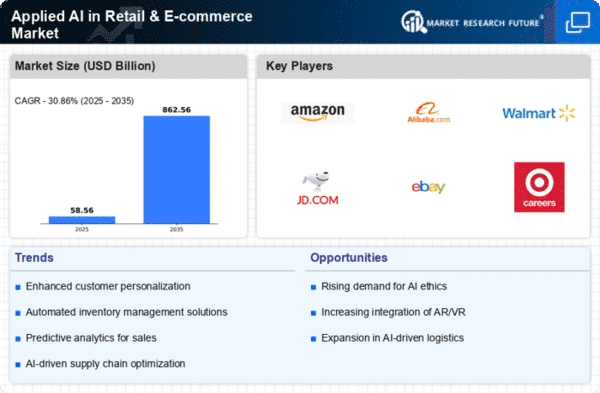
As per MRFR analysis, the Applied AI in Retail & E-commerce Market was estimated at 44.75 USD Billion in 2024. The Applied AI industry is projected to grow from 58.57 USD Billion in 2025 to 862.56 USD Billion by 2035, exhibiting a compound annual growth rate (CAGR) of 30.86 during the forecast period 2025 - 2035.

Key Market Trends & Highlights

The Applied AI in Retail and E-commerce Market is experiencing robust growth driven by technological advancements and evolving consumer expectations.

  • Personalization through AI is becoming increasingly prevalent, enhancing customer engagement and satisfaction.
  • AI-driven supply chain optimization is streamlining operations, particularly in North America, which remains the largest market.
  • Customer service automation is the largest segment, while personalized marketing is rapidly gaining traction in the Asia-Pacific region.
  • Enhanced customer experience and data-driven decision making are key drivers propelling market growth.

Market Size & Forecast

2024 Market Size 44.75 (USD Billion)
2035 Market Size 862.56 (USD Billion)
CAGR (2025 - 2035) 30.86%
Largest Regional Market Share in 2024 North America

Major Players

Amazon (US), Alibaba (CN), Walmart (US), JD.com (CN), eBay (US), Target (US), Zalando (DE), Shopify (CA), Rakuten (JP)

Market Trends

The Applied AI in Retail & E-commerce Market is currently experiencing a transformative phase, driven by advancements in technology and changing consumer behaviors. Retailers are increasingly adopting artificial intelligence solutions to enhance customer experiences, streamline operations, and optimize inventory management. This shift appears to be fueled by the need for personalized shopping experiences, where AI algorithms analyze consumer data to provide tailored recommendations. Furthermore, the integration of AI in supply chain logistics is likely to improve efficiency and reduce costs, thereby enhancing overall profitability for businesses in this sector. In December 2025, the landscape of the Applied AI in Retail & E-commerce Market seems to be characterized by a growing emphasis on ethical AI practices. Companies are becoming more aware of the implications of data privacy and are striving to implement transparent AI systems. This trend indicates a potential shift towards responsible AI usage, where businesses prioritize consumer trust and compliance with regulations. As the market evolves, it is expected that the focus on sustainability and ethical considerations will play a crucial role in shaping future strategies for retailers and e-commerce platforms.

Personalization through AI

The trend towards personalization is becoming increasingly prevalent in the Applied AI in Retail & E-commerce Market. Retailers are leveraging AI technologies to analyze customer data, enabling them to offer tailored product recommendations and personalized marketing strategies. This approach not only enhances customer satisfaction but also drives sales by creating a more engaging shopping experience.

AI-Driven Supply Chain Optimization

Supply chain optimization is another significant trend within the Applied AI in Retail & E-commerce Market. Businesses are utilizing AI to forecast demand, manage inventory levels, and streamline logistics. This application of AI helps in reducing operational costs and improving efficiency, ultimately leading to better service delivery and customer satisfaction.

Ethical AI Practices

The focus on ethical AI practices is emerging as a critical trend in the Applied AI in Retail & E-commerce Market. Companies are increasingly prioritizing data privacy and transparency in their AI applications. This shift suggests a growing recognition of the importance of consumer trust and compliance with regulatory standards, which may influence future business strategies.

Applied AI in Retail & E-commerce Market Market Drivers

Market Growth Projections

The Global Applied AI in Retail and E-commerce Market Industry is poised for remarkable growth, with projections indicating a market value of 44.7 USD Billion in 2024 and an anticipated surge to 862.5 USD Billion by 2035. This growth trajectory reflects a compound annual growth rate of 30.88% from 2025 to 2035, highlighting the increasing adoption of AI technologies across the retail sector. As businesses continue to recognize the transformative potential of AI, the market is likely to expand significantly, driven by advancements in technology, consumer demand for personalization, and the need for efficient supply chain management.

Enhanced Supply Chain Management

Efficient supply chain management is crucial for the success of the Global Applied AI in Retail and E-commerce Market Industry. AI technologies enable retailers to optimize inventory levels, forecast demand accurately, and streamline logistics. For example, predictive analytics can help businesses anticipate stock shortages and adjust procurement strategies accordingly. This optimization not only reduces operational costs but also enhances customer satisfaction by ensuring product availability. As the market evolves, the integration of AI in supply chain processes is expected to drive significant growth, with a projected compound annual growth rate of 30.88% from 2025 to 2035.

Rapid Technological Advancements

The Global Applied AI in Retail and E-commerce Market Industry is experiencing rapid technological advancements that enhance operational efficiency and customer experience. Innovations in machine learning, natural language processing, and computer vision are transforming how retailers interact with consumers. For instance, AI-driven chatbots are now commonplace, providing 24/7 customer service and personalized recommendations. This technological evolution is projected to drive the market's growth, with the industry expected to reach 44.7 USD Billion in 2024. As these technologies continue to evolve, they are likely to create new opportunities for retailers to optimize their supply chains and improve customer engagement.

Emergence of Omnichannel Retailing

The emergence of omnichannel retailing is reshaping the Global Applied AI in Retail and E-commerce Market Industry. Retailers are increasingly adopting a seamless approach to integrate online and offline shopping experiences, which is facilitated by AI technologies. By utilizing AI for data analysis, businesses can better understand consumer behavior across multiple channels and tailor their marketing strategies accordingly. This integration not only enhances customer engagement but also drives sales growth. As the market adapts to this omnichannel approach, it is likely to witness substantial growth, with projections indicating a market value of 862.5 USD Billion by 2035.

Growing Investment in AI Technologies

Investment in AI technologies is a key driver of the Global Applied AI in Retail and E-commerce Market Industry. Retailers are increasingly allocating resources to develop and implement AI solutions that enhance their operational capabilities. This trend is evidenced by the rising number of partnerships between technology firms and retail businesses aimed at harnessing AI for various applications, from customer service to inventory management. As companies recognize the potential return on investment from AI integration, funding for AI initiatives is expected to surge, further propelling market growth. The industry's value is anticipated to reach 44.7 USD Billion in 2024, reflecting this growing investment trend.

Increased Consumer Demand for Personalization

Consumer demand for personalized shopping experiences is a significant driver in the Global Applied AI in Retail and E-commerce Market Industry. Shoppers increasingly expect tailored recommendations and experiences that cater to their individual preferences. Retailers are leveraging AI algorithms to analyze consumer data and deliver personalized content, which has been shown to enhance customer satisfaction and loyalty. As a result, businesses that adopt AI-driven personalization strategies are likely to see increased sales and customer retention. This trend is expected to contribute to the market's growth, with projections indicating a substantial increase in market value, reaching 862.5 USD Billion by 2035.

Market Segment Insights

By Application: Customer Service Automation (Largest) vs. Personalized Marketing (Fastest-Growing)

In the Applied AI in Retail & E-commerce Market, Customer Service Automation currently holds the largest market share among various applications. This segment leverages AI technologies to enhance customer interactions, streamline support processes, and deliver real-time assistance. Following closely is Personalized Marketing, which is gaining traction due to consumers' demand for tailored shopping experiences, resulting in increased engagement and conversion rates. These applications are critical to retaining customer loyalty and driving sales in a competitive landscape.

Customer Service Automation (Dominant) vs. Personalized Marketing (Emerging)

Customer Service Automation, as a dominant application in the retail and e-commerce sector, serves to enhance customer engagement by providing instant responses and resolving queries efficiently. It utilizes AI chatbots and virtual assistants, ensuring round-the-clock support that strengthens customer satisfaction. On the other hand, Personalized Marketing is an emerging application, focusing on leveraging customer data to deliver relevant advertisements and recommendations. This strategy caters to individual preferences, thereby improving customer retention and enhancing the overall shopping experience. The growth of both segments highlights the importance of consumer-centric approaches in the retail market.

By Technology: Machine Learning (Largest) vs. Natural Language Processing (Fastest-Growing)

In the Applied AI in Retail & E-commerce Market, Machine Learning holds the largest share, leveraging its vast applications to enhance customer experiences and optimize inventory management. Natural Language Processing, while holding a smaller share, is rapidly gaining traction as the demand for chatbots and voice-activated assistants grows in retail environments. These technologies represent the forefront of AI innovation, significantly impacting how businesses engage with consumers. As retailers increasingly adopt AI technologies, the growth of machine learning is supported by its ability to analyze vast amounts of data for predictive insights. Natural Language Processing benefits from the uptick in e-commerce transactions and customer service automation, making it a focal point for growth. Furthermore, advancements in deep learning and linguistic understanding are driving its adoption, making it a key area for investment in the coming years.

Machine Learning: Core (Dominant) vs. Predictive Analytics (Emerging)

Within the Applied AI segment, Machine Learning stands as the core technology, dominating the landscape due to its extensive applicability. It empowers retailers to better understand consumer behavior, personalize shopping experiences, and automate various processes. This allows businesses to operate more efficiently and respond to market trends proactively. In contrast, Predictive Analytics is emerging as a vital tool that unearths actionable insights by forecasting future trends based on historical data. As retailers increasingly recognize the value of foresight in decision-making and inventory management, Predictive Analytics is gaining prominence. Together, these technologies complement each other, creating a robust framework for operational excellence in the retail sector.

By End Use: Online Retail (Largest) vs. E-commerce Platforms (Fastest-Growing)

The Applied AI in Retail & E-commerce Market showcases a significant market share distribution, with Online Retail leading as the largest segment. This dominance can be attributed to the increasing consumer reliance on digital channels for shopping, boosted by the enhancing technology offered by AI solutions. Conversely, E-commerce Platforms are gaining momentum, reflecting a robust surge as retailers opt for more sophisticated digital offerings to meet consumer demands. Key players are investing heavily in online infrastructures, enhancing customer experiences and operational efficiencies. Growth trends reveal that while Online Retail shows steady retention of its market position, E-commerce Platforms are rapidly expanding due to the proliferation of mobile shopping and personalization capabilities powered by AI. This surge is driven by the increasing need for streamlined operations and better customer engagement. As consumer preferences evolve, platforms offering enhanced AI-driven functionalities are poised for substantial growth, allowing retailers to leverage data analytics in real-time decision-making.

Online Retail (Dominant) vs. Marketplaces (Emerging)

In the Applied AI in Retail & E-commerce Market, Online Retail stands out as a dominant force, characterized by its established platforms that greatly utilize AI technologies to optimize inventory management, customer service, and personalized shopping experiences. Retailers in this domain leverage AI tools to analyze consumer behavior, enabling timely recommendations and targeted marketing approaches. On the other hand, Marketplaces represent an emerging segment, designed to foster connections between various sellers and buyers in a single digital ecosystem. They capitalize on AI to enhance user experience through improved search functionalities, adaptive pricing models, and efficient order fulfillment processes. While Online Retail remains a staple, Marketplaces are increasingly attracting both consumers and businesses by offering a diverse range of products and services integrated with advanced AI analytics.

Get more detailed insights about Applied AI in Retail & E-commerce Market Research Report - Forecast till 2035

Regional Insights

North America : Innovation and Market Leadership

North America leads the Applied AI in Retail & E-commerce market, holding a significant share of 22.5% in 2024. The region's growth is driven by rapid technological advancements, increasing consumer demand for personalized shopping experiences, and robust investment in AI technologies. Regulatory support for innovation and data privacy is also a key catalyst, fostering a conducive environment for AI adoption. The competitive landscape is characterized by major players such as Amazon, Walmart, and eBay, which are leveraging AI to enhance customer engagement and streamline operations. The U.S. remains a hub for AI development, with significant contributions from tech giants and startups alike. This dynamic ecosystem positions North America as a leader in the global market for Applied AI in Retail & E-commerce.

Europe : Emerging AI Adoption Trends

Europe's Applied AI in Retail & E-commerce market is projected to reach a size of €10.5 billion by 2025, driven by increasing digitalization and consumer expectations for seamless shopping experiences. Regulatory frameworks, such as the GDPR, are shaping the landscape, ensuring data protection while encouraging innovation. The region is witnessing a surge in AI applications, particularly in customer service and inventory management. Leading countries like Germany, the UK, and France are at the forefront of this transformation, with companies like Zalando and Shopify making significant strides. The competitive environment is marked by collaborations between tech firms and retailers, enhancing the overall market dynamics. As European consumers become more tech-savvy, the demand for AI-driven solutions is expected to grow, further solidifying the region's position in the global market.

Asia-Pacific : Rapid Growth and Innovation

The Asia-Pacific region is experiencing rapid growth in the Applied AI in Retail & E-commerce market, with a projected size of $9.0 billion by 2025. Key drivers include a burgeoning middle class, increasing internet penetration, and a strong focus on digital transformation. Countries like China and Japan are leading the charge, supported by favorable government policies that promote AI research and development. China's e-commerce giants, such as Alibaba and JD.com, are at the forefront of AI integration in retail, utilizing advanced algorithms for personalized marketing and supply chain optimization. The competitive landscape is vibrant, with numerous startups emerging alongside established players, creating a dynamic environment for innovation. As consumer preferences evolve, the demand for AI solutions is expected to surge, positioning Asia-Pacific as a critical player in the global market.

Middle East and Africa : Untapped Potential in AI

The Middle East and Africa (MEA) region is gradually recognizing the potential of Applied AI in Retail & E-commerce, with a market size of $2.75 billion anticipated by 2025. Factors such as increasing smartphone penetration, urbanization, and a young population are driving demand for AI solutions. Governments are also beginning to invest in digital infrastructure, creating a favorable environment for AI adoption. Countries like South Africa and the UAE are leading the way, with initiatives aimed at enhancing e-commerce capabilities through AI technologies. The competitive landscape is still developing, with both local and international players vying for market share. As awareness of AI benefits grows, the MEA region is poised for significant growth, making it an attractive market for investment and innovation.

Key Players and Competitive Insights

The Applied AI in Retail & E-commerce Market is characterized by a rapidly evolving competitive landscape, driven by technological advancements and shifting consumer preferences. Major players such as Amazon (US), Alibaba (CN), and Walmart (US) are at the forefront, leveraging AI to enhance customer experiences and streamline operations. Amazon (US) continues to innovate with its AI-driven recommendation systems, while Alibaba (CN) focuses on integrating AI into its logistics and supply chain management. Walmart (US) emphasizes digital transformation through AI-enhanced inventory management and personalized shopping experiences. Collectively, these strategies not only bolster their market positions but also intensify competition, as they set new benchmarks for operational efficiency and customer engagement.Key business tactics within this market include localizing manufacturing and optimizing supply chains to meet regional demands. The competitive structure appears moderately fragmented, with a mix of established giants and emerging players. The influence of key players is substantial, as they drive trends in AI adoption and set standards for service delivery, thereby shaping the overall market dynamics.

In November Amazon (US) announced the launch of its AI-powered virtual shopping assistant, designed to enhance customer interaction and streamline the purchasing process. This strategic move is significant as it not only reinforces Amazon's commitment to innovation but also positions the company to capture a larger share of the market by improving user experience and engagement. The introduction of such technology could potentially redefine how consumers interact with e-commerce platforms.

In October Alibaba (CN) unveiled its new AI-driven logistics platform, which aims to optimize delivery routes and reduce operational costs. This initiative is crucial as it highlights Alibaba's focus on enhancing supply chain efficiency, which is increasingly vital in a competitive market. By leveraging AI for logistics, Alibaba may improve its service reliability and speed, thereby attracting more customers and solidifying its market leadership.

In September Walmart (US) expanded its partnership with various tech firms to integrate advanced AI analytics into its supply chain operations. This collaboration is indicative of Walmart's strategy to harness external expertise to bolster its internal capabilities. By doing so, Walmart is likely to enhance its operational efficiency and responsiveness to market changes, which could provide a competitive edge in the retail sector.

As of December current trends in the Applied AI in Retail & E-commerce Market include a pronounced focus on digitalization, sustainability, and the integration of AI technologies. Strategic alliances among key players are increasingly shaping the competitive landscape, fostering innovation and collaboration. Looking ahead, it appears that competitive differentiation will evolve from traditional price-based strategies to a greater emphasis on technological innovation, supply chain reliability, and enhanced customer experiences. This shift suggests that companies must continuously adapt and innovate to maintain their competitive positions in an ever-changing market.

Key Companies in the Applied AI in Retail & E-commerce Market include

Industry Developments

August 2023:The Singapore MIT-Alliance for Research and Technology (SMART), a research enterprise in Singapore, has launched a new interdisciplinary research group working on rise of artificial intelligence and other new technologies. 

September 2023:Zomato, a leading online meal delivery service, has introduced ‘Zomato AI’, an interactive chatbot to make food ordering process more convenient & personalized.

Future Outlook

Applied AI in Retail & E-commerce Market Future Outlook

The Applied AI in Retail & E-commerce Market is projected to grow at a 30.86% CAGR from 2024 to 2035, driven by enhanced customer personalization, operational efficiency, and data analytics advancements.

New opportunities lie in:

  • Automated inventory management systems leveraging AI for real-time stock optimization.
  • AI-driven customer insights platforms to enhance targeted marketing strategies.
  • Personalized shopping experiences through AI chatbots and virtual assistants.

By 2035, the market is expected to be a cornerstone of retail innovation and efficiency.

Market Segmentation

Applied AI in Retail & E-commerce Market End Use Outlook

  • Online Retail
  • Brick-and-Mortar Retail
  • Wholesale Distribution
  • E-commerce Platforms
  • Marketplaces

Applied AI in Retail & E-commerce Market Technology Outlook

  • Machine Learning
  • Natural Language Processing
  • Computer Vision
  • Robotic Process Automation
  • Predictive Analytics

Applied AI in Retail & E-commerce Market Application Outlook

  • Customer Service Automation
  • Personalized Marketing
  • Inventory Management
  • Fraud Detection
  • Supply Chain Optimization

Report Scope

MARKET SIZE 202444.75(USD Billion)
MARKET SIZE 202558.57(USD Billion)
MARKET SIZE 2035862.56(USD Billion)
COMPOUND ANNUAL GROWTH RATE (CAGR)30.86% (2025 - 2035)
REPORT COVERAGERevenue Forecast, Competitive Landscape, Growth Factors, and Trends
BASE YEAR2024
Market Forecast Period2025 - 2035
Historical Data2019 - 2024
Market Forecast UnitsUSD Billion
Key Companies ProfiledAmazon (US), Alibaba (CN), Walmart (US), JD.com (CN), eBay (US), Target (US), Zalando (DE), Shopify (CA), Rakuten (JP)
Segments CoveredApplication, Technology, End Use
Key Market OpportunitiesIntegration of personalized shopping experiences through advanced predictive analytics in Applied AI in Retail and E-commerce Market.
Key Market DynamicsRising adoption of Applied Artificial Intelligence enhances customer personalization and optimizes supply chain efficiencies in retail.
Countries CoveredNorth America, Europe, APAC, South America, MEA

FAQs

How much is the Applied AI in Retail & E-commerce Market?

The Applied AI in Retail & E-commerce Market size was valued at USD 44.75 billion in 2024.

What is the growth rate of the Applied AI in Retail & E-commerce Market?

The global market is projected to grow at a CAGR of 30.86% during the forecast period, 2025-2034.

Which region held the largest market share in the Applied AI in Retail & E-commerce Market?

North America had the largest share in the Applied AI in Retail & E-commerce Market.

Who are the key players in the Applied AI in Retail & E-commerce Market?

The key players in the market are Quantifind, OpenAI, Accenture, DataRobot, SAS, IBM, Microsoft, Adobe, NVIDIA, Intel, Google, Amazon, and other market players.

Which Technology Type led the Applied AI in Retail & E-commerce Market?

Machine Learning dominated the market in 2024.

Which application had the largest market share in the Applied AI in Retail & E-commerce Market?

The Customer Service & Support application had the largest share in the global market.

  1. SECTION I: EXECUTIVE SUMMARY AND KEY HIGHLIGHTS
    1. | 1.1 EXECUTIVE SUMMARY
  2. SECTION II: SCOPING, METHODOLOGY AND MARKET STRUCTURE
    1. | 2.1 MARKET INTRODUCTION
    2. | 2.2 RESEARCH METHODOLOGY
  3. SECTION III: QUALITATIVE ANALYSIS
    1. | 3.1 MARKET DYNAMICS
    2. | 3.2 MARKET FACTOR ANALYSIS
  4. SECTION IV: QUANTITATIVE ANALYSIS
    1. | 4.1 Information and Communications Technology, BY Application (USD Billion)
    2. | 4.2 Information and Communications Technology, BY Technology (USD Billion)
    3. | 4.3 Information and Communications Technology, BY End Use (USD Billion)
    4. | 4.4 Information and Communications Technology, BY Region (USD Billion)
  5. SECTION V: COMPETITIVE ANALYSIS
    1. | 5.1 Competitive Landscape
    2. | 5.2 Company Profiles
    3. | 5.3 Appendix

Applied AI in Retail & E-commerce Market Segmentation

Market Segmentation Overview

  • Detailed segmentation data will be available in the full report
  • Comprehensive analysis by multiple parameters
  • Regional and country-level breakdowns
  • Market size forecasts by segment
Infographic

Free Sample Request

Kindly complete the form below to receive a free sample of this Report

Get Free Sample

Customer Strories

Compare Licence

×
Features License Type
Single User Multiuser License Enterprise User
Price $4,950 $5,950 $7,250
Maximum User Access Limit 1 User Upto 10 Users Unrestricted Access Throughout the Organization
Free Customization
Direct Access to Analyst
Deliverable Format
Platform Access
Discount on Next Purchase 10% 15% 15%
Printable Versions