
Request Free Sample ×

Kindly complete the form below to receive a free sample of this Report

* Please use a valid business email

Leading companies partner with us for data-driven Insights

clients tt-cursor
Hero Background
English
Chinese
French
Japanese
Korean
German
Spanish

Applied AI in Education Market Analysis

ID: MRFR/ICT/10652-HCR
128 Pages
Ankit Gupta
Last Updated: April 06, 2026

Applied AI in Education Market Research Report: Information By Component (Solutions, Services) By Deployment (Cloud-based ,On-premises) By Technology (Machine Learning, Computer Vision, Virtual Assistants/Chatbots) By Application (Virtual Facilitators for IT Automation, Intelligent Tutoring Systems , Content Delivery Systems, Fraud and Risk Management, Student-centric Recommendation Systems) By Region (North America, Europe, Asia-Pacific, Middle East and Africa and South America) - Forecast Till 2035.

Share:
Download PDF ×

We do not share your information with anyone. However, we may send you emails based on your report interest from time to time. You may contact us at any time to opt-out.

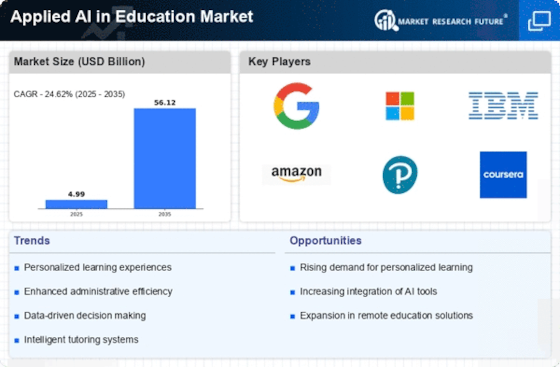
Applied AI in Education Market Infographic
Purchase Options

Market Analysis

In-depth Analysis of Applied AI in Education Market Industry Landscape

The Applied AI in Education Market is a dynamic sector that changes its landscape under various market forces which collectively determine its growth as well as influence on educational development. One key driver is the growing acknowledgement that AI technologies could transform teaching and learning processes completely. To address issues related to diverse challenges like personalization, student engagement or educational outcomes among others; applied artificial intelligence becomes a useful resource since it augments quality experiences and outcomes within schools.

Underpinning technological innovation within the Applied AI in Education Market are machine learning models advancement together with natural language processing along with other AI algorithms which now make it possible for intelligent solutions capable of analyzing massive volumes of educational data. As a result, we see innovations like personalized learning platforms powered by AI, intelligent tutoring systems and adaptive assessment tools that collectively provide educators and students with data-driven insights and tailored learning experiences.

Economic conditions on a global scale also play a crucial role in shaping the Applied AI in Education Market. Therefore, economic drivers such as country’s GDP, inflation rate or exchange rates which may affect investment decisions of educational institutions, governments or even technology companies looking at adopting AI driven technologies. For example, in times of economic boom there is usually increased funding for educational technology initiatives; hence more room for AI solutions innovation within education. On the contrary, times of economic recession might mean slow down due to cautionary steps being taken thereby affecting the rate of investment and development in the field of AI in education.

The Applied AI in Education Market has numerous regulatory dynamics as well as privacy considerations. Consequently, it becomes increasingly important to develop a regulatory framework around privacy issues surrounding artificial intelligence applications for education as well as ethical use of AI. Therefore, compliance with regulations and able to demonstrate that they are using AIs ethically becomes very essential for organizations developing or deploying these technologies within education domain.


Author
Author Profile
Ankit Gupta
Team Lead - Research

Ankit Gupta is a seasoned market intelligence and strategic research professional with over six plus years of experience in the ICT and Semiconductor industries. With academic roots in Telecom, Marketing, and Electronics, he blends technical insight with business strategy. Ankit has led 200+ projects, including work for Fortune 500 clients like Microsoft and Rio Tinto, covering market sizing, tech forecasting, and go-to-market strategies. Known for bridging engineering and enterprise decision-making, his insights support growth, innovation, and investment planning across diverse technology markets.

Leave a Comment

FAQs

What is the current valuation of the Applied AI in Education Market?

<p>The market valuation was 4.985 USD Billion in 2024.</p>

What is the projected market size for the Applied AI in Education Market by 2035?

<p>The market is projected to reach 56.12 USD Billion by 2035.</p>

What is the expected CAGR for the Applied AI in Education Market during the forecast period?

<p>The expected CAGR for the market from 2025 to 2035 is 24.62%.</p>

Which companies are considered key players in the Applied AI in Education Market?

<p>Key players include Google, Microsoft, IBM, Amazon, Pearson, Coursera, Duolingo, Edmodo, Knewton, and Squirrel AI.</p>

What are the main components of the Applied AI in Education Market?

The main components are Solutions and Services, each valued at approximately 2.493 and 2.492 USD Billion respectively in 2024.

How is the market segmented by deployment type?

The market is segmented into Cloud-based, valued at 2.99 USD Billion, and On-premises, valued at 1.99 USD Billion.

What technologies are driving the Applied AI in Education Market?

Key technologies include Machine Learning, Computer Vision, and Virtual Assistants/Chatbots, with valuations of 1.995, 1.5, and 1.49 USD Billion respectively.

What applications are prevalent in the Applied AI in Education Market?

Prominent applications include Intelligent Tutoring Systems and Student-centric Recommendation Systems, valued at 1.2 and 1.485 USD Billion respectively.

How does the market's growth potential compare across different segments?

The market shows varied growth potential, with the Technology segment, particularly Machine Learning, indicating strong performance.

What trends are expected to shape the Applied AI in Education Market in the coming years?

Trends suggest a shift towards more personalized learning experiences and increased integration of AI technologies in educational settings.

Market Summary

As per Market Research Future analysis, the Applied AI in Education Market Size was estimated at 4.985 USD Billion in 2024. The Applied AI in Education industry is projected to grow from 6.212 USD Billion in 2025 to 56.12 USD Billion by 2035, exhibiting a compound annual growth rate (CAGR) of 24.62% during the forecast period 2025 - 2035

Key Market Trends & Highlights

The Applied AI in Education Market is experiencing robust growth driven by personalized learning and ethical considerations.

  • Personalized learning solutions are increasingly being adopted to cater to diverse student needs. Data-driven decision making is becoming essential for educational institutions to enhance learning outcomes. North America remains the largest market, while Asia-Pacific is recognized as the fastest-growing region in this sector. The increased demand for personalized learning and the integration of AI in administrative processes are key drivers of market expansion.

Market Size & Forecast

2024 Market Size 4.985 (USD Billion)
2035 Market Size 56.12 (USD Billion)
CAGR (2025 - 2035) 24.62%
Largest Regional Market Share in 2024 North America

Major Players

Google (US), Microsoft (US), IBM (US), Amazon (US), Pearson (GB), Coursera (US), Duolingo (US), Edmodo (US), Knewton (US), Squirrel AI (CN)

Market Trends

The Applied AI in Education Market is currently experiencing a transformative phase, characterized by the integration of advanced technologies into educational frameworks. This evolution appears to be driven by a growing recognition of the potential benefits that artificial intelligence can offer in enhancing learning experiences. Institutions are increasingly adopting AI-driven tools to personalize education, streamline administrative tasks, and improve student engagement. As a result, the landscape of education is shifting, with a focus on creating more adaptive and responsive learning environments. Furthermore, the collaboration between educational institutions and technology providers seems to be fostering innovation, leading to the development of tailored solutions that address specific educational challenges. In addition to personalized learning, the Applied AI in Education Market is witnessing a rise in the use of data analytics to inform decision-making processes. Educators and administrators are leveraging AI to analyze student performance and engagement metrics, which may lead to more informed strategies for curriculum development and resource allocation. This data-driven approach not only enhances the educational experience but also supports the continuous improvement of teaching methodologies. As the market evolves, it is likely that the emphasis on ethical considerations and data privacy will become increasingly prominent, shaping the future of AI applications in education.

Personalized Learning Solutions

The trend towards personalized learning solutions is gaining momentum within the Applied AI in Education Market. AI technologies are being utilized to tailor educational content to individual student needs, preferences, and learning paces. This customization enhances student engagement and improves learning outcomes, as learners receive support that aligns with their unique requirements.

Data-Driven Decision Making

Data-driven decision making is emerging as a critical trend in the Applied AI in Education Market. Educational institutions are harnessing AI to analyze vast amounts of data related to student performance and engagement. This analytical approach enables educators to make informed decisions regarding curriculum design and resource allocation, ultimately enhancing the overall educational experience.

Ethical AI Implementation

The focus on ethical AI implementation is becoming increasingly relevant in the Applied AI in Education Market. As educational institutions adopt AI technologies, there is a growing awareness of the need to address issues related to data privacy, bias, and transparency. This trend suggests that stakeholders are prioritizing responsible AI practices to ensure that technology serves the best interests of all students.

Applied AI in Education Market Market Drivers

Emphasis on Ethical AI Practices

The Applied AI in Education Market is increasingly emphasizing ethical AI practices as stakeholders become more aware of the implications of AI technologies. Concerns regarding data privacy, algorithmic bias, and transparency are prompting educational institutions to adopt ethical frameworks for AI implementation. This focus on ethics is not merely a regulatory response; it reflects a broader societal expectation for responsible AI use in education. Institutions are investing in training programs to ensure that educators and administrators understand the ethical considerations surrounding AI technologies. As a result, the demand for AI solutions that prioritize ethical standards is likely to grow. This trend not only enhances trust among students and parents but also positions institutions as leaders in responsible AI adoption, potentially influencing future policy developments in the education sector.

Growing Focus on Lifelong Learning

The Applied AI in Education Market is increasingly influenced by a growing focus on lifelong learning. As the job market evolves, individuals seek continuous skill development to remain competitive. AI technologies facilitate this shift by providing flexible and accessible learning opportunities tailored to adult learners. Online platforms powered by AI offer personalized course recommendations based on individual career goals and learning preferences. Recent trends indicate that the lifelong learning market is expected to reach a valuation of several billion dollars in the next few years. This growth underscores the importance of AI in supporting continuous education and professional development. As educational institutions adapt to this demand, the integration of AI into lifelong learning initiatives is likely to become a cornerstone of modern education.

Enhanced Data Analytics Capabilities

The Applied AI in Education Market benefits from enhanced data analytics capabilities that empower educators and administrators to make informed decisions. The proliferation of data generated by students, courses, and assessments presents both opportunities and challenges. AI technologies enable institutions to analyze vast amounts of data, uncovering insights that can drive curriculum improvements and student support initiatives. For instance, predictive analytics can identify at-risk students, allowing for timely interventions. Reports suggest that institutions leveraging AI-driven analytics experience a 25% improvement in student retention rates. This capability not only enhances educational outcomes but also fosters a culture of continuous improvement within institutions. As data analytics becomes increasingly sophisticated, the role of AI in transforming educational practices is likely to expand.

Increased Demand for Personalized Learning

The Applied AI in Education Market experiences a notable surge in demand for personalized learning solutions. Educational institutions increasingly recognize the necessity of tailoring learning experiences to individual student needs. This trend is driven by advancements in AI technologies that enable adaptive learning platforms to analyze student performance data and adjust content accordingly. According to recent statistics, the market for personalized learning is projected to grow at a compound annual growth rate of over 20% in the coming years. This growth reflects a broader shift towards student-centered education, where AI plays a pivotal role in enhancing engagement and improving learning outcomes. As a result, educational institutions are investing in AI-driven tools that facilitate personalized learning pathways, thereby transforming traditional educational paradigms.

Integration of AI in Administrative Processes

The Applied AI in Education Market is witnessing a significant integration of AI technologies into administrative processes within educational institutions. This integration aims to streamline operations, reduce administrative burdens, and enhance overall efficiency. AI applications such as chatbots and automated scheduling systems are increasingly utilized to manage student inquiries and optimize resource allocation. Recent data indicates that institutions adopting AI for administrative tasks report a reduction in operational costs by approximately 15%. This trend not only allows educators to focus more on teaching but also improves the overall student experience. As educational institutions continue to embrace AI-driven administrative solutions, the potential for increased efficiency and effectiveness in managing educational environments becomes increasingly apparent.

Market Segment Insights

By Component: Solutions (Largest) vs. Services (Fastest-Growing)

In the Applied AI in Education Market, the component segment is predominantly held by Solutions, which constitutes the largest share due to their critical role in integrating artificial intelligence into educational frameworks. Solutions encompass a wide range of products, including intelligent tutoring systems, data analytics tools, and personalized learning platforms that are essential for modern educational institutions. On the other hand, Services, which include consulting, installation, and ongoing support, are emerging rapidly, responding to the increasing needs for customized AI solutions and effective implementation strategies that cater to specific educational environments.

Solutions (Dominant) vs. Services (Emerging)

Solutions in the Applied AI in Education Market are characterized by their robust capabilities in automating teaching processes and enhancing learning experiences. These solutions have a dominant position due to their scalability and adaptability, making them invaluable for educational institutions aiming to leverage AI for personalized education. Meanwhile, Services, as an emerging segment, are gaining traction as educators seek expert guidance in deploying AI technologies. This trend is driven by the growing complexity of educational needs and the necessity for tailored solutions, ensuring that institutions can maximize the effectiveness of AI tools while minimizing integration challenges.

By Deployment: Cloud-based (Largest) vs. On-premises (Fastest-Growing)

In the Applied AI in Education Market, the deployment segment showcases a notable division between cloud-based and on-premises solutions. Cloud-based systems dominate the market due to their accessibility and efficiency, allowing educational institutions to leverage AI tools without extensive infrastructure. In comparison, on-premises solutions, while less prevalent, are gaining traction among institutions that prioritize <a href="https://www.marketresearchfuture.com/reports/big-data-security-market-4410">data security</a> and customized deployment environments.

Deployment: Cloud-based (Dominant) vs. On-premises (Emerging)

Cloud-based deployments are characterized by their scalability and convenience, enabling educational institutions to adopt AI technologies without the need for significant upfront investments in hardware. These solutions allow for easy updates and integration with existing systems, making them especially appealing to institutions seeking flexibility. Conversely, on-premises deployments are becoming an emerging choice for those valuing control over their data and systems. They offer robust security and customization, aligning with the needs of specific educational environments that require tailored solutions.

By Technology: Machine Learning (Largest) vs. Virtual Assistants/Chatbots (Fastest-Growing)

In the Applied AI in Education Market, Machine Learning commands the largest share, attributed to its versatile applications in personalizing learning experiences and enhancing administrative efficiencies. The ability to process large datasets allows educational institutions to adopt more tailored approaches to instruction, thereby improving student outcomes. Following closely is the deployment of Virtual Assistants and Chatbots, which are rapidly becoming the go-to solution for student interaction, offering 24/7 support and facilitating streamlined communication processes.

Technology: Machine Learning (Dominant) vs. Virtual Assistants/Chatbots (Emerging)

Machine Learning stands out as the dominant technology in the Applied AI in Education Market. Its ability to analyze and leverage data effectively makes it indispensable for adaptive learning platforms and student analytics. Conversely, Virtual Assistants and Chatbots are emerging as powerful tools for enhancing student engagement and support. These tools automate responses to common queries, freeing up educators to focus on more complex issues. As educational institutions increasingly recognize the value these technologies add to learning environments, both Machine Learning and Virtual Assistants/Chatbots will continue to evolve and shape the future of education.

By Application: Intelligent Tutoring Systems (Largest) vs. Virtual Facilitators for IT Automation (Fastest-Growing)

The Applied AI in Education Market features a diverse range of applications, with Intelligent Tutoring Systems commanding the largest market share, owing to their proven effectiveness in personalized learning experiences. Virtual Facilitators for IT Automation are emerging rapidly, leveraging AI-driven solutions to streamline administrative processes in educational institutions, thereby attracting significant investment and growth potential. As institutions increasingly embrace technology, the distribution among segment values reflects a shift towards innovative delivery models in education.

Intelligent Tutoring Systems (Dominant) vs. Virtual Facilitators for IT Automation (Emerging)

Intelligent Tutoring Systems (ITS) are at the forefront of the Applied AI in Education Market, providing learners with personalized feedback and tailored instructional pathways that enhance learning outcomes. These systems utilize complex algorithms to adapt to individual learning styles and progress rates, making education more efficient and effective. On the other hand, Virtual Facilitators for IT Automation are gaining traction as an emerging force, assisting educators in managing administrative tasks and fostering a more focused learning environment. As these technologies evolve, their integration into traditional educational frameworks is expected to revolutionize teaching and learning methodologies.

Get more detailed insights about Applied AI in Education Market Research Report - Forecast till 2035

Regional Insights

North America : Innovation Hub for Education

North America is the largest market for Applied AI in Education Market, holding approximately 45% of the global market share. The region's growth is driven by significant investments in technology, increasing demand for personalized learning experiences, and supportive regulatory frameworks. The U.S. government has been actively promoting AI integration in education through various initiatives, enhancing the overall ecosystem for educational technology. The competitive landscape is dominated by key players such as Google, Microsoft, and IBM, which are continuously innovating to enhance educational outcomes. The presence of numerous startups and established companies fosters a vibrant ecosystem, with states like California and New York leading in AI adoption. The focus on STEM education and digital literacy further propels market growth, making North America a pivotal region in the global education technology landscape.

Europe : Emerging Powerhouse in AI

Europe is witnessing rapid growth in the Applied AI in Education Market, accounting for approximately 30% of the global share. The region benefits from strong regulatory support, with initiatives aimed at integrating AI into educational frameworks. The European Commission's Digital Education Action Plan emphasizes the importance of digital skills, driving demand for AI solutions in schools and universities across member states. Leading countries such as the UK, Germany, and France are at the forefront of this transformation, with a competitive landscape featuring both established firms and innovative startups. Companies like Pearson and Coursera are leveraging AI to enhance learning experiences. The focus on data privacy and ethical AI use is also shaping the market, ensuring that educational institutions adopt responsible AI practices. This regulatory environment is crucial for fostering trust and encouraging further investment in AI technologies.

Asia-Pacific : Rapidly Growing Market

Asia-Pacific is emerging as a significant player in the Applied AI in Education Market, holding around 20% of the global market share. The region's growth is fueled by increasing internet penetration, a large student population, and government initiatives promoting digital education. Countries like China and India are leading the charge, with substantial investments in AI technologies to enhance educational access and quality. The competitive landscape is characterized by a mix of local and international players, including Squirrel AI and various edtech startups. The focus on personalized learning and adaptive learning technologies is driving innovation in the sector. Additionally, partnerships between educational institutions and technology companies are becoming more common, further accelerating the adoption of AI solutions in classrooms across the region. This collaborative approach is essential for addressing the diverse educational needs of the rapidly growing student population.

Middle East and Africa : Resource-Rich Frontier

The Middle East and Africa region is gradually embracing the Applied AI in Education Market, currently holding about 5% of the global share. The growth is driven by increasing investments in educational technology and government initiatives aimed at improving educational outcomes. Countries like South Africa and the UAE are leading the way, with a focus on integrating AI into their educational systems to enhance learning experiences and accessibility. The competitive landscape is still developing, with a mix of local startups and international players entering the market. The presence of key players is growing, and partnerships between governments and tech companies are becoming more common. The emphasis on digital transformation in education is crucial for addressing the challenges faced by the region, such as high dropout rates and limited access to quality education. This focus on innovation is expected to drive further growth in the coming years.

Key Players and Competitive Insights

The applied AI in the education market consists of a combination of technology giants, specialized edtech companies, and startups. Notable participants in this market include Microsoft, IBM, Google, AWS, Pearson, Knewton, and others. These companies are primarily focused on creating AI-powered learning platforms, virtual learning tools, and intelligent tutoring/assessment systems. Moreover, they are actively seeking partnerships with educational institutions to test new AI applications. Startups in this sector concentrate on specific areas such as adaptive learning, personalized recommendations, and virtual labs/simulations. To maintain a competitive edge in this rapidly evolving field, companies are making significant investments in research and development. Additionally, strategic collaborations and mergers and acquisitions are common as companies aim to expand their capabilities and market share.

Key Companies in the Applied AI in Education Market include

Industry Developments

May 2024 Eviden has announced a partnership with NVIDIA and the University of Maryland, Baltimore County (UMBC) Training Centers to establish a center for applied AI and edge AI training. This center aims to be a hub for advanced education, innovation, and practical use of artificial intelligence. This collaboration leverages the capabilities and knowledge of three prominent organizations in the technology and education industries, with the goal of providing professionals, entrepreneurs, and researchers with the necessary advanced skills and knowledge to succeed in the rapidly evolving field of artificial intelligence.

Eviden AI experts conduct intensive three-day courses, utilizing their extensive industry knowledge and expertise to cater to the requirements of both current professionals and future difficulties. The center offers a comprehensive range of training programs, workshops, and materials that cover a wide range of applied AI and edge AI technologies. The center employs the NVIDIA Metropolis and NVIDIA NeMo platforms to play a leading role in developing the curriculum. Metropolis provides a comprehensive collection of tools for developers working with vision AI and smart city solutions. NeMo is a toolkit specifically designed for creating sophisticated conversational AI models.

These platforms are essential components of the program, as they focus on developing, optimizing, and implementing AI solutions at the edge.

Future Outlook

Applied AI in Education Market Future Outlook

The Applied AI in Education Market is projected to grow at a 24.62% CAGR from 2025 to 2035, driven by advancements in personalized learning, <a href="https://www.marketresearchfuture.com/reports/hadoop-big-data-analytics-market-2541">data analytics</a>, and automation technologies.

New opportunities lie in:

  • <p>Development of AI-driven personalized learning platforms for diverse learning styles. Integration of AI assessment tools to enhance student performance tracking. Creation of AI-based administrative solutions to streamline educational operations.</p>

By 2035, the market is expected to be robust, reflecting substantial growth and innovation.

Market Segmentation

Applied AI in Education Market Component Outlook

  • Solutions
  • Services

Applied AI in Education Market Deployment Outlook

  • Cloud-based
  • On-premises

Applied AI in Education Market Technology Outlook

  • Machine Learning
  • Computer Vision
  • Virtual Assistants/Chatbots

Applied AI in Education Market Application Outlook

  • Virtual Facilitators for IT Automation
  • Intelligent Tutoring Systems
  • Content Delivery Systems
  • Fraud and Risk Management
  • Student-centric Recommendation Systems

Report Scope

MARKET SIZE 2024 4.985(USD Billion)
MARKET SIZE 2025 6.212(USD Billion)
MARKET SIZE 2035 56.12(USD Billion)
COMPOUND ANNUAL GROWTH RATE (CAGR) 24.62% (2025 - 2035)
REPORT COVERAGE Revenue Forecast, Competitive Landscape, Growth Factors, and Trends
BASE YEAR 2024
Market Forecast Period 2025 - 2035
Historical Data 2019 - 2024
Market Forecast Units USD Billion
Key Companies Profiled Google (US), Microsoft (US), IBM (US), Amazon (US), Pearson (GB), Coursera (US), Duolingo (US), Edmodo (US), Knewton (US), Squirrel AI (CN)
Segments Covered Component, Deployment, Technology, Application, Region
Key Market Opportunities Integration of personalized learning solutions through adaptive learning technologies in the Applied AI in Education Market.
Key Market Dynamics Rising demand for personalized learning solutions drives innovation and competition in the Applied AI in Education Market.
Countries Covered North America, Europe, APAC, South America, MEA

FAQs

What is the current valuation of the Applied AI in Education Market?

<p>The market valuation was 4.985 USD Billion in 2024.</p>

What is the projected market size for the Applied AI in Education Market by 2035?

<p>The market is projected to reach 56.12 USD Billion by 2035.</p>

What is the expected CAGR for the Applied AI in Education Market during the forecast period?

<p>The expected CAGR for the market from 2025 to 2035 is 24.62%.</p>

Which companies are considered key players in the Applied AI in Education Market?

<p>Key players include Google, Microsoft, IBM, Amazon, Pearson, Coursera, Duolingo, Edmodo, Knewton, and Squirrel AI.</p>

What are the main components of the Applied AI in Education Market?

The main components are Solutions and Services, each valued at approximately 2.493 and 2.492 USD Billion respectively in 2024.

How is the market segmented by deployment type?

The market is segmented into Cloud-based, valued at 2.99 USD Billion, and On-premises, valued at 1.99 USD Billion.

What technologies are driving the Applied AI in Education Market?

Key technologies include Machine Learning, Computer Vision, and Virtual Assistants/Chatbots, with valuations of 1.995, 1.5, and 1.49 USD Billion respectively.

What applications are prevalent in the Applied AI in Education Market?

Prominent applications include Intelligent Tutoring Systems and Student-centric Recommendation Systems, valued at 1.2 and 1.485 USD Billion respectively.

How does the market's growth potential compare across different segments?

The market shows varied growth potential, with the Technology segment, particularly Machine Learning, indicating strong performance.

What trends are expected to shape the Applied AI in Education Market in the coming years?

Trends suggest a shift towards more personalized learning experiences and increased integration of AI technologies in educational settings.

  1. SECTION I: EXECUTIVE SUMMARY AND KEY HIGHLIGHTS
    1. | 1.1 EXECUTIVE SUMMARY
    2. | | 1.1.1 Market Overview
    3. | | 1.1.2 Key Findings
    4. | | 1.1.3 Market Segmentation
    5. | | 1.1.4 Competitive Landscape
    6. | | 1.1.5 Challenges and Opportunities
    7. | | 1.1.6 Future Outlook
  2. SECTION II: SCOPING, METHODOLOGY AND MARKET STRUCTURE
    1. | 2.1 MARKET INTRODUCTION
    2. | | 2.1.1 Definition
    3. | | 2.1.2 Scope of the study
    4. | | | 2.1.2.1 Research Objective
    5. | | | 2.1.2.2 Assumption
    6. | | | 2.1.2.3 Limitations
    7. | 2.2 RESEARCH METHODOLOGY
    8. | | 2.2.1 Overview
    9. | | 2.2.2 Data Mining
    10. | | 2.2.3 Secondary Research
    11. | | 2.2.4 Primary Research
    12. | | | 2.2.4.1 Primary Interviews and Information Gathering Process
    13. | | | 2.2.4.2 Breakdown of Primary Respondents
    14. | | 2.2.5 Forecasting Model
    15. | | 2.2.6 Market Size Estimation
    16. | | | 2.2.6.1 Bottom-Up Approach
    17. | | | 2.2.6.2 Top-Down Approach
    18. | | 2.2.7 Data Triangulation
    19. | | 2.2.8 Validation
  3. SECTION III: QUALITATIVE ANALYSIS
    1. | 3.1 MARKET DYNAMICS
    2. | | 3.1.1 Overview
    3. | | 3.1.2 Drivers
    4. | | 3.1.3 Restraints
    5. | | 3.1.4 Opportunities
    6. | 3.2 MARKET FACTOR ANALYSIS
    7. | | 3.2.1 Value chain Analysis
    8. | | 3.2.2 Porter's Five Forces Analysis
    9. | | | 3.2.2.1 Bargaining Power of Suppliers
    10. | | | 3.2.2.2 Bargaining Power of Buyers
    11. | | | 3.2.2.3 Threat of New Entrants
    12. | | | 3.2.2.4 Threat of Substitutes
    13. | | | 3.2.2.5 Intensity of Rivalry
    14. | | 3.2.3 COVID-19 Impact Analysis
    15. | | | 3.2.3.1 Market Impact Analysis
    16. | | | 3.2.3.2 Regional Impact
    17. | | | 3.2.3.3 Opportunity and Threat Analysis
  4. SECTION IV: QUANTITATIVE ANALYSIS
    1. | 4.1 Information and Communications Technology, BY Component (USD Billion)
    2. | | 4.1.1 Solutions
    3. | | 4.1.2 Services
    4. | 4.2 Information and Communications Technology, BY Deployment (USD Billion)
    5. | | 4.2.1 Cloud-based
    6. | | 4.2.2 On-premises
    7. | 4.3 Information and Communications Technology, BY Technology (USD Billion)
    8. | | 4.3.1 Machine Learning
    9. | | 4.3.2 Computer Vision
    10. | | 4.3.3 Virtual Assistants/Chatbots
    11. | 4.4 Information and Communications Technology, BY Application (USD Billion)
    12. | | 4.4.1 Virtual Facilitators for IT Automation
    13. | | 4.4.2 Intelligent Tutoring Systems
    14. | | 4.4.3 Content Delivery Systems
    15. | | 4.4.4 Fraud and Risk Management
    16. | | 4.4.5 Student-centric Recommendation Systems
    17. | 4.5 Information and Communications Technology, BY Region (USD Billion)
    18. | | 4.5.1 North America
    19. | | | 4.5.1.1 US
    20. | | | 4.5.1.2 Canada
    21. | | 4.5.2 Europe
    22. | | | 4.5.2.1 Germany
    23. | | | 4.5.2.2 UK
    24. | | | 4.5.2.3 France
    25. | | | 4.5.2.4 Russia
    26. | | | 4.5.2.5 Italy
    27. | | | 4.5.2.6 Spain
    28. | | | 4.5.2.7 Rest of Europe
    29. | | 4.5.3 APAC
    30. | | | 4.5.3.1 China
    31. | | | 4.5.3.2 India
    32. | | | 4.5.3.3 Japan
    33. | | | 4.5.3.4 South Korea
    34. | | | 4.5.3.5 Malaysia
    35. | | | 4.5.3.6 Thailand
    36. | | | 4.5.3.7 Indonesia
    37. | | | 4.5.3.8 Rest of APAC
    38. | | 4.5.4 South America
    39. | | | 4.5.4.1 Brazil
    40. | | | 4.5.4.2 Mexico
    41. | | | 4.5.4.3 Argentina
    42. | | | 4.5.4.4 Rest of South America
    43. | | 4.5.5 MEA
    44. | | | 4.5.5.1 GCC Countries
    45. | | | 4.5.5.2 South Africa
    46. | | | 4.5.5.3 Rest of MEA
  5. SECTION V: COMPETITIVE ANALYSIS
    1. | 5.1 Competitive Landscape
    2. | | 5.1.1 Overview
    3. | | 5.1.2 Competitive Analysis
    4. | | 5.1.3 Market share Analysis
    5. | | 5.1.4 Major Growth Strategy in the Information and Communications Technology
    6. | | 5.1.5 Competitive Benchmarking
    7. | | 5.1.6 Leading Players in Terms of Number of Developments in the Information and Communications Technology
    8. | | 5.1.7 Key developments and growth strategies
    9. | | | 5.1.7.1 New Product Launch/Service Deployment
    10. | | | 5.1.7.2 Merger & Acquisitions
    11. | | | 5.1.7.3 Joint Ventures
    12. | | 5.1.8 Major Players Financial Matrix
    13. | | | 5.1.8.1 Sales and Operating Income
    14. | | | 5.1.8.2 Major Players R&D Expenditure. 2023
    15. | 5.2 Company Profiles
    16. | | 5.2.1 Google (US)
    17. | | | 5.2.1.1 Financial Overview
    18. | | | 5.2.1.2 Products Offered
    19. | | | 5.2.1.3 Key Developments
    20. | | | 5.2.1.4 SWOT Analysis
    21. | | | 5.2.1.5 Key Strategies
    22. | | 5.2.2 Microsoft (US)
    23. | | | 5.2.2.1 Financial Overview
    24. | | | 5.2.2.2 Products Offered
    25. | | | 5.2.2.3 Key Developments
    26. | | | 5.2.2.4 SWOT Analysis
    27. | | | 5.2.2.5 Key Strategies
    28. | | 5.2.3 IBM (US)
    29. | | | 5.2.3.1 Financial Overview
    30. | | | 5.2.3.2 Products Offered
    31. | | | 5.2.3.3 Key Developments
    32. | | | 5.2.3.4 SWOT Analysis
    33. | | | 5.2.3.5 Key Strategies
    34. | | 5.2.4 Amazon (US)
    35. | | | 5.2.4.1 Financial Overview
    36. | | | 5.2.4.2 Products Offered
    37. | | | 5.2.4.3 Key Developments
    38. | | | 5.2.4.4 SWOT Analysis
    39. | | | 5.2.4.5 Key Strategies
    40. | | 5.2.5 Pearson (GB)
    41. | | | 5.2.5.1 Financial Overview
    42. | | | 5.2.5.2 Products Offered
    43. | | | 5.2.5.3 Key Developments
    44. | | | 5.2.5.4 SWOT Analysis
    45. | | | 5.2.5.5 Key Strategies
    46. | | 5.2.6 Coursera (US)
    47. | | | 5.2.6.1 Financial Overview
    48. | | | 5.2.6.2 Products Offered
    49. | | | 5.2.6.3 Key Developments
    50. | | | 5.2.6.4 SWOT Analysis
    51. | | | 5.2.6.5 Key Strategies
    52. | | 5.2.7 Duolingo (US)
    53. | | | 5.2.7.1 Financial Overview
    54. | | | 5.2.7.2 Products Offered
    55. | | | 5.2.7.3 Key Developments
    56. | | | 5.2.7.4 SWOT Analysis
    57. | | | 5.2.7.5 Key Strategies
    58. | | 5.2.8 Edmodo (US)
    59. | | | 5.2.8.1 Financial Overview
    60. | | | 5.2.8.2 Products Offered
    61. | | | 5.2.8.3 Key Developments
    62. | | | 5.2.8.4 SWOT Analysis
    63. | | | 5.2.8.5 Key Strategies
    64. | | 5.2.9 Knewton (US)
    65. | | | 5.2.9.1 Financial Overview
    66. | | | 5.2.9.2 Products Offered
    67. | | | 5.2.9.3 Key Developments
    68. | | | 5.2.9.4 SWOT Analysis
    69. | | | 5.2.9.5 Key Strategies
    70. | | 5.2.10 Squirrel AI (CN)
    71. | | | 5.2.10.1 Financial Overview
    72. | | | 5.2.10.2 Products Offered
    73. | | | 5.2.10.3 Key Developments
    74. | | | 5.2.10.4 SWOT Analysis
    75. | | | 5.2.10.5 Key Strategies
    76. | 5.3 Appendix
    77. | | 5.3.1 References
    78. | | 5.3.2 Related Reports
  6. LIST OF FIGURES
    1. | 6.1 MARKET SYNOPSIS
    2. | 6.2 NORTH AMERICA MARKET ANALYSIS
    3. | 6.3 US MARKET ANALYSIS BY COMPONENT
    4. | 6.4 US MARKET ANALYSIS BY DEPLOYMENT
    5. | 6.5 US MARKET ANALYSIS BY TECHNOLOGY
    6. | 6.6 US MARKET ANALYSIS BY APPLICATION
    7. | 6.7 CANADA MARKET ANALYSIS BY COMPONENT
    8. | 6.8 CANADA MARKET ANALYSIS BY DEPLOYMENT
    9. | 6.9 CANADA MARKET ANALYSIS BY TECHNOLOGY
    10. | 6.10 CANADA MARKET ANALYSIS BY APPLICATION
    11. | 6.11 EUROPE MARKET ANALYSIS
    12. | 6.12 GERMANY MARKET ANALYSIS BY COMPONENT
    13. | 6.13 GERMANY MARKET ANALYSIS BY DEPLOYMENT
    14. | 6.14 GERMANY MARKET ANALYSIS BY TECHNOLOGY
    15. | 6.15 GERMANY MARKET ANALYSIS BY APPLICATION
    16. | 6.16 UK MARKET ANALYSIS BY COMPONENT
    17. | 6.17 UK MARKET ANALYSIS BY DEPLOYMENT
    18. | 6.18 UK MARKET ANALYSIS BY TECHNOLOGY
    19. | 6.19 UK MARKET ANALYSIS BY APPLICATION
    20. | 6.20 FRANCE MARKET ANALYSIS BY COMPONENT
    21. | 6.21 FRANCE MARKET ANALYSIS BY DEPLOYMENT
    22. | 6.22 FRANCE MARKET ANALYSIS BY TECHNOLOGY
    23. | 6.23 FRANCE MARKET ANALYSIS BY APPLICATION
    24. | 6.24 RUSSIA MARKET ANALYSIS BY COMPONENT
    25. | 6.25 RUSSIA MARKET ANALYSIS BY DEPLOYMENT
    26. | 6.26 RUSSIA MARKET ANALYSIS BY TECHNOLOGY
    27. | 6.27 RUSSIA MARKET ANALYSIS BY APPLICATION
    28. | 6.28 ITALY MARKET ANALYSIS BY COMPONENT
    29. | 6.29 ITALY MARKET ANALYSIS BY DEPLOYMENT
    30. | 6.30 ITALY MARKET ANALYSIS BY TECHNOLOGY
    31. | 6.31 ITALY MARKET ANALYSIS BY APPLICATION
    32. | 6.32 SPAIN MARKET ANALYSIS BY COMPONENT
    33. | 6.33 SPAIN MARKET ANALYSIS BY DEPLOYMENT
    34. | 6.34 SPAIN MARKET ANALYSIS BY TECHNOLOGY
    35. | 6.35 SPAIN MARKET ANALYSIS BY APPLICATION
    36. | 6.36 REST OF EUROPE MARKET ANALYSIS BY COMPONENT
    37. | 6.37 REST OF EUROPE MARKET ANALYSIS BY DEPLOYMENT
    38. | 6.38 REST OF EUROPE MARKET ANALYSIS BY TECHNOLOGY
    39. | 6.39 REST OF EUROPE MARKET ANALYSIS BY APPLICATION
    40. | 6.40 APAC MARKET ANALYSIS
    41. | 6.41 CHINA MARKET ANALYSIS BY COMPONENT
    42. | 6.42 CHINA MARKET ANALYSIS BY DEPLOYMENT
    43. | 6.43 CHINA MARKET ANALYSIS BY TECHNOLOGY
    44. | 6.44 CHINA MARKET ANALYSIS BY APPLICATION
    45. | 6.45 INDIA MARKET ANALYSIS BY COMPONENT
    46. | 6.46 INDIA MARKET ANALYSIS BY DEPLOYMENT
    47. | 6.47 INDIA MARKET ANALYSIS BY TECHNOLOGY
    48. | 6.48 INDIA MARKET ANALYSIS BY APPLICATION
    49. | 6.49 JAPAN MARKET ANALYSIS BY COMPONENT
    50. | 6.50 JAPAN MARKET ANALYSIS BY DEPLOYMENT
    51. | 6.51 JAPAN MARKET ANALYSIS BY TECHNOLOGY
    52. | 6.52 JAPAN MARKET ANALYSIS BY APPLICATION
    53. | 6.53 SOUTH KOREA MARKET ANALYSIS BY COMPONENT
    54. | 6.54 SOUTH KOREA MARKET ANALYSIS BY DEPLOYMENT
    55. | 6.55 SOUTH KOREA MARKET ANALYSIS BY TECHNOLOGY
    56. | 6.56 SOUTH KOREA MARKET ANALYSIS BY APPLICATION
    57. | 6.57 MALAYSIA MARKET ANALYSIS BY COMPONENT
    58. | 6.58 MALAYSIA MARKET ANALYSIS BY DEPLOYMENT
    59. | 6.59 MALAYSIA MARKET ANALYSIS BY TECHNOLOGY
    60. | 6.60 MALAYSIA MARKET ANALYSIS BY APPLICATION
    61. | 6.61 THAILAND MARKET ANALYSIS BY COMPONENT
    62. | 6.62 THAILAND MARKET ANALYSIS BY DEPLOYMENT
    63. | 6.63 THAILAND MARKET ANALYSIS BY TECHNOLOGY
    64. | 6.64 THAILAND MARKET ANALYSIS BY APPLICATION
    65. | 6.65 INDONESIA MARKET ANALYSIS BY COMPONENT
    66. | 6.66 INDONESIA MARKET ANALYSIS BY DEPLOYMENT
    67. | 6.67 INDONESIA MARKET ANALYSIS BY TECHNOLOGY
    68. | 6.68 INDONESIA MARKET ANALYSIS BY APPLICATION
    69. | 6.69 REST OF APAC MARKET ANALYSIS BY COMPONENT
    70. | 6.70 REST OF APAC MARKET ANALYSIS BY DEPLOYMENT
    71. | 6.71 REST OF APAC MARKET ANALYSIS BY TECHNOLOGY
    72. | 6.72 REST OF APAC MARKET ANALYSIS BY APPLICATION
    73. | 6.73 SOUTH AMERICA MARKET ANALYSIS
    74. | 6.74 BRAZIL MARKET ANALYSIS BY COMPONENT
    75. | 6.75 BRAZIL MARKET ANALYSIS BY DEPLOYMENT
    76. | 6.76 BRAZIL MARKET ANALYSIS BY TECHNOLOGY
    77. | 6.77 BRAZIL MARKET ANALYSIS BY APPLICATION
    78. | 6.78 MEXICO MARKET ANALYSIS BY COMPONENT
    79. | 6.79 MEXICO MARKET ANALYSIS BY DEPLOYMENT
    80. | 6.80 MEXICO MARKET ANALYSIS BY TECHNOLOGY
    81. | 6.81 MEXICO MARKET ANALYSIS BY APPLICATION
    82. | 6.82 ARGENTINA MARKET ANALYSIS BY COMPONENT
    83. | 6.83 ARGENTINA MARKET ANALYSIS BY DEPLOYMENT
    84. | 6.84 ARGENTINA MARKET ANALYSIS BY TECHNOLOGY
    85. | 6.85 ARGENTINA MARKET ANALYSIS BY APPLICATION
    86. | 6.86 REST OF SOUTH AMERICA MARKET ANALYSIS BY COMPONENT
    87. | 6.87 REST OF SOUTH AMERICA MARKET ANALYSIS BY DEPLOYMENT
    88. | 6.88 REST OF SOUTH AMERICA MARKET ANALYSIS BY TECHNOLOGY
    89. | 6.89 REST OF SOUTH AMERICA MARKET ANALYSIS BY APPLICATION
    90. | 6.90 MEA MARKET ANALYSIS
    91. | 6.91 GCC COUNTRIES MARKET ANALYSIS BY COMPONENT
    92. | 6.92 GCC COUNTRIES MARKET ANALYSIS BY DEPLOYMENT
    93. | 6.93 GCC COUNTRIES MARKET ANALYSIS BY TECHNOLOGY
    94. | 6.94 GCC COUNTRIES MARKET ANALYSIS BY APPLICATION
    95. | 6.95 SOUTH AFRICA MARKET ANALYSIS BY COMPONENT
    96. | 6.96 SOUTH AFRICA MARKET ANALYSIS BY DEPLOYMENT
    97. | 6.97 SOUTH AFRICA MARKET ANALYSIS BY TECHNOLOGY
    98. | 6.98 SOUTH AFRICA MARKET ANALYSIS BY APPLICATION
    99. | 6.99 REST OF MEA MARKET ANALYSIS BY COMPONENT
    100. | 6.100 REST OF MEA MARKET ANALYSIS BY DEPLOYMENT
    101. | 6.101 REST OF MEA MARKET ANALYSIS BY TECHNOLOGY
    102. | 6.102 REST OF MEA MARKET ANALYSIS BY APPLICATION
    103. | 6.103 KEY BUYING CRITERIA OF INFORMATION AND COMMUNICATIONS TECHNOLOGY
    104. | 6.104 RESEARCH PROCESS OF MRFR
    105. | 6.105 DRO ANALYSIS OF INFORMATION AND COMMUNICATIONS TECHNOLOGY
    106. | 6.106 DRIVERS IMPACT ANALYSIS: INFORMATION AND COMMUNICATIONS TECHNOLOGY
    107. | 6.107 RESTRAINTS IMPACT ANALYSIS: INFORMATION AND COMMUNICATIONS TECHNOLOGY
    108. | 6.108 SUPPLY / VALUE CHAIN: INFORMATION AND COMMUNICATIONS TECHNOLOGY
    109. | 6.109 INFORMATION AND COMMUNICATIONS TECHNOLOGY, BY COMPONENT, 2024 (% SHARE)
    110. | 6.110 INFORMATION AND COMMUNICATIONS TECHNOLOGY, BY COMPONENT, 2024 TO 2035 (USD Billion)
    111. | 6.111 INFORMATION AND COMMUNICATIONS TECHNOLOGY, BY DEPLOYMENT, 2024 (% SHARE)
    112. | 6.112 INFORMATION AND COMMUNICATIONS TECHNOLOGY, BY DEPLOYMENT, 2024 TO 2035 (USD Billion)
    113. | 6.113 INFORMATION AND COMMUNICATIONS TECHNOLOGY, BY TECHNOLOGY, 2024 (% SHARE)
    114. | 6.114 INFORMATION AND COMMUNICATIONS TECHNOLOGY, BY TECHNOLOGY, 2024 TO 2035 (USD Billion)
    115. | 6.115 INFORMATION AND COMMUNICATIONS TECHNOLOGY, BY APPLICATION, 2024 (% SHARE)
    116. | 6.116 INFORMATION AND COMMUNICATIONS TECHNOLOGY, BY APPLICATION, 2024 TO 2035 (USD Billion)
    117. | 6.117 BENCHMARKING OF MAJOR COMPETITORS
  7. LIST OF TABLES
    1. | 7.1 LIST OF ASSUMPTIONS
    2. | | 7.1.1
    3. | 7.2 North America MARKET SIZE ESTIMATES; FORECAST
    4. | | 7.2.1 BY COMPONENT, 2025-2035 (USD Billion)
    5. | | 7.2.2 BY DEPLOYMENT, 2025-2035 (USD Billion)
    6. | | 7.2.3 BY TECHNOLOGY, 2025-2035 (USD Billion)
    7. | | 7.2.4 BY APPLICATION, 2025-2035 (USD Billion)
    8. | 7.3 US MARKET SIZE ESTIMATES; FORECAST
    9. | | 7.3.1 BY COMPONENT, 2025-2035 (USD Billion)
    10. | | 7.3.2 BY DEPLOYMENT, 2025-2035 (USD Billion)
    11. | | 7.3.3 BY TECHNOLOGY, 2025-2035 (USD Billion)
    12. | | 7.3.4 BY APPLICATION, 2025-2035 (USD Billion)
    13. | 7.4 Canada MARKET SIZE ESTIMATES; FORECAST
    14. | | 7.4.1 BY COMPONENT, 2025-2035 (USD Billion)
    15. | | 7.4.2 BY DEPLOYMENT, 2025-2035 (USD Billion)
    16. | | 7.4.3 BY TECHNOLOGY, 2025-2035 (USD Billion)
    17. | | 7.4.4 BY APPLICATION, 2025-2035 (USD Billion)
    18. | 7.5 Europe MARKET SIZE ESTIMATES; FORECAST
    19. | | 7.5.1 BY COMPONENT, 2025-2035 (USD Billion)
    20. | | 7.5.2 BY DEPLOYMENT, 2025-2035 (USD Billion)
    21. | | 7.5.3 BY TECHNOLOGY, 2025-2035 (USD Billion)
    22. | | 7.5.4 BY APPLICATION, 2025-2035 (USD Billion)
    23. | 7.6 Germany MARKET SIZE ESTIMATES; FORECAST
    24. | | 7.6.1 BY COMPONENT, 2025-2035 (USD Billion)
    25. | | 7.6.2 BY DEPLOYMENT, 2025-2035 (USD Billion)
    26. | | 7.6.3 BY TECHNOLOGY, 2025-2035 (USD Billion)
    27. | | 7.6.4 BY APPLICATION, 2025-2035 (USD Billion)
    28. | 7.7 UK MARKET SIZE ESTIMATES; FORECAST
    29. | | 7.7.1 BY COMPONENT, 2025-2035 (USD Billion)
    30. | | 7.7.2 BY DEPLOYMENT, 2025-2035 (USD Billion)
    31. | | 7.7.3 BY TECHNOLOGY, 2025-2035 (USD Billion)
    32. | | 7.7.4 BY APPLICATION, 2025-2035 (USD Billion)
    33. | 7.8 France MARKET SIZE ESTIMATES; FORECAST
    34. | | 7.8.1 BY COMPONENT, 2025-2035 (USD Billion)
    35. | | 7.8.2 BY DEPLOYMENT, 2025-2035 (USD Billion)
    36. | | 7.8.3 BY TECHNOLOGY, 2025-2035 (USD Billion)
    37. | | 7.8.4 BY APPLICATION, 2025-2035 (USD Billion)
    38. | 7.9 Russia MARKET SIZE ESTIMATES; FORECAST
    39. | | 7.9.1 BY COMPONENT, 2025-2035 (USD Billion)
    40. | | 7.9.2 BY DEPLOYMENT, 2025-2035 (USD Billion)
    41. | | 7.9.3 BY TECHNOLOGY, 2025-2035 (USD Billion)
    42. | | 7.9.4 BY APPLICATION, 2025-2035 (USD Billion)
    43. | 7.10 Italy MARKET SIZE ESTIMATES; FORECAST
    44. | | 7.10.1 BY COMPONENT, 2025-2035 (USD Billion)
    45. | | 7.10.2 BY DEPLOYMENT, 2025-2035 (USD Billion)
    46. | | 7.10.3 BY TECHNOLOGY, 2025-2035 (USD Billion)
    47. | | 7.10.4 BY APPLICATION, 2025-2035 (USD Billion)
    48. | 7.11 Spain MARKET SIZE ESTIMATES; FORECAST
    49. | | 7.11.1 BY COMPONENT, 2025-2035 (USD Billion)
    50. | | 7.11.2 BY DEPLOYMENT, 2025-2035 (USD Billion)
    51. | | 7.11.3 BY TECHNOLOGY, 2025-2035 (USD Billion)
    52. | | 7.11.4 BY APPLICATION, 2025-2035 (USD Billion)
    53. | 7.12 Rest of Europe MARKET SIZE ESTIMATES; FORECAST
    54. | | 7.12.1 BY COMPONENT, 2025-2035 (USD Billion)
    55. | | 7.12.2 BY DEPLOYMENT, 2025-2035 (USD Billion)
    56. | | 7.12.3 BY TECHNOLOGY, 2025-2035 (USD Billion)
    57. | | 7.12.4 BY APPLICATION, 2025-2035 (USD Billion)
    58. | 7.13 APAC MARKET SIZE ESTIMATES; FORECAST
    59. | | 7.13.1 BY COMPONENT, 2025-2035 (USD Billion)
    60. | | 7.13.2 BY DEPLOYMENT, 2025-2035 (USD Billion)
    61. | | 7.13.3 BY TECHNOLOGY, 2025-2035 (USD Billion)
    62. | | 7.13.4 BY APPLICATION, 2025-2035 (USD Billion)
    63. | 7.14 China MARKET SIZE ESTIMATES; FORECAST
    64. | | 7.14.1 BY COMPONENT, 2025-2035 (USD Billion)
    65. | | 7.14.2 BY DEPLOYMENT, 2025-2035 (USD Billion)
    66. | | 7.14.3 BY TECHNOLOGY, 2025-2035 (USD Billion)
    67. | | 7.14.4 BY APPLICATION, 2025-2035 (USD Billion)
    68. | 7.15 India MARKET SIZE ESTIMATES; FORECAST
    69. | | 7.15.1 BY COMPONENT, 2025-2035 (USD Billion)
    70. | | 7.15.2 BY DEPLOYMENT, 2025-2035 (USD Billion)
    71. | | 7.15.3 BY TECHNOLOGY, 2025-2035 (USD Billion)
    72. | | 7.15.4 BY APPLICATION, 2025-2035 (USD Billion)
    73. | 7.16 Japan MARKET SIZE ESTIMATES; FORECAST
    74. | | 7.16.1 BY COMPONENT, 2025-2035 (USD Billion)
    75. | | 7.16.2 BY DEPLOYMENT, 2025-2035 (USD Billion)
    76. | | 7.16.3 BY TECHNOLOGY, 2025-2035 (USD Billion)
    77. | | 7.16.4 BY APPLICATION, 2025-2035 (USD Billion)
    78. | 7.17 South Korea MARKET SIZE ESTIMATES; FORECAST
    79. | | 7.17.1 BY COMPONENT, 2025-2035 (USD Billion)
    80. | | 7.17.2 BY DEPLOYMENT, 2025-2035 (USD Billion)
    81. | | 7.17.3 BY TECHNOLOGY, 2025-2035 (USD Billion)
    82. | | 7.17.4 BY APPLICATION, 2025-2035 (USD Billion)
    83. | 7.18 Malaysia MARKET SIZE ESTIMATES; FORECAST
    84. | | 7.18.1 BY COMPONENT, 2025-2035 (USD Billion)
    85. | | 7.18.2 BY DEPLOYMENT, 2025-2035 (USD Billion)
    86. | | 7.18.3 BY TECHNOLOGY, 2025-2035 (USD Billion)
    87. | | 7.18.4 BY APPLICATION, 2025-2035 (USD Billion)
    88. | 7.19 Thailand MARKET SIZE ESTIMATES; FORECAST
    89. | | 7.19.1 BY COMPONENT, 2025-2035 (USD Billion)
    90. | | 7.19.2 BY DEPLOYMENT, 2025-2035 (USD Billion)
    91. | | 7.19.3 BY TECHNOLOGY, 2025-2035 (USD Billion)
    92. | | 7.19.4 BY APPLICATION, 2025-2035 (USD Billion)
    93. | 7.20 Indonesia MARKET SIZE ESTIMATES; FORECAST
    94. | | 7.20.1 BY COMPONENT, 2025-2035 (USD Billion)
    95. | | 7.20.2 BY DEPLOYMENT, 2025-2035 (USD Billion)
    96. | | 7.20.3 BY TECHNOLOGY, 2025-2035 (USD Billion)
    97. | | 7.20.4 BY APPLICATION, 2025-2035 (USD Billion)
    98. | 7.21 Rest of APAC MARKET SIZE ESTIMATES; FORECAST
    99. | | 7.21.1 BY COMPONENT, 2025-2035 (USD Billion)
    100. | | 7.21.2 BY DEPLOYMENT, 2025-2035 (USD Billion)
    101. | | 7.21.3 BY TECHNOLOGY, 2025-2035 (USD Billion)
    102. | | 7.21.4 BY APPLICATION, 2025-2035 (USD Billion)
    103. | 7.22 South America MARKET SIZE ESTIMATES; FORECAST
    104. | | 7.22.1 BY COMPONENT, 2025-2035 (USD Billion)
    105. | | 7.22.2 BY DEPLOYMENT, 2025-2035 (USD Billion)
    106. | | 7.22.3 BY TECHNOLOGY, 2025-2035 (USD Billion)
    107. | | 7.22.4 BY APPLICATION, 2025-2035 (USD Billion)
    108. | 7.23 Brazil MARKET SIZE ESTIMATES; FORECAST
    109. | | 7.23.1 BY COMPONENT, 2025-2035 (USD Billion)
    110. | | 7.23.2 BY DEPLOYMENT, 2025-2035 (USD Billion)
    111. | | 7.23.3 BY TECHNOLOGY, 2025-2035 (USD Billion)
    112. | | 7.23.4 BY APPLICATION, 2025-2035 (USD Billion)
    113. | 7.24 Mexico MARKET SIZE ESTIMATES; FORECAST
    114. | | 7.24.1 BY COMPONENT, 2025-2035 (USD Billion)
    115. | | 7.24.2 BY DEPLOYMENT, 2025-2035 (USD Billion)
    116. | | 7.24.3 BY TECHNOLOGY, 2025-2035 (USD Billion)
    117. | | 7.24.4 BY APPLICATION, 2025-2035 (USD Billion)
    118. | 7.25 Argentina MARKET SIZE ESTIMATES; FORECAST
    119. | | 7.25.1 BY COMPONENT, 2025-2035 (USD Billion)
    120. | | 7.25.2 BY DEPLOYMENT, 2025-2035 (USD Billion)
    121. | | 7.25.3 BY TECHNOLOGY, 2025-2035 (USD Billion)
    122. | | 7.25.4 BY APPLICATION, 2025-2035 (USD Billion)
    123. | 7.26 Rest of South America MARKET SIZE ESTIMATES; FORECAST
    124. | | 7.26.1 BY COMPONENT, 2025-2035 (USD Billion)
    125. | | 7.26.2 BY DEPLOYMENT, 2025-2035 (USD Billion)
    126. | | 7.26.3 BY TECHNOLOGY, 2025-2035 (USD Billion)
    127. | | 7.26.4 BY APPLICATION, 2025-2035 (USD Billion)
    128. | 7.27 MEA MARKET SIZE ESTIMATES; FORECAST
    129. | | 7.27.1 BY COMPONENT, 2025-2035 (USD Billion)
    130. | | 7.27.2 BY DEPLOYMENT, 2025-2035 (USD Billion)
    131. | | 7.27.3 BY TECHNOLOGY, 2025-2035 (USD Billion)
    132. | | 7.27.4 BY APPLICATION, 2025-2035 (USD Billion)
    133. | 7.28 GCC Countries MARKET SIZE ESTIMATES; FORECAST
    134. | | 7.28.1 BY COMPONENT, 2025-2035 (USD Billion)
    135. | | 7.28.2 BY DEPLOYMENT, 2025-2035 (USD Billion)
    136. | | 7.28.3 BY TECHNOLOGY, 2025-2035 (USD Billion)
    137. | | 7.28.4 BY APPLICATION, 2025-2035 (USD Billion)
    138. | 7.29 South Africa MARKET SIZE ESTIMATES; FORECAST
    139. | | 7.29.1 BY COMPONENT, 2025-2035 (USD Billion)
    140. | | 7.29.2 BY DEPLOYMENT, 2025-2035 (USD Billion)
    141. | | 7.29.3 BY TECHNOLOGY, 2025-2035 (USD Billion)
    142. | | 7.29.4 BY APPLICATION, 2025-2035 (USD Billion)
    143. | 7.30 Rest of MEA MARKET SIZE ESTIMATES; FORECAST
    144. | | 7.30.1 BY COMPONENT, 2025-2035 (USD Billion)
    145. | | 7.30.2 BY DEPLOYMENT, 2025-2035 (USD Billion)
    146. | | 7.30.3 BY TECHNOLOGY, 2025-2035 (USD Billion)
    147. | | 7.30.4 BY APPLICATION, 2025-2035 (USD Billion)
    148. | 7.31 PRODUCT LAUNCH/PRODUCT DEVELOPMENT/APPROVAL
    149. | | 7.31.1
    150. | 7.32 ACQUISITION/PARTNERSHIP
    151. | | 7.32.1

Information and Communications Technology Market Segmentation

Information and Communications Technology By Component (USD Billion, 2025-2035)

  • Solutions
  • Services

Information and Communications Technology By Deployment (USD Billion, 2025-2035)

  • Cloud-based
  • On-premises

Information and Communications Technology By Technology (USD Billion, 2025-2035)

  • Machine Learning
  • Computer Vision
  • Virtual Assistants/Chatbots

Information and Communications Technology By Application (USD Billion, 2025-2035)

  • Virtual Facilitators for IT Automation
  • Intelligent Tutoring Systems
  • Content Delivery Systems
  • Fraud and Risk Management
  • Student-centric Recommendation Systems
Infographic

Free Sample Request

Kindly complete the form below to receive a free sample of this Report

Get Free Sample

Customer Strories

Compare Licence

×
Features License Type
Single User Multiuser License Enterprise User
Price $4,950 $5,950 $7,250
Maximum User Access Limit 1 User Upto 10 Users Unrestricted Access Throughout the Organization
Free Customization
Direct Access to Analyst
Deliverable Format
Platform Access
Discount on Next Purchase 10% 15% 15%
Printable Versions