
Request Free Sample ×

Kindly complete the form below to receive a free sample of this Report

* Please use a valid business email

Leading companies partner with us for data-driven Insights

clients tt-cursor
Hero Background
English
Chinese
French
Japanese
Korean
German
Spanish

Application Transformation Market Share

ID: MRFR/ICT/10235-HCR
128 Pages
Aarti Dhapte
December 2024

Application Transformation Market Size, Share and Trends Analysis Report By Service (Portfolio Assessment, Cloud Migration, Replatforming, Integration, UI Modernization, and Post Modernization), By Organization Size (Small and Medium-Sized Businesses and Large Enterprises), By Vertical (Retail, IT and Telecommunication, Healthcare, Banking, Financial Services, and Insurance, Government, and Manufacturing), and By Region (North America, Europe, Asia-Pacific, and Rest Of The World) – Market Forecast Till 2035

Share:
Download PDF ×

We do not share your information with anyone. However, we may send you emails based on your report interest from time to time. You may contact us at any time to opt-out.

Application Transformation Market Infographic
Purchase Options

Market Share

Application Transformation Market Share Analysis

IT and software development are dynamic, and the Application Transformation industry has seen major shifts. Application modernization and transformation have increased in recent years due to the requirement for organizations to be flexible, competitive, and resilient to technology advances. This market is rapidly adopting cloud-native technology. As companies adopt cloud computing, they focus on cloud-native application development using microservices architecture, containers, and serverless computing. This trend improves application deployment and administration scalability, flexibility, and efficiency, allowing enterprises to maximize cloud settings. DevOps use has increased in the Application Transformation industry. DevOps speeds application development and deployment by integrating development and operations. Companies are automating and speeding up software upgrades via CI/CD pipelines. This tendency follows the industry shift toward agile development, which speeds up product and enhancement release. User experience and design are another application transformation trend. As apps grow increasingly important to consumer interactions, intuitive, user-friendly interfaces are prioritized. Application transformation now includes UI and UX redesigns to improve usability and assure cross-device compatibility. E-commerce, banking, and healthcare, where user experience is crucial to digital app success, are particularly affected by this trend. Low-code and no-code development platforms have also grown in the Application Transformation industry. Those without coding abilities may help create and alter apps using these platforms. Low-code and no-code solutions let business users design and modify apps without programming. This democratization of application development supports industry goals of business-IT cooperation. AI and ML have changed the Application Transformation market. AI and ML are being added to apps to improve functionality, automate decision-making, and get insights from massive datasets. This trend is important for data analytics, customer service, and process automation. Adding AI and ML to apps boosts productivity and personalizes user experiences. In the Application Transformation industry, security is crucial. The frequency and complexity of cyber attacks are driving enterprises to include strong security measures throughout the application development lifecycle. Secure code, vulnerability evaluations, and encryption and authentication are included. Applications hold and handle sensitive data, thus securing them is essential to transformation. Due to the COVID-19 epidemic, remote work has become more popular, affecting application transformation. Applications are being updated to facilitate remote collaboration, virtual workflows, and secure business-critical system access. This trend has increased the use of cloud-based collaboration tools, VDI, and mobile apps that allow workers to work remotely. The Application Transformation industry is also moving toward containerization and orchestration. Containers like Kubernetes' make applications more portable and scalable across environments by standardizing and lightweighting them. Container orchestration simplifies application deployment, scalability, and administration. This trend improves application development and deployment agility and efficiency, helping firms achieve consistency and dependability across different IT settings. Interoperability is a major Application Transformation trend. As companies use a mix of historical and contemporary technologies, smooth integration and communication are needed. Applications are transformed to provide interoperability, enabling data and processes to move across platforms. This trend promotes data sharing and cooperation in digital ecosystems. The market has also witnessed more edge computing in application transformation techniques. Organizations are moving their applications to process and analyze data closer to the source as network edge data grows. Manufacturing, healthcare, and IoT need low-latency and real-time processing, making this trend significant. Application transformation for edge computing improves dispersed application efficiency and responsiveness.


Author
Author Profile
Aarti Dhapte
AVP - Research

A consulting professional focused on helping businesses navigate complex markets through structured research and strategic insights. I partner with clients to solve high-impact business problems across market entry strategy, competitive intelligence, and opportunity assessment. Over the course of my experience, I have led and contributed to 100+ market research and consulting engagements, delivering insights across multiple industries and geographies, and supporting strategic decisions linked to $500M+ market opportunities. My core expertise lies in building robust market sizing, forecasting, and commercial models (top-down and bottom-up), alongside deep-dive competitive and industry analysis. I have played a key role in shaping go-to-market strategies, investment cases, and growth roadmaps, enabling clients to make confident, data-backed decisions in dynamic markets.

Leave a Comment

FAQs

What is the current valuation of the Application Transformation Market?

<p>As of 2024, the Application Transformation Market was valued at 15.9 USD Billion.</p>

What is the projected market size for the Application Transformation Market by 2035?

<p>The market is projected to reach approximately 244.43 USD Billion by 2035.</p>

What is the expected CAGR for the Application Transformation Market during the forecast period 2025 - 2035?

<p>The expected CAGR for the Application Transformation Market during 2025 - 2035 is 28.2%.</p>

Which organizations are leading the Application Transformation Market?

<p>Key players in the market include IBM, Microsoft, Oracle, SAP, Accenture, Cognizant, Capgemini, Hewlett Packard Enterprise, Tata Consultancy Services, and Infosys.</p>

How does the Application Transformation Market perform across different organization sizes?

<p>In 2024, the market for Small and Medium-Sized Businesses was approximately 3.975 USD Billion, while for Large Enterprises, it was around 11.925 USD Billion.</p>

What are the primary service segments within the Application Transformation Market?

<p>The main service segments include Cloud Migration, Integration, Replatforming, UI Modernization, Portfolio Assessment, and Post Modernization.</p>

What is the valuation of the Cloud Migration segment in the Application Transformation Market?

The Cloud Migration segment was valued at 4.0 USD Billion in 2024 and is expected to grow significantly.

Which verticals are most prominent in the Application Transformation Market?

Prominent verticals include IT and Telecommunication, Healthcare, Banking, Financial Services, Insurance, Retail, Government, and Manufacturing.

What was the valuation of the Integration segment in 2024?

The Integration segment was valued at 3.5 USD Billion in 2024.

How does the Application Transformation Market's growth compare across different verticals?

In 2024, the IT and Telecommunication sector led with a valuation of 4.0 USD Billion, followed by Banking, Financial Services, and Insurance at 3.5 USD Billion.

Market Summary

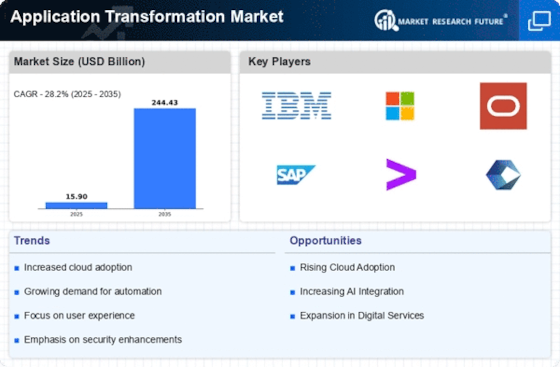
As per Market Research Future analysis, the Application Transformation Market Size was estimated at 15.9 USD Billion in 2024. The Application Transformation industry is projected to grow from 20.38 USD Billion in 2025 to 244.43 USD Billion by 2035, exhibiting a compound annual growth rate (CAGR) of 28.2% during the forecast period 2025 - 2035

Key Market Trends & Highlights

The Application Transformation Market is experiencing robust growth driven by cloud migration and advanced technology integration.

  • North America remains the largest market for application transformation, driven by a strong demand for cloud solutions. The Asia-Pacific region is emerging as the fastest-growing area, reflecting a rapid adoption of digital transformation initiatives. Cloud migration services dominate the market, while integration of advanced technologies is the fastest-growing segment. Key market drivers include increased demand for cloud solutions and the integration of artificial intelligence to enhance customer experience.

Market Size & Forecast

2024 Market Size 15.9 (USD Billion)
2035 Market Size 244.43 (USD Billion)
CAGR (2025 - 2035) 28.2%
Largest Regional Market Share in 2024 North America

Major Players

IBM (US), Microsoft (US), Oracle (US), SAP (DE), Accenture (IE), Cognizant (US), Capgemini (FR), Hewlett Packard Enterprise (US), Tata Consultancy Services (IN), Infosys (IN)

Market Trends

The Application Transformation Market is currently experiencing a dynamic evolution, driven by the increasing need for organizations to modernize their legacy systems. As businesses strive to enhance operational efficiency and improve customer experiences, the demand for application transformation services appears to be on the rise. This market encompasses a variety of services, including cloud migration, application re-engineering, and the integration of advanced technologies such as artificial intelligence and machine learning. Companies are recognizing that transforming their applications is not merely a technical necessity but a strategic imperative that can lead to competitive advantages in a rapidly changing digital landscape.

Moreover, the Application Transformation Market is characterized by a growing emphasis on agility and scalability. Many enterprises are initiating a comprehensive application transformation to replace outdated legacy architectures with cloud-native solutions. This shift is likely to foster innovation and enable businesses to deploy new features and services more rapidly. As the Application Transformation Market continues to mature, collaboration between technology providers and enterprises is expected to deepen, facilitating the development of tailored application transformation services that address specific industry challenges. Overall, the market is poised for substantial growth as organizations seek to navigate the complexities of digital transformation and leverage technology to drive business success.

Cloud Migration Services

Cloud migration services are becoming a cornerstone of the Application Transformation Market. Organizations are increasingly moving their applications to cloud environments to enhance scalability and reduce operational costs. This trend indicates a shift towards more flexible infrastructures that can adapt to changing business needs.

Integration of Advanced Technologies

The primary driver for application transformation is the need to increase operational agility and support faster deployment of new digital features. The integration of advanced technologies, such as artificial intelligence and machine learning, is gaining traction within the Application Transformation Market as they make the workprocess significantly faster and efficient. These technologies enable organizations to automate processes and gain insights from data, potentially leading to improved decision-making and operational efficiency.

Focus on Agility and Scalability

A pronounced focus on agility and scalability is emerging in the Application Transformation Market. Businesses are prioritizing solutions that allow for rapid deployment and adaptation to market changes, suggesting a move towards more responsive and innovative operational models.

Application Transformation Market Market Drivers

Focus on Customer Experience

The Application Transformation Market is heavily influenced by the growing emphasis on customer experience. Organizations are recognizing that enhancing user engagement and satisfaction is crucial for retaining customers and driving growth. As a result, businesses are investing in transforming their applications to provide seamless and intuitive user experiences. Data suggests that companies prioritizing customer experience can achieve revenue growth rates of up to 10-15% higher than their competitors. This focus on customer-centric applications is likely to propel the Application Transformation Market forward, as organizations seek to innovate and differentiate themselves in a competitive landscape.

Adoption of Agile Methodologies

The Application Transformation Market is increasingly adopting agile methodologies to enhance project delivery and responsiveness. Agile practices enable organizations to develop and deploy applications more rapidly, fostering innovation and adaptability. As businesses face dynamic market conditions, the need for agility becomes paramount. Research indicates that organizations utilizing agile methodologies can improve project success rates by up to 30%. This trend is driving the transformation of applications, as companies seek to implement iterative development processes that align with changing business requirements. Consequently, the Application Transformation Market is likely to see a rise in demand for agile-driven application transformation initiatives.

Increased Demand for Cloud Solutions

The Application Transformation Market is experiencing a notable surge in demand for cloud solutions. Organizations are increasingly migrating their applications to cloud platforms to enhance operational efficiency and reduce costs. According to recent data, the cloud services market is projected to reach a valuation of over 800 billion dollars by 2025. This shift towards cloud-based solutions is driven by the need for flexibility, scalability, and improved collaboration among teams. As businesses seek to modernize their IT infrastructure, the Application Transformation Market is poised to benefit significantly from this trend, as companies invest in transforming legacy applications to be cloud-compatible.

Integration of Artificial Intelligence

The Application Transformation Market is witnessing a growing integration of artificial intelligence (AI) technologies. AI enhances application capabilities, enabling organizations to automate processes, improve decision-making, and deliver personalized user experiences. The Application Transformation Market is expected to surpass 500 billion dollars by 2025, indicating a robust interest in AI-driven solutions. This integration not only streamlines operations but also allows businesses to leverage data analytics for better insights. As companies prioritize digital transformation, the Application Transformation Market is likely to see increased investments in AI technologies, further driving the transformation of applications to meet evolving business needs.

Regulatory Compliance and Security Concerns

In the Application Transformation Market, regulatory compliance and security concerns are becoming increasingly paramount. Organizations are compelled to transform their applications to adhere to stringent regulations and protect sensitive data. The rise in cyber threats has heightened the focus on security, prompting businesses to invest in application transformation initiatives. According to industry reports, compliance-related spending is expected to grow significantly, with organizations allocating substantial budgets to ensure their applications meet regulatory standards. This trend underscores the necessity for businesses to modernize their applications, thereby creating opportunities within the Application Transformation Market as firms seek to enhance security and compliance.

Market Segment Insights

By Service: Cloud Migration (Largest) vs. Integration (Fastest-Growing)

In the Application Transformation Market, the service segment is characterized by varied values, chief among them being Cloud Migration, which holds a significant portion of the market share. This service enables organizations to adapt their existing applications to cloud environments, driving a substantial share compared to others. Integration, on the other hand, is rapidly gaining traction as businesses increasingly seek to streamline operations and enhance interoperability among disparate systems and applications. This growing demand highlights its potential within the overall segment, making it a critical player in the dynamic landscape of application transformation. The growth trends in the Application Transformation Market indicate a robust movement towards digital transformation as organizations seek enhanced agility and efficiency in their operations. Cloud Migration continues to dominate due to its necessity in modernizing IT infrastructures, while Integration sees impressive growth prompted by the need for seamless connectivity across platforms. Other services such as Portfolio Assessment and UI Modernization play vital roles in supporting businesses in their transition journeys, ensuring that they remain competitive in an evolving market.

Cloud Migration (Dominant) vs. UI Modernization (Emerging)

Cloud Migration stands out as the dominant service in the Application Transformation Market due to its essential role in facilitating organizations' transition to cloud technologies. It enables businesses to migrate their applications to cloud environments, resulting in improved scalability, cost efficiency, and flexibility. Conversely, UI Modernization, while emerging, is gaining momentum as companies focus on enhancing user experiences through updated interfaces and functionalities. This trend reflects a growing emphasis on customer-centric approaches and the importance of maintaining competitive edge in the digital realm. As organizations prioritize user satisfaction and engagement, UI Modernization is likely to become a critical aspect of application transformation strategies.

By Organization Size: Small and Medium-Sized Businesses (Largest) vs. Large Enterprises (Fastest-Growing)

The Application Transformation Market delineates a significant division between small and medium-sized businesses (SMBs) and large enterprises. SMBs represent the largest share of the application transformation market due to their increasing reliance on digital solutions to enhance operational efficiency and customer engagement. Their adaptability to emerging technologies gives them an edge in leveraging application transformation services, thereby dominating the segment. On the other hand, large enterprises are rapidly catching up as they invest heavily in application modernization to retain competitive advantage and improve agility across their operations. Growth trends in the Application Transformation Market are being driven by the increasing demand from both SMBs and large enterprises for cloud-based solutions, which are seen as crucial for operational efficiency. SMBs are leveraging cost-effective transformation strategies that help them scale efficiently, while large enterprises are seeking innovative solutions to address complex legacy systems. The push towards digital transformation across all organizational sizes is expected to continue, with each segment adapting uniquely to their specific needs and challenges.

Small and Medium-Sized Businesses (Dominant) vs. Large Enterprises (Emerging)

In the Application Transformation Market, small and medium-sized businesses (SMBs) emerge as the dominant force due to their flexible operational structures and their readiness to adopt new technologies. These businesses are inclined to embrace application transformation initiatives that facilitate enhanced customer experiences and operational efficiencies, making them pivotal in driving innovation. Conversely, large enterprises, while slower to adapt due to their existing legacy systems, are seen as an emerging segment as they begin to invest heavily in application modernization. They recognize the need to enhance agility and innovation to compete in rapidly evolving markets, which positions them as a significant growth driver in the transformation landscape.

By Vertical: Retail (Largest) vs. Healthcare (Fastest-Growing)

In the Application Transformation Market, the distribution of market share among verticals highlights Retail as the dominant player. This sector has leveraged application transformation technologies to enhance customer engagement and streamline operations, securing a substantial share of the market. Following closely are sectors such as Banking and Healthcare, which are also crucial yet take a backseat to Retail's prominence.

Retail: Dominant vs. Healthcare: Emerging

The Retail sector has established itself as a dominant force in the Application Transformation Market, characterized by its rapid adoption of innovative technologies to improve customer interaction and operational efficiency. Retailers are increasingly investing in application transformation to respond to evolving consumer behaviors and preferences, indicating a robust presence in the application transformation market. On the other hand, the Healthcare sector is emerging rapidly, driven by the necessity for improved patient experiences and operational efficiencies. Digital health initiatives and telemedicine platforms are propelling this vertical's transformation, leading to increased investment and experimentation, which are fostering growth. With technology-driven innovations, Healthcare aims to catch up, highlighting its potential as an emerging powerhouse.

Get more detailed insights about Application Transformation Market Research Report—Global Forecast till 2035

Regional Insights

North America : Innovation and Leadership Hub

North America is the largest market for application transformation, holding approximately 45% of the global share. The region's growth is driven by rapid technological advancements, increasing cloud adoption, and a strong focus on digital transformation initiatives. Regulatory support for innovation and data security further catalyzes market expansion, making it a key player in the global landscape. The United States leads the market, followed by Canada, with major players like IBM, Microsoft, and Oracle establishing a strong presence. The competitive landscape is characterized by continuous innovation and strategic partnerships, enabling companies to offer comprehensive solutions. The focus on enhancing customer experience and operational efficiency drives demand, positioning North America as a leader in application transformation.

Europe : Emerging Digital Transformation Leader

Europe is the second-largest market for application transformation, accounting for around 30% of the global share. The region's growth is propelled by stringent regulations on data protection, such as GDPR, and a strong emphasis on sustainability and digital innovation. Countries are increasingly investing in digital infrastructure, which is expected to further boost market demand in the coming years. Germany, the UK, and France are the leading countries in this market, with significant contributions from local players like SAP and Capgemini. The competitive landscape is marked by a mix of established firms and emerging startups, all vying for market share. The presence of key players and a collaborative ecosystem fosters innovation, making Europe a vibrant hub for application transformation.

Asia-Pacific : Rapid Growth and Adoption

Asia-Pacific is witnessing rapid growth in the application transformation market, holding approximately 20% of the global share. The region's expansion is driven by increasing digitalization, a growing middle class, and government initiatives aimed at enhancing technological capabilities. Countries like India and China are at the forefront, with significant investments in IT infrastructure and cloud services. India is a key player, with companies like Tata Consultancy Services and Infosys leading the charge. The competitive landscape is dynamic, with both local and international firms competing for market share. The region's focus on innovation and cost-effective solutions positions it as a burgeoning powerhouse in the application transformation sector, attracting global attention and investment.

Middle East and Africa : Emerging Market with Potential

The Middle East and Africa (MEA) region is gradually emerging in the application transformation market, holding about 5% of the global share. The growth is primarily driven by increasing investments in digital transformation initiatives and government support for technology adoption. Countries are focusing on enhancing their digital infrastructure to meet the demands of a rapidly evolving market landscape. South Africa and the UAE are leading the charge, with a growing number of local and international players entering the market. The competitive landscape is characterized by a mix of established firms and new entrants, all aiming to capitalize on the region's potential. As digital initiatives gain momentum, MEA is poised for significant growth in application transformation, attracting interest from global technology firms.

Key Players and Competitive Insights

The Application Transformation Market is currently characterized by a dynamic competitive landscape, driven by the increasing demand for digital transformation and the need for businesses to modernize their legacy systems. Key players such as IBM (US), Microsoft (US), and Accenture (IE) are strategically positioned to leverage their technological expertise and extensive service portfolios. IBM (US) focuses on hybrid cloud solutions and AI integration, while Microsoft (US) emphasizes its Azure platform to facilitate seamless application migration and transformation. Accenture (IE) adopts a consultative approach, partnering with clients to tailor solutions that enhance operational efficiency. Collectively, these strategies foster a competitive environment that prioritizes innovation and customer-centric solutions.In terms of business tactics, companies are increasingly localizing their operations and optimizing supply chains to enhance service delivery and responsiveness. The Application Transformation Market appears moderately fragmented, with a mix of established players and emerging firms vying for market share. The collective influence of key players is significant, as they set industry standards and drive technological advancements that shape market dynamics.

In September IBM (US) announced a strategic partnership with a leading telecommunications provider to enhance its cloud services, aiming to deliver more robust application transformation solutions. This collaboration is likely to expand IBM's reach in the telecommunications sector, allowing it to offer tailored solutions that address specific industry challenges. Such partnerships may enhance IBM's competitive edge by integrating advanced technologies into its service offerings.
In August Microsoft (US) launched a new initiative aimed at accelerating application modernization for small and medium-sized enterprises (SMEs). This initiative includes a suite of tools designed to simplify the migration process to the cloud. By targeting SMEs, Microsoft is likely to capture a growing segment of the market that seeks cost-effective solutions for digital transformation, thereby reinforcing its position as a leader in the Application Transformation Market.
In July Accenture (IE) acquired a prominent digital consultancy firm to bolster its capabilities in application transformation. This acquisition is expected to enhance Accenture's service offerings, particularly in the areas of cloud migration and digital strategy. By integrating the expertise of the acquired firm, Accenture may strengthen its competitive position and provide more comprehensive solutions to its clients, reflecting a trend towards consolidation in the market.
As of October the Application Transformation Market is witnessing trends such as increased digitalization, a focus on sustainability, and the integration of artificial intelligence into application processes. Strategic alliances among key players are shaping the competitive landscape, fostering innovation and collaboration. Looking ahead, competitive differentiation is likely to evolve, with a shift from price-based competition to a focus on technological innovation, reliability in supply chains, and the ability to deliver customized solutions that meet the unique needs of clients.

Key Companies in the Application Transformation Market include

Industry Developments

June 2022: To aid in the advancement of technology elements and enhance the service, Accenture opened its new Advanced Technology Centre in India.

Future Outlook

Application Transformation Market Future Outlook

The Application Transformation Market is projected to grow at a 28.2% CAGR from 2025 to 2035, driven by digital transformation, cloud adoption, and increasing demand for agile solutions.

New opportunities lie in:

  • <p>Development of AI-driven application modernization tools Expansion of cloud-native application platforms Integration of low-code/no-code development environments</p>

By 2035, the Application Transformation Market is expected to be robust, reflecting substantial growth and innovation.

Market Segmentation

Application Transformation Market Service Outlook

  • Portfolio Assessment
  • Cloud Migration
  • Replatforming
  • Integration
  • UI Modernization
  • Post Modernization

Application Transformation Market Vertical Outlook

  • Retail
  • IT and Telecommunication
  • Healthcare
  • Banking
  • Financial Services
  • and Insurance
  • Government
  • Manufacturing

Application Transformation Market Organization Size Outlook

  • Small and Medium-Sized Businesses
  • Large Enterprises

Report Scope

MARKET SIZE 2024 15.9(USD Billion)
MARKET SIZE 2025 20.38(USD Billion)
MARKET SIZE 2035 244.43(USD Billion)
COMPOUND ANNUAL GROWTH RATE (CAGR) 28.2% (2025 - 2035)
REPORT COVERAGE Revenue Forecast, Competitive Landscape, Growth Factors, and Trends
BASE YEAR 2024
Market Forecast Period 2025 - 2035
Historical Data 2019 - 2024
Market Forecast Units USD Billion
Key Companies Profiled IBM (US), Microsoft (US), Oracle (US), SAP (DE), Accenture (IE), Cognizant (US), Capgemini (FR), Hewlett Packard Enterprise (US), Tata Consultancy Services (IN), Infosys (IN)
Segments Covered Service, Organization Size, Vertical, Region
Key Market Opportunities Integration of artificial intelligence and cloud solutions drives growth in the Application Transformation Market.
Key Market Dynamics Rising demand for cloud-native applications drives competitive innovation and transformation across various industry sectors.
Countries Covered North America, Europe, APAC, South America, MEA

FAQs

What is the current valuation of the Application Transformation Market?

<p>As of 2024, the Application Transformation Market was valued at 15.9 USD Billion.</p>

What is the projected market size for the Application Transformation Market by 2035?

<p>The market is projected to reach approximately 244.43 USD Billion by 2035.</p>

What is the expected CAGR for the Application Transformation Market during the forecast period 2025 - 2035?

<p>The expected CAGR for the Application Transformation Market during 2025 - 2035 is 28.2%.</p>

Which organizations are leading the Application Transformation Market?

<p>Key players in the market include IBM, Microsoft, Oracle, SAP, Accenture, Cognizant, Capgemini, Hewlett Packard Enterprise, Tata Consultancy Services, and Infosys.</p>

How does the Application Transformation Market perform across different organization sizes?

<p>In 2024, the market for Small and Medium-Sized Businesses was approximately 3.975 USD Billion, while for Large Enterprises, it was around 11.925 USD Billion.</p>

What are the primary service segments within the Application Transformation Market?

<p>The main service segments include Cloud Migration, Integration, Replatforming, UI Modernization, Portfolio Assessment, and Post Modernization.</p>

What is the valuation of the Cloud Migration segment in the Application Transformation Market?

The Cloud Migration segment was valued at 4.0 USD Billion in 2024 and is expected to grow significantly.

Which verticals are most prominent in the Application Transformation Market?

Prominent verticals include IT and Telecommunication, Healthcare, Banking, Financial Services, Insurance, Retail, Government, and Manufacturing.

What was the valuation of the Integration segment in 2024?

The Integration segment was valued at 3.5 USD Billion in 2024.

How does the Application Transformation Market's growth compare across different verticals?

In 2024, the IT and Telecommunication sector led with a valuation of 4.0 USD Billion, followed by Banking, Financial Services, and Insurance at 3.5 USD Billion.

  1. SECTION I: EXECUTIVE SUMMARY AND KEY HIGHLIGHTS |
    1. EXECUTIVE SUMMARY | |
      1. Market Overview | |
      2. Key Findings | |
      3. Market Segmentation | |
      4. Competitive Landscape | |
      5. Challenges and Opportunities | |
      6. Future Outlook 2
  2. SECTION II: SCOPING, METHODOLOGY AND MARKET STRUCTURE |
    1. MARKET INTRODUCTION | |
      1. Definition | |
      2. Scope of the study | | |
    2. RESEARCH METHODOLOGY | |
      1. Overview | |
      2. Data Mining | |
      3. Secondary Research | |
      4. Primary Research | | |
      5. Forecasting Model | |
      6. Market Size Estimation | | |
      7. Data Triangulation | |
      8. Validation 3
  3. SECTION III: QUALITATIVE ANALYSIS |
    1. MARKET DYNAMICS | |
      1. Overview | |
      2. Drivers | |
      3. Restraints | |
      4. Opportunities |
    2. MARKET FACTOR ANALYSIS | |
      1. Value chain Analysis | |
      2. Porter's Five Forces Analysis | | |
      3. COVID-19 Impact Analysis | | |
  4. SECTION IV: QUANTITATIVE ANALYSIS |
    1. Information and Communications Technology, BY Service (USD Billion) | |
      1. Portfolio Assessment | |
      2. Cloud Migration | |
      3. Replatforming | |
      4. Integration | |
      5. UI Modernization | |
      6. Post Modernization |
    2. Information and Communications Technology, BY Organization Size (USD Billion) | |
      1. Small and Medium-Sized Businesses | |
      2. Large Enterprises |
    3. Information and Communications Technology, BY Vertical (USD Billion) | |
      1. Retail | |
      2. IT and Telecommunication | |
      3. Healthcare | |
      4. Banking, Financial Services, and Insurance | |
      5. Government | |
      6. Manufacturing |
    4. Information and Communications Technology, BY Region (USD Billion) | |
      1. North America | | |
      2. Europe | | |
      3. APAC | | |
      4. South America | | |
      5. MEA | | |
  5. SECTION V: COMPETITIVE ANALYSIS |
    1. Competitive Landscape | |
      1. Overview | |
      2. Competitive Analysis | |
      3. Market share Analysis | |
      4. Major Growth Strategy in the Information and Communications Technology | |
      5. Competitive Benchmarking | |
      6. Leading Players in Terms of Number of Developments in the Information and Communications Technology | |
      7. Key developments and growth strategies | | |
      8. Major Players Financial Matrix | | |
    2. Company Profiles | |
      1. IBM (US) | | |
      2. Microsoft (US) | | |
      3. Oracle (US) | | |
      4. SAP (DE) | | |
      5. Accenture (IE) | | |
      6. Cognizant (US) | | |
      7. Capgemini (FR) | | |
      8. Hewlett Packard Enterprise (US) | | |
      9. Tata Consultancy Services (IN) | | |
      10. Infosys (IN) | | |
    3. Appendix | |
      1. References | |
      2. Related Reports 6 LIST OF FIGURES |
    4. MARKET SYNOPSIS |
    5. NORTH AMERICA MARKET ANALYSIS |
    6. US MARKET ANALYSIS BY SERVICE |
    7. US MARKET ANALYSIS BY ORGANIZATION SIZE |
    8. US MARKET ANALYSIS BY VERTICAL |
    9. CANADA MARKET ANALYSIS BY SERVICE |
    10. CANADA MARKET ANALYSIS BY ORGANIZATION SIZE |
    11. CANADA MARKET ANALYSIS BY VERTICAL |
    12. EUROPE MARKET ANALYSIS |
    13. GERMANY MARKET ANALYSIS BY SERVICE |
    14. GERMANY MARKET ANALYSIS BY ORGANIZATION SIZE |
    15. GERMANY MARKET ANALYSIS BY VERTICAL |
    16. UK MARKET ANALYSIS BY SERVICE |
    17. UK MARKET ANALYSIS BY ORGANIZATION SIZE |
    18. UK MARKET ANALYSIS BY VERTICAL |
    19. FRANCE MARKET ANALYSIS BY SERVICE |
    20. FRANCE MARKET ANALYSIS BY ORGANIZATION SIZE |
    21. FRANCE MARKET ANALYSIS BY VERTICAL |
    22. RUSSIA MARKET ANALYSIS BY SERVICE |
    23. RUSSIA MARKET ANALYSIS BY ORGANIZATION SIZE |
    24. RUSSIA MARKET ANALYSIS BY VERTICAL |
    25. ITALY MARKET ANALYSIS BY SERVICE |
    26. ITALY MARKET ANALYSIS BY ORGANIZATION SIZE |
    27. ITALY MARKET ANALYSIS BY VERTICAL |
    28. SPAIN MARKET ANALYSIS BY SERVICE |
    29. SPAIN MARKET ANALYSIS BY ORGANIZATION SIZE |
    30. SPAIN MARKET ANALYSIS BY VERTICAL |
    31. REST OF EUROPE MARKET ANALYSIS BY SERVICE |
    32. REST OF EUROPE MARKET ANALYSIS BY ORGANIZATION SIZE |
    33. REST OF EUROPE MARKET ANALYSIS BY VERTICAL |
    34. APAC MARKET ANALYSIS |
    35. CHINA MARKET ANALYSIS BY SERVICE |
    36. CHINA MARKET ANALYSIS BY ORGANIZATION SIZE |
    37. CHINA MARKET ANALYSIS BY VERTICAL |
    38. INDIA MARKET ANALYSIS BY SERVICE |
    39. INDIA MARKET ANALYSIS BY ORGANIZATION SIZE |
    40. INDIA MARKET ANALYSIS BY VERTICAL |
    41. JAPAN MARKET ANALYSIS BY SERVICE |
    42. JAPAN MARKET ANALYSIS BY ORGANIZATION SIZE |
    43. JAPAN MARKET ANALYSIS BY VERTICAL |
    44. SOUTH KOREA MARKET ANALYSIS BY SERVICE |
    45. SOUTH KOREA MARKET ANALYSIS BY ORGANIZATION SIZE |
    46. SOUTH KOREA MARKET ANALYSIS BY VERTICAL |
    47. MALAYSIA MARKET ANALYSIS BY SERVICE |
    48. MALAYSIA MARKET ANALYSIS BY ORGANIZATION SIZE |
    49. MALAYSIA MARKET ANALYSIS BY VERTICAL |
    50. THAILAND MARKET ANALYSIS BY SERVICE |
    51. THAILAND MARKET ANALYSIS BY ORGANIZATION SIZE |
    52. THAILAND MARKET ANALYSIS BY VERTICAL |
    53. INDONESIA MARKET ANALYSIS BY SERVICE |
    54. INDONESIA MARKET ANALYSIS BY ORGANIZATION SIZE |
    55. INDONESIA MARKET ANALYSIS BY VERTICAL |
    56. REST OF APAC MARKET ANALYSIS BY SERVICE |
    57. REST OF APAC MARKET ANALYSIS BY ORGANIZATION SIZE |
    58. REST OF APAC MARKET ANALYSIS BY VERTICAL |
    59. SOUTH AMERICA MARKET ANALYSIS |
    60. BRAZIL MARKET ANALYSIS BY SERVICE |
    61. BRAZIL MARKET ANALYSIS BY ORGANIZATION SIZE |
    62. BRAZIL MARKET ANALYSIS BY VERTICAL |
    63. MEXICO MARKET ANALYSIS BY SERVICE |
    64. MEXICO MARKET ANALYSIS BY ORGANIZATION SIZE |
    65. MEXICO MARKET ANALYSIS BY VERTICAL |
    66. ARGENTINA MARKET ANALYSIS BY SERVICE |
    67. ARGENTINA MARKET ANALYSIS BY ORGANIZATION SIZE |
    68. ARGENTINA MARKET ANALYSIS BY VERTICAL |
    69. REST OF SOUTH AMERICA MARKET ANALYSIS BY SERVICE |
    70. REST OF SOUTH AMERICA MARKET ANALYSIS BY ORGANIZATION SIZE |
    71. REST OF SOUTH AMERICA MARKET ANALYSIS BY VERTICAL |
    72. MEA MARKET ANALYSIS |
    73. GCC COUNTRIES MARKET ANALYSIS BY SERVICE |
    74. GCC COUNTRIES MARKET ANALYSIS BY ORGANIZATION SIZE |
    75. GCC COUNTRIES MARKET ANALYSIS BY VERTICAL |
    76. SOUTH AFRICA MARKET ANALYSIS BY SERVICE |
    77. SOUTH AFRICA MARKET ANALYSIS BY ORGANIZATION SIZE |
    78. SOUTH AFRICA MARKET ANALYSIS BY VERTICAL |
    79. REST OF MEA MARKET ANALYSIS BY SERVICE |
    80. REST OF MEA MARKET ANALYSIS BY ORGANIZATION SIZE |
    81. REST OF MEA MARKET ANALYSIS BY VERTICAL |
    82. KEY BUYING CRITERIA OF INFORMATION AND COMMUNICATIONS TECHNOLOGY |
    83. RESEARCH PROCESS OF MRFR |
    84. DRO ANALYSIS OF INFORMATION AND COMMUNICATIONS TECHNOLOGY |
    85. DRIVERS IMPACT ANALYSIS: INFORMATION AND COMMUNICATIONS TECHNOLOGY |
    86. RESTRAINTS IMPACT ANALYSIS: INFORMATION AND COMMUNICATIONS TECHNOLOGY |
    87. SUPPLY / VALUE CHAIN: INFORMATION AND COMMUNICATIONS TECHNOLOGY |
    88. INFORMATION AND COMMUNICATIONS TECHNOLOGY, BY SERVICE, 2024 (% SHARE) |
    89. INFORMATION AND COMMUNICATIONS TECHNOLOGY, BY SERVICE, 2024 TO 2035 (USD Billion) |
    90. INFORMATION AND COMMUNICATIONS TECHNOLOGY, BY ORGANIZATION SIZE, 2024 (% SHARE) |
    91. INFORMATION AND COMMUNICATIONS TECHNOLOGY, BY ORGANIZATION SIZE, 2024 TO 2035 (USD Billion) |
    92. INFORMATION AND COMMUNICATIONS TECHNOLOGY, BY VERTICAL, 2024 (% SHARE) |
    93. INFORMATION AND COMMUNICATIONS TECHNOLOGY, BY VERTICAL, 2024 TO 2035 (USD Billion) |
    94. BENCHMARKING OF MAJOR COMPETITORS 7 LIST OF TABLES |
    95. LIST OF ASSUMPTIONS | |
      1. |
    96. North America MARKET SIZE ESTIMATES; FORECAST | |
      1. BY SERVICE, 2025-2035 (USD Billion) | |
      2. BY ORGANIZATION SIZE, 2025-2035 (USD Billion) | |
      3. BY VERTICAL, 2025-2035 (USD Billion) |
    97. US MARKET SIZE ESTIMATES; FORECAST | |
      1. BY SERVICE, 2025-2035 (USD Billion) | |
      2. BY ORGANIZATION SIZE, 2025-2035 (USD Billion) | |
      3. BY VERTICAL, 2025-2035 (USD Billion) |
    98. Canada MARKET SIZE ESTIMATES; FORECAST | |
      1. BY SERVICE, 2025-2035 (USD Billion) | |
      2. BY ORGANIZATION SIZE, 2025-2035 (USD Billion) | |
      3. BY VERTICAL, 2025-2035 (USD Billion) |
    99. Europe MARKET SIZE ESTIMATES; FORECAST | |
      1. BY SERVICE, 2025-2035 (USD Billion) | |
      2. BY ORGANIZATION SIZE, 2025-2035 (USD Billion) | |
      3. BY VERTICAL, 2025-2035 (USD Billion) |
    100. Germany MARKET SIZE ESTIMATES; FORECAST | |
      1. BY SERVICE, 2025-2035 (USD Billion) | |
      2. BY ORGANIZATION SIZE, 2025-2035 (USD Billion) | |
      3. BY VERTICAL, 2025-2035 (USD Billion) |
    101. UK MARKET SIZE ESTIMATES; FORECAST | |
      1. BY SERVICE, 2025-2035 (USD Billion) | |
      2. BY ORGANIZATION SIZE, 2025-2035 (USD Billion) | |
      3. BY VERTICAL, 2025-2035 (USD Billion) |
    102. France MARKET SIZE ESTIMATES; FORECAST | |
      1. BY SERVICE, 2025-2035 (USD Billion) | |
      2. BY ORGANIZATION SIZE, 2025-2035 (USD Billion) | |
      3. BY VERTICAL, 2025-2035 (USD Billion) |
    103. Russia MARKET SIZE ESTIMATES; FORECAST | |
      1. BY SERVICE, 2025-2035 (USD Billion) | |
      2. BY ORGANIZATION SIZE, 2025-2035 (USD Billion) | |
      3. BY VERTICAL, 2025-2035 (USD Billion) |
    104. Italy MARKET SIZE ESTIMATES; FORECAST | |
      1. BY SERVICE, 2025-2035 (USD Billion) | |
      2. BY ORGANIZATION SIZE, 2025-2035 (USD Billion) | |
      3. BY VERTICAL, 2025-2035 (USD Billion) |
    105. Spain MARKET SIZE ESTIMATES; FORECAST | |
      1. BY SERVICE, 2025-2035 (USD Billion) | |
      2. BY ORGANIZATION SIZE, 2025-2035 (USD Billion) | |
      3. BY VERTICAL, 2025-2035 (USD Billion) |
    106. Rest of Europe MARKET SIZE ESTIMATES; FORECAST | |
      1. BY SERVICE, 2025-2035 (USD Billion) | |
      2. BY ORGANIZATION SIZE, 2025-2035 (USD Billion) | |
      3. BY VERTICAL, 2025-2035 (USD Billion) |
    107. APAC MARKET SIZE ESTIMATES; FORECAST | |
      1. BY SERVICE, 2025-2035 (USD Billion) | |
      2. BY ORGANIZATION SIZE, 2025-2035 (USD Billion) | |
      3. BY VERTICAL, 2025-2035 (USD Billion) |
    108. China MARKET SIZE ESTIMATES; FORECAST | |
      1. BY SERVICE, 2025-2035 (USD Billion) | |
      2. BY ORGANIZATION SIZE, 2025-2035 (USD Billion) | |
      3. BY VERTICAL, 2025-2035 (USD Billion) |
    109. India MARKET SIZE ESTIMATES; FORECAST | |
      1. BY SERVICE, 2025-2035 (USD Billion) | |
      2. BY ORGANIZATION SIZE, 2025-2035 (USD Billion) | |
      3. BY VERTICAL, 2025-2035 (USD Billion) |
    110. Japan MARKET SIZE ESTIMATES; FORECAST | |
      1. BY SERVICE, 2025-2035 (USD Billion) | |
      2. BY ORGANIZATION SIZE, 2025-2035 (USD Billion) | |
      3. BY VERTICAL, 2025-2035 (USD Billion) |
    111. South Korea MARKET SIZE ESTIMATES; FORECAST | |
      1. BY SERVICE, 2025-2035 (USD Billion) | |
      2. BY ORGANIZATION SIZE, 2025-2035 (USD Billion) | |
      3. BY VERTICAL, 2025-2035 (USD Billion) |
    112. Malaysia MARKET SIZE ESTIMATES; FORECAST | |
      1. BY SERVICE, 2025-2035 (USD Billion) | |
      2. BY ORGANIZATION SIZE, 2025-2035 (USD Billion) | |
      3. BY VERTICAL, 2025-2035 (USD Billion) |
    113. Thailand MARKET SIZE ESTIMATES; FORECAST | |
      1. BY SERVICE, 2025-2035 (USD Billion) | |
      2. BY ORGANIZATION SIZE, 2025-2035 (USD Billion) | |
      3. BY VERTICAL, 2025-2035 (USD Billion) |
    114. Indonesia MARKET SIZE ESTIMATES; FORECAST | |
      1. BY SERVICE, 2025-2035 (USD Billion) | |
      2. BY ORGANIZATION SIZE, 2025-2035 (USD Billion) | |
      3. BY VERTICAL, 2025-2035 (USD Billion) |
    115. Rest of APAC MARKET SIZE ESTIMATES; FORECAST | |
      1. BY SERVICE, 2025-2035 (USD Billion) | |
      2. BY ORGANIZATION SIZE, 2025-2035 (USD Billion) | |
      3. BY VERTICAL, 2025-2035 (USD Billion) |
    116. South America MARKET SIZE ESTIMATES; FORECAST | |
      1. BY SERVICE, 2025-2035 (USD Billion) | |
      2. BY ORGANIZATION SIZE, 2025-2035 (USD Billion) | |
      3. BY VERTICAL, 2025-2035 (USD Billion) |
    117. Brazil MARKET SIZE ESTIMATES; FORECAST | |
      1. BY SERVICE, 2025-2035 (USD Billion) | |
      2. BY ORGANIZATION SIZE, 2025-2035 (USD Billion) | |
      3. BY VERTICAL, 2025-2035 (USD Billion) |
    118. Mexico MARKET SIZE ESTIMATES; FORECAST | |
      1. BY SERVICE, 2025-2035 (USD Billion) | |
      2. BY ORGANIZATION SIZE, 2025-2035 (USD Billion) | |
      3. BY VERTICAL, 2025-2035 (USD Billion) |
    119. Argentina MARKET SIZE ESTIMATES; FORECAST | |
      1. BY SERVICE, 2025-2035 (USD Billion) | |
      2. BY ORGANIZATION SIZE, 2025-2035 (USD Billion) | |
      3. BY VERTICAL, 2025-2035 (USD Billion) |
    120. Rest of South America MARKET SIZE ESTIMATES; FORECAST | |
      1. BY SERVICE, 2025-2035 (USD Billion) | |
      2. BY ORGANIZATION SIZE, 2025-2035 (USD Billion) | |
      3. BY VERTICAL, 2025-2035 (USD Billion) |
    121. MEA MARKET SIZE ESTIMATES; FORECAST | |
      1. BY SERVICE, 2025-2035 (USD Billion) | |
      2. BY ORGANIZATION SIZE, 2025-2035 (USD Billion) | |
      3. BY VERTICAL, 2025-2035 (USD Billion) |
    122. GCC Countries MARKET SIZE ESTIMATES; FORECAST | |
      1. BY SERVICE, 2025-2035 (USD Billion) | |
      2. BY ORGANIZATION SIZE, 2025-2035 (USD Billion) | |
      3. BY VERTICAL, 2025-2035 (USD Billion) |
    123. South Africa MARKET SIZE ESTIMATES; FORECAST | |
      1. BY SERVICE, 2025-2035 (USD Billion) | |
      2. BY ORGANIZATION SIZE, 2025-2035 (USD Billion) | |
      3. BY VERTICAL, 2025-2035 (USD Billion) |
    124. Rest of MEA MARKET SIZE ESTIMATES; FORECAST | |
      1. BY SERVICE, 2025-2035 (USD Billion) | |
      2. BY ORGANIZATION SIZE, 2025-2035 (USD Billion) | |
      3. BY VERTICAL, 2025-2035 (USD Billion) |
    125. PRODUCT LAUNCH/PRODUCT DEVELOPMENT/APPROVAL | |
      1. |
    126. ACQUISITION/PARTNERSHIP | |

Information and Communications Technology Market Segmentation

Information and Communications Technology By Service (USD Billion, 2025-2035)

  • Portfolio Assessment
  • Cloud Migration
  • Replatforming
  • Integration
  • UI Modernization
  • Post Modernization

Information and Communications Technology By Organization Size (USD Billion, 2025-2035)

  • Small and Medium-Sized Businesses
  • Large Enterprises

Information and Communications Technology By Vertical (USD Billion, 2025-2035)

  • Retail
  • IT and Telecommunication
  • Healthcare
  • Banking, Financial Services, and Insurance
  • Government
  • Manufacturing
Infographic

Free Sample Request

Kindly complete the form below to receive a free sample of this Report

Get Free Sample

Customer Strories

Compare Licence

×
Features License Type
Single User Multiuser License Enterprise User
Price $4,950 $5,950 $7,250
Maximum User Access Limit 1 User Upto 10 Users Unrestricted Access Throughout the Organization
Free Customization
Direct Access to Analyst
Deliverable Format
Platform Access
Discount on Next Purchase 10% 15% 15%
Printable Versions