
×
Request Free Sample ×

Kindly complete the form below to receive a free sample of this Report

* Please use a valid business email

Leading companies partner with us for data-driven Insights

clients tt-cursor
Hero Background
English
Chinese
French
Japanese
Korean
German
Spanish

Application Modernization Services Market Share

ID: MRFR/ICT/4093-HCR
100 Pages
Ankit Gupta
February 2026

Application Modernization Services Market Size, Share and Trends Analysis Report By Vertical (Healthcare, IT, Telecommunications, Energy and utilities, Manufacturing and Consumer goods and retail), By Deployment Type (Hybrid cloud, Private cloud and Public cloud), By Application (Post modernization, Application portfolio assignment, UI modernization, Cloud application mitigation, Application integration and Application re-platforming), and By Region (North America, Europe, Asia-Pacific, and Rest Of The World) - Forecast Till 2035.

Share:
Download PDF ×

We do not share your information with anyone. However, we may send you emails based on your report interest from time to time. You may contact us at any time to opt-out.

Application Modernization Services Market Infographic
Purchase Options

Market Share

Introduction: Navigating the Competitive Landscape of Application Modernization Services

In the era of technological evolution and changing customer expectations, the competition in the field of modernization of applications is becoming increasingly fierce. IT system integrators, cloud service providers, and companies in the field of artificial intelligence compete for leadership in the field of digital transformation, deploying advanced tools for analysis, automation, and IoT integration. IT system integrators focus on the possibility of smooth migration of applications, and cloud service providers on scalability and security, which leads to a multifaceted competition. The emerging disruptors, using biometrics and green IT, differentiate their offerings and address the needs of the green economy and the requirements of the authorities. In the context of the growing priority of modernization of applications and the increase in the efficiency of business processes, the potential for growth is mainly in North America and Asia-Pacific. Strategic trends for the period 2024–2025 are likely to be focused on hybrid cloud solutions and data governance, enabling the early adopters to gain significant market share.

Competitive Positioning

Full-Suite Integrators

These vendors offer comprehensive solutions that encompass the entire application modernization lifecycle, from assessment to implementation.

Vendor Competitive Edge Solution Focus Regional Focus
Wipro Strong global delivery capabilities End-to-end modernization services Global
IBM Robust AI and cloud integration Cloud-native application modernization Global
Capgemini Deep industry expertise Digital transformation services Global
Accenture Innovative technology partnerships Comprehensive modernization strategies Global
Cognizant Strong focus on customer experience Application and cloud services Global

Specialized Technology Vendors

These vendors focus on niche technologies and solutions that enhance specific aspects of application modernization.

Vendor Competitive Edge Solution Focus Regional Focus
Aspire Systems Agile and customer-centric approach Application development and modernization North America, Europe, Asia
Virtusa Strong digital engineering capabilities Cloud and digital transformation North America, Europe, Asia
Blu Age Automated modernization solutions Legacy application transformation Global

Infrastructure & Equipment Providers

These vendors provide the necessary infrastructure and tools to support application modernization efforts.

Vendor Competitive Edge Solution Focus Regional Focus
Oracle Comprehensive cloud infrastructure Database and cloud services Global
Dell Robust hardware and software integration Infrastructure solutions for modernization Global
Fujitsu Strong focus on IT services and solutions Infrastructure and cloud services Asia, Europe
HCL Innovative service delivery models IT and engineering services Global
DXC Technology Extensive industry partnerships IT modernization and consulting Global
NTT Data Global reach with local expertise IT services and solutions Global
Bell Integrator Custom solutions for diverse industries IT and business solutions Europe, Asia

Emerging Players & Regional Champions

  • CloudMinds (China): This company specializes in application modernization with artificial intelligence, and has been working with a major telecommunications company to modernize its legacy systems, challenging the established vendors with low-cost and high-efficiency alternatives.
  • AppCrafters (India): specializes in low-code application development for modernization. It has just landed a contract with a large retail chain to revamp its e-commerce platform. It complements the established vendors by providing agile and rapid deployment.
  • ModernizeIT (Brazil): Provides cloud-native migration services tailored to local companies, has recently completed a modernization project for a government agency, and is positioning itself as a local champion against the big global players by emphasizing local compliance and support.
  • TechRevamp, Germany, offers end-to-end application modernization services, with a focus on microservices. Recently completed a project for a financial institution, TechRevamp is a major challenger to traditional vendors in the area of scalability and speed-to-market.

Regional Trends: In 2023, there will be a significant regional increase in the use of application modernization services, especially in Asia-Pacific and Latin America, driven by the need for digital transformation and cloud migration. Companies are increasingly specializing in low-code platforms and the integration of artificial intelligence, which will enable faster and more cost-effective modernization solutions. Local champions are emerging to address the specific regulatory and compliance needs of individual markets, which will create a competitive landscape against the major international vendors.

Collaborations & M&A Movements

  • IBM and Red Hat expanded their partnership to enhance hybrid cloud solutions, aiming to capture a larger share of the growing cloud-native application market amidst increasing demand for modernization services.
  • Microsoft acquired Nuance Communications to bolster its AI capabilities in healthcare applications, positioning itself as a leader in AI-driven application modernization within the healthcare sector.
  • Accenture and ServiceNow entered into a strategic alliance to deliver integrated digital transformation solutions, enhancing their competitive positioning in the application modernization landscape.

Competitive Summary Table

Capability Leading Players Remarks
Biometric Self-Boarding IBM, Thales IBM’s biometric self-boarding solution has been successfully implemented in major airports, improving passenger flow and reducing waiting times. Thales provides a platform that is both reliable and fully compatible with existing systems, with unique strengths in security and user experience.
AI-Powered Ops Mgmt Microsoft, Accenture It is also a great example of how Microsoft Azure AI tools can be used to improve operational efficiency. Case studies show that these tools have saved organizations a lot of money. And they have already been successfully used in the field of logistics and supply chain management.
Border Control Gemalto, NEC Several countries have already implemented Gemalto’s biometric solutions for border control. NEC’s facial recognition technology has been used at various international airports and has proven its effectiveness in identifying individuals in real time.
Sustainability SAP, Salesforce Using the latest technology, the new SAP solutions for resource management and the reduction of the carbon footprint are now in use. They are achieving greater compliance and greater efficiency. Salesforce with its cloud solutions and its data-driven decision-making demonstrates its unique strengths in the field of sustainable business.
Passenger Experience Amadeus, Travelport Case studies have demonstrated how Amadeus provides a more personalised travel experience and has increased customer satisfaction. The new systems from Travelport simplify the booking process and engage with travellers.

Conclusion: Navigating the Application Modernization Landscape

The Application Modernization Services market in 2023 will be characterized by intense competition and significant fragmentation, with both established and new players competing for market share. The vendors’ strategies will be increasingly based on localization, as they adapt to the specific needs and regulatory environment of each region. These strategies will be based on a combination of the legacy players’ existing customer base and their industry knowledge, and the newcomers’ focus on innovation, automation, and sustainable development. The key to success in the evolving market will be the ability to offer flexible, scalable solutions. These vendors will not only gain a competitive advantage but will also be well positioned to meet the enterprise demand for agile and sustainable modernization.


Author
Ankit Gupta
Team Lead - Research

Ankit Gupta is a seasoned market intelligence and strategic research professional with over six plus years of experience in the ICT and Semiconductor industries. With academic roots in Telecom, Marketing, and Electronics, he blends technical insight with business strategy. Ankit has led 200+ projects, including work for Fortune 500 clients like Microsoft and Rio Tinto, covering market sizing, tech forecasting, and go-to-market strategies. Known for bridging engineering and enterprise decision-making, his insights support growth, innovation, and investment planning across diverse technology markets.

Leave a Comment

FAQs

What is the projected market valuation for Application Modernization Services by 2035?

<p>The projected market valuation for Application Modernization Services is expected to reach 61.28 USD Billion by 2035.</p>

What was the market valuation for Application Modernization Services in 2024?

<p>The overall market valuation for Application Modernization Services was 11.4 USD Billion in 2024.</p>

What is the expected CAGR for Application Modernization Services from 2025 to 2035?

<p>The expected CAGR for Application Modernization Services during the forecast period 2025 - 2035 is 16.52%.</p>

Which sectors are expected to see significant growth in Application Modernization Services?

<p>Sectors such as IT, healthcare, and manufacturing are projected to experience substantial growth, with IT expected to reach 15.0 USD Billion by 2035.</p>

What are the key deployment modes for Application Modernization Services?

<p>The key deployment modes include hybrid cloud, private cloud, and public cloud, with public cloud projected to grow to 27.8 USD Billion by 2035.</p>

Who are the leading companies in the Application Modernization Services market?

<p>Key players in the market include Microsoft, IBM, Amazon Web Services, and Google Cloud, among others.</p>

What is the expected growth for application integration services in the coming years?

<p>Application integration services are anticipated to grow from 2.4 USD Billion in 2024 to 12.0 USD Billion by 2035.</p>

How does UI modernization contribute to the Application Modernization Services market?

UI modernization is projected to increase from 1.8 USD Billion in 2024 to 9.0 USD Billion by 2035, indicating its growing importance.

What is the significance of application re-platforming in the market?

Application re-platforming is expected to grow from 2.5 USD Billion in 2024 to 15.0 USD Billion by 2035, highlighting its critical role in modernization.

What trends are influencing the Application Modernization Services market?

Trends such as the shift to cloud computing and the need for digital transformation are driving growth in Application Modernization Services.

Market Summary

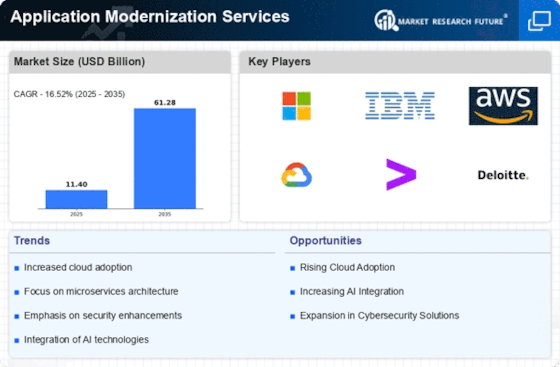
As per Market Research Future analysis, the Application Modernization Services Market Size was estimated at 11.4 Billion USD in 2024. The Application Modernization Services industry is projected to grow from 13.28 Billion USD in 2025 to 61.28 Billion USD by 2035, exhibiting a compound annual growth rate (CAGR) of 16.52% during the forecast period 2025 - 2035

Key Market Trends & Highlights

The Application Modernization Services Market is experiencing robust growth driven by cloud adoption and a focus on security.

  • North America remains the largest market for Application Modernization Services Market, driven by extensive cloud integration efforts. Asia-Pacific is emerging as the fastest-growing region, with increasing investments in digital transformation initiatives. The healthcare segment leads in market size, while the IT segment is witnessing the fastest growth due to rising demand for agile solutions. Key market drivers include the increased demand for digital transformation and the rise of cloud computing solutions, particularly in hybrid cloud environments.

Market Size & Forecast

2024 Market Size 11.4 (USD Billion)
2035 Market Size 61.28 (USD Billion)
CAGR (2025 - 2035) 16.52%
Largest Regional Market Share in 2024 North America

Major Players

<a href="https://blogs.windows.com/windowsexperience/2025/12/09/windows-pc-gaming-in-2025-handheld-innovation-arm-progress-and-directx-advances/">Microsoft</a> (US), IBM (US), Amazon Web Services (US), Google Cloud (US), Accenture (IE), Deloitte (US), Cognizant (US), Capgemini (FR), Tata Consultancy Services (IN), <a href="https://m.economictimes.com/markets/stocks/stock-liveblog/infosys-share-price-today-live-updates-29-dec-2025/amp_liveblog/126223018.cms">Infosys</a> (IN)

Market Trends

The landscape of Application Modernization Services Market is evolving rapidly, driven by the need for organizations to enhance operational efficiency and adapt to changing technological environments.Key application modernization trends include cloud migration, microservices adoption, and UI modernization.As businesses increasingly recognize the importance of agility and innovation, they are turning to modernization strategies that leverage cloud computing, microservices, and automation. This shift not only facilitates the integration of legacy systems with contemporary applications but also fosters a culture of continuous improvement.Modernization services are becoming a strategic priority as organizations seek long-term scalability and cost optimization.Consequently, organizations are better positioned to respond to market demands and customer expectations, which appear to be paramount in today's competitive climate. Moreover, the emphasis on security and compliance is becoming more pronounced within Application Modernization Services Market.Application modernization initiatives are gaining traction among enterprises operating in regulated markets across Europe.Organizations are compelled to ensure that their modernization efforts align with regulatory requirements while safeguarding sensitive data. This dual focus on innovation and security suggests that businesses are not merely seeking to modernize for the sake of modernization; rather, they are pursuing a holistic approach that encompasses both technological advancement and risk management. As a result, the future of Application Modernization Services Market seems poised for further growth, with an increasing number of enterprises recognizing the value of strategic modernization initiatives.The application modernization market is evolving rapidly as organizations prioritize cloud-native architectures and microservices-based development. Major application modernization drivers include cloud adoption, demand for operational agility, and rising security requirements. A structured application modernization framework enables organizations to prioritize workloads and optimize modernization outcomes.

Cloud Adoption and Integration

The trend towards cloud adoption is reshaping Application Modernization Services Market. Organizations are increasingly migrating their applications to cloud platforms, which allows for greater scalability and flexibility. This transition not only enhances operational efficiency but also enables businesses to leverage advanced technologies such as artificial intelligence and machine learning.Enterprises are increasingly adopting app modernization services to improve application performance and reduce infrastructure complexity. Cloud app modernization services are gaining adoption as organizations transition toward hybrid and public cloud environments.

Focus on Security and Compliance

As organizations modernize their applications, there is a heightened focus on security and compliance. Businesses are prioritizing the integration of robust security measures within their modernization strategies to protect sensitive data and adhere to regulatory standards. This trend indicates a shift towards a more comprehensive approach to modernization.

Emphasis on Agile Methodologies

The adoption of agile methodologies is becoming prevalent in Application Modernization Services Market. Organizations are increasingly utilizing agile practices to enhance collaboration and accelerate development cycles. This approach allows for quicker responses to market changes and fosters a culture of innovation, which is essential in today's fast-paced environment.Software modernization & migration strategies are helping enterprises transition from monolithic architectures to microservices-based platforms.

Application Modernization Services Market Market Drivers

Focus on Enhanced User Experience

In the Application Modernization Services Industry, there is a pronounced focus on enhancing user experience. As customer expectations evolve, organizations are compelled to modernize their applications to provide intuitive and seamless interactions. Data suggests that companies prioritizing user experience see a 60% increase in customer satisfaction and retention rates. This trend underscores the importance of modernizing applications to incorporate user-centric design principles and advanced functionalities. By leveraging modern technologies, such as responsive design and real-time analytics, businesses can create applications that not only meet but exceed user expectations. This emphasis on user experience is likely to drive further investments in application modernization services, as organizations seek to differentiate themselves in a crowded marketplace.

Rise of Cloud Computing Solutions

The Application Modernization Services Industry is significantly influenced by the rise of cloud computing solutions. Organizations are increasingly migrating their applications to cloud environments to capitalize on scalability, flexibility, and cost-effectiveness. Recent statistics indicate that over 80% of enterprises are expected to adopt cloud services by 2025, which directly correlates with the demand for application modernization. This shift allows businesses to decommission outdated infrastructure and embrace modern architectures, such as microservices and serverless computing. Consequently, the Application Modernization Services Industry is witnessing a surge in projects aimed at re-architecting applications for cloud compatibility. This transition not only enhances performance but also enables organizations to respond swiftly to market changes, thereby solidifying their competitive edge.

Integration of Emerging Technologies

The Application Modernization Services Industry is significantly impacted by the integration of emerging technologies. As organizations seek to harness the potential of technologies such as artificial intelligence, machine learning, and the Internet of Things, the need for modernized applications becomes increasingly apparent. Data indicates that approximately 65% of enterprises are investing in application modernization to facilitate the integration of these technologies. This trend reflects a broader shift towards innovation and digital transformation, where legacy systems are often inadequate to support advanced functionalities. By modernizing applications, organizations can leverage these emerging technologies to drive efficiency, enhance decision-making, and create new revenue streams. The Application Modernization Services Industry is thus positioned as a vital enabler of technological advancement, fostering a culture of innovation across various sectors.

Increased Demand for Digital Transformation

The Application Modernization Services Industry experiences heightened demand as organizations strive for digital transformation. Companies are increasingly recognizing the necessity to modernize legacy systems to enhance operational efficiency and customer engagement. According to recent data, approximately 70% of enterprises are prioritizing digital transformation initiatives, which often necessitate the adoption of application modernization services. This trend is driven by the need to remain competitive in a rapidly evolving market, where agility and responsiveness are paramount. As businesses seek to leverage emerging technologies such as artificial intelligence and machine learning, the Application Modernization Services Industry is poised to play a critical role in facilitating these transitions. The integration of modern applications not only streamlines processes but also fosters innovation, thereby driving growth and sustainability in various sectors.

Regulatory Compliance and Security Concerns

The Application Modernization Services Industry is increasingly shaped by regulatory compliance and security concerns. As data protection regulations become more stringent, organizations are compelled to modernize their applications to ensure compliance with laws such as GDPR and CCPA. Recent findings indicate that nearly 75% of businesses view compliance as a critical driver for application modernization. This necessity to adhere to regulatory standards often leads to the adoption of modern security protocols and practices, which are integral to the modernization process. Consequently, the Application Modernization Services Industry is witnessing a surge in demand for services that not only modernize applications but also enhance their security posture. This dual focus on compliance and security is likely to remain a key driver in the industry, as organizations strive to protect sensitive data while meeting regulatory requirements.

Market Segment Insights

By Vertical: Healthcare (Largest) vs. IT (Fastest-Growing)

The Application Modernization Services Market shows significant variation in market share among different verticals. The Healthcare sector holds the largest portion, largely driven by the need for efficient patient data management and regulatory compliance. Other key verticals, including Telecommunications and Energy, also contribute to market dynamics, but they lag behind healthcare in overall penetration and adoption rates. IT services, while historically robust, are witnessing rapid evolution which facilitates modernized applications across all sectors, particularly fueling the shift toward cloud-based solutions. Growth trends in Application Modernization Services Market reflect a shift in consumer demands and technological advancements. The Healthcare sector is increasingly focusing on integrated solutions that enhance patient engagement and digital transformation. Meanwhile, the IT vertical is emerging as the fastest-growing segment, driven by the surge in cloud adoption, microservices architecture, and agile development methodologies, positioning companies to respond more swiftly to market changes.

Healthcare (Dominant) vs. IT (Emerging)

The Healthcare sector is a dominant player in the Application Modernization Services Market due to its pressing need for enhanced efficiency, data management, and compliance with healthcare regulations. This sector prioritizes solutions that facilitate integration of legacy systems with cutting-edge technologies, promoting patient-centric care. In contrast, the IT sector is considered an emerging vertical in this space, experiencing rapid growth propelled by cloud services and a drive towards digital transformation. Companies in the IT sector are focusing on agile methodologies and advanced infrastructure to adapt quickly to the evolving technological landscape, making it a crucial area for modernization efforts.

By Deployment Mode: Hybrid Cloud (Largest) vs. Private Cloud (Fastest-Growing)

In the Application Modernization Services Market, the deployment mode segment is diversified among hybrid cloud, private cloud, and public cloud solutions. Currently, the hybrid cloud model demonstrates the largest market share, driven by its versatility and ability to optimize resources by blending on-premises and cloud environments. Meanwhile, the private cloud model is witnessing increasing adoption, capitalizing on organizations' demand for enhanced security and compliance, vital for sensitive workloads.Application migration and modernization initiatives enable enterprises to modernize legacy workloads while minimizing operational disruption.

Hybrid Cloud (Dominant) vs. Private Cloud (Emerging)

The hybrid cloud stands out as the dominant deployment mode in the Application Modernization Services Market, providing a balanced approach that allows businesses to enjoy the scalability of public clouds while retaining critical data on private infrastructures. This flexibility addresses various business needs, ensuring that applications can be moved seamlessly between environments. On the other hand, the private cloud is emerging rapidly, appealing to sectors where security and control are paramount. Organizations are increasingly recognizing the benefits of dedicated resources and customizable configurations, leading to accelerated growth in private cloud solutions.

By Application: UI Modernization (Largest) vs. Application Integration (Fastest-Growing)

In the Application Modernization Services Market, UI modernization holds the largest share among various segment values, driven by the increasing demand for user-friendly interfaces and enhanced customer experiences. Application integration, on the other hand, is gaining traction as businesses seek to connect their disparate applications seamlessly, allowing for effective data sharing and process efficiency. This dynamic is contributing to the broad market distribution of these services as companies pivot towards optimized digital strategies.

UI Modernization (Dominant) vs. Application Integration (Emerging)

UI modernization represents a dominant force in the Application Modernization Services Market landscape, focusing on improving the visual and interactive aspects of applications to meet contemporary user expectations. It enhances usability and accessibility, thus driving user engagement and satisfaction. Conversely, application integration is identified as an emerging growth area in this sector. It facilitates the connectivity between various applications and data sources, streamlining operations and enhancing overall productivity. Organizations show a growing preference for integrated solutions that foster agility and real-time information accessibility, further solidifying the need for strategies that bridge diverse application frameworks.

Get more detailed insights about Application Modernization Services Market Research Report-Forecast till 2035

Regional Insights

North America : Innovation and Leadership Hub

North America is the largest market for Application Modernization Services Market, holding approximately 45% of the global market share. The region's growth is driven by rapid technological advancements, increasing cloud adoption, and a strong focus on digital transformation. Regulatory support for innovation and data security further catalyzes demand, making it a fertile ground for modernization initiatives. The competitive landscape is robust, with key players like Microsoft, IBM, and Amazon Web Services leading the charge. The United States is the primary contributor, followed by Canada, which is also witnessing significant investments in modernization services. The presence of major tech firms and a skilled workforce enhances the region's capability to deliver cutting-edge solutions.

Europe : Emerging Market with Regulations

Europe is the second-largest market for Application Modernization Services Market, accounting for around 30% of the global market share. The region's growth is fueled by stringent regulations on data protection and a strong push towards digital transformation across various sectors. Countries are increasingly investing in modernization to comply with regulations like GDPR, which drives demand for innovative solutions. Leading countries include Germany, the UK, and France, where major players like Accenture and Capgemini are actively involved. The competitive landscape is characterized by a mix of local and international firms, all vying for market share. The European market is also seeing a rise in partnerships and collaborations aimed at enhancing service offerings and meeting regulatory requirements.

Asia-Pacific : Rapid Growth and Adoption

Asia-Pacific is witnessing rapid growth in Application Modernization Services Market, holding about 20% of the global market share. The region's demand is driven by increasing digitalization, a growing number of startups, and government initiatives promoting technology adoption. Countries like India and China are at the forefront, with significant investments in cloud infrastructure and modernization services, supported by favorable regulations. India is emerging as a key player, with companies like Tata Consultancy Services and Infosys leading the market. The competitive landscape is diverse, featuring both established firms and new entrants. The region's focus on innovation and technology adoption is expected to further accelerate growth in the coming years, making it a vital area for modernization services.

Middle East and Africa : Resource-Rich with Potential

The Middle East and Africa represent a growing market for Application Modernization Services Market, accounting for approximately 5% of the global market share. The region's growth is driven by increasing investments in technology and infrastructure, alongside a rising demand for digital transformation across various sectors. Governments are actively promoting modernization initiatives to enhance economic diversification and competitiveness. Leading countries include South Africa and the UAE, where there is a burgeoning tech ecosystem. The competitive landscape is evolving, with both local and international players entering the market. The presence of key firms is gradually increasing, and as the region continues to invest in technology, the potential for growth in modernization services is significant.

Key Players and Competitive Insights

Major market players are spending a lot on R&D to increase their product lines, which will help the application modernization services industry grow even more. Market participants are also taking various strategic initiatives to grow their worldwide footprint, including new product launches, contractual agreements, mergers and acquisitions, increased investments, market developments and collaboration with other organizations. Competitors in the industry must offer cost-effective items to expand and survive in an increasingly competitive and rising market industry. Software modernization services are increasingly being integrated with application modernization strategies to support enterprise-wide digital transformation. Application modernization and migration services are increasingly being adopted to accelerate cloud-native transformation.
One of the primary business strategies manufacturers adopt in the application modernization services industry to benefit clients and expand the sector is manufacturing locally to reduce operating costs. In recent years, application modernization services industry has provided medicine with some of the most significant benefits.Leading application modernization vendors such as Microsoft, IBM, and Accenture are expanding their service portfolios through strategic investments The application modernization services market major player such as Wipro, Virtusa, IBM, Capgemini, Software, Aspire Systems, Oracle, DXC Technology, NTT Data, Accenture, HCL, Bell Integrator, Dell, Cognizant, Blu Age and Fujitsu.
An American multinational provider of consulting and IT services is Cognizant. Its main office is in Teaneck, New Jersey, in the US. In 1994, Dun & Bradstreet established it as an internal technology division. In 1996, it began providing services to outside clients.
In February Cognizant collaborated with CECONY to update its legacy IT platform, technological infrastructure, and applications in order to increase operational effectiveness, provide better agility, and enhance the customer experience at its US locations in New York and the surrounding areas.
The Austin, Texas-based Oracle Corporation is a multinational American company that specialises in computer technology. According to sales and market capitalization, Oracle was the third-largest software firm in the world in 2020. The company sells enterprise software products like enterprise resource planning (ERP) software, human capital management (HCM) software, customer relationship management (CRM) software (also known as customer experience), enterprise performance management (EPM) software, and supply chain management (SCM) software, as well as database software and technology (especially under its own brands).

Key Companies in the Application Modernization Services Market include

Industry Developments

  • Q2 2024: Infosys and ServiceNow Expand Strategic Partnership to Accelerate Enterprise Modernization Infosys and ServiceNow announced an expanded partnership to help enterprises accelerate their digital transformation and application modernization initiatives, focusing on cloud migration and workflow automation.
  • Q2 2024: IBM Launches New Application Modernization Center in Dallas IBM opened a new Application Modernization Center in Dallas, Texas, aimed at supporting clients in modernizing legacy applications and accelerating cloud adoption.
  • Q3 2024: Accenture Acquires Cloudworks to Boost Application Modernization Capabilities Accenture acquired Cloudworks, a Canadian cloud advisory and technology services provider, to strengthen its application modernization and cloud migration services.
  • Q3 2024: Cognizant Announces Partnership with Google Cloud to Accelerate Application Modernization Cognizant and Google Cloud entered a partnership to help enterprises modernize legacy applications and adopt cloud-native technologies, leveraging Google Cloud’s AI and analytics capabilities.
  • Q4 2024: vFunction Raises $26M Series B to Expand Application Modernization Platform vFunction, a startup specializing in application modernization, raised $26 million in Series B funding to accelerate product development and expand its go-to-market efforts.
  • Q4 2024: HCLTech Launches Application Modernization Studio in London HCLTech inaugurated a new Application Modernization Studio in London to provide clients with advanced tools and expertise for legacy system transformation and cloud migration.
  • Q1 2025: Capgemini and Microsoft Deepen Collaboration to Drive Application Modernization Capgemini and Microsoft announced an expanded collaboration to deliver application modernization services, focusing on cloud-native development and AI integration for enterprise clients.
  • Q1 2025: Wipro Appoints New Head of Application Modernization Services Market Wipro appointed a new global head for its Application Modernization Services Market division, aiming to strengthen its leadership and accelerate growth in the sector.
  • Q2 2025: Tata Consultancy Services Wins $100M Application Modernization Contract from European Bank Tata Consultancy Services (TCS) secured a $100 million contract to modernize core banking applications for a major European financial institution.
  • Q2 2025: AWS Launches New Application Modernization Accelerator Program Amazon Web Services (AWS) launched a new accelerator program to support startups and enterprises in modernizing legacy applications and adopting cloud-native architectures.
  • Q3 2025: Persistent Systems Acquires ModernizeIT to Expand Application Modernization Portfolio Persistent Systems acquired ModernizeIT, a boutique application modernization firm, to enhance its service offerings and strengthen its position in the global market.
  • Q3 2025: DXC Technology Opens Application Modernization Innovation Hub in Singapore DXC Technology opened a new innovation hub in Singapore dedicated to application modernization, providing clients with access to advanced modernization tools and expertise.

Future Outlook

Application Modernization Services Market Future Outlook

The Application Modernization Services Market is projected to grow at a 16.52% CAGR from 2025 to 2035, driven by cloud adoption, digital transformation, and the need for enhanced operational efficiency.

New opportunities lie in:

  • <p>Integration of AI-driven analytics for predictive maintenance Development of microservices architecture for scalability Implementation of low-code platforms to accelerate modernization efforts</p>

By 2035, the market is expected to be robust, reflecting substantial growth and innovation.

Market Segmentation

Application Modernization Services Market Vertical Outlook

  • Healthcare
  • IT
  • Telecommunications
  • Energy and utilities
  • Manufacturing
  • Consumer goods and retail

Application Modernization Services Market Application Outlook

  • Post modernization
  • Application portfolio assignment
  • UI modernization
  • Cloud application mitigation
  • Application integration
  • Application re-platforming

Application Modernization Services Market Deployment Mode Outlook

  • Hybrid cloud
  • Private cloud
  • Public cloud

Report Scope

MARKET SIZE 2024 11.4(USD Billion)
MARKET SIZE 2025 13.28(USD Billion)
MARKET SIZE 2035 61.28(USD Billion)
COMPOUND ANNUAL GROWTH RATE (CAGR) 16.52% for 2024 - 2035
REPORT COVERAGE Revenue Forecast, Competitive Landscape, Growth Factors, and Trends
BASE YEAR 2024
Market Forecast Period 2025 - 2035
Historical Data 2019 - 2024
Market Forecast Units USD Billion
Key Companies Profiled Microsoft (US), IBM (US), Amazon Web Services (US), Google Cloud (US), Accenture (IE), Deloitte (US), Cognizant (US), Capgemini (FR), Tata Consultancy Services (IN), Infosys (IN)
Segments Covered Vertical, Deployment Type, Application, Region
Key Market Opportunities Integration of cloud-native architectures enhances scalability and efficiency in Application Modernization Services.
Key Market Dynamics Rising demand for cloud-native applications drives competition and innovation in Application Modernization Services.
Countries Covered North America, Europe, APAC, South America, MEA

FAQs

What is the projected market valuation for Application Modernization Services by 2035?

<p>The projected market valuation for Application Modernization Services is expected to reach 61.28 USD Billion by 2035.</p>

What was the market valuation for Application Modernization Services in 2024?

<p>The overall market valuation for Application Modernization Services was 11.4 USD Billion in 2024.</p>

What is the expected CAGR for Application Modernization Services from 2025 to 2035?

<p>The expected CAGR for Application Modernization Services during the forecast period 2025 - 2035 is 16.52%.</p>

Which sectors are expected to see significant growth in Application Modernization Services?

<p>Sectors such as IT, healthcare, and manufacturing are projected to experience substantial growth, with IT expected to reach 15.0 USD Billion by 2035.</p>

What are the key deployment modes for Application Modernization Services?

<p>The key deployment modes include hybrid cloud, private cloud, and public cloud, with public cloud projected to grow to 27.8 USD Billion by 2035.</p>

Who are the leading companies in the Application Modernization Services market?

<p>Key players in the market include Microsoft, IBM, Amazon Web Services, and Google Cloud, among others.</p>

What is the expected growth for application integration services in the coming years?

<p>Application integration services are anticipated to grow from 2.4 USD Billion in 2024 to 12.0 USD Billion by 2035.</p>

How does UI modernization contribute to the Application Modernization Services market?

UI modernization is projected to increase from 1.8 USD Billion in 2024 to 9.0 USD Billion by 2035, indicating its growing importance.

What is the significance of application re-platforming in the market?

Application re-platforming is expected to grow from 2.5 USD Billion in 2024 to 15.0 USD Billion by 2035, highlighting its critical role in modernization.

What trends are influencing the Application Modernization Services market?

Trends such as the shift to cloud computing and the need for digital transformation are driving growth in Application Modernization Services.

  1. SECTION I: EXECUTIVE SUMMARY AND KEY HIGHLIGHTS
    1. | 1.1 EXECUTIVE SUMMARY
    2. | | 1.1.1 Market Overview
    3. | | 1.1.2 Key Findings
    4. | | 1.1.3 Market Segmentation
    5. | | 1.1.4 Competitive Landscape
    6. | | 1.1.5 Challenges and Opportunities
    7. | | 1.1.6 Future Outlook
  2. SECTION II: SCOPING, METHODOLOGY AND MARKET STRUCTURE
    1. | 2.1 MARKET INTRODUCTION
    2. | | 2.1.1 Definition
    3. | | 2.1.2 Scope of the study
    4. | | | 2.1.2.1 Research Objective
    5. | | | 2.1.2.2 Assumption
    6. | | | 2.1.2.3 Limitations
    7. | 2.2 RESEARCH METHODOLOGY
    8. | | 2.2.1 Overview
    9. | | 2.2.2 Data Mining
    10. | | 2.2.3 Secondary Research
    11. | | 2.2.4 Primary Research
    12. | | | 2.2.4.1 Primary Interviews and Information Gathering Process
    13. | | | 2.2.4.2 Breakdown of Primary Respondents
    14. | | 2.2.5 Forecasting Model
    15. | | 2.2.6 Market Size Estimation
    16. | | | 2.2.6.1 Bottom-Up Approach
    17. | | | 2.2.6.2 Top-Down Approach
    18. | | 2.2.7 Data Triangulation
    19. | | 2.2.8 Validation
  3. SECTION III: QUALITATIVE ANALYSIS
    1. | 3.1 MARKET DYNAMICS
    2. | | 3.1.1 Overview
    3. | | 3.1.2 Drivers
    4. | | 3.1.3 Restraints
    5. | | 3.1.4 Opportunities
    6. | 3.2 MARKET FACTOR ANALYSIS
    7. | | 3.2.1 Value chain Analysis
    8. | | 3.2.2 Porter's Five Forces Analysis
    9. | | | 3.2.2.1 Bargaining Power of Suppliers
    10. | | | 3.2.2.2 Bargaining Power of Buyers
    11. | | | 3.2.2.3 Threat of New Entrants
    12. | | | 3.2.2.4 Threat of Substitutes
    13. | | | 3.2.2.5 Intensity of Rivalry
    14. | | 3.2.3 COVID-19 Impact Analysis
    15. | | | 3.2.3.1 Market Impact Analysis
    16. | | | 3.2.3.2 Regional Impact
    17. | | | 3.2.3.3 Opportunity and Threat Analysis
  4. SECTION IV: QUANTITATIVE ANALYSIS
    1. | 4.1 Information and Communications Technology, BY Vertical (USD Billion)
    2. | | 4.1.1 Healthcare
    3. | | 4.1.2 IT
    4. | | 4.1.3 Telecommunications
    5. | | 4.1.4 Energy and utilities
    6. | | 4.1.5 Manufacturing
    7. | | 4.1.6 Consumer goods and retail
    8. | 4.2 Information and Communications Technology, BY Deployment Mode (USD Billion)
    9. | | 4.2.1 Hybrid cloud
    10. | | 4.2.2 Private cloud
    11. | | 4.2.3 Public cloud
    12. | 4.3 Information and Communications Technology, BY Application (USD Billion)
    13. | | 4.3.1 Post modernization
    14. | | 4.3.2 Application portfolio assignment
    15. | | 4.3.3 UI modernization
    16. | | 4.3.4 Cloud application mitigation
    17. | | 4.3.5 Application integration
    18. | | 4.3.6 Application re-platforming
    19. | 4.4 Information and Communications Technology, BY Region (USD Billion)
    20. | | 4.4.1 North America
    21. | | | 4.4.1.1 US
    22. | | | 4.4.1.2 Canada
    23. | | 4.4.2 Europe
    24. | | | 4.4.2.1 Germany
    25. | | | 4.4.2.2 UK
    26. | | | 4.4.2.3 France
    27. | | | 4.4.2.4 Russia
    28. | | | 4.4.2.5 Italy
    29. | | | 4.4.2.6 Spain
    30. | | | 4.4.2.7 Rest of Europe
    31. | | 4.4.3 APAC
    32. | | | 4.4.3.1 China
    33. | | | 4.4.3.2 India
    34. | | | 4.4.3.3 Japan
    35. | | | 4.4.3.4 South Korea
    36. | | | 4.4.3.5 Malaysia
    37. | | | 4.4.3.6 Thailand
    38. | | | 4.4.3.7 Indonesia
    39. | | | 4.4.3.8 Rest of APAC
    40. | | 4.4.4 South America
    41. | | | 4.4.4.1 Brazil
    42. | | | 4.4.4.2 Mexico
    43. | | | 4.4.4.3 Argentina
    44. | | | 4.4.4.4 Rest of South America
    45. | | 4.4.5 MEA
    46. | | | 4.4.5.1 GCC Countries
    47. | | | 4.4.5.2 South Africa
    48. | | | 4.4.5.3 Rest of MEA
  5. SECTION V: COMPETITIVE ANALYSIS
    1. | 5.1 Competitive Landscape
    2. | | 5.1.1 Overview
    3. | | 5.1.2 Competitive Analysis
    4. | | 5.1.3 Market share Analysis
    5. | | 5.1.4 Major Growth Strategy in the Information and Communications Technology
    6. | | 5.1.5 Competitive Benchmarking
    7. | | 5.1.6 Leading Players in Terms of Number of Developments in the Information and Communications Technology
    8. | | 5.1.7 Key developments and growth strategies
    9. | | | 5.1.7.1 New Product Launch/Service Deployment
    10. | | | 5.1.7.2 Merger & Acquisitions
    11. | | | 5.1.7.3 Joint Ventures
    12. | | 5.1.8 Major Players Financial Matrix
    13. | | | 5.1.8.1 Sales and Operating Income
    14. | | | 5.1.8.2 Major Players R&D Expenditure. 2023
    15. | 5.2 Company Profiles
    16. | | 5.2.1 Microsoft (US)
    17. | | | 5.2.1.1 Financial Overview
    18. | | | 5.2.1.2 Products Offered
    19. | | | 5.2.1.3 Key Developments
    20. | | | 5.2.1.4 SWOT Analysis
    21. | | | 5.2.1.5 Key Strategies
    22. | | 5.2.2 IBM (US)
    23. | | | 5.2.2.1 Financial Overview
    24. | | | 5.2.2.2 Products Offered
    25. | | | 5.2.2.3 Key Developments
    26. | | | 5.2.2.4 SWOT Analysis
    27. | | | 5.2.2.5 Key Strategies
    28. | | 5.2.3 Amazon Web Services (US)
    29. | | | 5.2.3.1 Financial Overview
    30. | | | 5.2.3.2 Products Offered
    31. | | | 5.2.3.3 Key Developments
    32. | | | 5.2.3.4 SWOT Analysis
    33. | | | 5.2.3.5 Key Strategies
    34. | | 5.2.4 Google Cloud (US)
    35. | | | 5.2.4.1 Financial Overview
    36. | | | 5.2.4.2 Products Offered
    37. | | | 5.2.4.3 Key Developments
    38. | | | 5.2.4.4 SWOT Analysis
    39. | | | 5.2.4.5 Key Strategies
    40. | | 5.2.5 Accenture (IE)
    41. | | | 5.2.5.1 Financial Overview
    42. | | | 5.2.5.2 Products Offered
    43. | | | 5.2.5.3 Key Developments
    44. | | | 5.2.5.4 SWOT Analysis
    45. | | | 5.2.5.5 Key Strategies
    46. | | 5.2.6 Deloitte (US)
    47. | | | 5.2.6.1 Financial Overview
    48. | | | 5.2.6.2 Products Offered
    49. | | | 5.2.6.3 Key Developments
    50. | | | 5.2.6.4 SWOT Analysis
    51. | | | 5.2.6.5 Key Strategies
    52. | | 5.2.7 Cognizant (US)
    53. | | | 5.2.7.1 Financial Overview
    54. | | | 5.2.7.2 Products Offered
    55. | | | 5.2.7.3 Key Developments
    56. | | | 5.2.7.4 SWOT Analysis
    57. | | | 5.2.7.5 Key Strategies
    58. | | 5.2.8 Capgemini (FR)
    59. | | | 5.2.8.1 Financial Overview
    60. | | | 5.2.8.2 Products Offered
    61. | | | 5.2.8.3 Key Developments
    62. | | | 5.2.8.4 SWOT Analysis
    63. | | | 5.2.8.5 Key Strategies
    64. | | 5.2.9 Tata Consultancy Services (IN)
    65. | | | 5.2.9.1 Financial Overview
    66. | | | 5.2.9.2 Products Offered
    67. | | | 5.2.9.3 Key Developments
    68. | | | 5.2.9.4 SWOT Analysis
    69. | | | 5.2.9.5 Key Strategies
    70. | | 5.2.10 Infosys (IN)
    71. | | | 5.2.10.1 Financial Overview
    72. | | | 5.2.10.2 Products Offered
    73. | | | 5.2.10.3 Key Developments
    74. | | | 5.2.10.4 SWOT Analysis
    75. | | | 5.2.10.5 Key Strategies
    76. | 5.3 Appendix
    77. | | 5.3.1 References
    78. | | 5.3.2 Related Reports
  6. LIST OF FIGURES
    1. | 6.1 MARKET SYNOPSIS
    2. | 6.2 NORTH AMERICA MARKET ANALYSIS
    3. | 6.3 US MARKET ANALYSIS BY VERTICAL
    4. | 6.4 US MARKET ANALYSIS BY DEPLOYMENT MODE
    5. | 6.5 US MARKET ANALYSIS BY APPLICATION
    6. | 6.6 CANADA MARKET ANALYSIS BY VERTICAL
    7. | 6.7 CANADA MARKET ANALYSIS BY DEPLOYMENT MODE
    8. | 6.8 CANADA MARKET ANALYSIS BY APPLICATION
    9. | 6.9 EUROPE MARKET ANALYSIS
    10. | 6.10 GERMANY MARKET ANALYSIS BY VERTICAL
    11. | 6.11 GERMANY MARKET ANALYSIS BY DEPLOYMENT MODE
    12. | 6.12 GERMANY MARKET ANALYSIS BY APPLICATION
    13. | 6.13 UK MARKET ANALYSIS BY VERTICAL
    14. | 6.14 UK MARKET ANALYSIS BY DEPLOYMENT MODE
    15. | 6.15 UK MARKET ANALYSIS BY APPLICATION
    16. | 6.16 FRANCE MARKET ANALYSIS BY VERTICAL
    17. | 6.17 FRANCE MARKET ANALYSIS BY DEPLOYMENT MODE
    18. | 6.18 FRANCE MARKET ANALYSIS BY APPLICATION
    19. | 6.19 RUSSIA MARKET ANALYSIS BY VERTICAL
    20. | 6.20 RUSSIA MARKET ANALYSIS BY DEPLOYMENT MODE
    21. | 6.21 RUSSIA MARKET ANALYSIS BY APPLICATION
    22. | 6.22 ITALY MARKET ANALYSIS BY VERTICAL
    23. | 6.23 ITALY MARKET ANALYSIS BY DEPLOYMENT MODE
    24. | 6.24 ITALY MARKET ANALYSIS BY APPLICATION
    25. | 6.25 SPAIN MARKET ANALYSIS BY VERTICAL
    26. | 6.26 SPAIN MARKET ANALYSIS BY DEPLOYMENT MODE
    27. | 6.27 SPAIN MARKET ANALYSIS BY APPLICATION
    28. | 6.28 REST OF EUROPE MARKET ANALYSIS BY VERTICAL
    29. | 6.29 REST OF EUROPE MARKET ANALYSIS BY DEPLOYMENT MODE
    30. | 6.30 REST OF EUROPE MARKET ANALYSIS BY APPLICATION
    31. | 6.31 APAC MARKET ANALYSIS
    32. | 6.32 CHINA MARKET ANALYSIS BY VERTICAL
    33. | 6.33 CHINA MARKET ANALYSIS BY DEPLOYMENT MODE
    34. | 6.34 CHINA MARKET ANALYSIS BY APPLICATION
    35. | 6.35 INDIA MARKET ANALYSIS BY VERTICAL
    36. | 6.36 INDIA MARKET ANALYSIS BY DEPLOYMENT MODE
    37. | 6.37 INDIA MARKET ANALYSIS BY APPLICATION
    38. | 6.38 JAPAN MARKET ANALYSIS BY VERTICAL
    39. | 6.39 JAPAN MARKET ANALYSIS BY DEPLOYMENT MODE
    40. | 6.40 JAPAN MARKET ANALYSIS BY APPLICATION
    41. | 6.41 SOUTH KOREA MARKET ANALYSIS BY VERTICAL
    42. | 6.42 SOUTH KOREA MARKET ANALYSIS BY DEPLOYMENT MODE
    43. | 6.43 SOUTH KOREA MARKET ANALYSIS BY APPLICATION
    44. | 6.44 MALAYSIA MARKET ANALYSIS BY VERTICAL
    45. | 6.45 MALAYSIA MARKET ANALYSIS BY DEPLOYMENT MODE
    46. | 6.46 MALAYSIA MARKET ANALYSIS BY APPLICATION
    47. | 6.47 THAILAND MARKET ANALYSIS BY VERTICAL
    48. | 6.48 THAILAND MARKET ANALYSIS BY DEPLOYMENT MODE
    49. | 6.49 THAILAND MARKET ANALYSIS BY APPLICATION
    50. | 6.50 INDONESIA MARKET ANALYSIS BY VERTICAL
    51. | 6.51 INDONESIA MARKET ANALYSIS BY DEPLOYMENT MODE
    52. | 6.52 INDONESIA MARKET ANALYSIS BY APPLICATION
    53. | 6.53 REST OF APAC MARKET ANALYSIS BY VERTICAL
    54. | 6.54 REST OF APAC MARKET ANALYSIS BY DEPLOYMENT MODE
    55. | 6.55 REST OF APAC MARKET ANALYSIS BY APPLICATION
    56. | 6.56 SOUTH AMERICA MARKET ANALYSIS
    57. | 6.57 BRAZIL MARKET ANALYSIS BY VERTICAL
    58. | 6.58 BRAZIL MARKET ANALYSIS BY DEPLOYMENT MODE
    59. | 6.59 BRAZIL MARKET ANALYSIS BY APPLICATION
    60. | 6.60 MEXICO MARKET ANALYSIS BY VERTICAL
    61. | 6.61 MEXICO MARKET ANALYSIS BY DEPLOYMENT MODE
    62. | 6.62 MEXICO MARKET ANALYSIS BY APPLICATION
    63. | 6.63 ARGENTINA MARKET ANALYSIS BY VERTICAL
    64. | 6.64 ARGENTINA MARKET ANALYSIS BY DEPLOYMENT MODE
    65. | 6.65 ARGENTINA MARKET ANALYSIS BY APPLICATION
    66. | 6.66 REST OF SOUTH AMERICA MARKET ANALYSIS BY VERTICAL
    67. | 6.67 REST OF SOUTH AMERICA MARKET ANALYSIS BY DEPLOYMENT MODE
    68. | 6.68 REST OF SOUTH AMERICA MARKET ANALYSIS BY APPLICATION
    69. | 6.69 MEA MARKET ANALYSIS
    70. | 6.70 GCC COUNTRIES MARKET ANALYSIS BY VERTICAL
    71. | 6.71 GCC COUNTRIES MARKET ANALYSIS BY DEPLOYMENT MODE
    72. | 6.72 GCC COUNTRIES MARKET ANALYSIS BY APPLICATION
    73. | 6.73 SOUTH AFRICA MARKET ANALYSIS BY VERTICAL
    74. | 6.74 SOUTH AFRICA MARKET ANALYSIS BY DEPLOYMENT MODE
    75. | 6.75 SOUTH AFRICA MARKET ANALYSIS BY APPLICATION
    76. | 6.76 REST OF MEA MARKET ANALYSIS BY VERTICAL
    77. | 6.77 REST OF MEA MARKET ANALYSIS BY DEPLOYMENT MODE
    78. | 6.78 REST OF MEA MARKET ANALYSIS BY APPLICATION
    79. | 6.79 KEY BUYING CRITERIA OF INFORMATION AND COMMUNICATIONS TECHNOLOGY
    80. | 6.80 RESEARCH PROCESS OF MRFR
    81. | 6.81 DRO ANALYSIS OF INFORMATION AND COMMUNICATIONS TECHNOLOGY
    82. | 6.82 DRIVERS IMPACT ANALYSIS: INFORMATION AND COMMUNICATIONS TECHNOLOGY
    83. | 6.83 RESTRAINTS IMPACT ANALYSIS: INFORMATION AND COMMUNICATIONS TECHNOLOGY
    84. | 6.84 SUPPLY / VALUE CHAIN: INFORMATION AND COMMUNICATIONS TECHNOLOGY
    85. | 6.85 INFORMATION AND COMMUNICATIONS TECHNOLOGY, BY VERTICAL, 2024 (% SHARE)
    86. | 6.86 INFORMATION AND COMMUNICATIONS TECHNOLOGY, BY VERTICAL, 2024 TO 2035 (USD Billion)
    87. | 6.87 INFORMATION AND COMMUNICATIONS TECHNOLOGY, BY DEPLOYMENT MODE, 2024 (% SHARE)
    88. | 6.88 INFORMATION AND COMMUNICATIONS TECHNOLOGY, BY DEPLOYMENT MODE, 2024 TO 2035 (USD Billion)
    89. | 6.89 INFORMATION AND COMMUNICATIONS TECHNOLOGY, BY APPLICATION, 2024 (% SHARE)
    90. | 6.90 INFORMATION AND COMMUNICATIONS TECHNOLOGY, BY APPLICATION, 2024 TO 2035 (USD Billion)
    91. | 6.91 BENCHMARKING OF MAJOR COMPETITORS
  7. LIST OF TABLES
    1. | 7.1 LIST OF ASSUMPTIONS
    2. | | 7.1.1
    3. | 7.2 North America MARKET SIZE ESTIMATES; FORECAST
    4. | | 7.2.1 BY VERTICAL, 2025-2035 (USD Billion)
    5. | | 7.2.2 BY DEPLOYMENT MODE, 2025-2035 (USD Billion)
    6. | | 7.2.3 BY APPLICATION, 2025-2035 (USD Billion)
    7. | 7.3 US MARKET SIZE ESTIMATES; FORECAST
    8. | | 7.3.1 BY VERTICAL, 2025-2035 (USD Billion)
    9. | | 7.3.2 BY DEPLOYMENT MODE, 2025-2035 (USD Billion)
    10. | | 7.3.3 BY APPLICATION, 2025-2035 (USD Billion)
    11. | 7.4 Canada MARKET SIZE ESTIMATES; FORECAST
    12. | | 7.4.1 BY VERTICAL, 2025-2035 (USD Billion)
    13. | | 7.4.2 BY DEPLOYMENT MODE, 2025-2035 (USD Billion)
    14. | | 7.4.3 BY APPLICATION, 2025-2035 (USD Billion)
    15. | 7.5 Europe MARKET SIZE ESTIMATES; FORECAST
    16. | | 7.5.1 BY VERTICAL, 2025-2035 (USD Billion)
    17. | | 7.5.2 BY DEPLOYMENT MODE, 2025-2035 (USD Billion)
    18. | | 7.5.3 BY APPLICATION, 2025-2035 (USD Billion)
    19. | 7.6 Germany MARKET SIZE ESTIMATES; FORECAST
    20. | | 7.6.1 BY VERTICAL, 2025-2035 (USD Billion)
    21. | | 7.6.2 BY DEPLOYMENT MODE, 2025-2035 (USD Billion)
    22. | | 7.6.3 BY APPLICATION, 2025-2035 (USD Billion)
    23. | 7.7 UK MARKET SIZE ESTIMATES; FORECAST
    24. | | 7.7.1 BY VERTICAL, 2025-2035 (USD Billion)
    25. | | 7.7.2 BY DEPLOYMENT MODE, 2025-2035 (USD Billion)
    26. | | 7.7.3 BY APPLICATION, 2025-2035 (USD Billion)
    27. | 7.8 France MARKET SIZE ESTIMATES; FORECAST
    28. | | 7.8.1 BY VERTICAL, 2025-2035 (USD Billion)
    29. | | 7.8.2 BY DEPLOYMENT MODE, 2025-2035 (USD Billion)
    30. | | 7.8.3 BY APPLICATION, 2025-2035 (USD Billion)
    31. | 7.9 Russia MARKET SIZE ESTIMATES; FORECAST
    32. | | 7.9.1 BY VERTICAL, 2025-2035 (USD Billion)
    33. | | 7.9.2 BY DEPLOYMENT MODE, 2025-2035 (USD Billion)
    34. | | 7.9.3 BY APPLICATION, 2025-2035 (USD Billion)
    35. | 7.10 Italy MARKET SIZE ESTIMATES; FORECAST
    36. | | 7.10.1 BY VERTICAL, 2025-2035 (USD Billion)
    37. | | 7.10.2 BY DEPLOYMENT MODE, 2025-2035 (USD Billion)
    38. | | 7.10.3 BY APPLICATION, 2025-2035 (USD Billion)
    39. | 7.11 Spain MARKET SIZE ESTIMATES; FORECAST
    40. | | 7.11.1 BY VERTICAL, 2025-2035 (USD Billion)
    41. | | 7.11.2 BY DEPLOYMENT MODE, 2025-2035 (USD Billion)
    42. | | 7.11.3 BY APPLICATION, 2025-2035 (USD Billion)
    43. | 7.12 Rest of Europe MARKET SIZE ESTIMATES; FORECAST
    44. | | 7.12.1 BY VERTICAL, 2025-2035 (USD Billion)
    45. | | 7.12.2 BY DEPLOYMENT MODE, 2025-2035 (USD Billion)
    46. | | 7.12.3 BY APPLICATION, 2025-2035 (USD Billion)
    47. | 7.13 APAC MARKET SIZE ESTIMATES; FORECAST
    48. | | 7.13.1 BY VERTICAL, 2025-2035 (USD Billion)
    49. | | 7.13.2 BY DEPLOYMENT MODE, 2025-2035 (USD Billion)
    50. | | 7.13.3 BY APPLICATION, 2025-2035 (USD Billion)
    51. | 7.14 China MARKET SIZE ESTIMATES; FORECAST
    52. | | 7.14.1 BY VERTICAL, 2025-2035 (USD Billion)
    53. | | 7.14.2 BY DEPLOYMENT MODE, 2025-2035 (USD Billion)
    54. | | 7.14.3 BY APPLICATION, 2025-2035 (USD Billion)
    55. | 7.15 India MARKET SIZE ESTIMATES; FORECAST
    56. | | 7.15.1 BY VERTICAL, 2025-2035 (USD Billion)
    57. | | 7.15.2 BY DEPLOYMENT MODE, 2025-2035 (USD Billion)
    58. | | 7.15.3 BY APPLICATION, 2025-2035 (USD Billion)
    59. | 7.16 Japan MARKET SIZE ESTIMATES; FORECAST
    60. | | 7.16.1 BY VERTICAL, 2025-2035 (USD Billion)
    61. | | 7.16.2 BY DEPLOYMENT MODE, 2025-2035 (USD Billion)
    62. | | 7.16.3 BY APPLICATION, 2025-2035 (USD Billion)
    63. | 7.17 South Korea MARKET SIZE ESTIMATES; FORECAST
    64. | | 7.17.1 BY VERTICAL, 2025-2035 (USD Billion)
    65. | | 7.17.2 BY DEPLOYMENT MODE, 2025-2035 (USD Billion)
    66. | | 7.17.3 BY APPLICATION, 2025-2035 (USD Billion)
    67. | 7.18 Malaysia MARKET SIZE ESTIMATES; FORECAST
    68. | | 7.18.1 BY VERTICAL, 2025-2035 (USD Billion)
    69. | | 7.18.2 BY DEPLOYMENT MODE, 2025-2035 (USD Billion)
    70. | | 7.18.3 BY APPLICATION, 2025-2035 (USD Billion)
    71. | 7.19 Thailand MARKET SIZE ESTIMATES; FORECAST
    72. | | 7.19.1 BY VERTICAL, 2025-2035 (USD Billion)
    73. | | 7.19.2 BY DEPLOYMENT MODE, 2025-2035 (USD Billion)
    74. | | 7.19.3 BY APPLICATION, 2025-2035 (USD Billion)
    75. | 7.20 Indonesia MARKET SIZE ESTIMATES; FORECAST
    76. | | 7.20.1 BY VERTICAL, 2025-2035 (USD Billion)
    77. | | 7.20.2 BY DEPLOYMENT MODE, 2025-2035 (USD Billion)
    78. | | 7.20.3 BY APPLICATION, 2025-2035 (USD Billion)
    79. | 7.21 Rest of APAC MARKET SIZE ESTIMATES; FORECAST
    80. | | 7.21.1 BY VERTICAL, 2025-2035 (USD Billion)
    81. | | 7.21.2 BY DEPLOYMENT MODE, 2025-2035 (USD Billion)
    82. | | 7.21.3 BY APPLICATION, 2025-2035 (USD Billion)
    83. | 7.22 South America MARKET SIZE ESTIMATES; FORECAST
    84. | | 7.22.1 BY VERTICAL, 2025-2035 (USD Billion)
    85. | | 7.22.2 BY DEPLOYMENT MODE, 2025-2035 (USD Billion)
    86. | | 7.22.3 BY APPLICATION, 2025-2035 (USD Billion)
    87. | 7.23 Brazil MARKET SIZE ESTIMATES; FORECAST
    88. | | 7.23.1 BY VERTICAL, 2025-2035 (USD Billion)
    89. | | 7.23.2 BY DEPLOYMENT MODE, 2025-2035 (USD Billion)
    90. | | 7.23.3 BY APPLICATION, 2025-2035 (USD Billion)
    91. | 7.24 Mexico MARKET SIZE ESTIMATES; FORECAST
    92. | | 7.24.1 BY VERTICAL, 2025-2035 (USD Billion)
    93. | | 7.24.2 BY DEPLOYMENT MODE, 2025-2035 (USD Billion)
    94. | | 7.24.3 BY APPLICATION, 2025-2035 (USD Billion)
    95. | 7.25 Argentina MARKET SIZE ESTIMATES; FORECAST
    96. | | 7.25.1 BY VERTICAL, 2025-2035 (USD Billion)
    97. | | 7.25.2 BY DEPLOYMENT MODE, 2025-2035 (USD Billion)
    98. | | 7.25.3 BY APPLICATION, 2025-2035 (USD Billion)
    99. | 7.26 Rest of South America MARKET SIZE ESTIMATES; FORECAST
    100. | | 7.26.1 BY VERTICAL, 2025-2035 (USD Billion)
    101. | | 7.26.2 BY DEPLOYMENT MODE, 2025-2035 (USD Billion)
    102. | | 7.26.3 BY APPLICATION, 2025-2035 (USD Billion)
    103. | 7.27 MEA MARKET SIZE ESTIMATES; FORECAST
    104. | | 7.27.1 BY VERTICAL, 2025-2035 (USD Billion)
    105. | | 7.27.2 BY DEPLOYMENT MODE, 2025-2035 (USD Billion)
    106. | | 7.27.3 BY APPLICATION, 2025-2035 (USD Billion)
    107. | 7.28 GCC Countries MARKET SIZE ESTIMATES; FORECAST
    108. | | 7.28.1 BY VERTICAL, 2025-2035 (USD Billion)
    109. | | 7.28.2 BY DEPLOYMENT MODE, 2025-2035 (USD Billion)
    110. | | 7.28.3 BY APPLICATION, 2025-2035 (USD Billion)
    111. | 7.29 South Africa MARKET SIZE ESTIMATES; FORECAST
    112. | | 7.29.1 BY VERTICAL, 2025-2035 (USD Billion)
    113. | | 7.29.2 BY DEPLOYMENT MODE, 2025-2035 (USD Billion)
    114. | | 7.29.3 BY APPLICATION, 2025-2035 (USD Billion)
    115. | 7.30 Rest of MEA MARKET SIZE ESTIMATES; FORECAST
    116. | | 7.30.1 BY VERTICAL, 2025-2035 (USD Billion)
    117. | | 7.30.2 BY DEPLOYMENT MODE, 2025-2035 (USD Billion)
    118. | | 7.30.3 BY APPLICATION, 2025-2035 (USD Billion)
    119. | 7.31 PRODUCT LAUNCH/PRODUCT DEVELOPMENT/APPROVAL
    120. | | 7.31.1
    121. | 7.32 ACQUISITION/PARTNERSHIP
    122. | | 7.32.1

Information and Communications Technology Market Segmentation

Information and Communications Technology By Vertical (USD Billion, 2025-2035)

  • Healthcare
  • IT
  • Telecommunications
  • Energy and utilities
  • Manufacturing
  • Consumer goods and retail

Information and Communications Technology By Deployment Mode (USD Billion, 2025-2035)

  • Hybrid cloud
  • Private cloud
  • Public cloud

Information and Communications Technology By Application (USD Billion, 2025-2035)

  • Post modernization
  • Application portfolio assignment
  • UI modernization
  • Cloud application mitigation
  • Application integration
  • Application re-platforming
Infographic

Free Sample Request

Kindly complete the form below to receive a free sample of this Report

Get Free Sample

Customer Strories

Compare Licence

×
Features License Type
Single User Multiuser License Enterprise User
Price $4,950 $5,950 $7,250
Maximum User Access Limit 1 User Upto 10 Users Unrestricted Access Throughout the Organization
Free Customization
Direct Access to Analyst
Deliverable Format
Platform Access
Discount on Next Purchase 10% 15% 15%
Printable Versions