×
Hero Background
English
Chinese
French
Japanese
Korean
German
Spanish

APAC Antiscalant Market Analysis

ID: MRFR/CnM/10924-HCR
128 Pages
Anshula Mandaokar
October 2025

APAC Antiscalant Market Research Report Information By Type (Calcium Carbonate, Phosphonates, Sulphates, Fluorides, Magnesium, Calcium Sulfate and Others), By Method (Threshold Inhibition, Crystal Modification and Dispersion), By Ore (Aluminum, Iron, Copper, Gold, Cobalt, Nickel, Coal and Others) – and APAC Market Forecast Till 2035.

Share:
Download PDF ×

We do not share your information with anyone. However, we may send you emails based on your report interest from time to time. You may contact us at any time to opt-out.

APAC Antiscalant Market Infographic
Purchase Options

Market Analysis

In-depth Analysis of APAC Antiscalant Market Industry Landscape

The Antiscalant Market in the Asia-Pacific (APAC) region is experiencing dynamic modifications influenced by factors including fast industrialization, water shortage issues, and a growing emphasis on water remedies in diverse industries. One key driver shaping the market dynamics is the growing demand for water remedy answers due to the place's increasing business activities and the need to cope with water first-rate problems. Technological advancements are playing a pivotal function in shaping the market dynamics of antiscalants in APAC. Continuous innovation in antiscalant formulations, inclusive of the improvement of environmentally friendly and excessive-overall performance chemicals, is riding market growth. The integration of advanced technology in water treatment methods, consisting of membrane filtration and opposite osmosis, will also increase the demand for effective antiscalant answers. The competitive panorama is an enormous component influencing market dynamics, with several worldwide and nearby players competing to provide a diverse range of antiscalant merchandise. Regulatory influences additionally shape the market dynamics of antiscalants in the APAC location. Governments and environmental agencies are implementing water-satisfaction standards and regulations to deal with the environmental impact of business activities. Moreover, economic conditions and business boom significantly affect the market dynamics of antiscalants in APAC. Economic improvement, growing commercial activities, and investments in infrastructure projects contribute to the overall demand for water treatment answers. The expansion of key industries such as electricity technology, petrochemicals, and chemicals further drives the want for antiscalants to prevent scaling in essential systems and structures. Consumer alternatives within industries such as power generation, oil and fuel, and water desalination make contributions to the market dynamics of antiscalants. Global developments, including the upward push of sustainable and inexperienced technologies, affect the market dynamics of antiscalants in APAC. The demand for environmentally pleasant antiscalant formulations that reduce the ecological effect of water treatment processes is growing. Antiscalant manufacturers that target growing green solutions, together with biodegradable and non-toxic antiscalants, align with the sustainability desires of industries and contribute to the general dynamism of the market.

Author
Anshula Mandaokar
Team Lead - Research

Anshula Mandaokar holds an academic degree in Chemical Engineering and has been contributing to the field for more than 5 years. She has expertise in Market Research and Business Consulting and serves as a Team Lead for a reputed Market Research firm under the Chemicals and Materials domain spectrum. She has worked on multiple projects, generating explicit results in a quick turnaround time. Her understanding of data interpretation justifies her role as a leader.

Leave a Comment

FAQs

What is the current valuation of the APAC Antiscalant Market?

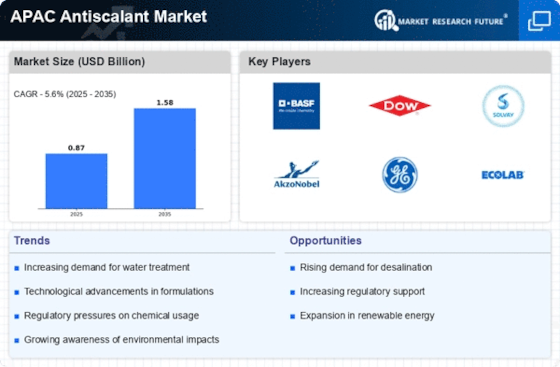
The APAC Antiscalant Market was valued at 0.8659 USD Billion in 2024.

What is the projected market size for the APAC Antiscalant Market by 2035?

The market is projected to reach 1.577 USD Billion by 2035.

What is the expected CAGR for the APAC Antiscalant Market during the forecast period?

The expected CAGR for the APAC Antiscalant Market from 2025 to 2035 is 5.6%.

Which companies are considered key players in the APAC Antiscalant Market?

Key players include BASF, Dow, Solvay, AkzoNobel, GE Water, Ecolab, SUEZ, Nalco Champion, and Clariant.

What are the main types of antiscalants in the APAC market?

Main types include Calcium Carbonate, Phosphonates, Sulphates, Fluorides, Magnesium, Calcium Sulfate, and Others.

Market Summary

As per MRFR analysis, the APAC Antiscalant Market Size was estimated at 0.8659 USD Billion in 2024. The antiscalant industry is projected to grow from 0.9144 in 2025 to 1.577 by 2035, exhibiting a compound annual growth rate (CAGR) of 5.6 during the forecast period 2025 - 2035.

Key Market Trends & Highlights

The APAC Antiscalant Market is poised for substantial growth driven by industrial demand and technological advancements.

  • The market experiences rising industrial demand, particularly in Asia-Pacific, which is currently the fastest-growing region.
  • There is an increasing focus on eco-friendly solutions, reflecting a broader trend towards sustainability in water treatment.
  • Technological advancements are reshaping the landscape, with innovations in both phosphonates and crystal modification segments.
  • Key market drivers include rising water scarcity and regulatory compliance, which are pushing industries towards effective antiscalant solutions.

Market Size & Forecast

2024 Market Size 0.8659 (USD Billion)
2035 Market Size 1.577 (USD Billion)
CAGR (2025 - 2035) 5.6%
Largest Regional Market Share in 2024 Asia Pacific

Major Players

<p>BASF (DE), Dow (US), Solvay (BE), AkzoNobel (NL), GE Water (US), Ecolab (US), SUEZ (FR), Nalco Champion (US), Clariant (CH)</p>

Market Trends

The APAC Antiscalant Market is currently experiencing a dynamic evolution, driven by increasing industrialization and the growing demand for water treatment solutions. As industries expand, the need for effective antiscalants to prevent scale formation in water systems becomes more pronounced. This trend is further fueled by stringent regulations aimed at ensuring water quality and sustainability. Companies are increasingly investing in research and development to create innovative formulations that enhance performance and reduce environmental impact. Moreover, the rising awareness of water scarcity issues across the region is prompting industries to adopt advanced technologies, thereby propelling the market forward. In addition, the APAC Antiscalant Market is witnessing a shift towards eco-friendly products. Manufacturers are focusing on developing biodegradable and non-toxic antiscalants to meet the demands of environmentally conscious consumers and regulatory bodies. This transition not only aligns with The APAC Antiscalant Market growth. As the region continues to prioritize sustainable practices, the adoption of green chemistry in antiscalant production is likely to gain momentum, indicating a promising future for the market. Overall, the APAC Antiscalant Market appears poised for substantial growth, driven by innovation, regulatory support, and a commitment to sustainability.

Rising Industrial Demand

The APAC Antiscalant Market is influenced by the increasing industrial activities across various sectors. Industries such as oil and gas, power generation, and manufacturing are expanding, leading to a heightened need for effective water treatment solutions. This demand for antiscalants is primarily driven by the necessity to maintain operational efficiency and prevent equipment damage caused by scale formation.

Focus on Eco-Friendly Solutions

There is a noticeable trend towards the development of environmentally friendly antiscalants within the APAC Antiscalant Market. Manufacturers are prioritizing the creation of biodegradable and non-toxic formulations to cater to the growing consumer preference for sustainable products. This shift not only addresses environmental concerns but also aligns with regulatory requirements aimed at reducing chemical impacts.

Technological Advancements

The APAC Antiscalant Market is benefiting from ongoing technological advancements in water treatment processes. Innovations in formulation chemistry and application techniques are enhancing the effectiveness of antiscalants. These advancements enable industries to achieve better scale control while minimizing chemical usage, thus improving overall operational efficiency and sustainability.

APAC Antiscalant Market Market Drivers

Rising Water Scarcity

The increasing scarcity of freshwater resources in the APAC region is a critical driver for the APAC Antiscalant Market. As industries and municipalities face challenges in sourcing adequate water supplies, the demand for effective water treatment solutions, including antiscalants, is likely to rise. Reports indicate that water scarcity affects over 1.5 billion people in the region, prompting a shift towards advanced water management practices. Antiscalants play a vital role in preventing scale formation in water treatment systems, thereby enhancing efficiency and reducing operational costs. This trend is expected to propel the growth of the APAC Antiscalant Market as stakeholders seek sustainable solutions to address water shortages.

Industrial Growth and Expansion

The rapid industrialization across various sectors in the APAC region is significantly influencing the APAC Antiscalant Market. Industries such as oil and gas, power generation, and manufacturing are expanding, leading to increased water usage and the need for effective water treatment solutions. The market for antiscalants is projected to grow at a compound annual growth rate (CAGR) of approximately 6% over the next few years, driven by the rising demand for water-intensive processes. As industries strive to optimize their operations and minimize downtime caused by scaling, the adoption of antiscalants is likely to become more prevalent, further stimulating market growth.

Regulatory Compliance and Standards

Stringent regulations regarding water quality and environmental protection are emerging as a significant driver for the APAC Antiscalant Market. Governments across the region are implementing stricter guidelines to ensure that industrial discharges meet specific quality standards. This regulatory landscape compels industries to adopt advanced water treatment solutions, including antiscalants, to comply with these requirements. The need for compliance not only enhances operational efficiency but also mitigates environmental impacts. As a result, the APAC Antiscalant Market is expected to witness increased demand as companies prioritize adherence to regulations while maintaining productivity.

Growing Awareness of Sustainable Practices

The increasing awareness of sustainable practices among industries and consumers is influencing the APAC Antiscalant Market. As environmental concerns gain prominence, there is a growing emphasis on adopting eco-friendly water treatment solutions. Antiscalants that are biodegradable and have minimal environmental impact are becoming more desirable. This shift towards sustainability is prompting manufacturers to innovate and develop greener formulations, aligning with consumer preferences. The APAC Antiscalant Market is likely to benefit from this trend as industries strive to enhance their sustainability profiles while ensuring effective water treatment solutions.

Technological Innovations in Water Treatment

Technological advancements in water treatment processes are reshaping the APAC Antiscalant Market. Innovations such as membrane filtration, reverse osmosis, and advanced chemical formulations are enhancing the effectiveness of antiscalants. These technologies enable industries to achieve higher efficiency in water treatment, thereby reducing costs and improving sustainability. The integration of smart technologies and automation in water management systems is also likely to drive the adoption of advanced antiscalants. As industries seek to leverage these innovations, the APAC Antiscalant Market is poised for growth, with a focus on enhancing performance and reducing environmental footprints.

Market Segment Insights

By Type: Phosphonates (Largest) vs. Calcium Carbonate (Fastest-Growing)

<p>In the APAC Antiscalant Market, the segment distribution reveals a diverse range of substances utilized to combat scaling in various industrial processes. Phosphonates dominate this segment, widely recognized for their effectiveness in preventing scale formation in water treatment and industrial applications. Other significant contributors include Calcium Carbonate, Sulphates, and Fluorides, which serve specific niches. While Calcium Carbonate maintains a steady presence in the market due to its natural occurrence and cost-effectiveness, it is witnessing an emerging growth trend, appealing to industries seeking more eco-friendly solutions. The growth dynamics within the APAC Antiscalant Market are influenced by increasing industrial activities and stringent regulations on water quality. Phosphonates demonstrate robust demand due to their versatility and performance, making them essential in water treatment and power generation sectors. Meanwhile, the fast-growing Calcium Carbonate segment is motivated by rising environmental awareness and the need for sustainable practices in manufacturing processes. Market players are innovating to enhance the efficiency and application scope of these antiscalants, further opening avenues for growth in the region.</p>

<p>Phosphonates (Dominant) vs. Calcium Carbonate (Emerging)</p>

<p>Phosphonates are the dominant type in the APAC Antiscalant Market, celebrated for their high efficacy in controlling scale deposits across various industries, including oil and gas, power generation, and water treatment. Their chemical stability and broad applicability render them a preferred choice, leading to their significant market share. On the other hand, Calcium Carbonate is emerging as a popular alternative, particularly favored for its eco-friendly profile and cost-efficiency. As industries shift towards sustainable practices, Calcium Carbonate's usage is expected to increase. These materials offer unique capabilities, fulfilling specific demands within the industry while forming a comprehensive portfolio that enriches the overall market landscape.</p>

By Method: Threshold Inhibition (Largest) vs. Crystal Modification (Fastest-Growing)

<p>In the APAC Antiscalant Market, the method segment showcases a diverse range of technologies, with Threshold Inhibition currently holding the largest market share. This method is favored for its ability to effectively prevent scale formation through chemical means, making it a go-to choice among industries reliant on water treatment. Following closely is the Crystal Modification technique, which is rapidly gaining traction due to its innovative approach to controlling scale deposition by altering crystal growth patterns. Growth trends within the segment are significantly influenced by increasing industrial activities and the rising need for efficient water treatment solutions. As water scarcity becomes a pressing issue within the region, the demand for effective antiscalants is projected to surge, propelling both Threshold Inhibition and Crystal Modification methods. Additionally, advancements in formulation technologies are set to enhance product performance, thereby further driving market growth.</p>

<p>Threshold Inhibition (Dominant) vs. Crystal Modification (Emerging)</p>

<p>Threshold Inhibition stands as the dominant method in the APAC Antiscalant Market, known for its efficacy in preventing scale deposition through specific chemical reactions that inhibit crystal nuclei formation. Its widespread adoption can be attributed to its effectiveness across various applications, including industrial water treatment and oil extraction. Conversely, Crystal Modification is emerging as an innovative solution that modifies the properties of scale-forming crystals, facilitating easier removal and reducing potential build-up. As industries seek more sustainable and efficient solutions, Crystal Modification is becoming increasingly popular due to its environmentally friendly characteristics and effectiveness in different water chemistries. Together, these methods represent a significant portion of market dynamics, each catering to unique needs across various sectors.</p>

By Ore: Aluminum (Largest) vs. Copper (Fastest-Growing)

<p>The APAC Antiscalant Market is significantly influenced by various ore segments, with Aluminum holding a dominant position in market share. This segment outpaces others in terms of demand, driven by extensive usage in the processing industry and manufacturing. Following closely are Iron and Copper, which together form a crucial part of this market landscape, while Gold and Cobalt, though smaller, play important roles in specialized applications. As the market evolves, Copper is emerging as the fastest-growing segment due to its increasing use in advanced technologies and renewable energy solutions. The rising emphasis on sustainability is also driving demand for more efficient antiscalants tailored for copper extraction processes. This shifting landscape presents new opportunities for market participants who are agile and innovative in addressing these trends.</p>

<p>Aluminum (Dominant) vs. Cobalt (Emerging)</p>

<p>Aluminum represents the dominant segment in the APAC Antiscalant Market, being extensively utilized in various applications such as metal processing and water treatment. Its ability to effectively prevent scaling and improve operational efficiency makes it a preferred choice among users. On the other hand, Cobalt is identified as an emerging segment with growing relevance in specific industries, particularly in battery material production and advanced materials. This rise can be attributed to its unique properties and applications, leading to increased investment and innovation in cobalt-based antiscalants. As industries shift towards eco-friendlier and high-efficiency solutions, these two segments will likely play pivotal roles in shaping the future of the antiscalant market, with manufacturers focusing on developing specialized products to meet diverse needs.</p>

Get more detailed insights about APAC Antiscalant Market Research Report - Till 2035

Regional Insights

North America : Established Market Leaders

The North American antiscalant market is driven by stringent regulations and a growing demand for water treatment solutions. The U.S. holds the largest market share at approximately 60%, followed by Canada at around 25%. Regulatory frameworks, such as the Clean Water Act, are pivotal in shaping market dynamics, pushing industries towards sustainable practices. Key players like Dow and Ecolab dominate the landscape, leveraging advanced technologies to enhance product efficiency. The competitive environment is characterized by innovation and strategic partnerships, ensuring a robust supply chain. The presence of major companies fosters a healthy market, with continuous investments in R&D to meet evolving customer needs.

Europe : Innovative Regulatory Environment

Europe's antiscalant market is characterized by a strong emphasis on sustainability and regulatory compliance. Germany and France are the largest markets, holding approximately 35% and 20% of the market share, respectively. The European Union's Water Framework Directive plays a crucial role in promoting eco-friendly solutions, driving demand for advanced antiscalants. Leading countries are investing heavily in research and development, with companies like BASF and Solvay at the forefront. The competitive landscape is marked by innovation, with a focus on developing biodegradable and non-toxic products. This commitment to sustainability is reshaping the market, ensuring compliance with stringent regulations while meeting customer demands.

Asia-Pacific : Emerging Market Potential

The Asia-Pacific antiscalant market is witnessing rapid growth, driven by industrialization and increasing water scarcity. China and India are the largest markets, accounting for approximately 40% and 25% of the total market share, respectively. The region's demand for efficient water treatment solutions is further fueled by government initiatives aimed at improving water quality and availability. Countries in this region are experiencing a surge in investments from key players like GE Water and Nalco Champion, who are expanding their operations to meet local demands. The competitive landscape is evolving, with a mix of The APAC Antiscalant Market share. This dynamic environment is fostering innovation and collaboration, essential for addressing the unique challenges faced by the region.

Middle East and Africa : Resource-Rich Opportunities

The Middle East and Africa antiscalant market is driven by the urgent need for effective water management solutions in arid regions. The UAE and South Africa are the largest markets, holding approximately 30% and 20% of the market share, respectively. The region's water scarcity issues are prompting governments to invest in advanced water treatment technologies, creating a favorable environment for antiscalant products. Key players like SUEZ and Clariant are actively participating in this market, focusing on innovative solutions tailored to local needs. The competitive landscape is characterized by partnerships and collaborations aimed at enhancing product offerings. As the region continues to develop its water infrastructure, the demand for effective antiscalants is expected to rise significantly.

Key Players and Competitive Insights

Leading market players are investing heavily in research and development in order to expand their product lines, which will help the antiscalant market, grow even more. Market participants are also undertaking a variety of strategic activities to expand their footprint, with important market developments including new product launches, contractual agreements, mergers and acquisitions, higher investments, and collaboration with other organizations. To expand and survive in a more competitive and rising market climate, antiscalant industry must offer cost-effective items.

Key Companies in the APAC Antiscalant Market market include

Industry Developments

Future Outlook

APAC Antiscalant Market Future Outlook

<p>The APAC Antiscalant Market is projected to grow at a 5.6% CAGR from 2024 to 2035, driven by increasing industrial water treatment needs and technological advancements.</p>

New opportunities lie in:

  • <p>Development of eco-friendly antiscalants for sustainable practices.</p>
  • <p>Integration of IoT for real-time monitoring of scaling conditions.</p>
  • <p>Expansion into emerging markets with tailored product offerings.</p>

<p>By 2035, the APAC Antiscalant Market is expected to achieve robust growth, reflecting evolving industry demands.</p>

Market Segmentation

APAC Antiscalant Market Ore Outlook

  • Aluminum
  • Iron
  • Copper
  • Gold
  • Cobalt
  • Nickel
  • Coal
  • Others

APAC Antiscalant Market Type Outlook

  • Calcium Carbonate
  • Phosphonates
  • Sulphates
  • Fluorides
  • Magnesium
  • Calcium Sulfate
  • Others

APAC Antiscalant Market Method Outlook

  • Threshold Inhibition
  • Crystal Modification
  • Dispersion

Report Scope

MARKET SIZE 20240.8659(USD Billion)
MARKET SIZE 20250.9144(USD Billion)
MARKET SIZE 20351.577(USD Billion)
COMPOUND ANNUAL GROWTH RATE (CAGR)5.6% (2024 - 2035)
REPORT COVERAGERevenue Forecast, Competitive Landscape, Growth Factors, and Trends
BASE YEAR2024
Market Forecast Period2025 - 2035
Historical Data2019 - 2024
Market Forecast UnitsUSD Billion
Key Companies ProfiledMarket analysis in progress
Segments CoveredMarket segmentation analysis in progress
Key Market OpportunitiesGrowing demand for sustainable water treatment solutions drives innovation in the APAC Antiscalant Market.
Key Market DynamicsRising demand for water treatment solutions drives innovation and competition in the APAC Antiscalant Market.
Countries CoveredNorth America, Europe, APAC, South America, MEA

FAQs

What is the current valuation of the APAC Antiscalant Market?

The APAC Antiscalant Market was valued at 0.8659 USD Billion in 2024.

What is the projected market size for the APAC Antiscalant Market by 2035?

The market is projected to reach 1.577 USD Billion by 2035.

What is the expected CAGR for the APAC Antiscalant Market during the forecast period?

The expected CAGR for the APAC Antiscalant Market from 2025 to 2035 is 5.6%.

Which companies are considered key players in the APAC Antiscalant Market?

Key players include BASF, Dow, Solvay, AkzoNobel, GE Water, Ecolab, SUEZ, Nalco Champion, and Clariant.

What are the main types of antiscalants in the APAC market?

Main types include Calcium Carbonate, Phosphonates, Sulphates, Fluorides, Magnesium, Calcium Sulfate, and Others.

  1. SECTION I: EXECUTIVE SUMMARY AND KEY HIGHLIGHTS
    1. EXECUTIVE SUMMARY
      1. Market Overview
      2. Key Findings
      3. Market Segmentation
      4. Competitive Landscape
      5. Challenges and Opportunities
      6. Future Outlook
  2. SECTION II: SCOPING, METHODOLOGY AND MARKET STRUCTURE
    1. MARKET INTRODUCTION
      1. Definition
      2. Scope of the study
    2. RESEARCH METHODOLOGY
      1. Overview
      2. Data Mining
      3. Secondary Research
      4. Primary Research
      5. Forecasting Model
      6. Market Size Estimation
      7. Data Triangulation
      8. Validation
  3. SECTION III: QUALITATIVE ANALYSIS
    1. MARKET DYNAMICS
      1. Overview
      2. Drivers
      3. Restraints
      4. Opportunities
    2. MARKET FACTOR ANALYSIS
      1. Value chain Analysis
      2. Porter's Five Forces Analysis
      3. COVID-19 Impact Analysis
  4. SECTION IV: QUANTITATIVE ANALYSIS
    1. Chemicals and Materials, BY Type (USD Billion)
      1. Calcium Carbonate
      2. Phosphonates
      3. Sulphates
      4. Fluorides
      5. Magnesium
      6. Calcium Sulfate
      7. Others
    2. Chemicals and Materials, BY Method (USD Billion)
      1. Threshold Inhibition
      2. Crystal Modification
      3. Dispersion
    3. Chemicals and Materials, BY Ore (USD Billion)
      1. Aluminum
      2. Iron
      3. Copper
      4. Gold
      5. Cobalt
      6. Nickel
      7. Coal
      8. Others
    4. Chemicals and Materials, BY Region (USD Billion)
      1. North America
      2. Europe
      3. APAC
      4. South America
      5. MEA
  5. SECTION V: COMPETITIVE ANALYSIS
    1. Competitive Landscape
      1. Overview
      2. Competitive Analysis
      3. Market share Analysis
      4. Major Growth Strategy in the Chemicals and Materials
      5. Competitive Benchmarking
      6. Leading Players in Terms of Number of Developments in the Chemicals and Materials
      7. Key developments and growth strategies
      8. Major Players Financial Matrix
    2. Company Profiles
      1. BASF (DE)
      2. Dow (US)
      3. Solvay (BE)
      4. AkzoNobel (NL)
      5. GE Water (US)
      6. Ecolab (US)
      7. SUEZ (FR)
      8. Nalco Champion (US)
      9. Clariant (CH)
    3. Appendix
      1. References
      2. Related Reports
  6. LIST OF FIGURES
    1. MARKET SYNOPSIS
    2. NORTH AMERICA MARKET ANALYSIS
    3. US MARKET ANALYSIS BY TYPE
    4. US MARKET ANALYSIS BY METHOD
    5. US MARKET ANALYSIS BY ORE
    6. CANADA MARKET ANALYSIS BY TYPE
    7. CANADA MARKET ANALYSIS BY METHOD
    8. CANADA MARKET ANALYSIS BY ORE
    9. EUROPE MARKET ANALYSIS
    10. GERMANY MARKET ANALYSIS BY TYPE
    11. GERMANY MARKET ANALYSIS BY METHOD
    12. GERMANY MARKET ANALYSIS BY ORE
    13. UK MARKET ANALYSIS BY TYPE
    14. UK MARKET ANALYSIS BY METHOD
    15. UK MARKET ANALYSIS BY ORE
    16. FRANCE MARKET ANALYSIS BY TYPE
    17. FRANCE MARKET ANALYSIS BY METHOD
    18. FRANCE MARKET ANALYSIS BY ORE
    19. RUSSIA MARKET ANALYSIS BY TYPE
    20. RUSSIA MARKET ANALYSIS BY METHOD
    21. RUSSIA MARKET ANALYSIS BY ORE
    22. ITALY MARKET ANALYSIS BY TYPE
    23. ITALY MARKET ANALYSIS BY METHOD
    24. ITALY MARKET ANALYSIS BY ORE
    25. SPAIN MARKET ANALYSIS BY TYPE
    26. SPAIN MARKET ANALYSIS BY METHOD
    27. SPAIN MARKET ANALYSIS BY ORE
    28. REST OF EUROPE MARKET ANALYSIS BY TYPE
    29. REST OF EUROPE MARKET ANALYSIS BY METHOD
    30. REST OF EUROPE MARKET ANALYSIS BY ORE
    31. APAC MARKET ANALYSIS
    32. CHINA MARKET ANALYSIS BY TYPE
    33. CHINA MARKET ANALYSIS BY METHOD
    34. CHINA MARKET ANALYSIS BY ORE
    35. INDIA MARKET ANALYSIS BY TYPE
    36. INDIA MARKET ANALYSIS BY METHOD
    37. INDIA MARKET ANALYSIS BY ORE
    38. JAPAN MARKET ANALYSIS BY TYPE
    39. JAPAN MARKET ANALYSIS BY METHOD
    40. JAPAN MARKET ANALYSIS BY ORE
    41. SOUTH KOREA MARKET ANALYSIS BY TYPE
    42. SOUTH KOREA MARKET ANALYSIS BY METHOD
    43. SOUTH KOREA MARKET ANALYSIS BY ORE
    44. MALAYSIA MARKET ANALYSIS BY TYPE
    45. MALAYSIA MARKET ANALYSIS BY METHOD
    46. MALAYSIA MARKET ANALYSIS BY ORE
    47. THAILAND MARKET ANALYSIS BY TYPE
    48. THAILAND MARKET ANALYSIS BY METHOD
    49. THAILAND MARKET ANALYSIS BY ORE
    50. INDONESIA MARKET ANALYSIS BY TYPE
    51. INDONESIA MARKET ANALYSIS BY METHOD
    52. INDONESIA MARKET ANALYSIS BY ORE
    53. REST OF APAC MARKET ANALYSIS BY TYPE
    54. REST OF APAC MARKET ANALYSIS BY METHOD
    55. REST OF APAC MARKET ANALYSIS BY ORE
    56. SOUTH AMERICA MARKET ANALYSIS
    57. BRAZIL MARKET ANALYSIS BY TYPE
    58. BRAZIL MARKET ANALYSIS BY METHOD
    59. BRAZIL MARKET ANALYSIS BY ORE
    60. MEXICO MARKET ANALYSIS BY TYPE
    61. MEXICO MARKET ANALYSIS BY METHOD
    62. MEXICO MARKET ANALYSIS BY ORE
    63. ARGENTINA MARKET ANALYSIS BY TYPE
    64. ARGENTINA MARKET ANALYSIS BY METHOD
    65. ARGENTINA MARKET ANALYSIS BY ORE
    66. REST OF SOUTH AMERICA MARKET ANALYSIS BY TYPE
    67. REST OF SOUTH AMERICA MARKET ANALYSIS BY METHOD
    68. REST OF SOUTH AMERICA MARKET ANALYSIS BY ORE
    69. MEA MARKET ANALYSIS
    70. GCC COUNTRIES MARKET ANALYSIS BY TYPE
    71. GCC COUNTRIES MARKET ANALYSIS BY METHOD
    72. GCC COUNTRIES MARKET ANALYSIS BY ORE
    73. SOUTH AFRICA MARKET ANALYSIS BY TYPE
    74. SOUTH AFRICA MARKET ANALYSIS BY METHOD
    75. SOUTH AFRICA MARKET ANALYSIS BY ORE
    76. REST OF MEA MARKET ANALYSIS BY TYPE
    77. REST OF MEA MARKET ANALYSIS BY METHOD
    78. REST OF MEA MARKET ANALYSIS BY ORE
    79. KEY BUYING CRITERIA OF CHEMICALS AND MATERIALS
    80. RESEARCH PROCESS OF MRFR
    81. DRO ANALYSIS OF CHEMICALS AND MATERIALS
    82. DRIVERS IMPACT ANALYSIS: CHEMICALS AND MATERIALS
    83. RESTRAINTS IMPACT ANALYSIS: CHEMICALS AND MATERIALS
    84. SUPPLY / VALUE CHAIN: CHEMICALS AND MATERIALS
    85. CHEMICALS AND MATERIALS, BY TYPE, 2024 (% SHARE)
    86. CHEMICALS AND MATERIALS, BY TYPE, 2024 TO 2035 (USD Billion)
    87. CHEMICALS AND MATERIALS, BY METHOD, 2024 (% SHARE)
    88. CHEMICALS AND MATERIALS, BY METHOD, 2024 TO 2035 (USD Billion)
    89. CHEMICALS AND MATERIALS, BY ORE, 2024 (% SHARE)
    90. CHEMICALS AND MATERIALS, BY ORE, 2024 TO 2035 (USD Billion)
    91. BENCHMARKING OF MAJOR COMPETITORS
  7. LIST OF TABLES
    1. LIST OF ASSUMPTIONS
    2. North America MARKET SIZE ESTIMATES; FORECAST
      1. BY TYPE, 2025-2035 (USD Billion)
      2. BY METHOD, 2025-2035 (USD Billion)
      3. BY ORE, 2025-2035 (USD Billion)
    3. US MARKET SIZE ESTIMATES; FORECAST
      1. BY TYPE, 2025-2035 (USD Billion)
      2. BY METHOD, 2025-2035 (USD Billion)
      3. BY ORE, 2025-2035 (USD Billion)
    4. Canada MARKET SIZE ESTIMATES; FORECAST
      1. BY TYPE, 2025-2035 (USD Billion)
      2. BY METHOD, 2025-2035 (USD Billion)
      3. BY ORE, 2025-2035 (USD Billion)
    5. Europe MARKET SIZE ESTIMATES; FORECAST
      1. BY TYPE, 2025-2035 (USD Billion)
      2. BY METHOD, 2025-2035 (USD Billion)
      3. BY ORE, 2025-2035 (USD Billion)
    6. Germany MARKET SIZE ESTIMATES; FORECAST
      1. BY TYPE, 2025-2035 (USD Billion)
      2. BY METHOD, 2025-2035 (USD Billion)
      3. BY ORE, 2025-2035 (USD Billion)
    7. UK MARKET SIZE ESTIMATES; FORECAST
      1. BY TYPE, 2025-2035 (USD Billion)
      2. BY METHOD, 2025-2035 (USD Billion)
      3. BY ORE, 2025-2035 (USD Billion)
    8. France MARKET SIZE ESTIMATES; FORECAST
      1. BY TYPE, 2025-2035 (USD Billion)
      2. BY METHOD, 2025-2035 (USD Billion)
      3. BY ORE, 2025-2035 (USD Billion)
    9. Russia MARKET SIZE ESTIMATES; FORECAST
      1. BY TYPE, 2025-2035 (USD Billion)
      2. BY METHOD, 2025-2035 (USD Billion)
      3. BY ORE, 2025-2035 (USD Billion)
    10. Italy MARKET SIZE ESTIMATES; FORECAST
      1. BY TYPE, 2025-2035 (USD Billion)
      2. BY METHOD, 2025-2035 (USD Billion)
      3. BY ORE, 2025-2035 (USD Billion)
    11. Spain MARKET SIZE ESTIMATES; FORECAST
      1. BY TYPE, 2025-2035 (USD Billion)
      2. BY METHOD, 2025-2035 (USD Billion)
      3. BY ORE, 2025-2035 (USD Billion)
    12. Rest of Europe MARKET SIZE ESTIMATES; FORECAST
      1. BY TYPE, 2025-2035 (USD Billion)
      2. BY METHOD, 2025-2035 (USD Billion)
      3. BY ORE, 2025-2035 (USD Billion)
    13. APAC MARKET SIZE ESTIMATES; FORECAST
      1. BY TYPE, 2025-2035 (USD Billion)
      2. BY METHOD, 2025-2035 (USD Billion)
      3. BY ORE, 2025-2035 (USD Billion)
    14. China MARKET SIZE ESTIMATES; FORECAST
      1. BY TYPE, 2025-2035 (USD Billion)
      2. BY METHOD, 2025-2035 (USD Billion)
      3. BY ORE, 2025-2035 (USD Billion)
    15. India MARKET SIZE ESTIMATES; FORECAST
      1. BY TYPE, 2025-2035 (USD Billion)
      2. BY METHOD, 2025-2035 (USD Billion)
      3. BY ORE, 2025-2035 (USD Billion)
    16. Japan MARKET SIZE ESTIMATES; FORECAST
      1. BY TYPE, 2025-2035 (USD Billion)
      2. BY METHOD, 2025-2035 (USD Billion)
      3. BY ORE, 2025-2035 (USD Billion)
    17. South Korea MARKET SIZE ESTIMATES; FORECAST
      1. BY TYPE, 2025-2035 (USD Billion)
      2. BY METHOD, 2025-2035 (USD Billion)
      3. BY ORE, 2025-2035 (USD Billion)
    18. Malaysia MARKET SIZE ESTIMATES; FORECAST
      1. BY TYPE, 2025-2035 (USD Billion)
      2. BY METHOD, 2025-2035 (USD Billion)
      3. BY ORE, 2025-2035 (USD Billion)
    19. Thailand MARKET SIZE ESTIMATES; FORECAST
      1. BY TYPE, 2025-2035 (USD Billion)
      2. BY METHOD, 2025-2035 (USD Billion)
      3. BY ORE, 2025-2035 (USD Billion)
    20. Indonesia MARKET SIZE ESTIMATES; FORECAST
      1. BY TYPE, 2025-2035 (USD Billion)
      2. BY METHOD, 2025-2035 (USD Billion)
      3. BY ORE, 2025-2035 (USD Billion)
    21. Rest of APAC MARKET SIZE ESTIMATES; FORECAST
      1. BY TYPE, 2025-2035 (USD Billion)
      2. BY METHOD, 2025-2035 (USD Billion)
      3. BY ORE, 2025-2035 (USD Billion)
    22. South America MARKET SIZE ESTIMATES; FORECAST
      1. BY TYPE, 2025-2035 (USD Billion)
      2. BY METHOD, 2025-2035 (USD Billion)
      3. BY ORE, 2025-2035 (USD Billion)
    23. Brazil MARKET SIZE ESTIMATES; FORECAST
      1. BY TYPE, 2025-2035 (USD Billion)
      2. BY METHOD, 2025-2035 (USD Billion)
      3. BY ORE, 2025-2035 (USD Billion)
    24. Mexico MARKET SIZE ESTIMATES; FORECAST
      1. BY TYPE, 2025-2035 (USD Billion)
      2. BY METHOD, 2025-2035 (USD Billion)
      3. BY ORE, 2025-2035 (USD Billion)
    25. Argentina MARKET SIZE ESTIMATES; FORECAST
      1. BY TYPE, 2025-2035 (USD Billion)
      2. BY METHOD, 2025-2035 (USD Billion)
      3. BY ORE, 2025-2035 (USD Billion)
    26. Rest of South America MARKET SIZE ESTIMATES; FORECAST
      1. BY TYPE, 2025-2035 (USD Billion)
      2. BY METHOD, 2025-2035 (USD Billion)
      3. BY ORE, 2025-2035 (USD Billion)
    27. MEA MARKET SIZE ESTIMATES; FORECAST
      1. BY TYPE, 2025-2035 (USD Billion)
      2. BY METHOD, 2025-2035 (USD Billion)
      3. BY ORE, 2025-2035 (USD Billion)
    28. GCC Countries MARKET SIZE ESTIMATES; FORECAST
      1. BY TYPE, 2025-2035 (USD Billion)
      2. BY METHOD, 2025-2035 (USD Billion)
      3. BY ORE, 2025-2035 (USD Billion)
    29. South Africa MARKET SIZE ESTIMATES; FORECAST
      1. BY TYPE, 2025-2035 (USD Billion)
      2. BY METHOD, 2025-2035 (USD Billion)
      3. BY ORE, 2025-2035 (USD Billion)
    30. Rest of MEA MARKET SIZE ESTIMATES; FORECAST
      1. BY TYPE, 2025-2035 (USD Billion)
      2. BY METHOD, 2025-2035 (USD Billion)
      3. BY ORE, 2025-2035 (USD Billion)
    31. PRODUCT LAUNCH/PRODUCT DEVELOPMENT/APPROVAL
    32. ACQUISITION/PARTNERSHIP

APAC Antiscalant Market Segmentation

Market Segmentation Overview

  • Detailed segmentation data will be available in the full report
  • Comprehensive analysis by multiple parameters
  • Regional and country-level breakdowns
  • Market size forecasts by segment
Infographic

Free Sample Request

Kindly complete the form below to receive a free sample of this Report

Get Free Sample

Customer Strories

Compare Licence

×
Features License Type
Single User Multiuser License Enterprise User
Price $4,950 $5,950 $7,250
Maximum User Access Limit 1 User Upto 10 Users Unrestricted Access Throughout the Organization
Free Customization
Direct Access to Analyst
Deliverable Format
Platform Access
Discount on Next Purchase 10% 15% 15%
Printable Versions