×
  • Cat-intel
  • MedIntelliX
  • Resources
  • About Us
  • Hero Background
    English
    Chinese
    French
    Japanese
    Korean
    German
    Spanish

    Aortic Valve Market Trends

    ID: MRFR/HC/7160-HCR
    90 Pages
    Kinjoll Dey
    October 2025

    Aortic Valve Market Research Report Information by Valve Type (Mechanical and Biological), Suture Type (Suture and Sutureless), Surgery Type (Minimally Invasive Surgery (Transfemoral, Transaortic Implantation, Transapical, and Trans-subclavian) and Open surgery), End-User (Hospitals, Ambulatory Surgery Centers) and Region (Americas, Europe, Asia-Pacific, and the Middle East & Africa) - Fore...

    Share:
    Download PDF ×

    We do not share your information with anyone. However, we may send you emails based on your report interest from time to time. You may contact us at any time to opt-out.

    Aortic Valve Market Infographic
    Purchase Options

    Market Trends

    Key Emerging Trends in the Aortic Valve Market

    The Aortic Valve Market sector is on a revolutionary wave developing in the context of improved medical technology, widening population aging, and rising rates of cardiovascular diseases. Notable becoming is the hiking of transcatheter aortic valve replacement (TAVR) through the use of less an invasive method of replacing surgical valve. TAVR procedures have today became widespread use as consecutively they are less invasive, recovery time is significantly reduced, and broad applicability to patients with high risk for surgery and even those considered unsuitable. This indicates movement towards the new way of approaching aortic valve interventions, which require the least invasive methods for achieving better results in patients.

    The med-tech market is experiencing the perfect time for the development of TAVR devices and systems. New technological developments in TAVR - such as valve designs, delivery systems and imaging procedures - result in the centralization and widespread use of TAVR procedures. However, this recent development is in line with long-term goals of improving the performance, efficacy and durability of TAVR thus widening indications of TAVR procedure to more patients.

    In addition there is an increasing interest in the growing field of next-generation tissue and mechanical valves alongside the surgical and transcatheter interventions. The evolution of biomaterials, durability, and better in terms of the hemodynamic performance of prosthetic aortic valves continues to be the goal in research and development so as to extend their durability and functionality. Hence, it signals attempts to minimize the shortcomings usually experienced with valve replacement with a view to achieving long-term endurance and effectiveness.

    The market now has to go through a trend that will place patient specific and precision medicine as the basis of aortic valve procedures. Through incorporating the most recent imaging, third dimension (3D) printing and artificial intelligence; patient specific treatment planning and device selection gets simplified and the desired winning result come to fruition. This tendency is the reflection of process-driven and individualized treatments of the aortic valve replacement, and of course this makes sense in context of precision medicine.

    Technological inventions in percutaneous and catheter-based aortic valve surgeries determine the aortic valve market size and outlook. The utilization of improved tools, methods, and methods of deployment increases the procedural efficiency and safety of aortic valve operation as well. The increasing trend is an indicator of the ongoing movement in the interventional cardiology field that leads to more precise and controlled valve implantations.

    In addition, the current segment is dilated with a growth in the utilization of aortic valve restoration techniques. The valve replacement surgery still continues to be an ace of practices; however, there is an increasing attention to repair procedures that retain the patients’ native valves. The shift towards these techniques matches the period of development where there is a quest for treatment procedures that offer the least harm but at the same time, they are life saving in nature.


    Author
    Kinjoll Dey
    Research Analyst Level I

    He is an extremely curious individual currently working in Healthcare and Medical Devices Domain. Kinjoll is comfortably versed in data centric research backed by healthcare educational background. He leverages extensive data mining and analytics tools such as Primary and Secondary Research, Statistical Analysis, Machine Learning, Data Modelling. His key role also involves Technical Sales Support, Client Interaction and Project management within the Healthcare team. Lastly, he showcases extensive affinity towards learning new skills and remain fascinated in implementing them.

    Leave a Comment

    FAQs

    At what CAGR is the Global Aortic Valve Market projected to grow in the forecast period (2024-2032)?

    Aortic Valve Market is projected to grow at approximately 15.02% CAGR during the assessment period (2024-2032).

    What was the value of the Global Aortic Valve Market in 2032?

    Aortic Valve Market had valued at around USD 47.59 Billion in 2032.

    What are the major tailwinds pushing the growth of the Global Aortic Valve Market?

    Surging prevalence of cardiac disorders and introduction of innovative products, are major tailwinds pushing the growth of the Global Aortic Valve Market.

    Which region holds the largest share in the Global Aortic Valve Market?

    North America holds the largest share in the Global Aortic Valve Market, followed by Europe and the Asia Pacific, respectively.

    Who are the top players in the Global Aortic Valve Market?

    Medtronic(US), TTK HealthCare (India), Boston Scientific Corporation (US), JenaValve (US), Abbott Laboratories (US), Biotronik (Germany), Edwards Lifesciences Corporation (2025US), Colibri Heart Valve (US), LivaNova PLC (UK), and CryoLife (US), are some of the top players operating in the Global Aortic Valve Market.

    Market Summary

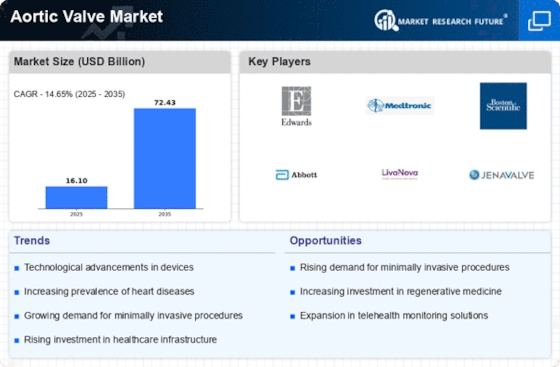
    As per MRFR analysis, the Aortic Valve Market Size was estimated at 16.1 USD Billion in 2024. The Aortic Valve industry is projected to grow from 18.46 USD Billion in 2025 to 72.43 USD Billion by 2035, exhibiting a compound annual growth rate (CAGR) of 14.65 during the forecast period 2025 - 2035.

    Key Market Trends & Highlights

    The Aortic Valve Market is poised for substantial growth driven by technological advancements and demographic shifts.

    • North America remains the largest market for aortic valves, driven by advanced healthcare infrastructure and high patient awareness.
    • The Asia-Pacific region is emerging as the fastest-growing market, fueled by increasing healthcare investments and a rising aging population.
    • Mechanical valves dominate the market, while biological valves are experiencing rapid growth due to their favorable patient outcomes.
    • Key market drivers include the rising incidence of aortic valve disorders and technological innovations in valve design, which are enhancing treatment options.

    Market Size & Forecast

    2024 Market Size 16.1 (USD Billion)
    2035 Market Size 72.43 (USD Billion)
    CAGR (2025 - 2035) 14.65%
    Largest Regional Market Share in 2024 Americas

    Major Players

    <p>Edwards Lifesciences (US), Medtronic (US), Boston Scientific (US), Abbott Laboratories (US), LivaNova (GB), JenaValve Technology (DE), Sorin Group (IT), CryoLife (US)</p>

    Market Trends

    The Aortic Valve Market is currently experiencing a dynamic evolution, driven by advancements in medical technology and an increasing prevalence of aortic valve diseases. Innovations in minimally invasive surgical techniques, such as transcatheter aortic valve replacement, are reshaping treatment paradigms, offering patients safer and more effective options. Furthermore, the growing geriatric population, which is more susceptible to cardiovascular conditions, is likely to contribute to the rising demand for aortic valve interventions. As healthcare systems worldwide adapt to these changes, the market appears poised for substantial growth, with a focus on improving patient outcomes and enhancing procedural efficiency. In addition to technological advancements, the Aortic Valve Market is influenced by regulatory developments and evolving reimbursement policies. These factors may create both challenges and opportunities for manufacturers and healthcare providers. The emphasis on value-based care is prompting stakeholders to seek solutions that not only address clinical needs but also align with economic considerations. As the landscape continues to shift, collaboration among industry players, healthcare professionals, and regulatory bodies will be essential in navigating the complexities of this market and ensuring sustainable growth in the years to come.

    Technological Advancements

    The Aortic Valve Market is witnessing rapid technological progress, particularly in the development of innovative devices and surgical techniques. Minimally invasive procedures are gaining traction, allowing for reduced recovery times and improved patient experiences. This trend is likely to enhance the overall efficiency of aortic valve interventions.

    Aging Population

    The increasing number of elderly individuals globally is contributing to a higher incidence of aortic valve diseases. This demographic shift is expected to drive demand for aortic valve replacements and repairs, as older adults are more prone to cardiovascular issues. Healthcare providers are adapting to meet this growing need.

    Regulatory Changes

    Evolving regulations and reimbursement frameworks are shaping the Aortic Valve Market. Stakeholders must navigate these changes to ensure compliance while also focusing on delivering value-based care. This trend may influence product development and market entry strategies for manufacturers.

    Aortic Valve Market Market Drivers

    Increasing Healthcare Expenditure

    Rising healthcare expenditure across various regions is significantly impacting the Aortic Valve Market. As governments and private sectors allocate more resources to healthcare, there is a corresponding increase in funding for cardiovascular treatments, including aortic valve procedures. This trend is particularly evident in developed economies, where healthcare spending is projected to grow at a compound annual growth rate of 5-7% over the next few years. Enhanced funding allows for better access to advanced medical technologies and surgical procedures, which in turn drives demand for aortic valve replacements. Consequently, this increase in healthcare expenditure is expected to bolster the Aortic Valve Market.

    Growing Awareness and Screening Programs

    The rise in awareness regarding heart health and the implementation of screening programs are contributing to the growth of the Aortic Valve Market. Public health initiatives aimed at educating individuals about cardiovascular diseases have led to earlier diagnosis and treatment of aortic valve disorders. Screening programs, particularly for high-risk populations, are becoming more prevalent, which facilitates timely interventions. This proactive approach not only improves patient outcomes but also increases the demand for aortic valve replacements and repairs. As awareness continues to grow, it is anticipated that the Aortic Valve Market will experience sustained growth driven by early detection and treatment.

    Technological Innovations in Valve Design

    Technological advancements in aortic valve design and materials are transforming the Aortic Valve Market. Innovations such as transcatheter aortic valve replacement (TAVR) and bioprosthetic valves have enhanced patient outcomes and reduced recovery times. The introduction of minimally invasive techniques has broadened the patient base eligible for treatment, thereby increasing market demand. Furthermore, the development of durable and biocompatible materials is expected to improve the longevity of valve replacements, which could lead to a higher adoption rate among healthcare providers. As these technologies continue to evolve, they are likely to play a crucial role in shaping the future landscape of the Aortic Valve Market.

    Rising Incidence of Aortic Valve Disorders

    The increasing prevalence of aortic valve disorders, such as aortic stenosis and regurgitation, is a primary driver of the Aortic Valve Market. As populations age, the incidence of these conditions rises, leading to a greater demand for surgical interventions and valve replacements. According to recent data, aortic stenosis affects approximately 2-7% of the population over 65 years, indicating a substantial market potential. This trend is likely to continue, as the aging demographic is projected to expand significantly in the coming years. Consequently, healthcare providers are increasingly focusing on innovative treatment options, which further stimulates growth within the Aortic Valve Market.

    Regulatory Support for Innovative Therapies

    Regulatory bodies are increasingly supporting the development and approval of innovative therapies within the Aortic Valve Market. Streamlined approval processes for new devices and treatments are encouraging manufacturers to invest in research and development. This regulatory environment fosters innovation, leading to the introduction of advanced aortic valve solutions that meet the evolving needs of patients and healthcare providers. As a result, the market is likely to witness a surge in new product launches, which could enhance competition and drive down costs. This supportive regulatory landscape is expected to play a pivotal role in shaping the future of the Aortic Valve Market.

    Market Segment Insights

    By Valve Type: Mechanical (Largest) vs. Biological (Fastest-Growing)

    <p>In the Aortic Valve Market, the distribution of market share between mechanical and biological valves shows a clear delineation of preferences. Mechanical valves, known for their durability and longevity, hold the largest share in the market, appealing primarily to patients requiring long-term solutions. They are often favored in younger populations who need a valve that can last for many years without the need for replacement. In contrast, biological valves, which are derived from animal tissues and are designed to mimic natural valvular function, are gaining traction among patients who favor a lower risk of clot formation and less need for lifelong anticoagulation therapy.</p>

    <p>Valve Type: Mechanical (Dominant) vs. Biological (Emerging)</p>

    <p>Mechanical valves are characterized by their robust design and long-lasting materials, making them a dominant choice among surgeons for patients seeking durability. Their ability to withstand the high pressures of the aortic circulation makes them particularly suitable for younger patients. Conversely, biological valves, often seen as an emerging option, offer significant advantages like reduced thromboembolic risk and a more natural flow dynamics, appealing particularly to the older demographic and those who may struggle with anticoagulation therapy. The demand for biological options is expected to rise as more patients prioritize reduced surgical risk and favored outcomes.</p>

    By Surgery Type: Minimally Invasive Surgeries (Largest) vs. Open Surgery (Fastest-Growing)

    <p>In the Aortic Valve Market, the distribution of surgeries is significantly skewed towards minimally invasive surgeries, which hold a prominent share due to advancements in surgical technology and greater patient acceptance. Minimally invasive procedures are preferred by both patients and healthcare providers as they offer reduced recovery times and lower complication rates. Open surgery has historically been the standard treatment but is losing ground as new techniques become available. Growth trends in this segment reveal a robust increase in the adoption of minimally invasive surgeries, propelled by technological innovations like robotic assistance and improvements in imaging techniques. On the other hand, open surgery is gaining momentum in certain demographics where traditional methods are still preferred, resulting in it being labeled as the fastest-growing segment. Factors such as aging populations and an increase in cardiovascular diseases are driving the demand for both approaches.</p>

    <p>Surgery Types: Minimally Invasive (Dominant) vs. Open (Emerging)</p>

    <p>Minimally invasive surgeries serve as the dominant approach in aortic valve procedures predominantly due to their effectiveness and patient-centric advantages such as less postoperative pain and shorter hospital stays. They leverage technologies like video-assisted thoracoscopic surgery, which enhance precision and reduce trauma to surrounding tissues. In contrast, open surgery, while increasingly considered an emerging alternative, is regaining attention as newer techniques improve outcomes for high-risk patients who may not qualify for minimally invasive approaches. This segment underscores a pivotal shift in surgical practice, where the focus is on balancing procedural risks with patient recovery experiences.</p>

    By End-User: Hospitals (Largest) vs. Ambulatory Surgery Centers (Fastest-Growing)

    <p>In the Aortic Valve Market, hospitals hold the largest share among end-users, as they are equipped with advanced medical technologies and a higher number of procedures performed. Ambulatory Surgery Centers (ASCs) follow closely, providing a cost-effective alternative for patients requiring less complex procedures. The distribution clearly illustrates hospitals' dominance, driven by their infrastructure and specialized surgical teams, while ASCs continue to grow in importance, thanks to increased patient preference for outpatient care.</p>

    <p>Hospitals (Dominant) vs. Ambulatory Surgery Centers (Emerging)</p>

    <p>Hospitals remain the dominant end-user segment in the Aortic Valve Market due to their established infrastructure, experienced surgical teams, and ability to handle complex cases. They provide comprehensive cardiac care, which is essential for successful aortic valve surgeries. On the other hand, Ambulatory Surgery Centers are emerging rapidly as a viable option for simpler procedures, attracting patients seeking lower costs and more convenience. ASCs benefit from advancements in surgical techniques and are increasingly favored by patients and physician groups alike for their efficiency and reduced recovery times, indicating a shift in how aortic valve procedures are approached.</p>

    Get more detailed insights about Aortic Valve Market Research Report - Global Forecast till 2035

    Regional Insights

    Key Companies in the Aortic Valve Market market include

    Industry Developments

    Future Outlook

    Aortic Valve Market Future Outlook

    <p>The Aortic Valve Market is projected to grow at a 14.65% CAGR from 2024 to 2035, driven by technological advancements, increasing prevalence of heart diseases, and rising geriatric population.</p>

    New opportunities lie in:

    • <p>Development of minimally invasive surgical techniques for aortic valve replacement.</p>
    • <p>Expansion of telehealth services for pre- and post-operative care.</p>
    • <p>Investment in bioprosthetic valve innovations to enhance patient outcomes.</p>

    <p>By 2035, the Aortic Valve Market is expected to achieve substantial growth and innovation.</p>

    Market Segmentation

    Aortic Valve Market End-User Outlook

    • Hospitals
    • Ambulatory Surgery Centers
    • Others

    Aortic Valve Market Valve Type Outlook

    • Mechanical
    • Biological

    Aortic Valve Market Surgery Type Outlook

    • Minimally invasive surgeries
    • Open surgery

    Report Scope

    MARKET SIZE 202416.1(USD Billion)
    MARKET SIZE 202518.46(USD Billion)
    MARKET SIZE 203572.43(USD Billion)
    COMPOUND ANNUAL GROWTH RATE (CAGR)14.65% (2024 - 2035)
    REPORT COVERAGERevenue Forecast, Competitive Landscape, Growth Factors, and Trends
    BASE YEAR2024
    Market Forecast Period2025 - 2035
    Historical Data2019 - 2024
    Market Forecast UnitsUSD Billion
    Key Companies ProfiledMarket analysis in progress
    Segments CoveredMarket segmentation analysis in progress
    Key Market OpportunitiesAdvancements in minimally invasive procedures enhance growth potential in the Aortic Valve Market.
    Key Market DynamicsTechnological advancements in minimally invasive procedures drive growth in the aortic valve market, enhancing patient outcomes.
    Countries CoveredNorth America, Europe, APAC, South America, MEA

    FAQs

    At what CAGR is the Global Aortic Valve Market projected to grow in the forecast period (2024-2032)?

    Aortic Valve Market is projected to grow at approximately 15.02% CAGR during the assessment period (2024-2032).

    What was the value of the Global Aortic Valve Market in 2032?

    Aortic Valve Market had valued at around USD 47.59 Billion in 2032.

    What are the major tailwinds pushing the growth of the Global Aortic Valve Market?

    Surging prevalence of cardiac disorders and introduction of innovative products, are major tailwinds pushing the growth of the Global Aortic Valve Market.

    Which region holds the largest share in the Global Aortic Valve Market?

    North America holds the largest share in the Global Aortic Valve Market, followed by Europe and the Asia Pacific, respectively.

    Who are the top players in the Global Aortic Valve Market?

    Medtronic(US), TTK HealthCare (India), Boston Scientific Corporation (US), JenaValve (US), Abbott Laboratories (US), Biotronik (Germany), Edwards Lifesciences Corporation (2025US), Colibri Heart Valve (US), LivaNova PLC (UK), and CryoLife (US), are some of the top players operating in the Global Aortic Valve Market.

    1. SECTION I: EXECUTIVE SUMMARY AND KEY HIGHLIGHTS
      1. | 1.1 EXECUTIVE SUMMARY
      2. | | 1.1.1 Market Overview
      3. | | 1.1.2 Key Findings
      4. | | 1.1.3 Market Segmentation
      5. | | 1.1.4 Competitive Landscape
      6. | | 1.1.5 Challenges and Opportunities
      7. | | 1.1.6 Future Outlook
    2. SECTION II: SCOPING, METHODOLOGY AND MARKET STRUCTURE
      1. | 2.1 MARKET INTRODUCTION
      2. | | 2.1.1 Definition
      3. | | 2.1.2 Scope of the study
      4. | | | 2.1.2.1 Research Objective
      5. | | | 2.1.2.2 Assumption
      6. | | | 2.1.2.3 Limitations
      7. | 2.2 RESEARCH METHODOLOGY
      8. | | 2.2.1 Overview
      9. | | 2.2.2 Data Mining
      10. | | 2.2.3 Secondary Research
      11. | | 2.2.4 Primary Research
      12. | | | 2.2.4.1 Primary Interviews and Information Gathering Process
      13. | | | 2.2.4.2 Breakdown of Primary Respondents
      14. | | 2.2.5 Forecasting Model
      15. | | 2.2.6 Market Size Estimation
      16. | | | 2.2.6.1 Bottom-Up Approach
      17. | | | 2.2.6.2 Top-Down Approach
      18. | | 2.2.7 Data Triangulation
      19. | | 2.2.8 Validation
    3. SECTION III: QUALITATIVE ANALYSIS
      1. | 3.1 MARKET DYNAMICS
      2. | | 3.1.1 Overview
      3. | | 3.1.2 Drivers
      4. | | 3.1.3 Restraints
      5. | | 3.1.4 Opportunities
      6. | 3.2 MARKET FACTOR ANALYSIS
      7. | | 3.2.1 Value chain Analysis
      8. | | 3.2.2 Porter's Five Forces Analysis
      9. | | | 3.2.2.1 Bargaining Power of Suppliers
      10. | | | 3.2.2.2 Bargaining Power of Buyers
      11. | | | 3.2.2.3 Threat of New Entrants
      12. | | | 3.2.2.4 Threat of Substitutes
      13. | | | 3.2.2.5 Intensity of Rivalry
      14. | | 3.2.3 COVID-19 Impact Analysis
      15. | | | 3.2.3.1 Market Impact Analysis
      16. | | | 3.2.3.2 Regional Impact
      17. | | | 3.2.3.3 Opportunity and Threat Analysis
    4. SECTION IV: QUANTITATIVE ANALYSIS
      1. | 4.1 Healthcare, BY Valve Type (USD Billion)
      2. | | 4.1.1 Mechanical
      3. | | 4.1.2 Biological
      4. | 4.2 Healthcare, BY Surgery Type (USD Billion)
      5. | | 4.2.1 Minimally invasive surgeries
      6. | | 4.2.2 Open surgery
      7. | 4.3 Healthcare, BY End-User (USD Billion)
      8. | | 4.3.1 Hospitals
      9. | | 4.3.2 Ambulatory Surgery Centers
      10. | | 4.3.3 Others
      11. | 4.4 Healthcare, BY Region (USD Billion)
      12. | | 4.4.1 North America
      13. | | | 4.4.1.1 US
      14. | | | 4.4.1.2 Canada
      15. | | 4.4.2 Europe
      16. | | | 4.4.2.1 Germany
      17. | | | 4.4.2.2 UK
      18. | | | 4.4.2.3 France
      19. | | | 4.4.2.4 Russia
      20. | | | 4.4.2.5 Italy
      21. | | | 4.4.2.6 Spain
      22. | | | 4.4.2.7 Rest of Europe
      23. | | 4.4.3 APAC
      24. | | | 4.4.3.1 China
      25. | | | 4.4.3.2 India
      26. | | | 4.4.3.3 Japan
      27. | | | 4.4.3.4 South Korea
      28. | | | 4.4.3.5 Malaysia
      29. | | | 4.4.3.6 Thailand
      30. | | | 4.4.3.7 Indonesia
      31. | | | 4.4.3.8 Rest of APAC
      32. | | 4.4.4 South America
      33. | | | 4.4.4.1 Brazil
      34. | | | 4.4.4.2 Mexico
      35. | | | 4.4.4.3 Argentina
      36. | | | 4.4.4.4 Rest of South America
      37. | | 4.4.5 MEA
      38. | | | 4.4.5.1 GCC Countries
      39. | | | 4.4.5.2 South Africa
      40. | | | 4.4.5.3 Rest of MEA
    5. SECTION V: COMPETITIVE ANALYSIS
      1. | 5.1 Competitive Landscape
      2. | | 5.1.1 Overview
      3. | | 5.1.2 Competitive Analysis
      4. | | 5.1.3 Market share Analysis
      5. | | 5.1.4 Major Growth Strategy in the Healthcare
      6. | | 5.1.5 Competitive Benchmarking
      7. | | 5.1.6 Leading Players in Terms of Number of Developments in the Healthcare
      8. | | 5.1.7 Key developments and growth strategies
      9. | | | 5.1.7.1 New Product Launch/Service Deployment
      10. | | | 5.1.7.2 Merger & Acquisitions
      11. | | | 5.1.7.3 Joint Ventures
      12. | | 5.1.8 Major Players Financial Matrix
      13. | | | 5.1.8.1 Sales and Operating Income
      14. | | | 5.1.8.2 Major Players R&D Expenditure. 2023
      15. | 5.2 Company Profiles
      16. | | 5.2.1 Edwards Lifesciences (US)
      17. | | | 5.2.1.1 Financial Overview
      18. | | | 5.2.1.2 Products Offered
      19. | | | 5.2.1.3 Key Developments
      20. | | | 5.2.1.4 SWOT Analysis
      21. | | | 5.2.1.5 Key Strategies
      22. | | 5.2.2 Medtronic (US)
      23. | | | 5.2.2.1 Financial Overview
      24. | | | 5.2.2.2 Products Offered
      25. | | | 5.2.2.3 Key Developments
      26. | | | 5.2.2.4 SWOT Analysis
      27. | | | 5.2.2.5 Key Strategies
      28. | | 5.2.3 Boston Scientific (US)
      29. | | | 5.2.3.1 Financial Overview
      30. | | | 5.2.3.2 Products Offered
      31. | | | 5.2.3.3 Key Developments
      32. | | | 5.2.3.4 SWOT Analysis
      33. | | | 5.2.3.5 Key Strategies
      34. | | 5.2.4 Abbott Laboratories (US)
      35. | | | 5.2.4.1 Financial Overview
      36. | | | 5.2.4.2 Products Offered
      37. | | | 5.2.4.3 Key Developments
      38. | | | 5.2.4.4 SWOT Analysis
      39. | | | 5.2.4.5 Key Strategies
      40. | | 5.2.5 LivaNova (GB)
      41. | | | 5.2.5.1 Financial Overview
      42. | | | 5.2.5.2 Products Offered
      43. | | | 5.2.5.3 Key Developments
      44. | | | 5.2.5.4 SWOT Analysis
      45. | | | 5.2.5.5 Key Strategies
      46. | | 5.2.6 JenaValve Technology (DE)
      47. | | | 5.2.6.1 Financial Overview
      48. | | | 5.2.6.2 Products Offered
      49. | | | 5.2.6.3 Key Developments
      50. | | | 5.2.6.4 SWOT Analysis
      51. | | | 5.2.6.5 Key Strategies
      52. | | 5.2.7 Sorin Group (IT)
      53. | | | 5.2.7.1 Financial Overview
      54. | | | 5.2.7.2 Products Offered
      55. | | | 5.2.7.3 Key Developments
      56. | | | 5.2.7.4 SWOT Analysis
      57. | | | 5.2.7.5 Key Strategies
      58. | | 5.2.8 CryoLife (US)
      59. | | | 5.2.8.1 Financial Overview
      60. | | | 5.2.8.2 Products Offered
      61. | | | 5.2.8.3 Key Developments
      62. | | | 5.2.8.4 SWOT Analysis
      63. | | | 5.2.8.5 Key Strategies
      64. | 5.3 Appendix
      65. | | 5.3.1 References
      66. | | 5.3.2 Related Reports
    6. LIST OF FIGURES
      1. | 6.1 MARKET SYNOPSIS
      2. | 6.2 NORTH AMERICA MARKET ANALYSIS
      3. | 6.3 US MARKET ANALYSIS BY VALVE TYPE
      4. | 6.4 US MARKET ANALYSIS BY SURGERY TYPE
      5. | 6.5 US MARKET ANALYSIS BY END-USER
      6. | 6.6 CANADA MARKET ANALYSIS BY VALVE TYPE
      7. | 6.7 CANADA MARKET ANALYSIS BY SURGERY TYPE
      8. | 6.8 CANADA MARKET ANALYSIS BY END-USER
      9. | 6.9 EUROPE MARKET ANALYSIS
      10. | 6.10 GERMANY MARKET ANALYSIS BY VALVE TYPE
      11. | 6.11 GERMANY MARKET ANALYSIS BY SURGERY TYPE
      12. | 6.12 GERMANY MARKET ANALYSIS BY END-USER
      13. | 6.13 UK MARKET ANALYSIS BY VALVE TYPE
      14. | 6.14 UK MARKET ANALYSIS BY SURGERY TYPE
      15. | 6.15 UK MARKET ANALYSIS BY END-USER
      16. | 6.16 FRANCE MARKET ANALYSIS BY VALVE TYPE
      17. | 6.17 FRANCE MARKET ANALYSIS BY SURGERY TYPE
      18. | 6.18 FRANCE MARKET ANALYSIS BY END-USER
      19. | 6.19 RUSSIA MARKET ANALYSIS BY VALVE TYPE
      20. | 6.20 RUSSIA MARKET ANALYSIS BY SURGERY TYPE
      21. | 6.21 RUSSIA MARKET ANALYSIS BY END-USER
      22. | 6.22 ITALY MARKET ANALYSIS BY VALVE TYPE
      23. | 6.23 ITALY MARKET ANALYSIS BY SURGERY TYPE
      24. | 6.24 ITALY MARKET ANALYSIS BY END-USER
      25. | 6.25 SPAIN MARKET ANALYSIS BY VALVE TYPE
      26. | 6.26 SPAIN MARKET ANALYSIS BY SURGERY TYPE
      27. | 6.27 SPAIN MARKET ANALYSIS BY END-USER
      28. | 6.28 REST OF EUROPE MARKET ANALYSIS BY VALVE TYPE
      29. | 6.29 REST OF EUROPE MARKET ANALYSIS BY SURGERY TYPE
      30. | 6.30 REST OF EUROPE MARKET ANALYSIS BY END-USER
      31. | 6.31 APAC MARKET ANALYSIS
      32. | 6.32 CHINA MARKET ANALYSIS BY VALVE TYPE
      33. | 6.33 CHINA MARKET ANALYSIS BY SURGERY TYPE
      34. | 6.34 CHINA MARKET ANALYSIS BY END-USER
      35. | 6.35 INDIA MARKET ANALYSIS BY VALVE TYPE
      36. | 6.36 INDIA MARKET ANALYSIS BY SURGERY TYPE
      37. | 6.37 INDIA MARKET ANALYSIS BY END-USER
      38. | 6.38 JAPAN MARKET ANALYSIS BY VALVE TYPE
      39. | 6.39 JAPAN MARKET ANALYSIS BY SURGERY TYPE
      40. | 6.40 JAPAN MARKET ANALYSIS BY END-USER
      41. | 6.41 SOUTH KOREA MARKET ANALYSIS BY VALVE TYPE
      42. | 6.42 SOUTH KOREA MARKET ANALYSIS BY SURGERY TYPE
      43. | 6.43 SOUTH KOREA MARKET ANALYSIS BY END-USER
      44. | 6.44 MALAYSIA MARKET ANALYSIS BY VALVE TYPE
      45. | 6.45 MALAYSIA MARKET ANALYSIS BY SURGERY TYPE
      46. | 6.46 MALAYSIA MARKET ANALYSIS BY END-USER
      47. | 6.47 THAILAND MARKET ANALYSIS BY VALVE TYPE
      48. | 6.48 THAILAND MARKET ANALYSIS BY SURGERY TYPE
      49. | 6.49 THAILAND MARKET ANALYSIS BY END-USER
      50. | 6.50 INDONESIA MARKET ANALYSIS BY VALVE TYPE
      51. | 6.51 INDONESIA MARKET ANALYSIS BY SURGERY TYPE
      52. | 6.52 INDONESIA MARKET ANALYSIS BY END-USER
      53. | 6.53 REST OF APAC MARKET ANALYSIS BY VALVE TYPE
      54. | 6.54 REST OF APAC MARKET ANALYSIS BY SURGERY TYPE
      55. | 6.55 REST OF APAC MARKET ANALYSIS BY END-USER
      56. | 6.56 SOUTH AMERICA MARKET ANALYSIS
      57. | 6.57 BRAZIL MARKET ANALYSIS BY VALVE TYPE
      58. | 6.58 BRAZIL MARKET ANALYSIS BY SURGERY TYPE
      59. | 6.59 BRAZIL MARKET ANALYSIS BY END-USER
      60. | 6.60 MEXICO MARKET ANALYSIS BY VALVE TYPE
      61. | 6.61 MEXICO MARKET ANALYSIS BY SURGERY TYPE
      62. | 6.62 MEXICO MARKET ANALYSIS BY END-USER
      63. | 6.63 ARGENTINA MARKET ANALYSIS BY VALVE TYPE
      64. | 6.64 ARGENTINA MARKET ANALYSIS BY SURGERY TYPE
      65. | 6.65 ARGENTINA MARKET ANALYSIS BY END-USER
      66. | 6.66 REST OF SOUTH AMERICA MARKET ANALYSIS BY VALVE TYPE
      67. | 6.67 REST OF SOUTH AMERICA MARKET ANALYSIS BY SURGERY TYPE
      68. | 6.68 REST OF SOUTH AMERICA MARKET ANALYSIS BY END-USER
      69. | 6.69 MEA MARKET ANALYSIS
      70. | 6.70 GCC COUNTRIES MARKET ANALYSIS BY VALVE TYPE
      71. | 6.71 GCC COUNTRIES MARKET ANALYSIS BY SURGERY TYPE
      72. | 6.72 GCC COUNTRIES MARKET ANALYSIS BY END-USER
      73. | 6.73 SOUTH AFRICA MARKET ANALYSIS BY VALVE TYPE
      74. | 6.74 SOUTH AFRICA MARKET ANALYSIS BY SURGERY TYPE
      75. | 6.75 SOUTH AFRICA MARKET ANALYSIS BY END-USER
      76. | 6.76 REST OF MEA MARKET ANALYSIS BY VALVE TYPE
      77. | 6.77 REST OF MEA MARKET ANALYSIS BY SURGERY TYPE
      78. | 6.78 REST OF MEA MARKET ANALYSIS BY END-USER
      79. | 6.79 KEY BUYING CRITERIA OF HEALTHCARE
      80. | 6.80 RESEARCH PROCESS OF MRFR
      81. | 6.81 DRO ANALYSIS OF HEALTHCARE
      82. | 6.82 DRIVERS IMPACT ANALYSIS: HEALTHCARE
      83. | 6.83 RESTRAINTS IMPACT ANALYSIS: HEALTHCARE
      84. | 6.84 SUPPLY / VALUE CHAIN: HEALTHCARE
      85. | 6.85 HEALTHCARE, BY VALVE TYPE, 2024 (% SHARE)
      86. | 6.86 HEALTHCARE, BY VALVE TYPE, 2024 TO 2035 (USD Billion)
      87. | 6.87 HEALTHCARE, BY SURGERY TYPE, 2024 (% SHARE)
      88. | 6.88 HEALTHCARE, BY SURGERY TYPE, 2024 TO 2035 (USD Billion)
      89. | 6.89 HEALTHCARE, BY END-USER, 2024 (% SHARE)
      90. | 6.90 HEALTHCARE, BY END-USER, 2024 TO 2035 (USD Billion)
      91. | 6.91 BENCHMARKING OF MAJOR COMPETITORS
    7. LIST OF TABLES
      1. | 7.1 LIST OF ASSUMPTIONS
      2. | | 7.1.1
      3. | 7.2 North America MARKET SIZE ESTIMATES; FORECAST
      4. | | 7.2.1 BY VALVE TYPE, 2025-2035 (USD Billion)
      5. | | 7.2.2 BY SURGERY TYPE, 2025-2035 (USD Billion)
      6. | | 7.2.3 BY END-USER, 2025-2035 (USD Billion)
      7. | 7.3 US MARKET SIZE ESTIMATES; FORECAST
      8. | | 7.3.1 BY VALVE TYPE, 2025-2035 (USD Billion)
      9. | | 7.3.2 BY SURGERY TYPE, 2025-2035 (USD Billion)
      10. | | 7.3.3 BY END-USER, 2025-2035 (USD Billion)
      11. | 7.4 Canada MARKET SIZE ESTIMATES; FORECAST
      12. | | 7.4.1 BY VALVE TYPE, 2025-2035 (USD Billion)
      13. | | 7.4.2 BY SURGERY TYPE, 2025-2035 (USD Billion)
      14. | | 7.4.3 BY END-USER, 2025-2035 (USD Billion)
      15. | 7.5 Europe MARKET SIZE ESTIMATES; FORECAST
      16. | | 7.5.1 BY VALVE TYPE, 2025-2035 (USD Billion)
      17. | | 7.5.2 BY SURGERY TYPE, 2025-2035 (USD Billion)
      18. | | 7.5.3 BY END-USER, 2025-2035 (USD Billion)
      19. | 7.6 Germany MARKET SIZE ESTIMATES; FORECAST
      20. | | 7.6.1 BY VALVE TYPE, 2025-2035 (USD Billion)
      21. | | 7.6.2 BY SURGERY TYPE, 2025-2035 (USD Billion)
      22. | | 7.6.3 BY END-USER, 2025-2035 (USD Billion)
      23. | 7.7 UK MARKET SIZE ESTIMATES; FORECAST
      24. | | 7.7.1 BY VALVE TYPE, 2025-2035 (USD Billion)
      25. | | 7.7.2 BY SURGERY TYPE, 2025-2035 (USD Billion)
      26. | | 7.7.3 BY END-USER, 2025-2035 (USD Billion)
      27. | 7.8 France MARKET SIZE ESTIMATES; FORECAST
      28. | | 7.8.1 BY VALVE TYPE, 2025-2035 (USD Billion)
      29. | | 7.8.2 BY SURGERY TYPE, 2025-2035 (USD Billion)
      30. | | 7.8.3 BY END-USER, 2025-2035 (USD Billion)
      31. | 7.9 Russia MARKET SIZE ESTIMATES; FORECAST
      32. | | 7.9.1 BY VALVE TYPE, 2025-2035 (USD Billion)
      33. | | 7.9.2 BY SURGERY TYPE, 2025-2035 (USD Billion)
      34. | | 7.9.3 BY END-USER, 2025-2035 (USD Billion)
      35. | 7.10 Italy MARKET SIZE ESTIMATES; FORECAST
      36. | | 7.10.1 BY VALVE TYPE, 2025-2035 (USD Billion)
      37. | | 7.10.2 BY SURGERY TYPE, 2025-2035 (USD Billion)
      38. | | 7.10.3 BY END-USER, 2025-2035 (USD Billion)
      39. | 7.11 Spain MARKET SIZE ESTIMATES; FORECAST
      40. | | 7.11.1 BY VALVE TYPE, 2025-2035 (USD Billion)
      41. | | 7.11.2 BY SURGERY TYPE, 2025-2035 (USD Billion)
      42. | | 7.11.3 BY END-USER, 2025-2035 (USD Billion)
      43. | 7.12 Rest of Europe MARKET SIZE ESTIMATES; FORECAST
      44. | | 7.12.1 BY VALVE TYPE, 2025-2035 (USD Billion)
      45. | | 7.12.2 BY SURGERY TYPE, 2025-2035 (USD Billion)
      46. | | 7.12.3 BY END-USER, 2025-2035 (USD Billion)
      47. | 7.13 APAC MARKET SIZE ESTIMATES; FORECAST
      48. | | 7.13.1 BY VALVE TYPE, 2025-2035 (USD Billion)
      49. | | 7.13.2 BY SURGERY TYPE, 2025-2035 (USD Billion)
      50. | | 7.13.3 BY END-USER, 2025-2035 (USD Billion)
      51. | 7.14 China MARKET SIZE ESTIMATES; FORECAST
      52. | | 7.14.1 BY VALVE TYPE, 2025-2035 (USD Billion)
      53. | | 7.14.2 BY SURGERY TYPE, 2025-2035 (USD Billion)
      54. | | 7.14.3 BY END-USER, 2025-2035 (USD Billion)
      55. | 7.15 India MARKET SIZE ESTIMATES; FORECAST
      56. | | 7.15.1 BY VALVE TYPE, 2025-2035 (USD Billion)
      57. | | 7.15.2 BY SURGERY TYPE, 2025-2035 (USD Billion)
      58. | | 7.15.3 BY END-USER, 2025-2035 (USD Billion)
      59. | 7.16 Japan MARKET SIZE ESTIMATES; FORECAST
      60. | | 7.16.1 BY VALVE TYPE, 2025-2035 (USD Billion)
      61. | | 7.16.2 BY SURGERY TYPE, 2025-2035 (USD Billion)
      62. | | 7.16.3 BY END-USER, 2025-2035 (USD Billion)
      63. | 7.17 South Korea MARKET SIZE ESTIMATES; FORECAST
      64. | | 7.17.1 BY VALVE TYPE, 2025-2035 (USD Billion)
      65. | | 7.17.2 BY SURGERY TYPE, 2025-2035 (USD Billion)
      66. | | 7.17.3 BY END-USER, 2025-2035 (USD Billion)
      67. | 7.18 Malaysia MARKET SIZE ESTIMATES; FORECAST
      68. | | 7.18.1 BY VALVE TYPE, 2025-2035 (USD Billion)
      69. | | 7.18.2 BY SURGERY TYPE, 2025-2035 (USD Billion)
      70. | | 7.18.3 BY END-USER, 2025-2035 (USD Billion)
      71. | 7.19 Thailand MARKET SIZE ESTIMATES; FORECAST
      72. | | 7.19.1 BY VALVE TYPE, 2025-2035 (USD Billion)
      73. | | 7.19.2 BY SURGERY TYPE, 2025-2035 (USD Billion)
      74. | | 7.19.3 BY END-USER, 2025-2035 (USD Billion)
      75. | 7.20 Indonesia MARKET SIZE ESTIMATES; FORECAST
      76. | | 7.20.1 BY VALVE TYPE, 2025-2035 (USD Billion)
      77. | | 7.20.2 BY SURGERY TYPE, 2025-2035 (USD Billion)
      78. | | 7.20.3 BY END-USER, 2025-2035 (USD Billion)
      79. | 7.21 Rest of APAC MARKET SIZE ESTIMATES; FORECAST
      80. | | 7.21.1 BY VALVE TYPE, 2025-2035 (USD Billion)
      81. | | 7.21.2 BY SURGERY TYPE, 2025-2035 (USD Billion)
      82. | | 7.21.3 BY END-USER, 2025-2035 (USD Billion)
      83. | 7.22 South America MARKET SIZE ESTIMATES; FORECAST
      84. | | 7.22.1 BY VALVE TYPE, 2025-2035 (USD Billion)
      85. | | 7.22.2 BY SURGERY TYPE, 2025-2035 (USD Billion)
      86. | | 7.22.3 BY END-USER, 2025-2035 (USD Billion)
      87. | 7.23 Brazil MARKET SIZE ESTIMATES; FORECAST
      88. | | 7.23.1 BY VALVE TYPE, 2025-2035 (USD Billion)
      89. | | 7.23.2 BY SURGERY TYPE, 2025-2035 (USD Billion)
      90. | | 7.23.3 BY END-USER, 2025-2035 (USD Billion)
      91. | 7.24 Mexico MARKET SIZE ESTIMATES; FORECAST
      92. | | 7.24.1 BY VALVE TYPE, 2025-2035 (USD Billion)
      93. | | 7.24.2 BY SURGERY TYPE, 2025-2035 (USD Billion)
      94. | | 7.24.3 BY END-USER, 2025-2035 (USD Billion)
      95. | 7.25 Argentina MARKET SIZE ESTIMATES; FORECAST
      96. | | 7.25.1 BY VALVE TYPE, 2025-2035 (USD Billion)
      97. | | 7.25.2 BY SURGERY TYPE, 2025-2035 (USD Billion)
      98. | | 7.25.3 BY END-USER, 2025-2035 (USD Billion)
      99. | 7.26 Rest of South America MARKET SIZE ESTIMATES; FORECAST
      100. | | 7.26.1 BY VALVE TYPE, 2025-2035 (USD Billion)
      101. | | 7.26.2 BY SURGERY TYPE, 2025-2035 (USD Billion)
      102. | | 7.26.3 BY END-USER, 2025-2035 (USD Billion)
      103. | 7.27 MEA MARKET SIZE ESTIMATES; FORECAST
      104. | | 7.27.1 BY VALVE TYPE, 2025-2035 (USD Billion)
      105. | | 7.27.2 BY SURGERY TYPE, 2025-2035 (USD Billion)
      106. | | 7.27.3 BY END-USER, 2025-2035 (USD Billion)
      107. | 7.28 GCC Countries MARKET SIZE ESTIMATES; FORECAST
      108. | | 7.28.1 BY VALVE TYPE, 2025-2035 (USD Billion)
      109. | | 7.28.2 BY SURGERY TYPE, 2025-2035 (USD Billion)
      110. | | 7.28.3 BY END-USER, 2025-2035 (USD Billion)
      111. | 7.29 South Africa MARKET SIZE ESTIMATES; FORECAST
      112. | | 7.29.1 BY VALVE TYPE, 2025-2035 (USD Billion)
      113. | | 7.29.2 BY SURGERY TYPE, 2025-2035 (USD Billion)
      114. | | 7.29.3 BY END-USER, 2025-2035 (USD Billion)
      115. | 7.30 Rest of MEA MARKET SIZE ESTIMATES; FORECAST
      116. | | 7.30.1 BY VALVE TYPE, 2025-2035 (USD Billion)
      117. | | 7.30.2 BY SURGERY TYPE, 2025-2035 (USD Billion)
      118. | | 7.30.3 BY END-USER, 2025-2035 (USD Billion)
      119. | 7.31 PRODUCT LAUNCH/PRODUCT DEVELOPMENT/APPROVAL
      120. | | 7.31.1
      121. | 7.32 ACQUISITION/PARTNERSHIP
      122. | | 7.32.1

    Aortic Valve Market Segmentation

    Market Segmentation Overview

    • Detailed segmentation data will be available in the full report
    • Comprehensive analysis by multiple parameters
    • Regional and country-level breakdowns
    • Market size forecasts by segment
    Infographic

    Free Sample Request

    Kindly complete the form below to receive a free sample of this Report

    Get Free Sample

    Customer Strories

    “I am very pleased with how market segments have been defined in a relevant way for my purposes (such as "Portable Freezers & refrigerators" and "last-mile"). In general the report is well structured. Thanks very much for your efforts.”

    Victoria Milne

    Founder
    Case Study
    Chemicals and Materials

    Compare Licence

    ×
    Features License Type
    Single User Multiuser License Enterprise User
    Price $4,950 $5,950 $7,250
    Maximum User Access Limit 1 User Upto 10 Users Unrestricted Access Throughout the Organization
    Free Customization
    Direct Access to Analyst
    Deliverable Format
    Platform Access
    Discount on Next Purchase 10% 15% 15%
    Printable Versions