Request Free Sample ×

Kindly complete the form below to receive a free sample of this Report

* Please use a valid business email

Leading companies partner with us for data-driven Insights

clients tt-cursor
Hero Background
English
Chinese
French
Japanese
Korean
German
Spanish

Antistatic Coatings Market Size

ID: MRFR/CnM/10594-CR
111 Pages
Chitranshi Jaiswal
Last Updated: April 23, 2026

Antistatic Coatings Market Research Report Information By Technology (Spraying, Roll-Coating, Brushing, Others), By Antistat (Spraying, Roll-Coating, Brushing, Others), By Antistat (Ethoxylated Fatty Acid Amines, Diethanolamides, Glycerol Monostearate, Others), By Polymer Type (Polypropylene (PP), Acrylonitrile Butadiene Styrene (ABS), Polyethylene (PE), Polyvinyl Chloride (PVC), Others), By Application (Packaging, Electrical & Electronics, Automotive, Aerospace, Textiles, Others) and By Region - Global Forecast to 2035

Share:
Download PDF ×

We do not share your information with anyone. However, we may send you emails based on your report interest from time to time. You may contact us at any time to opt-out.

Antistatic Coatings Market Infographic
Purchase Options

Antistatic Coatings Size

Antistatic Coatings Market Growth Projections and Opportunities

The Antistatic Coatings market is influenced by a multitude of factors that significantly impact its growth and development. To comprehend the dynamics of this industry, it's essential to explore the critical market factors shaping the Antistatic Coatings market. Here are key factors presented in a clear and concise pointer format: Electronics Industry Demand: The primary driver for the Antistatic Coatings market is the robust demand from the electronics industry. Antistatic coatings are crucial in preventing static electricity buildup on electronic components, protecting sensitive devices from electrostatic discharge (ESD) and ensuring their reliable performance. Growth in Manufacturing Activities: As manufacturing activities across various industries expand, the demand for antistatic coatings rises. These coatings find applications in manufacturing processes where static electricity can be a significant concern, such as in the production of plastics, textiles, and automotive components. Increasing Use in Packaging Materials: Antistatic coatings are widely used in packaging materials to prevent static charges that can damage sensitive products. The growth of the e-commerce industry and the need for protective packaging contribute to the increased demand for antistatic coatings in materials like films, wraps, and containers. Surge in Electronics Consumption: The increasing global consumption of electronic devices, including smartphones, tablets, and wearable technology, boosts the demand for antistatic coatings. These coatings are essential in the production and assembly of electronic gadgets to maintain the integrity of delicate electronic components. Stringent Industry Standards: Compliance with industry standards and regulations regarding static control in specific applications, such as electronics and healthcare, drives the adoption of antistatic coatings. Manufacturers must adhere to these standards to ensure the effectiveness and reliability of their products in various industries. Rise in Healthcare Applications: Antistatic coatings play a vital role in healthcare settings where static electricity can pose risks to sensitive medical equipment. The increasing use of electronic medical devices and diagnostic equipment contributes to the demand for antistatic coatings in the healthcare sector. Technological Advancements: Ongoing advancements in coating technologies contribute to the growth of the antistatic coatings market. Innovations in formulations, application methods, and the development of more effective and durable coatings enhance their performance in diverse industrial applications. Expansion of Automotive Manufacturing: The automotive industry's expansion, coupled with the increasing integration of electronic components in vehicles, fuels the demand for antistatic coatings. These coatings are applied to various automotive parts and components to prevent static-related issues during manufacturing and assembly processes. Concerns About Explosive Environments: Industries dealing with flammable or explosive materials, such as chemicals and petrochemicals, utilize antistatic coatings to mitigate the risk of static electricity-induced fires or explosions. This safety consideration drives the adoption of antistatic coatings in potentially hazardous environments. Environmental and Safety Standards: The increasing focus on environmental sustainability and safety standards impacts the choice of coatings in various industries. Antistatic coatings that meet eco-friendly criteria and safety regulations are preferred, influencing purchasing decisions across sectors. Cost Considerations and Affordability: While the benefits of antistatic coatings are significant, cost considerations remain a factor for industries adopting these coatings. Manufacturers need to balance the performance benefits with the overall cost-effectiveness of antistatic coatings to ensure market competitiveness. Global Supply Chain Dynamics: The globalization of supply chains affects the availability and pricing of antistatic coatings. Companies operating in the market must navigate international trade dynamics, addressing factors such as tariffs, logistics, and regional variations in demand.
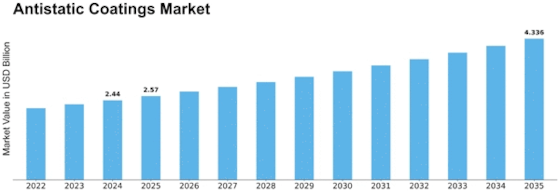
Antistatic Coatings Market Size Graph
Author
Author Profile
Chitranshi Jaiswal
Team Lead - Research

Chitranshi is a Team Leader in the Chemicals & Materials (CnM) and Energy & Power (EnP) domains, with 6+ years of experience in market research. She leads and mentors teams to deliver cross-domain projects that equip clients with actionable insights and growth strategies. She is skilled in market estimation, forecasting, competitive benchmarking, and both primary & secondary research, enabling her to turn complex data into decision-ready insights. An engineer and MBA professional, she combines technical expertise with strategic acumen to solve dynamic market challenges. Chitranshi has successfully managed projects that support market entry, investment planning, and competitive positioning, while building strong client relationships. Certified in Advanced Excel & Power BI she leverages data-driven approaches to ensure accuracy, clarity, and impactful outcomes.

Leave a Comment

FAQs

What is the projected market valuation of the Antistatic Coatings Market by 2035?

<p>The Antistatic Coatings Market is projected to reach a valuation of 4.336 USD Billion by 2035.</p>

What was the market valuation of the Antistatic Coatings Market in 2024?

<p>In 2024, the Antistatic Coatings Market was valued at 2.444 USD Billion.</p>

What is the expected CAGR for the Antistatic Coatings Market during the forecast period 2025 - 2035?

<p>The expected CAGR for the Antistatic Coatings Market during the forecast period 2025 - 2035 is 5.35%.</p>

Which application segment is anticipated to have the highest valuation in the Antistatic Coatings Market?

The Electrical &amp; Electronics application segment is anticipated to have the highest valuation, projected between 0.9 and 1.5 USD Billion.

What are the key technologies used in the Antistatic Coatings Market?

<p>Key technologies in the Antistatic Coatings Market include Spraying, Roll-Coating, and Brushing, with valuations ranging from 0.733 to 1.295 USD Billion for Spraying and Roll-Coating.</p>

Which polymer types are most commonly used in the Antistatic Coatings Market?

<p>Common polymer types include Polypropylene (PP) and Acrylonitrile Butadiene Styrene (ABS), with valuations of 0.733 to 0.978 USD Billion and 0.488 to 0.654 USD Billion, respectively.</p>

Who are the leading companies in the Antistatic Coatings Market?

<p>Leading companies in the Antistatic Coatings Market include BASF SE, DuPont de Nemours Inc, and 3M Company.</p>

What is the projected growth trend for the Antistatic Coatings Market applications?

The projected growth trend indicates that the Packaging and Electrical &amp; Electronics applications will likely see substantial increases in valuation by 2035.

What are the expected valuations for the Antistat segment in the Antistatic Coatings Market?

<p>The Antistat segment is expected to have valuations ranging from 0.733 to 1.305 USD Billion by 2035.</p>

How does the Antistatic Coatings Market's growth compare across different segments?

The growth across segments appears varied, with the Electrical &amp; Electronics segment showing the most potential for higher valuations compared to others.

Market Summary

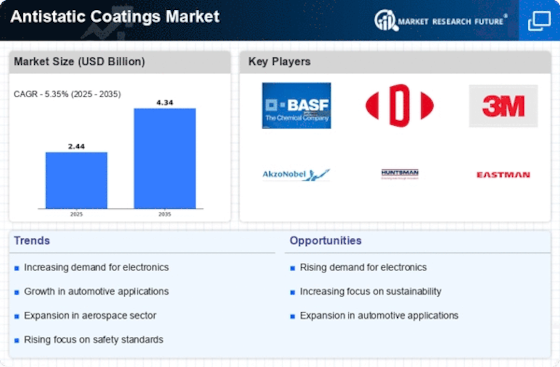
As per Market Research Future analysis, the Antistatic Coatings Market Size was estimated at 2.444 USD Billion in 2024. The Antistatic Coatings industry is projected to grow from 2.575 USD Billion in 2025 to 4.336 USD Billion by 2035, exhibiting a compound annual growth rate (CAGR) of 5.35% during the forecast period 2025 - 2035

Key Market Trends & Highlights

The Antistatic Coatings Market is poised for substantial growth driven by technological advancements and increasing demand across various sectors.

  • North America remains the largest market for antistatic coatings, driven by a robust electronics industry. Asia-Pacific is emerging as the fastest-growing region, fueled by rapid industrialization and technological adoption. The spraying segment dominates the market, while the roll-coating segment is witnessing the fastest growth due to its efficiency. Key market drivers include the rising demand for electronics and heightened regulatory compliance regarding safety standards.

Market Size & Forecast

2024 Market Size 2.444 (USD Billion)
2035 Market Size 4.336 (USD Billion)
CAGR (2025 - 2035) 5.35%
Largest Regional Market Share in 2024 Asia Pacific

Major Players

BASF SE (DE), DuPont de Nemours Inc (US), 3M Company (US), AkzoNobel N.V. (NL), Huntsman Corporation (US), Eastman Chemical Company (US), PPG Industries Inc (US), Sherwin-Williams Company (US), Kansai Paint Co Ltd (JP)

Market Trends

The Antistatic Coatings Market is currently experiencing a notable evolution, driven by the increasing demand for electronic devices and the need for effective static control solutions. Industries such as electronics, automotive, and packaging are recognizing the importance of antistatic coatings in preventing damage caused by electrostatic discharge. This heightened awareness is fostering innovation in product development, leading to the introduction of advanced formulations that enhance performance and durability. Furthermore, the growing emphasis on safety and compliance with regulatory standards is propelling manufacturers to invest in research and development, thereby expanding the range of applications for antistatic coatings. In addition, the Antistatic Coatings Market is witnessing a shift towards environmentally friendly solutions. As sustainability becomes a priority for many industries, there is a rising interest in eco-friendly antistatic coatings that minimize environmental impact while maintaining effectiveness. This trend is likely to influence purchasing decisions, as companies seek to align their operations with green initiatives. Overall, the Antistatic Coatings Market appears poised for growth, with a focus on innovation, sustainability, and meeting the evolving needs of various sectors.

Technological Advancements

The Antistatic Coatings Market is benefiting from continuous technological advancements that enhance the performance of coatings. Innovations in formulation chemistry are leading to the development of coatings that offer superior static control, durability, and adhesion properties. These advancements are likely to attract a broader range of applications across various industries.

Sustainability Initiatives

There is a growing trend towards sustainability within the Antistatic Coatings Market, as manufacturers increasingly prioritize eco-friendly formulations. This shift is driven by regulatory pressures and consumer demand for greener products, prompting companies to explore sustainable raw materials and production processes.

Expansion in Emerging Markets

Emerging markets are becoming increasingly important for the Antistatic Coatings Market, as industrialization and technological growth create new opportunities. As these regions develop their manufacturing capabilities, the demand for effective static control solutions is expected to rise, potentially leading to significant market expansion.

Antistatic Coatings Market Market Drivers

Rising Awareness of ESD Risks

The increasing awareness of electrostatic discharge (ESD) risks among manufacturers and consumers is a crucial driver for the Antistatic Coatings Market. As industries recognize the potential damage that static electricity can inflict on electronic components and sensitive equipment, the demand for antistatic coatings is likely to surge. Educational initiatives and industry standards are promoting the importance of ESD protection, leading to greater adoption of antistatic solutions across various sectors. This heightened awareness is particularly evident in industries such as telecommunications, automotive, and healthcare, where the reliability of electronic systems is critical. As companies strive to mitigate ESD risks, the market for antistatic coatings is expected to experience robust growth, reflecting the increasing prioritization of product protection and operational efficiency.

Growth in the Packaging Industry

The packaging industry is experiencing substantial growth, which is positively impacting the Antistatic Coatings Market. With the rise of e-commerce and the need for protective packaging solutions, antistatic coatings are increasingly utilized to prevent static charge accumulation during the handling and transportation of sensitive products. The packaging sector is expected to grow at a CAGR of around 4% in the coming years, driven by the demand for innovative packaging solutions that ensure product integrity. Antistatic coatings are particularly valuable in packaging electronic components, pharmaceuticals, and food products, where static electricity can compromise quality and safety. As companies seek to enhance their packaging processes, the adoption of antistatic coatings is likely to rise, further propelling market expansion.

Increasing Demand for Electronics

The rising demand for electronic devices is a primary driver for the Antistatic Coatings Market. As the electronics sector expands, the need for protective coatings that prevent static electricity buildup becomes critical. Antistatic coatings are essential in safeguarding sensitive electronic components from electrostatic discharge (ESD), which can lead to product failure. The electronics industry is projected to grow at a compound annual growth rate (CAGR) of approximately 5% over the next few years, further fueling the demand for antistatic solutions. This growth is particularly evident in sectors such as consumer electronics, automotive electronics, and telecommunications, where the reliability of electronic components is paramount. Consequently, manufacturers are increasingly investing in antistatic coatings to enhance product durability and performance.

Regulatory Compliance and Safety Standards

Regulatory compliance plays a significant role in shaping the Antistatic Coatings Market. Various industries, including aerospace, automotive, and healthcare, are subject to stringent safety standards that necessitate the use of antistatic coatings. These coatings help mitigate the risks associated with static electricity, which can pose safety hazards in environments where flammable materials are present. For instance, the aerospace sector mandates the use of antistatic materials to ensure the safety of both personnel and equipment. As regulations become more stringent, companies are compelled to adopt antistatic coatings to comply with safety standards, thereby driving market growth. The increasing focus on workplace safety and environmental regulations further emphasizes the importance of antistatic solutions in various industrial applications.

Technological Innovations in Coating Solutions

Technological advancements in coating formulations are significantly influencing the Antistatic Coatings Market. Innovations in nanotechnology and polymer chemistry have led to the development of more effective and durable antistatic coatings. These advancements enable manufacturers to create coatings that not only provide antistatic properties but also enhance other performance characteristics, such as chemical resistance and durability. The introduction of water-based and eco-friendly antistatic coatings is also gaining traction, aligning with the growing emphasis on sustainability in manufacturing processes. As industries increasingly seek high-performance coatings that meet diverse application needs, the demand for technologically advanced antistatic solutions is expected to rise, thereby driving market growth.

Market Segment Insights

By Technology: Spraying (Largest) vs. Roll-Coating (Fastest-Growing)

In the Antistatic Coatings Market, the technology segment is primarily composed of four methods: Spraying, Roll-Coating, Brushing, and Others. Among these, Spraying holds the largest share due to its widespread adoption across various industries requiring antistatic solutions. Roll-Coating, though smaller in share, is rapidly gaining traction and is recognized as the fastest-growing segment, appealing to manufacturers looking for efficient application methods that minimize waste and enhance performance.

Technology: Spraying (Dominant) vs. Roll-Coating (Emerging)

Spraying technology is dominant in the Antistatic Coatings Market, characterized by its versatility and effectiveness in applying coatings that significantly reduce static charge accumulation. It is widely used across sectors such as electronics, packaging, and automotive, where static control is critical. Meanwhile, Roll-Coating is emerging as a strong contender—particularly attractive for high-volume production environments. This method offers consistent thickness and is increasingly favored for its efficiency and ability to cover large surfaces quickly, reflecting a shift towards automation and sustainability in coating processes.

By Antistat: Ethoxylated Fatty Acid Amines (Largest) vs. Diethanolamides (Fastest-Growing)

In the Antistatic Coatings Market, Ethoxylated Fatty Acid Amines hold the largest market share due to their effectiveness and versatility in providing antistatic properties. The ability to impart excellent surface conductivity makes them a preferred choice in various applications, ranging from electronics to textiles. On the other hand, Diethanolamides are quickly gaining traction in the market, representing the fastest-growing segment, primarily driven by their eco-friendly characteristics and compatibility with various substrates, making them a desirable alternative in sustainable formulations.

Ethoxylated Fatty Acid Amines (Dominant) vs. Diethanolamides (Emerging)

Ethoxylated Fatty Acid Amines are well-regarded in the Antistatic Coatings Market for their unparalleled antistatic performance and adaptability across multiple industries. Their dominance is attributed to the widespread demand for materials that enhance product safety and performance, particularly in sensitive applications like electronics and packaging. Conversely, Diethanolamides, while currently in the emerging phase, are recognized for their biodegradable properties and gentle formulation, appealing to manufacturers looking for sustainable options. As industries pivot towards greener alternatives, the growing awareness and demand for environmentally friendly products position Diethanolamides as an essential future player in the market.

By Polymer Type: Polypropylene (PP) (Largest) vs. Acrylonitrile Butadiene Styrene (ABS) (Fastest-Growing)

In the Antistatic Coatings Market, the polymer type segment demonstrates a diverse distribution across various materials, with Polypropylene (PP) leading as the largest contributor. Following PP, other polymers like Polyethylene (PE) and Polyvinyl Chloride (PVC) also hold significant market shares. <a title="acrylonitrile" href="https://www.marketresearchfuture.com/reports/acrylonitrile-market-2914" target="_blank" rel="noopener">Acrylonitrile</a> Butadiene Styrene (ABS) is emerging prominently, gaining traction among users seeking enhanced antistatic properties, showcasing a dynamic competitive landscape among these materials. Market trends exhibit that Polypropylene (PP) benefits from widespread adoption in industries requiring effective static electricity control, thanks to its favorable balance of properties. On the other hand, the rapid rise of Acrylonitrile Butadiene Styrene (ABS) is driven by its versatility and suitability for advanced applications, particularly in electronics and automotive sectors, where static control is paramount.

Polypropylene (PP) (Dominant) vs. Acrylonitrile Butadiene Styrene (ABS) (Emerging)

Polypropylene (PP) is recognized as the dominant polymer in the Antistatic Coatings Market due to its exceptional resistance to static build-up and cost-effectiveness. This polymer is extensively utilized in packaging, automotive, and consumer goods, providing a reliable solution for various applications. In contrast, <a title="acrylonitrile butadiene styrene" href="https://www.marketresearchfuture.com/reports/acrylonitrile-butadiene-styrene-market-5566" target="_blank" rel="noopener">Acrylonitrile Butadiene Styrene</a> (ABS) is regarded as an emerging force, especially in sectors demanding superior durability and impact resistance. Its adaptation in electronic devices and automotive components exemplifies its growing importance. As industries increasingly prioritize static control to prevent damage and enhance product longevity, the competition between PP and ABS showcases an evolving market dynamic, balancing established strengths with innovative applications.

By Application: Packaging (Largest) vs. Electrical & Electronics (Fastest-Growing)

The Antistatic Coatings Market is significantly segmented by application, with Packaging maintaining the largest market share due to its critical role in preserving product integrity against electrostatic charges. This sector is vital in ensuring the safe transportation and preservation of sensitive goods, hence attracting a considerable share of investments and innovation. Meanwhile, Electrical &amp; Electronics is emerging rapidly, supported by increasing demand for static-free environments in electronic manufacturing and storage processes. Growth in this segment is influenced by advancements in technology, particularly in electronic devices and components that require robust antistatic solutions to prevent damage. The rise of smart technologies and IoT devices continues to drive the demand for innovative antistatic coatings. Additionally, regulatory measures emphasizing workplace safety and anti-static measures in manufacturing processes bolster the need for effective antistatic coatings across several applications.

Packaging (Dominant) vs. Automotive (Emerging)

The Packaging application in the Antistatic Coatings Market stands out as a dominant force, widely utilized in industries that require solutions to combat electrostatic discharge (ESD), ensuring the safety of sensitive products. These coatings are crucial in sectors ranging from electronics packaging to food preservation, where electrostatic charges can lead to contamination or damage. In comparison, the Automotive sector represents an emerging market for these coatings, as automotive manufacturers increasingly focus on ESD protection for components and assemblies. This segment is gaining momentum due to growing electric vehicle production and the need for advanced materials that facilitate safety and performance. Both segments play pivotal roles in the market landscape, with Packaging leading due to its established application and Automotive showing promising growth due to technological advancements.

Get more detailed insights about Antistatic Coatings Market Research Report—Global Forecast till 2035

Regional Insights

North America : Innovation and Demand Surge

North America is the largest market for antistatic coatings, holding approximately 40% of the global share. The growth is driven by increasing demand from the electronics and automotive sectors, alongside stringent regulations on static electricity control. The region's focus on innovation and advanced manufacturing processes further propels market expansion. Regulatory catalysts, such as the EPA's guidelines on chemical safety, also play a significant role in shaping market dynamics. The United States dominates the North American market, with key players like DuPont, 3M, and Sherwin-Williams leading the charge. The competitive landscape is characterized by continuous innovation and strategic partnerships among major companies. Canada and Mexico also contribute to the market, albeit at a smaller scale, focusing on niche applications in various industries. The presence of established manufacturers ensures a robust supply chain and product availability.

Europe : Regulatory Framework Drives Growth

Europe is the second-largest market for antistatic coatings, accounting for approximately 30% of the global market share. The region's growth is significantly influenced by stringent regulations aimed at reducing static discharge in sensitive environments, particularly in the electronics and healthcare sectors. The REACH regulations and other environmental directives are key drivers, fostering innovation and compliance among manufacturers. Germany, France, and the UK are the leading countries in this market, with major players like BASF and AkzoNobel spearheading advancements. The competitive landscape is marked by a mix of established companies and emerging startups focusing on sustainable solutions. The presence of a robust manufacturing base and a strong emphasis on research and development further enhance the region's market position.

Asia-Pacific : Rapid Industrialization Fuels Demand

Asia-Pacific is witnessing rapid growth in the antistatic coatings market, driven by industrialization and increasing demand from the electronics and automotive sectors. The region holds approximately 25% of the global market share, with countries like China and Japan leading the charge. The rise in manufacturing activities and the need for effective static control solutions are key factors propelling market growth. Additionally, government initiatives to promote advanced manufacturing technologies are expected to further boost demand. China is the largest market in the region, followed by Japan and South Korea. The competitive landscape is characterized by a mix of local and international players, including Kansai Paint and 3M. The presence of established manufacturers and a growing number of startups focusing on innovative solutions contribute to a dynamic market environment. As the region continues to industrialize, the demand for antistatic coatings is expected to rise significantly.

Middle East and Africa : Emerging Markets and Opportunities

The Middle East and Africa region is gradually emerging as a potential market for antistatic coatings, holding about 5% of the global market share. The growth is primarily driven by increasing industrial activities and the rising demand for electronic products. Countries like South Africa and the UAE are at the forefront, with investments in manufacturing and technology sectors. The region's focus on improving infrastructure and regulatory frameworks is expected to catalyze market growth in the coming years. South Africa leads the market, with a growing number of local manufacturers and international players looking to establish a presence. The competitive landscape is evolving, with companies focusing on innovative solutions tailored to regional needs. As the market matures, opportunities for growth in various sectors, including automotive and electronics, are becoming more apparent, paving the way for future expansion.

Key Players and Competitive Insights

The Antistatic Coatings Market is distinguished by the presence of numerous global, regional, and local players catering to the antistatic coatings techniques that are evolving at a rapid pace. Furthermore, the expansion in the electronic industry is further driving the growth of Antistatic Coatings Market during the forecast period. The major players have adopted a strategy of obtaining regulatory approval from government agencies for their products and signing contracts and agreements to broaden their reach and reduce operational costs. The Antistatic Coatings Market is extremely competitive, with players competing, partnering, and investing heavily in research and development to gain a significant market share. The market is moderately fragmented with rising competition, increasing collaborative partnerships, and other strategic decisions to achieve operational efficiency. Mergers and collaborations were also observed to expand the company's product portfolio, as well as introduce new software and services. The growth of prominent industry players is dependent on various factors, such as market conditions, government support, and industry development. Key manufacturers in the antistatic coatings market are focusing on developing products with advanced technologies. It is also projected that a rise in the investments for R&D will also boost the market's growth in the upcoming future. The global Antistatic Coatings industry is highly fragmented. The key players operating in the Antistatic Coatings Market include ADEKA CORPORATION (Japan), BASF SE (Germany), Evonik Industries AG (Germany), Kao Corporation (Japan), Mitsubishi Chemical Corporation (Japan), Nouryon (The Netherlands), Palsgaard (Denmark), Nicca Chemical Co., Ltd (Japan), Arkema S.A. (France), Clariant AG (Switzerland), Croda International Plc (UK) and many more. ADEKA Corporation: ADEKA Corporation is a manufacturer and distributor of chemicals and food products. The company offers resin products, insulators, and processed fat/oil products. Its operations are carried out through the following segments: Chemical Products, Food Products, Life Science, and Others. The Chemical products division manufactures propylene glycol, hydrogen peroxide, polyolefin additives, polyvinyl chloride stabilizers, plasticizers, flame retardants, epoxy resin, surfactants, lubricating oil additives, electronic circuit board etching equipment, and semiconductor materials. Margarine, shortenings, and sauces are all part of the food products category. In addition, the Life Science area includes pharmaceuticals, quasi-drugs, veterinary drugs, wood chemicals, and medicinal supplies. Furthermore, the others segment consists of real estate firms, logistics services, and construction administration. It operates sales offices, manufacturing facilities, and R&D facilities in Japan's Nagoya, Sapporo, Sendai, Fukuoka, and Osaka areas. The company operates in a number of locations throughout Asia, North and South America, and Europe. Croda International plc: Croda International plc (Croda) is a manufacturer and supplier of a diverse range of chemicals and chemical products, including oleo chemicals and industrial chemicals. It provides active ingredients and cosmetic oils that are used in coatings & polymers, crop care, geo technologies, health care, home care, industrial chemicals, lubricants, personal care, and polymer additives. It offers products to a number of industries, including those that deal with industrial chemicals, personal care products, life sciences, and consumer products. The company sells its products in over 37 countries across the world. Moreover, the company has operations in Asia Pacific Europe and EEMEA (Europe, Middle East, Africa) Latin America North America.

Key Companies in the Antistatic Coatings Market include

Industry Developments

December 2022: One of India's largest multinational flexible packaging materials and solutions companies, UFlex has developed a wide range of products such as anti-static films and others that cater to brands' packaging needs with added convenience and features. These developments underscore UFlex's 360-degree focus on brand needs, user experience and commitment to the environment.

Octtober 2022: Berry BPI Packaging Solutions announced the integration of up to 50% recycled content into its NorDiVent fill and seal (FFS) film without compromising overall strength and moisture barrier performance. In addition, the NorDiVent mold has anti-static properties and high tear resistance to ensure safety and prevent spills and waste.

March 2019: Heraeus offers the first antistatic coating to protect lighting units in electrostatically discharged and explosion-proof areas. Based on the conductive polymer Clevios, Heraeus Epurio and Plast Composite Consulting (PCC) have developed a coating for lighting covers in electrostatic discharge (ESD) and explosion-proof areas. This is the first coating to combine conductivity with a transparent surface seal.

Future Outlook

Antistatic Coatings Market Future Outlook

The Antistatic Coatings Market is projected to grow at a 5.35% CAGR from 2025 to 2035, driven by increasing demand in electronics, automotive, and aerospace sectors.

New opportunities lie in:

  • <p>Development of eco-friendly antistatic coatings for sustainable applications. Expansion into emerging markets with tailored product offerings. Integration of smart technologies for real-time monitoring of static control.</p>

By 2035, the Antistatic Coatings Market is expected to achieve robust growth and innovation.

Market Segmentation

Antistatic Coatings Market Antistat Outlook

  • Ethoxylated Fatty Acid Amines
  • Diethanolamides
  • Glycerol Monostearate
  • Others

Antistatic Coatings Market Technology Outlook

  • Spraying
  • Roll-Coating
  • Brushing
  • Others

Antistatic Coatings Market Application Outlook

  • Packaging
  • Electrical & Electronics
  • Automotive
  • Aerospace
  • Textiles
  • Others

Antistatic Coatings Market Polymer Type Outlook

  • Polypropylene (PP)
  • Acrylonitrile Butadiene Styrene (ABS)
  • Polyethylene (PE)
  • Polyvinyl Chloride (PVC)
  • Others

Report Scope

MARKET SIZE 2024 2.444(USD Billion)
MARKET SIZE 2025 2.575(USD Billion)
MARKET SIZE 2035 4.336(USD Billion)
COMPOUND ANNUAL GROWTH RATE (CAGR) 5.35% (2025 - 2035)
REPORT COVERAGE Revenue Forecast, Competitive Landscape, Growth Factors, and Trends
BASE YEAR 2024
Market Forecast Period 2025 - 2035
Historical Data 2019 - 2024
Market Forecast Units USD Billion
Key Companies Profiled BASF SE (DE), DuPont de Nemours Inc (US), 3M Company (US), AkzoNobel N.V. (NL), Huntsman Corporation (US), Eastman Chemical Company (US), PPG Industries Inc (US), Sherwin-Williams Company (US), Kansai Paint Co Ltd (JP)
Segments Covered Technology, Antistat, Antistat, Polymer Type, Application, Region - Global Forecast to 2035
Key Market Opportunities Growing demand for advanced electronics drives innovation in Antistatic Coatings Market applications and formulations.
Key Market Dynamics Rising demand for antistatic coatings in electronics drives innovation and competitive dynamics in the market.
Countries Covered North America, Europe, APAC, South America, MEA

FAQs

What is the projected market valuation of the Antistatic Coatings Market by 2035?

<p>The Antistatic Coatings Market is projected to reach a valuation of 4.336 USD Billion by 2035.</p>

What was the market valuation of the Antistatic Coatings Market in 2024?

<p>In 2024, the Antistatic Coatings Market was valued at 2.444 USD Billion.</p>

What is the expected CAGR for the Antistatic Coatings Market during the forecast period 2025 - 2035?

<p>The expected CAGR for the Antistatic Coatings Market during the forecast period 2025 - 2035 is 5.35%.</p>

Which application segment is anticipated to have the highest valuation in the Antistatic Coatings Market?

The Electrical &amp; Electronics application segment is anticipated to have the highest valuation, projected between 0.9 and 1.5 USD Billion.

What are the key technologies used in the Antistatic Coatings Market?

<p>Key technologies in the Antistatic Coatings Market include Spraying, Roll-Coating, and Brushing, with valuations ranging from 0.733 to 1.295 USD Billion for Spraying and Roll-Coating.</p>

Which polymer types are most commonly used in the Antistatic Coatings Market?

<p>Common polymer types include Polypropylene (PP) and Acrylonitrile Butadiene Styrene (ABS), with valuations of 0.733 to 0.978 USD Billion and 0.488 to 0.654 USD Billion, respectively.</p>

Who are the leading companies in the Antistatic Coatings Market?

<p>Leading companies in the Antistatic Coatings Market include BASF SE, DuPont de Nemours Inc, and 3M Company.</p>

What is the projected growth trend for the Antistatic Coatings Market applications?

The projected growth trend indicates that the Packaging and Electrical &amp; Electronics applications will likely see substantial increases in valuation by 2035.

What are the expected valuations for the Antistat segment in the Antistatic Coatings Market?

<p>The Antistat segment is expected to have valuations ranging from 0.733 to 1.305 USD Billion by 2035.</p>

How does the Antistatic Coatings Market's growth compare across different segments?

The growth across segments appears varied, with the Electrical &amp; Electronics segment showing the most potential for higher valuations compared to others.

  1. SECTION I: EXECUTIVE SUMMARY AND KEY HIGHLIGHTS |
    1. EXECUTIVE SUMMARY | |
      1. Market Overview | |
      2. Key Findings | |
      3. Market Segmentation | |
      4. Competitive Landscape | |
      5. Challenges and Opportunities | |
      6. Future Outlook 2
  2. SECTION II: SCOPING, METHODOLOGY AND MARKET STRUCTURE |
    1. MARKET INTRODUCTION | |
      1. Definition | |
      2. Scope of the study | | |
    2. RESEARCH METHODOLOGY | |
      1. Overview | |
      2. Data Mining | |
      3. Secondary Research | |
      4. Primary Research | | |
      5. Forecasting Model | |
      6. Market Size Estimation | | |
      7. Data Triangulation | |
      8. Validation 3
  3. SECTION III: QUALITATIVE ANALYSIS |
    1. MARKET DYNAMICS | |
      1. Overview | |
      2. Drivers | |
      3. Restraints | |
      4. Opportunities |
    2. MARKET FACTOR ANALYSIS | |
      1. Value chain Analysis | |
      2. Porter's Five Forces Analysis | | |
      3. COVID-19 Impact Analysis | | |
  4. SECTION IV: QUANTITATIVE ANALYSIS |
    1. Chemicals and Materials, BY Technology (USD Billion) | |
      1. Spraying | |
      2. Roll-Coating | |
      3. Brushing | |
      4. Others |
    2. Chemicals and Materials, BY Antistat (USD Billion) | |
      1. Ethoxylated Fatty Acid Amines | |
      2. Diethanolamides | |
      3. Glycerol Monostearate | |
      4. Others |
    3. Chemicals and Materials, BY Polymer Type (USD Billion) | |
      1. Polypropylene (PP) | |
      2. Acrylonitrile Butadiene Styrene (ABS) | |
      3. Polyethylene (PE) | |
      4. Polyvinyl Chloride (PVC) | |
      5. Others |
    4. Chemicals and Materials, BY Application (USD Billion) | |
      1. Packaging | |
      2. Electrical & Electronics | |
      3. Automotive | |
      4. Aerospace | |
      5. Textiles | |
      6. Others |
    5. Chemicals and Materials, BY Region (USD Billion) | |
      1. North America | | |
      2. Europe | | |
      3. APAC | | |
      4. South America | | |
      5. MEA | | |
  5. SECTION V: COMPETITIVE ANALYSIS |
    1. Competitive Landscape | |
      1. Overview | |
      2. Competitive Analysis | |
      3. Market share Analysis | |
      4. Major Growth Strategy in the Chemicals and Materials | |
      5. Competitive Benchmarking | |
      6. Leading Players in Terms of Number of Developments in the Chemicals and Materials | |
      7. Key developments and growth strategies | | |
      8. Major Players Financial Matrix | | |
    2. Company Profiles | |
      1. BASF SE (DE) | | |
      2. DuPont de Nemours Inc (US) | | |
      3. 3M Company (US) | | |
      4. AkzoNobel N.V. (NL) | | |
      5. Huntsman Corporation (US) | | |
      6. Eastman Chemical Company (US) | | |
      7. PPG Industries Inc (US) | | |
      8. Sherwin-Williams Company (US) | | |
      9. Kansai Paint Co Ltd (JP) | | |
    3. Appendix | |
      1. References | |
      2. Related Reports 6 LIST OF FIGURES |
    4. MARKET SYNOPSIS |
    5. NORTH AMERICA MARKET ANALYSIS |
    6. US MARKET ANALYSIS BY TECHNOLOGY |
    7. US MARKET ANALYSIS BY ANTISTAT |
    8. US MARKET ANALYSIS BY POLYMER TYPE |
    9. US MARKET ANALYSIS BY APPLICATION |
    10. CANADA MARKET ANALYSIS BY TECHNOLOGY |
    11. CANADA MARKET ANALYSIS BY ANTISTAT |
    12. CANADA MARKET ANALYSIS BY POLYMER TYPE |
    13. CANADA MARKET ANALYSIS BY APPLICATION |
    14. EUROPE MARKET ANALYSIS |
    15. GERMANY MARKET ANALYSIS BY TECHNOLOGY |
    16. GERMANY MARKET ANALYSIS BY ANTISTAT |
    17. GERMANY MARKET ANALYSIS BY POLYMER TYPE |
    18. GERMANY MARKET ANALYSIS BY APPLICATION |
    19. UK MARKET ANALYSIS BY TECHNOLOGY |
    20. UK MARKET ANALYSIS BY ANTISTAT |
    21. UK MARKET ANALYSIS BY POLYMER TYPE |
    22. UK MARKET ANALYSIS BY APPLICATION |
    23. FRANCE MARKET ANALYSIS BY TECHNOLOGY |
    24. FRANCE MARKET ANALYSIS BY ANTISTAT |
    25. FRANCE MARKET ANALYSIS BY POLYMER TYPE |
    26. FRANCE MARKET ANALYSIS BY APPLICATION |
    27. RUSSIA MARKET ANALYSIS BY TECHNOLOGY |
    28. RUSSIA MARKET ANALYSIS BY ANTISTAT |
    29. RUSSIA MARKET ANALYSIS BY POLYMER TYPE |
    30. RUSSIA MARKET ANALYSIS BY APPLICATION |
    31. ITALY MARKET ANALYSIS BY TECHNOLOGY |
    32. ITALY MARKET ANALYSIS BY ANTISTAT |
    33. ITALY MARKET ANALYSIS BY POLYMER TYPE |
    34. ITALY MARKET ANALYSIS BY APPLICATION |
    35. SPAIN MARKET ANALYSIS BY TECHNOLOGY |
    36. SPAIN MARKET ANALYSIS BY ANTISTAT |
    37. SPAIN MARKET ANALYSIS BY POLYMER TYPE |
    38. SPAIN MARKET ANALYSIS BY APPLICATION |
    39. REST OF EUROPE MARKET ANALYSIS BY TECHNOLOGY |
    40. REST OF EUROPE MARKET ANALYSIS BY ANTISTAT |
    41. REST OF EUROPE MARKET ANALYSIS BY POLYMER TYPE |
    42. REST OF EUROPE MARKET ANALYSIS BY APPLICATION |
    43. APAC MARKET ANALYSIS |
    44. CHINA MARKET ANALYSIS BY TECHNOLOGY |
    45. CHINA MARKET ANALYSIS BY ANTISTAT |
    46. CHINA MARKET ANALYSIS BY POLYMER TYPE |
    47. CHINA MARKET ANALYSIS BY APPLICATION |
    48. INDIA MARKET ANALYSIS BY TECHNOLOGY |
    49. INDIA MARKET ANALYSIS BY ANTISTAT |
    50. INDIA MARKET ANALYSIS BY POLYMER TYPE |
    51. INDIA MARKET ANALYSIS BY APPLICATION |
    52. JAPAN MARKET ANALYSIS BY TECHNOLOGY |
    53. JAPAN MARKET ANALYSIS BY ANTISTAT |
    54. JAPAN MARKET ANALYSIS BY POLYMER TYPE |
    55. JAPAN MARKET ANALYSIS BY APPLICATION |
    56. SOUTH KOREA MARKET ANALYSIS BY TECHNOLOGY |
    57. SOUTH KOREA MARKET ANALYSIS BY ANTISTAT |
    58. SOUTH KOREA MARKET ANALYSIS BY POLYMER TYPE |
    59. SOUTH KOREA MARKET ANALYSIS BY APPLICATION |
    60. MALAYSIA MARKET ANALYSIS BY TECHNOLOGY |
    61. MALAYSIA MARKET ANALYSIS BY ANTISTAT |
    62. MALAYSIA MARKET ANALYSIS BY POLYMER TYPE |
    63. MALAYSIA MARKET ANALYSIS BY APPLICATION |
    64. THAILAND MARKET ANALYSIS BY TECHNOLOGY |
    65. THAILAND MARKET ANALYSIS BY ANTISTAT |
    66. THAILAND MARKET ANALYSIS BY POLYMER TYPE |
    67. THAILAND MARKET ANALYSIS BY APPLICATION |
    68. INDONESIA MARKET ANALYSIS BY TECHNOLOGY |
    69. INDONESIA MARKET ANALYSIS BY ANTISTAT |
    70. INDONESIA MARKET ANALYSIS BY POLYMER TYPE |
    71. INDONESIA MARKET ANALYSIS BY APPLICATION |
    72. REST OF APAC MARKET ANALYSIS BY TECHNOLOGY |
    73. REST OF APAC MARKET ANALYSIS BY ANTISTAT |
    74. REST OF APAC MARKET ANALYSIS BY POLYMER TYPE |
    75. REST OF APAC MARKET ANALYSIS BY APPLICATION |
    76. SOUTH AMERICA MARKET ANALYSIS |
    77. BRAZIL MARKET ANALYSIS BY TECHNOLOGY |
    78. BRAZIL MARKET ANALYSIS BY ANTISTAT |
    79. BRAZIL MARKET ANALYSIS BY POLYMER TYPE |
    80. BRAZIL MARKET ANALYSIS BY APPLICATION |
    81. MEXICO MARKET ANALYSIS BY TECHNOLOGY |
    82. MEXICO MARKET ANALYSIS BY ANTISTAT |
    83. MEXICO MARKET ANALYSIS BY POLYMER TYPE |
    84. MEXICO MARKET ANALYSIS BY APPLICATION |
    85. ARGENTINA MARKET ANALYSIS BY TECHNOLOGY |
    86. ARGENTINA MARKET ANALYSIS BY ANTISTAT |
    87. ARGENTINA MARKET ANALYSIS BY POLYMER TYPE |
    88. ARGENTINA MARKET ANALYSIS BY APPLICATION |
    89. REST OF SOUTH AMERICA MARKET ANALYSIS BY TECHNOLOGY |
    90. REST OF SOUTH AMERICA MARKET ANALYSIS BY ANTISTAT |
    91. REST OF SOUTH AMERICA MARKET ANALYSIS BY POLYMER TYPE |
    92. REST OF SOUTH AMERICA MARKET ANALYSIS BY APPLICATION |
    93. MEA MARKET ANALYSIS |
    94. GCC COUNTRIES MARKET ANALYSIS BY TECHNOLOGY |
    95. GCC COUNTRIES MARKET ANALYSIS BY ANTISTAT |
    96. GCC COUNTRIES MARKET ANALYSIS BY POLYMER TYPE |
    97. GCC COUNTRIES MARKET ANALYSIS BY APPLICATION |
    98. SOUTH AFRICA MARKET ANALYSIS BY TECHNOLOGY |
    99. SOUTH AFRICA MARKET ANALYSIS BY ANTISTAT |
    100. SOUTH AFRICA MARKET ANALYSIS BY POLYMER TYPE |
    101. SOUTH AFRICA MARKET ANALYSIS BY APPLICATION |
    102. REST OF MEA MARKET ANALYSIS BY TECHNOLOGY |
    103. REST OF MEA MARKET ANALYSIS BY ANTISTAT |
    104. REST OF MEA MARKET ANALYSIS BY POLYMER TYPE |
    105. REST OF MEA MARKET ANALYSIS BY APPLICATION |
    106. KEY BUYING CRITERIA OF CHEMICALS AND MATERIALS |
    107. RESEARCH PROCESS OF MRFR |
    108. DRO ANALYSIS OF CHEMICALS AND MATERIALS |
    109. DRIVERS IMPACT ANALYSIS: CHEMICALS AND MATERIALS |
    110. RESTRAINTS IMPACT ANALYSIS: CHEMICALS AND MATERIALS |
    111. SUPPLY / VALUE CHAIN: CHEMICALS AND MATERIALS |
    112. CHEMICALS AND MATERIALS, BY TECHNOLOGY, 2024 (% SHARE) |
    113. CHEMICALS AND MATERIALS, BY TECHNOLOGY, 2024 TO 2035 (USD Billion) |
    114. CHEMICALS AND MATERIALS, BY ANTISTAT, 2024 (% SHARE) |
    115. CHEMICALS AND MATERIALS, BY ANTISTAT, 2024 TO 2035 (USD Billion) |
    116. CHEMICALS AND MATERIALS, BY POLYMER TYPE, 2024 (% SHARE) |
    117. CHEMICALS AND MATERIALS, BY POLYMER TYPE, 2024 TO 2035 (USD Billion) |
    118. CHEMICALS AND MATERIALS, BY APPLICATION, 2024 (% SHARE) |
    119. CHEMICALS AND MATERIALS, BY APPLICATION, 2024 TO 2035 (USD Billion) |
    120. BENCHMARKING OF MAJOR COMPETITORS 7 LIST OF TABLES |
    121. LIST OF ASSUMPTIONS | |
      1. |
    122. North America MARKET SIZE ESTIMATES; FORECAST | |
      1. BY TECHNOLOGY, 2025-2035 (USD Billion) | |
      2. BY ANTISTAT, 2025-2035 (USD Billion) | |
      3. BY POLYMER TYPE, 2025-2035 (USD Billion) | |
      4. BY APPLICATION, 2025-2035 (USD Billion) |
    123. US MARKET SIZE ESTIMATES; FORECAST | |
      1. BY TECHNOLOGY, 2025-2035 (USD Billion) | |
      2. BY ANTISTAT, 2025-2035 (USD Billion) | |
      3. BY POLYMER TYPE, 2025-2035 (USD Billion) | |
      4. BY APPLICATION, 2025-2035 (USD Billion) |
    124. Canada MARKET SIZE ESTIMATES; FORECAST | |
      1. BY TECHNOLOGY, 2025-2035 (USD Billion) | |
      2. BY ANTISTAT, 2025-2035 (USD Billion) | |
      3. BY POLYMER TYPE, 2025-2035 (USD Billion) | |
      4. BY APPLICATION, 2025-2035 (USD Billion) |
    125. Europe MARKET SIZE ESTIMATES; FORECAST | |
      1. BY TECHNOLOGY, 2025-2035 (USD Billion) | |
      2. BY ANTISTAT, 2025-2035 (USD Billion) | |
      3. BY POLYMER TYPE, 2025-2035 (USD Billion) | |
      4. BY APPLICATION, 2025-2035 (USD Billion) |
    126. Germany MARKET SIZE ESTIMATES; FORECAST | |
      1. BY TECHNOLOGY, 2025-2035 (USD Billion) | |
      2. BY ANTISTAT, 2025-2035 (USD Billion) | |
      3. BY POLYMER TYPE, 2025-2035 (USD Billion) | |
      4. BY APPLICATION, 2025-2035 (USD Billion) |
    127. UK MARKET SIZE ESTIMATES; FORECAST | |
      1. BY TECHNOLOGY, 2025-2035 (USD Billion) | |
      2. BY ANTISTAT, 2025-2035 (USD Billion) | |
      3. BY POLYMER TYPE, 2025-2035 (USD Billion) | |
      4. BY APPLICATION, 2025-2035 (USD Billion) |
    128. France MARKET SIZE ESTIMATES; FORECAST | |
      1. BY TECHNOLOGY, 2025-2035 (USD Billion) | |
      2. BY ANTISTAT, 2025-2035 (USD Billion) | |
      3. BY POLYMER TYPE, 2025-2035 (USD Billion) | |
      4. BY APPLICATION, 2025-2035 (USD Billion) |
    129. Russia MARKET SIZE ESTIMATES; FORECAST | |
      1. BY TECHNOLOGY, 2025-2035 (USD Billion) | |
      2. BY ANTISTAT, 2025-2035 (USD Billion) | |
      3. BY POLYMER TYPE, 2025-2035 (USD Billion) | |
      4. BY APPLICATION, 2025-2035 (USD Billion) |
    130. Italy MARKET SIZE ESTIMATES; FORECAST | |
      1. BY TECHNOLOGY, 2025-2035 (USD Billion) | |
      2. BY ANTISTAT, 2025-2035 (USD Billion) | |
      3. BY POLYMER TYPE, 2025-2035 (USD Billion) | |
      4. BY APPLICATION, 2025-2035 (USD Billion) |
    131. Spain MARKET SIZE ESTIMATES; FORECAST | |
      1. BY TECHNOLOGY, 2025-2035 (USD Billion) | |
      2. BY ANTISTAT, 2025-2035 (USD Billion) | |
      3. BY POLYMER TYPE, 2025-2035 (USD Billion) | |
      4. BY APPLICATION, 2025-2035 (USD Billion) |
    132. Rest of Europe MARKET SIZE ESTIMATES; FORECAST | |
      1. BY TECHNOLOGY, 2025-2035 (USD Billion) | |
      2. BY ANTISTAT, 2025-2035 (USD Billion) | |
      3. BY POLYMER TYPE, 2025-2035 (USD Billion) | |
      4. BY APPLICATION, 2025-2035 (USD Billion) |
    133. APAC MARKET SIZE ESTIMATES; FORECAST | |
      1. BY TECHNOLOGY, 2025-2035 (USD Billion) | |
      2. BY ANTISTAT, 2025-2035 (USD Billion) | |
      3. BY POLYMER TYPE, 2025-2035 (USD Billion) | |
      4. BY APPLICATION, 2025-2035 (USD Billion) |
    134. China MARKET SIZE ESTIMATES; FORECAST | |
      1. BY TECHNOLOGY, 2025-2035 (USD Billion) | |
      2. BY ANTISTAT, 2025-2035 (USD Billion) | |
      3. BY POLYMER TYPE, 2025-2035 (USD Billion) | |
      4. BY APPLICATION, 2025-2035 (USD Billion) |
    135. India MARKET SIZE ESTIMATES; FORECAST | |
      1. BY TECHNOLOGY, 2025-2035 (USD Billion) | |
      2. BY ANTISTAT, 2025-2035 (USD Billion) | |
      3. BY POLYMER TYPE, 2025-2035 (USD Billion) | |
      4. BY APPLICATION, 2025-2035 (USD Billion) |
    136. Japan MARKET SIZE ESTIMATES; FORECAST | |
      1. BY TECHNOLOGY, 2025-2035 (USD Billion) | |
      2. BY ANTISTAT, 2025-2035 (USD Billion) | |
      3. BY POLYMER TYPE, 2025-2035 (USD Billion) | |
      4. BY APPLICATION, 2025-2035 (USD Billion) |
    137. South Korea MARKET SIZE ESTIMATES; FORECAST | |
      1. BY TECHNOLOGY, 2025-2035 (USD Billion) | |
      2. BY ANTISTAT, 2025-2035 (USD Billion) | |
      3. BY POLYMER TYPE, 2025-2035 (USD Billion) | |
      4. BY APPLICATION, 2025-2035 (USD Billion) |
    138. Malaysia MARKET SIZE ESTIMATES; FORECAST | |
      1. BY TECHNOLOGY, 2025-2035 (USD Billion) | |
      2. BY ANTISTAT, 2025-2035 (USD Billion) | |
      3. BY POLYMER TYPE, 2025-2035 (USD Billion) | |
      4. BY APPLICATION, 2025-2035 (USD Billion) |
    139. Thailand MARKET SIZE ESTIMATES; FORECAST | |
      1. BY TECHNOLOGY, 2025-2035 (USD Billion) | |
      2. BY ANTISTAT, 2025-2035 (USD Billion) | |
      3. BY POLYMER TYPE, 2025-2035 (USD Billion) | |
      4. BY APPLICATION, 2025-2035 (USD Billion) |
    140. Indonesia MARKET SIZE ESTIMATES; FORECAST | |
      1. BY TECHNOLOGY, 2025-2035 (USD Billion) | |
      2. BY ANTISTAT, 2025-2035 (USD Billion) | |
      3. BY POLYMER TYPE, 2025-2035 (USD Billion) | |
      4. BY APPLICATION, 2025-2035 (USD Billion) |
    141. Rest of APAC MARKET SIZE ESTIMATES; FORECAST | |
      1. BY TECHNOLOGY, 2025-2035 (USD Billion) | |
      2. BY ANTISTAT, 2025-2035 (USD Billion) | |
      3. BY POLYMER TYPE, 2025-2035 (USD Billion) | |
      4. BY APPLICATION, 2025-2035 (USD Billion) |
    142. South America MARKET SIZE ESTIMATES; FORECAST | |
      1. BY TECHNOLOGY, 2025-2035 (USD Billion) | |
      2. BY ANTISTAT, 2025-2035 (USD Billion) | |
      3. BY POLYMER TYPE, 2025-2035 (USD Billion) | |
      4. BY APPLICATION, 2025-2035 (USD Billion) |
    143. Brazil MARKET SIZE ESTIMATES; FORECAST | |
      1. BY TECHNOLOGY, 2025-2035 (USD Billion) | |
      2. BY ANTISTAT, 2025-2035 (USD Billion) | |
      3. BY POLYMER TYPE, 2025-2035 (USD Billion) | |
      4. BY APPLICATION, 2025-2035 (USD Billion) |
    144. Mexico MARKET SIZE ESTIMATES; FORECAST | |
      1. BY TECHNOLOGY, 2025-2035 (USD Billion) | |
      2. BY ANTISTAT, 2025-2035 (USD Billion) | |
      3. BY POLYMER TYPE, 2025-2035 (USD Billion) | |
      4. BY APPLICATION, 2025-2035 (USD Billion) |
    145. Argentina MARKET SIZE ESTIMATES; FORECAST | |
      1. BY TECHNOLOGY, 2025-2035 (USD Billion) | |
      2. BY ANTISTAT, 2025-2035 (USD Billion) | |
      3. BY POLYMER TYPE, 2025-2035 (USD Billion) | |
      4. BY APPLICATION, 2025-2035 (USD Billion) |
    146. Rest of South America MARKET SIZE ESTIMATES; FORECAST | |
      1. BY TECHNOLOGY, 2025-2035 (USD Billion) | |
      2. BY ANTISTAT, 2025-2035 (USD Billion) | |
      3. BY POLYMER TYPE, 2025-2035 (USD Billion) | |
      4. BY APPLICATION, 2025-2035 (USD Billion) |
    147. MEA MARKET SIZE ESTIMATES; FORECAST | |
      1. BY TECHNOLOGY, 2025-2035 (USD Billion) | |
      2. BY ANTISTAT, 2025-2035 (USD Billion) | |
      3. BY POLYMER TYPE, 2025-2035 (USD Billion) | |
      4. BY APPLICATION, 2025-2035 (USD Billion) |
    148. GCC Countries MARKET SIZE ESTIMATES; FORECAST | |
      1. BY TECHNOLOGY, 2025-2035 (USD Billion) | |
      2. BY ANTISTAT, 2025-2035 (USD Billion) | |
      3. BY POLYMER TYPE, 2025-2035 (USD Billion) | |
      4. BY APPLICATION, 2025-2035 (USD Billion) |
    149. South Africa MARKET SIZE ESTIMATES; FORECAST | |
      1. BY TECHNOLOGY, 2025-2035 (USD Billion) | |
      2. BY ANTISTAT, 2025-2035 (USD Billion) | |
      3. BY POLYMER TYPE, 2025-2035 (USD Billion) | |
      4. BY APPLICATION, 2025-2035 (USD Billion) |
    150. Rest of MEA MARKET SIZE ESTIMATES; FORECAST | |
      1. BY TECHNOLOGY, 2025-2035 (USD Billion) | |
      2. BY ANTISTAT, 2025-2035 (USD Billion) | |
      3. BY POLYMER TYPE, 2025-2035 (USD Billion) | |
      4. BY APPLICATION, 2025-2035 (USD Billion) |
    151. PRODUCT LAUNCH/PRODUCT DEVELOPMENT/APPROVAL | |
      1. |
    152. ACQUISITION/PARTNERSHIP | |

Chemicals and Materials Market Segmentation

Chemicals and Materials By Technology (USD Billion, 2025-2035)

  • Spraying
  • Roll-Coating
  • Brushing
  • Others

Chemicals and Materials By Antistat (USD Billion, 2025-2035)

  • Ethoxylated Fatty Acid Amines
  • Diethanolamides
  • Glycerol Monostearate
  • Others

Chemicals and Materials By Polymer Type (USD Billion, 2025-2035)

  • Polypropylene (PP)
  • Acrylonitrile Butadiene Styrene (ABS)
  • Polyethylene (PE)
  • Polyvinyl Chloride (PVC)
  • Others

Chemicals and Materials By Application (USD Billion, 2025-2035)

  • Packaging
  • Electrical & Electronics
  • Automotive
  • Aerospace
  • Textiles
  • Others
Infographic

Free Sample Request

Kindly complete the form below to receive a free sample of this Report

Get Free Sample

Customer Strories

Compare Licence

×
Features License Type
Single User Multiuser License Enterprise User
Price $4,950 $5,950 $7,250
Maximum User Access Limit 1 User Upto 10 Users Unrestricted Access Throughout the Organization
Free Customization
Direct Access to Analyst
Deliverable Format
Platform Access
Discount on Next Purchase 10% 15% 15%
Printable Versions