×
Request Free Sample ×

Kindly complete the form below to receive a free sample of this Report

* Please use a valid business email

Leading companies partner with us for data-driven Insights

clients tt-cursor
Hero Background
English
Chinese
French
Japanese
Korean
German
Spanish

Antistatic Agent Market Trends

ID: MRFR/CnM/1203-HCR
138 Pages
Priya Nagrale
October 2025

Antistatic Agents Market Research Report Information by Antistats (Ethoxylated Fatty Acid Amines, Diethanolamides, & Glycerol Monostearate), Polymer Type (PP, ABS, PE, & PVC), End-Use Industry (Packaging, Electronics, & Automotive) & Region—Forecast till 2035

Share:
Download PDF ×

We do not share your information with anyone. However, we may send you emails based on your report interest from time to time. You may contact us at any time to opt-out.

Antistatic Agent Market Infographic
×
Antistatic Agent Market Infographic Full View
Purchase Options

Market Trends

Key Emerging Trends in the Antistatic Agent Market

The antistatic agent market, a crucial sector in the plastics, electronics, and packaging industries, is witnessing several notable trends that shape its current landscape. Understanding these market trends is essential for industry stakeholders to make informed decisions, stay competitive, and capitalize on emerging opportunities within this specialized market.

Growing Demand in Plastics Industry:

The plastics industry is experiencing a surge in demand for antistatic agents, driven by the need to mitigate static charges in plastic products. Increasing applications in packaging, automotive components, and consumer goods contribute to the growing demand for antistatic agents. Proliferation of Electronic Devices:

The rising usage of electronic devices, including smartphones, tablets, and wearable technology, fuels the demand for antistatic agents in electronic components and packaging. Antistatic agents play a crucial role in preventing static-related damage to sensitive electronic devices during manufacturing and handling. Shift towards Biodegradable Antistatic Agents:

Environmental concerns and a focus on sustainability are driving a trend towards biodegradable antistatic agents. Manufacturers are exploring and developing eco-friendly alternatives to meet regulatory requirements and address consumer preferences for greener products. Technological Advancements in Formulations:

Ongoing technological advancements in antistatic agent formulations contribute to market trends. Innovations in formulation techniques, including the development of long-lasting and more effective antistatic agents, influence product performance and market adoption. Focus on Smart Packaging:

The packaging industry is witnessing a trend towards smart packaging solutions, incorporating technologies such as RFID tags and sensors. Antistatic agents play a role in preventing static interference in smart packaging applications, influencing market dynamics within the packaging sector. Rise in Demand for Antistatic Films:

The demand for antistatic films is on the rise, especially in industries such as electronics, where preventing static buildup is critical during manufacturing and transportation. Antistatic films find applications in electronic packaging, protective covers, and other specialized uses, contributing to market growth. Increasing Application in Textiles:

Antistatic agents are finding expanded applications in the textile industry, particularly in the manufacturing of clothing and fabrics. The demand for antistatic textiles is driven by consumer preferences for comfortable and static-free clothing, influencing market trends in the textile sector. Stringent Regulations and Compliance:

Stringent regulations regarding the use of chemicals in various industries impact the antistatic agent market. Compliance with regulatory standards, such as REACH and RoHS, is becoming increasingly important for manufacturers, influencing product formulations and market access. Asia-Pacific Emerging as a Key Market:

The Asia-Pacific region is emerging as a key market for antistatic agents, driven by the growth of manufacturing activities in countries like China and India. Increasing industrialization, coupled with a growing electronics manufacturing sector, contributes to the regional demand for antistatic agents. Preference for Water-Based Antistatic Agents:

There is a growing preference for water-based antistatic agents over solvent-based counterparts. Water-based formulations are considered environmentally friendly and are gaining traction as industries seek sustainable and less volatile alternatives. Collaborations and Partnerships:

Collaborations and partnerships between antistatic agent manufacturers and end-user industries are becoming more prevalent. Working closely with industries such as electronics, packaging, and textiles allows manufacturers to tailor solutions to specific application requirements. Focus on Research and Development:

Companies in the antistatic agent market are placing a strong emphasis on research and development to stay competitive. Continued investment in R&D activities helps in the development of advanced formulations, keeping pace with industry demands and emerging trends.

Author
Priya Nagrale
Senior Research Analyst

With an experience of over five years in market research industry (Chemicals & Materials domain), I gather and analyze market data from diverse sources to produce results, which are then presented back to a client. Also, provide recommendations based on the findings. As a Senior Research Analyst, I perform quality checks (QC) for market estimations, QC for reports, and handle queries and work extensively on client customizations. Also, handle the responsibilities of client proposals, report planning, report finalization, and execution

Leave a Comment

FAQs

What are antistatic agents, their types, and applications?

Antistatic agents are polymer additives used to prevent the static electricity build-up and thus, to increase the dielectric surface & volume conductivity in plastic materials. Diethanolamides, ethoxylated fatty acid amines, and glycerol monostearate are major antistatic.

Which are the major end-use industries of antistatic agents?

Packaging, electronics, and automotive are the major end-use industries of antistatic agents.

What are the key driving forces behind the growth of the global antistatic agent market?

Widespread use of plastics across the industries.

Which region holds the largest share in the global antistatic agent market?

Asia Pacific holds the largest share in the global antistatic agent market followed by North America and Europe, respectively.

Who are the top players in the global antistatic agent market?

BASF SE (Germany), 3M (US), DowDuPont (US), Croda International Plc (UK), Akzo Nobel N.V. (Netherlands), A. Schulman, Inc. (US), Solvay (Belgium), Arkema (France), Evonik Industries AG (Germany), LyondellBasell Industries N.V. (Netherlands), Clariant (Switzerland), and Mitsubishi Chemical Holdings Corporation (Japan), are some of the leading players in the global antistatic agent market.

Market Summary

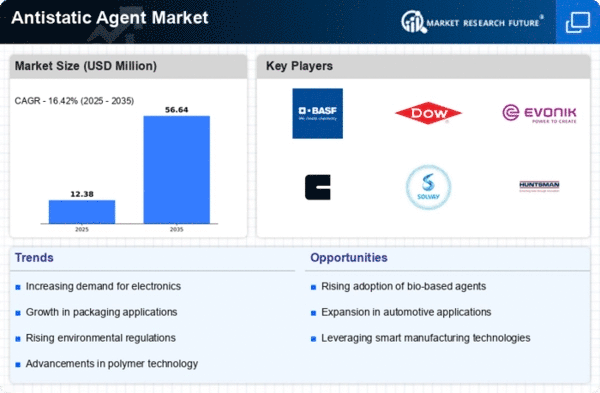
As per MRFR analysis, the Antistatic Agent Market Size was estimated at 10.63 USD Million in 2024. The Antistatic Agent industry is projected to grow from 12.38 in 2025 to 56.64 by 2035, exhibiting a compound annual growth rate (CAGR) of 16.42 during the forecast period 2025 - 2035.

Key Market Trends & Highlights

The Antistatic Agent Market is experiencing robust growth driven by technological advancements and increasing demand across various sectors.

  • The electronics sector continues to drive the largest demand for antistatic agents, particularly in North America. Sustainable solutions are gaining traction, reflecting a broader industry shift towards environmentally friendly formulations. Technological advancements in antistatic agent formulations are enhancing performance and application versatility, especially in textiles. Key market drivers include the rising use of antistatic agents in packaging applications and the expansion of the automotive sector in Asia-Pacific.

Market Size & Forecast

2024 Market Size 10.63 (USD Million)
2035 Market Size 56.64 (USD Million)
CAGR (2025 - 2035) 16.42%
Largest Regional Market Share in 2024 North America

Major Players

<p>BASF (DE), Dow (US), Evonik Industries (DE), Clariant (CH), Solvay (BE), Huntsman Corporation (US), Rudolf GmbH (DE), Kraton Corporation (US), A. Schulman (US)</p>

Market Trends

The Antistatic Agent Market is currently experiencing notable transformations driven by various factors. The increasing demand for electronic devices and packaging materials that require antistatic properties is shaping the landscape of this market. Industries such as automotive, electronics, and textiles are increasingly adopting antistatic agents to mitigate static electricity, which can lead to product damage and safety hazards. Furthermore, the growing awareness regarding the importance of static control in manufacturing processes is prompting companies to invest in advanced antistatic solutions. This trend indicates a shift towards more sustainable and efficient production practices, as businesses seek to enhance product quality and reliability. In addition, the Antistatic Agent Market is witnessing innovations in product formulations, with manufacturers focusing on developing eco-friendly and non-toxic alternatives. This shift aligns with global sustainability goals and consumer preferences for safer materials. As regulations surrounding chemical usage become more stringent, the market is likely to adapt by introducing greener options that do not compromise performance. Overall, the Antistatic Agent Market appears poised for growth, driven by technological advancements and a heightened emphasis on safety and environmental responsibility.

Rising Demand in Electronics Sector

The electronics industry is a primary driver of growth in the Antistatic Agent Market. As electronic devices become more prevalent, the need for effective static control solutions is increasing. Antistatic agents are essential in preventing damage to sensitive components during manufacturing and transportation.

Focus on Sustainable Solutions

There is a growing trend towards the development of eco-friendly antistatic agents. Manufacturers are increasingly prioritizing sustainability, leading to innovations in formulations that minimize environmental impact while maintaining effectiveness. This shift reflects broader consumer preferences for greener products.

Technological Advancements in Formulations

The Antistatic Agent Market is benefiting from ongoing research and development efforts aimed at enhancing product performance. New formulations are being introduced that offer improved efficacy and versatility, catering to diverse applications across various industries.

Antistatic Agent Market Market Drivers

Increasing Demand in Electronics

The Global Antistatic Agent Market Industry is experiencing heightened demand driven by the electronics sector. As electronic devices become more prevalent, the need for antistatic agents to prevent electrostatic discharge is critical. In 2024, the market is projected to reach 399.6 USD Million, reflecting the growing reliance on these agents in manufacturing processes. Industries such as consumer electronics, automotive, and telecommunications are increasingly adopting antistatic solutions to enhance product reliability and safety. This trend is likely to continue, as the integration of advanced technologies necessitates stringent measures against static electricity.

Market Segment Insights

By Application: Electronics (Largest) vs. Textiles (Fastest-Growing)

<p>The Antistatic Agent Market is significantly driven by the electronics sector, which holds the largest share among the various applications. The increasing demand for electronic devices has led to a marked rise in the utilization of antistatic agents to mitigate static electricity build-up, ensuring product integrity during manufacturing and transportation. Meanwhile, sectors like textiles are gaining traction, reflecting a growing awareness and requirements for static control in fabric manufacturing and processing activities. Growth trends in the Antistatic Agent Market point towards a robust expansion in applications beyond traditional sectors. The automotive and packaging industries are also key players, pushing demand for innovative antistatic solutions. As e-commerce grow, the focus on packaging optimization is emerging, thus propelling the need for antistatic agents that prevent product damage during shipment, while the automotive sector seeks enhanced safety measures against static build-up in components and assemblies.</p>

<p>Electronics (Dominant) vs. Textiles (Emerging)</p>

<p>The electronics sector stands as the dominant force within the Antistatic Agent Market, necessitated by the extensive use of sensitive electronic components requiring static-free environments for manufacturing and handling. Antistatic agents in this sector are critical to prevent equipment malfunction or product failure, thus preserving brand reputation and customer satisfaction. Meanwhile, textiles represent an emerging segment fueled by growing consumer consciousness regarding static-induced issues in fabrics. The increasing integration of antistatic technologies in textiles enhances product quality and promotes safety in apparel, indicating a promising shift toward consumer-preferred static-free fabrics. As companies innovate to meet these needs, the textiles sector is expected to experience rapid growth, driven by both fashion trends and industrial applications.</p>

By End Use Industry: Consumer Electronics (Largest) vs. Automotive (Fastest-Growing)

<p>In the Antistatic Agent Market, Consumer Electronics holds the largest share, driven by the increasing demand for electronic devices and growing concerns regarding static electricity. The rising use of plastics and advanced materials in electronics is propelling the utilization of antistatic agents to prevent static-related damages. Conversely, the Automotive sector is experiencing rapid growth due to the integration of electric vehicles and advanced electronic systems. Antistatic agents play a crucial role in protecting sensitive components in automotive applications, leading to an uptick in market utilization within this segment.</p>

<p>Consumer Electronics: Dominant vs. Automotive: Emerging</p>

<p>Consumer Electronics is the dominant sector in the Antistatic Agent Market due to the prevalent use of sensitive electronic components that require protection against static charges. The growth of smart devices, coupled with the demand for sophisticated electronic applications, has created a significant need for effective antistatic solutions. On the other hand, the Automotive segment is emerging rapidly as the industry integrates more electronic features, especially in electric vehicles and automation systems. This segment's adoption of antistatic agents is increasing as manufacturers recognize the importance of safeguarding critical electronic parts from static electricity, thus enabling both sectors to thrive.</p>

By Type: Cationic Antistatic Agents (Largest) vs. Nonionic Antistatic Agents (Fastest-Growing)

<p>In the Antistatic Agent Market, cationic antistatic agents currently hold the largest share due to their effectiveness in various applications, especially in textiles and electronics. Anionic and amphoteric antistatic agents also contribute to the market, but their shares are comparatively smaller. Nonionic antistatic agents, although smaller in market share, are gaining visibility owing to their versatility and compatibility with various substrates.</p>

<p>Cationic Antistatic Agents (Dominant) vs. Nonionic Antistatic Agents (Emerging)</p>

<p>Cationic antistatic agents are widely recognized for their strong performance in controlling static electricity, particularly in the textile and packaging industries. They are crucial for products requiring a high level of electrostatic control. Conversely, nonionic antistatic agents are becoming increasingly popular due to their compatibility with a broader range of materials and lower toxicity. As industries focus on sustainability, the appeal of nonionic agents is rising. Their ability to function effectively across diverse applications positions them as an emerging force in the market, poised for substantial growth in the coming years.</p>

By Formulation: Liquid (Largest) vs. Powder (Fastest-Growing)

<p>The formulation segment of the Antistatic Agent Market is characterized by distinct categories such as Liquid, Powder, Concentrate, and Masterbatch. Among these, Liquid formulations hold the largest market share due to their versatility and ease of application across various industries. The Powder segment, while currently smaller, is gaining traction owing to its favorable characteristics of ease of handling and application in solid and semi-solid products. Overall, the distribution highlights a commitment to evolving customer preferences that favor liquid solutions for efficiency.</p>

<p>Liquid (Dominant) vs. Powder (Emerging)</p>

<p>Liquid antistatic agents are the dominant form in the market, celebrated for their ease of use, adaptability, and effectiveness in a variety of applications from electronics to textiles. Their formulation allows for uniform application, making them highly desirable in sectors requiring stringent control of electrostatic discharge. In contrast, powder formulations, although emerging, are rapidly gaining attention for their unique properties that offer advantages such as enhanced stability and ease of formulation in product mixtures. This duality of dominance and potential represents a dynamic market landscape, as manufacturers innovate to meet diverse operational needs.</p>

By Distribution Channel: Direct Sales (Largest) vs. Online Sales (Fastest-Growing)

<p>In the Antistatic Agent Market, Direct Sales remains the largest distribution channel, capturing a significant portion of the market share. This channel facilitates personalized customer interactions and allows manufacturers to build strong relationships with clients. Conversely, Online Sales, while currently smaller in overall share, is rapidly gaining traction, driven by the growing trend of e-commerce and digital platforms. As industries increasingly shift toward online purchasing, the penetration of e-commerce has become vital for reaching a broader customer base. The growth trends for this segment indicate shifting consumer preferences toward convenience and accessibility. Online Sales are particularly benefitting from the rising adoption of digital technologies, which allow customers to browse and purchase antistatic agents with ease. Conversely, Direct Sales continue to thrive in specialized sectors that require tailored solutions, emphasizing the importance of personal engagement and expert guidance in certain markets. These evolving dynamics suggest a future where hybrid models, integrating both Direct and Online Sales approaches, will become increasingly common in the Antistatic Agent Market.</p>

<p>Direct Sales (Dominant) vs. Online Sales (Emerging)</p>

<p>Direct Sales has established itself as a dominant force within the Antistatic Agent Market due to its ability to offer tailored solutions and foster strong customer relationships. This channel allows manufacturers to directly communicate the technical benefits of their products, ensuring that customers receive comprehensive support and expert advice. In contrast, Online Sales represents an emerging segment that is gaining momentum, characterized by its convenience and ability to reach a wider audience. The online platform attracts customers seeking quick access to product information, competitive pricing, and ease of purchase. As both channels continue to evolve, Direct Sales will likely remain critical in specialized markets, while Online Sales may redefine the purchasing landscape by making antistatic agents more accessible to diverse consumer segments.</p>

Get more detailed insights about Antistatic Agent Market Research Report -Forecast to 2035

Regional Insights

North America : Market Leader in Antistatic Agents

North America is poised to maintain its leadership in the Antistatic Agent Market, holding a significant market share of 4.5 in 2024. The growth is driven by increasing demand from the electronics and packaging sectors, where static control is critical. Regulatory support for safer manufacturing processes and environmental compliance further catalyzes market expansion. The region's focus on innovation and technology adoption also plays a crucial role in enhancing product offerings and meeting consumer needs. The competitive landscape in North America is robust, featuring key players such as BASF, Dow, and Huntsman Corporation. These companies leverage advanced technologies and extensive distribution networks to capture market share. The U.S. stands out as the leading country, supported by a strong manufacturing base and significant investments in R&D. The presence of established firms fosters a dynamic environment, driving continuous improvements and product diversification.

Europe : Emerging Market with Growth Potential

Europe, with a market size of 3.2, is witnessing a steady rise in the Antistatic Agent Market, driven by stringent regulations aimed at enhancing product safety and environmental sustainability. The demand for antistatic solutions is particularly strong in the automotive and electronics industries, where static discharge can lead to significant losses. Regulatory frameworks, such as REACH, are pivotal in shaping market dynamics, ensuring compliance and promoting innovation in product development. Leading countries in Europe include Germany, France, and the UK, where major players like Evonik Industries and Clariant are actively engaged in expanding their product portfolios. The competitive landscape is characterized by a mix of established firms and emerging startups, fostering innovation and collaboration. The region's focus on sustainability and eco-friendly solutions is expected to drive further growth, positioning Europe as a key player in the global market.

Asia-Pacific : Rapidly Growing Antistatic Market

Asia-Pacific is emerging as a significant player in the Antistatic Agent Market, with a market size of 2.5. The region's growth is fueled by rapid industrialization, increasing consumer electronics production, and a growing awareness of static control in manufacturing processes. Countries like China and India are leading this growth, supported by favorable government policies and investments in infrastructure. The rising demand for packaging solutions in e-commerce further propels market expansion, making it a focal point for manufacturers. The competitive landscape in Asia-Pacific is diverse, with both local and international players vying for market share. Key companies such as Kraton Corporation and A. Schulman are expanding their operations to meet the rising demand. The presence of a large manufacturing base and a growing middle-class population contribute to the region's attractiveness for antistatic solutions. As the market matures, innovation and product differentiation will be crucial for sustaining growth and competitiveness.

Middle East and Africa : Emerging Market with Untapped Potential

The Middle East and Africa region, with a market size of 0.43, presents untapped potential in the Antistatic Agent Market. The growth is primarily driven by increasing industrial activities and the rising demand for electronic products. However, the market is still in its nascent stages, with significant opportunities for expansion as industries recognize the importance of static control. Government initiatives aimed at boosting manufacturing and technology adoption are expected to catalyze market growth in the coming years. Leading countries in this region include South Africa and the UAE, where local manufacturers are beginning to explore antistatic solutions. The competitive landscape is gradually evolving, with both regional and international players entering the market. As awareness of the benefits of antistatic agents grows, the region is likely to see increased investments and innovations, paving the way for a more robust market presence.

Key Players and Competitive Insights

The Antistatic Agent Market is currently characterized by a dynamic competitive landscape, driven by increasing demand across various industries such as electronics, packaging, and automotive. Key players are focusing on innovation and sustainability to enhance their market positions. For instance, BASF (DE) emphasizes its commitment to sustainable solutions, while Dow (US) is leveraging its extensive research capabilities to develop advanced antistatic agents. Evonik Industries (DE) is also notable for its strategic partnerships aimed at expanding its product portfolio, which collectively shapes a competitive environment that is increasingly focused on technological advancements and eco-friendly products.In terms of business tactics, companies are localizing manufacturing to reduce lead times and optimize supply chains. The market structure appears moderately fragmented, with several players vying for market share. This fragmentation allows for a diverse range of products and innovations, although the influence of key players like Clariant (CH) and Solvay (BE) remains substantial, as they continue to set industry standards through their extensive R&D investments.


In November Clariant (CH) announced a strategic partnership with a leading electronics manufacturer to develop a new line of antistatic agents tailored for sensitive electronic components. This collaboration is expected to enhance Clariant's market presence in the electronics sector, reflecting a growing trend towards specialized solutions that cater to specific industry needs. Such partnerships not only bolster product offerings but also signify a shift towards more integrated supply chains.


In October Solvay (BE) launched a new range of biodegradable antistatic agents, aligning with the increasing consumer demand for sustainable products. This initiative is particularly significant as it positions Solvay as a leader in eco-friendly solutions within the market, potentially attracting environmentally conscious customers and enhancing brand loyalty. The introduction of biodegradable options may also influence competitors to innovate in sustainability, thereby reshaping market dynamics.


In September Huntsman Corporation (US) expanded its production capacity for antistatic agents in response to rising global demand. This expansion not only demonstrates Huntsman's commitment to meeting market needs but also reflects a broader trend of scaling operations to enhance supply chain reliability. Such moves are crucial in a market where timely delivery and product availability are increasingly prioritized by customers.


As of December current competitive trends indicate a strong emphasis on digitalization, sustainability, and the integration of AI technologies in product development. Strategic alliances are becoming more prevalent, as companies recognize the value of collaboration in driving innovation. The competitive landscape is likely to evolve from traditional price-based competition towards a focus on technological differentiation, sustainability, and supply chain resilience, suggesting that companies that prioritize these aspects will be better positioned for future success.

Key Companies in the Antistatic Agent Market include

Industry Developments

December 2021- Alfa Chemistry, a prominent player in the antistatic agent market worldwide, recently disclosed to provide a wide range of halide quaternary ammonium salts that is just one kind of its varied offering of quaternary ammonium compounds (QACs), including quaternary phosphonium compounds, quaternary ammonium hydroxide, polyquaternium, and acid radical quaternary ammonium salts. Halide quaternary ammonium salts are usually known as quaternary ammonium salts and are broadly utilized in purifying scenarios. The Marketing Chief of Alfa Chemistry said that the firm delivers several halide quaternary ammonium salts.

Till now, bromide series, fluoride series, and chloride series, and iodide series can be feasibly found at the company. Customers can find the CAS No. or type the name of the chemical they are looking for in the search bar of the company’s website.Halide quaternary ammonium salts can be utilized as antistatic softening agents or as a fungicide in the printing and textile and dyeing industry with excellent softness, anti-yellowing, sterilization, and antistatic properties. They can also be broadly utilized as flocculant synergists in the water treatment industry.Clariant launched new anti-static agents that increased its sustainable competitive advantage

KAO group

entered into a strategic partnership to produce new forms of anti-static agents

Future Outlook

Antistatic Agent Market Future Outlook

<p>The Antistatic Agent Market is projected to grow at a 16.42% CAGR from 2025 to 2035, driven by increasing demand in electronics, automotive, and packaging sectors.</p>

New opportunities lie in:

  • <p>Development of biodegradable antistatic agents for eco-friendly applications. Expansion into emerging markets with tailored product offerings. Investment in R&amp;D for innovative formulations enhancing performance and cost-effectiveness.</p>

<p>By 2035, the Antistatic Agent Market is expected to achieve substantial growth and diversification.</p>

Market Segmentation

Antistatic Agent Market Type Outlook

  • Cationic Antistatic Agents
  • Anionic Antistatic Agents
  • Nonionic Antistatic Agents
  • Amphoteric Antistatic Agents

Antistatic Agent Market Application Outlook

  • Electronics
  • Packaging
  • Automotive
  • Textiles
  • Construction

Antistatic Agent Market Formulation Outlook

  • Liquid
  • Powder
  • Concentrate
  • Masterbatch

Antistatic Agent Market End Use Industry Outlook

  • Consumer Electronics
  • Automotive
  • Aerospace
  • Healthcare
  • Industrial

Antistatic Agent Market Distribution Channel Outlook

  • Direct Sales
  • Online Sales
  • Distributors
  • Retail

Report Scope

MARKET SIZE 2024 10.63(USD Million)
MARKET SIZE 2025 12.38(USD Million)
MARKET SIZE 2035 56.64(USD Million)
COMPOUND ANNUAL GROWTH RATE (CAGR) 16.42% (2025 - 2035)
REPORT COVERAGE Revenue Forecast, Competitive Landscape, Growth Factors, and Trends
BASE YEAR 2024
Market Forecast Period 2025 - 2035
Historical Data 2019 - 2024
Market Forecast Units USD Million
Key Companies Profiled BASF (DE), Dow (US), Evonik Industries (DE), Clariant (CH), Solvay (BE), Huntsman Corporation (US), Rudolf GmbH (DE), Kraton Corporation (US), A. Schulman (US)
Segments Covered Application, End Use Industry, Type, Formulation, Distribution Channel
Key Market Opportunities Growing demand for sustainable materials drives innovation in the Antistatic Agent Market.
Key Market Dynamics Rising demand for antistatic agents in electronics manufacturing drives innovation and competitive dynamics in the market.
Countries Covered North America, Europe, APAC, South America, MEA

FAQs

What are antistatic agents, their types, and applications?

Antistatic agents are polymer additives used to prevent the static electricity build-up and thus, to increase the dielectric surface &amp; volume conductivity in plastic materials. Diethanolamides, ethoxylated fatty acid amines, and glycerol monostearate are major antistatic.

Which are the major end-use industries of antistatic agents?

Packaging, electronics, and automotive are the major end-use industries of antistatic agents.

What are the key driving forces behind the growth of the global antistatic agent market?

Widespread use of plastics across the industries.

Which region holds the largest share in the global antistatic agent market?

Asia Pacific holds the largest share in the global antistatic agent market followed by North America and Europe, respectively.

Who are the top players in the global antistatic agent market?

BASF SE (Germany), 3M (US), DowDuPont (US), Croda International Plc (UK), Akzo Nobel N.V. (Netherlands), A. Schulman, Inc. (US), Solvay (Belgium), Arkema (France), Evonik Industries AG (Germany), LyondellBasell Industries N.V. (Netherlands), Clariant (Switzerland), and Mitsubishi Chemical Holdings Corporation (Japan), are some of the leading players in the global antistatic agent market.

  1. SECTION I: EXECUTIVE SUMMARY AND KEY HIGHLIGHTS |
    1. EXECUTIVE SUMMARY 2
  2. SECTION II: SCOPING, METHODOLOGY AND MARKET STRUCTURE |
    1. MARKET INTRODUCTION |
    2. RESEARCH METHODOLOGY 3
  3. SECTION III: QUALITATIVE ANALYSIS |
    1. MARKET DYNAMICS |
    2. MARKET FACTOR ANALYSIS 4
  4. SECTION IV: QUANTITATIVE ANALYSIS |
    1. Chemicals and Materials, BY Application (USD Million) |
    2. Chemicals and Materials, BY End Use Industry (USD Million) |
    3. Chemicals and Materials, BY Type (USD Million) |
    4. Chemicals and Materials, BY Formulation (USD Million) |
    5. Chemicals and Materials, BY Distribution Channel (USD Million) |
    6. Chemicals and Materials, BY Region (USD Million) 5
  5. SECTION V: COMPETITIVE ANALYSIS |
    1. Competitive Landscape |
    2. Company Profiles |
    3. Appendix

Antistatic Agent Market Segmentation

Market Segmentation Overview

  • Detailed segmentation data will be available in the full report
  • Comprehensive analysis by multiple parameters
  • Regional and country-level breakdowns
  • Market size forecasts by segment
Infographic

Free Sample Request

Kindly complete the form below to receive a free sample of this Report

Get Free Sample

Customer Strories

Compare Licence

×
Features License Type
Single User Multiuser License Enterprise User
Price $4,950 $5,950 $7,250
Maximum User Access Limit 1 User Upto 10 Users Unrestricted Access Throughout the Organization
Free Customization
Direct Access to Analyst
Deliverable Format
Platform Access
Discount on Next Purchase 10% 15% 15%
Printable Versions