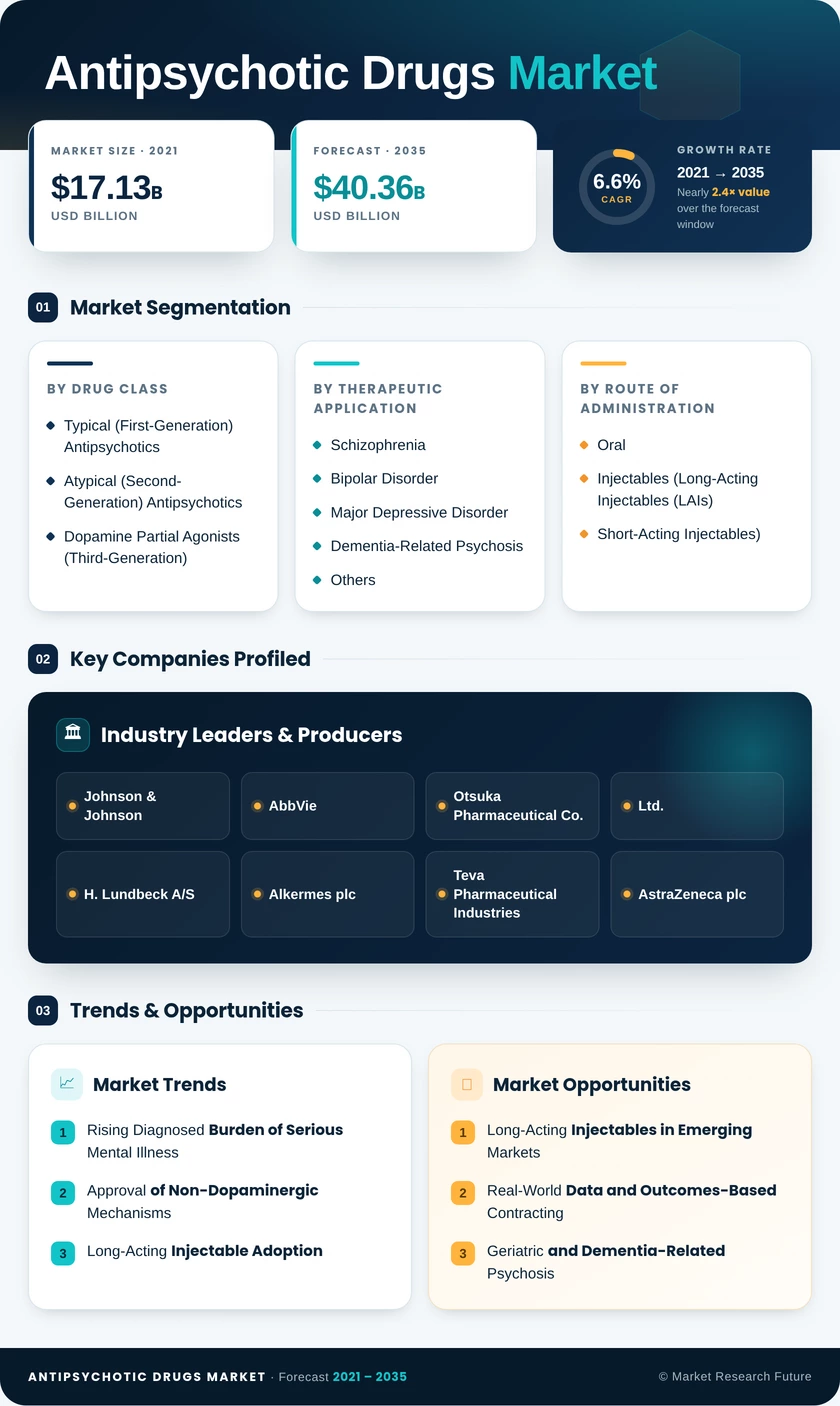
Antipsychotic Drugs Market (2026 - 2035)

ID: MRFR/Pharma/2067-HCR 90 Pages Satyendra Maurya Last Updated: November 20, 2026
Antipsychotic Drugs Market Research Report By Drug Type (Typical Antipsychotics, Atypical Antipsychotics, Long-Acting Injectables, Mood Stabilizers), By Indication (Schizophrenia, Bipolar Disorder, Major Depressive Disorder, Autism Spectrum Disorders), By Administration Route (Oral, Injectable, Transdermal), By Patient Age Group (Pediatric, Adult, Geriatric) and By Regional (North America, Europe, South America, Asia Pacific, Middle East and Africa) - Growth & Industry Forecast 2026 To 2035
Antipsychotic Drugs Market
Market Size
Forecast Period2026-2035
CAGR (2026-2035)6.6%
2025 Market SizeUSD 21.30 Billion
2035 Market SizeUSD 40.36 Billion
Key Players
Johnson & Johnson
AbbVie
Otsuka Pharmaceutical Co., Ltd.
H. Lundbeck A/S
Alkermes plc
Teva Pharmaceutical Industries
Opportunities
  • Long-Acting Injectables in Emerging Markets
  • Real-World Data and Outcomes-Based Contracting
  • Geriatric and Dementia-Related Psychosis
  1. 1 Market Summary | |
  2. 2 Key Report Takeaways | |
    1. 2.1 By Drug Class | |
    2. 2.2 By Therapeutic Application | |
    3. 2.3 By Route of Administration | |
    4. 2.4 By Region | |
  3. 3 Market Size and Forecast (2021–2035) | |
    1. 3.1 Historical Market Size (2021–2024) | |
    2. 3.2 Base Year and Forecast Market Size (2025–2035) | |
    3. 3.3 Year-over-Year Growth Analysis | |
  4. 4 Driver Impact Analysis | |
    1. 4.1 Rising Diagnosed Burden of Serious Mental Illness | |
    2. 4.2 Approval of Non-Dopaminergic Mechanisms | |
    3. 4.3 Long-Acting Injectable Adoption | |
    4. 4.4 Label Expansion into Mood and Dementia Indications | |
    5. 4.5 Psychiatric Service Expansion in Asia | |
    6. 4.6 Large-Scale M&A Funding Late-Stage Pipelines | |
    7. 4.7 Public Payer Coverage of Severe Mental Illness | |
  5. 5 Restraints Impact Analysis | |
    1. 5.1 Generic Erosion of Branded Atypicals | |
    2. 5.2 Safety Warnings in Elderly Populations | |
    3. 5.3 Metabolic and Movement-Disorder Side Effects | |
    4. 5.4 High Late-Stage Pipeline Attrition | |
    5. 5.5 Under-Treatment in Low- and Middle-Income Countries | |
  6. 6 Opportunities | |
    1. 6.1 Long-Acting Injectables in Emerging Markets | |
    2. 6.2 Real-World Data and Outcomes-Based Contracting | |
    3. 6.3 Geriatric and Dementia-Related Psychosis | |
    4. 6.4 In-Licensing Novel Mechanisms | |
    5. 6.5 Japan Lifecycle Management | |
  7. 7 Regional Market Share and Country-Level Analysis | |
    1. 7.1 North America | | |
      1. 7.1.1 United States | | |
      2. 7.1.2 Canada | | |
      3. 7.1.3 Mexico | |
    2. 7.2 Europe | | |
      1. 7.2.1 Germany | | |
      2. 7.2.2 United Kingdom | | |
      3. 7.2.3 France | | |
      4. 7.2.4 Italy | | |
      5. 7.2.5 Spain | | |
      6. 7.2.6 Rest of Europe | |
    3. 7.3 Asia-Pacific | | |
      1. 7.3.1 China | | |
      2. 7.3.2 Japan | | |
      3. 7.3.3 India | | |
      4. 7.3.4 Australia | | |
      5. 7.3.5 South Korea | | |
      6. 7.3.6 Rest of Asia-Pacific | |
    4. 7.4 South America | | |
      1. 7.4.1 Brazil | | |
      2. 7.4.2 Argentina | | |
      3. 7.4.3 Rest of South America | |
    5. 7.5 Middle East & Africa | | |
      1. 7.5.1 GCC | | |
      2. 7.5.2 South Africa | | |
      3. 7.5.3 Rest of Middle East & Africa | |
  8. 8 Future Outlook (2026–2035) | |
    1. 8.1 Mechanism Diversification Beyond Dopamine | |
    2. 8.2 Longer Intervals and Subcutaneous Delivery | |
    3. 8.3 Precision Psychiatry and Digital Phenotyping | |
    4. 8.4 Value-Based Pricing Through the Genericization Cycle | |
  9. 9 Segmentation Analysis | |
    1. 9.1 By Drug Class | | |
      1. 9.1.1 Typical (First-Generation) Antipsychotics | | |
      2. 9.1.2 Atypical (Second-Generation) Antipsychotics | | |
      3. 9.1.3 Dopamine Partial Agonists (Third-Generation) | |
    2. 9.2 By Therapeutic Application | | |
      1. 9.2.1 Schizophrenia | | |
      2. 9.2.2 Bipolar Disorder | | |
      3. 9.2.3 Major Depressive Disorder | | |
      4. 9.2.4 Dementia-Related Psychosis | | |
      5. 9.2.5 Others | |
    3. 9.3 By Route of Administration | | |
      1. 9.3.1 Oral | | |
      2. 9.3.2 Injectables | |
  10. 10 Competitive Landscape | |
    1. 10.1 Market Concentration Analysis | |
    2. 10.2 Competitive Benchmarking Matrix | |
  11. 11 Recent News & Developments | |
  12. 12 Report Scope and Methodology | |
  13. 13 Detailed Sources and Citations | |
  14. 14 Frequently Asked Questions (FAQs) | | LIST OF TABLES | |
  15. TABLE 1 Global Market Summary Snapshot, 2025–2035 | |
  16. TABLE 2 Global Market Size and Forecast, by Revenue (USD Billion), 2021–2035 | |
  17. TABLE 3 Driver Impact Analysis on CAGR, 2026–2035 | |
  18. TABLE 4 Restraint Impact Analysis on CAGR, 2026–2035 | |
  19. TABLE 5 Regional Summary, 2025 | |
  20. TABLE 6 North America Market, by Country, 2025 | |
  21. TABLE 7 Europe Market, by Country, 2025 | |
  22. TABLE 8 Asia-Pacific Market, by Country, 2025 | |
  23. TABLE 9 South America Market, by Country, 2025 | |
  24. TABLE 10 Middle East & Africa Market, by Country, 2025 | |
  25. TABLE 11 Global Market, by Drug Class, 2025 | |
  26. TABLE 12 Global Market, by Therapeutic Application, 2025 | |
  27. TABLE 13 Global Market, by Route of Administration, 2025 | |
  28. TABLE 14 Competitive Benchmarking Matrix, 2025 | |
  29. TABLE 15 Report Scope and Methodology | |
  30. TABLE 16 Detailed Sources and Citations | | LIST OF FIGURES | |
  31. FIGURE 1 Market Dynamics Overview — Drivers, Restraints and Opportunities | |
  32. FIGURE 2 Industry Value Chain Analysis | |
  33. FIGURE 3 Porter's Five Forces Analysis | |
  34. FIGURE 4 Global Market Size Trend, 2021–2035 (USD Billion) | |
  35. FIGURE 5 Market Share by Drug Class, 2025 | |
  36. FIGURE 6 Market Share by Therapeutic Application, 2025 | |
  37. FIGURE 7 Market Share by Route of Administration, 2025 | |
  38. FIGURE 8 Regional Market Share, 2025 | |
  39. FIGURE 9 Regional Growth Comparison, 2026–2035 | |
  40. FIGURE 10 Competitive Landscape — Estimated Revenue Share Ranges, 2025

Segmentation Quick Reference

DimensionSub-SegmentsDominant SegmentFastest Growing Segment
By Drug ClassTypical (First-Generation) Antipsychotics; Atypical (Second-Generation) Antipsychotics; Dopamine Partial Agonists (Third-Generation)Atypical (Second-Generation) Antipsychotics (67.8% share)Dopamine Partial Agonists (Third-Generation) (7.4% CAGR)
By Therapeutic ApplicationSchizophrenia; Bipolar Disorder; Major Depressive Disorder; Dementia-Related Psychosis; OthersSchizophrenia (57.9% share)Bipolar Disorder (8.2% CAGR)
By Route of AdministrationOral; Injectables (Long-Acting Injectables (LAIs), Short-Acting Injectables)Oral (73.2% share)Long-Acting Injectables (LAIs) (8.0% CAGR)
By RegionNorth America; Europe; Asia-Pacific; South America; Middle East & AfricaNorth America (41.8% share)Asia-Pacific (8.1% CAGR)

Market Segmentation Overview

By Drug Class

Sub-SegmentKey Trend
Typical (First-Generation) AntipsychoticsDeclining share; retained for acute agitation and tender markets
Atypical (Second-Generation) AntipsychoticsRevenue anchor through LAI formulations and broad labels
Dopamine Partial Agonists (Third-Generation)Fastest growth on tolerability and mood-disorder approvals

Atypical (Second-Generation) Antipsychotics lead the class because paliperidone and risperidone franchises have moved patients into long-acting formats that generics have not yet copied. Dopamine Partial Agonists (Third-Generation) grow fastest because their partial D2 activity causes fewer motor and prolactin side effects. Typical (First-Generation) Antipsychotics continue to lose share outside emergency and low-cost settings.

By Therapeutic Application

Sub-SegmentKey Trend
SchizophreniaCore maintenance indication; prime LAI target
Bipolar DisorderFastest growth on depressive-phase approvals
Major Depressive DisorderAdjunctive use alongside antidepressants
Dementia-Related PsychosisEmerging indication after Alzheimer's agitation approval
OthersPaediatric irritability and neurological indications

Schizophrenia leads applications because patients need decades of continuous treatment and are the main target for long-acting injectables. Bipolar Disorder grows fastest as lumateperone and cariprazine gain approval for depressive episodes, a large population with few previous options. Dementia-Related Psychosis is the next growth front, but mortality warnings will keep uptake measured.

By Route of Administration

Sub-SegmentKey Trend
OralDominant for initiation and titration; generic-heavy
InjectablesLong-Acting Injectables (LAIs) drive growth; Short-Acting Injectables remain a niche for emergency use

Oral formulations lead this dimension because almost every patient starts on tablets and generic oral options are inexpensive. Within Injectables, Long-Acting Injectables (LAIs) grow fastest as two-month, subcutaneous and six-month products reduce relapse risk and clinic burden. Short-Acting Injectables stay confined to emergency stabilization and inpatient agitation.


Download PDF ×

We do not share your information with anyone. However, we may send you emails based on your report interest from time to time. You may contact us at any time to opt-out.