Request Free Sample ×

Kindly complete the form below to receive a free sample of this Report

* Please use a valid business email

Leading companies partner with us for data-driven Insights

clients tt-cursor
Hero Background
English
Chinese
French
Japanese
Korean
German
Spanish

Antihelminthics Market Analysis

ID: MRFR/Pharma/3086-HCR
85 Pages
Vikita Thakur
March 2026

Antihelminthics Market Size, Growth Research Report By Type (Benzimidazoles, (Albendazole, Mebendazole, Benzimidazoles, Thiabendazole, Others), Abamectin, Salicylanilides (Niclosamide, Oxyclozanide, Rafoxanide, Others), Praziquantel, and Others), By Application (Schistosomiasis, Fasciolasis, Filariasis, Angiostrongylosis, Ascariasis, Giardiasis, and Others) – Competitor Industry Analysis and Trends Forecast Till 2035

Share:
Download PDF ×

We do not share your information with anyone. However, we may send you emails based on your report interest from time to time. You may contact us at any time to opt-out.

Antihelminthics Market Infographic
Purchase Options

Market Analysis

In-depth Analysis of Antihelminthics Market Industry Landscape

Millions of people worldwide have parasitic worm infections, including soil-transmitted and schistosomiasis helminths. This raises the need for efficient antihelminthic drugs and changes market trends in infectious disease treatment. People often call helminthic infections "neglected diseases." Efforts to deal with NTDs help the market grow and make it easier for drug companies, states, and foreign groups to work together.

The market gains from the growing number of programs that give out a lot of drugs at once. Large-scale programs that give antihelminthic drugs to whole communities have an effect on market growth and help control and get rid of helminthic diseases in places where they are common.

Worm-killing programs in schools set the tone for the market. Trying to get school-aged kids to get regular antihelminthic treatment changes the market because kids are more likely to get helminthic illnesses, which affects treatment availability and demand.

There are uses for antihelminthic drugs in animal medicine, which changes how the market works. The treatment of helminthic diseases in cattle, such as deworming programs for farm animals, affects veterinary healthcare and adds to the market for antihelminthics as a whole.

When anthelmintic resistance shows up, it changes how the market works. When helminths become resistant to widely used antihelminthic drugs, it changes the goals of research, which in turn changes market competition and leads to the search for new treatment choices.

A lot of research and development goes into making anthelmintic drugs, which has a big effect on how the market works. Finding new chemicals and combinations helps make antihelminthic drugs that work better and are safer, which affects drug innovation market trends.

The market will also benefit from strong attempts to make it easier for people to get medicine. Making antihelminthic drugs easier to get, especially in low- and middle-income countries, helps the market grow and is in line with global goals for health equality.

Community health worker schemes that give out antihelminthic drugs like the market. Including community-based health care in deworming programs changes how easy it is for people to get products and helps control diseases at the community level.


Author
Author Profile
Vikita Thakur
Senior Research Analyst

She holds an experience of about 5+ years in market research and business consulting projects for sectors such as life sciences, medical devices, and healthcare IT. She possesses a robust background in data analysis, market estimation, competitive intelligence, pipeline analysis market trend identification, and consumer behavior insights. Her expertise lies in technical Sales support, client interaction and project management, designing and implementing market research studies, conducting competitive analysis, and synthesizing complex data into actionable recommendations that drive business growth.

Leave a Comment

FAQs

What is the current valuation of the Antihelminthics Market as of 2024?

<p>The Antihelminthics Market was valued at 1742.75 USD Million in 2024.</p>

What is the projected market valuation for the Antihelminthics Market in 2035?

<p>The market is projected to reach 4461.78 USD Million by 2035.</p>

What is the expected CAGR for the Antihelminthics Market during the forecast period 2025 - 2035?

<p>The expected CAGR for the Antihelminthics Market during 2025 - 2035 is 8.92%.</p>

Which companies are considered key players in the Antihelminthics Market?

<p>Key players in the market include Bayer AG, Merck & Co., Boehringer Ingelheim, Novartis AG, GlaxoSmithKline, Sanofi, Pfizer Inc., and Bristol-Myers Squibb.</p>

What are the main applications of antihelminthic treatments?

<p>The main applications include Anthelmintic Treatment, Preventive Treatment, Veterinary Use, and Research and Development.</p>

How does the market segment by drug type look in terms of valuation?

<p>The market segments by drug type include Benzimidazoles, Macrocyclic Lactones, Praziquantel, and Tetrahydropyrimidines, with valuations ranging from 242.75 to 1500.0 USD Million.</p>

What are the primary end users of antihelminthic products?

Primary end users include Hospitals, Clinics, Pharmacies, and Research Institutions.

What is the valuation range for veterinary use in the Antihelminthics Market?

The valuation range for veterinary use is between 500.0 and 1200.0 USD Million.

How does the valuation of preventive treatment compare to other applications?

Preventive Treatment has a valuation range of 400.0 to 1000.0 USD Million, indicating a substantial market presence.

What is the significance of research and development in the Antihelminthics Market?

Research and Development holds a valuation range of 242.75 to 761.78 USD Million, highlighting its critical role in market innovation.

Market Summary

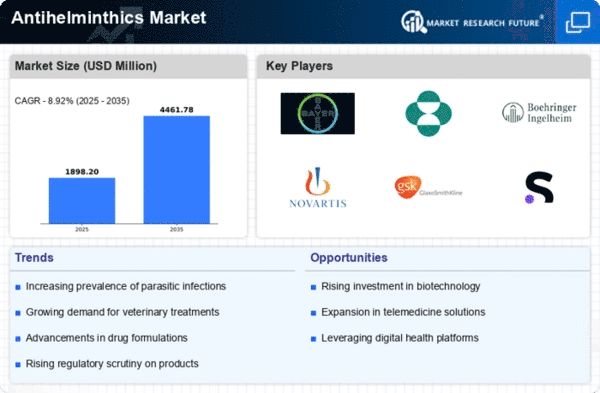
As per MRFR analysis, the Antihelminthics Market Size was estimated at 1742.75 USD Million in 2024. The Antihelminthics industry is projected to grow from 1898.24 USD Million in 2025 to 4461.78 USD Million by 2035, exhibiting a compound annual growth rate (CAGR) of 8.92% during the forecast period 2025 - 2035.

Key Market Trends & Highlights

The Antihelminthics Market is experiencing robust growth driven by rising awareness and advancements in drug development.

  • North America remains the largest market for antihelminthics, reflecting a strong demand for effective treatments. Asia-Pacific is identified as the fastest-growing region, driven by increasing healthcare access and awareness. Anthelmintic drugs dominate the market, while veterinary medicine is emerging as the fastest-growing segment. The rising prevalence of helminth infections and government initiatives are key drivers propelling market expansion.

Market Size & Forecast

2024 Market Size 1742.75 (USD Million)
2035 Market Size 4461.78 (USD Million)
CAGR (2025 - 2035) 8.92%
Largest Regional Market Share in 2024 North America

Major Players

Bayer AG (DE), Merck &amp; Co. (US), Boehringer Ingelheim (DE), Novartis AG (CH), GlaxoSmithKline (GB), Sanofi (FR), Pfizer Inc. (US), Bristol-Myers Squibb (US)

Market Trends

The Antihelminthics Market is currently experiencing notable transformations driven by various factors. The increasing prevalence of parasitic infections globally has heightened the demand for effective antihelminthic treatments. This surge is further influenced by rising awareness regarding the health implications of helminth infections, particularly in developing regions where such diseases are endemic. Additionally, advancements in pharmaceutical research are leading to the development of novel antihelminthic agents, which may offer improved efficacy and safety profiles compared to traditional treatments. As a result, stakeholders in the healthcare sector are focusing on innovative solutions to address the challenges posed by these infections. Moreover, the Antihelminthics Market is witnessing a shift towards combination therapies, which may enhance treatment outcomes and reduce the likelihood of resistance development. This trend is indicative of a broader movement within the pharmaceutical industry to optimize therapeutic regimens. Furthermore, the increasing collaboration between public health organizations and private entities suggests a concerted effort to combat helminth infections on a global scale. Such partnerships may facilitate the distribution of antihelminthic medications in underserved areas, thereby improving access to essential treatments. Overall, the Antihelminthics Market appears poised for growth as it adapts to the evolving landscape of infectious disease management.

Rising Awareness and Education

There is a growing emphasis on educating communities about the risks associated with helminth infections. Public health campaigns are increasingly targeting vulnerable populations, aiming to reduce transmission rates and promote preventive measures. This heightened awareness is likely to drive demand for antihelminthic treatments.

Advancements in Drug Development

Innovations in pharmaceutical research are leading to the creation of new antihelminthic agents. These developments may provide enhanced efficacy and safety, addressing the limitations of existing treatments. The focus on research and development is expected to shape the future of the Antihelminthics Market.

Shift Towards Combination Therapies

The trend towards combination therapies is gaining traction within the Antihelminthics Market. Such approaches may improve treatment outcomes and mitigate the risk of drug resistance. This strategy reflects a broader movement in healthcare to optimize therapeutic effectiveness.

Antihelminthics Market Market Drivers

Market Growth Projections

The Global Antihelminthics Market Industry is poised for substantial growth, with projections indicating a market value of 1.74 USD Billion in 2024 and an anticipated increase to 4.47 USD Billion by 2035. This growth trajectory suggests a compound annual growth rate of 8.95% from 2025 to 2035. The factors driving this expansion include rising prevalence of helminth infections, government initiatives, advancements in drug development, and increased awareness. These elements collectively contribute to a robust market outlook, reflecting the critical need for effective antihelminthic treatments in both human and veterinary medicine.

Rising Veterinary Applications

The expanding use of antihelminthic drugs in veterinary medicine is emerging as a notable driver for the Global Antihelminthics Market Industry. As pet ownership increases globally, the demand for effective deworming treatments for pets and livestock is rising. This trend is particularly evident in developed countries, where pet owners are becoming more proactive about their animals' health. The veterinary segment is projected to contribute significantly to the overall market growth, as it encompasses a wide range of antihelminthic products tailored for various animal species. This diversification in applications is likely to enhance the market's resilience and adaptability.

Advancements in Drug Development

Innovations in drug development play a crucial role in shaping the Global Antihelminthics Market Industry. The emergence of novel antihelminthic agents, which are more effective and exhibit fewer side effects, is likely to attract attention from healthcare providers and patients alike. Research institutions and pharmaceutical companies are increasingly focusing on developing combination therapies that target multiple helminth species simultaneously. This trend not only enhances treatment efficacy but also addresses the issue of drug resistance. As a result, the market is expected to grow at a compound annual growth rate of 8.95% from 2025 to 2035, indicating a robust future for antihelminthic innovations.

Increased Awareness and Education

Heightened awareness and education regarding helminth infections significantly contribute to the growth of the Global Antihelminthics Market Industry. Public health campaigns aimed at educating communities about the transmission and prevention of these infections are gaining traction. Such initiatives encourage individuals to seek treatment and preventive measures, thereby increasing the demand for antihelminthic medications. Additionally, healthcare professionals are being trained to recognize and address helminth infections effectively. This growing awareness is expected to drive the market value to 1.74 USD Billion in 2024, as more individuals seek treatment options and preventive strategies.

Government Initiatives and Funding

Government initiatives aimed at controlling and eliminating helminth infections significantly influence the Global Antihelminthics Market Industry. Various countries are implementing national programs to provide free or subsidized antihelminthic treatments, particularly in endemic regions. For instance, the World Health Organization's preventive chemotherapy strategy encourages mass drug administration, which has been shown to reduce infection rates. Such initiatives not only enhance accessibility to treatments but also stimulate market growth. The anticipated increase in market value to 4.47 USD Billion by 2035 reflects the positive impact of these government efforts on the antihelminthic sector.

Rising Prevalence of Helminth Infections

The increasing incidence of helminth infections globally is a primary driver for the Global Antihelminthics Market Industry. According to the World Health Organization, approximately 1.5 billion people are infected with soil-transmitted helminths, particularly in tropical and subtropical regions. This widespread prevalence necessitates effective antihelminthic treatments, thereby propelling market growth. As awareness of these infections rises, governments and health organizations are likely to invest more in antihelminthic therapies, contributing to the projected market value of 1.74 USD Billion in 2024. The urgency to address these health challenges indicates a sustained demand for antihelminthic medications.

Market Segment Insights

By Application: Anthelmintic Treatment (Largest) vs. Preventive Treatment (Fastest-Growing)

<p>In the Antihelminthics Market, the application segment is primarily driven by Anthelmintic Treatment, which holds the largest share in terms of consumption. This segment has established itself as the leading choice among healthcare providers, especially in regions heavily affected by parasitic infections. Preventive Treatment, on the other hand, is gaining traction, reflecting a growing awareness about the importance of proactive measures against helminth infections. Recent trends indicate a significant shift towards Preventive Treatment due to increasing health consciousness and preventive health policies. This segment is projected to witness swift growth, driven by rising initiatives promoting health education, advancements in preventive healthcare strategies, and a surge in demand for veterinary applications. As a result, Preventive Treatment is solidifying its place as a critical component of the Antihelminthics Market.</p>

<p>Anthelmintic Treatment: Largest vs. Preventive Treatment: Fastest-Growing</p>

<p>Anthelmintic Treatment remains the dominant application in the Antihelminthics Market, underscoring the critical need for effective therapies against parasitic infections. This segment includes a range of medications specifically designed to eliminate helminths in humans and animals. Its predominance stems from the persistent burden of helminthic diseases in various populations, prompting healthcare systems to prioritize treatment options. Meanwhile, Preventive Treatment is recognized as an emerging segment, characterized by its focus on preemptive measures to control the spread of infections. It is bolstered by growing public health campaigns and innovation in pharmaceutical formulations that enhance compliance and efficacy. Both segments play vital roles in shaping market dynamics, reflecting the dual approach of tackling existing infections while proactively preventing new cases.</p>

By Drug Type: Benzimidazoles (Largest) vs. Macrocyclic Lactones (Fastest-Growing)

In the Antihelminthics Market, Benimidazoles command the largest market share, attributed to their well-established efficacy and widespread use in treating various parasitic infections. This segment encompasses several widely prescribed medications that have become staple treatments for patients across different demographics, thus solidifying its dominant position. Conversely, Macrocyclic Lactones, while currently smaller in share, are recognized as the fastest-growing segment thanks to their effectiveness against resistant strains and their expanding use in veterinary medicine, fostering interest and investment in new product developments.

Praziquantel (Dominant) vs. Nitazoxanide (Emerging)

Praziquantel continues to be a dominant player in the Antihelminthics Market due to its broad-spectrum activity against trematodes and cestodes, making it a preferred choice for treating schistosomiasis and other parasitic infections. Its established position is reinforced by extensive clinical usage and support from global health initiatives. On the other hand, Nitazoxanide is emerging as a promising alternative due to its unique mechanism of action against various helminths and its growing application in treating gastrointestinal infections. Its position is bolstered by increasing recognition as a viable treatment option, alongside ongoing research that enhances its profile in the market.

By End User: Hospitals (Largest) vs. Clinics (Fastest-Growing)

<p>In the Antihelminthics Market, the distribution of end users reveals that hospitals hold the largest share, leveraging their comprehensive healthcare services and specialized facilities to address parasitic infections effectively. Clinics, on the other hand, are emerging as significant players in the market, particularly in urban areas where accessibility to healthcare has improved. Both end-user segments contribute meaningfully to the overall demand for antihelminthic treatments, underscoring a balanced market landscape. Growth trends indicate a marked increase in the demand for antihelminthics within clinics, facilitated by the rise in outpatient services and preventive healthcare measures. The hospitals continue to play a crucial role due to their critical care capabilities, while clinics are witnessing a surge driven by a growing awareness of helminth infections. Innovations in treatment protocols and an increasing inclination towards early diagnosis are further enhancing the growth potential of these end-user segments.</p>

<p>Hospitals: Dominant vs. Clinics: Emerging</p>

<p>Hospitals dominate the Antihelminthics Market as major service providers where complex cases of helminth infections are treated. Equipped with advanced medical technology and specialized personnel, hospitals can offer a wide range of treatments and have established protocols for managing parasitic diseases. Their significant influence on patient outcomes and access to comprehensive healthcare services position them favorably in the market. Conversely, clinics are emerging rapidly, especially in primary care settings, providing easier access to treatments and preventive care. With the increasing number of outpatient treatments and public health initiatives focused on raising awareness of helminth infections, clinics are expected to grow significantly. Their role in community health is becoming critical as they bridge the gap between patients and specialized treatment.</p>

By End User: Hospitals (Largest) vs. Veterinary Clinics (Fastest-Growing)

Within the Antihelminthics Market, the distribution among end users reveals that hospitals hold the largest share, primarily due to their extensive use of antihelminthic medications for treating various parasitic infections. Following hospitals, pharmacies also play a significant role in the market, providing direct access to treatment for consumers. Veterinary clinics and the agricultural sector follow, representing noteworthy segments, particularly in the burgeoning veterinary market.

Hospitals: Dominant vs. Veterinary Clinics: Emerging

Hospitals are a dominant force in the Antihelminthics Market, leveraging their infrastructure to provide comprehensive treatments for patients affected by parasitic infestations. They benefit from a variety of antihelminthic drugs designed for optimal efficacy and safety. In contrast, veterinary clinics are emerging as a crucial player in this market, experiencing rapid growth due to the rising awareness of parasitic diseases affecting pets and livestock. This segment's growing focus on <a href="https://www.marketresearchfuture.com/reports/animal-health-market-7163">animal health</a> and welfare drives demand for specialized antihelminthic medications, making it a dynamic area of growth in comparison to the stability seen in hospital settings.

Get more detailed insights about Antihelminthics Market Research Report- Forecast till 2035

Regional Insights

North America : Market Leader in Antihelminthics

North America is poised to maintain its leadership in the Antihelminthics market, holding a significant share of $800.0M in 2025. The region's growth is driven by increasing awareness of parasitic infections and the rising demand for effective treatments. Regulatory support from agencies like the FDA further catalyzes market expansion, ensuring that innovative therapies are swiftly brought to market. The focus on research and development in this region is also a key driver, enhancing treatment options for healthcare providers and patients alike. The competitive landscape in North America is robust, featuring major players such as Merck & Co., Pfizer Inc., and Bristol-Myers Squibb. These companies are investing heavily in R&D to develop new antihelminthic agents, ensuring they remain at the forefront of the market. The presence of established pharmaceutical firms fosters a dynamic environment, encouraging innovation and collaboration. As a result, North America is expected to continue leading The Antihelminthics well into the future.

Europe : Emerging Market with Growth Potential

Europe's Antihelminthics market is projected to reach $500.0M by 2025, driven by increasing healthcare expenditure and a growing focus on public health initiatives. The region is witnessing a rise in parasitic infections, prompting governments to implement regulations that promote the use of antihelminthic treatments. Additionally, the European Medicines Agency (EMA) is actively involved in streamlining the approval process for new drugs, which is expected to further boost market growth. Leading countries in this region include Germany, France, and the UK, where major pharmaceutical companies like Bayer AG and GlaxoSmithKline are based. The competitive landscape is characterized by a mix of established players and emerging biotech firms, all vying for market share. The presence of these key players, along with supportive regulatory frameworks, positions Europe as a significant player in The Antihelminthics.

Asia-Pacific : Rapidly Growing Market Segment

The Asia-Pacific region is experiencing rapid growth in the Antihelminthics market, projected to reach $350.0M by 2025. This growth is fueled by increasing awareness of parasitic diseases and the rising incidence of infections in developing countries. Governments are implementing health programs aimed at controlling parasitic infections, which is driving demand for effective antihelminthic treatments. Regulatory bodies are also enhancing their frameworks to facilitate quicker approvals for new drugs, further supporting market expansion. Countries like China, India, and Japan are leading the charge in this region, with a mix of local and international players competing for market share. Key companies such as Novartis AG and Boehringer Ingelheim are actively involved in the market, focusing on innovative solutions to combat parasitic infections. The competitive landscape is dynamic, with ongoing collaborations and partnerships aimed at enhancing treatment accessibility and effectiveness across the region.

Middle East and Africa : Emerging Market with Challenges

The Middle East and Africa (MEA) region is gradually emerging in the Antihelminthics market, with a projected size of $92.75M by 2025. The growth is primarily driven by increasing healthcare initiatives aimed at combating parasitic infections, particularly in rural areas. However, challenges such as limited access to healthcare and varying regulatory environments can hinder market expansion. Governments are working to improve healthcare infrastructure, which is expected to positively impact the availability of antihelminthic treatments. Leading countries in this region include South Africa and Nigeria, where local and international pharmaceutical companies are striving to address the growing demand for antihelminthic drugs. The competitive landscape is characterized by a mix of established firms and new entrants, all focused on improving treatment access. As the region continues to develop its healthcare systems, the Antihelminthics market is expected to grow steadily, albeit with challenges.

Key Players and Competitive Insights

The Antihelminthics Market is characterized by a competitive landscape that is increasingly shaped by innovation, strategic partnerships, and a focus on sustainability. Key players such as Bayer AG (DE), Merck & Co. (US), and Novartis AG (CH) are actively pursuing strategies that emphasize research and development, regional expansion, and digital transformation. These companies are not only enhancing their product portfolios but also adapting to the evolving regulatory frameworks and consumer demands, which collectively influence the market dynamics and competitive environment.In terms of business tactics, companies are localizing manufacturing and optimizing supply chains to enhance efficiency and responsiveness to market needs. The competitive structure of the Antihelminthics Market appears moderately fragmented, with several players vying for market share. However, the collective influence of major companies like GlaxoSmithKline (GB) and Pfizer Inc. (US) is significant, as they leverage their extensive distribution networks and established brand reputations to maintain a competitive edge.
In November Bayer AG (DE) announced a strategic partnership with a leading biotechnology firm to develop a novel antihelminthic agent targeting resistant strains of parasites. This collaboration is expected to enhance Bayer's R&D capabilities and accelerate the introduction of innovative solutions to the market, thereby reinforcing its position as a leader in the sector. The strategic importance of this move lies in its potential to address the growing concern of drug resistance, which is a critical issue in the treatment of helminth infections.
In October Merck & Co. (US) launched a new digital platform aimed at improving patient access to antihelminthic treatments. This initiative not only reflects Merck's commitment to enhancing patient outcomes but also signifies a shift towards integrating technology into healthcare delivery. By streamlining access to medications, Merck is likely to strengthen its market presence and foster greater patient engagement, which is increasingly vital in today's healthcare landscape.
In September Novartis AG (CH) expanded its manufacturing capabilities in Asia to meet the rising demand for antihelminthic products in emerging markets. This strategic move is indicative of Novartis's focus on regional expansion and its intent to capitalize on growth opportunities in areas with high prevalence of helminth infections. The expansion is expected to enhance supply chain reliability and reduce lead times, thereby positioning Novartis favorably against its competitors.
As of December current trends in the Antihelminthics Market are increasingly defined by digitalization, sustainability, and the integration of artificial intelligence in drug development. Strategic alliances are playing a pivotal role in shaping the competitive landscape, as companies seek to leverage complementary strengths to drive innovation. Looking ahead, it is anticipated that competitive differentiation will evolve, with a pronounced shift from price-based competition to a focus on innovation, technological advancements, and supply chain reliability, thereby ensuring long-term sustainability and market leadership.

Key Companies in the Antihelminthics Market include

Industry Developments

Sanofi: Concentrated on international outreach initiatives, improving medication accessibility for helminthiasis and other neglected tropical diseases.

In order to enhance treatment adherence in children, Bayer AG has made investments in collaborations to create pediatric formulations of currently available antihelminthics.

April 2019: The WHO prequalified VERMOX (Mebendazole) CHEWABLE, a new medicine from Janssen Pharmaceuticals Inc., for intestinal worms. Following the WHO prequalification, this product is likely to be accessible to young children under the age of one, particularly in nations with a high burden.

September 2018: Albendazole 200 mg tablet's Abbreviated New Drug Application (ANDA) was finally approved, according to Cipla.

Future Outlook

Antihelminthics Market Future Outlook

The Antihelminthics Market is projected to grow at an 8.92% CAGR from 2025 to 2035, driven by rising global health awareness and increasing parasitic infections.

New opportunities lie in:

  • <p>Development of novel combination therapies for enhanced efficacy. Expansion into emerging markets with tailored product offerings. Investment in digital health platforms for remote patient monitoring.</p>

By 2035, the Antihelminthics Market is expected to achieve substantial growth and innovation.

Market Segmentation

Antihelminthics Market End User Outlook

  • Hospitals
  • Pharmacies
  • Veterinary Clinics
  • Agricultural Sector
  • Research Institutions

Antihelminthics Market Drug Type Outlook

  • Benzimidazoles
  • Macrocyclic Lactones
  • Praziquantel
  • Nitazoxanide
  • Levamisole

Antihelminthics Market Application Outlook

  • Anthelmintic Drugs
  • Veterinary Medicine
  • Agricultural Use
  • Food Safety
  • Research and Development

Antihelminthics Market Formulation Type Outlook

  • Tablets
  • Injectables
  • Oral Suspensions
  • Topical Solutions
  • Powders

Report Scope

MARKET SIZE 2024 1742.75(USD Million)
MARKET SIZE 2025 1898.24(USD Million)
MARKET SIZE 2035 4461.78(USD Million)
COMPOUND ANNUAL GROWTH RATE (CAGR) 8.92% (2025 - 2035)
REPORT COVERAGE Revenue Forecast, Competitive Landscape, Growth Factors, and Trends
BASE YEAR 2024
Market Forecast Period 2025 - 2035
Historical Data 2019 - 2024
Market Forecast Units USD Million
Key Companies Profiled Bayer AG (DE), Merck & Co. (US), Boehringer Ingelheim (DE), Novartis AG (CH), GlaxoSmithKline (GB), Sanofi (FR), Pfizer Inc. (US), Bristol-Myers Squibb (US)
Segments Covered Application, Drug Type, Formulation Type, End User
Key Market Opportunities Emerging biopharmaceutical innovations enhance efficacy and safety in the Antihelminthics Market.
Key Market Dynamics Rising demand for novel antihelminthic agents driven by increasing parasitic infections and evolving resistance patterns.
Countries Covered North America, Europe, APAC, South America, MEA

FAQs

What is the current valuation of the Antihelminthics Market as of 2024?

<p>The Antihelminthics Market was valued at 1742.75 USD Million in 2024.</p>

What is the projected market valuation for the Antihelminthics Market in 2035?

<p>The market is projected to reach 4461.78 USD Million by 2035.</p>

What is the expected CAGR for the Antihelminthics Market during the forecast period 2025 - 2035?

<p>The expected CAGR for the Antihelminthics Market during 2025 - 2035 is 8.92%.</p>

Which companies are considered key players in the Antihelminthics Market?

<p>Key players in the market include Bayer AG, Merck & Co., Boehringer Ingelheim, Novartis AG, GlaxoSmithKline, Sanofi, Pfizer Inc., and Bristol-Myers Squibb.</p>

What are the main applications of antihelminthic treatments?

<p>The main applications include Anthelmintic Treatment, Preventive Treatment, Veterinary Use, and Research and Development.</p>

How does the market segment by drug type look in terms of valuation?

<p>The market segments by drug type include Benzimidazoles, Macrocyclic Lactones, Praziquantel, and Tetrahydropyrimidines, with valuations ranging from 242.75 to 1500.0 USD Million.</p>

What are the primary end users of antihelminthic products?

Primary end users include Hospitals, Clinics, Pharmacies, and Research Institutions.

What is the valuation range for veterinary use in the Antihelminthics Market?

The valuation range for veterinary use is between 500.0 and 1200.0 USD Million.

How does the valuation of preventive treatment compare to other applications?

Preventive Treatment has a valuation range of 400.0 to 1000.0 USD Million, indicating a substantial market presence.

What is the significance of research and development in the Antihelminthics Market?

Research and Development holds a valuation range of 242.75 to 761.78 USD Million, highlighting its critical role in market innovation.

  1. SECTION I: EXECUTIVE SUMMARY AND KEY HIGHLIGHTS
    1. | 1.1 EXECUTIVE SUMMARY
    2. | | 1.1.1 Market Overview
    3. | | 1.1.2 Key Findings
    4. | | 1.1.3 Market Segmentation
    5. | | 1.1.4 Competitive Landscape
    6. | | 1.1.5 Challenges and Opportunities
    7. | | 1.1.6 Future Outlook
  2. SECTION II: SCOPING, METHODOLOGY AND MARKET STRUCTURE
    1. | 2.1 MARKET INTRODUCTION
    2. | | 2.1.1 Definition
    3. | | 2.1.2 Scope of the study
    4. | | | 2.1.2.1 Research Objective
    5. | | | 2.1.2.2 Assumption
    6. | | | 2.1.2.3 Limitations
    7. | 2.2 RESEARCH METHODOLOGY
    8. | | 2.2.1 Overview
    9. | | 2.2.2 Data Mining
    10. | | 2.2.3 Secondary Research
    11. | | 2.2.4 Primary Research
    12. | | | 2.2.4.1 Primary Interviews and Information Gathering Process
    13. | | | 2.2.4.2 Breakdown of Primary Respondents
    14. | | 2.2.5 Forecasting Model
    15. | | 2.2.6 Market Size Estimation
    16. | | | 2.2.6.1 Bottom-Up Approach
    17. | | | 2.2.6.2 Top-Down Approach
    18. | | 2.2.7 Data Triangulation
    19. | | 2.2.8 Validation
  3. SECTION III: QUALITATIVE ANALYSIS
    1. | 3.1 MARKET DYNAMICS
    2. | | 3.1.1 Overview
    3. | | 3.1.2 Drivers
    4. | | 3.1.3 Restraints
    5. | | 3.1.4 Opportunities
    6. | 3.2 MARKET FACTOR ANALYSIS
    7. | | 3.2.1 Value chain Analysis
    8. | | 3.2.2 Porter's Five Forces Analysis
    9. | | | 3.2.2.1 Bargaining Power of Suppliers
    10. | | | 3.2.2.2 Bargaining Power of Buyers
    11. | | | 3.2.2.3 Threat of New Entrants
    12. | | | 3.2.2.4 Threat of Substitutes
    13. | | | 3.2.2.5 Intensity of Rivalry
    14. | | 3.2.3 COVID-19 Impact Analysis
    15. | | | 3.2.3.1 Market Impact Analysis
    16. | | | 3.2.3.2 Regional Impact
    17. | | | 3.2.3.3 Opportunity and Threat Analysis
  4. SECTION IV: QUANTITATIVE ANALYSIS
    1. | 4.1 Healthcare, BY Application (USD Million)
    2. | | 4.1.1 Anthelmintic Treatment
    3. | | 4.1.2 Preventive Treatment
    4. | | 4.1.3 Veterinary Use
    5. | | 4.1.4 Research and Development
    6. | 4.2 Healthcare, BY Drug Type (USD Million)
    7. | | 4.2.1 Benzimidazoles
    8. | | 4.2.2 Macrocyclic Lactones
    9. | | 4.2.3 Praziquantel
    10. | | 4.2.4 Tetrahydropyrimidines
    11. | 4.3 Healthcare, BY End User (USD Million)
    12. | | 4.3.1 Hospitals
    13. | | 4.3.2 Clinics
    14. | | 4.3.3 Pharmacies
    15. | | 4.3.4 Research Institutions
    16. | 4.4 Healthcare, BY Region (USD Million)
    17. | | 4.4.1 North America
    18. | | | 4.4.1.1 US
    19. | | | 4.4.1.2 Canada
    20. | | 4.4.2 Europe
    21. | | | 4.4.2.1 Germany
    22. | | | 4.4.2.2 UK
    23. | | | 4.4.2.3 France
    24. | | | 4.4.2.4 Russia
    25. | | | 4.4.2.5 Italy
    26. | | | 4.4.2.6 Spain
    27. | | | 4.4.2.7 Rest of Europe
    28. | | 4.4.3 APAC
    29. | | | 4.4.3.1 China
    30. | | | 4.4.3.2 India
    31. | | | 4.4.3.3 Japan
    32. | | | 4.4.3.4 South Korea
    33. | | | 4.4.3.5 Malaysia
    34. | | | 4.4.3.6 Thailand
    35. | | | 4.4.3.7 Indonesia
    36. | | | 4.4.3.8 Rest of APAC
    37. | | 4.4.4 South America
    38. | | | 4.4.4.1 Brazil
    39. | | | 4.4.4.2 Mexico
    40. | | | 4.4.4.3 Argentina
    41. | | | 4.4.4.4 Rest of South America
    42. | | 4.4.5 MEA
    43. | | | 4.4.5.1 GCC Countries
    44. | | | 4.4.5.2 South Africa
    45. | | | 4.4.5.3 Rest of MEA
  5. SECTION V: COMPETITIVE ANALYSIS
    1. | 5.1 Competitive Landscape
    2. | | 5.1.1 Overview
    3. | | 5.1.2 Competitive Analysis
    4. | | 5.1.3 Market share Analysis
    5. | | 5.1.4 Major Growth Strategy in the Healthcare
    6. | | 5.1.5 Competitive Benchmarking
    7. | | 5.1.6 Leading Players in Terms of Number of Developments in the Healthcare
    8. | | 5.1.7 Key developments and growth strategies
    9. | | | 5.1.7.1 New Product Launch/Service Deployment
    10. | | | 5.1.7.2 Merger & Acquisitions
    11. | | | 5.1.7.3 Joint Ventures
    12. | | 5.1.8 Major Players Financial Matrix
    13. | | | 5.1.8.1 Sales and Operating Income
    14. | | | 5.1.8.2 Major Players R&D Expenditure. 2023
    15. | 5.2 Company Profiles
    16. | | 5.2.1 Bayer AG (DE)
    17. | | | 5.2.1.1 Financial Overview
    18. | | | 5.2.1.2 Products Offered
    19. | | | 5.2.1.3 Key Developments
    20. | | | 5.2.1.4 SWOT Analysis
    21. | | | 5.2.1.5 Key Strategies
    22. | | 5.2.2 Merck & Co. (US)
    23. | | | 5.2.2.1 Financial Overview
    24. | | | 5.2.2.2 Products Offered
    25. | | | 5.2.2.3 Key Developments
    26. | | | 5.2.2.4 SWOT Analysis
    27. | | | 5.2.2.5 Key Strategies
    28. | | 5.2.3 Boehringer Ingelheim (DE)
    29. | | | 5.2.3.1 Financial Overview
    30. | | | 5.2.3.2 Products Offered
    31. | | | 5.2.3.3 Key Developments
    32. | | | 5.2.3.4 SWOT Analysis
    33. | | | 5.2.3.5 Key Strategies
    34. | | 5.2.4 Novartis AG (CH)
    35. | | | 5.2.4.1 Financial Overview
    36. | | | 5.2.4.2 Products Offered
    37. | | | 5.2.4.3 Key Developments
    38. | | | 5.2.4.4 SWOT Analysis
    39. | | | 5.2.4.5 Key Strategies
    40. | | 5.2.5 GlaxoSmithKline (GB)
    41. | | | 5.2.5.1 Financial Overview
    42. | | | 5.2.5.2 Products Offered
    43. | | | 5.2.5.3 Key Developments
    44. | | | 5.2.5.4 SWOT Analysis
    45. | | | 5.2.5.5 Key Strategies
    46. | | 5.2.6 Sanofi (FR)
    47. | | | 5.2.6.1 Financial Overview
    48. | | | 5.2.6.2 Products Offered
    49. | | | 5.2.6.3 Key Developments
    50. | | | 5.2.6.4 SWOT Analysis
    51. | | | 5.2.6.5 Key Strategies
    52. | | 5.2.7 Pfizer Inc. (US)
    53. | | | 5.2.7.1 Financial Overview
    54. | | | 5.2.7.2 Products Offered
    55. | | | 5.2.7.3 Key Developments
    56. | | | 5.2.7.4 SWOT Analysis
    57. | | | 5.2.7.5 Key Strategies
    58. | | 5.2.8 Bristol-Myers Squibb (US)
    59. | | | 5.2.8.1 Financial Overview
    60. | | | 5.2.8.2 Products Offered
    61. | | | 5.2.8.3 Key Developments
    62. | | | 5.2.8.4 SWOT Analysis
    63. | | | 5.2.8.5 Key Strategies
    64. | 5.3 Appendix
    65. | | 5.3.1 References
    66. | | 5.3.2 Related Reports
  6. LIST OF FIGURES
    1. | 6.1 MARKET SYNOPSIS
    2. | 6.2 NORTH AMERICA MARKET ANALYSIS
    3. | 6.3 US MARKET ANALYSIS BY APPLICATION
    4. | 6.4 US MARKET ANALYSIS BY DRUG TYPE
    5. | 6.5 US MARKET ANALYSIS BY END USER
    6. | 6.6 CANADA MARKET ANALYSIS BY APPLICATION
    7. | 6.7 CANADA MARKET ANALYSIS BY DRUG TYPE
    8. | 6.8 CANADA MARKET ANALYSIS BY END USER
    9. | 6.9 EUROPE MARKET ANALYSIS
    10. | 6.10 GERMANY MARKET ANALYSIS BY APPLICATION
    11. | 6.11 GERMANY MARKET ANALYSIS BY DRUG TYPE
    12. | 6.12 GERMANY MARKET ANALYSIS BY END USER
    13. | 6.13 UK MARKET ANALYSIS BY APPLICATION
    14. | 6.14 UK MARKET ANALYSIS BY DRUG TYPE
    15. | 6.15 UK MARKET ANALYSIS BY END USER
    16. | 6.16 FRANCE MARKET ANALYSIS BY APPLICATION
    17. | 6.17 FRANCE MARKET ANALYSIS BY DRUG TYPE
    18. | 6.18 FRANCE MARKET ANALYSIS BY END USER
    19. | 6.19 RUSSIA MARKET ANALYSIS BY APPLICATION
    20. | 6.20 RUSSIA MARKET ANALYSIS BY DRUG TYPE
    21. | 6.21 RUSSIA MARKET ANALYSIS BY END USER
    22. | 6.22 ITALY MARKET ANALYSIS BY APPLICATION
    23. | 6.23 ITALY MARKET ANALYSIS BY DRUG TYPE
    24. | 6.24 ITALY MARKET ANALYSIS BY END USER
    25. | 6.25 SPAIN MARKET ANALYSIS BY APPLICATION
    26. | 6.26 SPAIN MARKET ANALYSIS BY DRUG TYPE
    27. | 6.27 SPAIN MARKET ANALYSIS BY END USER
    28. | 6.28 REST OF EUROPE MARKET ANALYSIS BY APPLICATION
    29. | 6.29 REST OF EUROPE MARKET ANALYSIS BY DRUG TYPE
    30. | 6.30 REST OF EUROPE MARKET ANALYSIS BY END USER
    31. | 6.31 APAC MARKET ANALYSIS
    32. | 6.32 CHINA MARKET ANALYSIS BY APPLICATION
    33. | 6.33 CHINA MARKET ANALYSIS BY DRUG TYPE
    34. | 6.34 CHINA MARKET ANALYSIS BY END USER
    35. | 6.35 INDIA MARKET ANALYSIS BY APPLICATION
    36. | 6.36 INDIA MARKET ANALYSIS BY DRUG TYPE
    37. | 6.37 INDIA MARKET ANALYSIS BY END USER
    38. | 6.38 JAPAN MARKET ANALYSIS BY APPLICATION
    39. | 6.39 JAPAN MARKET ANALYSIS BY DRUG TYPE
    40. | 6.40 JAPAN MARKET ANALYSIS BY END USER
    41. | 6.41 SOUTH KOREA MARKET ANALYSIS BY APPLICATION
    42. | 6.42 SOUTH KOREA MARKET ANALYSIS BY DRUG TYPE
    43. | 6.43 SOUTH KOREA MARKET ANALYSIS BY END USER
    44. | 6.44 MALAYSIA MARKET ANALYSIS BY APPLICATION
    45. | 6.45 MALAYSIA MARKET ANALYSIS BY DRUG TYPE
    46. | 6.46 MALAYSIA MARKET ANALYSIS BY END USER
    47. | 6.47 THAILAND MARKET ANALYSIS BY APPLICATION
    48. | 6.48 THAILAND MARKET ANALYSIS BY DRUG TYPE
    49. | 6.49 THAILAND MARKET ANALYSIS BY END USER
    50. | 6.50 INDONESIA MARKET ANALYSIS BY APPLICATION
    51. | 6.51 INDONESIA MARKET ANALYSIS BY DRUG TYPE
    52. | 6.52 INDONESIA MARKET ANALYSIS BY END USER
    53. | 6.53 REST OF APAC MARKET ANALYSIS BY APPLICATION
    54. | 6.54 REST OF APAC MARKET ANALYSIS BY DRUG TYPE
    55. | 6.55 REST OF APAC MARKET ANALYSIS BY END USER
    56. | 6.56 SOUTH AMERICA MARKET ANALYSIS
    57. | 6.57 BRAZIL MARKET ANALYSIS BY APPLICATION
    58. | 6.58 BRAZIL MARKET ANALYSIS BY DRUG TYPE
    59. | 6.59 BRAZIL MARKET ANALYSIS BY END USER
    60. | 6.60 MEXICO MARKET ANALYSIS BY APPLICATION
    61. | 6.61 MEXICO MARKET ANALYSIS BY DRUG TYPE
    62. | 6.62 MEXICO MARKET ANALYSIS BY END USER
    63. | 6.63 ARGENTINA MARKET ANALYSIS BY APPLICATION
    64. | 6.64 ARGENTINA MARKET ANALYSIS BY DRUG TYPE
    65. | 6.65 ARGENTINA MARKET ANALYSIS BY END USER
    66. | 6.66 REST OF SOUTH AMERICA MARKET ANALYSIS BY APPLICATION
    67. | 6.67 REST OF SOUTH AMERICA MARKET ANALYSIS BY DRUG TYPE
    68. | 6.68 REST OF SOUTH AMERICA MARKET ANALYSIS BY END USER
    69. | 6.69 MEA MARKET ANALYSIS
    70. | 6.70 GCC COUNTRIES MARKET ANALYSIS BY APPLICATION
    71. | 6.71 GCC COUNTRIES MARKET ANALYSIS BY DRUG TYPE
    72. | 6.72 GCC COUNTRIES MARKET ANALYSIS BY END USER
    73. | 6.73 SOUTH AFRICA MARKET ANALYSIS BY APPLICATION
    74. | 6.74 SOUTH AFRICA MARKET ANALYSIS BY DRUG TYPE
    75. | 6.75 SOUTH AFRICA MARKET ANALYSIS BY END USER
    76. | 6.76 REST OF MEA MARKET ANALYSIS BY APPLICATION
    77. | 6.77 REST OF MEA MARKET ANALYSIS BY DRUG TYPE
    78. | 6.78 REST OF MEA MARKET ANALYSIS BY END USER
    79. | 6.79 KEY BUYING CRITERIA OF HEALTHCARE
    80. | 6.80 RESEARCH PROCESS OF MRFR
    81. | 6.81 DRO ANALYSIS OF HEALTHCARE
    82. | 6.82 DRIVERS IMPACT ANALYSIS: HEALTHCARE
    83. | 6.83 RESTRAINTS IMPACT ANALYSIS: HEALTHCARE
    84. | 6.84 SUPPLY / VALUE CHAIN: HEALTHCARE
    85. | 6.85 HEALTHCARE, BY APPLICATION, 2024 (% SHARE)
    86. | 6.86 HEALTHCARE, BY APPLICATION, 2024 TO 2035 (USD Million)
    87. | 6.87 HEALTHCARE, BY DRUG TYPE, 2024 (% SHARE)
    88. | 6.88 HEALTHCARE, BY DRUG TYPE, 2024 TO 2035 (USD Million)
    89. | 6.89 HEALTHCARE, BY END USER, 2024 (% SHARE)
    90. | 6.90 HEALTHCARE, BY END USER, 2024 TO 2035 (USD Million)
    91. | 6.91 BENCHMARKING OF MAJOR COMPETITORS
  7. LIST OF TABLES
    1. | 7.1 LIST OF ASSUMPTIONS
    2. | | 7.1.1
    3. | 7.2 North America MARKET SIZE ESTIMATES; FORECAST
    4. | | 7.2.1 BY APPLICATION, 2025-2035 (USD Million)
    5. | | 7.2.2 BY DRUG TYPE, 2025-2035 (USD Million)
    6. | | 7.2.3 BY END USER, 2025-2035 (USD Million)
    7. | 7.3 US MARKET SIZE ESTIMATES; FORECAST
    8. | | 7.3.1 BY APPLICATION, 2025-2035 (USD Million)
    9. | | 7.3.2 BY DRUG TYPE, 2025-2035 (USD Million)
    10. | | 7.3.3 BY END USER, 2025-2035 (USD Million)
    11. | 7.4 Canada MARKET SIZE ESTIMATES; FORECAST
    12. | | 7.4.1 BY APPLICATION, 2025-2035 (USD Million)
    13. | | 7.4.2 BY DRUG TYPE, 2025-2035 (USD Million)
    14. | | 7.4.3 BY END USER, 2025-2035 (USD Million)
    15. | 7.5 Europe MARKET SIZE ESTIMATES; FORECAST
    16. | | 7.5.1 BY APPLICATION, 2025-2035 (USD Million)
    17. | | 7.5.2 BY DRUG TYPE, 2025-2035 (USD Million)
    18. | | 7.5.3 BY END USER, 2025-2035 (USD Million)
    19. | 7.6 Germany MARKET SIZE ESTIMATES; FORECAST
    20. | | 7.6.1 BY APPLICATION, 2025-2035 (USD Million)
    21. | | 7.6.2 BY DRUG TYPE, 2025-2035 (USD Million)
    22. | | 7.6.3 BY END USER, 2025-2035 (USD Million)
    23. | 7.7 UK MARKET SIZE ESTIMATES; FORECAST
    24. | | 7.7.1 BY APPLICATION, 2025-2035 (USD Million)
    25. | | 7.7.2 BY DRUG TYPE, 2025-2035 (USD Million)
    26. | | 7.7.3 BY END USER, 2025-2035 (USD Million)
    27. | 7.8 France MARKET SIZE ESTIMATES; FORECAST
    28. | | 7.8.1 BY APPLICATION, 2025-2035 (USD Million)
    29. | | 7.8.2 BY DRUG TYPE, 2025-2035 (USD Million)
    30. | | 7.8.3 BY END USER, 2025-2035 (USD Million)
    31. | 7.9 Russia MARKET SIZE ESTIMATES; FORECAST
    32. | | 7.9.1 BY APPLICATION, 2025-2035 (USD Million)
    33. | | 7.9.2 BY DRUG TYPE, 2025-2035 (USD Million)
    34. | | 7.9.3 BY END USER, 2025-2035 (USD Million)
    35. | 7.10 Italy MARKET SIZE ESTIMATES; FORECAST
    36. | | 7.10.1 BY APPLICATION, 2025-2035 (USD Million)
    37. | | 7.10.2 BY DRUG TYPE, 2025-2035 (USD Million)
    38. | | 7.10.3 BY END USER, 2025-2035 (USD Million)
    39. | 7.11 Spain MARKET SIZE ESTIMATES; FORECAST
    40. | | 7.11.1 BY APPLICATION, 2025-2035 (USD Million)
    41. | | 7.11.2 BY DRUG TYPE, 2025-2035 (USD Million)
    42. | | 7.11.3 BY END USER, 2025-2035 (USD Million)
    43. | 7.12 Rest of Europe MARKET SIZE ESTIMATES; FORECAST
    44. | | 7.12.1 BY APPLICATION, 2025-2035 (USD Million)
    45. | | 7.12.2 BY DRUG TYPE, 2025-2035 (USD Million)
    46. | | 7.12.3 BY END USER, 2025-2035 (USD Million)
    47. | 7.13 APAC MARKET SIZE ESTIMATES; FORECAST
    48. | | 7.13.1 BY APPLICATION, 2025-2035 (USD Million)
    49. | | 7.13.2 BY DRUG TYPE, 2025-2035 (USD Million)
    50. | | 7.13.3 BY END USER, 2025-2035 (USD Million)
    51. | 7.14 China MARKET SIZE ESTIMATES; FORECAST
    52. | | 7.14.1 BY APPLICATION, 2025-2035 (USD Million)
    53. | | 7.14.2 BY DRUG TYPE, 2025-2035 (USD Million)
    54. | | 7.14.3 BY END USER, 2025-2035 (USD Million)
    55. | 7.15 India MARKET SIZE ESTIMATES; FORECAST
    56. | | 7.15.1 BY APPLICATION, 2025-2035 (USD Million)
    57. | | 7.15.2 BY DRUG TYPE, 2025-2035 (USD Million)
    58. | | 7.15.3 BY END USER, 2025-2035 (USD Million)
    59. | 7.16 Japan MARKET SIZE ESTIMATES; FORECAST
    60. | | 7.16.1 BY APPLICATION, 2025-2035 (USD Million)
    61. | | 7.16.2 BY DRUG TYPE, 2025-2035 (USD Million)
    62. | | 7.16.3 BY END USER, 2025-2035 (USD Million)
    63. | 7.17 South Korea MARKET SIZE ESTIMATES; FORECAST
    64. | | 7.17.1 BY APPLICATION, 2025-2035 (USD Million)
    65. | | 7.17.2 BY DRUG TYPE, 2025-2035 (USD Million)
    66. | | 7.17.3 BY END USER, 2025-2035 (USD Million)
    67. | 7.18 Malaysia MARKET SIZE ESTIMATES; FORECAST
    68. | | 7.18.1 BY APPLICATION, 2025-2035 (USD Million)
    69. | | 7.18.2 BY DRUG TYPE, 2025-2035 (USD Million)
    70. | | 7.18.3 BY END USER, 2025-2035 (USD Million)
    71. | 7.19 Thailand MARKET SIZE ESTIMATES; FORECAST
    72. | | 7.19.1 BY APPLICATION, 2025-2035 (USD Million)
    73. | | 7.19.2 BY DRUG TYPE, 2025-2035 (USD Million)
    74. | | 7.19.3 BY END USER, 2025-2035 (USD Million)
    75. | 7.20 Indonesia MARKET SIZE ESTIMATES; FORECAST
    76. | | 7.20.1 BY APPLICATION, 2025-2035 (USD Million)
    77. | | 7.20.2 BY DRUG TYPE, 2025-2035 (USD Million)
    78. | | 7.20.3 BY END USER, 2025-2035 (USD Million)
    79. | 7.21 Rest of APAC MARKET SIZE ESTIMATES; FORECAST
    80. | | 7.21.1 BY APPLICATION, 2025-2035 (USD Million)
    81. | | 7.21.2 BY DRUG TYPE, 2025-2035 (USD Million)
    82. | | 7.21.3 BY END USER, 2025-2035 (USD Million)
    83. | 7.22 South America MARKET SIZE ESTIMATES; FORECAST
    84. | | 7.22.1 BY APPLICATION, 2025-2035 (USD Million)
    85. | | 7.22.2 BY DRUG TYPE, 2025-2035 (USD Million)
    86. | | 7.22.3 BY END USER, 2025-2035 (USD Million)
    87. | 7.23 Brazil MARKET SIZE ESTIMATES; FORECAST
    88. | | 7.23.1 BY APPLICATION, 2025-2035 (USD Million)
    89. | | 7.23.2 BY DRUG TYPE, 2025-2035 (USD Million)
    90. | | 7.23.3 BY END USER, 2025-2035 (USD Million)
    91. | 7.24 Mexico MARKET SIZE ESTIMATES; FORECAST
    92. | | 7.24.1 BY APPLICATION, 2025-2035 (USD Million)
    93. | | 7.24.2 BY DRUG TYPE, 2025-2035 (USD Million)
    94. | | 7.24.3 BY END USER, 2025-2035 (USD Million)
    95. | 7.25 Argentina MARKET SIZE ESTIMATES; FORECAST
    96. | | 7.25.1 BY APPLICATION, 2025-2035 (USD Million)
    97. | | 7.25.2 BY DRUG TYPE, 2025-2035 (USD Million)
    98. | | 7.25.3 BY END USER, 2025-2035 (USD Million)
    99. | 7.26 Rest of South America MARKET SIZE ESTIMATES; FORECAST
    100. | | 7.26.1 BY APPLICATION, 2025-2035 (USD Million)
    101. | | 7.26.2 BY DRUG TYPE, 2025-2035 (USD Million)
    102. | | 7.26.3 BY END USER, 2025-2035 (USD Million)
    103. | 7.27 MEA MARKET SIZE ESTIMATES; FORECAST
    104. | | 7.27.1 BY APPLICATION, 2025-2035 (USD Million)
    105. | | 7.27.2 BY DRUG TYPE, 2025-2035 (USD Million)
    106. | | 7.27.3 BY END USER, 2025-2035 (USD Million)
    107. | 7.28 GCC Countries MARKET SIZE ESTIMATES; FORECAST
    108. | | 7.28.1 BY APPLICATION, 2025-2035 (USD Million)
    109. | | 7.28.2 BY DRUG TYPE, 2025-2035 (USD Million)
    110. | | 7.28.3 BY END USER, 2025-2035 (USD Million)
    111. | 7.29 South Africa MARKET SIZE ESTIMATES; FORECAST
    112. | | 7.29.1 BY APPLICATION, 2025-2035 (USD Million)
    113. | | 7.29.2 BY DRUG TYPE, 2025-2035 (USD Million)
    114. | | 7.29.3 BY END USER, 2025-2035 (USD Million)
    115. | 7.30 Rest of MEA MARKET SIZE ESTIMATES; FORECAST
    116. | | 7.30.1 BY APPLICATION, 2025-2035 (USD Million)
    117. | | 7.30.2 BY DRUG TYPE, 2025-2035 (USD Million)
    118. | | 7.30.3 BY END USER, 2025-2035 (USD Million)
    119. | 7.31 PRODUCT LAUNCH/PRODUCT DEVELOPMENT/APPROVAL
    120. | | 7.31.1
    121. | 7.32 ACQUISITION/PARTNERSHIP
    122. | | 7.32.1

Healthcare Market Segmentation

Healthcare By Application (USD Million, 2025-2035)

  • Anthelmintic Treatment
  • Preventive Treatment
  • Veterinary Use
  • Research and Development

Healthcare By Drug Type (USD Million, 2025-2035)

  • Benzimidazoles
  • Macrocyclic Lactones
  • Praziquantel
  • Tetrahydropyrimidines

Healthcare By End User (USD Million, 2025-2035)

  • Hospitals
  • Clinics
  • Pharmacies
  • Research Institutions
Infographic

Free Sample Request

Kindly complete the form below to receive a free sample of this Report

Get Free Sample

Customer Strories

Compare Licence

×
Features License Type
Single User Multiuser License Enterprise User
Price $4,950 $5,950 $7,250
Maximum User Access Limit 1 User Upto 10 Users Unrestricted Access Throughout the Organization
Free Customization
Direct Access to Analyst
Deliverable Format
Platform Access
Discount on Next Purchase 10% 15% 15%
Printable Versions