Request Free Sample ×

Kindly complete the form below to receive a free sample of this Report

* Please use a valid business email

Leading companies partner with us for data-driven Insights

clients tt-cursor
Hero Background
English
Chinese
French
Japanese
Korean
German
Spanish

Anti Radiation Drugs Market Trends

ID: MRFR/Pharma/10741-HCR
130 Pages
Rahul Gotadki
April 2026

Anti-Radiation Drugs Market Research Report Information by compound (Potassium lodide (Kl), Prussian Blue, DTPA (Diethylenetriamine Pentaacetate) and Others), by application (Acute Radiation Syndrome (ARS), Cancer Treatment, Radiation Exposure and Others), by distribution Channel (Hospital Pharmacies, Retail Pharmacies and Others) And By Region (North America, Europe, Asia-Pacific, And Rest Of The World) –Market Forecast Till 2035.

Share:
Download PDF ×

We do not share your information with anyone. However, we may send you emails based on your report interest from time to time. You may contact us at any time to opt-out.

Anti Radiation Drugs Market Infographic
Purchase Options

Market Trends

Key Emerging Trends in the Anti Radiation Drugs Market

The Pharmaceutical Anti-Radiation Drugs Market is dynamic with trends reflecting the increasing importance of radiation protection in various sectors such as medicine and industry. An example of this is the growing demand for pharmaceutical anti-radiation drugs in nuclear medicine and oncology sectors. The need to protect normal tissues from radiation exposure during diagnostic and therapeutic procedures involving radiation has led to increased research on drugs that can mitigate these effects. This trend aligns with the broader healthcare industry's commitment to improving patient outcomes and safety in radiation-based treatments.

Market trends within the Pharmaceutical Anti-Radiation Drugs Market are shaped largely by technological advancements. Improvement of efficacy and safety profiles of existing drug formulations is achieved through the development of novel radioprotective agents. In order to make these medicines better at protecting individuals, researchers in partnership with companies have embarked on researching new approaches towards enhancing their radioprotective properties thus widening their diversity in terms of use.

In addition, there has been an increase in R&D activities directed towards developing pharmaceutical anti-radiation drugs for emergencies like nuclear accidents or terrorism attacks. Counter measures have to be put into place to prevent immediate and long term effects from severe exposures among people who might get exposed to radiological incidents. This trend represents a commitment by companies operating within this industry towards public health’s welfare even amidst unexpected happenings.

Another significant trend involves testing pharmaceutical anti-radiation drugs outside medical contexts especially where employees may be exposed to radiation at work places .This is so because industries such as nuclear power, radiography and manufacturing that involve exposure ionizing radiation require pharmacologic intervention that will be effective enough in mitigating against prolonged exposure consequences .This again underscores the interdisciplinary application areas that anti-radiation drugs are having beyond traditional medical settings.

Furthermore, the level of awareness regarding radio protective measures has gone up leading to increased government interventions about it globally. Guidelines, policies and regulations by governments as well as international organizations have been put in place to ensure that radiation is utilized in a safe manner across the medical, industrial and environmental sectors. The development and commercialization of anti-radiation drugs are significantly affected by this regulatory framework that emphasizes safety procedures as well as quality demands.

In addition, these market trends come about due to collaborations between pharmaceutical companies, research institutions and government agencies. Such collaborative initiatives lead to pooling of resources, knowledge sharing and hastening drug development for radiation protection. These partnerships aim at mitigating the multifaceted problems associated with exposure to radiation and ensuring that effective anti-radiation drugs are within reach for people.

The Pharmaceutical Anti-Radiation Drugs Market is now embracing personalized medicine within the concept of radiological protection. As scientists get more insights into individual variations in radiation response, there has been an increasing interest in coming up with tailor-made protective measures. Personalized anti-radiation strategies may involve discovering genetic or biomarker profiles determining susceptibility to radiation thus enabling more focused and efficient use of medicines.

In addition, market is responding to global increase in nuclear power generation resulting from increased demand for radioprotective materials. Governments of countries seeking to expand their nuclear energy capacities invest on research and development related to pharmaceutical anti-radiation drugs so as not only workers but also those residing around them will be safe. This trend represents the intersection between healthcare and energy sectors as they attempt to address some of the challenges posed by radiation exposure.

Author
Author Profile
Rahul Gotadki
Research Manager

He holds an experience of about 9+ years in Market Research and Business Consulting, working under the spectrum of Life Sciences and Healthcare domains. Rahul conceptualizes and implements a scalable business strategy and provides strategic leadership to the clients. His expertise lies in market estimation, competitive intelligence, pipeline analysis, customer assessment, etc.

Leave a Comment

FAQs

What is the current valuation of the Anti-Radiation Drugs Market?

<p>The Anti-Radiation Drugs Market was valued at 4.364 USD Billion in 2024.</p>

What is the projected market valuation for the Anti-Radiation Drugs Market in 2035?

<p>The market is projected to reach 12.7 USD Billion by 2035.</p>

What is the expected CAGR for the Anti-Radiation Drugs Market during the forecast period 2025 - 2035?

<p>The expected CAGR for the market during 2025 - 2035 is 10.2%.</p>

Which companies are considered key players in the Anti-Radiation Drugs Market?

<p>Key players include Bristol-Myers Squibb, Merck & Co., Pfizer Inc., Eli Lilly and Company, Novartis AG, Bayer AG, Amgen Inc., and Teva Pharmaceutical Industries Ltd.</p>

What are the main segments of the Anti-Radiation Drugs Market?

<p>The main segments include compounds, applications, and distribution channels.</p>

How did the segment for Potassium Iodide perform in 2024?

<p>In 2024, the Potassium Iodide segment was valued at 1.5 USD Billion and is projected to grow to 4.5 USD Billion.</p>

What is the valuation range for the Cancer Treatment application segment?

The Cancer Treatment application segment was valued at 1.5 USD Billion in 2024 and is expected to reach 4.0 USD Billion.

What distribution channel had the highest valuation in 2024?

Hospital Pharmacies had the highest valuation at 1.5 USD Billion in 2024, projected to grow to 4.3 USD Billion.

What is the projected growth for the Prussian Blue compound segment?

The Prussian Blue compound segment was valued at 1.0 USD Billion in 2024 and is expected to grow to 3.0 USD Billion.

What does the future hold for the Others category in the application segment?

The Others category in the application segment was valued at 1.364 USD Billion in 2024 and is projected to reach 4.2 USD Billion by 2035.

Market Summary

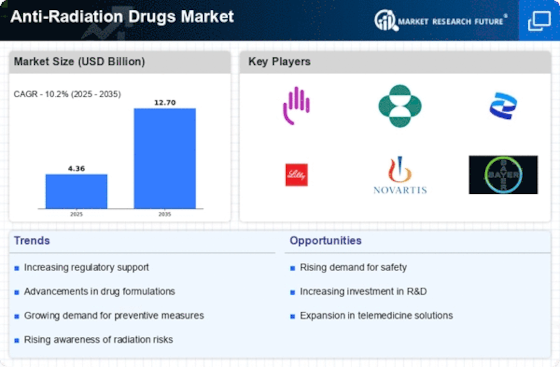
As per Market Research Future analysis, the Anti-Radiation Drugs Market Size was estimated at 4.364 USD Billion in 2024. The Anti-Radiation Drugs industry is projected to grow from 4.809 USD Billion in 2025 to 12.7 USD Billion by 2035, exhibiting a compound annual growth rate (CAGR) of 10.2% during the forecast period 2025 - 2035

Key Market Trends & Highlights

The Anti-Radiation Drugs Market is poised for growth driven by increasing awareness and technological advancements.

  • Rising awareness of radiation risks is shaping consumer behavior and driving demand for anti-radiation drugs. North America remains the largest market, while the Asia-Pacific region is emerging as the fastest-growing area for anti-radiation therapies. Potassium Iodide leads the market as the largest segment, whereas DTPA is witnessing rapid growth due to its effectiveness in treating radiation exposure. Key market drivers include the increasing incidence of radiation exposure and government initiatives that support research and development.

Market Size & Forecast

2024 Market Size 4.364 (USD Billion)
2035 Market Size 12.7 (USD Billion)
CAGR (2025 - 2035) 10.2%
Largest Regional Market Share in 2024 North America

Major Players

Bristol-Myers Squibb (US), Merck &amp; Co. (US), <a href="https://www.pfizer.com/products/product-list">Pfizer Inc</a>. (US), Eli Lilly and Company (US), Novartis AG (CH), Bayer AG (DE), Amgen Inc. (US), Teva Pharmaceutical Industries Ltd. (IL)

Market Trends

The Anti-Radiation Drugs Market is currently experiencing a notable evolution, driven by increasing awareness of radiation exposure risks and advancements in pharmaceutical research. As global concerns regarding nuclear safety and radiation therapy rise, the demand for effective anti-radiation medications appears to be on the upswing. This market encompasses a range of products designed to mitigate the harmful effects of radiation, including both therapeutic and preventive solutions. The ongoing development of innovative compounds and formulations suggests a promising future for this sector, as researchers strive to enhance efficacy and safety profiles. Moreover, the regulatory landscape surrounding anti-radiation drugs is evolving, with various health authorities emphasizing the need for rigorous testing and approval processes. This shift may lead to a more structured market environment, fostering trust among consumers and healthcare providers. Collaboration between pharmaceutical companies and research institutions is likely to intensify, potentially accelerating the introduction of novel therapies. As the Anti-Radiation Drugs Market continues to mature, it may witness increased investment and interest from stakeholders, reflecting a broader commitment to public health and safety in the face of radiation-related challenges.

Rising Awareness of Radiation Risks

There is a growing recognition of the dangers associated with radiation exposure, particularly in medical and industrial settings. This heightened awareness is driving demand for anti-radiation drugs, as individuals and healthcare providers seek effective solutions to mitigate potential health risks.

Advancements in Pharmaceutical Research

Innovations in drug development are paving the way for new anti-radiation therapies. Ongoing research efforts focus on enhancing the efficacy and safety of these medications, which may lead to the introduction of more effective treatment options in the near future.

Regulatory Changes and Market Structure

The evolving regulatory framework surrounding anti-radiation drugs is likely to impact market dynamics. Stricter approval processes may enhance product safety and efficacy, fostering consumer confidence and potentially leading to increased market growth.

Anti Radiation Drugs Market Market Drivers

Government Initiatives and Funding

Government initiatives and funding aimed at addressing radiation safety are pivotal in shaping the Anti-Radiation Drugs Market. Various governments are investing in research and development to enhance public health measures against radiation exposure. For example, funding programs that support the development of anti-radiation drugs are becoming more prevalent. These initiatives not only promote innovation but also encourage collaboration between public and private sectors. The financial backing from governmental bodies is likely to accelerate the pace of research, leading to the introduction of new anti-radiation therapies. As a result, the Anti-Radiation Drugs Market is poised for growth, driven by these supportive policies and funding opportunities.

Emerging Markets and Global Expansion

Emerging markets are playing a crucial role in the expansion of the Anti-Radiation Drugs Market. As economies develop, there is a corresponding increase in healthcare infrastructure and access to medical services, leading to a higher incidence of radiation exposure. Countries with growing populations and expanding healthcare systems are witnessing a surge in demand for anti-radiation drugs. Additionally, the globalization of pharmaceutical companies is facilitating the introduction of innovative anti-radiation therapies in these markets. This expansion presents opportunities for growth, as companies seek to establish a presence in regions with unmet medical needs. The potential for market penetration in emerging economies is likely to drive the Anti-Radiation Drugs Market forward, as awareness and demand for radiation protection increase.

Rising Demand from Healthcare Providers

The rising demand from healthcare providers for effective anti-radiation solutions is a significant driver of the Anti-Radiation Drugs Market. As healthcare professionals become increasingly aware of the risks associated with radiation exposure, there is a growing emphasis on preventive measures. Hospitals and clinics are actively seeking anti-radiation drugs to protect patients undergoing radiation therapy or diagnostic imaging. This demand is further fueled by the increasing prevalence of conditions requiring radiation treatment, such as cancer. Consequently, pharmaceutical companies are responding by developing a range of anti-radiation drugs tailored to meet the needs of healthcare providers. This trend indicates a robust growth trajectory for the Anti-Radiation Drugs Market, as the healthcare sector prioritizes patient safety and effective treatment options.

Increasing Incidence of Radiation Exposure

The rising incidence of radiation exposure due to various factors, including medical imaging and industrial applications, is a key driver for the Anti-Radiation Drugs Market. As more individuals undergo procedures involving radiation, the demand for protective pharmaceuticals is likely to increase. Reports indicate that the number of diagnostic imaging procedures has surged, leading to heightened awareness of potential radiation risks. This trend suggests a growing market for anti-radiation drugs, as healthcare providers and patients seek effective solutions to mitigate the adverse effects of radiation exposure. Furthermore, the increasing use of radiation in cancer treatments necessitates the development of drugs that can protect healthy tissues, thereby expanding the scope of the Anti-Radiation Drugs Market.

Technological Advancements in Drug Development

Technological advancements in drug development are significantly influencing the Anti-Radiation Drugs Market. Innovations in biotechnology and pharmacology have led to the creation of more effective and targeted anti-radiation drugs. For instance, the development of novel compounds that can selectively protect against radiation damage is gaining traction. The market is witnessing a shift towards personalized medicine, where treatments are tailored to individual patient profiles, enhancing efficacy. Additionally, the integration of artificial intelligence in drug discovery processes is expediting the identification of potential anti-radiation agents. This evolution in drug development methodologies is expected to bolster the Anti-Radiation Drugs Market, as new and improved therapies become available to address the growing concerns surrounding radiation exposure.

Market Segment Insights

By Compound: Potassium Iodide (KL) (Largest) vs. DTPA (Fastest-Growing)

The Anti-Radiation Drugs Market is primarily segmented into Potassium Iodide (KL), Prussian Blue, DTPA, and Other compounds. <a href="https://www.marketresearchfuture.com/reports/potassium-iodide-market-29711">Potassium Iodide </a>holds the largest share due to its established efficacy in thyroid protection during radiological emergencies. In contrast, DTPA is gaining traction as a primary chelating agent for heavy metal detoxification, which contributes to its rise within the market. Prussian Blue and others follow, representing niche yet essential opportunities for healthcare providers.

Potassium Iodide (KL) (Dominant) vs. DTPA (Emerging)

Potassium Iodide (KL) serves as a dominant player in the Anti-Radiation Drugs Market, well-known for its ability to block radioactive iodine uptake in the thyroid. Its extensive usage in emergency preparedness scenarios has solidified its market position, making it the go-to choice for health organizations worldwide. DTPA, on the other hand, is emerging rapidly as a favored option for removing toxic metal substances from the body, making it crucial for post-exposure treatments. The increasing frequency of nuclear accidents coupled with heightened health awareness is propelling DTPA's growth, positioning it strongly against older alternatives.

By Application: Cancer Treatment (Largest) vs. Acute Radiation Syndrome (ARS) (Fastest-Growing)

The Anti-Radiation Drugs Market is characterized by a diverse range of applications, with Cancer Treatment holding the majority share due to the increasing prevalence of cancer and reliance on radiation therapies. This segment highlights the critical need for effective anti-radiation strategies in cancer management, thereby establishing itself as the dominant application category. In contrast, Acute Radiation Syndrome (ARS) represents a rapidly growing segment, driven by rising concerns over nuclear accidents and radiation exposure from medical procedures. Its growth underscores the increasing awareness and urgency for effective treatments in emergency situations.

Cancer Treatment: Dominant vs. Acute Radiation Syndrome: Emerging

In the Anti-Radiation Drugs Market, Cancer Treatment stands out as the dominant application segment. This is largely attributed to the high frequency of radiation therapy utilized in oncology, necessitating robust supportive medications to mitigate adverse effects. Conversely, Acute Radiation Syndrome (ARS) is positioning itself as an emerging segment, driven by heightened awareness due to nuclear safety concerns and the potential impact of radiological emergencies. The growth of this segment is fueled by significant advancements in medical research and increasing government initiatives aimed at developing effective countermeasures to radiation exposure. This duality reflects a market that is expanding in response to both therapeutic and preventive needs.

By Distribution Channel: Hospital Pharmacies (Largest) vs. Retail Pharmacies (Fastest-Growing)

In the Anti-Radiation Drugs Market, the distribution channel segment is pivotal for product accessibility and market penetration. Hospital pharmacies dominate this segment, as they are the primary point of care for patients requiring immediate anti-radiation treatment. Retail pharmacies, on the other hand, have captured a substantial market share and are increasingly becoming a preferred option for consumers seeking convenience, thus expanding their footprint in this segment.

Hospital Pharmacies (Dominant) vs. Retail Pharmacies (Emerging)

Hospital pharmacies stand as the dominant force in the distribution of anti-radiation drugs due to their integral role in patient management and treatment protocols within healthcare establishments. They offer a comprehensive range of products tailored for patients in acute settings. The emerging retail pharmacies segment, characterized by increasing partnerships with pharmaceutical suppliers and the advent of home healthcare trends, is rapidly gaining ground. This growth can be attributed to the consumer shift towards easier access and over-the-counter options as awareness of anti-radiation drugs rises, along with an increase in self-medication practices.

Get more detailed insights about Anti Radiation Drugs Market Research Report 2035

Regional Insights

By region, the study provides the market insights into North America, Europe, Asia-Pacific and Rest of the World. The North America Anti-Radiation Drugs Market dominated this market in 2022 (45.80%). The nuclear power industry are active in both the United States and Canada. The existence of nuclear power plants, radiation-using research institutes, and healthcare facilities highlights the requirement for anti-radiation medications to safeguard local inhabitants and workers. Further, the U.S. Anti-radiation drugs market held the largest market share, and the Canada Anti-radiation drugs market was the fastest growing market in the North America region.

Further, the major countries studied in the market report are The U.S., Canada, German, France, the UK, Italy, Spain, China, Japan, India, Australia, South Korea, and Brazil.

Figure 2: ANTI-RADIATION DRUGS MARKET SHARE BY REGION 2022 (USD Billion)

 Source: Secondary Research, Primary Research, MRFR Database and Analyst Review

Europe Anti-radiation drugs market accounts for the second-largest market share. Nuclear disasters like the Fukushima Daiichi catastrophe in Japan and the Chernobyl disaster in the Ukraine have occurred in a few European nations in the past. Due to these incidents, people are now more aware of the dangers of radiation exposure and the significance of having access to anti-radiation medications. Further, the German Anti-radiation drugs market held the largest market share, and the UK Anti-radiation drugs market was the fastest growing market in the European region.

The Asia-Pacific Anti-Radiation Drugs Market is expected to grow at the fastest CAGR from 2023 to 2032. Radiation-based medical procedures are frequently employed in diagnostic and cancer treatment procedures, and the Asia-Pacific area is a hub for medical tourism worldwide. Radiation exposure for radiation treatment patients, radiology, nuclear medicine, and oncology healthcare professionals is enhanced. This raises the demand for cutting-edge anti-radiation medications designed for use in medical settings. Moreover, China’s Anti-radiation drugs market held the largest market share, and the Indian Anti-radiation drugs market was the fastest growing market in the Asia-Pacific region.

Key Players and Competitive Insights

Leading market players are investing heavily in research and development in order to expand their product lines, which will help the Anti-radiation drugs market, grow even more. Market participants are also undertaking a variety of strategic activities to expand their global footprint, with important market developments including new product launches, contractual agreements, mergers and acquisitions, higher investments, and collaboration with other organizations. To expand and survive in a more competitive and rising market climate, Anti-radiation drugs industry must offer cost-effective items. Manufacturing locally to minimize operational costs is one of the key business tactics used by manufacturers in the global Anti-radiation drugs industry to benefit clients and increase the market sector. In recent years, the Anti-radiation drugs industry has offered some of the most significant advantages to medicine. Major players in the Anti-radiation drugs market, including Amgen Inc., Anbex Inc., Arco Pharmaceuticals LLC, BTG International Inc., Cellphire, Inc., Chrysalis BioTherapeutics, Inc., Darnitsa, Enzychem Lifesciences Corporation, Humanetics Corporation, Mission Pharmacal Company, Myelo Therapeutics GmbH, Partner Therapeutics, Pluri Inc. and others, are attempting to increase market demand by investing in research and development operations. Modern human pharmaceuticals are discovered, created, produced, and sold by a biotechnology company called Amgen Inc. (Amgen) to treat people with life-threatening disorders. It develops novel drugs in the therapeutic areas of cardiovascular disease, oncology/hematology, inflammation, bone health, neurological disorders, and nephrology. The company develops solutions using cutting-edge human genetics to investigate illness concerns and comprehend the fundamentals of human biology. Amgen mostly deals with US pharmaceutical wholesalers when selling its products. Additionally, it uses partnerships with other companies and direct-to-consumer platforms to market some products to clients directly. Australia, North America, Europe, the Middle East, and Asia-Pacific are among the regions where the firm operates. Amgen's headquarters are in Thousand Oaks, California, in the US. Mission Pharmacal Co. is responsible for the development, manufacturing, and marketing of prescription, over-the-counter, and dietary supplement products. It offers remedies for conditions related to urology, dermatitis, and women's health, among other conditions. Additionally, it offers contract manufacturing services. Among the many formats in which Mission Pharmacal's products are made and distributed are powders, pills, solutions, creams, lotions, gels, and suspensions. The company serves both domestic and international markets through its network of sales and distribution. The company has warehouses and production, research and development facilities in Texas. The corporation is based in San Antonio, Texas, in the United States.

Key Companies in the Anti Radiation Drugs Market include

Industry Developments

February 2023: Amgen Inc. announced the African American Heart Study in collaboration with the Association of Black Cardiologists and the Morehouse School of Medicine to measure the association between Lipoprotein and atherosclerotic cardiovascular diseases in 5,000 African American individuals across the US.

Future Outlook

Anti Radiation Drugs Market Future Outlook

The Anti-Radiation Drugs Market is projected to grow at a 10.2% CAGR from 2025 to 2035, driven by increasing radiation exposure and advancements in drug development.

New opportunities lie in:

  • <p>Development of targeted therapies for specific radiation types. Expansion into emerging markets with high radiation risks. Partnerships with healthcare providers for integrated treatment solutions.</p>

By 2035, the market is expected to be robust, driven by innovation and strategic partnerships.

Market Segmentation

Anti Radiation Drugs Market Compound Outlook

  • Potassium lodide (Kl)
  • Prussian blue
  • DTPA (Diethylenetriamine Pentaacetate)
  • Others

Anti Radiation Drugs Market Application Outlook

  • Acute Radiation Syndrome (ARS)
  • Cancer Treatment
  • Radiation Exposure
  • Others

Anti Radiation Drugs Market Distribution Channel Outlook

  • Hospital Pharmacies
  • Retail Pharmacies
  • Others

Report Scope

MARKET SIZE 2024 4.364(USD Billion)
MARKET SIZE 2025 4.809(USD Billion)
MARKET SIZE 2035 12.7(USD Billion)
COMPOUND ANNUAL GROWTH RATE (CAGR) 10.2% (2025 - 2035)
REPORT COVERAGE Revenue Forecast, Competitive Landscape, Growth Factors, and Trends
BASE YEAR 2024
Market Forecast Period 2025 - 2035
Historical Data 2019 - 2024
Market Forecast Units USD Billion
Key Companies Profiled Bristol-Myers Squibb (US), Merck & Co. (US), Pfizer Inc. (US), Eli Lilly and Company (US), Novartis AG (CH), Bayer AG (DE), Amgen Inc. (US), Teva Pharmaceutical Industries Ltd. (IL)
Segments Covered compound, application, distribution Channel, Region
Key Market Opportunities Emerging technologies in drug formulation enhance efficacy in the Anti-Radiation Drugs Market.
Key Market Dynamics Rising regulatory scrutiny and technological advancements drive innovation in the Anti-Radiation Drugs Market.
Countries Covered North America, Europe, APAC, South America, MEA

FAQs

What is the current valuation of the Anti-Radiation Drugs Market?

<p>The Anti-Radiation Drugs Market was valued at 4.364 USD Billion in 2024.</p>

What is the projected market valuation for the Anti-Radiation Drugs Market in 2035?

<p>The market is projected to reach 12.7 USD Billion by 2035.</p>

What is the expected CAGR for the Anti-Radiation Drugs Market during the forecast period 2025 - 2035?

<p>The expected CAGR for the market during 2025 - 2035 is 10.2%.</p>

Which companies are considered key players in the Anti-Radiation Drugs Market?

<p>Key players include Bristol-Myers Squibb, Merck & Co., Pfizer Inc., Eli Lilly and Company, Novartis AG, Bayer AG, Amgen Inc., and Teva Pharmaceutical Industries Ltd.</p>

What are the main segments of the Anti-Radiation Drugs Market?

<p>The main segments include compounds, applications, and distribution channels.</p>

How did the segment for Potassium Iodide perform in 2024?

<p>In 2024, the Potassium Iodide segment was valued at 1.5 USD Billion and is projected to grow to 4.5 USD Billion.</p>

What is the valuation range for the Cancer Treatment application segment?

The Cancer Treatment application segment was valued at 1.5 USD Billion in 2024 and is expected to reach 4.0 USD Billion.

What distribution channel had the highest valuation in 2024?

Hospital Pharmacies had the highest valuation at 1.5 USD Billion in 2024, projected to grow to 4.3 USD Billion.

What is the projected growth for the Prussian Blue compound segment?

The Prussian Blue compound segment was valued at 1.0 USD Billion in 2024 and is expected to grow to 3.0 USD Billion.

What does the future hold for the Others category in the application segment?

The Others category in the application segment was valued at 1.364 USD Billion in 2024 and is projected to reach 4.2 USD Billion by 2035.

  1. SECTION I: EXECUTIVE SUMMARY AND KEY HIGHLIGHTS
    1. | 1.1 EXECUTIVE SUMMARY
    2. | | 1.1.1 Market Overview
    3. | | 1.1.2 Key Findings
    4. | | 1.1.3 Market Segmentation
    5. | | 1.1.4 Competitive Landscape
    6. | | 1.1.5 Challenges and Opportunities
    7. | | 1.1.6 Future Outlook
  2. SECTION II: SCOPING, METHODOLOGY AND MARKET STRUCTURE
    1. | 2.1 MARKET INTRODUCTION
    2. | | 2.1.1 Definition
    3. | | 2.1.2 Scope of the study
    4. | | | 2.1.2.1 Research Objective
    5. | | | 2.1.2.2 Assumption
    6. | | | 2.1.2.3 Limitations
    7. | 2.2 RESEARCH METHODOLOGY
    8. | | 2.2.1 Overview
    9. | | 2.2.2 Data Mining
    10. | | 2.2.3 Secondary Research
    11. | | 2.2.4 Primary Research
    12. | | | 2.2.4.1 Primary Interviews and Information Gathering Process
    13. | | | 2.2.4.2 Breakdown of Primary Respondents
    14. | | 2.2.5 Forecasting Model
    15. | | 2.2.6 Market Size Estimation
    16. | | | 2.2.6.1 Bottom-Up Approach
    17. | | | 2.2.6.2 Top-Down Approach
    18. | | 2.2.7 Data Triangulation
    19. | | 2.2.8 Validation
  3. SECTION III: QUALITATIVE ANALYSIS
    1. | 3.1 MARKET DYNAMICS
    2. | | 3.1.1 Overview
    3. | | 3.1.2 Drivers
    4. | | 3.1.3 Restraints
    5. | | 3.1.4 Opportunities
    6. | 3.2 MARKET FACTOR ANALYSIS
    7. | | 3.2.1 Value chain Analysis
    8. | | 3.2.2 Porter's Five Forces Analysis
    9. | | | 3.2.2.1 Bargaining Power of Suppliers
    10. | | | 3.2.2.2 Bargaining Power of Buyers
    11. | | | 3.2.2.3 Threat of New Entrants
    12. | | | 3.2.2.4 Threat of Substitutes
    13. | | | 3.2.2.5 Intensity of Rivalry
    14. | | 3.2.3 COVID-19 Impact Analysis
    15. | | | 3.2.3.1 Market Impact Analysis
    16. | | | 3.2.3.2 Regional Impact
    17. | | | 3.2.3.3 Opportunity and Threat Analysis
  4. SECTION IV: QUANTITATIVE ANALYSIS
    1. | 4.1 Healthcare, BY Compound (USD Billion)
    2. | | 4.1.1 Potassium lodide (Kl)
    3. | | 4.1.2 Prussian blue
    4. | | 4.1.3 DTPA (Diethylenetriamine Pentaacetate)
    5. | | 4.1.4 Others
    6. | 4.2 Healthcare, BY Application (USD Billion)
    7. | | 4.2.1 Acute Radiation Syndrome (ARS)
    8. | | 4.2.2 Cancer Treatment
    9. | | 4.2.3 Radiation Exposure
    10. | | 4.2.4 Others
    11. | 4.3 Healthcare, BY Distribution Channel (USD Billion)
    12. | | 4.3.1 Hospital Pharmacies
    13. | | 4.3.2 Retail Pharmacies
    14. | | 4.3.3 Others
    15. | 4.4 Healthcare, BY Region (USD Billion)
    16. | | 4.4.1 North America
    17. | | | 4.4.1.1 US
    18. | | | 4.4.1.2 Canada
    19. | | 4.4.2 Europe
    20. | | | 4.4.2.1 Germany
    21. | | | 4.4.2.2 UK
    22. | | | 4.4.2.3 France
    23. | | | 4.4.2.4 Russia
    24. | | | 4.4.2.5 Italy
    25. | | | 4.4.2.6 Spain
    26. | | | 4.4.2.7 Rest of Europe
    27. | | 4.4.3 APAC
    28. | | | 4.4.3.1 China
    29. | | | 4.4.3.2 India
    30. | | | 4.4.3.3 Japan
    31. | | | 4.4.3.4 South Korea
    32. | | | 4.4.3.5 Malaysia
    33. | | | 4.4.3.6 Thailand
    34. | | | 4.4.3.7 Indonesia
    35. | | | 4.4.3.8 Rest of APAC
    36. | | 4.4.4 South America
    37. | | | 4.4.4.1 Brazil
    38. | | | 4.4.4.2 Mexico
    39. | | | 4.4.4.3 Argentina
    40. | | | 4.4.4.4 Rest of South America
    41. | | 4.4.5 MEA
    42. | | | 4.4.5.1 GCC Countries
    43. | | | 4.4.5.2 South Africa
    44. | | | 4.4.5.3 Rest of MEA
  5. SECTION V: COMPETITIVE ANALYSIS
    1. | 5.1 Competitive Landscape
    2. | | 5.1.1 Overview
    3. | | 5.1.2 Competitive Analysis
    4. | | 5.1.3 Market share Analysis
    5. | | 5.1.4 Major Growth Strategy in the Healthcare
    6. | | 5.1.5 Competitive Benchmarking
    7. | | 5.1.6 Leading Players in Terms of Number of Developments in the Healthcare
    8. | | 5.1.7 Key developments and growth strategies
    9. | | | 5.1.7.1 New Product Launch/Service Deployment
    10. | | | 5.1.7.2 Merger & Acquisitions
    11. | | | 5.1.7.3 Joint Ventures
    12. | | 5.1.8 Major Players Financial Matrix
    13. | | | 5.1.8.1 Sales and Operating Income
    14. | | | 5.1.8.2 Major Players R&D Expenditure. 2023
    15. | 5.2 Company Profiles
    16. | | 5.2.1 Bristol-Myers Squibb (US)
    17. | | | 5.2.1.1 Financial Overview
    18. | | | 5.2.1.2 Products Offered
    19. | | | 5.2.1.3 Key Developments
    20. | | | 5.2.1.4 SWOT Analysis
    21. | | | 5.2.1.5 Key Strategies
    22. | | 5.2.2 Merck & Co. (US)
    23. | | | 5.2.2.1 Financial Overview
    24. | | | 5.2.2.2 Products Offered
    25. | | | 5.2.2.3 Key Developments
    26. | | | 5.2.2.4 SWOT Analysis
    27. | | | 5.2.2.5 Key Strategies
    28. | | 5.2.3 Pfizer Inc. (US)
    29. | | | 5.2.3.1 Financial Overview
    30. | | | 5.2.3.2 Products Offered
    31. | | | 5.2.3.3 Key Developments
    32. | | | 5.2.3.4 SWOT Analysis
    33. | | | 5.2.3.5 Key Strategies
    34. | | 5.2.4 Eli Lilly and Company (US)
    35. | | | 5.2.4.1 Financial Overview
    36. | | | 5.2.4.2 Products Offered
    37. | | | 5.2.4.3 Key Developments
    38. | | | 5.2.4.4 SWOT Analysis
    39. | | | 5.2.4.5 Key Strategies
    40. | | 5.2.5 Novartis AG (CH)
    41. | | | 5.2.5.1 Financial Overview
    42. | | | 5.2.5.2 Products Offered
    43. | | | 5.2.5.3 Key Developments
    44. | | | 5.2.5.4 SWOT Analysis
    45. | | | 5.2.5.5 Key Strategies
    46. | | 5.2.6 Bayer AG (DE)
    47. | | | 5.2.6.1 Financial Overview
    48. | | | 5.2.6.2 Products Offered
    49. | | | 5.2.6.3 Key Developments
    50. | | | 5.2.6.4 SWOT Analysis
    51. | | | 5.2.6.5 Key Strategies
    52. | | 5.2.7 Amgen Inc. (US)
    53. | | | 5.2.7.1 Financial Overview
    54. | | | 5.2.7.2 Products Offered
    55. | | | 5.2.7.3 Key Developments
    56. | | | 5.2.7.4 SWOT Analysis
    57. | | | 5.2.7.5 Key Strategies
    58. | | 5.2.8 Teva Pharmaceutical Industries Ltd. (IL)
    59. | | | 5.2.8.1 Financial Overview
    60. | | | 5.2.8.2 Products Offered
    61. | | | 5.2.8.3 Key Developments
    62. | | | 5.2.8.4 SWOT Analysis
    63. | | | 5.2.8.5 Key Strategies
    64. | 5.3 Appendix
    65. | | 5.3.1 References
    66. | | 5.3.2 Related Reports
  6. LIST OF FIGURES
    1. | 6.1 MARKET SYNOPSIS
    2. | 6.2 NORTH AMERICA MARKET ANALYSIS
    3. | 6.3 US MARKET ANALYSIS BY COMPOUND
    4. | 6.4 US MARKET ANALYSIS BY APPLICATION
    5. | 6.5 US MARKET ANALYSIS BY DISTRIBUTION CHANNEL
    6. | 6.6 CANADA MARKET ANALYSIS BY COMPOUND
    7. | 6.7 CANADA MARKET ANALYSIS BY APPLICATION
    8. | 6.8 CANADA MARKET ANALYSIS BY DISTRIBUTION CHANNEL
    9. | 6.9 EUROPE MARKET ANALYSIS
    10. | 6.10 GERMANY MARKET ANALYSIS BY COMPOUND
    11. | 6.11 GERMANY MARKET ANALYSIS BY APPLICATION
    12. | 6.12 GERMANY MARKET ANALYSIS BY DISTRIBUTION CHANNEL
    13. | 6.13 UK MARKET ANALYSIS BY COMPOUND
    14. | 6.14 UK MARKET ANALYSIS BY APPLICATION
    15. | 6.15 UK MARKET ANALYSIS BY DISTRIBUTION CHANNEL
    16. | 6.16 FRANCE MARKET ANALYSIS BY COMPOUND
    17. | 6.17 FRANCE MARKET ANALYSIS BY APPLICATION
    18. | 6.18 FRANCE MARKET ANALYSIS BY DISTRIBUTION CHANNEL
    19. | 6.19 RUSSIA MARKET ANALYSIS BY COMPOUND
    20. | 6.20 RUSSIA MARKET ANALYSIS BY APPLICATION
    21. | 6.21 RUSSIA MARKET ANALYSIS BY DISTRIBUTION CHANNEL
    22. | 6.22 ITALY MARKET ANALYSIS BY COMPOUND
    23. | 6.23 ITALY MARKET ANALYSIS BY APPLICATION
    24. | 6.24 ITALY MARKET ANALYSIS BY DISTRIBUTION CHANNEL
    25. | 6.25 SPAIN MARKET ANALYSIS BY COMPOUND
    26. | 6.26 SPAIN MARKET ANALYSIS BY APPLICATION
    27. | 6.27 SPAIN MARKET ANALYSIS BY DISTRIBUTION CHANNEL
    28. | 6.28 REST OF EUROPE MARKET ANALYSIS BY COMPOUND
    29. | 6.29 REST OF EUROPE MARKET ANALYSIS BY APPLICATION
    30. | 6.30 REST OF EUROPE MARKET ANALYSIS BY DISTRIBUTION CHANNEL
    31. | 6.31 APAC MARKET ANALYSIS
    32. | 6.32 CHINA MARKET ANALYSIS BY COMPOUND
    33. | 6.33 CHINA MARKET ANALYSIS BY APPLICATION
    34. | 6.34 CHINA MARKET ANALYSIS BY DISTRIBUTION CHANNEL
    35. | 6.35 INDIA MARKET ANALYSIS BY COMPOUND
    36. | 6.36 INDIA MARKET ANALYSIS BY APPLICATION
    37. | 6.37 INDIA MARKET ANALYSIS BY DISTRIBUTION CHANNEL
    38. | 6.38 JAPAN MARKET ANALYSIS BY COMPOUND
    39. | 6.39 JAPAN MARKET ANALYSIS BY APPLICATION
    40. | 6.40 JAPAN MARKET ANALYSIS BY DISTRIBUTION CHANNEL
    41. | 6.41 SOUTH KOREA MARKET ANALYSIS BY COMPOUND
    42. | 6.42 SOUTH KOREA MARKET ANALYSIS BY APPLICATION
    43. | 6.43 SOUTH KOREA MARKET ANALYSIS BY DISTRIBUTION CHANNEL
    44. | 6.44 MALAYSIA MARKET ANALYSIS BY COMPOUND
    45. | 6.45 MALAYSIA MARKET ANALYSIS BY APPLICATION
    46. | 6.46 MALAYSIA MARKET ANALYSIS BY DISTRIBUTION CHANNEL
    47. | 6.47 THAILAND MARKET ANALYSIS BY COMPOUND
    48. | 6.48 THAILAND MARKET ANALYSIS BY APPLICATION
    49. | 6.49 THAILAND MARKET ANALYSIS BY DISTRIBUTION CHANNEL
    50. | 6.50 INDONESIA MARKET ANALYSIS BY COMPOUND
    51. | 6.51 INDONESIA MARKET ANALYSIS BY APPLICATION
    52. | 6.52 INDONESIA MARKET ANALYSIS BY DISTRIBUTION CHANNEL
    53. | 6.53 REST OF APAC MARKET ANALYSIS BY COMPOUND
    54. | 6.54 REST OF APAC MARKET ANALYSIS BY APPLICATION
    55. | 6.55 REST OF APAC MARKET ANALYSIS BY DISTRIBUTION CHANNEL
    56. | 6.56 SOUTH AMERICA MARKET ANALYSIS
    57. | 6.57 BRAZIL MARKET ANALYSIS BY COMPOUND
    58. | 6.58 BRAZIL MARKET ANALYSIS BY APPLICATION
    59. | 6.59 BRAZIL MARKET ANALYSIS BY DISTRIBUTION CHANNEL
    60. | 6.60 MEXICO MARKET ANALYSIS BY COMPOUND
    61. | 6.61 MEXICO MARKET ANALYSIS BY APPLICATION
    62. | 6.62 MEXICO MARKET ANALYSIS BY DISTRIBUTION CHANNEL
    63. | 6.63 ARGENTINA MARKET ANALYSIS BY COMPOUND
    64. | 6.64 ARGENTINA MARKET ANALYSIS BY APPLICATION
    65. | 6.65 ARGENTINA MARKET ANALYSIS BY DISTRIBUTION CHANNEL
    66. | 6.66 REST OF SOUTH AMERICA MARKET ANALYSIS BY COMPOUND
    67. | 6.67 REST OF SOUTH AMERICA MARKET ANALYSIS BY APPLICATION
    68. | 6.68 REST OF SOUTH AMERICA MARKET ANALYSIS BY DISTRIBUTION CHANNEL
    69. | 6.69 MEA MARKET ANALYSIS
    70. | 6.70 GCC COUNTRIES MARKET ANALYSIS BY COMPOUND
    71. | 6.71 GCC COUNTRIES MARKET ANALYSIS BY APPLICATION
    72. | 6.72 GCC COUNTRIES MARKET ANALYSIS BY DISTRIBUTION CHANNEL
    73. | 6.73 SOUTH AFRICA MARKET ANALYSIS BY COMPOUND
    74. | 6.74 SOUTH AFRICA MARKET ANALYSIS BY APPLICATION
    75. | 6.75 SOUTH AFRICA MARKET ANALYSIS BY DISTRIBUTION CHANNEL
    76. | 6.76 REST OF MEA MARKET ANALYSIS BY COMPOUND
    77. | 6.77 REST OF MEA MARKET ANALYSIS BY APPLICATION
    78. | 6.78 REST OF MEA MARKET ANALYSIS BY DISTRIBUTION CHANNEL
    79. | 6.79 KEY BUYING CRITERIA OF HEALTHCARE
    80. | 6.80 RESEARCH PROCESS OF MRFR
    81. | 6.81 DRO ANALYSIS OF HEALTHCARE
    82. | 6.82 DRIVERS IMPACT ANALYSIS: HEALTHCARE
    83. | 6.83 RESTRAINTS IMPACT ANALYSIS: HEALTHCARE
    84. | 6.84 SUPPLY / VALUE CHAIN: HEALTHCARE
    85. | 6.85 HEALTHCARE, BY COMPOUND, 2024 (% SHARE)
    86. | 6.86 HEALTHCARE, BY COMPOUND, 2024 TO 2035 (USD Billion)
    87. | 6.87 HEALTHCARE, BY APPLICATION, 2024 (% SHARE)
    88. | 6.88 HEALTHCARE, BY APPLICATION, 2024 TO 2035 (USD Billion)
    89. | 6.89 HEALTHCARE, BY DISTRIBUTION CHANNEL, 2024 (% SHARE)
    90. | 6.90 HEALTHCARE, BY DISTRIBUTION CHANNEL, 2024 TO 2035 (USD Billion)
    91. | 6.91 BENCHMARKING OF MAJOR COMPETITORS
  7. LIST OF TABLES
    1. | 7.1 LIST OF ASSUMPTIONS
    2. | | 7.1.1
    3. | 7.2 North America MARKET SIZE ESTIMATES; FORECAST
    4. | | 7.2.1 BY COMPOUND, 2025-2035 (USD Billion)
    5. | | 7.2.2 BY APPLICATION, 2025-2035 (USD Billion)
    6. | | 7.2.3 BY DISTRIBUTION CHANNEL, 2025-2035 (USD Billion)
    7. | 7.3 US MARKET SIZE ESTIMATES; FORECAST
    8. | | 7.3.1 BY COMPOUND, 2025-2035 (USD Billion)
    9. | | 7.3.2 BY APPLICATION, 2025-2035 (USD Billion)
    10. | | 7.3.3 BY DISTRIBUTION CHANNEL, 2025-2035 (USD Billion)
    11. | 7.4 Canada MARKET SIZE ESTIMATES; FORECAST
    12. | | 7.4.1 BY COMPOUND, 2025-2035 (USD Billion)
    13. | | 7.4.2 BY APPLICATION, 2025-2035 (USD Billion)
    14. | | 7.4.3 BY DISTRIBUTION CHANNEL, 2025-2035 (USD Billion)
    15. | 7.5 Europe MARKET SIZE ESTIMATES; FORECAST
    16. | | 7.5.1 BY COMPOUND, 2025-2035 (USD Billion)
    17. | | 7.5.2 BY APPLICATION, 2025-2035 (USD Billion)
    18. | | 7.5.3 BY DISTRIBUTION CHANNEL, 2025-2035 (USD Billion)
    19. | 7.6 Germany MARKET SIZE ESTIMATES; FORECAST
    20. | | 7.6.1 BY COMPOUND, 2025-2035 (USD Billion)
    21. | | 7.6.2 BY APPLICATION, 2025-2035 (USD Billion)
    22. | | 7.6.3 BY DISTRIBUTION CHANNEL, 2025-2035 (USD Billion)
    23. | 7.7 UK MARKET SIZE ESTIMATES; FORECAST
    24. | | 7.7.1 BY COMPOUND, 2025-2035 (USD Billion)
    25. | | 7.7.2 BY APPLICATION, 2025-2035 (USD Billion)
    26. | | 7.7.3 BY DISTRIBUTION CHANNEL, 2025-2035 (USD Billion)
    27. | 7.8 France MARKET SIZE ESTIMATES; FORECAST
    28. | | 7.8.1 BY COMPOUND, 2025-2035 (USD Billion)
    29. | | 7.8.2 BY APPLICATION, 2025-2035 (USD Billion)
    30. | | 7.8.3 BY DISTRIBUTION CHANNEL, 2025-2035 (USD Billion)
    31. | 7.9 Russia MARKET SIZE ESTIMATES; FORECAST
    32. | | 7.9.1 BY COMPOUND, 2025-2035 (USD Billion)
    33. | | 7.9.2 BY APPLICATION, 2025-2035 (USD Billion)
    34. | | 7.9.3 BY DISTRIBUTION CHANNEL, 2025-2035 (USD Billion)
    35. | 7.10 Italy MARKET SIZE ESTIMATES; FORECAST
    36. | | 7.10.1 BY COMPOUND, 2025-2035 (USD Billion)
    37. | | 7.10.2 BY APPLICATION, 2025-2035 (USD Billion)
    38. | | 7.10.3 BY DISTRIBUTION CHANNEL, 2025-2035 (USD Billion)
    39. | 7.11 Spain MARKET SIZE ESTIMATES; FORECAST
    40. | | 7.11.1 BY COMPOUND, 2025-2035 (USD Billion)
    41. | | 7.11.2 BY APPLICATION, 2025-2035 (USD Billion)
    42. | | 7.11.3 BY DISTRIBUTION CHANNEL, 2025-2035 (USD Billion)
    43. | 7.12 Rest of Europe MARKET SIZE ESTIMATES; FORECAST
    44. | | 7.12.1 BY COMPOUND, 2025-2035 (USD Billion)
    45. | | 7.12.2 BY APPLICATION, 2025-2035 (USD Billion)
    46. | | 7.12.3 BY DISTRIBUTION CHANNEL, 2025-2035 (USD Billion)
    47. | 7.13 APAC MARKET SIZE ESTIMATES; FORECAST
    48. | | 7.13.1 BY COMPOUND, 2025-2035 (USD Billion)
    49. | | 7.13.2 BY APPLICATION, 2025-2035 (USD Billion)
    50. | | 7.13.3 BY DISTRIBUTION CHANNEL, 2025-2035 (USD Billion)
    51. | 7.14 China MARKET SIZE ESTIMATES; FORECAST
    52. | | 7.14.1 BY COMPOUND, 2025-2035 (USD Billion)
    53. | | 7.14.2 BY APPLICATION, 2025-2035 (USD Billion)
    54. | | 7.14.3 BY DISTRIBUTION CHANNEL, 2025-2035 (USD Billion)
    55. | 7.15 India MARKET SIZE ESTIMATES; FORECAST
    56. | | 7.15.1 BY COMPOUND, 2025-2035 (USD Billion)
    57. | | 7.15.2 BY APPLICATION, 2025-2035 (USD Billion)
    58. | | 7.15.3 BY DISTRIBUTION CHANNEL, 2025-2035 (USD Billion)
    59. | 7.16 Japan MARKET SIZE ESTIMATES; FORECAST
    60. | | 7.16.1 BY COMPOUND, 2025-2035 (USD Billion)
    61. | | 7.16.2 BY APPLICATION, 2025-2035 (USD Billion)
    62. | | 7.16.3 BY DISTRIBUTION CHANNEL, 2025-2035 (USD Billion)
    63. | 7.17 South Korea MARKET SIZE ESTIMATES; FORECAST
    64. | | 7.17.1 BY COMPOUND, 2025-2035 (USD Billion)
    65. | | 7.17.2 BY APPLICATION, 2025-2035 (USD Billion)
    66. | | 7.17.3 BY DISTRIBUTION CHANNEL, 2025-2035 (USD Billion)
    67. | 7.18 Malaysia MARKET SIZE ESTIMATES; FORECAST
    68. | | 7.18.1 BY COMPOUND, 2025-2035 (USD Billion)
    69. | | 7.18.2 BY APPLICATION, 2025-2035 (USD Billion)
    70. | | 7.18.3 BY DISTRIBUTION CHANNEL, 2025-2035 (USD Billion)
    71. | 7.19 Thailand MARKET SIZE ESTIMATES; FORECAST
    72. | | 7.19.1 BY COMPOUND, 2025-2035 (USD Billion)
    73. | | 7.19.2 BY APPLICATION, 2025-2035 (USD Billion)
    74. | | 7.19.3 BY DISTRIBUTION CHANNEL, 2025-2035 (USD Billion)
    75. | 7.20 Indonesia MARKET SIZE ESTIMATES; FORECAST
    76. | | 7.20.1 BY COMPOUND, 2025-2035 (USD Billion)
    77. | | 7.20.2 BY APPLICATION, 2025-2035 (USD Billion)
    78. | | 7.20.3 BY DISTRIBUTION CHANNEL, 2025-2035 (USD Billion)
    79. | 7.21 Rest of APAC MARKET SIZE ESTIMATES; FORECAST
    80. | | 7.21.1 BY COMPOUND, 2025-2035 (USD Billion)
    81. | | 7.21.2 BY APPLICATION, 2025-2035 (USD Billion)
    82. | | 7.21.3 BY DISTRIBUTION CHANNEL, 2025-2035 (USD Billion)
    83. | 7.22 South America MARKET SIZE ESTIMATES; FORECAST
    84. | | 7.22.1 BY COMPOUND, 2025-2035 (USD Billion)
    85. | | 7.22.2 BY APPLICATION, 2025-2035 (USD Billion)
    86. | | 7.22.3 BY DISTRIBUTION CHANNEL, 2025-2035 (USD Billion)
    87. | 7.23 Brazil MARKET SIZE ESTIMATES; FORECAST
    88. | | 7.23.1 BY COMPOUND, 2025-2035 (USD Billion)
    89. | | 7.23.2 BY APPLICATION, 2025-2035 (USD Billion)
    90. | | 7.23.3 BY DISTRIBUTION CHANNEL, 2025-2035 (USD Billion)
    91. | 7.24 Mexico MARKET SIZE ESTIMATES; FORECAST
    92. | | 7.24.1 BY COMPOUND, 2025-2035 (USD Billion)
    93. | | 7.24.2 BY APPLICATION, 2025-2035 (USD Billion)
    94. | | 7.24.3 BY DISTRIBUTION CHANNEL, 2025-2035 (USD Billion)
    95. | 7.25 Argentina MARKET SIZE ESTIMATES; FORECAST
    96. | | 7.25.1 BY COMPOUND, 2025-2035 (USD Billion)
    97. | | 7.25.2 BY APPLICATION, 2025-2035 (USD Billion)
    98. | | 7.25.3 BY DISTRIBUTION CHANNEL, 2025-2035 (USD Billion)
    99. | 7.26 Rest of South America MARKET SIZE ESTIMATES; FORECAST
    100. | | 7.26.1 BY COMPOUND, 2025-2035 (USD Billion)
    101. | | 7.26.2 BY APPLICATION, 2025-2035 (USD Billion)
    102. | | 7.26.3 BY DISTRIBUTION CHANNEL, 2025-2035 (USD Billion)
    103. | 7.27 MEA MARKET SIZE ESTIMATES; FORECAST
    104. | | 7.27.1 BY COMPOUND, 2025-2035 (USD Billion)
    105. | | 7.27.2 BY APPLICATION, 2025-2035 (USD Billion)
    106. | | 7.27.3 BY DISTRIBUTION CHANNEL, 2025-2035 (USD Billion)
    107. | 7.28 GCC Countries MARKET SIZE ESTIMATES; FORECAST
    108. | | 7.28.1 BY COMPOUND, 2025-2035 (USD Billion)
    109. | | 7.28.2 BY APPLICATION, 2025-2035 (USD Billion)
    110. | | 7.28.3 BY DISTRIBUTION CHANNEL, 2025-2035 (USD Billion)
    111. | 7.29 South Africa MARKET SIZE ESTIMATES; FORECAST
    112. | | 7.29.1 BY COMPOUND, 2025-2035 (USD Billion)
    113. | | 7.29.2 BY APPLICATION, 2025-2035 (USD Billion)
    114. | | 7.29.3 BY DISTRIBUTION CHANNEL, 2025-2035 (USD Billion)
    115. | 7.30 Rest of MEA MARKET SIZE ESTIMATES; FORECAST
    116. | | 7.30.1 BY COMPOUND, 2025-2035 (USD Billion)
    117. | | 7.30.2 BY APPLICATION, 2025-2035 (USD Billion)
    118. | | 7.30.3 BY DISTRIBUTION CHANNEL, 2025-2035 (USD Billion)
    119. | 7.31 PRODUCT LAUNCH/PRODUCT DEVELOPMENT/APPROVAL
    120. | | 7.31.1
    121. | 7.32 ACQUISITION/PARTNERSHIP
    122. | | 7.32.1

Healthcare Market Segmentation

Healthcare By Compound (USD Billion, 2025-2035)

  • Potassium lodide (Kl)
  • Prussian blue
  • DTPA (Diethylenetriamine Pentaacetate)
  • Others

Healthcare By Application (USD Billion, 2025-2035)

  • Acute Radiation Syndrome (ARS)
  • Cancer Treatment
  • Radiation Exposure
  • Others

Healthcare By Distribution Channel (USD Billion, 2025-2035)

  • Hospital Pharmacies
  • Retail Pharmacies
  • Others
Infographic

Free Sample Request

Kindly complete the form below to receive a free sample of this Report

Get Free Sample

Customer Strories

Compare Licence

×
Features License Type
Single User Multiuser License Enterprise User
Price $4,950 $5,950 $7,250
Maximum User Access Limit 1 User Upto 10 Users Unrestricted Access Throughout the Organization
Free Customization
Direct Access to Analyst
Deliverable Format
Platform Access
Discount on Next Purchase 10% 15% 15%
Printable Versions