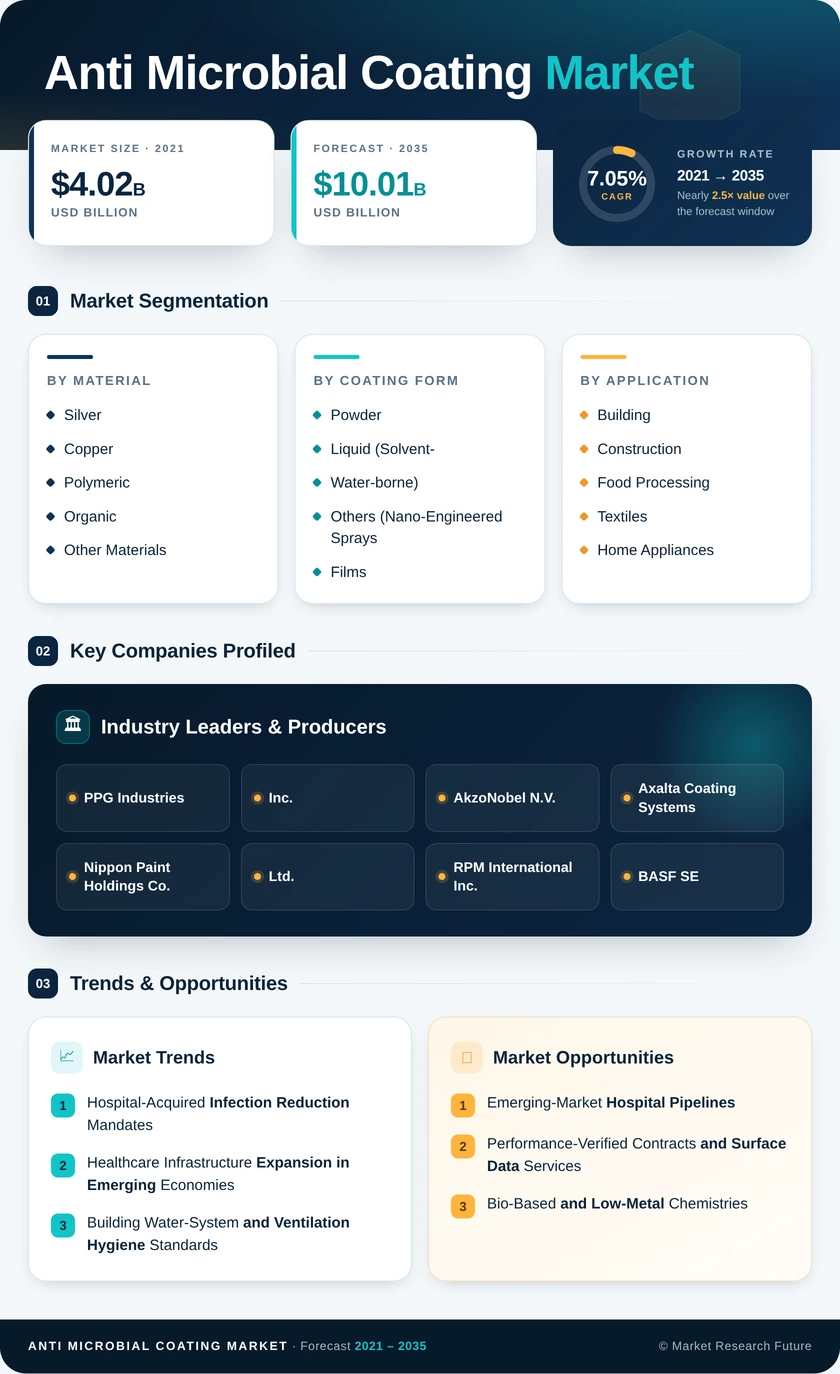
Anti Microbial Coating Market (2026 - 2035)

ID: MRFR/CnM/8158-HCR 200 Pages Chitranshi Jaiswal Last Updated: November 23, 2026
Anti Microbial Coating Market Research Report Information By Material (Silver, Copper, Polymeric, Organic, and Other Materials (Graphene Oxide and Photocatalytic Titanium Dioxide)), By Coating Form (Powder, Liquid (Solvent- and Water-Borne), and Others (Nano-Engineered Sprays and Films, and Surface Modification Treatments)), By Application (Building and Construction, Food Processing, Textiles, Home Appliances, Healthcare, Marine, and Other Applications (Transit, Education, and Electronics Surfaces)), And By Region (North America, Europe, Asia-Pacific, and Rest of the World) – Market Forecast Till 2035
Anti Microbial Coating Market
Market Size
Forecast Period2026-2035
CAGR (2026-2035)7.05%
2025 Market SizeUSD 5.07 Billion
2035 Market SizeUSD 10.01 Billion
Key Players
PPG Industries, Inc.
AkzoNobel N.V.
Axalta Coating Systems
Nippon Paint Holdings Co., Ltd.
RPM International Inc.
BASF SE
Opportunities
  • Emerging-Market Hospital Pipelines
  • Performance-Verified Contracts and Surface Data Services
  • Bio-Based and Low-Metal Chemistries
  1. 1 Market Summary | |
  2. 2 Key Report Takeaways | |
    1. 2.1 By Material | |
    2. 2.2 By Coating Form | |
    3. 2.3 By Application | |
    4. 2.4 By Region | |
  3. 3 Market Size and Forecast (2021–2035) | |
    1. 3.1 Historical Market Size (2021–2025) | |
    2. 3.2 Forecast Market Size (2026–2035) | |
    3. 3.3 Year-over-Year Growth Analysis | |
  4. 4 Driver Impact Analysis | |
    1. 4.1 Hospital-Acquired Infection Reduction Mandates | |
    2. 4.2 Healthcare Infrastructure Expansion in Emerging Economies | |
    3. 4.3 Building Water-System and Ventilation Hygiene Standards | |
    4. 4.4 Food-Safety Compliance in Processing Plants | |
    5. 4.5 Antimicrobial Resistance Policy Commitments | |
    6. 4.6 Hygiene Differentiation in Appliances and Textiles | |
  5. 5 Restraints Impact Analysis | |
    1. 5.1 Silver and Copper Price Volatility | |
    2. 5.2 Biocide Registration Cost and Timelines | |
    3. 5.3 Ecotoxicity and Nanomaterial Scrutiny | |
    4. 5.4 Efficacy-Claim Restrictions and Enforcement | |
    5. 5.5 Durability Under Aggressive Disinfection | |
  6. 6 Opportunities | |
    1. 6.1 Emerging-Market Hospital Pipelines | |
    2. 6.2 Performance-Verified Contracts and Surface Data Services | |
    3. 6.3 Bio-Based and Low-Metal Chemistries | |
    4. 6.4 Food Cold Chain and Logistics Assets | |
    5. 6.5 Public Transit and Shared Touchpoints | |
  7. 7 Regional Market Share and Country-Level Analysis | |
    1. 7.1 North America | | |
      1. 7.1.1 United States | | |
      2. 7.1.2 Canada | | |
      3. 7.1.3 Mexico | |
    2. 7.2 Europe | | |
      1. 7.2.1 Germany | | |
      2. 7.2.2 United Kingdom | | |
      3. 7.2.3 France | | |
      4. 7.2.4 Italy | | |
      5. 7.2.5 Rest of Europe | |
    3. 7.3 Asia-Pacific | | |
      1. 7.3.1 China | | |
      2. 7.3.2 India | | |
      3. 7.3.3 Japan | | |
      4. 7.3.4 South Korea | | |
      5. 7.3.5 Rest of Asia-Pacific | |
    4. 7.4 South America | | |
      1. 7.4.1 Brazil | | |
      2. 7.4.2 Argentina | | |
      3. 7.4.3 Rest of South America | |
    5. 7.5 Middle East and Africa | | |
      1. 7.5.1 Saudi Arabia | | |
      2. 7.5.2 South Africa | | |
      3. 7.5.3 Rest of Middle East and Africa | |
  8. 8 Future Outlook (2026–2035) | |
    1. 8.1 AI-Assisted Formulation and Faster Biocide Discovery | |
    2. 8.2 Data-Linked Infection Control | |
    3. 8.3 Sustainability Reporting and Low-Toxicity Chemistry | |
    4. 8.4 Pandemic Preparedness and Shared Infrastructure | |
  9. 9 Segmentation Analysis | |
    1. 9.1 By Material | | |
      1. 9.1.1 Silver | | |
      2. 9.1.2 Copper | | |
      3. 9.1.3 Polymeric | | |
      4. 9.1.4 Organic | | |
      5. 9.1.5 Other Materials | |
    2. 9.2 By Coating Form | | |
      1. 9.2.1 Powder | | |
      2. 9.2.2 Liquid (Solvent- and Water-borne) | | |
      3. 9.2.3 Others (Nano-Engineered Sprays and Films, Surface Modification Treatments) | |
    3. 9.3 By Application | | |
      1. 9.3.1 Building and Construction | | |
      2. 9.3.2 Food Processing | | |
      3. 9.3.3 Textiles | | |
      4. 9.3.4 Home Appliances | | |
      5. 9.3.5 Healthcare | | |
      6. 9.3.6 Marine | | |
      7. 9.3.7 Other Applications | |
  10. 10 Competitive Landscape | |
    1. 10.1 Market Concentration Analysis | |
    2. 10.2 Competitive Benchmarking Matrix | |
    3. 10.3 Company Profiles | | |
      1. 10.3.1 The Sherwin-Williams Company | | |
      2. 10.3.2 PPG Industries, Inc. | | |
      3. 10.3.3 AkzoNobel N.V. | | |
      4. 10.3.4 Axalta Coating Systems | | |
      5. 10.3.5 Nippon Paint Holdings Co., Ltd. | | |
      6. 10.3.6 RPM International Inc. | | |
      7. 10.3.7 BASF SE | | |
      8. 10.3.8 Kansai Paint Co., Ltd. | | |
      9. 10.3.9 Microban International | | |
      10. 10.3.10 Sciessent LLC | |
  11. 11 Recent News & Developments | |
  12. 12 Report Scope and Methodology | |
  13. 13 Detailed Sources and Citations | |
  14. 14 Frequently Asked Questions (FAQs) | | LIST OF TABLES | |
  15. TABLE 1 Global Antimicrobial Coatings Summary Snapshot, 2025–2035 | |
  16. TABLE 2 Global Market Size and Forecast, by Revenue (USD Billion), 2021–2035 | |
  17. TABLE 3 Driver Impact Analysis | |
  18. TABLE 4 Restraints Impact Analysis | |
  19. TABLE 5 Regional Summary, 2025 | |
  20. TABLE 6 North America, by Country, 2025 | |
  21. TABLE 7 Europe, by Country, 2025 | |
  22. TABLE 8 Asia-Pacific, by Country, 2025 | |
  23. TABLE 9 South America, by Country, 2025 | |
  24. TABLE 10 Middle East and Africa, by Country, 2025 | |
  25. TABLE 11 Global Market, by Material, 2025 | |
  26. TABLE 12 Global Market, by Coating Form, 2025 | |
  27. TABLE 13 Global Market, by Application, 2025 | |
  28. TABLE 14 Competitive Benchmarking Matrix, 2025 | |
  29. TABLE 15 Report Scope and Methodology | |
  30. TABLE 16 Detailed Sources and Citations | |
  31. TABLE 17 Segmentation Quick Reference | | LIST OF FIGURES | |
  32. FIGURE 1 Market Dynamics Overview (Drivers, Restraints, Opportunities) | |
  33. FIGURE 2 Industry Value Chain Analysis | |
  34. FIGURE 3 Porter's Five Forces Analysis | |
  35. FIGURE 4 Global Market Size Trend, 2021–2035 (USD Billion) | |
  36. FIGURE 5 Market Share by Material, 2025 | |
  37. FIGURE 6 Market Share by Coating Form, 2025 | |
  38. FIGURE 7 Market Share by Application, 2025 | |
  39. FIGURE 8 Regional Market Share, 2025 | |
  40. FIGURE 9 Country-Level Share within Key Regions, 2025 | |
  41. FIGURE 10 Competitive Landscape Positioning Map, 2025

Segmentation Quick Reference

DimensionSub-SegmentsDominant SegmentFastest Growing Segment
By MaterialSilver; Copper; Polymeric; Organic; Other MaterialsSilver (46.2% share)Organic (9.1% CAGR)
By Coating FormPowder; Liquid (Solvent- and Water-borne); Others (Nano-Engineered Sprays and Films, Surface Modification Treatments)Liquid (Solvent- and Water-borne) (42.6% share)Others (Nano-Engineered Sprays and Films, Surface Modification Treatments) (8.2% CAGR)
By ApplicationBuilding and Construction; Food Processing; Textiles; Home Appliances; Healthcare; Marine; Other ApplicationsHealthcare (38.0% share)Building and Construction (7.4% CAGR)
By RegionNorth America; Europe; Asia-Pacific; South America; Middle East and AfricaNorth America (36.8% share)Asia-Pacific (8.6% CAGR)

Market Segmentation Overview

By Material

Sub-SegmentKey Trend
SilverLower loadings through hybrid composites
CopperShift to polymer carriers to offset input costs
PolymericEncapsulated biocides extend release life
OrganicQuaternary ammonium, chitosan, and essential-oil actives scale up
Other MaterialsGraphene oxide and photocatalytic titanium dioxide in pilot use

Silver keeps the lead because its long approval history shortens qualification at hospitals. Organic actives grow fastest as formulators respond to concerns about environmental toxicity with metal-free chemistries. Polymeric carriers help Copper and Silver products achieve the same log-reduction with less metal.

By Coating Form

Sub-SegmentKey Trend
PowderElectrostatic application on appliances and cold-chain metalwork
Liquid (Solvent- and Water-borne)Water-borne grades replace solvent-borne under VOC caps
Others (Nano-Engineered Sprays and Films, Surface Modification Treatments)Plasma and nano-film treatments for devices and touchscreens

Liquid (Solvent- and Water-borne) systems lead because brush and roller application suits retrofits in wards and offices that stay in use. Others grow fastest because their sub-micron Nano-Engineered Sprays and Films and plasma-based Surface Modification Treatments protect touchscreens and autoclaved instruments without affecting how they work. Powder holds a steady niche on metal surfaces.

By Application

Sub-SegmentKey Trend
Building and ConstructionTreatments for cooling towers, coils, and drain pans
Food ProcessingAntimicrobial floor and wall systems for Listeria control
TextilesDurable finishes for uniforms and hospital linens
Home AppliancesSilver-ion interiors as a consumer selling point
HealthcareSurface and device retrofits driven by accreditation audits
MarineMove to silicone foul-release after cybutryne ban
Other ApplicationsTransit, education, and electronics touchpoints

Healthcare leads because accreditation audits and reimbursement penalties make treated surfaces a budgeted part of infection control. Building and Construction grows fastest as water-management standards extend biocidal surface protection into HVAC and cooling-tower components. Food Processing adds steady volume driven by compliance, and Home Appliances adds steady volume driven by brand differentiation.


Download PDF ×

We do not share your information with anyone. However, we may send you emails based on your report interest from time to time. You may contact us at any time to opt-out.