Request Free Sample ×

Kindly complete the form below to receive a free sample of this Report

* Please use a valid business email

Leading companies partner with us for data-driven Insights

clients tt-cursor
Hero Background
English
Chinese
French
Japanese
Korean
German
Spanish

Anti counterfeit packaging market Trends

ID: MRFR/PCM/0719-HCR
111 Pages
Snehal Singh
April 2026

Anti-Counterfeit Packaging Market Research Report: By Technology (Holography, RFID, Barcodes, Digital Watermarking, Invisible Printing), By Packaging Type (Labels, Tapes, Shrink Sleeves, Box, Pouches), By End Use Industry (Food and Beverages, Pharmaceuticals, Cosmetics, Electronics, Automotive), By Level of Security (Basic, Intermediate, High) andBy Regional (North America, Europe, South America, Asia Pacific, Middle East and Africa)- Forecast to 2035.

Share:
Download PDF ×

We do not share your information with anyone. However, we may send you emails based on your report interest from time to time. You may contact us at any time to opt-out.

Anti counterfeit packaging market Infographic
Purchase Options

Market Trends

Key Emerging Trends in the Anti counterfeit packaging market

The Anti-counterfeit Packaging market is experiencing significant trends driven by the increasing need for secure and tamper-evident packaging solutions across various industries. One prominent trend shaping the market is the rising awareness and concern about counterfeit products globally. As the prevalence of counterfeit goods continues to grow, manufacturers are turning to advanced anti-counterfeit packaging technologies to protect their brands and consumers. Anti-counterfeit packaging solutions, such as holograms, security labels, and QR codes, provide visible and covert features that make it challenging for counterfeiters to replicate, ensuring the authenticity of products.

Stringent regulations and standards related to product safety and consumer protection are driving the adoption of anti-counterfeit packaging. Governments and regulatory bodies worldwide are imposing strict requirements on manufacturers to implement effective measures against counterfeiting. This has led to an increased demand for innovative and secure packaging solutions that not only deter counterfeiters but also enable traceability throughout the supply chain. Technologies like RFID (Radio-Frequency Identification) and serialization are becoming integral components of anti-counterfeit packaging strategies.

Technological advancements are playing a crucial role in shaping the Anti-counterfeit Packaging market. The integration of smart packaging solutions, including NFC (Near Field Communication) and blockchain technology, allows for real-time tracking and authentication of products. These technologies enhance transparency in the supply chain, providing consumers with the ability to verify the origin and authenticity of the products they purchase. Additionally, advancements in printing technologies enable the production of high-security features, making it increasingly challenging for counterfeiters to reproduce packaging components accurately.

The pharmaceutical and healthcare industries are witnessing a significant uptick in the adoption of anti-counterfeit packaging. With counterfeit drugs posing a serious threat to public health, pharmaceutical companies are investing in packaging solutions that ensure the integrity and authenticity of their products. Tamper-evident features, holographic labels, and unique identifiers play a crucial role in securing pharmaceutical packaging and preventing the infiltration of counterfeit medications into the market.

Globalization and the expansion of e-commerce have further fueled the demand for anti-counterfeit packaging. As products move across borders and are sold through various online platforms, the risk of counterfeiting increases. E-commerce companies and manufacturers are deploying anti-counterfeit packaging solutions to protect their brands and maintain consumer trust. This trend is expected to continue as online shopping becomes increasingly prevalent worldwide.

Environmental sustainability is also becoming a consideration in the anti-counterfeit packaging market. Consumers and businesses alike are seeking solutions that not only provide security against counterfeiting but also align with sustainable and eco-friendly practices. Manufacturers are exploring options for anti-counterfeit packaging materials that are recyclable and contribute to reducing the overall environmental impact of packaging.

Regionally, the adoption of anti-counterfeit packaging varies based on the prevalence of counterfeit activities, regulatory frameworks, and industry awareness. High-risk industries, such as pharmaceuticals, electronics, and luxury goods, witness greater demand for advanced anti-counterfeit solutions. Emerging economies, where counterfeiting is often more prevalent, are also experiencing a growing need for robust anti-counterfeit packaging measures.

The COVID-19 pandemic has further emphasized the importance of secure packaging, as the surge in online shopping and disruptions in supply chains created opportunities for counterfeiters. The pandemic has accelerated the adoption of digital technologies in anti-counterfeit packaging, as companies seek resilient and technologically advanced solutions to safeguard their products.


Author
Author Profile
Snehal Singh
Manager - Research

High acumen in analyzing complex macro & micro markets with more than 6 years of work experience in the field of market research. By implementing her analytical skills in forecasting and estimation into market research reports, she has expertise in Packaging, Construction, and Equipment domains. She handles a team size of 20-25 resources and ensures smooth running of the projects, associated marketing activities, and client servicing.

Leave a Comment

FAQs

What is the projected market valuation for the Anti Counterfeit Electronic and Automobiles Packaging Market by 2035?

<p>The projected market valuation for the Anti Counterfeit Electronic and Automobiles Packaging Market is expected to reach 133.97 USD Billion by 2035.</p>

What was the market valuation for the Anti Counterfeit Electronic and Automobiles Packaging Market in 2024?

<p>The market valuation for the Anti Counterfeit Electronic and Automobiles Packaging Market was 37.84 USD Billion in 2024.</p>

What is the expected CAGR for the Anti Counterfeit Electronic and Automobiles Packaging Market during the forecast period 2025 - 2035?

<p>The expected CAGR for the Anti Counterfeit Electronic and Automobiles Packaging Market during the forecast period 2025 - 2035 is 12.18%.</p>

Which packaging type segment is projected to have the highest valuation by 2035?

<p>The Custom Packaging segment is projected to reach a valuation of 45.97 USD Billion by 2035.</p>

What are the key materials used in the Anti Counterfeit Electronic and Automobiles Packaging Market?

<p>Key materials include Plastic, Metal, Glass, Paperboard, and Biodegradable Materials, with Plastic projected to reach 52.0 USD Billion by 2035.</p>

Which application segment is expected to grow the most in the Anti Counterfeit Electronic and Automobiles Packaging Market?

<p>The Electronic Devices application segment is expected to grow significantly, reaching 35.0 USD Billion by 2035.</p>

Who are the leading players in the Anti Counterfeit Electronic and Automobiles Packaging Market?

<p>Key players include SICPA, Zebra Technologies, Authentix, Avery Dennison, and Holostik, among others.</p>

What technology is anticipated to dominate the Anti Counterfeit Electronic and Automobiles Packaging Market by 2035?

<p>Radio Frequency Identification (RFID) technology is anticipated to dominate, with a projected valuation of 35.0 USD Billion by 2035.</p>

How does the Automotive Industry contribute to the Anti Counterfeit Electronic and Automobiles Packaging Market?

<p>The Automotive Industry is projected to reach a valuation of 18.0 USD Billion by 2035, indicating its significant contribution to the market.</p>

What is the expected growth trend for the Food Beverage Industry within the Anti Counterfeit Electronic and Automobiles Packaging Market?

<p>The Food Beverage Industry is expected to grow, reaching a valuation of 25.0 USD Billion by 2035.</p>

Market Summary

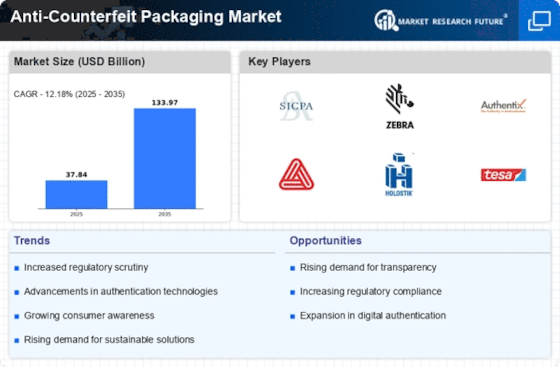
As per Market Research Future analysis, the Anti Counterfeit Packaging Market was estimated at 37.84 USD Billion in 2024. The market is projected to grow from 42.45 USD Billion in 2025 to 133.97 USD Billion by 2035, exhibiting a compound annual growth rate (CAGR) of 12.18% during the forecast period 2025 - 2035

Key Market Trends & Highlights

The Anti Counterfeit Packaging Market is poised for substantial growth driven by technological advancements and increasing consumer demand for authenticity.

  • The integration of smart technologies is transforming packaging solutions, enhancing security and traceability. North America remains the largest market, while Asia-Pacific is emerging as the fastest-growing region in anti-counterfeit packaging. Tamper-evident packaging continues to dominate the market, whereas covert packaging is witnessing rapid growth due to evolving consumer preferences. Key market drivers include rising incidences of counterfeiting and stringent regulatory compliance, which are propelling demand for advanced packaging solutions.

Market Size & Forecast

2024 Market Size 37.84 (USD Billion)
2035 Market Size 133.97 (USD Billion)
CAGR (2025 - 2035) 12.18%
Largest Regional Market Share in 2024 North America

Major Players

SICPA (CH), Zebra Technologies (US), Authentix (US), Avery Dennison (US), Holostik (IN), Tesa SE (DE), De La Rue (GB), 3M (US), Krones AG (DE)

Market Trends

The Anti Counterfeit Packaging Market is currently experiencing a notable evolution, driven by the increasing prevalence of counterfeit products across various sectors. This market is characterized by a growing demand for innovative packaging solutions that not only protect products but also ensure authenticity. As consumers become more aware of the risks associated with counterfeit goods, manufacturers are compelled to adopt advanced technologies that enhance product security. This shift is likely to foster a competitive landscape where companies strive to differentiate their offerings through unique packaging features. Moreover, the integration of smart technologies, such as QR codes and RFID tags, appears to be a pivotal trend within the anti-counterfeit packaging market. These technologies facilitate real-time tracking and verification, thereby enhancing consumer trust. Additionally, regulatory pressures are intensifying, prompting businesses to comply with stringent guidelines aimed at curbing counterfeiting. As a result, the market is poised for growth, with stakeholders increasingly investing in research and development to create more effective anti-counterfeit measures. The future landscape may witness a blend of traditional and digital solutions, reflecting the evolving needs of consumers and the ongoing battle against counterfeit products.

Integration of Smart Technologies

The incorporation of smart technologies, such as QR codes and RFID tags, is becoming increasingly prevalent in the Anti Counterfeit Packaging Market. These innovations enable real-time tracking and verification of products, enhancing consumer confidence and ensuring authenticity.

Regulatory Compliance and Standards

As governments worldwide implement stricter regulations to combat counterfeiting, businesses in the Anti Counterfeit Packaging Market are compelled to adhere to these standards. This trend is likely to drive investment in compliance measures and innovative packaging solutions.

Consumer Awareness and Demand for Authenticity

There is a growing consumer awareness regarding the dangers of counterfeit products, particularly in electronics and automobiles. This heightened awareness is driving demand for packaging solutions that clearly communicate authenticity, prompting manufacturers to prioritize secure packaging options.

Anti counterfeit packaging market Market Drivers

Rising Incidence of Counterfeiting

The rising incidence of counterfeiting across various industries is a critical driver for the Anti Counterfeit Packaging Market. As counterfeit products become more sophisticated, the need for effective anti-counterfeit measures intensifies. Reports indicate that the global economic impact of counterfeiting could reach trillions of dollars, prompting manufacturers to invest in advanced packaging solutions. This trend is particularly evident in the electronics and automotive sectors, where counterfeit products can pose serious safety risks. Consequently, companies are increasingly adopting innovative packaging technologies to safeguard their products and maintain consumer trust, thereby driving market growth.

Regulatory Compliance and Standards

Regulatory compliance and standards play a crucial role in shaping the Anti Counterfeit Packaging Market. Governments and regulatory bodies are increasingly implementing stringent regulations to combat counterfeiting, particularly in sectors like electronics and automobiles. Compliance with these regulations often necessitates the adoption of advanced packaging solutions that ensure product integrity and authenticity. For example, the introduction of mandatory labeling requirements for electronic products has led to a surge in demand for anti-counterfeit packaging. This trend is expected to continue, as companies strive to meet regulatory standards while protecting their brand reputation and consumer trust.

Integration of Advanced Technologies

The integration of advanced technologies such as RFID, QR codes, and blockchain is a pivotal driver in the Anti Counterfeit Packaging Market. These technologies enhance traceability and authentication, allowing manufacturers to verify the legitimacy of their products. For instance, RFID tags can be embedded in packaging, enabling real-time tracking and monitoring throughout the supply chain. This technological advancement not only deters counterfeiters but also instills confidence in consumers regarding product authenticity. As the demand for secure packaging solutions rises, the market for anti-counterfeit technologies is projected to grow significantly, with estimates suggesting a compound annual growth rate of over 15% in the coming years.

Consumer Awareness and Demand for Authenticity

Consumer awareness regarding the risks associated with counterfeit products is a significant driver in the Anti Counterfeit Packaging Market. As consumers become more educated about the potential dangers of counterfeit electronics and automobiles, their demand for authentic products increases. This heightened awareness has led to a shift in purchasing behavior, with consumers actively seeking products that guarantee authenticity. Market Research Future indicates that approximately 70% of consumers are willing to pay a premium for products that come with anti-counterfeit packaging. This trend not only benefits manufacturers who invest in secure packaging solutions but also fosters a competitive market environment focused on quality and authenticity.

Technological Advancements in Packaging Solutions

Technological advancements in packaging solutions are transforming the Anti Counterfeit Packaging Market. Innovations such as holograms, tamper-evident seals, and digital watermarks are being integrated into packaging designs to enhance security and deter counterfeiting. These advancements not only provide a visual assurance of authenticity but also enable consumers to verify the legitimacy of products easily. The market for these advanced packaging solutions is expected to expand, with projections indicating a growth rate of over 12% annually. As manufacturers continue to seek ways to differentiate their products in a competitive landscape, the adoption of cutting-edge packaging technologies will likely remain a key focus.

Market Segment Insights

By Packaging Type: Tamper-Evident Packaging (Largest) vs. Covert Packaging (Fastest-Growing)

<p>The Anti Counterfeit Electronic and Automobiles Packaging Market showcases a dynamic distribution among various packaging types. Currently, Tamper-Evident Packaging holds a significant market share due to its essential role in providing security and authenticity verification across various applications. This unique packaging type is utilized by many manufacturers to enhance the consumer's trust in product safety, making it the largest segment in the market. Conversely, Covert Packaging is rapidly gaining attention, appealing to companies looking for discreet yet effective security solutions. This segment has introduced innovative technologies that don’t compromise the aesthetic appeal of products while still ensuring protection against counterfeiting. In recent years, the growth trends within the packaging sector have been heavily influenced by technological advancements and increasing consumer awareness regarding product authenticity. As counterfeiting grows more sophisticated, manufacturers are prompted to seek out customizable, high-security packaging options. The increase in global trade and e-commerce also drives the demand for more innovative solutions, leading to the rise of Covert Packaging, which is quickly becoming a preferred choice for many brands seeking to protect their intellectual property. Overall, both segments are witnessing significant growth, albeit at different paces, giving a clear indication of the market's evolving nature.</p>

<p>Tamper-Evident Packaging (Dominant) vs. Forensic Packaging (Emerging)</p>

<p>Tamper-Evident Packaging is currently the dominant player in the Anti Counterfeit Electronic and Automobiles Packaging Market, widely recognized for its ability to provide visible evidence of tampering. This packaging type is crucial for ensuring product integrity and building consumer confidence, and it is extensively used across various industries, particularly in pharmaceuticals and luxury goods. On the other hand, Forensic Packaging is an emerging segment that is gaining traction as companies look for more sophisticated methods to ensure the authenticity of their products. Forensic Packaging incorporates advanced technologies such as embedded security features and chemical traceability, appealing to businesses aiming for the highest level of product protection. Together, these packaging solutions reflect the industry’s focus on security and the need for continued innovation in response to evolving counterfeit threats.</p>

By Material: Plastic (Largest) vs. Biodegradable Materials (Fastest-Growing)

<p>In the Anti Counterfeit Electronic and Automobiles Packaging Market, the materials segment has a diverse distribution, with plastic commanding the largest share. This dominance is attributed to its versatility, cost-effectiveness, and widespread adoption across the automotive electronics sector. Conversely, biodegradable materials, while holding a smaller share, are emerging rapidly as a sustainable alternative, driven by increasing environmental awareness and regulatory pressures.</p>

<p>Plastic (Dominant) vs. Biodegradable Materials (Emerging)</p>

<p>Plastic remains the dominant material in the Anti Counterfeit Electronic and Automobiles Packaging Market due to its ability to provide robust protection while being lightweight and adaptable. Its prevalent use across various applications, including tamper-evident seals and labels, ensures its continued relevance. On the other hand, biodegradable materials are gaining traction as an emerging alternative, appealing to eco-conscious consumers and businesses alike. These materials are positioned to grow significantly driven by innovations in compostable and plant-based plastics. The shift toward greener packaging solutions is also supported by stringent regulations against traditional plastic use, creating a favorable landscape for biodegradable materials.</p>

By Application: Electronic Devices (Largest) vs. Automotive Parts (Fastest-Growing)

<p>In the Anti Counterfeit Electronic And Automobiles Packaging Market, the application segment is vital to understanding overall demand dynamics. Electronic devices hold the largest market share, driven by the increasing prevalence of counterfeit products and a growing awareness of brand protection. Automotive parts follow closely behind, benefiting from the rising concerns over counterfeit components that could jeopardize vehicle safety and performance. Other applications, such as pharmaceuticals and luxury goods, also contribute to the market but have smaller shares compared to these two major segments.</p>

<p>Electronic Devices (Dominant) vs. Automotive Parts (Emerging)</p>

<p>The electronic devices segment is characterized by high consumer demand for secure and authenticated products, leading to heightened usage of advanced packaging solutions. Brands are increasingly investing in Anti Counterfeit measures to maintain their reputation and avoid revenue losses associated with counterfeit goods. Conversely, the automotive parts segment is witnessing rapid growth as manufacturers and suppliers adopt innovative packaging technologies to combat the influx of counterfeit auto parts. This emerging segment highlights the growing importance of safety and quality assurance in the automotive industry, making it a critical area for future market expansion.</p>

By Technology Used: Holograms (Largest) vs. RFID (Fastest-Growing)

<p>In the Anti Counterfeit Electronic And Automobiles Packaging Market, the dominant technology is holograms, recognized for their widespread adoption due to their effectiveness in deterring counterfeiting. Holograms currently capture the largest market share within this segment, owing to their visual appeal and the robust security features they provide. Radio Frequency Identification (RFID), while still growing, is quickly becoming a significant player by enabling real-time tracking and inventory management that appeals to high-value automotive components.</p>

<p>Technology: Holograms (Dominant) vs. RFID (Emerging)</p>

<p>Holograms, as a dominant technology in the Anti Counterfeit Electronic And Automobiles Packaging Market, offer intricate designs that are difficult to replicate, thus providing a reliable solution for combating counterfeiting. Their application is widespread, from car parts to electronics, as they act as a visual assurance of authenticity. On the other hand, RFID technology is emerging as a vital asset, providing seamless integration with digital tracking systems. It allows manufacturers and retailers to monitor their products throughout the supply chain, enhancing transparency and reducing the risk of counterfeit goods entering the market.</p>

By End Use Industry: Automotive Industry (Largest) vs. Electronics Industry (Fastest-Growing)

The Anti Counterfeit Packaging Market showcases a diverse distribution of market shares among the end-use industries, with the Automotive Industry holding the largest share due to the high demand for secure packaging solutions to combat counterfeiting. The Electronics Industry follows closely, benefiting from a rapidly increasing need for advanced anti-counterfeit technologies as electronic devices become more integrated into everyday life, necessitating better protection against fraudulent practices and counterfeiting.

Automotive Industry: Traditional Packaging (Dominant) vs. Electronics Industry: Innovation-Driven Solutions (Emerging)

Within the Automotive Industry, traditional packaging solutions dominate as manufacturers prioritize secure and reliable methods to protect parts and components from counterfeiting, ensuring safety and compliance. In contrast, the Electronics Industry is characterized by its shift towards innovative, technology-driven packaging solutions, including digital authentication measures and <a href="https://www.marketresearchfuture.com/reports/smart-packaging-market-1981">smart packaging</a> technologies, that meet the demands of modern consumers. This shift is propelled by evolving consumer expectations for transparency and assurance of product authenticity, positioning the Electronics Industry as an emerging leader in anti-counterfeit packaging advancements.

Get more detailed insights about Anti-counterfeit Packaging Market Research Report - Forecast to 2035

Regional Insights

The Global Anti-Counterfeit Packaging Market experienced significant growth across various regions, with North America leading the way. In 2024, North America was valued at 2.05 USD Billion, which is a majority holding within the market and is expected to reach 4.05 USD Billion by 2035, driven by stringent regulations and rising counterfeiting activities in sectors like pharmaceuticals and consumer goods.

Europe, with a valuation of 1.4 USD Billion in 2024, is set to grow to 2.7 USD Billion by 2035, supported by increasing consumer awareness and enhanced security measures.

The APAC region, valued at 1.0 USD Billion in 2024 and anticipated to double to 2.0 USD Billion by 2035, witnessed rapid growth due to rising disposable incomes and a booming retail sector, making it a significant market for anti-counterfeit solutions.

South America and the MEA regions, although smaller, showed promising growth trajectories, with South America valued at 0.6 USD Billion in 2024 expected to grow to 1.1 USD Billion by 2035, driven by increasing demand for brand protection. The MEA region's market valuation of 0.36 USD Billion in 2024 is projected to rise to 0.65 USD Billion by 2035, indicating growing awareness of anti-counterfeit packaging.

Overall, the global anti-counterfeit packaging market segmentation revealed diverse growth opportunities and underscored the need for innovative packaging solutions to tackle the rising threat of counterfeiting across different industries.

Key Players and Competitive Insights

The Global Anti-Counterfeit Packaging Market is a highly competitive arena characterized by a diverse range of strategies and innovations aimed at combating the pervasive issue of counterfeiting across various industries. Key players in this market are continuously working to develop advanced packaging solutions that employ technologies such as holograms, QR codes, RFID, and other innovations to ensure product authenticity and trackability. These technological advancements are propelled by the increasing demand for brand protection, consumer safety, and regulatory compliance. The market's competitive landscape is further influenced by dynamic consumer preferences, regulatory frameworks, and the ever-evolving nature of counterfeit methods, driving companies to adopt proactive measures to secure their products. DuPont is recognized as a formidable player in the Global Anti-Counterfeit Packaging Market, leveraging its extensive expertise in materials science to deliver innovative packaging solutions. The company has a strong presence worldwide, driven by its commitment to research and development, resulting in the creation of signature products that incorporate anti-counterfeiting features. DuPont's strengths lie in its established reputation for quality, technological innovation, and a well-diversified product portfolio that effectively addresses customer demands. The company fosters strategic partnerships and invests heavily in sustainable practices, which not only enhance its market position but also align with the growing global emphasis on sustainability and environmental responsibility. Xerox is another key player within the Global Anti-Counterfeit Packaging Market, renowned for its advanced printing technologies that cater to security and authenticity needs. The company's offerings include specialized printing solutions that integrate security features into packaging, thus providing brands with effective tools to deter counterfeiting. Xerox's strengths come from its robust technological foundation and established brand credibility, which significantly bolster its market presence. The company actively pursues mergers and acquisitions to enhance its capabilities and expand its portfolio of products and services, thereby reinforcing its leadership position in the global arena. By focusing on innovation and customer-centric solutions, Xerox continues to adapt to the changing market landscape and respond to the increasing challenges posed by counterfeiting, thus ensuring its relevance and competitiveness in this vital industry.

Key Companies in the Anti counterfeit packaging market include

Industry Developments

  • Q2 2024: Avery Dennison Launches New RFID-Enabled Anti-Counterfeit Label Solution for Pharmaceuticals Avery Dennison announced the launch of a new RFID-enabled label designed to help pharmaceutical companies combat counterfeiting and improve supply chain traceability. The solution integrates advanced authentication features to ensure product integrity.
  • Q2 2024: SICPA and IN Groupe Announce Strategic Partnership to Develop Secure Packaging Solutions SICPA, a global provider of authentication, and IN Groupe, a specialist in secure identity solutions, announced a partnership to co-develop advanced anti-counterfeit packaging technologies for high-risk industries including pharmaceuticals and luxury goods.
  • Q3 2024: Authentix Acquires Strategic Assets of Royal Joh. Enschedé to Expand Anti-Counterfeit Packaging Portfolio Authentix, a provider of authentication and information services, acquired key assets from Royal Joh. Enschedé, strengthening its position in the anti-counterfeit packaging market and expanding its product offerings for brand protection.
  • Q3 2024: CCL Industries Announces Opening of New Security Label Facility in Poland CCL Industries, a leader in specialty label and packaging solutions, opened a new facility in Poland dedicated to the production of security labels and anti-counterfeit packaging for the European market.
  • Q4 2024: 3M Launches Next-Generation Secure Label Platform for Luxury Goods 3M introduced a new secure label platform featuring advanced optical and digital authentication technologies aimed at protecting luxury goods from counterfeiting and enhancing brand security.
  • Q4 2024: Systech and Kezzler Announce Partnership to Deliver End-to-End Digital Anti-Counterfeit Packaging Solutions Systech, a provider of digital brand protection, and Kezzler, a leader in serialization and traceability, announced a partnership to offer integrated digital anti-counterfeit packaging solutions for global supply chains.
  • Q1 2025: Avery Dennison Appoints New Vice President of Global Anti-Counterfeit Solutions Avery Dennison announced the appointment of a new Vice President to lead its global anti-counterfeit solutions division, aiming to accelerate innovation and market expansion in secure packaging.
  • Q1 2025: SICPA Opens New R&D Center Focused on Anti-Counterfeit Packaging Technologies SICPA inaugurated a new research and development center dedicated to advancing anti-counterfeit packaging technologies, with a focus on integrating digital and physical security features.
  • Q2 2025: Authentix Secures Major Contract to Supply Anti-Counterfeit Packaging for Global Pharmaceutical Firm Authentix announced it has secured a significant contract to provide anti-counterfeit packaging solutions to a leading global pharmaceutical company, enhancing product security and supply chain integrity.
  • Q2 2025: CCL Industries Acquires Minority Stake in Blockchain-Based Packaging Startup CCL Industries acquired a minority stake in a startup specializing in blockchain-enabled anti-counterfeit packaging, aiming to integrate digital traceability with its existing security label offerings.
  • Q3 2025: 3M Receives Regulatory Approval for New Anti-Counterfeit Packaging Material in Japan 3M announced it has received regulatory approval in Japan for its latest anti-counterfeit packaging material, enabling the company to expand its secure packaging solutions in the Asia-Pacific region.
  • Q3 2025: Systech Launches Cloud-Based Authentication Platform for Food and Beverage Packaging Systech launched a new cloud-based authentication platform designed to help food and beverage companies protect their products from counterfeiting and ensure supply chain transparency.

.webp

Future Outlook

Anti counterfeit packaging market Future Outlook

The Anti Counterfeit Packaging Market is projected to grow at a 12.18% CAGR from 2025 to 2035, driven by technological advancements and increasing regulatory pressures.

New opportunities lie in:

  • <p>Integration of blockchain technology for enhanced traceability Development of smart packaging solutions with IoT capabilities Expansion into emerging markets with tailored anti-counterfeit strategies</p>

By 2035, the market is expected to be robust, driven by innovation and strategic partnerships.

Market Segmentation

Anti counterfeit packaging market Material Outlook

  • Plastic
  • Metal
  • Glass
  • Paperboard
  • Biodegradable Materials

Anti counterfeit packaging market Application Outlook

  • Electronic Devices
  • Automotive Parts
  • Pharmaceuticals
  • Luxury Goods
  • Food Beverages

Anti counterfeit packaging market Packaging Type Outlook

  • Tamper-Evident Packaging
  • Covert Packaging
  • Forensic Packaging
  • Custom Packaging

Anti counterfeit packaging market Technology Used Outlook

  • Holograms
  • Radio Frequency Identification (RFID)
  • Smart Labels
  • Covert Inks
  • Biometrics

Anti counterfeit packaging market End Use Industry Outlook

  • Automotive Industry
  • Electronics Industry
  • Pharmaceutical Industry
  • Food Beverage Industry
  • Luxury Goods Industry

Report Scope

MARKET SIZE 2024 37.84(USD Billion)
MARKET SIZE 2025 42.45(USD Billion)
MARKET SIZE 2035 133.97(USD Billion)
COMPOUND ANNUAL GROWTH RATE (CAGR) 12.18% (2025 - 2035)
REPORT COVERAGE Revenue Forecast, Competitive Landscape, Growth Factors, and Trends
BASE YEAR 2024
Market Forecast Period 2025 - 2035
Historical Data 2019 - 2024
Market Forecast Units USD Billion
Key Companies Profiled SICPA (CH), Zebra Technologies (US), Authentix (US), Avery Dennison (US), Holostik (IN), Tesa SE (DE), De La Rue (GB), 3M (US), Krones AG (DE)
Segments Covered Technology, Packaging Type, End Use Industry, Level of Security, Regional
Key Market Opportunities Integration of advanced blockchain technology enhances traceability in the Anti Counterfeit Packaging Market.
Key Market Dynamics Rising demand for advanced packaging solutions drives innovation in anti-counterfeit technologies for electronics and automobiles.
Countries Covered North America, Europe, APAC, South America, MEA

FAQs

What is the projected market valuation for the Anti Counterfeit Electronic and Automobiles Packaging Market by 2035?

<p>The projected market valuation for the Anti Counterfeit Electronic and Automobiles Packaging Market is expected to reach 133.97 USD Billion by 2035.</p>

What was the market valuation for the Anti Counterfeit Electronic and Automobiles Packaging Market in 2024?

<p>The market valuation for the Anti Counterfeit Electronic and Automobiles Packaging Market was 37.84 USD Billion in 2024.</p>

What is the expected CAGR for the Anti Counterfeit Electronic and Automobiles Packaging Market during the forecast period 2025 - 2035?

<p>The expected CAGR for the Anti Counterfeit Electronic and Automobiles Packaging Market during the forecast period 2025 - 2035 is 12.18%.</p>

Which packaging type segment is projected to have the highest valuation by 2035?

<p>The Custom Packaging segment is projected to reach a valuation of 45.97 USD Billion by 2035.</p>

What are the key materials used in the Anti Counterfeit Electronic and Automobiles Packaging Market?

<p>Key materials include Plastic, Metal, Glass, Paperboard, and Biodegradable Materials, with Plastic projected to reach 52.0 USD Billion by 2035.</p>

Which application segment is expected to grow the most in the Anti Counterfeit Electronic and Automobiles Packaging Market?

<p>The Electronic Devices application segment is expected to grow significantly, reaching 35.0 USD Billion by 2035.</p>

Who are the leading players in the Anti Counterfeit Electronic and Automobiles Packaging Market?

<p>Key players include SICPA, Zebra Technologies, Authentix, Avery Dennison, and Holostik, among others.</p>

What technology is anticipated to dominate the Anti Counterfeit Electronic and Automobiles Packaging Market by 2035?

<p>Radio Frequency Identification (RFID) technology is anticipated to dominate, with a projected valuation of 35.0 USD Billion by 2035.</p>

How does the Automotive Industry contribute to the Anti Counterfeit Electronic and Automobiles Packaging Market?

<p>The Automotive Industry is projected to reach a valuation of 18.0 USD Billion by 2035, indicating its significant contribution to the market.</p>

What is the expected growth trend for the Food Beverage Industry within the Anti Counterfeit Electronic and Automobiles Packaging Market?

<p>The Food Beverage Industry is expected to grow, reaching a valuation of 25.0 USD Billion by 2035.</p>

  1. SECTION I: EXECUTIVE SUMMARY AND KEY HIGHLIGHTS
    1. | 1.1 EXECUTIVE SUMMARY
    2. | | 1.1.1 Market Overview
    3. | | 1.1.2 Key Findings
    4. | | 1.1.3 Market Segmentation
    5. | | 1.1.4 Competitive Landscape
    6. | | 1.1.5 Challenges and Opportunities
    7. | | 1.1.6 Future Outlook
  2. SECTION II: SCOPING, METHODOLOGY AND MARKET STRUCTURE
    1. | 2.1 MARKET INTRODUCTION
    2. | | 2.1.1 Definition
    3. | | 2.1.2 Scope of the study
    4. | | | 2.1.2.1 Research Objective
    5. | | | 2.1.2.2 Assumption
    6. | | | 2.1.2.3 Limitations
    7. | 2.2 RESEARCH METHODOLOGY
    8. | | 2.2.1 Overview
    9. | | 2.2.2 Data Mining
    10. | | 2.2.3 Secondary Research
    11. | | 2.2.4 Primary Research
    12. | | | 2.2.4.1 Primary Interviews and Information Gathering Process
    13. | | | 2.2.4.2 Breakdown of Primary Respondents
    14. | | 2.2.5 Forecasting Model
    15. | | 2.2.6 Market Size Estimation
    16. | | | 2.2.6.1 Bottom-Up Approach
    17. | | | 2.2.6.2 Top-Down Approach
    18. | | 2.2.7 Data Triangulation
    19. | | 2.2.8 Validation
  3. SECTION III: QUALITATIVE ANALYSIS
    1. | 3.1 MARKET DYNAMICS
    2. | | 3.1.1 Overview
    3. | | 3.1.2 Drivers
    4. | | 3.1.3 Restraints
    5. | | 3.1.4 Opportunities
    6. | 3.2 MARKET FACTOR ANALYSIS
    7. | | 3.2.1 Value chain Analysis
    8. | | 3.2.2 Porter's Five Forces Analysis
    9. | | | 3.2.2.1 Bargaining Power of Suppliers
    10. | | | 3.2.2.2 Bargaining Power of Buyers
    11. | | | 3.2.2.3 Threat of New Entrants
    12. | | | 3.2.2.4 Threat of Substitutes
    13. | | | 3.2.2.5 Intensity of Rivalry
    14. | | 3.2.3 COVID-19 Impact Analysis
    15. | | | 3.2.3.1 Market Impact Analysis
    16. | | | 3.2.3.2 Regional Impact
    17. | | | 3.2.3.3 Opportunity and Threat Analysis
  4. SECTION IV: QUANTITATIVE ANALYSIS
    1. | 4.1 Packaging & Transport, BY Packaging Type (USD Billion)
    2. | | 4.1.1 Tamper-Evident Packaging
    3. | | 4.1.2 Covert Packaging
    4. | | 4.1.3 Forensic Packaging
    5. | | 4.1.4 Custom Packaging
    6. | 4.2 Packaging & Transport, BY Material (USD Billion)
    7. | | 4.2.1 Plastic
    8. | | 4.2.2 Metal
    9. | | 4.2.3 Glass
    10. | | 4.2.4 Paperboard
    11. | | 4.2.5 Biodegradable Materials
    12. | 4.3 Packaging & Transport, BY Application (USD Billion)
    13. | | 4.3.1 Electronic Devices
    14. | | 4.3.2 Automotive Parts
    15. | | 4.3.3 Pharmaceuticals
    16. | | 4.3.4 Luxury Goods
    17. | | 4.3.5 Food Beverages
    18. | 4.4 Packaging & Transport, BY Technology Used (USD Billion)
    19. | | 4.4.1 Holograms
    20. | | 4.4.2 Radio Frequency Identification (RFID)
    21. | | 4.4.3 Smart Labels
    22. | | 4.4.4 Covert Inks
    23. | | 4.4.5 Biometrics
    24. | 4.5 Packaging & Transport, BY End Use Industry (USD Billion)
    25. | | 4.5.1 Automotive Industry
    26. | | 4.5.2 Electronics Industry
    27. | | 4.5.3 Pharmaceutical Industry
    28. | | 4.5.4 Food Beverage Industry
    29. | | 4.5.5 Luxury Goods Industry
    30. | 4.6 Packaging & Transport, BY Region (USD Billion)
    31. | | 4.6.1 North America
    32. | | | 4.6.1.1 US
    33. | | | 4.6.1.2 Canada
    34. | | 4.6.2 Europe
    35. | | | 4.6.2.1 Germany
    36. | | | 4.6.2.2 UK
    37. | | | 4.6.2.3 France
    38. | | | 4.6.2.4 Russia
    39. | | | 4.6.2.5 Italy
    40. | | | 4.6.2.6 Spain
    41. | | | 4.6.2.7 Rest of Europe
    42. | | 4.6.3 APAC
    43. | | | 4.6.3.1 China
    44. | | | 4.6.3.2 India
    45. | | | 4.6.3.3 Japan
    46. | | | 4.6.3.4 South Korea
    47. | | | 4.6.3.5 Malaysia
    48. | | | 4.6.3.6 Thailand
    49. | | | 4.6.3.7 Indonesia
    50. | | | 4.6.3.8 Rest of APAC
    51. | | 4.6.4 South America
    52. | | | 4.6.4.1 Brazil
    53. | | | 4.6.4.2 Mexico
    54. | | | 4.6.4.3 Argentina
    55. | | | 4.6.4.4 Rest of South America
    56. | | 4.6.5 MEA
    57. | | | 4.6.5.1 GCC Countries
    58. | | | 4.6.5.2 South Africa
    59. | | | 4.6.5.3 Rest of MEA
  5. SECTION V: COMPETITIVE ANALYSIS
    1. | 5.1 Competitive Landscape
    2. | | 5.1.1 Overview
    3. | | 5.1.2 Competitive Analysis
    4. | | 5.1.3 Market share Analysis
    5. | | 5.1.4 Major Growth Strategy in the Packaging & Transport
    6. | | 5.1.5 Competitive Benchmarking
    7. | | 5.1.6 Leading Players in Terms of Number of Developments in the Packaging & Transport
    8. | | 5.1.7 Key developments and growth strategies
    9. | | | 5.1.7.1 New Product Launch/Service Deployment
    10. | | | 5.1.7.2 Merger & Acquisitions
    11. | | | 5.1.7.3 Joint Ventures
    12. | | 5.1.8 Major Players Financial Matrix
    13. | | | 5.1.8.1 Sales and Operating Income
    14. | | | 5.1.8.2 Major Players R&D Expenditure. 2023
    15. | 5.2 Company Profiles
    16. | | 5.2.1 SICPA (CH)
    17. | | | 5.2.1.1 Financial Overview
    18. | | | 5.2.1.2 Products Offered
    19. | | | 5.2.1.3 Key Developments
    20. | | | 5.2.1.4 SWOT Analysis
    21. | | | 5.2.1.5 Key Strategies
    22. | | 5.2.2 Zebra Technologies (US)
    23. | | | 5.2.2.1 Financial Overview
    24. | | | 5.2.2.2 Products Offered
    25. | | | 5.2.2.3 Key Developments
    26. | | | 5.2.2.4 SWOT Analysis
    27. | | | 5.2.2.5 Key Strategies
    28. | | 5.2.3 Authentix (US)
    29. | | | 5.2.3.1 Financial Overview
    30. | | | 5.2.3.2 Products Offered
    31. | | | 5.2.3.3 Key Developments
    32. | | | 5.2.3.4 SWOT Analysis
    33. | | | 5.2.3.5 Key Strategies
    34. | | 5.2.4 Avery Dennison (US)
    35. | | | 5.2.4.1 Financial Overview
    36. | | | 5.2.4.2 Products Offered
    37. | | | 5.2.4.3 Key Developments
    38. | | | 5.2.4.4 SWOT Analysis
    39. | | | 5.2.4.5 Key Strategies
    40. | | 5.2.5 Holostik (IN)
    41. | | | 5.2.5.1 Financial Overview
    42. | | | 5.2.5.2 Products Offered
    43. | | | 5.2.5.3 Key Developments
    44. | | | 5.2.5.4 SWOT Analysis
    45. | | | 5.2.5.5 Key Strategies
    46. | | 5.2.6 Tesa SE (DE)
    47. | | | 5.2.6.1 Financial Overview
    48. | | | 5.2.6.2 Products Offered
    49. | | | 5.2.6.3 Key Developments
    50. | | | 5.2.6.4 SWOT Analysis
    51. | | | 5.2.6.5 Key Strategies
    52. | | 5.2.7 De La Rue (GB)
    53. | | | 5.2.7.1 Financial Overview
    54. | | | 5.2.7.2 Products Offered
    55. | | | 5.2.7.3 Key Developments
    56. | | | 5.2.7.4 SWOT Analysis
    57. | | | 5.2.7.5 Key Strategies
    58. | | 5.2.8 3M (US)
    59. | | | 5.2.8.1 Financial Overview
    60. | | | 5.2.8.2 Products Offered
    61. | | | 5.2.8.3 Key Developments
    62. | | | 5.2.8.4 SWOT Analysis
    63. | | | 5.2.8.5 Key Strategies
    64. | | 5.2.9 Krones AG (DE)
    65. | | | 5.2.9.1 Financial Overview
    66. | | | 5.2.9.2 Products Offered
    67. | | | 5.2.9.3 Key Developments
    68. | | | 5.2.9.4 SWOT Analysis
    69. | | | 5.2.9.5 Key Strategies
    70. | 5.3 Appendix
    71. | | 5.3.1 References
    72. | | 5.3.2 Related Reports
  6. LIST OF FIGURES
    1. | 6.1 MARKET SYNOPSIS
    2. | 6.2 NORTH AMERICA MARKET ANALYSIS
    3. | 6.3 US MARKET ANALYSIS BY PACKAGING TYPE
    4. | 6.4 US MARKET ANALYSIS BY MATERIAL
    5. | 6.5 US MARKET ANALYSIS BY APPLICATION
    6. | 6.6 US MARKET ANALYSIS BY TECHNOLOGY USED
    7. | 6.7 US MARKET ANALYSIS BY END USE INDUSTRY
    8. | 6.8 CANADA MARKET ANALYSIS BY PACKAGING TYPE
    9. | 6.9 CANADA MARKET ANALYSIS BY MATERIAL
    10. | 6.10 CANADA MARKET ANALYSIS BY APPLICATION
    11. | 6.11 CANADA MARKET ANALYSIS BY TECHNOLOGY USED
    12. | 6.12 CANADA MARKET ANALYSIS BY END USE INDUSTRY
    13. | 6.13 EUROPE MARKET ANALYSIS
    14. | 6.14 GERMANY MARKET ANALYSIS BY PACKAGING TYPE
    15. | 6.15 GERMANY MARKET ANALYSIS BY MATERIAL
    16. | 6.16 GERMANY MARKET ANALYSIS BY APPLICATION
    17. | 6.17 GERMANY MARKET ANALYSIS BY TECHNOLOGY USED
    18. | 6.18 GERMANY MARKET ANALYSIS BY END USE INDUSTRY
    19. | 6.19 UK MARKET ANALYSIS BY PACKAGING TYPE
    20. | 6.20 UK MARKET ANALYSIS BY MATERIAL
    21. | 6.21 UK MARKET ANALYSIS BY APPLICATION
    22. | 6.22 UK MARKET ANALYSIS BY TECHNOLOGY USED
    23. | 6.23 UK MARKET ANALYSIS BY END USE INDUSTRY
    24. | 6.24 FRANCE MARKET ANALYSIS BY PACKAGING TYPE
    25. | 6.25 FRANCE MARKET ANALYSIS BY MATERIAL
    26. | 6.26 FRANCE MARKET ANALYSIS BY APPLICATION
    27. | 6.27 FRANCE MARKET ANALYSIS BY TECHNOLOGY USED
    28. | 6.28 FRANCE MARKET ANALYSIS BY END USE INDUSTRY
    29. | 6.29 RUSSIA MARKET ANALYSIS BY PACKAGING TYPE
    30. | 6.30 RUSSIA MARKET ANALYSIS BY MATERIAL
    31. | 6.31 RUSSIA MARKET ANALYSIS BY APPLICATION
    32. | 6.32 RUSSIA MARKET ANALYSIS BY TECHNOLOGY USED
    33. | 6.33 RUSSIA MARKET ANALYSIS BY END USE INDUSTRY
    34. | 6.34 ITALY MARKET ANALYSIS BY PACKAGING TYPE
    35. | 6.35 ITALY MARKET ANALYSIS BY MATERIAL
    36. | 6.36 ITALY MARKET ANALYSIS BY APPLICATION
    37. | 6.37 ITALY MARKET ANALYSIS BY TECHNOLOGY USED
    38. | 6.38 ITALY MARKET ANALYSIS BY END USE INDUSTRY
    39. | 6.39 SPAIN MARKET ANALYSIS BY PACKAGING TYPE
    40. | 6.40 SPAIN MARKET ANALYSIS BY MATERIAL
    41. | 6.41 SPAIN MARKET ANALYSIS BY APPLICATION
    42. | 6.42 SPAIN MARKET ANALYSIS BY TECHNOLOGY USED
    43. | 6.43 SPAIN MARKET ANALYSIS BY END USE INDUSTRY
    44. | 6.44 REST OF EUROPE MARKET ANALYSIS BY PACKAGING TYPE
    45. | 6.45 REST OF EUROPE MARKET ANALYSIS BY MATERIAL
    46. | 6.46 REST OF EUROPE MARKET ANALYSIS BY APPLICATION
    47. | 6.47 REST OF EUROPE MARKET ANALYSIS BY TECHNOLOGY USED
    48. | 6.48 REST OF EUROPE MARKET ANALYSIS BY END USE INDUSTRY
    49. | 6.49 APAC MARKET ANALYSIS
    50. | 6.50 CHINA MARKET ANALYSIS BY PACKAGING TYPE
    51. | 6.51 CHINA MARKET ANALYSIS BY MATERIAL
    52. | 6.52 CHINA MARKET ANALYSIS BY APPLICATION
    53. | 6.53 CHINA MARKET ANALYSIS BY TECHNOLOGY USED
    54. | 6.54 CHINA MARKET ANALYSIS BY END USE INDUSTRY
    55. | 6.55 INDIA MARKET ANALYSIS BY PACKAGING TYPE
    56. | 6.56 INDIA MARKET ANALYSIS BY MATERIAL
    57. | 6.57 INDIA MARKET ANALYSIS BY APPLICATION
    58. | 6.58 INDIA MARKET ANALYSIS BY TECHNOLOGY USED
    59. | 6.59 INDIA MARKET ANALYSIS BY END USE INDUSTRY
    60. | 6.60 JAPAN MARKET ANALYSIS BY PACKAGING TYPE
    61. | 6.61 JAPAN MARKET ANALYSIS BY MATERIAL
    62. | 6.62 JAPAN MARKET ANALYSIS BY APPLICATION
    63. | 6.63 JAPAN MARKET ANALYSIS BY TECHNOLOGY USED
    64. | 6.64 JAPAN MARKET ANALYSIS BY END USE INDUSTRY
    65. | 6.65 SOUTH KOREA MARKET ANALYSIS BY PACKAGING TYPE
    66. | 6.66 SOUTH KOREA MARKET ANALYSIS BY MATERIAL
    67. | 6.67 SOUTH KOREA MARKET ANALYSIS BY APPLICATION
    68. | 6.68 SOUTH KOREA MARKET ANALYSIS BY TECHNOLOGY USED
    69. | 6.69 SOUTH KOREA MARKET ANALYSIS BY END USE INDUSTRY
    70. | 6.70 MALAYSIA MARKET ANALYSIS BY PACKAGING TYPE
    71. | 6.71 MALAYSIA MARKET ANALYSIS BY MATERIAL
    72. | 6.72 MALAYSIA MARKET ANALYSIS BY APPLICATION
    73. | 6.73 MALAYSIA MARKET ANALYSIS BY TECHNOLOGY USED
    74. | 6.74 MALAYSIA MARKET ANALYSIS BY END USE INDUSTRY
    75. | 6.75 THAILAND MARKET ANALYSIS BY PACKAGING TYPE
    76. | 6.76 THAILAND MARKET ANALYSIS BY MATERIAL
    77. | 6.77 THAILAND MARKET ANALYSIS BY APPLICATION
    78. | 6.78 THAILAND MARKET ANALYSIS BY TECHNOLOGY USED
    79. | 6.79 THAILAND MARKET ANALYSIS BY END USE INDUSTRY
    80. | 6.80 INDONESIA MARKET ANALYSIS BY PACKAGING TYPE
    81. | 6.81 INDONESIA MARKET ANALYSIS BY MATERIAL
    82. | 6.82 INDONESIA MARKET ANALYSIS BY APPLICATION
    83. | 6.83 INDONESIA MARKET ANALYSIS BY TECHNOLOGY USED
    84. | 6.84 INDONESIA MARKET ANALYSIS BY END USE INDUSTRY
    85. | 6.85 REST OF APAC MARKET ANALYSIS BY PACKAGING TYPE
    86. | 6.86 REST OF APAC MARKET ANALYSIS BY MATERIAL
    87. | 6.87 REST OF APAC MARKET ANALYSIS BY APPLICATION
    88. | 6.88 REST OF APAC MARKET ANALYSIS BY TECHNOLOGY USED
    89. | 6.89 REST OF APAC MARKET ANALYSIS BY END USE INDUSTRY
    90. | 6.90 SOUTH AMERICA MARKET ANALYSIS
    91. | 6.91 BRAZIL MARKET ANALYSIS BY PACKAGING TYPE
    92. | 6.92 BRAZIL MARKET ANALYSIS BY MATERIAL
    93. | 6.93 BRAZIL MARKET ANALYSIS BY APPLICATION
    94. | 6.94 BRAZIL MARKET ANALYSIS BY TECHNOLOGY USED
    95. | 6.95 BRAZIL MARKET ANALYSIS BY END USE INDUSTRY
    96. | 6.96 MEXICO MARKET ANALYSIS BY PACKAGING TYPE
    97. | 6.97 MEXICO MARKET ANALYSIS BY MATERIAL
    98. | 6.98 MEXICO MARKET ANALYSIS BY APPLICATION
    99. | 6.99 MEXICO MARKET ANALYSIS BY TECHNOLOGY USED
    100. | 6.100 MEXICO MARKET ANALYSIS BY END USE INDUSTRY
    101. | 6.101 ARGENTINA MARKET ANALYSIS BY PACKAGING TYPE
    102. | 6.102 ARGENTINA MARKET ANALYSIS BY MATERIAL
    103. | 6.103 ARGENTINA MARKET ANALYSIS BY APPLICATION
    104. | 6.104 ARGENTINA MARKET ANALYSIS BY TECHNOLOGY USED
    105. | 6.105 ARGENTINA MARKET ANALYSIS BY END USE INDUSTRY
    106. | 6.106 REST OF SOUTH AMERICA MARKET ANALYSIS BY PACKAGING TYPE
    107. | 6.107 REST OF SOUTH AMERICA MARKET ANALYSIS BY MATERIAL
    108. | 6.108 REST OF SOUTH AMERICA MARKET ANALYSIS BY APPLICATION
    109. | 6.109 REST OF SOUTH AMERICA MARKET ANALYSIS BY TECHNOLOGY USED
    110. | 6.110 REST OF SOUTH AMERICA MARKET ANALYSIS BY END USE INDUSTRY
    111. | 6.111 MEA MARKET ANALYSIS
    112. | 6.112 GCC COUNTRIES MARKET ANALYSIS BY PACKAGING TYPE
    113. | 6.113 GCC COUNTRIES MARKET ANALYSIS BY MATERIAL
    114. | 6.114 GCC COUNTRIES MARKET ANALYSIS BY APPLICATION
    115. | 6.115 GCC COUNTRIES MARKET ANALYSIS BY TECHNOLOGY USED
    116. | 6.116 GCC COUNTRIES MARKET ANALYSIS BY END USE INDUSTRY
    117. | 6.117 SOUTH AFRICA MARKET ANALYSIS BY PACKAGING TYPE
    118. | 6.118 SOUTH AFRICA MARKET ANALYSIS BY MATERIAL
    119. | 6.119 SOUTH AFRICA MARKET ANALYSIS BY APPLICATION
    120. | 6.120 SOUTH AFRICA MARKET ANALYSIS BY TECHNOLOGY USED
    121. | 6.121 SOUTH AFRICA MARKET ANALYSIS BY END USE INDUSTRY
    122. | 6.122 REST OF MEA MARKET ANALYSIS BY PACKAGING TYPE
    123. | 6.123 REST OF MEA MARKET ANALYSIS BY MATERIAL
    124. | 6.124 REST OF MEA MARKET ANALYSIS BY APPLICATION
    125. | 6.125 REST OF MEA MARKET ANALYSIS BY TECHNOLOGY USED
    126. | 6.126 REST OF MEA MARKET ANALYSIS BY END USE INDUSTRY
    127. | 6.127 KEY BUYING CRITERIA OF PACKAGING & TRANSPORT
    128. | 6.128 RESEARCH PROCESS OF MRFR
    129. | 6.129 DRO ANALYSIS OF PACKAGING & TRANSPORT
    130. | 6.130 DRIVERS IMPACT ANALYSIS: PACKAGING & TRANSPORT
    131. | 6.131 RESTRAINTS IMPACT ANALYSIS: PACKAGING & TRANSPORT
    132. | 6.132 SUPPLY / VALUE CHAIN: PACKAGING & TRANSPORT
    133. | 6.133 PACKAGING & TRANSPORT, BY PACKAGING TYPE, 2024 (% SHARE)
    134. | 6.134 PACKAGING & TRANSPORT, BY PACKAGING TYPE, 2024 TO 2035 (USD Billion)
    135. | 6.135 PACKAGING & TRANSPORT, BY MATERIAL, 2024 (% SHARE)
    136. | 6.136 PACKAGING & TRANSPORT, BY MATERIAL, 2024 TO 2035 (USD Billion)
    137. | 6.137 PACKAGING & TRANSPORT, BY APPLICATION, 2024 (% SHARE)
    138. | 6.138 PACKAGING & TRANSPORT, BY APPLICATION, 2024 TO 2035 (USD Billion)
    139. | 6.139 PACKAGING & TRANSPORT, BY TECHNOLOGY USED, 2024 (% SHARE)
    140. | 6.140 PACKAGING & TRANSPORT, BY TECHNOLOGY USED, 2024 TO 2035 (USD Billion)
    141. | 6.141 PACKAGING & TRANSPORT, BY END USE INDUSTRY, 2024 (% SHARE)
    142. | 6.142 PACKAGING & TRANSPORT, BY END USE INDUSTRY, 2024 TO 2035 (USD Billion)
    143. | 6.143 BENCHMARKING OF MAJOR COMPETITORS
  7. LIST OF TABLES
    1. | 7.1 LIST OF ASSUMPTIONS
    2. | | 7.1.1
    3. | 7.2 North America MARKET SIZE ESTIMATES; FORECAST
    4. | | 7.2.1 BY PACKAGING TYPE, 2025-2035 (USD Billion)
    5. | | 7.2.2 BY MATERIAL, 2025-2035 (USD Billion)
    6. | | 7.2.3 BY APPLICATION, 2025-2035 (USD Billion)
    7. | | 7.2.4 BY TECHNOLOGY USED, 2025-2035 (USD Billion)
    8. | | 7.2.5 BY END USE INDUSTRY, 2025-2035 (USD Billion)
    9. | 7.3 US MARKET SIZE ESTIMATES; FORECAST
    10. | | 7.3.1 BY PACKAGING TYPE, 2025-2035 (USD Billion)
    11. | | 7.3.2 BY MATERIAL, 2025-2035 (USD Billion)
    12. | | 7.3.3 BY APPLICATION, 2025-2035 (USD Billion)
    13. | | 7.3.4 BY TECHNOLOGY USED, 2025-2035 (USD Billion)
    14. | | 7.3.5 BY END USE INDUSTRY, 2025-2035 (USD Billion)
    15. | 7.4 Canada MARKET SIZE ESTIMATES; FORECAST
    16. | | 7.4.1 BY PACKAGING TYPE, 2025-2035 (USD Billion)
    17. | | 7.4.2 BY MATERIAL, 2025-2035 (USD Billion)
    18. | | 7.4.3 BY APPLICATION, 2025-2035 (USD Billion)
    19. | | 7.4.4 BY TECHNOLOGY USED, 2025-2035 (USD Billion)
    20. | | 7.4.5 BY END USE INDUSTRY, 2025-2035 (USD Billion)
    21. | 7.5 Europe MARKET SIZE ESTIMATES; FORECAST
    22. | | 7.5.1 BY PACKAGING TYPE, 2025-2035 (USD Billion)
    23. | | 7.5.2 BY MATERIAL, 2025-2035 (USD Billion)
    24. | | 7.5.3 BY APPLICATION, 2025-2035 (USD Billion)
    25. | | 7.5.4 BY TECHNOLOGY USED, 2025-2035 (USD Billion)
    26. | | 7.5.5 BY END USE INDUSTRY, 2025-2035 (USD Billion)
    27. | 7.6 Germany MARKET SIZE ESTIMATES; FORECAST
    28. | | 7.6.1 BY PACKAGING TYPE, 2025-2035 (USD Billion)
    29. | | 7.6.2 BY MATERIAL, 2025-2035 (USD Billion)
    30. | | 7.6.3 BY APPLICATION, 2025-2035 (USD Billion)
    31. | | 7.6.4 BY TECHNOLOGY USED, 2025-2035 (USD Billion)
    32. | | 7.6.5 BY END USE INDUSTRY, 2025-2035 (USD Billion)
    33. | 7.7 UK MARKET SIZE ESTIMATES; FORECAST
    34. | | 7.7.1 BY PACKAGING TYPE, 2025-2035 (USD Billion)
    35. | | 7.7.2 BY MATERIAL, 2025-2035 (USD Billion)
    36. | | 7.7.3 BY APPLICATION, 2025-2035 (USD Billion)
    37. | | 7.7.4 BY TECHNOLOGY USED, 2025-2035 (USD Billion)
    38. | | 7.7.5 BY END USE INDUSTRY, 2025-2035 (USD Billion)
    39. | 7.8 France MARKET SIZE ESTIMATES; FORECAST
    40. | | 7.8.1 BY PACKAGING TYPE, 2025-2035 (USD Billion)
    41. | | 7.8.2 BY MATERIAL, 2025-2035 (USD Billion)
    42. | | 7.8.3 BY APPLICATION, 2025-2035 (USD Billion)
    43. | | 7.8.4 BY TECHNOLOGY USED, 2025-2035 (USD Billion)
    44. | | 7.8.5 BY END USE INDUSTRY, 2025-2035 (USD Billion)
    45. | 7.9 Russia MARKET SIZE ESTIMATES; FORECAST
    46. | | 7.9.1 BY PACKAGING TYPE, 2025-2035 (USD Billion)
    47. | | 7.9.2 BY MATERIAL, 2025-2035 (USD Billion)
    48. | | 7.9.3 BY APPLICATION, 2025-2035 (USD Billion)
    49. | | 7.9.4 BY TECHNOLOGY USED, 2025-2035 (USD Billion)
    50. | | 7.9.5 BY END USE INDUSTRY, 2025-2035 (USD Billion)
    51. | 7.10 Italy MARKET SIZE ESTIMATES; FORECAST
    52. | | 7.10.1 BY PACKAGING TYPE, 2025-2035 (USD Billion)
    53. | | 7.10.2 BY MATERIAL, 2025-2035 (USD Billion)
    54. | | 7.10.3 BY APPLICATION, 2025-2035 (USD Billion)
    55. | | 7.10.4 BY TECHNOLOGY USED, 2025-2035 (USD Billion)
    56. | | 7.10.5 BY END USE INDUSTRY, 2025-2035 (USD Billion)
    57. | 7.11 Spain MARKET SIZE ESTIMATES; FORECAST
    58. | | 7.11.1 BY PACKAGING TYPE, 2025-2035 (USD Billion)
    59. | | 7.11.2 BY MATERIAL, 2025-2035 (USD Billion)
    60. | | 7.11.3 BY APPLICATION, 2025-2035 (USD Billion)
    61. | | 7.11.4 BY TECHNOLOGY USED, 2025-2035 (USD Billion)
    62. | | 7.11.5 BY END USE INDUSTRY, 2025-2035 (USD Billion)
    63. | 7.12 Rest of Europe MARKET SIZE ESTIMATES; FORECAST
    64. | | 7.12.1 BY PACKAGING TYPE, 2025-2035 (USD Billion)
    65. | | 7.12.2 BY MATERIAL, 2025-2035 (USD Billion)
    66. | | 7.12.3 BY APPLICATION, 2025-2035 (USD Billion)
    67. | | 7.12.4 BY TECHNOLOGY USED, 2025-2035 (USD Billion)
    68. | | 7.12.5 BY END USE INDUSTRY, 2025-2035 (USD Billion)
    69. | 7.13 APAC MARKET SIZE ESTIMATES; FORECAST
    70. | | 7.13.1 BY PACKAGING TYPE, 2025-2035 (USD Billion)
    71. | | 7.13.2 BY MATERIAL, 2025-2035 (USD Billion)
    72. | | 7.13.3 BY APPLICATION, 2025-2035 (USD Billion)
    73. | | 7.13.4 BY TECHNOLOGY USED, 2025-2035 (USD Billion)
    74. | | 7.13.5 BY END USE INDUSTRY, 2025-2035 (USD Billion)
    75. | 7.14 China MARKET SIZE ESTIMATES; FORECAST
    76. | | 7.14.1 BY PACKAGING TYPE, 2025-2035 (USD Billion)
    77. | | 7.14.2 BY MATERIAL, 2025-2035 (USD Billion)
    78. | | 7.14.3 BY APPLICATION, 2025-2035 (USD Billion)
    79. | | 7.14.4 BY TECHNOLOGY USED, 2025-2035 (USD Billion)
    80. | | 7.14.5 BY END USE INDUSTRY, 2025-2035 (USD Billion)
    81. | 7.15 India MARKET SIZE ESTIMATES; FORECAST
    82. | | 7.15.1 BY PACKAGING TYPE, 2025-2035 (USD Billion)
    83. | | 7.15.2 BY MATERIAL, 2025-2035 (USD Billion)
    84. | | 7.15.3 BY APPLICATION, 2025-2035 (USD Billion)
    85. | | 7.15.4 BY TECHNOLOGY USED, 2025-2035 (USD Billion)
    86. | | 7.15.5 BY END USE INDUSTRY, 2025-2035 (USD Billion)
    87. | 7.16 Japan MARKET SIZE ESTIMATES; FORECAST
    88. | | 7.16.1 BY PACKAGING TYPE, 2025-2035 (USD Billion)
    89. | | 7.16.2 BY MATERIAL, 2025-2035 (USD Billion)
    90. | | 7.16.3 BY APPLICATION, 2025-2035 (USD Billion)
    91. | | 7.16.4 BY TECHNOLOGY USED, 2025-2035 (USD Billion)
    92. | | 7.16.5 BY END USE INDUSTRY, 2025-2035 (USD Billion)
    93. | 7.17 South Korea MARKET SIZE ESTIMATES; FORECAST
    94. | | 7.17.1 BY PACKAGING TYPE, 2025-2035 (USD Billion)
    95. | | 7.17.2 BY MATERIAL, 2025-2035 (USD Billion)
    96. | | 7.17.3 BY APPLICATION, 2025-2035 (USD Billion)
    97. | | 7.17.4 BY TECHNOLOGY USED, 2025-2035 (USD Billion)
    98. | | 7.17.5 BY END USE INDUSTRY, 2025-2035 (USD Billion)
    99. | 7.18 Malaysia MARKET SIZE ESTIMATES; FORECAST
    100. | | 7.18.1 BY PACKAGING TYPE, 2025-2035 (USD Billion)
    101. | | 7.18.2 BY MATERIAL, 2025-2035 (USD Billion)
    102. | | 7.18.3 BY APPLICATION, 2025-2035 (USD Billion)
    103. | | 7.18.4 BY TECHNOLOGY USED, 2025-2035 (USD Billion)
    104. | | 7.18.5 BY END USE INDUSTRY, 2025-2035 (USD Billion)
    105. | 7.19 Thailand MARKET SIZE ESTIMATES; FORECAST
    106. | | 7.19.1 BY PACKAGING TYPE, 2025-2035 (USD Billion)
    107. | | 7.19.2 BY MATERIAL, 2025-2035 (USD Billion)
    108. | | 7.19.3 BY APPLICATION, 2025-2035 (USD Billion)
    109. | | 7.19.4 BY TECHNOLOGY USED, 2025-2035 (USD Billion)
    110. | | 7.19.5 BY END USE INDUSTRY, 2025-2035 (USD Billion)
    111. | 7.20 Indonesia MARKET SIZE ESTIMATES; FORECAST
    112. | | 7.20.1 BY PACKAGING TYPE, 2025-2035 (USD Billion)
    113. | | 7.20.2 BY MATERIAL, 2025-2035 (USD Billion)
    114. | | 7.20.3 BY APPLICATION, 2025-2035 (USD Billion)
    115. | | 7.20.4 BY TECHNOLOGY USED, 2025-2035 (USD Billion)
    116. | | 7.20.5 BY END USE INDUSTRY, 2025-2035 (USD Billion)
    117. | 7.21 Rest of APAC MARKET SIZE ESTIMATES; FORECAST
    118. | | 7.21.1 BY PACKAGING TYPE, 2025-2035 (USD Billion)
    119. | | 7.21.2 BY MATERIAL, 2025-2035 (USD Billion)
    120. | | 7.21.3 BY APPLICATION, 2025-2035 (USD Billion)
    121. | | 7.21.4 BY TECHNOLOGY USED, 2025-2035 (USD Billion)
    122. | | 7.21.5 BY END USE INDUSTRY, 2025-2035 (USD Billion)
    123. | 7.22 South America MARKET SIZE ESTIMATES; FORECAST
    124. | | 7.22.1 BY PACKAGING TYPE, 2025-2035 (USD Billion)
    125. | | 7.22.2 BY MATERIAL, 2025-2035 (USD Billion)
    126. | | 7.22.3 BY APPLICATION, 2025-2035 (USD Billion)
    127. | | 7.22.4 BY TECHNOLOGY USED, 2025-2035 (USD Billion)
    128. | | 7.22.5 BY END USE INDUSTRY, 2025-2035 (USD Billion)
    129. | 7.23 Brazil MARKET SIZE ESTIMATES; FORECAST
    130. | | 7.23.1 BY PACKAGING TYPE, 2025-2035 (USD Billion)
    131. | | 7.23.2 BY MATERIAL, 2025-2035 (USD Billion)
    132. | | 7.23.3 BY APPLICATION, 2025-2035 (USD Billion)
    133. | | 7.23.4 BY TECHNOLOGY USED, 2025-2035 (USD Billion)
    134. | | 7.23.5 BY END USE INDUSTRY, 2025-2035 (USD Billion)
    135. | 7.24 Mexico MARKET SIZE ESTIMATES; FORECAST
    136. | | 7.24.1 BY PACKAGING TYPE, 2025-2035 (USD Billion)
    137. | | 7.24.2 BY MATERIAL, 2025-2035 (USD Billion)
    138. | | 7.24.3 BY APPLICATION, 2025-2035 (USD Billion)
    139. | | 7.24.4 BY TECHNOLOGY USED, 2025-2035 (USD Billion)
    140. | | 7.24.5 BY END USE INDUSTRY, 2025-2035 (USD Billion)
    141. | 7.25 Argentina MARKET SIZE ESTIMATES; FORECAST
    142. | | 7.25.1 BY PACKAGING TYPE, 2025-2035 (USD Billion)
    143. | | 7.25.2 BY MATERIAL, 2025-2035 (USD Billion)
    144. | | 7.25.3 BY APPLICATION, 2025-2035 (USD Billion)
    145. | | 7.25.4 BY TECHNOLOGY USED, 2025-2035 (USD Billion)
    146. | | 7.25.5 BY END USE INDUSTRY, 2025-2035 (USD Billion)
    147. | 7.26 Rest of South America MARKET SIZE ESTIMATES; FORECAST
    148. | | 7.26.1 BY PACKAGING TYPE, 2025-2035 (USD Billion)
    149. | | 7.26.2 BY MATERIAL, 2025-2035 (USD Billion)
    150. | | 7.26.3 BY APPLICATION, 2025-2035 (USD Billion)
    151. | | 7.26.4 BY TECHNOLOGY USED, 2025-2035 (USD Billion)
    152. | | 7.26.5 BY END USE INDUSTRY, 2025-2035 (USD Billion)
    153. | 7.27 MEA MARKET SIZE ESTIMATES; FORECAST
    154. | | 7.27.1 BY PACKAGING TYPE, 2025-2035 (USD Billion)
    155. | | 7.27.2 BY MATERIAL, 2025-2035 (USD Billion)
    156. | | 7.27.3 BY APPLICATION, 2025-2035 (USD Billion)
    157. | | 7.27.4 BY TECHNOLOGY USED, 2025-2035 (USD Billion)
    158. | | 7.27.5 BY END USE INDUSTRY, 2025-2035 (USD Billion)
    159. | 7.28 GCC Countries MARKET SIZE ESTIMATES; FORECAST
    160. | | 7.28.1 BY PACKAGING TYPE, 2025-2035 (USD Billion)
    161. | | 7.28.2 BY MATERIAL, 2025-2035 (USD Billion)
    162. | | 7.28.3 BY APPLICATION, 2025-2035 (USD Billion)
    163. | | 7.28.4 BY TECHNOLOGY USED, 2025-2035 (USD Billion)
    164. | | 7.28.5 BY END USE INDUSTRY, 2025-2035 (USD Billion)
    165. | 7.29 South Africa MARKET SIZE ESTIMATES; FORECAST
    166. | | 7.29.1 BY PACKAGING TYPE, 2025-2035 (USD Billion)
    167. | | 7.29.2 BY MATERIAL, 2025-2035 (USD Billion)
    168. | | 7.29.3 BY APPLICATION, 2025-2035 (USD Billion)
    169. | | 7.29.4 BY TECHNOLOGY USED, 2025-2035 (USD Billion)
    170. | | 7.29.5 BY END USE INDUSTRY, 2025-2035 (USD Billion)
    171. | 7.30 Rest of MEA MARKET SIZE ESTIMATES; FORECAST
    172. | | 7.30.1 BY PACKAGING TYPE, 2025-2035 (USD Billion)
    173. | | 7.30.2 BY MATERIAL, 2025-2035 (USD Billion)
    174. | | 7.30.3 BY APPLICATION, 2025-2035 (USD Billion)
    175. | | 7.30.4 BY TECHNOLOGY USED, 2025-2035 (USD Billion)
    176. | | 7.30.5 BY END USE INDUSTRY, 2025-2035 (USD Billion)
    177. | 7.31 PRODUCT LAUNCH/PRODUCT DEVELOPMENT/APPROVAL
    178. | | 7.31.1
    179. | 7.32 ACQUISITION/PARTNERSHIP
    180. | | 7.32.1

Packaging & Transport Market Segmentation

Packaging & Transport By Packaging Type (USD Billion, 2025-2035)

  • Tamper-Evident Packaging
  • Covert Packaging
  • Forensic Packaging
  • Custom Packaging

Packaging & Transport By Material (USD Billion, 2025-2035)

  • Plastic
  • Metal
  • Glass
  • Paperboard
  • Biodegradable Materials

Packaging & Transport By Application (USD Billion, 2025-2035)

  • Electronic Devices
  • Automotive Parts
  • Pharmaceuticals
  • Luxury Goods
  • Food Beverages

Packaging & Transport By Technology Used (USD Billion, 2025-2035)

  • Holograms
  • Radio Frequency Identification (RFID)
  • Smart Labels
  • Covert Inks
  • Biometrics

Packaging & Transport By End Use Industry (USD Billion, 2025-2035)

  • Automotive Industry
  • Electronics Industry
  • Pharmaceutical Industry
  • Food Beverage Industry
  • Luxury Goods Industry
Infographic

Free Sample Request

Kindly complete the form below to receive a free sample of this Report

Get Free Sample

Customer Strories

Compare Licence

×
Features License Type
Single User Multiuser License Enterprise User
Price $4,950 $5,950 $7,250
Maximum User Access Limit 1 User Upto 10 Users Unrestricted Access Throughout the Organization
Free Customization
Direct Access to Analyst
Deliverable Format
Platform Access
Discount on Next Purchase 10% 15% 15%
Printable Versions
%>