×
Hero Background
English
Chinese
French
Japanese
Korean
German
Spanish

Anhydrides Market Trends

ID: MRFR/CnM/2400-HCR
140 Pages
Priya Nagrale
October 2025

Anhydrides Market Research Report Information- by Composition (Organic, Inorganic), by Types (Acetic Anhydride, Maleic Anhydride, Isobutyric Anhydride, Propionic Anhydride, Phthalic Anhydride, Isatoic Acid Anhydride, and Others), by Application (Pesticides, Plasticizer, Dye & Pigments, Additives, Flavors, and Others), by End Use Industry (Construction, Pharmaceutical, Automotive, Agrochemicals, Textiles, Food & Beverages, and Other), and by Region - Forecast till 2035

Share:
Download PDF ×

We do not share your information with anyone. However, we may send you emails based on your report interest from time to time. You may contact us at any time to opt-out.

Anhydrides Market Infographic
Purchase Options

Market Trends

Key Emerging Trends in the Anhydrides Market

The Anhydrides market is currently shaped by several prominent trends, reflecting the dynamic nature of the industry. Here's a concise overview of the key market trends in a pointer format:

Expanding Applications in Resin Production:

  • Anhydrides are witnessing increased demand as key components in resin production. The epoxy resin market, in particular, is experiencing substantial growth, driven by applications in coatings, adhesives, and electronic materials. This surge in demand for resins is a significant trend shaping the Anhydrides market.

Growing Popularity of Maleic Anhydride in Copolymers:

  • Maleic anhydride, a prominent type of anhydride, is gaining popularity for its use in copolymers. Its incorporation in the production of copolymers with styrene and other monomers contributes to the development of high-performance materials used in various industries, including packaging and automotive.

Rising Demand in Agriculture Sector:

  • Anhydrides, such as phthalic anhydride, find applications in the agriculture sector for the production of pesticides and herbicides. As global agricultural activities increase to meet food demand, the demand for anhydrides in the formulation of agrochemicals is on the rise.

Shift Towards Sustainable and Bio-Based Anhydrides:

  • The market is experiencing a notable shift towards sustainable practices, with a growing emphasis on bio-based anhydrides. Manufacturers are exploring renewable feedstocks and eco-friendly production processes to align with environmental sustainability goals and address concerns related to the ecological impact of traditional anhydride production.

Asia-Pacific Emerging as a Major Consumer and Producer:

  • The Asia-Pacific region is emerging as a major consumer and producer in the Anhydrides market. Rapid industrialization, especially in countries like China and India, is driving demand for anhydrides in various applications. Additionally, the region's increasing manufacturing activities contribute to its role as a key player in the global market.

Stringent Environmental Regulations Impacting Production:

  • The Anhydrides market is influenced by stringent environmental regulations governing the production and use of anhydride-based products. Compliance with these regulations is a crucial factor for market participants, leading to the adoption of cleaner production methods and the development of environmentally friendly alternatives.

Application Growth in the Automotive Industry:

  • Anhydrides, particularly those used in the production of composites and adhesives, are witnessing increased demand from the automotive industry. Lightweight materials and advanced adhesives play a crucial role in automotive manufacturing, driving the adoption of anhydride-based products in this sector.

Focus on Research and Development for Product Innovation:

  • Research and development activities are a focal point for market players aiming to drive innovation in the Anhydrides market. Efforts are directed towards developing new formulations, improving existing products, and exploring novel applications in response to evolving industry needs and technological advancements.

Global Collaborations and Strategic Alliances:

  • Companies in the Anhydrides market are actively engaging in global collaborations and strategic alliances. These partnerships aim to strengthen market presence, facilitate technology transfer, and enhance the overall competitiveness of market participants. Joint ventures and alliances also provide opportunities for shared resources and expertise.

Fluctuating Raw Material Prices Impacting Profit Margins:

  • The Anhydrides market is sensitive to fluctuations in raw material prices, affecting profit margins for manufacturers. Volatility in feedstock prices, such as benzene and maleic anhydride, poses challenges for market players in managing production costs and maintaining competitive pricing.

Author
Priya Nagrale
Senior Research Analyst

With an experience of over five years in market research industry (Chemicals & Materials domain), I gather and analyze market data from diverse sources to produce results, which are then presented back to a client. Also, provide recommendations based on the findings. As a Senior Research Analyst, I perform quality checks (QC) for market estimations, QC for reports, and handle queries and work extensively on client customizations. Also, handle the responsibilities of client proposals, report planning, report finalization, and execution

Leave a Comment

FAQs

At what CAGR is the Anhydrides Market predicted to grow during the forecast period?

Anhydrides Market is predicted to grow at Substantial CAGR through forecast period of 2023-2035.

What is the forecast period of Anhydrides Market research report?

The forecast period for Anhydrides Market research report is 2023-2035.

Which region will lead the global Anhydrides Market?

Global Anhydrides Market is dominated by APAC region.

What are the key factors driving the Anhydrides Market?

Increasing demand from various industry such as agriculture, pharmaceuticals, and textile

Who are the key players in the Anhydrides Market?

Huntsman International LLC (US), LANXESS (Germany), BASF SE (Germany), Celanese Corporation (US), E. I. du Pont de Nemours and Company (US), Eastman Chemical Company (US), Solvay S.A. (Belgium), Akzo Nobel N.V (Netherlands), SABIC (Saudi Arabia), HaiShun Chemical Co. ltd.(China)

Market Summary

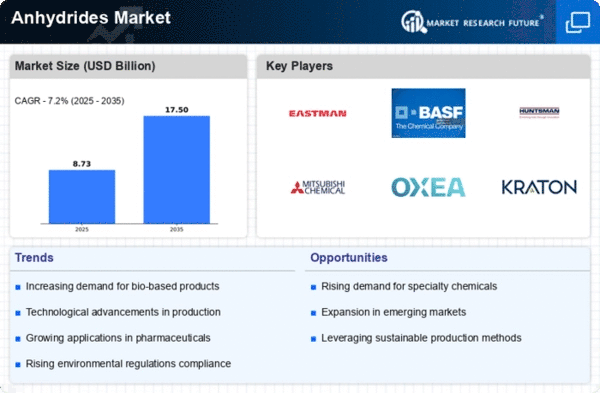
As per Market Research Future analysis, the Anhydrides Market Size was estimated at 8.14 USD Billion in 2024. The Anhydrides industry is projected to grow from USD 8.73 Billion in 2025 to USD 17.5 Billion by 2035, exhibiting a compound annual growth rate (CAGR) of 7.2% during the forecast period 2025 - 2035

Key Market Trends & Highlights

The Anhydrides Market is experiencing a dynamic shift towards sustainability and innovation, driven by diverse applications across various sectors.

  • Sustainable practices in production are increasingly shaping the Anhydrides Market, particularly in North America.
  • Technological innovations are enhancing production processes, contributing to efficiency and cost-effectiveness in the chemical synthesis segment.
  • Regulatory influences are prompting manufacturers to adopt safer chemical practices, especially in the pharmaceuticals sector.
  • Rising demand in chemical manufacturing and growth in adhesives and sealants are key drivers propelling market expansion in both North America and Asia-Pacific.

Market Size & Forecast

2024 Market Size 8.14 (USD Billion)
2035 Market Size 17.5 (USD Billion)
CAGR (2025 - 2035) 7.2%
Largest Regional Market Share in 2024 North America

Major Players

<p>Eastman Chemical Company (US), BASF SE (DE), Huntsman Corporation (US), Mitsubishi Chemical Corporation (JP), Oxea GmbH (DE), Kraton Corporation (US), DOW Inc. (US), SABIC (SA), Lanxess AG (DE)</p>

Market Trends

The Anhydrides Market is currently experiencing a dynamic phase characterized by evolving applications and increasing demand across various industries. This market encompasses a range of chemical compounds that are pivotal in the production of resins, plastics, and pharmaceuticals. The versatility of anhydrides, particularly in the synthesis of polyesters and other polymers, suggests a robust growth trajectory. Furthermore, the rising emphasis on sustainable practices and eco-friendly materials may drive innovation in the sector, as manufacturers seek to develop greener alternatives. As industries continue to expand globally, the Anhydrides Market appears poised for significant advancements, potentially reshaping supply chains and production methodologies. In addition to the growing applications, the Anhydrides Market is influenced by regulatory frameworks that govern chemical production and usage. These regulations may encourage the adoption of safer and more environmentally friendly processes, thereby impacting market dynamics. The interplay between technological advancements and regulatory compliance could lead to the emergence of novel anhydride formulations, enhancing their utility in various sectors. Overall, the Anhydrides Market is likely to witness transformative changes, driven by both consumer preferences and legislative pressures, which may redefine its landscape in the coming years.

Sustainable Practices in Production

The Anhydrides Market is increasingly leaning towards sustainable production methods. Manufacturers are exploring eco-friendly alternatives and processes that minimize environmental impact. This trend reflects a broader industry shift towards sustainability, as companies aim to meet consumer demand for greener products.

Technological Innovations

Advancements in technology are playing a crucial role in the Anhydrides Market. New production techniques and improved chemical processes are enhancing efficiency and reducing costs. These innovations may lead to the development of novel anhydride compounds, expanding their applications across various sectors.

Regulatory Influences

The Anhydrides Market is subject to evolving regulatory frameworks that govern chemical safety and environmental impact. These regulations may drive manufacturers to adopt safer practices and develop compliant products. As a result, the market landscape could shift significantly in response to these legislative changes.

Anhydrides Market Market Drivers

Expansion of End-Use Industries

The expansion of end-use industries, such as automotive, construction, and electronics, significantly influences the Global Anhydrides Market Industry. These sectors increasingly utilize anhydrides in the production of high-performance materials, coatings, and sealants. The automotive industry, in particular, is adopting lightweight materials to enhance fuel efficiency, leading to a higher demand for anhydride-based composites. This trend is expected to contribute to a compound annual growth rate of 4.61% from 2025 to 2035, indicating a sustained interest in anhydrides across various applications.

Growth in Pharmaceutical Applications

Pharmaceutical applications represent a critical driver for the Global Anhydrides Market Industry. Anhydrides Market are utilized in the synthesis of active pharmaceutical ingredients, enhancing the efficacy and stability of medications. The increasing prevalence of chronic diseases and the subsequent demand for innovative drug formulations contribute to this growth. As the pharmaceutical sector evolves, the need for high-quality anhydrides is likely to rise. This trend aligns with the overall market growth, which is anticipated to reach 11.0 USD Billion by 2035, showcasing the importance of anhydrides in the development of modern therapeutics.

Rising Demand in Chemical Manufacturing

The Global Anhydrides Market Industry experiences a notable surge in demand driven by the chemical manufacturing sector. Anhydrides Market serve as essential intermediates in the production of various chemicals, including plastics, resins, and adhesives. As industries increasingly focus on sustainable practices, the demand for eco-friendly alternatives has risen, further propelling the market. In 2024, the market is projected to reach 6.7 USD Billion, reflecting the growing reliance on anhydrides in diverse applications. This trend indicates a robust growth trajectory, with the market expected to expand significantly over the next decade.

Regulatory Support for Sustainable Chemicals

Regulatory support for sustainable chemicals plays a pivotal role in the Global Anhydrides Market Industry. Governments worldwide are implementing policies that encourage the use of environmentally friendly chemicals, including anhydrides. This regulatory landscape fosters innovation and investment in sustainable production methods, driving demand for anhydrides in various applications. As industries adapt to these regulations, the market is expected to benefit from increased adoption of anhydride-based products. This trend aligns with the broader movement towards sustainability, potentially enhancing the market's growth prospects in the coming years.

Technological Advancements in Production Processes

Technological advancements in production processes are reshaping the Global Anhydrides Market Industry. Innovations in synthesis methods, such as more efficient catalytic processes and greener production techniques, are enhancing the yield and purity of anhydrides. These advancements not only reduce production costs but also align with global sustainability goals. As manufacturers adopt these technologies, the market is likely to witness increased competitiveness and growth. The ongoing improvements in production efficiency may further support the market's expansion, as industries seek reliable and high-quality anhydride products.

Market Segment Insights

By Application: Chemical Synthesis (Largest) vs. Pharmaceuticals (Fastest-Growing)

<p>The Anhydrides Market is characterized by diverse applications, each contributing to the overall market dynamics. Among these, Chemical Synthesis holds the largest share, predominately utilized in various industrial processes, while Pharmaceuticals is emerging as the fastest-growing application. This trend is driven by increasing demand for advanced drug formulations that leverage anhydride compounds for enhanced therapeutic effects. Additionally, the Agricultural Chemicals segment is also significant, with a notable share attributed to its role in agrochemical products.</p>

<p>Pharmaceuticals (Dominant) vs. Agricultural Chemicals (Emerging)</p>

<p>The Pharmaceuticals segment of the Anhydrides Market stands out due to its critical role in drug development, where anhydrides serve as key intermediates in synthesizing active pharmaceutical ingredients (APIs). This segment is driven by heightened research and development in the healthcare sector, focusing on innovative treatments. Meanwhile, Agricultural Chemicals represent an emerging segment, gaining traction as agricultural practices evolve and the need for efficient crop protection solutions increases. Anhydrides play a versatile role in formulating herbicides, pesticides, and fertilizers, reflecting a growing shift towards sustainable agricultural practices. Overall, both segments exhibit unique dynamics that cater to changing market needs.</p>

By End Use: Automotive (Largest) vs. Construction (Fastest-Growing)

<p>The Anhydrides Market is primarily shaped by its end-use applications in automotive, construction, electronics, and textiles. The automotive segment holds the largest share as it significantly relies on various anhydrides for manufacturing processes, particularly for composite materials and coatings. Following automotive, the construction segment is also prominent, driven by the increasing use of anhydrides in adhesives and sealants. Electronics and textiles also play important roles, albeit at a smaller scale.</p>

<p>Automotive: Adhesives (Dominant) vs. Construction: Sealants (Emerging)</p>

<p>Within the automotive sector, anhydrides, particularly those used in adhesives, are crucial for enhancing vehicle performance and durability. This segment's dominance is attributed to the growing demand for lightweight materials in automotive manufacturing, which necessitates advanced adhesive solutions. Conversely, the construction sector's focus on sealants is rapidly emerging, driven by the uptick in construction activities and infrastructure development. Sealants infused with anhydrides offer superior adhesion and longevity, making them preferred choices in modern building applications, thus contributing to their swift growth in the market.</p>

By Type: Acetic Anhydride (Largest) vs. Phthalic Anhydride (Fastest-Growing)

<p>The Anhydrides Market showcases a diverse range of segment values, with Acetic Anhydride holding the largest market share due to its extensive applications in industrial settings. Phthalic Anhydride, on the other hand, is gaining traction rapidly, driven by the increasing demand for plastics and resins. The growth of these segments is influenced by various end-use industries, particularly in the production of chemicals and intermediates, which contribute significantly to the market dynamics.</p>

<p>Acetic Anhydride (Dominant) vs. Maleic Anhydride (Emerging)</p>

<p>Acetic Anhydride is recognized as the dominant player in the Anhydrides Market, primarily due to its pivotal role in synthesizing acetic acid and various acetate derivatives. Its expansive application in pharmaceuticals, agrochemicals, and textiles underscores its importance. Conversely, Maleic Anhydride is emerging as a significant contender, bolstered by the rise in demand for unsaturated polyester resins and plasticizers. The differentiation in their market positions reflects the diverse needs across sectors, with Acetic Anhydride leading in volume and Maleic Anhydride rapidly increasing its footprint through innovation and application-specific usage.</p>

By Form: Liquid (Largest) vs. Solid (Fastest-Growing)

<p>In the Anhydrides Market, the distribution of market share among the form segments is predominantly led by the liquid form, which accounts for the largest share. This is largely due to the widespread use of liquid anhydrides in various applications such as paints, coatings, plasticizers, and adhesives. Solid anhydrides, on the other hand, while currently holding a smaller market share, are gaining traction due to their applicability in specialized sectors including pharmaceuticals and electronics, which are driving demand.</p>

<p>Liquid (Dominant) vs. Solid (Emerging)</p>

<p>Liquid anhydrides are the dominant form in the market, primarily because of their versatility and ease of handling. They are utilized extensively in industries such as chemical manufacturing and automotive, where their properties serve essential roles in production processes. In contrast, solid anhydrides are emerging as a significant player, spurred by innovations in material science and increased demand for high-purity materials. Their stability and long shelf life make them attractive for industries requiring precise formulations, thus highlighting a growing segment that could reshape market dynamics in the future.</p>

By Distribution Channel: Direct Sales (Largest) vs. Online Sales (Fastest-Growing)

<p>In the Anhydrides Market, the distribution channel segment is primarily dominated by Direct Sales, which reflects a significant share of the market due to the direct relationship it fosters between manufacturers and customers. This channel allows for customized solutions and direct communication, making it a preferred choice among large-scale buyers. On the other hand, Online Sales is emerging as the fastest-growing segment, spurred by the increasing reliance on digital platforms for procurement. The convenience and accessibility offered by online channels are driving more customers towards this option, especially among smaller businesses and startups seeking cost-effective solutions.</p>

<p>Direct Sales (Dominant) vs. Distributors (Emerging)</p>

<p>Direct Sales have established themselves as the dominant distribution channel in the Anhydrides Market due to their ability to provide tailored customer experiences and maintain strong relationships with clients. This channel enables manufacturers to offer direct technical support and streamline logistics, further enhancing customer satisfaction. Meanwhile, Distributors are an emerging segment that facilitate wider market reach and ease of access to end-users. By leveraging established networks and logistical efficiencies, distributors help manufacturers penetrate new markets and customer segments. The strategic partnerships with manufacturers allow distributors to enhance their service offerings, making them an essential player in supplementing direct sales efforts and expanding overall market presence.</p>

Get more detailed insights about Anhydrides Market Research Report - Forecast to 2035

Regional Insights

North America : Market Leader in Anhydrides

North America is poised to maintain its leadership in the anhydrides market, holding a significant share of 3.5 in 2025. The region's growth is driven by robust demand from industries such as automotive, construction, and pharmaceuticals. Regulatory support for sustainable chemical production further enhances market dynamics, encouraging innovation and investment in eco-friendly processes. The increasing focus on reducing carbon footprints is also a catalyst for growth in this sector. The competitive landscape in North America is characterized by the presence of major players like Eastman Chemical Company, DOW Inc., and Huntsman Corporation. These companies are investing heavily in R&D to develop advanced anhydride products that meet evolving market needs. The U.S. remains the leading country, supported by a strong manufacturing base and favorable trade policies. This competitive environment fosters innovation and ensures a steady supply of high-quality anhydrides to meet growing demand.

Europe : Emerging Market with Potential

Europe's anhydrides market is projected to grow, with a market size of 2.5 in 2025. The region is witnessing increased demand for anhydrides in the production of resins, coatings, and adhesives, driven by the construction and automotive sectors. Regulatory frameworks promoting sustainable practices are also influencing market dynamics, encouraging the adoption of bio-based anhydrides. This shift is expected to enhance market growth and align with the EU's Green Deal objectives. Leading countries in Europe include Germany, France, and the UK, where key players like BASF SE and Oxea GmbH are actively involved. The competitive landscape is marked by innovation and strategic partnerships aimed at expanding product offerings. The presence of established chemical manufacturers ensures a robust supply chain, while ongoing investments in technology and sustainability initiatives position Europe as a promising market for anhydrides.

Asia-Pacific : Rapid Growth and Development

The Asia-Pacific region is emerging as a significant player in the anhydrides market, with a projected size of 1.8 in 2025. The growth is primarily driven by increasing industrialization and urbanization, particularly in countries like China and India. The demand for anhydrides in various applications, including plastics and textiles, is on the rise. Additionally, supportive government policies aimed at boosting the chemical industry are expected to further propel market growth in this region. China stands out as the leading country in the Asia-Pacific market, with major companies like Mitsubishi Chemical Corporation and Kraton Corporation investing in expanding their production capacities. The competitive landscape is evolving, with both local and international players vying for market share. This dynamic environment fosters innovation and ensures a diverse range of anhydride products to meet the growing demand across various sectors.

Middle East and Africa : Emerging Market with Challenges

The Middle East and Africa (MEA) region is gradually developing its anhydrides market, with a size of 0.34 in 2025. The growth is driven by increasing industrial activities and a rising demand for chemicals in various sectors, including construction and automotive. However, challenges such as limited infrastructure and regulatory hurdles may impede faster growth. Nevertheless, the region's rich natural resources present opportunities for investment and development in the chemical sector. Countries like South Africa and Saudi Arabia are leading the way in the MEA market, with key players such as SABIC and Lanxess AG establishing a strong presence. The competitive landscape is characterized by a mix of local and international companies, focusing on expanding their product portfolios. As the region continues to develop, strategic investments in infrastructure and technology will be crucial for unlocking the full potential of the anhydrides market.

Key Players and Competitive Insights

The Anhydrides Market is characterized by a competitive landscape that is increasingly shaped by innovation, sustainability, and strategic partnerships. Key players such as Eastman Chemical Company (US), BASF SE (DE), and DOW Inc. (US) are actively pursuing strategies that emphasize technological advancements and operational efficiencies. Eastman Chemical Company (US) has focused on expanding its product portfolio through innovation, particularly in sustainable anhydride solutions, which aligns with the growing demand for eco-friendly chemicals. Meanwhile, BASF SE (DE) has been enhancing its global footprint by investing in regional production facilities, thereby optimizing its supply chain and reducing lead times. DOW Inc. (US) appears to be leveraging digital transformation initiatives to streamline operations and improve customer engagement, which collectively shapes a competitive environment that is dynamic and responsive to market needs.

The business tactics employed by these companies reflect a moderately fragmented market structure, where localized manufacturing and supply chain optimization are pivotal. The influence of major players is significant, as they not only drive innovation but also set benchmarks for operational excellence. This competitive structure allows for a diverse range of products and services, catering to various industrial applications, while also fostering an environment where smaller players can thrive through niche offerings.

In November 2025, Eastman Chemical Company (US) announced the launch of a new line of bio-based anhydrides aimed at reducing carbon emissions in industrial applications. This strategic move underscores the company's commitment to sustainability and positions it favorably in a market increasingly driven by environmental considerations. The introduction of these products is likely to enhance Eastman's competitive edge, appealing to customers seeking greener alternatives.

In October 2025, BASF SE (DE) completed the acquisition of a regional competitor, which is expected to bolster its market share and enhance its production capabilities in Europe. This acquisition not only expands BASF's operational capacity but also allows for greater integration of its supply chain, potentially leading to cost efficiencies and improved service delivery. Such strategic actions indicate a proactive approach to consolidating market presence and responding to competitive pressures.

In September 2025, DOW Inc. (US) unveiled a new digital platform designed to optimize the distribution of its anhydride products. This platform aims to enhance customer experience by providing real-time tracking and improved order management. The strategic importance of this initiative lies in its potential to streamline operations and foster stronger customer relationships, which are crucial in a competitive landscape where service quality is paramount.

As of December 2025, the Anhydrides Market is witnessing trends that emphasize digitalization, sustainability, and the integration of AI technologies. Strategic alliances are increasingly shaping the competitive landscape, enabling companies to pool resources and expertise to drive innovation. The shift from price-based competition to a focus on technological advancements and supply chain reliability is evident, suggesting that future competitive differentiation will hinge on the ability to innovate and adapt to evolving market demands.

Key Companies in the Anhydrides Market market include

Industry Developments

In May 2021, The first phase of Ibn Sina Petrochemical Company in Mahshahr, Khuzestan Province, will be launched soon to complete the butane value chain. Using butane as feedstock, the plant will produce three essential products: maleic anhydride, isobutane, and normal butane.

In September 2020, AOC, a global resins and specialty materials supplier, revealed that it has successfully developed the maleic anhydride business and manufacturing facility in Neal, West Virginia, from Ashland Global Holdings. 

State Owned Indian Oil Corporation announced that it would invest Rs. 3681 crores to develop India's biggest Maleic Anhydride Plant for the manufacturing of valuable products at Panipat refinery.

Report Overview

The detailed study of the anhydrides market analysis states that it will proceed with a higher growth pace due to the presence of growth influencing factors like key drivers and opportunities. The limiting factors were also studied along with the pandemic's impact. The market segments were described with their sub-segments. The regional report states about the market's growth in different regions around the world. The industrial players' importance was stated, isobutane, and their developments were briefly noticed.

The overall report shows that the anhydrides market has shown a significant growth rate, and it is expected to maintain its consistency and obtain a massive CAGR value.

Key Industrial Segments

By Type

  • Acetic Anhydride
  • Maleic Anhydride
  • Isobutyric Anhydride
  • Propionic Anhydride
  • Phthalic Anhydride
  • Isatoic Acid Anhydride
  • Others

By Composition

  • Organic
  • Inorganic

By Application

  • Pesticides
  • Plasticizer
  • Dye & Pigments
  • Additives
  • Flavors
  • Others

By End-User Industry

  • Construction
  • Pharmaceutical
  • Automotive
  • Agrochemicals
  • Textiles
  • Food & Beverages
  • Other

Future Outlook

Anhydrides Market Future Outlook

<p>The Anhydrides Market is projected to grow at a 7.2% CAGR from 2024 to 2035, driven by increasing demand in chemical manufacturing and sustainable materials.</p>

New opportunities lie in:

  • <p>Expansion into bio-based anhydrides for eco-friendly applications.</p>
  • <p>Development of customized anhydride formulations for niche industries.</p>
  • <p>Investment in advanced production technologies to enhance efficiency.</p>

<p>By 2035, the Anhydrides Market is expected to achieve robust growth, positioning itself as a key player in the chemical sector.</p>

Market Segmentation

Anhydrides Market Form Outlook

  • Liquid
  • Solid
  • Gas

Anhydrides Market Type Outlook

  • Acetic Anhydride
  • Phthalic Anhydride
  • Maleic Anhydride
  • Succinic Anhydride

Anhydrides Market End Use Outlook

  • Automotive
  • Construction
  • Electronics
  • Textiles

Anhydrides Market Application Outlook

  • Chemical Synthesis
  • Polymer Production
  • Pharmaceuticals
  • Agricultural Chemicals

Anhydrides Market Distribution Channel Outlook

  • Direct Sales
  • Distributors
  • Online Sales

Report Scope

MARKET SIZE 20248.14(USD Billion)
MARKET SIZE 20258.73(USD Billion)
MARKET SIZE 203517.5(USD Billion)
COMPOUND ANNUAL GROWTH RATE (CAGR)7.2% (2024 - 2035)
REPORT COVERAGERevenue Forecast, Competitive Landscape, Growth Factors, and Trends
BASE YEAR2024
Market Forecast Period2025 - 2035
Historical Data2019 - 2024
Market Forecast UnitsUSD Billion
Key Companies ProfiledEastman Chemical Company (US), BASF SE (DE), Huntsman Corporation (US), Mitsubishi Chemical Corporation (JP), Oxea GmbH (DE), Kraton Corporation (US), DOW Inc. (US), SABIC (SA), Lanxess AG (DE)
Segments CoveredApplication, End Use, Type, Form, Distribution Channel
Key Market OpportunitiesGrowing demand for bio-based anhydrides in sustainable chemical applications presents a notable opportunity.
Key Market DynamicsRising demand for eco-friendly materials drives innovation and competition in the anhydrides market.
Countries CoveredNorth America, Europe, APAC, South America, MEA

FAQs

At what CAGR is the Anhydrides Market predicted to grow during the forecast period?

Anhydrides Market is predicted to grow at Substantial CAGR through forecast period of 2023-2035.

What is the forecast period of Anhydrides Market research report?

The forecast period for Anhydrides Market research report is 2023-2035.

Which region will lead the global Anhydrides Market?

Global Anhydrides Market is dominated by APAC region.

What are the key factors driving the Anhydrides Market?

Increasing demand from various industry such as agriculture, pharmaceuticals, and textile

Who are the key players in the Anhydrides Market?

Huntsman International LLC (US), LANXESS (Germany), BASF SE (Germany), Celanese Corporation (US), E. I. du Pont de Nemours and Company (US), Eastman Chemical Company (US), Solvay S.A. (Belgium), Akzo Nobel N.V (Netherlands), SABIC (Saudi Arabia), HaiShun Chemical Co. ltd.(China)

  1. Executive Summary
  2. Scope of The Report
    1. Market Definition
    2. Scope of The Study
      1. Research Objectives
      2. Assumptions & Limitations
    3. Markets Structure
  3. Market Research Methodology
    1. Research Process
    2. Secondary Research
    3. Primary Research
    4. Forecast Model
  4. Market Landscape
    1. Five Forces Analysis
      1. Threat of New Entrants
      2. Bargaining power of buyers
      3. Threat of substitutes
      4. Segment rivalry
    2. Value Chain/Supply Chain of Global Anhydrides Market
  5. Industry Overview of Global Anhydrides Market
    1. Introduction
    2. Growth Drivers
    3. Impact analysis
    4. Market Challenges
    5. Impact analysis
  6. Market Trends
    1. Introduction
    2. Growth Trends
    3. Impact analysis
  7. Global Anhydrides Market by Composition
    1. Introduction
    2. Insecticides
    3. Fungicides
  8. Global Anhydrides Market by Types
    1. Introduction
    2. Acetic Anhydride
    3. Maleic Anhydride
    4. Isobutyric Anhydride
    5. Propionic Anhydride
    6. Phthalic Anhydride
    7. Isatoic Acid Anhydride
    8. Others
  9. Global Anhydrides Market by Application
    1. Introduction
    2. Pesticides
    3. Plasticizer
    4. Dye & Pigments
    5. Additives
    6. Flavors
    7. Others
  10. Global Anhydrides Market by End User
    1. Introduction
    2. Construction
    3. Pharmaceutical
    4. Automotive
    5. Agrochemicals
    6. Textiles
    7. Food & Beverages
    8. Other
  11. Global Anhydrides Market by Region
    1. Introduction
    2. North America
      1. US
      2. Canada
    3. Europe
      1. Germany
      2. France
      3. Italy
      4. Spain
      5. UK
    4. Asia-Pacific
      1. China
      2. India
      3. Japan
      4. Australia
      5. New Zealand
      6. Rest of Asia-Pacific
    5. Middle East & Africa
      1. Turkey
      2. Israel
      3. North Africa
      4. GCC
      5. Rest of Middle East & Africa
    6. Latin America
      1. Brazil
      2. Argentina
      3. Rest of Latin America
  12. Company Landscape
  13. Company Profiles
    1. Huntsman International LLC
      1. Company Overview
      2. Product/Business Segment Overview
      3. Financial Updates
      4. Key Developments
    2. LANXESS
      1. Company Overview
      2. Product/Business Segment Overview
      3. Financial Updates
      4. Key Developments
    3. BASF SE
      1. Company Overview
      2. Product/Business Segment Overview
      3. Financial Updates
      4. Key Developments
    4. Celanese Corporation
      1. Company Overview
      2. Product/Business Segment Overview
      3. Financial Updates
      4. Key Developments
    5. E. I. du Pont de Nemours and Company
      1. Company Overview
      2. Product/Business Segment Overview
      3. Financial Updates
      4. Key Developments
    6. Eastman Chemical Company
      1. Company Overview
      2. Product/Business Segment Overview
      3. Financial Updates
      4. Key Developments
    7. Solvay S.A.
      1. Company Overview
      2. Product/Business Segment Overview
      3. Financial Updates
      4. Key Developments
    8. Akzo Nobel N.V
      1. Company Overview
      2. Product/Business Segment Overview
      3. Financial Updates
      4. Key Developments
    9. SABIC.
      1. Company Overview
      2. Product/Business Segment Overview
      3. Financial Updates
      4. Key Developments
    10. HaiShun Chemical Co. ltd.
      1. Company Overview
      2. Product/Business Segment Overview
      3. Financial Updates
      4. Key Developments
  14. Conclusion
  15. LIST OF TABLES
  16. World Population by Major Regions (2020-2027)
  17. Global Anhydrides Market: By Region, 2020-2027
  18. North America Anhydrides Market: By Country, 2020-2027
  19. Europe Anhydrides Market: By Country, 2020-2027
  20. Asia-Pacific Anhydrides Market: By Country, 2020-2027
  21. RoW Anhydrides Market: By Country, 2020-2027
  22. Global Anhydrides by Applications Market: By Regions, 2020-2027
  23. North America Anhydrides by Applications Market: By Country, 2020-2027
  24. Europe Anhydrides by Applications Market: By Country, 2020-2027
  25. Asia-Pacific Anhydrides by Applications Market: By Country, 2020-2027
  26. RoW Anhydrides by Applications Market: By Country, 2020-2027
  27. North America Anhydrides for End User Market: By Country, 2020-2027
  28. Europe Anhydrides for End User Market: By Country, 2020-2027
  29. Asia-Pacific Anhydrides for End User Market: By Country, 2020-2027
  30. RoW Anhydrides for End User Market: By Country, 2020-2027
  31. Global Anhydrides for End User Market: By Region, 2020-2027
  32. North America Anhydrides for End User Market: By Country, 2020-2027
  33. Europe Anhydrides for End User Market: By Country, 2020-2027
  34. Asia-Pacific Anhydrides for End User Market: By Country, 2020-2027
  35. RoW Anhydrides for End User Market: By Country, 2020-2027
  36. RoW Anhydrides for End User Market: By Country, 2020-2027
  37. Global Applications Market: By Region, 2020-2027
  38. Global End User Market: By Region, 2020-2027
  39. North America Anhydrides Market, By Country
  40. North America Anhydrides Market, By Applications
  41. North America Anhydrides Market, By End User
  42. Europe: Anhydrides Market, By Country
  43. Table28 Europe: Anhydrides Market, By Applications
  44. Table29 Europe: Anhydrides Market, By End User
  45. Table30 Asia-Pacific: Anhydrides Market, By Country
  46. Table31 Asia-Pacific: Anhydrides Market, By Applications
  47. Table32 Asia-Pacific: Anhydrides Market, By End User
  48. Table33 RoW: Anhydrides Market, By Country
  49. Table34 RoW Anhydrides Market, By Applications
  50. Table35 RoW: Anhydrides Market, By End User
  51. LIST OF FIGURES
  52. Global Anhydrides Market segmentation
  53. Forecast Methodology
  54. Five Forces Analysis of Global Anhydrides Market
  55. Value Chain of Global Anhydrides Market
  56. Share of Global Anhydrides Market in 2020, by country (in %)
  57. Global Anhydrides Market, 2020-2027,
  58. Sub-segments of End Users
  59. Global Anhydrides Market size by End User, 2020
  60. Share of Global Anhydrides Market by End User, 2020-2027
  61. Global Anhydrides Market size by Applications, 2020
  62. Share of Global Anhydrides Market by Applications, 2020-2027
    1. "

Anhydrides Market Segmentation

Market Segmentation Overview

  • Detailed segmentation data will be available in the full report
  • Comprehensive analysis by multiple parameters
  • Regional and country-level breakdowns
  • Market size forecasts by segment
Infographic

Free Sample Request

Kindly complete the form below to receive a free sample of this Report

Get Free Sample

Customer Strories

Compare Licence

×
Features License Type
Single User Multiuser License Enterprise User
Price $4,950 $5,950 $7,250
Maximum User Access Limit 1 User Upto 10 Users Unrestricted Access Throughout the Organization
Free Customization
Direct Access to Analyst
Deliverable Format
Platform Access
Discount on Next Purchase 10% 15% 15%
Printable Versions