


Market Trends
Introduction
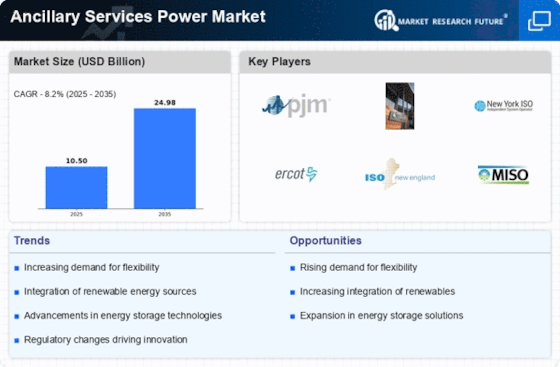
Ancillary services, power market. As we enter the year 2024, the ancillary services market is undergoing a major transformation. Technological innovations in the field of energy storage and grid management are radically reshaping operational efficiency, while the regulatory framework aimed at reducing CO2 emissions is forcing the ancillary services market to adapt its strategy. The shift in customer preferences towards renewable energy and decentralized energy solutions is also having an effect on the market. These trends are strategically significant for the various market participants as they navigate the complexities of a rapidly changing energy landscape. Hence a proactive approach is required to seize opportunities and minimize risks.
Top Trends
-
Increased Demand for Frequency Regulation
The growing share of wind power has increased the demand for frequency control services. In 2023, for example, the California Independent System Operator (CAISO) reported a 30% increase in frequency control services demand. The variability of solar and wind power has increased the demand for ancillary services. These services are provided by companies that are investing in batteries. This shows a move towards more flexible energy systems. -
Integration of Smart Grid Technologies
Achieving an efficient management of ancillary services requires the use of smart grids. The American Department of Energy has stated that an investment in smart grids could increase the reliability of the grid by 20 per cent. Leading companies are investing in smart metering and the analysis of real-time data to optimize the distribution of electricity. This will reduce the costs of operating the grid and speed up the response to disturbances. -
Regulatory Support for Ancillary Services
Governments are more and more aware of the importance of ancillary services in the field of energy transition. The European Union's package of measures for a sustainable energy system for all Europeans stresses the need for a strong framework for ancillary services. This regulatory support is a spur to investment in ancillary service markets, to innovation and competition between operators, which could lead to more efficient energy systems. -
Growth of Demand Response Programs
Demand-response programmes are gaining ground as a cost-effective ancillary service. In 2023 the FERC reported a 15% increase in demand-response participation across the country. These programmes allow consumers to reduce their electricity use during peak periods, thereby giving grid operators more flexibility. In future it is likely that more sophisticated incentive schemes will be introduced to increase participation. -
Expansion of Energy Storage Solutions
The energy storage systems are important for the improvement of the ancillary services. The International Energy Agency projects a 40 per cent increase in the world's battery storage capacity by 2023. Li-ion and other storage systems are being heavily invested in by companies in order to provide ancillary services such as load shifting and frequency regulation. This trend is expected to continue as the cost of storage falls and the technology improves. -
Decentralization of Energy Systems
The trend towards decentralized energy systems is reshaping the ancillary service landscape. Localized power generation such as roof-top solar is increasing the need for community-based ancillary services. According to a recent report by the International Energy Agency, by 2025, decentralized systems could provide up to 30% of ancillary services. This trend may lead to new business models and new alliances among local energy producers. -
Enhanced Cybersecurity Measures
In the field of ancillary services, the rise of digital technology has heightened the importance of cyber security. In 2023, the U.S. Cybersecurity and Infrastructure Security Agency recorded a 50% increase in cyber attacks against energy infrastructure. These attacks rely on the weakest link in the energy chain: the consumer. Without a high degree of trust in the energy market, it would be impossible to ensure the stability and security of supply. -
Collaboration Between Utilities and Tech Firms
In Ancillary Services, the joint venture between the electricity companies and the technological companies is the driving force of innovation. One can thus see, for example, the fruit of the collaboration between a great electricity company and a technological start-up, the emergence of an artificial intelligence platform for real-time grid management. These collaborations are expected to increase operational efficiency, reduce costs, and lead to more responsive and agile energy systems. -
Focus on Environmental Sustainability
In the ancillary services market, the issue of sustainability is increasingly becoming a key driver. It is now more important than ever that businesses align their operations with the environment, as a number of the major electricity suppliers have pledged to achieve zero emissions by 2050. The focus on cleaner practices and new, sustainable solutions is likely to lead to the development of a new ancillary services market. -
Emergence of Virtual Power Plants
Virtual Power Plants are becoming a significant player in the ancillary services market. VPPs can aggregate distributed energy resources to provide ancillary services more efficiently. A recent study found that VPPs could save up to 20 percent compared to a traditional power plant. This trend will continue as more distributed energy resources come on line, enabling the grid to be more flexible and resilient.
Conclusion: Navigating the Ancillary Services Landscape
The ancillary services power market in 2024 is characterised by a highly competitive environment with considerable fragmentation, as both legacy and new entrants compete for market share. There are clear trends towards greater focus on flexibility and sustainability as operators and regulators respond to changing demands and framework conditions. In this new market, the established players are able to exploit their established physical assets, while integrating advanced capabilities such as artificial intelligence and automation to enhance their operational efficiency. But the new entrants are focusing on new, sustainable and flexible solutions and positioning themselves as agile competitors. As the market develops, the ability to harness artificial intelligence, to implement automation and to offer flexible solutions will be key for the vendors who want to establish themselves as leaders in the rapidly changing environment.
























Leave a Comment