


Ancillary Services Power Size
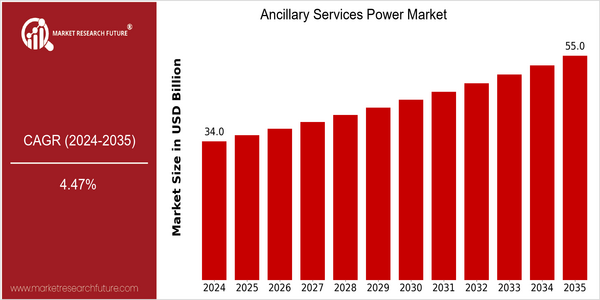
Market Size Snapshot
| Year | Value |
|---|---|
| 2024 | USD 33.99 Billion |
| 2035 | USD 55.0 Billion |
| CAGR (2025-2035) | 4.47 % |
Note – Market size depicts the revenue generated over the financial year
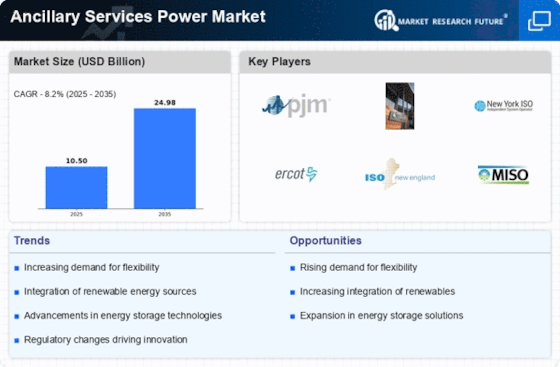
The Ancillary Services Market is expected to reach a market size of $33.94 billion by 2024, and is expected to reach $57.4 billion by 2035. This represents a CAGR of 4.47% between 2025 and 2035. This shows that the demand for ancillary services that support the stability and reliability of the power system is still growing. The need to modernize the grid and the integration of renewable energy sources are the main driving forces of this market. The need for ancillary services such as frequency regulation, voltage support and reserve capacity is growing. The major players in this field, such as Siemens, GE and ABB, are constantly investing in new technology and forming strategic alliances to strengthen their service offerings. Recent strategic alliances aimed at developing advanced energy storage solutions and smart grids are expected to further increase the growth of the market and make these companies the leaders of the ancillary services industry.
Regional Market Size
Regional Deep Dive
Ancillary Services Market is experiencing a rapid growth in all regions, driven by increasing integration of renewable energy sources, technological advancements in the grid, and the evolution of regulatory frameworks. Each region has its own characteristics, influenced by local energy demand, grid availability and government policies to increase grid reliability and efficiency. The Ancillary Services Market is expected to play a crucial role in the energy transition to a more sustainable future.
Europe
- The European Union's Clean Energy for All Europeans package aims to enhance the role of ancillary services in supporting the transition to a low-carbon energy system, with specific regulations promoting demand response and energy storage solutions.
- Countries like Germany and Denmark are leading in the deployment of innovative technologies such as virtual power plants, which aggregate distributed energy resources to provide ancillary services, thereby improving grid reliability and efficiency.
Asia Pacific
- China's rapid expansion of renewable energy capacity has led to significant investments in ancillary services, with the State Grid Corporation of China developing advanced energy management systems to optimize grid operations and enhance stability.
- The Australian National Energy Market is undergoing a major transformation to facilitate the integration of renewable energy, with the Australian Energy Market Operator (AEMO) promoting the use of ancillary services such as frequency control to cope with the growing variability of wind and solar power.
Latin America
- Brazil's National Electric System Operator (ONS) is implementing new regulations to enhance the provision of ancillary services, particularly in response to the growing share of intermittent renewable energy sources like wind and solar.
- Chile's energy market is evolving with the introduction of ancillary services auctions, which aim to attract investment in technologies that can provide grid support, such as battery storage and demand response solutions.
North America
- Order 841 of the Federal Energy Regulatory Commission makes it possible for storage resources to participate in the wholesale electricity markets and thus makes the ancillary services market more flexible and responsive.
- The Independent System Operator of California has been in the forefront of integrating renewables, with the introduction of the Resource Adequacy Program, which incentivizes the development of ancillary services to support the growing share of wind and solar energy.
Middle East And Africa
- The United Arab Emirates is investing heavily in smart grids and energy storage. The Dubai Clean Energy Strategy 2050 aims to diversify the energy sources and increase the role of ancillary services in the grid.
- South Africa's Integrated Resource Plan emphasizes the need for ancillary services to support the integration of renewable energy, with the government encouraging private sector participation in the development of these services.
Did You Know?
“In the U.S., ancillary services can account for up to 20% of the total electricity market revenue, highlighting their critical role in maintaining grid stability and reliability.” — U.S. Energy Information Administration (EIA)
Segmental Market Size
The ancillary services power market plays a crucial role in ensuring the stability and reliability of the power grid. It is currently growing significantly, mainly due to the growing demand for the integration of wind and solar energy. In particular, it is driven by the increasing need for flexibility as the share of intermittent renewable energy increases, and by regulatory measures that encourage the provision of ancillary services to support the integration of these intermittent sources. Furthermore, technological progress in energy storage and demand response is increasing the importance of ancillary services. The market is now at the stage of a first deployment. Notable examples of advanced ancillary services programmes, such as those of the California Independent System Operation (CAISO), are available. Companies such as Tesla and Siemens are leading in the provision of these services with their energy storage solutions. These trends are being further driven by the push towards a greener energy system and the drive for a more sustainable economy. The evolution of ancillary services is also being shaped by technological developments such as artificial intelligence and blockchain, which are expected to make them more efficient and transparent.
Future Outlook
During the period from 2024 to 2035, the global ancillary services market is projected to reach $36.9 billion, growing at a CAGR of 4.31%. The growth will be fueled by the growing need for grid stability and security, which is being driven by the increasing penetration of renewable energy. Among the various ancillary services, the most important are frequency regulation, voltage support and reserve power. The need for ancillary services is growing as more and more intermittent sources of electricity, such as wind and solar, are being integrated into the grid. The development of smart grids and the deployment of energy storage systems are expected to play a key role in shaping the future of the ancillary services market. These innovations will enhance the responsiveness and responsiveness of ancillary services, which will help utilities to better manage the supply and demand of electricity. Also, supportive government regulations and policies aimed at encouraging the use of clean energy will drive market growth. In 2035, ancillary services are expected to account for a growing share of the total energy market. The frequency of use is expected to rise significantly, as the grid operators seek to optimize their operations in the increasingly complex energy environment.

























Leave a Comment