
Request Free Sample ×

Kindly complete the form below to receive a free sample of this Report

* Please use a valid business email

Leading companies partner with us for data-driven Insights

clients tt-cursor
Hero Background
English
Chinese
French
Japanese
Korean
German
Spanish

Ancillary Services Power Market Share

ID: MRFR/EnP/10593-HCR
128 Pages
Garvit Vyas
April 2026

Ancillary Services Power Market Research Report By Service Type (Frequency Regulation, Voltage Support, Reactive Power Supply, Black Start Services), By Technology (Energy Storage Systems, Demand Response, Smart Grids, Distributed Generation), By Market Application (Utilities, Independent System Operators, Electricity Retailers), By End Use Sector (Residential, Commercial, Industrial) and By Regional (North America, Europe, South America, Asia Pacific, Middle East and Africa) - Growth & Industry Forecast to 2035

Share:
Download PDF ×

We do not share your information with anyone. However, we may send you emails based on your report interest from time to time. You may contact us at any time to opt-out.

Ancillary Services Power Market Infographic
Purchase Options

Market Share

Introduction: Navigating the Competitive Landscape of Ancillary Services Power

The market for ancillary services for power plants is experiencing a new level of competition, driven by the rapid development of technology, regulatory changes, and increased customer demand for reliability and sustainability. IT companies, IT system suppliers, and power plant operators are vying for leadership by using technologically advanced differentiators such as artificial intelligence-based analytics, automation, IoT integration, and biometrics. These innovations not only increase efficiency, but also redefine the scope of the services offered, thereby increasing market share. Strategic trends are shifting towards green and smart grids, which can be tapped by early adopters. This is why understanding the strategic positioning of the market players is important for C-level managers and strategic planners to navigate the complex market.

Competitive Positioning

Full-Suite Integrators

These vendors provide comprehensive solutions that integrate various ancillary services for power markets.

Vendor Competitive Edge Solution Focus Regional Focus
NextEra Energy Leading in renewable energy integration Renewable energy and ancillary services North America
Enel SpA Strong global presence with diverse offerings Integrated energy solutions Europe, Latin America
Brookfield Renewable Partners Focus on sustainable energy investments Renewable energy generation North America, Europe
Exelon Corporation Expertise in nuclear and renewable energy Energy generation and management United States
Southern Company Diverse energy portfolio and innovation Energy generation and distribution Southeastern United States
Duke Energy Strong utility infrastructure and customer focus Electric utility services Southeastern and Midwestern United States

Specialized Technology Vendors

These vendors focus on specific technologies that enhance ancillary services in the power market.

Vendor Competitive Edge Solution Focus Regional Focus
General Electric Innovative technology solutions for energy Power generation and grid solutions Global
ABB Ltd Leader in automation and electrification Grid automation and control systems Global
Schneider Electric Expertise in energy management and efficiency Energy management solutions Global
Siemens AG Strong focus on digitalization in energy Smart grid and energy solutions Global
Iberdrola Commitment to renewable energy sources Renewable energy and smart grids Europe, Americas

Infrastructure & Equipment Providers

These vendors supply essential infrastructure and equipment for ancillary services in the power market.

Vendor Competitive Edge Solution Focus Regional Focus
RWE AG Strong focus on renewable energy transition Energy generation and infrastructure Europe
Vestas Wind Systems Leading wind turbine manufacturer Wind energy solutions Global
FirstEnergy Corporation Robust utility infrastructure and services Electric utility services Northeastern United States
Eaton Corporation Innovative power management solutions Power management and distribution Global

Emerging Players & Regional Champions

  • Voltus (US): Demand-response solutions and energy management, recently won contracts with several electricity suppliers to supply ancillary services at peak times, challenging the established suppliers with a flexible and scalable solution that makes use of IoT technology.
  • The UK's GridBeyond focuses on energy management and demand-side response. It has recently started a large-scale project with a UK utility to improve grid stability. It complements traditional ancillary service suppliers by integrating big data and machine learning into ancillary services.
  • Enel X (Italy): Offers ancillary services, demand response, and energy storage, recently expanded its presence in Europe with new contracts in Spain and France, is establishing itself as a regional champion by deploying its extensive customer base and technological innovation.
  • SONNEN (Germany): The manufacturer of household batteries has recently started a virtual power plant, which bundles home batteries to provide ancillary services. This new business model, which uses decentralized energy sources to offer grid services, thereby destabilizing the existing utility business model.

Regional Trends: In 2024, a marked regional trend of the increased use of demand-side management and storage solutions, based on regulatory support and the need for grid resilience, can be observed. The specialization of technology is shifting towards artificial intelligence and machine learning applications for energy management, with a growing focus on decentralized energy resources and virtual power plants.

Collaborations & M&A Movements

  • Siemens and Enel X entered a partnership to develop smart grid solutions aimed at enhancing energy efficiency in urban areas, positioning themselves as leaders in the growing ancillary services market.
  • NextEra Energy acquired a minority stake in a renewable energy storage startup to bolster its ancillary services offerings, enhancing its competitive positioning in the renewable energy sector.
  • Schneider Electric and Duke Energy collaborated to implement advanced demand response programs, aiming to optimize energy consumption and improve grid reliability amidst increasing regulatory pressures for sustainability.

Competitive Summary Table

Capability Leading Players Remarks
Biometric Self-Boarding Clear, SITA Having already implemented the biometric self-boarding at several US airports, Clear has improved passenger flow and reduced waiting times. SITA's Smart Path solution has also been adopted at various international airports, demonstrating its scalability and ability to be integrated with existing systems.
AI-Powered Ops Mgmt Amadeus, IBM Amadeus leverages AI for operational efficiency, with case studies showing reduced delays and optimized resource allocation. IBM's Watson is utilized in predictive maintenance, improving service reliability and reducing downtime.
Border Control Gemalto, Vision-Box In several countries, Gemalto's border control solutions are already in use, and they improve both security and speed of service. In some major airports, the Vision-Box system has already proved its worth in managing the flow of passengers.
Sustainability Airbus, Boeing Airbus is leading with its A320neo family, which offers significant fuel efficiency and lower emissions. Boeing's ecoDemonstrator program showcases innovative technologies aimed at reducing environmental impact, with successful trials reported.
Passenger Experience Delta Air Lines, Singapore Airlines In the course of time, Delta has become a major player in the world of telecommunications. Its app and in-flight services have made it one of the most popular carriers in the world. And in the same way, Singapore Airlines, whose cabins are famous for their elegance and innovation, is always ranked among the best in customer satisfaction studies.

Conclusion: Navigating the Ancillary Services Landscape

The Ancillary Services Power Market in 2024 is characterized by a highly competitive environment and a significant fragmentation, with the presence of both old and new players. The main regional trends show a growing emphasis on flexibility and sustainability, as utilities and service companies adapt to changing regulatory frameworks and customer requirements. The most important players are integrating advanced digital and automation solutions to improve their operational efficiency. Emerging players are focusing on the development of new solutions, focusing on sustainability and flexibility, positioning themselves as agile competitors. As the market develops, the ability to use artificial intelligence, to implement automation and to offer flexible solutions will be essential for the leaders of the market.


Author
Author Profile
Garvit Vyas
Vice President - Operations

Garvit Vyas is a Research Analyst with experience in working across multiple industry domains in the market research sector. Over the past four years, he has been actively involved in analyzing diverse markets, gathering industry insights, and contributing to the development of comprehensive research reports. His work includes studying market trends, evaluating competitive landscapes, and supporting data-driven business insights. In the early phase of his career, Garvit worked on cross-domain research projects, which helped him build a strong foundation in market analysis, data interpretation, and industry intelligence across various sectors. Later, he transitioned into the Quality Control (QC) function, where he focuses on reviewing and refining research reports and marketing collaterals to ensure accuracy, consistency, and high editorial standards. His responsibilities include validating research data, improving report structure, and maintaining the overall quality of published content. Garvit is committed to maintaining strong research integrity and delivering reliable insights that support informed business decision-making.

Leave a Comment

FAQs

What is the projected market valuation of the Ancillary Services Power Market by 2035?

<p>The projected market valuation of the Ancillary Services Power Market is expected to reach 24.98 USD Billion by 2035.</p>

What was the market valuation of the Ancillary Services Power Market in 2024?

<p>The overall market valuation of the Ancillary Services Power Market was 10.5 USD Billion in 2024.</p>

What is the expected CAGR for the Ancillary Services Power Market during the forecast period 2025 - 2035?

<p>The expected CAGR for the Ancillary Services Power Market during the forecast period 2025 - 2035 is 8.2%.</p>

Which service type segment is projected to have the highest valuation by 2035?

<p>The Frequency Regulation service type segment is projected to reach a valuation of 7.5 USD Billion by 2035.</p>

What are the key players in the Ancillary Services Power Market?

<p>Key players in the Ancillary Services Power Market include PJM Interconnection, California Independent System Operator, and E.ON among others.</p>

How does the valuation of Energy Storage Systems compare to other technology segments by 2035?

<p>Energy Storage Systems are projected to reach a valuation of 5.0 USD Billion by 2035, indicating strong growth compared to other technology segments.</p>

What is the projected valuation for the Industrial end-use sector by 2035?

<p>The Industrial end-use sector is projected to reach a valuation of 12.98 USD Billion by 2035.</p>

Which market application segment is expected to have the highest valuation by 2035?

<p>Electricity Retailers are expected to have the highest valuation among market application segments, projected at 12.48 USD Billion by 2035.</p>

What is the projected valuation for the Reactive Power Supply service type by 2035?

<p>The Reactive Power Supply service type is projected to reach a valuation of 5.5 USD Billion by 2035.</p>

How does the projected growth of the Ancillary Services Power Market reflect on the demand for smart grids?

<p>The Smart Grids technology segment is projected to reach a valuation of 7.0 USD Billion by 2035, reflecting increasing demand in the Ancillary Services Power Market.</p>

Market Summary

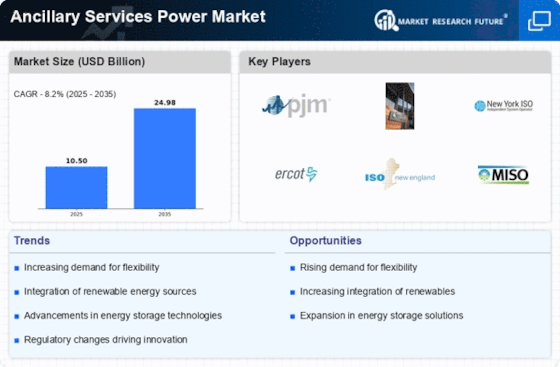
As per Market Research Future analysis, the Ancillary Services Power Market Size was estimated at 10.5 USD Billion in 2024. The Ancillary Services Power industry is projected to grow from 11.36 USD Billion in 2025 to 24.98 USD Billion by 2035, exhibiting a compound annual growth rate (CAGR) of 8% during the forecast period 2025 - 2035

Key Market Trends & Highlights

The Ancillary Services Power Market is experiencing robust growth driven by technological advancements and regulatory support.

  • The integration of renewable energy sources is reshaping the landscape of ancillary services, particularly in North America. Technological advancements in energy management are enhancing the efficiency of frequency regulation services, which remains the largest segment. Regulatory changes and policy support are fostering rapid growth in voltage support services, especially in the Asia-Pacific region. Growing demand for grid stability and increased investment in energy storage solutions are key drivers propelling market expansion.

Market Size & Forecast

2024 Market Size 10.5 (USD Billion)
2035 Market Size 24.98 (USD Billion)
CAGR (2025 - 2035) 8.2%
Largest Regional Market Share in 2024 North America

Major Players

PJM Interconnection (US), <a href="https://www.caiso.com/market-operations/products-services/ancillary-services">California Independent System Operator</a> (US), New York Independent System Operator (US), <a href="https://www.ercot.com/gridmktinfo/dashboards/ancillaryservices">Electric Reliability Council of Texas</a> (US), ISO New England (US), Midcontinent Independent System Operator (US), Southwest Power Pool (US), National Grid (GB), E.ON (DE), Engie (FR)

Market Trends

The Ancillary Services Power Market is currently experiencing a transformative phase, driven by the increasing demand for reliable and efficient energy systems. As the global energy landscape evolves, the need for ancillary services, which support the stability and reliability of the power grid, becomes more pronounced. This market encompasses a range of services, including frequency regulation, voltage support, and reserve power, all of which are essential for maintaining the balance between supply and demand. The integration of renewable energy sources further complicates this balance, necessitating advanced ancillary services to manage variability and ensure grid resilience. In addition, technological advancements are reshaping the Ancillary Services Power Market. Innovations in energy storage, smart grid technologies, and demand response mechanisms are enhancing the capabilities of ancillary services. These developments not only improve operational efficiency but also facilitate the transition towards a more sustainable energy future. Stakeholders in this market are increasingly focusing on optimizing service delivery and enhancing the overall reliability of power systems. As the landscape continues to evolve, the Ancillary Services Power Market is poised for growth, driven by the dual imperatives of reliability and sustainability.

Integration of Renewable Energy Sources

The growing incorporation of renewable energy sources into the power grid is reshaping the Ancillary Services Power Market. This trend necessitates enhanced ancillary services to manage the inherent variability and unpredictability associated with renewable generation. As more wind and solar power come online, the demand for services that can quickly respond to fluctuations in generation and consumption is likely to increase.

Technological Advancements in Energy Management

Recent innovations in energy management technologies are significantly impacting the Ancillary Services Power Market. Developments in smart grid systems, energy storage solutions, and demand response strategies are enabling more efficient and effective ancillary service provision. These technologies facilitate real-time monitoring and control, thereby enhancing grid stability and reliability.

Regulatory Changes and Policy Support

The regulatory environment surrounding the Ancillary Services Power Market is evolving, with many governments implementing policies that promote the development and integration of ancillary services. This trend indicates a growing recognition of the importance of ancillary services in achieving energy security and sustainability goals. As regulations become more supportive, market participants may find new opportunities for growth and innovation.

Ancillary Services Power Market Market Drivers

Growing Demand for Grid Stability

The increasing complexity of power systems, driven by the integration of renewable energy sources, has led to a heightened demand for grid stability. Ancillary Services Power Market plays a crucial role in maintaining this stability by providing essential services such as frequency regulation and voltage control. As more intermittent renewable sources like wind and solar are added to the energy mix, the need for ancillary services becomes more pronounced. According to recent data, the ancillary services market is projected to grow at a compound annual growth rate of approximately 8% over the next five years. This growth is indicative of the industry's response to the challenges posed by fluctuating energy supply and demand, thereby ensuring a reliable and resilient power grid.

Technological Innovations in Grid Management

Technological advancements in grid management are significantly influencing the Ancillary Services Power Market. Innovations such as smart grid technologies and advanced analytics are enhancing the ability to monitor and manage power systems in real-time. These technologies facilitate better integration of renewable energy sources and improve the efficiency of ancillary services. For example, the deployment of artificial intelligence in grid operations can optimize the dispatch of ancillary services, leading to cost savings and improved reliability. The market for smart grid technologies is anticipated to grow substantially, with estimates suggesting a market size of over 100 billion dollars by 2026. This growth underscores the critical role of technology in shaping the future of ancillary services.

Regulatory Support for Clean Energy Initiatives

Regulatory frameworks are evolving to support clean energy initiatives, which in turn bolster the Ancillary Services Power Market. Governments are increasingly implementing policies that promote the use of renewable energy and the associated ancillary services required to support these technologies. For instance, mandates for renewable portfolio standards and incentives for energy efficiency are driving demand for ancillary services. As a result, the ancillary services market is expected to expand, with projections indicating a potential increase in market size by 15% over the next decade. This regulatory support not only encourages investment in ancillary services but also aligns with broader sustainability goals, fostering a cleaner energy future.

Rising Consumer Participation in Energy Markets

The shift towards decentralized energy systems is fostering greater consumer participation in the Ancillary Services Power Market. As consumers become more engaged in energy production and consumption, they are increasingly capable of providing ancillary services, such as demand response. This trend is supported by advancements in technology that enable consumers to manage their energy use more effectively. Recent data indicates that demand response programs could contribute to a reduction in peak demand by up to 10%, thereby enhancing grid stability. The growing involvement of consumers not only diversifies the sources of ancillary services but also empowers individuals to play a proactive role in the energy landscape, potentially reshaping market dynamics.

Increased Investment in Energy Storage Solutions

The rise of energy storage technologies is transforming the Ancillary Services Power Market. Energy storage systems, such as batteries, are increasingly being deployed to provide ancillary services, including load shifting and frequency regulation. These systems can store excess energy generated during low demand periods and release it during peak demand, thus enhancing grid reliability. Recent estimates suggest that the energy storage market could reach a valuation of over 200 billion dollars by 2030, with ancillary services being a significant contributor to this growth. The ability of storage solutions to respond quickly to grid needs positions them as vital assets in the ancillary services landscape, potentially reshaping how power systems operate.

Market Segment Insights

By Service Type: Frequency Regulation (Largest) vs. Voltage Support (Fastest-Growing)

In the Ancillary Services Power Market, Frequency Regulation holds the largest market share, primarily due to its critical role in maintaining the stability and reliability of the electrical grid. This service ensures that the supply and demand of electricity are balanced, thereby preventing outages and disruptions. Voltage Support follows as a rapidly growing segment, highlighting an increasing focus on grid management and the integration of renewable energy sources that require enhanced voltage support mechanisms to stabilize their variable outputs.

Frequency Regulation (Dominant) vs. Voltage Support (Emerging)

Frequency Regulation is recognized as a dominant segment in the Ancillary Services Power Market, characterized by its essential function in preserving the operational integrity of power systems. This service employs various technologies and methodologies to adjust the power output and maintain the system's frequency within specified limits. Conversely, Voltage Support stands out as an emerging segment, driven by the increasing penetration of renewable energy systems, which necessitate advanced measures to manage voltage fluctuations. While Frequency Regulation benefits from established technologies, Voltage Support is gaining momentum through innovative solutions such as battery storage and flexible generation resources, which cater to the dynamic needs of modern grids.

By Technology: Energy Storage Systems (Largest) vs. Demand Response (Fastest-Growing)

The ancillary services power market has seen a significant distribution in market share among its key technology segments, namely, Energy Storage Systems, Demand Response, Smart Grids, and Distributed Generation. Energy Storage Systems lead the market, driven by their ability to balance supply and demand, provide frequency regulation, and enhance overall grid reliability. Following closely, Demand Response segments exhibit robust growth as utilities and consumers increasingly seek to optimize energy use and reduce peak loads through incentive programs and real-time adjustments in consumption patterns.

Technology: Energy Storage Systems (Dominant) vs. Demand Response (Emerging)

Energy Storage Systems are positioned as the dominant technology within the Ancillary Services Power Market, offering unparalleled advantages such as grid stability and integration of renewable energies. These systems serve as a crucial link, facilitating the effective use of intermittent resources like solar and wind. In contrast, Demand Response represents an emerging technology with strong growth potential, driven by advancements in communication technologies and consumer engagement strategies. This segment empowers consumers to participate actively in energy management by adjusting their consumption in response to real-time signals from utilities, ultimately contributing to energy efficiency and system reliability.

By Market Application: Utilities (Largest) vs. Independent System Operators (Fastest-Growing)

In the Ancillary Services Power Market, the 'Utilities' segment holds the largest market share, driven by the substantial demand for reliable energy supply and the necessity of grid stability. Utilities are pivotal in ensuring the efficient delivery of power and managing ancillary services, making them a dominant force in this sector. Meanwhile, Independent System Operators (ISOs) are emerging rapidly, focusing on promoting competition and enhancing grid reliability, which positions them favorably for future growth.

Utilities (Dominant) vs. Independent System Operators (Emerging)

Utilities are established players in the Ancillary Services Power Market, characterized by their extensive infrastructure and regulatory frameworks that support stable electricity provision. They typically engage in a variety of ancillary services, including frequency regulation and reserve services, ensuring operational efficiency and reliability. In contrast, Independent System Operators are gaining traction as they foster competitive markets for electric power, leading to significant innovations in service delivery. Their role in coordinating and overseeing electricity markets is becoming increasingly critical as the industry evolves, making them vital to the overall landscape of ancillary services.

By End Use Sector: Residential (Largest) vs. Commercial (Fastest-Growing)

The Ancillary Services Power Market is characterized by a distinct distribution among the end-use sectors. The residential sector is the largest segment, holding a significant share due to the increasing reliance on power supply for residential needs. Meanwhile, the commercial sector, although smaller in comparison, is the fastest-growing segment as businesses increasingly adopt ancillary services to ensure stable power supply and efficiency in operations. The industrial segment, while crucial, shows steady growth as its established infrastructure often relies on traditional energy sources. Analyzing growth trends, the residential sector's expansion can be attributed to evolving lifestyle preferences and the rising demand for smart home technologies that require reliable power storage and management solutions. Conversely, the commercial sector's rapid growth is driven by enhanced regulatory frameworks and corporate sustainability initiatives that necessitate advanced energy solutions. The industrial sector remains stable, primarily focusing on optimizing existing energy systems rather than adopting new ancillary service models.

Residential (Dominant) vs. Commercial (Emerging)

The residential segment stands out as the dominant force in the Ancillary Services Power Market. This segment emphasizes the importance of reliable power supply for everyday comfort, which has been amplified with the rise of home automation and electric vehicle charging solutions. Residential consumers are increasingly seeking ancillary services that not only guarantee power availability but also enhance energy efficiency and sustainability. On the other hand, the commercial sector represents an emerging segment characterized by rapid adaptation to new energy management technologies. Businesses are leveraging ancillary services to maximize energy efficiency, reduce costs, and meet regulatory compliance. As renewable energy integration grows, commercial entities are exploring innovative solutions that provide enhanced reliability and cost-effectiveness, positioning themselves as significant players in the evolving power landscape.

Get more detailed insights about Ancillary Services Power Market Research Report – Forecast till 2035

Regional Insights

North America : Leading Market Innovators

North America is the largest market for ancillary services, driven by a robust regulatory framework and increasing demand for grid reliability. The region holds approximately 60% of the global market share, with the United States being the primary contributor. Regulatory bodies like the Federal Energy Regulatory Commission (FERC) have implemented policies that encourage investment in ancillary services, enhancing grid stability and efficiency. The competitive landscape is characterized by key players such as PJM Interconnection, California Independent System Operator, and Electric Reliability Council of Texas. These organizations are pivotal in managing grid operations and ensuring the availability of ancillary services. The presence of advanced technologies and a focus on renewable energy integration further bolster the market, making North America a leader in ancillary services.

Europe : Regulatory Frameworks Driving Growth

Europe is witnessing significant growth in the ancillary services market, driven by the transition to renewable energy and stringent regulatory frameworks. The region accounts for approximately 25% of the global market share, with Germany and the UK being the largest contributors. The European Union's Clean Energy for All Europeans package has catalyzed investments in ancillary services, promoting grid flexibility and reliability. Leading countries like Germany, France, and the UK are at the forefront of this market, supported by key players such as National Grid and E.ON. The competitive landscape is evolving, with a focus on innovative solutions to manage grid stability amidst increasing renewable energy penetration. The integration of smart technologies and demand response programs is enhancing the efficiency of ancillary services across Europe.

Asia-Pacific : Rapid Growth and Investment

The Asia-Pacific region is rapidly emerging as a significant player in the ancillary services market, driven by increasing energy demand and investments in grid infrastructure. This region holds approximately 10% of the global market share, with China and India leading the charge. Government initiatives aimed at enhancing energy security and integrating renewable sources are key growth drivers, fostering a favorable regulatory environment for ancillary services. China is the largest market in the region, with substantial investments in smart grid technologies and energy storage solutions. India is also making strides, focusing on improving grid reliability and efficiency. The competitive landscape features local players and international firms collaborating to enhance service offerings, ensuring the region's growth in ancillary services continues to accelerate.

Middle East and Africa : Emerging Opportunities in Energy

The Middle East and Africa region is beginning to explore the ancillary services market, driven by increasing energy demands and the need for grid stability. This region currently holds about 5% of the global market share, with countries like South Africa and the UAE leading the way. Government initiatives aimed at diversifying energy sources and enhancing grid reliability are crucial for market development, creating opportunities for ancillary services to flourish. South Africa is focusing on renewable energy integration, while the UAE is investing in smart grid technologies. The competitive landscape is still developing, with local utilities and international players looking to establish a foothold in the market. As the region continues to invest in energy infrastructure, the ancillary services market is expected to grow significantly in the coming years.

Key Players and Competitive Insights

The Ancillary Services Power Market has been experiencing transformative changes, driven by the growing need for grid stability and reliability in the face of increasing renewable energy generation. This market encompasses a variety of services that support the transmission of electric power from producers to consumers while maintaining the reliability of the grid. In light of the global push towards decarbonization and renewable energy integration, ancillary services have emerged as critical components that facilitate the efficient operation of power systems.
Competitive insights within this domain reveal a landscape where companies seek to enhance their technological capabilities, optimize operational efficiencies, and establish strategic partnerships. Furthermore, innovation in energy storage, demand response, and advanced grid management solutions is pivotal for stakeholders aiming to gain a competitive edge in the market.
NextEra Energy has established a formidable presence in the Ancillary Services Power Market through its substantial investments in renewable energy and advanced grid technologies. The company leverages its extensive portfolio of wind and solar projects to provide ancillary services, thus ensuring the stability of power grids while meeting the rising demand for clean energy solutions. NextEra Energy’s strategic focus on innovation positions it as a leader, evidenced by its significant capabilities in energy storage and demand response mechanisms. By optimizing asset management and integrating advanced forecasting tools, the company enhances the reliability of ancillary services, thereby strengthening its market position.
As it continues to expand its operations, NextEra Energy remains committed to maintaining a competitive advantage through a robust emphasis on sustainability and technological advancement.
Enel SpA plays a crucial role in the Ancillary Services Power Market, characterized by its diversified energy portfolio and commitment to sustainable development. The company is renowned for integrating cutting-edge technologies into its operations, such as smart grids and advanced energy management systems, which optimize the delivery of ancillary services. Enel SpA’s strategic initiatives include mergers and acquisitions that enhance its market presence and capacity for innovation in the provision of ancillary services. Offering a comprehensive range of services, including frequency regulation, voltage control, and reserve power, the company adeptly positions itself to meet various grid needs across global markets.
Its proactive approach to digital transformation ensures efficient service delivery and enhances reliability, further solidifying its competitive standing in the ancillary services sector.

Key Companies in the Ancillary Services Power Market include

Industry Developments

Recent developments in the Ancillary Services Power Market have been marked by significant activities from key players like NextEra Energy, Enel SpA, and General Electric. In October 2023, Enel SpA announced its plans to expand its renewable energy offerings, which are expected to enhance its ancillary services capabilities. Meanwhile, Siemens AG has been investing heavily in digital solutions that complement its ancillary services, aiming to drive market growth. The valuation in the ancillary services sector has increased notably, with Brookfield Renewable Partners and RWE AG seeing strong growth due to their strategic initiatives in energy transition.

Additionally, a merger between Exelon Corporation and Southern Company is expected to bolster operational synergies in ancillary services, as announced in August 2023. In recent years, major happenings, such as Schneider Electric's partnership with Duke Energy in June 2022 to enhance grid reliability, have also impacted the market by promoting innovative solutions in ancillary services. These developments indicate a robust evolution within the Ancillary Services Power Market, demonstrating a focus on sustainability and technological advancement as key drivers of progress.

Future Outlook

Ancillary Services Power Market Future Outlook

The Ancillary Services Power Market is projected to grow at an 8.2% CAGR from 2025 to 2035, driven by increasing renewable energy integration, regulatory support, and technological advancements.

New opportunities lie in:

  • Development of advanced energy storage solutions for grid stability.
  • Implementation of demand response programs to optimize energy consumption.
  • Expansion of virtual power plants to enhance resource flexibility.

By 2035, the Ancillary Services Power Market is expected to be robust, driven by innovation and strategic investments.

Market Segmentation

Ancillary Services Power Market Technology Outlook

  • Energy Storage Systems
  • Demand Response
  • Smart Grids
  • Distributed Generation

Ancillary Services Power Market Service Type Outlook

  • Frequency Regulation
  • Voltage Support
  • Reactive Power Supply
  • Black Start Services

Ancillary Services Power Market End Use Sector Outlook

  • Residential
  • Commercial
  • Industrial

Ancillary Services Power Market Market Application Outlook

  • Utilities
  • Independent System Operators
  • Electricity Retailers

Report Scope

MARKET SIZE 2024 10.5(USD Billion)
MARKET SIZE 2025 11.36(USD Billion)
MARKET SIZE 2035 24.98(USD Billion)
COMPOUND ANNUAL GROWTH RATE (CAGR) 8.2% (2025 - 2035)
REPORT COVERAGE Revenue Forecast, Competitive Landscape, Growth Factors, and Trends
BASE YEAR 2024
Market Forecast Period 2025 - 2035
Historical Data 2019 - 2024
Market Forecast Units USD Billion
Key Companies Profiled PJM Interconnection (US), California Independent System Operator (US), New York Independent System Operator (US), Electric Reliability Council of Texas (US), ISO New England (US), Midcontinent Independent System Operator (US), Southwest Power Pool (US), National Grid (GB), E.ON (DE), Engie (FR)
Segments Covered Service Type, Technology, Market Application, End Use Sector, Regional
Key Market Opportunities Integration of advanced energy storage solutions enhances reliability in the Ancillary Services Power Market.
Key Market Dynamics Rising demand for grid stability drives innovation in ancillary services, enhancing reliability and efficiency in power systems.
Countries Covered North America, Europe, APAC, South America, MEA

FAQs

What is the projected market valuation of the Ancillary Services Power Market by 2035?

<p>The projected market valuation of the Ancillary Services Power Market is expected to reach 24.98 USD Billion by 2035.</p>

What was the market valuation of the Ancillary Services Power Market in 2024?

<p>The overall market valuation of the Ancillary Services Power Market was 10.5 USD Billion in 2024.</p>

What is the expected CAGR for the Ancillary Services Power Market during the forecast period 2025 - 2035?

<p>The expected CAGR for the Ancillary Services Power Market during the forecast period 2025 - 2035 is 8.2%.</p>

Which service type segment is projected to have the highest valuation by 2035?

<p>The Frequency Regulation service type segment is projected to reach a valuation of 7.5 USD Billion by 2035.</p>

What are the key players in the Ancillary Services Power Market?

<p>Key players in the Ancillary Services Power Market include PJM Interconnection, California Independent System Operator, and E.ON among others.</p>

How does the valuation of Energy Storage Systems compare to other technology segments by 2035?

<p>Energy Storage Systems are projected to reach a valuation of 5.0 USD Billion by 2035, indicating strong growth compared to other technology segments.</p>

What is the projected valuation for the Industrial end-use sector by 2035?

<p>The Industrial end-use sector is projected to reach a valuation of 12.98 USD Billion by 2035.</p>

Which market application segment is expected to have the highest valuation by 2035?

<p>Electricity Retailers are expected to have the highest valuation among market application segments, projected at 12.48 USD Billion by 2035.</p>

What is the projected valuation for the Reactive Power Supply service type by 2035?

<p>The Reactive Power Supply service type is projected to reach a valuation of 5.5 USD Billion by 2035.</p>

How does the projected growth of the Ancillary Services Power Market reflect on the demand for smart grids?

<p>The Smart Grids technology segment is projected to reach a valuation of 7.0 USD Billion by 2035, reflecting increasing demand in the Ancillary Services Power Market.</p>

  1. SECTION I: EXECUTIVE SUMMARY AND KEY HIGHLIGHTS
    1. | 1.1 EXECUTIVE SUMMARY
    2. | | 1.1.1 Market Overview
    3. | | 1.1.2 Key Findings
    4. | | 1.1.3 Market Segmentation
    5. | | 1.1.4 Competitive Landscape
    6. | | 1.1.5 Challenges and Opportunities
    7. | | 1.1.6 Future Outlook
  2. SECTION II: SCOPING, METHODOLOGY AND MARKET STRUCTURE
    1. | 2.1 MARKET INTRODUCTION
    2. | | 2.1.1 Definition
    3. | | 2.1.2 Scope of the study
    4. | | | 2.1.2.1 Research Objective
    5. | | | 2.1.2.2 Assumption
    6. | | | 2.1.2.3 Limitations
    7. | 2.2 RESEARCH METHODOLOGY
    8. | | 2.2.1 Overview
    9. | | 2.2.2 Data Mining
    10. | | 2.2.3 Secondary Research
    11. | | 2.2.4 Primary Research
    12. | | | 2.2.4.1 Primary Interviews and Information Gathering Process
    13. | | | 2.2.4.2 Breakdown of Primary Respondents
    14. | | 2.2.5 Forecasting Model
    15. | | 2.2.6 Market Size Estimation
    16. | | | 2.2.6.1 Bottom-Up Approach
    17. | | | 2.2.6.2 Top-Down Approach
    18. | | 2.2.7 Data Triangulation
    19. | | 2.2.8 Validation
  3. SECTION III: QUALITATIVE ANALYSIS
    1. | 3.1 MARKET DYNAMICS
    2. | | 3.1.1 Overview
    3. | | 3.1.2 Drivers
    4. | | 3.1.3 Restraints
    5. | | 3.1.4 Opportunities
    6. | 3.2 MARKET FACTOR ANALYSIS
    7. | | 3.2.1 Value chain Analysis
    8. | | 3.2.2 Porter's Five Forces Analysis
    9. | | | 3.2.2.1 Bargaining Power of Suppliers
    10. | | | 3.2.2.2 Bargaining Power of Buyers
    11. | | | 3.2.2.3 Threat of New Entrants
    12. | | | 3.2.2.4 Threat of Substitutes
    13. | | | 3.2.2.5 Intensity of Rivalry
    14. | | 3.2.3 COVID-19 Impact Analysis
    15. | | | 3.2.3.1 Market Impact Analysis
    16. | | | 3.2.3.2 Regional Impact
    17. | | | 3.2.3.3 Opportunity and Threat Analysis
  4. SECTION IV: QUANTITATIVE ANALYSIS
    1. | 4.1 Energy & Power, BY Service Type (USD Billion)
    2. | | 4.1.1 Frequency Regulation
    3. | | 4.1.2 Voltage Support
    4. | | 4.1.3 Reactive Power Supply
    5. | | 4.1.4 Black Start Services
    6. | 4.2 Energy & Power, BY Technology (USD Billion)
    7. | | 4.2.1 Energy Storage Systems
    8. | | 4.2.2 Demand Response
    9. | | 4.2.3 Smart Grids
    10. | | 4.2.4 Distributed Generation
    11. | 4.3 Energy & Power, BY Market Application (USD Billion)
    12. | | 4.3.1 Utilities
    13. | | 4.3.2 Independent System Operators
    14. | | 4.3.3 Electricity Retailers
    15. | 4.4 Energy & Power, BY End Use Sector (USD Billion)
    16. | | 4.4.1 Residential
    17. | | 4.4.2 Commercial
    18. | | 4.4.3 Industrial
    19. | 4.5 Energy & Power, BY Region (USD Billion)
    20. | | 4.5.1 North America
    21. | | | 4.5.1.1 US
    22. | | | 4.5.1.2 Canada
    23. | | 4.5.2 Europe
    24. | | | 4.5.2.1 Germany
    25. | | | 4.5.2.2 UK
    26. | | | 4.5.2.3 France
    27. | | | 4.5.2.4 Russia
    28. | | | 4.5.2.5 Italy
    29. | | | 4.5.2.6 Spain
    30. | | | 4.5.2.7 Rest of Europe
    31. | | 4.5.3 APAC
    32. | | | 4.5.3.1 China
    33. | | | 4.5.3.2 India
    34. | | | 4.5.3.3 Japan
    35. | | | 4.5.3.4 South Korea
    36. | | | 4.5.3.5 Malaysia
    37. | | | 4.5.3.6 Thailand
    38. | | | 4.5.3.7 Indonesia
    39. | | | 4.5.3.8 Rest of APAC
    40. | | 4.5.4 South America
    41. | | | 4.5.4.1 Brazil
    42. | | | 4.5.4.2 Mexico
    43. | | | 4.5.4.3 Argentina
    44. | | | 4.5.4.4 Rest of South America
    45. | | 4.5.5 MEA
    46. | | | 4.5.5.1 GCC Countries
    47. | | | 4.5.5.2 South Africa
    48. | | | 4.5.5.3 Rest of MEA
  5. SECTION V: COMPETITIVE ANALYSIS
    1. | 5.1 Competitive Landscape
    2. | | 5.1.1 Overview
    3. | | 5.1.2 Competitive Analysis
    4. | | 5.1.3 Market share Analysis
    5. | | 5.1.4 Major Growth Strategy in the Energy & Power
    6. | | 5.1.5 Competitive Benchmarking
    7. | | 5.1.6 Leading Players in Terms of Number of Developments in the Energy & Power
    8. | | 5.1.7 Key developments and growth strategies
    9. | | | 5.1.7.1 New Product Launch/Service Deployment
    10. | | | 5.1.7.2 Merger & Acquisitions
    11. | | | 5.1.7.3 Joint Ventures
    12. | | 5.1.8 Major Players Financial Matrix
    13. | | | 5.1.8.1 Sales and Operating Income
    14. | | | 5.1.8.2 Major Players R&D Expenditure. 2023
    15. | 5.2 Company Profiles
    16. | | 5.2.1 PJM Interconnection (US)
    17. | | | 5.2.1.1 Financial Overview
    18. | | | 5.2.1.2 Products Offered
    19. | | | 5.2.1.3 Key Developments
    20. | | | 5.2.1.4 SWOT Analysis
    21. | | | 5.2.1.5 Key Strategies
    22. | | 5.2.2 California Independent System Operator (US)
    23. | | | 5.2.2.1 Financial Overview
    24. | | | 5.2.2.2 Products Offered
    25. | | | 5.2.2.3 Key Developments
    26. | | | 5.2.2.4 SWOT Analysis
    27. | | | 5.2.2.5 Key Strategies
    28. | | 5.2.3 New York Independent System Operator (US)
    29. | | | 5.2.3.1 Financial Overview
    30. | | | 5.2.3.2 Products Offered
    31. | | | 5.2.3.3 Key Developments
    32. | | | 5.2.3.4 SWOT Analysis
    33. | | | 5.2.3.5 Key Strategies
    34. | | 5.2.4 Electric Reliability Council of Texas (US)
    35. | | | 5.2.4.1 Financial Overview
    36. | | | 5.2.4.2 Products Offered
    37. | | | 5.2.4.3 Key Developments
    38. | | | 5.2.4.4 SWOT Analysis
    39. | | | 5.2.4.5 Key Strategies
    40. | | 5.2.5 ISO New England (US)
    41. | | | 5.2.5.1 Financial Overview
    42. | | | 5.2.5.2 Products Offered
    43. | | | 5.2.5.3 Key Developments
    44. | | | 5.2.5.4 SWOT Analysis
    45. | | | 5.2.5.5 Key Strategies
    46. | | 5.2.6 Midcontinent Independent System Operator (US)
    47. | | | 5.2.6.1 Financial Overview
    48. | | | 5.2.6.2 Products Offered
    49. | | | 5.2.6.3 Key Developments
    50. | | | 5.2.6.4 SWOT Analysis
    51. | | | 5.2.6.5 Key Strategies
    52. | | 5.2.7 Southwest Power Pool (US)
    53. | | | 5.2.7.1 Financial Overview
    54. | | | 5.2.7.2 Products Offered
    55. | | | 5.2.7.3 Key Developments
    56. | | | 5.2.7.4 SWOT Analysis
    57. | | | 5.2.7.5 Key Strategies
    58. | | 5.2.8 National Grid (GB)
    59. | | | 5.2.8.1 Financial Overview
    60. | | | 5.2.8.2 Products Offered
    61. | | | 5.2.8.3 Key Developments
    62. | | | 5.2.8.4 SWOT Analysis
    63. | | | 5.2.8.5 Key Strategies
    64. | | 5.2.9 E.ON (DE)
    65. | | | 5.2.9.1 Financial Overview
    66. | | | 5.2.9.2 Products Offered
    67. | | | 5.2.9.3 Key Developments
    68. | | | 5.2.9.4 SWOT Analysis
    69. | | | 5.2.9.5 Key Strategies
    70. | | 5.2.10 Engie (FR)
    71. | | | 5.2.10.1 Financial Overview
    72. | | | 5.2.10.2 Products Offered
    73. | | | 5.2.10.3 Key Developments
    74. | | | 5.2.10.4 SWOT Analysis
    75. | | | 5.2.10.5 Key Strategies
    76. | 5.3 Appendix
    77. | | 5.3.1 References
    78. | | 5.3.2 Related Reports
  6. LIST OF FIGURES
    1. | 6.1 MARKET SYNOPSIS
    2. | 6.2 NORTH AMERICA MARKET ANALYSIS
    3. | 6.3 US MARKET ANALYSIS BY SERVICE TYPE
    4. | 6.4 US MARKET ANALYSIS BY TECHNOLOGY
    5. | 6.5 US MARKET ANALYSIS BY MARKET APPLICATION
    6. | 6.6 US MARKET ANALYSIS BY END USE SECTOR
    7. | 6.7 CANADA MARKET ANALYSIS BY SERVICE TYPE
    8. | 6.8 CANADA MARKET ANALYSIS BY TECHNOLOGY
    9. | 6.9 CANADA MARKET ANALYSIS BY MARKET APPLICATION
    10. | 6.10 CANADA MARKET ANALYSIS BY END USE SECTOR
    11. | 6.11 EUROPE MARKET ANALYSIS
    12. | 6.12 GERMANY MARKET ANALYSIS BY SERVICE TYPE
    13. | 6.13 GERMANY MARKET ANALYSIS BY TECHNOLOGY
    14. | 6.14 GERMANY MARKET ANALYSIS BY MARKET APPLICATION
    15. | 6.15 GERMANY MARKET ANALYSIS BY END USE SECTOR
    16. | 6.16 UK MARKET ANALYSIS BY SERVICE TYPE
    17. | 6.17 UK MARKET ANALYSIS BY TECHNOLOGY
    18. | 6.18 UK MARKET ANALYSIS BY MARKET APPLICATION
    19. | 6.19 UK MARKET ANALYSIS BY END USE SECTOR
    20. | 6.20 FRANCE MARKET ANALYSIS BY SERVICE TYPE
    21. | 6.21 FRANCE MARKET ANALYSIS BY TECHNOLOGY
    22. | 6.22 FRANCE MARKET ANALYSIS BY MARKET APPLICATION
    23. | 6.23 FRANCE MARKET ANALYSIS BY END USE SECTOR
    24. | 6.24 RUSSIA MARKET ANALYSIS BY SERVICE TYPE
    25. | 6.25 RUSSIA MARKET ANALYSIS BY TECHNOLOGY
    26. | 6.26 RUSSIA MARKET ANALYSIS BY MARKET APPLICATION
    27. | 6.27 RUSSIA MARKET ANALYSIS BY END USE SECTOR
    28. | 6.28 ITALY MARKET ANALYSIS BY SERVICE TYPE
    29. | 6.29 ITALY MARKET ANALYSIS BY TECHNOLOGY
    30. | 6.30 ITALY MARKET ANALYSIS BY MARKET APPLICATION
    31. | 6.31 ITALY MARKET ANALYSIS BY END USE SECTOR
    32. | 6.32 SPAIN MARKET ANALYSIS BY SERVICE TYPE
    33. | 6.33 SPAIN MARKET ANALYSIS BY TECHNOLOGY
    34. | 6.34 SPAIN MARKET ANALYSIS BY MARKET APPLICATION
    35. | 6.35 SPAIN MARKET ANALYSIS BY END USE SECTOR
    36. | 6.36 REST OF EUROPE MARKET ANALYSIS BY SERVICE TYPE
    37. | 6.37 REST OF EUROPE MARKET ANALYSIS BY TECHNOLOGY
    38. | 6.38 REST OF EUROPE MARKET ANALYSIS BY MARKET APPLICATION
    39. | 6.39 REST OF EUROPE MARKET ANALYSIS BY END USE SECTOR
    40. | 6.40 APAC MARKET ANALYSIS
    41. | 6.41 CHINA MARKET ANALYSIS BY SERVICE TYPE
    42. | 6.42 CHINA MARKET ANALYSIS BY TECHNOLOGY
    43. | 6.43 CHINA MARKET ANALYSIS BY MARKET APPLICATION
    44. | 6.44 CHINA MARKET ANALYSIS BY END USE SECTOR
    45. | 6.45 INDIA MARKET ANALYSIS BY SERVICE TYPE
    46. | 6.46 INDIA MARKET ANALYSIS BY TECHNOLOGY
    47. | 6.47 INDIA MARKET ANALYSIS BY MARKET APPLICATION
    48. | 6.48 INDIA MARKET ANALYSIS BY END USE SECTOR
    49. | 6.49 JAPAN MARKET ANALYSIS BY SERVICE TYPE
    50. | 6.50 JAPAN MARKET ANALYSIS BY TECHNOLOGY
    51. | 6.51 JAPAN MARKET ANALYSIS BY MARKET APPLICATION
    52. | 6.52 JAPAN MARKET ANALYSIS BY END USE SECTOR
    53. | 6.53 SOUTH KOREA MARKET ANALYSIS BY SERVICE TYPE
    54. | 6.54 SOUTH KOREA MARKET ANALYSIS BY TECHNOLOGY
    55. | 6.55 SOUTH KOREA MARKET ANALYSIS BY MARKET APPLICATION
    56. | 6.56 SOUTH KOREA MARKET ANALYSIS BY END USE SECTOR
    57. | 6.57 MALAYSIA MARKET ANALYSIS BY SERVICE TYPE
    58. | 6.58 MALAYSIA MARKET ANALYSIS BY TECHNOLOGY
    59. | 6.59 MALAYSIA MARKET ANALYSIS BY MARKET APPLICATION
    60. | 6.60 MALAYSIA MARKET ANALYSIS BY END USE SECTOR
    61. | 6.61 THAILAND MARKET ANALYSIS BY SERVICE TYPE
    62. | 6.62 THAILAND MARKET ANALYSIS BY TECHNOLOGY
    63. | 6.63 THAILAND MARKET ANALYSIS BY MARKET APPLICATION
    64. | 6.64 THAILAND MARKET ANALYSIS BY END USE SECTOR
    65. | 6.65 INDONESIA MARKET ANALYSIS BY SERVICE TYPE
    66. | 6.66 INDONESIA MARKET ANALYSIS BY TECHNOLOGY
    67. | 6.67 INDONESIA MARKET ANALYSIS BY MARKET APPLICATION
    68. | 6.68 INDONESIA MARKET ANALYSIS BY END USE SECTOR
    69. | 6.69 REST OF APAC MARKET ANALYSIS BY SERVICE TYPE
    70. | 6.70 REST OF APAC MARKET ANALYSIS BY TECHNOLOGY
    71. | 6.71 REST OF APAC MARKET ANALYSIS BY MARKET APPLICATION
    72. | 6.72 REST OF APAC MARKET ANALYSIS BY END USE SECTOR
    73. | 6.73 SOUTH AMERICA MARKET ANALYSIS
    74. | 6.74 BRAZIL MARKET ANALYSIS BY SERVICE TYPE
    75. | 6.75 BRAZIL MARKET ANALYSIS BY TECHNOLOGY
    76. | 6.76 BRAZIL MARKET ANALYSIS BY MARKET APPLICATION
    77. | 6.77 BRAZIL MARKET ANALYSIS BY END USE SECTOR
    78. | 6.78 MEXICO MARKET ANALYSIS BY SERVICE TYPE
    79. | 6.79 MEXICO MARKET ANALYSIS BY TECHNOLOGY
    80. | 6.80 MEXICO MARKET ANALYSIS BY MARKET APPLICATION
    81. | 6.81 MEXICO MARKET ANALYSIS BY END USE SECTOR
    82. | 6.82 ARGENTINA MARKET ANALYSIS BY SERVICE TYPE
    83. | 6.83 ARGENTINA MARKET ANALYSIS BY TECHNOLOGY
    84. | 6.84 ARGENTINA MARKET ANALYSIS BY MARKET APPLICATION
    85. | 6.85 ARGENTINA MARKET ANALYSIS BY END USE SECTOR
    86. | 6.86 REST OF SOUTH AMERICA MARKET ANALYSIS BY SERVICE TYPE
    87. | 6.87 REST OF SOUTH AMERICA MARKET ANALYSIS BY TECHNOLOGY
    88. | 6.88 REST OF SOUTH AMERICA MARKET ANALYSIS BY MARKET APPLICATION
    89. | 6.89 REST OF SOUTH AMERICA MARKET ANALYSIS BY END USE SECTOR
    90. | 6.90 MEA MARKET ANALYSIS
    91. | 6.91 GCC COUNTRIES MARKET ANALYSIS BY SERVICE TYPE
    92. | 6.92 GCC COUNTRIES MARKET ANALYSIS BY TECHNOLOGY
    93. | 6.93 GCC COUNTRIES MARKET ANALYSIS BY MARKET APPLICATION
    94. | 6.94 GCC COUNTRIES MARKET ANALYSIS BY END USE SECTOR
    95. | 6.95 SOUTH AFRICA MARKET ANALYSIS BY SERVICE TYPE
    96. | 6.96 SOUTH AFRICA MARKET ANALYSIS BY TECHNOLOGY
    97. | 6.97 SOUTH AFRICA MARKET ANALYSIS BY MARKET APPLICATION
    98. | 6.98 SOUTH AFRICA MARKET ANALYSIS BY END USE SECTOR
    99. | 6.99 REST OF MEA MARKET ANALYSIS BY SERVICE TYPE
    100. | 6.100 REST OF MEA MARKET ANALYSIS BY TECHNOLOGY
    101. | 6.101 REST OF MEA MARKET ANALYSIS BY MARKET APPLICATION
    102. | 6.102 REST OF MEA MARKET ANALYSIS BY END USE SECTOR
    103. | 6.103 KEY BUYING CRITERIA OF ENERGY & POWER
    104. | 6.104 RESEARCH PROCESS OF MRFR
    105. | 6.105 DRO ANALYSIS OF ENERGY & POWER
    106. | 6.106 DRIVERS IMPACT ANALYSIS: ENERGY & POWER
    107. | 6.107 RESTRAINTS IMPACT ANALYSIS: ENERGY & POWER
    108. | 6.108 SUPPLY / VALUE CHAIN: ENERGY & POWER
    109. | 6.109 ENERGY & POWER, BY SERVICE TYPE, 2024 (% SHARE)
    110. | 6.110 ENERGY & POWER, BY SERVICE TYPE, 2024 TO 2035 (USD Billion)
    111. | 6.111 ENERGY & POWER, BY TECHNOLOGY, 2024 (% SHARE)
    112. | 6.112 ENERGY & POWER, BY TECHNOLOGY, 2024 TO 2035 (USD Billion)
    113. | 6.113 ENERGY & POWER, BY MARKET APPLICATION, 2024 (% SHARE)
    114. | 6.114 ENERGY & POWER, BY MARKET APPLICATION, 2024 TO 2035 (USD Billion)
    115. | 6.115 ENERGY & POWER, BY END USE SECTOR, 2024 (% SHARE)
    116. | 6.116 ENERGY & POWER, BY END USE SECTOR, 2024 TO 2035 (USD Billion)
    117. | 6.117 BENCHMARKING OF MAJOR COMPETITORS
  7. LIST OF TABLES
    1. | 7.1 LIST OF ASSUMPTIONS
    2. | | 7.1.1
    3. | 7.2 North America MARKET SIZE ESTIMATES; FORECAST
    4. | | 7.2.1 BY SERVICE TYPE, 2025-2035 (USD Billion)
    5. | | 7.2.2 BY TECHNOLOGY, 2025-2035 (USD Billion)
    6. | | 7.2.3 BY MARKET APPLICATION, 2025-2035 (USD Billion)
    7. | | 7.2.4 BY END USE SECTOR, 2025-2035 (USD Billion)
    8. | 7.3 US MARKET SIZE ESTIMATES; FORECAST
    9. | | 7.3.1 BY SERVICE TYPE, 2025-2035 (USD Billion)
    10. | | 7.3.2 BY TECHNOLOGY, 2025-2035 (USD Billion)
    11. | | 7.3.3 BY MARKET APPLICATION, 2025-2035 (USD Billion)
    12. | | 7.3.4 BY END USE SECTOR, 2025-2035 (USD Billion)
    13. | 7.4 Canada MARKET SIZE ESTIMATES; FORECAST
    14. | | 7.4.1 BY SERVICE TYPE, 2025-2035 (USD Billion)
    15. | | 7.4.2 BY TECHNOLOGY, 2025-2035 (USD Billion)
    16. | | 7.4.3 BY MARKET APPLICATION, 2025-2035 (USD Billion)
    17. | | 7.4.4 BY END USE SECTOR, 2025-2035 (USD Billion)
    18. | 7.5 Europe MARKET SIZE ESTIMATES; FORECAST
    19. | | 7.5.1 BY SERVICE TYPE, 2025-2035 (USD Billion)
    20. | | 7.5.2 BY TECHNOLOGY, 2025-2035 (USD Billion)
    21. | | 7.5.3 BY MARKET APPLICATION, 2025-2035 (USD Billion)
    22. | | 7.5.4 BY END USE SECTOR, 2025-2035 (USD Billion)
    23. | 7.6 Germany MARKET SIZE ESTIMATES; FORECAST
    24. | | 7.6.1 BY SERVICE TYPE, 2025-2035 (USD Billion)
    25. | | 7.6.2 BY TECHNOLOGY, 2025-2035 (USD Billion)
    26. | | 7.6.3 BY MARKET APPLICATION, 2025-2035 (USD Billion)
    27. | | 7.6.4 BY END USE SECTOR, 2025-2035 (USD Billion)
    28. | 7.7 UK MARKET SIZE ESTIMATES; FORECAST
    29. | | 7.7.1 BY SERVICE TYPE, 2025-2035 (USD Billion)
    30. | | 7.7.2 BY TECHNOLOGY, 2025-2035 (USD Billion)
    31. | | 7.7.3 BY MARKET APPLICATION, 2025-2035 (USD Billion)
    32. | | 7.7.4 BY END USE SECTOR, 2025-2035 (USD Billion)
    33. | 7.8 France MARKET SIZE ESTIMATES; FORECAST
    34. | | 7.8.1 BY SERVICE TYPE, 2025-2035 (USD Billion)
    35. | | 7.8.2 BY TECHNOLOGY, 2025-2035 (USD Billion)
    36. | | 7.8.3 BY MARKET APPLICATION, 2025-2035 (USD Billion)
    37. | | 7.8.4 BY END USE SECTOR, 2025-2035 (USD Billion)
    38. | 7.9 Russia MARKET SIZE ESTIMATES; FORECAST
    39. | | 7.9.1 BY SERVICE TYPE, 2025-2035 (USD Billion)
    40. | | 7.9.2 BY TECHNOLOGY, 2025-2035 (USD Billion)
    41. | | 7.9.3 BY MARKET APPLICATION, 2025-2035 (USD Billion)
    42. | | 7.9.4 BY END USE SECTOR, 2025-2035 (USD Billion)
    43. | 7.10 Italy MARKET SIZE ESTIMATES; FORECAST
    44. | | 7.10.1 BY SERVICE TYPE, 2025-2035 (USD Billion)
    45. | | 7.10.2 BY TECHNOLOGY, 2025-2035 (USD Billion)
    46. | | 7.10.3 BY MARKET APPLICATION, 2025-2035 (USD Billion)
    47. | | 7.10.4 BY END USE SECTOR, 2025-2035 (USD Billion)
    48. | 7.11 Spain MARKET SIZE ESTIMATES; FORECAST
    49. | | 7.11.1 BY SERVICE TYPE, 2025-2035 (USD Billion)
    50. | | 7.11.2 BY TECHNOLOGY, 2025-2035 (USD Billion)
    51. | | 7.11.3 BY MARKET APPLICATION, 2025-2035 (USD Billion)
    52. | | 7.11.4 BY END USE SECTOR, 2025-2035 (USD Billion)
    53. | 7.12 Rest of Europe MARKET SIZE ESTIMATES; FORECAST
    54. | | 7.12.1 BY SERVICE TYPE, 2025-2035 (USD Billion)
    55. | | 7.12.2 BY TECHNOLOGY, 2025-2035 (USD Billion)
    56. | | 7.12.3 BY MARKET APPLICATION, 2025-2035 (USD Billion)
    57. | | 7.12.4 BY END USE SECTOR, 2025-2035 (USD Billion)
    58. | 7.13 APAC MARKET SIZE ESTIMATES; FORECAST
    59. | | 7.13.1 BY SERVICE TYPE, 2025-2035 (USD Billion)
    60. | | 7.13.2 BY TECHNOLOGY, 2025-2035 (USD Billion)
    61. | | 7.13.3 BY MARKET APPLICATION, 2025-2035 (USD Billion)
    62. | | 7.13.4 BY END USE SECTOR, 2025-2035 (USD Billion)
    63. | 7.14 China MARKET SIZE ESTIMATES; FORECAST
    64. | | 7.14.1 BY SERVICE TYPE, 2025-2035 (USD Billion)
    65. | | 7.14.2 BY TECHNOLOGY, 2025-2035 (USD Billion)
    66. | | 7.14.3 BY MARKET APPLICATION, 2025-2035 (USD Billion)
    67. | | 7.14.4 BY END USE SECTOR, 2025-2035 (USD Billion)
    68. | 7.15 India MARKET SIZE ESTIMATES; FORECAST
    69. | | 7.15.1 BY SERVICE TYPE, 2025-2035 (USD Billion)
    70. | | 7.15.2 BY TECHNOLOGY, 2025-2035 (USD Billion)
    71. | | 7.15.3 BY MARKET APPLICATION, 2025-2035 (USD Billion)
    72. | | 7.15.4 BY END USE SECTOR, 2025-2035 (USD Billion)
    73. | 7.16 Japan MARKET SIZE ESTIMATES; FORECAST
    74. | | 7.16.1 BY SERVICE TYPE, 2025-2035 (USD Billion)
    75. | | 7.16.2 BY TECHNOLOGY, 2025-2035 (USD Billion)
    76. | | 7.16.3 BY MARKET APPLICATION, 2025-2035 (USD Billion)
    77. | | 7.16.4 BY END USE SECTOR, 2025-2035 (USD Billion)
    78. | 7.17 South Korea MARKET SIZE ESTIMATES; FORECAST
    79. | | 7.17.1 BY SERVICE TYPE, 2025-2035 (USD Billion)
    80. | | 7.17.2 BY TECHNOLOGY, 2025-2035 (USD Billion)
    81. | | 7.17.3 BY MARKET APPLICATION, 2025-2035 (USD Billion)
    82. | | 7.17.4 BY END USE SECTOR, 2025-2035 (USD Billion)
    83. | 7.18 Malaysia MARKET SIZE ESTIMATES; FORECAST
    84. | | 7.18.1 BY SERVICE TYPE, 2025-2035 (USD Billion)
    85. | | 7.18.2 BY TECHNOLOGY, 2025-2035 (USD Billion)
    86. | | 7.18.3 BY MARKET APPLICATION, 2025-2035 (USD Billion)
    87. | | 7.18.4 BY END USE SECTOR, 2025-2035 (USD Billion)
    88. | 7.19 Thailand MARKET SIZE ESTIMATES; FORECAST
    89. | | 7.19.1 BY SERVICE TYPE, 2025-2035 (USD Billion)
    90. | | 7.19.2 BY TECHNOLOGY, 2025-2035 (USD Billion)
    91. | | 7.19.3 BY MARKET APPLICATION, 2025-2035 (USD Billion)
    92. | | 7.19.4 BY END USE SECTOR, 2025-2035 (USD Billion)
    93. | 7.20 Indonesia MARKET SIZE ESTIMATES; FORECAST
    94. | | 7.20.1 BY SERVICE TYPE, 2025-2035 (USD Billion)
    95. | | 7.20.2 BY TECHNOLOGY, 2025-2035 (USD Billion)
    96. | | 7.20.3 BY MARKET APPLICATION, 2025-2035 (USD Billion)
    97. | | 7.20.4 BY END USE SECTOR, 2025-2035 (USD Billion)
    98. | 7.21 Rest of APAC MARKET SIZE ESTIMATES; FORECAST
    99. | | 7.21.1 BY SERVICE TYPE, 2025-2035 (USD Billion)
    100. | | 7.21.2 BY TECHNOLOGY, 2025-2035 (USD Billion)
    101. | | 7.21.3 BY MARKET APPLICATION, 2025-2035 (USD Billion)
    102. | | 7.21.4 BY END USE SECTOR, 2025-2035 (USD Billion)
    103. | 7.22 South America MARKET SIZE ESTIMATES; FORECAST
    104. | | 7.22.1 BY SERVICE TYPE, 2025-2035 (USD Billion)
    105. | | 7.22.2 BY TECHNOLOGY, 2025-2035 (USD Billion)
    106. | | 7.22.3 BY MARKET APPLICATION, 2025-2035 (USD Billion)
    107. | | 7.22.4 BY END USE SECTOR, 2025-2035 (USD Billion)
    108. | 7.23 Brazil MARKET SIZE ESTIMATES; FORECAST
    109. | | 7.23.1 BY SERVICE TYPE, 2025-2035 (USD Billion)
    110. | | 7.23.2 BY TECHNOLOGY, 2025-2035 (USD Billion)
    111. | | 7.23.3 BY MARKET APPLICATION, 2025-2035 (USD Billion)
    112. | | 7.23.4 BY END USE SECTOR, 2025-2035 (USD Billion)
    113. | 7.24 Mexico MARKET SIZE ESTIMATES; FORECAST
    114. | | 7.24.1 BY SERVICE TYPE, 2025-2035 (USD Billion)
    115. | | 7.24.2 BY TECHNOLOGY, 2025-2035 (USD Billion)
    116. | | 7.24.3 BY MARKET APPLICATION, 2025-2035 (USD Billion)
    117. | | 7.24.4 BY END USE SECTOR, 2025-2035 (USD Billion)
    118. | 7.25 Argentina MARKET SIZE ESTIMATES; FORECAST
    119. | | 7.25.1 BY SERVICE TYPE, 2025-2035 (USD Billion)
    120. | | 7.25.2 BY TECHNOLOGY, 2025-2035 (USD Billion)
    121. | | 7.25.3 BY MARKET APPLICATION, 2025-2035 (USD Billion)
    122. | | 7.25.4 BY END USE SECTOR, 2025-2035 (USD Billion)
    123. | 7.26 Rest of South America MARKET SIZE ESTIMATES; FORECAST
    124. | | 7.26.1 BY SERVICE TYPE, 2025-2035 (USD Billion)
    125. | | 7.26.2 BY TECHNOLOGY, 2025-2035 (USD Billion)
    126. | | 7.26.3 BY MARKET APPLICATION, 2025-2035 (USD Billion)
    127. | | 7.26.4 BY END USE SECTOR, 2025-2035 (USD Billion)
    128. | 7.27 MEA MARKET SIZE ESTIMATES; FORECAST
    129. | | 7.27.1 BY SERVICE TYPE, 2025-2035 (USD Billion)
    130. | | 7.27.2 BY TECHNOLOGY, 2025-2035 (USD Billion)
    131. | | 7.27.3 BY MARKET APPLICATION, 2025-2035 (USD Billion)
    132. | | 7.27.4 BY END USE SECTOR, 2025-2035 (USD Billion)
    133. | 7.28 GCC Countries MARKET SIZE ESTIMATES; FORECAST
    134. | | 7.28.1 BY SERVICE TYPE, 2025-2035 (USD Billion)
    135. | | 7.28.2 BY TECHNOLOGY, 2025-2035 (USD Billion)
    136. | | 7.28.3 BY MARKET APPLICATION, 2025-2035 (USD Billion)
    137. | | 7.28.4 BY END USE SECTOR, 2025-2035 (USD Billion)
    138. | 7.29 South Africa MARKET SIZE ESTIMATES; FORECAST
    139. | | 7.29.1 BY SERVICE TYPE, 2025-2035 (USD Billion)
    140. | | 7.29.2 BY TECHNOLOGY, 2025-2035 (USD Billion)
    141. | | 7.29.3 BY MARKET APPLICATION, 2025-2035 (USD Billion)
    142. | | 7.29.4 BY END USE SECTOR, 2025-2035 (USD Billion)
    143. | 7.30 Rest of MEA MARKET SIZE ESTIMATES; FORECAST
    144. | | 7.30.1 BY SERVICE TYPE, 2025-2035 (USD Billion)
    145. | | 7.30.2 BY TECHNOLOGY, 2025-2035 (USD Billion)
    146. | | 7.30.3 BY MARKET APPLICATION, 2025-2035 (USD Billion)
    147. | | 7.30.4 BY END USE SECTOR, 2025-2035 (USD Billion)
    148. | 7.31 PRODUCT LAUNCH/PRODUCT DEVELOPMENT/APPROVAL
    149. | | 7.31.1
    150. | 7.32 ACQUISITION/PARTNERSHIP
    151. | | 7.32.1

Energy & Power Market Segmentation

Energy & Power By Service Type (USD Billion, 2025-2035)

  • Frequency Regulation
  • Voltage Support
  • Reactive Power Supply
  • Black Start Services

Energy & Power By Technology (USD Billion, 2025-2035)

  • Energy Storage Systems
  • Demand Response
  • Smart Grids
  • Distributed Generation

Energy & Power By Market Application (USD Billion, 2025-2035)

  • Utilities
  • Independent System Operators
  • Electricity Retailers

Energy & Power By End Use Sector (USD Billion, 2025-2035)

  • Residential
  • Commercial
  • Industrial
Infographic

Free Sample Request

Kindly complete the form below to receive a free sample of this Report

Get Free Sample

Customer Strories

Compare Licence

×
Features License Type
Single User Multiuser License Enterprise User
Price $4,950 $5,950 $7,250
Maximum User Access Limit 1 User Upto 10 Users Unrestricted Access Throughout the Organization
Free Customization
Direct Access to Analyst
Deliverable Format
Platform Access
Discount on Next Purchase 10% 15% 15%
Printable Versions