Request Free Sample ×

Kindly complete the form below to receive a free sample of this Report

* Please use a valid business email

Leading companies partner with us for data-driven Insights

clients tt-cursor
Hero Background
English
Chinese
French
Japanese
Korean
German
Spanish

Amorphous Polyethylene Terephthalate Market Share

ID: MRFR/CnM/4480-HCR
100 Pages
Priya Nagrale
Last Updated: April 06, 2026

Global Amorphous Polyethylene Terephthalate Market Research Report Information: By Additives (Chain Extenders, Solid Stating Accelerators), Application (Bottles, Packaging), End-Use Industries (Food & Beverage, Pharmaceuticals, Automotive), Region - Forecast Till 2035

Share:
Download PDF ×

We do not share your information with anyone. However, we may send you emails based on your report interest from time to time. You may contact us at any time to opt-out.

Amorphous Polyethylene Terephthalate Market Infographic
Purchase Options

Market Share

Amorphous Polyethylene Terephthalate Market Share Analysis

In the dynamic landscape of the Amorphous Polyethylene Terephthalate (APET) market, businesses employ various positioning strategies to secure and expand their market share. These strategies are crucial as they determine how a company's products or services are perceived in relation to competitors. One common approach is differentiation, where companies seek to distinguish their APET products from others in the market. This may involve emphasizing unique features, such as enhanced durability, environmental sustainability, or innovative packaging solutions. By highlighting these distinctive qualities, companies aim to attract customers who value specific attributes and are willing to pay a premium for them.

Another strategic avenue in market share positioning involves cost leadership. Some businesses focus on becoming the low-cost producers of APET, aiming to offer competitive prices without compromising quality. Cost leadership strategies often involve optimizing production processes, securing efficient supply chains, and investing in technology to drive economies of scale. This approach is particularly effective in price-sensitive markets where customers prioritize affordability over other product attributes. Companies employing cost leadership strategies aim to capture a significant portion of the market by appealing to budget-conscious consumers and building strong relationships with retailers.

Furthermore, niche market positioning is a strategy adopted by certain companies within the APET sector. Instead of targeting the broader market, these businesses identify and cater to specific segments with unique needs. This might involve producing specialty APET products tailored for particular industries, such as food and beverage packaging or medical applications. Niche market positioning allows companies to focus their resources on serving a smaller, but more dedicated customer base, often leading to higher profit margins and increased brand loyalty.

Collaboration and partnerships also play a pivotal role in market share positioning within the APET industry. Companies may form strategic alliances with suppliers, distributors, or other stakeholders to enhance their reach and capabilities. By leveraging complementary strengths and resources, businesses can gain a competitive edge in terms of production efficiency, distribution networks, or access to new markets. Collaborative efforts contribute to building a robust market presence, especially when facing challenges such as fluctuating raw material prices or regulatory changes.

Moreover, innovation is a key driver in market share positioning for APET manufacturers. Companies that consistently invest in research and development to create cutting-edge products or improve existing ones can capture the attention of consumers seeking advanced solutions. Whether it's developing APET with enhanced recyclability, improved barrier properties, or other performance enhancements, innovation allows companies to stay ahead of the curve and maintain a strong market position. Effective communication of these innovations through marketing efforts helps build brand credibility and attracts customers who value technological advancements.

Author
Author Profile
Priya Nagrale
Senior Research Analyst

With an experience of over five years in market research industry (Chemicals & Materials domain), I gather and analyze market data from diverse sources to produce results, which are then presented back to a client. Also, provide recommendations based on the findings. As a Senior Research Analyst, I perform quality checks (QC) for market estimations, QC for reports, and handle queries and work extensively on client customizations. Also, handle the responsibilities of client proposals, report planning, report finalization, and execution

Leave a Comment

FAQs

What is the projected market valuation of the Amorphous Polyethylene Terephthalate Market by 2035?

<p>The projected market valuation for the Amorphous Polyethylene Terephthalate Market is expected to reach 21.17 USD Billion by 2035.</p>

What was the market valuation of Amorphous Polyethylene Terephthalate in 2024?

<p>The overall market valuation of Amorphous Polyethylene Terephthalate was 6.12 USD Billion in 2024.</p>

What is the expected CAGR for the Amorphous Polyethylene Terephthalate Market during the forecast period 2025 - 2035?

<p>The expected CAGR for the Amorphous Polyethylene Terephthalate Market during the forecast period 2025 - 2035 is 11.95%.</p>

Which application segment is projected to have the highest valuation by 2035?

<p>The Packaging application segment is projected to reach a valuation of 8.5 USD Billion by 2035.</p>

What are the key players in the Amorphous Polyethylene Terephthalate Market?

<p>Key players in the market include BASF SE, Eastman Chemical Company, Mitsubishi Chemical Corporation, and Teijin Limited.</p>

How does the Food and Beverage end-use segment perform in terms of valuation?

The Food and Beverage end-use segment is expected to grow to 6.25 USD Billion by 2035.

What is the projected valuation for the Resins form of Amorphous Polyethylene Terephthalate by 2035?

The Resins form of Amorphous Polyethylene Terephthalate is projected to reach a valuation of 5.0 USD Billion by 2035.

Which processing technique is anticipated to have the highest market value by 2035?

The Injection Molding processing technique is anticipated to achieve a market value of 6.36 USD Billion by 2035.

What is the expected growth of the Online Sales distribution channel by 2035?

The Online Sales distribution channel is expected to grow to 4.2 USD Billion by 2035.

How does the Automotive application segment compare to others in terms of future valuation?

The Automotive application segment is projected to reach 3.5 USD Billion by 2035, indicating robust growth compared to other segments.

Market Summary

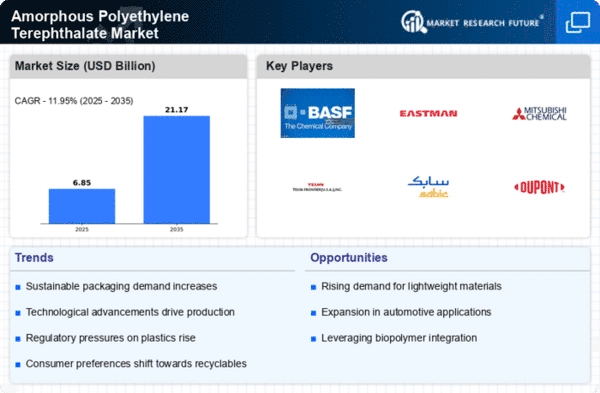
As per MRFR analysis, the Amorphous Polyethylene Terephthalate Market Size was estimated at 6.12 USD Billion in 2024. The Amorphous Polyethylene Terephthalate industry is projected to grow from 6.85 USD Billion in 2025 to 21.17 USD Billion by 2035, exhibiting a compound annual growth rate (CAGR) of 11.95% during the forecast period 2025 - 2035.

Key Market Trends & Highlights

The Amorphous Polyethylene Terephthalate Market is experiencing robust growth driven by sustainability and technological advancements.

  • North America remains the largest market for Amorphous Polyethylene Terephthalate, reflecting strong demand across various applications. The Asia-Pacific region is emerging as the fastest-growing market, propelled by increasing industrialization and consumer demand. The packaging segment continues to dominate the market, while the textiles segment is witnessing rapid growth due to evolving consumer preferences. Sustainability initiatives and regulatory support are key drivers, enhancing the appeal of Amorphous Polyethylene Terephthalate in food and beverage applications.

Market Size & Forecast

2024 Market Size 6.12 (USD Billion)
2035 Market Size 21.17 (USD Billion)
CAGR (2025 - 2035) 11.95%
Largest Regional Market Share in 2024 Asia-Pacific

Major Players

BASF SE (DE), Eastman Chemical Company (US), Mitsubishi Chemical Corporation (JP), Teijin Limited (JP), SABIC (SA), DuPont de Nemours, Inc. (US), Lotte Chemical Corporation (KR), Indorama Ventures Public Company Limited (TH), SK Chemicals Co., Ltd. (KR)

Market Trends

The Amorphous Polyethylene Terephthalate Market is currently experiencing a notable transformation, driven by various factors that influence its growth trajectory. This polymer, known for its clarity, strength, and versatility, finds applications across multiple sectors, including packaging, textiles, and electronics. As industries increasingly prioritize sustainability, the demand for eco-friendly materials is rising, prompting manufacturers to explore innovative production methods. Furthermore, advancements in technology are enhancing the properties of amorphous polyethylene terephthalate, making it a preferred choice for high-performance applications.

In addition to sustainability, the amorphous polyethylene terephthalate market is witnessing a shift toward lightweight materials, which are essential for improving energy efficiency in transportation and packaging. The ongoing trend of urbanization and changing consumer preferences are also contributing to the market's evolution. As urban populations grow, the need for efficient packaging solutions that reduce waste and enhance product shelf life becomes increasingly critical. Overall, the Amorphous Polyethylene Terephthalate Market appears poised for continued growth, driven by innovation and a focus on sustainable practices.

Sustainability Initiatives

The emphasis on sustainable practices is reshaping the amorphous polyethylene terephthalate market.  Manufacturers are increasingly adopting eco-friendly production techniques and exploring recycling options to minimize environmental impact. This trend aligns with global efforts to reduce plastic waste and promote circular economy principles.

Technological Advancements

Innovations in material science and processing technologies are enhancing the performance characteristics of products within the amorphous polyethylene terephthalate market. . Developments in processing techniques and material formulations are enabling the creation of products with superior properties, such as improved barrier performance and thermal stability, thereby expanding application possibilities.

Diverse Applications

The versatility of amorphous polyethylene terephthalate is driving its adoption across a wide range of applications. From packaging to electronics, the material's unique properties make it suitable for various uses. This trend indicates a potential for market expansion as new applications are explored and developed.

Amorphous Polyethylene Terephthalate Market Market Drivers

Rising Demand in Packaging Sector

The Global Amorphous Polyethylene Terephthalate Market Industry is experiencing a notable surge in demand, particularly within the packaging sector. This growth is driven by the increasing preference for lightweight, durable, and recyclable materials among manufacturers. For instance, the packaging industry is projected to account for a significant share of the market, as companies seek to enhance product shelf life while minimizing environmental impact. The market is expected to reach approximately 37.9 USD Billion in 2024, reflecting a robust shift towards sustainable packaging solutions that utilize amorphous polyethylene terephthalate due to its favorable properties.

Emerging Markets and Economic Growth

Emerging markets are playing a pivotal role in the expansion of the Global Amorphous Polyethylene Terephthalate Market Industry. Rapid economic growth in regions such as Asia-Pacific and Latin America is leading to increased industrialization and urbanization, driving demand for various applications of amorphous polyethylene terephthalate. As disposable incomes rise, consumers are seeking higher-quality products, which in turn fuels the need for advanced materials. This trend is likely to enhance market dynamics, as manufacturers in these regions capitalize on the growing demand, further contributing to the overall market growth.

Technological Advancements in Production

Technological innovations in the production processes of amorphous polyethylene terephthalate are significantly influencing the Global Amorphous Polyethylene Terephthalate Market Industry. Enhanced manufacturing techniques, such as advanced polymerization methods and improved recycling processes, are leading to higher efficiency and lower production costs. These advancements not only improve the quality of the end product but also facilitate the development of new applications across various sectors. As a result, the market is poised for substantial growth, with projections indicating a compound annual growth rate of 7.99% from 2025 to 2035, driven by these technological enhancements.

Sustainability and Environmental Regulations

Sustainability concerns and stringent environmental regulations are driving the Global Amorphous Polyethylene Terephthalate Market Industry towards greener alternatives. Governments worldwide are implementing policies aimed at reducing plastic waste and promoting recycling initiatives. Amorphous polyethylene terephthalate, being recyclable and less harmful to the environment, aligns well with these regulatory frameworks. Companies are increasingly adopting this material to comply with sustainability mandates, thereby enhancing their market position. This shift towards eco-friendly materials is expected to propel the market forward, as consumers and businesses alike prioritize sustainable practices in their operations.

Growth in Electronics and Automotive Applications

The Global Amorphous Polyethylene Terephthalate Market Industry is witnessing increased utilization in the electronics and automotive sectors. The material's excellent thermal stability, electrical insulation properties, and lightweight nature make it an ideal choice for manufacturing components such as connectors, housings, and displays. As the demand for electronic devices and advanced automotive technologies continues to rise, the market for amorphous polyethylene terephthalate is expected to expand significantly. This trend is likely to contribute to the overall market growth, with forecasts suggesting a market value of 88.2 USD Billion by 2035, underscoring the material's versatility and applicability.

Market Segment Insights

By Application: Packaging (Largest) vs. Textiles (Fastest-Growing)

In the Amorphous Polyethylene Terephthalate (APET) market, the 'By Application' segment showcases a diverse distribution of application areas. Packaging dominates this segment, holding a significant share as it is pivotal for food and beverage industries, contributing to safety and shelf life. Textiles follow, reflecting a growing interest in sustainable products and innovative uses of APET for applications like clothing and accessories, thus gaining traction rapidly in recent years.

Packaging (Dominant) vs. Textiles (Emerging)

The packaging sector remains the dominant application in the Amorphous Polyethylene Terephthalate market, primarily due to its versatility and barrier properties, making it ideal for bottling, film applications, and containers. Meanwhile, textiles are emerging with their increasing integration of recycled APET fibers, emphasizing eco-friendly fashion trends. This shift towards sustainable textile solutions is accelerating growth, driven by consumer preferences for recyclable and biodegradable materials. As manufacturers innovate to meet sustainability goals, textiles are positioned to gain market share rapidly.

By End Use: Food and Beverage (Largest) vs. Pharmaceuticals (Fastest-Growing)

The Amorphous Polyethylene Terephthalate (APET) market is significantly driven by varied end-use applications such as Food and Beverage, Pharmaceuticals, Personal Care, Household Products, and Industrial sectors. Among these, the Food and Beverage sector holds a dominant share due to the rising demand for lightweight and recyclable packaging solutions. APET’s superior barrier properties make it a preferred choice in this sector, contributing to its substantial market presence.

Food and Beverage (Dominant) vs. Pharmaceuticals (Emerging)

Food and Beverage stands out as a dominant segment in the Amorphous Polyethylene Terephthalate market, driven by the increasing demand for convenience and sustainability in packaging. APET offers excellent clarity, strength, and recyclability, making it ideal for food packaging applications, including bottles and containers. On the other hand, the Pharmaceuticals segment, while emerging, is witnessing rapid growth attributable to the rising need for safe and sterile packaging. APET’s chemical resistance and ability to maintain product integrity make it an attractive option for <a href="https://www.marketresearchfuture.com/reports/pharmaceutical-packaging-market-1291">pharmaceutical packaging</a>, leading to its swift adoption and integration in the healthcare industry.

By Form: Films (Largest) vs. Fibers (Fastest-Growing)

In the Amorphous Polyethylene Terephthalate market, the form segment is primarily influenced by the distribution of films, sheets, fibers, <a href="https://www.marketresearchfuture.com/reports/resins-market-12613">resins</a>, and granules. Films account for the largest share of the market, owing to their extensive use in packaging, especially in food and beverage sectors. Sheets and resins follow, catering to various industrial applications, while fibers and granules are growing but represent a smaller fraction of the overall market share.

Films (Dominant) vs. Fibers (Emerging)

Films in the Amorphous Polyethylene Terephthalate market are the dominant form due to their versatile applications across numerous industries, particularly in food packaging and electronics insulation. Their lightweight, flexible, and moisture-resistant properties make them highly effective for protective covering and enhancing product shelf life. On the other hand, fibers represent an emerging segment fueled by demand in textiles and composite materials. The shift towards eco-friendly and lightweight materials drives this growth, as fibers offer durability and strength while meeting sustainability goals. As manufacturers innovate, both segments are set to expand, aligning with evolving consumer preferences.

By Processing Technique: Injection Molding (Largest) vs. 3D Printing (Fastest-Growing)

<p>In the Amorphous Polyethylene Terephthalate Market, the processing techniques vary significantly in terms of market share. Injection molding stands out as the largest segment, holding a substantial share due to its widespread application in producing complex parts efficiently. In contrast, other techniques like extrusion and blow molding occupy noteworthy portions, but none match the dominance of injection molding. 3D printing, while currently having a smaller share, is gaining traction with advancements in technology and customization capabilities, reflecting a growing interest in its potential applications in various industries. Growth trends for the processing techniques show that while injection molding maintains its lead, 3D printing is emerging as the fastest-growing technique. The rise of lightweight and custom products fuels increased demand for 3D printing, particularly in sectors like automotive and healthcare. The flexibility and rapid prototyping advantages of 3D printing are making it more attractive to manufacturers looking to innovate in their product offerings and respond quickly to market needs.</p>

<p>Injection Molding (Dominant) vs. 3D Printing (Emerging)</p>

<p>Injection molding is the dominant processing technique in the Amorphous Polyethylene Terephthalate Market, appreciated for its ability to produce high volumes of uniform parts rapidly. Its efficiency and consistent quality have made it the preferred method for many applications. Players in various industries favor injection molding for producing intricate designs with minimal waste. On the other hand, 3D printing, though still emerging, is capturing attention due to its capacity for custom, on-demand manufacturing. This technique allows for intricate designs that are often impossible with traditional methods, catering to niche markets demanding customization. As technology advances, the gap between these two processing methods is narrowing, with 3D printing potentially reshaping future manufacturing landscapes.</p>

By Distribution Channel: Online Sales (Largest) vs. Direct Sales (Fastest-Growing)

The distribution channels for Amorphous Polyethylene Terephthalate (APET) primarily consist of Direct Sales, Online Sales, Retail Sales, Wholesale Distribution, and Distributors. Currently, Online Sales holds the largest share in the market, driven by the increasing preference for e-commerce among customers and manufacturers alike. This trend allows for better reach and convenience, making Online Sales a key segment. Other channels such as Direct Sales and Retail Sales also contribute significantly, but they have been slower in growth compared to online platforms, indicating a shift in consumer behavior towards digital buying. In terms of growth trends, Direct Sales is emerging as the fastest-growing distribution channel in the APET market. This growth can be attributed to the rising demand for customized solutions and direct engagement with manufacturers that allow end-users to have more control over their purchasing process. While Retail Sales maintain a stable market share, the potential for Online Sales and Wholesale Distribution to expand is noteworthy as consumers increasingly prioritize accessibility and convenience in procurement. This evolving landscape signifies an ongoing transition towards more direct forms of sales and distribution, impacting all segments of the APET market.

Online Sales (Dominant) vs. Wholesale Distribution (Emerging)

Online Sales stands out as the dominant distribution channel in the Amorphous Polyethylene Terephthalate market, capitalizing on the increasing trend of online shopping and digital marketing. This channel provides a seamless purchasing experience for customers and vast outreach potential for businesses. Companies leveraging online platforms can explore innovative marketing strategies that resonate with a tech-savvy audience. Moreover, the transition to online sales facilitates better inventory management and direct feedback from customers, enhancing overall service quality. Conversely, Wholesale Distribution is considered an emerging channel, offering bulk purchasing advantages and catering to larger-scale industries. While it does not yet match the dominance of online sales, it is gaining traction due to the growing demand for in-person interactions and the strength of established wholesale networks in ensuring consistent supply to retailers.

Get more detailed insights about Amorphous Polyethylene Terephthalate Market Research Report – Forecast to 2035

Regional Insights

North America : Innovation and Sustainability Focus

The North American Amorphous Polyethylene Terephthalate (APET) market is projected to reach $1.84 billion by December 2025, driven by increasing demand for sustainable packaging solutions and stringent regulations on plastic waste. The region's focus on innovation in recycling technologies and eco-friendly materials is expected to further boost market growth. Regulatory initiatives aimed at reducing plastic usage are also catalyzing demand for APET, making it a preferred choice for manufacturers. The competitive landscape in North America is characterized by the presence of major players such as DuPont de Nemours, Inc. and Eastman Chemical Company. These companies are investing heavily in R&D to enhance product performance and sustainability. The U.S. remains the largest market, with Canada and Mexico also contributing significantly to the regional growth. The emphasis on circular economy practices is reshaping the market dynamics, positioning North America as a leader in APET innovation.

Europe : Sustainability and Regulatory Compliance

Europe's Amorphous Polyethylene Terephthalate (APET) market is expected to reach $1.83 billion by December 2025, driven by a strong emphasis on sustainability and compliance with EU regulations. The region is witnessing a shift towards eco-friendly packaging solutions, spurred by consumer demand and government initiatives aimed at reducing plastic waste. The European market is characterized by a growing preference for recycled materials, which is expected to enhance the market share of APET in the coming years. Leading countries in this region include Germany, France, and the UK, where major players like BASF SE and SABIC are actively involved in developing innovative APET solutions. The competitive landscape is marked by collaborations and partnerships aimed at enhancing product offerings. The EU's commitment to sustainability is evident in its regulatory framework, which encourages the use of recycled materials in packaging. "The European market is increasingly prioritizing sustainable materials to meet regulatory standards and consumer expectations," European Commission report.

Asia-Pacific : Emerging Market with High Demand

The Asia-Pacific region is projected to dominate the Amorphous Polyethylene Terephthalate (APET) market, reaching $2.8 billion by December 2025. This growth is fueled by rapid industrialization, urbanization, and increasing consumer demand for packaged goods. Countries like China and India are leading the charge, with significant investments in manufacturing capabilities and infrastructure. The region's favorable regulatory environment is also promoting the use of APET in various applications, including food and beverage packaging. China stands out as the largest market, driven by its robust manufacturing sector and growing consumer base. Key players such as Mitsubishi Chemical Corporation and Teijin Limited are expanding their operations to meet the rising demand. The competitive landscape is becoming increasingly dynamic, with local manufacturers also entering the market. The focus on sustainability and innovation is expected to further enhance the region's market position in the global APET landscape.

Middle East and Africa : Growth Potential in Emerging Markets

The Middle East and Africa (MEA) region is anticipated to reach $0.65 billion in the Amorphous Polyethylene Terephthalate (APET) market by December 2025. This growth is primarily driven by increasing demand for packaging solutions in the food and beverage sector, alongside a growing awareness of sustainable practices. The region's market is characterized by a gradual shift towards eco-friendly materials, supported by government initiatives aimed at reducing plastic waste and promoting recycling. Countries like South Africa and the UAE are leading the market, with key players such as Indorama Ventures Public Company Limited and SABIC making significant investments in production facilities. The competitive landscape is evolving, with local manufacturers emerging to meet the growing demand. The focus on sustainability and regulatory compliance is expected to shape the future of the APET market in the MEA region, presenting opportunities for growth and innovation.

Key Players and Competitive Insights

The Amorphous Polyethylene Terephthalate Market is currently characterized by a dynamic competitive landscape, driven by increasing demand for lightweight and high-performance materials across various industries, including packaging, automotive, and electronics. Key players such as BASF SE (DE), Eastman Chemical Company (US), and Mitsubishi Chemical Corporation (JP) are strategically positioning themselves through innovation and regional expansion. For instance, BASF SE (DE) has focused on enhancing its product portfolio with sustainable solutions, while Eastman Chemical Company (US) emphasizes digital transformation to optimize its operations. These strategies collectively shape a competitive environment that is increasingly focused on sustainability and technological advancement.In terms of business tactics, companies are localizing manufacturing and optimizing supply chains to enhance efficiency and responsiveness to market demands. The market structure appears moderately fragmented, with several key players exerting considerable influence. This fragmentation allows for a variety of competitive strategies, as companies seek to differentiate themselves through unique offerings and operational efficiencies.
In November Eastman Chemical Company (US) announced a partnership with a leading packaging firm to develop innovative, sustainable packaging solutions using amorphous polyethylene terephthalate. This collaboration is strategically significant as it aligns with the growing consumer preference for eco-friendly products, potentially enhancing Eastman's market share in the sustainable packaging segment.
In October Mitsubishi Chemical Corporation (JP) unveiled a new production facility in Southeast Asia aimed at increasing its output of amorphous polyethylene terephthalate. This expansion is crucial as it not only boosts production capacity but also positions Mitsubishi to better serve the rapidly growing Asian markets, which are witnessing a surge in demand for high-performance materials.
In September DuPont de Nemours, Inc. (US) launched a new line of amorphous polyethylene terephthalate products designed specifically for the automotive sector. This strategic move is indicative of DuPont's commitment to innovation and its focus on high-growth industries, potentially allowing the company to capture a larger share of the automotive materials market.
As of December current competitive trends in the Amorphous Polyethylene Terephthalate Market are heavily influenced by digitalization, sustainability, and the integration of AI technologies. Strategic alliances are increasingly shaping the landscape, enabling companies to leverage shared resources and expertise. Looking ahead, competitive differentiation is likely to evolve from traditional price-based competition to a focus on innovation, technological advancements, and supply chain reliability, reflecting a broader industry shift towards sustainable and high-performance solutions.

Key Companies in the Amorphous Polyethylene Terephthalate Market include

Industry Developments

Indorama Ventures, a Thai-based petrochemical company, has completed the acquisition of Vietnam's leading PET packaging company, Ngoc Nghia Industry – Service – Trading Joint Stock Co. (NN). It paid about 3.09 billion baht for 97.8 percent of Ngoc Nghia. NN is a high-quality supplier of PET packaging materials to large global and Vietnamese brands in the beverage and non-beverage industries. Its operations are overseen by a seasoned management team with extensive industry experience and a thorough understanding of the local market.

Alpek, a Mexican chemical manufacturing company, has agreed to purchase OCTAL Holding SAOC (Octal). Octal is a major global producer of PET sheet and proprietary direct-to-sheet (DPET) technology, serving customers in the Americas, the Middle East, and Europe. The acquisition adds more than one million tonnes of installed capacity spread across four sites: Salalah Free Zone in Oman, Riyadh in Saudi Arabia, and Cincinnati in the United States.

September 2023:

 The European Commission published a proposal for a new regulation on single-use plastics, which would ban certain single-use plastic products, including APET cups and plates. The regulation is expected to be finalized in 2024.

Future Outlook

Amorphous Polyethylene Terephthalate Market Future Outlook

The Amorphous Polyethylene Terephthalate Market is projected to grow at 11.95% CAGR from 2025 to 2035, driven by increasing demand in packaging, automotive, and electronics sectors.

New opportunities lie in:

  • <p>Expansion into biodegradable PET alternatives for sustainable packaging solutions. Development of high-performance amorphous PET for advanced electronics applications. Strategic partnerships with recycling firms to enhance circular economy initiatives.</p>

By 2035, the market is expected to solidify its position as a leader in sustainable materials.

Market Segmentation

Amorphous Polyethylene Terephthalate Market Form Outlook

  • Films
  • Sheets
  • Fibers
  • Resins
  • Granules

Amorphous Polyethylene Terephthalate Market End Use Outlook

  • Food and Beverage
  • Pharmaceuticals
  • Personal Care
  • Household Products
  • Industrial

Amorphous Polyethylene Terephthalate Market Application Outlook

  • Packaging
  • Textiles
  • Electronics
  • Automotive
  • Consumer Goods

Amorphous Polyethylene Terephthalate Market Distribution Channel Outlook

  • Direct Sales
  • Online Sales
  • Retail Sales
  • Wholesale Distribution
  • Distributors

Amorphous Polyethylene Terephthalate Market Processing Technique Outlook

  • Injection Molding
  • Blow Molding
  • Extrusion
  • Thermoforming
  • 3D Printing

Report Scope

MARKET SIZE 2024 6.12(USD Billion)
MARKET SIZE 2025 6.85(USD Billion)
MARKET SIZE 2035 21.17(USD Billion)
COMPOUND ANNUAL GROWTH RATE (CAGR) 11.95% (2025 - 2035)
REPORT COVERAGE Revenue Forecast, Competitive Landscape, Growth Factors, and Trends
BASE YEAR 2024
Market Forecast Period 2025 - 2035
Historical Data 2019 - 2024
Market Forecast Units USD Billion
Key Companies Profiled BASF SE (DE), Eastman Chemical Company (US), Mitsubishi Chemical Corporation (JP), Teijin Limited (JP), SABIC (SA), DuPont de Nemours, Inc. (US), Lotte Chemical Corporation (KR), Indorama Ventures Public Company Limited (TH), SK Chemicals Co., Ltd. (KR)
Segments Covered Application, End Use, Form, Processing Technique, Distribution Channel
Key Market Opportunities Growing demand for sustainable packaging solutions drives innovation in the Amorphous Polyethylene Terephthalate Market.
Key Market Dynamics Rising demand for sustainable packaging drives innovation and competition in the Amorphous Polyethylene Terephthalate Market.
Countries Covered North America, Europe, APAC, South America, MEA

FAQs

What is the projected market valuation of the Amorphous Polyethylene Terephthalate Market by 2035?

<p>The projected market valuation for the Amorphous Polyethylene Terephthalate Market is expected to reach 21.17 USD Billion by 2035.</p>

What was the market valuation of Amorphous Polyethylene Terephthalate in 2024?

<p>The overall market valuation of Amorphous Polyethylene Terephthalate was 6.12 USD Billion in 2024.</p>

What is the expected CAGR for the Amorphous Polyethylene Terephthalate Market during the forecast period 2025 - 2035?

<p>The expected CAGR for the Amorphous Polyethylene Terephthalate Market during the forecast period 2025 - 2035 is 11.95%.</p>

Which application segment is projected to have the highest valuation by 2035?

<p>The Packaging application segment is projected to reach a valuation of 8.5 USD Billion by 2035.</p>

What are the key players in the Amorphous Polyethylene Terephthalate Market?

<p>Key players in the market include BASF SE, Eastman Chemical Company, Mitsubishi Chemical Corporation, and Teijin Limited.</p>

How does the Food and Beverage end-use segment perform in terms of valuation?

The Food and Beverage end-use segment is expected to grow to 6.25 USD Billion by 2035.

What is the projected valuation for the Resins form of Amorphous Polyethylene Terephthalate by 2035?

The Resins form of Amorphous Polyethylene Terephthalate is projected to reach a valuation of 5.0 USD Billion by 2035.

Which processing technique is anticipated to have the highest market value by 2035?

The Injection Molding processing technique is anticipated to achieve a market value of 6.36 USD Billion by 2035.

What is the expected growth of the Online Sales distribution channel by 2035?

The Online Sales distribution channel is expected to grow to 4.2 USD Billion by 2035.

How does the Automotive application segment compare to others in terms of future valuation?

The Automotive application segment is projected to reach 3.5 USD Billion by 2035, indicating robust growth compared to other segments.

  1. SECTION I: EXECUTIVE SUMMARY AND KEY HIGHLIGHTS
    1. | 1.1 EXECUTIVE SUMMARY
    2. | | 1.1.1 Market Overview
    3. | | 1.1.2 Key Findings
    4. | | 1.1.3 Market Segmentation
    5. | | 1.1.4 Competitive Landscape
    6. | | 1.1.5 Challenges and Opportunities
    7. | | 1.1.6 Future Outlook
  2. SECTION II: SCOPING, METHODOLOGY AND MARKET STRUCTURE
    1. | 2.1 MARKET INTRODUCTION
    2. | | 2.1.1 Definition
    3. | | 2.1.2 Scope of the study
    4. | | | 2.1.2.1 Research Objective
    5. | | | 2.1.2.2 Assumption
    6. | | | 2.1.2.3 Limitations
    7. | 2.2 RESEARCH METHODOLOGY
    8. | | 2.2.1 Overview
    9. | | 2.2.2 Data Mining
    10. | | 2.2.3 Secondary Research
    11. | | 2.2.4 Primary Research
    12. | | | 2.2.4.1 Primary Interviews and Information Gathering Process
    13. | | | 2.2.4.2 Breakdown of Primary Respondents
    14. | | 2.2.5 Forecasting Model
    15. | | 2.2.6 Market Size Estimation
    16. | | | 2.2.6.1 Bottom-Up Approach
    17. | | | 2.2.6.2 Top-Down Approach
    18. | | 2.2.7 Data Triangulation
    19. | | 2.2.8 Validation
  3. SECTION III: QUALITATIVE ANALYSIS
    1. | 3.1 MARKET DYNAMICS
    2. | | 3.1.1 Overview
    3. | | 3.1.2 Drivers
    4. | | 3.1.3 Restraints
    5. | | 3.1.4 Opportunities
    6. | 3.2 MARKET FACTOR ANALYSIS
    7. | | 3.2.1 Value chain Analysis
    8. | | 3.2.2 Porter's Five Forces Analysis
    9. | | | 3.2.2.1 Bargaining Power of Suppliers
    10. | | | 3.2.2.2 Bargaining Power of Buyers
    11. | | | 3.2.2.3 Threat of New Entrants
    12. | | | 3.2.2.4 Threat of Substitutes
    13. | | | 3.2.2.5 Intensity of Rivalry
    14. | | 3.2.3 COVID-19 Impact Analysis
    15. | | | 3.2.3.1 Market Impact Analysis
    16. | | | 3.2.3.2 Regional Impact
    17. | | | 3.2.3.3 Opportunity and Threat Analysis
  4. SECTION IV: QUANTITATIVE ANALYSIS
    1. | 4.1 Chemicals and Materials, BY Application (USD Billion)
    2. | | 4.1.1 Packaging
    3. | | 4.1.2 Textiles
    4. | | 4.1.3 Automotive
    5. | | 4.1.4 Electronics
    6. | | 4.1.5 Consumer Goods
    7. | 4.2 Chemicals and Materials, BY End Use (USD Billion)
    8. | | 4.2.1 Food and Beverage
    9. | | 4.2.2 Pharmaceuticals
    10. | | 4.2.3 Personal Care
    11. | | 4.2.4 Household Products
    12. | | 4.2.5 Industrial
    13. | 4.3 Chemicals and Materials, BY Form (USD Billion)
    14. | | 4.3.1 Films
    15. | | 4.3.2 Sheets
    16. | | 4.3.3 Fibers
    17. | | 4.3.4 Resins
    18. | | 4.3.5 Granules
    19. | 4.4 Chemicals and Materials, BY Processing Technique (USD Billion)
    20. | | 4.4.1 Injection Molding
    21. | | 4.4.2 Blow Molding
    22. | | 4.4.3 Extrusion
    23. | | 4.4.4 Thermoforming
    24. | | 4.4.5 3D Printing
    25. | 4.5 Chemicals and Materials, BY Distribution Channel (USD Billion)
    26. | | 4.5.1 Direct Sales
    27. | | 4.5.2 Online Sales
    28. | | 4.5.3 Retail Sales
    29. | | 4.5.4 Wholesale
    30. | 4.6 Chemicals and Materials, BY Region (USD Billion)
    31. | | 4.6.1 North America
    32. | | | 4.6.1.1 US
    33. | | | 4.6.1.2 Canada
    34. | | 4.6.2 Europe
    35. | | | 4.6.2.1 Germany
    36. | | | 4.6.2.2 UK
    37. | | | 4.6.2.3 France
    38. | | | 4.6.2.4 Russia
    39. | | | 4.6.2.5 Italy
    40. | | | 4.6.2.6 Spain
    41. | | | 4.6.2.7 Rest of Europe
    42. | | 4.6.3 APAC
    43. | | | 4.6.3.1 China
    44. | | | 4.6.3.2 India
    45. | | | 4.6.3.3 Japan
    46. | | | 4.6.3.4 South Korea
    47. | | | 4.6.3.5 Malaysia
    48. | | | 4.6.3.6 Thailand
    49. | | | 4.6.3.7 Indonesia
    50. | | | 4.6.3.8 Rest of APAC
    51. | | 4.6.4 South America
    52. | | | 4.6.4.1 Brazil
    53. | | | 4.6.4.2 Mexico
    54. | | | 4.6.4.3 Argentina
    55. | | | 4.6.4.4 Rest of South America
    56. | | 4.6.5 MEA
    57. | | | 4.6.5.1 GCC Countries
    58. | | | 4.6.5.2 South Africa
    59. | | | 4.6.5.3 Rest of MEA
  5. SECTION V: COMPETITIVE ANALYSIS
    1. | 5.1 Competitive Landscape
    2. | | 5.1.1 Overview
    3. | | 5.1.2 Competitive Analysis
    4. | | 5.1.3 Market share Analysis
    5. | | 5.1.4 Major Growth Strategy in the Chemicals and Materials
    6. | | 5.1.5 Competitive Benchmarking
    7. | | 5.1.6 Leading Players in Terms of Number of Developments in the Chemicals and Materials
    8. | | 5.1.7 Key developments and growth strategies
    9. | | | 5.1.7.1 New Product Launch/Service Deployment
    10. | | | 5.1.7.2 Merger & Acquisitions
    11. | | | 5.1.7.3 Joint Ventures
    12. | | 5.1.8 Major Players Financial Matrix
    13. | | | 5.1.8.1 Sales and Operating Income
    14. | | | 5.1.8.2 Major Players R&D Expenditure. 2023
    15. | 5.2 Company Profiles
    16. | | 5.2.1 BASF SE (DE)
    17. | | | 5.2.1.1 Financial Overview
    18. | | | 5.2.1.2 Products Offered
    19. | | | 5.2.1.3 Key Developments
    20. | | | 5.2.1.4 SWOT Analysis
    21. | | | 5.2.1.5 Key Strategies
    22. | | 5.2.2 Eastman Chemical Company (US)
    23. | | | 5.2.2.1 Financial Overview
    24. | | | 5.2.2.2 Products Offered
    25. | | | 5.2.2.3 Key Developments
    26. | | | 5.2.2.4 SWOT Analysis
    27. | | | 5.2.2.5 Key Strategies
    28. | | 5.2.3 Mitsubishi Chemical Corporation (JP)
    29. | | | 5.2.3.1 Financial Overview
    30. | | | 5.2.3.2 Products Offered
    31. | | | 5.2.3.3 Key Developments
    32. | | | 5.2.3.4 SWOT Analysis
    33. | | | 5.2.3.5 Key Strategies
    34. | | 5.2.4 Teijin Limited (JP)
    35. | | | 5.2.4.1 Financial Overview
    36. | | | 5.2.4.2 Products Offered
    37. | | | 5.2.4.3 Key Developments
    38. | | | 5.2.4.4 SWOT Analysis
    39. | | | 5.2.4.5 Key Strategies
    40. | | 5.2.5 SABIC (SA)
    41. | | | 5.2.5.1 Financial Overview
    42. | | | 5.2.5.2 Products Offered
    43. | | | 5.2.5.3 Key Developments
    44. | | | 5.2.5.4 SWOT Analysis
    45. | | | 5.2.5.5 Key Strategies
    46. | | 5.2.6 DuPont de Nemours, Inc. (US)
    47. | | | 5.2.6.1 Financial Overview
    48. | | | 5.2.6.2 Products Offered
    49. | | | 5.2.6.3 Key Developments
    50. | | | 5.2.6.4 SWOT Analysis
    51. | | | 5.2.6.5 Key Strategies
    52. | | 5.2.7 Lotte Chemical Corporation (KR)
    53. | | | 5.2.7.1 Financial Overview
    54. | | | 5.2.7.2 Products Offered
    55. | | | 5.2.7.3 Key Developments
    56. | | | 5.2.7.4 SWOT Analysis
    57. | | | 5.2.7.5 Key Strategies
    58. | | 5.2.8 Indorama Ventures Public Company Limited (TH)
    59. | | | 5.2.8.1 Financial Overview
    60. | | | 5.2.8.2 Products Offered
    61. | | | 5.2.8.3 Key Developments
    62. | | | 5.2.8.4 SWOT Analysis
    63. | | | 5.2.8.5 Key Strategies
    64. | | 5.2.9 SK Chemicals Co., Ltd. (KR)
    65. | | | 5.2.9.1 Financial Overview
    66. | | | 5.2.9.2 Products Offered
    67. | | | 5.2.9.3 Key Developments
    68. | | | 5.2.9.4 SWOT Analysis
    69. | | | 5.2.9.5 Key Strategies
    70. | 5.3 Appendix
    71. | | 5.3.1 References
    72. | | 5.3.2 Related Reports
  6. LIST OF FIGURES
    1. | 6.1 MARKET SYNOPSIS
    2. | 6.2 NORTH AMERICA MARKET ANALYSIS
    3. | 6.3 US MARKET ANALYSIS BY APPLICATION
    4. | 6.4 US MARKET ANALYSIS BY END USE
    5. | 6.5 US MARKET ANALYSIS BY FORM
    6. | 6.6 US MARKET ANALYSIS BY PROCESSING TECHNIQUE
    7. | 6.7 US MARKET ANALYSIS BY DISTRIBUTION CHANNEL
    8. | 6.8 CANADA MARKET ANALYSIS BY APPLICATION
    9. | 6.9 CANADA MARKET ANALYSIS BY END USE
    10. | 6.10 CANADA MARKET ANALYSIS BY FORM
    11. | 6.11 CANADA MARKET ANALYSIS BY PROCESSING TECHNIQUE
    12. | 6.12 CANADA MARKET ANALYSIS BY DISTRIBUTION CHANNEL
    13. | 6.13 EUROPE MARKET ANALYSIS
    14. | 6.14 GERMANY MARKET ANALYSIS BY APPLICATION
    15. | 6.15 GERMANY MARKET ANALYSIS BY END USE
    16. | 6.16 GERMANY MARKET ANALYSIS BY FORM
    17. | 6.17 GERMANY MARKET ANALYSIS BY PROCESSING TECHNIQUE
    18. | 6.18 GERMANY MARKET ANALYSIS BY DISTRIBUTION CHANNEL
    19. | 6.19 UK MARKET ANALYSIS BY APPLICATION
    20. | 6.20 UK MARKET ANALYSIS BY END USE
    21. | 6.21 UK MARKET ANALYSIS BY FORM
    22. | 6.22 UK MARKET ANALYSIS BY PROCESSING TECHNIQUE
    23. | 6.23 UK MARKET ANALYSIS BY DISTRIBUTION CHANNEL
    24. | 6.24 FRANCE MARKET ANALYSIS BY APPLICATION
    25. | 6.25 FRANCE MARKET ANALYSIS BY END USE
    26. | 6.26 FRANCE MARKET ANALYSIS BY FORM
    27. | 6.27 FRANCE MARKET ANALYSIS BY PROCESSING TECHNIQUE
    28. | 6.28 FRANCE MARKET ANALYSIS BY DISTRIBUTION CHANNEL
    29. | 6.29 RUSSIA MARKET ANALYSIS BY APPLICATION
    30. | 6.30 RUSSIA MARKET ANALYSIS BY END USE
    31. | 6.31 RUSSIA MARKET ANALYSIS BY FORM
    32. | 6.32 RUSSIA MARKET ANALYSIS BY PROCESSING TECHNIQUE
    33. | 6.33 RUSSIA MARKET ANALYSIS BY DISTRIBUTION CHANNEL
    34. | 6.34 ITALY MARKET ANALYSIS BY APPLICATION
    35. | 6.35 ITALY MARKET ANALYSIS BY END USE
    36. | 6.36 ITALY MARKET ANALYSIS BY FORM
    37. | 6.37 ITALY MARKET ANALYSIS BY PROCESSING TECHNIQUE
    38. | 6.38 ITALY MARKET ANALYSIS BY DISTRIBUTION CHANNEL
    39. | 6.39 SPAIN MARKET ANALYSIS BY APPLICATION
    40. | 6.40 SPAIN MARKET ANALYSIS BY END USE
    41. | 6.41 SPAIN MARKET ANALYSIS BY FORM
    42. | 6.42 SPAIN MARKET ANALYSIS BY PROCESSING TECHNIQUE
    43. | 6.43 SPAIN MARKET ANALYSIS BY DISTRIBUTION CHANNEL
    44. | 6.44 REST OF EUROPE MARKET ANALYSIS BY APPLICATION
    45. | 6.45 REST OF EUROPE MARKET ANALYSIS BY END USE
    46. | 6.46 REST OF EUROPE MARKET ANALYSIS BY FORM
    47. | 6.47 REST OF EUROPE MARKET ANALYSIS BY PROCESSING TECHNIQUE
    48. | 6.48 REST OF EUROPE MARKET ANALYSIS BY DISTRIBUTION CHANNEL
    49. | 6.49 APAC MARKET ANALYSIS
    50. | 6.50 CHINA MARKET ANALYSIS BY APPLICATION
    51. | 6.51 CHINA MARKET ANALYSIS BY END USE
    52. | 6.52 CHINA MARKET ANALYSIS BY FORM
    53. | 6.53 CHINA MARKET ANALYSIS BY PROCESSING TECHNIQUE
    54. | 6.54 CHINA MARKET ANALYSIS BY DISTRIBUTION CHANNEL
    55. | 6.55 INDIA MARKET ANALYSIS BY APPLICATION
    56. | 6.56 INDIA MARKET ANALYSIS BY END USE
    57. | 6.57 INDIA MARKET ANALYSIS BY FORM
    58. | 6.58 INDIA MARKET ANALYSIS BY PROCESSING TECHNIQUE
    59. | 6.59 INDIA MARKET ANALYSIS BY DISTRIBUTION CHANNEL
    60. | 6.60 JAPAN MARKET ANALYSIS BY APPLICATION
    61. | 6.61 JAPAN MARKET ANALYSIS BY END USE
    62. | 6.62 JAPAN MARKET ANALYSIS BY FORM
    63. | 6.63 JAPAN MARKET ANALYSIS BY PROCESSING TECHNIQUE
    64. | 6.64 JAPAN MARKET ANALYSIS BY DISTRIBUTION CHANNEL
    65. | 6.65 SOUTH KOREA MARKET ANALYSIS BY APPLICATION
    66. | 6.66 SOUTH KOREA MARKET ANALYSIS BY END USE
    67. | 6.67 SOUTH KOREA MARKET ANALYSIS BY FORM
    68. | 6.68 SOUTH KOREA MARKET ANALYSIS BY PROCESSING TECHNIQUE
    69. | 6.69 SOUTH KOREA MARKET ANALYSIS BY DISTRIBUTION CHANNEL
    70. | 6.70 MALAYSIA MARKET ANALYSIS BY APPLICATION
    71. | 6.71 MALAYSIA MARKET ANALYSIS BY END USE
    72. | 6.72 MALAYSIA MARKET ANALYSIS BY FORM
    73. | 6.73 MALAYSIA MARKET ANALYSIS BY PROCESSING TECHNIQUE
    74. | 6.74 MALAYSIA MARKET ANALYSIS BY DISTRIBUTION CHANNEL
    75. | 6.75 THAILAND MARKET ANALYSIS BY APPLICATION
    76. | 6.76 THAILAND MARKET ANALYSIS BY END USE
    77. | 6.77 THAILAND MARKET ANALYSIS BY FORM
    78. | 6.78 THAILAND MARKET ANALYSIS BY PROCESSING TECHNIQUE
    79. | 6.79 THAILAND MARKET ANALYSIS BY DISTRIBUTION CHANNEL
    80. | 6.80 INDONESIA MARKET ANALYSIS BY APPLICATION
    81. | 6.81 INDONESIA MARKET ANALYSIS BY END USE
    82. | 6.82 INDONESIA MARKET ANALYSIS BY FORM
    83. | 6.83 INDONESIA MARKET ANALYSIS BY PROCESSING TECHNIQUE
    84. | 6.84 INDONESIA MARKET ANALYSIS BY DISTRIBUTION CHANNEL
    85. | 6.85 REST OF APAC MARKET ANALYSIS BY APPLICATION
    86. | 6.86 REST OF APAC MARKET ANALYSIS BY END USE
    87. | 6.87 REST OF APAC MARKET ANALYSIS BY FORM
    88. | 6.88 REST OF APAC MARKET ANALYSIS BY PROCESSING TECHNIQUE
    89. | 6.89 REST OF APAC MARKET ANALYSIS BY DISTRIBUTION CHANNEL
    90. | 6.90 SOUTH AMERICA MARKET ANALYSIS
    91. | 6.91 BRAZIL MARKET ANALYSIS BY APPLICATION
    92. | 6.92 BRAZIL MARKET ANALYSIS BY END USE
    93. | 6.93 BRAZIL MARKET ANALYSIS BY FORM
    94. | 6.94 BRAZIL MARKET ANALYSIS BY PROCESSING TECHNIQUE
    95. | 6.95 BRAZIL MARKET ANALYSIS BY DISTRIBUTION CHANNEL
    96. | 6.96 MEXICO MARKET ANALYSIS BY APPLICATION
    97. | 6.97 MEXICO MARKET ANALYSIS BY END USE
    98. | 6.98 MEXICO MARKET ANALYSIS BY FORM
    99. | 6.99 MEXICO MARKET ANALYSIS BY PROCESSING TECHNIQUE
    100. | 6.100 MEXICO MARKET ANALYSIS BY DISTRIBUTION CHANNEL
    101. | 6.101 ARGENTINA MARKET ANALYSIS BY APPLICATION
    102. | 6.102 ARGENTINA MARKET ANALYSIS BY END USE
    103. | 6.103 ARGENTINA MARKET ANALYSIS BY FORM
    104. | 6.104 ARGENTINA MARKET ANALYSIS BY PROCESSING TECHNIQUE
    105. | 6.105 ARGENTINA MARKET ANALYSIS BY DISTRIBUTION CHANNEL
    106. | 6.106 REST OF SOUTH AMERICA MARKET ANALYSIS BY APPLICATION
    107. | 6.107 REST OF SOUTH AMERICA MARKET ANALYSIS BY END USE
    108. | 6.108 REST OF SOUTH AMERICA MARKET ANALYSIS BY FORM
    109. | 6.109 REST OF SOUTH AMERICA MARKET ANALYSIS BY PROCESSING TECHNIQUE
    110. | 6.110 REST OF SOUTH AMERICA MARKET ANALYSIS BY DISTRIBUTION CHANNEL
    111. | 6.111 MEA MARKET ANALYSIS
    112. | 6.112 GCC COUNTRIES MARKET ANALYSIS BY APPLICATION
    113. | 6.113 GCC COUNTRIES MARKET ANALYSIS BY END USE
    114. | 6.114 GCC COUNTRIES MARKET ANALYSIS BY FORM
    115. | 6.115 GCC COUNTRIES MARKET ANALYSIS BY PROCESSING TECHNIQUE
    116. | 6.116 GCC COUNTRIES MARKET ANALYSIS BY DISTRIBUTION CHANNEL
    117. | 6.117 SOUTH AFRICA MARKET ANALYSIS BY APPLICATION
    118. | 6.118 SOUTH AFRICA MARKET ANALYSIS BY END USE
    119. | 6.119 SOUTH AFRICA MARKET ANALYSIS BY FORM
    120. | 6.120 SOUTH AFRICA MARKET ANALYSIS BY PROCESSING TECHNIQUE
    121. | 6.121 SOUTH AFRICA MARKET ANALYSIS BY DISTRIBUTION CHANNEL
    122. | 6.122 REST OF MEA MARKET ANALYSIS BY APPLICATION
    123. | 6.123 REST OF MEA MARKET ANALYSIS BY END USE
    124. | 6.124 REST OF MEA MARKET ANALYSIS BY FORM
    125. | 6.125 REST OF MEA MARKET ANALYSIS BY PROCESSING TECHNIQUE
    126. | 6.126 REST OF MEA MARKET ANALYSIS BY DISTRIBUTION CHANNEL
    127. | 6.127 KEY BUYING CRITERIA OF CHEMICALS AND MATERIALS
    128. | 6.128 RESEARCH PROCESS OF MRFR
    129. | 6.129 DRO ANALYSIS OF CHEMICALS AND MATERIALS
    130. | 6.130 DRIVERS IMPACT ANALYSIS: CHEMICALS AND MATERIALS
    131. | 6.131 RESTRAINTS IMPACT ANALYSIS: CHEMICALS AND MATERIALS
    132. | 6.132 SUPPLY / VALUE CHAIN: CHEMICALS AND MATERIALS
    133. | 6.133 CHEMICALS AND MATERIALS, BY APPLICATION, 2024 (% SHARE)
    134. | 6.134 CHEMICALS AND MATERIALS, BY APPLICATION, 2024 TO 2035 (USD Billion)
    135. | 6.135 CHEMICALS AND MATERIALS, BY END USE, 2024 (% SHARE)
    136. | 6.136 CHEMICALS AND MATERIALS, BY END USE, 2024 TO 2035 (USD Billion)
    137. | 6.137 CHEMICALS AND MATERIALS, BY FORM, 2024 (% SHARE)
    138. | 6.138 CHEMICALS AND MATERIALS, BY FORM, 2024 TO 2035 (USD Billion)
    139. | 6.139 CHEMICALS AND MATERIALS, BY PROCESSING TECHNIQUE, 2024 (% SHARE)
    140. | 6.140 CHEMICALS AND MATERIALS, BY PROCESSING TECHNIQUE, 2024 TO 2035 (USD Billion)
    141. | 6.141 CHEMICALS AND MATERIALS, BY DISTRIBUTION CHANNEL, 2024 (% SHARE)
    142. | 6.142 CHEMICALS AND MATERIALS, BY DISTRIBUTION CHANNEL, 2024 TO 2035 (USD Billion)
    143. | 6.143 BENCHMARKING OF MAJOR COMPETITORS
  7. LIST OF TABLES
    1. | 7.1 LIST OF ASSUMPTIONS
    2. | | 7.1.1
    3. | 7.2 North America MARKET SIZE ESTIMATES; FORECAST
    4. | | 7.2.1 BY APPLICATION, 2025-2035 (USD Billion)
    5. | | 7.2.2 BY END USE, 2025-2035 (USD Billion)
    6. | | 7.2.3 BY FORM, 2025-2035 (USD Billion)
    7. | | 7.2.4 BY PROCESSING TECHNIQUE, 2025-2035 (USD Billion)
    8. | | 7.2.5 BY DISTRIBUTION CHANNEL, 2025-2035 (USD Billion)
    9. | 7.3 US MARKET SIZE ESTIMATES; FORECAST
    10. | | 7.3.1 BY APPLICATION, 2025-2035 (USD Billion)
    11. | | 7.3.2 BY END USE, 2025-2035 (USD Billion)
    12. | | 7.3.3 BY FORM, 2025-2035 (USD Billion)
    13. | | 7.3.4 BY PROCESSING TECHNIQUE, 2025-2035 (USD Billion)
    14. | | 7.3.5 BY DISTRIBUTION CHANNEL, 2025-2035 (USD Billion)
    15. | 7.4 Canada MARKET SIZE ESTIMATES; FORECAST
    16. | | 7.4.1 BY APPLICATION, 2025-2035 (USD Billion)
    17. | | 7.4.2 BY END USE, 2025-2035 (USD Billion)
    18. | | 7.4.3 BY FORM, 2025-2035 (USD Billion)
    19. | | 7.4.4 BY PROCESSING TECHNIQUE, 2025-2035 (USD Billion)
    20. | | 7.4.5 BY DISTRIBUTION CHANNEL, 2025-2035 (USD Billion)
    21. | 7.5 Europe MARKET SIZE ESTIMATES; FORECAST
    22. | | 7.5.1 BY APPLICATION, 2025-2035 (USD Billion)
    23. | | 7.5.2 BY END USE, 2025-2035 (USD Billion)
    24. | | 7.5.3 BY FORM, 2025-2035 (USD Billion)
    25. | | 7.5.4 BY PROCESSING TECHNIQUE, 2025-2035 (USD Billion)
    26. | | 7.5.5 BY DISTRIBUTION CHANNEL, 2025-2035 (USD Billion)
    27. | 7.6 Germany MARKET SIZE ESTIMATES; FORECAST
    28. | | 7.6.1 BY APPLICATION, 2025-2035 (USD Billion)
    29. | | 7.6.2 BY END USE, 2025-2035 (USD Billion)
    30. | | 7.6.3 BY FORM, 2025-2035 (USD Billion)
    31. | | 7.6.4 BY PROCESSING TECHNIQUE, 2025-2035 (USD Billion)
    32. | | 7.6.5 BY DISTRIBUTION CHANNEL, 2025-2035 (USD Billion)
    33. | 7.7 UK MARKET SIZE ESTIMATES; FORECAST
    34. | | 7.7.1 BY APPLICATION, 2025-2035 (USD Billion)
    35. | | 7.7.2 BY END USE, 2025-2035 (USD Billion)
    36. | | 7.7.3 BY FORM, 2025-2035 (USD Billion)
    37. | | 7.7.4 BY PROCESSING TECHNIQUE, 2025-2035 (USD Billion)
    38. | | 7.7.5 BY DISTRIBUTION CHANNEL, 2025-2035 (USD Billion)
    39. | 7.8 France MARKET SIZE ESTIMATES; FORECAST
    40. | | 7.8.1 BY APPLICATION, 2025-2035 (USD Billion)
    41. | | 7.8.2 BY END USE, 2025-2035 (USD Billion)
    42. | | 7.8.3 BY FORM, 2025-2035 (USD Billion)
    43. | | 7.8.4 BY PROCESSING TECHNIQUE, 2025-2035 (USD Billion)
    44. | | 7.8.5 BY DISTRIBUTION CHANNEL, 2025-2035 (USD Billion)
    45. | 7.9 Russia MARKET SIZE ESTIMATES; FORECAST
    46. | | 7.9.1 BY APPLICATION, 2025-2035 (USD Billion)
    47. | | 7.9.2 BY END USE, 2025-2035 (USD Billion)
    48. | | 7.9.3 BY FORM, 2025-2035 (USD Billion)
    49. | | 7.9.4 BY PROCESSING TECHNIQUE, 2025-2035 (USD Billion)
    50. | | 7.9.5 BY DISTRIBUTION CHANNEL, 2025-2035 (USD Billion)
    51. | 7.10 Italy MARKET SIZE ESTIMATES; FORECAST
    52. | | 7.10.1 BY APPLICATION, 2025-2035 (USD Billion)
    53. | | 7.10.2 BY END USE, 2025-2035 (USD Billion)
    54. | | 7.10.3 BY FORM, 2025-2035 (USD Billion)
    55. | | 7.10.4 BY PROCESSING TECHNIQUE, 2025-2035 (USD Billion)
    56. | | 7.10.5 BY DISTRIBUTION CHANNEL, 2025-2035 (USD Billion)
    57. | 7.11 Spain MARKET SIZE ESTIMATES; FORECAST
    58. | | 7.11.1 BY APPLICATION, 2025-2035 (USD Billion)
    59. | | 7.11.2 BY END USE, 2025-2035 (USD Billion)
    60. | | 7.11.3 BY FORM, 2025-2035 (USD Billion)
    61. | | 7.11.4 BY PROCESSING TECHNIQUE, 2025-2035 (USD Billion)
    62. | | 7.11.5 BY DISTRIBUTION CHANNEL, 2025-2035 (USD Billion)
    63. | 7.12 Rest of Europe MARKET SIZE ESTIMATES; FORECAST
    64. | | 7.12.1 BY APPLICATION, 2025-2035 (USD Billion)
    65. | | 7.12.2 BY END USE, 2025-2035 (USD Billion)
    66. | | 7.12.3 BY FORM, 2025-2035 (USD Billion)
    67. | | 7.12.4 BY PROCESSING TECHNIQUE, 2025-2035 (USD Billion)
    68. | | 7.12.5 BY DISTRIBUTION CHANNEL, 2025-2035 (USD Billion)
    69. | 7.13 APAC MARKET SIZE ESTIMATES; FORECAST
    70. | | 7.13.1 BY APPLICATION, 2025-2035 (USD Billion)
    71. | | 7.13.2 BY END USE, 2025-2035 (USD Billion)
    72. | | 7.13.3 BY FORM, 2025-2035 (USD Billion)
    73. | | 7.13.4 BY PROCESSING TECHNIQUE, 2025-2035 (USD Billion)
    74. | | 7.13.5 BY DISTRIBUTION CHANNEL, 2025-2035 (USD Billion)
    75. | 7.14 China MARKET SIZE ESTIMATES; FORECAST
    76. | | 7.14.1 BY APPLICATION, 2025-2035 (USD Billion)
    77. | | 7.14.2 BY END USE, 2025-2035 (USD Billion)
    78. | | 7.14.3 BY FORM, 2025-2035 (USD Billion)
    79. | | 7.14.4 BY PROCESSING TECHNIQUE, 2025-2035 (USD Billion)
    80. | | 7.14.5 BY DISTRIBUTION CHANNEL, 2025-2035 (USD Billion)
    81. | 7.15 India MARKET SIZE ESTIMATES; FORECAST
    82. | | 7.15.1 BY APPLICATION, 2025-2035 (USD Billion)
    83. | | 7.15.2 BY END USE, 2025-2035 (USD Billion)
    84. | | 7.15.3 BY FORM, 2025-2035 (USD Billion)
    85. | | 7.15.4 BY PROCESSING TECHNIQUE, 2025-2035 (USD Billion)
    86. | | 7.15.5 BY DISTRIBUTION CHANNEL, 2025-2035 (USD Billion)
    87. | 7.16 Japan MARKET SIZE ESTIMATES; FORECAST
    88. | | 7.16.1 BY APPLICATION, 2025-2035 (USD Billion)
    89. | | 7.16.2 BY END USE, 2025-2035 (USD Billion)
    90. | | 7.16.3 BY FORM, 2025-2035 (USD Billion)
    91. | | 7.16.4 BY PROCESSING TECHNIQUE, 2025-2035 (USD Billion)
    92. | | 7.16.5 BY DISTRIBUTION CHANNEL, 2025-2035 (USD Billion)
    93. | 7.17 South Korea MARKET SIZE ESTIMATES; FORECAST
    94. | | 7.17.1 BY APPLICATION, 2025-2035 (USD Billion)
    95. | | 7.17.2 BY END USE, 2025-2035 (USD Billion)
    96. | | 7.17.3 BY FORM, 2025-2035 (USD Billion)
    97. | | 7.17.4 BY PROCESSING TECHNIQUE, 2025-2035 (USD Billion)
    98. | | 7.17.5 BY DISTRIBUTION CHANNEL, 2025-2035 (USD Billion)
    99. | 7.18 Malaysia MARKET SIZE ESTIMATES; FORECAST
    100. | | 7.18.1 BY APPLICATION, 2025-2035 (USD Billion)
    101. | | 7.18.2 BY END USE, 2025-2035 (USD Billion)
    102. | | 7.18.3 BY FORM, 2025-2035 (USD Billion)
    103. | | 7.18.4 BY PROCESSING TECHNIQUE, 2025-2035 (USD Billion)
    104. | | 7.18.5 BY DISTRIBUTION CHANNEL, 2025-2035 (USD Billion)
    105. | 7.19 Thailand MARKET SIZE ESTIMATES; FORECAST
    106. | | 7.19.1 BY APPLICATION, 2025-2035 (USD Billion)
    107. | | 7.19.2 BY END USE, 2025-2035 (USD Billion)
    108. | | 7.19.3 BY FORM, 2025-2035 (USD Billion)
    109. | | 7.19.4 BY PROCESSING TECHNIQUE, 2025-2035 (USD Billion)
    110. | | 7.19.5 BY DISTRIBUTION CHANNEL, 2025-2035 (USD Billion)
    111. | 7.20 Indonesia MARKET SIZE ESTIMATES; FORECAST
    112. | | 7.20.1 BY APPLICATION, 2025-2035 (USD Billion)
    113. | | 7.20.2 BY END USE, 2025-2035 (USD Billion)
    114. | | 7.20.3 BY FORM, 2025-2035 (USD Billion)
    115. | | 7.20.4 BY PROCESSING TECHNIQUE, 2025-2035 (USD Billion)
    116. | | 7.20.5 BY DISTRIBUTION CHANNEL, 2025-2035 (USD Billion)
    117. | 7.21 Rest of APAC MARKET SIZE ESTIMATES; FORECAST
    118. | | 7.21.1 BY APPLICATION, 2025-2035 (USD Billion)
    119. | | 7.21.2 BY END USE, 2025-2035 (USD Billion)
    120. | | 7.21.3 BY FORM, 2025-2035 (USD Billion)
    121. | | 7.21.4 BY PROCESSING TECHNIQUE, 2025-2035 (USD Billion)
    122. | | 7.21.5 BY DISTRIBUTION CHANNEL, 2025-2035 (USD Billion)
    123. | 7.22 South America MARKET SIZE ESTIMATES; FORECAST
    124. | | 7.22.1 BY APPLICATION, 2025-2035 (USD Billion)
    125. | | 7.22.2 BY END USE, 2025-2035 (USD Billion)
    126. | | 7.22.3 BY FORM, 2025-2035 (USD Billion)
    127. | | 7.22.4 BY PROCESSING TECHNIQUE, 2025-2035 (USD Billion)
    128. | | 7.22.5 BY DISTRIBUTION CHANNEL, 2025-2035 (USD Billion)
    129. | 7.23 Brazil MARKET SIZE ESTIMATES; FORECAST
    130. | | 7.23.1 BY APPLICATION, 2025-2035 (USD Billion)
    131. | | 7.23.2 BY END USE, 2025-2035 (USD Billion)
    132. | | 7.23.3 BY FORM, 2025-2035 (USD Billion)
    133. | | 7.23.4 BY PROCESSING TECHNIQUE, 2025-2035 (USD Billion)
    134. | | 7.23.5 BY DISTRIBUTION CHANNEL, 2025-2035 (USD Billion)
    135. | 7.24 Mexico MARKET SIZE ESTIMATES; FORECAST
    136. | | 7.24.1 BY APPLICATION, 2025-2035 (USD Billion)
    137. | | 7.24.2 BY END USE, 2025-2035 (USD Billion)
    138. | | 7.24.3 BY FORM, 2025-2035 (USD Billion)
    139. | | 7.24.4 BY PROCESSING TECHNIQUE, 2025-2035 (USD Billion)
    140. | | 7.24.5 BY DISTRIBUTION CHANNEL, 2025-2035 (USD Billion)
    141. | 7.25 Argentina MARKET SIZE ESTIMATES; FORECAST
    142. | | 7.25.1 BY APPLICATION, 2025-2035 (USD Billion)
    143. | | 7.25.2 BY END USE, 2025-2035 (USD Billion)
    144. | | 7.25.3 BY FORM, 2025-2035 (USD Billion)
    145. | | 7.25.4 BY PROCESSING TECHNIQUE, 2025-2035 (USD Billion)
    146. | | 7.25.5 BY DISTRIBUTION CHANNEL, 2025-2035 (USD Billion)
    147. | 7.26 Rest of South America MARKET SIZE ESTIMATES; FORECAST
    148. | | 7.26.1 BY APPLICATION, 2025-2035 (USD Billion)
    149. | | 7.26.2 BY END USE, 2025-2035 (USD Billion)
    150. | | 7.26.3 BY FORM, 2025-2035 (USD Billion)
    151. | | 7.26.4 BY PROCESSING TECHNIQUE, 2025-2035 (USD Billion)
    152. | | 7.26.5 BY DISTRIBUTION CHANNEL, 2025-2035 (USD Billion)
    153. | 7.27 MEA MARKET SIZE ESTIMATES; FORECAST
    154. | | 7.27.1 BY APPLICATION, 2025-2035 (USD Billion)
    155. | | 7.27.2 BY END USE, 2025-2035 (USD Billion)
    156. | | 7.27.3 BY FORM, 2025-2035 (USD Billion)
    157. | | 7.27.4 BY PROCESSING TECHNIQUE, 2025-2035 (USD Billion)
    158. | | 7.27.5 BY DISTRIBUTION CHANNEL, 2025-2035 (USD Billion)
    159. | 7.28 GCC Countries MARKET SIZE ESTIMATES; FORECAST
    160. | | 7.28.1 BY APPLICATION, 2025-2035 (USD Billion)
    161. | | 7.28.2 BY END USE, 2025-2035 (USD Billion)
    162. | | 7.28.3 BY FORM, 2025-2035 (USD Billion)
    163. | | 7.28.4 BY PROCESSING TECHNIQUE, 2025-2035 (USD Billion)
    164. | | 7.28.5 BY DISTRIBUTION CHANNEL, 2025-2035 (USD Billion)
    165. | 7.29 South Africa MARKET SIZE ESTIMATES; FORECAST
    166. | | 7.29.1 BY APPLICATION, 2025-2035 (USD Billion)
    167. | | 7.29.2 BY END USE, 2025-2035 (USD Billion)
    168. | | 7.29.3 BY FORM, 2025-2035 (USD Billion)
    169. | | 7.29.4 BY PROCESSING TECHNIQUE, 2025-2035 (USD Billion)
    170. | | 7.29.5 BY DISTRIBUTION CHANNEL, 2025-2035 (USD Billion)
    171. | 7.30 Rest of MEA MARKET SIZE ESTIMATES; FORECAST
    172. | | 7.30.1 BY APPLICATION, 2025-2035 (USD Billion)
    173. | | 7.30.2 BY END USE, 2025-2035 (USD Billion)
    174. | | 7.30.3 BY FORM, 2025-2035 (USD Billion)
    175. | | 7.30.4 BY PROCESSING TECHNIQUE, 2025-2035 (USD Billion)
    176. | | 7.30.5 BY DISTRIBUTION CHANNEL, 2025-2035 (USD Billion)
    177. | 7.31 PRODUCT LAUNCH/PRODUCT DEVELOPMENT/APPROVAL
    178. | | 7.31.1
    179. | 7.32 ACQUISITION/PARTNERSHIP
    180. | | 7.32.1

Chemicals and Materials Market Segmentation

Chemicals and Materials By Application (USD Billion, 2025-2035)

  • Packaging
  • Textiles
  • Automotive
  • Electronics
  • Consumer Goods

Chemicals and Materials By End Use (USD Billion, 2025-2035)

  • Food and Beverage
  • Pharmaceuticals
  • Personal Care
  • Household Products
  • Industrial

Chemicals and Materials By Form (USD Billion, 2025-2035)

  • Films
  • Sheets
  • Fibers
  • Resins
  • Granules

Chemicals and Materials By Processing Technique (USD Billion, 2025-2035)

  • Injection Molding
  • Blow Molding
  • Extrusion
  • Thermoforming
  • 3D Printing

Chemicals and Materials By Distribution Channel (USD Billion, 2025-2035)

  • Direct Sales
  • Online Sales
  • Retail Sales
  • Wholesale
Infographic

Free Sample Request

Kindly complete the form below to receive a free sample of this Report

Get Free Sample

Customer Strories

Compare Licence

×
Features License Type
Single User Multiuser License Enterprise User
Price $4,950 $5,950 $7,250
Maximum User Access Limit 1 User Upto 10 Users Unrestricted Access Throughout the Organization
Free Customization
Direct Access to Analyst
Deliverable Format
Platform Access
Discount on Next Purchase 10% 15% 15%
Printable Versions