Request Free Sample ×

Kindly complete the form below to receive a free sample of this Report

* Please use a valid business email

Leading companies partner with us for data-driven Insights

clients tt-cursor
Hero Background
English
Chinese
French
Japanese
Korean
German
Spanish

Americas Insomnia Market Analysis

ID: MRFR/Pharma/0126-HCR
50 Pages
Rahul Gotadki
March 2026

Americas Insomnia Market Research Report, by types of therapy (Pharmacological therapy and Non Pharmacological therapy), by drug formulation (Capsules, Tablet and others), by type of disease (poor quality of sleep, sleep maintenance and others) - Forecast till 2035

Share:
Download PDF ×

We do not share your information with anyone. However, we may send you emails based on your report interest from time to time. You may contact us at any time to opt-out.

Americas Insomnia Market Infographic
Purchase Options

Market Analysis

In-depth Analysis of Americas Insomnia Market Industry Landscape

The Americas Insomnia Market addresses the prevalent sleep disorder affecting a significant portion of the population across North and South America. This market is a vital segment within the healthcare industry, and its dynamics are influenced by factors such as lifestyle changes, increasing awareness of mental health, advancements in treatment options, and the role of pharmaceutical interventions. The consumption patterns emerge from very contintental lifestyles in the Americas, typified by factors like working very late, watching more screens, and tension. And these lifestyles' primary factor is insomnia rise, the reason of an increased popularity of such solutions as methods to treat sleep disorders and provide a person with and better sleep quality. Greater awareness of the problems entities such as insomnia have on mental health is one of the fundamental aspects of market dynamics emergence. Mental healthcare and awareness programs aim at escalating the attention rate of the public on the subject of the value of quality sleep, and on the negative consequences that can be expected from untreated insomnia, which result in the elevated demand of necessary help. The constancy of improvement in insomnia events solutions continues to result into market expansion. Beyond the existing strategies of cognitive-behavioral therapy for insomnia (CBT-I), modern technology is an innovative tool when it comes to detecting and managing sleep disorders. It also provides several alternatives to drugs, like non-pharmacological methods which best suit certain patients. The drugs that are being used remain the most important factor for the development of the Americas Insomnia Drug market. The birth of new-generation sedative drugs like non-benzodiazepine and inners-receptors agonist provide a better instruments for people having continuous trouble with insomnia. The pharmaceutical section firstly sparks a competition between incessant leaders trying to develop and provide safer drugs. Demographical factors with special focus on ageing population in American region will accelerate market distribution greatly. The elderly repeatedly encounter such issues as the sleep system problems and increased frequency of insomnia. Keeping in mind the needs of this particular demographic, the market is very technology-savvy and comes up with specialized solutions like sleep aids and therapies for the elderly. In the United States of America, Americas Insomnia medication administration is closely monitored by governmental authorities to guarantee the products’ safety and efficacy. Meeting the regulatory regulations, obtaining approvals from health bodies are key components for the manufacturer’s compliance. The regulations change can do market dynamics rewriting, this is manifested in product development tempo and market introducing way. Global economic sceneries regardless of their nature impact the market of Americas Insomnia. There are factors such as stability of economy, healthcare funding, and insurance burdens that may influence patients’ availability to insomnia medications. Economic conditions can influence the way providers of the care and patients with insomnia who are looking for healthcare solutions make their purchases.

The market is shaped by efforts to educate consumers about the importance of sleep hygiene and healthy sleep practices. Awareness campaigns emphasize lifestyle adjustments, sleep environment optimization, and establishing consistent sleep routines. These initiatives contribute to preventive measures and early intervention for insomnia. Looking ahead, the Americas Insomnia Market is poised for further innovation with trends such as personalized medicine, digital therapeutics, and the integration of artificial intelligence in sleep diagnostics. These trends are expected to redefine the landscape, offering new possibilities for individualized and technologically advanced approaches to insomnia management.


Author
Author Profile
Rahul Gotadki
Research Manager

He holds an experience of about 9+ years in Market Research and Business Consulting, working under the spectrum of Life Sciences and Healthcare domains. Rahul conceptualizes and implements a scalable business strategy and provides strategic leadership to the clients. His expertise lies in market estimation, competitive intelligence, pipeline analysis, customer assessment, etc.

Leave a Comment

FAQs

What is the current valuation of the Americas Insomnia Market?

The Americas Insomnia Market was valued at 2.43 USD Billion in 2024.

What is the projected market size for the Americas Insomnia Market by 2035?

The market is projected to reach 4.122 USD Billion by 2035.

What is the expected CAGR for the Americas Insomnia Market during the forecast period?

The expected CAGR for the Americas Insomnia Market from 2025 to 2035 is 4.92%.

Which companies are the key players in the Americas Insomnia Market?

Key players include Pfizer Inc, Merck & Co Inc, Eli Lilly and Company, and others.

What are the main segments of the Americas Insomnia Market?

The main segments include Pharmacological Therapy and Non-Pharmacological Therapy.

How did the Pharmacological Therapy segment perform in 2024?

In 2024, the Pharmacological Therapy segment was valued at 2.5 USD Billion.

What is the projected growth for Non-Pharmacological Therapy by 2035?

The Non-Pharmacological Therapy segment is expected to grow to 1.62 USD Billion by 2035.

What are the leading drug formulations in the Americas Insomnia Market?

Leading drug formulations include Capsules, Tablets, and others, with Tablets valued at 1.85 USD Billion by 2035.

What types of diseases are primarily addressed in the Americas Insomnia Market?

The market addresses issues such as poor quality of sleep and sleep maintenance.

What is the expected performance of the Benzodiazepines segment by 2035?

The Benzodiazepines segment is projected to reach 1.3 USD Billion by 2035.

Market Summary

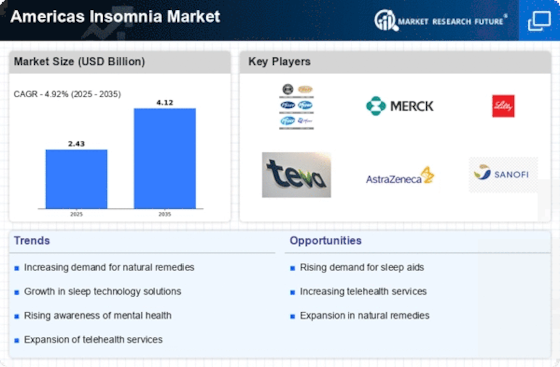
As per Market Research Future analysis, the Americas Insomnia Market Size was estimated at 2.43 USD Billion in 2024. The insomnia industry is projected to grow from 2.55 USD Billion in 2025 to 4.122 USD Billion by 2035, exhibiting a compound annual growth rate (CAGR) of 4.92% during the forecast period 2025 - 2035

Key Market Trends & Highlights

The Americas Insomnia Market is experiencing a transformative shift towards innovative treatment solutions and heightened awareness.

  • The rise of digital health solutions is reshaping how insomnia is managed across North America.
  • Diversification of treatment options is evident, with pharmacological therapy remaining the largest segment while non-pharmacological therapy is rapidly gaining traction.
  • Increased awareness and education about sleep disorders are driving consumer engagement and demand for effective solutions.
  • The growing prevalence of insomnia and advancements in sleep technology are key drivers propelling market growth, particularly in the North American and Asia-Pacific regions.

Market Size & Forecast

2024 Market Size 2.43 (USD Billion)
2035 Market Size 4.122 (USD Billion)
CAGR (2025 - 2035) 4.92%
Largest Regional Market Share in 2024 North America

Major Players

Pfizer Inc (US), Merck & Co Inc (US), Eli Lilly and Company (US), Teva Pharmaceutical Industries Ltd (IL), AstraZeneca PLC (GB), Sanofi S.A. (FR), Bristol-Myers Squibb Company (US), Johnson & Johnson (US), Novartis AG (CH)

Market Trends

The Americas Insomnia Market is currently experiencing a notable evolution, driven by a combination of increasing awareness regarding sleep disorders and a growing demand for effective treatment options. As more individuals recognize the impact of insomnia on overall health and well-being, there is a shift towards seeking professional help and exploring various therapeutic avenues. This trend is further amplified by the rise of digital health solutions, which offer innovative approaches to managing sleep issues. The integration of technology into treatment plans appears to enhance accessibility and convenience for patients, potentially leading to improved outcomes. Moreover, the market is witnessing a diversification of products and services aimed at addressing insomnia. Traditional pharmacological treatments are being complemented by alternative therapies, including cognitive behavioral therapy and lifestyle modifications. This multifaceted approach suggests a broader understanding of insomnia as a complex condition that requires tailored interventions. As the landscape continues to evolve, stakeholders in the Americas Insomnia Market must remain vigilant to emerging trends and consumer preferences, ensuring that they adapt their offerings to meet the changing needs of the population.

Rise of Digital Health Solutions

The integration of technology into insomnia management is becoming increasingly prevalent. Digital health solutions, such as mobile applications and telehealth services, provide patients with convenient access to resources and support. This trend indicates a shift towards more personalized and accessible treatment options.

Diversification of Treatment Options

The Americas Insomnia Market is seeing a growing variety of treatment modalities. While traditional medications remain in use, there is an increasing emphasis on alternative therapies, including cognitive behavioral therapy and lifestyle changes. This diversification reflects a more comprehensive understanding of insomnia.

Increased Awareness and Education

There is a noticeable rise in public awareness regarding the implications of insomnia on health. Educational campaigns and resources are helping individuals recognize symptoms and seek appropriate care. This trend suggests a proactive approach to managing sleep disorders.

Americas Insomnia Market Market Drivers

Growing Prevalence of Insomnia

The rising prevalence of insomnia in the Americas is a critical driver for the Americas Insomnia Market. Recent studies indicate that approximately 30% of adults experience insomnia symptoms, with around 10% suffering from chronic insomnia. This growing incidence is attributed to various factors, including increased stress levels, lifestyle changes, and the pervasive use of technology. As more individuals seek effective solutions to manage their sleep disorders, the demand for insomnia treatments, including medications and therapies, is likely to escalate. This trend not only highlights the urgent need for innovative solutions but also presents significant opportunities for stakeholders within the Americas Insomnia Market to develop targeted interventions that address the specific needs of affected populations.

Advancements in Sleep Technology

Technological advancements in sleep monitoring and treatment devices are transforming the Americas Insomnia Market. Innovations such as wearable sleep trackers, smart mattresses, and mobile applications designed to improve sleep quality are gaining traction among consumers. The market for sleep technology is projected to grow significantly, with estimates suggesting a compound annual growth rate of over 20% in the coming years. These advancements not only provide users with valuable insights into their sleep patterns but also facilitate personalized treatment options. As consumers become more health-conscious and tech-savvy, the integration of technology into sleep management is likely to enhance the overall effectiveness of insomnia treatments, thereby driving growth within the Americas Insomnia Market.

Increased Focus on Mental Health

The heightened focus on mental health and well-being is influencing the Americas Insomnia Market. As awareness of the connection between mental health and sleep disorders grows, more individuals are seeking help for insomnia as part of a broader approach to mental wellness. Reports indicate that nearly 50% of individuals with insomnia also experience symptoms of anxiety or depression. This recognition is prompting healthcare providers to adopt more holistic treatment strategies that address both mental health and sleep issues. Consequently, the demand for integrated treatment options, including therapy and medication, is expected to rise, thereby propelling the growth of the Americas Insomnia Market. This trend underscores the importance of addressing the multifaceted nature of insomnia and its impact on overall health.

Rising Demand for Natural Remedies

The rising demand for natural and alternative remedies for insomnia is shaping the Americas Insomnia Market. Consumers are increasingly seeking non-pharmaceutical options, such as herbal supplements, aromatherapy, and mindfulness practices, to manage their sleep issues. This trend is driven by a growing awareness of the potential side effects associated with conventional sleep medications and a desire for holistic approaches to health. Market data suggests that the natural sleep aid segment is experiencing robust growth, with sales projected to increase significantly over the next few years. As more individuals turn to these alternatives, the Americas Insomnia Market is likely to see a diversification of product offerings, catering to the preferences of health-conscious consumers seeking effective and safe solutions for their insomnia.

Regulatory Support for Sleep Disorders

Regulatory support for the treatment of sleep disorders is emerging as a significant driver in the Americas Insomnia Market. Governments and health organizations are increasingly recognizing insomnia as a public health concern, leading to the development of guidelines and policies aimed at improving diagnosis and treatment. For instance, initiatives to promote research funding and public awareness campaigns are being implemented to address the growing burden of sleep disorders. This regulatory environment not only encourages innovation among pharmaceutical and healthcare companies but also fosters collaboration between stakeholders. As a result, the Americas Insomnia Market is likely to benefit from enhanced access to treatment options and increased investment in research and development, ultimately improving patient outcomes.

Market Segment Insights

By Type of Therapy: Pharmacological Therapy (Largest) vs. Non-Pharmacological Therapy (Fastest-Growing)

In the Americas Insomnia Market, Pharmacological Therapy represents the largest segment, capturing a substantial portion of the market share due to its established presence and widespread utilization among healthcare providers. It encompasses various medication types, including sedatives and <a href="https://www.marketresearchfuture.com/reports/sleep-aids-market-11738" target="_blank" title="sleep aids">sleep aids</a>, which are commonly prescribed to manage insomnia effectively. On the other hand, Non-Pharmacological Therapy is gaining traction, driven by an increasing preference among patients for natural remedies and non-invasive treatment options. This segment has seen a rapid rise in adoption, especially with the emphasis on mental health and well-being.

Therapy Type: Pharmacological (Dominant) vs. Non-Pharmacological (Emerging)

Pharmacological Therapy is the dominant player in the Americas Insomnia Market, offering a range of pharmaceutical options that are favored for their quick and effective results in alleviating insomnia symptoms. These therapies often involve prescription medications that cater to a variety of sleep disorders. Conversely, Non-Pharmacological Therapy is emerging as a valuable alternative, encompassing therapies such as cognitive behavioral therapy, mindfulness, and lifestyle modifications. This segment appeals to a growing audience seeking holistic approaches to health, believing they can achieve long-term benefits without the side effects associated with pharmacological solutions. The increase in awareness and acceptance of these methods positions Non-Pharmacological Therapy as a notable competitor in the market.

By Pharmacological Therapy: Benzodiazepines (Largest) vs. Non-benzodiazepines (Fastest-Growing)

In the Americas Insomnia Market, the distribution of market share among pharmacological therapies reveals that Benzodiazepines remain the largest segment. Patients relying on these medications account for a significant percentage of the market due to their established efficacy and widespread prescription. Non-benzodiazepines, while currently smaller in share, have garnered attention for their favorable side effect profiles and are rapidly gaining traction among consumers looking for safer alternatives. As awareness grows around sleep disorders and the impact of sleep on overall health, the demand for effective insomnia treatments is on the rise. Non-benzodiazepines are becoming increasingly popular for their targeted action on sleep patterns without the dependency issues associated with traditional benzodiazepines. This shift in patient preference towards less addictive options is contributing to the faster growth of the Non-benzodiazepine segment, indicative of changing perceptions in insomnia management strategies.

Benzodiazepines (Dominant) vs. Melatonin Receptor Agonists (Emerging)

Benzodiazepines dominate the Americas Insomnia Market due to their long-standing reputation and proven effectiveness in managing severe insomnia symptoms. They work by enhancing the effect of the neurotransmitter GABA, producing a calming effect, making it easier for users to fall and stay asleep. However, their potential for dependency has sparked interest in Melatonin receptor agonists as an emerging alternative. These agents mimic the natural sleep hormone melatonin, targeting specific receptors in the brain to promote improved sleep quality without the high risk of abuse associated with Benzodiazepines. As a result, Melatonin receptor agonists are increasingly positioned to meet the growing demand for safer therapeutic options, highlighting a shift towards more sustainable insomnia management solutions.

By Non-Pharmacological Therapy: Cognitive Behavioural Therapy (Largest) vs. Relaxation Therapy (Fastest-Growing)

In the Americas Insomnia Market, the Non-Pharmacological Therapy segment is characterized by a diverse range of therapies, with Cognitive Behavioural Therapy (CBT) holding the largest market share. Following closely is Relaxation Therapy, noted for its rapid growth, reflecting an increasing preference among consumers for non-invasive treatment options. Other therapies like Sleep Hygiene Education and Stimulus Controls also contribute to this dynamic landscape but are comparatively smaller in market share. While CBT is established and widely recommended, emerging therapies are gaining traction as they align with trends towards holistic health approaches.

Cognitive Behavioural Therapy (Dominant) vs. Relaxation Therapy (Emerging)

Cognitive Behavioural Therapy (CBT) is recognized as the dominant approach in the Non-Pharmacological Therapy segment for insomnia, primarily due to its structured framework that addresses cognitive patterns contributing to sleep disturbances. It is extensively researched and often used in clinical settings, enhancing its credibility among practitioners and patients. In contrast, Relaxation Therapy is emerging rapidly as a preferred alternative. This therapy emphasizes stress reduction through various techniques such as breathing exercises and guided imagery. Its appeal lies in its accessibility and ability to be self-administered, making it particularly attractive for individuals seeking immediate relief from insomnia symptoms. As awareness grows, both therapies are likely to evolve and complement each other in treatment plans.

By Drug Formulation: Capsules (Largest) vs. Tablets (Fastest-Growing)

In the Americas Insomnia Market, the drug formulation segment shows a varied distribution among its key players. Capsules dominate this segment, capturing a significant portion of market preference due to their convenience and efficacy in delivering therapeutic ingredients. Tablets follow closely, showing a strong consumer preference, particularly among those seeking cost-effective and easily administered solutions. The 'Others' category, while a smaller share, includes various innovative delivery methods that appeal to niche market segments.

Capsules (Dominant) vs. Tablets (Emerging)

Capsules continue to be the dominant form of drug formulation in the Americas Insomnia Market, favored for their ability to mask the taste of active ingredients and enhance shelf life. They often contain liquid or powder medications, which can be absorbed quickly into the system, making them appealing to consumers. Tablets, on the other hand, are emerging rapidly, particularly as manufacturers innovate new formulations to improve disintegration times and bioavailability. The growth of Tablets is driven by rising consumer familiarity and preferences for over-the-counter solutions, along with their affordability and accessibility in the retail market.

By Type of Disease: Poor Quality of Sleep (Largest) vs. Sleep Maintenance (Fastest-Growing)

In the Americas Insomnia Market, the primary focus is on the type of disease impacting sleep quality. Poor quality of sleep represents the largest segment, capturing significant attention due to its prevalence among consumers. This segment is characterized by individuals who experience unrestful sleep patterns, leading to a considerable impact on daily functioning. Meanwhile, the sleep maintenance segment is emerging rapidly, with a growing number of people struggling to sustain sleep throughout the night. This shift is indicative of changing lifestyle factors that affect the duration and continuity of sleep, contributing to an evolving market landscape. As awareness of sleep disorders increases, the growth trends in this segment are being driven by heightened consumer awareness and the rising incidence of insomnia-related conditions. Factors such as escalating stress levels, lifestyle changes, and increased use of technology before bed are all contributing to the growth of sleep maintenance issues. As consumers seek solutions for uninterrupted rest, brands are responding with targeted interventions and products designed to cater specifically to these segment needs, resulting in increased market share for sleep maintenance solutions in upcoming years.

Poor Quality of Sleep (Dominant) vs. Sleep Maintenance (Emerging)

The segment addressing poor quality of sleep is currently dominant in the Americas Insomnia Market, as it encompasses a wide array of issues, from anxiety and stress-driven disturbances to underlying health conditions affecting sleep quality. This segment captures significant market attention as it resonates with the majority of individuals seeking solutions to enhance their nightly rest. Conversely, the sleep maintenance segment is rapidly emerging, appealing particularly to those facing challenges in staying asleep throughout the night. This growing segment highlights the evolving consumer preferences towards solutions that are not only effective in inducing sleep but also in maintaining it. The emergence of dedicated therapies and products fostering improved sleep persistence reflects the market's adaptability to consumer needs.

Get more detailed insights about Americas Insomnia Market Research Report Forecast to 2035

Regional Insights

North America : Market Leader in Insomnia Solutions

North America is the largest market for insomnia treatments, accounting for approximately 60% of the global market share. The region's growth is driven by increasing awareness of sleep disorders, a rising prevalence of insomnia, and supportive regulatory frameworks. The demand for innovative therapies and digital health solutions is also on the rise, further propelling market expansion. The United States is the primary contributor, with significant investments in research and development from key players like Pfizer Inc and Merck & Co. Canada follows as the second-largest market, holding about 15% of the share. The competitive landscape is characterized by a mix of established pharmaceutical companies and emerging biotech firms, all striving to meet the growing demand for effective insomnia treatments.

Europe : Emerging Market with Growth Potential

Europe is witnessing a growing demand for insomnia treatments, driven by increasing awareness of mental health and sleep disorders. The region holds approximately 20% of the global market share, with Germany and the UK being the largest markets. Regulatory support for innovative therapies and a focus on mental well-being are key growth drivers. Germany leads the market, followed by the UK, with a competitive landscape featuring major players like Sanofi and AstraZeneca. The presence of robust healthcare systems and increasing investments in sleep research are enhancing the market's potential. As the region continues to prioritize mental health, the insomnia market is expected to expand significantly in the coming years.

Asia-Pacific : Rapidly Growing Insomnia Market

Asia-Pacific is rapidly emerging as a significant market for insomnia treatments, driven by increasing urbanization, lifestyle changes, and rising stress levels. The region holds about 15% of the global market share, with countries like Japan and Australia leading the way. The growing awareness of sleep disorders and the need for effective treatments are key factors fueling market growth. Japan is the largest market in the region, followed closely by Australia. The competitive landscape is evolving, with both local and international players, including Teva Pharmaceutical Industries and Eli Lilly, striving to capture market share. The increasing focus on mental health and wellness is expected to further boost the demand for insomnia solutions in this region.

Middle East and Africa : Untapped Potential in Sleep Health

The Middle East and Africa region presents untapped potential in the insomnia market, with a growing awareness of sleep disorders and mental health issues. Currently, it holds about 5% of the global market share, with countries like South Africa and the UAE showing increasing demand for effective treatments. The region's growth is supported by improving healthcare infrastructure and rising disposable incomes. South Africa is the leading market, followed by the UAE, with a competitive landscape that includes both local and international players. The presence of key pharmaceutical companies is gradually increasing, and as awareness grows, the insomnia treatment market is expected to expand significantly in the coming years.

Key Players and Competitive Insights

The Americas Insomnia Market is characterized by a competitive landscape that is increasingly shaped by innovation, strategic partnerships, and a focus on patient-centric solutions. Key players such as Pfizer Inc (US), Merck & Co Inc (US), and Eli Lilly and Company (US) are actively engaged in enhancing their product offerings and expanding their market presence. Pfizer Inc (US) has positioned itself as a leader in the development of novel therapies, focusing on research and development to address the unmet needs of insomnia patients. Meanwhile, Merck & Co Inc (US) emphasizes strategic collaborations with healthcare providers to improve treatment accessibility, thereby enhancing its competitive edge. Eli Lilly and Company (US) is also notable for its commitment to digital health solutions, which aligns with the growing trend of integrating technology into healthcare. Collectively, these strategies contribute to a dynamic competitive environment where innovation and patient engagement are paramount.

The business tactics employed by these companies reflect a nuanced understanding of the market's structure, which is moderately fragmented yet dominated by a few key players. Localizing manufacturing and optimizing supply chains are critical strategies that enhance operational efficiency and responsiveness to market demands. The collective influence of these major companies shapes the market dynamics, as they leverage their resources to create a more integrated and responsive supply chain, ultimately benefiting consumers through improved product availability and affordability.

In August 2025, Pfizer Inc (US) announced a strategic partnership with a leading telehealth provider to enhance access to insomnia treatments. This collaboration aims to integrate telemedicine into the treatment pathway, allowing patients to receive timely consultations and prescriptions from the comfort of their homes. The strategic importance of this move lies in its potential to significantly increase patient engagement and adherence to treatment protocols, thereby improving overall health outcomes in the insomnia segment.

In September 2025, Merck & Co Inc (US) launched a new digital platform designed to support insomnia patients through personalized treatment plans and educational resources. This initiative reflects a growing trend towards digital health solutions, which are increasingly recognized for their role in enhancing patient experience and outcomes. By investing in such platforms, Merck not only strengthens its market position but also aligns itself with the evolving expectations of consumers who seek more tailored healthcare solutions.

In July 2025, Eli Lilly and Company (US) expanded its product line with the introduction of a new sleep aid that incorporates AI-driven insights to optimize dosing and treatment regimens. This innovative approach not only differentiates Eli Lilly's offerings but also highlights the increasing integration of technology in pharmaceutical development. The strategic importance of this product launch lies in its potential to set new standards in insomnia treatment, emphasizing the role of personalized medicine in addressing diverse patient needs.

As of October 2025, the competitive trends in the Americas Insomnia Market are increasingly defined by digitalization, sustainability, and the integration of artificial intelligence. Strategic alliances are becoming more prevalent, as companies recognize the value of collaboration in enhancing their service offerings and operational capabilities. Looking ahead, competitive differentiation is likely to evolve from traditional price-based competition towards a focus on innovation, technological advancements, and supply chain reliability. This shift underscores the importance of adapting to consumer needs and leveraging technology to create more effective and accessible insomnia treatments.

Key Companies in the Americas Insomnia Market include

Industry Developments

Future Outlook

Americas Insomnia Market Future Outlook

The Americas Insomnia Market is projected to grow at a 4.92% CAGR from 2025 to 2035, driven by increasing awareness of sleep disorders and advancements in treatment options.

New opportunities lie in:

  • Development of personalized sleep solutions leveraging AI technology.
  • Expansion of <a href="https://www.marketresearchfuture.com/reports/telehealth-service-market-43509" target="_blank" title="telehealth service">telehealth services</a> for insomnia management.

  • Investment in natural sleep aid product lines targeting health-conscious consumers.

By 2035, the market is expected to be robust, reflecting evolving consumer needs and innovative treatment approaches.

Market Segmentation

Americas Insomnia Market Type of Disease Outlook

  • Poor quality of sleep
  • Sleep maintenance
  • Others

Americas Insomnia Market Type of Therapy Outlook

  • Pharmacological Therapy
  • Non-Pharmacological Therapy

Americas Insomnia Market Drug Formulation Outlook

  • Capsules
  • Tablets
  • Others

Americas Insomnia Market Pharmacological Therapy Outlook

  • Benzodiazepines
  • Non-benzodiazepines
  • Melatonin receptor agonists
  • Others

Americas Insomnia Market Non-Pharmacological Therapy Outlook

  • Relaxation therapy
  • Cognitive behavioural therapy
  • Sleep hygiene education
  • Stimulus Controls
  • Paradoxical intention
  • Others

Report Scope

MARKET SIZE 2024 2.43(USD Billion)
MARKET SIZE 2025 2.55(USD Billion)
MARKET SIZE 2035 4.122(USD Billion)
COMPOUND ANNUAL GROWTH RATE (CAGR) 4.92% (2025 - 2035)
REPORT COVERAGE Revenue Forecast, Competitive Landscape, Growth Factors, and Trends
BASE YEAR 2024
Market Forecast Period 2025 - 2035
Historical Data 2019 - 2024
Market Forecast Units USD Billion
Key Companies Profiled Pfizer Inc (US), Merck & Co Inc (US), Eli Lilly and Company (US), Teva Pharmaceutical Industries Ltd (IL), AstraZeneca PLC (GB), Sanofi S.A. (FR), Bristol-Myers Squibb Company (US), Johnson & Johnson (US), Novartis AG (CH)
Segments Covered types of therapy, drug formulation, type of disease
Key Market Opportunities Integration of digital therapeutics and personalized sleep solutions in the Americas Insomnia Market.
Key Market Dynamics Rising consumer awareness drives demand for innovative insomnia treatments and holistic sleep solutions in the Americas.
Countries Covered North America, Europe, APAC, South America, MEA

FAQs

What is the current valuation of the Americas Insomnia Market?

The Americas Insomnia Market was valued at 2.43 USD Billion in 2024.

What is the projected market size for the Americas Insomnia Market by 2035?

The market is projected to reach 4.122 USD Billion by 2035.

What is the expected CAGR for the Americas Insomnia Market during the forecast period?

The expected CAGR for the Americas Insomnia Market from 2025 to 2035 is 4.92%.

Which companies are the key players in the Americas Insomnia Market?

Key players include Pfizer Inc, Merck &amp; Co Inc, Eli Lilly and Company, and others.

What are the main segments of the Americas Insomnia Market?

The main segments include Pharmacological Therapy and Non-Pharmacological Therapy.

How did the Pharmacological Therapy segment perform in 2024?

In 2024, the Pharmacological Therapy segment was valued at 2.5 USD Billion.

What is the projected growth for Non-Pharmacological Therapy by 2035?

The Non-Pharmacological Therapy segment is expected to grow to 1.62 USD Billion by 2035.

What are the leading drug formulations in the Americas Insomnia Market?

Leading drug formulations include Capsules, Tablets, and others, with Tablets valued at 1.85 USD Billion by 2035.

What types of diseases are primarily addressed in the Americas Insomnia Market?

The market addresses issues such as poor quality of sleep and sleep maintenance.

What is the expected performance of the Benzodiazepines segment by 2035?

The Benzodiazepines segment is projected to reach 1.3 USD Billion by 2035.

  1. SECTION I: EXECUTIVE SUMMARY AND KEY HIGHLIGHTS
    1. | 1.1 EXECUTIVE SUMMARY
    2. | | 1.1.1 Market Overview
    3. | | 1.1.2 Key Findings
    4. | | 1.1.3 Market Segmentation
    5. | | 1.1.4 Competitive Landscape
    6. | | 1.1.5 Challenges and Opportunities
    7. | | 1.1.6 Future Outlook
  2. SECTION II: SCOPING, METHODOLOGY AND MARKET STRUCTURE
    1. | 2.1 MARKET INTRODUCTION
    2. | | 2.1.1 Definition
    3. | | 2.1.2 Scope of the study
    4. | | | 2.1.2.1 Research Objective
    5. | | | 2.1.2.2 Assumption
    6. | | | 2.1.2.3 Limitations
    7. | 2.2 RESEARCH METHODOLOGY
    8. | | 2.2.1 Overview
    9. | | 2.2.2 Data Mining
    10. | | 2.2.3 Secondary Research
    11. | | 2.2.4 Primary Research
    12. | | | 2.2.4.1 Primary Interviews and Information Gathering Process
    13. | | | 2.2.4.2 Breakdown of Primary Respondents
    14. | | 2.2.5 Forecasting Model
    15. | | 2.2.6 Market Size Estimation
    16. | | | 2.2.6.1 Bottom-Up Approach
    17. | | | 2.2.6.2 Top-Down Approach
    18. | | 2.2.7 Data Triangulation
    19. | | 2.2.8 Validation
  3. SECTION III: QUALITATIVE ANALYSIS
    1. | 3.1 MARKET DYNAMICS
    2. | | 3.1.1 Overview
    3. | | 3.1.2 Drivers
    4. | | 3.1.3 Restraints
    5. | | 3.1.4 Opportunities
    6. | 3.2 MARKET FACTOR ANALYSIS
    7. | | 3.2.1 Value chain Analysis
    8. | | 3.2.2 Porter's Five Forces Analysis
    9. | | | 3.2.2.1 Bargaining Power of Suppliers
    10. | | | 3.2.2.2 Bargaining Power of Buyers
    11. | | | 3.2.2.3 Threat of New Entrants
    12. | | | 3.2.2.4 Threat of Substitutes
    13. | | | 3.2.2.5 Intensity of Rivalry
    14. | | 3.2.3 COVID-19 Impact Analysis
    15. | | | 3.2.3.1 Market Impact Analysis
    16. | | | 3.2.3.2 Regional Impact
    17. | | | 3.2.3.3 Opportunity and Threat Analysis
  4. SECTION IV: QUANTITATIVE ANALYSIS
    1. | 4.1 Healthcare, BY Type of Therapy (USD Billion)
    2. | | 4.1.1 Pharmacological Therapy
    3. | | 4.1.2 Non-Pharmacological Therapy
    4. | 4.2 Healthcare, BY Pharmacological Therapy (USD Billion)
    5. | | 4.2.1 Benzodiazepines
    6. | | 4.2.2 Non-benzodiazepines
    7. | | 4.2.3 Melatonin receptor agonists
    8. | | 4.2.4 Others
    9. | 4.3 Healthcare, BY Non-Pharmacological Therapy (USD Billion)
    10. | | 4.3.1 Relaxation therapy
    11. | | 4.3.2 Cognitive behavioural therapy
    12. | | 4.3.3 Sleep hygiene education
    13. | | 4.3.4 Stimulus Controls
    14. | | 4.3.5 Paradoxical intention
    15. | | 4.3.6 Others
    16. | 4.4 Healthcare, BY Drug Formulation (USD Billion)
    17. | | 4.4.1 Capsules
    18. | | 4.4.2 Tablets
    19. | | 4.4.3 Others
    20. | 4.5 Healthcare, BY Type of Disease (USD Billion)
    21. | | 4.5.1 Poor quality of sleep
    22. | | 4.5.2 Sleep maintenance
    23. | | 4.5.3 Others
    24. | 4.6 Healthcare, BY Region (USD Billion)
    25. | | 4.6.1 North America
    26. | | | 4.6.1.1 US
    27. | | | 4.6.1.2 Canada
    28. | | 4.6.2 Europe
    29. | | | 4.6.2.1 Germany
    30. | | | 4.6.2.2 UK
    31. | | | 4.6.2.3 France
    32. | | | 4.6.2.4 Russia
    33. | | | 4.6.2.5 Italy
    34. | | | 4.6.2.6 Spain
    35. | | | 4.6.2.7 Rest of Europe
    36. | | 4.6.3 APAC
    37. | | | 4.6.3.1 China
    38. | | | 4.6.3.2 India
    39. | | | 4.6.3.3 Japan
    40. | | | 4.6.3.4 South Korea
    41. | | | 4.6.3.5 Malaysia
    42. | | | 4.6.3.6 Thailand
    43. | | | 4.6.3.7 Indonesia
    44. | | | 4.6.3.8 Rest of APAC
    45. | | 4.6.4 South America
    46. | | | 4.6.4.1 Brazil
    47. | | | 4.6.4.2 Mexico
    48. | | | 4.6.4.3 Argentina
    49. | | | 4.6.4.4 Rest of South America
    50. | | 4.6.5 MEA
    51. | | | 4.6.5.1 GCC Countries
    52. | | | 4.6.5.2 South Africa
    53. | | | 4.6.5.3 Rest of MEA
  5. SECTION V: COMPETITIVE ANALYSIS
    1. | 5.1 Competitive Landscape
    2. | | 5.1.1 Overview
    3. | | 5.1.2 Competitive Analysis
    4. | | 5.1.3 Market share Analysis
    5. | | 5.1.4 Major Growth Strategy in the Healthcare
    6. | | 5.1.5 Competitive Benchmarking
    7. | | 5.1.6 Leading Players in Terms of Number of Developments in the Healthcare
    8. | | 5.1.7 Key developments and growth strategies
    9. | | | 5.1.7.1 New Product Launch/Service Deployment
    10. | | | 5.1.7.2 Merger & Acquisitions
    11. | | | 5.1.7.3 Joint Ventures
    12. | | 5.1.8 Major Players Financial Matrix
    13. | | | 5.1.8.1 Sales and Operating Income
    14. | | | 5.1.8.2 Major Players R&D Expenditure. 2023
    15. | 5.2 Company Profiles
    16. | | 5.2.1 Pfizer Inc (US)
    17. | | | 5.2.1.1 Financial Overview
    18. | | | 5.2.1.2 Products Offered
    19. | | | 5.2.1.3 Key Developments
    20. | | | 5.2.1.4 SWOT Analysis
    21. | | | 5.2.1.5 Key Strategies
    22. | | 5.2.2 Merck & Co Inc (US)
    23. | | | 5.2.2.1 Financial Overview
    24. | | | 5.2.2.2 Products Offered
    25. | | | 5.2.2.3 Key Developments
    26. | | | 5.2.2.4 SWOT Analysis
    27. | | | 5.2.2.5 Key Strategies
    28. | | 5.2.3 Eli Lilly and Company (US)
    29. | | | 5.2.3.1 Financial Overview
    30. | | | 5.2.3.2 Products Offered
    31. | | | 5.2.3.3 Key Developments
    32. | | | 5.2.3.4 SWOT Analysis
    33. | | | 5.2.3.5 Key Strategies
    34. | | 5.2.4 Teva Pharmaceutical Industries Ltd (IL)
    35. | | | 5.2.4.1 Financial Overview
    36. | | | 5.2.4.2 Products Offered
    37. | | | 5.2.4.3 Key Developments
    38. | | | 5.2.4.4 SWOT Analysis
    39. | | | 5.2.4.5 Key Strategies
    40. | | 5.2.5 AstraZeneca PLC (GB)
    41. | | | 5.2.5.1 Financial Overview
    42. | | | 5.2.5.2 Products Offered
    43. | | | 5.2.5.3 Key Developments
    44. | | | 5.2.5.4 SWOT Analysis
    45. | | | 5.2.5.5 Key Strategies
    46. | | 5.2.6 Sanofi S.A. (FR)
    47. | | | 5.2.6.1 Financial Overview
    48. | | | 5.2.6.2 Products Offered
    49. | | | 5.2.6.3 Key Developments
    50. | | | 5.2.6.4 SWOT Analysis
    51. | | | 5.2.6.5 Key Strategies
    52. | | 5.2.7 Bristol-Myers Squibb Company (US)
    53. | | | 5.2.7.1 Financial Overview
    54. | | | 5.2.7.2 Products Offered
    55. | | | 5.2.7.3 Key Developments
    56. | | | 5.2.7.4 SWOT Analysis
    57. | | | 5.2.7.5 Key Strategies
    58. | | 5.2.8 Johnson & Johnson (US)
    59. | | | 5.2.8.1 Financial Overview
    60. | | | 5.2.8.2 Products Offered
    61. | | | 5.2.8.3 Key Developments
    62. | | | 5.2.8.4 SWOT Analysis
    63. | | | 5.2.8.5 Key Strategies
    64. | | 5.2.9 Novartis AG (CH)
    65. | | | 5.2.9.1 Financial Overview
    66. | | | 5.2.9.2 Products Offered
    67. | | | 5.2.9.3 Key Developments
    68. | | | 5.2.9.4 SWOT Analysis
    69. | | | 5.2.9.5 Key Strategies
    70. | 5.3 Appendix
    71. | | 5.3.1 References
    72. | | 5.3.2 Related Reports
  6. LIST OF FIGURES
    1. | 6.1 MARKET SYNOPSIS
    2. | 6.2 NORTH AMERICA MARKET ANALYSIS
    3. | 6.3 US MARKET ANALYSIS BY TYPE OF THERAPY
    4. | 6.4 US MARKET ANALYSIS BY PHARMACOLOGICAL THERAPY
    5. | 6.5 US MARKET ANALYSIS BY NON-PHARMACOLOGICAL THERAPY
    6. | 6.6 US MARKET ANALYSIS BY DRUG FORMULATION
    7. | 6.7 US MARKET ANALYSIS BY TYPE OF DISEASE
    8. | 6.8 CANADA MARKET ANALYSIS BY TYPE OF THERAPY
    9. | 6.9 CANADA MARKET ANALYSIS BY PHARMACOLOGICAL THERAPY
    10. | 6.10 CANADA MARKET ANALYSIS BY NON-PHARMACOLOGICAL THERAPY
    11. | 6.11 CANADA MARKET ANALYSIS BY DRUG FORMULATION
    12. | 6.12 CANADA MARKET ANALYSIS BY TYPE OF DISEASE
    13. | 6.13 EUROPE MARKET ANALYSIS
    14. | 6.14 GERMANY MARKET ANALYSIS BY TYPE OF THERAPY
    15. | 6.15 GERMANY MARKET ANALYSIS BY PHARMACOLOGICAL THERAPY
    16. | 6.16 GERMANY MARKET ANALYSIS BY NON-PHARMACOLOGICAL THERAPY
    17. | 6.17 GERMANY MARKET ANALYSIS BY DRUG FORMULATION
    18. | 6.18 GERMANY MARKET ANALYSIS BY TYPE OF DISEASE
    19. | 6.19 UK MARKET ANALYSIS BY TYPE OF THERAPY
    20. | 6.20 UK MARKET ANALYSIS BY PHARMACOLOGICAL THERAPY
    21. | 6.21 UK MARKET ANALYSIS BY NON-PHARMACOLOGICAL THERAPY
    22. | 6.22 UK MARKET ANALYSIS BY DRUG FORMULATION
    23. | 6.23 UK MARKET ANALYSIS BY TYPE OF DISEASE
    24. | 6.24 FRANCE MARKET ANALYSIS BY TYPE OF THERAPY
    25. | 6.25 FRANCE MARKET ANALYSIS BY PHARMACOLOGICAL THERAPY
    26. | 6.26 FRANCE MARKET ANALYSIS BY NON-PHARMACOLOGICAL THERAPY
    27. | 6.27 FRANCE MARKET ANALYSIS BY DRUG FORMULATION
    28. | 6.28 FRANCE MARKET ANALYSIS BY TYPE OF DISEASE
    29. | 6.29 RUSSIA MARKET ANALYSIS BY TYPE OF THERAPY
    30. | 6.30 RUSSIA MARKET ANALYSIS BY PHARMACOLOGICAL THERAPY
    31. | 6.31 RUSSIA MARKET ANALYSIS BY NON-PHARMACOLOGICAL THERAPY
    32. | 6.32 RUSSIA MARKET ANALYSIS BY DRUG FORMULATION
    33. | 6.33 RUSSIA MARKET ANALYSIS BY TYPE OF DISEASE
    34. | 6.34 ITALY MARKET ANALYSIS BY TYPE OF THERAPY
    35. | 6.35 ITALY MARKET ANALYSIS BY PHARMACOLOGICAL THERAPY
    36. | 6.36 ITALY MARKET ANALYSIS BY NON-PHARMACOLOGICAL THERAPY
    37. | 6.37 ITALY MARKET ANALYSIS BY DRUG FORMULATION
    38. | 6.38 ITALY MARKET ANALYSIS BY TYPE OF DISEASE
    39. | 6.39 SPAIN MARKET ANALYSIS BY TYPE OF THERAPY
    40. | 6.40 SPAIN MARKET ANALYSIS BY PHARMACOLOGICAL THERAPY
    41. | 6.41 SPAIN MARKET ANALYSIS BY NON-PHARMACOLOGICAL THERAPY
    42. | 6.42 SPAIN MARKET ANALYSIS BY DRUG FORMULATION
    43. | 6.43 SPAIN MARKET ANALYSIS BY TYPE OF DISEASE
    44. | 6.44 REST OF EUROPE MARKET ANALYSIS BY TYPE OF THERAPY
    45. | 6.45 REST OF EUROPE MARKET ANALYSIS BY PHARMACOLOGICAL THERAPY
    46. | 6.46 REST OF EUROPE MARKET ANALYSIS BY NON-PHARMACOLOGICAL THERAPY
    47. | 6.47 REST OF EUROPE MARKET ANALYSIS BY DRUG FORMULATION
    48. | 6.48 REST OF EUROPE MARKET ANALYSIS BY TYPE OF DISEASE
    49. | 6.49 APAC MARKET ANALYSIS
    50. | 6.50 CHINA MARKET ANALYSIS BY TYPE OF THERAPY
    51. | 6.51 CHINA MARKET ANALYSIS BY PHARMACOLOGICAL THERAPY
    52. | 6.52 CHINA MARKET ANALYSIS BY NON-PHARMACOLOGICAL THERAPY
    53. | 6.53 CHINA MARKET ANALYSIS BY DRUG FORMULATION
    54. | 6.54 CHINA MARKET ANALYSIS BY TYPE OF DISEASE
    55. | 6.55 INDIA MARKET ANALYSIS BY TYPE OF THERAPY
    56. | 6.56 INDIA MARKET ANALYSIS BY PHARMACOLOGICAL THERAPY
    57. | 6.57 INDIA MARKET ANALYSIS BY NON-PHARMACOLOGICAL THERAPY
    58. | 6.58 INDIA MARKET ANALYSIS BY DRUG FORMULATION
    59. | 6.59 INDIA MARKET ANALYSIS BY TYPE OF DISEASE
    60. | 6.60 JAPAN MARKET ANALYSIS BY TYPE OF THERAPY
    61. | 6.61 JAPAN MARKET ANALYSIS BY PHARMACOLOGICAL THERAPY
    62. | 6.62 JAPAN MARKET ANALYSIS BY NON-PHARMACOLOGICAL THERAPY
    63. | 6.63 JAPAN MARKET ANALYSIS BY DRUG FORMULATION
    64. | 6.64 JAPAN MARKET ANALYSIS BY TYPE OF DISEASE
    65. | 6.65 SOUTH KOREA MARKET ANALYSIS BY TYPE OF THERAPY
    66. | 6.66 SOUTH KOREA MARKET ANALYSIS BY PHARMACOLOGICAL THERAPY
    67. | 6.67 SOUTH KOREA MARKET ANALYSIS BY NON-PHARMACOLOGICAL THERAPY
    68. | 6.68 SOUTH KOREA MARKET ANALYSIS BY DRUG FORMULATION
    69. | 6.69 SOUTH KOREA MARKET ANALYSIS BY TYPE OF DISEASE
    70. | 6.70 MALAYSIA MARKET ANALYSIS BY TYPE OF THERAPY
    71. | 6.71 MALAYSIA MARKET ANALYSIS BY PHARMACOLOGICAL THERAPY
    72. | 6.72 MALAYSIA MARKET ANALYSIS BY NON-PHARMACOLOGICAL THERAPY
    73. | 6.73 MALAYSIA MARKET ANALYSIS BY DRUG FORMULATION
    74. | 6.74 MALAYSIA MARKET ANALYSIS BY TYPE OF DISEASE
    75. | 6.75 THAILAND MARKET ANALYSIS BY TYPE OF THERAPY
    76. | 6.76 THAILAND MARKET ANALYSIS BY PHARMACOLOGICAL THERAPY
    77. | 6.77 THAILAND MARKET ANALYSIS BY NON-PHARMACOLOGICAL THERAPY
    78. | 6.78 THAILAND MARKET ANALYSIS BY DRUG FORMULATION
    79. | 6.79 THAILAND MARKET ANALYSIS BY TYPE OF DISEASE
    80. | 6.80 INDONESIA MARKET ANALYSIS BY TYPE OF THERAPY
    81. | 6.81 INDONESIA MARKET ANALYSIS BY PHARMACOLOGICAL THERAPY
    82. | 6.82 INDONESIA MARKET ANALYSIS BY NON-PHARMACOLOGICAL THERAPY
    83. | 6.83 INDONESIA MARKET ANALYSIS BY DRUG FORMULATION
    84. | 6.84 INDONESIA MARKET ANALYSIS BY TYPE OF DISEASE
    85. | 6.85 REST OF APAC MARKET ANALYSIS BY TYPE OF THERAPY
    86. | 6.86 REST OF APAC MARKET ANALYSIS BY PHARMACOLOGICAL THERAPY
    87. | 6.87 REST OF APAC MARKET ANALYSIS BY NON-PHARMACOLOGICAL THERAPY
    88. | 6.88 REST OF APAC MARKET ANALYSIS BY DRUG FORMULATION
    89. | 6.89 REST OF APAC MARKET ANALYSIS BY TYPE OF DISEASE
    90. | 6.90 SOUTH AMERICA MARKET ANALYSIS
    91. | 6.91 BRAZIL MARKET ANALYSIS BY TYPE OF THERAPY
    92. | 6.92 BRAZIL MARKET ANALYSIS BY PHARMACOLOGICAL THERAPY
    93. | 6.93 BRAZIL MARKET ANALYSIS BY NON-PHARMACOLOGICAL THERAPY
    94. | 6.94 BRAZIL MARKET ANALYSIS BY DRUG FORMULATION
    95. | 6.95 BRAZIL MARKET ANALYSIS BY TYPE OF DISEASE
    96. | 6.96 MEXICO MARKET ANALYSIS BY TYPE OF THERAPY
    97. | 6.97 MEXICO MARKET ANALYSIS BY PHARMACOLOGICAL THERAPY
    98. | 6.98 MEXICO MARKET ANALYSIS BY NON-PHARMACOLOGICAL THERAPY
    99. | 6.99 MEXICO MARKET ANALYSIS BY DRUG FORMULATION
    100. | 6.100 MEXICO MARKET ANALYSIS BY TYPE OF DISEASE
    101. | 6.101 ARGENTINA MARKET ANALYSIS BY TYPE OF THERAPY
    102. | 6.102 ARGENTINA MARKET ANALYSIS BY PHARMACOLOGICAL THERAPY
    103. | 6.103 ARGENTINA MARKET ANALYSIS BY NON-PHARMACOLOGICAL THERAPY
    104. | 6.104 ARGENTINA MARKET ANALYSIS BY DRUG FORMULATION
    105. | 6.105 ARGENTINA MARKET ANALYSIS BY TYPE OF DISEASE
    106. | 6.106 REST OF SOUTH AMERICA MARKET ANALYSIS BY TYPE OF THERAPY
    107. | 6.107 REST OF SOUTH AMERICA MARKET ANALYSIS BY PHARMACOLOGICAL THERAPY
    108. | 6.108 REST OF SOUTH AMERICA MARKET ANALYSIS BY NON-PHARMACOLOGICAL THERAPY
    109. | 6.109 REST OF SOUTH AMERICA MARKET ANALYSIS BY DRUG FORMULATION
    110. | 6.110 REST OF SOUTH AMERICA MARKET ANALYSIS BY TYPE OF DISEASE
    111. | 6.111 MEA MARKET ANALYSIS
    112. | 6.112 GCC COUNTRIES MARKET ANALYSIS BY TYPE OF THERAPY
    113. | 6.113 GCC COUNTRIES MARKET ANALYSIS BY PHARMACOLOGICAL THERAPY
    114. | 6.114 GCC COUNTRIES MARKET ANALYSIS BY NON-PHARMACOLOGICAL THERAPY
    115. | 6.115 GCC COUNTRIES MARKET ANALYSIS BY DRUG FORMULATION
    116. | 6.116 GCC COUNTRIES MARKET ANALYSIS BY TYPE OF DISEASE
    117. | 6.117 SOUTH AFRICA MARKET ANALYSIS BY TYPE OF THERAPY
    118. | 6.118 SOUTH AFRICA MARKET ANALYSIS BY PHARMACOLOGICAL THERAPY
    119. | 6.119 SOUTH AFRICA MARKET ANALYSIS BY NON-PHARMACOLOGICAL THERAPY
    120. | 6.120 SOUTH AFRICA MARKET ANALYSIS BY DRUG FORMULATION
    121. | 6.121 SOUTH AFRICA MARKET ANALYSIS BY TYPE OF DISEASE
    122. | 6.122 REST OF MEA MARKET ANALYSIS BY TYPE OF THERAPY
    123. | 6.123 REST OF MEA MARKET ANALYSIS BY PHARMACOLOGICAL THERAPY
    124. | 6.124 REST OF MEA MARKET ANALYSIS BY NON-PHARMACOLOGICAL THERAPY
    125. | 6.125 REST OF MEA MARKET ANALYSIS BY DRUG FORMULATION
    126. | 6.126 REST OF MEA MARKET ANALYSIS BY TYPE OF DISEASE
    127. | 6.127 KEY BUYING CRITERIA OF HEALTHCARE
    128. | 6.128 RESEARCH PROCESS OF MRFR
    129. | 6.129 DRO ANALYSIS OF HEALTHCARE
    130. | 6.130 DRIVERS IMPACT ANALYSIS: HEALTHCARE
    131. | 6.131 RESTRAINTS IMPACT ANALYSIS: HEALTHCARE
    132. | 6.132 SUPPLY / VALUE CHAIN: HEALTHCARE
    133. | 6.133 HEALTHCARE, BY TYPE OF THERAPY, 2024 (% SHARE)
    134. | 6.134 HEALTHCARE, BY TYPE OF THERAPY, 2024 TO 2035 (USD Billion)
    135. | 6.135 HEALTHCARE, BY PHARMACOLOGICAL THERAPY, 2024 (% SHARE)
    136. | 6.136 HEALTHCARE, BY PHARMACOLOGICAL THERAPY, 2024 TO 2035 (USD Billion)
    137. | 6.137 HEALTHCARE, BY NON-PHARMACOLOGICAL THERAPY, 2024 (% SHARE)
    138. | 6.138 HEALTHCARE, BY NON-PHARMACOLOGICAL THERAPY, 2024 TO 2035 (USD Billion)
    139. | 6.139 HEALTHCARE, BY DRUG FORMULATION, 2024 (% SHARE)
    140. | 6.140 HEALTHCARE, BY DRUG FORMULATION, 2024 TO 2035 (USD Billion)
    141. | 6.141 HEALTHCARE, BY TYPE OF DISEASE, 2024 (% SHARE)
    142. | 6.142 HEALTHCARE, BY TYPE OF DISEASE, 2024 TO 2035 (USD Billion)
    143. | 6.143 BENCHMARKING OF MAJOR COMPETITORS
  7. LIST OF TABLES
    1. | 7.1 LIST OF ASSUMPTIONS
    2. | | 7.1.1
    3. | 7.2 North America MARKET SIZE ESTIMATES; FORECAST
    4. | | 7.2.1 BY TYPE OF THERAPY, 2025-2035 (USD Billion)
    5. | | 7.2.2 BY PHARMACOLOGICAL THERAPY, 2025-2035 (USD Billion)
    6. | | 7.2.3 BY NON-PHARMACOLOGICAL THERAPY, 2025-2035 (USD Billion)
    7. | | 7.2.4 BY DRUG FORMULATION, 2025-2035 (USD Billion)
    8. | | 7.2.5 BY TYPE OF DISEASE, 2025-2035 (USD Billion)
    9. | 7.3 US MARKET SIZE ESTIMATES; FORECAST
    10. | | 7.3.1 BY TYPE OF THERAPY, 2025-2035 (USD Billion)
    11. | | 7.3.2 BY PHARMACOLOGICAL THERAPY, 2025-2035 (USD Billion)
    12. | | 7.3.3 BY NON-PHARMACOLOGICAL THERAPY, 2025-2035 (USD Billion)
    13. | | 7.3.4 BY DRUG FORMULATION, 2025-2035 (USD Billion)
    14. | | 7.3.5 BY TYPE OF DISEASE, 2025-2035 (USD Billion)
    15. | 7.4 Canada MARKET SIZE ESTIMATES; FORECAST
    16. | | 7.4.1 BY TYPE OF THERAPY, 2025-2035 (USD Billion)
    17. | | 7.4.2 BY PHARMACOLOGICAL THERAPY, 2025-2035 (USD Billion)
    18. | | 7.4.3 BY NON-PHARMACOLOGICAL THERAPY, 2025-2035 (USD Billion)
    19. | | 7.4.4 BY DRUG FORMULATION, 2025-2035 (USD Billion)
    20. | | 7.4.5 BY TYPE OF DISEASE, 2025-2035 (USD Billion)
    21. | 7.5 Europe MARKET SIZE ESTIMATES; FORECAST
    22. | | 7.5.1 BY TYPE OF THERAPY, 2025-2035 (USD Billion)
    23. | | 7.5.2 BY PHARMACOLOGICAL THERAPY, 2025-2035 (USD Billion)
    24. | | 7.5.3 BY NON-PHARMACOLOGICAL THERAPY, 2025-2035 (USD Billion)
    25. | | 7.5.4 BY DRUG FORMULATION, 2025-2035 (USD Billion)
    26. | | 7.5.5 BY TYPE OF DISEASE, 2025-2035 (USD Billion)
    27. | 7.6 Germany MARKET SIZE ESTIMATES; FORECAST
    28. | | 7.6.1 BY TYPE OF THERAPY, 2025-2035 (USD Billion)
    29. | | 7.6.2 BY PHARMACOLOGICAL THERAPY, 2025-2035 (USD Billion)
    30. | | 7.6.3 BY NON-PHARMACOLOGICAL THERAPY, 2025-2035 (USD Billion)
    31. | | 7.6.4 BY DRUG FORMULATION, 2025-2035 (USD Billion)
    32. | | 7.6.5 BY TYPE OF DISEASE, 2025-2035 (USD Billion)
    33. | 7.7 UK MARKET SIZE ESTIMATES; FORECAST
    34. | | 7.7.1 BY TYPE OF THERAPY, 2025-2035 (USD Billion)
    35. | | 7.7.2 BY PHARMACOLOGICAL THERAPY, 2025-2035 (USD Billion)
    36. | | 7.7.3 BY NON-PHARMACOLOGICAL THERAPY, 2025-2035 (USD Billion)
    37. | | 7.7.4 BY DRUG FORMULATION, 2025-2035 (USD Billion)
    38. | | 7.7.5 BY TYPE OF DISEASE, 2025-2035 (USD Billion)
    39. | 7.8 France MARKET SIZE ESTIMATES; FORECAST
    40. | | 7.8.1 BY TYPE OF THERAPY, 2025-2035 (USD Billion)
    41. | | 7.8.2 BY PHARMACOLOGICAL THERAPY, 2025-2035 (USD Billion)
    42. | | 7.8.3 BY NON-PHARMACOLOGICAL THERAPY, 2025-2035 (USD Billion)
    43. | | 7.8.4 BY DRUG FORMULATION, 2025-2035 (USD Billion)
    44. | | 7.8.5 BY TYPE OF DISEASE, 2025-2035 (USD Billion)
    45. | 7.9 Russia MARKET SIZE ESTIMATES; FORECAST
    46. | | 7.9.1 BY TYPE OF THERAPY, 2025-2035 (USD Billion)
    47. | | 7.9.2 BY PHARMACOLOGICAL THERAPY, 2025-2035 (USD Billion)
    48. | | 7.9.3 BY NON-PHARMACOLOGICAL THERAPY, 2025-2035 (USD Billion)
    49. | | 7.9.4 BY DRUG FORMULATION, 2025-2035 (USD Billion)
    50. | | 7.9.5 BY TYPE OF DISEASE, 2025-2035 (USD Billion)
    51. | 7.10 Italy MARKET SIZE ESTIMATES; FORECAST
    52. | | 7.10.1 BY TYPE OF THERAPY, 2025-2035 (USD Billion)
    53. | | 7.10.2 BY PHARMACOLOGICAL THERAPY, 2025-2035 (USD Billion)
    54. | | 7.10.3 BY NON-PHARMACOLOGICAL THERAPY, 2025-2035 (USD Billion)
    55. | | 7.10.4 BY DRUG FORMULATION, 2025-2035 (USD Billion)
    56. | | 7.10.5 BY TYPE OF DISEASE, 2025-2035 (USD Billion)
    57. | 7.11 Spain MARKET SIZE ESTIMATES; FORECAST
    58. | | 7.11.1 BY TYPE OF THERAPY, 2025-2035 (USD Billion)
    59. | | 7.11.2 BY PHARMACOLOGICAL THERAPY, 2025-2035 (USD Billion)
    60. | | 7.11.3 BY NON-PHARMACOLOGICAL THERAPY, 2025-2035 (USD Billion)
    61. | | 7.11.4 BY DRUG FORMULATION, 2025-2035 (USD Billion)
    62. | | 7.11.5 BY TYPE OF DISEASE, 2025-2035 (USD Billion)
    63. | 7.12 Rest of Europe MARKET SIZE ESTIMATES; FORECAST
    64. | | 7.12.1 BY TYPE OF THERAPY, 2025-2035 (USD Billion)
    65. | | 7.12.2 BY PHARMACOLOGICAL THERAPY, 2025-2035 (USD Billion)
    66. | | 7.12.3 BY NON-PHARMACOLOGICAL THERAPY, 2025-2035 (USD Billion)
    67. | | 7.12.4 BY DRUG FORMULATION, 2025-2035 (USD Billion)
    68. | | 7.12.5 BY TYPE OF DISEASE, 2025-2035 (USD Billion)
    69. | 7.13 APAC MARKET SIZE ESTIMATES; FORECAST
    70. | | 7.13.1 BY TYPE OF THERAPY, 2025-2035 (USD Billion)
    71. | | 7.13.2 BY PHARMACOLOGICAL THERAPY, 2025-2035 (USD Billion)
    72. | | 7.13.3 BY NON-PHARMACOLOGICAL THERAPY, 2025-2035 (USD Billion)
    73. | | 7.13.4 BY DRUG FORMULATION, 2025-2035 (USD Billion)
    74. | | 7.13.5 BY TYPE OF DISEASE, 2025-2035 (USD Billion)
    75. | 7.14 China MARKET SIZE ESTIMATES; FORECAST
    76. | | 7.14.1 BY TYPE OF THERAPY, 2025-2035 (USD Billion)
    77. | | 7.14.2 BY PHARMACOLOGICAL THERAPY, 2025-2035 (USD Billion)
    78. | | 7.14.3 BY NON-PHARMACOLOGICAL THERAPY, 2025-2035 (USD Billion)
    79. | | 7.14.4 BY DRUG FORMULATION, 2025-2035 (USD Billion)
    80. | | 7.14.5 BY TYPE OF DISEASE, 2025-2035 (USD Billion)
    81. | 7.15 India MARKET SIZE ESTIMATES; FORECAST
    82. | | 7.15.1 BY TYPE OF THERAPY, 2025-2035 (USD Billion)
    83. | | 7.15.2 BY PHARMACOLOGICAL THERAPY, 2025-2035 (USD Billion)
    84. | | 7.15.3 BY NON-PHARMACOLOGICAL THERAPY, 2025-2035 (USD Billion)
    85. | | 7.15.4 BY DRUG FORMULATION, 2025-2035 (USD Billion)
    86. | | 7.15.5 BY TYPE OF DISEASE, 2025-2035 (USD Billion)
    87. | 7.16 Japan MARKET SIZE ESTIMATES; FORECAST
    88. | | 7.16.1 BY TYPE OF THERAPY, 2025-2035 (USD Billion)
    89. | | 7.16.2 BY PHARMACOLOGICAL THERAPY, 2025-2035 (USD Billion)
    90. | | 7.16.3 BY NON-PHARMACOLOGICAL THERAPY, 2025-2035 (USD Billion)
    91. | | 7.16.4 BY DRUG FORMULATION, 2025-2035 (USD Billion)
    92. | | 7.16.5 BY TYPE OF DISEASE, 2025-2035 (USD Billion)
    93. | 7.17 South Korea MARKET SIZE ESTIMATES; FORECAST
    94. | | 7.17.1 BY TYPE OF THERAPY, 2025-2035 (USD Billion)
    95. | | 7.17.2 BY PHARMACOLOGICAL THERAPY, 2025-2035 (USD Billion)
    96. | | 7.17.3 BY NON-PHARMACOLOGICAL THERAPY, 2025-2035 (USD Billion)
    97. | | 7.17.4 BY DRUG FORMULATION, 2025-2035 (USD Billion)
    98. | | 7.17.5 BY TYPE OF DISEASE, 2025-2035 (USD Billion)
    99. | 7.18 Malaysia MARKET SIZE ESTIMATES; FORECAST
    100. | | 7.18.1 BY TYPE OF THERAPY, 2025-2035 (USD Billion)
    101. | | 7.18.2 BY PHARMACOLOGICAL THERAPY, 2025-2035 (USD Billion)
    102. | | 7.18.3 BY NON-PHARMACOLOGICAL THERAPY, 2025-2035 (USD Billion)
    103. | | 7.18.4 BY DRUG FORMULATION, 2025-2035 (USD Billion)
    104. | | 7.18.5 BY TYPE OF DISEASE, 2025-2035 (USD Billion)
    105. | 7.19 Thailand MARKET SIZE ESTIMATES; FORECAST
    106. | | 7.19.1 BY TYPE OF THERAPY, 2025-2035 (USD Billion)
    107. | | 7.19.2 BY PHARMACOLOGICAL THERAPY, 2025-2035 (USD Billion)
    108. | | 7.19.3 BY NON-PHARMACOLOGICAL THERAPY, 2025-2035 (USD Billion)
    109. | | 7.19.4 BY DRUG FORMULATION, 2025-2035 (USD Billion)
    110. | | 7.19.5 BY TYPE OF DISEASE, 2025-2035 (USD Billion)
    111. | 7.20 Indonesia MARKET SIZE ESTIMATES; FORECAST
    112. | | 7.20.1 BY TYPE OF THERAPY, 2025-2035 (USD Billion)
    113. | | 7.20.2 BY PHARMACOLOGICAL THERAPY, 2025-2035 (USD Billion)
    114. | | 7.20.3 BY NON-PHARMACOLOGICAL THERAPY, 2025-2035 (USD Billion)
    115. | | 7.20.4 BY DRUG FORMULATION, 2025-2035 (USD Billion)
    116. | | 7.20.5 BY TYPE OF DISEASE, 2025-2035 (USD Billion)
    117. | 7.21 Rest of APAC MARKET SIZE ESTIMATES; FORECAST
    118. | | 7.21.1 BY TYPE OF THERAPY, 2025-2035 (USD Billion)
    119. | | 7.21.2 BY PHARMACOLOGICAL THERAPY, 2025-2035 (USD Billion)
    120. | | 7.21.3 BY NON-PHARMACOLOGICAL THERAPY, 2025-2035 (USD Billion)
    121. | | 7.21.4 BY DRUG FORMULATION, 2025-2035 (USD Billion)
    122. | | 7.21.5 BY TYPE OF DISEASE, 2025-2035 (USD Billion)
    123. | 7.22 South America MARKET SIZE ESTIMATES; FORECAST
    124. | | 7.22.1 BY TYPE OF THERAPY, 2025-2035 (USD Billion)
    125. | | 7.22.2 BY PHARMACOLOGICAL THERAPY, 2025-2035 (USD Billion)
    126. | | 7.22.3 BY NON-PHARMACOLOGICAL THERAPY, 2025-2035 (USD Billion)
    127. | | 7.22.4 BY DRUG FORMULATION, 2025-2035 (USD Billion)
    128. | | 7.22.5 BY TYPE OF DISEASE, 2025-2035 (USD Billion)
    129. | 7.23 Brazil MARKET SIZE ESTIMATES; FORECAST
    130. | | 7.23.1 BY TYPE OF THERAPY, 2025-2035 (USD Billion)
    131. | | 7.23.2 BY PHARMACOLOGICAL THERAPY, 2025-2035 (USD Billion)
    132. | | 7.23.3 BY NON-PHARMACOLOGICAL THERAPY, 2025-2035 (USD Billion)
    133. | | 7.23.4 BY DRUG FORMULATION, 2025-2035 (USD Billion)
    134. | | 7.23.5 BY TYPE OF DISEASE, 2025-2035 (USD Billion)
    135. | 7.24 Mexico MARKET SIZE ESTIMATES; FORECAST
    136. | | 7.24.1 BY TYPE OF THERAPY, 2025-2035 (USD Billion)
    137. | | 7.24.2 BY PHARMACOLOGICAL THERAPY, 2025-2035 (USD Billion)
    138. | | 7.24.3 BY NON-PHARMACOLOGICAL THERAPY, 2025-2035 (USD Billion)
    139. | | 7.24.4 BY DRUG FORMULATION, 2025-2035 (USD Billion)
    140. | | 7.24.5 BY TYPE OF DISEASE, 2025-2035 (USD Billion)
    141. | 7.25 Argentina MARKET SIZE ESTIMATES; FORECAST
    142. | | 7.25.1 BY TYPE OF THERAPY, 2025-2035 (USD Billion)
    143. | | 7.25.2 BY PHARMACOLOGICAL THERAPY, 2025-2035 (USD Billion)
    144. | | 7.25.3 BY NON-PHARMACOLOGICAL THERAPY, 2025-2035 (USD Billion)
    145. | | 7.25.4 BY DRUG FORMULATION, 2025-2035 (USD Billion)
    146. | | 7.25.5 BY TYPE OF DISEASE, 2025-2035 (USD Billion)
    147. | 7.26 Rest of South America MARKET SIZE ESTIMATES; FORECAST
    148. | | 7.26.1 BY TYPE OF THERAPY, 2025-2035 (USD Billion)
    149. | | 7.26.2 BY PHARMACOLOGICAL THERAPY, 2025-2035 (USD Billion)
    150. | | 7.26.3 BY NON-PHARMACOLOGICAL THERAPY, 2025-2035 (USD Billion)
    151. | | 7.26.4 BY DRUG FORMULATION, 2025-2035 (USD Billion)
    152. | | 7.26.5 BY TYPE OF DISEASE, 2025-2035 (USD Billion)
    153. | 7.27 MEA MARKET SIZE ESTIMATES; FORECAST
    154. | | 7.27.1 BY TYPE OF THERAPY, 2025-2035 (USD Billion)
    155. | | 7.27.2 BY PHARMACOLOGICAL THERAPY, 2025-2035 (USD Billion)
    156. | | 7.27.3 BY NON-PHARMACOLOGICAL THERAPY, 2025-2035 (USD Billion)
    157. | | 7.27.4 BY DRUG FORMULATION, 2025-2035 (USD Billion)
    158. | | 7.27.5 BY TYPE OF DISEASE, 2025-2035 (USD Billion)
    159. | 7.28 GCC Countries MARKET SIZE ESTIMATES; FORECAST
    160. | | 7.28.1 BY TYPE OF THERAPY, 2025-2035 (USD Billion)
    161. | | 7.28.2 BY PHARMACOLOGICAL THERAPY, 2025-2035 (USD Billion)
    162. | | 7.28.3 BY NON-PHARMACOLOGICAL THERAPY, 2025-2035 (USD Billion)
    163. | | 7.28.4 BY DRUG FORMULATION, 2025-2035 (USD Billion)
    164. | | 7.28.5 BY TYPE OF DISEASE, 2025-2035 (USD Billion)
    165. | 7.29 South Africa MARKET SIZE ESTIMATES; FORECAST
    166. | | 7.29.1 BY TYPE OF THERAPY, 2025-2035 (USD Billion)
    167. | | 7.29.2 BY PHARMACOLOGICAL THERAPY, 2025-2035 (USD Billion)
    168. | | 7.29.3 BY NON-PHARMACOLOGICAL THERAPY, 2025-2035 (USD Billion)
    169. | | 7.29.4 BY DRUG FORMULATION, 2025-2035 (USD Billion)
    170. | | 7.29.5 BY TYPE OF DISEASE, 2025-2035 (USD Billion)
    171. | 7.30 Rest of MEA MARKET SIZE ESTIMATES; FORECAST
    172. | | 7.30.1 BY TYPE OF THERAPY, 2025-2035 (USD Billion)
    173. | | 7.30.2 BY PHARMACOLOGICAL THERAPY, 2025-2035 (USD Billion)
    174. | | 7.30.3 BY NON-PHARMACOLOGICAL THERAPY, 2025-2035 (USD Billion)
    175. | | 7.30.4 BY DRUG FORMULATION, 2025-2035 (USD Billion)
    176. | | 7.30.5 BY TYPE OF DISEASE, 2025-2035 (USD Billion)
    177. | 7.31 PRODUCT LAUNCH/PRODUCT DEVELOPMENT/APPROVAL
    178. | | 7.31.1
    179. | 7.32 ACQUISITION/PARTNERSHIP
    180. | | 7.32.1

Healthcare Market Segmentation

Healthcare By Type of Therapy (USD Billion, 2025-2035)

  • Pharmacological Therapy
  • Non-Pharmacological Therapy

Healthcare By Pharmacological Therapy (USD Billion, 2025-2035)

  • Benzodiazepines
  • Non-benzodiazepines
  • Melatonin receptor agonists
  • Others

Healthcare By Non-Pharmacological Therapy (USD Billion, 2025-2035)

  • Relaxation therapy
  • Cognitive behavioural therapy
  • Sleep hygiene education
  • Stimulus Controls
  • Paradoxical intention
  • Others

Healthcare By Drug Formulation (USD Billion, 2025-2035)

  • Capsules
  • Tablets
  • Others

Healthcare By Type of Disease (USD Billion, 2025-2035)

  • Poor quality of sleep
  • Sleep maintenance
  • Others
Infographic

Free Sample Request

Kindly complete the form below to receive a free sample of this Report

Get Free Sample

Customer Strories

Compare Licence

×
Features License Type
Single User Multiuser License Enterprise User
Price $4,950 $5,950 $7,250
Maximum User Access Limit 1 User Upto 10 Users Unrestricted Access Throughout the Organization
Free Customization
Direct Access to Analyst
Deliverable Format
Platform Access
Discount on Next Purchase 10% 15% 15%
Printable Versions