Request Free Sample ×

Kindly complete the form below to receive a free sample of this Report

* Please use a valid business email

Leading companies partner with us for data-driven Insights

clients tt-cursor
Hero Background
English
Chinese
French
Japanese
Korean
German
Spanish

Allyl Chloride Market Analysis

ID: MRFR/CnM/5781-CR
108 Pages
Priya Nagrale
Last Updated: March 22, 2026

Allyl Chloride Market Research Report by Application (Epichlorohydrin, Allyl Amines, Allyl Sulfonates, Glycidyl Ether, Water Treatment Chemicals, Others), and Region - Global Forecast till 2035

Share:
Download PDF ×

We do not share your information with anyone. However, we may send you emails based on your report interest from time to time. You may contact us at any time to opt-out.

Allyl Chloride Market Infographic
Purchase Options

Market Analysis

In-depth Analysis of Allyl Chloride Market Industry Landscape

The Allyl Chloride Market operates within a dynamic framework influenced by various factors that collectively shape its growth and trends. Allyl chloride, a versatile chemical compound, finds applications in the production of pharmaceuticals, agrochemicals, and allyl resins. The market dynamics of allyl chloride are intricately linked to trends in end-user industries, technological advancements, regulatory standards, and global economic conditions.

One of the driving forces behind the allyl chloride market is the demand from the pharmaceutical and agrochemical sectors. Allyl chloride serves as a crucial intermediate in the synthesis of various chemicals, including allylamine and allyl isothiocyanate, which are key components in the production of pharmaceuticals and pesticides. The dynamics of the market respond to the increasing need for these chemicals, with companies adapting their strategies to meet the evolving requirements of the pharmaceutical and agrochemical industries.

Technological advancements play a significant role in shaping the allyl chloride market dynamics. Ongoing research and development efforts focus on improving the production processes, enhancing the purity of allyl chloride, and minimizing environmental impact. Innovations in catalyst technologies, raw material sourcing, and manufacturing efficiency contribute to the production of high-quality allyl chloride. The market dynamics adapt to these technological breakthroughs, with companies striving to offer advanced allyl chloride solutions that meet the evolving needs of industries and regulatory requirements.

Regulatory standards and compliance are critical factors influencing the allyl chloride market dynamics. Allyl chloride is subject to regulations due to its potential health and safety risks, prompting companies to comply with stringent safety and environmental standards. Compliance with specifications regarding purity, handling, and transportation becomes integral to the competitive positioning of companies within the market. Companies must stay abreast of evolving regulatory requirements to navigate the complex landscape and ensure market compliance, especially in regions where stringent environmental and safety standards prevail.

Global economic conditions and industrial activities further contribute to the dynamics of the allyl chloride market. Economic growth leads to increased demand for chemicals in various applications, driving the need for allyl chloride. Conversely, economic downturns may lead to a temporary reduction in industrial activities, impacting the dynamics of the allyl chloride market. The cyclical nature of the economy adds an element of unpredictability to market trends.

Market dynamics are also influenced by the competitive landscape and regional variations. Companies operating in specific regions may tailor their allyl chloride products to meet local regulatory requirements and industry practices. The geographical distribution of manufacturing facilities, the concentration of end-user industries, and the availability of raw materials impact the competitiveness of allyl chloride suppliers in specific regions. Global players often adapt their strategies to address regional variations and maintain a strong market presence. The level of competition, market consolidation, and strategic alliances within the allyl chloride market contribute to the overall dynamics of the industry.

Environmental considerations play an increasingly important role in the allyl chloride market dynamics. As industries emphasize sustainability and environmental responsibility, the dynamics of the market respond to the growing demand for allyl chloride produced through environmentally friendly processes. Companies are investing in technologies that reduce emissions and minimize the environmental impact of allyl chloride production, contributing to the industry's overall sustainability goals.

Author
Author Profile
Priya Nagrale
Senior Research Analyst

With an experience of over five years in market research industry (Chemicals & Materials domain), I gather and analyze market data from diverse sources to produce results, which are then presented back to a client. Also, provide recommendations based on the findings. As a Senior Research Analyst, I perform quality checks (QC) for market estimations, QC for reports, and handle queries and work extensively on client customizations. Also, handle the responsibilities of client proposals, report planning, report finalization, and execution

Leave a Comment

FAQs

What is the projected market valuation of the Allyl Chloride Market by 2035?

<p>The Allyl Chloride Market is projected to reach a valuation of 3.04 USD Million by 2035.</p>

What was the market valuation of the Allyl Chloride Market in 2024?

<p>In 2024, the Allyl Chloride Market had a valuation of 1.9 USD Million.</p>

What is the expected CAGR for the Allyl Chloride Market during the forecast period 2025 - 2035?

<p>The expected CAGR for the Allyl Chloride Market during the forecast period 2025 - 2035 is 4.36%.</p>

Which companies are considered key players in the Allyl Chloride Market?

<p>Key players in the Allyl Chloride Market include Olin Corporation, BASF SE, Dow Chemical Company, and Shin-Etsu Chemical Co., Ltd.</p>

What are the primary applications of Allyl Chloride?

<p>The primary applications of Allyl Chloride include Chemical Synthesis, Pharmaceuticals, Agricultural Chemicals, and Polymer Production.</p>

How does the Allyl Chloride Market segment by end-use industry?

The market segments by end-use industry include Chemical Manufacturing, Agriculture, Pharmaceuticals, and Plastics.

What forms of Allyl Chloride are available in the market?

Allyl Chloride is available in various forms, including Liquid, Gas, and Solid.

What purity levels are offered in the Allyl Chloride Market?

The Allyl Chloride Market offers products in Low Purity, Medium Purity, and High Purity levels.

How is the distribution of Allyl Chloride managed?

Distribution channels for Allyl Chloride include Direct Sales, Distributors, and Online Sales.

What was the valuation of the Chemical Synthesis segment in 2024?

The valuation of the Chemical Synthesis segment in 2024 was 0.76 USD Million.

Market Summary

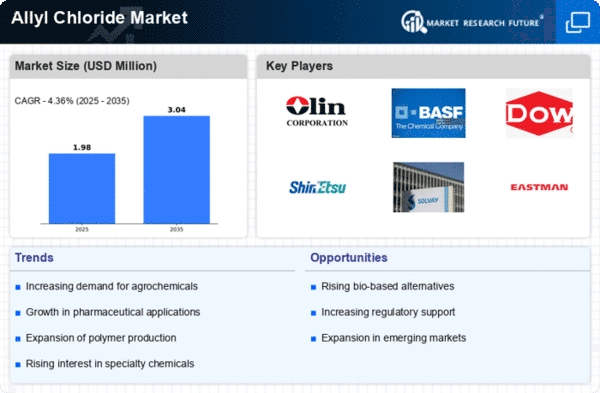
As per MRFR analysis, the Allyl Chloride Market Size was estimated at 1.9 USD Million in 2024. The Allyl Chloride industry is projected to grow from 1.98 in 2025 to 3.04 by 2035, exhibiting a compound annual growth rate (CAGR) of 4.36% during the forecast period 2025 - 2035.

Key Market Trends & Highlights

The Allyl Chloride Market is poised for growth driven by diverse applications and regional dynamics.

  • North America remains the largest market for allyl chloride, primarily due to its extensive use in chemical synthesis.
  • The Asia-Pacific region is emerging as the fastest-growing market, fueled by increasing demand in the agriculture sector.
  • The chemical synthesis segment dominates the market, while the pharmaceutical segment is experiencing rapid growth.
  • Key drivers include the rising demand for allyl chloride in chemical synthesis and the expansion of its applications in the agrochemical sector.

Market Size & Forecast

2024 Market Size 1.9 (USD Million)
2035 Market Size 3.04 (USD Million)
CAGR (2025 - 2035) 4.36%
Largest Regional Market Share in 2024 North America

Major Players

Olin Corporation (US), BASF SE (DE), Dow Chemical Company (US), Shin-Etsu Chemical Co., Ltd. (JP), Solvay S.A. (BE), Eastman Chemical Company (US), Huntsman Corporation (US), Kraton Corporation (US)

Market Trends

The Allyl Chloride Market is currently experiencing a dynamic phase characterized by evolving applications and increasing demand across various sectors. This compound, primarily utilized in the production of agrochemicals, pharmaceuticals, and polymers, appears to be gaining traction due to its versatility and effectiveness. The market landscape is influenced by several factors, including technological advancements, regulatory frameworks, and shifting consumer preferences. As industries seek more sustainable and efficient solutions, the demand for allyl chloride is likely to expand, reflecting broader trends in chemical manufacturing and environmental considerations. Moreover, the competitive environment within the Allyl Chloride Market is intensifying, with numerous players striving to innovate and enhance their product offerings. Companies are focusing on research and development to create more efficient production methods and explore new applications. This trend suggests a potential for growth, as stakeholders aim to meet the evolving needs of end-users. Additionally, The Allyl Chloride towards greener alternatives, influencing production practices and product formulations. Overall, the Allyl Chloride Market is poised for transformation, with opportunities for growth and innovation on the horizon.

Rising Demand in Agrochemicals

The Allyl Chloride Market is witnessing an increase in demand from the agrochemical sector. This trend is driven by the need for effective crop protection solutions and the development of advanced fertilizers. As agricultural practices evolve, the role of allyl chloride in formulating innovative agrochemicals is becoming more prominent.

Technological Advancements in Production

Innovations in production techniques are shaping the Allyl Chloride Market. Enhanced manufacturing processes are likely to improve efficiency and reduce environmental impact. These advancements may lead to cost-effective solutions, making allyl chloride more accessible to various industries.

Focus on Sustainable Practices

There is a growing emphasis on sustainability within the Allyl Chloride Market. Companies are increasingly adopting eco-friendly practices and exploring greener alternatives. This shift reflects a broader commitment to environmental responsibility, potentially influencing product development and market dynamics.

Allyl Chloride Market Market Drivers

Market Growth Projections

The Global Allyl Chloride Market Industry is projected to experience substantial growth over the next decade. With an estimated market value of 2.18 USD Billion in 2024 and a forecasted increase to 3.48 USD Billion by 2035, the industry is on a promising trajectory. The compound annual growth rate of 4.32% from 2025 to 2035 indicates a sustained upward trend, driven by various factors including increased demand from end-use industries and technological advancements. These projections highlight the market's potential and the opportunities that lie ahead for stakeholders.

Expansion of End-Use Industries

The expansion of end-use industries is a significant driver for the Global Allyl Chloride Market Industry. Sectors such as automotive, construction, and electronics are increasingly utilizing allyl chloride in the production of advanced materials and coatings. This trend is likely to enhance the market's growth, as these industries are projected to expand substantially over the next decade. The anticipated growth in these sectors suggests a potential increase in allyl chloride consumption, contributing to the market's expected valuation of 3.48 USD Billion by 2035. Such developments indicate a strong correlation between industry growth and allyl chloride demand.

Regulatory Support for Chemical Safety

Regulatory support for chemical safety is increasingly shaping the Global Allyl Chloride Market Industry. Governments worldwide are implementing stringent regulations to ensure the safe handling and use of chemicals, including allyl chloride. This regulatory framework is fostering a safer operational environment, encouraging manufacturers to comply with safety standards. As a result, companies are investing in safer production practices and technologies, which may enhance the industry's reputation and marketability. This regulatory landscape is likely to drive growth, as compliance can lead to increased market access and consumer trust.

Growing Demand in Chemical Manufacturing

The Global Allyl Chloride Market Industry is experiencing a notable surge in demand driven by its extensive applications in chemical manufacturing. This compound serves as a vital intermediate in the production of various chemicals, including glycerol and epoxy resins. As industries increasingly seek efficient and versatile chemical solutions, the market is projected to reach 2.18 USD Billion in 2024, reflecting a robust growth trajectory. The rising need for specialty chemicals across sectors such as pharmaceuticals and agriculture further fuels this demand, indicating a promising outlook for the industry in the coming years.

Technological Advancements in Production

Technological advancements in the production of allyl chloride are poised to significantly impact the Global Allyl Chloride Market Industry. Innovations in synthesis methods and process optimization are enhancing production efficiency and reducing costs. These advancements not only improve yield but also minimize environmental impact, aligning with global sustainability goals. As manufacturers adopt these technologies, the market is expected to benefit from increased production capacity and lower operational costs. This trend may contribute to a compound annual growth rate of 4.32% from 2025 to 2035, indicating a robust future for the industry.

Market Diversification and Product Innovation

Market diversification and product innovation are critical drivers of the Global Allyl Chloride Market Industry. Manufacturers are exploring new applications and formulations to meet the evolving needs of various industries. This includes the development of novel derivatives and blends that enhance performance characteristics. Such innovations not only cater to existing market demands but also open new avenues for growth. As companies invest in research and development, the market is likely to witness an influx of innovative products, further solidifying its position in the global chemical landscape.

Market Segment Insights

By Application: Chemical Synthesis (Largest) vs. Pharmaceuticals (Fastest-Growing)

In the Allyl Chloride Market, Chemical Synthesis holds the largest segment share due to its extensive use in producing various chemicals and intermediates. Following closely are Pharmaceuticals, Agricultural Chemicals, and Polymer Production, which are also significant but smaller in proportion. The market dynamics display a strong preference towards application areas that leverage the unique properties of allyl chloride, resulting in a competitive landscape among these segments.

Chemical Synthesis (Dominant) vs. Pharmaceuticals (Emerging)

Chemical Synthesis remains the dominant force in the Allyl Chloride Market, utilizing allyl chloride as a key raw material for synthesizing a wide array of chemical compounds. This segment benefits from established industrial practices and stable demand. Conversely, Pharmaceuticals is an emerging segment, experiencing rapid growth driven by increasing innovation in drug development and a growing focus on specialty chemicals. The use of allyl chloride in pharmaceuticals extends to creating active pharmaceutical ingredients (APIs) and its derivatives, promising a lucrative opportunity as pharmaceutical companies aim to enhance their formulations. The contrast between these segments demonstrates the broader applicability of allyl chloride in both traditional and new market areas.

By End Use Industry: Chemical Manufacturing (Largest) vs. Agriculture (Fastest-Growing)

<p>The Allyl Chloride Market shows a diverse distribution of market share among its end-use industries. Chemical manufacturing holds the largest portion due to its extensive applications in producing various chemical intermediates. Agriculture is also a significant sector utilizing allyl chloride in herbicides and other formulations, albeit with a relatively smaller share. The pharmaceuticals and plastics industries also contribute to the market, albeit to a lesser extent, highlighting the diversified nature of allyl chloride's applications across various sectors.</p>

<p>Chemical Manufacturing (Dominant) vs. Agriculture (Emerging)</p>

<p>In the Allyl Chloride Market, chemical manufacturing stands out as the dominant end-use industry, leveraging allyl chloride extensively for synthesizing various chemicals, ranging from epoxides to organics used in coatings. The established nature of this sector ensures a consistent demand for allyl chloride, driving its usage in multitude of applications. Conversely, agriculture is emerging strongly, particularly with innovations in agrochemicals that utilize allyl chloride-derived products. This growth is fueled by the increasing need for effective pest control solutions and sustainable agricultural practices, making agriculture a pivotal player in the future landscape of the allyl chloride market.</p>

By Form: Liquid (Largest) vs. Gas (Fastest-Growing)

In the Allyl Chloride Market, the 'Form' segment showcases a diverse distribution among its values. Liquid form holds the largest share, widely utilized in various industrial applications, primarily due to its favorable handling and transportation properties. Gas form, while smaller in overall market share, is witnessing significant growth as advancements in technology streamline its production and application processes. The solid form, though present, remains a niche market with limited applications in comparison.

Form: Liquid (Dominant) vs. Gas (Emerging)

The liquid form of allyl chloride is the dominant player in this market, preferred for its versatility and effectiveness in a range of chemical processes. Its superior stability, ease of storage, and handling lead to its widespread adoption in industries such as pharmaceuticals and agriculture. In contrast, gas form is emerging rapidly, driven by increasing demand in specific applications like specialized synthesis where gaseous reagents provide unique advantages. This shift is partly propelled by innovations that enhance the efficiency of gas utilization, making it an attractive option for emerging applications, thus marking a significant evolution in the Allyl Chloride Market.

By Purity Level: High Purity (Largest) vs. Medium Purity (Fastest-Growing)

<p>The Allyl Chloride Market exhibits a clear distribution of market shares across different purity levels. High Purity products dominate the market due to their superior quality and application in industries that demand stringent material standards. In parallel, Medium Purity has begun to carve out a significant presence, capturing attention for applications where budget constraints are pivotal but quality is still essential. Low Purity products likely hold a smaller share, primarily appealing to niche markets or applications less sensitive to purity standards. Growth trends indicate that the segment for High Purity Allyl Chloride will continue to thrive, driven by increasing demand from sectors such as pharmaceuticals and specialty chemicals where purity is non-negotiable. Conversely, Medium Purity is recognized as the fastest-growing segment, as businesses seek cost-effective solutions without compromising on quality. This trend is also fueled by the overarching need for sustainable practices which guide decisions toward more economical options.</p>

<p>High Purity (Dominant) vs. Medium Purity (Emerging)</p>

<p>High Purity Allyl Chloride represents the dominant segment of the market, characterized by its application in high-stakes industries such as pharmaceuticals and <a href="https://www.marketresearchfuture.com/reports/advanced-material-market-11431" target="_blank" title="advanced material">advanced materials</a>, where the stakes of purity are critical. This segment's growth is driven by stringent regulatory frameworks and a constant demand for the highest quality outputs. In contrast, Medium Purity products are emerging as a viable alternative, offering a balance between quality and cost. They cater to a broad base of applications, particularly in sectors that require moderate standards yet remain price-sensitive. The growing preference for Medium Purity is indicative of market shifts towards efficiency without the full premium of high purity, making it an attractive option amidst fluctuating economic conditions.</p>

By Distribution Channel: Direct Sales (Largest) vs. Online Sales (Fastest-Growing)

<p>In the Allyl Chloride Market, the distribution channels play a crucial role in reaching various consumer segments. Direct Sales represents the largest share of the market due to established relationships and trust between manufacturers and end-users. This channel leverages direct contact with clients, guaranteeing a tailored approach and immediate feedback, which can be instrumental for product innovation and customer satisfaction. Online Sales, while currently smaller in market share, is rapidly expanding as digital transformation pushes more transactions online, particularly among tech-savvy consumers. The growth trends for distribution channels in the Allyl Chloride Market are heavily influenced by changing buyer behaviors and advancements in technology. Distributors continue to face stiff competition from direct sales, which provide more personalized service. However, the online sales channel is emerging as a strong contender, driven by consumers' increasing preference for convenience and accessibility. The ease of online transactions is propelling this segment, attracting not only individual buyers but also small-to-medium enterprises looking to procure onions efficiently, thereby altering the competitive landscape of the market.</p>

<p>Direct Sales (Dominant) vs. Online Sales (Emerging)</p>

<p>Direct Sales in the Allyl Chloride Market remains a dominant force due to its ability to foster direct relationships with clients, ensuring high levels of customer satisfaction and loyalty. This channel allows manufacturers to communicate their value propositions face-to-face, facilitating tailored solutions for specific customer needs. On the other hand, Online Sales is an emerging segment that is revolutionizing how transactions take place. This mode offers a convenient platform for consumers to access products without geographical barriers. The rising preference for online solutions is compelling traditional players to rethink their distribution strategies. As more industries embrace e-commerce, Online Sales is likely to expand its footprint, appealing to a broader audience and enhancing market competition.</p>

Get more detailed insights about Allyl Chloride Market Research Report - Forecast to 2035

Regional Insights

Key Players and Competitive Insights

The Allyl Chloride Market exhibits a dynamic competitive landscape characterized by a blend of innovation, strategic partnerships, and regional expansion. Key players such as Olin Corporation (US), BASF SE (DE), and Dow Chemical Company (US) are at the forefront, each employing distinct strategies to enhance their market positioning. Olin Corporation (US) focuses on expanding its production capabilities, which appears to be a response to increasing global demand for specialty chemicals. Meanwhile, BASF SE (DE) emphasizes sustainability in its operations, aligning with the growing trend towards environmentally friendly practices. Dow Chemical Company (US) is leveraging digital transformation to optimize its supply chain, thereby enhancing efficiency and responsiveness to market changes. Collectively, these strategies contribute to a competitive environment that is increasingly shaped by innovation and sustainability initiatives.In terms of business tactics, companies are localizing manufacturing to reduce logistics costs and improve supply chain resilience. The market structure is moderately fragmented, with several players vying for market share, yet the influence of major companies remains substantial. This competitive structure allows for a variety of strategies to coexist, fostering an environment where innovation and operational efficiency are paramount.

In November Olin Corporation (US) announced the opening of a new production facility in Texas, aimed at increasing its output of allyl chloride. This strategic move is likely to enhance Olin's ability to meet the rising demand in North America, positioning the company favorably against its competitors. The facility is expected to utilize advanced manufacturing technologies, which may further improve production efficiency and reduce environmental impact.

In October BASF SE (DE) launched a new line of sustainable allyl chloride derivatives, which underscores its commitment to sustainability and innovation. This initiative not only caters to the increasing consumer demand for eco-friendly products but also strengthens BASF's market position by differentiating its offerings. The introduction of these derivatives could potentially attract new customers who prioritize sustainability in their purchasing decisions.

In September Dow Chemical Company (US) entered into a strategic partnership with a leading technology firm to enhance its digital capabilities in the production of allyl chloride. This collaboration aims to integrate AI and machine learning into its manufacturing processes, which may lead to significant improvements in operational efficiency and product quality. Such advancements are likely to set Dow apart from competitors who may not be as technologically advanced.

As of December the competitive trends in the Allyl Chloride Market are increasingly defined by digitalization, sustainability, and technological integration. Strategic alliances are becoming more prevalent, as companies recognize the need to collaborate to enhance their capabilities and market reach. Looking ahead, competitive differentiation is expected to evolve, shifting from traditional price-based competition to a focus on innovation, technology, and supply chain reliability. This transition may redefine how companies compete, emphasizing the importance of agility and responsiveness in a rapidly changing market.

Key Companies in the Allyl Chloride Market include

Industry Developments

November 2021: Manufacturers of specialty chemicals, such as Galaxy Surfactants, the market leader in alkyl polyglucoside surfactants, continue to benefit from robust demand, but supply chain constraints are limiting the advantages. The September quarter performance reflected the same. However, the company's total revenues increased by 22% year on year in the September quarter, supported by improved realisations. Galaxy's stock prices increased by more than 3% in early trading. Volumes in all areas were modest, including surfactants and specialist care products. The supply chain for critical raw materials presented issues, and increased input costs had an adverse effect on operating performance.

Supply-side restrictions were exacerbated by volatility in feedstock costs, unavailability of important feedstocks, and extended lead times.

INOVYN, a UK based chemical company, launched an environmentally sustainable and bio-based new allyl chloride into the market in March 2023 to expand its specialty chemicals products range as well as enhance environmental sustainability.Kashima Chemicals has been actively involved in producing allyl chloride. In 2024, it still maintained its strong presence in the specialty chemical markets, especially because of unremitting innovations in the area of allyl chloride.On May 2023, the Dongying Economic and Technological Development Zone of Shandong Province approved a new project by Dongying Yi Rui Zengnew Material Technology Co.

LTD., which aim is to develop electronic-grade epoxy resin and brand-new special resin materials with an annual capacity of 200k tons.Osaka Soda Co., Ltd., another major player in the allyl chloride market, has been focusing on developing and commercializing allyl chloride as well as derivatives. It is important, however, that as of March 2024, the firm still intends to broaden its product range while keeping hold of its market share through intensive research and development.UK’s major chemical firm INOVYN innovated a new product in the field of allyl chlorides in March 2023.

It comprises an environment-friendly version made out of bio-based substances, hence addressing concerns for the surrounding area while various eco-chemical solutions are being sought. Here, INOVYN demonstrates its dedication to a better future through greener alternatives rather than traditional Allyl Chloride Market products.Gelest Inc., a specialized chemicals producer located in the USA, announced a strategic partnership with a leading Asian corporation manufacturing chemicals in January 2022.

The goal was to expand Gelest’s position within the Ally Chloride market by enhancing supply chain capabilities and increasing its customer base across the APAC region.In June 2021, BASF SE, a Germany-based global chemical company, has revealed its intention to amplify the production of Allyl Chloride Market. The organization is contemplating on creating a new plant in Ludwigshafen, Germany so as to meet increasing demands from major sectors like pharmaceuticals, plastics and agrochemicals.

Future Outlook

Allyl Chloride Market Future Outlook

The Allyl Chloride Market is projected to grow at a 4.36% CAGR from 2025 to 2035, driven by increasing demand in pharmaceuticals, agrochemicals, and specialty chemicals.

New opportunities lie in:

  • Expansion into emerging markets with tailored product offerings.
  • Development of eco-friendly production processes to attract sustainability-focused clients.
  • Investment in R&D for innovative applications in polymer manufacturing.

By 2035, the Allyl Chloride Market is expected to achieve robust growth, solidifying its global presence.

Market Segmentation

Allyl Chloride Market Form Outlook

  • Liquid
  • Gas
  • Solid

Allyl Chloride Market End Use Outlook

  • Chemical Manufacturing
  • Agriculture
  • Pharmaceutical Industry
  • Plastic Industry

Allyl Chloride Market Application Outlook

  • Chemical Synthesis
  • Pharmaceuticals
  • Agricultural Chemicals
  • Polymer Production

Allyl Chloride Market Purity Level Outlook

  • High Purity
  • Standard Purity
  • Technical Grade

Allyl Chloride Market Distribution Channel Outlook

  • Direct Sales
  • Distributors
  • Online Sales

Report Scope

MARKET SIZE 2024 1.9(USD Million)
MARKET SIZE 2025 1.98(USD Million)
MARKET SIZE 2035 3.04(USD Million)
COMPOUND ANNUAL GROWTH RATE (CAGR) 4.36% (2025 - 2035)
REPORT COVERAGE Revenue Forecast, Competitive Landscape, Growth Factors, and Trends
BASE YEAR 2024
Market Forecast Period 2025 - 2035
Historical Data 2019 - 2024
Market Forecast Units USD Million
Key Companies Profiled Olin Corporation (US), BASF SE (DE), Dow Chemical Company (US), Shin-Etsu Chemical Co., Ltd. (JP), Solvay S.A. (BE), Eastman Chemical Company (US), Huntsman Corporation (US), Kraton Corporation (US)
Segments Covered Application, End Use, Form, Purity Level, Distribution Channel
Key Market Opportunities Growing demand for bio-based chemicals presents opportunities in the Allyl Chloride Market.
Key Market Dynamics Rising demand for allyl chloride in pharmaceuticals drives competitive dynamics and regulatory scrutiny in chemical manufacturing.
Countries Covered North America, Europe, APAC, South America, MEA

FAQs

What is the projected market valuation of the Allyl Chloride Market by 2035?

<p>The Allyl Chloride Market is projected to reach a valuation of 3.04 USD Million by 2035.</p>

What was the market valuation of the Allyl Chloride Market in 2024?

<p>In 2024, the Allyl Chloride Market had a valuation of 1.9 USD Million.</p>

What is the expected CAGR for the Allyl Chloride Market during the forecast period 2025 - 2035?

<p>The expected CAGR for the Allyl Chloride Market during the forecast period 2025 - 2035 is 4.36%.</p>

Which companies are considered key players in the Allyl Chloride Market?

<p>Key players in the Allyl Chloride Market include Olin Corporation, BASF SE, Dow Chemical Company, and Shin-Etsu Chemical Co., Ltd.</p>

What are the primary applications of Allyl Chloride?

<p>The primary applications of Allyl Chloride include Chemical Synthesis, Pharmaceuticals, Agricultural Chemicals, and Polymer Production.</p>

How does the Allyl Chloride Market segment by end-use industry?

The market segments by end-use industry include Chemical Manufacturing, Agriculture, Pharmaceuticals, and Plastics.

What forms of Allyl Chloride are available in the market?

Allyl Chloride is available in various forms, including Liquid, Gas, and Solid.

What purity levels are offered in the Allyl Chloride Market?

The Allyl Chloride Market offers products in Low Purity, Medium Purity, and High Purity levels.

How is the distribution of Allyl Chloride managed?

Distribution channels for Allyl Chloride include Direct Sales, Distributors, and Online Sales.

What was the valuation of the Chemical Synthesis segment in 2024?

The valuation of the Chemical Synthesis segment in 2024 was 0.76 USD Million.

  1. SECTION I: EXECUTIVE SUMMARY AND KEY HIGHLIGHTS
    1. | 1.1 EXECUTIVE SUMMARY
    2. | | 1.1.1 Market Overview
    3. | | 1.1.2 Key Findings
    4. | | 1.1.3 Market Segmentation
    5. | | 1.1.4 Competitive Landscape
    6. | | 1.1.5 Challenges and Opportunities
    7. | | 1.1.6 Future Outlook
  2. SECTION II: SCOPING, METHODOLOGY AND MARKET STRUCTURE
    1. | 2.1 MARKET INTRODUCTION
    2. | | 2.1.1 Definition
    3. | | 2.1.2 Scope of the study
    4. | | | 2.1.2.1 Research Objective
    5. | | | 2.1.2.2 Assumption
    6. | | | 2.1.2.3 Limitations
    7. | 2.2 RESEARCH METHODOLOGY
    8. | | 2.2.1 Overview
    9. | | 2.2.2 Data Mining
    10. | | 2.2.3 Secondary Research
    11. | | 2.2.4 Primary Research
    12. | | | 2.2.4.1 Primary Interviews and Information Gathering Process
    13. | | | 2.2.4.2 Breakdown of Primary Respondents
    14. | | 2.2.5 Forecasting Model
    15. | | 2.2.6 Market Size Estimation
    16. | | | 2.2.6.1 Bottom-Up Approach
    17. | | | 2.2.6.2 Top-Down Approach
    18. | | 2.2.7 Data Triangulation
    19. | | 2.2.8 Validation
  3. SECTION III: QUALITATIVE ANALYSIS
    1. | 3.1 MARKET DYNAMICS
    2. | | 3.1.1 Overview
    3. | | 3.1.2 Drivers
    4. | | 3.1.3 Restraints
    5. | | 3.1.4 Opportunities
    6. | 3.2 MARKET FACTOR ANALYSIS
    7. | | 3.2.1 Value chain Analysis
    8. | | 3.2.2 Porter's Five Forces Analysis
    9. | | | 3.2.2.1 Bargaining Power of Suppliers
    10. | | | 3.2.2.2 Bargaining Power of Buyers
    11. | | | 3.2.2.3 Threat of New Entrants
    12. | | | 3.2.2.4 Threat of Substitutes
    13. | | | 3.2.2.5 Intensity of Rivalry
    14. | | 3.2.3 COVID-19 Impact Analysis
    15. | | | 3.2.3.1 Market Impact Analysis
    16. | | | 3.2.3.2 Regional Impact
    17. | | | 3.2.3.3 Opportunity and Threat Analysis
  4. SECTION IV: QUANTITATIVE ANALYSIS
    1. | 4.1 Chemicals and Materials, BY Application (USD Million)
    2. | | 4.1.1 Chemical Synthesis
    3. | | 4.1.2 Pharmaceuticals
    4. | | 4.1.3 Agricultural Chemicals
    5. | | 4.1.4 Polymer Production
    6. | 4.2 Chemicals and Materials, BY End Use Industry (USD Million)
    7. | | 4.2.1 Chemical Manufacturing
    8. | | 4.2.2 Agriculture
    9. | | 4.2.3 Pharmaceuticals
    10. | | 4.2.4 Plastics
    11. | 4.3 Chemicals and Materials, BY Form (USD Million)
    12. | | 4.3.1 Liquid
    13. | | 4.3.2 Gas
    14. | | 4.3.3 Solid
    15. | 4.4 Chemicals and Materials, BY Purity Level (USD Million)
    16. | | 4.4.1 Low Purity
    17. | | 4.4.2 Medium Purity
    18. | | 4.4.3 High Purity
    19. | 4.5 Chemicals and Materials, BY Distribution Channel (USD Million)
    20. | | 4.5.1 Direct Sales
    21. | | 4.5.2 Distributors
    22. | | 4.5.3 Online Sales
    23. | 4.6 Chemicals and Materials, BY Region (USD Million)
    24. | | 4.6.1 North America
    25. | | | 4.6.1.1 US
    26. | | | 4.6.1.2 Canada
    27. | | 4.6.2 Europe
    28. | | | 4.6.2.1 Germany
    29. | | | 4.6.2.2 UK
    30. | | | 4.6.2.3 France
    31. | | | 4.6.2.4 Russia
    32. | | | 4.6.2.5 Italy
    33. | | | 4.6.2.6 Spain
    34. | | | 4.6.2.7 Rest of Europe
    35. | | 4.6.3 APAC
    36. | | | 4.6.3.1 China
    37. | | | 4.6.3.2 India
    38. | | | 4.6.3.3 Japan
    39. | | | 4.6.3.4 South Korea
    40. | | | 4.6.3.5 Malaysia
    41. | | | 4.6.3.6 Thailand
    42. | | | 4.6.3.7 Indonesia
    43. | | | 4.6.3.8 Rest of APAC
    44. | | 4.6.4 South America
    45. | | | 4.6.4.1 Brazil
    46. | | | 4.6.4.2 Mexico
    47. | | | 4.6.4.3 Argentina
    48. | | | 4.6.4.4 Rest of South America
    49. | | 4.6.5 MEA
    50. | | | 4.6.5.1 GCC Countries
    51. | | | 4.6.5.2 South Africa
    52. | | | 4.6.5.3 Rest of MEA
  5. SECTION V: COMPETITIVE ANALYSIS
    1. | 5.1 Competitive Landscape
    2. | | 5.1.1 Overview
    3. | | 5.1.2 Competitive Analysis
    4. | | 5.1.3 Market share Analysis
    5. | | 5.1.4 Major Growth Strategy in the Chemicals and Materials
    6. | | 5.1.5 Competitive Benchmarking
    7. | | 5.1.6 Leading Players in Terms of Number of Developments in the Chemicals and Materials
    8. | | 5.1.7 Key developments and growth strategies
    9. | | | 5.1.7.1 New Product Launch/Service Deployment
    10. | | | 5.1.7.2 Merger & Acquisitions
    11. | | | 5.1.7.3 Joint Ventures
    12. | | 5.1.8 Major Players Financial Matrix
    13. | | | 5.1.8.1 Sales and Operating Income
    14. | | | 5.1.8.2 Major Players R&D Expenditure. 2023
    15. | 5.2 Company Profiles
    16. | | 5.2.1 Olin Corporation (US)
    17. | | | 5.2.1.1 Financial Overview
    18. | | | 5.2.1.2 Products Offered
    19. | | | 5.2.1.3 Key Developments
    20. | | | 5.2.1.4 SWOT Analysis
    21. | | | 5.2.1.5 Key Strategies
    22. | | 5.2.2 BASF SE (DE)
    23. | | | 5.2.2.1 Financial Overview
    24. | | | 5.2.2.2 Products Offered
    25. | | | 5.2.2.3 Key Developments
    26. | | | 5.2.2.4 SWOT Analysis
    27. | | | 5.2.2.5 Key Strategies
    28. | | 5.2.3 Dow Chemical Company (US)
    29. | | | 5.2.3.1 Financial Overview
    30. | | | 5.2.3.2 Products Offered
    31. | | | 5.2.3.3 Key Developments
    32. | | | 5.2.3.4 SWOT Analysis
    33. | | | 5.2.3.5 Key Strategies
    34. | | 5.2.4 Shin-Etsu Chemical Co., Ltd. (JP)
    35. | | | 5.2.4.1 Financial Overview
    36. | | | 5.2.4.2 Products Offered
    37. | | | 5.2.4.3 Key Developments
    38. | | | 5.2.4.4 SWOT Analysis
    39. | | | 5.2.4.5 Key Strategies
    40. | | 5.2.5 Solvay S.A. (BE)
    41. | | | 5.2.5.1 Financial Overview
    42. | | | 5.2.5.2 Products Offered
    43. | | | 5.2.5.3 Key Developments
    44. | | | 5.2.5.4 SWOT Analysis
    45. | | | 5.2.5.5 Key Strategies
    46. | | 5.2.6 Eastman Chemical Company (US)
    47. | | | 5.2.6.1 Financial Overview
    48. | | | 5.2.6.2 Products Offered
    49. | | | 5.2.6.3 Key Developments
    50. | | | 5.2.6.4 SWOT Analysis
    51. | | | 5.2.6.5 Key Strategies
    52. | | 5.2.7 Huntsman Corporation (US)
    53. | | | 5.2.7.1 Financial Overview
    54. | | | 5.2.7.2 Products Offered
    55. | | | 5.2.7.3 Key Developments
    56. | | | 5.2.7.4 SWOT Analysis
    57. | | | 5.2.7.5 Key Strategies
    58. | | 5.2.8 Kraton Corporation (US)
    59. | | | 5.2.8.1 Financial Overview
    60. | | | 5.2.8.2 Products Offered
    61. | | | 5.2.8.3 Key Developments
    62. | | | 5.2.8.4 SWOT Analysis
    63. | | | 5.2.8.5 Key Strategies
    64. | 5.3 Appendix
    65. | | 5.3.1 References
    66. | | 5.3.2 Related Reports
  6. LIST OF FIGURES
    1. | 6.1 MARKET SYNOPSIS
    2. | 6.2 NORTH AMERICA MARKET ANALYSIS
    3. | 6.3 US MARKET ANALYSIS BY APPLICATION
    4. | 6.4 US MARKET ANALYSIS BY END USE INDUSTRY
    5. | 6.5 US MARKET ANALYSIS BY FORM
    6. | 6.6 US MARKET ANALYSIS BY PURITY LEVEL
    7. | 6.7 US MARKET ANALYSIS BY DISTRIBUTION CHANNEL
    8. | 6.8 CANADA MARKET ANALYSIS BY APPLICATION
    9. | 6.9 CANADA MARKET ANALYSIS BY END USE INDUSTRY
    10. | 6.10 CANADA MARKET ANALYSIS BY FORM
    11. | 6.11 CANADA MARKET ANALYSIS BY PURITY LEVEL
    12. | 6.12 CANADA MARKET ANALYSIS BY DISTRIBUTION CHANNEL
    13. | 6.13 EUROPE MARKET ANALYSIS
    14. | 6.14 GERMANY MARKET ANALYSIS BY APPLICATION
    15. | 6.15 GERMANY MARKET ANALYSIS BY END USE INDUSTRY
    16. | 6.16 GERMANY MARKET ANALYSIS BY FORM
    17. | 6.17 GERMANY MARKET ANALYSIS BY PURITY LEVEL
    18. | 6.18 GERMANY MARKET ANALYSIS BY DISTRIBUTION CHANNEL
    19. | 6.19 UK MARKET ANALYSIS BY APPLICATION
    20. | 6.20 UK MARKET ANALYSIS BY END USE INDUSTRY
    21. | 6.21 UK MARKET ANALYSIS BY FORM
    22. | 6.22 UK MARKET ANALYSIS BY PURITY LEVEL
    23. | 6.23 UK MARKET ANALYSIS BY DISTRIBUTION CHANNEL
    24. | 6.24 FRANCE MARKET ANALYSIS BY APPLICATION
    25. | 6.25 FRANCE MARKET ANALYSIS BY END USE INDUSTRY
    26. | 6.26 FRANCE MARKET ANALYSIS BY FORM
    27. | 6.27 FRANCE MARKET ANALYSIS BY PURITY LEVEL
    28. | 6.28 FRANCE MARKET ANALYSIS BY DISTRIBUTION CHANNEL
    29. | 6.29 RUSSIA MARKET ANALYSIS BY APPLICATION
    30. | 6.30 RUSSIA MARKET ANALYSIS BY END USE INDUSTRY
    31. | 6.31 RUSSIA MARKET ANALYSIS BY FORM
    32. | 6.32 RUSSIA MARKET ANALYSIS BY PURITY LEVEL
    33. | 6.33 RUSSIA MARKET ANALYSIS BY DISTRIBUTION CHANNEL
    34. | 6.34 ITALY MARKET ANALYSIS BY APPLICATION
    35. | 6.35 ITALY MARKET ANALYSIS BY END USE INDUSTRY
    36. | 6.36 ITALY MARKET ANALYSIS BY FORM
    37. | 6.37 ITALY MARKET ANALYSIS BY PURITY LEVEL
    38. | 6.38 ITALY MARKET ANALYSIS BY DISTRIBUTION CHANNEL
    39. | 6.39 SPAIN MARKET ANALYSIS BY APPLICATION
    40. | 6.40 SPAIN MARKET ANALYSIS BY END USE INDUSTRY
    41. | 6.41 SPAIN MARKET ANALYSIS BY FORM
    42. | 6.42 SPAIN MARKET ANALYSIS BY PURITY LEVEL
    43. | 6.43 SPAIN MARKET ANALYSIS BY DISTRIBUTION CHANNEL
    44. | 6.44 REST OF EUROPE MARKET ANALYSIS BY APPLICATION
    45. | 6.45 REST OF EUROPE MARKET ANALYSIS BY END USE INDUSTRY
    46. | 6.46 REST OF EUROPE MARKET ANALYSIS BY FORM
    47. | 6.47 REST OF EUROPE MARKET ANALYSIS BY PURITY LEVEL
    48. | 6.48 REST OF EUROPE MARKET ANALYSIS BY DISTRIBUTION CHANNEL
    49. | 6.49 APAC MARKET ANALYSIS
    50. | 6.50 CHINA MARKET ANALYSIS BY APPLICATION
    51. | 6.51 CHINA MARKET ANALYSIS BY END USE INDUSTRY
    52. | 6.52 CHINA MARKET ANALYSIS BY FORM
    53. | 6.53 CHINA MARKET ANALYSIS BY PURITY LEVEL
    54. | 6.54 CHINA MARKET ANALYSIS BY DISTRIBUTION CHANNEL
    55. | 6.55 INDIA MARKET ANALYSIS BY APPLICATION
    56. | 6.56 INDIA MARKET ANALYSIS BY END USE INDUSTRY
    57. | 6.57 INDIA MARKET ANALYSIS BY FORM
    58. | 6.58 INDIA MARKET ANALYSIS BY PURITY LEVEL
    59. | 6.59 INDIA MARKET ANALYSIS BY DISTRIBUTION CHANNEL
    60. | 6.60 JAPAN MARKET ANALYSIS BY APPLICATION
    61. | 6.61 JAPAN MARKET ANALYSIS BY END USE INDUSTRY
    62. | 6.62 JAPAN MARKET ANALYSIS BY FORM
    63. | 6.63 JAPAN MARKET ANALYSIS BY PURITY LEVEL
    64. | 6.64 JAPAN MARKET ANALYSIS BY DISTRIBUTION CHANNEL
    65. | 6.65 SOUTH KOREA MARKET ANALYSIS BY APPLICATION
    66. | 6.66 SOUTH KOREA MARKET ANALYSIS BY END USE INDUSTRY
    67. | 6.67 SOUTH KOREA MARKET ANALYSIS BY FORM
    68. | 6.68 SOUTH KOREA MARKET ANALYSIS BY PURITY LEVEL
    69. | 6.69 SOUTH KOREA MARKET ANALYSIS BY DISTRIBUTION CHANNEL
    70. | 6.70 MALAYSIA MARKET ANALYSIS BY APPLICATION
    71. | 6.71 MALAYSIA MARKET ANALYSIS BY END USE INDUSTRY
    72. | 6.72 MALAYSIA MARKET ANALYSIS BY FORM
    73. | 6.73 MALAYSIA MARKET ANALYSIS BY PURITY LEVEL
    74. | 6.74 MALAYSIA MARKET ANALYSIS BY DISTRIBUTION CHANNEL
    75. | 6.75 THAILAND MARKET ANALYSIS BY APPLICATION
    76. | 6.76 THAILAND MARKET ANALYSIS BY END USE INDUSTRY
    77. | 6.77 THAILAND MARKET ANALYSIS BY FORM
    78. | 6.78 THAILAND MARKET ANALYSIS BY PURITY LEVEL
    79. | 6.79 THAILAND MARKET ANALYSIS BY DISTRIBUTION CHANNEL
    80. | 6.80 INDONESIA MARKET ANALYSIS BY APPLICATION
    81. | 6.81 INDONESIA MARKET ANALYSIS BY END USE INDUSTRY
    82. | 6.82 INDONESIA MARKET ANALYSIS BY FORM
    83. | 6.83 INDONESIA MARKET ANALYSIS BY PURITY LEVEL
    84. | 6.84 INDONESIA MARKET ANALYSIS BY DISTRIBUTION CHANNEL
    85. | 6.85 REST OF APAC MARKET ANALYSIS BY APPLICATION
    86. | 6.86 REST OF APAC MARKET ANALYSIS BY END USE INDUSTRY
    87. | 6.87 REST OF APAC MARKET ANALYSIS BY FORM
    88. | 6.88 REST OF APAC MARKET ANALYSIS BY PURITY LEVEL
    89. | 6.89 REST OF APAC MARKET ANALYSIS BY DISTRIBUTION CHANNEL
    90. | 6.90 SOUTH AMERICA MARKET ANALYSIS
    91. | 6.91 BRAZIL MARKET ANALYSIS BY APPLICATION
    92. | 6.92 BRAZIL MARKET ANALYSIS BY END USE INDUSTRY
    93. | 6.93 BRAZIL MARKET ANALYSIS BY FORM
    94. | 6.94 BRAZIL MARKET ANALYSIS BY PURITY LEVEL
    95. | 6.95 BRAZIL MARKET ANALYSIS BY DISTRIBUTION CHANNEL
    96. | 6.96 MEXICO MARKET ANALYSIS BY APPLICATION
    97. | 6.97 MEXICO MARKET ANALYSIS BY END USE INDUSTRY
    98. | 6.98 MEXICO MARKET ANALYSIS BY FORM
    99. | 6.99 MEXICO MARKET ANALYSIS BY PURITY LEVEL
    100. | 6.100 MEXICO MARKET ANALYSIS BY DISTRIBUTION CHANNEL
    101. | 6.101 ARGENTINA MARKET ANALYSIS BY APPLICATION
    102. | 6.102 ARGENTINA MARKET ANALYSIS BY END USE INDUSTRY
    103. | 6.103 ARGENTINA MARKET ANALYSIS BY FORM
    104. | 6.104 ARGENTINA MARKET ANALYSIS BY PURITY LEVEL
    105. | 6.105 ARGENTINA MARKET ANALYSIS BY DISTRIBUTION CHANNEL
    106. | 6.106 REST OF SOUTH AMERICA MARKET ANALYSIS BY APPLICATION
    107. | 6.107 REST OF SOUTH AMERICA MARKET ANALYSIS BY END USE INDUSTRY
    108. | 6.108 REST OF SOUTH AMERICA MARKET ANALYSIS BY FORM
    109. | 6.109 REST OF SOUTH AMERICA MARKET ANALYSIS BY PURITY LEVEL
    110. | 6.110 REST OF SOUTH AMERICA MARKET ANALYSIS BY DISTRIBUTION CHANNEL
    111. | 6.111 MEA MARKET ANALYSIS
    112. | 6.112 GCC COUNTRIES MARKET ANALYSIS BY APPLICATION
    113. | 6.113 GCC COUNTRIES MARKET ANALYSIS BY END USE INDUSTRY
    114. | 6.114 GCC COUNTRIES MARKET ANALYSIS BY FORM
    115. | 6.115 GCC COUNTRIES MARKET ANALYSIS BY PURITY LEVEL
    116. | 6.116 GCC COUNTRIES MARKET ANALYSIS BY DISTRIBUTION CHANNEL
    117. | 6.117 SOUTH AFRICA MARKET ANALYSIS BY APPLICATION
    118. | 6.118 SOUTH AFRICA MARKET ANALYSIS BY END USE INDUSTRY
    119. | 6.119 SOUTH AFRICA MARKET ANALYSIS BY FORM
    120. | 6.120 SOUTH AFRICA MARKET ANALYSIS BY PURITY LEVEL
    121. | 6.121 SOUTH AFRICA MARKET ANALYSIS BY DISTRIBUTION CHANNEL
    122. | 6.122 REST OF MEA MARKET ANALYSIS BY APPLICATION
    123. | 6.123 REST OF MEA MARKET ANALYSIS BY END USE INDUSTRY
    124. | 6.124 REST OF MEA MARKET ANALYSIS BY FORM
    125. | 6.125 REST OF MEA MARKET ANALYSIS BY PURITY LEVEL
    126. | 6.126 REST OF MEA MARKET ANALYSIS BY DISTRIBUTION CHANNEL
    127. | 6.127 KEY BUYING CRITERIA OF CHEMICALS AND MATERIALS
    128. | 6.128 RESEARCH PROCESS OF MRFR
    129. | 6.129 DRO ANALYSIS OF CHEMICALS AND MATERIALS
    130. | 6.130 DRIVERS IMPACT ANALYSIS: CHEMICALS AND MATERIALS
    131. | 6.131 RESTRAINTS IMPACT ANALYSIS: CHEMICALS AND MATERIALS
    132. | 6.132 SUPPLY / VALUE CHAIN: CHEMICALS AND MATERIALS
    133. | 6.133 CHEMICALS AND MATERIALS, BY APPLICATION, 2024 (% SHARE)
    134. | 6.134 CHEMICALS AND MATERIALS, BY APPLICATION, 2024 TO 2035 (USD Million)
    135. | 6.135 CHEMICALS AND MATERIALS, BY END USE INDUSTRY, 2024 (% SHARE)
    136. | 6.136 CHEMICALS AND MATERIALS, BY END USE INDUSTRY, 2024 TO 2035 (USD Million)
    137. | 6.137 CHEMICALS AND MATERIALS, BY FORM, 2024 (% SHARE)
    138. | 6.138 CHEMICALS AND MATERIALS, BY FORM, 2024 TO 2035 (USD Million)
    139. | 6.139 CHEMICALS AND MATERIALS, BY PURITY LEVEL, 2024 (% SHARE)
    140. | 6.140 CHEMICALS AND MATERIALS, BY PURITY LEVEL, 2024 TO 2035 (USD Million)
    141. | 6.141 CHEMICALS AND MATERIALS, BY DISTRIBUTION CHANNEL, 2024 (% SHARE)
    142. | 6.142 CHEMICALS AND MATERIALS, BY DISTRIBUTION CHANNEL, 2024 TO 2035 (USD Million)
    143. | 6.143 BENCHMARKING OF MAJOR COMPETITORS
  7. LIST OF TABLES
    1. | 7.1 LIST OF ASSUMPTIONS
    2. | | 7.1.1
    3. | 7.2 North America MARKET SIZE ESTIMATES; FORECAST
    4. | | 7.2.1 BY APPLICATION, 2025-2035 (USD Million)
    5. | | 7.2.2 BY END USE INDUSTRY, 2025-2035 (USD Million)
    6. | | 7.2.3 BY FORM, 2025-2035 (USD Million)
    7. | | 7.2.4 BY PURITY LEVEL, 2025-2035 (USD Million)
    8. | | 7.2.5 BY DISTRIBUTION CHANNEL, 2025-2035 (USD Million)
    9. | 7.3 US MARKET SIZE ESTIMATES; FORECAST
    10. | | 7.3.1 BY APPLICATION, 2025-2035 (USD Million)
    11. | | 7.3.2 BY END USE INDUSTRY, 2025-2035 (USD Million)
    12. | | 7.3.3 BY FORM, 2025-2035 (USD Million)
    13. | | 7.3.4 BY PURITY LEVEL, 2025-2035 (USD Million)
    14. | | 7.3.5 BY DISTRIBUTION CHANNEL, 2025-2035 (USD Million)
    15. | 7.4 Canada MARKET SIZE ESTIMATES; FORECAST
    16. | | 7.4.1 BY APPLICATION, 2025-2035 (USD Million)
    17. | | 7.4.2 BY END USE INDUSTRY, 2025-2035 (USD Million)
    18. | | 7.4.3 BY FORM, 2025-2035 (USD Million)
    19. | | 7.4.4 BY PURITY LEVEL, 2025-2035 (USD Million)
    20. | | 7.4.5 BY DISTRIBUTION CHANNEL, 2025-2035 (USD Million)
    21. | 7.5 Europe MARKET SIZE ESTIMATES; FORECAST
    22. | | 7.5.1 BY APPLICATION, 2025-2035 (USD Million)
    23. | | 7.5.2 BY END USE INDUSTRY, 2025-2035 (USD Million)
    24. | | 7.5.3 BY FORM, 2025-2035 (USD Million)
    25. | | 7.5.4 BY PURITY LEVEL, 2025-2035 (USD Million)
    26. | | 7.5.5 BY DISTRIBUTION CHANNEL, 2025-2035 (USD Million)
    27. | 7.6 Germany MARKET SIZE ESTIMATES; FORECAST
    28. | | 7.6.1 BY APPLICATION, 2025-2035 (USD Million)
    29. | | 7.6.2 BY END USE INDUSTRY, 2025-2035 (USD Million)
    30. | | 7.6.3 BY FORM, 2025-2035 (USD Million)
    31. | | 7.6.4 BY PURITY LEVEL, 2025-2035 (USD Million)
    32. | | 7.6.5 BY DISTRIBUTION CHANNEL, 2025-2035 (USD Million)
    33. | 7.7 UK MARKET SIZE ESTIMATES; FORECAST
    34. | | 7.7.1 BY APPLICATION, 2025-2035 (USD Million)
    35. | | 7.7.2 BY END USE INDUSTRY, 2025-2035 (USD Million)
    36. | | 7.7.3 BY FORM, 2025-2035 (USD Million)
    37. | | 7.7.4 BY PURITY LEVEL, 2025-2035 (USD Million)
    38. | | 7.7.5 BY DISTRIBUTION CHANNEL, 2025-2035 (USD Million)
    39. | 7.8 France MARKET SIZE ESTIMATES; FORECAST
    40. | | 7.8.1 BY APPLICATION, 2025-2035 (USD Million)
    41. | | 7.8.2 BY END USE INDUSTRY, 2025-2035 (USD Million)
    42. | | 7.8.3 BY FORM, 2025-2035 (USD Million)
    43. | | 7.8.4 BY PURITY LEVEL, 2025-2035 (USD Million)
    44. | | 7.8.5 BY DISTRIBUTION CHANNEL, 2025-2035 (USD Million)
    45. | 7.9 Russia MARKET SIZE ESTIMATES; FORECAST
    46. | | 7.9.1 BY APPLICATION, 2025-2035 (USD Million)
    47. | | 7.9.2 BY END USE INDUSTRY, 2025-2035 (USD Million)
    48. | | 7.9.3 BY FORM, 2025-2035 (USD Million)
    49. | | 7.9.4 BY PURITY LEVEL, 2025-2035 (USD Million)
    50. | | 7.9.5 BY DISTRIBUTION CHANNEL, 2025-2035 (USD Million)
    51. | 7.10 Italy MARKET SIZE ESTIMATES; FORECAST
    52. | | 7.10.1 BY APPLICATION, 2025-2035 (USD Million)
    53. | | 7.10.2 BY END USE INDUSTRY, 2025-2035 (USD Million)
    54. | | 7.10.3 BY FORM, 2025-2035 (USD Million)
    55. | | 7.10.4 BY PURITY LEVEL, 2025-2035 (USD Million)
    56. | | 7.10.5 BY DISTRIBUTION CHANNEL, 2025-2035 (USD Million)
    57. | 7.11 Spain MARKET SIZE ESTIMATES; FORECAST
    58. | | 7.11.1 BY APPLICATION, 2025-2035 (USD Million)
    59. | | 7.11.2 BY END USE INDUSTRY, 2025-2035 (USD Million)
    60. | | 7.11.3 BY FORM, 2025-2035 (USD Million)
    61. | | 7.11.4 BY PURITY LEVEL, 2025-2035 (USD Million)
    62. | | 7.11.5 BY DISTRIBUTION CHANNEL, 2025-2035 (USD Million)
    63. | 7.12 Rest of Europe MARKET SIZE ESTIMATES; FORECAST
    64. | | 7.12.1 BY APPLICATION, 2025-2035 (USD Million)
    65. | | 7.12.2 BY END USE INDUSTRY, 2025-2035 (USD Million)
    66. | | 7.12.3 BY FORM, 2025-2035 (USD Million)
    67. | | 7.12.4 BY PURITY LEVEL, 2025-2035 (USD Million)
    68. | | 7.12.5 BY DISTRIBUTION CHANNEL, 2025-2035 (USD Million)
    69. | 7.13 APAC MARKET SIZE ESTIMATES; FORECAST
    70. | | 7.13.1 BY APPLICATION, 2025-2035 (USD Million)
    71. | | 7.13.2 BY END USE INDUSTRY, 2025-2035 (USD Million)
    72. | | 7.13.3 BY FORM, 2025-2035 (USD Million)
    73. | | 7.13.4 BY PURITY LEVEL, 2025-2035 (USD Million)
    74. | | 7.13.5 BY DISTRIBUTION CHANNEL, 2025-2035 (USD Million)
    75. | 7.14 China MARKET SIZE ESTIMATES; FORECAST
    76. | | 7.14.1 BY APPLICATION, 2025-2035 (USD Million)
    77. | | 7.14.2 BY END USE INDUSTRY, 2025-2035 (USD Million)
    78. | | 7.14.3 BY FORM, 2025-2035 (USD Million)
    79. | | 7.14.4 BY PURITY LEVEL, 2025-2035 (USD Million)
    80. | | 7.14.5 BY DISTRIBUTION CHANNEL, 2025-2035 (USD Million)
    81. | 7.15 India MARKET SIZE ESTIMATES; FORECAST
    82. | | 7.15.1 BY APPLICATION, 2025-2035 (USD Million)
    83. | | 7.15.2 BY END USE INDUSTRY, 2025-2035 (USD Million)
    84. | | 7.15.3 BY FORM, 2025-2035 (USD Million)
    85. | | 7.15.4 BY PURITY LEVEL, 2025-2035 (USD Million)
    86. | | 7.15.5 BY DISTRIBUTION CHANNEL, 2025-2035 (USD Million)
    87. | 7.16 Japan MARKET SIZE ESTIMATES; FORECAST
    88. | | 7.16.1 BY APPLICATION, 2025-2035 (USD Million)
    89. | | 7.16.2 BY END USE INDUSTRY, 2025-2035 (USD Million)
    90. | | 7.16.3 BY FORM, 2025-2035 (USD Million)
    91. | | 7.16.4 BY PURITY LEVEL, 2025-2035 (USD Million)
    92. | | 7.16.5 BY DISTRIBUTION CHANNEL, 2025-2035 (USD Million)
    93. | 7.17 South Korea MARKET SIZE ESTIMATES; FORECAST
    94. | | 7.17.1 BY APPLICATION, 2025-2035 (USD Million)
    95. | | 7.17.2 BY END USE INDUSTRY, 2025-2035 (USD Million)
    96. | | 7.17.3 BY FORM, 2025-2035 (USD Million)
    97. | | 7.17.4 BY PURITY LEVEL, 2025-2035 (USD Million)
    98. | | 7.17.5 BY DISTRIBUTION CHANNEL, 2025-2035 (USD Million)
    99. | 7.18 Malaysia MARKET SIZE ESTIMATES; FORECAST
    100. | | 7.18.1 BY APPLICATION, 2025-2035 (USD Million)
    101. | | 7.18.2 BY END USE INDUSTRY, 2025-2035 (USD Million)
    102. | | 7.18.3 BY FORM, 2025-2035 (USD Million)
    103. | | 7.18.4 BY PURITY LEVEL, 2025-2035 (USD Million)
    104. | | 7.18.5 BY DISTRIBUTION CHANNEL, 2025-2035 (USD Million)
    105. | 7.19 Thailand MARKET SIZE ESTIMATES; FORECAST
    106. | | 7.19.1 BY APPLICATION, 2025-2035 (USD Million)
    107. | | 7.19.2 BY END USE INDUSTRY, 2025-2035 (USD Million)
    108. | | 7.19.3 BY FORM, 2025-2035 (USD Million)
    109. | | 7.19.4 BY PURITY LEVEL, 2025-2035 (USD Million)
    110. | | 7.19.5 BY DISTRIBUTION CHANNEL, 2025-2035 (USD Million)
    111. | 7.20 Indonesia MARKET SIZE ESTIMATES; FORECAST
    112. | | 7.20.1 BY APPLICATION, 2025-2035 (USD Million)
    113. | | 7.20.2 BY END USE INDUSTRY, 2025-2035 (USD Million)
    114. | | 7.20.3 BY FORM, 2025-2035 (USD Million)
    115. | | 7.20.4 BY PURITY LEVEL, 2025-2035 (USD Million)
    116. | | 7.20.5 BY DISTRIBUTION CHANNEL, 2025-2035 (USD Million)
    117. | 7.21 Rest of APAC MARKET SIZE ESTIMATES; FORECAST
    118. | | 7.21.1 BY APPLICATION, 2025-2035 (USD Million)
    119. | | 7.21.2 BY END USE INDUSTRY, 2025-2035 (USD Million)
    120. | | 7.21.3 BY FORM, 2025-2035 (USD Million)
    121. | | 7.21.4 BY PURITY LEVEL, 2025-2035 (USD Million)
    122. | | 7.21.5 BY DISTRIBUTION CHANNEL, 2025-2035 (USD Million)
    123. | 7.22 South America MARKET SIZE ESTIMATES; FORECAST
    124. | | 7.22.1 BY APPLICATION, 2025-2035 (USD Million)
    125. | | 7.22.2 BY END USE INDUSTRY, 2025-2035 (USD Million)
    126. | | 7.22.3 BY FORM, 2025-2035 (USD Million)
    127. | | 7.22.4 BY PURITY LEVEL, 2025-2035 (USD Million)
    128. | | 7.22.5 BY DISTRIBUTION CHANNEL, 2025-2035 (USD Million)
    129. | 7.23 Brazil MARKET SIZE ESTIMATES; FORECAST
    130. | | 7.23.1 BY APPLICATION, 2025-2035 (USD Million)
    131. | | 7.23.2 BY END USE INDUSTRY, 2025-2035 (USD Million)
    132. | | 7.23.3 BY FORM, 2025-2035 (USD Million)
    133. | | 7.23.4 BY PURITY LEVEL, 2025-2035 (USD Million)
    134. | | 7.23.5 BY DISTRIBUTION CHANNEL, 2025-2035 (USD Million)
    135. | 7.24 Mexico MARKET SIZE ESTIMATES; FORECAST
    136. | | 7.24.1 BY APPLICATION, 2025-2035 (USD Million)
    137. | | 7.24.2 BY END USE INDUSTRY, 2025-2035 (USD Million)
    138. | | 7.24.3 BY FORM, 2025-2035 (USD Million)
    139. | | 7.24.4 BY PURITY LEVEL, 2025-2035 (USD Million)
    140. | | 7.24.5 BY DISTRIBUTION CHANNEL, 2025-2035 (USD Million)
    141. | 7.25 Argentina MARKET SIZE ESTIMATES; FORECAST
    142. | | 7.25.1 BY APPLICATION, 2025-2035 (USD Million)
    143. | | 7.25.2 BY END USE INDUSTRY, 2025-2035 (USD Million)
    144. | | 7.25.3 BY FORM, 2025-2035 (USD Million)
    145. | | 7.25.4 BY PURITY LEVEL, 2025-2035 (USD Million)
    146. | | 7.25.5 BY DISTRIBUTION CHANNEL, 2025-2035 (USD Million)
    147. | 7.26 Rest of South America MARKET SIZE ESTIMATES; FORECAST
    148. | | 7.26.1 BY APPLICATION, 2025-2035 (USD Million)
    149. | | 7.26.2 BY END USE INDUSTRY, 2025-2035 (USD Million)
    150. | | 7.26.3 BY FORM, 2025-2035 (USD Million)
    151. | | 7.26.4 BY PURITY LEVEL, 2025-2035 (USD Million)
    152. | | 7.26.5 BY DISTRIBUTION CHANNEL, 2025-2035 (USD Million)
    153. | 7.27 MEA MARKET SIZE ESTIMATES; FORECAST
    154. | | 7.27.1 BY APPLICATION, 2025-2035 (USD Million)
    155. | | 7.27.2 BY END USE INDUSTRY, 2025-2035 (USD Million)
    156. | | 7.27.3 BY FORM, 2025-2035 (USD Million)
    157. | | 7.27.4 BY PURITY LEVEL, 2025-2035 (USD Million)
    158. | | 7.27.5 BY DISTRIBUTION CHANNEL, 2025-2035 (USD Million)
    159. | 7.28 GCC Countries MARKET SIZE ESTIMATES; FORECAST
    160. | | 7.28.1 BY APPLICATION, 2025-2035 (USD Million)
    161. | | 7.28.2 BY END USE INDUSTRY, 2025-2035 (USD Million)
    162. | | 7.28.3 BY FORM, 2025-2035 (USD Million)
    163. | | 7.28.4 BY PURITY LEVEL, 2025-2035 (USD Million)
    164. | | 7.28.5 BY DISTRIBUTION CHANNEL, 2025-2035 (USD Million)
    165. | 7.29 South Africa MARKET SIZE ESTIMATES; FORECAST
    166. | | 7.29.1 BY APPLICATION, 2025-2035 (USD Million)
    167. | | 7.29.2 BY END USE INDUSTRY, 2025-2035 (USD Million)
    168. | | 7.29.3 BY FORM, 2025-2035 (USD Million)
    169. | | 7.29.4 BY PURITY LEVEL, 2025-2035 (USD Million)
    170. | | 7.29.5 BY DISTRIBUTION CHANNEL, 2025-2035 (USD Million)
    171. | 7.30 Rest of MEA MARKET SIZE ESTIMATES; FORECAST
    172. | | 7.30.1 BY APPLICATION, 2025-2035 (USD Million)
    173. | | 7.30.2 BY END USE INDUSTRY, 2025-2035 (USD Million)
    174. | | 7.30.3 BY FORM, 2025-2035 (USD Million)
    175. | | 7.30.4 BY PURITY LEVEL, 2025-2035 (USD Million)
    176. | | 7.30.5 BY DISTRIBUTION CHANNEL, 2025-2035 (USD Million)
    177. | 7.31 PRODUCT LAUNCH/PRODUCT DEVELOPMENT/APPROVAL
    178. | | 7.31.1
    179. | 7.32 ACQUISITION/PARTNERSHIP
    180. | | 7.32.1

Chemicals and Materials Market Segmentation

Chemicals and Materials By Application (USD Million, 2025-2035)

  • Chemical Synthesis
  • Pharmaceuticals
  • Agricultural Chemicals
  • Polymer Production

Chemicals and Materials By End Use Industry (USD Million, 2025-2035)

  • Chemical Manufacturing
  • Agriculture
  • Pharmaceuticals
  • Plastics

Chemicals and Materials By Form (USD Million, 2025-2035)

  • Liquid
  • Gas
  • Solid

Chemicals and Materials By Purity Level (USD Million, 2025-2035)

  • Low Purity
  • Medium Purity
  • High Purity

Chemicals and Materials By Distribution Channel (USD Million, 2025-2035)

  • Direct Sales
  • Distributors
  • Online Sales
Infographic

Free Sample Request

Kindly complete the form below to receive a free sample of this Report

Get Free Sample

Customer Strories

Compare Licence

×
Features License Type
Single User Multiuser License Enterprise User
Price $4,950 $5,950 $7,250
Maximum User Access Limit 1 User Upto 10 Users Unrestricted Access Throughout the Organization
Free Customization
Direct Access to Analyst
Deliverable Format
Platform Access
Discount on Next Purchase 10% 15% 15%
Printable Versions