Request Free Sample ×

Kindly complete the form below to receive a free sample of this Report

* Please use a valid business email

Leading companies partner with us for data-driven Insights

clients tt-cursor
Hero Background
English
Chinese
French
Japanese
Korean
German
Spanish

Alloys for Automotive Market Analysis

ID: MRFR/AT/1378-HCR
100 Pages
Shubham Munde
April 2026

Alloys for Automotive Market Research Report Information By Type (Iron, Titanium, Steel, Copper, and Other), By Application (Chassis, Powertrain, Interior, Exterior), By Vehicles (Passenger Vehicle and Commercial Vehicles), And By Region (North America, Europe, Asia-Pacific, And Rest Of The World) –Market Forecast Till 2035

Share:
Download PDF ×

We do not share your information with anyone. However, we may send you emails based on your report interest from time to time. You may contact us at any time to opt-out.

Alloys for Automotive Market Infographic
Purchase Options

Market Analysis

In-depth Analysis of Alloys for Automotive Market Industry Landscape

The automotive industry's relentless pursuit of innovation has led to a significant emphasis on materials used in vehicle manufacturing, with alloys playing a pivotal role in enhancing performance, durability, and efficiency. Several market factors contribute to the widespread use of alloys in the automotive sector, shaping the landscape of this dynamic and evolving industry.

One of the primary market factors driving the adoption of alloys in the automotive sector is the constant demand for lightweight materials. As manufacturers strive to meet stringent fuel efficiency and emission standards, reducing the overall weight of vehicles has become paramount. Alloys, which are engineered combinations of metals, offer a compelling solution by providing strength and structural integrity without the excessive weight associated with traditional materials like steel. This not only enhances fuel efficiency but also contributes to improved handling and overall performance.

Another crucial market factor is the increasing focus on sustainability and environmental considerations. As the automotive industry aligns itself with global efforts to reduce carbon footprints, the demand for materials that are not only lightweight but also eco-friendly has risen. Alloys, with their ability to be recycled and reused, fit well within this sustainability narrative. The recyclability of alloys aligns with the automotive industry's commitment to circular economy principles, reducing waste and lowering the environmental impact of manufacturing processes.

Furthermore, the automotive market is heavily influenced by regulatory standards and safety requirements. Alloys, with their customizable properties, enable manufacturers to meet and exceed these standards. Whether it's enhancing crashworthiness or improving corrosion resistance, alloys offer a versatile solution to address various safety and regulatory concerns. This adaptability allows automakers to design vehicles that not only comply with existing regulations but also anticipate and meet future standards.

The constantly evolving landscape of consumer preferences is also a significant market factor driving the use of alloys in the automotive sector. Modern consumers are increasingly conscious of not only the environmental impact of their vehicles but also factors like aesthetics and performance. Alloys provide a means to achieve a delicate balance between form and function. With a wide range of alloy compositions available, automakers can tailor the appearance and performance of their vehicles to cater to diverse consumer preferences, thereby gaining a competitive edge in the market.

Global economic trends and market dynamics also play a role in shaping the use of alloys in the automotive industry. Fluctuations in the prices of raw materials, geopolitical factors, and trade policies can impact the cost of manufacturing. Alloys, with their ability to offer a cost-effective solution without compromising on performance, become an attractive option for automakers looking to maintain profitability in the face of economic uncertainties.

In conclusion, the market factors influencing the use of alloys in the automotive sector are multifaceted. From addressing regulatory requirements and consumer preferences to promoting sustainability and adapting to economic trends, alloys emerge as a versatile and essential component in the ongoing evolution of the automotive industry. As technological advancements continue to drive innovation, the role of alloys in shaping the future of automotive manufacturing is likely to remain pivotal.

Author
Author Profile
Shubham Munde
Team Lead - Research

Shubham brings over 7 years of expertise in Market Intelligence and Strategic Consulting, with a strong focus on the Automotive, Aerospace, and Defense sectors. Backed by a solid foundation in semiconductors, electronics, and software, he has successfully delivered high-impact syndicated and custom research on a global scale. His core strengths include market sizing, forecasting, competitive intelligence, consumer insights, and supply chain mapping. Widely recognized for developing scalable growth strategies, Shubham empowers clients to navigate complex markets and achieve a lasting competitive edge. Trusted by start-ups and Fortune 500 companies alike, he consistently converts challenges into strategic opportunities that drive sustainable growth.

Leave a Comment

FAQs

What is the projected market valuation for the Alloys for Automotive Market in 2035?

<p>The projected market valuation for the Alloys for Automotive Market in 2035 is 236.24 USD Billion.</p>

What was the overall market valuation for the Alloys for Automotive Market in 2024?

<p>The overall market valuation for the Alloys for Automotive Market in 2024 was 116.81 USD Billion.</p>

What is the expected CAGR for the Alloys for Automotive Market during the forecast period 2025 - 2035?

<p>The expected CAGR for the Alloys for Automotive Market during the forecast period 2025 - 2035 is 6.61%.</p>

Which segment had the highest valuation in the Alloys for Automotive Market in 2024?

<p>In 2024, the Steel segment had the highest valuation in the Alloys for Automotive Market, amounting to 45.0 USD Billion.</p>

What are the key applications of alloys in the automotive sector?

<p>Key applications of alloys in the automotive sector include Chassis, Powertrain, Interior, and Exterior components.</p>

Which company is a leading player in the Alloys for Automotive Market?

<p>Alcoa Corporation is one of the leading players in the Alloys for Automotive Market.</p>

What is the projected valuation for the Chassis application segment by 2035?

The projected valuation for the Chassis application segment by 2035 is expected to reach 50.0 USD Billion.

How does the valuation of the Copper segment compare to the Iron segment in 2024?

In 2024, the Copper segment was valued at 20.0 USD Billion, whereas the Iron segment was valued at 23.36 USD Billion.

What is the projected market size for Passenger Vehicles in 2035?

The projected market size for Passenger Vehicles in 2035 is anticipated to be between 70.0 and 150.0 USD Billion.

What is the valuation range for the Exterior application segment in 2024?

The valuation range for the Exterior application segment in 2024 was between 41.81 and 86.24 USD Billion.

Market Summary

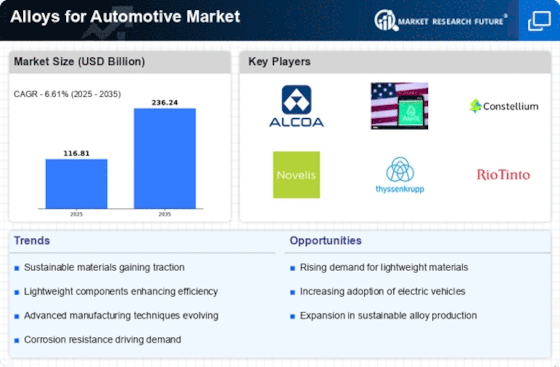
As per Market Research Future analysis, the Alloys for Automotive Market Size was estimated at 116.81 USD Billion in 2024. The Alloys for Automotive industry is projected to grow from 124.53 USD Billion in 2025 to 236.24 USD Billion by 2035, exhibiting a compound annual growth rate (CAGR) of 6.61% during the forecast period 2025 - 2035

Key Market Trends & Highlights

The Alloys for Automotive Market is experiencing a transformative shift towards sustainability and advanced materials.

  • North America remains the largest market for automotive alloys, driven by robust automotive production and innovation. The Asia-Pacific region is emerging as the fastest-growing market, fueled by increasing vehicle demand and manufacturing capabilities. Steel continues to dominate the market as the largest segment, while titanium is rapidly gaining traction as the fastest-growing segment. Sustainability initiatives and consumer preferences for performance are key drivers influencing the demand for lightweight materials in both chassis and powertrain applications.

Market Size & Forecast

2024 Market Size 116.81 (USD Billion)
2035 Market Size 236.24 (USD Billion)
CAGR (2025 - 2035) 6.61%
Largest Regional Market Share in 2024 Asia Pacific

Major Players

Alcoa Corporation (US), Aleris Corporation (US), Constellium SE (FR), Novelis Inc. (US), Thyssenkrupp AG (DE), Rio Tinto Group (GB), Kaiser Aluminum Corporation (US), Norsk Hydro ASA (NO), ArcelorMittal (LU)

Market Trends

The Alloys for Automotive Market is currently experiencing a transformative phase, driven by the increasing demand for lightweight materials that enhance fuel efficiency and reduce emissions. Manufacturers are increasingly adopting advanced alloys, such as aluminum and magnesium, which offer superior strength-to-weight ratios. This shift is not merely a trend but appears to be a fundamental change in how vehicles are designed and constructed. Furthermore, the automotive industry is witnessing a growing emphasis on sustainability, prompting companies to explore recyclable and eco-friendly alloy options. This focus on environmental responsibility is likely to shape future innovations in alloy development. In addition to sustainability, the Alloys for Automotive Market is influenced by technological advancements in manufacturing processes. Innovations such as additive manufacturing and advanced casting techniques are enabling the production of complex alloy components with enhanced performance characteristics. These developments may lead to improved safety and durability in vehicles, aligning with consumer expectations for higher quality and reliability. As the market evolves, collaboration between automotive manufacturers and alloy producers is expected to intensify, fostering a more integrated approach to material selection and application. Overall, the Alloys for Automotive Market is poised for significant growth, driven by a confluence of factors that prioritize efficiency, sustainability, and technological progress.

Sustainability Initiatives

The Alloys for Automotive Market is increasingly influenced by sustainability initiatives. Manufacturers are prioritizing the development of eco-friendly alloys that minimize environmental impact. This trend reflects a broader commitment to reducing carbon footprints and enhancing recyclability, aligning with global efforts to promote sustainable practices in the automotive sector.

Technological Advancements

Technological advancements are reshaping the Alloys for Automotive Market. Innovations in manufacturing processes, such as additive manufacturing and advanced casting techniques, are enabling the production of complex alloy components. These developments enhance performance characteristics, potentially improving vehicle safety and durability.

Lightweight Materials Demand

There is a growing demand for lightweight materials within the Alloys for Automotive Market. As manufacturers seek to improve fuel efficiency and reduce emissions, the adoption of advanced alloys like aluminum and magnesium is becoming more prevalent. This trend indicates a shift in vehicle design priorities, focusing on performance and efficiency.

Alloys for Automotive Market Market Drivers

Regulatory Compliance

Regulatory compliance regarding emissions and fuel efficiency standards is a significant driver for the Alloys for Automotive Market. Governments worldwide are implementing stringent regulations aimed at reducing greenhouse gas emissions from vehicles. This regulatory landscape compels automotive manufacturers to seek out advanced alloys that can help meet these standards. For instance, the use of high-strength steel and aluminum alloys is becoming more common as they offer the necessary strength while contributing to weight reduction. The Alloys for Automotive Market is likely to benefit from this trend, as compliance with regulations becomes increasingly critical for manufacturers.

Sustainability Initiatives

The increasing emphasis on sustainability initiatives within the automotive sector appears to drive the Alloys for Automotive Market. Manufacturers are increasingly adopting eco-friendly practices, which include the use of recyclable materials and the reduction of carbon footprints. This shift is likely influenced by regulatory pressures and consumer demand for greener vehicles. As a result, the market for aluminum and magnesium alloys, known for their lightweight and recyclable properties, is expected to expand. In fact, the use of aluminum in automotive applications is projected to reach approximately 5.5 million metric tons by 2025, indicating a robust growth trajectory for the Alloys for Automotive Market.

Technological Advancements

Technological advancements in alloy production and processing techniques are likely to enhance the performance characteristics of automotive alloys. Innovations such as advanced casting methods and heat treatment processes are enabling the development of high-strength, lightweight alloys that meet the stringent requirements of modern vehicles. These advancements not only improve fuel efficiency but also enhance safety and durability. The Alloys for Automotive Market is witnessing a surge in demand for high-performance alloys, with the market size expected to reach USD 20 billion by 2025. This growth is indicative of the industry's commitment to integrating cutting-edge technology into alloy manufacturing.

Lightweight Materials Demand

The demand for lightweight materials in the automotive sector is a critical driver for the Alloys for Automotive Market. As automakers strive to improve fuel efficiency and reduce emissions, the adoption of lightweight alloys such as aluminum and titanium is becoming increasingly prevalent. These materials contribute to weight reduction, which directly correlates with enhanced vehicle performance and lower fuel consumption. Recent studies suggest that vehicles utilizing lightweight materials can achieve up to a 30% reduction in weight, leading to significant improvements in fuel economy. Consequently, the Alloys for Automotive Market is poised for growth as manufacturers prioritize lightweight solutions.

Consumer Preferences for Performance

Consumer preferences for enhanced vehicle performance are shaping the Alloys for Automotive Market. As buyers become more discerning, there is a growing demand for vehicles that offer superior handling, acceleration, and overall driving experience. Alloys that provide high strength-to-weight ratios are particularly appealing, as they contribute to improved performance metrics. The automotive industry is responding by integrating advanced alloys into vehicle designs, which is expected to drive market growth. Research indicates that the performance-oriented segment of the automotive market is projected to grow at a CAGR of 5% through 2025, further underscoring the importance of alloys in meeting consumer expectations.

Market Segment Insights

By Type: Steel (Largest) vs. Titanium (Fastest-Growing)

In the Alloys for Automotive Market, Steel emerges as the largest segment due to its extensive application in vehicle manufacturing, driven by its strength, ductility, and cost-effectiveness. Its dominant market share is supported by the continued demand from automakers aiming to balance performance and affordability. Meanwhile, Titanium, although smaller in share, is gaining traction due to its extraordinary strength-to-weight ratio, making it a desirable material choice for high-performance vehicles and components.

Steel (Dominant) vs. Titanium (Emerging)

Steel, recognized for its strength and versatility, remains the predominant alloy in automotive manufacturing, extensively used in body structures, engine components, and safety features. It provides a favorable balance of mechanical properties and affordability, making it the go-to choice for most automobiles. In contrast, Titanium, considered an emerging segment, is becoming increasingly important, especially in specialized applications. Its lightweight nature enhances fuel efficiency and performance, appealing to manufacturers looking to innovate with advanced materials and cater to a growing market for high-performance and electric vehicles.

By Application: Chassis (Largest) vs. Powertrain (Fastest-Growing)

In the Alloys for Automotive Market, the application segments showcase varied shares with Chassis leading the way. Chassis applications dominate the market due to their essential function in vehicle structure and safety, contributing significantly to the overall material demand. On the other hand, while the interior and exterior applications play crucial roles, they lag behind in market share. The powertrain segment, however, is witnessing a rapid transformation and growth as manufacturers increasingly prioritize performance and efficiency, signaling shifts in material preferences across the industry.

Chassis (Dominant) vs. Powertrain (Emerging)

The Chassis segment remains the dominant force in the Alloys for Automotive Market, characterized by its critical role in vehicle integrity and safety. This segment leverages high-strength alloys to enhance durability and reduce weight, improving overall vehicle performance. As such, it has maintained leading market significance. Conversely, the Powertrain segment is emerging quickly due to advancements in automotive technology, with manufacturers focusing on lightweight materials that can deliver better fuel efficiency and performance. These alloys are crucial for enhancing engine performance and are increasingly being adopted, indicating a strong growth trajectory as automotive manufacturers adapt to changing regulatory and consumer demands.

By Vehicles: Passenger Vehicle (Largest) vs. Commercial Vehicles (Fastest-Growing)

The 'Alloys for Automotive Market' demonstrates a clear segmentation between passenger vehicles and commercial vehicles, with passenger vehicles holding a significant share of the total market. This dominance can be attributed to a larger consumer base and higher production rates, as the demand for lightweight, fuel-efficient automobiles continues to rise. Conversely, commercial vehicles occupy a smaller but rapidly expanding segment, supported by a surge in logistics, e-commerce, and transportation demands that are reshaping market dynamics.

Passenger Vehicles (Dominant) vs. Commercial Vehicles (Emerging)

Passenger vehicles dominate the alloys for automotive segment, driven by consumer preferences for comfort, performance, and sustainability. These vehicles increasingly incorporate advanced alloys to reduce weight and enhance efficiency. On the other hand, commercial vehicles represent an emerging segment, characterized by their tailored alloy needs for durability and performance under heavy use. The increasing focus on electric commercial fleets and stringent emissions regulations is pushing manufacturers towards innovative alloy solutions, making this segment a key area for future growth and investment.

Get more detailed insights about Alloys for Automotive Market Research Report – Global Forecast to 2035

Regional Insights

North America : Automotive Innovation Leader

North America is the largest market for automotive alloys, holding approximately 40% of the global share. The region's growth is driven by increasing vehicle production, a shift towards lightweight materials for fuel efficiency, and stringent emissions regulations. The U.S. and Canada are the primary contributors, with a focus on advanced manufacturing technologies and sustainable practices. Key players like Alcoa Corporation and Novelis Inc. dominate the landscape, supported by a robust supply chain and R&D investments. The competitive environment is characterized by innovation in alloy formulations and recycling processes. The presence of major automotive manufacturers further fuels demand, ensuring a dynamic market landscape.

Europe : Sustainable Manufacturing Hub

Europe is the second-largest market for automotive alloys, accounting for around 30% of the global share. The region's growth is propelled by stringent environmental regulations and a strong push towards electric vehicles, which require advanced lightweight materials. Countries like Germany and France lead in production, with a focus on sustainability and innovation in alloy technologies. The competitive landscape features key players such as Constellium SE and Thyssenkrupp AG, who are investing heavily in R&D to meet regulatory standards. The European Union's Green Deal aims to promote sustainable practices in the automotive sector, further enhancing market dynamics. This regulatory framework supports the transition to greener alloys, ensuring long-term growth.

Asia-Pacific : Emerging Market Potential

Asia-Pacific is witnessing rapid growth in the automotive alloys market, holding approximately 25% of the global share. The region's expansion is driven by increasing vehicle production, urbanization, and rising disposable incomes. China and India are the leading countries, with significant investments in automotive manufacturing and infrastructure development, fostering demand for lightweight alloys. The competitive landscape is marked by the presence of key players like Kaiser Aluminum Corporation and Norsk Hydro ASA. These companies are focusing on innovation and cost-effective production methods to capture market share. The region's growing automotive sector, coupled with government initiatives to promote electric vehicles, is expected to further boost the demand for advanced alloys in the coming years.

Middle East and Africa : Resource-Rich Opportunities

The Middle East and Africa region is gradually emerging in the automotive alloys market, holding about 5% of the global share. The growth is driven by increasing automotive production and investments in infrastructure. Countries like South Africa and the UAE are focusing on enhancing their automotive sectors, which is expected to drive demand for lightweight alloys in the near future. The competitive landscape is still developing, with local players and international companies exploring opportunities in the region. The presence of natural resources and a growing automotive industry provide a unique advantage for alloy manufacturers. As the market matures, the demand for advanced alloys is anticipated to rise, supported by government initiatives to boost local manufacturing capabilities.

Key Players and Competitive Insights

Leading market players invested heavily in research and development (R&D) to increase their production capacity and develop innovative products, which will help the Alloys for the Automotive market expand and grow further. Market participants are also undertaking organic and inorganic approaches to expand and strengthen their global footprint, with important market developments including new product lines, contractual deals, raining funds and investments, mergers and acquisitions, capital expenditure, and strategic alliances with other organizations. The Alloys for the Automotive industry must offer cost-effective and innovative solutions to survive in a highly fragmented and competitive market.

Manufacturing locally to increase production capacity and minimize operational expenses is one of the key business strategies organizations use in the global Alloys for the Automotive industry to offer lucrative benefits to their clients and capture the untapped market share. The Alloys for the Automotive industry have offered significant advantages and technological advancements in the Automotive sector.

Major players in the Alloys for Automotive Market, including ArcelorMittal SA (Luxembourg), Aditya Birla Group (India), Alcoa Inc. (U.S.), UACJ Corporation (Japan), ThyssenKrupp AG (Germany), Kobe Steel, Ltd. (Japan), Norsk Hydro ASA (Norway), AMG Advanced Metallurgical Group NV (Netherlands), and Constellium (Netherlands), and AGCO Corporation (U.S), are attempting to capture market share by investing in research and development (R&D) operations to offer innovative solutions.

Alcoa is one of the largest bauxite miners globally, with first-quartile costs and high-quality reserves. Charles Martin Hall founded the Pittsburgh-based business on July 9, 1886. It functions in the following areas: Aluminum, alumina, and bauxite. It is a leading manufacturer of fabricated aluminum, primary aluminum, and alumina as a whole because of its growing and active involvement in major industry sectors: innovation, mining, refining, purifying, manufacturing, and reusing.

In July 2022, Alcoa Corporation announced that out of its three operational smelting lines, one of its facilities, Warrick Operations plants in Indiana, will be shut down shortly due to operational difficulties.

Wheel Pros is a recognized aftermarket wheel developer, marketer, and supplier. The firm also distributes superior tires and components. Jody Groce, the Company's founder, established the business in 1995. Presently the Company sells confidential, established brands recognized throughout all key vehicle segments via a network of 30 nationwide and three foreign distribution centers.

In November Wheel Pros announced in November 2020 that it had bought the assets of Performance Replicas, Inc., an established supplier of replica wheels. Performance Replicas is a renowned brand in the original equipment imitation wheel industry, having long-standing ties with well-known national and online merchants.

Key Companies in the Alloys for Automotive Market include

Industry Developments

August 2022: Maxion wheels entered the steel and aluminum industry's drive to achieve carbon-free automobiles.

July 2022: Alcoa Corporation has announced out of its three operational smelting lines, one of its facilities, Warrick Operations plants in Indiana, is going to be shut down shortly due to operational difficulties.

November 2020: Wheel Pros announced in November 2020 that it had bought the assets of Performance Replicas, Inc., an established supplier of replica wheels. Performance Replicas is a renowned brand in the original equipment imitation wheel industry, having long-standing ties with well-known national and online merchants.

Future Outlook

Alloys for Automotive Market Future Outlook

The Alloys for Automotive Market is projected to grow at a 6.61% CAGR from 2025 to 2035, driven by advancements in lightweight materials, sustainability initiatives, and increasing vehicle production.

New opportunities lie in:

  • Development of high-performance aluminum alloys for electric vehicles
  • Investment in recycling technologies for alloy materials
  • Partnerships with automotive manufacturers for customized alloy solutions

By 2035, the market is expected to achieve robust growth, driven by innovation and strategic partnerships.

Market Segmentation

Alloys for Automotive Market Type Outlook

  • Iron
  • Titanium
  • Steel
  • Copper
  • Other

Alloys for Automotive Market Vehicles Outlook

  • Passenger Vehicle
  • Commercial Vehicles

Alloys for Automotive Market Application Outlook

  • Chassis
  • Powertrain
  • Interior
  • Exterior

Report Scope

MARKET SIZE 2024 116.81(USD Billion)
MARKET SIZE 2025 124.53(USD Billion)
MARKET SIZE 2035 236.24(USD Billion)
COMPOUND ANNUAL GROWTH RATE (CAGR) 6.61% (2025 - 2035)
REPORT COVERAGE Revenue Forecast, Competitive Landscape, Growth Factors, and Trends
BASE YEAR 2024
Market Forecast Period 2025 - 2035
Historical Data 2019 - 2024
Market Forecast Units USD Billion
Key Companies Profiled Alcoa Corporation (US), Aleris Corporation (US), Constellium SE (FR), Novelis Inc. (US), Thyssenkrupp AG (DE), Rio Tinto Group (GB), Kaiser Aluminum Corporation (US), Norsk Hydro ASA (NO), ArcelorMittal (LU)
Segments Covered Type, Application, Vehicles, Region
Key Market Opportunities Adoption of lightweight alloys enhances fuel efficiency and meets stringent emissions regulations in the Alloys for Automotive Market.
Key Market Dynamics Rising demand for lightweight alloys driven by fuel efficiency regulations and consumer preference for sustainable vehicles.
Countries Covered North America, Europe, APAC, South America, MEA

FAQs

What is the projected market valuation for the Alloys for Automotive Market in 2035?

<p>The projected market valuation for the Alloys for Automotive Market in 2035 is 236.24 USD Billion.</p>

What was the overall market valuation for the Alloys for Automotive Market in 2024?

<p>The overall market valuation for the Alloys for Automotive Market in 2024 was 116.81 USD Billion.</p>

What is the expected CAGR for the Alloys for Automotive Market during the forecast period 2025 - 2035?

<p>The expected CAGR for the Alloys for Automotive Market during the forecast period 2025 - 2035 is 6.61%.</p>

Which segment had the highest valuation in the Alloys for Automotive Market in 2024?

<p>In 2024, the Steel segment had the highest valuation in the Alloys for Automotive Market, amounting to 45.0 USD Billion.</p>

What are the key applications of alloys in the automotive sector?

<p>Key applications of alloys in the automotive sector include Chassis, Powertrain, Interior, and Exterior components.</p>

Which company is a leading player in the Alloys for Automotive Market?

<p>Alcoa Corporation is one of the leading players in the Alloys for Automotive Market.</p>

What is the projected valuation for the Chassis application segment by 2035?

The projected valuation for the Chassis application segment by 2035 is expected to reach 50.0 USD Billion.

How does the valuation of the Copper segment compare to the Iron segment in 2024?

In 2024, the Copper segment was valued at 20.0 USD Billion, whereas the Iron segment was valued at 23.36 USD Billion.

What is the projected market size for Passenger Vehicles in 2035?

The projected market size for Passenger Vehicles in 2035 is anticipated to be between 70.0 and 150.0 USD Billion.

What is the valuation range for the Exterior application segment in 2024?

The valuation range for the Exterior application segment in 2024 was between 41.81 and 86.24 USD Billion.

  1. SECTION I: EXECUTIVE SUMMARY AND KEY HIGHLIGHTS
    1. | 1.1 EXECUTIVE SUMMARY
    2. | | 1.1.1 Market Overview
    3. | | 1.1.2 Key Findings
    4. | | 1.1.3 Market Segmentation
    5. | | 1.1.4 Competitive Landscape
    6. | | 1.1.5 Challenges and Opportunities
    7. | | 1.1.6 Future Outlook
  2. SECTION II: SCOPING, METHODOLOGY AND MARKET STRUCTURE
    1. | 2.1 MARKET INTRODUCTION
    2. | | 2.1.1 Definition
    3. | | 2.1.2 Scope of the study
    4. | | | 2.1.2.1 Research Objective
    5. | | | 2.1.2.2 Assumption
    6. | | | 2.1.2.3 Limitations
    7. | 2.2 RESEARCH METHODOLOGY
    8. | | 2.2.1 Overview
    9. | | 2.2.2 Data Mining
    10. | | 2.2.3 Secondary Research
    11. | | 2.2.4 Primary Research
    12. | | | 2.2.4.1 Primary Interviews and Information Gathering Process
    13. | | | 2.2.4.2 Breakdown of Primary Respondents
    14. | | 2.2.5 Forecasting Model
    15. | | 2.2.6 Market Size Estimation
    16. | | | 2.2.6.1 Bottom-Up Approach
    17. | | | 2.2.6.2 Top-Down Approach
    18. | | 2.2.7 Data Triangulation
    19. | | 2.2.8 Validation
  3. SECTION III: QUALITATIVE ANALYSIS
    1. | 3.1 MARKET DYNAMICS
    2. | | 3.1.1 Overview
    3. | | 3.1.2 Drivers
    4. | | 3.1.3 Restraints
    5. | | 3.1.4 Opportunities
    6. | 3.2 MARKET FACTOR ANALYSIS
    7. | | 3.2.1 Value chain Analysis
    8. | | 3.2.2 Porter's Five Forces Analysis
    9. | | | 3.2.2.1 Bargaining Power of Suppliers
    10. | | | 3.2.2.2 Bargaining Power of Buyers
    11. | | | 3.2.2.3 Threat of New Entrants
    12. | | | 3.2.2.4 Threat of Substitutes
    13. | | | 3.2.2.5 Intensity of Rivalry
    14. | | 3.2.3 COVID-19 Impact Analysis
    15. | | | 3.2.3.1 Market Impact Analysis
    16. | | | 3.2.3.2 Regional Impact
    17. | | | 3.2.3.3 Opportunity and Threat Analysis
  4. SECTION IV: QUANTITATIVE ANALYSIS
    1. | 4.1 Automobile, BY Type (USD Billion)
    2. | | 4.1.1 Iron
    3. | | 4.1.2 Titanium
    4. | | 4.1.3 Steel
    5. | | 4.1.4 Copper
    6. | | 4.1.5 Other
    7. | 4.2 Automobile, BY Application (USD Billion)
    8. | | 4.2.1 Chassis
    9. | | 4.2.2 Powertrain
    10. | | 4.2.3 Interior
    11. | | 4.2.4 Exterior
    12. | 4.3 Automobile, BY Vehicles (USD Billion)
    13. | | 4.3.1 Passenger Vehicle
    14. | | 4.3.2 Commercial Vehicles
    15. | 4.4 Automobile, BY Region (USD Billion)
    16. | | 4.4.1 North America
    17. | | | 4.4.1.1 US
    18. | | | 4.4.1.2 Canada
    19. | | 4.4.2 Europe
    20. | | | 4.4.2.1 Germany
    21. | | | 4.4.2.2 UK
    22. | | | 4.4.2.3 France
    23. | | | 4.4.2.4 Russia
    24. | | | 4.4.2.5 Italy
    25. | | | 4.4.2.6 Spain
    26. | | | 4.4.2.7 Rest of Europe
    27. | | 4.4.3 APAC
    28. | | | 4.4.3.1 China
    29. | | | 4.4.3.2 India
    30. | | | 4.4.3.3 Japan
    31. | | | 4.4.3.4 South Korea
    32. | | | 4.4.3.5 Malaysia
    33. | | | 4.4.3.6 Thailand
    34. | | | 4.4.3.7 Indonesia
    35. | | | 4.4.3.8 Rest of APAC
    36. | | 4.4.4 South America
    37. | | | 4.4.4.1 Brazil
    38. | | | 4.4.4.2 Mexico
    39. | | | 4.4.4.3 Argentina
    40. | | | 4.4.4.4 Rest of South America
    41. | | 4.4.5 MEA
    42. | | | 4.4.5.1 GCC Countries
    43. | | | 4.4.5.2 South Africa
    44. | | | 4.4.5.3 Rest of MEA
  5. SECTION V: COMPETITIVE ANALYSIS
    1. | 5.1 Competitive Landscape
    2. | | 5.1.1 Overview
    3. | | 5.1.2 Competitive Analysis
    4. | | 5.1.3 Market share Analysis
    5. | | 5.1.4 Major Growth Strategy in the Automobile
    6. | | 5.1.5 Competitive Benchmarking
    7. | | 5.1.6 Leading Players in Terms of Number of Developments in the Automobile
    8. | | 5.1.7 Key developments and growth strategies
    9. | | | 5.1.7.1 New Product Launch/Service Deployment
    10. | | | 5.1.7.2 Merger & Acquisitions
    11. | | | 5.1.7.3 Joint Ventures
    12. | | 5.1.8 Major Players Financial Matrix
    13. | | | 5.1.8.1 Sales and Operating Income
    14. | | | 5.1.8.2 Major Players R&D Expenditure. 2023
    15. | 5.2 Company Profiles
    16. | | 5.2.1 Alcoa Corporation (US)
    17. | | | 5.2.1.1 Financial Overview
    18. | | | 5.2.1.2 Products Offered
    19. | | | 5.2.1.3 Key Developments
    20. | | | 5.2.1.4 SWOT Analysis
    21. | | | 5.2.1.5 Key Strategies
    22. | | 5.2.2 Aleris Corporation (US)
    23. | | | 5.2.2.1 Financial Overview
    24. | | | 5.2.2.2 Products Offered
    25. | | | 5.2.2.3 Key Developments
    26. | | | 5.2.2.4 SWOT Analysis
    27. | | | 5.2.2.5 Key Strategies
    28. | | 5.2.3 Constellium SE (FR)
    29. | | | 5.2.3.1 Financial Overview
    30. | | | 5.2.3.2 Products Offered
    31. | | | 5.2.3.3 Key Developments
    32. | | | 5.2.3.4 SWOT Analysis
    33. | | | 5.2.3.5 Key Strategies
    34. | | 5.2.4 Novelis Inc. (US)
    35. | | | 5.2.4.1 Financial Overview
    36. | | | 5.2.4.2 Products Offered
    37. | | | 5.2.4.3 Key Developments
    38. | | | 5.2.4.4 SWOT Analysis
    39. | | | 5.2.4.5 Key Strategies
    40. | | 5.2.5 Thyssenkrupp AG (DE)
    41. | | | 5.2.5.1 Financial Overview
    42. | | | 5.2.5.2 Products Offered
    43. | | | 5.2.5.3 Key Developments
    44. | | | 5.2.5.4 SWOT Analysis
    45. | | | 5.2.5.5 Key Strategies
    46. | | 5.2.6 Rio Tinto Group (GB)
    47. | | | 5.2.6.1 Financial Overview
    48. | | | 5.2.6.2 Products Offered
    49. | | | 5.2.6.3 Key Developments
    50. | | | 5.2.6.4 SWOT Analysis
    51. | | | 5.2.6.5 Key Strategies
    52. | | 5.2.7 Kaiser Aluminum Corporation (US)
    53. | | | 5.2.7.1 Financial Overview
    54. | | | 5.2.7.2 Products Offered
    55. | | | 5.2.7.3 Key Developments
    56. | | | 5.2.7.4 SWOT Analysis
    57. | | | 5.2.7.5 Key Strategies
    58. | | 5.2.8 Norsk Hydro ASA (NO)
    59. | | | 5.2.8.1 Financial Overview
    60. | | | 5.2.8.2 Products Offered
    61. | | | 5.2.8.3 Key Developments
    62. | | | 5.2.8.4 SWOT Analysis
    63. | | | 5.2.8.5 Key Strategies
    64. | | 5.2.9 ArcelorMittal (LU)
    65. | | | 5.2.9.1 Financial Overview
    66. | | | 5.2.9.2 Products Offered
    67. | | | 5.2.9.3 Key Developments
    68. | | | 5.2.9.4 SWOT Analysis
    69. | | | 5.2.9.5 Key Strategies
    70. | 5.3 Appendix
    71. | | 5.3.1 References
    72. | | 5.3.2 Related Reports
  6. LIST OF FIGURES
    1. | 6.1 MARKET SYNOPSIS
    2. | 6.2 NORTH AMERICA MARKET ANALYSIS
    3. | 6.3 US MARKET ANALYSIS BY TYPE
    4. | 6.4 US MARKET ANALYSIS BY APPLICATION
    5. | 6.5 US MARKET ANALYSIS BY VEHICLES
    6. | 6.6 CANADA MARKET ANALYSIS BY TYPE
    7. | 6.7 CANADA MARKET ANALYSIS BY APPLICATION
    8. | 6.8 CANADA MARKET ANALYSIS BY VEHICLES
    9. | 6.9 EUROPE MARKET ANALYSIS
    10. | 6.10 GERMANY MARKET ANALYSIS BY TYPE
    11. | 6.11 GERMANY MARKET ANALYSIS BY APPLICATION
    12. | 6.12 GERMANY MARKET ANALYSIS BY VEHICLES
    13. | 6.13 UK MARKET ANALYSIS BY TYPE
    14. | 6.14 UK MARKET ANALYSIS BY APPLICATION
    15. | 6.15 UK MARKET ANALYSIS BY VEHICLES
    16. | 6.16 FRANCE MARKET ANALYSIS BY TYPE
    17. | 6.17 FRANCE MARKET ANALYSIS BY APPLICATION
    18. | 6.18 FRANCE MARKET ANALYSIS BY VEHICLES
    19. | 6.19 RUSSIA MARKET ANALYSIS BY TYPE
    20. | 6.20 RUSSIA MARKET ANALYSIS BY APPLICATION
    21. | 6.21 RUSSIA MARKET ANALYSIS BY VEHICLES
    22. | 6.22 ITALY MARKET ANALYSIS BY TYPE
    23. | 6.23 ITALY MARKET ANALYSIS BY APPLICATION
    24. | 6.24 ITALY MARKET ANALYSIS BY VEHICLES
    25. | 6.25 SPAIN MARKET ANALYSIS BY TYPE
    26. | 6.26 SPAIN MARKET ANALYSIS BY APPLICATION
    27. | 6.27 SPAIN MARKET ANALYSIS BY VEHICLES
    28. | 6.28 REST OF EUROPE MARKET ANALYSIS BY TYPE
    29. | 6.29 REST OF EUROPE MARKET ANALYSIS BY APPLICATION
    30. | 6.30 REST OF EUROPE MARKET ANALYSIS BY VEHICLES
    31. | 6.31 APAC MARKET ANALYSIS
    32. | 6.32 CHINA MARKET ANALYSIS BY TYPE
    33. | 6.33 CHINA MARKET ANALYSIS BY APPLICATION
    34. | 6.34 CHINA MARKET ANALYSIS BY VEHICLES
    35. | 6.35 INDIA MARKET ANALYSIS BY TYPE
    36. | 6.36 INDIA MARKET ANALYSIS BY APPLICATION
    37. | 6.37 INDIA MARKET ANALYSIS BY VEHICLES
    38. | 6.38 JAPAN MARKET ANALYSIS BY TYPE
    39. | 6.39 JAPAN MARKET ANALYSIS BY APPLICATION
    40. | 6.40 JAPAN MARKET ANALYSIS BY VEHICLES
    41. | 6.41 SOUTH KOREA MARKET ANALYSIS BY TYPE
    42. | 6.42 SOUTH KOREA MARKET ANALYSIS BY APPLICATION
    43. | 6.43 SOUTH KOREA MARKET ANALYSIS BY VEHICLES
    44. | 6.44 MALAYSIA MARKET ANALYSIS BY TYPE
    45. | 6.45 MALAYSIA MARKET ANALYSIS BY APPLICATION
    46. | 6.46 MALAYSIA MARKET ANALYSIS BY VEHICLES
    47. | 6.47 THAILAND MARKET ANALYSIS BY TYPE
    48. | 6.48 THAILAND MARKET ANALYSIS BY APPLICATION
    49. | 6.49 THAILAND MARKET ANALYSIS BY VEHICLES
    50. | 6.50 INDONESIA MARKET ANALYSIS BY TYPE
    51. | 6.51 INDONESIA MARKET ANALYSIS BY APPLICATION
    52. | 6.52 INDONESIA MARKET ANALYSIS BY VEHICLES
    53. | 6.53 REST OF APAC MARKET ANALYSIS BY TYPE
    54. | 6.54 REST OF APAC MARKET ANALYSIS BY APPLICATION
    55. | 6.55 REST OF APAC MARKET ANALYSIS BY VEHICLES
    56. | 6.56 SOUTH AMERICA MARKET ANALYSIS
    57. | 6.57 BRAZIL MARKET ANALYSIS BY TYPE
    58. | 6.58 BRAZIL MARKET ANALYSIS BY APPLICATION
    59. | 6.59 BRAZIL MARKET ANALYSIS BY VEHICLES
    60. | 6.60 MEXICO MARKET ANALYSIS BY TYPE
    61. | 6.61 MEXICO MARKET ANALYSIS BY APPLICATION
    62. | 6.62 MEXICO MARKET ANALYSIS BY VEHICLES
    63. | 6.63 ARGENTINA MARKET ANALYSIS BY TYPE
    64. | 6.64 ARGENTINA MARKET ANALYSIS BY APPLICATION
    65. | 6.65 ARGENTINA MARKET ANALYSIS BY VEHICLES
    66. | 6.66 REST OF SOUTH AMERICA MARKET ANALYSIS BY TYPE
    67. | 6.67 REST OF SOUTH AMERICA MARKET ANALYSIS BY APPLICATION
    68. | 6.68 REST OF SOUTH AMERICA MARKET ANALYSIS BY VEHICLES
    69. | 6.69 MEA MARKET ANALYSIS
    70. | 6.70 GCC COUNTRIES MARKET ANALYSIS BY TYPE
    71. | 6.71 GCC COUNTRIES MARKET ANALYSIS BY APPLICATION
    72. | 6.72 GCC COUNTRIES MARKET ANALYSIS BY VEHICLES
    73. | 6.73 SOUTH AFRICA MARKET ANALYSIS BY TYPE
    74. | 6.74 SOUTH AFRICA MARKET ANALYSIS BY APPLICATION
    75. | 6.75 SOUTH AFRICA MARKET ANALYSIS BY VEHICLES
    76. | 6.76 REST OF MEA MARKET ANALYSIS BY TYPE
    77. | 6.77 REST OF MEA MARKET ANALYSIS BY APPLICATION
    78. | 6.78 REST OF MEA MARKET ANALYSIS BY VEHICLES
    79. | 6.79 KEY BUYING CRITERIA OF AUTOMOBILE
    80. | 6.80 RESEARCH PROCESS OF MRFR
    81. | 6.81 DRO ANALYSIS OF AUTOMOBILE
    82. | 6.82 DRIVERS IMPACT ANALYSIS: AUTOMOBILE
    83. | 6.83 RESTRAINTS IMPACT ANALYSIS: AUTOMOBILE
    84. | 6.84 SUPPLY / VALUE CHAIN: AUTOMOBILE
    85. | 6.85 AUTOMOBILE, BY TYPE, 2024 (% SHARE)
    86. | 6.86 AUTOMOBILE, BY TYPE, 2024 TO 2035 (USD Billion)
    87. | 6.87 AUTOMOBILE, BY APPLICATION, 2024 (% SHARE)
    88. | 6.88 AUTOMOBILE, BY APPLICATION, 2024 TO 2035 (USD Billion)
    89. | 6.89 AUTOMOBILE, BY VEHICLES, 2024 (% SHARE)
    90. | 6.90 AUTOMOBILE, BY VEHICLES, 2024 TO 2035 (USD Billion)
    91. | 6.91 BENCHMARKING OF MAJOR COMPETITORS
  7. LIST OF TABLES
    1. | 7.1 LIST OF ASSUMPTIONS
    2. | | 7.1.1
    3. | 7.2 North America MARKET SIZE ESTIMATES; FORECAST
    4. | | 7.2.1 BY TYPE, 2025-2035 (USD Billion)
    5. | | 7.2.2 BY APPLICATION, 2025-2035 (USD Billion)
    6. | | 7.2.3 BY VEHICLES, 2025-2035 (USD Billion)
    7. | 7.3 US MARKET SIZE ESTIMATES; FORECAST
    8. | | 7.3.1 BY TYPE, 2025-2035 (USD Billion)
    9. | | 7.3.2 BY APPLICATION, 2025-2035 (USD Billion)
    10. | | 7.3.3 BY VEHICLES, 2025-2035 (USD Billion)
    11. | 7.4 Canada MARKET SIZE ESTIMATES; FORECAST
    12. | | 7.4.1 BY TYPE, 2025-2035 (USD Billion)
    13. | | 7.4.2 BY APPLICATION, 2025-2035 (USD Billion)
    14. | | 7.4.3 BY VEHICLES, 2025-2035 (USD Billion)
    15. | 7.5 Europe MARKET SIZE ESTIMATES; FORECAST
    16. | | 7.5.1 BY TYPE, 2025-2035 (USD Billion)
    17. | | 7.5.2 BY APPLICATION, 2025-2035 (USD Billion)
    18. | | 7.5.3 BY VEHICLES, 2025-2035 (USD Billion)
    19. | 7.6 Germany MARKET SIZE ESTIMATES; FORECAST
    20. | | 7.6.1 BY TYPE, 2025-2035 (USD Billion)
    21. | | 7.6.2 BY APPLICATION, 2025-2035 (USD Billion)
    22. | | 7.6.3 BY VEHICLES, 2025-2035 (USD Billion)
    23. | 7.7 UK MARKET SIZE ESTIMATES; FORECAST
    24. | | 7.7.1 BY TYPE, 2025-2035 (USD Billion)
    25. | | 7.7.2 BY APPLICATION, 2025-2035 (USD Billion)
    26. | | 7.7.3 BY VEHICLES, 2025-2035 (USD Billion)
    27. | 7.8 France MARKET SIZE ESTIMATES; FORECAST
    28. | | 7.8.1 BY TYPE, 2025-2035 (USD Billion)
    29. | | 7.8.2 BY APPLICATION, 2025-2035 (USD Billion)
    30. | | 7.8.3 BY VEHICLES, 2025-2035 (USD Billion)
    31. | 7.9 Russia MARKET SIZE ESTIMATES; FORECAST
    32. | | 7.9.1 BY TYPE, 2025-2035 (USD Billion)
    33. | | 7.9.2 BY APPLICATION, 2025-2035 (USD Billion)
    34. | | 7.9.3 BY VEHICLES, 2025-2035 (USD Billion)
    35. | 7.10 Italy MARKET SIZE ESTIMATES; FORECAST
    36. | | 7.10.1 BY TYPE, 2025-2035 (USD Billion)
    37. | | 7.10.2 BY APPLICATION, 2025-2035 (USD Billion)
    38. | | 7.10.3 BY VEHICLES, 2025-2035 (USD Billion)
    39. | 7.11 Spain MARKET SIZE ESTIMATES; FORECAST
    40. | | 7.11.1 BY TYPE, 2025-2035 (USD Billion)
    41. | | 7.11.2 BY APPLICATION, 2025-2035 (USD Billion)
    42. | | 7.11.3 BY VEHICLES, 2025-2035 (USD Billion)
    43. | 7.12 Rest of Europe MARKET SIZE ESTIMATES; FORECAST
    44. | | 7.12.1 BY TYPE, 2025-2035 (USD Billion)
    45. | | 7.12.2 BY APPLICATION, 2025-2035 (USD Billion)
    46. | | 7.12.3 BY VEHICLES, 2025-2035 (USD Billion)
    47. | 7.13 APAC MARKET SIZE ESTIMATES; FORECAST
    48. | | 7.13.1 BY TYPE, 2025-2035 (USD Billion)
    49. | | 7.13.2 BY APPLICATION, 2025-2035 (USD Billion)
    50. | | 7.13.3 BY VEHICLES, 2025-2035 (USD Billion)
    51. | 7.14 China MARKET SIZE ESTIMATES; FORECAST
    52. | | 7.14.1 BY TYPE, 2025-2035 (USD Billion)
    53. | | 7.14.2 BY APPLICATION, 2025-2035 (USD Billion)
    54. | | 7.14.3 BY VEHICLES, 2025-2035 (USD Billion)
    55. | 7.15 India MARKET SIZE ESTIMATES; FORECAST
    56. | | 7.15.1 BY TYPE, 2025-2035 (USD Billion)
    57. | | 7.15.2 BY APPLICATION, 2025-2035 (USD Billion)
    58. | | 7.15.3 BY VEHICLES, 2025-2035 (USD Billion)
    59. | 7.16 Japan MARKET SIZE ESTIMATES; FORECAST
    60. | | 7.16.1 BY TYPE, 2025-2035 (USD Billion)
    61. | | 7.16.2 BY APPLICATION, 2025-2035 (USD Billion)
    62. | | 7.16.3 BY VEHICLES, 2025-2035 (USD Billion)
    63. | 7.17 South Korea MARKET SIZE ESTIMATES; FORECAST
    64. | | 7.17.1 BY TYPE, 2025-2035 (USD Billion)
    65. | | 7.17.2 BY APPLICATION, 2025-2035 (USD Billion)
    66. | | 7.17.3 BY VEHICLES, 2025-2035 (USD Billion)
    67. | 7.18 Malaysia MARKET SIZE ESTIMATES; FORECAST
    68. | | 7.18.1 BY TYPE, 2025-2035 (USD Billion)
    69. | | 7.18.2 BY APPLICATION, 2025-2035 (USD Billion)
    70. | | 7.18.3 BY VEHICLES, 2025-2035 (USD Billion)
    71. | 7.19 Thailand MARKET SIZE ESTIMATES; FORECAST
    72. | | 7.19.1 BY TYPE, 2025-2035 (USD Billion)
    73. | | 7.19.2 BY APPLICATION, 2025-2035 (USD Billion)
    74. | | 7.19.3 BY VEHICLES, 2025-2035 (USD Billion)
    75. | 7.20 Indonesia MARKET SIZE ESTIMATES; FORECAST
    76. | | 7.20.1 BY TYPE, 2025-2035 (USD Billion)
    77. | | 7.20.2 BY APPLICATION, 2025-2035 (USD Billion)
    78. | | 7.20.3 BY VEHICLES, 2025-2035 (USD Billion)
    79. | 7.21 Rest of APAC MARKET SIZE ESTIMATES; FORECAST
    80. | | 7.21.1 BY TYPE, 2025-2035 (USD Billion)
    81. | | 7.21.2 BY APPLICATION, 2025-2035 (USD Billion)
    82. | | 7.21.3 BY VEHICLES, 2025-2035 (USD Billion)
    83. | 7.22 South America MARKET SIZE ESTIMATES; FORECAST
    84. | | 7.22.1 BY TYPE, 2025-2035 (USD Billion)
    85. | | 7.22.2 BY APPLICATION, 2025-2035 (USD Billion)
    86. | | 7.22.3 BY VEHICLES, 2025-2035 (USD Billion)
    87. | 7.23 Brazil MARKET SIZE ESTIMATES; FORECAST
    88. | | 7.23.1 BY TYPE, 2025-2035 (USD Billion)
    89. | | 7.23.2 BY APPLICATION, 2025-2035 (USD Billion)
    90. | | 7.23.3 BY VEHICLES, 2025-2035 (USD Billion)
    91. | 7.24 Mexico MARKET SIZE ESTIMATES; FORECAST
    92. | | 7.24.1 BY TYPE, 2025-2035 (USD Billion)
    93. | | 7.24.2 BY APPLICATION, 2025-2035 (USD Billion)
    94. | | 7.24.3 BY VEHICLES, 2025-2035 (USD Billion)
    95. | 7.25 Argentina MARKET SIZE ESTIMATES; FORECAST
    96. | | 7.25.1 BY TYPE, 2025-2035 (USD Billion)
    97. | | 7.25.2 BY APPLICATION, 2025-2035 (USD Billion)
    98. | | 7.25.3 BY VEHICLES, 2025-2035 (USD Billion)
    99. | 7.26 Rest of South America MARKET SIZE ESTIMATES; FORECAST
    100. | | 7.26.1 BY TYPE, 2025-2035 (USD Billion)
    101. | | 7.26.2 BY APPLICATION, 2025-2035 (USD Billion)
    102. | | 7.26.3 BY VEHICLES, 2025-2035 (USD Billion)
    103. | 7.27 MEA MARKET SIZE ESTIMATES; FORECAST
    104. | | 7.27.1 BY TYPE, 2025-2035 (USD Billion)
    105. | | 7.27.2 BY APPLICATION, 2025-2035 (USD Billion)
    106. | | 7.27.3 BY VEHICLES, 2025-2035 (USD Billion)
    107. | 7.28 GCC Countries MARKET SIZE ESTIMATES; FORECAST
    108. | | 7.28.1 BY TYPE, 2025-2035 (USD Billion)
    109. | | 7.28.2 BY APPLICATION, 2025-2035 (USD Billion)
    110. | | 7.28.3 BY VEHICLES, 2025-2035 (USD Billion)
    111. | 7.29 South Africa MARKET SIZE ESTIMATES; FORECAST
    112. | | 7.29.1 BY TYPE, 2025-2035 (USD Billion)
    113. | | 7.29.2 BY APPLICATION, 2025-2035 (USD Billion)
    114. | | 7.29.3 BY VEHICLES, 2025-2035 (USD Billion)
    115. | 7.30 Rest of MEA MARKET SIZE ESTIMATES; FORECAST
    116. | | 7.30.1 BY TYPE, 2025-2035 (USD Billion)
    117. | | 7.30.2 BY APPLICATION, 2025-2035 (USD Billion)
    118. | | 7.30.3 BY VEHICLES, 2025-2035 (USD Billion)
    119. | 7.31 PRODUCT LAUNCH/PRODUCT DEVELOPMENT/APPROVAL
    120. | | 7.31.1
    121. | 7.32 ACQUISITION/PARTNERSHIP
    122. | | 7.32.1

Automobile Market Segmentation

Automobile By Type (USD Billion, 2025-2035)

  • Iron
  • Titanium
  • Steel
  • Copper
  • Other

Automobile By Application (USD Billion, 2025-2035)

  • Chassis
  • Powertrain
  • Interior
  • Exterior

Automobile By Vehicles (USD Billion, 2025-2035)

  • Passenger Vehicle
  • Commercial Vehicles
Infographic

Free Sample Request

Kindly complete the form below to receive a free sample of this Report

Get Free Sample

Customer Strories

Compare Licence

×
Features License Type
Single User Multiuser License Enterprise User
Price $4,950 $5,950 $7,250
Maximum User Access Limit 1 User Upto 10 Users Unrestricted Access Throughout the Organization
Free Customization
Direct Access to Analyst
Deliverable Format
Platform Access
Discount on Next Purchase 10% 15% 15%
Printable Versions
%>