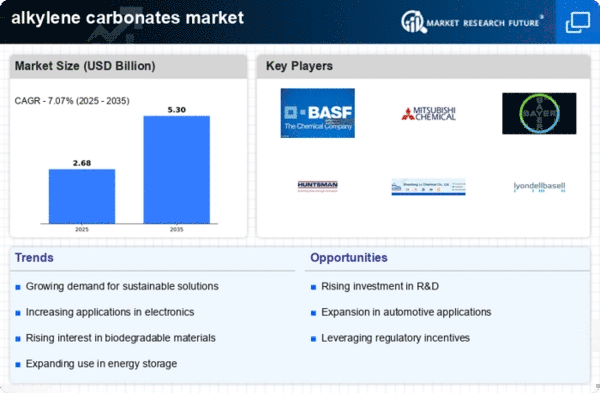
The alkylene carbonates market is currently characterized by a dynamic competitive landscape, driven by increasing demand for sustainable and eco-friendly chemical solutions. Key players are actively engaging in strategic initiatives to enhance their market positioning. For instance, BASF SE (Germany) has been focusing on innovation and sustainability, emphasizing the development of bio-based alkylene carbonates to meet the growing environmental regulations. Similarly, Mitsubishi Chemical Corporation (Japan) is leveraging its extensive research capabilities to enhance product performance and expand its application range, particularly in the automotive and electronics sectors. These strategies collectively contribute to a competitive environment that prioritizes sustainability and technological advancement.
In terms of business tactics, companies are increasingly localizing manufacturing to reduce logistics costs and improve supply chain efficiency. The market structure appears moderately fragmented, with several players vying for market share. However, the collective influence of major companies like Bayer AG (Germany) and Huntsman Corporation (US) is notable, as they continue to optimize their operations and expand their global footprint, thereby shaping the competitive dynamics of the market.
In November 2025, Bayer AG (Germany) announced a strategic partnership with a leading renewable energy firm to develop a new line of alkylene carbonates derived from renewable sources. This collaboration is expected to enhance Bayer's sustainability profile and align with global trends towards greener chemical production. The strategic importance of this partnership lies in its potential to position Bayer as a leader in the sustainable chemicals sector, appealing to environmentally conscious consumers and businesses alike.
In October 2025, Huntsman Corporation (US) unveiled a new production facility dedicated to the manufacturing of high-purity alkylene carbonates. This facility is expected to significantly increase production capacity and cater to the rising demand in the Asia-Pacific region. The establishment of this facility underscores Huntsman's commitment to meeting market needs and enhancing its competitive edge through localized production.
In September 2025, LyondellBasell Industries N.V. (Netherlands) launched a new digital platform aimed at optimizing its supply chain operations for alkylene carbonates. This initiative is indicative of the broader trend towards digitalization within the industry, as companies seek to leverage technology to improve efficiency and responsiveness. The strategic importance of this digital transformation lies in its potential to enhance customer service and streamline operations, thereby providing a competitive advantage in a rapidly evolving market.
As of December 2025, current competitive trends are increasingly defined by digitalization, sustainability, and the integration of advanced technologies such as AI. Strategic alliances are playing a crucial role in shaping the market landscape, enabling companies to pool resources and expertise to drive innovation. Looking ahead, it appears that competitive differentiation will increasingly shift from price-based competition to a focus on innovation, technology, and supply chain reliability. This evolution suggests that companies that prioritize sustainable practices and technological advancements are likely to emerge as leaders in the alkylene carbonates market.


















Leave a Comment