Alkylamines Market (2026 - 2035)

Alkylamines Market Research Report Information By Product Type (Methylamines, Ethylamines, Propyl Amines, Butyl Amines, and Cyclohexylamines), By Application (Solvents, Rubber, Agrochemicals, Paper Chemicals, Fuel Additives, Pharmaceuticals, and Other Applications (Feed Additives, Water Treatment, and Surfactants)), And By Region (North America, Europe, Asia-Pacific, and Rest of the World) โ€“ Market Forecast Till 2035.
ID: MRFR/CnM/9190-HCR 449 Pages Chitranshi Jaiswal Last Updated: November 06, 2026
Alkylamines Market
Market Size
Forecast Period2026-2035
CAGR (2026-2035)6.3%
2025 Market SizeUSD 6.42 Billion
2035 Market SizeUSD 11.82 Billion
Key Players
BASF SE
Luxi Chemical Group Co., Ltd.
Alkyl Amines Chemicals Ltd.
Shandong Hualu-Hengsheng Chemical Co., Ltd.
Balaji Amines Ltd.
Koei Chemical Co., Ltd.
Opportunities
  • API Supply Chains in India and Southeast Asia
  • Low-Carbon and Bio-Based Feedstocks
  • Data-Driven Supply Contracts and Toll Manufacturing

Alkylamines Market Summary

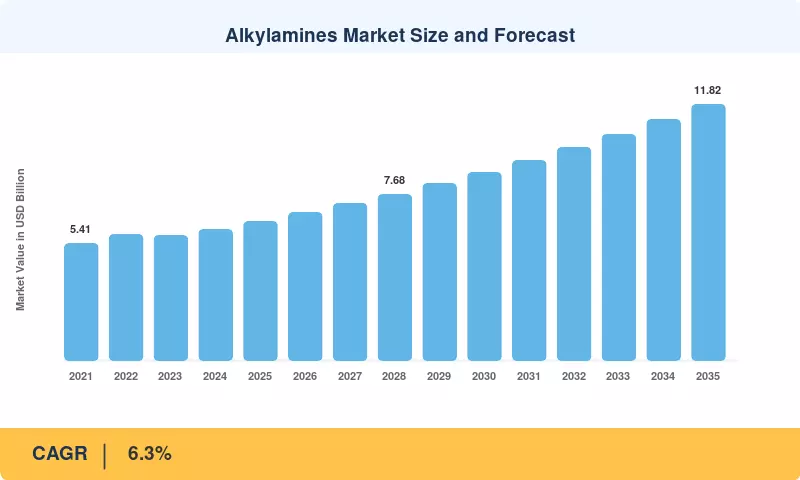
The Alkylamines Market was valued at USD 6.42 billion in 2025 and is projected to reach USD 6.82 billion in 2026, rising to USD 11.82 billion by 2035 at a CAGR of 6.3% over 2026โ€“2035. Methylamines, ethylamines and higher amines feed solvents, crop-protection actives, rubber chemicals and drug synthesis, so demand tracks several end markets at once. Two catalysts carry the forecast: India's INR 15,000 crore Production Linked Incentive scheme for pharmaceuticals, which is pulling API capacity and its feedstocks onshore, and steady agrochemical volume, with global pesticide use near 3.7 million tonnes of active ingredients in 2022 [1].

Production technology is shifting as well. Legacy plants built around fossil ammonia and methanol, with energy-intensive separation trains, are being upgraded to continuous catalytic amination of alcohols, better distillation integration and, over time, low-carbon feedstocks. Ammonia alone accounts for about 1.3% of energy-system CO2 emissions [8], and the U.S. Department of Energy has committed USD 7 billion to regional clean hydrogen hubs that could supply lower-carbon ammonia to amine producers [22].

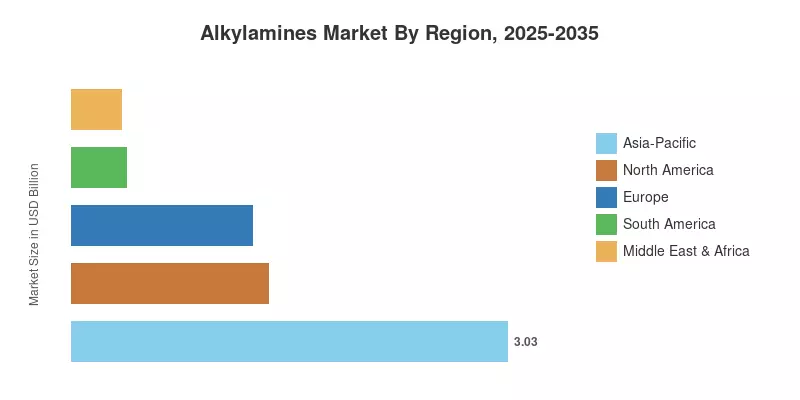
Asia-Pacific leads with a 47.2% share in 2025 and is also the fastest-expanding region, driven by Chinese solvent output and Indian pharmaceutical and agrochemical synthesis. North America ranks second, supported by integrated methylamine capacity on the U.S. Gulf Coast and feed-grade choline chloride demand. Over the next decade, competitive advantage will shift toward producers that pair feedstock security with regulatory-grade product stewardship.

Key Report Takeaways

โ€ข By Product Type

  • Methylamines hold a 41.5% share of the Alkylamines Market, anchored by dimethylamine demand for DMF, DMAC and choline chloride.
  • Cyclohexylamines are the fastest-growing product type at a 7.2% CAGR, supported by rubber accelerator and boiler-water corrosion inhibitor use.
  • Ethylamines generated USD 1.28 billion in 2025, led by herbicide and pharmaceutical synthesis.

โ€ข By Application

  • Solvents account for 27.4% of the Alkylamines Market, reflecting the role of amine-derived solvents in paints, coatings and fibre spinning.
  • Pharmaceuticals post the fastest application growth at a 7.6% CAGR as API manufacturing expands in India and China.
  • Agrochemicals were worth USD 1.15 billion in 2025, tied to salt formulations of glyphosate and 2,4-D.

โ€ข By Region

  • Asia-Pacific controls 47.2% of the Alkylamines Market, the largest regional position.
  • North America reached USD 1.37 billion in 2025 on integrated Gulf Coast production.
  • South America is set to grow at a 5.9% CAGR, led by Brazilian crop-protection demand.

Alkylamines Market Size and Forecast (2021โ€“2035)

Market Research Future built the series bottom-up from plant-level capacity and utilisation data for methylamine, ethylamine and higher-amine units, cross-checked against trade flows, producer annual reports [13][14][16] and end-use consumption in solvents, agrochemicals and pharmaceuticals. Prices were validated against feedstock cost movements in natural gas, ammonia and methanol [19][20]. The 2022 jump reflects price pass-through after the European gas shock rather than volume growth, while 2023 shows inventory destocking across coatings and agrochemical channels.
Alkylamines Market Size and Forecast
Our Impact

Enabled $4.3B Revenue Impact for Fortune 500 and Leading Multinationals

Partnering with 2000+ Global Organizations Each Year

30K+ Citations by Top-Tier Firms in the Industry

Driver Impact Analysis

Driver ~% Impact on CAGR Geographic Relevance Impact Timeline
Amine-based solvents for paints, coatings and fibres +1.4% Asia-Pacific, Europe Medium-term (2โ€“4 yr)
Agrochemical salt formulations and actives +1.2% Global, led by South America and Asia-Pacific Short-term (โ‰ค2 yr)
Pharmaceutical innovation and API onshoring +1.1% India, China, North America Long-term (โ‰ฅ4 yr)
Pulp and paper chemicals in developing economies +0.7% Asia-Pacific, South America Medium-term (2โ€“4 yr)
Rubber processing chemicals +0.6% Asia-Pacific Medium-term (2โ€“4 yr)
Feed additives and water treatment +0.5% Global Long-term (โ‰ฅ4 yr)

Amine-Based Solvents for Paints, Coatings and Fibres

Dimethylamine is the building block for DMF and DMAC, which dissolve polyurethane resins, acrylic fibres and coating binders. Producers in Asia have absorbed solvent volumes displaced in Europe after the REACH restriction on DMF set an inhalation exposure limit of 6 mg/mยณ from December 2023 [3]. The EU Chemicals Strategy for Sustainability continues to push reformulation, which favours higher-purity amine grades with documented exposure profiles [23]. Net, solvent demand keeps growing even as its geography shifts east.

Agrochemical Salt Formulations and Actives

Isopropylamine and dimethylamine salts make glyphosate and 2,4-D water-soluble, and alkylamines also serve as building blocks for herbicides such as atrazine. Global pesticide use reached roughly 3.7 million tonnes of active ingredients in 2022, with the Americas and Asia accounting for the largest share of the increase [1]. Generic herbicide manufacturing in China and India buys amines on annual contracts, which gives producers good volume visibility. Brazil's soybean expansion adds further pull for salt formulations across the Alkylamines Market.

Pharmaceutical Innovation and API Onshoring

Ethylamines, butyl amines and cyclohexylamines appear in antihistamines, antidiabetics and anaesthetic APIs. India's INR 15,000 crore pharmaceutical PLI scheme and its separate INR 6,940 crore bulk-drug scheme are adding domestic API capacity that requires reliable amine supply. Innovation also matters: the U.S. FDA's Center for Drug Evaluation and Research approved 50 novel drugs in 2024, and many small-molecule pipelines need high-purity amine reagents during scale-up.

Pulp and Paper Chemicals in Developing Economies

Alkylamines are used to make wet-strength resins, retention aids and cationic starch modifiers. Global paper and paperboard output is above 400 million tonnes a year, and new capacity is concentrated in China, Indonesia and Brazil [2]. Packaging grades are growing faster than graphic papers as e-commerce raises demand for containerboard, and those grades use more wet-strength chemistry per tonne. The result is steady, if unspectacular, demand growth for amine-derived paper additives.

Rubber Processing Chemicals

Cyclohexylamine and tert-butylamine are precursors to sulfenamide accelerators such as CBS and TBBS, which control vulcanization speed in tyre compounds. Tyre capacity additions in Thailand, Vietnam and India keep accelerator demand growing faster than global vehicle output. India's chemicals ministry reports rising domestic production of rubber chemicals alongside policy support for import substitution [21]. Producers with captive cyclohexylamine gain margin by integrating forward into accelerators.

Feed Additives and Water Treatment

Trimethylamine reacts with ethylene oxide or chloroethanol to make choline chloride, a standard poultry and swine feed additive. Integrated producers report feed-grade choline as a stable outlet that offsets cyclical solvent demand [14]. Morpholine and cyclohexylamine also serve as neutralising amines in steam-boiler treatment. Both uses grow with protein consumption and industrial steam capacity, giving the portfolio a defensive, long-cycle component worth an estimated 0.5% of annual growth.

Restraints Impact Analysis

Restraint ~% Impact on CAGR Geographic Relevance Impact Timeline
Toxicity rules on amine-derived solvents -0.6% Europe, North America Medium-term (2โ€“4 yr)
Feedstock price volatility -0.5% Europe, Asia-Pacific Short-term (โ‰ค2 yr)
Chinese overcapacity and price pressure -0.4% Global Short-term (โ‰ค2 yr)
Transport emission limits -0.3% Europe, North America Long-term (โ‰ฅ4 yr)
Hazardous handling and logistics costs -0.2% Global Long-term (โ‰ฅ4 yr)

Toxicity Rules on Amine-Derived Solvents

DMF is categorized as harmful for reproduction, and Regulation (EU) 2021/2030 sets a limit for worker exposure for all its uses, with a deadline of December 2024 for polyurethane coating applications to meet the requirements [3]. Further restrictions are listed in ECHAโ€™s Annex XVII, raising compliance costs for downstream users [4]. Some formulators are changing to non-amine solvents, which is cutting dimethylamine demand in Europe by low single digits.

Feedstock Price Volatility

Ammonia and methanol provide the bulk of the cash cost of methylamines, and both follow natural gas. European gas prices soared beyond EUR 300/MWh in August 2022, and natural gas indices were volatile until 2024, according to World Bank data [19]. U.S. producers have the advantage of Henry Hub pricing [20], while facilities in Europe experience recurring margin squeezes that defer investment decisions.

Chinese Overcapacity and Price Pressure

China has built huge capacities of methylamine and DMF in the last decade, and utilization rates have often been well below nameplate. These factories have low ceiling prices for exports in Southeast Asia and India. In 2023, BASF announced a reform of Ludwigshafen, citing declining European demand and high energy costs and highlighting the cost disparity with operations in Asia [13]. Smaller non-integrated producers have limited investments due to pressure on margins.

Transport Emission Limits

Tightening of automotive and marine emission rules accelerates the transition to electric drivetrains and cleaner fuels, which affects demand for some amine-based gasoline detergents and corrosion inhibitors. The IMO 0.50% sulfur cap has changed the chemistry of marine fuels [9], and the EUโ€™s Euro 7 legislation implemented in 2024 will tighten the limits much more [10]. The influence accumulates over the ten years.

Hazardous Handling and Logistics Costs

Monomethylamine and trimethylamine are combustible gases carried under pressure; higher amines are corrosive liquids. Specialized ISO tanks, emergency response preparation, and site permits all add expense per ton. The U.S. EPA regulations under TSCA continue to increase reporting and handling standards for hazardous solvents and intermediates [6]. These costs favor local supply and penalize long-distance trade.

Alkylamines Market Opportunities

API Supply Chains in India and Southeast Asia

Emerging markets offer the clearest volume upside for the Alkylamines Market. India's pharmaceutical incentives and Southeast Asian generic drug clusters need local sources of ethylamines, butyl amines and cyclohexylamines that today often arrive from China or Europe. Producers that locate high-purity distillation capacity near Gujarat, Telangana or Andhra Pradesh can win multi-year qualification contracts. Indian producers have already announced brownfield expansions with this goal[16].

Low-Carbon and Bio-Based Feedstocks

Green ammonia and bio-methanol give amine makers a route to lower product carbon footprints. The U.S. 45V clean hydrogen tax credit, finalised in January 2025, pays up to USD 3 per kilogram of qualifying hydrogen [7], improving the economics of low-carbon ammonia. Pharmaceutical and consumer-goods buyers with Scope 3 targets may pay premiums for verified low-carbon amines.

Data-Driven Supply Contracts and Toll Manufacturing

New business models can lift margins in a commoditised segment. Producers can offer index-linked contracts tied to published gas and methanol prices [18][20], vendor-managed inventory using tank telemetry, and toll amination for specialty customers. Selling regulatory dossiers, impurity data and carbon-footprint certificates alongside product turns compliance information into a billable service.

Crop-Protection Growth in Africa and South America

Africa uses far less pesticide per hectare than Asia or the Americas [1], and governments there are pushing yield gains through input programmes. Brazil and Argentina are expanding local formulation of herbicide salts. Regional blending hubs supplied with dimethylamine and isopropylamine could capture this demand ahead of global competitors.

Alkylamines Market Future Outlook

Low-Carbon Ammonia and Methanol Feedstocks

The next decade will reprice amines by carbon content. Ammonia production uses about 2% of global final energy [8], and methanol demand already exceeds 100 million tonnes a year [18]. As green and blue supply scales under programmes such as the DOE hydrogen hubs [22], producers in the Alkylamines Market that secure low-carbon feedstock early will hold a cost and compliance edge.

Supply-Chain Realignment

Western pharmaceutical and agrochemical buyers are reducing single-country dependence for critical intermediates. That shift favours capacity in India, the United States and selected Southeast Asian sites over further concentration in China. Expect more dual-sourcing clauses, regional inventory buffers and long-term offtake agreements between API makers and suppliers in the Alkylamines Market.

Sustainability Reporting and Product Stewardship

The EU's CBAM moves to its definitive phase in 2026, and the Commission proposed simplifications in February 2025. Combined with corporate Scope 3 reporting, these rules will require amine suppliers to publish verified product carbon footprints. Producers without that data risk losing access to European and multinational customers.

Digital Process Control

Advanced process control and AI-based optimisation can cut energy use in amination and distillation, where steam is the highest variable cost after feedstock. Plant operators are deploying digital twins to tune methylamine ratio control, reduce off-spec batches and extend catalyst life. These tools matter most in Europe, where energy prices remain highest [19].

Regional Market Share Analysis

Region Key Metric Primary Investment Themes
North America USD 1.37 Billion (2025) Gulf Coast integration, feed-grade choline, pharma reagents
Europe 19.6% share (2025) REACH compliance, specialty amines, low-carbon feedstock
Asia-Pacific 47.2% share (2025) Solvent capacity, API synthesis, agrochemical intermediates
South America 5.9% CAGR (2026โ€“2035) Herbicide salt formulation, sugarcane and soy inputs
Middle East & Africa USD 0.35 Billion (2025) Gas-based feedstock, crop-protection imports
Total USD 6.42 Billion (2025) โ€”

Asia-Pacific anchors the Alkylamines Market, while North America and Europe hold most of the integrated, high-purity capacity. South America and the Middle East & Africa remain net importers with growing formulation demand.

North America

Country Key Metric (2025) Key Driver
United States 74.5% of regional share Integrated methylamine and choline chloride production
Mexico 6.4% CAGR (2026โ€“2035) Agrochemical formulation and coatings
Canada USD 0.16 Billion Pulp, paper and oilfield chemicals

The United States dominates regional supply through integrated methylamine plants that draw on low-cost natural gas [20], and producers such as Eastman and Chemours serve agrochemical, feed and water-treatment customers from domestic sites [14][17]. Canada imports most of its needs for pulp and oilfield chemicals. Mexico's demand grows with agrochemical formulation and automotive coatings, and USMCA rules support regional sourcing.

Europe

Country Key Metric (2025) Key Driver
Germany 29.8% of regional share Integrated amine complexes and specialty grades
United Kingdom USD 0.17 Billion Pharmaceutical and fine-chemical synthesis
France 5.2% CAGR (2026โ€“2035) Agrochemical and cosmetic intermediates
Italy 13.1% of regional share Generic API manufacturing
Rest of Europe USD 0.38 Billion Benelux and Nordic chemical clusters

Germany hosts the region's largest amine complexes, led by BASF at Ludwigshafen, though the company has reduced ammonia capacity there [13]. The DMF restriction [3] and CBAM, which entered its transitional phase in October 2023 and covers ammonia-based fertilisers, raise costs for importers and local producers alike. Italy and France rely on amines for pharmaceutical and rubber chemicals.

Asia-Pacific

Country Key Metric (2025) Key Driver
China 52.6% of regional share DMF solvents and generic agrochemicals
India 8.4% CAGR (2026โ€“2035) API and agrochemical intermediate expansion
Japan USD 0.39 Billion High-purity specialty amines
South Korea 7.9% of regional share Rubber chemicals and electronics solvents
Rest of Asia-Pacific 7.1% CAGR (2026โ€“2035) Tyre and agrochemical capacity in Southeast Asia

China combines the world's largest DMF and methylamine capacity with heavy agrochemical output, making it both the main consumer and the price setter in the Alkylamines Market. India is the growth engine, backed by pharmaceutical PLI funding and capacity additions from domestic producers[16]. Japan and South Korea focus on high-purity grades for electronics, pharmaceuticals and rubber chemicals.

South America

Country Key Metric (2025) Key Driver
Brazil 61.5% of regional share Herbicide salt formulation for row crops
Argentina 5.6% CAGR (2026โ€“2035) Soybean and corn crop protection
Rest of South America USD 0.07 Billion Agrochemical and mining chemicals imports

Brazil drives regional demand through herbicide salt formulation for soybean, corn and sugarcane. Argentina follows a similar crop-protection pattern on a smaller scale, though currency volatility affects import timing. The region has little primary amine production, so supply depends on shipments from the United States, Europe and China, leaving buyers exposed to freight and exchange-rate risk.

Middle East & Africa

Country Key Metric (2025) Key Driver
United Arab Emirates 6.8% CAGR (2026โ€“2035) Trading, blending and re-export hub
Saudi Arabia 34.0% of regional share Gas-based feedstock and downstream diversification
Rest of Middle East & Africa USD 0.14 Billion Crop-protection and water-treatment imports

Saudi Arabia leverages gas-based methanol and ammonia for downstream chemicals under its industrial diversification programmes. The United Arab Emirates acts as a trading and blending hub for amines destined for Africa and South Asia. Across the rest of the region, demand comes mostly from imported crop-protection products and water-treatment chemicals.

Alkylamines Market By Region, 2025-2035

Alkylamines Market Segmentation

By Product Type

Segment Key Metric Primary Demand Driver
Methylamines 41.5% share (2025) DMF, DMAC and choline chloride
Ethylamines USD 1.28 Billion (2025) Herbicides and pharmaceutical synthesis
Propyl Amines 6.6% CAGR (2026โ€“2035) Glyphosate isopropylamine salt
Butyl Amines 12.8% share (2025) Rubber accelerators and pharmaceuticals
Cyclohexylamines 7.2% CAGR (2026โ€“2035) Sulfenamide accelerators and boiler treatment

Methylamines lead because monomethylamine, dimethylamine and trimethylamine serve the largest outlets: solvents, choline chloride and water-treatment chemicals. Cyclohexylamines grow fastest, as tyre capacity in Asia lifts demand for CBS-type accelerators and steam systems use more neutralising amines. Propyl amines benefit from isopropylamine salts of glyphosate. Butyl amines supply rubber vulcanization accelerators and pharmaceutical synthesis, while ethylamines track herbicide and API production.

By Application

Segment Key Metric Primary Demand Driver
Solvents 27.4% share (2025) Paints, coatings and acrylic fibre spinning
Rubber 5.8% CAGR (2026โ€“2035) Tyre accelerator synthesis
Agrochemicals USD 1.15 Billion (2025) Herbicide salts and actives
Paper Chemicals 9.6% share (2025) Wet-strength resins for packaging grades
Fuel Additives 6.1% CAGR (2026โ€“2035) Detergents and corrosion inhibitors
Pharmaceuticals 7.6% CAGR (2026โ€“2035) API synthesis and onshoring
Other Applications 8.9% share (2025) Feed additives, water treatment, surfactants

Solvents lead because DMF and DMAC remain hard to replace in polyurethane, acrylic fibre and coating production, even with European restrictions. Pharmaceuticals grow fastest, supported by Indian incentives and a steady stream of small-molecule approvals that rely on amine reagents. Agrochemicals provide large, contract-based volumes. Fuel additives hold modest growth in emerging markets, offset by electrification in mature fleets, and paper chemicals follow packaging demand.

Competitive Benchmarking

The Alkylamines Market is fragmented, with an estimated HHI of roughly 550โ€“700 and the top five producers holding an estimated 35โ€“40% of revenue. Large integrated firms compete on feedstock cost and portfolio breadth, Indian producers on pharmaceutical-grade service, and Chinese producers on price in methylamines and DMF.

Company Est. Revenue Share Range Key Offerings for Alkylamines Market Strategic Positioning
BASF SE ~9โ€“12% Methylamines, ethylamines, higher alkylamines, cyclohexylamine Broadest portfolio; Verbund integration
Eastman Chemical Company ~8โ€“11% Methylamines, higher amines, choline chloride Integrated U.S. and European amine chains
Luxi Chemical Group Co., Ltd. ~5โ€“7% Methylamines, DMF Low-cost coal-to-chemicals scale
Alkyl Amines Chemicals Ltd. ~4โ€“6% Methylamines, ethylamines, derivatives Pharma and agrochemical customer focus in India
Mitsubishi Gas Chemical Company, Inc. ~4โ€“6% Methylamines, high-purity grades Methanol integration and Asian supply
Shandong Hualu-Hengsheng Chemical Co., Ltd. ~4โ€“6% Methylamines, DMF Cost leadership in China
The Chemours Company ~3โ€“5% Methylamines U.S. supply for agrochemical and water-treatment users
Balaji Amines Ltd. ~3โ€“5% Methylamines, ethylamines, specialty derivatives Rapid capacity growth in India
Koei Chemical Co., Ltd. ~2โ€“4% Alkylamines and fine chemical intermediates High-purity Japanese specialty supplier
Zhejiang Jiangshan Chemical Co., Ltd. ~2โ€“4% Methylamines, DMF Regional solvent supply in eastern China

Recent News & Developments

  • BASF SE (February 2023): Announced cost cuts at Ludwigshafen, including closure of one of two ammonia plants, reducing European feedstock integration for amines and shifting some supply to imports [13].
  • European Commission (October 2023): Started the CBAM transitional phase covering fertilisers including ammonia, raising the cost visibility of imported nitrogen feedstocks.
  • European Commission (December 2023): The REACH restriction on DMF took effect, forcing downstream users to meet strict exposure limits and accelerating solvent substitution in Europe [3].
  • U.S. EPA (April 2024): Finalised a TSCA rule banning most uses of methylene chloride, pushing paint-stripping and coating formulators toward alternative solvent systems [6].
  • U.S. Treasury (January 2025): Published final 45V clean hydrogen credit regulations, improving the economics of low-carbon ammonia for chemical producers [7].
  • European Commission (February 2025): Proposed simplification of CBAM obligations ahead of the definitive phase, easing compliance for smaller importers of nitrogen products.

Alkylamines Market Report Scope

Parameter Details
Market Scope The Alkylamines Market covers methylamines, ethylamines, propyl amines, butyl amines and cyclohexylamines sold into solvents, rubber, agrochemicals, paper chemicals, fuel additives, pharmaceuticals and other applications
Study Period 2021โ€“2035
Base Year 2025
Historical Data 2021โ€“2024
Forecast Period 2026โ€“2035
Market Size in 2025 USD 6.42 Billion
Market Size in 2035 USD 11.82 Billion
CAGR (2026โ€“2035) 6.3%
Fastest Growing Segments Pharmaceuticals (7.6% CAGR); Cyclohexylamines (7.2% CAGR); Propyl Amines (6.6% CAGR)
Regions Covered North America, Europe, South America, Asia Pacific, Middle East and Africa and ROW
Companies Profiled BASF SE, Eastman Chemical Company, Luxi Chemical Group Co., Ltd., Alkyl Amines Chemicals Ltd., Mitsubishi Gas Chemical Company, Inc., Shandong Hualu-Hengsheng Chemical Co., Ltd., The Chemours Company, Balaji Amines Ltd., Koei Chemical Co., Ltd., Zhejiang Jiangshan Chemical Co., Ltd.
Valuation Currency USD Billion
Methodology 350+ primary expert interviews; bottom-up market sizing; top-down validation; data triangulation; scenario-based forecasting; real-time project tracking

FAQs

Which purity grades matter most when buying for the Alkylamines Market?
Pharmaceutical buyers usually specify a 99.5% minimum assay with tight limits on water and secondary-amine impurities. Agrochemical and solvent users accept technical grades sold at a discount [16].
Should buyers choose anhydrous or aqueous methylamines?
Aqueous 40% solutions dominate the alkylamines market trade because they are cheaper to ship and store. Anhydrous gas suits large continuous plants that need water-free reactions, but it requires pressurised storage and stricter permits [6].
How does REACH registration affect new suppliers entering the Alkylamines Market?
Any producer or importer placing more than one tonne a year in the EU must hold a REACH registration. Full dossiers for high-volume amines can take 12โ€“18 months to prepare, which slows supplier switching [4].
What contract structure works best for amine procurement?
Annual contracts indexed to methanol and natural gas prices are standard in the Alkylamines Market and reduce disputes during feedstock swings. Buyers should add quarterly reopeners and volume bands of plus or minus 15% [18][20].
Where is new investment in the Alkylamines Market most likely to go?
Brownfield debottlenecking in India attracts the most capital because it serves pharmaceutical customers with short payback periods. Greenfield methylamine plants are now rare outside China .
Are amines used in carbon capture?
Most carbon-capture solvents are alkanolamines such as MEA rather than simple alkylamines. Some tertiary and hindered amines derived from alkylamine chemistry are being tested to cut regeneration energy [25].
What are the main transport classification requirements?
Methylamine gases ship as UN class 2.1 flammable gases, while most liquid higher amines fall under class 3 or class 8. Shippers need trained staff and approved pressure or corrosion-resistant packaging [24].
Author
Author Author Profile Chitranshi Jaiswal LinkedIn Team Lead - Research
Chitranshi is a Team Leader in the Chemicals & Materials (CnM) and Energy & Power (EnP) domains, with 6+ years of experience in market research. She leads and mentors teams to deliver cross-domain projects that equip clients with actionable insights and growth strategies. She is skilled in market estimation, forecasting, competitive benchmarking, and both primary & secondary research, enabling her to turn complex data into decision-ready insights. An engineer and MBA professional, she combines technical expertise with strategic acumen to solve dynamic market challenges. Chitranshi has successfully managed projects that support market entry, investment planning, and competitive positioning, while building strong client relationships. Certified in Advanced Excel & Power BI she leverages data-driven approaches to ensure accuracy, clarity, and impactful outcomes.
Download Free Sample

Kindly complete the form below to receive a free sample of this Report

Download PDF ×

We do not share your information with anyone. However, we may send you emails based on your report interest from time to time. You may contact us at any time to opt-out.