Algae Protein Market

ID: MRFR/FnB/26615-HCR
128 Pages
Varsha More
Last Updated: June 19, 2026
Algae Protein Market Size, Share, Industry Trend & Analysis Research Report By Source (Freshwater Algae, Marine Algae), By Type (Spirulina, Chlorella, Others), By Application (Food and Beverages, Supplements, Animal Feed), By Geography (North America, Europe, Asia-Pacific, South America, Middle East & Africa) - Forecast to 2035.
Download PDF ×

We do not share your information with anyone. However, we may send you emails based on your report interest from time to time. You may contact us at any time to opt-out.

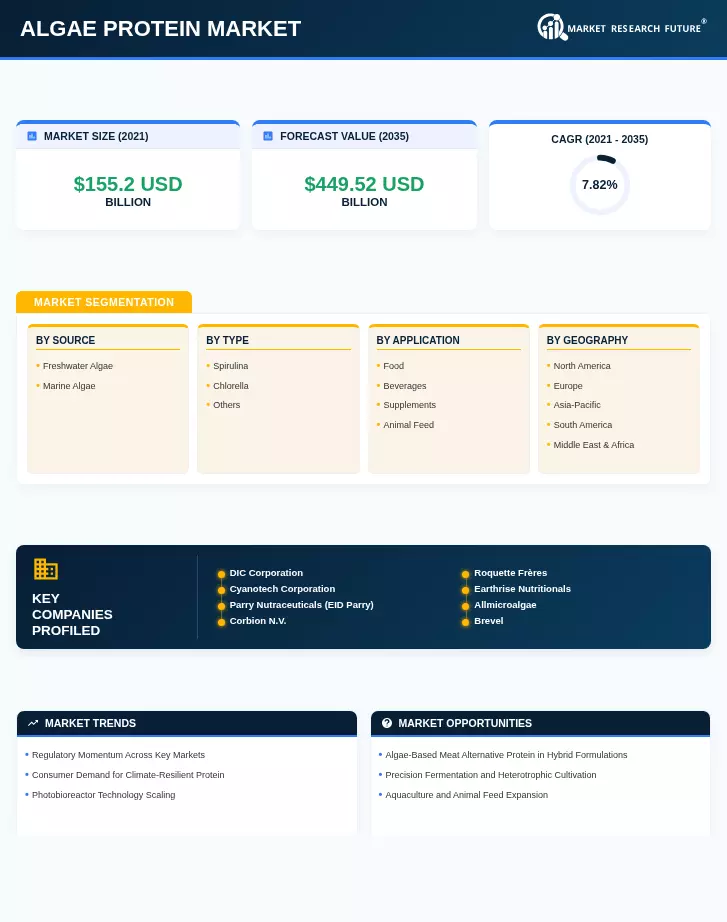
Algae Protein Market

Market Size

Forecast Period2026-2035
CAGR (2026-2035)7.82%
2025 Market SizeUSD 218.70 million
2035 Market SizeUSD 449.52 million

Key Players

DIC Corporation
Cyanotech Corporation
Parry Nutraceuticals
Corbion N.V.
Roquette Frères
Earthrise Nutritionals
Opportunities
  • Algae-Based Meat Alternative Protein in Hybrid Formulations
  • Precision Fermentation and Heterotrophic Cultivation
  • Aquaculture and Animal Feed Expansion
  1. 1 Market Overview |
    1. 1.1 Study Assumptions & Market Definition |
    2. 1.2 Scope of the Study |
    3. 1.3 Research Methodology
  2. 2 Market Summary & Key Takeaways
  3. 3 Market Dynamics |
    1. 3.1 Market Drivers Analysis | |
      1. 3.1.1 Regulatory Approvals for Novel Algae Species | |
      2. 3.1.2 Consumer Shift Toward Sustainable Protein | |
      3. 3.1.3 Closed Photobioreactor Cost Reduction | |
      4. 3.1.4 Functional Food & Beverage Reformulation |
    2. 3.2 Market Restraints Analysis | |
      1. 3.2.1 High Production Costs vs. Soy/Pea Protein | |
      2. 3.2.2 Taste and Odor Challenges in Food Formulation | |
      3. 3.2.3 Limited Consumer Awareness in Emerging Markets | |
      4. 3.2.4 Fragmented Regulatory Landscape Globally | |
      5. 3.2.5 Scalability Bottlenecks in Drying and Extraction |
    3. 3.3 Market Opportunity Analysis | |
      1. 3.3.1 Algae-Based Meat Alternative Protein in Hybrid Formulations | |
      2. 3.3.2 Precision Fermentation and Heterotrophic Cultivation | |
      3. 3.3.3 Aquaculture and Animal Feed Expansion | |
      4. 3.3.4 Emerging Market Entry in India and Southeast Asia | |
      5. 3.3.5 Carbon Credit Monetization and ESG Value Chains |
    4. 3.4 Industry Value Chain Analysis |
    5. 3.5 Porter's Five Forces Analysis
  4. 4 Global Algae Protein Market Size & Forecast (2021–2035) |
    1. 4.1 Historical Market Size (2021–2025) |
    2. 4.2 Current & Forecast Market Size (2026–2035) |
    3. 4.3 Market Size by Revenue (USD Million) |
    4. 4.4 Year-over-Year Growth Analysis
  5. 5 Segmentation Analysis |
    1. 5.1 By Source | |
      1. 5.1.1 Freshwater Algae | |
      2. 5.1.2 Marine Algae |
    2. 5.2 By Type | |
      1. 5.2.1 Spirulina | |
      2. 5.2.2 Chlorella | |
      3. 5.2.3 Others |
    3. 5.3 By Application | |
      1. 5.3.1 Food and Beverages | |
      2. 5.3.2 Supplements | |
      3. 5.3.3 Animal Feed
  6. 6 Regional Analysis |
    1. 6.1 North America | |
      1. 6.1.1 United States | |
      2. 6.1.2 Canada | |
      3. 6.1.3 Mexico |
    2. 6.2 Europe | |
      1. 6.2.1 Germany | |
      2. 6.2.2 United Kingdom | |
      3. 6.2.3 France | |
      4. 6.2.4 Italy | |
      5. 6.2.5 Spain | |
      6. 6.2.6 Nordic Countries | |
      7. 6.2.7 Russia | |
      8. 6.2.8 Rest of Europe |
    3. 6.3 Asia-Pacific | |
      1. 6.3.1 China | |
      2. 6.3.2 India | |
      3. 6.3.3 Japan | |
      4. 6.3.4 South Korea | |
      5. 6.3.5 ASEAN | |
      6. 6.3.6 Rest of Asia-Pacific |
    4. 6.4 South America | |
      1. 6.4.1 Brazil | |
      2. 6.4.2 Argentina | |
      3. 6.4.3 Rest of South America |
    5. 6.5 Middle East & Africa | |
      1. 6.5.1 Saudi Arabia | |
      2. 6.5.2 UAE | |
      3. 6.5.3 South Africa | |
      4. 6.5.4 Egypt | |
      5. 6.5.5 Rest of MEA
  7. 7 Competitive Landscape |
    1. 7.1 Market Share Analysis (2026) |
    2. 7.2 Competitive Benchmarking Matrix |
    3. 7.3 Company Profiles | |
      1. 7.3.1 DIC Corporation | |
      2. 7.3.2 Cyanotech Corporation | |
      3. 7.3.3 Parry Nutraceuticals (EID Parry) | |
      4. 7.3.4 Corbion N.V. | |
      5. 7.3.5 Roquette Frères | |
      6. 7.3.6 Earthrise Nutritionals | |
      7. 7.3.7 All microalgae | |
      8. 7.3.8 Brevel | |
      9. 7.3.9 Phycom | |
      10. 7.3.10 Far East Bio-Tec Co. (FEBICO)
  8. 8 Future Outlook & Strategic Recommendations (2026–2035) |
    1. 8.1 AI-Optimized Strain Engineering and Bioprocess Control |
    2. 8.2 Platform Economics and Ingredient-as-a-Service Models |
    3. 8.3 Climate Resilience and Water-Positive Protein Production |
    4. 8.4 ESG Reporting and Scope 3 Emission Reduction
  9. 9 Recent Developments & News
  10. 10 Frequently Asked Questions (FAQs)
  11. 11 Report Scope & Methodology |
    1. 11.1 Study Period & Base Year |
    2. 11.2 Data Sources & Citations |
    3. 11.3 Abbreviations
  12. 1 LIST OF TABLES |
  13. TABLE 1 Global Algae Protein Market Size & Forecast, by Revenue (USD Million), 2021–2035 |
  14. TABLE 2 Global Algae Protein Market – Year-over-Year Growth Analysis, 2021–2035 |
  15. TABLE 3 Driver Impact Analysis – Algae Protein Market, 2026–2035 |
  16. TABLE 4 Restraint Impact Analysis – Algae Protein Market, 2026–2035 |
  17. TABLE 5 Regional Summary – Algae Protein Market Share & Investment Themes, 2025 |
  18. TABLE 6 North America Algae Protein Market Size, by Country, 2021–2035 (USD Million) |
  19. TABLE 7 Europe Algae Protein Market Size, by Country, 2021–2035 (USD Million) |
  20. TABLE 8 Asia-Pacific Algae Protein Market Size, by Country, 2021–2035 (USD Million) |
  21. TABLE 9 South America Algae Protein Market Size, by Country, 2021–2035 (USD Million) |
  22. TABLE 10 Middle East & Africa Algae Protein Market Size, by Country, 2021–2035 (USD Million) |
  23. TABLE 11 Global Algae Protein Market Size, by Source, 2021–2035 (USD Million) |
  24. TABLE 12 Global Algae Protein Market Size, by Type, 2021–2035 (USD Million) |
  25. TABLE 13 Global Algae Protein Market Size, by Application, 2021–2035 (USD Million) |
  26. TABLE 14 Competitive Benchmarking Matrix – Global Algae Protein Market, 2026 |
  27. TABLE 15 Company Profiles – Key Players, Global Algae Protein Market |
  28. TABLE 16 Recent Developments & Strategic Announcements, 2023–2025 |
  29. TABLE 17 Report Scope & Methodology – Algae Protein Market |
  30. TABLE 18 Detailed Sources and Citations
  31. 2 LIST OF FIGURES |
  32. FIGURE 1 Algae Protein Market Dynamics – Drivers, Restraints, and Opportunities |
  33. FIGURE 2 Algae Protein Market Value Chain Analysis |
  34. FIGURE 3 Porter's Five Forces Analysis – Algae Protein Market |
  35. FIGURE 4 Global Algae Protein Market Size Trend, 2021–2035 (USD Million) |
  36. FIGURE 5 Algae Protein Market Share, by Source, 2025 (%) |
  37. FIGURE 6 Algae Protein Market Share, by Type, 2025 (%) |
  38. FIGURE 7 Algae Protein Market Share, by Application, 2025 (%) |
  39. FIGURE 8 Algae Protein Market Share, by Region, 2025 (%) |
  40. FIGURE 9 North America Algae Protein Market Size, by Country, 2025 (%) |
  41. FIGURE 10 Europe Algae Protein Market Size, by Country, 2025 (%) |
  42. FIGURE 11 Asia-Pacific Algae Protein Market Size, by Country, 2025 (%) |
  43. FIGURE 12 South America Algae Protein Market Size, by Country, 2025 (%) |
  44. FIGURE 13 Middle East & Africa Algae Protein Market Size, by Country, 2025 (%) |
  45. FIGURE 14 Competitive Landscape – Market Share Analysis, 2026 |
  46. FIGURE 15 Competitive Benchmarking – Strategic Positioning Map

Segmentation Quick Reference

DimensionSub-SegmentsDominant SegmentFastest Growing Segment
By SourceFreshwater Algae, Marine AlgaeFreshwater AlgaeMarine Algae
By TypeSpirulina, Chlorella, OthersSpirulinaChlorella
By ApplicationFood and Beverages, Supplements, Animal FeedSupplementsFood and Beverages
By GeographyNorth America, Europe, Asia-Pacific, South America, Middle East & AfricaNorth AmericaAsia-Pacific


Market Segmentation Overview

By Source

Sub-SegmentKey Trend
Freshwater AlgaeEstablished commercial cultivation for spirulina and chlorella; dominant production infrastructure globally
Marine AlgaeGrowing interest in omega-3-rich species like Nannochloropsis; dual-revenue protein + lipid extraction models


Freshwater algae remain the foundation of global algae protein supply, supported by decades of optimized cultivation protocols for spirulina and chlorella species. Marine algae are emerging as a high-growth category driven by novel species approvals and co-product value from omega-3 fatty acid extraction.

By Type

Sub-SegmentKey Trend
SpirulinaHighest protein content by dry weight (60–70%); dominant supplement and food ingredient globally
ChlorellaFastest-growing type; differentiated by CGF content, detox positioning, and immune health claims
OthersEmerging species, including Haematococcus (astaxanthin), Dunaliella (beta-carotene), and Nannochloropsis


Spirulina leads global production volumes and brand recognition, while chlorella is capturing incremental share through differentiated health positioning. Emerging species contribute niche value through high-margin co-products such as astaxanthin and natural beta-carotene.

By Application

Sub-SegmentKey Trend
Food and BeveragesRapid reformulation of protein bars, beverages, and plant-based alternatives with algae ingredients
SupplementsLargest revenue segment: capsules, tablets, and powder formats via DTC and retail channels
Animal FeedAquaculture-driven demand for fishmeal replacement; 10–15% inclusion rates in tilapia and shrimp feed


Supplements anchor current algae protein revenue through established consumer trust and premium pricing. Food and beverage applications are growing fastest as manufacturers reformulate with algae-based ingredients. Animal feed represents a high-volume opportunity tied to aquaculture expansion and fishmeal substitution mandates.

By Geography

Sub-SegmentKey Trend
North AmericaDominant region; supplement innovation, FDA regulatory momentum, mature retail channels
EuropeSecond-largest EU Novel Food approvals, sustainability-driven demand, and biotech cluster development
Asia-PacificFastest-growing mass spirulina cultivation in China, government nutrition programs in India
South AmericaAquaculture feed integration in Brazil; emerging spirulina export cultivation in Argentina
Middle East & AfricaDesert photobioreactor pilots; food fortification NGO programs; early-stage market development


North America and Europe together account for over half of global algae protein revenue, while Asia-Pacific is closing the gap through aggressive capacity expansion. South America and MEA represent emerging opportunities where targeted applications in aquaculture feed and nutrition fortification are creating new demand vectors.