
×
Request Free Sample ×

Kindly complete the form below to receive a free sample of this Report

* Please use a valid business email

Leading companies partner with us for data-driven Insights

clients tt-cursor
Hero Background
English
Chinese
French
Japanese
Korean
German
Spanish

Airport Services Market Share

ID: MRFR/AD/6923-HCR
168 Pages
Swapnil Palwe
October 2025

Airport Services Market Size, Share, Industry Trend & Analysis Research Report Information by Service Type (Aircraft Handling and Related Services [Ramp Services, Runway Maintenance and others], Hospitality Event Services [Baggage Handling Services, Catering Services, Passenger Parking Fields and others] and Cargo Handling Services [Cargo Operations and Ground Support Services]), Airport Type [Civil Airports, Military/Federal Government Airports and Private Airports] and Region (North America, Europe, Asia-Pacific, the Middle East Africa... read more

Share:
Download PDF ×

We do not share your information with anyone. However, we may send you emails based on your report interest from time to time. You may contact us at any time to opt-out.

Airport Services Market Infographic
Purchase Options

Market Share

Airport Services Market Share Analysis

In the competitive landscape of the Airport Services Market, market share positioning strategies play a pivotal role in distinguishing service providers and establishing a significant market presence. Differentiation through service quality stands as a fundamental strategy. Companies aim to differentiate their offerings by providing superior service quality across various airport services, including passenger handling, baggage management, ground operations, security screening, retail, dining, and other ancillary services. Delivering exceptional service experiences helps in securing customer loyalty and setting providers apart from competitors.

Strategic alliances and partnerships are key positioning strategies within the Airport Services Market. Collaborations with airlines, airport authorities, technology firms, and retail brands allow service providers to expand their service portfolio and geographical reach. Partnerships also facilitate the sharing of expertise, resources, and infrastructure, enabling providers to offer comprehensive and integrated solutions that cater to diverse airport requirements.

Moreover, diversification of services is a significant market positioning strategy. Companies seek to diversify their service offerings by expanding into multiple segments within the airport ecosystem. For instance, a service provider handling passenger operations may diversify into retail or ground handling services. Diversification not only broadens the scope of services but also mitigates risks associated with dependency on a single service segment.

Innovation and technological advancements serve as key drivers for market share positioning in the Airport Services Market. Service providers strive to differentiate themselves by embracing innovative technologies such as artificial intelligence, automation, data analytics, and biometrics to enhance operational efficiency, streamline processes, and improve passenger experiences. Companies investing in cutting-edge technologies gain a competitive edge and position themselves as leaders in providing forward-thinking airport services.

Cost leadership is another crucial strategy adopted by service providers to position themselves in the market. Companies focus on optimizing costs without compromising service quality. Offering cost-effective solutions and competitive pricing structures while maintaining operational efficiency helps in attracting airlines and airports looking for reliable services at reasonable rates, thus positioning providers favorably in the market.

Additionally, customer-centric approaches play a significant role in market positioning strategies. Service providers prioritize understanding and meeting the unique needs of their customers – airlines, airports, and passengers. Tailoring services to align with customer preferences, providing personalized experiences, and being responsive to customer feedback fosters stronger relationships and positions providers as trusted partners in delivering tailored and responsive airport services.

Brand reputation and track record significantly impact market positioning in the Airport Services Market. Companies with a strong brand built on a history of reliable, safe, and efficient services, backed by successful operational records and customer satisfaction, gain credibility and trust within the industry. A positive brand image positions service providers as preferred choices for airlines and airports seeking dependable partners.

Lastly, sustainability and environmental consciousness are emerging as influential positioning strategies. Companies focusing on eco-friendly practices, energy-efficient operations, waste reduction, and sustainable initiatives align with global environmental trends. Being environmentally responsible not only enhances brand image but also resonates with environmentally conscious airlines and airports seeking partners committed to sustainability.


Author
Swapnil Palwe
Team Lead - Research

With a technical background as Bachelor's in Mechanical Engineering, with MBA in Operations Management , Swapnil has 6+ years of experience in market research, consulting and analytics with the tasks of data mining, analysis, and project execution. He is the POC for our clients, for their consulting projects running under the Automotive/A&D domain. Swapnil has worked on major projects in verticals such as Aerospace & Defense, Automotive and many other domain projects. He has worked on projects for fortune 500 companies' syndicate and consulting projects along with several government projects.

Leave a Comment

FAQs

How airport services market estimated to expand during the forecast period?

Airport Services Market Size Is Expected To Reach USD 241.07 Billion By 2030. At A CAGR Of 18% By 2022-2030

Who are the established key players of the global airport services market?

Japan Airport Terminal Co., Ltd (Japan), Flughafen Wien AG (Austria), Aeroports de Paris SA (France), Japan Airport Terminal Co., Ltd (Japan) are some of the established key players of the global airport services market.

What are the driving factors of the global airport services market?

Development in commercial aviation, modernization of existing airports, and establishment of new airports are estimated to be the most significant factors driving the global airport services market.

Which region is projected to record the highest CAGR during the forecast period?

Europe is projected to record the highest CAGR during the forecast period.

Market Summary

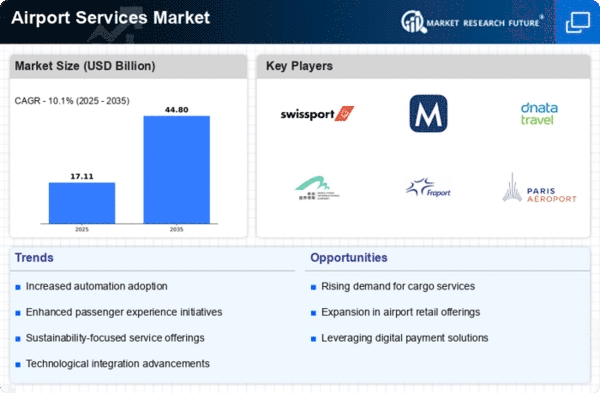
As per MRFR analysis, the Airport Services Market was estimated at 15.54 USD Billion in 2024. The Airport Services industry is projected to grow from 17.12 USD Billion in 2025 to 44.8 USD Billion by 2035, exhibiting a compound annual growth rate (CAGR) of 10.1 during the forecast period 2025 - 2035.

Key Market Trends & Highlights

The Airport Services Market is poised for robust growth driven by technological advancements and sustainability initiatives.

  • Technological integration is reshaping airport operations, enhancing efficiency and service delivery.
  • Sustainability initiatives are increasingly prioritized, reflecting a global commitment to environmental responsibility.
  • The passenger services segment is experiencing rapid growth, particularly in the Asia-Pacific region, driven by rising air travel demand.
  • Technological advancements and increased air travel demand are key drivers propelling the market forward.

Market Size & Forecast

2024 Market Size 15.54 (USD Billion)
2035 Market Size 44.8 (USD Billion)
CAGR (2025 - 2035) 10.1%
Largest Regional Market Share in 2024 North America

Major Players

Swissport International Ltd (CH), Menzies Aviation (GB), Dnata (AE), Airport Authority Hong Kong (HK), Fraport AG (DE), Aeroports de Paris (FR), TAV Airports Holding (TR), London Heathrow Airport Holdings Limited (GB), Changi Airport Group (SG)

Market Trends

The Airport Services Market is currently experiencing a dynamic evolution, driven by various factors that influence passenger expectations and operational efficiencies. As air travel continues to grow, the demand for enhanced services at airports is becoming increasingly pronounced. This market encompasses a wide range of offerings, including ground handling, passenger services, and airport management solutions. Stakeholders are focusing on integrating technology to streamline operations and improve customer experiences, which appears to be a pivotal aspect of current market strategies. Furthermore, sustainability initiatives are gaining traction, as airports seek to minimize their environmental impact while maintaining high service standards. In December 2025, the Airport Services Market reflects a landscape where innovation and customer-centric approaches are paramount. The integration of digital solutions, such as mobile applications and automated systems, is likely to redefine how services are delivered. Additionally, the emphasis on safety and security remains a critical concern, prompting investments in advanced technologies. Overall, the market seems poised for continued growth, with stakeholders adapting to emerging trends and consumer preferences, thereby shaping the future of airport services.

Technological Integration

The Airport Services Market is witnessing a notable shift towards the adoption of advanced technologies. Innovations such as artificial intelligence, biometrics, and automation are being integrated into various services, enhancing operational efficiency and improving passenger experiences. This trend suggests that airports are increasingly prioritizing technology to streamline processes and reduce wait times.

Sustainability Initiatives

There is a growing emphasis on sustainability within the Airport Services Market. Airports are actively pursuing eco-friendly practices, such as reducing carbon emissions and implementing waste management programs. This trend indicates a broader commitment to environmental stewardship, which resonates with the values of modern travelers.

Enhanced Customer Experience

The focus on enhancing customer experience is becoming a defining characteristic of the Airport Services Market. Stakeholders are investing in personalized services, improved amenities, and seamless travel experiences. This trend suggests that understanding and catering to passenger needs is essential for maintaining competitiveness in the evolving market.

Airport Services Market Market Drivers

Sustainability Initiatives

Sustainability has emerged as a critical focus within the Global Airport Services Market Industry, as airports strive to reduce their environmental impact. Initiatives such as carbon offset programs, energy-efficient terminal designs, and the use of renewable energy sources are becoming increasingly prevalent. Airports are also exploring sustainable aviation fuels to minimize emissions. These efforts not only align with global environmental goals but also appeal to environmentally conscious travelers. As sustainability becomes a key differentiator, airports that prioritize these initiatives may enhance their competitive edge and attract more passengers, thereby contributing to market growth.

Emergence of Smart Airports

The concept of smart airports is gaining traction within the Global Airport Services Market Industry, characterized by the integration of digital technologies to enhance operational efficiency and passenger experience. Smart airports utilize Internet of Things (IoT) devices, real-time data analytics, and mobile applications to streamline processes such as check-in, security screening, and boarding. This trend is expected to grow as airports seek to adapt to the evolving needs of travelers. The implementation of smart technologies not only improves efficiency but also fosters a more personalized experience for passengers, potentially driving increased loyalty and repeat business.

Increasing Air Traffic Demand

The Global Airport Services Market Industry is experiencing a notable surge in air traffic demand, driven by rising disposable incomes and a growing middle class worldwide. In 2024, the market is valued at approximately 63.8 USD Billion, reflecting the increasing number of passengers traveling by air. This trend is expected to continue, with projections indicating that by 2035, the market could reach 551.5 USD Billion. The expansion of low-cost carriers and the introduction of new routes further contribute to this growth, suggesting a robust future for airport services as they adapt to accommodate the increasing volume of travelers.

Government Investments in Infrastructure

Government investments in airport infrastructure are a significant driver of growth in the Global Airport Services Market Industry. Many countries are recognizing the importance of modernizing their airport facilities to accommodate increasing passenger volumes and enhance operational efficiency. These investments often include expanding runways, upgrading terminals, and improving air traffic control systems. For instance, several nations have allocated substantial budgets for airport development projects, which are expected to yield long-term economic benefits. As these infrastructure improvements take shape, they are likely to bolster the overall market, facilitating smoother operations and improved passenger experiences.

Technological Advancements in Airport Operations

Technological innovations play a pivotal role in enhancing the efficiency of airport operations within the Global Airport Services Market Industry. Automation, artificial intelligence, and advanced data analytics are being integrated into various airport services, such as baggage handling and passenger processing. These advancements not only streamline operations but also improve the overall passenger experience. For instance, biometric screening technologies are being adopted to expedite security checks. As airports invest in these technologies, they are likely to see improved operational efficiency and customer satisfaction, which could further drive market growth in the coming years.

Market Segment Insights

By Service Type: Ground Handling Services (Largest) vs. Passenger Services (Fastest-Growing)

In the Airport Services Market, Ground Handling Services account for the largest share across the service types, reflecting their critical role in airport operations. This segment encompasses a wide range of functions including baggage handling, aircraft marshaling, and ramp services. Passenger Services also represent a significant portion of the market, focusing on the experience provided to travelers from check-in to boarding, yet this sector is showing rapid growth driven by increasing air travel demand and enhanced customer service initiatives. Recent trends indicate a shift towards automation and technology integration within Ground Handling Services, enhancing efficiency and safety. Conversely, Passenger Services are evolving with a focus on improving passenger experiences through innovative service offerings, such as personalized assistance and smart airport technologies. As travel continues to rebound, both segments are essential for maintaining airport efficacy and customer satisfaction.

Ground Handling Services (Dominant) vs. Passenger Services (Emerging)

Ground Handling Services are characterized by their extensive functionalities, which include baggage handling, ramp services, and aircraft servicing, making them indispensable for airports. This segment has established its dominance due to its essential role in ensuring operational efficiency at airports. On the other hand, Passenger Services are emerging as a crucial element of the airport experience, focusing on enhancing traveler satisfaction through innovative solutions such as mobile check-in and facilities that cater to passenger needs. While Ground Handling remains dominant, the evolving dynamics of the Passenger Services market reflect a growing emphasis on customer experience, presenting opportunities for service providers to innovate and expand their offerings.

By Airport Size: Large Airports (Largest) vs. Small Airports (Fastest-Growing)

In the Airport Services Market, the market share distribution among various airport sizes highlights that large airports command a significant portion of the market due to their extensive facilities, higher passenger traffic, and comprehensive service offerings. Medium airports follow, catering to regional travel demands, while small airports represent a notable segment, primarily serving local communities and niche markets. Their role in providing access to less populated areas maintains their relevance in the market.

Large Airports (Dominant) vs. Small Airports (Emerging)

Large airports play a dominant role in the Airport Services Market, characterized by their ability to handle substantial passenger volumes and diverse international flights. They are equipped with extensive amenities and services, which attract airlines and passengers alike. In contrast, small airports, while emerging, are increasingly recognized for their growth potential as they cater to the demand for regional air travel and promote connectivity to underserved areas. Their agile operations and minimal congestion present unique advantages, particularly in the context of evolving travel preferences that favor convenience and accessibility.

By Service Provider Type: Public Service Providers (Largest) vs. Private Service Providers (Fastest-Growing)

Within the Airport Services Market, the distribution of service providers is notably diverse. Public Service Providers dominate the landscape, leveraging government backing and established networks to maintain a robust presence at major airports. Conversely, Private Service Providers are swiftly carving out their niche, appealing to specific customer needs and differentiating themselves with innovative offerings and enhanced efficiency. Hybrid Service Providers, combining both public and private attributes, are also gaining traction, appealing to a growing segment of airport operators seeking flexibility and adaptability in their service arrangements.

Public Service Providers (Dominant) vs. Private Service Providers (Emerging)

Public Service Providers exemplify stability and reliability, offering essential airport services backed by government support. These providers typically operate on a larger scale, ensuring compliance with regulatory standards while maintaining a consistent level of service across various airports. In contrast, Private Service Providers represent the emergent wave in the Airport Services Market, often focusing on specialized segments. They thrive by offering customized services, utilizing technological advancements to enhance user experience. This agility allows them to respond rapidly to changing market demands, making them increasingly attractive to airport operators looking for innovative solutions. Consequently, the competition between these segments fosters a vibrant and dynamic marketplace.

By Passenger Type: Leisure Travelers (Largest) vs. Business Travelers (Fastest-Growing)

In the Airport Services Market, the passenger type segment is primarily dominated by Leisure Travelers, who account for a significant share of air traffic. Their preference for budget airlines and demand for cost-effective services reinforces their position as the largest segment. In contrast, Business Travelers, though a smaller segment, have been experiencing rapid growth driven by the increasing number of corporate travels and the expansion of corporate travel budgets, making them a vital segment for airport services.

Leisure Travelers: Dominant vs. Business Travelers: Emerging

Leisure Travelers represent a dominant force in the Airport Services Market due to their high frequency of travel for vacations and personal reasons. This segment values affordability and convenience, often opting for low-cost carriers and basic services. In contrast, Business Travelers, while emerging, showcase a distinct profile characterized by higher spending behaviors and requirements for premium services such as lounges and expedited check-ins. They are increasingly influential as companies enhance their travel budgets, showcasing a growing preference for comfort and efficiency during travel, thus shaping service offerings at airports.

Get more detailed insights about Airport Services Market Research Report -Forecast till 2035

Regional Insights

North America : Market Leader in Airport Services

North America is poised to maintain its leadership in the Airport Services Market, holding a significant market share of 6.5 in 2024. The region's growth is driven by increasing air travel demand, technological advancements, and robust regulatory frameworks that support infrastructure development. The rise in passenger traffic and cargo services further fuels this growth, with airports investing heavily in service enhancements and operational efficiencies. Leading countries such as the USA and Canada are home to major players like Swissport International Ltd and Menzies Aviation, which dominate the competitive landscape. The presence of key airports, including Hartsfield-Jackson Atlanta International and Los Angeles International, underscores the region's strategic importance. The competitive environment is characterized by partnerships and innovations aimed at improving customer experience and operational performance.

Europe : Emerging Hub for Airport Services

Europe's Airport Services Market is projected to grow, with a market size of 4.5 in 2024. The region benefits from a strong regulatory environment that promotes safety and efficiency in air travel. Increasing passenger numbers and the expansion of low-cost carriers are key drivers of demand. Additionally, sustainability initiatives are shaping the market, as airports seek to reduce their carbon footprint and enhance service quality. Countries like Germany, France, and the UK are at the forefront, with major players such as Fraport AG and Aeroports de Paris leading the charge. The competitive landscape is marked by strategic alliances and investments in technology to improve operational efficiency. The European market is also characterized by a focus on customer satisfaction and innovative service offerings, positioning it as a vital player in the global airport services sector.

Asia-Pacific : Rapid Growth in Airport Services

The Asia-Pacific region is witnessing rapid growth in the Airport Services Market, with a market size of 3.5 in 2024. This growth is fueled by increasing air travel demand, urbanization, and government investments in airport infrastructure. Regulatory support for enhancing safety and efficiency is also a significant catalyst, as countries aim to modernize their aviation sectors to accommodate rising passenger numbers. Leading countries such as China, India, and Singapore are key players in this market, with companies like Dnata and Changi Airport Group making substantial contributions. The competitive landscape is evolving, with a focus on technological advancements and customer-centric services. As the region continues to expand its airport capabilities, it is set to play a crucial role in The Airport Services.

Middle East and Africa : Emerging Market for Airport Services

The Middle East and Africa region is emerging as a significant player in the Airport Services Market, with a market size of 1.04 in 2024. The growth is driven by increasing air travel demand, strategic investments in airport infrastructure, and a focus on enhancing passenger experience. Regulatory frameworks are evolving to support the expansion of airport services, making the region attractive for investment and development. Countries like the UAE and South Africa are leading the way, with key players such as Dnata and TAV Airports Holding establishing a strong presence. The competitive landscape is characterized by partnerships and collaborations aimed at improving service delivery and operational efficiency. As the region continues to develop its airport capabilities, it is poised for significant growth in the coming years.

Key Players and Competitive Insights

The Airport Services Market is characterized by a dynamic competitive landscape, driven by factors such as increasing air travel demand, technological advancements, and a growing emphasis on sustainability. Major players like Swissport International Ltd (CH), Menzies Aviation (GB), and Dnata (AE) are strategically positioned to leverage these trends. Swissport International Ltd (CH) focuses on enhancing operational efficiency through digital transformation initiatives, while Menzies Aviation (GB) emphasizes regional expansion and service diversification. Dnata (AE) is actively pursuing partnerships to bolster its service offerings, collectively shaping a competitive environment that prioritizes innovation and customer-centric solutions.The market structure appears moderately fragmented, with key players employing various business tactics to optimize their operations. Localizing manufacturing and optimizing supply chains are prevalent strategies among these companies, allowing them to respond swiftly to regional demands. The collective influence of these major players fosters a competitive atmosphere where agility and responsiveness are paramount, enabling them to adapt to evolving market conditions.

In November Swissport International Ltd (CH) announced a partnership with a leading technology firm to implement AI-driven baggage handling systems. This strategic move is likely to enhance operational efficiency and reduce turnaround times, positioning Swissport as a frontrunner in technological innovation within the sector. The integration of AI not only streamlines processes but also aligns with the growing demand for enhanced customer experiences.

In October Menzies Aviation (GB) expanded its footprint in Asia by acquiring a regional ground handling company. This acquisition is significant as it allows Menzies to tap into the burgeoning Asian market, which is witnessing a surge in air travel. By enhancing its service capabilities in this region, Menzies is poised to capture a larger market share and strengthen its competitive position.

In September Dnata (AE) launched a sustainability initiative aimed at reducing carbon emissions across its operations. This initiative underscores Dnata's commitment to environmental stewardship and aligns with global trends towards sustainability in the aviation sector. By prioritizing eco-friendly practices, Dnata not only enhances its brand reputation but also meets the increasing expectations of environmentally conscious consumers.

As of December current competitive trends in the Airport Services Market are heavily influenced by digitalization, sustainability, and AI integration. Strategic alliances are becoming increasingly vital, enabling companies to pool resources and expertise to navigate the complexities of the market. The competitive differentiation is likely to evolve from traditional price-based competition to a focus on innovation, technology, and supply chain reliability, reflecting a broader shift in industry priorities.

Key Companies in the Airport Services Market include

Industry Developments

  • New technologies such as Artificial Intelligence, Robotics, and Machine Learning are being used by businesses in the airport services market to improve the satisfaction level of the customers.
  • Fraport Frankfurt Airport Services Market has introduced a new attraction at the airport where customers can explore around 30 interactive and innovative exhibits and explore the latest aviation hub of Germany uniquely. 

Future Outlook

Airport Services Market Future Outlook

The Airport Services Market is projected to grow at a 10.1% CAGR from 2025 to 2035, driven by technological advancements, increasing passenger traffic, and enhanced service offerings.

New opportunities lie in:

  • Implementation of automated baggage handling systems to improve efficiency.
  • Development of premium lounge services targeting high-value travelers.
  • Integration of AI-driven customer service solutions for personalized passenger experiences.

By 2035, the Airport Services Market is expected to be robust, reflecting substantial growth and innovation.

Market Segmentation

Airport Services Market Airport Size Outlook

  • Large Airports
  • Medium Airports
  • Small Airports

Airport Services Market Service Type Outlook

  • Ground Handling Services
  • Passenger Services
  • Cargo Services
  • Maintenance Services

Airport Services Market Passenger Type Outlook

  • Business Travelers
  • Leisure Travelers
  • Transit Passengers

Airport Services Market Service Provider Type Outlook

  • Public Service Providers
  • Private Service Providers
  • Hybrid Service Providers

Report Scope

MARKET SIZE 202415.54(USD Billion)
MARKET SIZE 202517.12(USD Billion)
MARKET SIZE 203544.8(USD Billion)
COMPOUND ANNUAL GROWTH RATE (CAGR)10.1% (2025 - 2035)
REPORT COVERAGERevenue Forecast, Competitive Landscape, Growth Factors, and Trends
BASE YEAR2024
Market Forecast Period2025 - 2035
Historical Data2019 - 2024
Market Forecast UnitsUSD Billion
Key Companies ProfiledSwissport International Ltd (CH), Menzies Aviation (GB), Dnata (AE), Airport Authority Hong Kong (HK), Fraport AG (DE), Aeroports de Paris (FR), TAV Airports Holding (TR), London Heathrow Airport Holdings Limited (GB), Changi Airport Group (SG)
Segments CoveredService Type, Airport Size, Service Provider Type, Passenger Type
Key Market OpportunitiesIntegration of advanced technologies for enhanced passenger experience in the Airport Services Market.
Key Market DynamicsTechnological advancements and regulatory changes drive innovation and competition in the Airport Services Market.
Countries CoveredNorth America, Europe, APAC, South America, MEA

FAQs

How airport services market estimated to expand during the forecast period?

Airport Services Market Size Is Expected To Reach USD 241.07 Billion By 2030. At A CAGR Of 18% By 2022-2030

Who are the established key players of the global airport services market?

Japan Airport Terminal Co., Ltd (Japan), Flughafen Wien AG (Austria), Aeroports de Paris SA (France), Japan Airport Terminal Co., Ltd (Japan) are some of the established key players of the global airport services market.

What are the driving factors of the global airport services market?

Development in commercial aviation, modernization of existing airports, and establishment of new airports are estimated to be the most significant factors driving the global airport services market.

Which region is projected to record the highest CAGR during the forecast period?

Europe is projected to record the highest CAGR during the forecast period.

  1. SECTION I: EXECUTIVE SUMMARY AND KEY HIGHLIGHTS
    1. | 1.1 EXECUTIVE SUMMARY
    2. | 1.1.1 Market Overview
    3. | 1.1.2 Key Findings
    4. | 1.1.3 Market Segmentation
    5. | 1.1.4 Competitive Landscape
    6. | 1.1.5 Challenges and Opportunities
    7. | 1.1.6 Future Outlook
  2. SECTION II: SCOPING, METHODOLOGY AND MARKET STRUCTURE
    1. | 2.1 MARKET INTRODUCTION
    2. | 2.1.1 Definition
    3. | 2.1.2 Scope of the study
    4. |-- 2.1.2.1 Research Objective
    5. |-- 2.1.2.2 Assumption
    6. |-- 2.1.2.3 Limitations
    7. | 2.2 RESEARCH METHODOLOGY
    8. | 2.2.1 Overview
    9. | 2.2.2 Data Mining
    10. | 2.2.3 Secondary Research
    11. | 2.2.4 Primary Research
    12. |-- 2.2.4.1 Primary Interviews and Information Gathering Process
    13. |-- 2.2.4.2 Breakdown of Primary Respondents
    14. | 2.2.5 Forecasting Model
    15. | 2.2.6 Market Size Estimation
    16. |-- 2.2.6.1 Bottom-Up Approach
    17. |-- 2.2.6.2 Top-Down Approach
    18. | 2.2.7 Data Triangulation
    19. | 2.2.8 Validation
  3. SECTION III: QUALITATIVE ANALYSIS
    1. | 3.1 MARKET DYNAMICS
    2. | 3.1.1 Overview
    3. | 3.1.2 Drivers
    4. | 3.1.3 Restraints
    5. | 3.1.4 Opportunities
    6. | 3.2 MARKET FACTOR ANALYSIS
    7. | 3.2.1 Value chain Analysis
    8. | 3.2.2 Porter's Five Forces Analysis
    9. |-- 3.2.2.1 Bargaining Power of Suppliers
    10. |-- 3.2.2.2 Bargaining Power of Buyers
    11. |-- 3.2.2.3 Threat of New Entrants
    12. |-- 3.2.2.4 Threat of Substitutes
    13. |-- 3.2.2.5 Intensity of Rivalry
    14. | 3.2.3 COVID-19 Impact Analysis
    15. |-- 3.2.3.1 Market Impact Analysis
    16. |-- 3.2.3.2 Regional Impact
    17. |-- 3.2.3.3 Opportunity and Threat Analysis
  4. SECTION IV: QUANTITATIVE ANALYSIS
    1. | 4.1 Aerospace & Defense, BY Service Type (USD Billion)
    2. | 4.1.1 Ground Handling Services
    3. | 4.1.2 Passenger Services
    4. | 4.1.3 Cargo Services
    5. | 4.1.4 Maintenance Services
    6. | 4.2 Aerospace & Defense, BY Airport Size (USD Billion)
    7. | 4.2.1 Large Airports
    8. | 4.2.2 Medium Airports
    9. | 4.2.3 Small Airports
    10. | 4.3 Aerospace & Defense, BY Service Provider Type (USD Billion)
    11. | 4.3.1 Public Service Providers
    12. | 4.3.2 Private Service Providers
    13. | 4.3.3 Hybrid Service Providers
    14. | 4.4 Aerospace & Defense, BY Passenger Type (USD Billion)
    15. | 4.4.1 Business Travelers
    16. | 4.4.2 Leisure Travelers
    17. | 4.4.3 Transit Passengers
    18. | 4.5 Aerospace & Defense, BY Region (USD Billion)
    19. | 4.5.1 North America
    20. |-- 4.5.1.1 US
    21. |-- 4.5.1.2 Canada
    22. | 4.5.2 Europe
    23. |-- 4.5.2.1 Germany
    24. |-- 4.5.2.2 UK
    25. |-- 4.5.2.3 France
    26. |-- 4.5.2.4 Russia
    27. |-- 4.5.2.5 Italy
    28. |-- 4.5.2.6 Spain
    29. |-- 4.5.2.7 Rest of Europe
    30. | 4.5.3 APAC
    31. |-- 4.5.3.1 China
    32. |-- 4.5.3.2 India
    33. |-- 4.5.3.3 Japan
    34. |-- 4.5.3.4 South Korea
    35. |-- 4.5.3.5 Malaysia
    36. |-- 4.5.3.6 Thailand
    37. |-- 4.5.3.7 Indonesia
    38. |-- 4.5.3.8 Rest of APAC
    39. | 4.5.4 South America
    40. |-- 4.5.4.1 Brazil
    41. |-- 4.5.4.2 Mexico
    42. |-- 4.5.4.3 Argentina
    43. |-- 4.5.4.4 Rest of South America
    44. | 4.5.5 MEA
    45. |-- 4.5.5.1 GCC Countries
    46. |-- 4.5.5.2 South Africa
    47. |-- 4.5.5.3 Rest of MEA
  5. SECTION V: COMPETITIVE ANALYSIS
    1. | 5.1 Competitive Landscape
    2. | 5.1.1 Overview
    3. | 5.1.2 Competitive Analysis
    4. | 5.1.3 Market share Analysis
    5. | 5.1.4 Major Growth Strategy in the Aerospace & Defense
    6. | 5.1.5 Competitive Benchmarking
    7. | 5.1.6 Leading Players in Terms of Number of Developments in the Aerospace & Defense
    8. | 5.1.7 Key developments and growth strategies
    9. |-- 5.1.7.1 New Product Launch/Service Deployment
    10. |-- 5.1.7.2 Merger & Acquisitions
    11. |-- 5.1.7.3 Joint Ventures
    12. | 5.1.8 Major Players Financial Matrix
    13. |-- 5.1.8.1 Sales and Operating Income
    14. |-- 5.1.8.2 Major Players R&D Expenditure. 2023
    15. | 5.2 Company Profiles
    16. | 5.2.1 Swissport International Ltd (CH)
    17. |-- 5.2.1.1 Financial Overview
    18. |-- 5.2.1.2 Products Offered
    19. |-- 5.2.1.3 Key Developments
    20. |-- 5.2.1.4 SWOT Analysis
    21. |-- 5.2.1.5 Key Strategies
    22. | 5.2.2 Menzies Aviation (GB)
    23. |-- 5.2.2.1 Financial Overview
    24. |-- 5.2.2.2 Products Offered
    25. |-- 5.2.2.3 Key Developments
    26. |-- 5.2.2.4 SWOT Analysis
    27. |-- 5.2.2.5 Key Strategies
    28. | 5.2.3 Dnata (AE)
    29. |-- 5.2.3.1 Financial Overview
    30. |-- 5.2.3.2 Products Offered
    31. |-- 5.2.3.3 Key Developments
    32. |-- 5.2.3.4 SWOT Analysis
    33. |-- 5.2.3.5 Key Strategies
    34. | 5.2.4 Airport Authority Hong Kong (HK)
    35. |-- 5.2.4.1 Financial Overview
    36. |-- 5.2.4.2 Products Offered
    37. |-- 5.2.4.3 Key Developments
    38. |-- 5.2.4.4 SWOT Analysis
    39. |-- 5.2.4.5 Key Strategies
    40. | 5.2.5 Fraport AG (DE)
    41. |-- 5.2.5.1 Financial Overview
    42. |-- 5.2.5.2 Products Offered
    43. |-- 5.2.5.3 Key Developments
    44. |-- 5.2.5.4 SWOT Analysis
    45. |-- 5.2.5.5 Key Strategies
    46. | 5.2.6 Aeroports de Paris (FR)
    47. |-- 5.2.6.1 Financial Overview
    48. |-- 5.2.6.2 Products Offered
    49. |-- 5.2.6.3 Key Developments
    50. |-- 5.2.6.4 SWOT Analysis
    51. |-- 5.2.6.5 Key Strategies
    52. | 5.2.7 TAV Airports Holding (TR)
    53. |-- 5.2.7.1 Financial Overview
    54. |-- 5.2.7.2 Products Offered
    55. |-- 5.2.7.3 Key Developments
    56. |-- 5.2.7.4 SWOT Analysis
    57. |-- 5.2.7.5 Key Strategies
    58. | 5.2.8 London Heathrow Airport Holdings Limited (GB)
    59. |-- 5.2.8.1 Financial Overview
    60. |-- 5.2.8.2 Products Offered
    61. |-- 5.2.8.3 Key Developments
    62. |-- 5.2.8.4 SWOT Analysis
    63. |-- 5.2.8.5 Key Strategies
    64. | 5.2.9 Changi Airport Group (SG)
    65. |-- 5.2.9.1 Financial Overview
    66. |-- 5.2.9.2 Products Offered
    67. |-- 5.2.9.3 Key Developments
    68. |-- 5.2.9.4 SWOT Analysis
    69. |-- 5.2.9.5 Key Strategies
    70. | 5.3 Appendix
    71. | 5.3.1 References
    72. | 5.3.2 Related Reports

Aerospace & Defense Market Segmentation

Aerospace & Defense By Service Type (USD Billion, 2025-2035)

  • Ground Handling Services
  • Passenger Services
  • Cargo Services
  • Maintenance Services

Aerospace & Defense By Airport Size (USD Billion, 2025-2035)

  • Large Airports
  • Medium Airports
  • Small Airports

Aerospace & Defense By Service Provider Type (USD Billion, 2025-2035)

  • Public Service Providers
  • Private Service Providers
  • Hybrid Service Providers

Aerospace & Defense By Passenger Type (USD Billion, 2025-2035)

  • Business Travelers
  • Leisure Travelers
  • Transit Passengers
Infographic

Free Sample Request

Kindly complete the form below to receive a free sample of this Report

Get Free Sample

Customer Strories

Compare Licence

×
Features License Type
Single User Multiuser License Enterprise User
Price $4,950 $5,950 $7,250
Maximum User Access Limit 1 User Upto 10 Users Unrestricted Access Throughout the Organization
Free Customization
Direct Access to Analyst
Deliverable Format
Platform Access
Discount on Next Purchase 10% 15% 15%
Printable Versions