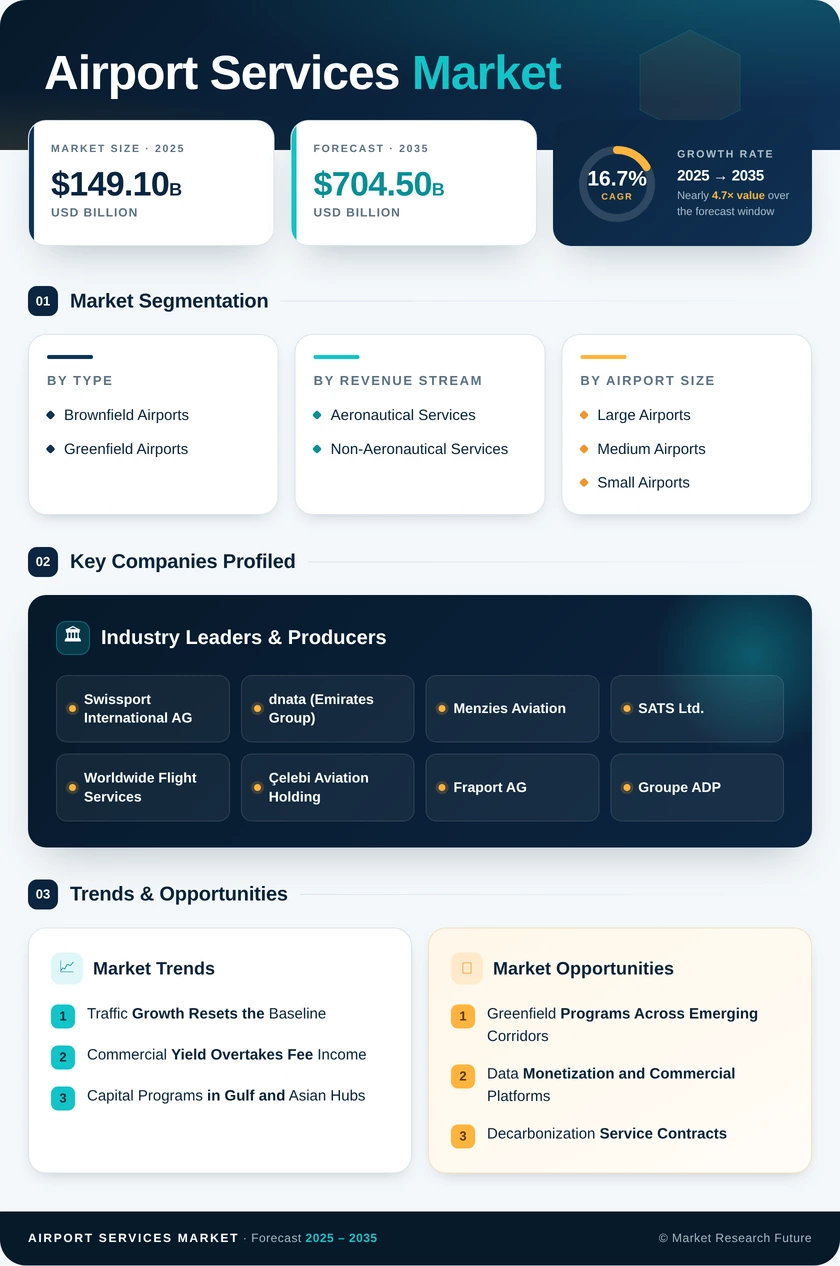
Segmentation Quick Reference
| Dimension | Sub-Segments | Dominant Segment | Fastest Growing Segment |
| By Service Type | Aircraft Ground Handling Services; Baggage & Cargo Handling Services; Aircraft Maintenance Services; Passenger Services; Aircraft Fueling Services; Other Airport Services | Aircraft Ground Handling Services | Baggage & Cargo Handling Services |
| By Revenue Stream | Aeronautical Services; Non-Aeronautical Services | Aeronautical Services | Non-Aeronautical Services |
| By Airport Size | Large Airports; Medium Airports; Small Airports | Large Airports | Small Airports |
| By Infrastructure Type | Brownfield Airports; Greenfield Airports | Brownfield Airports | Greenfield Airports |
| By Region | North America; Europe; Asia-Pacific; South America; Middle East & Africa | North America | Asia-Pacific |
Market Segmentation Overview
By Service Type
| Sub-Segment | Key Trend |
| Aircraft Ground Handling Services | Outcome-based pricing replacing headcount-based contracts |
| Baggage & Cargo Handling Services | Express and e-commerce freight driving automated sortation |
| Aircraft Maintenance Services | Line maintenance moving to predictive, sensor-triggered scheduling |
| Passenger Services | Biometric processing reducing agent-touch requirements |
| Aircraft Fueling Services | Blending compliance adding measurement and reporting scope |
| Other Airport Services | Security screening and de-icing consolidating under integrated vendors |
Service-type competition is bifurcating. Volume scopes reward operators with the lowest cost per turn, while technical and certified scopes reward specialists who can document compliance. Providers straddling both are finding it harder to defend margin in either.
By Revenue Stream
| Sub-Segment | Key Trend |
| Aeronautical Services | Regulated charge reviews limiting recovery of new investment |
| Non-Aeronautical Services | Retail, parking, and real estate yield rising as strategic priorities |
Operators increasingly manage the two streams as separate businesses with separate leadership. That separation is producing sharper commercial performance but also new tension over how terminal space is allocated between throughput and revenue generation.
By Airport Size
| Sub-Segment | Key Trend |
| Large Airports | Multi-vendor scope splitting to reduce single-provider dependency |
| Medium Airports | Point-to-point network growth expanding contract addressable value |
| Small Airports | Subsidized regional connectivity schemes creating new demand pockets |
Growth is flowing outward from the largest hubs. Smaller fields, historically underserved by global providers, now attract attention because government connectivity programs underwrite traffic that would not otherwise exist.
By Infrastructure Type
| Sub-Segment | Key Trend |
| Brownfield Airports | Retrofit programs balancing construction against live operations |
| Greenfield Airports | New-build hubs in Asia and the Gulf specifying automation from day one |
Retrofits still dominate spending because most of the world's capacity already exists. New-build programs, though fewer, set the technical benchmark — they arrive with electrified fleets, integrated data platforms, and automated baggage systems as standard rather than upgrades.
By Region
| Sub-Segment | Key Trend |
| North America | Federal grant capital funding terminal modernization at mid-size fields |
| Europe | Emissions and charge regulation shaping contract economics |
| Asia-Pacific | Terminal build-out and cargo hub expansion driving fastest growth |
| South America | Concession rounds transferring assets to private operators |
| Middle East & Africa | Megahub programs and transfer-traffic strategies raising service standards |
Regional divergence is widening. Mature markets compete on efficiency and compliance, while high-growth regions compete on capacity delivery. Providers building portfolios across both are hedging cyclical exposure but carrying heavier operating complexity.


 Noah Malgeri
Co-Founder

 Peter Groot koerkamp
Account and Business Manager

 Younghwan Choi
Senior Retail Manager

 Mark Irwin
Management Consultant

 Akif Moroglu
Strategy & Business Development Director

 Guilherme Gomes Martins
Product Management Director

 Joseph Aguayo
Sales Operations & Pricing Manager

 La Terria Dodd
Program Support Specialist

 Rob Kooiker
Group Product Manager HVAC & Fire Protection GMA