
×
Request Free Sample ×

Kindly complete the form below to receive a free sample of this Report

* Please use a valid business email

Leading companies partner with us for data-driven Insights

clients tt-cursor
Hero Background
English
Chinese
French
Japanese
Korean
German
Spanish

Airport IOT Market Size

ID: MRFR/AD/5259-HCR
124 Pages
Swapnil Palwe
October 2025

Airport IoT Market Size, Share, Industry Trend & Analysis Research Report Information by Airport Type (Commercial Airport, Cargo Airport, and General Airport), Application (Passenger Handling, Operations, and Security), Technology (Sensing Layer Technology, Network Layer Technology, and Application Layer Technology), and Region (North America, Europe, Asia-Pacific, Middle East & Africa, and Latin America) - Global Forecast till 2035

Share:
Download PDF ×

We do not share your information with anyone. However, we may send you emails based on your report interest from time to time. You may contact us at any time to opt-out.

Airport IOT Market Infographic
Purchase Options

Airport Iot Size

Airport IOT Market Growth Projections and Opportunities

The Airport Internet of Things (IoT) sector is driven by technical advances, aviation industry digitization, and a focus on airport operational efficiency and passenger experience. Integration of IoT technology to enhance airport operations is a major driver. Airports may gather and analyze real-time data by implementing connected sensors, devices, and systems in baggage handling, security, and maintenance. This data-driven strategy improves airport efficiency by streamlining operations and improving decision-making.

Airport IoT market dynamics are driven by IoT device and connection innovations. As sensors, communication protocols, and edge computing improve, airports may deploy several IoT applications. These technologies allow airports to establish networked systems that give useful insights, improving safety, security, and resource management by tracking luggage and aircraft maintenance.

Demand for better passenger experiences drives Airport IoT market dynamics. Airports are using IoT to speed up and customize passenger experiences. This includes smart check-in, real-time updates, and passenger-specific services. IoT technology in passenger-centric services improve airport efficiency and customer happiness, increasing loyalty.

Airport IoT adoption is driven by security concerns, affecting market dynamics. IoT-enabled surveillance, biometric authentication, and access control improve airport security. Airports can swiftly respond to threats and maintain passenger, crew, and asset safety by monitoring and analyzing security-related IoT device data in real time. Security concerns and the requirement for strong threat detection drive airport IoT application growth.

The regulatory environment also shapes Airport IoT market dynamics. Airports must follow strict safety, security, and efficiency regulations. As airports develop and implement IoT technology, regulatory compliance becomes increasingly important. Manufacturers and service providers building IoT solutions that fulfill industry standards and increasing regulatory frameworks affect market dynamics.

Airport budgets and financing affect Airport IoT market dynamics. Airports' IoT investments and deployment depend on their finances. Airports prioritize solutions with a high return on investment and integrate their IoT adoption strategy with financial limits. Airports and technology suppliers must consider IoT solution pricing and cost-effectiveness.

The Airport IoT industry is driven by airport-technology vendor alliances and ecosystems. Airports work with technology suppliers, system integrators, and IoT solution developers to customize IoT apps. This collaborative strategy accelerates IoT adoption, stimulates creativity, and develops comprehensive and interoperable solutions to airport concerns.

Airport IoT markets are increasingly considering sustainability. Airports are investigating IoT applications to improve energy efficiency, resource consumption, and waste reduction as the aviation sector reduces its environmental impact. Sustainable market dynamics entail the development of IoT solutions that help airports meet environmental goals, aligning with industry trends toward eco-friendly and sustainable activities.

Airport IOT Market Size Graph
Author
Swapnil Palwe
Team Lead - Research

With a technical background as Bachelor's in Mechanical Engineering, with MBA in Operations Management , Swapnil has 6+ years of experience in market research, consulting and analytics with the tasks of data mining, analysis, and project execution. He is the POC for our clients, for their consulting projects running under the Automotive/A&D domain. Swapnil has worked on major projects in verticals such as Aerospace & Defense, Automotive and many other domain projects. He has worked on projects for fortune 500 companies' syndicate and consulting projects along with several government projects.

Leave a Comment

Market Summary

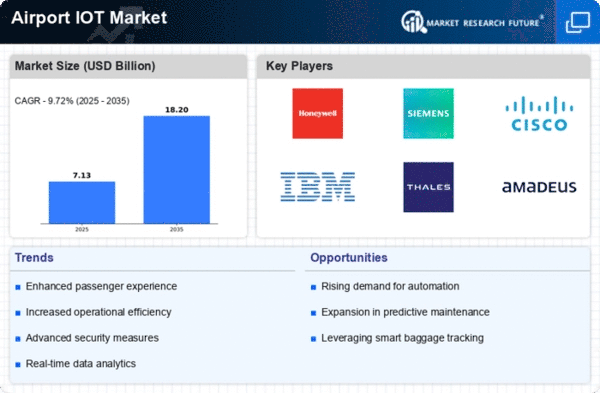
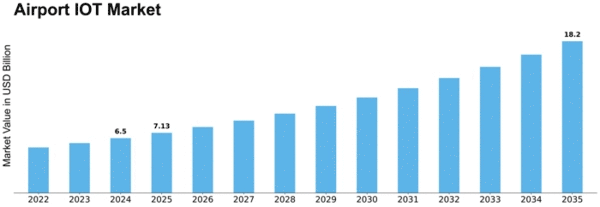
As per MRFR analysis, the Airport IOT Market Size was estimated at 6.5 USD Billion in 2024. The Airport IOT industry is projected to grow from 7.2 in 2025 to 18.2 by 2035, exhibiting a compound annual growth rate (CAGR) of 9.72 during the forecast period 2025 - 2035.

Key Market Trends & Highlights

The Airport IoT Market is poised for substantial growth driven by technological advancements and evolving passenger expectations.

  • The North American region remains the largest market for Airport IoT solutions, reflecting a strong investment in smart airport technologies.
  • Asia-Pacific is emerging as the fastest-growing region, with rapid adoption of IoT solutions to enhance operational efficiency.
  • Passenger tracking is the largest segment, while baggage management is witnessing the fastest growth due to increasing demand for seamless travel experiences.
  • Key market drivers include the rising demand for smart airports and the integration of real-time data analytics to improve security and sustainability.

Market Size & Forecast

2024 Market Size 6.5 (USD Billion)
2035 Market Size 18.2 (USD Billion)
CAGR (2025 - 2035) 9.72%
Largest Regional Market Share in 2024 North America

Major Players

<p>Honeywell (US), Siemens (DE), Cisco (US), IBM (US), Thales (FR), Amadeus IT Group (ES), SITA (CH), Indra Sistemas (ES), Rockwell Collins (US)</p>

Market Trends

The Airport IOT Market is currently experiencing a transformative phase, driven by advancements in technology and the increasing demand for enhanced operational efficiency. Airports are integrating Internet of Things solutions to streamline processes, improve passenger experiences, and bolster security measures. This integration appears to be fostering a more connected environment, where real-time data exchange facilitates better decision-making and resource allocation. As a result, stakeholders are likely to witness a shift towards more automated systems, which could lead to reduced operational costs and improved service delivery. Moreover, the emphasis on sustainability and environmental responsibility is becoming more pronounced within the Airport IOT Market. Airports are exploring innovative solutions that not only enhance operational efficiency but also minimize their ecological footprint. This trend suggests a growing awareness among airport authorities regarding the importance of sustainable practices. Consequently, the adoption of smart technologies that promote energy efficiency and waste reduction is expected to gain momentum, potentially reshaping the future landscape of airport operations.

Enhanced Passenger Experience

The focus on improving passenger satisfaction is becoming a central theme in the Airport IOT Market. Airports are leveraging IoT technologies to provide personalized services, such as real-time flight updates and tailored recommendations. This trend indicates a shift towards a more customer-centric approach, where the traveler’s journey is prioritized.

Operational Efficiency through Automation

Automation is increasingly being recognized as a key driver of efficiency within the Airport IOT Market. By implementing IoT solutions, airports can optimize resource management, streamline baggage handling, and enhance security protocols. This trend suggests that operational processes are likely to become more seamless and less prone to human error.

Sustainability Initiatives

Sustainability is emerging as a critical focus area in the Airport IOT Market. Airports are adopting IoT technologies to monitor energy consumption and reduce waste, aligning with global environmental goals. This trend indicates a commitment to greener practices, which may influence future investments and operational strategies.

Airport IOT Market Market Drivers

Increased Demand for Enhanced Passenger Experience

The Global Airport IoT Market Industry is witnessing a surge in demand for enhanced passenger experiences. Airports are increasingly adopting IoT technologies to streamline operations and improve customer satisfaction. For instance, smart kiosks and mobile applications provide real-time flight updates and personalized services. This trend is expected to contribute to the market's growth, with projections indicating a market value of 6.2 USD Billion in 2024. As passenger expectations evolve, airports are likely to invest in IoT solutions that facilitate smoother check-ins and boarding processes, ultimately enhancing the overall travel experience.

Market Segment Insights

By Application: Passenger Tracking (Largest) vs. Baggage Management (Fastest-Growing)

<p>In the Airport IoT Market, the application segment is primarily driven by Passenger Tracking, which holds the largest market share. This segment capitalizes on the need for enhanced passenger experiences, providing real-time tracking and analytics. Following closely is Baggage Management, which is rapidly gaining traction, fueled by innovations in RFID and tracking solutions that improve efficiency and reliability in baggage handling. As airports increasingly adopt smart technologies, the growth of the Airport IoT Market's applications is significant. Passenger Tracking continues to evolve with features such as mobile alerts and predictive analytics, while Baggage Management is poised for accelerated growth, driven by the increasing demand for seamless travel experiences and the growing adoption of IoT-enabled tracking systems.</p>

<p>Security Monitoring (Dominant) vs. Environmental Monitoring (Emerging)</p>

<p>In the Airport IoT Market, Security Monitoring stands as a dominant application, leveraging advanced technologies such as facial recognition, video surveillance, and threat detection. It plays a critical role in ensuring passenger and staff safety, thereby maintaining operational integrity at airports. As security regulations become more stringent, investments in IoT-based monitoring systems are becoming paramount. On the other hand, Environmental Monitoring is an emerging segment that focuses on tracking climate conditions and air quality within airport environments. With growing awareness of environmental impact and sustainability, this segment is gaining traction, as airports seek to implement green practices and comply with regulatory standards. Together, these applications highlight the dynamic nature of airport operations and the need for continual technological advancement.</p>

By Technology: Sensor Technology (Largest) vs. Data Analytics (Fastest-Growing)

<p>In the Airport IoT Market, Sensor Technology holds the largest market share, driven by the increasing demand for real-time monitoring and information collection. Its applications in flight tracking, baggage handling, and security systems make it essential for improving airport efficiency. On the other hand, Data Analytics is witnessing rapid growth as airports leverage data-driven insights to enhance operational decisions and customer experiences. This segment is transforming through advanced algorithms and machine learning techniques, unlocking new potential in service optimization and predictive maintenance.</p>

<p>Technology: Sensor Technology (Dominant) vs. Data Analytics (Emerging)</p>

<p>Sensor Technology is a pivotal element in the Airport IoT market due to its extensive applications in monitoring and data collection processes. By enhancing operational efficiency, it allows airports to track various operations such as baggage handling and passenger movements. Meanwhile, Data Analytics is emerging as a powerful tool that aids airports in employing real-time data for enhanced decision-making. This synergy between Sensor Technology and Data Analytics indicates a changing landscape where data-driven insights will play a significant role in shaping the future of airport operations, making processes quicker and more efficient.</p>

By End Use: Airports (Largest) vs. Airlines (Fastest-Growing)

<p>The Airport IoT Market is prominently influenced by various end-use segments. Airports hold the largest share, capitalizing on the need for smart operations, enhanced operational efficiency, and passenger experience improvements. Airlines, while slightly behind in overall market share, are experiencing rapid growth as they increasingly adopt IoT technologies to optimize fleet management, improve fuel efficiency, and enhance customer service through connected technologies. In terms of growth trends, the airline sector is on an upward trajectory, largely due to advancements in IoT solutions that focus on predictive maintenance and real-time data analytics. Moreover, increasing investments in smart airport initiatives drive demand within airports, while airlines respond by adopting innovative IoT strategies to stay competitive in a rapidly evolving landscape.</p>

<p>Airports (Dominant) vs. Ground Handling Services (Emerging)</p>

<p>Airports represent the dominant segment in the Airport IoT Market, reflecting a critical focus on integrated solutions that enhance passenger flow, security, and operational efficiency. With comprehensive data analytics and seamless connectivity, airports leverage IoT technology to streamline processes, reduce downtime, and elevate overall customer experience. In contrast, ground handling services are emerging as a significant player, increasingly recognizing the value of IoT for optimizing baggage handling and turnaround times. The adoption of IoT technologies in ground handling is driven by the need for improved safety, tracking, and enhanced service delivery. As this segment evolves, it aims to align closely with airport operations, ensuring timely coordination and efficient logistics in the ever-demanding airport environment.</p>

Get more detailed insights about Airport IoT Market Research Report - Global Forecast till 2035

Regional Insights

North America : Market Leader in Innovation

North America is poised to maintain its leadership in the Airport IoT market, holding a significant share of 3.25B in 2025. The region's growth is driven by increasing passenger traffic, the need for enhanced operational efficiency, and stringent safety regulations. Government initiatives promoting smart airport technologies further catalyze this growth, ensuring that North America remains at the forefront of innovation in the aviation sector. The competitive landscape is robust, with key players like Honeywell, Cisco, and IBM leading the charge. The U.S. is the primary market, supported by advanced infrastructure and a high adoption rate of IoT solutions. Companies are investing heavily in R&D to develop cutting-edge technologies that enhance passenger experience and streamline airport operations, solidifying North America's position as a global hub for Airport IoT solutions.

Europe : Emerging Hub for Smart Airports

Europe is witnessing a surge in the Airport IoT market, projected to reach 1.8B by 2025. The region's growth is fueled by increasing investments in smart airport infrastructure and a focus on sustainability. Regulatory frameworks, such as the European Union's Green Deal, are pushing airports to adopt IoT solutions that enhance operational efficiency while reducing carbon footprints. This regulatory support is crucial for driving innovation and investment in the sector. Leading countries like Germany, France, and the UK are at the forefront of this transformation, with companies such as Siemens and Thales playing pivotal roles. The competitive landscape is characterized by collaborations between technology providers and airport authorities, aiming to implement integrated IoT systems that improve passenger experience and operational efficiency. The European market is set to become a benchmark for smart airport solutions globally.

Asia-Pacific : Rapid Growth in Airport Technologies

Asia-Pacific is rapidly emerging as a significant player in the Airport IoT market, with a projected size of 1.5B by 2025. The region's growth is driven by increasing air travel demand, urbanization, and government initiatives aimed at modernizing airport infrastructure. Countries like China and India are investing heavily in smart airport technologies to enhance operational efficiency and passenger experience, supported by favorable regulatory environments. The competitive landscape features key players such as Cisco and IBM, who are collaborating with local governments to implement IoT solutions. The presence of a large number of airports and the rising trend of digital transformation in the aviation sector are propelling the growth of IoT applications. As the region continues to develop, it is expected to play a crucial role in shaping the future of airport operations.

Middle East and Africa : Emerging Market Potential

The Middle East and Africa region is gradually emerging in the Airport IoT market, with a market size of 0.95B projected for 2025. The growth is driven by increasing investments in airport infrastructure and a rising number of air travelers. Governments are focusing on enhancing airport facilities and adopting smart technologies to improve operational efficiency and passenger experience. Regulatory support is crucial in fostering this growth, as countries aim to position themselves as global aviation hubs. Leading countries like the UAE and South Africa are making significant strides in implementing IoT solutions at airports. The competitive landscape includes both local and international players, with companies like SITA and Indra Sistemas actively participating in the market. As the region continues to develop its aviation sector, the demand for innovative IoT solutions is expected to rise, presenting substantial growth opportunities.

Key Players and Competitive Insights

The Airport IOT Market is currently characterized by a dynamic competitive landscape, driven by technological advancements and the increasing demand for operational efficiency. Major players such as Honeywell (US), Siemens (DE), and Cisco (US) are at the forefront, each adopting distinct strategies to enhance their market positioning. Honeywell (US) focuses on innovation through the development of smart airport solutions that integrate IoT technologies, while Siemens (DE) emphasizes digital transformation initiatives aimed at optimizing airport operations. Cisco (US) leverages its expertise in networking to provide robust connectivity solutions, which are essential for the seamless operation of IoT systems in airports. Collectively, these strategies contribute to a competitive environment that is increasingly centered around technological integration and operational excellence.

In terms of business tactics, companies are localizing manufacturing and optimizing supply chains to enhance responsiveness to market demands. The competitive structure of the Airport IOT Market appears moderately fragmented, with several key players exerting influence over various segments. This fragmentation allows for a diverse range of solutions, catering to the specific needs of airports worldwide, while also fostering innovation as companies strive to differentiate themselves.

In November 2025, Honeywell (US) announced a partnership with a leading airport authority to implement a comprehensive IoT-based management system aimed at improving passenger flow and enhancing security measures. This strategic move underscores Honeywell's commitment to leveraging IoT technologies to address contemporary challenges faced by airports, thereby reinforcing its competitive edge in the market. The partnership is expected to yield significant operational efficiencies and improve the overall passenger experience.

In October 2025, Siemens (DE) unveiled a new digital platform designed to integrate various airport systems, including baggage handling and security operations. This initiative reflects Siemens' focus on creating a unified ecosystem that enhances operational efficiency and reduces costs. By streamlining processes through digitalization, Siemens positions itself as a leader in the Airport IOT Market, potentially setting new standards for operational excellence.

In September 2025, Cisco (US) launched an advanced cybersecurity framework tailored for airport IoT systems, addressing the growing concerns regarding data security and system integrity. This strategic action highlights Cisco's proactive approach to safeguarding critical infrastructure, which is increasingly vital as airports adopt more interconnected technologies. By prioritizing cybersecurity, Cisco not only enhances its value proposition but also strengthens its competitive position in a market where trust and reliability are paramount.

As of December 2025, the competitive trends in the Airport IOT Market are heavily influenced by digitalization, sustainability, and the integration of artificial intelligence (AI). Strategic alliances among key players are shaping the landscape, fostering innovation and collaborative solutions. The shift from price-based competition to a focus on technological advancement and supply chain reliability is evident, suggesting that future differentiation will hinge on the ability to innovate and adapt to evolving market demands. Companies that can effectively leverage these trends are likely to emerge as leaders in the Airport IOT Market.

Key Companies in the Airport IOT Market include

Industry Developments

SITA has partnered with Microsoft to develop a new cloud-based platform for airport operations. The platform will use Azure IoT to collect and analyze data from sensors throughout the airport, and will use machine learning to improve efficiency and passenger experience.

Air France-KLM has launched a pilot program to use blockchain technology to track baggage. The program will use sensors to track baggage throughout its journey, and will use blockchain to create a secure and tamper-proof record of its location.

Future Outlook

Airport IOT Market Future Outlook

<p>The Airport IoT Market is projected to grow at a 9.72% CAGR from 2024 to 2035, driven by advancements in automation, enhanced passenger experience, and operational efficiency.</p>

New opportunities lie in:

  • <p>Integration of AI-driven predictive maintenance systems</p>
  • <p>Development of real-time baggage tracking solutions</p>
  • <p>Implementation of smart parking management technologies</p>

<p>By 2035, the Airport IoT Market is expected to be robust, driven by innovative solutions and increased operational efficiencies.</p>

Market Segmentation

Airport IOT Market End Use Outlook

  • Airports
  • Airlines
  • Ground Handling Services
  • Security Agencies
  • Government Authorities

Airport IOT Market Technology Outlook

  • Sensor Technology
  • Communication Technology
  • Data Analytics
  • Cloud Computing
  • Artificial Intelligence

Airport IOT Market Application Outlook

  • Passenger Tracking
  • Baggage Management
  • Security Monitoring
  • Asset Management
  • Environmental Monitoring

Report Scope

MARKET SIZE 20246.5(USD Billion)
MARKET SIZE 20257.2(USD Billion)
MARKET SIZE 203518.2(USD Billion)
COMPOUND ANNUAL GROWTH RATE (CAGR)9.72% (2024 - 2035)
REPORT COVERAGERevenue Forecast, Competitive Landscape, Growth Factors, and Trends
BASE YEAR2024
Market Forecast Period2025 - 2035
Historical Data2019 - 2024
Market Forecast UnitsUSD Billion
Key Companies ProfiledHoneywell (US), Siemens (DE), Cisco (US), IBM (US), Thales (FR), Amadeus IT Group (ES), SITA (CH), Indra Sistemas (ES), Rockwell Collins (US)
Segments CoveredApplication, Technology, End Use
Key Market OpportunitiesIntegration of advanced analytics and real-time data for enhanced passenger experience in the Airport IOT Market.
Key Market DynamicsRising demand for enhanced operational efficiency drives innovation in Airport Internet of Things technologies and solutions.
Countries CoveredNorth America, Europe, APAC, South America, MEA

FAQs

  1. Executive
    1. Summary
    2. Market Attractiveness Analysis
  2. Airport IoT Market, By Airport Type
  3. Airport
  4. IoT Market, By Application
    1. Technology
    2. Market Introduction
    3. Scope of the Study
    4. Key Buying Criteria
  5. Airport IoT Market, By
  6. Airport IoT Market, By Region
    1. Market Definition
    2. Market Structure
    3. Market Factor Indicator Analysis
  7. Research Methodology
    1. Research
    2. Process
    3. Primary Research
    4. Secondary
    5. Research
    6. Market Size Estimation
    7. Forecast Model
    8. List of Assumptions
    9. Market Insights
  8. Market Dynamics
    1. Introduction
    2. Drivers
    3. Restraints
    4. Opportunities
    5. Market/Technological
    6. Trends
    7. Patent Trends
    8. Regulatory
    9. Landscape/Standards
  9. Market Factor Analysis
    1. Value Chain/Supply Chain Analysis
    2. & Sales
    3. Porter’s Five Forces Analysis
    4. New Entrants
    5. Buyers
    6. Segment Rivalry
    7. of Supplies
  10. R&D
  11. Manufacturing
  12. Distribution
  13. Post-Sales Monitoring
  14. Threat of
  15. Bargaining Simulation and Training of
  16. Threat of Substitutes
  17. Bargaining Simulation and Training
  18. Airport IoT Market, by Airport Type
    1. Overview
    2. Commercial Airport
      1. Market
    3. Market Estimates & Forecast, 2022–2032
    4. Estimates & Forecast, by Region, 2022–2032
    5. Cargo
      1. Market Estimates & Forecast, 2022–2032
      2. Market Estimates & Forecast, by Region, 2022–2032
    6. Airport
    7. General Airport
      1. Market Estimates
      2. Market Estimates &
    8. & Forecast, 2022–2032
    9. Forecast, by Region, 2022–2032
  19. Airport IoT Market,
    1. by Application
    2. Overview
    3. Passenger
      1. Market Estimates & Forecast, 2022–2032
      2. Market Estimates & Forecast, by Region, 2022–2032
    4. Handling
    5. Security
      1. Market Estimates
      2. Market Estimates &
    6. & Forecast, 2022–2032
    7. Forecast, by Region, 2022–2032
    8. Operations
      1. Market
    9. Market Estimates & Forecast, 2022–2032
    10. Estimates & Forecast, by Region, 2022–2032
  20. Airport
  21. IoT Market, by Technology
    1. Overview
      1. Market Estimates &
      2. Market Estimates & Forecast,
    2. Sensing Layer Technology
    3. Forecast, 2022–2032
    4. by Region, 2022–2032
    5. Network Layer Technology
      1. Market Estimates & Forecast, 2022–2032
  22. Market Estimates & Forecast, by Region, 2022–2032
    1. Application Layer Technology
    2. & Forecast, 2022–2032
    3. Forecast, by Region, 2022–2032
  23. Market Estimates
  24. Market Estimates &
  25. Airport IoT Market,
    1. by Region
    2. Overview
    3. North
      1. Market Estimates & Forecast, by Country,
      2. Market Estimates & Forecast,
      3. Market Estimates
      4. Market
      5. Canada
    4. America
    5. by Airport Type, 2022–2032
    6. & Forecast, by Application, 2022–2032
    7. Estimates & Forecast, by Technology, 2022–2032
    8. US
    9. Type, 2022–2032
    10. by Application, 2022–2032
    11. & Forecast, by Technology, 2022–2032
    12. by Application, 2022–2032
    13. & Forecast, by Technology, 2022–2032
    14. Europe
      1. Market Estimates & Forecast, by Country, 2022–2032
      2. Market Estimates & Forecast, by Airport Type, 2022–2032
      3. Market Estimates & Forecast, by Application, 2022–2032
      4. Market Estimates & Forecast, by Technology, 2022–2032
      5. UK
    15. & Forecast, by Airport Type, 2022–2032
    16. Estimates & Forecast, by Application, 2022–2032
  26. Market Estimates & Forecast, by Technology, 2022–2032
    1. Germany
    2. by Airport Type, 2022–2032
    3. & Forecast, by Application, 2022–2032
    4. Estimates & Forecast, by Technology, 2022–2032
    5. France
    6. Airport Type, 2022–2032
    7. & Forecast, by Application, 2022–2032
    8. Estimates & Forecast, by Technology, 2022–2032
    9. Italy
    10. Airport Type, 2022–2032
    11. & Forecast, by Application, 2022–2032
  27. Market Estimates & Forecast,
  28. Market Estimates
  29. Market
  30. Market Estimates & Forecast, by
  31. Market Estimates
  32. Market
  33. Market Estimates & Forecast, by
  34. Market Estimates
  35. Market Estimates & Forecast, by Technology, 2022–2032
    1. Rest of Europe
    2. by Airport Type, 2022–2032
    3. & Forecast, by Application, 2022–2032
  36. Market Estimates & Forecast,
  37. Market Estimates
  38. Market Estimates & Forecast, by Technology, 2022–2032
    1. Asia-Pacific
    2. by Country, 2022–2032
    3. Forecast, by Airport Type, 2022–2032
    4. Estimates & Forecast, by Application, 2022–2032
  39. Market Estimates & Forecast,
  40. Market Estimates &
  41. Market
  42. Market Estimates & Forecast, by Technology, 2022–2032
    1. China
    2. Airport Type, 2022–2032
    3. & Forecast, by Application, 2022–2032
  43. Market Estimates & Forecast, by
  44. Market Estimates
  45. Market Estimates & Forecast, by Technology, 2022–2032
    1. Japan
    2. Airport Type, 2022–2032
    3. & Forecast, by Application, 2022–2032
  46. Market Estimates & Forecast, by
  47. Market Estimates
  48. Market Estimates & Forecast, by Technology, 2022–2032
    1. India
    2. Airport Type, 2022–2032
    3. & Forecast, by Application, 2022–2032
  49. Market Estimates & Forecast, by
  50. Market Estimates
  51. Market Estimates & Forecast, by Technology, 2022–2032
    1. Australia
    2. by Airport Type, 2022–2032
    3. & Forecast, by Application, 2022–2032
  52. Market Estimates & Forecast,
  53. Market Estimates
  54. Market Estimates & Forecast, by Technology, 2022–2032
    1. Rest of Asia-Pacific
    2. Forecast, by Airport Type, 2022–2032
    3. Estimates & Forecast, by Application, 2022–2032
  55. Market Estimates &
  56. Market
  57. Market Estimates & Forecast, by Technology, 2022–2032
    1. Middle East & Africa
    2. Forecast, by Country, 2022–2032
    3. & Forecast, by Airport Type, 2022–2032
    4. Estimates & Forecast, by Application, 2022–2032
  58. Market Estimates &
  59. Market Estimates
  60. Market
  61. Market Estimates & Forecast, by Technology, 2022–2032
    1. Saudi Arabia
    2. by Airport Type, 2022–2032
    3. & Forecast, by Application, 2022–2032
    4. Estimates & Forecast, by Technology, 2022–2032
    5. UAE
    6. Type, 2022–2032
    7. by Application, 2022–2032
    8. & Forecast, by Technology, 2022–2032
    9. of Middle East & Africa
    10. Forecast, by Airport Type, 2022–2032
    11. Estimates & Forecast, by Application, 2022–2032
  62. Market Estimates & Forecast,
  63. Market Estimates
  64. Market
  65. Market Estimates & Forecast, by Airport
  66. Market Estimates & Forecast,
  67. Market Estimates
  68. Rest
  69. Market Estimates &
  70. Market
  71. Market Estimates & Forecast, by Technology, 2022–2032
    1. Latin America
    2. by Country, 2022–2032
    3. Forecast, by Airport Type, 2022–2032
    4. Estimates & Forecast, by Application, 2022–2032
  72. Market Estimates & Forecast,
  73. Market Estimates &
  74. Market
  75. Market Estimates & Forecast, by Technology, 2022–2032
    1. Brazil
    2. Airport Type, 2022–2032
    3. & Forecast, by Application, 2022–2032
    4. Estimates & Forecast, by Technology, 2022–2032
    5. Rest of Latin America
    6. Forecast, by Airport Type, 2022–2032
    7. Estimates & Forecast, by Application, 2022–2032
  76. Market Estimates & Forecast, by
  77. Market Estimates
  78. Market
  79. Market Estimates &
  80. Market
  81. Market Estimates & Forecast, by Technology, 2022–2032
    1. Competitive Landscape
    2. Competitive Overview
    3. Competitor Dashboard
    4. Major
    5. Growth Strategy in the Airport IoT Market
    6. Competitive
    7. Benchmarking
    8. Market Share Analysis/ Market Concentration
    9. Ratio Analysis
    10. Leading Player in terms of Number
    11. of Developments in Airport IoT Market
    12. Key Developments
      1. New Product Launch/Service
      2. Merger & Acquisition
    13. & Growth Strategies
    14. Deployment
    15. Joint Ventures
  82. Company Profiles
    1. Key Market Players
    2. Company Overview
    3. Financial Overview
    4. SWOT Analysis
    5. Cisco Systems, Inc.
    6. Overview
    7. SWOT Analysis
    8. Collins Aerospace
    9. Overview
    10. SWOT Analysis
    11. Huawei Technologies Co., Ltd
    12. Overview
    13. Financial Overview
    14. SWOT Analysis
    15. IBM Corporation
    16. Product Offering
    17. Key Developments
    18. Strategy
    19. Company Overview
    20. Financial Overview
    21. SWOT Analysis
    22. Honeywell International, Inc.
    23. Overview
    24. SWOT Analysis
    25. SAP SE
    26. Product Offering
    27. Key Developments
    28. Strategy
    29. Company Overview
    30. Financial Overview
    31. SWOT Analysis
    32. SITAONAIR
    33. Product Offering
    34. Key Developments
    35. Strategy
    36. Offering
    37. Key Developments
    38. Strategy
  83. Amadeus IT Group
  84. Product Offering
  85. Key Developments
  86. Strategy
  87. Company Overview
  88. Product Offering
  89. Financial
  90. Key Developments
  91. Strategy
  92. Company Overview
  93. Product Offering
  94. Financial
  95. Key Developments
  96. Strategy
  97. Company
  98. Product Offering
  99. Key Developments
  100. Strategy
  101. Company Overview
  102. Financial Overview
  103. SWOT Analysis
  104. Microsoft Corporation
  105. Product Offering
  106. Key Developments
  107. Strategy
  108. Company Overview
  109. Product Offering
  110. Financial
  111. Key Developments
  112. Strategy
  113. Company Overview
  114. Financial Overview
  115. SWOT Analysis
  116. Siemens AG
  117. Product Offering
  118. Key Developments
  119. Strategy
  120. Company Overview
  121. Financial Overview
  122. SWOT Analysis
  123. Wind River Systems, Inc.
  124. Company Overview
  125. Product
  126. Financial Overview
  127. SWOT Analysis
  128. Appendix
    1. References
    2. Related Reports
    3. List of Abbreviation
  129. Industry Insights
    1. Note: This table of content is tentative
    2. and subject to change as the research progresses.
    3. List of Tables
    4. Table
  130. Global Airport IoT Market, by Region, 2022–2032
  131. North America: Airport IoT Market, by Country, 2022–2032
  132. Europe: Airport IoT Market, by Country, 2022–2032
  133. Asia-Pacific: Airport IoT Market, by Country,
  134. Middle East & Africa:
  135. Airport IoT Market, by Country, 2022–2032
  136. Latin
  137. America: Airport IoT Market, by Country, 2022–2032
    1. Table 7
  138. Global Airport IoT Market Size, by Region, 2022–2032
    1. Table
  139. North America: Airport IoT Market Size, by Country, 2022–2032
  140. Europe: Airport IoT Market Size, by Country,
  141. Asia-Pacific: Airport IoT
  142. Market Size, by Country, 2022–2032
  143. Middle
  144. East & Africa: Airport IoT Market Size, by Country, 2022–2032
    1. Table
  145. Latin America: Airport IoT Market Size, by Country, 2022–2032
  146. Global Airport IoT Airport Type Market, by Region,
  147. North America: Airport IoT
  148. Airport Type Market, by Country, 2022–2032
    1. Table 15
  149. Europe: Airport IoT Airport Type Market, by Country, 2022–2032
  150. Asia-Pacific: Airport IoT Airport Type Market, by Country,
  151. Middle East & Africa:
  152. Airport IoT Airport Type Market, by Country, 2022–2032
    1. Table 18
  153. Latin America: Airport IoT Airport Type Market, by Country, 2022–2032
  154. Global Airport IoT Technology Market, by Region, 2022–2032
  155. North America: Airport IoT Technology Market,
    1. by Country, 2022–2032
  156. Europe: Airport
  157. IoT Technology Market, by Country, 2022–2032
    1. Table 22
  158. Asia-Pacific: Airport IoT Technology Market, by Country, 2022–2032
  159. Middle East & Africa: Airport IoT Technology Market,
    1. by Country, 2022–2032
  160. Latin America: Airport
  161. IoT Technology Market, by Country, 2022–2032
  162. Global
  163. Airport IoT Application Market, by Region, 2022–2032
    1. Table 26
  164. North America: Airport IoT Application Market, by Country, 2022–2032
  165. Europe: Airport IoT Application Market, by
    1. Country, 2022–2032
  166. Asia-Pacific: Airport
  167. IoT Application Market, by Country, 2022–2032
    1. Table 29
  168. Middle East & Africa: Airport IoT Application Market, by Country, 2022–2032
  169. Latin America: Airport IoT Application Market, by Country,
  170. Global Airport IoT Market, by Region,
  171. Global Airport IoT Market,
    1. by Airport Type, 2022–2032
  172. Global Airport
  173. IoT Market, by Technology, 2022–2032
  174. Global
  175. Airport IoT Market, by Application, 2022–2032
  176. North
  177. America: Airport IoT Market, by Country, 2022–2032
    1. Table 36
  178. North America: Airport IoT Market, by Airport Type, 2022–2032
    1. Table
  179. North America: Airport IoT Market, by Technology, 2022–2032
  180. North America: Airport IoT Market, by Application,
  181. Europe: Airport IoT Market, by Country,
  182. Europe: Airport IoT Market,
    1. by Airport Type, 2022–2032
  183. Europe: Airport
  184. IoT Market, by Technology, 2022–2032
  185. Europe:
  186. Airport IoT Market, by Application, 2022–2032
  187. Asia-Pacific:
  188. Airport IoT Market, by Country, 2022–2032
    1. Table 44
  189. Asia-Pacific: Airport IoT Market, by Airport Type, 2022–2032
    1. Table
  190. Asia-Pacific: Airport IoT Market, by Technology, 2022–2032
  191. Asia-Pacific: Airport IoT Market, by Application, 2022–2032
  192. Middle East & Africa: Airport IoT Market, by Country,
  193. Middle East & Africa:
  194. Airport IoT Market, by Airport Type, 2022–2032
  195. Middle
  196. East & Africa: Airport IoT Market, by Technology, 2022–2032
    1. Table
  197. Middle East & Africa: Airport IoT Market, by Application,
  198. Latin America: Airport IoT Market,
    1. by Country, 2022–2032
  199. Latin America:
  200. Airport IoT Market, by Airport Type, 2022–2032
  201. Latin
  202. America: Airport IoT Market, by Technology, 2022–2032
    1. Table 54
  203. Latin America: Airport IoT Market, by Application, 2022–2032
    1. Table
  204. Latin America: Airport IoT Market, by Application, 2022–2032
    1. List of Figures
  205. Research Process of
    1. MRFR
  206. Top-Down & Bottom-Up Approaches
    1. FIGURE
  207. Market Dynamics
  208. Impact Analysis:
    1. Market Drivers
  209. Impact Analysis: Market Restraints
  210. Porter's Five Forces Analysis
    1. FIGURE 7
    2. Value Chain Analysis
  211. Global Airport IoT Market
    1. Share, by Airport Type, 2020 (%)
  212. Global Airport
  213. IoT Market, by Airport Type, 2022–2032 (USD Million)
    1. FIGURE 10
  214. Global Airport IoT Market Share, by Technology, 2020 (%)
    1. FIGURE 11
  215. Global Airport IoT Market, by Technology, (USD Million)
    1. FIGURE 12
  216. Global Airport IoT Market Share, by Application, 2020 (%)
    1. FIGURE 13
  217. Global Airport IoT Market, by Application, 2022–2032 (USD Million)
  218. Global Airport IoT Market Share (%), by Region, 2020
  219. Global Airport IoT Market, by Region, 2022–2032
    1. (USD Million)
  220. North America: Airport IoT Market
    1. Share (%), 2020
  221. North America: Airport IoT Market,
    1. by Country, 2022–2032 (USD Million)
  222. Europe:
    1. Airport IoT Market Share (%), 2020
  223. Europe: Airport
  224. IoT Market, by Country, 2022–2032 (USD Million)
    1. FIGURE 20
    2. Asia-Pacific: Airport IoT Market Share (%), 2020
    3. FIGURE 21
  225. Asia-Pacific: Airport IoT Market, by Country, 2022–2032 (USD Million)
  226. Middle East & Africa: Airport IoT Market Share
    1. (%), 2020
  227. Middle East & Africa: Airport IoT
  228. Market, by Country, 2022–2032 (USD Million)
  229. Latin
    1. America: Airport IoT Market Share (%), 2020
  230. Latin
  231. America: Airport IoT Market, by Country, 2022–2032 (USD Million)

Airport IoT Market Segmentation

Market Segmentation Overview

  • Detailed segmentation data will be available in the full report
  • Comprehensive analysis by multiple parameters
  • Regional and country-level breakdowns
  • Market size forecasts by segment
Infographic

Free Sample Request

Kindly complete the form below to receive a free sample of this Report

Get Free Sample

Customer Strories

Compare Licence

×
Features License Type
Single User Multiuser License Enterprise User
Price $4,950 $5,950 $7,250
Maximum User Access Limit 1 User Upto 10 Users Unrestricted Access Throughout the Organization
Free Customization
Direct Access to Analyst
Deliverable Format
Platform Access
Discount on Next Purchase 10% 15% 15%
Printable Versions