
×
Request Free Sample ×

Kindly complete the form below to receive a free sample of this Report

* Please use a valid business email

Leading companies partner with us for data-driven Insights

clients tt-cursor
Hero Background
English
Chinese
French
Japanese
Korean
German
Spanish

Airport Information Systems Market Size

ID: MRFR/AD/6208-CR
200 Pages
Sejal Akre
June 2025

Airport Information Systems Market Size, Share, Industry Trend & Analysis Research Report By Application (Passenger Information Systems, Baggage Handling Systems, Flight Information Display Systems, Airport Operations Management, Revenue Management Systems), By Component (Hardware, Software, Services), By End-use (Commercial Airports, General Aviation Airports, Military Airports), By Deployment Mode (On-Premise, Cloud-Based), and By Regional (North America, Europe, South America, Asia Pacific, Middle East and Africa)-Forecast to 2035

Share:
Download PDF ×

We do not share your information with anyone. However, we may send you emails based on your report interest from time to time. You may contact us at any time to opt-out.

Airport Information Systems Market Infographic
Purchase Options

Airport Information Systems Size

Airport Information Systems Market Growth Projections and Opportunities

Due to several market considerations, the airport information systems industry is growing rapidly. Demand for efficient and technologically sophisticated aviation solutions is a major motivator. Complex airport operations need seamless integration of passenger processing, luggage handling, security, and air traffic control systems. These procedures may be managed and optimized by airport information systems, improving operational efficiency. The USD 4.89 billion Airport Information Systems Market is expected to increase 4.11% by 2020-2030. Advances in technology shape the airport information systems industry. Airports are using cloud computing, AI, and the IoT to improve their information systems as the aviation sector digitizes. These technologies increase data analytics, real-time monitoring, and predictive maintenance, helping airports make educated choices and react quickly to operational changes. Airport information systems market size depends on regulatory compliance. Aviation authorities worldwide create and update legislation to assure air transport safety, security, and efficiency. Airport operators must follow these rules, and information systems enable them do so. Demand for sophisticated information systems that can respond to shifting compliance requirements drives market expansion as rules change. Another major airport information systems market driver is rising air passenger volume. Airports must properly manage passenger flows due to rising air travel worldwide. Information systems that streamline check-in, security screening, and boarding reduce wait times and improve customer satisfaction. Airports upgrade information systems to accommodate rising passenger numbers and boost throughput. Airport information systems market growth is driven by security and threat detection. Advanced technology are needed to detect and mitigate airport security risks. Airport security is improved via integrated information systems that link security cameras, access control, and screening equipment. Market growth is driven by need for better security-capable information systems. Smart airports and digital solutions drive the airport information systems industry. Smart airport projects use information technology to link airlines, ground handlers, and transportation authorities and communicate data effortlessly. These networked systems promote airport efficiency, cooperation, and resource utilisation. Budget and cost-effectiveness are key in airport information systems. Airport operators typically have budget constraints and want cost-effective solutions that satisfy their needs. Scalability, adaptability, and cost-effectiveness make information systems appealing to airports of all sizes and capabilities. Globalization and developing market air transport infrastructure growth shape the airport information systems industry. Modern information systems are needed to support the operational complexity of new and expanded airports. This tendency is especially noticeable in fast-growing economies with high air travel demand.

Airport Information Systems Market Size Graph
Author
Sejal Akre
Senior Research Analyst

She has over 5 years of rich experience, in market research and consulting providing valuable market insights to client. Hands on expertise in management consulting, and extensive knowledge in domain including ICT, Automotive & Transportation and Aerospace & Defense. She is skilled in Go-to market strategy, industry analysis, market sizing, in depth company profiling, competitive intelligence & benchmarking and value chain amongst others.

Leave a Comment

FAQs

What is the projected market valuation of the Airport Information Systems Market by 2035?

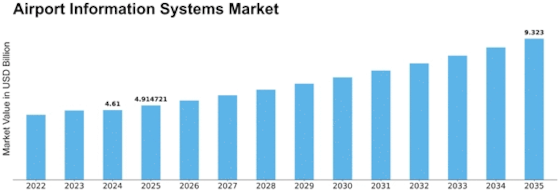
<p>The projected market valuation for the Airport Information Systems Market by 2035 is 9.323 USD Billion.</p>

What was the market valuation of the Airport Information Systems Market in 2024?

The overall market valuation of the Airport Information Systems Market was 4.61 USD Billion in 2024.

What is the expected CAGR for the Airport Information Systems Market during the forecast period 2025 - 2035?

The expected CAGR for the Airport Information Systems Market during the forecast period 2025 - 2035 is 6.61%.

Which segments are included in the Airport Information Systems Market?

The Airport Information Systems Market includes segments such as Passenger Information Systems, Baggage Handling Systems, and Airport Operations Management.

What are the projected values for Passenger Information Systems from 2024 to 2035?

The projected values for Passenger Information Systems are expected to grow from 0.92 USD Billion in 2024 to 1.85 USD Billion by 2035.

Who are the key players in the Airport Information Systems Market?

Key players in the Airport Information Systems Market include Amadeus IT Group, SITA, Rockwell Collins, and Honeywell International.

What is the expected growth for Baggage Handling Systems from 2024 to 2035?

Baggage Handling Systems are projected to grow from 1.15 USD Billion in 2024 to 2.25 USD Billion by 2035.

What is the market size for Airport Operations Management in 2024?

The market size for Airport Operations Management was 1.25 USD Billion in 2024.

What are the projected values for Cloud-Based deployment mode by 2035?

The projected value for Cloud-Based deployment mode is expected to reach 4.66 USD Billion by 2035.

How do the hardware and software components compare in terms of market valuation?

In 2024, hardware was valued at 1.38 USD Billion, while software was valued at 1.84 USD Billion, indicating a potential growth trajectory for both components.

Market Summary

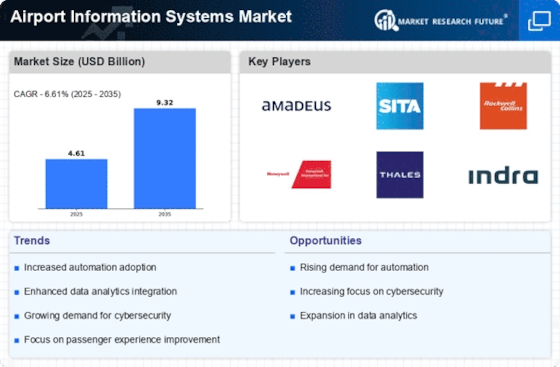
As per Market Research Future analysis, the Airport Information Systems Market Size was estimated at 4.61 USD Billion in 2024. The Airport Information Systems industry is projected to grow from 4.915 USD Billion in 2025 to 9.323 USD Billion by 2035, exhibiting a compound annual growth rate (CAGR) of 6.61% during the forecast period 2025 - 2035

Key Market Trends & Highlights

The Airport Information Systems Market is poised for substantial growth driven by technological advancements and increasing passenger demands.

  • The integration of advanced technologies is transforming airport operations, enhancing efficiency and passenger experience. Sustainability initiatives are becoming a focal point, as airports strive to reduce their environmental impact. The rise of smart airports is evident, with innovations in automation and data analytics shaping the future of air travel. Increased passenger traffic and regulatory compliance are key drivers, particularly in the Passenger Information Systems and Baggage Handling Systems segments.

Market Size & Forecast

2024 Market Size 4.61 (USD Billion)
2035 Market Size 9.323 (USD Billion)
CAGR (2025 - 2035) 6.61%
Largest Regional Market Share in 2024 North America

Major Players

Amadeus IT Group (ES), SITA (CH), Rockwell Collins (US), <a href="https://en.wikipedia.org/wiki/Honeywell">Honeywell International</a> (US), Thales Group (FR), Indra Sistemas (ES), IBM (US), Siemens AG (DE), Northrop Grumman (US)

Market Trends

The Airport Information Systems Market is currently experiencing a transformative phase, driven by advancements in technology and the increasing demand for efficient airport operations, aligned with evolving airport information systems market share dynamics. The integration of artificial intelligence and machine learning into airport management systems appears to enhance decision-making processes, streamline operations, and improve passenger experiences. Furthermore, the growing emphasis on sustainability and environmental considerations is likely to influence the development of innovative solutions that reduce the carbon footprint of airport activities. As airports strive to adapt to evolving passenger expectations and regulatory requirements, the airport information systems market is poised for substantial growth.

In addition, the rise of smart airports, characterized by the implementation of Internet of Things (IoT) technologies, suggests a shift towards more interconnected and automated systems. This trend may facilitate real-time data sharing among various stakeholders, including airlines, ground services, and security agencies, thereby optimizing resource allocation and enhancing overall efficiency. The Airport Information Systems Market is thus positioned at the intersection of technology and operational excellence, indicating a promising future as stakeholders seek to leverage these advancements for improved service delivery and operational resilience within the broader airport information systems market.

Integration of Advanced Technologies

The incorporation of advanced technologies such as artificial intelligence and machine learning into airport information systems is reshaping operational frameworks within the airport information systems market. These innovations facilitate enhanced data analysis, predictive maintenance, and improved passenger flow management, potentially leading to more efficient airport operations.

Focus on Sustainability

There is a growing trend towards sustainability within the Airport Information Systems Market, influencing evolving airport information systems market share trends as stakeholders increasingly prioritize eco-friendly practices. This focus may drive the development of systems that minimize environmental impact, optimize energy consumption, and promote sustainable resource management.

Rise of Smart Airports

The emergence of smart airports, characterized by the use of IoT and interconnected systems, indicates a significant shift in how airports operate across the airport information systems market. This trend may enhance real-time communication and data sharing among various entities, leading to improved efficiency and passenger satisfaction.

Airport Information Systems Market Market Drivers

Rise of Smart Airports

The concept of smart airports is gaining traction within the Airport Information Systems Market. Smart airports leverage technology to enhance passenger experience and operational efficiency. Features such as automated check-in kiosks, biometric screening, and real-time flight information systems are becoming standard. The market for smart airport technologies is expected to reach several billion dollars by the end of the decade, driven by increasing passenger expectations and the need for operational efficiency. This transformation is not merely about technology; it also involves rethinking airport design and operations to create a seamless travel experience. As more airports adopt smart technologies, the competitive landscape of the industry is likely to evolve.

Focus on Sustainability

Sustainability has emerged as a pivotal driver in the Airport Information Systems Market. Airports are increasingly adopting eco-friendly practices and technologies to minimize their environmental impact. This includes the implementation of energy-efficient systems and the use of renewable energy sources. According to recent data, airports that prioritize sustainability initiatives can reduce operational costs by up to 30%. Furthermore, regulatory pressures and public demand for greener operations are pushing airports to invest in sustainable information systems. This trend not only enhances the airport's reputation but also aligns with global efforts to combat climate change, making sustainability a crucial aspect of future airport developments.

Increased Passenger Traffic

The Airport Information Systems Market is significantly influenced by the increase in passenger traffic worldwide. As travel demand continues to rise, airports are compelled to enhance their information systems to manage the growing number of travelers efficiently. Recent statistics indicate that passenger numbers are expected to reach over 10 billion annually by 2030, necessitating advanced systems for crowd management, security, and information dissemination. This surge in traffic drives investments in airport information systems, as stakeholders seek to improve operational capabilities and ensure a smooth travel experience. Consequently, the industry is witnessing a robust demand for innovative solutions that can accommodate this influx.

Integration of Advanced Technologies

The Airport Information Systems Market is experiencing a notable shift towards the integration of advanced technologies such as artificial intelligence, machine learning, and the Internet of Things. These technologies enhance operational efficiency, improve passenger experience, and streamline airport management processes. For instance, AI-driven analytics can predict passenger flow, enabling airports to allocate resources more effectively. The market for AI in airport operations is projected to grow significantly, with estimates suggesting a compound annual growth rate of over 20% in the coming years. This technological integration not only optimizes existing systems but also fosters innovation, making airports more responsive to changing demands.

Regulatory Compliance and Security Enhancements

Regulatory compliance and security enhancements are critical drivers in the Airport Information Systems Market. With increasing global security threats, airports are under pressure to implement robust security measures. This includes advanced surveillance systems, biometric identification, and data protection protocols. Compliance with international regulations, such as those set by the International Civil Aviation Organization, is essential for airport operations. The market for security-related information systems is projected to grow as airports invest in technologies that ensure passenger safety while maintaining operational efficiency. This focus on security not only protects travelers but also enhances the overall integrity of airport operations.

Market Segment Insights

By Application: Passenger Information Systems (Largest) vs. Baggage Handling Systems (Fastest-Growing)

In the Airport Information Systems Market, Passenger Information Systems hold a significant share, contributing strongly to overall airport information systems market share, as they play a crucial role in enhancing the passenger experience through real-time updates and critical flight information. Following closely, Baggage Handling Systems have gained attention due to their necessity in ensuring efficient baggage management, which ultimately improves operational efficiency at airports. Other notable segments include Flight Information Display Systems and Airport Operations Management, both contributing to the overall effectiveness of airport operations, but with comparatively smaller market shares. The growth trends in this segment are largely driven by increasing passenger traffic globally, necessitating advanced systems that can support efficient airport operations. Innovations in technology, such as AI and IoT, have also spurred development in these systems, allowing for automation and improving overall service delivery. Additionally, the ongoing trend towards digitization in airport services is set to further boost demand for Passenger Information Systems and Baggage Handling Systems, as airports seek to enhance customer satisfaction and operational efficiency.

Passenger Information Systems (Dominant) vs. Airport Operations Management (Emerging)

Passenger Information Systems are pivotal in the Airport Information Systems Market and continue to influence competitive positioning within the airport information systems market. These systems, including digital displays and mobile apps, facilitate communication regarding flight information, gate changes, and travel guidelines, effectively enhancing the passenger experience. On the other hand, Airport Operations Management systems are emerging as essential tools for airport authorities to streamline operations, manage resources, and improve process efficiencies. With a focus on operational analytics, these systems help airports efficiently allocate staff and resources, manage air traffic, and ensure compliance with regulations. The continued integration of advanced technologies into both segments promises to enhance functionality and reliability, positioning both as vital components of modern airport infrastructure.

By Component: Software (Largest) vs. Hardware (Fastest-Growing)

In the Airport Information Systems Market, the component segment is primarily dominated by software, reinforcing its leadership position within the airport information systems market. The software segment benefits from constant innovation and the increasing demand for advanced data management solutions. Hardware and services, while significant, have comparatively smaller shares, with hardware representing a crucial infrastructure component. Services, including maintenance and support, also play an essential role but follow the software lead in market distribution.

Technology: Software (Dominant) vs. Hardware (Emerging)

The software component of the airport information systems market stands out as the dominant force, driven by the need for sophisticated data processing, operational efficiency, and passenger management solutions. Key players are focusing on enhancing software capabilities with cloud integration and AI-driven analytics. In contrast, the hardware segment represents an emerging market characterized by rapid growth as airports seek to upgrade their technological infrastructures. Advancements in hardware technology, including more robust systems for real-time data capture and processing, are rapidly gaining traction, making this segment increasingly vital for overall airport operations.

By End-use: Commercial Airports (Largest) vs. Military Airports (Fastest-Growing)

In the Airport Information Systems Market, the distribution among various end-use segments shows that commercial airports hold the largest share, driven by the increasing demand for efficient passenger handling and safety measures. General aviation airports also contribute significantly, catering to a growing number of private and charter flights. Military airports, while currently smaller in market share, are gaining traction due to heightened investments in defense and modernization activities. The growth trends in the end-use segments reflect varying demand dynamics. Commercial airports continue to invest in sophisticated information systems to enhance operational efficiency, especially post-pandemic, while military airports are rapidly adopting advanced technologies to improve security and operational readiness. The surge in demand for general aviation, particularly in emerging markets, further propels overall growth in this segment, making military airports the fastest-growing category within the market.

Commercial Airports (Dominant) vs. General Aviation Airports (Emerging)

Commercial airports are characterized by their extensive infrastructure and capacity to handle large volumes of passenger traffic, making them the dominant segment in the Airport Information Systems Market. They emphasize the integration of advanced technology, enhancing operational efficiency and ensuring passenger safety. Conversely, general aviation airports, though smaller in market size, are the emerging segment that caters to a variety of private and corporate aviation needs. They are experiencing growth due to increased demand for personalized flight options and are gradually upgrading their information systems to keep pace with commercial standards. This transition reflects a shift toward more modern capabilities, driven by technological advancements and a growing interest in private air travel.

By Deployment Mode: Cloud-Based (Largest) vs. On-Premise (Fastest-Growing)

In the Airport Information Systems Market, the segmentation by Deployment Mode reveals that Cloud-Based solutions hold the largest market share. These solutions are favored for their scalability, flexibility, and ability to integrate with various airport operations seamlessly. On the other hand, On-Premise systems, while traditionally popular, are witnessing a notable growth trend as airports aim to enhance security and maintain control over their data. This shift reflects a changing landscape where operational efficiency and data sovereignty are prioritized.

Deployment Mode: Cloud-Based (Dominant) vs. On-Premise (Emerging)

Cloud-Based deployment continues to dominate the Airport Information Systems Market due to its adaptability and cost-effectiveness, allowing airports to optimize operations remotely. These systems facilitate real-time data updates and multi-user access, reducing downtime and enhancing the passenger experience. In contrast, On-Premise solutions are emerging as a viable option, particularly for airports concerned with data security and regulatory compliance. They provide high levels of control and customization, catering to unique operational needs but often require substantial initial investments and continuous maintenance.

Get more detailed insights about Airport Information Systems Market Research Report- Forecast till 2035

Regional Insights

North America : Technological Innovation Leader

North America is the largest market for Airport Information Systems Market, holding approximately 40% of the global share. The region's growth is driven by increasing air traffic, advancements in technology, and stringent regulatory requirements aimed at enhancing airport security and efficiency. The U.S. and Canada are the primary contributors, with significant investments in infrastructure and digital transformation initiatives. The competitive landscape is dominated by key players such as Amadeus IT Group, SITA, and Rockwell Collins, which are continuously innovating to meet the evolving demands of the aviation sector. The presence of major airports and a robust technological ecosystem further bolster the market. Additionally, government initiatives to improve airport operations and passenger experience are pivotal in shaping the market dynamics.

Europe : Regulatory Framework Enhancer

Europe is the second-largest market for Airport Information Systems Market, accounting for around 30% of the global market share. The region's growth is propelled by increasing passenger volumes, the need for enhanced operational efficiency, and compliance with EU regulations aimed at improving safety and security in air travel. Countries like Germany and France are at the forefront, driving demand through modernization projects and digital initiatives. The competitive landscape features prominent players such as Thales Group and Siemens AG, which are leveraging innovative technologies to enhance airport operations. The European market is characterized by a strong emphasis on sustainability and environmental regulations, pushing airports to adopt greener technologies. This regulatory environment fosters innovation and collaboration among stakeholders, ensuring a dynamic market landscape.

Asia-Pacific : Emerging Market Potential

Asia-Pacific is witnessing rapid growth in the Airport Information Systems Market, holding approximately 25% of the global share. The region's expansion is driven by increasing air travel demand, government investments in airport infrastructure, and the adoption of advanced technologies. Countries like China and India are leading this growth, with significant projects aimed at modernizing airport facilities and enhancing passenger experience. The competitive landscape is becoming increasingly dynamic, with both established players and new entrants vying for market share. Key players such as IBM and Honeywell International are focusing on innovative solutions to address the unique challenges faced by airports in this region. The growing emphasis on smart airports and digital transformation is reshaping the market, making it a focal point for investment and development.

Middle East and Africa : Strategic Growth Hub

The Middle East and Africa region is emerging as a strategic hub for Airport Information Systems Market, accounting for about 5% of the global market share. The growth is driven by increasing air traffic, investments in airport infrastructure, and a focus on enhancing operational efficiency. Countries like the UAE and South Africa are leading the charge, with ambitious projects aimed at transforming airport operations and passenger services. The competitive landscape is characterized by a mix of local and international players, including Indra Sistemas and Northrop Grumman, who are introducing innovative solutions tailored to the region's unique needs. The emphasis on smart technologies and digital solutions is reshaping the market, with governments actively promoting initiatives to improve airport efficiency and passenger experience. This strategic focus positions the region for significant growth in the coming years.

Key Players and Competitive Insights

The Airport Information Systems Market is currently characterized by a dynamic competitive landscape, driven by technological advancements and the increasing demand for efficient airport operations. Key players such as Amadeus IT Group (ES), SITA (CH), and Honeywell International (US) are strategically positioned to leverage innovation and digital transformation. Amadeus IT Group (ES) focuses on enhancing passenger experience through integrated solutions, while SITA (CH) emphasizes cloud-based services to streamline airport operations. Honeywell International (US) is investing in IoT technologies to improve operational efficiency, collectively shaping a competitive environment that prioritizes customer-centric solutions and operational excellence. The market structure appears moderately fragmented, with several players vying for market share through various business tactics. Companies are increasingly localizing manufacturing and optimizing supply chains to enhance responsiveness to regional demands. This competitive structure allows for a diverse range of offerings, enabling players to cater to specific market needs while fostering innovation and collaboration among key stakeholders. In August 2025, SITA (CH) announced a partnership with a leading airport authority to implement a new cloud-based passenger processing system. This strategic move is expected to enhance operational efficiency and improve the passenger experience by reducing wait times and streamlining check-in processes. Such initiatives indicate SITA's commitment to leveraging technology to address the evolving needs of airports and airlines. In September 2025, Honeywell International (US) unveiled its latest IoT platform designed specifically for airport operations. This platform aims to integrate various airport systems, providing real-time data analytics to optimize resource allocation and enhance safety measures. The introduction of this platform underscores Honeywell's focus on innovation and its potential to redefine operational standards within the industry. In July 2025, Amadeus IT Group (ES) launched a new suite of digital solutions aimed at improving the end-to-end passenger journey. This initiative reflects Amadeus's strategic emphasis on enhancing customer experience through technology, positioning the company as a leader in the digital transformation of airport operations. The launch is likely to strengthen Amadeus's market presence and attract new clients seeking advanced technological solutions. As of October 2025, the competitive trends within the Airport Information Systems Market are increasingly defined by digitalization, sustainability, and the integration of artificial intelligence. Strategic alliances among key players are shaping the landscape, fostering innovation and collaborative solutions. The shift from price-based competition to a focus on technological advancement and supply chain reliability is evident, suggesting that future competitive differentiation will hinge on the ability to innovate and adapt to changing market demands.

Key Companies in the Airport Information Systems Market include

Industry Developments

The Airport Information Systems Market continues to evolve rapidly with significant developments and events. Recent advancements include increased integration of artificial intelligence and machine learning technologies by companies like IBM and SITA, enhancing operational efficiency and passenger experience.

In October 2023, Northrop Grumman reported a partnership with several airports to upgrade their data processing systems, demonstrating a shift towards smarter infrastructure.

A notable merger occurred in August 2023, when Amadeus IT Group acquired AirportLabs to expand its offerings in comprehensive passenger management solutions, a move that aligns with industry trends towards consolidation and integrated services.

Other companies, such as Honeywell and Thales Group, are ramping up Research and Development efforts focusing on cybersecurity measures to protect airport information systems from rising cyber threats.

An observable market growth is noted as the Airport Information Systems Market valuation is projected to reach USD 10 billion by 2026, driven by increased demand for advanced technologies in air travel and the growing emphasis on operational efficiency post-pandemic.

In recent years, investments in cloud-based solutions have been prominent, enhancing flexibility and scalability across airport operations globally.

Future Outlook

Airport Information Systems Market Future Outlook

The Airport Information Systems Market is projected to grow at a 6.61% CAGR from 2025 to 2035, driven by technological advancements, increased air traffic, and enhanced operational efficiency.

New opportunities lie in:

  • <p>Integration of AI-driven predictive maintenance solutions Development of mobile applications for real-time passenger updates Implementation of advanced data analytics for operational optimization</p>

By 2035, the market is expected to be robust, driven by innovation and increased demand.

Market Segmentation

Airport Information Systems Market End-use Outlook

  • Commercial Airports
  • General Aviation Airports
  • Military Airports

Airport Information Systems Market Component Outlook

  • Hardware
  • Software
  • Services

Airport Information Systems Market Application Outlook

  • Passenger Information Systems
  • Baggage Handling Systems
  • Flight Information Display Systems
  • Airport Operations Management
  • Revenue Management Systems

Airport Information Systems Market Deployment Mode Outlook

  • On-Premise
  • Cloud-Based

Report Scope

MARKET SIZE 2024 4.61(USD Billion)
MARKET SIZE 2025 4.915(USD Billion)
MARKET SIZE 2035 9.323(USD Billion)
COMPOUND ANNUAL GROWTH RATE (CAGR) 6.61% (2025 - 2035)
REPORT COVERAGE Revenue Forecast, Competitive Landscape, Growth Factors, and Trends
BASE YEAR 2024
Market Forecast Period 2025 - 2035
Historical Data 2019 - 2024
Market Forecast Units USD Billion
Key Companies Profiled Amadeus IT Group (ES), SITA (CH), Rockwell Collins (US), Honeywell International (US), Thales Group (FR), Indra Sistemas (ES), IBM (US), Siemens AG (DE), Northrop Grumman (US)
Segments Covered Application, Component, End-use, Deployment Mode, Regional
Key Market Opportunities Integration of artificial intelligence and machine learning enhances operational efficiency in the Airport Information Systems Market.
Key Market Dynamics Technological advancements drive competitive forces in Airport Information Systems, enhancing operational efficiency and passenger experience.
Countries Covered North America, Europe, APAC, South America, MEA

FAQs

What is the projected market valuation of the Airport Information Systems Market by 2035?

<p>The projected market valuation for the Airport Information Systems Market by 2035 is 9.323 USD Billion.</p>

What was the market valuation of the Airport Information Systems Market in 2024?

The overall market valuation of the Airport Information Systems Market was 4.61 USD Billion in 2024.

What is the expected CAGR for the Airport Information Systems Market during the forecast period 2025 - 2035?

The expected CAGR for the Airport Information Systems Market during the forecast period 2025 - 2035 is 6.61%.

Which segments are included in the Airport Information Systems Market?

The Airport Information Systems Market includes segments such as Passenger Information Systems, Baggage Handling Systems, and Airport Operations Management.

What are the projected values for Passenger Information Systems from 2024 to 2035?

The projected values for Passenger Information Systems are expected to grow from 0.92 USD Billion in 2024 to 1.85 USD Billion by 2035.

Who are the key players in the Airport Information Systems Market?

Key players in the Airport Information Systems Market include Amadeus IT Group, SITA, Rockwell Collins, and Honeywell International.

What is the expected growth for Baggage Handling Systems from 2024 to 2035?

Baggage Handling Systems are projected to grow from 1.15 USD Billion in 2024 to 2.25 USD Billion by 2035.

What is the market size for Airport Operations Management in 2024?

The market size for Airport Operations Management was 1.25 USD Billion in 2024.

What are the projected values for Cloud-Based deployment mode by 2035?

The projected value for Cloud-Based deployment mode is expected to reach 4.66 USD Billion by 2035.

How do the hardware and software components compare in terms of market valuation?

In 2024, hardware was valued at 1.38 USD Billion, while software was valued at 1.84 USD Billion, indicating a potential growth trajectory for both components.

  1. SECTION I: EXECUTIVE SUMMARY AND KEY HIGHLIGHTS
    1. | 1.1 EXECUTIVE SUMMARY
    2. | | 1.1.1 Market Overview
    3. | | 1.1.2 Key Findings
    4. | | 1.1.3 Market Segmentation
    5. | | 1.1.4 Competitive Landscape
    6. | | 1.1.5 Challenges and Opportunities
    7. | | 1.1.6 Future Outlook
  2. SECTION II: SCOPING, METHODOLOGY AND MARKET STRUCTURE
    1. | 2.1 MARKET INTRODUCTION
    2. | | 2.1.1 Definition
    3. | | 2.1.2 Scope of the study
    4. | | | 2.1.2.1 Research Objective
    5. | | | 2.1.2.2 Assumption
    6. | | | 2.1.2.3 Limitations
    7. | 2.2 RESEARCH METHODOLOGY
    8. | | 2.2.1 Overview
    9. | | 2.2.2 Data Mining
    10. | | 2.2.3 Secondary Research
    11. | | 2.2.4 Primary Research
    12. | | | 2.2.4.1 Primary Interviews and Information Gathering Process
    13. | | | 2.2.4.2 Breakdown of Primary Respondents
    14. | | 2.2.5 Forecasting Model
    15. | | 2.2.6 Market Size Estimation
    16. | | | 2.2.6.1 Bottom-Up Approach
    17. | | | 2.2.6.2 Top-Down Approach
    18. | | 2.2.7 Data Triangulation
    19. | | 2.2.8 Validation
  3. SECTION III: QUALITATIVE ANALYSIS
    1. | 3.1 MARKET DYNAMICS
    2. | | 3.1.1 Overview
    3. | | 3.1.2 Drivers
    4. | | 3.1.3 Restraints
    5. | | 3.1.4 Opportunities
    6. | 3.2 MARKET FACTOR ANALYSIS
    7. | | 3.2.1 Value chain Analysis
    8. | | 3.2.2 Porter's Five Forces Analysis
    9. | | | 3.2.2.1 Bargaining Power of Suppliers
    10. | | | 3.2.2.2 Bargaining Power of Buyers
    11. | | | 3.2.2.3 Threat of New Entrants
    12. | | | 3.2.2.4 Threat of Substitutes
    13. | | | 3.2.2.5 Intensity of Rivalry
    14. | | 3.2.3 COVID-19 Impact Analysis
    15. | | | 3.2.3.1 Market Impact Analysis
    16. | | | 3.2.3.2 Regional Impact
    17. | | | 3.2.3.3 Opportunity and Threat Analysis
  4. SECTION IV: QUANTITATIVE ANALYSIS
    1. | 4.1 Aerospace & Defense, BY Application (USD Billion)
    2. | | 4.1.1 Passenger Information Systems
    3. | | 4.1.2 Baggage Handling Systems
    4. | | 4.1.3 Flight Information Display Systems
    5. | | 4.1.4 Airport Operations Management
    6. | | 4.1.5 Revenue Management Systems
    7. | 4.2 Aerospace & Defense, BY Component (USD Billion)
    8. | | 4.2.1 Hardware
    9. | | 4.2.2 Software
    10. | | 4.2.3 Services
    11. | 4.3 Aerospace & Defense, BY End-use (USD Billion)
    12. | | 4.3.1 Commercial Airports
    13. | | 4.3.2 General Aviation Airports
    14. | | 4.3.3 Military Airports
    15. | 4.4 Aerospace & Defense, BY Deployment Mode (USD Billion)
    16. | | 4.4.1 On-Premise
    17. | | 4.4.2 Cloud-Based
    18. | 4.5 Aerospace & Defense, BY Region (USD Billion)
    19. | | 4.5.1 North America
    20. | | | 4.5.1.1 US
    21. | | | 4.5.1.2 Canada
    22. | | 4.5.2 Europe
    23. | | | 4.5.2.1 Germany
    24. | | | 4.5.2.2 UK
    25. | | | 4.5.2.3 France
    26. | | | 4.5.2.4 Russia
    27. | | | 4.5.2.5 Italy
    28. | | | 4.5.2.6 Spain
    29. | | | 4.5.2.7 Rest of Europe
    30. | | 4.5.3 APAC
    31. | | | 4.5.3.1 China
    32. | | | 4.5.3.2 India
    33. | | | 4.5.3.3 Japan
    34. | | | 4.5.3.4 South Korea
    35. | | | 4.5.3.5 Malaysia
    36. | | | 4.5.3.6 Thailand
    37. | | | 4.5.3.7 Indonesia
    38. | | | 4.5.3.8 Rest of APAC
    39. | | 4.5.4 South America
    40. | | | 4.5.4.1 Brazil
    41. | | | 4.5.4.2 Mexico
    42. | | | 4.5.4.3 Argentina
    43. | | | 4.5.4.4 Rest of South America
    44. | | 4.5.5 MEA
    45. | | | 4.5.5.1 GCC Countries
    46. | | | 4.5.5.2 South Africa
    47. | | | 4.5.5.3 Rest of MEA
  5. SECTION V: COMPETITIVE ANALYSIS
    1. | 5.1 Competitive Landscape
    2. | | 5.1.1 Overview
    3. | | 5.1.2 Competitive Analysis
    4. | | 5.1.3 Market share Analysis
    5. | | 5.1.4 Major Growth Strategy in the Aerospace & Defense
    6. | | 5.1.5 Competitive Benchmarking
    7. | | 5.1.6 Leading Players in Terms of Number of Developments in the Aerospace & Defense
    8. | | 5.1.7 Key developments and growth strategies
    9. | | | 5.1.7.1 New Product Launch/Service Deployment
    10. | | | 5.1.7.2 Merger & Acquisitions
    11. | | | 5.1.7.3 Joint Ventures
    12. | | 5.1.8 Major Players Financial Matrix
    13. | | | 5.1.8.1 Sales and Operating Income
    14. | | | 5.1.8.2 Major Players R&D Expenditure. 2023
    15. | 5.2 Company Profiles
    16. | | 5.2.1 Amadeus IT Group (ES)
    17. | | | 5.2.1.1 Financial Overview
    18. | | | 5.2.1.2 Products Offered
    19. | | | 5.2.1.3 Key Developments
    20. | | | 5.2.1.4 SWOT Analysis
    21. | | | 5.2.1.5 Key Strategies
    22. | | 5.2.2 SITA (CH)
    23. | | | 5.2.2.1 Financial Overview
    24. | | | 5.2.2.2 Products Offered
    25. | | | 5.2.2.3 Key Developments
    26. | | | 5.2.2.4 SWOT Analysis
    27. | | | 5.2.2.5 Key Strategies
    28. | | 5.2.3 Rockwell Collins (US)
    29. | | | 5.2.3.1 Financial Overview
    30. | | | 5.2.3.2 Products Offered
    31. | | | 5.2.3.3 Key Developments
    32. | | | 5.2.3.4 SWOT Analysis
    33. | | | 5.2.3.5 Key Strategies
    34. | | 5.2.4 Honeywell International (US)
    35. | | | 5.2.4.1 Financial Overview
    36. | | | 5.2.4.2 Products Offered
    37. | | | 5.2.4.3 Key Developments
    38. | | | 5.2.4.4 SWOT Analysis
    39. | | | 5.2.4.5 Key Strategies
    40. | | 5.2.5 Thales Group (FR)
    41. | | | 5.2.5.1 Financial Overview
    42. | | | 5.2.5.2 Products Offered
    43. | | | 5.2.5.3 Key Developments
    44. | | | 5.2.5.4 SWOT Analysis
    45. | | | 5.2.5.5 Key Strategies
    46. | | 5.2.6 Indra Sistemas (ES)
    47. | | | 5.2.6.1 Financial Overview
    48. | | | 5.2.6.2 Products Offered
    49. | | | 5.2.6.3 Key Developments
    50. | | | 5.2.6.4 SWOT Analysis
    51. | | | 5.2.6.5 Key Strategies
    52. | | 5.2.7 IBM (US)
    53. | | | 5.2.7.1 Financial Overview
    54. | | | 5.2.7.2 Products Offered
    55. | | | 5.2.7.3 Key Developments
    56. | | | 5.2.7.4 SWOT Analysis
    57. | | | 5.2.7.5 Key Strategies
    58. | | 5.2.8 Siemens AG (DE)
    59. | | | 5.2.8.1 Financial Overview
    60. | | | 5.2.8.2 Products Offered
    61. | | | 5.2.8.3 Key Developments
    62. | | | 5.2.8.4 SWOT Analysis
    63. | | | 5.2.8.5 Key Strategies
    64. | | 5.2.9 Northrop Grumman (US)
    65. | | | 5.2.9.1 Financial Overview
    66. | | | 5.2.9.2 Products Offered
    67. | | | 5.2.9.3 Key Developments
    68. | | | 5.2.9.4 SWOT Analysis
    69. | | | 5.2.9.5 Key Strategies
    70. | 5.3 Appendix
    71. | | 5.3.1 References
    72. | | 5.3.2 Related Reports
  6. LIST OF FIGURES
    1. | 6.1 MARKET SYNOPSIS
    2. | 6.2 NORTH AMERICA MARKET ANALYSIS
    3. | 6.3 US MARKET ANALYSIS BY APPLICATION
    4. | 6.4 US MARKET ANALYSIS BY COMPONENT
    5. | 6.5 US MARKET ANALYSIS BY END-USE
    6. | 6.6 US MARKET ANALYSIS BY DEPLOYMENT MODE
    7. | 6.7 CANADA MARKET ANALYSIS BY APPLICATION
    8. | 6.8 CANADA MARKET ANALYSIS BY COMPONENT
    9. | 6.9 CANADA MARKET ANALYSIS BY END-USE
    10. | 6.10 CANADA MARKET ANALYSIS BY DEPLOYMENT MODE
    11. | 6.11 EUROPE MARKET ANALYSIS
    12. | 6.12 GERMANY MARKET ANALYSIS BY APPLICATION
    13. | 6.13 GERMANY MARKET ANALYSIS BY COMPONENT
    14. | 6.14 GERMANY MARKET ANALYSIS BY END-USE
    15. | 6.15 GERMANY MARKET ANALYSIS BY DEPLOYMENT MODE
    16. | 6.16 UK MARKET ANALYSIS BY APPLICATION
    17. | 6.17 UK MARKET ANALYSIS BY COMPONENT
    18. | 6.18 UK MARKET ANALYSIS BY END-USE
    19. | 6.19 UK MARKET ANALYSIS BY DEPLOYMENT MODE
    20. | 6.20 FRANCE MARKET ANALYSIS BY APPLICATION
    21. | 6.21 FRANCE MARKET ANALYSIS BY COMPONENT
    22. | 6.22 FRANCE MARKET ANALYSIS BY END-USE
    23. | 6.23 FRANCE MARKET ANALYSIS BY DEPLOYMENT MODE
    24. | 6.24 RUSSIA MARKET ANALYSIS BY APPLICATION
    25. | 6.25 RUSSIA MARKET ANALYSIS BY COMPONENT
    26. | 6.26 RUSSIA MARKET ANALYSIS BY END-USE
    27. | 6.27 RUSSIA MARKET ANALYSIS BY DEPLOYMENT MODE
    28. | 6.28 ITALY MARKET ANALYSIS BY APPLICATION
    29. | 6.29 ITALY MARKET ANALYSIS BY COMPONENT
    30. | 6.30 ITALY MARKET ANALYSIS BY END-USE
    31. | 6.31 ITALY MARKET ANALYSIS BY DEPLOYMENT MODE
    32. | 6.32 SPAIN MARKET ANALYSIS BY APPLICATION
    33. | 6.33 SPAIN MARKET ANALYSIS BY COMPONENT
    34. | 6.34 SPAIN MARKET ANALYSIS BY END-USE
    35. | 6.35 SPAIN MARKET ANALYSIS BY DEPLOYMENT MODE
    36. | 6.36 REST OF EUROPE MARKET ANALYSIS BY APPLICATION
    37. | 6.37 REST OF EUROPE MARKET ANALYSIS BY COMPONENT
    38. | 6.38 REST OF EUROPE MARKET ANALYSIS BY END-USE
    39. | 6.39 REST OF EUROPE MARKET ANALYSIS BY DEPLOYMENT MODE
    40. | 6.40 APAC MARKET ANALYSIS
    41. | 6.41 CHINA MARKET ANALYSIS BY APPLICATION
    42. | 6.42 CHINA MARKET ANALYSIS BY COMPONENT
    43. | 6.43 CHINA MARKET ANALYSIS BY END-USE
    44. | 6.44 CHINA MARKET ANALYSIS BY DEPLOYMENT MODE
    45. | 6.45 INDIA MARKET ANALYSIS BY APPLICATION
    46. | 6.46 INDIA MARKET ANALYSIS BY COMPONENT
    47. | 6.47 INDIA MARKET ANALYSIS BY END-USE
    48. | 6.48 INDIA MARKET ANALYSIS BY DEPLOYMENT MODE
    49. | 6.49 JAPAN MARKET ANALYSIS BY APPLICATION
    50. | 6.50 JAPAN MARKET ANALYSIS BY COMPONENT
    51. | 6.51 JAPAN MARKET ANALYSIS BY END-USE
    52. | 6.52 JAPAN MARKET ANALYSIS BY DEPLOYMENT MODE
    53. | 6.53 SOUTH KOREA MARKET ANALYSIS BY APPLICATION
    54. | 6.54 SOUTH KOREA MARKET ANALYSIS BY COMPONENT
    55. | 6.55 SOUTH KOREA MARKET ANALYSIS BY END-USE
    56. | 6.56 SOUTH KOREA MARKET ANALYSIS BY DEPLOYMENT MODE
    57. | 6.57 MALAYSIA MARKET ANALYSIS BY APPLICATION
    58. | 6.58 MALAYSIA MARKET ANALYSIS BY COMPONENT
    59. | 6.59 MALAYSIA MARKET ANALYSIS BY END-USE
    60. | 6.60 MALAYSIA MARKET ANALYSIS BY DEPLOYMENT MODE
    61. | 6.61 THAILAND MARKET ANALYSIS BY APPLICATION
    62. | 6.62 THAILAND MARKET ANALYSIS BY COMPONENT
    63. | 6.63 THAILAND MARKET ANALYSIS BY END-USE
    64. | 6.64 THAILAND MARKET ANALYSIS BY DEPLOYMENT MODE
    65. | 6.65 INDONESIA MARKET ANALYSIS BY APPLICATION
    66. | 6.66 INDONESIA MARKET ANALYSIS BY COMPONENT
    67. | 6.67 INDONESIA MARKET ANALYSIS BY END-USE
    68. | 6.68 INDONESIA MARKET ANALYSIS BY DEPLOYMENT MODE
    69. | 6.69 REST OF APAC MARKET ANALYSIS BY APPLICATION
    70. | 6.70 REST OF APAC MARKET ANALYSIS BY COMPONENT
    71. | 6.71 REST OF APAC MARKET ANALYSIS BY END-USE
    72. | 6.72 REST OF APAC MARKET ANALYSIS BY DEPLOYMENT MODE
    73. | 6.73 SOUTH AMERICA MARKET ANALYSIS
    74. | 6.74 BRAZIL MARKET ANALYSIS BY APPLICATION
    75. | 6.75 BRAZIL MARKET ANALYSIS BY COMPONENT
    76. | 6.76 BRAZIL MARKET ANALYSIS BY END-USE
    77. | 6.77 BRAZIL MARKET ANALYSIS BY DEPLOYMENT MODE
    78. | 6.78 MEXICO MARKET ANALYSIS BY APPLICATION
    79. | 6.79 MEXICO MARKET ANALYSIS BY COMPONENT
    80. | 6.80 MEXICO MARKET ANALYSIS BY END-USE
    81. | 6.81 MEXICO MARKET ANALYSIS BY DEPLOYMENT MODE
    82. | 6.82 ARGENTINA MARKET ANALYSIS BY APPLICATION
    83. | 6.83 ARGENTINA MARKET ANALYSIS BY COMPONENT
    84. | 6.84 ARGENTINA MARKET ANALYSIS BY END-USE
    85. | 6.85 ARGENTINA MARKET ANALYSIS BY DEPLOYMENT MODE
    86. | 6.86 REST OF SOUTH AMERICA MARKET ANALYSIS BY APPLICATION
    87. | 6.87 REST OF SOUTH AMERICA MARKET ANALYSIS BY COMPONENT
    88. | 6.88 REST OF SOUTH AMERICA MARKET ANALYSIS BY END-USE
    89. | 6.89 REST OF SOUTH AMERICA MARKET ANALYSIS BY DEPLOYMENT MODE
    90. | 6.90 MEA MARKET ANALYSIS
    91. | 6.91 GCC COUNTRIES MARKET ANALYSIS BY APPLICATION
    92. | 6.92 GCC COUNTRIES MARKET ANALYSIS BY COMPONENT
    93. | 6.93 GCC COUNTRIES MARKET ANALYSIS BY END-USE
    94. | 6.94 GCC COUNTRIES MARKET ANALYSIS BY DEPLOYMENT MODE
    95. | 6.95 SOUTH AFRICA MARKET ANALYSIS BY APPLICATION
    96. | 6.96 SOUTH AFRICA MARKET ANALYSIS BY COMPONENT
    97. | 6.97 SOUTH AFRICA MARKET ANALYSIS BY END-USE
    98. | 6.98 SOUTH AFRICA MARKET ANALYSIS BY DEPLOYMENT MODE
    99. | 6.99 REST OF MEA MARKET ANALYSIS BY APPLICATION
    100. | 6.100 REST OF MEA MARKET ANALYSIS BY COMPONENT
    101. | 6.101 REST OF MEA MARKET ANALYSIS BY END-USE
    102. | 6.102 REST OF MEA MARKET ANALYSIS BY DEPLOYMENT MODE
    103. | 6.103 KEY BUYING CRITERIA OF AEROSPACE & DEFENSE
    104. | 6.104 RESEARCH PROCESS OF MRFR
    105. | 6.105 DRO ANALYSIS OF AEROSPACE & DEFENSE
    106. | 6.106 DRIVERS IMPACT ANALYSIS: AEROSPACE & DEFENSE
    107. | 6.107 RESTRAINTS IMPACT ANALYSIS: AEROSPACE & DEFENSE
    108. | 6.108 SUPPLY / VALUE CHAIN: AEROSPACE & DEFENSE
    109. | 6.109 AEROSPACE & DEFENSE, BY APPLICATION, 2024 (% SHARE)
    110. | 6.110 AEROSPACE & DEFENSE, BY APPLICATION, 2024 TO 2035 (USD Billion)
    111. | 6.111 AEROSPACE & DEFENSE, BY COMPONENT, 2024 (% SHARE)
    112. | 6.112 AEROSPACE & DEFENSE, BY COMPONENT, 2024 TO 2035 (USD Billion)
    113. | 6.113 AEROSPACE & DEFENSE, BY END-USE, 2024 (% SHARE)
    114. | 6.114 AEROSPACE & DEFENSE, BY END-USE, 2024 TO 2035 (USD Billion)
    115. | 6.115 AEROSPACE & DEFENSE, BY DEPLOYMENT MODE, 2024 (% SHARE)
    116. | 6.116 AEROSPACE & DEFENSE, BY DEPLOYMENT MODE, 2024 TO 2035 (USD Billion)
    117. | 6.117 BENCHMARKING OF MAJOR COMPETITORS
  7. LIST OF TABLES
    1. | 7.1 LIST OF ASSUMPTIONS
    2. | | 7.1.1
    3. | 7.2 North America MARKET SIZE ESTIMATES; FORECAST
    4. | | 7.2.1 BY APPLICATION, 2025-2035 (USD Billion)
    5. | | 7.2.2 BY COMPONENT, 2025-2035 (USD Billion)
    6. | | 7.2.3 BY END-USE, 2025-2035 (USD Billion)
    7. | | 7.2.4 BY DEPLOYMENT MODE, 2025-2035 (USD Billion)
    8. | 7.3 US MARKET SIZE ESTIMATES; FORECAST
    9. | | 7.3.1 BY APPLICATION, 2025-2035 (USD Billion)
    10. | | 7.3.2 BY COMPONENT, 2025-2035 (USD Billion)
    11. | | 7.3.3 BY END-USE, 2025-2035 (USD Billion)
    12. | | 7.3.4 BY DEPLOYMENT MODE, 2025-2035 (USD Billion)
    13. | 7.4 Canada MARKET SIZE ESTIMATES; FORECAST
    14. | | 7.4.1 BY APPLICATION, 2025-2035 (USD Billion)
    15. | | 7.4.2 BY COMPONENT, 2025-2035 (USD Billion)
    16. | | 7.4.3 BY END-USE, 2025-2035 (USD Billion)
    17. | | 7.4.4 BY DEPLOYMENT MODE, 2025-2035 (USD Billion)
    18. | 7.5 Europe MARKET SIZE ESTIMATES; FORECAST
    19. | | 7.5.1 BY APPLICATION, 2025-2035 (USD Billion)
    20. | | 7.5.2 BY COMPONENT, 2025-2035 (USD Billion)
    21. | | 7.5.3 BY END-USE, 2025-2035 (USD Billion)
    22. | | 7.5.4 BY DEPLOYMENT MODE, 2025-2035 (USD Billion)
    23. | 7.6 Germany MARKET SIZE ESTIMATES; FORECAST
    24. | | 7.6.1 BY APPLICATION, 2025-2035 (USD Billion)
    25. | | 7.6.2 BY COMPONENT, 2025-2035 (USD Billion)
    26. | | 7.6.3 BY END-USE, 2025-2035 (USD Billion)
    27. | | 7.6.4 BY DEPLOYMENT MODE, 2025-2035 (USD Billion)
    28. | 7.7 UK MARKET SIZE ESTIMATES; FORECAST
    29. | | 7.7.1 BY APPLICATION, 2025-2035 (USD Billion)
    30. | | 7.7.2 BY COMPONENT, 2025-2035 (USD Billion)
    31. | | 7.7.3 BY END-USE, 2025-2035 (USD Billion)
    32. | | 7.7.4 BY DEPLOYMENT MODE, 2025-2035 (USD Billion)
    33. | 7.8 France MARKET SIZE ESTIMATES; FORECAST
    34. | | 7.8.1 BY APPLICATION, 2025-2035 (USD Billion)
    35. | | 7.8.2 BY COMPONENT, 2025-2035 (USD Billion)
    36. | | 7.8.3 BY END-USE, 2025-2035 (USD Billion)
    37. | | 7.8.4 BY DEPLOYMENT MODE, 2025-2035 (USD Billion)
    38. | 7.9 Russia MARKET SIZE ESTIMATES; FORECAST
    39. | | 7.9.1 BY APPLICATION, 2025-2035 (USD Billion)
    40. | | 7.9.2 BY COMPONENT, 2025-2035 (USD Billion)
    41. | | 7.9.3 BY END-USE, 2025-2035 (USD Billion)
    42. | | 7.9.4 BY DEPLOYMENT MODE, 2025-2035 (USD Billion)
    43. | 7.10 Italy MARKET SIZE ESTIMATES; FORECAST
    44. | | 7.10.1 BY APPLICATION, 2025-2035 (USD Billion)
    45. | | 7.10.2 BY COMPONENT, 2025-2035 (USD Billion)
    46. | | 7.10.3 BY END-USE, 2025-2035 (USD Billion)
    47. | | 7.10.4 BY DEPLOYMENT MODE, 2025-2035 (USD Billion)
    48. | 7.11 Spain MARKET SIZE ESTIMATES; FORECAST
    49. | | 7.11.1 BY APPLICATION, 2025-2035 (USD Billion)
    50. | | 7.11.2 BY COMPONENT, 2025-2035 (USD Billion)
    51. | | 7.11.3 BY END-USE, 2025-2035 (USD Billion)
    52. | | 7.11.4 BY DEPLOYMENT MODE, 2025-2035 (USD Billion)
    53. | 7.12 Rest of Europe MARKET SIZE ESTIMATES; FORECAST
    54. | | 7.12.1 BY APPLICATION, 2025-2035 (USD Billion)
    55. | | 7.12.2 BY COMPONENT, 2025-2035 (USD Billion)
    56. | | 7.12.3 BY END-USE, 2025-2035 (USD Billion)
    57. | | 7.12.4 BY DEPLOYMENT MODE, 2025-2035 (USD Billion)
    58. | 7.13 APAC MARKET SIZE ESTIMATES; FORECAST
    59. | | 7.13.1 BY APPLICATION, 2025-2035 (USD Billion)
    60. | | 7.13.2 BY COMPONENT, 2025-2035 (USD Billion)
    61. | | 7.13.3 BY END-USE, 2025-2035 (USD Billion)
    62. | | 7.13.4 BY DEPLOYMENT MODE, 2025-2035 (USD Billion)
    63. | 7.14 China MARKET SIZE ESTIMATES; FORECAST
    64. | | 7.14.1 BY APPLICATION, 2025-2035 (USD Billion)
    65. | | 7.14.2 BY COMPONENT, 2025-2035 (USD Billion)
    66. | | 7.14.3 BY END-USE, 2025-2035 (USD Billion)
    67. | | 7.14.4 BY DEPLOYMENT MODE, 2025-2035 (USD Billion)
    68. | 7.15 India MARKET SIZE ESTIMATES; FORECAST
    69. | | 7.15.1 BY APPLICATION, 2025-2035 (USD Billion)
    70. | | 7.15.2 BY COMPONENT, 2025-2035 (USD Billion)
    71. | | 7.15.3 BY END-USE, 2025-2035 (USD Billion)
    72. | | 7.15.4 BY DEPLOYMENT MODE, 2025-2035 (USD Billion)
    73. | 7.16 Japan MARKET SIZE ESTIMATES; FORECAST
    74. | | 7.16.1 BY APPLICATION, 2025-2035 (USD Billion)
    75. | | 7.16.2 BY COMPONENT, 2025-2035 (USD Billion)
    76. | | 7.16.3 BY END-USE, 2025-2035 (USD Billion)
    77. | | 7.16.4 BY DEPLOYMENT MODE, 2025-2035 (USD Billion)
    78. | 7.17 South Korea MARKET SIZE ESTIMATES; FORECAST
    79. | | 7.17.1 BY APPLICATION, 2025-2035 (USD Billion)
    80. | | 7.17.2 BY COMPONENT, 2025-2035 (USD Billion)
    81. | | 7.17.3 BY END-USE, 2025-2035 (USD Billion)
    82. | | 7.17.4 BY DEPLOYMENT MODE, 2025-2035 (USD Billion)
    83. | 7.18 Malaysia MARKET SIZE ESTIMATES; FORECAST
    84. | | 7.18.1 BY APPLICATION, 2025-2035 (USD Billion)
    85. | | 7.18.2 BY COMPONENT, 2025-2035 (USD Billion)
    86. | | 7.18.3 BY END-USE, 2025-2035 (USD Billion)
    87. | | 7.18.4 BY DEPLOYMENT MODE, 2025-2035 (USD Billion)
    88. | 7.19 Thailand MARKET SIZE ESTIMATES; FORECAST
    89. | | 7.19.1 BY APPLICATION, 2025-2035 (USD Billion)
    90. | | 7.19.2 BY COMPONENT, 2025-2035 (USD Billion)
    91. | | 7.19.3 BY END-USE, 2025-2035 (USD Billion)
    92. | | 7.19.4 BY DEPLOYMENT MODE, 2025-2035 (USD Billion)
    93. | 7.20 Indonesia MARKET SIZE ESTIMATES; FORECAST
    94. | | 7.20.1 BY APPLICATION, 2025-2035 (USD Billion)
    95. | | 7.20.2 BY COMPONENT, 2025-2035 (USD Billion)
    96. | | 7.20.3 BY END-USE, 2025-2035 (USD Billion)
    97. | | 7.20.4 BY DEPLOYMENT MODE, 2025-2035 (USD Billion)
    98. | 7.21 Rest of APAC MARKET SIZE ESTIMATES; FORECAST
    99. | | 7.21.1 BY APPLICATION, 2025-2035 (USD Billion)
    100. | | 7.21.2 BY COMPONENT, 2025-2035 (USD Billion)
    101. | | 7.21.3 BY END-USE, 2025-2035 (USD Billion)
    102. | | 7.21.4 BY DEPLOYMENT MODE, 2025-2035 (USD Billion)
    103. | 7.22 South America MARKET SIZE ESTIMATES; FORECAST
    104. | | 7.22.1 BY APPLICATION, 2025-2035 (USD Billion)
    105. | | 7.22.2 BY COMPONENT, 2025-2035 (USD Billion)
    106. | | 7.22.3 BY END-USE, 2025-2035 (USD Billion)
    107. | | 7.22.4 BY DEPLOYMENT MODE, 2025-2035 (USD Billion)
    108. | 7.23 Brazil MARKET SIZE ESTIMATES; FORECAST
    109. | | 7.23.1 BY APPLICATION, 2025-2035 (USD Billion)
    110. | | 7.23.2 BY COMPONENT, 2025-2035 (USD Billion)
    111. | | 7.23.3 BY END-USE, 2025-2035 (USD Billion)
    112. | | 7.23.4 BY DEPLOYMENT MODE, 2025-2035 (USD Billion)
    113. | 7.24 Mexico MARKET SIZE ESTIMATES; FORECAST
    114. | | 7.24.1 BY APPLICATION, 2025-2035 (USD Billion)
    115. | | 7.24.2 BY COMPONENT, 2025-2035 (USD Billion)
    116. | | 7.24.3 BY END-USE, 2025-2035 (USD Billion)
    117. | | 7.24.4 BY DEPLOYMENT MODE, 2025-2035 (USD Billion)
    118. | 7.25 Argentina MARKET SIZE ESTIMATES; FORECAST
    119. | | 7.25.1 BY APPLICATION, 2025-2035 (USD Billion)
    120. | | 7.25.2 BY COMPONENT, 2025-2035 (USD Billion)
    121. | | 7.25.3 BY END-USE, 2025-2035 (USD Billion)
    122. | | 7.25.4 BY DEPLOYMENT MODE, 2025-2035 (USD Billion)
    123. | 7.26 Rest of South America MARKET SIZE ESTIMATES; FORECAST
    124. | | 7.26.1 BY APPLICATION, 2025-2035 (USD Billion)
    125. | | 7.26.2 BY COMPONENT, 2025-2035 (USD Billion)
    126. | | 7.26.3 BY END-USE, 2025-2035 (USD Billion)
    127. | | 7.26.4 BY DEPLOYMENT MODE, 2025-2035 (USD Billion)
    128. | 7.27 MEA MARKET SIZE ESTIMATES; FORECAST
    129. | | 7.27.1 BY APPLICATION, 2025-2035 (USD Billion)
    130. | | 7.27.2 BY COMPONENT, 2025-2035 (USD Billion)
    131. | | 7.27.3 BY END-USE, 2025-2035 (USD Billion)
    132. | | 7.27.4 BY DEPLOYMENT MODE, 2025-2035 (USD Billion)
    133. | 7.28 GCC Countries MARKET SIZE ESTIMATES; FORECAST
    134. | | 7.28.1 BY APPLICATION, 2025-2035 (USD Billion)
    135. | | 7.28.2 BY COMPONENT, 2025-2035 (USD Billion)
    136. | | 7.28.3 BY END-USE, 2025-2035 (USD Billion)
    137. | | 7.28.4 BY DEPLOYMENT MODE, 2025-2035 (USD Billion)
    138. | 7.29 South Africa MARKET SIZE ESTIMATES; FORECAST
    139. | | 7.29.1 BY APPLICATION, 2025-2035 (USD Billion)
    140. | | 7.29.2 BY COMPONENT, 2025-2035 (USD Billion)
    141. | | 7.29.3 BY END-USE, 2025-2035 (USD Billion)
    142. | | 7.29.4 BY DEPLOYMENT MODE, 2025-2035 (USD Billion)
    143. | 7.30 Rest of MEA MARKET SIZE ESTIMATES; FORECAST
    144. | | 7.30.1 BY APPLICATION, 2025-2035 (USD Billion)
    145. | | 7.30.2 BY COMPONENT, 2025-2035 (USD Billion)
    146. | | 7.30.3 BY END-USE, 2025-2035 (USD Billion)
    147. | | 7.30.4 BY DEPLOYMENT MODE, 2025-2035 (USD Billion)
    148. | 7.31 PRODUCT LAUNCH/PRODUCT DEVELOPMENT/APPROVAL
    149. | | 7.31.1
    150. | 7.32 ACQUISITION/PARTNERSHIP
    151. | | 7.32.1

Aerospace & Defense Market Segmentation

Aerospace & Defense By Application (USD Billion, 2025-2035)

  • Passenger Information Systems
  • Baggage Handling Systems
  • Flight Information Display Systems
  • Airport Operations Management
  • Revenue Management Systems

Aerospace & Defense By Component (USD Billion, 2025-2035)

  • Hardware
  • Software
  • Services

Aerospace & Defense By End-use (USD Billion, 2025-2035)

  • Commercial Airports
  • General Aviation Airports
  • Military Airports

Aerospace & Defense By Deployment Mode (USD Billion, 2025-2035)

  • On-Premise
  • Cloud-Based
Infographic

Free Sample Request

Kindly complete the form below to receive a free sample of this Report

Get Free Sample

Customer Strories

Compare Licence

×
Features License Type
Single User Multiuser License Enterprise User
Price $4,950 $5,950 $7,250
Maximum User Access Limit 1 User Upto 10 Users Unrestricted Access Throughout the Organization
Free Customization
Direct Access to Analyst
Deliverable Format
Platform Access
Discount on Next Purchase 10% 15% 15%
Printable Versions