×
Hero Background
English
Chinese
French
Japanese
Korean
German
Spanish

Aircraft Seals Market Share

ID: MRFR/AD/4657-HCR
100 Pages
Swapnil Palwe
October 2025

Aircraft Seals Market Research Report Information by Seal Type (Dynamic and Static), Aircraft Type (Fixed Wing and Rotary Wing), Material (Composites, Polymers, and Metals), Application (Engine, Airframe, Flight Control System, Landing Gear, Wheels & Brakes, and Others), Vendor (OEM and Aftermarket), Platform (Commercial and Military), and Region (North America, Asia Pacific, Europe, the Middle East & Africa, and Latin America) Forecast till 2035

Share:
Download PDF ×

We do not share your information with anyone. However, we may send you emails based on your report interest from time to time. You may contact us at any time to opt-out.

Aircraft Seals Market Infographic
Purchase Options

Market Share

Aircraft Seals Market Share Analysis

In the dynamic landscape of the Aircraft Seals Market, companies deploy a range of market share positioning strategies to gain a competitive advantage and secure a larger share of the industry. Differentiation emerges as a prominent strategy, with companies focusing on offering unique and innovative sealing solutions to distinguish themselves from competitors. This may involve the development of advanced materials, proprietary designs, or specialized technologies that enhance the performance and reliability of seals. By emphasizing these distinctive features, companies aim to attract customers who prioritize reliability, efficiency, and cutting-edge solutions, thus carving out a niche in the market.

In order to create materials for a wide range of applications, such as aviation gearboxes, air turbine motor starters, and main shaft seals for both aircraft turbine engines and aircraft auxiliary power units, businesses have recently been investing in technology development. Consequently, more money is being spent on creating extremely robust airplane seals that can tolerate high temperatures.

Cost leadership is another widely adopted strategy in the Aircraft Seals Market, wherein companies aim to become the low-cost providers of sealing solutions. This involves optimizing manufacturing processes, sourcing materials strategically, and leveraging economies of scale to offer cost-effective products without compromising quality. By providing competitively priced seals, companies following this strategy appeal to a broad customer base, including those who prioritize affordability without sacrificing performance. Striking the right balance between cost efficiency and maintaining high-quality standards is crucial for the success of this strategy in a market where precision and reliability are paramount.

Market segmentation is a key aspect of market share positioning in the Aircraft Seals Market. Companies analyze the diverse needs of their clientele, such as commercial airlines, military applications, or private aviation, and tailor their product offerings accordingly. By developing specialized seals that meet the unique requirements of different market segments, companies can effectively target their customer base and create a stronger foothold in specific niches within the overall market. This approach allows companies to address the distinct challenges and specifications of various applications, catering to the specific demands of each segment.

Strategic collaborations and partnerships also play a pivotal role in market share positioning within the Aircraft Seals Market. Companies may engage in alliances with aircraft manufacturers, maintenance providers, or other industry stakeholders to enhance their product offerings and extend their reach. Such partnerships can lead to joint research and development efforts, enabling the creation of seals that meet evolving industry standards and regulations. Collaborative ventures not only strengthen a company's market position but also foster innovation through shared knowledge and resources, ensuring a competitive edge in the rapidly evolving aerospace sector.

Furthermore, geographical expansion is a significant strategy for market share positioning. Companies may strategically enter new markets, either domestically or internationally, to tap into emerging opportunities. This expansion could involve establishing new production facilities, forming partnerships with local distributors, or acquiring companies with an established presence in the target region. By diversifying their geographic footprint, companies aim to increase their market share and reduce dependency on specific regions, thereby enhancing their overall resilience in the global Aircraft Seals Market.


Author
Swapnil Palwe
Team Lead - Research

With a technical background as Bachelor's in Mechanical Engineering, with MBA in Operations Management , Swapnil has 6+ years of experience in market research, consulting and analytics with the tasks of data mining, analysis, and project execution. He is the POC for our clients, for their consulting projects running under the Automotive/A&D domain. Swapnil has worked on major projects in verticals such as Aerospace & Defense, Automotive and many other domain projects. He has worked on projects for fortune 500 companies' syndicate and consulting projects along with several government projects.

Leave a Comment

FAQs

How Aircraft Seals Industry is Growing ?

Aircraft Seals Market Size Valued at USD 1,323 Million, market Grow at a CAGR Of 5.9% by 2024 -2032

Segmentation of the Global Aircraft Seals Market ?

Based on region, the market is segmented into North America, Asia-Pacific, Europe, the Middle East & Africa, and Latin America

who Are The Top Key Players Of Aircraft Seals Market ?

The key players in the global aircraft seals market are Eaton Corporation (Ireland), Esterline Technologies Corporation (US), Meggitt Plc (UK), Parker Hannifin Corporation (US), SKF (Sweden), Trelleborg Sealing Solutions (Sweden), Brown Aircraft Supply Inc. (US), Hutchinson SA (France), Saint-Gobain (France), and Technetics Group (US).

Market Summary

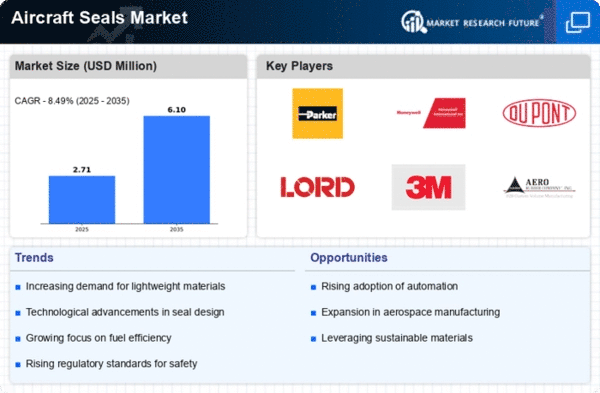
As per MRFR analysis, the Aircraft Seals Market Size was estimated at 2.5 USD Million in 2024. The Aircraft Seals industry is projected to grow from 2.7 in 2025 to 6.1 by 2035, exhibiting a compound annual growth rate (CAGR) of 8.49 during the forecast period 2025 - 2035.

Key Market Trends & Highlights

The Aircraft Seals Market is poised for growth driven by technological advancements and increasing demand for fuel efficiency.

  • Technological advancements in materials are enhancing the performance and durability of aircraft seals.
  • Sustainability initiatives are becoming increasingly important, influencing material choices and manufacturing processes.
  • North America remains the largest market, while Asia-Pacific is emerging as the fastest-growing region in the aircraft seals sector.
  • The expansion of the aerospace industry and the growing demand for fuel efficiency are key drivers propelling market growth.

Market Size & Forecast

2024 Market Size 2.5 (USD Million)
2035 Market Size 6.1 (USD Million)
CAGR (2025 - 2035) 8.49%
Largest Regional Market Share in 2024 North America

Major Players

<p>Parker Hannifin (US), Honeywell International (US), DuPont (US), Lord Corporation (US), 3M (US), Aerospace Rubber & Plastics (US), Seal Science (US), Trelleborg (SE), ElringKlinger (DE)</p>

Market Trends

The Aircraft Seals Market is currently experiencing a dynamic evolution, driven by advancements in technology and increasing demand for efficient sealing solutions in the aerospace sector. As aircraft manufacturers strive for enhanced performance and safety, the need for high-quality seals has become paramount. These components play a crucial role in preventing leaks, ensuring structural integrity, and maintaining optimal performance under various environmental conditions. The market appears to be influenced by a growing emphasis on lightweight materials, which may lead to innovations in seal design and manufacturing processes. Furthermore, the rising focus on sustainability and environmental regulations could potentially drive the development of eco-friendly sealing solutions, aligning with the broader trends in the aviation industry. In addition to technological advancements, the Aircraft Seals Market is likely to benefit from the increasing production rates of commercial and military aircraft. As global air travel continues to expand, manufacturers are ramping up production to meet the rising demand. This surge in aircraft production may create opportunities for seal manufacturers to establish partnerships with OEMs and suppliers, fostering a collaborative environment for innovation. Moreover, the ongoing maintenance and retrofitting of existing aircraft fleets could further stimulate demand for sealing solutions, as operators seek to enhance the longevity and reliability of their aircraft. Overall, the Aircraft Seals Market appears poised for growth, driven by a combination of technological progress and evolving industry needs.

Technological Advancements in Materials

The Aircraft Seals Market is witnessing a shift towards the adoption of advanced materials that offer superior performance characteristics. Innovations in polymers and composites are likely to enhance the durability and effectiveness of seals, catering to the rigorous demands of modern aircraft.

Sustainability Initiatives

There is a growing trend towards sustainability within the Aircraft Seals Market, as manufacturers increasingly focus on developing eco-friendly sealing solutions. This shift may align with broader industry efforts to reduce environmental impact and comply with stringent regulations.

Increased Aircraft Production

The rising production rates of both commercial and military aircraft are expected to drive demand within the Aircraft Seals Market. As manufacturers respond to the growing need for air travel, the requirement for reliable sealing solutions is likely to increase correspondingly.

Aircraft Seals Market Market Drivers

Market Growth Projections

The Global Aircraft Seals Market Industry is projected to experience robust growth in the coming years. With a market value anticipated to reach 2.49 USD Billion by 2035, the industry is on a trajectory of expansion driven by various factors. The compound annual growth rate of 5.9% from 2025 to 2035 indicates a strong demand for sealing solutions across commercial and military aviation sectors. This growth is underpinned by technological advancements, regulatory compliance, and the increasing production of aircraft. The market's evolution reflects the dynamic nature of the aerospace industry and the critical role that seals play in ensuring safety and performance.

Increase in Aircraft Production Rates

The Global Aircraft Seals Market Industry is poised for growth due to the rising production rates of commercial and military aircraft. As global air travel continues to expand, manufacturers are ramping up production to meet the increasing demand. This surge in aircraft production necessitates a corresponding rise in the demand for seals, which are critical components in ensuring the integrity and performance of aircraft systems. The industry is expected to benefit from this trend, with projections indicating a market value of 1.32 USD Billion in 2024. The interplay between production rates and seal demand underscores the importance of these components in the aerospace supply chain.

Growing Demand for Aircraft Maintenance

The Global Aircraft Seals Market Industry experiences a notable increase in demand for aircraft maintenance services. As airlines and operators prioritize safety and reliability, the need for high-quality seals becomes paramount. Maintenance, repair, and overhaul (MRO) activities are projected to grow, driven by an expanding fleet of aircraft. This trend is expected to contribute to the market's growth, with the industry projected to reach 1.32 USD Billion in 2024. The emphasis on preventive maintenance and the replacement of aging aircraft components further amplify the demand for seals, ensuring operational efficiency and compliance with stringent safety regulations.

Emergence of Electric and Hybrid Aircraft

The Global Aircraft Seals Market Industry is witnessing a transformative shift with the emergence of electric and hybrid aircraft. This new generation of aircraft requires specialized sealing solutions to accommodate unique design and operational characteristics. Seals must be engineered to handle different thermal and mechanical stresses associated with electric propulsion systems. As manufacturers innovate to meet these requirements, the market is likely to experience growth, driven by the increasing adoption of sustainable aviation technologies. The potential for electric and hybrid aircraft to reshape the industry landscape may lead to a substantial increase in demand for tailored sealing solutions, further propelling market expansion.

Regulatory Compliance and Safety Standards

The Global Aircraft Seals Market Industry is significantly shaped by stringent regulatory compliance and safety standards imposed by aviation authorities. Organizations such as the Federal Aviation Administration (FAA) and the European Union Aviation Safety Agency (EASA) enforce rigorous guidelines that necessitate the use of high-quality seals in aircraft manufacturing and maintenance. Compliance with these regulations not only ensures passenger safety but also enhances the operational efficiency of airlines. As a result, manufacturers are compelled to invest in superior sealing solutions, which is likely to drive market growth at a compound annual growth rate of 5.9% from 2025 to 2035, reflecting the industry's commitment to safety and reliability.

Technological Advancements in Seal Materials

Innovations in materials science significantly influence the Global Aircraft Seals Market Industry. The development of advanced elastomers and composite materials enhances the performance and durability of seals, catering to the evolving needs of the aerospace sector. These advancements not only improve resistance to extreme temperatures and pressures but also contribute to weight reduction in aircraft design. As manufacturers adopt these cutting-edge materials, the market is likely to witness a surge in demand, with projections indicating a growth trajectory that could see the industry reach 2.49 USD Billion by 2035. This technological evolution is essential for meeting the rigorous standards of modern aviation.

Market Segment Insights

By Application: Fuel Systems (Largest) vs. Hydraulic Systems (Fastest-Growing)

<p>The Aircraft Seals Market showcases a diverse application landscape, with Fuel Systems holding the largest market share. Fuel Systems are critical to aircraft performance and safety, leading to their predominant role in the market. Following closely is the Hydraulic Systems segment, which has emerged as the fastest-growing segment. Its increasing adoption in advanced aircraft designs is attributed to the demand for enhanced performance and reliability in hydraulic applications.</p>

<p>Fuel Systems (Dominant) vs. Hydraulic Systems (Emerging)</p>

<p>Fuel Systems are essential in ensuring precise fuel management and optimal engine performance, positioning them as the dominant segment within the Aircraft Seals Market. They are engineered to withstand harsh conditions, providing robust sealing solutions that enhance safety and efficiency. On the other hand, Hydraulic Systems are rapidly gaining traction, driven by innovations in aircraft technology and the demand for superior hydraulic performance. This segment is characterized by its adaptability to modern aircraft requirements, making it a key area for future growth. As manufacturers continue to integrate advanced technologies, Hydraulic Systems are expected to play an integral role in shaping the market dynamics.</p>

By Material Type: Rubber Seals (Largest) vs. Composite Seals (Fastest-Growing)

<p>In the Aircraft Seals Market, material type segments display varied market shares, with Rubber Seals leading the charge as the largest segment. This is primarily driven by their resilience and flexibility, which make them ideal for various aircraft applications. Meanwhile, Composite Seals are emerging rapidly, gaining significant traction as a fast-growing segment due to their lightweight nature and ability to withstand extreme conditions. The growth trends in this market segment are reflective of evolving aircraft design and performance requirements. As manufacturers focus on enhancing fuel efficiency and operational efficacy, the preference for Composite Seals has risen, indicating a shift towards advanced materials. This trend is further supported by technological advancements and increasing demands for sustainability in aviation, driving the growth of segments like Metal and Thermoplastic Seals in specific applications.</p>

<p>Rubber Seals (Dominant) vs. Composite Seals (Emerging)</p>

<p>Rubber Seals continue to dominate the Aircraft Seals Market primarily due to their superior sealing properties and proven performance across various aircraft segments. Their composition allows for excellent resistance to environmental factors, making them ideal for both commercial and military aviation. In contrast, Composite Seals, although emerging, are rapidly gaining a foothold in the market due to their lightweight advantage and enhanced performance attributes. These seals are designed to withstand high pressures and temperatures, which makes them suitable for modern aircraft systems that demand high efficiency and low weight for improved fuel economy. Both segments play crucial roles in ensuring aircraft safety and reliability, catering to distinct performance needs.</p>

By End Use: Commercial Aviation (Largest) vs. Military Aviation (Fastest-Growing)

<p>The aircraft seals market is significantly influenced by diverse end uses including commercial aviation, military aviation, general aviation, cargo aircraft, and business jets. Commercial aviation constitutes the largest share, driven by the increasing need for efficient sealing solutions in passenger aircraft. This sector's demand is characterized by long-term contracts and high volume production, ensuring consistent growth. Meanwhile, military aviation, though currently smaller, is the fastest-growing segment thanks to rising defense budgets and modernization efforts, including advanced aircraft that require superior sealing solutions.</p>

<p>Commercial Aviation (Dominant) vs. Military Aviation (Emerging)</p>

<p>Commercial aviation continues to dominate the aircraft seals market owing to the soaring number of air travelers and the expansion of airline fleets. This segment's consistent demand for seals is linked to stringent safety regulations and the pursuit of fuel efficiency. On the other hand, military aviation is emerging as a pivotal segment driven by geopolitical tensions and increased investments in defense. Military aircraft are being upgraded with advanced technologies, necessitating high-performance seals that can withstand extreme conditions. As both segments evolve, they reflect distinct needs in technology and reliability, shaping the future landscape of the aircraft seals market.</p>

Get more detailed insights about Aircraft Seals Market Research Report - Global Forecast till 2035

Regional Insights

North America : Market Leader in Aircraft Seals

North America is poised to maintain its leadership in the Aircraft Seals Market, holding a significant market share of 1.25 billion in 2024. The region's growth is driven by increasing air travel, stringent safety regulations, and advancements in aerospace technology. The demand for high-performance seals is further fueled by the rising production rates of commercial and military aircraft, alongside a focus on fuel efficiency and sustainability. The competitive landscape in North America is robust, featuring key players such as Parker Hannifin, Honeywell International, and DuPont. These companies are investing heavily in R&D to innovate and enhance product offerings. The presence of a well-established aerospace sector in the US, coupled with a growing emphasis on lightweight materials, positions North America as a critical hub for aircraft seal manufacturing and innovation.

Europe : Emerging Market with Growth Potential

Europe is witnessing a notable expansion in the Aircraft Seals Market, with a market size of 0.75 billion in 2024. The growth is driven by increasing investments in aerospace infrastructure, rising demand for fuel-efficient aircraft, and compliance with stringent environmental regulations. The European Union's focus on sustainable aviation practices is also a catalyst for innovation in seal technologies, enhancing market dynamics. Leading countries such as Germany, France, and the UK are at the forefront of this growth, supported by key players like Trelleborg and ElringKlinger. The competitive landscape is characterized by collaborations and partnerships aimed at developing advanced sealing solutions. As the region continues to prioritize aerospace advancements, the Aircraft Seals Market is expected to thrive, bolstered by a strong regulatory framework promoting safety and efficiency.

Asia-Pacific : Rapidly Growing Aerospace Sector

Asia-Pacific is emerging as a rapidly growing market for Aircraft Seals, with a market size of 0.4 billion in 2024. The region's growth is propelled by increasing air travel demand, expanding aerospace manufacturing capabilities, and government initiatives to boost the aviation sector. Countries like China and India are investing significantly in their aerospace industries, leading to heightened demand for advanced sealing solutions. The competitive landscape in Asia-Pacific is evolving, with local manufacturers and international players vying for market share. Companies are focusing on innovation and cost-effective solutions to cater to the diverse needs of the region. As the aerospace sector continues to expand, the Aircraft Seals Market is expected to benefit from increased production rates and technological advancements, positioning Asia-Pacific as a key player in the global market.

Middle East and Africa : Emerging Market with Untapped Potential

The Middle East and Africa region is an emerging market for Aircraft Seals, with a market size of 0.1 billion in 2024. The growth is driven by increasing investments in aviation infrastructure, rising air travel, and a focus on enhancing safety standards. Governments in the region are actively promoting the development of their aerospace sectors, which is expected to create new opportunities for aircraft seal manufacturers. Countries like the UAE and South Africa are leading the way in aerospace advancements, supported by a growing number of international partnerships. The competitive landscape is characterized by a mix of local and global players, with a focus on innovation and quality. As the region continues to develop its aviation capabilities, the Aircraft Seals Market is anticipated to grow, driven by the demand for reliable and efficient sealing solutions.

Key Players and Competitive Insights

The Aircraft Seals Market is currently characterized by a competitive landscape that is both dynamic and multifaceted. Key growth drivers include the increasing demand for lightweight materials, advancements in seal technology, and the ongoing expansion of the aerospace sector. Major players such as Parker Hannifin (US), Honeywell International (US), and DuPont (US) are strategically positioned to leverage these trends. Parker Hannifin (US) focuses on innovation in sealing solutions, particularly in developing advanced materials that enhance performance and durability. Honeywell International (US) emphasizes digital transformation and smart technologies, integrating IoT capabilities into their sealing products. Meanwhile, DuPont (US) is heavily invested in sustainability initiatives, aiming to reduce environmental impact through eco-friendly materials and processes. Collectively, these strategies shape a competitive environment that is increasingly focused on technological advancement and sustainability.

In terms of business tactics, companies are localizing manufacturing to reduce lead times and optimize supply chains. This approach is particularly relevant in a moderately fragmented market where agility can provide a competitive edge. The collective influence of key players is significant, as they not only drive innovation but also set industry standards that smaller firms often follow. The competitive structure is evolving, with larger companies acquiring niche players to enhance their product offerings and market reach.

In November 2025, Parker Hannifin (US) announced a partnership with a leading aerospace manufacturer to develop next-generation sealing solutions tailored for electric aircraft. This strategic move is likely to position Parker at the forefront of the emerging electric aviation market, aligning with the industry's shift towards sustainable technologies. The collaboration is expected to enhance their product portfolio and open new revenue streams.

In October 2025, Honeywell International (US) launched a new line of smart seals equipped with sensors that monitor performance in real-time. This innovation not only enhances operational efficiency but also aligns with the growing trend of digitalization in aerospace. By integrating IoT capabilities, Honeywell is likely to improve customer engagement and create value-added services that differentiate their offerings in a competitive market.

In September 2025, DuPont (US) unveiled a new eco-friendly sealing material designed to meet stringent environmental regulations. This initiative underscores DuPont's commitment to sustainability and positions the company as a leader in environmentally responsible manufacturing. The introduction of this material could potentially attract customers who prioritize sustainability in their procurement processes, thereby enhancing DuPont's market share.

As of December 2025, current competitive trends are increasingly defined by digitalization, sustainability, and the integration of AI technologies. Strategic alliances are becoming more prevalent, as companies recognize the need to collaborate to enhance innovation and market responsiveness. Looking ahead, competitive differentiation is expected to evolve from traditional price-based competition to a focus on innovation, technology, and supply chain reliability. This shift suggests that companies that prioritize R&D and sustainable practices will likely gain a competitive advantage in the Aircraft Seals Market.

Key Companies in the Aircraft Seals Market market include

Industry Developments

Future Outlook

Aircraft Seals Market Future Outlook

<p>The Aircraft Seals Market is projected to grow at an 8.49% CAGR from 2024 to 2035, driven by advancements in aerospace technology and increasing demand for fuel efficiency.</p>

New opportunities lie in:

  • <p>Development of advanced composite seals for enhanced durability</p>
  • <p>Integration of smart seals with IoT for real-time monitoring</p>
  • <p>Expansion into emerging markets with tailored seal solutions</p>

<p>By 2035, the Aircraft Seals Market is expected to achieve robust growth and innovation.</p>

Market Segmentation

Aircraft Seals Market End Use Outlook

  • Commercial Aviation
  • Military Aviation
  • General Aviation
  • Cargo Aircraft
  • Business Jets

Aircraft Seals Market Application Outlook

  • Fuel Systems
  • Hydraulic Systems
  • Environmental Control Systems
  • Landing Gear Systems
  • Cabin Pressure Systems

Aircraft Seals Market Material Type Outlook

  • Rubber Seals
  • Metal Seals
  • Composite Seals
  • Thermoplastic Seals
  • Elastomer Seals

Report Scope

MARKET SIZE 20242.5(USD Million)
MARKET SIZE 20252.7(USD Million)
MARKET SIZE 20356.1(USD Million)
COMPOUND ANNUAL GROWTH RATE (CAGR)8.49% (2024 - 2035)
REPORT COVERAGERevenue Forecast, Competitive Landscape, Growth Factors, and Trends
BASE YEAR2024
Market Forecast Period2025 - 2035
Historical Data2019 - 2024
Market Forecast UnitsUSD Million
Key Companies ProfiledParker Hannifin (US), Honeywell International (US), DuPont (US), Lord Corporation (US), 3M (US), Aerospace Rubber & Plastics (US), Seal Science (US), Trelleborg (SE), ElringKlinger (DE)
Segments CoveredApplication, Material Type, End Use
Key Market OpportunitiesAdvancements in lightweight materials enhance performance and fuel efficiency in the Aircraft Seals Market.

Key Market DynamicsRising demand for lightweight materials drives innovation in aircraft seals, enhancing performance and compliance with regulatory standards.
Countries CoveredNorth America, Europe, APAC, South America, MEA

FAQs

How Aircraft Seals Industry is Growing ?

Aircraft Seals Market Size Valued at USD 1,323 Million, market Grow at a CAGR Of 5.9% by 2024 -2032

Segmentation of the Global Aircraft Seals Market ?

Based on region, the market is segmented into North America, Asia-Pacific, Europe, the Middle East &amp; Africa, and Latin America

who Are The Top Key Players Of Aircraft Seals Market ?

The key players in the global aircraft seals market are Eaton Corporation (Ireland), Esterline Technologies Corporation (US), Meggitt Plc (UK), Parker Hannifin Corporation (US), SKF (Sweden), Trelleborg Sealing Solutions (Sweden), Brown Aircraft Supply Inc. (US), Hutchinson SA (France), Saint-Gobain (France), and Technetics Group (US).

  1. Executive Summary
  2. Scope of the Report
    1. Market Definition
    2. Scope of the Study
      1. Definition
      2. Assumptions
      3. Limitations
    3. Research Objective
    4. Research
      1. Primary Research
      2. Secondary Research
    5. Process
    6. Market
    7. Size Estimation
    8. Forecast Model
  3. Market Landscape
    1. Porter’s
      1. Threat of New Entrants
      2. Bargaining Power
      3. Threat of Substitutes
      4. Segment Rivalry
    2. Five Forces Analysis
    3. of Buyers
    4. Bargaining Power of Buyers
    5. Value Chain/Supply Chain Analysis
  4. Market
    1. Dynamics
    2. Introduction
    3. Market Drivers
    4. Market Restraints
    5. Market Opportunities
    6. Market Trends
  5. Aircraft Seals Market,
    1. by Seal Type
    2. Introduction
    3. Dynamic
      1. Market Estimates
      2. Market Estimates & Forecast, by Region,
      3. Contact Seal
      4. Clearance Seal
    4. & Forecast, 2020-2030
    5. Static
      1. Market Estimates & Forecast, 2020-2030
      2. Market Estimates &
      3. O-Rings & Gasket
      4. Other Seals
    6. Forecast, by Region, 2020-2030
    7. Estimates & Forecast, 2020-2030
    8. by Region, 2020-2030
    9. Forecast, 2020-2030
  6. Aircraft Seals Market, by Material
    1. Introduction
    2. Composites
      1. Market Estimates & Forecast, 2020-2030
      2. Market Estimates &
    3. Forecast, by Region, 2020-2030
    4. Polymers
      1. Market Estimates &
      2. Market Estimates & Forecast, by Region, 2020-2030
    5. Forecast, 2020-2030
    6. Metals
      1. Market Estimates & Forecast, 2020-2030
      2. Market
    7. Estimates & Forecast, by Region, 2020-2030
  7. Aircraft Seals Market, by
    1. Application
    2. Introduction
    3. Engine
      1. Market Estimates
      2. Market Estimates & Forecast, by Region,
    4. & Forecast, 2020-2030
    5. Airframe
      1. Market Estimates & Forecast, 2020-2030
      2. Market Estimates & Forecast, by Region, 2020-2030
    6. Flight Control
      1. Market Estimates & Forecast, 2020-2030
      2. Market Estimates
    7. System
    8. & Forecast, by Region, 2020-2030
    9. Landing Gear
      1. Market Estimates
      2. Market Estimates & Forecast, by Region,
    10. & Forecast, 2020-2030
    11. Wheels & Brakes
      1. Market Estimates & Forecast,
      2. Market Estimates & Forecast, by Region, 2020-2030
      3. Market Estimates & Forecast, 2020-2030
      4. Market Estimates
    12. Others
    13. & Forecast, by Region, 2020-2030
  8. Aircraft Seals Market, by Vendor
    1. Introduction
    2. OEM
      1. Market Estimates & Forecast, 2020-2030
      2. Market Estimates & Forecast, by Region, 2020-2030
    3. Aftermarket
      1. Market Estimates & Forecast, 2020-2030
      2. Market Estimates &
    4. Forecast, by Region, 2020-2030
  9. Aircraft Seals Market, by Platform
    1. Introduction
    2. Commercial
      1. Market Estimates & Forecast, 2020-2030
      2. Market Estimates & Forecast, by Region, 2020-2030
    3. Military
      1. Market Estimates & Forecast, 2020-2030
      2. Market Estimates &
    4. Forecast, by Region, 2020-2030
  10. Aircraft Seals Market, by Aircraft Seal Type
    1. Introduction
    2. Fixed Wing
      1. Market Estimates & Forecast,
      2. Market Estimates & Forecast, by Region, 2020-2030
      3. Market Estimates & Forecast, 2020-2030
      4. Market
    3. Rotary Wing
    4. Estimates & Forecast, by Region, 2020-2030
  11. Aircraft Seals Market, by
    1. Region
    2. Introduction
    3. North America
      1. Market Estimates
      2. Market Estimates & Forecast, by Seal Type,
      3. Market Estimates & Forecast, by Material, 2020-2030
      4. Market Estimates & Forecast, by Application, 2020-2030
    4. & Forecast, 2020-2030
  12. Market Estimates & Forecast, by Vendor, 2020-2030
    1. & Forecast, by Platform, 2020-2030
    2. by Aircraft Seal Type, 2020-2030
    3. Forecast, 2020-2030
  13. Market Estimates
  14. Market Estimates & Forecast,
  15. US
  16. Market Estimates &
  17. Market Estimates & Forecast, by Seal Type,
  18. Market Estimates & Forecast, by Material, 2020-2030
  19. Market Estimates & Forecast, by Application, 2020-2030
  20. Market Estimates & Forecast, by Vendor, 2020-2030
    1. & Forecast, by Platform, 2020-2030
    2. by Platform, 2020-2030
  21. Market Estimates
  22. Market Estimates & Forecast,
  23. Canada
  24. Market Estimates & Forecast,
  25. Market Estimates & Forecast, by Seal Type, 2020-2030
  26. Market Estimates & Forecast, by Material, 2020-2030
  27. Market Estimates & Forecast, by Application, 2020-2030
    1. Estimates & Forecast, by Vendor, 2020-2030
    2. Forecast, by Platform, 2020-2030
    3. by Platform, 2020-2030
    4. Estimates & Forecast, by Application, 2020-2030
    5. & Forecast, by Vendor, 2020-2030
    6. by Platform, 2020-2030
    7. Seal Type, 2020-2030
  28. Market
  29. Market Estimates &
  30. Market Estimates & Forecast,
    1. Europe
      1. Market Estimates & Forecast,
      2. Market Estimates & Forecast, by Seal Type, 2020-2030
      3. Market Estimates & Forecast, by Material, 2020-2030
      4. Market
      5. Market Estimates
      6. Market Estimates & Forecast,
      7. Market Estimates & Forecast, by Aircraft
      8. UK
  31. Market Estimates & Forecast, by Application, 2020-2030
    1. Estimates & Forecast, by Vendor, 2020-2030
    2. Forecast, by Platform, 2020-2030
    3. by Aircraft Seal Type, 2020-2030
    4. & Forecast, 2020-2030
    5. Type, 2020-2030
  32. Market
  33. Market Estimates &
  34. Market Estimates & Forecast,
  35. Germany
  36. Market Estimates
  37. Market Estimates & Forecast, by Seal
  38. Market Estimates & Forecast, by Material, 2020-2030
  39. Market Estimates & Forecast, by Application, 2020-2030
  40. Market Estimates & Forecast, by Vendor, 2020-2030
    1. & Forecast, by Platform, 2020-2030
    2. by Aircraft Seal Type, 2020-2030
    3. & Forecast, 2020-2030
    4. Type, 2020-2030
  41. Market Estimates
  42. Market Estimates & Forecast,
  43. France
  44. Market Estimates
  45. Market Estimates & Forecast, by Seal
  46. Market Estimates & Forecast, by Material, 2020-2030
  47. Market Estimates & Forecast, by Application, 2020-2030
  48. Market Estimates & Forecast, by Vendor, 2020-2030
    1. & Forecast, by Platform, 2020-2030
    2. by Aircraft Seal Type, 2020-2030
    3. & Forecast, 2020-2030
    4. Type, 2020-2030
  49. Market Estimates
  50. Market Estimates & Forecast,
  51. Russia
  52. Market Estimates
  53. Market Estimates & Forecast, by Seal
  54. Market Estimates & Forecast, by Material, 2020-2030
  55. Market Estimates & Forecast, by Application, 2020-2030
  56. Market Estimates & Forecast, by Vendor, 2020-2030
    1. & Forecast, by Platform, 2020-2030
    2. by Aircraft Seal Type, 2020-2030
    3. Estimates & Forecast, 2020-2030
    4. by Seal Type, 2020-2030
  57. Market Estimates
  58. Market Estimates & Forecast,
  59. Rest of Europe
  60. Market
  61. Market Estimates & Forecast,
  62. Market Estimates & Forecast, by Material,
  63. Market Estimates & Forecast, by Application, 2020-2030
  64. Market Estimates & Forecast, by Vendor, 2020-2030
  65. Market Estimates & Forecast, by Platform, 2020-2030
    1. & Forecast, by Aircraft Seal Type, 2020-2030
    2. Market Estimates & Forecast, 2020-2030
    3. by Seal Type, 2020-2030
    4. Estimates & Forecast, by Platform, 2020-2030
    5. Forecast, by Aircraft Seal Type, 2020-2030
    6. Estimates & Forecast, 2020-2030
    7. by Seal Type, 2020-2030
    8. Estimates & Forecast, by Platform, 2020-2030
    9. & Forecast, by Aircraft Seal Type, 2020-2030
    10. Market Estimates & Forecast, 2020-2030
    11. Forecast, by Seal Type, 2020-2030
    12. by Material, 2020-2030
  66. Market Estimates
    1. Asia-Pacific
      1. Market Estimates & Forecast,
      2. Market Estimates & Forecast, by Material,
      3. Market Estimates & Forecast, by Application, 2020-2030
      4. Market Estimates & Forecast, by Vendor, 2020-2030
      5. Market
      6. Market Estimates &
      7. China
      8. Japan
  67. Market Estimates & Forecast, by Aircraft Seal Type, 2020-2030
    1. & Forecast, by Seal Type, 2020-2030
    2. by Material, 2020-2030
  68. India
  69. Market Estimates & Forecast, 2020-2030
  70. Market Estimates
  71. Market Estimates & Forecast,
  72. Market Estimates & Forecast, by Application
  73. Market Estimates & Forecast, by Vendor, 2020-2030
  74. Market Estimates & Forecast, by Platform, 2020-2030
  75. Market Estimates & Forecast, by Aircraft Seal Type, 2020-2030
    1. of Asia-Pacific
  76. Rest
  77. Market Estimates & Forecast, 2020-2030
  78. Market Estimates & Forecast, by Seal Type, 2020-2030
    1. & Forecast, by Material, 2020-2030
    2. by Application, 2020-2030
    3. Estimates & Forecast, by Material, 2020-2030
    4. Forecast, by Application, 2020-2030
    5. by Vendor, 2020-2030
    6. Latin America
  79. Market Estimates
  80. Market Estimates & Forecast,
  81. Market Estimates & Forecast, by Vendor,
  82. Market Estimates & Forecast, by Platform, 2020-2030
  83. Market Estimates & Forecast, by Aircraft Seal Type, 2020-2030
    1. Middle East & Africa
      1. Market Estimates & Forecast, 2020-2030
      2. Market Estimates & Forecast, by Seal Type, 2020-2030
      3. Market
      4. Market Estimates &
      5. Market Estimates & Forecast,
      6. Market Estimates & Forecast, by Platform, 2020-2030
      7. Market Estimates & Forecast, by Aircraft Seal Type, 2020-2030
      8. Market Estimates & Forecast, 2020-2030
  84. Market Estimates & Forecast, by Seal Type, 2020-2030
    1. & Forecast, by Material, 2020-2030
    2. by Application, 2020-2030
    3. Competitive Landscape
  85. Market Estimates
  86. Market Estimates & Forecast,
  87. Market Estimates & Forecast, by Vendor,
  88. Market Estimates & Forecast, by Platform, 2020-2030
  89. Market Estimates & Forecast, by Aircraft Seal Type, 2020-2030
  90. Company Profile
    1. Eaton Corporation
      1. Products/Services Offered
      2. Financial Overview
      3. Key Developments
      4. Key Strategies
      5. SWOT Analysis
    2. Company Overview
    3. Esterline Technologies Corporation
      1. Company Overview
      2. Financial Overview
      3. Key Developments
      4. Key Strategies
      5. SWOT Analysis
    4. Products/Services Offered
    5. Meggitt Plc
      1. Products/Services Offered
      2. Financial Overview
      3. Key Developments
      4. Key Strategies
      5. SWOT Analysis
    6. Company Overview
    7. Parker Hannifin Corporation
      1. Company Overview
      2. Products/Services
      3. Financial Overview
      4. Key Developments
      5. SWOT Analysis
    8. Offered
    9. Key Strategies
    10. SKF
      1. Company Overview
      2. Products/Services Offered
      3. Financial Overview
      4. Key
      5. Key Strategies
      6. SWOT Analysis
    11. Developments
    12. Trelleborg
      1. Company Overview
      2. Products/Services Offered
      3. Financial Overview
      4. Key Developments
      5. Key Strategies
      6. SWOT Analysis
    13. Sealing Solutions
    14. Brown Aircraft Supply Inc.
      1. Company
      2. Products/Services Offered
      3. Financial Overview
      4. Key Developments
      5. Key Strategies
      6. SWOT Analysis
    15. Overview
    16. Hutchinson SA
      1. Company Overview
      2. Products/Services
      3. Financial Overview
      4. Key Developments
      5. SWOT Analysis
    17. Offered
    18. Key Strategies
    19. Saint-Gobain
      1. Company
      2. Products/Services Offered
      3. Financial Overview
      4. Key Developments
      5. Key Strategies
      6. SWOT Analysis
    20. Overview
    21. Technetics Group
      1. Company Overview
      2. Products/Services
      3. Financial Overview
      4. Key Developments
      5. SWOT Analysis
    22. Offered
    23. Key Strategies
  91. Appendix
    1. References
    2. Related Reports
    3. List of Abbreviations
  92. Industry Insights
    1. Note: This table of contents is tentative and subject to change as the research
    2. progresses.
    3. List of Tables
  93. Global Aircraft Seals Market,
    1. by Region, 2020-2030
  94. North America Aircraft Seals Market, by Country,
  95. Europe Aircraft Seals Market, by Country, 2020-2030
  96. Asia-Pacific Aircraft Seals Market, by Country, 2020-2030
    1. Table
  97. Middle East & Africa Aircraft Seals Market, by Country, 2020-2030
    1. Table
  98. Latin America Aircraft Seals Market, by Country, 2020-2030
  99. Global
  100. Aircraft Seals Market, by Region, 2020-2030
  101. Global Aircraft Seals
  102. Market, by Seal Type, 2020-2030
  103. Global Aircraft Seals Market, by Material,
  104. Global Aircraft Seals Market, by Platform, 2020-2030
  105. Global Aircraft Seals Market, by Application, 2020-2030
    1. Table 12
  106. Global Aircraft Seals Market, by Vendor, 2020-2030
  107. Global Aircraft
  108. Seals Market, by Aircraft Type, 2020-2030
  109. North America: Aircraft
  110. Seals Market, by Country, 2020-2030
  111. North America: Aircraft Seals
  112. Market, by Seal Type, 2020-2030
  113. North America: Aircraft Seals Market,
    1. by Material, 2020-2030
  114. North America: Aircraft Seals Market, by Platform,
  115. North America: Aircraft Seals Market, by Application, 2020-2030
  116. North America: Aircraft Seals Market, by Vendor, 2020-2030
    1. Table
  117. North America: Aircraft Seals Market, by Aircraft Type, 2020-2030
    1. Table
  118. Europe: Aircraft Seals Market, by Country, 2020-2030
  119. Europe: Aircraft
  120. Seals Market, by Seal Type, 2020-2030
  121. Europe: Aircraft Seals Market,
    1. by Material, 2020-2030
  122. Europe: Aircraft Seals Market, by Platform,
  123. Europe: Aircraft Seals Market, by Application, 2020-2030
  124. Europe: Aircraft Seals Market, by Vendor, 2020-2030
  125. Europe:
  126. Aircraft Seals Market, by Aircraft Type, 2020-2030
  127. Asia-Pacific:
  128. Aircraft Seals Market, by Country, 2020-2030
  129. Asia-Pacific: Aircraft
  130. Seals Market, by Seal Type, 2020-2030
  131. Asia-Pacific: Aircraft Seals
  132. Market, by Material, 2020-2030
  133. Asia-Pacific: Aircraft Seals Market,
    1. by Platform, 2020-2030
  134. Asia-Pacific: Aircraft Seals Market, by Application,
  135. Asia-Pacific: Aircraft Seals Market, by Vendor, 2020-2030
  136. Asia-Pacific: Aircraft Seals Market, by Aircraft Type, 2020-2030
    1. Table
  137. Middle East & Africa: Aircraft Seals Market, by Seal Type, 2020-2030
  138. Middle East & Africa: Aircraft Seals Market, by Material, 2020-2030
  139. Middle East & Africa: Aircraft Seals Market, by Platform, 2020-2030
  140. Middle East & Africa: Aircraft Seals Market, by Application,
  141. Middle East & Africa: Aircraft Seals Market, by Vendor,
  142. Middle East & Africa: Aircraft Seals Market, by Aircraft
    1. Type, 2020-2030
  143. Latin America: Aircraft Seals Market, by Region, 2020-2030
  144. Latin America: Aircraft Seals Market, by Seal Type, 2020-2030
  145. Latin America: Aircraft Seals Market, by Material, 2020-2030
    1. Table
  146. Latin America: Aircraft Seals Market, by Platform, 2020-2030
  147. Latin
  148. America: Aircraft Seals Market, by Application, 2020-2030
  149. Latin America:
  150. Aircraft Seals Market, by Vendor, 2020-2030
  151. Latin America: Aircraft
  152. Seals Market, by Aircraft Type, 2020-2030
    1. List of Figures
    2. FIGURE
  153. Research Process of MRFR
  154. Top-Down and Bottom-Up Approaches
    1. FIGURE
  155. Market Dynamics
  156. Impact Analysis: Market Drivers
  157. Impact
    1. Analysis: Market Restraints
  158. Porter's Five Forces Analysis
    1. FIGURE
  159. Value Chain Analysis
  160. Global Aircraft Seals Market Share, by Seal
    1. Type, 2020 (%)
  161. Global Aircraft Seals Market, by Seal Type, 2020-2030
    1. (USD Million)
  162. Global Aircraft Seals Market Share, by Material, 2020
    1. (%)
  163. Global Aircraft Seals Market, by Material, 2020-2030 (USD Million)
  164. Global Aircraft Seals Market Share, by Platform, 2020 (%)
    1. FIGURE
  165. Global Aircraft Seals Market, by Platform, 2020-2030 (USD Million)
    1. FIGURE
  166. Global Aircraft Seals Market Share, by Application, 2020 (%)
  167. Global
  168. Aircraft Seals Market, by Application, 2020-2030 (USD Million)
  169. Global
  170. Aircraft Seals Market Share, by Vendor, 2020 (%)
  171. Global Aircraft
  172. Seals Market, by Vendor, 2020-2030 (USD Million)
  173. Global Aircraft
  174. Seals Market Share, by Aircraft Type, 2020 (%)
  175. Global Aircraft Seals
  176. Market, by Aircraft Type, 2020-2030 (USD Million)
  177. Global Aircraft
  178. Seals Market Share (%), by Region, 2020
  179. Global Aircraft Seals Market,
    1. by Region, 2020-2030 (USD Million)
  180. North America: Aircraft Seals
    1. Market Share (%), 2020
  181. North America: Aircraft Seals Market, by Country,
  182. Europe: Aircraft Seals Market Share (%),
  183. Europe: Aircraft Seals Market, by Country, 2020-2030 (USD Million)
  184. Asia-Pacific: Aircraft Seals Market Share (%), 2020
  185. Asia-Pacific:
  186. Aircraft Seals Market, by Country, 2020-2030 (USD Million)
  187. Middle
    1. East & Africa Aircraft Seals Market Share (%), 2020
  188. Middle East
  189. & Africa Aircraft Seals Market, by Region, 2020-2030 (USD Million)
    1. FIGURE
  190. Latin America Aircraft Seals Market Share (%), 2020
  191. Latin America
  192. Aircraft Seals Market, by Region, 2020-2030 (USD Million)

Aircraft Seals Market Segmentation

Market Segmentation Overview

  • Detailed segmentation data will be available in the full report
  • Comprehensive analysis by multiple parameters
  • Regional and country-level breakdowns
  • Market size forecasts by segment
Infographic

Free Sample Request

Kindly complete the form below to receive a free sample of this Report

Get Free Sample

Customer Strories

Compare Licence

×
Features License Type
Single User Multiuser License Enterprise User
Price $4,950 $5,950 $7,250
Maximum User Access Limit 1 User Upto 10 Users Unrestricted Access Throughout the Organization
Free Customization
Direct Access to Analyst
Deliverable Format
Platform Access
Discount on Next Purchase 10% 15% 15%
Printable Versions