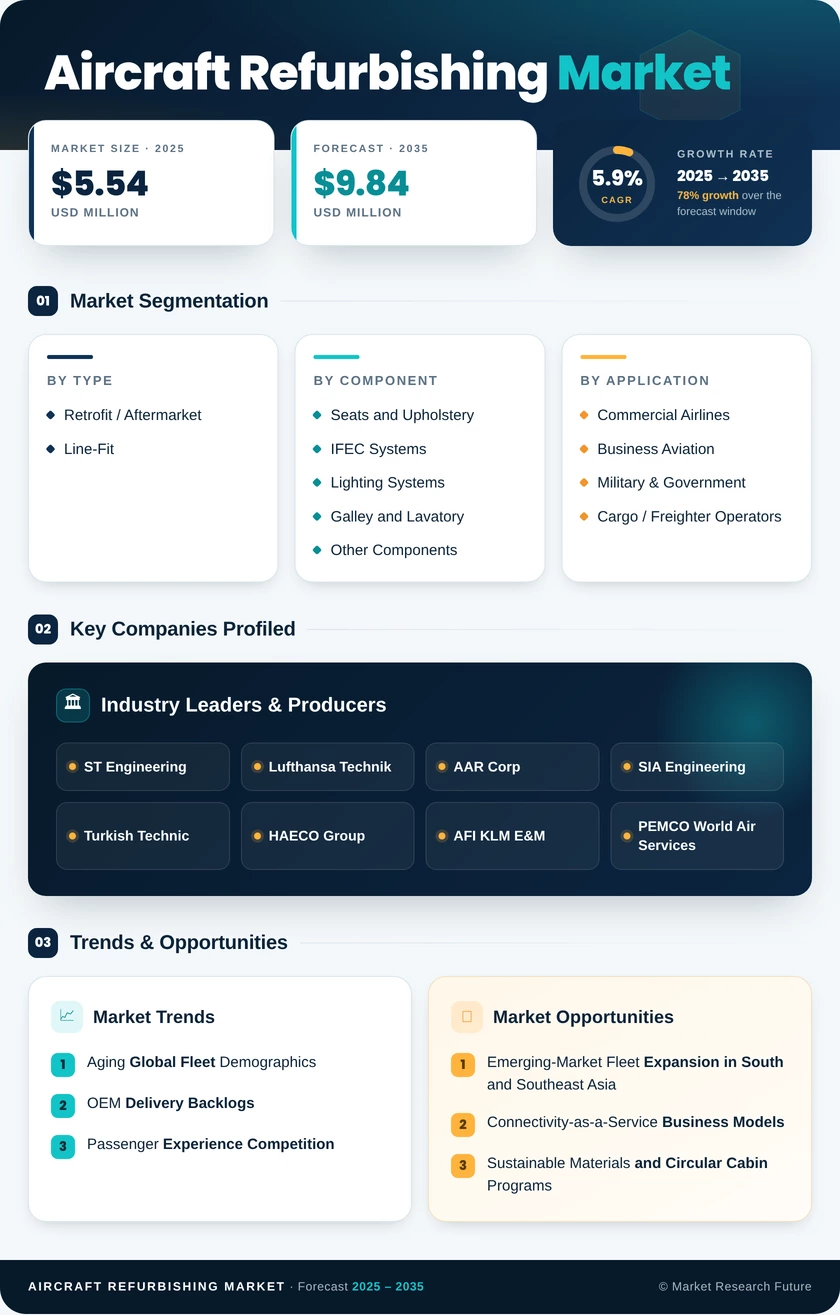
Segmentation Quick Reference
| Dimension | Sub-Segments | Dominant Segment | Fastest Growing Segment |
| Refurbishment Type | Interior, Exterior, Avionics | Interior (48% share) | Avionics (CAGR 6.7%) |
| Component | Seats & Upholstery, IFEC Systems, Lighting Systems, Galley & Lavatory, Other | Seats & Upholstery (34% share) | IFEC Systems (CAGR 7.1%) |
| Aircraft Type | Narrowbody, Widebody, Regional Jets, Turboprops & Others | Narrowbody (USD 3.04 B) | Widebody (CAGR 6.2%) |
| Fitment Type | Retrofit / Aftermarket, Line-Fit | Retrofit / Aftermarket (68% share) | Line-Fit (CAGR 5.4%) |
| End-User | Commercial Airlines, Business Aviation, Military & Government, Cargo / Freighter Operators | Commercial Airlines (74% share) | Cargo / Freighter Operators (CAGR 6.3%) |
Market Segmentation Overview
By Refurbishment Type
| Sub-Segment | Key Trend |
| Interior | Airlines shortening cabin refresh cycles from 8–10 years to 5–7 years to maintain competitive positioning |
| Exterior | Advanced polyurethane topcoat systems reduce weight and extend repaint intervals to 7–8 years |
| Avionics | Regulatory-driven demand from ADS-B, FANS-1/A, and glass-cockpit transition programs |
Interior refurbishment remains the revenue cornerstone of the Aircraft Refurbishing Market, driven by airlines' need to differentiate passenger experience in a competitive fare environment. Avionics upgrades carry strong non-discretionary demand due to regulatory compliance mandates from both the FAA and EASA.
By Component
| Sub-Segment | Key Trend |
| Seats and Upholstery | Slimline seat adoption reducing per-seat weight by 3–5 kg while improving ergonomics |
| IFEC Systems | Ka-band satellite connectivity and wireless streaming becoming baseline passenger expectations |
| Lighting Systems | LED mood lighting retrofit programs gaining traction across narrowbody and widebody fleets |
| Galley and Lavatory | Lightweight galley inserts and accessibility-compliant lavatory modules driving replacement cycles |
| Other Components | Overhead bins, sidewall panels, and flooring replacements bundled with major check events |
IFEC systems are experiencing the fastest growth among all components as airlines view high-speed in-flight connectivity as a non-negotiable element of the travel experience, particularly on medium- and long-haul routes.
By Aircraft Type
| Sub-Segment | Key Trend |
| Narrowbody | Largest addressable fleet globally; A320 and 737 families dominate refurbishment volumes |
| Widebody | Premium-class cabin redesigns drive high per-unit refurbishment values |
| Regional Jets | Embraer E-Jet and Bombardier CRJ families entering mid-life update cycles |
| Turboprops & Others | ATR and Dash 8 operators investing in cabin modernization for regional route competitiveness |
Narrowbody aircraft generate the highest aggregate refurbishment spend due to their dominance in global fleet counts, while widebody platforms command premium per-aircraft contract values driven by business- and first-class cabin overhauls.
By Fitment Type
| Sub-Segment | Key Trend |
| Retrofit / Aftermarket | Core of the market; airlines investing in mid-life upgrades to extend airframe economic life |
| Line-Fit | OEMs increasingly offering higher-specification interior packages at the factory stage |
Retrofit and aftermarket programs define the Aircraft Refurbishing Market's demand structure, as the vast majority of spending occurs on in-service aircraft rather than at initial delivery.
By End-User
| Sub-Segment | Key Trend |
| Commercial Airlines | Fleet scale and brand competition drive continuous cabin refresh investment |
| Business Aviation | VIP completion centers deliver bespoke interior programs for corporate and VVIP operators |
| Military & Government | Aging tanker, transport, and VIP fleets require periodic cabin and systems upgrades |
| Cargo / Freighter Operators | Passenger-to-freighter conversion programs represent a high-growth refurbishment category |
Commercial airlines represent the dominant end-user segment, while cargo operators are emerging as a fast-growing category driven by the global e-commerce logistics expansion and the resulting surge in P2F conversion programs.

 Noah Malgeri
Co-Founder
Noah Malgeri
Co-Founder

 Peter Groot koerkamp
Account and Business Manager
Peter Groot koerkamp
Account and Business Manager

 Younghwan Choi
Senior Retail Manager
Younghwan Choi
Senior Retail Manager

 Mark Irwin
Management Consultant
Mark Irwin
Management Consultant

 Akif Moroglu
Strategy & Business Development Director
Akif Moroglu
Strategy & Business Development Director

 Guilherme Gomes Martins
Product Management Director
Guilherme Gomes Martins
Product Management Director

 Joseph Aguayo
Sales Operations & Pricing Manager
Joseph Aguayo
Sales Operations & Pricing Manager

 La Terria Dodd
Program Support Specialist
La Terria Dodd
Program Support Specialist

 Rob Kooiker
Group Product Manager HVAC & Fire Protection GMA
Rob Kooiker
Group Product Manager HVAC & Fire Protection GMA