Request Free Sample ×

Kindly complete the form below to receive a free sample of this Report

* Please use a valid business email

Leading companies partner with us for data-driven Insights

clients tt-cursor
Hero Background
English
Chinese
French
Japanese
Korean
German
Spanish

Aircraft Recycling Market Trends

ID: MRFR/AD/12484-HCR
128 Pages
Abbas Raut
March 2026

Aircraft Recycling Market Size, Share, Industry Trend & Analysis Research Report Information By Aircraft (Narrow-Body, Wide-Body, and Regional), By Component (Engines, Landing Gear, Avionics, and Others), And By Region (North America, Europe, Asia-Pacific, And Rest Of The World) – Forecast Till 2035

Share:
Download PDF ×

We do not share your information with anyone. However, we may send you emails based on your report interest from time to time. You may contact us at any time to opt-out.

Aircraft Recycling Market Infographic
Purchase Options

Market Trends

Key Emerging Trends in the Aircraft Recycling Market

The aircraft recycling market has emerged as a significant sector within the aviation industry, driven by factors such as increasing retirements of commercial and military aircraft, stringent environmental regulations, and growing awareness of sustainability issues. One notable trend in the aircraft recycling market is the adoption of sustainable and environmentally responsible practices for dismantling and recycling end-of-life aircraft. Aircraft recycling facilities are implementing eco-friendly techniques such as dismantling, reusing, and recycling aircraft components and materials to minimize waste generation, reduce environmental pollution, and maximize resource recovery. By adopting these sustainable practices, aircraft recycling companies can meet regulatory requirements, minimize environmental impact, and contribute to the circular economy.

Moreover, there is a growing demand for aircraft dismantling and recycling services due to the increasing number of retired and decommissioned aircraft worldwide. With the global fleet of commercial and military aircraft reaching the end of their operational life cycle, there is a pressing need to decommission and recycle these aircraft in an environmentally responsible manner. Aircraft recycling companies are investing in specialized equipment, facilities, and personnel to handle the dismantling, recycling, and disposal of retired aircraft safely and efficiently, meeting the growing demand for end-of-life aircraft management services.

Additionally, the aircraft recycling market is witnessing a rise in the recovery and recycling of valuable materials and components from retired aircraft, including aluminum, titanium, copper, and high-value electronic components. These materials can be repurposed and recycled for use in various industries such as automotive, construction, and manufacturing, reducing the need for virgin raw materials and conserving natural resources. Aircraft recycling companies are employing advanced technologies such as automated dismantling equipment, shredders, and material separation systems to extract, process, and recover valuable materials from retired aircraft, maximizing the economic value of end-of-life aircraft assets.

Furthermore, there is a growing emphasis on regulatory compliance and environmental sustainability in the aircraft recycling market, driven by stringent regulations and guidelines governing the disposal and recycling of aircraft components and materials. Aircraft recycling facilities are required to adhere to strict environmental standards and regulations set forth by regulatory bodies such as the International Civil Aviation Organization (ICAO) and the European Aviation Safety Agency (EASA). Compliance with these regulations ensures that aircraft dismantling and recycling activities are conducted safely, responsibly, and in an environmentally sustainable manner, minimizing environmental impact and protecting public health and safety.

Another notable trend in the aircraft recycling market is the emergence of innovative business models and partnerships aimed at promoting collaboration and sustainability across the aviation industry. Aircraft manufacturers, airlines, leasing companies, and recycling facilities are forming partnerships and alliances to develop end-of-life aircraft management programs, implement sustainable recycling practices, and promote the reuse and recycling of aircraft components and materials. By working together, stakeholders in the aviation industry can address common challenges, share best practices, and drive innovation in aircraft recycling, ultimately contributing to the sustainability and resilience of the global aviation sector.


Author
Author Profile
Abbas Raut
Research Analyst

Abbas Raut is a Senior Research Analyst with 5+ years of experience delivering data-driven insights and strategic recommendations across the Automotive and Aerospace & Defense sectors. He specializes in emerging technologies, industry value chains, and global market dynamics shaping the future of mobility and defense. In automotive, Abbas has led studies on EVs, charging stations, BMS, superchargers, and more, guiding stakeholders through electrification and regulatory shifts. In Aerospace & Defense, he has analyzed markets for military electronics, drones, radars, and electronic warfare solutions, supporting procurement and investment strategies. With expertise in market sizing, forecasting, benchmarking, and technology adoption, Abbas is known for transforming complex datasets into actionable insights that drive strategy, innovation, and growth.

Leave a Comment

FAQs

What is the projected market valuation of The Global Aircraft Recycling by 2035?

<p>The projected market valuation for The Global Aircraft Recycling is expected to reach 12.72 USD Billion by 2035.</p>

What was the market valuation of The Global Aircraft Recycling in 2024?

The overall market valuation of The Global Aircraft Recycling was 4.977 USD Billion in 2024.

What is the expected CAGR for The Global Aircraft Recycling during the forecast period 2025 - 2035?

The expected CAGR for The Global Aircraft Recycling during the forecast period 2025 - 2035 is 8.9%.

Which companies are considered key players in The Global Aircraft Recycling?

Key players in The Global Aircraft Recycling include Aero Recycling (SE), Air Salvage International (GB), and Aircraft Recycling International (US), among others.

What are the projected valuations for narrow-body aircraft recycling by 2035?

The projected valuation for narrow-body aircraft recycling is expected to increase from 1.5 USD Billion to 3.8 USD Billion by 2035.

How does the market for wide-body aircraft recycling compare to narrow-body aircraft recycling?

The market for wide-body aircraft recycling is projected to grow from 2.0 USD Billion to 5.0 USD Billion, indicating a potentially higher growth trajectory than narrow-body aircraft recycling.

What is the expected growth in the regional aircraft recycling segment by 2035?

The regional aircraft recycling segment is anticipated to grow from 1.477 USD Billion to 3.92 USD Billion by 2035.

What components are included in The Global Aircraft Recycling?

The Global Aircraft Recycling includes components such as engines, landing gear, avionics, and others, with varying projected valuations.

What is the projected valuation for aircraft engines recycling by 2035?

The projected valuation for aircraft engines recycling is expected to rise from 1.5 USD Billion to 3.8 USD Billion by 2035.

How does the valuation of landing gear recycling compare to avionics recycling?

Landing gear recycling is projected to grow from 1.2 USD Billion to 3.0 USD Billion, whereas avionics recycling is expected to increase from 1.0 USD Billion to 2.5 USD Billion by 2035.

Market Summary

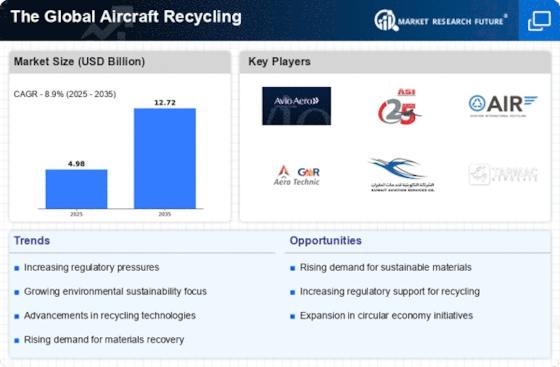
As per Market Research Future analysis, The Global Aircraft Recycling Market was estimated at 4.977 USD Billion in 2024. The aircraft recycling industry is projected to grow from 5.42 USD Billion in 2025 to 12.72 USD Billion by 2035, exhibiting a compound annual growth rate (CAGR) of 8% during the forecast period 2025 - 2035

Key Market Trends & Highlights

The Global Aircraft Recycling Market is poised for substantial growth driven by sustainability and technological advancements.

  • North America remains the largest market for aircraft recycling Market, reflecting a strong commitment to sustainability initiatives. The Asia-Pacific region is emerging as the fastest-growing market, propelled by increasing demand for eco-friendly practices. Narrow-body aircraft recycling dominates the market, while wide-body aircraft recycling is experiencing rapid growth due to evolving regulations. Key market drivers include sustainability initiatives and technological advancements, which are reshaping industry standards.

Market Size & Forecast

2024 Market Size 4.977 (USD Billion)
2035 Market Size 12.72 (USD Billion)
CAGR (2025 - 2035) 8.9%
Largest Regional Market Share in 2024 North America

Major Players

Aero Recycling (SE), <a href="https://airsalvage.co.uk/news/">Air Salvage International</a> (GB), Aircraft Recycling International (US), GMR Aero (IN), Kuwait Aviation Services Company (KW), SATA International (PT), Tarmac Aerosave (FR), Universal Asset Management (US)

Market Trends

The Global Aircraft Recycling is currently experiencing a transformative phase, driven by increasing environmental awareness and regulatory pressures. Stakeholders are recognizing the importance of sustainable practices in aviation, leading to a heightened focus on recycling and repurposing aircraft materials. This shift not only addresses ecological concerns but also presents economic opportunities, as valuable components can be salvaged and reused. The market appears to be evolving, with innovations in technology and processes enhancing the efficiency of recycling operations. Furthermore, collaboration among industry players is likely to foster advancements in best practices, ensuring that the sector adapts to changing demands and expectations. In addition, The Global Aircraft Recycling is witnessing a growing trend towards circular economy principles. This approach emphasizes minimizing waste and maximizing resource utilization, which aligns with global sustainability goals. As airlines and manufacturers increasingly prioritize end-of-life solutions for aircraft, the market may see a rise in partnerships and initiatives aimed at improving recycling rates. Overall, the landscape of aircraft recycling is shifting, suggesting a future where environmental responsibility and economic viability coexist harmoniously.

Sustainability Initiatives

The emphasis on sustainability is reshaping The Global Aircraft Recycling. Companies are adopting eco-friendly practices to reduce their carbon footprint, which is becoming a key driver for innovation in recycling technologies.

Technological Advancements

Emerging technologies are enhancing the efficiency of aircraft recycling processes. Innovations in material recovery and waste management are likely to streamline operations, making recycling more economically viable.

Regulatory Compliance

Stricter regulations regarding waste management and environmental protection are influencing The Global Aircraft Recycling. Compliance with these regulations is pushing companies to adopt more robust recycling strategies.

Aircraft Recycling Market Market Drivers

Economic Factors

Economic factors significantly influence The Global aircraft recycling Industry. The use of recyclates in aviation industry sector is subject to fluctuations in economic conditions, which can impact the lifecycle of aircraft. As airlines face financial pressures, the need to retire older, less efficient aircraft becomes more pronounced. In 2025, it is estimated that around 1,500 aircraft will reach the end of their operational life, creating a substantial opportunity for recycling services. Additionally, the rising costs of raw materials may drive airlines to consider recycling as a cost-effective alternative to sourcing new materials. The potential for recovering valuable metals and components from decommissioned aircraft presents a lucrative avenue for revenue generation, thereby stimulating market growth.

Consumer Awareness

Consumer awareness regarding environmental issues is increasingly driving The Global Aircraft Recycling Industry. As travelers become more conscious of their carbon footprint, they are more likely to support airlines that prioritize sustainable practices. This shift in consumer behavior is prompting airlines to adopt recycling initiatives as part of their corporate social responsibility strategies. In 2025, surveys indicate that over 70% of passengers prefer airlines that demonstrate a commitment to sustainability. This growing demand for eco-friendly practices is likely to encourage airlines to invest in aircraft recycling programs, thereby expanding the market. Furthermore, as consumers advocate for transparency in environmental practices, the pressure on airlines to disclose their recycling efforts will likely intensify, further propelling the industry forward.

Regulatory Compliance

Regulatory compliance is a significant driver influencing The Global Aircraft Recycling Industry. Governments and international bodies are increasingly implementing stringent regulations aimed at reducing waste and promoting recycling within the use of recyclates in aviation industry sector. For example, the European Union's Circular Economy Action Plan emphasizes the importance of recycling and resource efficiency, which directly impacts aircraft disposal practices. Compliance with these regulations not only helps airlines avoid penalties but also enhances their corporate image. In 2025, it is anticipated that compliance-related costs could account for up to 15% of operational expenses for airlines, underscoring the necessity for effective recycling strategies. Consequently, the demand for aircraft recycling services is likely to rise as companies seek to align with regulatory frameworks.

Sustainability Initiatives

The increasing emphasis on sustainability initiatives is a pivotal driver for The Global Aircraft Recycling Industry. As environmental concerns gain traction, airlines and manufacturers are compelled to adopt eco-friendly practices. The recycling of aircraft materials not only reduces waste but also conserves resources, aligning with global sustainability goals. In 2023, the use of recyclates in aviation industry sector generated approximately 920 million tons of CO2 emissions, prompting stakeholders to seek solutions that mitigate their environmental impact. The recycling of aircraft components, such as aluminum and titanium, can significantly lower the carbon footprint associated with new material production. This shift towards sustainable practices is likely to enhance the market's growth, as companies strive to meet regulatory requirements and consumer expectations for greener operations.

Technological Advancements

Technological advancements play a crucial role in shaping The Global Aircraft Recycling Industry. Innovations in recycling processes, such as automated dismantling and advanced material recovery techniques, enhance efficiency and reduce costs. For instance, the introduction of robotics in aircraft disassembly has streamlined operations, allowing for quicker and safer extraction of valuable materials. Furthermore, the development of new technologies for composite material recycling is gaining attention, as composites constitute a significant portion of modern aircraft. In 2024, it is projected that the market for recycled aircraft materials could reach USD 5 billion, driven by these technological improvements. As the industry embraces these advancements, the potential for increased profitability and reduced environmental impact becomes more pronounced.

Market Segment Insights

By Aircraft: Narrow-Body (Largest) vs. Wide-Body (Fastest-Growing)

In The Global Aircraft Recycling Market, the <a href="https://www.marketresearchfuture.com/reports/narrow-body-aircraft-market-23723">narrow-body</a> segment holds the largest market share due to its widespread usage in commercial aviation, with a significant number of aircraft reaching the end of their operational life. This segment has seen a robust demand for recycling as airlines aim to reduce costs and environmental impacts associated with decommissioning older aircraft. In contrast, while the wide-body segment does not hold as substantial a share, it is recognized as the fastest-growing segment. Its growth is fueled by the increased need for efficient recycling processes and the rising number of wide-body aircraft being retired.

Narrow-Body (Dominant) vs. Regional (Emerging)

The narrow-body aircraft segment is dominant in The Global Aircraft Recycling Market, primarily due to its extensive use in short to medium-haul flights, resulting in a larger volume of aircraft available for recycling. As airlines adopt sustainable practices, the recycling of these aircraft presents a lucrative opportunity for manufacturers and recyclers alike. On the other hand, the regional segment is emerging, characterized by smaller aircraft primarily used for connecting remote or underserved areas. While currently smaller in volume, the increasing regional air travel and a shift towards more sustainable operations position this segment for potential growth in recycling initiatives.

By Component: Engines (Largest) vs. Avionics (Fastest-Growing)

<a href="https://www.marketresearchfuture.com/reports/avionics-market-12007" target="_blank">avionics</a>

Engines (Dominant) vs. Avionics (Emerging)

Engines are the dominant component in the aircraft recycling Market sector, primarily due to their complex materials and high-value components that generate substantial demand in recycling efforts. The process often involves dismantling engines and recovering valuable metals and parts, making it economically advantageous. Conversely, Avionics represents an emerging segment influenced by the increasing complexity and miniaturization of electronic systems in modern aircraft. As aviation technology advances, the need for sustainable practices in recycling these electronic components grows, paving the way for innovative recycling methods to handle sensitive materials while addressing regulatory requirements.

Get more detailed insights about Aircraft Recycling Market Research Report - Global Forecast till 2035

Regional Insights

North America : Leading Market Innovators

North America is the largest market for aircraft recycling, holding approximately 45% of the global share. The region's growth is driven by stringent environmental regulations, increasing demand for sustainable practices, and advancements in recycling technologies. The U.S. and Canada are the primary contributors, with a focus on reducing carbon footprints and enhancing resource recovery. Regulatory frameworks, such as the FAA's guidelines on aircraft disposal, further catalyze market expansion. The competitive landscape in North America features key players like Aircraft Recycling Market International and Universal Asset Management, which are at the forefront of innovation. The presence of established companies fosters a robust ecosystem for aircraft recycling, ensuring compliance with environmental standards. Additionally, partnerships with airlines and manufacturers enhance the supply chain, promoting efficient recycling processes and resource recovery initiatives.

Europe : Regulatory-Driven Market Growth

Europe is the second-largest market for aircraft recycling Market, accounting for approximately 30% of the global share. The region's growth is propelled by stringent EU regulations aimed at reducing waste and promoting sustainable aviation practices. Countries like Germany and France lead the market, supported by initiatives such as the European Commission's Circular Economy Action Plan, which encourages recycling and resource efficiency in the aviation sector. The competitive landscape in Europe is characterized by key players such as Tarmac Aerosave and Air Salvage International, which are pioneering innovative recycling solutions. The presence of a well-established regulatory framework fosters collaboration between governments and private entities, enhancing the overall efficiency of the recycling process. As the market evolves, European companies are increasingly focusing on technological advancements to improve recycling rates and reduce environmental impact.

Asia-Pacific : Emerging Market Potential

Asia-Pacific is witnessing rapid growth in the aircraft recycling market, holding approximately 20% of the global share. The region's expansion is driven by increasing air travel demand, coupled with a growing emphasis on sustainable practices. Countries like India and China are emerging as key players, supported by government initiatives aimed at enhancing recycling capabilities and reducing environmental impact. Regulatory frameworks are evolving to support these trends, fostering a conducive environment for market growth. The competitive landscape in Asia-Pacific features companies like GMR Aero and Kuwait Aviation Services Company, which are investing in advanced recycling technologies. The region's market is characterized by a mix of established players and new entrants, creating a dynamic environment for innovation. As the demand for aircraft recycling services increases, collaboration between governments and private sectors is essential to enhance recycling efficiency and sustainability.

Middle East and Africa : Resource-Rich Opportunities

The Middle East and Africa region is gradually emerging in the aircraft recycling market, holding about 5% of the global share. The growth is primarily driven by increasing awareness of environmental sustainability and the need for efficient resource management. Countries like South Africa and the UAE are beginning to implement regulations that promote recycling and waste management in the aviation sector, although the market is still in its nascent stages compared to other regions. The competitive landscape in this region is evolving, with companies like Kuwait Aviation Services Company leading the charge in establishing recycling facilities. The presence of resource-rich countries provides opportunities for growth, but challenges remain in terms of regulatory frameworks and market maturity. As the region develops, partnerships between local governments and international firms will be crucial in enhancing recycling capabilities and promoting sustainable practices in the use of recyclates in aviation industry.

Key Players and Competitive Insights

The Global Aircraft Recycling is currently characterized by a dynamic competitive landscape, driven by increasing environmental regulations and the growing emphasis on sustainability. Key players are actively engaging in strategic initiatives to enhance their operational capabilities and market presence. Companies such as Aero Recycling (SE), Aircraft Recycling International (US), and Tarmac Aerosave (FR) are at the forefront, focusing on innovation and partnerships to optimize their recycling processes. Their collective strategies not only bolster their competitive positioning but also contribute to the overall growth of the market, as they adapt to evolving consumer demands and regulatory frameworks.

In terms of business tactics, companies are increasingly localizing their operations and optimizing supply chains to enhance efficiency and reduce costs. The market appears moderately fragmented, with several players vying for market share. However, the influence of major companies is significant, as they set industry standards and drive technological advancements. This competitive structure suggests that while there is room for smaller players, the dominance of established firms is likely to shape market dynamics in the foreseeable future.

In August 2025, Aero Recycling (SE) announced a partnership with a leading technology firm to develop advanced recycling technologies aimed at improving material recovery rates. This strategic move is expected to enhance Aero Recycling's operational efficiency and position it as a leader in sustainable practices within the industry. The collaboration underscores the importance of technological innovation in meeting the increasing demand for environmentally friendly recycling solutions.

In September 2025, Aircraft Recycling International (US) expanded its operations by acquiring a facility in Europe, which is anticipated to enhance its service offerings and geographical reach. This acquisition reflects a strategic effort to tap into the growing European market, where regulatory pressures for sustainable practices are intensifying. By establishing a stronger foothold in this region, Aircraft Recycling International is likely to benefit from increased demand for its services, thereby solidifying its competitive edge.

In July 2025, Tarmac Aerosave (FR) launched a new initiative focused on the circular economy, aiming to repurpose aircraft materials into new products. This initiative not only aligns with global sustainability goals but also positions Tarmac Aerosave as a pioneer in innovative recycling practices. The emphasis on circularity is indicative of a broader trend within the industry, where companies are increasingly seeking to minimize waste and maximize resource efficiency.

As of October 2025, the competitive trends in The Global Aircraft Recycling are heavily influenced by digitalization, sustainability, and the integration of artificial intelligence. Strategic alliances are becoming more prevalent, as companies recognize the value of collaboration in enhancing their technological capabilities and market reach. Looking ahead, it appears that competitive differentiation will increasingly hinge on innovation and technological advancements, rather than solely on price. The shift towards sustainable practices and reliable supply chains is likely to redefine the competitive landscape, compelling companies to adapt and innovate continuously.

Key Companies in the Aircraft Recycling Market include

Industry Developments

October 2023: Air France-KLM and Safran Landing Systems announced a partnership in order to develop and implement a closed-loop recycling program for landing gear components. The program aims to achieve 100% recycling of landing gear components by 2030.

May 2023: Amentum, a U.S.-based government contractor, acquired AEROS Environmental, a leading provider of aircraft recycling and parts support services. The acquisition will expand Amentum's capabilities in the aircraft recycling market.

October 2023: DAE International, a leading provider of aircraft maintenance and engineering services, acquired AELS, a U.S.-based company specializing in aircraft disassembly and recycling. The acquisition will expand DAE International's capabilities in the North American aircraft recycling market.

Future Outlook

Aircraft Recycling Market Future Outlook

The Global Aircraft Recycling Market is projected to grow at an 8.9% CAGR from 2025 to 2035, driven by increasing environmental regulations, rising aircraft retirements, and advancements in recycling technologies.

New opportunities lie in:

  • Development of advanced composite material recycling technologies.
  • Establishment of strategic partnerships with airlines for end-of-life aircraft management.
  • Expansion of mobile recycling units for on-site dismantling services.

By 2035, the market is expected to be robust, driven by innovation and strategic collaborations.

Market Segmentation

Aircraft Recycling Market Aircraft Outlook

  • Narrow-Body
  • Wide-Body
  • Regional

Aircraft Recycling Market Component Outlook

  • Engines
  • Landing Gear
  • Avionics
  • Others

Report Scope

MARKET SIZE 2024 4.977(USD Billion)
MARKET SIZE 2025 5.42(USD Billion)
MARKET SIZE 2035 12.72(USD Billion)
COMPOUND ANNUAL GROWTH RATE (CAGR) 8.9% (2025 - 2035)
REPORT COVERAGE Revenue Forecast, Competitive Landscape, Growth Factors, and Trends
BASE YEAR 2024
Market Forecast Period 2025 - 2035
Historical Data 2019 - 2024
Market Forecast Units USD Billion
Key Companies Profiled Aero Recycling (SE), Air Salvage International (GB), Aircraft Recycling International (US), GMR Aero (IN), Kuwait Aviation Services Company (KW), SATA International (PT), Tarmac Aerosave (FR), Universal Asset Management (US)
Segments Covered Aircraft, Component, Region
Key Market Opportunities Emerging technologies in material recovery enhance sustainability in The Global Aircraft Recycling.
Key Market Dynamics Rising regulatory pressures and technological advancements drive innovation and competition in the aircraft recycling sector.
Countries Covered North America, Europe, APAC, South America, MEA

FAQs

What is the projected market valuation of The Global Aircraft Recycling by 2035?

<p>The projected market valuation for The Global Aircraft Recycling is expected to reach 12.72 USD Billion by 2035.</p>

What was the market valuation of The Global Aircraft Recycling in 2024?

The overall market valuation of The Global Aircraft Recycling was 4.977 USD Billion in 2024.

What is the expected CAGR for The Global Aircraft Recycling during the forecast period 2025 - 2035?

The expected CAGR for The Global Aircraft Recycling during the forecast period 2025 - 2035 is 8.9%.

Which companies are considered key players in The Global Aircraft Recycling?

Key players in The Global Aircraft Recycling include Aero Recycling (SE), Air Salvage International (GB), and Aircraft Recycling International (US), among others.

What are the projected valuations for narrow-body aircraft recycling by 2035?

The projected valuation for narrow-body aircraft recycling is expected to increase from 1.5 USD Billion to 3.8 USD Billion by 2035.

How does the market for wide-body aircraft recycling compare to narrow-body aircraft recycling?

The market for wide-body aircraft recycling is projected to grow from 2.0 USD Billion to 5.0 USD Billion, indicating a potentially higher growth trajectory than narrow-body aircraft recycling.

What is the expected growth in the regional aircraft recycling segment by 2035?

The regional aircraft recycling segment is anticipated to grow from 1.477 USD Billion to 3.92 USD Billion by 2035.

What components are included in The Global Aircraft Recycling?

The Global Aircraft Recycling includes components such as engines, landing gear, avionics, and others, with varying projected valuations.

What is the projected valuation for aircraft engines recycling by 2035?

The projected valuation for aircraft engines recycling is expected to rise from 1.5 USD Billion to 3.8 USD Billion by 2035.

How does the valuation of landing gear recycling compare to avionics recycling?

Landing gear recycling is projected to grow from 1.2 USD Billion to 3.0 USD Billion, whereas avionics recycling is expected to increase from 1.0 USD Billion to 2.5 USD Billion by 2035.

  1. SECTION I: EXECUTIVE SUMMARY AND KEY HIGHLIGHTS
    1. | 1.1 EXECUTIVE SUMMARY
    2. | | 1.1.1 Market Overview
    3. | | 1.1.2 Key Findings
    4. | | 1.1.3 Market Segmentation
    5. | | 1.1.4 Competitive Landscape
    6. | | 1.1.5 Challenges and Opportunities
    7. | | 1.1.6 Future Outlook
  2. SECTION II: SCOPING, METHODOLOGY AND MARKET STRUCTURE
    1. | 2.1 MARKET INTRODUCTION
    2. | | 2.1.1 Definition
    3. | | 2.1.2 Scope of the study
    4. | | | 2.1.2.1 Research Objective
    5. | | | 2.1.2.2 Assumption
    6. | | | 2.1.2.3 Limitations
    7. | 2.2 RESEARCH METHODOLOGY
    8. | | 2.2.1 Overview
    9. | | 2.2.2 Data Mining
    10. | | 2.2.3 Secondary Research
    11. | | 2.2.4 Primary Research
    12. | | | 2.2.4.1 Primary Interviews and Information Gathering Process
    13. | | | 2.2.4.2 Breakdown of Primary Respondents
    14. | | 2.2.5 Forecasting Model
    15. | | 2.2.6 Market Size Estimation
    16. | | | 2.2.6.1 Bottom-Up Approach
    17. | | | 2.2.6.2 Top-Down Approach
    18. | | 2.2.7 Data Triangulation
    19. | | 2.2.8 Validation
  3. SECTION III: QUALITATIVE ANALYSIS
    1. | 3.1 MARKET DYNAMICS
    2. | | 3.1.1 Overview
    3. | | 3.1.2 Drivers
    4. | | 3.1.3 Restraints
    5. | | 3.1.4 Opportunities
    6. | 3.2 MARKET FACTOR ANALYSIS
    7. | | 3.2.1 Value chain Analysis
    8. | | 3.2.2 Porter's Five Forces Analysis
    9. | | | 3.2.2.1 Bargaining Power of Suppliers
    10. | | | 3.2.2.2 Bargaining Power of Buyers
    11. | | | 3.2.2.3 Threat of New Entrants
    12. | | | 3.2.2.4 Threat of Substitutes
    13. | | | 3.2.2.5 Intensity of Rivalry
    14. | | 3.2.3 COVID-19 Impact Analysis
    15. | | | 3.2.3.1 Market Impact Analysis
    16. | | | 3.2.3.2 Regional Impact
    17. | | | 3.2.3.3 Opportunity and Threat Analysis
  4. SECTION IV: QUANTITATIVE ANALYSIS
    1. | 4.1 Aerospace & Defense, BY Aircraft (USD Billion)
    2. | | 4.1.1 Narrow-Body
    3. | | 4.1.2 Wide-Body
    4. | | 4.1.3 Regional
    5. | 4.2 Aerospace & Defense, BY Component (USD Billion)
    6. | | 4.2.1 Engines
    7. | | 4.2.2 Landing Gear
    8. | | 4.2.3 Avionics
    9. | | 4.2.4 Others
    10. | 4.3 Aerospace & Defense, BY Region (USD Billion)
    11. | | 4.3.1 North America
    12. | | | 4.3.1.1 US
    13. | | | 4.3.1.2 Canada
    14. | | 4.3.2 Europe
    15. | | | 4.3.2.1 Germany
    16. | | | 4.3.2.2 UK
    17. | | | 4.3.2.3 France
    18. | | | 4.3.2.4 Russia
    19. | | | 4.3.2.5 Italy
    20. | | | 4.3.2.6 Spain
    21. | | | 4.3.2.7 Rest of Europe
    22. | | 4.3.3 APAC
    23. | | | 4.3.3.1 China
    24. | | | 4.3.3.2 India
    25. | | | 4.3.3.3 Japan
    26. | | | 4.3.3.4 South Korea
    27. | | | 4.3.3.5 Malaysia
    28. | | | 4.3.3.6 Thailand
    29. | | | 4.3.3.7 Indonesia
    30. | | | 4.3.3.8 Rest of APAC
    31. | | 4.3.4 South America
    32. | | | 4.3.4.1 Brazil
    33. | | | 4.3.4.2 Mexico
    34. | | | 4.3.4.3 Argentina
    35. | | | 4.3.4.4 Rest of South America
    36. | | 4.3.5 MEA
    37. | | | 4.3.5.1 GCC Countries
    38. | | | 4.3.5.2 South Africa
    39. | | | 4.3.5.3 Rest of MEA
  5. SECTION V: COMPETITIVE ANALYSIS
    1. | 5.1 Competitive Landscape
    2. | | 5.1.1 Overview
    3. | | 5.1.2 Competitive Analysis
    4. | | 5.1.3 Market share Analysis
    5. | | 5.1.4 Major Growth Strategy in the Aerospace & Defense
    6. | | 5.1.5 Competitive Benchmarking
    7. | | 5.1.6 Leading Players in Terms of Number of Developments in the Aerospace & Defense
    8. | | 5.1.7 Key developments and growth strategies
    9. | | | 5.1.7.1 New Product Launch/Service Deployment
    10. | | | 5.1.7.2 Merger & Acquisitions
    11. | | | 5.1.7.3 Joint Ventures
    12. | | 5.1.8 Major Players Financial Matrix
    13. | | | 5.1.8.1 Sales and Operating Income
    14. | | | 5.1.8.2 Major Players R&D Expenditure. 2023
    15. | 5.2 Company Profiles
    16. | | 5.2.1 Aero Recycling (SE)
    17. | | | 5.2.1.1 Financial Overview
    18. | | | 5.2.1.2 Products Offered
    19. | | | 5.2.1.3 Key Developments
    20. | | | 5.2.1.4 SWOT Analysis
    21. | | | 5.2.1.5 Key Strategies
    22. | | 5.2.2 Air Salvage International (GB)
    23. | | | 5.2.2.1 Financial Overview
    24. | | | 5.2.2.2 Products Offered
    25. | | | 5.2.2.3 Key Developments
    26. | | | 5.2.2.4 SWOT Analysis
    27. | | | 5.2.2.5 Key Strategies
    28. | | 5.2.3 Aircraft Recycling International (US)
    29. | | | 5.2.3.1 Financial Overview
    30. | | | 5.2.3.2 Products Offered
    31. | | | 5.2.3.3 Key Developments
    32. | | | 5.2.3.4 SWOT Analysis
    33. | | | 5.2.3.5 Key Strategies
    34. | | 5.2.4 GMR Aero (IN)
    35. | | | 5.2.4.1 Financial Overview
    36. | | | 5.2.4.2 Products Offered
    37. | | | 5.2.4.3 Key Developments
    38. | | | 5.2.4.4 SWOT Analysis
    39. | | | 5.2.4.5 Key Strategies
    40. | | 5.2.5 Kuwait Aviation Services Company (KW)
    41. | | | 5.2.5.1 Financial Overview
    42. | | | 5.2.5.2 Products Offered
    43. | | | 5.2.5.3 Key Developments
    44. | | | 5.2.5.4 SWOT Analysis
    45. | | | 5.2.5.5 Key Strategies
    46. | | 5.2.6 SATA International (PT)
    47. | | | 5.2.6.1 Financial Overview
    48. | | | 5.2.6.2 Products Offered
    49. | | | 5.2.6.3 Key Developments
    50. | | | 5.2.6.4 SWOT Analysis
    51. | | | 5.2.6.5 Key Strategies
    52. | | 5.2.7 Tarmac Aerosave (FR)
    53. | | | 5.2.7.1 Financial Overview
    54. | | | 5.2.7.2 Products Offered
    55. | | | 5.2.7.3 Key Developments
    56. | | | 5.2.7.4 SWOT Analysis
    57. | | | 5.2.7.5 Key Strategies
    58. | | 5.2.8 Universal Asset Management (US)
    59. | | | 5.2.8.1 Financial Overview
    60. | | | 5.2.8.2 Products Offered
    61. | | | 5.2.8.3 Key Developments
    62. | | | 5.2.8.4 SWOT Analysis
    63. | | | 5.2.8.5 Key Strategies
    64. | 5.3 Appendix
    65. | | 5.3.1 References
    66. | | 5.3.2 Related Reports
  6. LIST OF FIGURES
    1. | 6.1 MARKET SYNOPSIS
    2. | 6.2 NORTH AMERICA MARKET ANALYSIS
    3. | 6.3 US MARKET ANALYSIS BY AIRCRAFT
    4. | 6.4 US MARKET ANALYSIS BY COMPONENT
    5. | 6.5 CANADA MARKET ANALYSIS BY AIRCRAFT
    6. | 6.6 CANADA MARKET ANALYSIS BY COMPONENT
    7. | 6.7 EUROPE MARKET ANALYSIS
    8. | 6.8 GERMANY MARKET ANALYSIS BY AIRCRAFT
    9. | 6.9 GERMANY MARKET ANALYSIS BY COMPONENT
    10. | 6.10 UK MARKET ANALYSIS BY AIRCRAFT
    11. | 6.11 UK MARKET ANALYSIS BY COMPONENT
    12. | 6.12 FRANCE MARKET ANALYSIS BY AIRCRAFT
    13. | 6.13 FRANCE MARKET ANALYSIS BY COMPONENT
    14. | 6.14 RUSSIA MARKET ANALYSIS BY AIRCRAFT
    15. | 6.15 RUSSIA MARKET ANALYSIS BY COMPONENT
    16. | 6.16 ITALY MARKET ANALYSIS BY AIRCRAFT
    17. | 6.17 ITALY MARKET ANALYSIS BY COMPONENT
    18. | 6.18 SPAIN MARKET ANALYSIS BY AIRCRAFT
    19. | 6.19 SPAIN MARKET ANALYSIS BY COMPONENT
    20. | 6.20 REST OF EUROPE MARKET ANALYSIS BY AIRCRAFT
    21. | 6.21 REST OF EUROPE MARKET ANALYSIS BY COMPONENT
    22. | 6.22 APAC MARKET ANALYSIS
    23. | 6.23 CHINA MARKET ANALYSIS BY AIRCRAFT
    24. | 6.24 CHINA MARKET ANALYSIS BY COMPONENT
    25. | 6.25 INDIA MARKET ANALYSIS BY AIRCRAFT
    26. | 6.26 INDIA MARKET ANALYSIS BY COMPONENT
    27. | 6.27 JAPAN MARKET ANALYSIS BY AIRCRAFT
    28. | 6.28 JAPAN MARKET ANALYSIS BY COMPONENT
    29. | 6.29 SOUTH KOREA MARKET ANALYSIS BY AIRCRAFT
    30. | 6.30 SOUTH KOREA MARKET ANALYSIS BY COMPONENT
    31. | 6.31 MALAYSIA MARKET ANALYSIS BY AIRCRAFT
    32. | 6.32 MALAYSIA MARKET ANALYSIS BY COMPONENT
    33. | 6.33 THAILAND MARKET ANALYSIS BY AIRCRAFT
    34. | 6.34 THAILAND MARKET ANALYSIS BY COMPONENT
    35. | 6.35 INDONESIA MARKET ANALYSIS BY AIRCRAFT
    36. | 6.36 INDONESIA MARKET ANALYSIS BY COMPONENT
    37. | 6.37 REST OF APAC MARKET ANALYSIS BY AIRCRAFT
    38. | 6.38 REST OF APAC MARKET ANALYSIS BY COMPONENT
    39. | 6.39 SOUTH AMERICA MARKET ANALYSIS
    40. | 6.40 BRAZIL MARKET ANALYSIS BY AIRCRAFT
    41. | 6.41 BRAZIL MARKET ANALYSIS BY COMPONENT
    42. | 6.42 MEXICO MARKET ANALYSIS BY AIRCRAFT
    43. | 6.43 MEXICO MARKET ANALYSIS BY COMPONENT
    44. | 6.44 ARGENTINA MARKET ANALYSIS BY AIRCRAFT
    45. | 6.45 ARGENTINA MARKET ANALYSIS BY COMPONENT
    46. | 6.46 REST OF SOUTH AMERICA MARKET ANALYSIS BY AIRCRAFT
    47. | 6.47 REST OF SOUTH AMERICA MARKET ANALYSIS BY COMPONENT
    48. | 6.48 MEA MARKET ANALYSIS
    49. | 6.49 GCC COUNTRIES MARKET ANALYSIS BY AIRCRAFT
    50. | 6.50 GCC COUNTRIES MARKET ANALYSIS BY COMPONENT
    51. | 6.51 SOUTH AFRICA MARKET ANALYSIS BY AIRCRAFT
    52. | 6.52 SOUTH AFRICA MARKET ANALYSIS BY COMPONENT
    53. | 6.53 REST OF MEA MARKET ANALYSIS BY AIRCRAFT
    54. | 6.54 REST OF MEA MARKET ANALYSIS BY COMPONENT
    55. | 6.55 KEY BUYING CRITERIA OF AEROSPACE & DEFENSE
    56. | 6.56 RESEARCH PROCESS OF MRFR
    57. | 6.57 DRO ANALYSIS OF AEROSPACE & DEFENSE
    58. | 6.58 DRIVERS IMPACT ANALYSIS: AEROSPACE & DEFENSE
    59. | 6.59 RESTRAINTS IMPACT ANALYSIS: AEROSPACE & DEFENSE
    60. | 6.60 SUPPLY / VALUE CHAIN: AEROSPACE & DEFENSE
    61. | 6.61 AEROSPACE & DEFENSE, BY AIRCRAFT, 2024 (% SHARE)
    62. | 6.62 AEROSPACE & DEFENSE, BY AIRCRAFT, 2024 TO 2035 (USD Billion)
    63. | 6.63 AEROSPACE & DEFENSE, BY COMPONENT, 2024 (% SHARE)
    64. | 6.64 AEROSPACE & DEFENSE, BY COMPONENT, 2024 TO 2035 (USD Billion)
    65. | 6.65 BENCHMARKING OF MAJOR COMPETITORS
  7. LIST OF TABLES
    1. | 7.1 LIST OF ASSUMPTIONS
    2. | | 7.1.1
    3. | 7.2 North America MARKET SIZE ESTIMATES; FORECAST
    4. | | 7.2.1 BY AIRCRAFT, 2025-2035 (USD Billion)
    5. | | 7.2.2 BY COMPONENT, 2025-2035 (USD Billion)
    6. | 7.3 US MARKET SIZE ESTIMATES; FORECAST
    7. | | 7.3.1 BY AIRCRAFT, 2025-2035 (USD Billion)
    8. | | 7.3.2 BY COMPONENT, 2025-2035 (USD Billion)
    9. | 7.4 Canada MARKET SIZE ESTIMATES; FORECAST
    10. | | 7.4.1 BY AIRCRAFT, 2025-2035 (USD Billion)
    11. | | 7.4.2 BY COMPONENT, 2025-2035 (USD Billion)
    12. | 7.5 Europe MARKET SIZE ESTIMATES; FORECAST
    13. | | 7.5.1 BY AIRCRAFT, 2025-2035 (USD Billion)
    14. | | 7.5.2 BY COMPONENT, 2025-2035 (USD Billion)
    15. | 7.6 Germany MARKET SIZE ESTIMATES; FORECAST
    16. | | 7.6.1 BY AIRCRAFT, 2025-2035 (USD Billion)
    17. | | 7.6.2 BY COMPONENT, 2025-2035 (USD Billion)
    18. | 7.7 UK MARKET SIZE ESTIMATES; FORECAST
    19. | | 7.7.1 BY AIRCRAFT, 2025-2035 (USD Billion)
    20. | | 7.7.2 BY COMPONENT, 2025-2035 (USD Billion)
    21. | 7.8 France MARKET SIZE ESTIMATES; FORECAST
    22. | | 7.8.1 BY AIRCRAFT, 2025-2035 (USD Billion)
    23. | | 7.8.2 BY COMPONENT, 2025-2035 (USD Billion)
    24. | 7.9 Russia MARKET SIZE ESTIMATES; FORECAST
    25. | | 7.9.1 BY AIRCRAFT, 2025-2035 (USD Billion)
    26. | | 7.9.2 BY COMPONENT, 2025-2035 (USD Billion)
    27. | 7.10 Italy MARKET SIZE ESTIMATES; FORECAST
    28. | | 7.10.1 BY AIRCRAFT, 2025-2035 (USD Billion)
    29. | | 7.10.2 BY COMPONENT, 2025-2035 (USD Billion)
    30. | 7.11 Spain MARKET SIZE ESTIMATES; FORECAST
    31. | | 7.11.1 BY AIRCRAFT, 2025-2035 (USD Billion)
    32. | | 7.11.2 BY COMPONENT, 2025-2035 (USD Billion)
    33. | 7.12 Rest of Europe MARKET SIZE ESTIMATES; FORECAST
    34. | | 7.12.1 BY AIRCRAFT, 2025-2035 (USD Billion)
    35. | | 7.12.2 BY COMPONENT, 2025-2035 (USD Billion)
    36. | 7.13 APAC MARKET SIZE ESTIMATES; FORECAST
    37. | | 7.13.1 BY AIRCRAFT, 2025-2035 (USD Billion)
    38. | | 7.13.2 BY COMPONENT, 2025-2035 (USD Billion)
    39. | 7.14 China MARKET SIZE ESTIMATES; FORECAST
    40. | | 7.14.1 BY AIRCRAFT, 2025-2035 (USD Billion)
    41. | | 7.14.2 BY COMPONENT, 2025-2035 (USD Billion)
    42. | 7.15 India MARKET SIZE ESTIMATES; FORECAST
    43. | | 7.15.1 BY AIRCRAFT, 2025-2035 (USD Billion)
    44. | | 7.15.2 BY COMPONENT, 2025-2035 (USD Billion)
    45. | 7.16 Japan MARKET SIZE ESTIMATES; FORECAST
    46. | | 7.16.1 BY AIRCRAFT, 2025-2035 (USD Billion)
    47. | | 7.16.2 BY COMPONENT, 2025-2035 (USD Billion)
    48. | 7.17 South Korea MARKET SIZE ESTIMATES; FORECAST
    49. | | 7.17.1 BY AIRCRAFT, 2025-2035 (USD Billion)
    50. | | 7.17.2 BY COMPONENT, 2025-2035 (USD Billion)
    51. | 7.18 Malaysia MARKET SIZE ESTIMATES; FORECAST
    52. | | 7.18.1 BY AIRCRAFT, 2025-2035 (USD Billion)
    53. | | 7.18.2 BY COMPONENT, 2025-2035 (USD Billion)
    54. | 7.19 Thailand MARKET SIZE ESTIMATES; FORECAST
    55. | | 7.19.1 BY AIRCRAFT, 2025-2035 (USD Billion)
    56. | | 7.19.2 BY COMPONENT, 2025-2035 (USD Billion)
    57. | 7.20 Indonesia MARKET SIZE ESTIMATES; FORECAST
    58. | | 7.20.1 BY AIRCRAFT, 2025-2035 (USD Billion)
    59. | | 7.20.2 BY COMPONENT, 2025-2035 (USD Billion)
    60. | 7.21 Rest of APAC MARKET SIZE ESTIMATES; FORECAST
    61. | | 7.21.1 BY AIRCRAFT, 2025-2035 (USD Billion)
    62. | | 7.21.2 BY COMPONENT, 2025-2035 (USD Billion)
    63. | 7.22 South America MARKET SIZE ESTIMATES; FORECAST
    64. | | 7.22.1 BY AIRCRAFT, 2025-2035 (USD Billion)
    65. | | 7.22.2 BY COMPONENT, 2025-2035 (USD Billion)
    66. | 7.23 Brazil MARKET SIZE ESTIMATES; FORECAST
    67. | | 7.23.1 BY AIRCRAFT, 2025-2035 (USD Billion)
    68. | | 7.23.2 BY COMPONENT, 2025-2035 (USD Billion)
    69. | 7.24 Mexico MARKET SIZE ESTIMATES; FORECAST
    70. | | 7.24.1 BY AIRCRAFT, 2025-2035 (USD Billion)
    71. | | 7.24.2 BY COMPONENT, 2025-2035 (USD Billion)
    72. | 7.25 Argentina MARKET SIZE ESTIMATES; FORECAST
    73. | | 7.25.1 BY AIRCRAFT, 2025-2035 (USD Billion)
    74. | | 7.25.2 BY COMPONENT, 2025-2035 (USD Billion)
    75. | 7.26 Rest of South America MARKET SIZE ESTIMATES; FORECAST
    76. | | 7.26.1 BY AIRCRAFT, 2025-2035 (USD Billion)
    77. | | 7.26.2 BY COMPONENT, 2025-2035 (USD Billion)
    78. | 7.27 MEA MARKET SIZE ESTIMATES; FORECAST
    79. | | 7.27.1 BY AIRCRAFT, 2025-2035 (USD Billion)
    80. | | 7.27.2 BY COMPONENT, 2025-2035 (USD Billion)
    81. | 7.28 GCC Countries MARKET SIZE ESTIMATES; FORECAST
    82. | | 7.28.1 BY AIRCRAFT, 2025-2035 (USD Billion)
    83. | | 7.28.2 BY COMPONENT, 2025-2035 (USD Billion)
    84. | 7.29 South Africa MARKET SIZE ESTIMATES; FORECAST
    85. | | 7.29.1 BY AIRCRAFT, 2025-2035 (USD Billion)
    86. | | 7.29.2 BY COMPONENT, 2025-2035 (USD Billion)
    87. | 7.30 Rest of MEA MARKET SIZE ESTIMATES; FORECAST
    88. | | 7.30.1 BY AIRCRAFT, 2025-2035 (USD Billion)
    89. | | 7.30.2 BY COMPONENT, 2025-2035 (USD Billion)
    90. | 7.31 PRODUCT LAUNCH/PRODUCT DEVELOPMENT/APPROVAL
    91. | | 7.31.1
    92. | 7.32 ACQUISITION/PARTNERSHIP
    93. | | 7.32.1

Aerospace & Defense Market Segmentation

Aerospace & Defense By Aircraft (USD Billion, 2025-2035)

  • Narrow-Body
  • Wide-Body
  • Regional

Aerospace & Defense By Component (USD Billion, 2025-2035)

  • Engines
  • Landing Gear
  • Avionics
  • Others
Infographic

Free Sample Request

Kindly complete the form below to receive a free sample of this Report

Get Free Sample

Customer Strories

Compare Licence

×
Features License Type
Single User Multiuser License Enterprise User
Price $4,950 $5,950 $7,250
Maximum User Access Limit 1 User Upto 10 Users Unrestricted Access Throughout the Organization
Free Customization
Direct Access to Analyst
Deliverable Format
Platform Access
Discount on Next Purchase 10% 15% 15%
Printable Versions