
×
Hero Background
English
Chinese
French
Japanese
Korean
German
Spanish

Aircraft Leasing Market Share

ID: MRFR/AD/2894-CR
140 Pages
Sejal Akre
February 2021

Aircraft Leasing Market Research Report Information By Leasing Type (Wet Leasing (Aircraft, Crew, Maintenance and Insurance) and Dry Leasing) By Aircraft Type (Narrow-body, Wide-body and others), By Security Type (Asset-Backed Security (ABS) and Non-ABS) - Forecast till 2032

Share:
Download PDF ×

We do not share your information with anyone. However, we may send you emails based on your report interest from time to time. You may contact us at any time to opt-out.

Aircraft Leasing Market Infographic
Purchase Options

Market Share

Aircraft Leasing Market Share Analysis

In recent years, incumbent players in the aircraft insurance market have faced financial setbacks, primarily attributed to the imbalance between the amount paid in claims and the total insurance premiums in the aviation sector. This financial strain is further compounded by the reluctance of some insurers to offer the same level of premium relief as in pre-COVID times. This scenario has created an opening for new entrants to inject fresh capacity into the global aircraft insurance market. The significant reduction in market entry barriers presents lucrative prospects for these newcomers. Unlike established insurers grappling with recent financial losses, new entrants have the opportunity to formulate strategies that appeal to potential clients. They can offer comparable coverage for various risks inherent in the aviation industry, akin to what existing insurers provided before the onset of the COVID-19 pandemic. Consequently, the diminished market entry barriers pave the way for substantial growth opportunities, especially for new insurers, within the global aircraft insurance market throughout the forecast period. This shift in dynamics signifies a potential paradigm change in the industry landscape, offering space for innovation and competition among both existing and emerging players. The changing dynamics of the aircraft insurance market underscore a paradigm shift, driven by the financial challenges faced by established players. The emergence of financial losses, fueled by claims surpassing total insurance premiums in the aviation sector, has prompted a reconsideration of market strategies. Furthermore, the reluctance of certain insurers to extend pre-COVID premium relief has accentuated the need for fresh perspectives and new participants. This scenario presents a unique opportunity for new entrants to make a significant impact in the global aircraft insurance market. With reduced market entry barriers, these newcomers can introduce innovative approaches to attract clients and provide comprehensive coverage for the diverse risks associated with aviation. Unlike established insurers contending with recent financial setbacks, new players can position themselves as agile and responsive to the evolving needs of the industry. As the market landscape undergoes transformation, the stage is set for increased competition, fostering a dynamic environment that encourages innovation and client-centric solutions. The reduced entry barriers not only open doors for new insurers but also create an atmosphere conducive to redefining industry standards and ensuring sustainable growth in the global aircraft insurance market.


Author
Sejal Akre
Senior Research Analyst

She has over 5 years of rich experience, in market research and consulting providing valuable market insights to client. Hands on expertise in management consulting, and extensive knowledge in domain including ICT, Automotive & Transportation and Aerospace & Defense. She is skilled in Go-to market strategy, industry analysis, market sizing, in depth company profiling, competitive intelligence & benchmarking and value chain amongst others.

Leave a Comment

FAQs

How Much is the Aircraft Leasing Market Worth in 2032?

Aircraft Leasing Market to reach USD 312.2 billion by 2032.

How Large is the Aircraft Leasing Market?

Global Aircraft Leasing Market is estimated to grow at approximately 8.20% CAGR from 2024-2032

What is Aircraft Leasing?

Aircraft leasing is a technique where the airline companies procure the aircraft on lease from leasing airline companies and other aircraft operators.

What are the types of Aircraft leasing?

Aircraft leasing is mainly of two types—wet leasing and dry leasing. However, wet-leasing aircraft are procured for a shorter period, whereas dry leasing is used for a more extended leasing period.

What are the Key Companies of Aircraft Leasing?

The Key Players in the Global Aircraft Leasing Market are AerCap, Air Lease, BOC Aviation, GECAS, BBAM LLC, CIT Commercial Air, Aviation Capital Group, Boeing Capital, SAAB Aircraft Leasing and International Lease Finance Corporation.

Market Summary

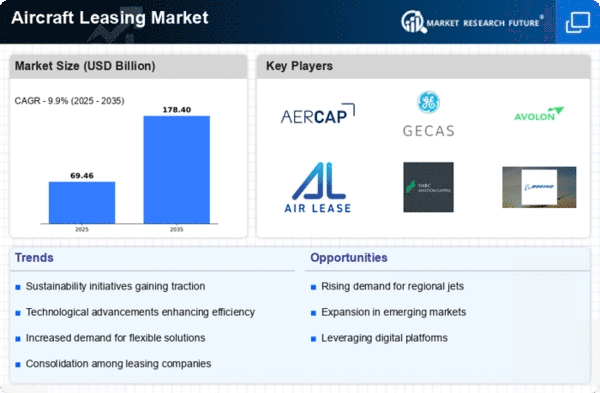
As per MRFR analysis, the Aircraft Leasing Market Size was estimated at 63.2 USD Billion in 2024. The Aircraft Leasing industry is projected to grow from 69.4 USD Billion in 2025 to 178.4 USD Billion by 2035, exhibiting a compound annual growth rate (CAGR) of 9.9 during the forecast period 2025 - 2035.

Key Market Trends & Highlights

The Aircraft Leasing Market is poised for growth driven by sustainability and technological advancements.

  • Sustainability initiatives are increasingly shaping the aircraft leasing landscape, particularly in North America.
  • Technological integration is enhancing operational efficiencies, especially within the narrow body segment, which remains the largest.
  • Flexible financing solutions are gaining traction, with operating leases dominating the market while finance leases are emerging rapidly.
  • The increasing demand for air travel and regulatory support for environmental standards are key drivers propelling market expansion.

Market Size & Forecast

2024 Market Size 63.2 (USD Billion)
2035 Market Size 178.4 (USD Billion)
CAGR (2025 - 2035) 9.9%
Largest Regional Market Share in 2024 North America

Major Players

<p>AerCap (IE), GECAS (US), Avolon (IE), Air Lease Corporation (US), SMBC Aviation Capital (IE), Boeing Capital Corporation (US), Nordic Aviation Capital (DK), Macquarie AirFinance (AU), CIT Aerospace (US)</p>

Market Trends

The Aircraft Leasing Market is currently experiencing a dynamic evolution, driven by various factors that shape its landscape. The demand for air travel continues to rise, prompting airlines to seek flexible financing options to expand their fleets without the burden of outright purchases. This trend appears to be fueled by the increasing need for operational efficiency and cost management, as airlines navigate fluctuating fuel prices and changing consumer preferences. Furthermore, the market is witnessing a shift towards more environmentally friendly aircraft, as operators aim to reduce their carbon footprints and comply with stringent regulations. This transition may lead to a greater emphasis on leasing newer, more efficient models that align with sustainability goals. In addition, the Aircraft Leasing Market is likely to see a surge in technological advancements, particularly in digital platforms that facilitate leasing transactions. These innovations could streamline processes, enhance transparency, and improve overall customer experience. As the market adapts to these changes, it seems poised for growth, with lessors and airlines alike exploring new strategies to remain competitive. The interplay between economic conditions, regulatory frameworks, and technological developments will continue to shape the future of this sector, making it a focal point for stakeholders in the aviation industry.

Sustainability Initiatives

The Aircraft Leasing Market is increasingly influenced by sustainability initiatives, as airlines prioritize eco-friendly operations. This trend may lead to a higher demand for leasing modern, fuel-efficient aircraft that meet environmental standards.

Technological Integration

Technological integration is transforming the Aircraft Leasing Market, with digital platforms enhancing transaction efficiency. This shift could improve transparency and streamline processes, benefiting both lessors and lessees.

Flexible Financing Solutions

Flexible financing solutions are becoming more prevalent in the Aircraft Leasing Market, as airlines seek to manage costs effectively. This trend suggests a growing preference for leasing arrangements that offer adaptability in fleet management.

Aircraft Leasing Market Market Drivers

Market Growth Projections

The Global Aircraft Leasing Industry is poised for substantial growth, with projections indicating a market size of 395.5 USD Billion by 2035. This anticipated growth reflects the increasing reliance on leased aircraft among airlines as they navigate a dynamic aviation landscape. Factors such as rising air travel demand, cost efficiency, and technological advancements are expected to drive this expansion. The market's trajectory suggests a robust future, with leasing becoming an integral part of airlines' operational strategies as they adapt to changing consumer preferences and economic conditions.

Cost Efficiency of Leasing

Cost efficiency remains a pivotal driver within the Global Aircraft Leasing Industry. Leasing aircraft allows airlines to maintain operational flexibility while minimizing financial risk. By avoiding large capital expenditures, airlines can allocate resources more effectively, investing in other critical areas such as technology and customer service. This financial strategy is particularly appealing in a competitive landscape where operational costs are scrutinized. The ability to lease newer, more fuel-efficient aircraft also contributes to lower operational costs, enhancing profitability and sustainability for airlines, thereby fostering growth in the leasing sector.

Rising Demand for Air Travel

The Global Aircraft Leasing Industry is experiencing a notable surge in demand for air travel, driven by increasing disposable incomes and a growing middle class in emerging economies. As more individuals and businesses seek air travel options, airlines are expanding their fleets to accommodate this demand. This trend is reflected in the projected market size, which is expected to reach 116.4 USD Billion in 2024. The leasing model allows airlines to acquire new aircraft without the substantial capital outlay associated with purchasing, thus enabling them to respond swiftly to market demands.

Regulatory Support and Incentives

Regulatory support and incentives play a crucial role in shaping the Global Aircraft Leasing Industry. Governments worldwide are increasingly recognizing the importance of aviation in driving economic growth and are implementing policies that favor aircraft leasing. These may include tax incentives, streamlined approval processes, and support for environmentally friendly aircraft. Such initiatives not only encourage airlines to lease rather than purchase but also promote the adoption of newer, more efficient aircraft. This supportive regulatory environment is likely to enhance the attractiveness of leasing, further propelling market growth.

Global Expansion of Low-Cost Carriers

The global expansion of low-cost carriers (LCCs) is a significant driver of the Global Aircraft Leasing Industry. LCCs are rapidly increasing their market share by offering affordable air travel options, which necessitates a flexible and efficient fleet management strategy. Leasing allows these carriers to scale their operations quickly without the burden of large capital investments. As LCCs continue to proliferate, the demand for leased aircraft is expected to rise, contributing to the overall market growth. This trend is indicative of a broader shift in consumer preferences towards cost-effective travel solutions.

Technological Advancements in Aircraft

Technological advancements in aircraft design and manufacturing are significantly influencing the Global Aircraft Leasing Industry. Innovations such as improved fuel efficiency, enhanced safety features, and advanced avionics systems are making newer aircraft more attractive to airlines. Leasing companies are increasingly investing in modern fleets to meet the evolving demands of airlines seeking to optimize operational efficiency. As a result, the market is projected to grow at a compound annual growth rate of 11.76% from 2025 to 2035, indicating a robust future for aircraft leasing as airlines prioritize modern, technologically advanced aircraft.

Market Segment Insights

By Aircraft Type: Narrow Body (Largest) vs. Wide Body (Fastest-Growing)

<p>The Aircraft Leasing Market segment is primarily dominated by Narrow Body aircraft, which hold a substantial market share due to their widespread usage in regional and domestic air travel. This category has been preferred by airlines for its fuel efficiency and capacity to serve a range of routes effectively. In contrast, the Wide Body segment is witnessing rapid growth as airlines expand their long-haul routes and adapt to increasing passenger demand for international travel, leading to a remarkable shift in leasing preferences that favor larger aircraft. In recent years, the demand for air travel has surged, particularly in emerging markets, pushing the need for both Narrow Body and Wide Body aircraft. Factors such as the recovery of airline operations post-pandemic, the rise of low-cost carriers, and the increasing focus on sustainability and operational efficiency have driven airlines to invest in modern fleets. Additionally, the Freighter segment is gaining traction due to the e-commerce boom, while Regional and Business Jets continue to cater to niche markets with specific operational needs.</p>

<p>Narrow Body (Dominant) vs. Business Jet (Emerging)</p>

<p>Narrow Body aircraft remain the dominant players in the Aircraft Leasing Market due to their versatility and operational efficiency. They are ideal for short to medium-haul routes, making them highly favored among low-cost airlines and full-service carriers alike. Narrow Body aircraft are cost-effective, allow for greater frequency of flights, and have a significant impact on revenue generation for many airlines. On the other hand, Business Jets represent an emerging segment characterized by tailored leasing options for private and corporate travel. Their appeal lies in the growing demand for convenience, time-saving travel, and personalized service. The Business Jet market is increasingly attracting interest from affluent individuals and corporations, indicating a shift towards greater investment in this segment.</p>

By Lease Type: Operating Lease (Largest) vs. Finance Lease (Fastest-Growing)

<p>In the Aircraft Leasing Market, the distribution among lease types reveals that Operating Leases dominate the segment, accounting for a significant portion of total leases. This popularity stems from the flexibility and lower upfront costs associated with operating leases, making them attractive for many airlines looking to optimize their fleet without extensive capital investment. Conversely, the Finance Lease segment is gaining traction, appealing to companies with long-term aircraft requirements, which reflects a strategic shift in asset management and capital allocation among airlines. Recent trends indicate that the Finance Lease has become the fastest-growing segment within the market, driven by the increasing need for airlines to manage cash flow effectively while still acquiring necessary aircraft. Additionally, the rise of e-commerce and international travel has led to higher demand for both types of leases, as airlines seek to expand their fleets to meet this growing demand. These dynamics suggest a changing landscape in aircraft finance, with both segments carving out specific niche markets to serve unique airline needs.</p>

<p>Operating Lease (Dominant) vs. Wet Lease (Emerging)</p>

<p>The Operating Lease segment remains the dominant force in the Aircraft Leasing Market, offering airlines flexible terms and lower financial risk. This type of lease allows airlines to utilize aircraft without assuming ownership, presenting a smart choice for those needing adaptability in their operations. On the other hand, the Wet Lease segment is emerging as a viable option for airlines looking to quickly augment their fleet for short-term routes or seasonal demand surges. Wet leases include aircraft, crew, maintenance, and insurance, which provide airlines with rapid solutions in fluctuating markets. The growing trend of unpredicted demand variations in air travel has made wet leasing increasingly appealing, as airlines strive to maintain operational efficiency while minimizing investment.</p>

By End User: Commercial Airlines (Largest) vs. Cargo Operators (Fastest-Growing)

<p>In the Aircraft Leasing Market, the end user segment is primarily dominated by commercial airlines, which command the largest share due to a high demand for both passenger travel and competitive pricing among airlines. Cargo operators, while smaller in market share compared to commercial airlines, are experiencing rapid growth as e-commerce continues to expand and the demand for air freight services rises, enabling their remarkable advancement within the market.</p>

<p>Commercial Airlines: Dominant vs. Cargo Operators: Emerging</p>

<p>Commercial airlines represent a dominant force within the Aircraft Leasing Market, characterized by their extensive fleets and strong operational capacity. These airlines prioritize leasing to optimize fleet flexibility and reduce upfront costs. In contrast, cargo operators, positioned as an emerging segment, are adapting rapidly to shifts in global logistics and increased demand for air freight services. They are investing in specialized aircraft types optimized for cargo operations, underscoring their responsiveness to evolving market needs. This divergence illustrates how commercial airlines leverage economies of scale, whereas cargo operators capitalize on niche opportunities to enhance their operational efficiencies.</p>

By Lease Duration: Long Term (Largest) vs. Short Term (Fastest-Growing)

<p>In the Aircraft Leasing Market, lease durations are categorized into short term, medium term, and long term. The long-term lease segment has emerged as the largest segment, capturing a substantial share of the market. This stability and consistent demand for long-term leasing solutions stem from airlines seeking to establish cost certainty and optimize asset management. Conversely, the short-term lease segment is rapidly gaining traction, fueled by the increasing demand for flexibility and quick turnaround times for airlines responding to fluctuating travel patterns.</p>

<p>Long Term: Established (Dominant) vs. Short Term: Flexible (Emerging)</p>

<p>Long-term leases are typically favored by airlines looking for stability, allowing them to plan their fleet usage over extended periods without the immediate pressure of asset turnover. This segment benefits from favorable contracts that offer security against market shifts. In contrast, short-term leases appeal to operators needing flexible arrangements, such as seasonal airlines or new startups that require aircraft without long-term commitments. This segment attracts carriers that aim to quickly adapt to market dynamics, making it the fastest-growing area within the leasing framework.</p>

By Market Dynamics: New Aircraft Leasing (Largest) vs. Sale and Leaseback (Fastest-Growing)

<p>The Aircraft Leasing Market is characterized by three primary segments: New Aircraft Leasing, Used Aircraft Leasing, and Sale and Leaseback transactions. Among these, New Aircraft Leasing holds the largest market share due to its appeal for airlines looking to enhance operational efficiency with the latest aircraft technology. Meanwhile, Used Aircraft Leasing continues to remain relevant, particularly among budget airlines seeking cost-effective solutions. Sale and Leaseback transactions have gained traction, primarily driven by airlines looking to free up capital while retaining operational control over their aircraft.</p>

<p>New Aircraft Leasing (Dominant) vs. Sale and Leaseback (Emerging)</p>

<p>New Aircraft Leasing is the dominant segment, largely favored for its ability to provide airlines with the latest features and fuel efficiency in aircraft, ensuring competitive edges in the market. This segment is characterized by long-term commitments from airlines, which often prefer acquiring modern fleets to meet growing demands and regulatory standards. On the other hand, Sale and Leaseback transactions are emerging as a favored strategy among airlines to optimize balance sheets. By selling their aircraft to leasing companies and leasing them back, airlines can liquidate assets while maintaining operational flexibility. This trend indicates a shift towards more innovative financing methods, allowing airlines to adapt quickly to market fluctuations.</p>

Get more detailed insights about Aircraft Leasing Market Research Report Information - Global Forecast to 2032

Regional Insights

North America : Leading Global Market

North America continues to lead the aircraft leasing market, holding a significant share of 32.0% as of December 2025. The region's growth is driven by a robust demand for air travel, supported by increasing passenger numbers and cargo transport needs. Regulatory frameworks favoring leasing arrangements and tax incentives further catalyze market expansion. The presence of major airlines and a well-established aviation infrastructure also contribute to this growth.

Europe : Strong Regulatory Framework

Europe's aircraft leasing market, valued at 18.0%, is characterized by a strong regulatory framework that encourages leasing as a viable financing option. The region benefits from a growing demand for modern aircraft, driven by sustainability initiatives and the need for fleet modernization. European countries are increasingly adopting policies that support the leasing model, enhancing market attractiveness for investors and operators alike.

Asia-Pacific : Emerging Market Potential

The Asia-Pacific region, with a market size of 10.0%, is witnessing rapid growth in the aircraft leasing sector. This growth is fueled by rising air travel demand, particularly in emerging economies like China and India. The region's increasing focus on expanding aviation infrastructure and enhancing connectivity is driving the need for leased aircraft, making it a key player in the global market.

Middle East and Africa : Untapped Market Opportunities

The Middle East and Africa, with a market size of 3.2%, present untapped opportunities in the aircraft leasing market. The region is experiencing a gradual increase in air travel demand, driven by tourism and business travel. However, challenges such as regulatory hurdles and limited financing options hinder faster growth. Key players are beginning to explore this market, recognizing its potential for future expansion.

Key Players and Competitive Insights

The Aircraft Leasing Market is currently characterized by a dynamic competitive landscape, driven by factors such as increasing air travel demand, fleet modernization, and the need for flexible financing solutions. Major players like AerCap (IE), GECAS (US), and Avolon (IE) are strategically positioned to leverage these growth drivers. AerCap (IE) has focused on expanding its portfolio through strategic acquisitions, while GECAS (US) emphasizes partnerships with airlines to enhance service offerings. Avolon (IE) appears to be concentrating on sustainability initiatives, aligning its fleet with emerging environmental regulations. Collectively, these strategies contribute to a competitive environment that is increasingly shaped by innovation and adaptability.

In terms of business tactics, companies are localizing operations and optimizing supply chains to enhance efficiency. The market structure is moderately fragmented, with a mix of large and mid-sized players. This fragmentation allows for diverse service offerings, yet the influence of key players remains substantial, as they set benchmarks for operational excellence and customer service.

In November 2025, AerCap (IE) announced a significant partnership with a leading airline to provide a fleet of next-generation aircraft, which underscores its commitment to modernization and customer-centric solutions. This strategic move not only enhances AerCap's market position but also reflects a broader trend towards fleet upgrades in response to evolving consumer preferences.

In October 2025, GECAS (US) completed a major transaction involving the leasing of several aircraft to a prominent low-cost carrier. This action illustrates GECAS's strategy of catering to the growing demand for cost-effective travel options, thereby solidifying its role as a key player in the budget airline segment. Such transactions are indicative of the shifting dynamics within the market, where affordability and accessibility are paramount.

In September 2025, Avolon (IE) launched a new sustainability initiative aimed at reducing carbon emissions across its fleet. This initiative not only aligns with global environmental goals but also positions Avolon as a leader in sustainable aviation practices. The emphasis on sustainability is becoming increasingly critical, as stakeholders demand greater accountability from industry players.

As of December 2025, the Aircraft Leasing Market is witnessing trends such as digitalization, sustainability, and the integration of AI technologies. Strategic alliances are becoming more prevalent, as companies seek to enhance their competitive edge through collaborative efforts. The competitive differentiation is likely to evolve from traditional price-based competition to a focus on innovation, technological advancements, and supply chain reliability. This shift suggests that companies that prioritize these aspects will be better positioned to thrive in an increasingly complex market.

Key Companies in the Aircraft Leasing Market market include

Industry Developments

On March 8, 2024, AerCap Holdings confirmed the acquisition of 50 Airbus A321neo airplanes. Such a decision finds reason in the increasing number of air carriers which the world’s airlines intend to change their fleet into more fuel-efficient ones.

In February of 2024, Avolon entered a multi-year lease deal with Indog, one of the India’s largest airlines for 20 Boeing 737 MAX planes. This agreement is relevant for the growth strategy of IndiGo and the growing requirement of air transport services in Asia Pacific region.

In January 2024, the Air Lease Corporation (ALC) has introduced a green leasing scheme with the type of innovation that benefits the airline even more. The scheme includes offering lower lease rates for leased aircraft that have a less carbon footprint.

Competitive Landscape

Future Outlook

Aircraft Leasing Market Future Outlook

<p>The Aircraft Leasing Market is projected to grow at a 9.9% CAGR from 2024 to 2035, driven by increasing air travel demand, fleet modernization, and sustainability initiatives.</p>

New opportunities lie in:

  • <p>Expansion of digital leasing platforms for enhanced customer engagement.</p>
  • <p>Development of green aircraft leasing options to meet sustainability goals.</p>
  • <p>Strategic partnerships with airlines for tailored leasing solutions.</p>

<p>By 2035, the Aircraft Leasing Market is expected to be robust, reflecting strong growth and innovation.</p>

Market Segmentation

Aircraft Leasing Market End User Outlook

  • Commercial Airlines
  • Cargo Operators
  • Charter Services
  • Government Agencies

Aircraft Leasing Market Lease Type Outlook

  • Operating Lease
  • Finance Lease
  • Wet Lease
  • Dry Lease

Aircraft Leasing Market Aircraft Type Outlook

  • Narrow Body
  • Wide Body
  • Regional
  • Freighter
  • Business Jet

Aircraft Leasing Market Lease Duration Outlook

  • Short Term
  • Medium Term
  • Long Term

Aircraft Leasing Market Market Dynamics Outlook

  • New Aircraft Leasing
  • Used Aircraft Leasing
  • Sale and Leaseback

Report Scope

MARKET SIZE 202463.2(USD Billion)
MARKET SIZE 202569.4(USD Billion)
MARKET SIZE 2035178.4(USD Billion)
COMPOUND ANNUAL GROWTH RATE (CAGR)9.9% (2024 - 2035)
REPORT COVERAGERevenue Forecast, Competitive Landscape, Growth Factors, and Trends
BASE YEAR2024
Market Forecast Period2025 - 2035
Historical Data2019 - 2024
Market Forecast UnitsUSD Billion
Key Companies ProfiledAerCap (IE), GECAS (US), Avolon (IE), Air Lease Corporation (US), SMBC Aviation Capital (IE), Boeing Capital Corporation (US), Nordic Aviation Capital (DK), Macquarie AirFinance (AU), CIT Aerospace (US)
Segments CoveredAircraft Type, Lease Type, End User, Lease Duration, Market Dynamics
Key Market OpportunitiesAdoption of sustainable aviation fuels enhances growth potential in the Aircraft Leasing Market.
Key Market DynamicsRising demand for fuel-efficient aircraft drives competitive leasing strategies and technological advancements in the aircraft leasing market.
Countries CoveredNorth America, Europe, APAC, South America, MEA

FAQs

How Much is the Aircraft Leasing Market Worth in 2032?

Aircraft Leasing Market to reach USD 312.2 billion by 2032.

How Large is the Aircraft Leasing Market?

Global Aircraft Leasing Market is estimated to grow at approximately 8.20% CAGR from 2024-2032

What is Aircraft Leasing?

Aircraft leasing is a technique where the airline companies procure the aircraft on lease from leasing airline companies and other aircraft operators.

What are the types of Aircraft leasing?

Aircraft leasing is mainly of two types—wet leasing and dry leasing. However, wet-leasing aircraft are procured for a shorter period, whereas dry leasing is used for a more extended leasing period.

What are the Key Companies of Aircraft Leasing?

The Key Players in the Global Aircraft Leasing Market are AerCap, Air Lease, BOC Aviation, GECAS, BBAM LLC, CIT Commercial Air, Aviation Capital Group, Boeing Capital, SAAB Aircraft Leasing and International Lease Finance Corporation.

  1. Executive Summary
    1. Aircraft Leasing Industry Attractiveness Analysis
      1. Global Aircraft Leasing Aircraft Leasing Industry , By Leasing Type
      2. Global Aircraft Leasing Aircraft Leasing Industry , By Aircraft Type
      3. Global Aircraft Leasing Aircraft Leasing Industry , By Security Type
      4. Global Aircraft Leasing Aircraft Leasing Industry , By Region
  2. Aircraft Leasing Industry Introduction
    1. Aircraft Leasing Industry Definition
    2. Scope Of the Study
    3. Aircraft Leasing Industry Structure
    4. Key Buying Criteria
    5. Aircraft Leasing Industry Factor Indicator Analysis
  3. Research Methodology
    1. Research Process
    2. Primary Research
    3. Secondary Research
    4. Aircraft Leasing Industry Size Estimation
    5. Forecast Model
    6. List Of Assumptions
  4. Aircraft Leasing Industry Insights
  5. Aircraft Leasing Industry Dynamics
    1. Introduction
    2. Drivers
    3. Restraints
    4. Opportunities
    5. Aircraft Leasing Industry /Technological Trends
    6. Patent Trends
    7. Regulatory Landscape/Standards
  6. Aircraft Leasing Industry Factor Analysis
    1. Value Chain/Supply Chain Analysis
      1. R&D
      2. Manufacturing
      3. Distribution & Sales
      4. Post-Sales Monitoring
    2. Porter’s Five Forces Analysis
      1. Threat Of New Entrants
      2. Bargaining Power Of Buyers
      3. Threat Of Substitutes
      4. Segment Rivalry
      5. Bargaining Power Of Supplies
  7. Global Aircraft Leasing Aircraft Leasing Industry , By Leasing Type
    1. Introduction
    2. Wet Leasing
      1. Aircraft
      2. Crew
      3. Maintenance
      4. Insurance
    3. Dry Leasing
      1. Aircraft Leasing Industry Estimates & Forecast, 2020-2030
      2. Aircraft Leasing Industry Estimates & Forecast, By Region, 2020-2030
  8. Global Aircraft Leasing Aircraft Leasing Industry , By Aircraft Type
    1. Introduction
    2. Narrow-Body
      1. Aircraft Leasing Industry Estimates & Forecast, 2020-2030
      2. Aircraft Leasing Industry Estimates & Forecast, By Region, 2020-2030
    3. Wide-Body
      1. Aircraft Leasing Industry Estimates & Forecast, 2020-2030
      2. Aircraft Leasing Industry Estimates & Forecast, By Region, 2020-2030
    4. Others
      1. Aircraft Leasing Industry Estimates & Forecast, 2020-2030
      2. Aircraft Leasing Industry Estimates & Forecast, By Region, 2020-2030
  9. Global Aircraft Leasing Aircraft Leasing Industry , By Security Type
    1. Introduction
    2. Asset-Backed Security (ABS)
      1. Aircraft Leasing Industry Estimates & Forecast, 2020-2030
      2. Aircraft Leasing Industry Estimates & Forecast, By Region, 2020-2030
    3. Non ABS
      1. Aircraft Leasing Industry Estimates & Forecast, 2020-2030
      2. Aircraft Leasing Industry Estimates & Forecast, By Region, 2020-2030
  10. Global Aircraft Leasing Aircraft Leasing Industry , By Region
    1. Introduction
    2. North America
      1. Aircraft Leasing Industry Estimates & Forecast, By Country, 2020-2030
      2. Aircraft Leasing Industry Estimates & Forecast, By Leasing Type, 2020-2030
      3. Aircraft Leasing Industry Estimates & Forecast, By Aircraft Type, 2020-2030
      4. Aircraft Leasing Industry Estimates & Forecast, By Security Type, 2020-2030
      5. US
      6. Canada
    3. Europe
      1. Aircraft Leasing Industry Estimates & Forecast, By Country, 2020-2030
      2. Aircraft Leasing Industry Estimates & Forecast, By Leasing Type, 2020-2030
      3. Aircraft Leasing Industry Estimates & Forecast, By Aircraft Type, 2020-2030
      4. Aircraft Leasing Industry Estimates & Forecast, By Security Type, 2020-2030
      5. UK
      6. Germany
      7. France
      8. Italy
      9. Rest Of Europe
    4. Asia-Pacific
      1. Aircraft Leasing Industry Estimates & Forecast, By Country, 2020-2030
      2. Aircraft Leasing Industry Estimates & Forecast, By Leasing Type, 2020-2030
      3. Aircraft Leasing Industry Estimates & Forecast, By Aircraft Type, 2020-2030
      4. Aircraft Leasing Industry Estimates & Forecast, By Security Type, 2020-2030
      5. China
      6. Japan
      7. India
      8. Australia
      9. Rest Of Asia-Pacific
    5. Middle East & Africa
      1. Aircraft Leasing Industry Estimates & Forecast, By Country, 2020-2030
      2. Aircraft Leasing Industry Estimates & Forecast, By Leasing Type, 2020-2030
      3. Aircraft Leasing Industry Estimates & Forecast, By Aircraft Type, 2020-2030
      4. Aircraft Leasing Industry Estimates & Forecast, By Security Type, 2020-2030
      5. Saudi Arabia
      6. UAE
      7. Rest Of Middle East & Africa
    6. Latin America
      1. Aircraft Leasing Industry Estimates & Forecast, By Country, 2020-2030
      2. Aircraft Leasing Industry Estimates & Forecast, By Leasing Type, 2020-2030
      3. Aircraft Leasing Industry Estimates & Forecast, By Aircraft Type, 2020-2030
      4. Aircraft Leasing Industry Estimates & Forecast, By Security Type, 2020-2030
      5. Brazil
      6. Rest Of Latin America
  11. Competitive Landscape
    1. Competitive Overview
    2. Competitor Dashboard
    3. Major Growth Strategy In The Global Aircraft Leasing Aircraft Leasing Industry
    4. Competitive Benchmarking
    5. Aircraft Leasing Industry Share Analysis
    6. Leading Player In Terms Of Number Of Developments In Global Aircraft Leasing Aircraft Leasing Industry
    7. Key Developments & Growth Strategies
      1. New Product Launch/Service Deployment
      2. Merger & Acquisition
      3. Joint Ventures
  12. Company Profiles
    1. AerCap
      1. Company Overview
      2. Financial Overview
      3. Product Offerings
      4. Key Developments
      5. SWOT Analysis
      6. Key Strategy
    2. Air Lease Corporation
      1. Company Overview
      2. Financial Overview
      3. Product Offerings
      4. Key Developments
      5. SWOT Analysis
      6. Key Strategy
    3. BOC Aviation
      1. Company Overview
      2. Financial Overview
      3. Product Offerings
      4. Key Developments
      5. SWOT Analysis
      6. Key Strategy
    4. GECAS
      1. Company Overview
      2. Financial Overview
      3. Product Offerings
      4. Key Developments
      5. SWOT Analysis
      6. Key Strategy
    5. BBAM LLC
      1. Company Overview
      2. Financial Overview
      3. Product Offerings
      4. Key Developments
      5. SWOT Analysis
      6. Key Strategy
    6. CIT Commercial Air
      1. Company Overview
      2. Financial Overview
      3. Product Offerings
      4. Key Developments
      5. SWOT Analysis
      6. Key Strategy
    7. Aviation Capital Group
      1. Company Overview
      2. Financial Overview
      3. Product Offerings
      4. Key Developments
      5. SWOT Analysis
      6. Key Strategy
    8. Boeing Capital Corporation
      1. Company Overview
      2. Financial Overview
      3. Product Offerings
      4. Key Developments
      5. SWOT Analysis
      6. Key Strategy
    9. SAAB Aircraft Leasing
      1. Company Overview
      2. Financial Overview
      3. Product Offerings
      4. Key Developments
      5. SWOT Analysis
      6. Key Strategy
    10. International Lease Finance Corporation
      1. Company Overview
      2. Financial Overview
      3. Product Offerings
      4. Key Developments
      5. SWOT Analysis
      6. Key Strategy
  13. Appendix
    1. References
    2. Related Reports
    3. List Of Abbreviation
  14. List Of Tables
  15. List Of Assumptions
  16. Major Patents Granted For Directed Energy Weapon (15 May 2010–15 May 2019)
  17. Leasing Type: Global Aircraft Leasing Aircraft Leasing Industry , 2020-2030(USD Million)
  18. Aircraft Type: Global Aircraft Leasing Aircraft Leasing Industry , 2020-2030(USD Million)
  19. Security Type: Global Aircraft Leasing Aircraft Leasing Industry , 2020-2030(USD Million)
  20. Global Aircraft Leasing Aircraft Leasing Industry , By Region, 2020-2030(USD Million)
  21. North America: Aircraft Leasing Aircraft Leasing Industry , By Country, 2020-2030(USD Million)
  22. North America: Aircraft Leasing Aircraft Leasing Industry , By Leasing Type, 2020-2030(USD Million)
  23. North America: Aircraft Leasing Aircraft Leasing Industry , By Aircraft Type, 2020-2030(USD Million)
  24. North America: Aircraft Leasing Aircraft Leasing Industry , By Security Type, 2020-2030(USD Million)
  25. US: Aircraft Leasing Aircraft Leasing Industry , By Leasing Type, 2020-2030(USD Million)
  26. US: Aircraft Leasing Aircraft Leasing Industry , By Aircraft Type, 2020-2030(USD Million)
  27. US: Aircraft Leasing Aircraft Leasing Industry , By Security Type, 2020-2030(USD Million)
  28. Canada: Aircraft Leasing Aircraft Leasing Industry , By Leasing Type, 2020-2030(USD Million)
  29. Canada: Aircraft Leasing Aircraft Leasing Industry , By Aircraft Type, 2020-2030(USD Million)
  30. Canada: Aircraft Leasing Aircraft Leasing Industry , By Security Type, 2020-2030(USD Million)
  31. Europe: Aircraft Leasing Aircraft Leasing Industry , By Country, 2020-2030(USD Million)
  32. Europe: Aircraft Leasing Aircraft Leasing Industry , By Leasing Type, 2020-2030(USD Million)
  33. Europe: Aircraft Leasing Aircraft Leasing Industry , By Aircraft Type, 2020-2030(USD Million)
  34. Europe: Aircraft Leasing Aircraft Leasing Industry , By Security Type, 2020-2030(USD Million)
  35. UK: Aircraft Leasing Aircraft Leasing Industry , By Leasing Type, 2020-2030(USD Million)
  36. UK: Aircraft Leasing Aircraft Leasing Industry , By AIRCRAFT Type, 2020-2030(USD Million)
  37. UK: Aircraft Leasing Aircraft Leasing Industry , By Security Type, 2020-2030(USD Million)
  38. Germany: Aircraft Leasing Aircraft Leasing Industry , By Leasing Type, 2020-2030(USD Million)
  39. Germany: Aircraft Leasing Aircraft Leasing Industry , By Aircraft Type, 2020-2030(USD Million)
  40. Germany: Aircraft Leasing Aircraft Leasing Industry , By Security Type, 2020-2030(USD Million)
  41. France: Aircraft Leasing Aircraft Leasing Industry , By Leasing Type, 2020-2030(USD Million)
  42. France: Aircraft Leasing Aircraft Leasing Industry , By Aircraft Type, 2020-2030(USD Million)
  43. France: Aircraft Leasing Aircraft Leasing Industry , By Security Type, 2020-2030(USD Million)
  44. Italy: Aircraft Leasing Aircraft Leasing Industry , By Leasing Type, 2020-2030(USD Million)
  45. Italy: Aircraft Leasing Aircraft Leasing Industry , By Aircraft Type, 2020-2030(USD Million)
  46. Italy: Aircraft Leasing Aircraft Leasing Industry , By Security Type, 2020-2030(USD Million)
  47. Rest Of Europe: Aircraft Leasing Aircraft Leasing Industry , By Leasing Type, 2020-2030(USD Million)
  48. Rest Of Europe: Aircraft Leasing Aircraft Leasing Industry , By Aircraft Type, 2020-2030(USD Million)
  49. Rest Of Europe: Aircraft Leasing Aircraft Leasing Industry , By Security Type, 2020-2030(USD Million)
  50. Asia-Pacific: Aircraft Leasing Aircraft Leasing Industry , By Country, 2020-2030(USD Million)
  51. Asia-Pacific: Aircraft Leasing Aircraft Leasing Industry , By Leasing Type, 2020-2030(USD Million)
  52. Asia-Pacific: Aircraft Leasing Aircraft Leasing Industry , By Aircraft Type, 2020-2030(USD Million)
  53. Asia-Pacific: Aircraft Leasing Aircraft Leasing Industry , By Security Type, 2020-2030(USD Million)
  54. China: Aircraft Leasing Aircraft Leasing Industry , By Leasing Type, 2020-2030(USD Million)
  55. China: Aircraft Leasing Aircraft Leasing Industry , By Aircraft Type, 2020-2030(USD Million)
  56. China: Aircraft Leasing Aircraft Leasing Industry , By Security Type, 2020-2030(USD Million)
  57. India: Aircraft Leasing Aircraft Leasing Industry , By Leasing Type, 2020-2030(USD Million)
  58. India: Aircraft Leasing Aircraft Leasing Industry , By Aircraft Type, 2020-2030(USD Million)
  59. India: Aircraft Leasing Aircraft Leasing Industry , By Security Type, 2020-2030(USD Million)
  60. Japan: Aircraft Leasing Aircraft Leasing Industry , By Leasing Type, 2020-2030(USD Million)
  61. Japan: Aircraft Leasing Aircraft Leasing Industry , By Aircraft Type, 2020-2030(USD Million)
  62. Japan: Aircraft Leasing Aircraft Leasing Industry , By Security Type, 2020-2030(USD Million)
  63. Australia: Aircraft Leasing Aircraft Leasing Industry , By Leasing Type, 2020-2030(USD Million)
  64. Australia: Aircraft Leasing Aircraft Leasing Industry , By Aircraft Type, 2020-2030(USD Million)
  65. Australia: Aircraft Leasing Aircraft Leasing Industry , By Security Type, 2020-2030(USD Million)
  66. Rest Of Asia-Pacific: Aircraft Leasing Aircraft Leasing Industry , By Leasing Type, 2020-2030(USD Million)
  67. Rest Of Asia-Pacific: Aircraft Leasing Aircraft Leasing Industry , By Aircraft Type, 2020-2030(USD Million)
  68. Rest Of Asia-Pacific: Aircraft Leasing Aircraft Leasing Industry , By Security Type, 2020-2030(USD Million)
  69. Middle East & Africa: Aircraft Leasing Aircraft Leasing Industry , By Country, 2020-2030(USD Million)
  70. Middle East & Africa: Aircraft Leasing Aircraft Leasing Industry , By Leasing Type, 2020-2030(USD Million)
  71. Middle East & Africa: Aircraft Leasing Aircraft Leasing Industry , By Aircraft Type, 2020-2030(USD Million)
  72. Middle East & Africa: Aircraft Leasing Aircraft Leasing Industry , By Security Type, 2020-2030(USD Million)
  73. Saudi Arabia: Aircraft Leasing Aircraft Leasing Industry , By Leasing Type, 2020-2030(USD Million)
  74. Saudi Arabia: Aircraft Leasing Aircraft Leasing Industry , By Aircraft Type, 2020-2030(USD Million)
  75. Saudi Arabia: Aircraft Leasing Aircraft Leasing Industry , By Security Type, 2020-2030(USD Million)
  76. UAE: Aircraft Leasing Aircraft Leasing Industry , By Leasing Type, 2020-2030(USD Million)
  77. UAE: Aircraft Leasing Aircraft Leasing Industry , By Aircraft Type, 2020-2030(USD Million)
  78. UAE: Aircraft Leasing Aircraft Leasing Industry , By Security Type, 2020-2030(USD Million)
  79. Rest Of The Middle East & Africa: Aircraft Leasing Aircraft Leasing Industry , By Leasing Type, 2020-2030(USD Million)
  80. Rest Of The Middle East & Africa: Aircraft Leasing Aircraft Leasing Industry , By Aircraft Type, 2020-2030(USD Million)
  81. Rest Of The Middle East & Africa: Aircraft Leasing Aircraft Leasing Industry , By Security Type, 2020-2030(USD Million)
  82. Latin America: Aircraft Leasing Aircraft Leasing Industry , By Country, 2020-2030(USD Million)
  83. Latin America: Aircraft Leasing Aircraft Leasing Industry , By Leasing Type, 2020-2030(USD Million)
  84. Latin America: Aircraft Leasing Aircraft Leasing Industry , By Aircraft Type, 2020-2030(USD Million)
  85. Latin America: Aircraft Leasing Aircraft Leasing Industry , By Security Type, 2020-2030(USD Million)
  86. Brazil: Aircraft Leasing Aircraft Leasing Industry , By Leasing Type, 2020-2030(USD Million)
  87. Brazil: Aircraft Leasing Aircraft Leasing Industry , By Aircraft Type, 2020-2030(USD Million)
  88. Brazil: Aircraft Leasing Aircraft Leasing Industry , By Security Type, 2020-2030(USD Million)
  89. Rest Of Latin America: Aircraft Leasing Aircraft Leasing Industry , By Leasing Type, 2020-2030(USD Million)
  90. Rest Of Latin America: Aircraft Leasing Aircraft Leasing Industry , By Aircraft Type, 2020-2030(USD Million)
  91. Rest Of Latin America: Aircraft Leasing Aircraft Leasing Industry , By Security Type, 2020-2030(USD Million)
  92. The Most Active Players In The Global Aircraft Leasing Aircraft Leasing Industry
  93. Contracts And Agreements
  94. Mergers & Acquisitions
  95. Product Development
  96. Expansions And Investments
  97. Joint Ventures & Partnerships
  98. List Of Figures
  99. Aircraft Leasing Industry Synopsis
  100. Global Aircraft Leasing Aircraft Leasing Industry : Aircraft Leasing Industry Attractiveness Analysis
  101. Global Aircraft Leasing Aircraft Leasing Industry Analysis, By Leasing Type
  102. Global Aircraft Leasing Aircraft Leasing Industry Analysis, By Component
  103. Global Aircraft Leasing Aircraft Leasing Industry Analysis, By Security Type
  104. Global Aircraft Leasing Aircraft Leasing Industry Analysis, By Region
  105. Global Aircraft Leasing Aircraft Leasing Industry : Aircraft Leasing Industry Structure
  106. Key Buying Criteria For Directed Energy Weapon Leasing Types
  107. Research Process Of MRFR
  108. North America: Aircraft Leasing Industry Size & Aircraft Leasing Industry Share, By Country, 2020 Vs 2025
  109. Europe: Aircraft Leasing Industry Size & Aircraft Leasing Industry Share, By Country, 2020 Vs 2025
  110. Asia-Pacific: Aircraft Leasing Industry Size & Aircraft Leasing Industry Share, By Country, 2020 Vs 2025
  111. Middle East & Africa: Aircraft Leasing Industry Size & Aircraft Leasing Industry Share, By Country, 2020 Vs 2025
  112. Latin America: Aircraft Leasing Industry Size & Aircraft Leasing Industry Share, By Region, 2020 Vs 2025
  113. Aircraft Leasing Industry Dynamics Overview
  114. Drivers Impact Analysis: Global Aircraft Leasing Aircraft Leasing Industry
  115. Restraints Impact Analysis: Global Aircraft Leasing Aircraft Leasing Industry
  116. Global Aircraft Leasing Aircraft Leasing Industry : (In Millions) 2009–2020
  117. Porter’s Five Forces Analysis Of The Global Aircraft Leasing Aircraft Leasing Industry
  118. Supply Chain: Global Aircraft Leasing Aircraft Leasing Industry
  119. Global Aircraft Leasing Aircraft Leasing Industry Share, By Leasing Type, 2020 (% Share)
  120. Global Aircraft Leasing Aircraft Leasing Industry Share, By Component, 2020 (% Share)
  121. Global Aircraft Leasing Aircraft Leasing Industry Share, By Security Type, 2020 (% Share)
  122. Global Aircraft Leasing Aircraft Leasing Industry Share, By Region, 2020 (% Share)
  123. North America: Aircraft Leasing Aircraft Leasing Industry Share, By Country, 2020 (% Share)
  124. Europe: Aircraft Leasing Aircraft Leasing Industry Share, By Country, 2020 (% Share)
  125. Asia-Pacific: Aircraft Leasing Aircraft Leasing Industry Share, By Country, 2020 (% Share)
  126. Middle East & Africa: Aircraft Leasing Aircraft Leasing Industry Share, By Country, 2020 (% Share)
  127. Latin America: Aircraft Leasing Aircraft Leasing Industry Share, By Country, 2020 (% Share)
  128. Competitor Dashboard: Global Aircraft Leasing Aircraft Leasing Industry
  129. Capital Aircraft Leasing Industry Ratio And Financial Matrix
  130. Contracts & Agreements: The Major Strategy Adopted By Key Players In The Global Aircraft Leasing Aircraft Leasing Industry
  131. Benchmarking Of Major Competitors
  132. Major Manufacturers Aircraft Leasing Industry Share Analysis, 2020
    1. "

Aircraft Leasing Market Segmentation

Market Segmentation Overview

  • Detailed segmentation data will be available in the full report
  • Comprehensive analysis by multiple parameters
  • Regional and country-level breakdowns
  • Market size forecasts by segment
Infographic

Free Sample Request

Kindly complete the form below to receive a free sample of this Report

Get Free Sample

Customer Strories

Compare Licence

×
Features License Type
Single User Multiuser License Enterprise User
Price $4,950 $5,950 $7,250
Maximum User Access Limit 1 User Upto 10 Users Unrestricted Access Throughout the Organization
Free Customization
Direct Access to Analyst
Deliverable Format
Platform Access
Discount on Next Purchase 10% 15% 15%
Printable Versions