
Request Free Sample ×

Kindly complete the form below to receive a free sample of this Report

* Please use a valid business email

Leading companies partner with us for data-driven Insights

clients tt-cursor
Hero Background
English
Chinese
French
Japanese
Korean
German
Spanish

Aircraft Fire Protection Systems Market Trends

ID: MRFR/AD/5712-HCR
130 Pages
Shubham Munde
April 2026

Aircraft Fire Protection Systems Market Size, Share, Industry Trend & Analysis Research Report By Application (Commercial Aviation, Military Aviation, Cargo Transport, General Aviation), By Component (Fire Detection Systems, Fire Suppression Systems, Fire Extinguishing Agents, Control Panels), By Aircraft Type (Narrow Body Aircraft, Wide Body Aircraft, Very Large Aircraft, Regional Jets), By End Use (OEM, Aftermarket) andBy Regional (North America, Europe, South America, Asia Pacific, Middle East and Africa)- Forecast to 2035.

Share:
Download PDF ×

We do not share your information with anyone. However, we may send you emails based on your report interest from time to time. You may contact us at any time to opt-out.

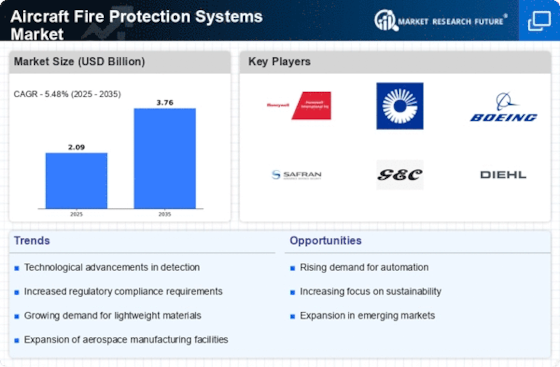
Aircraft Fire Protection Systems Market Infographic
Purchase Options

Market Trends

Introduction

In 2023, the aircraft fire-prevention system market is experiencing significant transformation. This is mainly due to the confluence of macroeconomic factors such as technological advancements, regulatory pressures and changing consumer preferences. Materials and sensors are being developed to enhance the performance and reliability of fire-prevention systems. At the same time, regulatory requirements are forcing manufacturers to adopt more robust solutions. In addition, the growing focus on the environment and on operational efficiency is putting pressure on the industry to adopt advanced fire-prevention systems that not only meet regulatory standards but also help meet environmental goals. These trends are strategically important for all stakeholders as they navigate the highly competitive market, ensure regulatory compliance and enhance safety and meet the changing demands of the aviation industry.

Top Trends

  1. Increased Regulatory Compliance
    Governments are adopting stricter regulations on the safety of air travel, resulting in the development of better fire prevention. For example, the FAA has mandated that the fire detection system on commercial aircraft be made more effective. This is pushing the manufacturers to improve the systems and increase the cost of the operation, but it also increases the safety of the aircraft. The companies that can adapt to the new regulations quickly will have a competitive advantage. These developments could include more advanced materials and newer technology.
  2. Advancements in Fire Suppression Technologies
    A new form of fire-extinguishing equipment is becoming common, such as the use of special foams. The big industry is investing in research to develop more effective and environmentally friendly fire-extinguishing systems. The use of biodegradable foams, for example, is gaining ground. This trend not only enhances the safety of people, but it also meets the requirements of the concept of sustainable development. In the future, this trend may spread to other aircraft types.
  3. Integration of IoT in Fire Protection Systems
    On the other hand, the integration of Internet of Things (IoT) technology in fire prevention systems is growing, enabling real-time monitoring and data analysis. IoT is being used to improve preventive maintenance and to improve the speed of emergency response. This is expected to reduce downtime and operating costs significantly. The evolution of IoT technology may lead to more complex systems that automatically detect and respond to fire hazards.
  4. Focus on Lightweight Materials
    A tendency to reduce weight in aeroplane construction has led to a similar tendency in fire-prevention devices. In other words, manufacturers are seeking materials which will be light as well as resistant to fire. For example, the properties of composite materials are being tested. This tendency is important in the light of the saving of fuel and the consequent improvement in the performance of the aeroplane. Moreover, future developments may lead to the invention of entirely new materials which will satisfy both the requirements of weight and safety.
  5. Enhanced Training and Simulation Programs
    There is a growing emphasis on the importance of fire-fighting training and simulation in the aviation industry. The manufacturers and the operators of the aircraft are investing in the most advanced simulation technology in order to train their crews to deal with fire emergencies. This trend is supported by the results of studies which have shown that well-trained crews can significantly reduce the severity of an accident. The evolution of the training programs is likely to lead to a more realistic and more immersive training environment, which will improve the safety outcomes.
  6. Collaboration Between Manufacturers and Airlines
    The co-operation between aircraft manufacturers and air carriers is increasing in the field of fire protection. The aim of these co-operations is to develop and to supply special solutions for the individual operational requirements of the aircraft. This trend is promoting innovation and making the systems effective and practical. Co-operation in the future may lead to standard solutions that can be used in various fleets.
  7. Increased Investment in R&D
    There has been a noticeable increase in the level of investment in fire-protection research and development. Companies are investing more and more in new products and in improving existing systems, prompted by the need to remain competitive and by the regulatory requirements. This is expected to result in major advances in the methods of fire detection and fire suppression. We may see the introduction of the next generation of systems, which will set new standards.
  8. Sustainability in Fire Protection Solutions
    In the development of fire protection systems, the question of the environment is becoming a major issue. Materials and processes are being developed that are as environmentally friendly as possible. This development is a result of both legal requirements and the desire of the public for greener solutions. As the importance of sustainability increases, we may see a shift towards a more thorough life-cycle assessment of fire protection products.
  9. Adoption of Advanced Detection Systems
    In this connection, the spread of the use of the latest fire detection systems, such as those based on machine learning, is advancing. These systems are able to learn from data patterns and so are better able to forecast potential fires. This trend is improving safety and reducing the number of false alarms that can disrupt operations. And further developments will likely result in fully automatic fire detection systems that will be integrated into the other systems of the aircraft.
  10. Global Supply Chain Resilience
    The recent disruptions to the supply chains have led to a review of the sourcing of fire-fighting components. The risk of a single source of supply has been recognized. To reduce this risk, the industry is diversifying its suppliers. This will increase costs but also improve availability. Local manufacture and sourcing may be future developments to increase resilience.

Conclusion: Navigating Competitive Waters in 2023

Aircraft Fire Protection in 2023 will be characterized by intense competition and considerable fragmentation, with both established and new entrants fighting for market share. Across all regions, safety compliance is becoming a greater priority, driving innovation and adaptation. To differentiate themselves, the established players are relying on their reputations and expertise, while the new entrants are focusing on cutting-edge technology such as artificial intelligence and automation. Strategic considerations for suppliers include the need to enhance capabilities in the areas of agility and resilience. These factors will become increasingly important for market leadership. As the market evolves, decision-makers must ensure that their strategic priorities and alliances align with these critical capabilities.


Author
Author Profile
Shubham Munde
Team Lead - Research

Shubham brings over 7 years of expertise in Market Intelligence and Strategic Consulting, with a strong focus on the Automotive, Aerospace, and Defense sectors. Backed by a solid foundation in semiconductors, electronics, and software, he has successfully delivered high-impact syndicated and custom research on a global scale. His core strengths include market sizing, forecasting, competitive intelligence, consumer insights, and supply chain mapping. Widely recognized for developing scalable growth strategies, Shubham empowers clients to navigate complex markets and achieve a lasting competitive edge. Trusted by start-ups and Fortune 500 companies alike, he consistently converts challenges into strategic opportunities that drive sustainable growth.

Leave a Comment

FAQs

What is the projected market valuation of the Aircraft Fire Protection Systems Market by 2035?

<p>The projected market valuation for the Aircraft Fire Protection Systems Market is expected to reach 3.756 USD Billion by 2035.</p>

What was the market valuation of the Aircraft Fire Protection Systems Market in 2024?

<p>The overall market valuation of the Aircraft Fire Protection Systems Market was 2.089 USD Billion in 2024.</p>

What is the expected CAGR for the Aircraft Fire Protection Systems Market during the forecast period 2025 - 2035?

<p>The expected CAGR for the Aircraft Fire Protection Systems Market during the forecast period 2025 - 2035 is 5.48%.</p>

Which companies are considered key players in the Aircraft Fire Protection Systems Market?

<p>Key players in the Aircraft Fire Protection Systems Market include Honeywell International Inc., UTC Aerospace Systems, Boeing Company, Safran S.A., and General Electric Company.</p>

What are the projected valuations for the Commercial Aviation segment by 2035?

<p>The Commercial Aviation segment is projected to reach a valuation of 1.485 USD Billion by 2035.</p>

How does the Military Aviation segment's valuation compare to the Commercial Aviation segment by 2035?

<p>By 2035, the Military Aviation segment is expected to reach 0.935 USD Billion, which is lower than the Commercial Aviation segment's 1.485 USD Billion.</p>

What is the expected valuation for Fire Suppression Systems by 2035?

<p>The expected valuation for Fire Suppression Systems is projected to be 1.482 USD Billion by 2035.</p>

What is the anticipated market size for Narrow Body Aircraft in 2035?

<p>The anticipated market size for Narrow Body Aircraft is expected to reach 1.485 USD Billion by 2035.</p>

What is the projected valuation for the Aftermarket segment by 2035?

<p>The projected valuation for the Aftermarket segment is expected to be 1.5285 USD Billion by 2035.</p>

What is the expected growth trend for Fire Detection Systems in the Aircraft Fire Protection Systems Market?

<p>Fire Detection Systems are projected to grow to 1.134 USD Billion by 2035, indicating a robust growth trend.</p>

Market Summary

As per Market Research Future analysis, the Aircraft Fire Protection Systems Market was estimated at 2.089 USD Billion in 2024. The Aircraft Fire Protection Systems industry is projected to grow from 2.203 USD Billion in 2025 to 3.756 USD Billion by 2035, exhibiting a compound annual growth rate (CAGR) of 5.48% during the forecast period 2025 - 2035

Key Market Trends & Highlights

The Aircraft Fire Protection Systems Market is poised for growth driven by technological advancements and regulatory compliance.

  • Technological advancements in fire detection systems are reshaping the Aircraft Fire Protection Systems Market. North America remains the largest market, while the Asia-Pacific region is recognized as the fastest-growing area for aircraft fire protection. The commercial aviation segment dominates the market, whereas military aviation is experiencing rapid growth. Key market drivers include increased aircraft production rates and a growing focus on passenger safety.

Market Size & Forecast

2024 Market Size 2.089 (USD Billion)
2035 Market Size 3.756 (USD Billion)
CAGR (2025 - 2035) 5.48%
Largest Regional Market Share in 2024 North America

Major Players

<a href="https://www.honeywell.com/us/en/press?tab=View+All">Honeywell International Inc</a>. (US), UTC Aerospace Systems (US), Boeing Company (US), Safran S.A. (FR), General Electric Company (US), Diehl Stiftung &amp; Co. KG (DE), Eaton Corporation plc (IE), L3Harris Technologies, Inc. (US), Thales Group (FR)

Market Trends

The Aircraft Fire Protection Systems Market is currently experiencing a notable evolution, driven by advancements in technology and increasing safety regulations. As the aviation industry continues to prioritize passenger safety, the demand for innovative fire protection solutions is on the rise. Manufacturers are focusing on developing more efficient systems that not only comply with stringent regulations but also enhance operational reliability. This shift towards modernization is likely to influence the market dynamics significantly, as stakeholders seek to integrate cutting-edge technologies into their offerings. Moreover, the growing emphasis on sustainability within the aviation sector is prompting companies to explore eco-friendly materials and practices in the design of fire protection systems. This trend suggests a potential transformation in product development, where environmental considerations become as crucial as performance metrics. As the Aircraft Fire Protection Systems Market adapts to these changes, it appears poised for growth, with opportunities emerging in both commercial and military aviation segments. The interplay between regulatory frameworks and technological advancements will likely shape the future landscape of this market.

Technological Advancements

The Aircraft Fire Protection Systems Market is witnessing a surge in technological innovations. Manufacturers are increasingly integrating advanced materials and smart technologies into their systems. This trend enhances detection capabilities and response times, thereby improving overall safety. As a result, stakeholders are likely to invest in research and development to stay competitive.

Regulatory Compliance

Stringent safety regulations are driving the Aircraft Fire Protection Systems Market. Regulatory bodies are continuously updating standards to ensure passenger safety. Consequently, manufacturers must adapt their products to meet these evolving requirements. This compliance focus may lead to increased investments in system upgrades and certifications.

Sustainability Initiatives

The growing emphasis on sustainability is influencing the Aircraft Fire Protection Systems Market. Companies are exploring eco-friendly materials and practices in their product designs. This shift not only addresses environmental concerns but also aligns with the broader industry trend towards greener aviation solutions.

Aircraft Fire Protection Systems Market Market Drivers

Growing Focus on Passenger Safety

The Aircraft Fire Protection Systems Market is increasingly driven by a growing focus on passenger safety. Airlines and manufacturers are prioritizing the implementation of advanced fire protection systems to mitigate risks associated with in-flight fires. This heightened emphasis on safety is reflected in the investments made by airlines in upgrading their fleets with modern fire protection technologies. Furthermore, consumer awareness regarding safety standards is rising, prompting airlines to adopt more robust fire protection measures. As a result, the Aircraft Fire Protection Systems Market is likely to witness a surge in demand for innovative fire suppression systems that enhance overall safety and reliability in aviation.

Increased Aircraft Production Rates

The Aircraft Fire Protection Systems Market is poised for growth due to increased aircraft production rates. With the rising demand for air travel, manufacturers are ramping up production to meet consumer needs. According to industry reports, aircraft production is expected to reach unprecedented levels, with estimates indicating a production increase of over 10% in the next few years. This surge in production directly correlates with the need for enhanced fire protection systems, as new aircraft models require state-of-the-art safety features. Consequently, the Aircraft Fire Protection Systems Market is likely to benefit from this trend, as manufacturers seek to equip their aircraft with the latest fire protection technologies to ensure compliance and safety.

Regulatory Standards and Compliance

The Aircraft Fire Protection Systems Market is heavily influenced by stringent regulatory standards imposed by aviation authorities. Compliance with these regulations is not only mandatory but also critical for ensuring passenger safety. Regulatory bodies, such as the Federal Aviation Administration (FAA) and the European Union Aviation Safety Agency (EASA), have established comprehensive guidelines for fire protection systems in aircraft. These regulations necessitate the adoption of advanced fire suppression technologies and regular maintenance protocols. As a result, manufacturers are compelled to invest in innovative fire protection solutions to meet compliance requirements. This trend is expected to drive growth in the Aircraft Fire Protection Systems Market, as companies seek to align their products with evolving safety standards.

Emerging Markets and Regional Expansion

The Aircraft Fire Protection Systems Market is witnessing growth due to emerging markets and regional expansion. Countries with developing aviation sectors are increasingly investing in modern aircraft and associated safety systems. This trend is particularly evident in regions where air travel is becoming more accessible, leading to a rise in new airline operators. As these markets expand, the demand for reliable fire protection systems is expected to increase. Manufacturers are likely to focus on these emerging markets to capitalize on the growing need for advanced fire protection solutions. Consequently, the Aircraft Fire Protection Systems Market is set to benefit from this regional expansion, as companies seek to establish a foothold in these burgeoning aviation markets.

Technological Innovations in Fire Detection

The Aircraft Fire Protection Systems Market is experiencing a surge in technological innovations, particularly in fire detection systems. Advanced sensors and detection technologies, such as fiber optic and infrared systems, are being integrated into aircraft designs. These innovations enhance the speed and accuracy of fire detection, thereby improving safety measures. The market for fire detection systems is projected to grow significantly, with estimates suggesting a compound annual growth rate of over 5% in the coming years. This growth is driven by the increasing demand for enhanced safety features in modern aircraft, as manufacturers strive to meet stringent safety regulations. As a result, the Aircraft Fire Protection Systems Market is likely to see a shift towards more sophisticated and reliable fire detection technologies.

Market Segment Insights

By Application: Commercial Aviation (Largest) vs. Military Aviation (Fastest-Growing)

The Aircraft Fire Protection Systems Market is predominantly driven by the commercial aviation segment, which holds the largest market share due to the continuous growth in air travel globally. Commercial aviation systems are crucial for passenger safety, resulting in increased adoption of advanced fire protection technologies. Military aviation follows closely and is poised for significant growth due to rising defense budgets and an increasing focus on modernization of military aircraft to enhance safety features, including fire protection systems. Recent trends indicate that the military aviation segment is rapidly evolving, driven by technological advancements and the need for enhanced safety protocols in defense operations. Meanwhile, commercial aviation continues to expand with the incorporation of innovative fire suppression technologies, aimed at improving safety and compliance with stringent regulations. This dual growth in both sectors signifies a robust market trajectory, encouraging investments in R&amp;D for novel fire protection solutions.

Commercial Aviation: Dominant vs. Military Aviation: Emerging

The commercial aviation sector remains dominant in the Aircraft Fire Protection Systems Market due to its extensive fleet requirements and stringent safety regulations. The growing number of airlines and air traffic has amplified the demand for efficient fire protection systems, focusing on reliability and quick response capabilities. In contrast, the military aviation segment is emerging with dynamic changes influenced by heightened defense priorities. This segment is adopting cutting-edge fire protection technologies to enhance mission success rates while ensuring safety measures are in place amidst modern warfare challenges. Both segments are crucial, with commercial aviation focusing on high safety standards, while military aviation emphasizes innovative solutions that cater to specific defense needs.

By Component: Fire Detection Systems (Largest) vs. Fire Suppression Systems (Fastest-Growing)

The Aircraft Fire Protection Systems Market is characterized by a diverse range of components, with the Fire Detection Systems holding the largest market share. This segment plays a critical role in ensuring the safety of aircraft by providing early warnings of fire hazards. Meanwhile, <a href="https://www.marketresearchfuture.com/reports/armored-vehicle-fire-suppression-systems-market-10566">Fire Suppression Systems</a> are emerging rapidly and are recognized as the fastest-growing component due to rising technological advancements and increased regulatory requirements for enhanced protection measures in aviation.

Fire Detection Systems (Dominant) vs. Fire Supression Systems (Emerging)

Fire Detection Systems are vital in the Aircraft Fire Protection Systems Market, featuring advanced technologies for early fire detection, maintaining a dominant position in ensuring aircraft safety. These systems utilize a combination of heat, smoke, and flame detectors to assess fire threats accurately and timely. In contrast, Fire Suppression Systems represent an emerging but swiftly expanding segment, driven by technological innovations aimed at more effective reaction to detected fires. These systems often employ various extinguishing agents and methodologies, including foam, gases, or water, tailored for specific aircraft designs, enhancing overall safety and compliance with stringent aviation standards.

By Aircraft Type: Narrow Body Aircraft (Largest) vs. Regional Jets (Fastest-Growing)

In the Aircraft Fire Protection Systems Market, the largest segment is the <a href="https://www.marketresearchfuture.com/reports/narrow-body-aircraft-market-23723">Narrow Body Aircraft</a>, which continues to capture a significant share of the overall market. This segment includes single-aisle airplane configurations prevalent in both domestic and international routes, highlighting its prominence in the changing aviation landscape. In contrast, Regional Jets are experiencing rapid growth, driven by the increasing demand for regional travel and the need for efficient air travel solutions.

Narrow Body Aircraft (Dominant) vs. Regional Jets (Emerging)

Narrow Body Aircraft dominate the Aircraft Fire Protection Systems Market due to their extensive usage across various airlines and flight routes, making fire protection systems critical for safety. These aircraft are typically designed for shorter ranges, allowing for higher frequency flights and their operational versatility across various air travel scenarios. On the other hand, Regional Jets are seen as an emerging segment within the industry, providing increased connectivity in less-populated areas. Their growth is attributed to major airlines expanding their fleets with smaller jets to capture regional demand, necessitating robust fire protection systems that meet specific operational requirements.

By End Use: OEM (Largest) vs. Aftermarket (Fastest-Growing)

In the Aircraft Fire Protection Systems Market, the OEM segment commands the largest share, serving as the primary source for fire protection systems in new aircraft. This segment is characterized by strong relationships with aircraft manufacturers and is central to the initial flight safety infrastructure. On the other hand, the Aftermarket segment plays a crucial role, particularly in the maintenance, repair, and overhaul (MRO) sector, catering to existing aircraft systems and ensuring compliance with safety regulations.

End Use: OEM (Dominant) vs. Aftermarket (Emerging)

The OEM segment remains dominant in the Aircraft Fire Protection Systems Market, driven by consistent demand from aircraft manufacturers who prioritize safety and compliance in new aircraft designs. This segment benefits from long-term contracts and partnerships with manufacturers, ensuring a steadier revenue stream. Conversely, the Aftermarket segment is emerging rapidly due to the increasing fleet of operational aircraft that require ongoing maintenance and upgrades. With a growing emphasis on retrofitting older aircraft and enhancing safety features, the aftermarket is set to capitalize on expanding opportunities as regulations tighten and airlines seek to optimize their existing assets.

Get more detailed insights about Aircraft Fire Protection Systems Market Research Report – Global Forecast till 2035

Regional Insights

The Aircraft Fire Protection Systems Market experienced substantial growth, particularly among its regional sectors. In 2023, North America dominated this market with a valuation of 0.8 USD Billion, reflecting its significant role in aviation safety technology. Europe followed, valued at 0.5 USD Billion, showcasing its commitment to stringent fire safety standards.

The APAC region, valued at 0.4 USD Billion, indicated the increasing investment in aviation infrastructure and safety measures across emerging economies. South America, with a valuation of 0.15 USD Billion, represented a growing market that is beginning to emphasize safety features.

Meanwhile, the MEA segment, valued at 0.13 USD Billion, underscored the rising demand for aircraft fire protection systems driven by an expanding air travel network.

The majority holding of North America in the  Aircraft Fire Protection Systems Market underlined its historic investment and development in aviation safety measures. As awareness of fire protection technology increased ly, significant opportunities for growth were presented, particularly in APAC and South America, where market expansion is evident.

The market faced challenges, including regulatory compliance and technological advancements needed to keep pace with increasing safety demands.

Source Primary Research, Secondary Research, Market Research Future Database and Analyst Review

Key Players and Competitive Insights

The  Aircraft Fire Protection Systems Market is characterized by a competitive landscape that has evolved significantly in response to stringent safety regulations and innovations in technology. As the aerospace sector experiences growth, the need for advanced fire protection systems has become paramount, driven by the increasing focus on passenger safety and the protection of valuable assets.
Companies operating in this market strive to enhance their offerings by integrating cutting-edge technologies such as detection, suppression, and management systems. The competition is fueled by a combination of large multinational corporations and specialized firms, all seeking to establish or maintain their market presence through strategic partnerships, acquisitions, and innovation.
The emphasis on regulatory compliance, reliability, and performance ensures that companies are continuously improving their product portfolios to meet the evolving demands of end-users.
Eaton Corporation stands out in the  Aircraft Fire Protection Systems Market with a solid reputation for innovation and reliability. With a robust portfolio of fire protection solutions, Eaton incorporates advanced technologies in its products, catering to various segments of the aerospace industry.
The company benefits from a  presence, enabling it to leverage economies of scale and a broad distribution network. Eaton's strengths lie in its commitment to research and development, which allows it to pioneer innovative solutions that improve fire safety in aircraft, such as advanced detection systems and reliable fire suppression systems.
Furthermore, Eaton's customer-centric approach helps foster long-term relationships with major aircraft manufacturers and operators, ultimately enhancing its competitive position in the market.
Tyco International also holds a significant position within the  Aircraft Fire Protection Systems Market, recognized for its extensive experience and comprehensive range of fire protection technologies. The company boasts a history of providing reliable fire safety and suppression solutions to the aviation sector, leveraging its expertise to develop systems that comply with rigorous safety standards.
Tyco International's strength manifests in its ability to deliver tailored solutions for various aircraft types, ensuring optimal performance in diverse operational environments. Additionally, its  reach allows Tyco to effectively serve clients across different geographic regions, enabling it to stay ahead in a competitive marketplace.
The focus on technological advancements, coupled with strong customer relationships, positions Tyco as a key player that contributes to enhancing safety measures throughout the aviation industry.

Key Companies in the Aircraft Fire Protection Systems Market include

Industry Developments

  • Q2 2024: Collins Aerospace Expands Fire Protection Systems Manufacturing Facility in Colorado Collins Aerospace announced the expansion of its fire protection systems manufacturing facility in Colorado, aiming to increase production capacity to meet rising demand from commercial and military aircraft customers.
  • Q1 2024: Meggitt Wins Major Contract to Supply Fire Detection Systems for Boeing 777X Meggitt secured a multi-year contract to provide advanced fire detection and suppression systems for Boeing's new 777X aircraft, strengthening its position as a key supplier in the sector.
  • Q2 2024: Honeywell Launches Next-Generation Aircraft Fire Detection System Honeywell introduced a new, lightweight fire detection system designed for next-generation commercial and business jets, featuring improved response times and enhanced integration with aircraft avionics.
  • Q3 2024: UTC Aerospace Systems Secures FAA Certification for New Cargo Fire Suppression System UTC Aerospace Systems received FAA certification for its latest cargo fire suppression system, enabling deployment on a range of wide-body and narrow-body aircraft.
  • Q2 2024: Safran Signs Partnership with Embraer for Fire Protection Solutions on E2 Jets Safran announced a strategic partnership with Embraer to supply integrated fire protection systems for the E2 family of regional jets, enhancing safety and compliance with new regulatory standards.
  • Q1 2025: Diehl Aviation Acquires Stake in Fire Protection Startup AeroSafe Diehl Aviation acquired a minority stake in AeroSafe, a startup specializing in advanced fire suppression technologies for electric and hybrid aircraft, signaling a move into next-generation aviation safety solutions.
  • Q2 2025: Kidde Aerospace Wins $120 Million Contract for Military Aircraft Fire Suppression Systems Kidde Aerospace was awarded a $120 million contract to supply fire suppression systems for a new fleet of military transport aircraft, with deliveries scheduled through 2028.
  • Q3 2024: Airbus Selects New Fire Detection Supplier for A320neo Family Airbus announced the selection of a new supplier for fire detection systems on its A320neo family, aiming to improve reliability and reduce maintenance costs for airline customers.
  • Q4 2024: Boeing Appoints New Head of Fire Protection Systems Engineering Boeing named Dr. Lisa Chen as the new head of its Fire Protection Systems Engineering division, responsible for overseeing innovation and regulatory compliance across all commercial aircraft programs.
  • Q1 2025: GKN Aerospace Opens New R&D Center for Aircraft Fire Safety in the UK GKN Aerospace inaugurated a new research and development center in the UK focused on advanced fire safety technologies for both commercial and military aircraft.
  • Q2 2025: Embraer Receives ANAC Approval for Enhanced Fire Suppression System on E195-E2 Embraer received approval from Brazil's National Civil Aviation Agency (ANAC) for its upgraded fire suppression system on the E195-E2, enabling improved safety and compliance with international standards.
  • Q3 2025: Rolls-Royce Partners with Kidde Aerospace for Electric Aircraft Fire Protection Rolls-Royce announced a partnership with Kidde Aerospace to develop fire protection systems tailored for electric propulsion aircraft, targeting the emerging urban air mobility market.

Future Outlook

Aircraft Fire Protection Systems Market Future Outlook

The Aircraft Fire Protection Systems Market is projected to grow at a 5.48% CAGR from 2025 to 2035, driven by technological advancements and increasing safety regulations.

New opportunities lie in:

  • Development of advanced fire detection systems using AI technology.
  • Expansion into emerging markets with tailored fire protection solutions.
  • Partnerships with aircraft manufacturers for integrated fire safety systems.

By 2035, the market is expected to be robust, reflecting substantial growth and innovation.

Market Segmentation

Aircraft Fire Protection Systems Market End Use Outlook

  • OEM
  • Aftermarket

Aircraft Fire Protection Systems Market Component Outlook

  • Fire Detection Systems
  • Fire Suppression Systems
  • Fire Extinguishing Agents
  • Control Panels

Aircraft Fire Protection Systems Market Application Outlook

  • Commercial Aviation
  • Military Aviation
  • Cargo Transport
  • General Aviation

Aircraft Fire Protection Systems Market Aircraft Type Outlook

  • Narrow Body Aircraft
  • Wide Body Aircraft
  • Very Large Aircraft
  • Regional Jets

Report Scope

MARKET SIZE 2024 2.089(USD Billion)
MARKET SIZE 2025 2.203(USD Billion)
MARKET SIZE 2035 3.756(USD Billion)
COMPOUND ANNUAL GROWTH RATE (CAGR) 5.48% (2025 - 2035)
REPORT COVERAGE Revenue Forecast, Competitive Landscape, Growth Factors, and Trends
BASE YEAR 2024
Market Forecast Period 2025 - 2035
Historical Data 2019 - 2024
Market Forecast Units USD Billion
Key Companies Profiled Honeywell International Inc. (US), UTC Aerospace Systems (US), Boeing Company (US), Safran S.A. (FR), General Electric Company (US), Diehl Stiftung & Co. KG (DE), Eaton Corporation plc (IE), L3Harris Technologies, Inc. (US), Thales Group (FR)
Segments Covered Application, Component, Aircraft Type, End Use, Regional
Key Market Opportunities Integration of advanced sensor technologies enhances safety in the Aircraft Fire Protection Systems Market.
Key Market Dynamics Technological advancements and stringent safety regulations drive innovation in Aircraft Fire Protection Systems.
Countries Covered North America, Europe, APAC, South America, MEA

FAQs

What is the projected market valuation of the Aircraft Fire Protection Systems Market by 2035?

<p>The projected market valuation for the Aircraft Fire Protection Systems Market is expected to reach 3.756 USD Billion by 2035.</p>

What was the market valuation of the Aircraft Fire Protection Systems Market in 2024?

<p>The overall market valuation of the Aircraft Fire Protection Systems Market was 2.089 USD Billion in 2024.</p>

What is the expected CAGR for the Aircraft Fire Protection Systems Market during the forecast period 2025 - 2035?

<p>The expected CAGR for the Aircraft Fire Protection Systems Market during the forecast period 2025 - 2035 is 5.48%.</p>

Which companies are considered key players in the Aircraft Fire Protection Systems Market?

<p>Key players in the Aircraft Fire Protection Systems Market include Honeywell International Inc., UTC Aerospace Systems, Boeing Company, Safran S.A., and General Electric Company.</p>

What are the projected valuations for the Commercial Aviation segment by 2035?

<p>The Commercial Aviation segment is projected to reach a valuation of 1.485 USD Billion by 2035.</p>

How does the Military Aviation segment's valuation compare to the Commercial Aviation segment by 2035?

<p>By 2035, the Military Aviation segment is expected to reach 0.935 USD Billion, which is lower than the Commercial Aviation segment's 1.485 USD Billion.</p>

What is the expected valuation for Fire Suppression Systems by 2035?

<p>The expected valuation for Fire Suppression Systems is projected to be 1.482 USD Billion by 2035.</p>

What is the anticipated market size for Narrow Body Aircraft in 2035?

<p>The anticipated market size for Narrow Body Aircraft is expected to reach 1.485 USD Billion by 2035.</p>

What is the projected valuation for the Aftermarket segment by 2035?

<p>The projected valuation for the Aftermarket segment is expected to be 1.5285 USD Billion by 2035.</p>

What is the expected growth trend for Fire Detection Systems in the Aircraft Fire Protection Systems Market?

<p>Fire Detection Systems are projected to grow to 1.134 USD Billion by 2035, indicating a robust growth trend.</p>

  1. SECTION I: EXECUTIVE SUMMARY AND KEY HIGHLIGHTS
    1. | 1.1 EXECUTIVE SUMMARY
    2. | | 1.1.1 Market Overview
    3. | | 1.1.2 Key Findings
    4. | | 1.1.3 Market Segmentation
    5. | | 1.1.4 Competitive Landscape
    6. | | 1.1.5 Challenges and Opportunities
    7. | | 1.1.6 Future Outlook
  2. SECTION II: SCOPING, METHODOLOGY AND MARKET STRUCTURE
    1. | 2.1 MARKET INTRODUCTION
    2. | | 2.1.1 Definition
    3. | | 2.1.2 Scope of the study
    4. | | | 2.1.2.1 Research Objective
    5. | | | 2.1.2.2 Assumption
    6. | | | 2.1.2.3 Limitations
    7. | 2.2 RESEARCH METHODOLOGY
    8. | | 2.2.1 Overview
    9. | | 2.2.2 Data Mining
    10. | | 2.2.3 Secondary Research
    11. | | 2.2.4 Primary Research
    12. | | | 2.2.4.1 Primary Interviews and Information Gathering Process
    13. | | | 2.2.4.2 Breakdown of Primary Respondents
    14. | | 2.2.5 Forecasting Model
    15. | | 2.2.6 Market Size Estimation
    16. | | | 2.2.6.1 Bottom-Up Approach
    17. | | | 2.2.6.2 Top-Down Approach
    18. | | 2.2.7 Data Triangulation
    19. | | 2.2.8 Validation
  3. SECTION III: QUALITATIVE ANALYSIS
    1. | 3.1 MARKET DYNAMICS
    2. | | 3.1.1 Overview
    3. | | 3.1.2 Drivers
    4. | | 3.1.3 Restraints
    5. | | 3.1.4 Opportunities
    6. | 3.2 MARKET FACTOR ANALYSIS
    7. | | 3.2.1 Value chain Analysis
    8. | | 3.2.2 Porter's Five Forces Analysis
    9. | | | 3.2.2.1 Bargaining Power of Suppliers
    10. | | | 3.2.2.2 Bargaining Power of Buyers
    11. | | | 3.2.2.3 Threat of New Entrants
    12. | | | 3.2.2.4 Threat of Substitutes
    13. | | | 3.2.2.5 Intensity of Rivalry
    14. | | 3.2.3 COVID-19 Impact Analysis
    15. | | | 3.2.3.1 Market Impact Analysis
    16. | | | 3.2.3.2 Regional Impact
    17. | | | 3.2.3.3 Opportunity and Threat Analysis
  4. SECTION IV: QUANTITATIVE ANALYSIS
    1. | 4.1 Aerospace & Defense, BY Application (USD Billion)
    2. | | 4.1.1 Commercial Aviation
    3. | | 4.1.2 Military Aviation
    4. | | 4.1.3 Cargo Transport
    5. | | 4.1.4 General Aviation
    6. | 4.2 Aerospace & Defense, BY Component (USD Billion)
    7. | | 4.2.1 Fire Detection Systems
    8. | | 4.2.2 Fire Suppression Systems
    9. | | 4.2.3 Fire Extinguishing Agents
    10. | | 4.2.4 Control Panels
    11. | 4.3 Aerospace & Defense, BY Aircraft Type (USD Billion)
    12. | | 4.3.1 Narrow Body Aircraft
    13. | | 4.3.2 Wide Body Aircraft
    14. | | 4.3.3 Very Large Aircraft
    15. | | 4.3.4 Regional Jets
    16. | 4.4 Aerospace & Defense, BY End Use (USD Billion)
    17. | | 4.4.1 OEM
    18. | | 4.4.2 Aftermarket
    19. | 4.5 Aerospace & Defense, BY Region (USD Billion)
    20. | | 4.5.1 North America
    21. | | | 4.5.1.1 US
    22. | | | 4.5.1.2 Canada
    23. | | 4.5.2 Europe
    24. | | | 4.5.2.1 Germany
    25. | | | 4.5.2.2 UK
    26. | | | 4.5.2.3 France
    27. | | | 4.5.2.4 Russia
    28. | | | 4.5.2.5 Italy
    29. | | | 4.5.2.6 Spain
    30. | | | 4.5.2.7 Rest of Europe
    31. | | 4.5.3 APAC
    32. | | | 4.5.3.1 China
    33. | | | 4.5.3.2 India
    34. | | | 4.5.3.3 Japan
    35. | | | 4.5.3.4 South Korea
    36. | | | 4.5.3.5 Malaysia
    37. | | | 4.5.3.6 Thailand
    38. | | | 4.5.3.7 Indonesia
    39. | | | 4.5.3.8 Rest of APAC
    40. | | 4.5.4 South America
    41. | | | 4.5.4.1 Brazil
    42. | | | 4.5.4.2 Mexico
    43. | | | 4.5.4.3 Argentina
    44. | | | 4.5.4.4 Rest of South America
    45. | | 4.5.5 MEA
    46. | | | 4.5.5.1 GCC Countries
    47. | | | 4.5.5.2 South Africa
    48. | | | 4.5.5.3 Rest of MEA
  5. SECTION V: COMPETITIVE ANALYSIS
    1. | 5.1 Competitive Landscape
    2. | | 5.1.1 Overview
    3. | | 5.1.2 Competitive Analysis
    4. | | 5.1.3 Market share Analysis
    5. | | 5.1.4 Major Growth Strategy in the Aerospace & Defense
    6. | | 5.1.5 Competitive Benchmarking
    7. | | 5.1.6 Leading Players in Terms of Number of Developments in the Aerospace & Defense
    8. | | 5.1.7 Key developments and growth strategies
    9. | | | 5.1.7.1 New Product Launch/Service Deployment
    10. | | | 5.1.7.2 Merger & Acquisitions
    11. | | | 5.1.7.3 Joint Ventures
    12. | | 5.1.8 Major Players Financial Matrix
    13. | | | 5.1.8.1 Sales and Operating Income
    14. | | | 5.1.8.2 Major Players R&D Expenditure. 2023
    15. | 5.2 Company Profiles
    16. | | 5.2.1 Honeywell International Inc. (US)
    17. | | | 5.2.1.1 Financial Overview
    18. | | | 5.2.1.2 Products Offered
    19. | | | 5.2.1.3 Key Developments
    20. | | | 5.2.1.4 SWOT Analysis
    21. | | | 5.2.1.5 Key Strategies
    22. | | 5.2.2 UTC Aerospace Systems (US)
    23. | | | 5.2.2.1 Financial Overview
    24. | | | 5.2.2.2 Products Offered
    25. | | | 5.2.2.3 Key Developments
    26. | | | 5.2.2.4 SWOT Analysis
    27. | | | 5.2.2.5 Key Strategies
    28. | | 5.2.3 Boeing Company (US)
    29. | | | 5.2.3.1 Financial Overview
    30. | | | 5.2.3.2 Products Offered
    31. | | | 5.2.3.3 Key Developments
    32. | | | 5.2.3.4 SWOT Analysis
    33. | | | 5.2.3.5 Key Strategies
    34. | | 5.2.4 Safran S.A. (FR)
    35. | | | 5.2.4.1 Financial Overview
    36. | | | 5.2.4.2 Products Offered
    37. | | | 5.2.4.3 Key Developments
    38. | | | 5.2.4.4 SWOT Analysis
    39. | | | 5.2.4.5 Key Strategies
    40. | | 5.2.5 General Electric Company (US)
    41. | | | 5.2.5.1 Financial Overview
    42. | | | 5.2.5.2 Products Offered
    43. | | | 5.2.5.3 Key Developments
    44. | | | 5.2.5.4 SWOT Analysis
    45. | | | 5.2.5.5 Key Strategies
    46. | | 5.2.6 Diehl Stiftung & Co. KG (DE)
    47. | | | 5.2.6.1 Financial Overview
    48. | | | 5.2.6.2 Products Offered
    49. | | | 5.2.6.3 Key Developments
    50. | | | 5.2.6.4 SWOT Analysis
    51. | | | 5.2.6.5 Key Strategies
    52. | | 5.2.7 Eaton Corporation plc (IE)
    53. | | | 5.2.7.1 Financial Overview
    54. | | | 5.2.7.2 Products Offered
    55. | | | 5.2.7.3 Key Developments
    56. | | | 5.2.7.4 SWOT Analysis
    57. | | | 5.2.7.5 Key Strategies
    58. | | 5.2.8 L3Harris Technologies, Inc. (US)
    59. | | | 5.2.8.1 Financial Overview
    60. | | | 5.2.8.2 Products Offered
    61. | | | 5.2.8.3 Key Developments
    62. | | | 5.2.8.4 SWOT Analysis
    63. | | | 5.2.8.5 Key Strategies
    64. | | 5.2.9 Thales Group (FR)
    65. | | | 5.2.9.1 Financial Overview
    66. | | | 5.2.9.2 Products Offered
    67. | | | 5.2.9.3 Key Developments
    68. | | | 5.2.9.4 SWOT Analysis
    69. | | | 5.2.9.5 Key Strategies
    70. | 5.3 Appendix
    71. | | 5.3.1 References
    72. | | 5.3.2 Related Reports
  6. LIST OF FIGURES
    1. | 6.1 MARKET SYNOPSIS
    2. | 6.2 NORTH AMERICA MARKET ANALYSIS
    3. | 6.3 US MARKET ANALYSIS BY APPLICATION
    4. | 6.4 US MARKET ANALYSIS BY COMPONENT
    5. | 6.5 US MARKET ANALYSIS BY AIRCRAFT TYPE
    6. | 6.6 US MARKET ANALYSIS BY END USE
    7. | 6.7 CANADA MARKET ANALYSIS BY APPLICATION
    8. | 6.8 CANADA MARKET ANALYSIS BY COMPONENT
    9. | 6.9 CANADA MARKET ANALYSIS BY AIRCRAFT TYPE
    10. | 6.10 CANADA MARKET ANALYSIS BY END USE
    11. | 6.11 EUROPE MARKET ANALYSIS
    12. | 6.12 GERMANY MARKET ANALYSIS BY APPLICATION
    13. | 6.13 GERMANY MARKET ANALYSIS BY COMPONENT
    14. | 6.14 GERMANY MARKET ANALYSIS BY AIRCRAFT TYPE
    15. | 6.15 GERMANY MARKET ANALYSIS BY END USE
    16. | 6.16 UK MARKET ANALYSIS BY APPLICATION
    17. | 6.17 UK MARKET ANALYSIS BY COMPONENT
    18. | 6.18 UK MARKET ANALYSIS BY AIRCRAFT TYPE
    19. | 6.19 UK MARKET ANALYSIS BY END USE
    20. | 6.20 FRANCE MARKET ANALYSIS BY APPLICATION
    21. | 6.21 FRANCE MARKET ANALYSIS BY COMPONENT
    22. | 6.22 FRANCE MARKET ANALYSIS BY AIRCRAFT TYPE
    23. | 6.23 FRANCE MARKET ANALYSIS BY END USE
    24. | 6.24 RUSSIA MARKET ANALYSIS BY APPLICATION
    25. | 6.25 RUSSIA MARKET ANALYSIS BY COMPONENT
    26. | 6.26 RUSSIA MARKET ANALYSIS BY AIRCRAFT TYPE
    27. | 6.27 RUSSIA MARKET ANALYSIS BY END USE
    28. | 6.28 ITALY MARKET ANALYSIS BY APPLICATION
    29. | 6.29 ITALY MARKET ANALYSIS BY COMPONENT
    30. | 6.30 ITALY MARKET ANALYSIS BY AIRCRAFT TYPE
    31. | 6.31 ITALY MARKET ANALYSIS BY END USE
    32. | 6.32 SPAIN MARKET ANALYSIS BY APPLICATION
    33. | 6.33 SPAIN MARKET ANALYSIS BY COMPONENT
    34. | 6.34 SPAIN MARKET ANALYSIS BY AIRCRAFT TYPE
    35. | 6.35 SPAIN MARKET ANALYSIS BY END USE
    36. | 6.36 REST OF EUROPE MARKET ANALYSIS BY APPLICATION
    37. | 6.37 REST OF EUROPE MARKET ANALYSIS BY COMPONENT
    38. | 6.38 REST OF EUROPE MARKET ANALYSIS BY AIRCRAFT TYPE
    39. | 6.39 REST OF EUROPE MARKET ANALYSIS BY END USE
    40. | 6.40 APAC MARKET ANALYSIS
    41. | 6.41 CHINA MARKET ANALYSIS BY APPLICATION
    42. | 6.42 CHINA MARKET ANALYSIS BY COMPONENT
    43. | 6.43 CHINA MARKET ANALYSIS BY AIRCRAFT TYPE
    44. | 6.44 CHINA MARKET ANALYSIS BY END USE
    45. | 6.45 INDIA MARKET ANALYSIS BY APPLICATION
    46. | 6.46 INDIA MARKET ANALYSIS BY COMPONENT
    47. | 6.47 INDIA MARKET ANALYSIS BY AIRCRAFT TYPE
    48. | 6.48 INDIA MARKET ANALYSIS BY END USE
    49. | 6.49 JAPAN MARKET ANALYSIS BY APPLICATION
    50. | 6.50 JAPAN MARKET ANALYSIS BY COMPONENT
    51. | 6.51 JAPAN MARKET ANALYSIS BY AIRCRAFT TYPE
    52. | 6.52 JAPAN MARKET ANALYSIS BY END USE
    53. | 6.53 SOUTH KOREA MARKET ANALYSIS BY APPLICATION
    54. | 6.54 SOUTH KOREA MARKET ANALYSIS BY COMPONENT
    55. | 6.55 SOUTH KOREA MARKET ANALYSIS BY AIRCRAFT TYPE
    56. | 6.56 SOUTH KOREA MARKET ANALYSIS BY END USE
    57. | 6.57 MALAYSIA MARKET ANALYSIS BY APPLICATION
    58. | 6.58 MALAYSIA MARKET ANALYSIS BY COMPONENT
    59. | 6.59 MALAYSIA MARKET ANALYSIS BY AIRCRAFT TYPE
    60. | 6.60 MALAYSIA MARKET ANALYSIS BY END USE
    61. | 6.61 THAILAND MARKET ANALYSIS BY APPLICATION
    62. | 6.62 THAILAND MARKET ANALYSIS BY COMPONENT
    63. | 6.63 THAILAND MARKET ANALYSIS BY AIRCRAFT TYPE
    64. | 6.64 THAILAND MARKET ANALYSIS BY END USE
    65. | 6.65 INDONESIA MARKET ANALYSIS BY APPLICATION
    66. | 6.66 INDONESIA MARKET ANALYSIS BY COMPONENT
    67. | 6.67 INDONESIA MARKET ANALYSIS BY AIRCRAFT TYPE
    68. | 6.68 INDONESIA MARKET ANALYSIS BY END USE
    69. | 6.69 REST OF APAC MARKET ANALYSIS BY APPLICATION
    70. | 6.70 REST OF APAC MARKET ANALYSIS BY COMPONENT
    71. | 6.71 REST OF APAC MARKET ANALYSIS BY AIRCRAFT TYPE
    72. | 6.72 REST OF APAC MARKET ANALYSIS BY END USE
    73. | 6.73 SOUTH AMERICA MARKET ANALYSIS
    74. | 6.74 BRAZIL MARKET ANALYSIS BY APPLICATION
    75. | 6.75 BRAZIL MARKET ANALYSIS BY COMPONENT
    76. | 6.76 BRAZIL MARKET ANALYSIS BY AIRCRAFT TYPE
    77. | 6.77 BRAZIL MARKET ANALYSIS BY END USE
    78. | 6.78 MEXICO MARKET ANALYSIS BY APPLICATION
    79. | 6.79 MEXICO MARKET ANALYSIS BY COMPONENT
    80. | 6.80 MEXICO MARKET ANALYSIS BY AIRCRAFT TYPE
    81. | 6.81 MEXICO MARKET ANALYSIS BY END USE
    82. | 6.82 ARGENTINA MARKET ANALYSIS BY APPLICATION
    83. | 6.83 ARGENTINA MARKET ANALYSIS BY COMPONENT
    84. | 6.84 ARGENTINA MARKET ANALYSIS BY AIRCRAFT TYPE
    85. | 6.85 ARGENTINA MARKET ANALYSIS BY END USE
    86. | 6.86 REST OF SOUTH AMERICA MARKET ANALYSIS BY APPLICATION
    87. | 6.87 REST OF SOUTH AMERICA MARKET ANALYSIS BY COMPONENT
    88. | 6.88 REST OF SOUTH AMERICA MARKET ANALYSIS BY AIRCRAFT TYPE
    89. | 6.89 REST OF SOUTH AMERICA MARKET ANALYSIS BY END USE
    90. | 6.90 MEA MARKET ANALYSIS
    91. | 6.91 GCC COUNTRIES MARKET ANALYSIS BY APPLICATION
    92. | 6.92 GCC COUNTRIES MARKET ANALYSIS BY COMPONENT
    93. | 6.93 GCC COUNTRIES MARKET ANALYSIS BY AIRCRAFT TYPE
    94. | 6.94 GCC COUNTRIES MARKET ANALYSIS BY END USE
    95. | 6.95 SOUTH AFRICA MARKET ANALYSIS BY APPLICATION
    96. | 6.96 SOUTH AFRICA MARKET ANALYSIS BY COMPONENT
    97. | 6.97 SOUTH AFRICA MARKET ANALYSIS BY AIRCRAFT TYPE
    98. | 6.98 SOUTH AFRICA MARKET ANALYSIS BY END USE
    99. | 6.99 REST OF MEA MARKET ANALYSIS BY APPLICATION
    100. | 6.100 REST OF MEA MARKET ANALYSIS BY COMPONENT
    101. | 6.101 REST OF MEA MARKET ANALYSIS BY AIRCRAFT TYPE
    102. | 6.102 REST OF MEA MARKET ANALYSIS BY END USE
    103. | 6.103 KEY BUYING CRITERIA OF AEROSPACE & DEFENSE
    104. | 6.104 RESEARCH PROCESS OF MRFR
    105. | 6.105 DRO ANALYSIS OF AEROSPACE & DEFENSE
    106. | 6.106 DRIVERS IMPACT ANALYSIS: AEROSPACE & DEFENSE
    107. | 6.107 RESTRAINTS IMPACT ANALYSIS: AEROSPACE & DEFENSE
    108. | 6.108 SUPPLY / VALUE CHAIN: AEROSPACE & DEFENSE
    109. | 6.109 AEROSPACE & DEFENSE, BY APPLICATION, 2024 (% SHARE)
    110. | 6.110 AEROSPACE & DEFENSE, BY APPLICATION, 2024 TO 2035 (USD Billion)
    111. | 6.111 AEROSPACE & DEFENSE, BY COMPONENT, 2024 (% SHARE)
    112. | 6.112 AEROSPACE & DEFENSE, BY COMPONENT, 2024 TO 2035 (USD Billion)
    113. | 6.113 AEROSPACE & DEFENSE, BY AIRCRAFT TYPE, 2024 (% SHARE)
    114. | 6.114 AEROSPACE & DEFENSE, BY AIRCRAFT TYPE, 2024 TO 2035 (USD Billion)
    115. | 6.115 AEROSPACE & DEFENSE, BY END USE, 2024 (% SHARE)
    116. | 6.116 AEROSPACE & DEFENSE, BY END USE, 2024 TO 2035 (USD Billion)
    117. | 6.117 BENCHMARKING OF MAJOR COMPETITORS
  7. LIST OF TABLES
    1. | 7.1 LIST OF ASSUMPTIONS
    2. | | 7.1.1
    3. | 7.2 North America MARKET SIZE ESTIMATES; FORECAST
    4. | | 7.2.1 BY APPLICATION, 2025-2035 (USD Billion)
    5. | | 7.2.2 BY COMPONENT, 2025-2035 (USD Billion)
    6. | | 7.2.3 BY AIRCRAFT TYPE, 2025-2035 (USD Billion)
    7. | | 7.2.4 BY END USE, 2025-2035 (USD Billion)
    8. | 7.3 US MARKET SIZE ESTIMATES; FORECAST
    9. | | 7.3.1 BY APPLICATION, 2025-2035 (USD Billion)
    10. | | 7.3.2 BY COMPONENT, 2025-2035 (USD Billion)
    11. | | 7.3.3 BY AIRCRAFT TYPE, 2025-2035 (USD Billion)
    12. | | 7.3.4 BY END USE, 2025-2035 (USD Billion)
    13. | 7.4 Canada MARKET SIZE ESTIMATES; FORECAST
    14. | | 7.4.1 BY APPLICATION, 2025-2035 (USD Billion)
    15. | | 7.4.2 BY COMPONENT, 2025-2035 (USD Billion)
    16. | | 7.4.3 BY AIRCRAFT TYPE, 2025-2035 (USD Billion)
    17. | | 7.4.4 BY END USE, 2025-2035 (USD Billion)
    18. | 7.5 Europe MARKET SIZE ESTIMATES; FORECAST
    19. | | 7.5.1 BY APPLICATION, 2025-2035 (USD Billion)
    20. | | 7.5.2 BY COMPONENT, 2025-2035 (USD Billion)
    21. | | 7.5.3 BY AIRCRAFT TYPE, 2025-2035 (USD Billion)
    22. | | 7.5.4 BY END USE, 2025-2035 (USD Billion)
    23. | 7.6 Germany MARKET SIZE ESTIMATES; FORECAST
    24. | | 7.6.1 BY APPLICATION, 2025-2035 (USD Billion)
    25. | | 7.6.2 BY COMPONENT, 2025-2035 (USD Billion)
    26. | | 7.6.3 BY AIRCRAFT TYPE, 2025-2035 (USD Billion)
    27. | | 7.6.4 BY END USE, 2025-2035 (USD Billion)
    28. | 7.7 UK MARKET SIZE ESTIMATES; FORECAST
    29. | | 7.7.1 BY APPLICATION, 2025-2035 (USD Billion)
    30. | | 7.7.2 BY COMPONENT, 2025-2035 (USD Billion)
    31. | | 7.7.3 BY AIRCRAFT TYPE, 2025-2035 (USD Billion)
    32. | | 7.7.4 BY END USE, 2025-2035 (USD Billion)
    33. | 7.8 France MARKET SIZE ESTIMATES; FORECAST
    34. | | 7.8.1 BY APPLICATION, 2025-2035 (USD Billion)
    35. | | 7.8.2 BY COMPONENT, 2025-2035 (USD Billion)
    36. | | 7.8.3 BY AIRCRAFT TYPE, 2025-2035 (USD Billion)
    37. | | 7.8.4 BY END USE, 2025-2035 (USD Billion)
    38. | 7.9 Russia MARKET SIZE ESTIMATES; FORECAST
    39. | | 7.9.1 BY APPLICATION, 2025-2035 (USD Billion)
    40. | | 7.9.2 BY COMPONENT, 2025-2035 (USD Billion)
    41. | | 7.9.3 BY AIRCRAFT TYPE, 2025-2035 (USD Billion)
    42. | | 7.9.4 BY END USE, 2025-2035 (USD Billion)
    43. | 7.10 Italy MARKET SIZE ESTIMATES; FORECAST
    44. | | 7.10.1 BY APPLICATION, 2025-2035 (USD Billion)
    45. | | 7.10.2 BY COMPONENT, 2025-2035 (USD Billion)
    46. | | 7.10.3 BY AIRCRAFT TYPE, 2025-2035 (USD Billion)
    47. | | 7.10.4 BY END USE, 2025-2035 (USD Billion)
    48. | 7.11 Spain MARKET SIZE ESTIMATES; FORECAST
    49. | | 7.11.1 BY APPLICATION, 2025-2035 (USD Billion)
    50. | | 7.11.2 BY COMPONENT, 2025-2035 (USD Billion)
    51. | | 7.11.3 BY AIRCRAFT TYPE, 2025-2035 (USD Billion)
    52. | | 7.11.4 BY END USE, 2025-2035 (USD Billion)
    53. | 7.12 Rest of Europe MARKET SIZE ESTIMATES; FORECAST
    54. | | 7.12.1 BY APPLICATION, 2025-2035 (USD Billion)
    55. | | 7.12.2 BY COMPONENT, 2025-2035 (USD Billion)
    56. | | 7.12.3 BY AIRCRAFT TYPE, 2025-2035 (USD Billion)
    57. | | 7.12.4 BY END USE, 2025-2035 (USD Billion)
    58. | 7.13 APAC MARKET SIZE ESTIMATES; FORECAST
    59. | | 7.13.1 BY APPLICATION, 2025-2035 (USD Billion)
    60. | | 7.13.2 BY COMPONENT, 2025-2035 (USD Billion)
    61. | | 7.13.3 BY AIRCRAFT TYPE, 2025-2035 (USD Billion)
    62. | | 7.13.4 BY END USE, 2025-2035 (USD Billion)
    63. | 7.14 China MARKET SIZE ESTIMATES; FORECAST
    64. | | 7.14.1 BY APPLICATION, 2025-2035 (USD Billion)
    65. | | 7.14.2 BY COMPONENT, 2025-2035 (USD Billion)
    66. | | 7.14.3 BY AIRCRAFT TYPE, 2025-2035 (USD Billion)
    67. | | 7.14.4 BY END USE, 2025-2035 (USD Billion)
    68. | 7.15 India MARKET SIZE ESTIMATES; FORECAST
    69. | | 7.15.1 BY APPLICATION, 2025-2035 (USD Billion)
    70. | | 7.15.2 BY COMPONENT, 2025-2035 (USD Billion)
    71. | | 7.15.3 BY AIRCRAFT TYPE, 2025-2035 (USD Billion)
    72. | | 7.15.4 BY END USE, 2025-2035 (USD Billion)
    73. | 7.16 Japan MARKET SIZE ESTIMATES; FORECAST
    74. | | 7.16.1 BY APPLICATION, 2025-2035 (USD Billion)
    75. | | 7.16.2 BY COMPONENT, 2025-2035 (USD Billion)
    76. | | 7.16.3 BY AIRCRAFT TYPE, 2025-2035 (USD Billion)
    77. | | 7.16.4 BY END USE, 2025-2035 (USD Billion)
    78. | 7.17 South Korea MARKET SIZE ESTIMATES; FORECAST
    79. | | 7.17.1 BY APPLICATION, 2025-2035 (USD Billion)
    80. | | 7.17.2 BY COMPONENT, 2025-2035 (USD Billion)
    81. | | 7.17.3 BY AIRCRAFT TYPE, 2025-2035 (USD Billion)
    82. | | 7.17.4 BY END USE, 2025-2035 (USD Billion)
    83. | 7.18 Malaysia MARKET SIZE ESTIMATES; FORECAST
    84. | | 7.18.1 BY APPLICATION, 2025-2035 (USD Billion)
    85. | | 7.18.2 BY COMPONENT, 2025-2035 (USD Billion)
    86. | | 7.18.3 BY AIRCRAFT TYPE, 2025-2035 (USD Billion)
    87. | | 7.18.4 BY END USE, 2025-2035 (USD Billion)
    88. | 7.19 Thailand MARKET SIZE ESTIMATES; FORECAST
    89. | | 7.19.1 BY APPLICATION, 2025-2035 (USD Billion)
    90. | | 7.19.2 BY COMPONENT, 2025-2035 (USD Billion)
    91. | | 7.19.3 BY AIRCRAFT TYPE, 2025-2035 (USD Billion)
    92. | | 7.19.4 BY END USE, 2025-2035 (USD Billion)
    93. | 7.20 Indonesia MARKET SIZE ESTIMATES; FORECAST
    94. | | 7.20.1 BY APPLICATION, 2025-2035 (USD Billion)
    95. | | 7.20.2 BY COMPONENT, 2025-2035 (USD Billion)
    96. | | 7.20.3 BY AIRCRAFT TYPE, 2025-2035 (USD Billion)
    97. | | 7.20.4 BY END USE, 2025-2035 (USD Billion)
    98. | 7.21 Rest of APAC MARKET SIZE ESTIMATES; FORECAST
    99. | | 7.21.1 BY APPLICATION, 2025-2035 (USD Billion)
    100. | | 7.21.2 BY COMPONENT, 2025-2035 (USD Billion)
    101. | | 7.21.3 BY AIRCRAFT TYPE, 2025-2035 (USD Billion)
    102. | | 7.21.4 BY END USE, 2025-2035 (USD Billion)
    103. | 7.22 South America MARKET SIZE ESTIMATES; FORECAST
    104. | | 7.22.1 BY APPLICATION, 2025-2035 (USD Billion)
    105. | | 7.22.2 BY COMPONENT, 2025-2035 (USD Billion)
    106. | | 7.22.3 BY AIRCRAFT TYPE, 2025-2035 (USD Billion)
    107. | | 7.22.4 BY END USE, 2025-2035 (USD Billion)
    108. | 7.23 Brazil MARKET SIZE ESTIMATES; FORECAST
    109. | | 7.23.1 BY APPLICATION, 2025-2035 (USD Billion)
    110. | | 7.23.2 BY COMPONENT, 2025-2035 (USD Billion)
    111. | | 7.23.3 BY AIRCRAFT TYPE, 2025-2035 (USD Billion)
    112. | | 7.23.4 BY END USE, 2025-2035 (USD Billion)
    113. | 7.24 Mexico MARKET SIZE ESTIMATES; FORECAST
    114. | | 7.24.1 BY APPLICATION, 2025-2035 (USD Billion)
    115. | | 7.24.2 BY COMPONENT, 2025-2035 (USD Billion)
    116. | | 7.24.3 BY AIRCRAFT TYPE, 2025-2035 (USD Billion)
    117. | | 7.24.4 BY END USE, 2025-2035 (USD Billion)
    118. | 7.25 Argentina MARKET SIZE ESTIMATES; FORECAST
    119. | | 7.25.1 BY APPLICATION, 2025-2035 (USD Billion)
    120. | | 7.25.2 BY COMPONENT, 2025-2035 (USD Billion)
    121. | | 7.25.3 BY AIRCRAFT TYPE, 2025-2035 (USD Billion)
    122. | | 7.25.4 BY END USE, 2025-2035 (USD Billion)
    123. | 7.26 Rest of South America MARKET SIZE ESTIMATES; FORECAST
    124. | | 7.26.1 BY APPLICATION, 2025-2035 (USD Billion)
    125. | | 7.26.2 BY COMPONENT, 2025-2035 (USD Billion)
    126. | | 7.26.3 BY AIRCRAFT TYPE, 2025-2035 (USD Billion)
    127. | | 7.26.4 BY END USE, 2025-2035 (USD Billion)
    128. | 7.27 MEA MARKET SIZE ESTIMATES; FORECAST
    129. | | 7.27.1 BY APPLICATION, 2025-2035 (USD Billion)
    130. | | 7.27.2 BY COMPONENT, 2025-2035 (USD Billion)
    131. | | 7.27.3 BY AIRCRAFT TYPE, 2025-2035 (USD Billion)
    132. | | 7.27.4 BY END USE, 2025-2035 (USD Billion)
    133. | 7.28 GCC Countries MARKET SIZE ESTIMATES; FORECAST
    134. | | 7.28.1 BY APPLICATION, 2025-2035 (USD Billion)
    135. | | 7.28.2 BY COMPONENT, 2025-2035 (USD Billion)
    136. | | 7.28.3 BY AIRCRAFT TYPE, 2025-2035 (USD Billion)
    137. | | 7.28.4 BY END USE, 2025-2035 (USD Billion)
    138. | 7.29 South Africa MARKET SIZE ESTIMATES; FORECAST
    139. | | 7.29.1 BY APPLICATION, 2025-2035 (USD Billion)
    140. | | 7.29.2 BY COMPONENT, 2025-2035 (USD Billion)
    141. | | 7.29.3 BY AIRCRAFT TYPE, 2025-2035 (USD Billion)
    142. | | 7.29.4 BY END USE, 2025-2035 (USD Billion)
    143. | 7.30 Rest of MEA MARKET SIZE ESTIMATES; FORECAST
    144. | | 7.30.1 BY APPLICATION, 2025-2035 (USD Billion)
    145. | | 7.30.2 BY COMPONENT, 2025-2035 (USD Billion)
    146. | | 7.30.3 BY AIRCRAFT TYPE, 2025-2035 (USD Billion)
    147. | | 7.30.4 BY END USE, 2025-2035 (USD Billion)
    148. | 7.31 PRODUCT LAUNCH/PRODUCT DEVELOPMENT/APPROVAL
    149. | | 7.31.1
    150. | 7.32 ACQUISITION/PARTNERSHIP
    151. | | 7.32.1

Aerospace & Defense Market Segmentation

Aerospace & Defense By Application (USD Billion, 2025-2035)

  • Commercial Aviation
  • Military Aviation
  • Cargo Transport
  • General Aviation

Aerospace & Defense By Component (USD Billion, 2025-2035)

  • Fire Detection Systems
  • Fire Suppression Systems
  • Fire Extinguishing Agents
  • Control Panels

Aerospace & Defense By Aircraft Type (USD Billion, 2025-2035)

  • Narrow Body Aircraft
  • Wide Body Aircraft
  • Very Large Aircraft
  • Regional Jets

Aerospace & Defense By End Use (USD Billion, 2025-2035)

  • OEM
  • Aftermarket
Infographic

Free Sample Request

Kindly complete the form below to receive a free sample of this Report

Get Free Sample

Customer Strories

Compare Licence

×
Features License Type
Single User Multiuser License Enterprise User
Price $4,950 $5,950 $7,250
Maximum User Access Limit 1 User Upto 10 Users Unrestricted Access Throughout the Organization
Free Customization
Direct Access to Analyst
Deliverable Format
Platform Access
Discount on Next Purchase 10% 15% 15%
Printable Versions