
×
Hero Background
English
Chinese
French
Japanese
Korean
German
Spanish

Aircraft Exhaust System Market Trends

ID: MRFR/AD/5899-HCR
130 Pages
Sejal Akre
October 2025

Aircraft Exhaust System Market Research Report Information by Engine Type (Turbine Engine System, Piston Engine System and APU System), by Application (Civil Aviation and Military Aviation), by End-User (OEM and Aftermarket) and by Region — Global Forecast till 2035

Share:
Download PDF ×

We do not share your information with anyone. However, we may send you emails based on your report interest from time to time. You may contact us at any time to opt-out.

Aircraft Exhaust System Market Infographic
Purchase Options

Market Trends

Key Emerging Trends in the Aircraft Exhaust System Market

The Aircraft Exhaust System market has seen significant changes over recent years due to environmental concerns, regulatory changes, and advancements in aviation technology all coming together. To meet stringent environmental standards while enhancing overall aircraft performance, aircraft exhaust systems play a vital role in managing engine emissions through their expulsion. One of the key drivers shaping the aircraft exhaust system market is the global green aviation movement. Due to increasing awareness about pollution caused by aviation emissions, especially greenhouse gases, there has been a need to focus more on developing emissions-reducing types of exhaust. As manufacturers seek more efficient solutions, inquiries are conducted aimed at designing environmentally friendly engines through selective catalytic reductions (SCR) or other emission reduction mechanisms from R&D investments in new technologies for cleaner combustion systems like low NOx burners or lean premix combustors leading this trend complements broader industry initiatives aimed at minimizing carbon footprint. Regulatory transformations have affected some aspects of the Aircraft Exhaust System sector's market dynamics, such as government regulations regarding emission levels. In order to deal with increased concern over environmental issues and promote cleaner air travel technology worldwide, governments have come up with strict regulations on plane emissions. These exhaust system changes are driven by a need to comply with and exceed regulatory requirements, hence making manufacturers innovate more. Further, fuel efficiency has become an important trend in the Aircraft Exhaust Systems market. This is because airlines and aircraft operators now tend to demand better exhaust systems that can improve engine performance as well as efficiency to optimize their fuel consumption and operational costs. Such improvements to the exhaust system have led to lower drag and weight, contributing to overall fuel savings for the airline industry, which is currently taken into consideration when selecting materials like lighter alloys or aerodynamically enhanced constructions. In turn, it supports broader goals of more sustainable air transport at less cost. Electric and hybrid-electric propulsion systems have transformed the Aircraft Exhaust System market. Electric and hybrid-electric aircraft have different types of exhaust systems from traditional ones due to aviation's shift towards alternative propulsion technologies away from conventional jet engines. Similarly, there has also been a move towards predictive maintenance and condition-based monitoring that influences market dynamics. Increasingly, aircraft operators are using technology that helps them monitor the real-time health status of exhaust system rates of deterioration, enabling timely avoidance of failures and thereby maximizing efficiency via reduced downtime. Manufacturers in the Aircraft Exhaust System sector are incorporating sensors and data analytics capabilities into their products to support these emerging maintenance strategies.


Author
Sejal Akre
Senior Research Analyst

She has over 5 years of rich experience, in market research and consulting providing valuable market insights to client. Hands on expertise in management consulting, and extensive knowledge in domain including ICT, Automotive & Transportation and Aerospace & Defense. She is skilled in Go-to market strategy, industry analysis, market sizing, in depth company profiling, competitive intelligence & benchmarking and value chain amongst others.

Leave a Comment

FAQs

What is the CAGR global Aircraft Exhaust System Market expects to witness in the future?

Global Aircraft Exhaust System Market Grow at a CAGR Of 8.33% by 2024 -2032

Name some of the top market players of the global aircraft exhaust system market.

Aircelle (part of Safran SA (France), Doncasters Group Ltd. (UK), Collins Aerospace (a part of United Technologies Corporation), GKN Aerospace (UK) are some of the top players of the global acoustic vehicle alerting systems market.

What is the primary growth factor for the Aircraft Exhaust System Market?

The main growth factor for the global Aircraft Exhaust System Market is attributed to the expansion in global air travel and successive demand for new commercial aircraft.

Which region is leading with the high market shares globally?

North America is the leading region for the global aircraft exhaust system market.

Market Summary

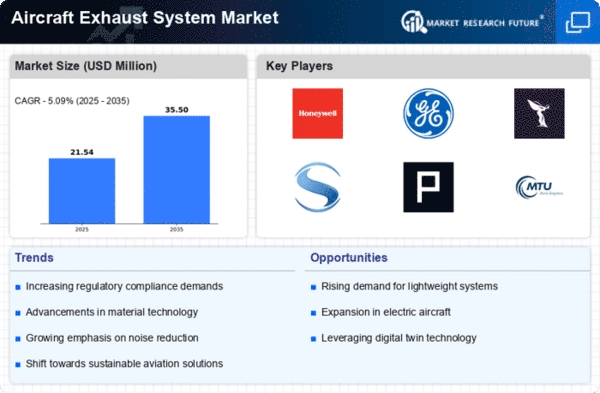
As per MRFR analysis, the Aircraft Exhaust System Market Size was estimated at 20.5 USD Million in 2024. The Aircraft Exhaust System industry is projected to grow from 21.6 in 2025 to 35.5 by 2035, exhibiting a compound annual growth rate (CAGR) of 5.09 during the forecast period 2025 - 2035.

Key Market Trends & Highlights

The Aircraft Exhaust System Market is poised for growth driven by sustainability and technological advancements.

  • North America remains the largest market for aircraft exhaust systems, reflecting robust demand across various aviation sectors.
  • Asia-Pacific is emerging as the fastest-growing region, fueled by increasing air travel and fleet expansion.
  • The commercial aviation segment dominates the market, while military aviation is experiencing rapid growth due to heightened defense spending.
  • Key market drivers include the increasing demand for fuel efficiency and regulatory pressures for emission reductions.

Market Size & Forecast

2024 Market Size 20.5 (USD Million)
2035 Market Size 35.5 (USD Million)
CAGR (2025 - 2035) 5.09%
Largest Regional Market Share in 2024 North America

Major Players

<p>Honeywell International Inc. (US), General Electric Company (US), Rolls-Royce Holdings plc (GB), Safran S.A. (FR), MTU Aero Engines AG (DE), Pratt & Whitney (US), Boeing Company (US), Thales Group (FR), United Technologies Corporation (US)</p>

Market Trends

The Aircraft Exhaust System Market is currently experiencing a transformative phase, driven by advancements in technology and increasing environmental regulations. Manufacturers are focusing on developing lightweight and efficient exhaust systems that not only enhance performance but also reduce emissions. This shift is largely influenced by the growing demand for sustainable aviation solutions, as stakeholders seek to minimize the ecological footprint of air travel. Furthermore, the integration of innovative materials and designs is expected to play a crucial role in shaping the future of this market. As the industry evolves, collaboration between aerospace manufacturers and regulatory bodies appears essential to ensure compliance with stringent environmental standards. In addition, the Aircraft Exhaust System Market is witnessing a rise in the adoption of electric and hybrid aircraft, which necessitates the development of specialized exhaust systems. These systems must cater to the unique requirements of new propulsion technologies, indicating a potential shift in design paradigms. The focus on enhancing fuel efficiency and reducing noise pollution is likely to drive further innovation in exhaust system technologies. Overall, the market seems poised for growth, with opportunities emerging from both traditional and novel aircraft designs, as well as from the increasing emphasis on sustainability in aviation practices.

Sustainability Initiatives

The Aircraft Exhaust System Market is increasingly influenced by sustainability initiatives, as manufacturers strive to create eco-friendly solutions. This trend reflects a broader commitment to reducing carbon emissions and enhancing fuel efficiency, aligning with global environmental goals.

Technological Advancements

Technological advancements are reshaping the Aircraft Exhaust System Market, with innovations in materials and design leading to improved performance. These developments may enhance the durability and efficiency of exhaust systems, catering to the evolving needs of the aviation sector.

Regulatory Compliance

Regulatory compliance is becoming a critical factor in the Aircraft Exhaust System Market, as governments implement stricter emissions standards. This trend compels manufacturers to adapt their products to meet these requirements, fostering a culture of continuous improvement and innovation.

Aircraft Exhaust System Market Market Drivers

Market Trends and Projections

The Global Aircraft Exhaust System Market Industry is characterized by dynamic trends and projections that reflect its growth trajectory. The market is anticipated to reach 899.9 USD Million in 2024, with expectations of expanding to 2169.9 USD Million by 2035. This growth is underpinned by a compound annual growth rate of 8.33% from 2025 to 2035. Factors such as increasing demand for fuel efficiency, regulatory compliance, and technological advancements are driving this upward trend. The market's evolution is indicative of broader shifts within the aviation industry, as stakeholders adapt to changing consumer preferences and environmental considerations.

Emerging Markets and Globalization

The Global Aircraft Exhaust System Market Industry is benefiting from the globalization of air travel and the emergence of new markets. Countries in Asia-Pacific and Latin America are witnessing rapid growth in their aviation sectors, driven by rising disposable incomes and increased connectivity. This expansion presents opportunities for manufacturers to tap into these burgeoning markets, thereby driving demand for advanced exhaust systems. As these regions develop their aviation infrastructure, the market is poised for growth, potentially achieving a compound annual growth rate of 8.33% from 2025 to 2035. The globalization of air travel is likely to further enhance the industry's prospects.

Increasing Demand for Fuel Efficiency

The Global Aircraft Exhaust System Market Industry is experiencing a notable surge in demand for fuel-efficient aircraft. Airlines and manufacturers are increasingly prioritizing technologies that enhance fuel economy, as fuel costs represent a substantial portion of operational expenses. The integration of advanced exhaust systems contributes to improved engine performance and reduced emissions, aligning with global sustainability goals. As a result, the market is projected to reach 899.9 USD Million in 2024, reflecting a growing emphasis on environmentally friendly aviation solutions. This trend is likely to continue, with the industry expected to evolve significantly by 2035, when the market could expand to 2169.9 USD Million.

Growth of the Commercial Aviation Sector

The Global Aircraft Exhaust System Market Industry is closely tied to the expansion of the commercial aviation sector. As air travel demand continues to rise globally, airlines are investing in new aircraft and retrofitting existing fleets with modern exhaust systems. This growth is driven by increasing passenger numbers and the need for more efficient aircraft to meet market demands. The commercial aviation sector's expansion is expected to propel the market forward, with projections indicating a market size of 899.9 USD Million in 2024. This trend is likely to persist, as the industry adapts to evolving consumer preferences and technological advancements.

Technological Advancements in Exhaust Systems

Technological innovation plays a pivotal role in shaping the Global Aircraft Exhaust System Market Industry. The development of advanced materials and designs enhances the efficiency and performance of exhaust systems. Innovations such as noise reduction technologies and lightweight materials contribute to overall aircraft performance, thereby attracting manufacturers to invest in these advancements. As the industry embraces cutting-edge technologies, the market is expected to witness substantial growth. The integration of these technologies not only improves operational efficiency but also aligns with the industry's commitment to sustainability, potentially driving the market towards a valuation of 2169.9 USD Million by 2035.

Regulatory Compliance and Environmental Standards

The Global Aircraft Exhaust System Market Industry is significantly influenced by stringent regulatory frameworks aimed at reducing aviation emissions. Governments worldwide are implementing more rigorous environmental standards, compelling manufacturers to innovate and adapt their exhaust systems accordingly. Compliance with these regulations not only ensures operational legitimacy but also enhances the marketability of aircraft. As airlines strive to meet these evolving standards, the demand for advanced exhaust systems is likely to escalate. This regulatory pressure serves as a catalyst for growth, potentially contributing to a compound annual growth rate of 8.33% from 2025 to 2035, as the industry aligns with global sustainability initiatives.

Market Segment Insights

By Application: Commercial Aviation (Largest) vs. Military Aviation (Fastest-Growing)

<p>In the Aircraft Exhaust System Market, the application segments reveal a competitive landscape where Commercial Aviation holds the largest share, driven by a high volume of global air travel and fleet modernization. Military Aviation, while currently smaller in terms of market share, is rapidly gaining traction as defense budgets increase and modernization initiatives are prioritized, indicating a shift in military procurement strategies.</p>

<p>Commercial Aviation: Dominant vs. Military Aviation: Emerging</p>

<p>Commercial Aviation is characterized by its broad customer base ranging from legacy carriers to low-cost airlines, necessitating advanced and efficient aircraft exhaust systems to meet regulatory and environmental standards. On the other hand, Military Aviation is emerging with heightened defense spending, focusing on technological upgrades and enhanced performance systems to improve aircraft efficiency. As nations invest in military capabilities, the demand for sophisticated exhaust systems tailored for military applications is expected to surge, providing a unique growth opportunity for market players in this sector.</p>

By Exhaust Type: Turbojet (Largest) vs. Turbofan (Fastest-Growing)

<p>The Aircraft Exhaust System Market is significantly influenced by various exhaust types, with turbojet engines currently holding the largest market share due to their application in military and commercial aviation. Turbofan engines are gaining traction, particularly in the commercial sector, leading to increased market competition between these two segments. As aviation evolves, the demand for efficient and high-thrust solutions drives market dynamics among these exhaust types, presenting numerous opportunities for innovation and expansion in the sector. Growth trends indicate that turbofan engines are emerging as the fastest-growing segment in the market. This growth can be attributed to advancements in engine technologies that enhance fuel efficiency and reduce emissions. Moreover, stringent environmental regulations and the industry's shift towards sustainable aviation solutions are propelling the adoption of turbofan engines, which are known for their performance and reliability. As the market adapts, turbojet engines will continue to play a vital role while turbofan technology takes center stage in future developments.</p>

<p>Turbojet (Dominant) vs. Turboprop (Emerging)</p>

<p>Turbojet engines dominate the Aircraft Exhaust System Market due to their proven reliability and power, particularly in high-speed applications like military jets and business aircraft. These engines are characterized by their ability to deliver high thrust-to-weight ratios, making them suitable for supersonic speeds. In contrast, turboprop engines are emerging as a competitive alternative, especially in regional aviation. They offer efficiency advantages at lower speeds and shorter distances, appealing to airlines focusing on cost-effective operations. The growth of turboprop technology is also bolstered by innovations that enhance fuel efficiency, making it an attractive option for both operators and manufacturers. The juxtaposition of these two technologies highlights the diversification of the market in response to varying operational needs.</p>

By Material Type: Stainless Steel (Largest) vs. Titanium (Fastest-Growing)

<p>In the Aircraft Exhaust System Market, the material type segments showcase a diverse distribution with stainless steel being the largest contributor due to its excellent strength-to-weight ratio and corrosion resistance. Titanium and Inconel are notable for their high-temperature performance, however, titanium is quickly gaining traction as a preferred choice due to its lightweight nature and strength, which enhances fuel efficiency in aerospace applications. Aluminum and composite materials, while essential, occupy a smaller share, focusing on weight reduction and cost efficiency ultimately enhancing the overall performance of aircraft exhaust systems. The growth trends within this segment are primarily driven by the aerospace industry's constant demand for lightweight, durable materials that improve overall operational efficiency and fuel economy. The shift towards more environmentally friendly solutions also propels titanium as the fastest-growing material, favored for its recyclability and lower carbon footprint. Furthermore, advances in manufacturing technologies, such as 3D printing, facilitate better material utilization and performance, thereby driving the adoption of innovative materials like composites in aircraft exhaust systems.</p>

<p>Stainless Steel (Dominant) vs. Composite Materials (Emerging)</p>

<p>Stainless steel has carved out a dominant position in the Aircraft Exhaust System Market due to its unmatched durability, resistance to oxidation, and capability to withstand high temperatures. Its properties make it an ideal choice for exhaust systems that endure harsh operational environments. On the other hand, composite materials are emerging as a noteworthy option among manufacturers aiming to achieve weight reduction without compromising structural integrity. Composites offer the potential for advanced thermal management and corrosion resistance, appealing to modern aircraft designs that prioritize fuel efficiency and lower emissions. As the market progresses, a balance between these materials may emerge, optimizing performance while addressing environmental concerns.</p>

By System Type: Integrated Exhaust System (Largest) vs. Afterburner Exhaust System (Fastest-Growing)

<p>In the Aircraft Exhaust System Market, the Integrated Exhaust System holds the largest market share among the various system types. It is widely favored in modern aircraft designs due to its compact nature and efficiency, which contribute to overall aircraft performance. Following this, the Afterburner Exhaust System is experiencing rapid growth, driven by the increased demand for high-speed aircraft and military jets that require enhanced thrust capabilities during flight. As the aviation industry advances, these systems play a crucial role in boosting performance while adhering to contemporary regulations. The growth trends indicate a shift towards more efficient and integrated solutions in aircraft design. The demand for noise reduction and fuel efficiency is pushing manufacturers to innovate further within the Integrated Exhaust System segment. Meanwhile, the Afterburner Exhaust System's emergence is aligning with technological advancements in propulsion systems, signaling increased investment in high-performance aircraft. Hence, as aviation technology evolves, these system types are likely to significantly impact market dynamics.</p>

<p>Integrated Exhaust System (Dominant) vs. Afterburner Exhaust System (Emerging)</p>

<p>The Integrated Exhaust System is positioned as the dominant segment within the Aircraft Exhaust System Market due to its ability to optimize fuel efficiency and minimize space in aircraft designs. This system integrates exhaust management with the overall engine architecture, facilitating reduced weight and enhanced aerodynamic performance. On the other hand, the Afterburner Exhaust System is emerging rapidly, primarily due to its role in maximizing thrust in supersonic and high-performance jets. Its design allows for additional fuel to be burned in the exhaust stream, significantly increasing engine power. Both systems cater to distinct operational needs in aerospace, with the Integrated Exhaust System focusing on efficiency and weight reduction, while the Afterburner Exhaust System aims for speed and power in military and advanced aviation applications.</p>

Get more detailed insights about Aircraft Exhaust System Market Research Report – Global Forecast till 2035

Regional Insights

North America : Market Leader in Innovation

North America continues to lead the Aircraft Exhaust System market, holding a significant share of 10.5 in 2024. The region's growth is driven by increasing air travel demand, advancements in aerospace technology, and stringent environmental regulations promoting fuel efficiency. The presence of major manufacturers and a robust supply chain further bolster market expansion. The United States is the primary contributor, with key players like Honeywell International Inc., General Electric Company, and Pratt & Whitney driving innovation. The competitive landscape is characterized by continuous R&D investments and collaborations among industry leaders, ensuring North America's dominance in the global market.

Europe : Emerging Market with Potential

Europe's Aircraft Exhaust System market is projected to grow, with a market size of 5.0 in 2024. The region benefits from a strong aerospace sector, driven by increasing demand for fuel-efficient aircraft and compliance with EU regulations on emissions. The European Union's commitment to sustainability and innovation in aviation technology acts as a catalyst for market growth. Leading countries like Germany, France, and the UK are at the forefront, hosting major players such as Rolls-Royce Holdings plc and Safran S.A. The competitive landscape is marked by strategic partnerships and technological advancements, positioning Europe as a key player in the global market. "The European aviation sector is committed to reducing its environmental impact, aiming for a 50% reduction in CO2 emissions by 2050."

Asia-Pacific : Rapidly Growing Aviation Hub

The Asia-Pacific region is witnessing rapid growth in the Aircraft Exhaust System market, with a size of 4.0 in 2024. Factors such as increasing air travel, rising disposable incomes, and government initiatives to enhance aviation infrastructure are driving this growth. Additionally, the region's focus on modernizing its fleet to meet international standards is a significant demand driver. Countries like China, India, and Japan are leading the charge, with a growing number of aircraft manufacturers and suppliers entering the market. The competitive landscape is evolving, with both established players and new entrants striving to capture market share, making Asia-Pacific a dynamic region for aircraft exhaust systems.

Middle East and Africa : Emerging Market Opportunities

The Middle East and Africa region, with a market size of 1.0 in 2024, presents emerging opportunities in the Aircraft Exhaust System market. The growth is fueled by increasing investments in aviation infrastructure and a rising number of air travelers. Additionally, government initiatives aimed at enhancing regional connectivity and promoting tourism are expected to drive demand for new aircraft. Countries like the UAE and South Africa are leading the market, with significant investments in aviation projects. The competitive landscape is characterized by collaborations between local and international players, aiming to leverage the region's growth potential. "The Middle East is set to become a global aviation hub, with investments exceeding $100 billion in airport infrastructure by 2030."

Key Players and Competitive Insights

The Aircraft Exhaust System Market is currently characterized by a competitive landscape that is both dynamic and multifaceted. Key growth drivers include the increasing demand for fuel-efficient aircraft, stringent environmental regulations, and advancements in aerospace technology. Major players such as Honeywell International Inc. (US), General Electric Company (US), and Rolls-Royce Holdings plc (GB) are strategically positioned to leverage these trends. Honeywell International Inc. (US) focuses on innovation in materials and design to enhance performance, while General Electric Company (US) emphasizes digital transformation and predictive maintenance solutions. Rolls-Royce Holdings plc (GB) is actively pursuing partnerships to expand its technological capabilities, thereby shaping a competitive environment that is increasingly reliant on advanced engineering and collaborative efforts.

In terms of business tactics, companies are localizing manufacturing to reduce costs and optimize supply chains, which is particularly relevant in a moderately fragmented market. The collective influence of these key players is significant, as they not only drive technological advancements but also set industry standards that smaller firms must adhere to. This competitive structure fosters an environment where innovation is paramount, and companies are incentivized to differentiate themselves through unique offerings and operational efficiencies.

In November 2025, Honeywell International Inc. (US) announced a partnership with a leading aerospace manufacturer to develop next-generation exhaust systems that utilize advanced composite materials. This strategic move is expected to enhance fuel efficiency and reduce emissions, aligning with global sustainability goals. The collaboration signifies Honeywell's commitment to innovation and positions it favorably in a market increasingly focused on environmental impact.

In October 2025, General Electric Company (US) unveiled a new digital platform designed to optimize the performance of aircraft exhaust systems through real-time data analytics. This initiative not only enhances operational efficiency but also provides customers with predictive maintenance capabilities, thereby reducing downtime. The introduction of this platform underscores General Electric's focus on integrating digital solutions into traditional aerospace manufacturing, potentially setting a new standard in the industry.

In September 2025, Rolls-Royce Holdings plc (GB) completed a strategic acquisition of a technology firm specializing in AI-driven exhaust system monitoring solutions. This acquisition is likely to bolster Rolls-Royce's capabilities in predictive analytics, enabling more efficient maintenance schedules and improved system reliability. Such strategic actions reflect a broader trend within the industry towards leveraging AI and machine learning to enhance product offerings and operational efficiencies.

As of December 2025, current competitive trends are increasingly defined by digitalization, sustainability, and the integration of AI technologies. Strategic alliances are becoming more prevalent, as companies recognize the need to collaborate in order to innovate effectively. The competitive differentiation is shifting from price-based strategies to a focus on technological advancement, reliability, and sustainability. This evolution suggests that future competition will hinge on the ability to deliver innovative solutions that meet the growing demands of both regulatory bodies and environmentally conscious consumers.

Key Companies in the Aircraft Exhaust System Market market include

Industry Developments

Future Outlook

Aircraft Exhaust System Market Future Outlook

<p>The Aircraft Exhaust System Market is projected to grow at a 5.09% CAGR from 2024 to 2035, driven by advancements in fuel efficiency, regulatory compliance, and increasing air travel demand.</p>

New opportunities lie in:

  • <p>Development of lightweight composite materials for exhaust systems.</p>
  • <p>Integration of advanced noise reduction technologies in designs.</p>
  • <p>Expansion into emerging markets with tailored exhaust solutions.</p>

<p>By 2035, the market is expected to achieve robust growth, reflecting evolving industry standards and technological advancements.</p>

Market Segmentation

Aircraft Exhaust System Market Application Outlook

  • Commercial Aviation
  • Military Aviation
  • General Aviation
  • Cargo Transport
  • Business Aviation

Aircraft Exhaust System Market System Type Outlook

  • Integrated Exhaust System
  • Separate Exhaust System
  • Afterburner Exhaust System
  • Noise Reduction System
  • Heat Exchanger System

Aircraft Exhaust System Market Exhaust Type Outlook

  • Turbojet
  • Turbofan
  • Turboprop
  • Piston Engine
  • Rocket Engine

Aircraft Exhaust System Market Material Type Outlook

  • Stainless Steel
  • Titanium
  • Inconel
  • Aluminum
  • Composite Materials

Report Scope

MARKET SIZE 202420.5(USD Million)
MARKET SIZE 202521.6(USD Million)
MARKET SIZE 203535.5(USD Million)
COMPOUND ANNUAL GROWTH RATE (CAGR)5.09% (2024 - 2035)
REPORT COVERAGERevenue Forecast, Competitive Landscape, Growth Factors, and Trends
BASE YEAR2024
Market Forecast Period2025 - 2035
Historical Data2019 - 2024
Market Forecast UnitsUSD Million
Key Companies ProfiledHoneywell International Inc. (US), General Electric Company (US), Rolls-Royce Holdings plc (GB), Safran S.A. (FR), MTU Aero Engines AG (DE), Pratt & Whitney (US), Boeing Company (US), Thales Group (FR), United Technologies Corporation (US)
Segments CoveredApplication, Exhaust Type, Material Type, System Type
Key Market OpportunitiesIntegration of advanced materials for lightweight, high-performance Aircraft Exhaust Systems enhances fuel efficiency and reduces emissions.
Key Market DynamicsTechnological advancements in materials and design enhance efficiency and reduce emissions in aircraft exhaust systems.
Countries CoveredNorth America, Europe, APAC, South America, MEA

FAQs

What is the CAGR global Aircraft Exhaust System Market expects to witness in the future?

Global Aircraft Exhaust System Market Grow at a CAGR Of 8.33% by 2024 -2032

Name some of the top market players of the global aircraft exhaust system market.

Aircelle (part of Safran SA (France), Doncasters Group Ltd. (UK), Collins Aerospace (a part of United Technologies Corporation), GKN Aerospace (UK) are some of the top players of the global acoustic vehicle alerting systems market.

What is the primary growth factor for the Aircraft Exhaust System Market?

The main growth factor for the global Aircraft Exhaust System Market is attributed to the expansion in global air travel and successive demand for new commercial aircraft.

Which region is leading with the high market shares globally?

North America is the leading region for the global aircraft exhaust system market.

  1. Executive Summary
  2. Market Introduction
    1. Market Definition
    2. Scope of the Study
    3. Market Structure
    4. Key Takeaways
    5. Key Buying Criteria
  3. Research Methodology
    1. Research Process
    2. Primary Research
    3. Secondary Research
    4. Market Size Estimation
    5. Forecast Model
    6. List of Assumptions
    7. Limitations
  4. Market Landscape
    1. Porter’s Five Forces Analysis
      1. Threat of New Entrants
      2. Bargaining Power of Buyers
      3. Threat of Substitutes
      4. Segment Rivalry
      5. Bargaining Power of Supplies
    2. Value Chain/Supply Chain Analysis
  5. Market Dynamics
    1. Introduction
    2. Market Drivers
    3. Market Restraints
    4. Market Opportunities
  6. Industry Dynamics
    1. Technology Trend
    2. Regulatory Landscape
    3. Patent Analysis Outlook
  7. Global Aircraft Exhaust System Market, by Application
    1. Introduction
    2. Civil Aviation
      1. Market Estimates & Forecast, 2020–2030
      2. Market Estimates & Forecast, by Region, 2020–2030
    3. Military Aviation
      1. Market Estimates & Forecast, 2020–2030
      2. Market Estimates & Forecast, by Region, 2020–2030
  8. Global Aircraft Exhaust System Market, by End-User
    1. Introduction
    2. OEM
      1. Market Estimates & Forecast, 2020–2030
      2. Market Estimates & Forecast, by Region, 2020–2030
    3. Aftermarket
      1. Market Estimates & Forecast, 2020–2030
      2. Market Estimates & Forecast, by Region, 2020–2030
  9. Global Aircraft Exhaust System Market, by Engine Type
    1. Introduction
    2. Turbine Engine
      1. Market Estimates & Forecast, 2020–2030
      2. Market Estimates & Forecast, by Region, 2020–2030
    3. Piston Engine
      1. Market Estimates & Forecast, 2020–2030
      2. Market Estimates & Forecast, by Region, 2020–2030
    4. APU
      1. Market Estimates & Forecast, 2020–2030
      2. Market Estimates & Forecast, by Region, 2020–2030
  10. Global Aircraft Exhaust System Market, by Region
    1. Introduction
    2. North America
      1. Market Estimates & Forecast, by Country, 2020–2030
      2. Market Estimates & Forecast, by Application, 2020–2030
      3. Market Estimates & Forecast, by End-User, 2020–2030
      4. Market Estimates & Forecast, by Engine Type, 2020–2030
      5. US
      6. Canada
    3. Europe
      1. Market Estimates & Forecast, by Country, 2020–2030
      2. Market Estimates & Forecast, by Application, 2020–2030
      3. Market Estimates & Forecast, by End-User, 2020–2030
      4. Market Estimates & Forecast, by Engine Type, 2020–2030
      5. UK
      6. Germany
      7. France
      8. Russia
      9. Rest of Europe
    4. Asia-Pacific
      1. Market Estimates & Forecast, by Country, 2020–2030
      2. Market Estimates & Forecast, by Application, 2020–2030
      3. Market Estimates & Forecast, by End-User, 2020–2030
      4. Market Estimates & Forecast, by Engine Type, 2020–2030
      5. China
      6. Japan
      7. India
      8. Rest of Asia-Pacific
    5. Rest of the World
      1. Market Estimates & Forecast, by Region, 2020–2030
      2. Market Estimates & Forecast, by Application, 2020–2030
      3. Market Estimates & Forecast, by End-User, 2020–2030
      4. Market Estimates & Forecast, by Engine Type, 2020–2030
      5. Middle East & Africa
      6. Latin America
  11. Competitive Landscape
    1. Competitive Scenario
    2. Competitive Overview
    3. Competitive Benchmarking
    4. Market Share Analysis
  12. Company Profiles
    1. Aerobraze Engineered Technologies (a part of Wall Colmonoy Corporation)
      1. Company Overview
      2. Product Offering
      3. Financial Overview
      4. Key Developments
      5. Swot Analysis
      6. Strategy
    2. Aircelle (part of Safran SA)
      1. Company Overview
      2. Product Offering
      3. Financial Overview
      4. Key Developments
      5. Swot Analysis
      6. Strategy
    3. Collins Aerospace (a part of United Technologies Corporation)
      1. Company Overview
      2. Product Offering
      3. Financial Overview
      4. Key Developments
      5. Swot Analysis
      6. Strategy
    4. Doncasters Group Ltd.
      1. Company Overview
      2. Product Offering
      3. Financial Overview
      4. Key Developments
      5. Swot Analysis
      6. Strategy
    5. Esterline Technologies Corporation
      1. Company Overview
      2. Product Offering
      3. Financial Overview
      4. Key Developments
      5. Swot Analysis
      6. Strategy
    6. GKN Aerospace
      1. Company Overview
      2. Product Offering
      3. Financial Overview
      4. Key Developments
      5. Swot Analysis
      6. Strategy
    7. Magellan Aerospace Corporation
      1. Company Overview
      2. Product Offering
      3. Financial Overview
      4. Key Developments
      5. Swot Analysis
      6. Strategy
    8. Nexcelle (a MRAS/Safran joint venture)
      1. Company Overview
      2. Product Offering
      3. Financial Overview
      4. Key Developments
      5. Swot Analysis
      6. Strategy
    9. Senior Aerospace
      1. Company Overview
      2. Product Offering
      3. Financial Overview
      4. Key Developments
      5. Swot Analysis
      6. Strategy
    10. Sky Dynamics Corporation
      1. Company Overview
      2. Product Offering
      3. Financial Overview
      4. Key Developments
      5. Swot Analysis
      6. Strategy
  13. Appendix
    1. List of Related Reports
    2. Abbreviations
    3. References
    4. List of Tables
  14. Global Aircraft Exhaust System Market, by Region, 2020–2030
  15. North America: Aircraft Exhaust System Market, by Country, 2020–2030
  16. Europe: Aircraft Exhaust System Market, by Country, 2020–2030
  17. Asia-Pacific: Aircraft Exhaust System Market, by Country, 2020–2030
  18. Rest of the World: Aircraft Exhaust System Market, by Region, 2020–2030
  19. Global Aircraft Exhaust System Application Market, by Region, 2020–2030
  20. North America: Aircraft Exhaust System Application Market, by Country, 2020–2030
  21. Europe: Aircraft Exhaust System Application Market, by Country, 2020–2030
  22. Asia-Pacific: Aircraft Exhaust System Application Market, by Country, 2020–2030
  23. Rest of the World: Aircraft Exhaust System Application Market, by Region, 2020–2030
  24. Global Aircraft Exhaust System End-User Market, by Region, 2020–2030
  25. North America: Aircraft Exhaust System End-User Market, by Country, 2020–2030
  26. Europe: Aircraft Exhaust System End-User Market, by Country, 2020–2030
  27. Asia-Pacific: Aircraft Exhaust System End-User Market, by Country, 2020–2030
  28. Rest of the World: Aircraft Exhaust System End-User Market, by Region, 2020–2030
  29. Global Aircraft Exhaust System Engine Type Market, by Region, 2020–2030
  30. North America: Aircraft Exhaust System Engine Type Market, by Country, 2020–2030
  31. Europe: Aircraft Exhaust System Engine Type Market, by Country, 2020–2030
  32. Asia-Pacific: Aircraft Exhaust System Engine Type Market, by Country, 2020–2030
  33. Rest of the World: Aircraft Exhaust System Engine Type Market, by Region, 2020–2030
  34. Global Aircraft Exhaust System Market, by Region, 2020–2030
  35. Global Aircraft Exhaust System Market, by Application, 2020–2030
  36. Global Aircraft Exhaust System Market, by End-User, 2020–2030
  37. Global Aircraft Exhaust System Market, by Engine Type, 2020–2030
  38. North America: Aircraft Exhaust System Market, by Country, 2020–2030
  39. North America: Aircraft Exhaust System Market, by Application, 2020–2030
  40. North America: Aircraft Exhaust System Market, by End-User, 2020–2030
  41. North America: Aircraft Exhaust System Market, by Engine Type, 2020–2030
  42. Europe: Aircraft Exhaust System Market, by Country, 2020–2030
  43. Europe: Aircraft Exhaust System Market, by Application, 2020–2030
  44. Europe: Aircraft Exhaust System Market, by End-User, 2020–2030
  45. Europe: Aircraft Exhaust System Market, by Engine Type, 2020–2030
  46. Asia-Pacific: Aircraft Exhaust System Market, by Country, 2020–2030
  47. Asia-Pacific: Aircraft Exhaust System Market, by Application, 2020–2030
  48. Asia-Pacific: Aircraft Exhaust System Market, by End-User, 2020–2030
  49. Asia-Pacific: Aircraft Exhaust System Market, by Engine Type, 2020–2030
  50. Rest of the World: Aircraft Exhaust System Market, by Region, 2020–2030
  51. Rest of the World: Aircraft Exhaust System Market, by Application, 2020–2030
  52. Rest of the World: Aircraft Exhaust System Market, by End-User, 2020–2030
  53. Rest of the World: Aircraft Exhaust System Market, by Engine Type, 2020–2030
    1. List Of Figures
  54. Research Process of MRFR
  55. Top-Down & Bottom-Up Approaches
  56. Market Dynamics
  57. Impact Analysis: Market Drivers
  58. Impact Analysis: Market Restraints
  59. Porter's Five Forces Analysis
  60. Value Chain Analysis
  61. Global Aircraft Exhaust System Market Share, by Application, 2020 (%)
  62. Global Aircraft Exhaust System Market, by Application, 2020–2030 (USD Million)
  63. Global Aircraft Exhaust System Market Share, by End-User, 2020 (%)
  64. Global Aircraft Exhaust System Market, by End-User, 2020–2030 (USD Million)
  65. Global Aircraft Exhaust System Market Share, by Engine Type, 2020 (%)
  66. Global Aircraft Exhaust System Market, by Engine Type, 2020–2030 (USD Million)
  67. Global Aircraft Exhaust System Market Share (%), By Region, 2020
  68. Global Aircraft Exhaust System Market, by Region, 2020–2030 (USD Million)
  69. North America: Aircraft Exhaust System Market Share (%), 2020
  70. North America: Aircraft Exhaust System Market by Country, 2020–2030 (USD Million)
  71. Europe: Aircraft Exhaust System Market Share (%), 2020
  72. Europe: Aircraft Exhaust System Market by Country, 2020–2030 (USD Million)
  73. Asia-Pacific: Aircraft Exhaust System Market Share (%), 2020
  74. Asia-Pacific: Aircraft Exhaust System Market by Country, 2020–2030 (USD Million)
  75. Rest of the World Aircraft Exhaust System Market Share (%), 2020
  76. Rest of the World Aircraft Exhaust System Market by Region, 2020–2030 (USD Million)

Aircraft Exhaust System Market Segmentation

Market Segmentation Overview

  • Detailed segmentation data will be available in the full report
  • Comprehensive analysis by multiple parameters
  • Regional and country-level breakdowns
  • Market size forecasts by segment
Infographic

Free Sample Request

Kindly complete the form below to receive a free sample of this Report

Get Free Sample

Customer Strories

Compare Licence

×
Features License Type
Single User Multiuser License Enterprise User
Price $4,950 $5,950 $7,250
Maximum User Access Limit 1 User Upto 10 Users Unrestricted Access Throughout the Organization
Free Customization
Direct Access to Analyst
Deliverable Format
Platform Access
Discount on Next Purchase 10% 15% 15%
Printable Versions