×
Request Free Sample ×

Kindly complete the form below to receive a free sample of this Report

* Please use a valid business email

Leading companies partner with us for data-driven Insights

clients tt-cursor
Hero Background
English
Chinese
French
Japanese
Korean
German
Spanish

Air Cargo Market Size

ID: MRFR/PCM/6799-HCR
133 Pages
Snehal Singh
February 2026

Air Cargo Market Research Report Information by Type (Air Freight and Air Mail), Service (Express and Regular), Destination (Domestic and International), End User (Retail, Food & Beverages, Pharmaceutical and Healthcare, Consumer Electronics, Automotive and others) and Region (North America, Europe, Asia-Pacific, Middle East & Africa and Latin America) - Forecast till 2035

Share:
Download PDF ×

We do not share your information with anyone. However, we may send you emails based on your report interest from time to time. You may contact us at any time to opt-out.

Air Cargo Market Infographic
Purchase Options

Air Cargo Size

Air Cargo Market Growth Projections and Opportunities

The market for air cargo is influenced by a number of market phenomena that determine its dynamics and performance. One important factor is the global economic situation. The need for air cargo services depends on the general health of the global economy. Consequently, when economies grow, businesses expand their operations, which in turn result in more trade and need to transport goods faster thereby raising the demand for air cargo. Conversely, an economic slowdown can reduce trade activities thus affecting the demand for air freight.

Fuel costs are one major factor shaping the landscape of air cargo markets. Fuel prices have a direct impact on operational costs of cargo carriers as aviation is inherently fuel-intensive. This increases pressure on profit margins for air cargo operators during spikes in fuel prices and could result in pricing strategy adjustment or improved operating efficiency to offset increased cost implications. Conversely, reduced fuel prices can help boost profit margins and may lead to growth within the sector.

Moreover, technological advances significantly affect the air cargo market as well. Developments in aircraft design, navigation systems and cargo handling technology increase efficiency and capacity in air transport services. Modern aircraft that use less fuel will enable cargos to be transported at lower costs thereby increasing competition among carriers. Additionally, advancements in tracking and monitoring technologies improve visibility into supply chains enhancing security concerns about timeliness related to carrying out airline transportation.

Capacity constraints and demand dynamics form part of intrinsic market factors within the airfreight industry. Changes in patterns of global trade or consumer preferences directly affect volumes of goods moved by planes internationally. During peak seasons or unexpected surges in demands there might be strains on capacity on services offered by airlines leading to increased prices along with possible disruptions within supply chain processes while low demands also tend to create excess capacities which then call for competitive pricing strategies from most Air Cargo Carriers.

Environmental issues have become increasingly relevant within the field of Air Cargo Market today. In order to achieve sustainability focus by the global community, there is a growing demand for the airline industry to reduce its carbon emission. Some airlines that have chosen to use environmentally friendly practices that enhance fuel-efficient aircraft have succeeded in gaining advantages over others. Moreover, environmental concerns also influence consumer preferences and may drive up demands for eco-friendly means of transport.

Air Cargo Market Size Graph
Author
Snehal Singh
Assistant Manager - Research

High acumen in analyzing complex macro & micro markets with more than 6 years of work experience in the field of market research. By implementing her analytical skills in forecasting and estimation into market research reports, she has expertise in Packaging, Construction, and Equipment domains. She handles a team size of 20-25 resources and ensures smooth running of the projects, associated marketing activities, and client servicing.

Leave a Comment

FAQs

What is the current valuation of The Global Air Cargo?

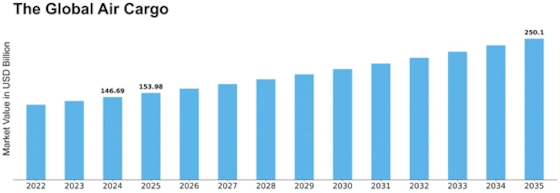
The Global Air Cargo was valued at 146.69 USD Billion in 2024.

What is the projected market size for The Global Air Cargo by 2035?

The market is projected to reach 250.1 USD Billion by 2035.

What is the expected CAGR for The Global Air Cargo during the forecast period 2025 - 2035?

The expected CAGR for The Global Air Cargo during 2025 - 2035 is 4.97%.

Which companies are considered key players in The Global Air Cargo?

Key players include DHL, FedEx, UPS, IAG Cargo, Lufthansa Cargo, Emirates SkyCargo, Qatar Airways Cargo, Singapore Airlines Cargo, and Cathay Pacific Cargo.

Market Summary

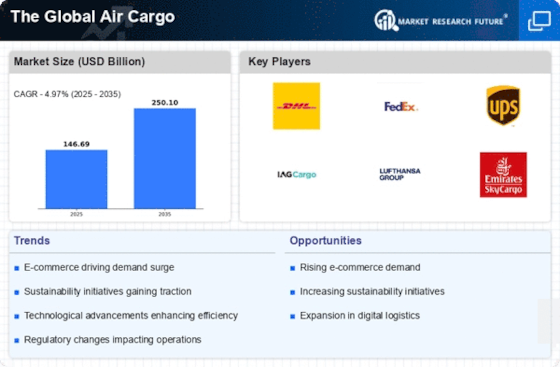
As per Market Research Future analysis, The Global Air Cargo Market Size was estimated at 146.69 USD Billion in 2024. The air cargo industry is projected to grow from 153.98 USD Billion in 2025 to 250.1 USD Billion by 2035, exhibiting a compound annual growth rate (CAGR) of 4.97% during the forecast period 2025 - 2035

Key Market Trends & Highlights

The Global Air Cargo Market is poised for robust growth driven by e-commerce and technological advancements.

  • The North American region remains the largest market for air cargo, driven by high consumer demand and established logistics networks. Asia-Pacific is emerging as the fastest-growing region, fueled by increasing e-commerce activities and expanding trade routes. Airmail continues to dominate as the largest segment, while air freight is rapidly gaining traction due to its efficiency and speed. Key market drivers include the expansion of e-commerce and rising consumer expectations for speed in delivery services.

Market Size & Forecast

2024 Market Size 146.69 (USD Billion)
2035 Market Size 250.1 (USD Billion)
CAGR (2025 - 2035) 4.97%
Largest Regional Market Share in 2024 Asia Pacific

Major Players

<p>DHL (DE), FedEx (US), UPS (US), IAG Cargo (GB), Lufthansa Cargo (DE), Emirates SkyCargo (AE), Qatar Airways Cargo (QA), Singapore Airlines Cargo (SG), Cathay Pacific Cargo (HK)</p>

Market Trends

The Global Air Cargo Market is currently experiencing a dynamic evolution, driven by various factors that shape its landscape. The increasing demand for expedited shipping solutions, particularly in e-commerce, appears to be a primary catalyst for growth. As businesses seek to enhance their supply chain efficiency, air freight emerges as a preferred option due to its speed and reliability. Furthermore, advancements in technology, such as automation and digitalization, seem to play a crucial role in optimizing operations within the sector. These innovations not only streamline processes but also improve tracking and visibility, which are essential for modern logistics. In addition to technological advancements, sustainability initiatives are gaining traction within The Global Air Cargo Market. Companies are increasingly focusing on reducing their carbon footprint and adopting eco-friendly practices. This shift towards greener operations may influence the choice of carriers and logistics partners, as stakeholders prioritize environmental responsibility. Overall, the interplay of these factors suggests a transformative period for The Global Air Cargo Market, where adaptability and innovation are likely to define future success.

E-commerce Growth

The rise of online shopping is reshaping The Global Air Cargo Market. As consumers increasingly prefer fast delivery options, businesses are compelled to utilize air freight services to meet these expectations. This trend indicates a shift in logistics strategies, emphasizing speed and efficiency.

Technological Advancements

Innovations in technology are revolutionizing The Global Air Cargo Market. Automation, artificial intelligence, and data analytics are enhancing operational efficiency and improving customer service. These advancements facilitate better tracking and management of shipments, which is crucial for maintaining competitiveness.

Sustainability Focus

There is a growing emphasis on sustainability within The Global Air Cargo Market. Companies are exploring eco-friendly practices and seeking to minimize their environmental impact. This trend may lead to the adoption of greener technologies and practices, influencing carrier selection and operational strategies.

Air Cargo Market Market Drivers

Regulatory Changes

Regulatory changes are influencing the dynamics of The Global Air Cargo Industry. Governments worldwide are implementing new policies aimed at enhancing air transport safety and security, which can impact operational procedures for air cargo carriers. For example, stricter customs regulations and security protocols may necessitate additional investments in compliance measures. However, these regulations can also create opportunities for growth by fostering a more secure and reliable air cargo environment. The ongoing evolution of international trade agreements and air transport regulations is likely to shape the competitive landscape, compelling companies to adapt their strategies to remain compliant while maximizing efficiency.

Rising Global Trade

The rise in The Global Air Cargo Industry. As countries increasingly engage in international trade, the demand for air freight services is expected to grow. In 2025, global trade volumes are anticipated to increase, with air cargo accounting for a substantial share of high-value goods transportation. This trend is particularly evident in sectors such as pharmaceuticals, electronics, and perishables, where speed and reliability are paramount. The air cargo industry is likely to benefit from this growth, as businesses seek to leverage air transport to meet the demands of a globalized economy and ensure timely delivery of goods.

E-commerce Expansion

The rapid expansion of e-commerce is a pivotal driver for The Global Air Cargo Industry. As online shopping continues to gain traction, the demand for swift and reliable delivery services has surged. In 2025, e-commerce sales are projected to reach approximately 6 trillion USD, necessitating efficient logistics solutions. Air cargo plays a crucial role in meeting the expectations of consumers for fast shipping, particularly for high-value and time-sensitive goods. This trend is likely to propel the air cargo sector, as companies seek to optimize their supply chains and enhance customer satisfaction. Furthermore, the increasing reliance on air freight for international shipments underscores the importance of this driver in shaping the future of The Global Air Cargo Industry.

Technological Innovations

Technological innovations are transforming The Global Air Cargo Industry, enhancing operational efficiency and service quality. The integration of advanced technologies such as artificial intelligence, blockchain, and IoT is streamlining logistics processes. For instance, AI-driven analytics can optimize route planning and inventory management, potentially reducing costs and improving delivery times. Moreover, the adoption of blockchain technology enhances transparency and security in cargo tracking, which is increasingly vital in a competitive market. As these technologies continue to evolve, they are expected to drive growth in the air cargo sector, enabling companies to respond more effectively to market demands and customer expectations.

Consumer Expectations for Speed

Consumer expectations for speed and reliability are driving changes in The Global Air Cargo Industry. As customers increasingly demand faster delivery times, air cargo services are becoming essential for businesses aiming to maintain competitive advantage. The expectation for same-day or next-day delivery is particularly pronounced in the e-commerce sector, where delays can lead to customer dissatisfaction. This shift in consumer behavior is prompting logistics providers to enhance their air freight capabilities, invest in infrastructure, and optimize their operations. Consequently, the air cargo market is likely to experience growth as companies strive to meet these evolving consumer demands and improve their service offerings.

Market Segment Insights

By Type: Airmail (Largest) vs. Air Freight (Fastest-Growing)

<p>The Global Air Cargo Market is primarily segmented into Airmail and Air Freight, with Airmail holding the largest market share due to its extensive adoption for shipping letters and small parcels globally. This segment has maintained its dominance owing to a growing e-commerce landscape that relies on quick delivery services. On the other hand, Air Freight represents a significant portion as well, driven by its capability to handle larger volumes of goods, particularly for international trade and perishable items that require swift transportation solutions.</p>

<p>Airmail (Dominant) vs. Air Freight (Emerging)</p>

<p>Airmail serves as a critical component of The Global Air Cargo Market, characterized by its efficiency in transporting letters, important documents, and small parcels. It is widely recognized for its quick delivery times and reliability, making it the preferred choice for individual and business communications alike. As e-commerce continues to expand, the Airmail segment remains dominant, thanks to its established mailing networks and partnerships with postal services worldwide. Conversely, Air Freight is emerging as a potent force in logistics, appealing to businesses that need to ship bulk products quickly across borders. This segment is propelled by increasing globalization and consumer demand for rapid delivery of various commodities, including electronics and fresh produce.</p>

By Service: Express Service (Largest) vs. Normal Service (Fastest-Growing)

<p>In The Global Air Cargo Market, the service segment showcases a significant distribution where Express Service has emerged as the largest contributor. It commands a substantial market share due to its efficiency and reliability, making it the preferred choice for time-sensitive shipments. Conversely, Normal Service, while currently smaller in share, is gaining traction as businesses seek cost-effective options for non-urgent deliveries, highlighting a shift in consumer behavior.</p>

<p>Service: Express (Dominant) vs. Normal (Emerging)</p>

<p>Express Service dominates The Global Air Cargo Market by offering swift delivery options that cater to businesses requiring immediate transportation of goods. This service is characterized by its speed, with deliveries often completed within 24 hours, making it essential for sectors like e-commerce and pharmaceuticals. On the other hand, Normal Service is positioned as an emerging alternative, appealing to cost-conscious customers looking for budget-friendly solutions without immediate urgency. Its growth is bolstered by increasing global trade and ecommerce, where affordable logistics solutions are gaining importance.</p>

By Destination: International Market (Largest) vs. Domestic Market (Fastest-Growing)

<p>In The Global Air Cargo Market, the distribution of market share between the International and Domestic markets illustrates significant dynamics. The International Market dominates the segment, driven by increased global trade and e-commerce, offering broader opportunities for logistics companies. Conversely, the Domestic Market is gaining traction, propelled by rising consumer demand and efficiency in logistics, leading to robust competition among air freight services.</p>

<p>Air Cargo Market: International Market (Dominant) vs. Domestic Market (Emerging)</p>

<p>The International Market within the air cargo segment is characterized by its substantial volume of cross-border shipments, serving multinational corporations and e-commerce giants. It benefits from established global trade routes and sophisticated logistics networks, ensuring timely delivery across regions. On the other hand, the Domestic Market is rapidly evolving, reflecting a shift in consumer behavior towards online shopping and same-day deliveries. This segment is marked by innovation, with logistics providers increasingly adopting technology to enhance operational efficiency and service quality, positioning it as a critical area for growth in the air cargo industry.</p>

By End-Users: Pharmaceutical and Healthcare (Largest) vs. Consumer Electronics (Fastest-Growing)

<p>In The Global Air Cargo Market, the distribution of market share among end-user segments reveals that the Pharmaceutical and Healthcare sector holds a significant portion, due to its reliance on time-sensitive and temperature-controlled shipments. Coupled with robust regulations and stringent quality control standards, this segment has established itself as a key driver of air cargo demand. Following closely, the Consumer Electronics sector exhibits a noteworthy presence, driven by the constant technological advancements and the rapid launch cycles that necessitate swift logistics solutions.</p>

<p>Pharmaceutical and Healthcare: Dominant vs. Consumer Electronics: Emerging</p>

<p>The Pharmaceutical and Healthcare segment is characterized by its high value and critical nature of products, requiring specialized handling and expedited transport. This sector includes vaccines, medical devices, and pharmaceuticals that must adhere to strict safety regulations, making air cargo an ideal choice for timely delivery. In contrast, the Consumer Electronics segment, while currently emerging, is experiencing rapid growth due to continuous innovation and the increasing popularity of e-commerce. Companies in this field demand an agile and responsive logistics network that can handle frequent shipments of high-demand products, resulting in a dynamic and evolving market landscape.</p>

Get more detailed insights about Air Cargo Market Research Report - Global Forecast till 2035

Regional Insights

North America : Logistics Powerhouse

North America is the largest market for air cargo, accounting for approximately 40% of the global share. The region's growth is driven by increasing e-commerce activities, demand for expedited shipping, and advancements in logistics technology. Regulatory support, such as the FAA's initiatives to enhance air traffic management, further catalyzes market expansion. The U.S. remains the dominant player, followed by Canada, which contributes significantly to the overall market growth. The competitive landscape in North America is characterized by major players like FedEx, UPS, and DHL, which dominate the market with extensive networks and advanced logistics solutions. The presence of these key players ensures a robust infrastructure for air cargo services. Additionally, the region benefits from a well-developed airport system and strategic geographic positioning, facilitating efficient trade routes and enhancing service delivery.

Europe : Regulatory Framework Enhancements

Europe is the second-largest market for air cargo, holding around 30% of the global market share. The region's growth is fueled by increasing international trade, regulatory improvements, and a strong focus on sustainability in logistics. The European Union's initiatives to streamline customs processes and enhance air transport regulations are pivotal in driving market demand. Countries like Germany and the UK lead the market, supported by their robust logistics infrastructure and strategic locations. Leading countries in Europe include Germany, the UK, and France, with key players such as Lufthansa Cargo and IAG Cargo dominating the landscape. The competitive environment is marked by a mix of established carriers and emerging players, all striving to innovate and improve service offerings. The region's commitment to sustainability and efficiency in air cargo operations positions it well for future growth, ensuring resilience in a dynamic market.

Asia-Pacific : Emerging Market Dynamics

Asia-Pacific is witnessing rapid growth in the air cargo market, accounting for approximately 25% of the global share. The region's expansion is driven by increasing demand for e-commerce, rising manufacturing activities, and investments in logistics infrastructure. Countries like China and India are at the forefront, with significant contributions to the overall market growth. Regulatory support, including the liberalization of air transport agreements, is enhancing connectivity and facilitating trade. China is the largest market in the region, followed by India, both of which are home to major logistics hubs. Key players such as Singapore Airlines Cargo and Cathay Pacific Cargo are pivotal in shaping the competitive landscape. The presence of these carriers, along with emerging logistics companies, is fostering innovation and efficiency in air cargo operations, positioning Asia-Pacific as a critical player in the global market.

Middle East and Africa : Strategic Trade Routes

The Middle East and Africa region is emerging as a significant player in The Global Air Cargo Market, holding around 5% of the total share. The growth is driven by strategic geographic positioning, facilitating trade between Europe, Asia, and Africa. The region's investment in airport infrastructure and logistics capabilities is enhancing its attractiveness for air cargo operations. Countries like the UAE and South Africa are leading the market, supported by favorable regulations and government initiatives. The UAE, particularly Dubai, serves as a major logistics hub, with Emirates SkyCargo playing a crucial role in the competitive landscape. South Africa is also gaining traction, with key players expanding their operations. The region's focus on developing air cargo capabilities and enhancing connectivity is expected to drive future growth, making it a vital area for global trade and logistics.

Key Players and Competitive Insights

The Global Air Cargo is currently characterized by a dynamic competitive landscape, driven by increasing demand for efficient logistics solutions and the ongoing globalization of trade. Major players such as DHL (DE), FedEx (US), and Emirates SkyCargo (AE) are strategically positioning themselves through a combination of technological innovation, regional expansion, and enhanced service offerings. These companies are not only focusing on optimizing their operational efficiencies but are also investing in digital transformation initiatives to improve customer experience and streamline supply chains. The collective strategies of these key players contribute to a moderately fragmented market structure, where competition is intensifying as firms seek to differentiate themselves through service quality and reliability.In terms of business tactics, companies are increasingly localizing their operations to better serve regional markets while optimizing their supply chains to enhance responsiveness. The competitive structure of the air cargo market appears to be moderately fragmented, with several key players exerting significant influence. This fragmentation allows for a variety of service offerings, catering to diverse customer needs, while also fostering innovation as companies strive to capture market share.


In September FedEx (US) announced a strategic partnership with a leading technology firm to enhance its AI-driven logistics solutions. This collaboration aims to leverage advanced analytics and machine learning to optimize route planning and improve delivery times. The strategic importance of this move lies in FedEx's commitment to maintaining its competitive edge through technological advancements, which are increasingly becoming a prerequisite for success in the air cargo sector.


In August Emirates SkyCargo (AE) unveiled a new sustainability initiative aimed at reducing carbon emissions across its operations. This initiative includes the introduction of more fuel-efficient aircraft and the implementation of sustainable aviation fuel (SAF) in its fleet. The significance of this action reflects a broader industry trend towards sustainability, as companies recognize the importance of environmental responsibility in enhancing their brand image and meeting regulatory requirements.


In July DHL (DE) expanded its global network by launching new routes to underserved markets in Africa and South America. This expansion is strategically important as it not only increases DHL's market presence but also positions the company to capitalize on the growing demand for air cargo services in emerging economies. By enhancing its global footprint, DHL is likely to strengthen its competitive position and drive revenue growth in the coming years.


As of October the air cargo market is witnessing significant trends such as digitalization, sustainability, and the integration of AI technologies. These trends are reshaping the competitive landscape, with strategic alliances becoming increasingly prevalent as companies seek to enhance their service offerings and operational efficiencies. Looking ahead, competitive differentiation is expected to evolve from traditional price-based competition towards a focus on innovation, technology integration, and supply chain reliability, underscoring the necessity for companies to adapt to changing market dynamics.

Key Companies in the Air Cargo Market include

Industry Developments

February 2022

AP Moller-Maersk AS will be paying around USD 1.6 billion for the acquisition of Pilot Freight, a first, middle & last mile solutions developer with a focus on the bulky and big air freight segment. Maersk is one of the biggest container shipping firms in the world, shipping almost 12 million containers every year, with extensive services, including air freight, inland shipping, ocean transport, and intercontinental rail.

February 2022

Flexport places an advanced purchase order for Natilus’s two large-scale cargo UAV designs, which is the 100t pitting cargo drone technology that could give competition to traditional aircraft. The company is working on developing the first-ever purpose-designed autonomous aircraft to be used for air freight transport.

Future Outlook

Air Cargo Market Future Outlook

<p>The Global Air Cargo Market is projected to grow at a 4.97% CAGR from 2025 to 2035, driven by e-commerce expansion, technological advancements, and increasing demand for fast logistics solutions.</p>

New opportunities lie in:

  • <p>Investment in automated cargo handling systems Development of specialized temperature-controlled air freight solutions Expansion of digital platforms for real-time cargo tracking</p>

<p>By 2035, the market is expected to achieve robust growth, reflecting evolving logistics demands.</p>

Market Segmentation

Air Cargo Market Type Outlook

  • Airmail
  • Air Freight

Air Cargo Market Service Outlook

  • Normal Service
  • Express Service

Air Cargo Market End-Users Outlook

  • Automotive Sector
  • Consumer Electronics
  • Pharmaceutical and Healthcare
  • Food and Beverages
  • Retail
  • Others

Air Cargo Market Destination Outlook

  • International Market
  • Domestic Market

Report Scope

MARKET SIZE 2024 146.69(USD Billion)
MARKET SIZE 2025 153.98(USD Billion)
MARKET SIZE 2035 250.1(USD Billion)
COMPOUND ANNUAL GROWTH RATE (CAGR) 4.97% (2025 - 2035)
REPORT COVERAGE Revenue Forecast, Competitive Landscape, Growth Factors, and Trends
BASE YEAR 2024
Market Forecast Period 2025 - 2035
Historical Data 2019 - 2024
Market Forecast Units USD Billion
Key Companies Profiled DHL (DE), FedEx (US), UPS (US), IAG Cargo (GB), Lufthansa Cargo (DE), Emirates SkyCargo (AE), Qatar Airways Cargo (QA), Singapore Airlines Cargo (SG), Cathay Pacific Cargo (HK)
Segments Covered Type
Key Market Opportunities Integration of advanced logistics technologies enhances efficiency in The Global Air Cargo.
Key Market Dynamics Rising demand for expedited shipping drives innovation and competition in the air cargo sector.
Countries Covered North America, Europe, APAC, South America, MEA

FAQs

What is the current valuation of The Global Air Cargo?

The Global Air Cargo was valued at 146.69 USD Billion in 2024.

What is the projected market size for The Global Air Cargo by 2035?

The market is projected to reach 250.1 USD Billion by 2035.

What is the expected CAGR for The Global Air Cargo during the forecast period 2025 - 2035?

The expected CAGR for The Global Air Cargo during 2025 - 2035 is 4.97%.

Which companies are considered key players in The Global Air Cargo?

Key players include DHL, FedEx, UPS, IAG Cargo, Lufthansa Cargo, Emirates SkyCargo, Qatar Airways Cargo, Singapore Airlines Cargo, and Cathay Pacific Cargo.

  1. Executive Summary
    1. Market Attractiveness Analysis
      1. Global Air Cargo Market, by Type
      2. Global Air Cargo Market, by Service
      3. Global Air Cargo Market, by Destination
      4. Global Air Cargo Market, by End User
      5. Global Air Cargo Market, by Region
  2. Market Introduction
    1. Market Definition
    2. Scope of the Study
    3. Market Structure
    4. Key Buying Criteria
    5. Market Factor Indicator Analysis
  3. Research Methodology
    1. Research Process
    2. Primary Research
    3. Secondary Research
    4. Market Size Estimation
    5. Forecast Model
    6. List of Assumptions
  4. Market Insights
  5. Market Dynamics
    1. Introduction
    2. Drivers
    3. Restraints
    4. Opportunities
    5. Challenges
    6. Market/Technological Trends
    7. Patent Trends
    8. Regulatory Landscape/Standards
  6. Market Factor Analysis
    1. Value Chain/Supply Chain Analysis
      1. R&D
      2. Manufacturing
      3. Distribution & Sales
      4. Post-Sales Monitoring
    2. Porter’s Five Forces Analysis
      1. Threat of New Entrants
      2. Bargaining Power of Buyers
      3. Threat of Substitutes
      4. Rivalry
      5. Bargaining Power of Supplies
  7. Global Air Cargo Market, by Type
    1. Introduction
    2. Air Freight
      1. Market Estimates & Forecast, 2020–2030
      2. Market Estimates & Forecast, by Region, 2020–2030
    3. Air Mail
      1. Market Estimates & Forecast, 2020–2030
      2. Market Estimates & Forecast, by Region, 2020–2030
  8. Global Air Cargo Market, by Service
    1. Introduction
    2. Express
      1. Market Estimates & Forecast, 2020–2030
      2. Market Estimates & Forecast, by Region, 2020–2030
    3. Regular
      1. Market Estimates & Forecast, 2020–2030
      2. Market Estimates & Forecast, by Region, 2020–2030
  9. Global Air Cargo Market, by Destination
    1. Introduction
    2. Domestic
      1. Market Estimates & Forecast, 2020–2030
      2. Market Estimates & Forecast, by Region, 2020–2030
    3. International
      1. Market Estimates & Forecast, 2020–2030
      2. Market Estimates & Forecast, by Region, 2020–2030
  10. Global Air Cargo Market, by End User
    1. Introduction
    2. Retail
      1. Market Estimates & Forecast, 2020–2030
      2. Market Estimates & Forecast, by Region, 2020–2030
    3. Food & Beverages
      1. Market Estimates & Forecast, 2020–2030
      2. Market Estimates & Forecast, by Region, 2020–2030
    4. Pharmaceutical & Healthcare
      1. Market Estimates & Forecast, 2020–2030
      2. Market Estimates & Forecast, by Region, 2020–2030
    5. Consumer Electronics
      1. Market Estimates & Forecast, 2020–2030
      2. Market Estimates & Forecast, by Region, 2020–2030
    6. Automotive
      1. Market Estimates & Forecast, 2020–2030
      2. Market Estimates & Forecast, by Region, 2020–2030
    7. Others
      1. Market Estimates & Forecast, 2020–2030
      2. Market Estimates & Forecast, by Region, 2020–2030
  11. Global Air Cargo Market, by Region
    1. Introduction
    2. North America
      1. Market Estimates & Forecast, by Country, 2020–2030
      2. Market Estimates & Forecast, by Type, 2020–2030
      3. Market Estimates & Forecast, by Service, 2020–2030
      4. Market Estimates & Forecast, by Destination, 2020–2030
      5. Market Estimates & Forecast, by End User, 2020–2030
      6. US
      7. Canada
    3. Europe
      1. Market Estimates & Forecast, by Country, 2020–2030
      2. Market Estimates & Forecast, by Type, 2020–2030
      3. Market Estimates & Forecast, by Service, 2020–2030
      4. Market Estimates & Forecast, by Destination, 2020–2030
      5. Market Estimates & Forecast, by End User, 2020–2030
      6. UK
      7. Germany
      8. France
      9. Russia
      10. Rest of Europe
    4. Asia-Pacific
      1. Market Estimates & Forecast, by Country, 2020–2030
      2. Market Estimates & Forecast, by Type, 2020–2030
      3. Market Estimates & Forecast, by Service, 2020–2030
      4. Market Estimates & Forecast, by Destination, 2020–2030
      5. Market Estimates & Forecast, by End User, 2020–2030
      6. China
      7. Japan
      8. India
      9. South Korea
      10. Rest of Asia-Pacific
    5. Middle East & Africa
      1. Market Estimates & Forecast, by Country, 2020–2030
      2. Market Estimates & Forecast, by Type, 2020–2030
      3. Market Estimates & Forecast, by Service, 2020–2030
      4. Market Estimates & Forecast, by Destination, 2020–2030
      5. Market Estimates & Forecast, by End User, 2020–2030
      6. UAE
      7. Saudi Arabia
      8. Qatar
      9. Rest of the Middle East & Africa
    6. Latin America
      1. Market Estimates & Forecast, by Country, 2020–2030
      2. Market Estimates & Forecast, by Type, 2020–2030
      3. Market Estimates & Forecast, by Service, 2020–2030
      4. Market Estimates & Forecast, by Destination, 2020–2030
      5. Market Estimates & Forecast, by End User, 2020–2030
      6. Brazil
      7. Rest of Latin America
  12. Competitive Landscape
    1. Competitive Overview
    2. Competitor Dashboard
    3. Major Growth Strategies in the Global Air Cargo Market
    4. Competitive Benchmarking
    5. Market Share Analysis
    6. FedEx: The Leading Player in Terms of Number of Developments in the Global Air Cargo Market
    7. Key Developments & Growth Strategies
      1. Product Launches/Service Deployments
      2. Mergers & Acquisitions
      3. Joint Ventures
  13. Company Profiles
    1. All Nippon Airways Co., Ltd
      1. Company Overview
      2. Products/Services Offered
      3. Financial Overview
      4. Key Developments
      5. SWOT Analysis
      6. Key Strategies
    2. Cargolux
      1. Company Overview
      2. Products/Services Offered
      3. Financial Overview
      4. Key Developments
      5. SWOT Analysis
      6. Key Strategies
    3. Cathay Pacific Airways Limited
      1. Company Overview
      2. Products/Services Offered
      3. Financial Overview
      4. Key Developments
      5. SWOT Analysis
      6. Key Strategies
    4. China Eastern Airlines Corporation Limited
      1. Company Overview
      2. Products/Services Offered
      3. Financial Overview
      4. Key Developments
      5. SWOT Analysis
      6. Key Strategies
    5. Deutsche Lufthansa AG
      1. Company Overview
      2. Products/Services Offered
      3. Financial Overview
      4. Key Developments
      5. SWOT Analysis
      6. Key Strategies
    6. DHL International GmbH
      1. Company Overview
      2. Products/Services Offered
      3. Financial Overview
      4. Key Developments
      5. SWOT Analysis
      6. Key Strategies
    7. Etihad Airways
      1. Company Overview
      2. Products/Services Offered
      3. Financial Overview
      4. Key Developments
      5. SWOT Analysis
      6. Key Strategies
    8. FedEx
      1. Company Overview
      2. Products/Services Offered
      3. Financial Overview
      4. Key Developments
      5. SWOT Analysis
      6. Key Strategies
    9. International Consolidated Airlines Group, SA.
      1. Company Overview
      2. Products/Services Offered
      3. Financial Overview
      4. Key Developments
      5. SWOT Analysis
      6. Key Strategies
    10. Japan Airlines
      1. Company Overview
      2. Products/Services Offered
      3. Financial Overview
      4. Key Developments
      5. SWOT Analysis
      6. Key Strategies
    11. Korean Air
      1. Company Overview
      2. Products/Services Offered
      3. Financial Overview
      4. Key Developments
      5. SWOT Analysis
      6. Key Strategies
    12. Singapore Airlines
      1. Company Overview
      2. Products/Services Offered
      3. Financial Overview
      4. Key Developments
      5. SWOT Analysis
      6. Key Strategies
    13. The Emirates Group
      1. Company Overview
      2. Products/Services Offered
      3. Financial Overview
      4. Key Developments
      5. SWOT Analysis
      6. Key Strategies
    14. United Parcel Service of America, Inc.
      1. Company Overview
      2. Products/Services Offered
      3. Financial Overview
      4. Key Developments
      5. SWOT Analysis
      6. Key Strategies
    15. Qatar Airways
      1. Company Overview
      2. Products/Services Offered
      3. Financial Overview
      4. Key Developments
      5. SWOT Analysis
      6. Key Strategies
  14. Appendix
    1. References
    2. Related Reports
    3. List of Abbreviations
  15. Industry Insights
    1. Note: This table of contents is tentative and subject to change as the research progresses.
    2. List of Tables
  16. Global Air Cargo Market, by Region, 2020–2030
  17. North America: Air Cargo Market, by Country, 2020–2030
  18. Europe: Air Cargo Market, by Country, 2020–2030
  19. Asia-Pacific: Air Cargo Market, by Country, 2020–2030
  20. Middle East & Africa: Air Cargo Market, by Country, 2020–2030
  21. Latin America: Air Cargo Market, by Country, 2020–2030
  22. Global Air Cargo Market Size, by Region, 2020–2030
  23. North America: Air Cargo Market Size, by Country, 2020–2030
  24. Europe: Air Cargo Market Size, by Country, 2020–2030
  25. Asia-Pacific: Air Cargo Market Size, by Country, 2020–2030
  26. Middle East & Africa: Air Cargo Market Size, by Country, 2020–2030
  27. Latin America: Air Cargo Market Size, by Country, 2020–2030
  28. Global Air Cargo Type Market, by Region, 2020–2030
  29. North America: Air Cargo Type Market, by Country, 2020–2030
  30. Europe: Air Cargo Type Market, by Country, 2020–2030
  31. Asia-Pacific: Air Cargo Type Market, by Country, 2020–2030
  32. Middle East & Africa: Air Cargo Type Market, by Country, 2020–2030
  33. Latin America: Air Cargo Type Market, by Country, 2020–2030
  34. Global Air Cargo Service Market, by Region, 2020–2030
  35. North America: Air Cargo Service Market, by Country, 2020–2030
  36. Europe: Air Cargo Service Market, by Country, 2020–2030
  37. Asia-Pacific: Air Cargo Service Market, by Country, 2020–2030
  38. Middle East & Africa: Air Cargo Service Market, by Country, 2020–2030
  39. Latin America: Air Cargo Service Market, by Country, 2020–2030
  40. Global Air Cargo Destination Market, by Region, 2020–2030
  41. North America: Air Cargo Destination Market, by Country, 2020–2030
  42. Europe: Air Cargo Destination Market, by Country, 2020–2030
  43. Asia-Pacific: Air Cargo Destination Market, by Country, 2020–2030
  44. Middle East & Africa: Air Cargo Destination Market, by Country, 2020–2030
  45. Latin America: Air Cargo Destination Market, by Country, 2020–2030
  46. Global Air Cargo End User Market, by Region, 2020–2030
  47. North America: Air Cargo End User Market, by Country, 2020–2030
  48. Europe: Air Cargo End User Market, by Country, 2020–2030
  49. Asia-Pacific: Air Cargo End User Market, by Country, 2020–2030
  50. Middle East & Africa: Air Cargo End User Market, by Country, 2020–2030
  51. Latin America: Air Cargo End User Market, by Country, 2020–2030
  52. Global Air Cargo Market, by Region, 2020–2030
  53. Global Air Cargo Market, by Type, 2020–2030
  54. Global Air Cargo Market, by Service, 2020–2030
  55. Global Air Cargo Market, by Destination, 2020–2030
  56. Global Air Cargo Market, by End User, 2020–2030
  57. North America: Air Cargo Market, by Country, 2020–2030
  58. North America: Air Cargo Market, by Type, 2020–2030
  59. North America: Air Cargo Market, by Service, 2020–2030
  60. North America: Air Cargo Market, by Destination, 2020–2030
  61. North America: Air Cargo Market, by End User, 2020–2030
  62. Europe: Air Cargo Market, by Country, 2020–2030
  63. Europe: Air Cargo Market, by Type, 2020–2030
  64. Europe: Air Cargo Market, by Service, 2020–2030
  65. Europe: Air Cargo Market, by Destination, 2020–2030
  66. Europe: Air Cargo Market, by End User, 2020–2030
  67. Asia-Pacific: Air Cargo Market, by Country, 2020–2030
  68. Asia-Pacific: Air Cargo Market, by Type, 2020–2030
  69. Asia-Pacific: Air Cargo Market, by Service, 2020–2030
  70. Asia-Pacific: Air Cargo Market, by Destination, 2020–2030
  71. Asia-Pacific: Air Cargo Market, by End User, 2020–2030
  72. Middle East & Africa: Air Cargo Market, by Country, 2020–2030
  73. Middle East & Africa: Air Cargo Market, by Type, 2020–2030
  74. Middle East & Africa: Air Cargo Market, by Service, 2020–2030
  75. Middle East & Africa: Air Cargo Market, by Destination, 2020–2030
  76. Middle East & Africa: Air Cargo Market, by End User, 2020–2030
  77. Latin America: Air Cargo Market, by Country, 2020–2030
  78. Latin America: Air Cargo Market, by Type, 2020–2030
  79. Latin America: Air Cargo Market, by Service, 2020–2030
  80. Latin America: Air Cargo Market, by Destination, 2020–2030
  81. Latin America: Air Cargo Market, by End User, 2020–2030
    1. List of Figures
  82. Research Process of MRFR
  83. Top-Down & Bottom-Up Approaches
  84. Market Dynamics
  85. Impact Analysis: Market Drivers
  86. Impact Analysis: Market Restraints
  87. Porter's Five Forces Analysis
  88. Value Chain Analysis
  89. Global Air Cargo Market Share, by Type, 2020 (%)
  90. Global Air Cargo Market, by Type, 2020–2030 (USD Million)
  91. Global Air Cargo Market Share, by Service, 2020 (%)
  92. Global Air Cargo Market, by Service, 2020–2030 (USD Million)
  93. Global Air Cargo Market Share, by Destination, 2020 (%)
  94. Global Air Cargo Market, by Destination, 2020–2030 (USD Million)
  95. Global Air Cargo Market Share, by End User, 2020 (%)
  96. Global Air Cargo Market, by End User, 2020–2030 (USD Million)
  97. Global Air Cargo Market Share (%), by Region, 2020
  98. Global Air Cargo Market, by Region, 2020–2030 (USD Million)
  99. North America: Air Cargo Market Share (%), 2020
  100. North America: Air Cargo Market, by Country, 2020–2030 (USD Million)
  101. Europe: Air Cargo Market Share (%), 2020
  102. Europe: Air Cargo Market, by Country, 2020–2030 (USD Million)
  103. Asia-Pacific: Air Cargo Market Share (%), 2020
  104. Asia-Pacific: Air Cargo Market, by Country, 2020–2030 (USD Million)
  105. Middle East & Africa: Air Cargo Market Share (%), 2020
  106. Middle East & Africa: Air Cargo Market, by Region, 2020–2030 (USD Million)
  107. Latin America: Air Cargo Market Share (%), 2020
  108. Latin America: Air Cargo Market, by Region, 2020–2030 (USD Million)

Air Cargo Market Segmentation

Market Segmentation Overview

  • Detailed segmentation data will be available in the full report
  • Comprehensive analysis by multiple parameters
  • Regional and country-level breakdowns
  • Market size forecasts by segment
Infographic

Free Sample Request

Kindly complete the form below to receive a free sample of this Report

Get Free Sample

Customer Strories

Compare Licence

×
Features License Type
Single User Multiuser License Enterprise User
Price $4,950 $5,950 $7,250
Maximum User Access Limit 1 User Upto 10 Users Unrestricted Access Throughout the Organization
Free Customization
Direct Access to Analyst
Deliverable Format
Platform Access
Discount on Next Purchase 10% 15% 15%
Printable Versions