
×
Hero Background
English
Chinese
French
Japanese
Korean
German
Spanish

AI in IoT Market Trends

ID: MRFR/ICT/10237-HCR
128 Pages
Ankit Gupta
October 2025

AI in IoT Market Research Report Information By Component (Platforms, Software Solutions, Services), By Technologies (ML and Deep Learning, NLP), By Vertical (Manufacturing, Energy and Utilities, Transportation and Mobility, BFSI, Government and Defense, Retail, Healthcare and Life Sciences, Telecom, and Others (Agriculture, Education, Telecom, And Tourism And Hospitality)), and By Region (North America, Europe, Asia-Pacific, and Rest Of The World) – Market Forecast Till 2035

Share:
Download PDF ×

We do not share your information with anyone. However, we may send you emails based on your report interest from time to time. You may contact us at any time to opt-out.

AI in IoT Market Infographic
Purchase Options

Market Trends

Key Emerging Trends in the AI in IoT Market

In the constantly developing Internet of Things, the AI in IoT Market is growing quickly. Businesses wanting to dominate this convergence of AI and IoT technologies must have strong market share positioning strategies. As organizations utilize artificial intelligence (AI) to derive actionable insights from massive IoT datasets, strategic positioning becomes more critical for differentiation and success in a competitive market. AI integration into Internet of Things goods is a key market share strategy. Businesses with advanced machine learning algorithms, natural language processing, and predictive analytics in their Internet of Things solutions have a big advantage. These firms advance artificial intelligence. This strategic approach allows them to become industry leaders in providing sophisticated and intelligent solutions that can gather data from Internet of Things devices and derive useful insights for informed decision-making. Market share ambitions for artificial intelligence in the internet of things must also be customer-centric. Understanding the needs and challenges of firms in different industries helps them tailor their AI and IoT solutions. Matching products to customer needs makes businesses important partners in the adoption and deployment of AI-powered Internet of Things solutions, whether they're optimizing operational operations, energy efficiency, or predictive maintenance. Strategic relationships and cooperation inside a company can help market positioning. Artificial intelligence in Internet of Things businesses may build whole ecosystems by partnering with device makers, cloud service providers, and industry-specific solution providers. These alliances promote artificial intelligence and internet of things interoperability and market reach, enabling individual and group growth and innovation. Building a strong brand identity is another key to market share positioning in AI/IoT. Businesses that can communicate the value of their AI-powered Internet of Things solutions, show success stories, and become thought leaders in the convergence of AI and IoT technologies gain exposure and credibility. Companies seeking trustworthy partners for digital transformation are more likely to be interested in a strong brand presence since it depicts the company as a reliable and inventive market player. Customization and scalability are also important when launching an AI product or service in the IoT. AI solutions that can adapt to a broad range of Internet of Things use cases and scale with deployment volume and complexity provide companies an edge over their competition. A corporation may promote itself as a flexible and adaptable solution provider by supplying AI algorithms tailored to certain applications, industries, or business processes. Market share ambitions for artificial intelligence in the internet of things must handle data security and privacy. The more connected devices are, the more strict security precautions are needed. Complete solutions that secure sensitive data inside IoT ecosystems boost the market positioning of businesses that emphasize the incorporation of artificial intelligence (AI) into Internet of Things (IoT) solutions with integrated security features, encryption, and data protection standards. Pricing strategies and product cost-effectiveness can affect market share positioning. Finding a balance between AI capabilities and cost in IoT systems is crucial. Affordable pricing, transparent cost structures, and value-added packages attract various clientele. These clients include small enterprises exploring IoT adoption and large organizations seeking advanced artificial intelligence capabilities.


Author
Ankit Gupta
Senior Research Analyst

Ankit Gupta is an analyst in market research industry in ICT and SEMI industry. With post-graduation in "Telecom and Marketing Management" and graduation in "Electronics and Telecommunication" vertical he is well versed with recent development in ICT industry as a whole. Having worked on more than 150+ reports including consultation for fortune 500 companies such as Microsoft and Rio Tinto in identifying solutions with respect to business problems his opinions are inclined towards mixture of technical and managerial aspects.

Leave a Comment

FAQs

What is the current market valuation of AI in IoT as of 2024?

The market valuation of AI in IoT was 10.64 USD Billion in 2024.

What is the projected market size for AI in IoT by 2035?

The projected market size for AI in IoT is expected to reach 163.61 USD Billion by 2035.

What is the expected CAGR for the AI in IoT market during the forecast period 2025 - 2035?

The expected CAGR for the AI in IoT market during the forecast period 2025 - 2035 is 28.2%.

Which companies are considered key players in the AI in IoT market?

Key players in the AI in IoT market include Microsoft, Amazon, IBM, Google, Cisco, Siemens, Intel, Qualcomm, GE, and Oracle.

What are the main components of the AI in IoT market?

The main components of the AI in IoT market include Platforms, Software Solutions, and Services, with valuations of 42.56, 67.56, and 53.49 USD Billion respectively.

Which technologies are driving growth in the AI in IoT market?

Technologies such as Machine Learning and Deep Learning, along with Natural Language Processing, are driving growth, with valuations of 82.0 and 81.61 USD Billion respectively.

Market Summary

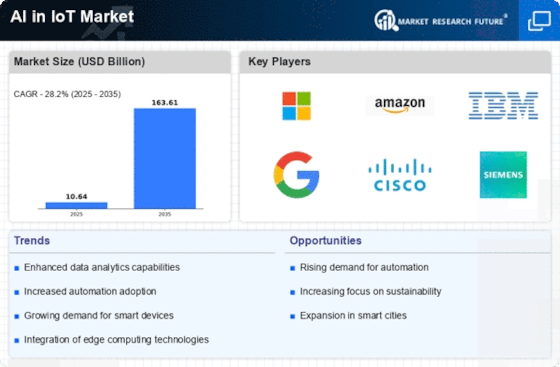
As per MRFR analysis, the AI in IoT Market Size was estimated at 10.64 USD Billion in 2024. The AI in IoT industry is projected to grow from 13.64 USD Billion in 2025 to 163.61 USD Billion by 2035, exhibiting a compound annual growth rate (CAGR) of 28.2 during the forecast period 2025 - 2035.

Key Market Trends & Highlights

The AI in IoT Market is poised for substantial growth, driven by advancements in technology and increasing demand for smart solutions.

  • North America remains the largest market for AI in IoT Market, showcasing robust investment in smart technologies.
  • Asia-Pacific is emerging as the fastest-growing region, fueled by rapid urbanization and technological adoption.
  • Platforms dominate the market, while services are experiencing the fastest growth due to rising demand for tailored solutions.
  • Key drivers include increased connectivity and advancements in machine learning, which enhance operational efficiency and security.

Market Size & Forecast

2024 Market Size 10.64 (USD Billion)
2035 Market Size 163.61 (USD Billion)
CAGR (2025 - 2035) 28.2%
Largest Regional Market Share in 2024 North America

Major Players

<p>Microsoft (US), Amazon (US), IBM (US), Google (US), Cisco (US), Siemens (DE), Intel (US), Qualcomm (US), GE (US), Oracle (US)</p>

Market Trends

The AI in IoT Market is currently experiencing a transformative phase, characterized by the integration of artificial intelligence technologies into Internet of Things devices. This convergence is fostering enhanced data analytics capabilities, enabling devices to process information more intelligently and autonomously. As organizations increasingly recognize the potential of AI to optimize operations, improve decision-making, and enhance user experiences, the demand for AI-driven IoT solutions is likely to escalate. Furthermore, advancements in machine learning algorithms and edge computing are facilitating real-time data processing, which is essential for applications in various sectors, including healthcare, manufacturing, and smart cities. In addition, the AI in IoT Market appears to be influenced by the growing emphasis on sustainability and energy efficiency. Companies are exploring innovative ways to leverage AI to reduce energy consumption and minimize waste. This trend suggests a shift towards more environmentally conscious practices, as organizations seek to align their operations with global sustainability goals. Overall, the AI in IoT Market is poised for substantial growth, driven by technological advancements and a heightened focus on efficiency and sustainability.

Enhanced Data Analytics

The integration of AI into IoT devices is significantly improving data analytics capabilities. This trend allows for more sophisticated data processing, enabling organizations to derive actionable insights from vast amounts of information.

Real-Time Processing

Advancements in edge computing are facilitating real-time data processing in the AI in IoT Market. This capability is crucial for applications that require immediate responses, such as autonomous vehicles and smart home systems.

Sustainability Focus

There is a growing trend towards utilizing AI in IoT Market solutions to promote sustainability. Organizations are increasingly seeking ways to reduce energy consumption and waste, aligning their operations with environmental goals.

AI in IoT Market Market Drivers

Increased Connectivity

The proliferation of connected devices is a primary driver in the AI in IoT Market. As more devices become interconnected, the demand for intelligent systems that can analyze and process data in real-time escalates. It is estimated that by 2025, the number of connected devices could reach 75 billion, creating vast amounts of data that require sophisticated AI algorithms for effective management. This connectivity not only enhances operational efficiency but also enables predictive maintenance and improved decision-making processes. Consequently, businesses are increasingly investing in AI technologies to harness the potential of IoT, thereby driving growth in the AI in IoT Market.

Enhanced Security Measures

As the number of connected devices increases, so does the vulnerability to cyber threats, making enhanced security measures a critical driver in the AI in IoT Market. Organizations are increasingly adopting AI-driven security solutions to protect their IoT ecosystems from potential breaches. AI technologies can analyze network traffic in real-time, detect anomalies, and respond to threats more effectively than traditional methods. The global market for AI in cybersecurity is expected to reach USD 38 billion by 2026, reflecting the growing importance of security in IoT applications. This focus on security not only safeguards data but also fosters trust among users, thereby promoting growth in the AI in IoT Market.

Advancements in Machine Learning

Recent advancements in machine learning technologies are significantly influencing the AI in IoT Market. These innovations allow for more accurate data analysis and predictive modeling, which are essential for optimizing IoT applications. For instance, machine learning algorithms can identify patterns in data collected from IoT devices, leading to improved automation and smarter decision-making. The market for machine learning in IoT is projected to grow at a compound annual growth rate of over 30% through 2025, indicating a robust demand for AI-driven solutions. This growth is likely to propel the AI in IoT Market forward, as organizations seek to leverage these technologies for competitive advantage.

Growing Demand for Smart Solutions

The rising consumer demand for smart solutions is a pivotal driver in the AI in IoT Market. As consumers increasingly seek convenience and efficiency, businesses are compelled to develop smart products that leverage AI and IoT technologies. This trend is evident in various sectors, including smart homes, healthcare, and transportation, where AI-enabled IoT devices are enhancing user experiences. The smart home market alone is projected to reach USD 174 billion by 2025, underscoring the appetite for intelligent solutions. This growing demand not only stimulates innovation but also propels investments in the AI in IoT Market, as companies strive to meet consumer expectations.

Cost Efficiency and Operational Optimization

The pursuit of cost efficiency and operational optimization is a significant driver in the AI in IoT Market. Businesses are increasingly recognizing that integrating AI with IoT can lead to substantial cost savings through improved resource management and reduced downtime. For example, predictive maintenance powered by AI can minimize equipment failures, leading to lower maintenance costs and enhanced productivity. According to industry reports, companies that implement AI-driven IoT solutions can achieve up to a 20% reduction in operational costs. This potential for cost savings is compelling organizations to invest in AI technologies, thereby accelerating growth in the AI in IoT Market.

Market Segment Insights

By Component: Platforms (Largest) vs. Services (Fastest-Growing)

<p>In the AI in IoT Market, the component segment is predominantly characterized by platforms that hold the largest market share. These platforms facilitate seamless integration and management of IoT devices, driving the overall adoption of AI solutions in this space. Services, on the other hand, are rapidly capturing market attention, showcasing impressive growth dynamics as enterprises increasingly seek tailored solutions to leverage AI in IoT Market effectively. The continuous evolution and enhancement of connectivity technologies contribute to this trend as organizations aim for greater efficiency and automation. The growth trends across the component segment of the AI in IoT Market are propelled by multiple drivers. The increasing need for intelligent automation, combined with the rise of smart devices, enhances the demand for both platforms and services. Moreover, emerging technologies such as edge computing and 5G networks are expected to fuel innovative applications, thereby creating new opportunities for growth. As businesses recognize the strategic importance of leveraging AI in their IoT frameworks, investment and focus are moving toward comprehensive platforms and specialized AI-driven services.</p>

<p>Platforms (Dominant) vs. Services (Emerging)</p>

<p>In the AI in IoT Market, platforms are recognized as the dominant force due to their established presence and functionality in managing vast networks of IoT devices. These platforms provide an essential backbone for data collection, analysis, and operational management, making them indispensable for businesses looking to harness the full potential of IoT. Conversely, services have emerged as a crucial player in the market, focusing on providing specialized assistance and solutions tailored to individual business needs. This shift reflects the growing complexity of IoT implementations and the necessity for ongoing support. While platforms offer stability and integration, services focus on customization and agility, catering to the unique requirements of various industries striving to implement AI-driven IoT solutions.</p>

By Technologies: ML and Deep Learning (Largest) vs. NLP (Fastest-Growing)

<p>In the AI in IoT Market, ML and Deep Learning technologies hold the largest share, primarily due to their extensive application in predictive analytics, automation, and real-time data processing. This segment has gradually positioned itself as the backbone of intelligent systems, leading to significant adoption across various industries, including healthcare, manufacturing, and smart homes. Conversely, Natural Language Processing (NLP) is emerging rapidly, driven by the increasing demand for AI-driven voice assistants and chatbots that enhance user interaction and experience. This burgeoning interest in NLP signifies a shift towards enhancing human-device communication in the IoT ecosystem.</p>

<p>Technologies: ML and Deep Learning (Dominant) vs. NLP (Emerging)</p>

<p>ML and Deep Learning technology is currently dominant in the AI in IoT Market, primarily attributed to its robustness in processing vast amounts of data and deriving actionable insights. This segment facilitates automated decision-making and improves efficiency in IoT applications such as predictive maintenance and smart analytics. On the other hand, NLP is emerging as a transformative force, characterized by its ability to interpret and generate human language, making it vital for user-friendly applications. The synergy of NLP with IoT devices is pivotal for advancing intelligent communication systems, ultimately making technology more accessible and interactive for consumers.</p>

By Vertical: Manufacturing (Largest) vs. Healthcare and Life Sciences (Fastest-Growing)

<p>In the AI in IoT Market, the manufacturing sector holds the largest share among verticals, distinguished by its widespread application of AI-driven insights for operational efficiency and automation. Following closely, the healthcare and life sciences sector demonstrates robust growth potential, thanks to the increasing integration of IoT technologies for remote patient monitoring and chronic disease management, indicating a shift towards more proactive healthcare delivery.</p>

<p>Manufacturing (Dominant) vs. Healthcare and Life Sciences (Emerging)</p>

<p>The manufacturing sector is the dominant player in the AI in IoT Market, leveraging AI technologies to optimize production processes, reduce costs, and enhance quality control. This segment's ability to implement AI-driven predictive maintenance and supply chain management has solidified its position as a leader. In contrast, the healthcare and life sciences sector is emerging rapidly, driven by the demand for efficient patient care solutions. The convergence of AI with IoT in this sector facilitates real-time health monitoring and data analytics, enabling healthcare providers to deliver tailored treatments and improving patient outcomes.</p>

Get more detailed insights about AI in IoT Market Research Report—Global Forecast till 2035

Regional Insights

North America : Innovation and Leadership Hub

North America is the largest market for AI in IoT Market, holding approximately 45% of the global share. The region benefits from strong technological infrastructure, significant investments in R&D, and a favorable regulatory environment. The demand for smart devices and automation in industries such as healthcare, manufacturing, and transportation is driving growth. Additionally, government initiatives promoting digital transformation are further catalyzing market expansion. The United States leads the North American market, with major players like Microsoft, Amazon, and IBM spearheading innovation. The competitive landscape is characterized by rapid advancements in AI technologies and IoT applications. Canada also plays a significant role, focusing on smart city initiatives and sustainable technologies. The presence of key players ensures a robust ecosystem for AI in IoT Market development, fostering collaboration and innovation.

Europe : Emerging Regulatory Frameworks

Europe is witnessing significant growth in the AI in IoT Market, holding around 30% of the global share, making it the second-largest region. The European Union's regulatory frameworks, such as the GDPR, are shaping the market landscape by ensuring data privacy and security. Additionally, initiatives like the European Green Deal are driving demand for sustainable IoT solutions, enhancing market potential across various sectors, including energy and transportation. Germany and the United Kingdom are the leading countries in this region, with a strong focus on industrial IoT and smart manufacturing. The competitive landscape is marked by the presence of key players like Siemens and Bosch, who are investing heavily in AI technologies. The collaboration between governments and private sectors is fostering innovation, making Europe a vital player in The AI in IoT Market.

Asia-Pacific : Rapid Growth and Adoption

Asia-Pacific is rapidly emerging as a significant player in the AI in IoT Market, holding approximately 20% of the global share. The region's growth is driven by increasing urbanization, a rising middle class, and government initiatives promoting smart cities and digital economies. Countries like China and India are at the forefront, with substantial investments in AI technologies and IoT infrastructure, enhancing market demand across various sectors, including agriculture and healthcare. China is the largest market in the region, supported by government policies that encourage innovation and technology adoption. India follows closely, focusing on digital transformation and smart solutions. The competitive landscape features both established companies and startups, fostering a dynamic environment for AI in IoT Market development. The presence of key players like Intel and Qualcomm further strengthens the region's market position, driving technological advancements.

Middle East and Africa : Resource-Rich and Emerging Markets

The Middle East and Africa (MEA) region is gradually emerging in the AI in IoT Market, holding about 5% of the global share. The growth is primarily driven by increasing investments in technology and infrastructure, alongside government initiatives aimed at digital transformation. Countries like the UAE and South Africa are leading the charge, focusing on smart city projects and enhancing connectivity, which are crucial for IoT adoption in various sectors, including energy and transportation. The UAE is particularly notable for its ambitious plans to become a global technology hub, attracting investments and fostering innovation. South Africa is also making strides in integrating AI and IoT solutions across industries. The competitive landscape is characterized by a mix of local and international players, creating opportunities for collaboration and growth in the region's AI in IoT Market.

Key Players and Competitive Insights

The AI in IoT Market is currently characterized by a dynamic competitive landscape, driven by rapid technological advancements and increasing demand for smart solutions across various sectors. Major players such as Microsoft (US), Amazon (US), and IBM (US) are strategically positioning themselves through innovation and partnerships, thereby enhancing their operational focus. Microsoft (US) emphasizes cloud-based AI solutions, while Amazon (US) leverages its extensive cloud infrastructure to integrate AI capabilities into IoT devices. IBM (US) is concentrating on enterprise solutions that combine AI with IoT for enhanced data analytics, which collectively shapes a competitive environment that is increasingly reliant on technological integration and strategic collaborations.

Key business tactics within this market include localizing manufacturing and optimizing supply chains to enhance efficiency and responsiveness. The competitive structure appears moderately fragmented, with a blend of established giants and emerging players. This fragmentation allows for diverse innovation pathways, yet the collective influence of key players like Cisco (US) and Siemens (DE) remains substantial, as they continue to set industry standards and drive technological advancements.

In September 2025, Microsoft (US) announced a significant partnership with Siemens (DE) to develop AI-driven IoT solutions aimed at optimizing industrial operations. This collaboration is poised to enhance predictive maintenance capabilities, thereby reducing downtime and operational costs for manufacturing clients. The strategic importance of this partnership lies in its potential to leverage both companies' strengths, creating a robust ecosystem that addresses the growing demand for smart manufacturing solutions.

In August 2025, Amazon (US) unveiled its latest IoT platform, which integrates advanced AI algorithms to improve device interoperability and user experience. This launch is particularly noteworthy as it reflects Amazon's commitment to enhancing its ecosystem, making it easier for developers to create innovative applications. The strategic significance of this move is underscored by the potential to capture a larger market share in the rapidly evolving smart home segment, where seamless integration is paramount.

In July 2025, IBM (US) expanded its AI capabilities by acquiring a startup specializing in edge computing solutions. This acquisition is expected to bolster IBM's IoT offerings by enabling real-time data processing at the edge, which is crucial for applications requiring immediate insights. The strategic importance of this acquisition lies in its alignment with the growing trend towards edge computing, positioning IBM as a leader in delivering comprehensive IoT solutions that meet the demands of modern enterprises.

As of October 2025, current competitive trends in the AI in IoT Market are heavily influenced by digitalization, sustainability, and the integration of AI technologies. Strategic alliances are increasingly shaping the landscape, as companies recognize the value of collaboration in driving innovation. Looking ahead, competitive differentiation is likely to evolve from traditional price-based competition to a focus on innovation, technological advancement, and supply chain reliability, suggesting a shift towards a more integrated and sustainable approach in the AI in IoT Market.

Key Companies in the AI in IoT Market market include

Industry Developments

  • Q2 2024: Infineon Technologies and Synaptics Announce Strategic Partnership to Accelerate AI-Enabled IoT Solutions Infineon Technologies and Synaptics announced a strategic partnership to jointly develop AI-enabled IoT solutions, combining Infineon's hardware with Synaptics' AI software to accelerate deployment of intelligent edge devices.
  • Q2 2024: Edge Impulse Raises $60 Million Series B to Expand AI for IoT Devices Edge Impulse, a platform for developing AI on IoT devices, secured $60 million in Series B funding to accelerate product development and expand its global reach in the AI-powered IoT sector.
  • Q2 2024: Siemens launches new AI-powered IoT platform for industrial automation Siemens introduced a new AI-powered IoT platform designed to enhance industrial automation, enabling real-time data analytics and predictive maintenance for manufacturing clients.
  • Q3 2024: Amazon Web Services Unveils AI-Driven IoT Security Suite Amazon Web Services launched a new AI-driven IoT security suite aimed at helping enterprises detect and respond to threats across connected devices using machine learning algorithms.
  • Q3 2024: FogHorn acquired by Johnson Controls to boost AI at the edge for smart buildings Johnson Controls acquired FogHorn, a provider of edge AI software for industrial and commercial IoT, to strengthen its smart building solutions with advanced AI analytics at the edge.
  • Q3 2024: Bosch and Microsoft Expand Partnership to Integrate AI into IoT Devices Bosch and Microsoft announced an expanded partnership to integrate Microsoft's Azure AI services into Bosch's IoT devices, aiming to deliver smarter connected products for industrial and consumer markets.
  • Q4 2024: Arm Launches New AI-Optimized IoT Chipset for Edge Devices Arm introduced a new AI-optimized chipset designed specifically for IoT edge devices, enabling more efficient on-device machine learning and analytics.
  • Q4 2024: Samsung Electronics Opens New AIoT Research Center in Singapore Samsung Electronics opened a new research center in Singapore focused on developing AIoT (Artificial Intelligence of Things) technologies for smart home and industrial applications.
  • Q1 2025: ABB and Nvidia partner to bring AI to industrial IoT systems ABB and Nvidia announced a partnership to integrate Nvidia's AI computing technology into ABB's industrial IoT systems, aiming to improve automation and predictive maintenance capabilities.

  • Q1 2025: Tuya Smart Announces Strategic Collaboration with Google Cloud to Advance AI in IoT Market Tuya Smart entered a strategic collaboration with Google Cloud to leverage AI and cloud computing for enhancing IoT device intelligence and interoperability.
  • Q2 2025: Honeywell Launches AI-Driven IoT Platform for Smart Energy Management Honeywell launched a new AI-driven IoT platform designed to optimize energy management in commercial buildings, using machine learning to analyze and control energy consumption.
  • Q2 2025: Cisco acquires IoT security startup VDOO to enhance AI-based device protection Cisco completed the acquisition of VDOO, an IoT security startup, to bolster its AI-based security offerings for connected devices across enterprise networks.

Future Outlook

AI in IoT Market Future Outlook

<p>The AI in IoT Market is projected to grow at a 28.2% CAGR from 2024 to 2035, driven by advancements in connectivity, data analytics, and automation technologies.</p>

New opportunities lie in:

  • <p>Development of AI-driven predictive maintenance solutions for industrial IoT applications.</p>
  • <p>Integration of AI algorithms in smart home devices for enhanced user experience.</p>
  • <p>Creation of AI-based cybersecurity frameworks for IoT networks.</p>

<p>By 2035, the AI in IoT Market is expected to be a pivotal sector, driving innovation and efficiency.</p>

Market Segmentation

AI in IoT Market Vertical Outlook

  • Manufacturing
  • Energy and Utilities
  • Transportation and Mobility
  • BFSI
  • Government and Defense
  • Retail
  • Healthcare and Life Sciences
  • Telecom
  • Others (agriculture, education, telecom, and tourism and hospitality)

AI in IoT Market Component Outlook

  • Platforms
  • Software Solutions
  • Services

AI in IoT Market Technologies Outlook

  • ML and Deep Learning
  • NLP

Report Scope

MARKET SIZE 202410.64(USD Billion)
MARKET SIZE 202513.64(USD Billion)
MARKET SIZE 2035163.61(USD Billion)
COMPOUND ANNUAL GROWTH RATE (CAGR)28.2% (2024 - 2035)
REPORT COVERAGERevenue Forecast, Competitive Landscape, Growth Factors, and Trends
BASE YEAR2024
Market Forecast Period2025 - 2035
Historical Data2019 - 2024
Market Forecast UnitsUSD Billion
Key Companies ProfiledMarket analysis in progress
Segments CoveredMarket segmentation analysis in progress
Key Market OpportunitiesIntegration of advanced analytics in AI in IoT Market enhances operational efficiency and decision-making capabilities.
Key Market DynamicsRising integration of artificial intelligence enhances operational efficiency and drives innovation in the Internet of Things sector.
Countries CoveredNorth America, Europe, APAC, South America, MEA

FAQs

What is the current market valuation of AI in IoT as of 2024?

The market valuation of AI in IoT was 10.64 USD Billion in 2024.

What is the projected market size for AI in IoT by 2035?

The projected market size for AI in IoT is expected to reach 163.61 USD Billion by 2035.

What is the expected CAGR for the AI in IoT market during the forecast period 2025 - 2035?

The expected CAGR for the AI in IoT market during the forecast period 2025 - 2035 is 28.2%.

Which companies are considered key players in the AI in IoT market?

Key players in the AI in IoT market include Microsoft, Amazon, IBM, Google, Cisco, Siemens, Intel, Qualcomm, GE, and Oracle.

What are the main components of the AI in IoT market?

The main components of the AI in IoT market include Platforms, Software Solutions, and Services, with valuations of 42.56, 67.56, and 53.49 USD Billion respectively.

Which technologies are driving growth in the AI in IoT market?

Technologies such as Machine Learning and Deep Learning, along with Natural Language Processing, are driving growth, with valuations of 82.0 and 81.61 USD Billion respectively.

  1. SECTION I: EXECUTIVE SUMMARY AND KEY HIGHLIGHTS
    1. EXECUTIVE SUMMARY
      1. Market Overview
      2. Key Findings
      3. Market Segmentation
      4. Competitive Landscape
      5. Challenges and Opportunities
      6. Future Outlook
  2. SECTION II: SCOPING, METHODOLOGY AND MARKET STRUCTURE
    1. MARKET INTRODUCTION
      1. Definition
      2. Scope of the study
    2. RESEARCH METHODOLOGY
      1. Overview
      2. Data Mining
      3. Secondary Research
      4. Primary Research
      5. Forecasting Model
      6. Market Size Estimation
      7. Data Triangulation
      8. Validation
  3. SECTION III: QUALITATIVE ANALYSIS
    1. MARKET DYNAMICS
      1. Overview
      2. Drivers
      3. Restraints
      4. Opportunities
    2. MARKET FACTOR ANALYSIS
      1. Value chain Analysis
      2. Porter's Five Forces Analysis
      3. COVID-19 Impact Analysis
  4. SECTION IV: QUANTITATIVE ANALYSIS
    1. Information and Communications Technology, BY Component (USD Billion)
      1. Platforms
      2. Software Solutions
      3. Services
    2. Information and Communications Technology, BY Technologies (USD Billion)
      1. ML and Deep Learning
      2. NLP
    3. Information and Communications Technology, BY Vertical (USD Billion)
      1. Manufacturing
      2. Energy and Utilities
      3. Transportation and Mobility
      4. BFSI
      5. Government and Defense
      6. Retail
      7. Healthcare and Life Sciences
      8. Telecom
      9. Others (agriculture, education, telecom, and tourism and hospitality)
    4. Information and Communications Technology, BY Region (USD Billion)
      1. North America
      2. Europe
      3. APAC
      4. South America
      5. MEA
  5. SECTION V: COMPETITIVE ANALYSIS
    1. Competitive Landscape
      1. Overview
      2. Competitive Analysis
      3. Market share Analysis
      4. Major Growth Strategy in the Information and Communications Technology
      5. Competitive Benchmarking
      6. Leading Players in Terms of Number of Developments in the Information and Communications Technology
      7. Key developments and growth strategies
      8. Major Players Financial Matrix
    2. Company Profiles
      1. Microsoft (US)
      2. Amazon (US)
      3. IBM (US)
      4. Google (US)
      5. Cisco (US)
      6. Siemens (DE)
      7. Intel (US)
      8. Qualcomm (US)
      9. GE (US)
      10. Oracle (US)
    3. Appendix
      1. References
      2. Related Reports
  6. LIST OF FIGURES
    1. MARKET SYNOPSIS
    2. NORTH AMERICA MARKET ANALYSIS
    3. US MARKET ANALYSIS BY COMPONENT
    4. US MARKET ANALYSIS BY TECHNOLOGIES
    5. US MARKET ANALYSIS BY VERTICAL
    6. CANADA MARKET ANALYSIS BY COMPONENT
    7. CANADA MARKET ANALYSIS BY TECHNOLOGIES
    8. CANADA MARKET ANALYSIS BY VERTICAL
    9. EUROPE MARKET ANALYSIS
    10. GERMANY MARKET ANALYSIS BY COMPONENT
    11. GERMANY MARKET ANALYSIS BY TECHNOLOGIES
    12. GERMANY MARKET ANALYSIS BY VERTICAL
    13. UK MARKET ANALYSIS BY COMPONENT
    14. UK MARKET ANALYSIS BY TECHNOLOGIES
    15. UK MARKET ANALYSIS BY VERTICAL
    16. FRANCE MARKET ANALYSIS BY COMPONENT
    17. FRANCE MARKET ANALYSIS BY TECHNOLOGIES
    18. FRANCE MARKET ANALYSIS BY VERTICAL
    19. RUSSIA MARKET ANALYSIS BY COMPONENT
    20. RUSSIA MARKET ANALYSIS BY TECHNOLOGIES
    21. RUSSIA MARKET ANALYSIS BY VERTICAL
    22. ITALY MARKET ANALYSIS BY COMPONENT
    23. ITALY MARKET ANALYSIS BY TECHNOLOGIES
    24. ITALY MARKET ANALYSIS BY VERTICAL
    25. SPAIN MARKET ANALYSIS BY COMPONENT
    26. SPAIN MARKET ANALYSIS BY TECHNOLOGIES
    27. SPAIN MARKET ANALYSIS BY VERTICAL
    28. REST OF EUROPE MARKET ANALYSIS BY COMPONENT
    29. REST OF EUROPE MARKET ANALYSIS BY TECHNOLOGIES
    30. REST OF EUROPE MARKET ANALYSIS BY VERTICAL
    31. APAC MARKET ANALYSIS
    32. CHINA MARKET ANALYSIS BY COMPONENT
    33. CHINA MARKET ANALYSIS BY TECHNOLOGIES
    34. CHINA MARKET ANALYSIS BY VERTICAL
    35. INDIA MARKET ANALYSIS BY COMPONENT
    36. INDIA MARKET ANALYSIS BY TECHNOLOGIES
    37. INDIA MARKET ANALYSIS BY VERTICAL
    38. JAPAN MARKET ANALYSIS BY COMPONENT
    39. JAPAN MARKET ANALYSIS BY TECHNOLOGIES
    40. JAPAN MARKET ANALYSIS BY VERTICAL
    41. SOUTH KOREA MARKET ANALYSIS BY COMPONENT
    42. SOUTH KOREA MARKET ANALYSIS BY TECHNOLOGIES
    43. SOUTH KOREA MARKET ANALYSIS BY VERTICAL
    44. MALAYSIA MARKET ANALYSIS BY COMPONENT
    45. MALAYSIA MARKET ANALYSIS BY TECHNOLOGIES
    46. MALAYSIA MARKET ANALYSIS BY VERTICAL
    47. THAILAND MARKET ANALYSIS BY COMPONENT
    48. THAILAND MARKET ANALYSIS BY TECHNOLOGIES
    49. THAILAND MARKET ANALYSIS BY VERTICAL
    50. INDONESIA MARKET ANALYSIS BY COMPONENT
    51. INDONESIA MARKET ANALYSIS BY TECHNOLOGIES
    52. INDONESIA MARKET ANALYSIS BY VERTICAL
    53. REST OF APAC MARKET ANALYSIS BY COMPONENT
    54. REST OF APAC MARKET ANALYSIS BY TECHNOLOGIES
    55. REST OF APAC MARKET ANALYSIS BY VERTICAL
    56. SOUTH AMERICA MARKET ANALYSIS
    57. BRAZIL MARKET ANALYSIS BY COMPONENT
    58. BRAZIL MARKET ANALYSIS BY TECHNOLOGIES
    59. BRAZIL MARKET ANALYSIS BY VERTICAL
    60. MEXICO MARKET ANALYSIS BY COMPONENT
    61. MEXICO MARKET ANALYSIS BY TECHNOLOGIES
    62. MEXICO MARKET ANALYSIS BY VERTICAL
    63. ARGENTINA MARKET ANALYSIS BY COMPONENT
    64. ARGENTINA MARKET ANALYSIS BY TECHNOLOGIES
    65. ARGENTINA MARKET ANALYSIS BY VERTICAL
    66. REST OF SOUTH AMERICA MARKET ANALYSIS BY COMPONENT
    67. REST OF SOUTH AMERICA MARKET ANALYSIS BY TECHNOLOGIES
    68. REST OF SOUTH AMERICA MARKET ANALYSIS BY VERTICAL
    69. MEA MARKET ANALYSIS
    70. GCC COUNTRIES MARKET ANALYSIS BY COMPONENT
    71. GCC COUNTRIES MARKET ANALYSIS BY TECHNOLOGIES
    72. GCC COUNTRIES MARKET ANALYSIS BY VERTICAL
    73. SOUTH AFRICA MARKET ANALYSIS BY COMPONENT
    74. SOUTH AFRICA MARKET ANALYSIS BY TECHNOLOGIES
    75. SOUTH AFRICA MARKET ANALYSIS BY VERTICAL
    76. REST OF MEA MARKET ANALYSIS BY COMPONENT
    77. REST OF MEA MARKET ANALYSIS BY TECHNOLOGIES
    78. REST OF MEA MARKET ANALYSIS BY VERTICAL
    79. KEY BUYING CRITERIA OF INFORMATION AND COMMUNICATIONS TECHNOLOGY
    80. RESEARCH PROCESS OF MRFR
    81. DRO ANALYSIS OF INFORMATION AND COMMUNICATIONS TECHNOLOGY
    82. DRIVERS IMPACT ANALYSIS: INFORMATION AND COMMUNICATIONS TECHNOLOGY
    83. RESTRAINTS IMPACT ANALYSIS: INFORMATION AND COMMUNICATIONS TECHNOLOGY
    84. SUPPLY / VALUE CHAIN: INFORMATION AND COMMUNICATIONS TECHNOLOGY
    85. INFORMATION AND COMMUNICATIONS TECHNOLOGY, BY COMPONENT, 2024 (% SHARE)
    86. INFORMATION AND COMMUNICATIONS TECHNOLOGY, BY COMPONENT, 2024 TO 2035 (USD Billion)
    87. INFORMATION AND COMMUNICATIONS TECHNOLOGY, BY TECHNOLOGIES, 2024 (% SHARE)
    88. INFORMATION AND COMMUNICATIONS TECHNOLOGY, BY TECHNOLOGIES, 2024 TO 2035 (USD Billion)
    89. INFORMATION AND COMMUNICATIONS TECHNOLOGY, BY VERTICAL, 2024 (% SHARE)
    90. INFORMATION AND COMMUNICATIONS TECHNOLOGY, BY VERTICAL, 2024 TO 2035 (USD Billion)
    91. BENCHMARKING OF MAJOR COMPETITORS
  7. LIST OF TABLES
    1. LIST OF ASSUMPTIONS
    2. North America MARKET SIZE ESTIMATES; FORECAST
      1. BY COMPONENT, 2025-2035 (USD Billion)
      2. BY TECHNOLOGIES, 2025-2035 (USD Billion)
      3. BY VERTICAL, 2025-2035 (USD Billion)
    3. US MARKET SIZE ESTIMATES; FORECAST
      1. BY COMPONENT, 2025-2035 (USD Billion)
      2. BY TECHNOLOGIES, 2025-2035 (USD Billion)
      3. BY VERTICAL, 2025-2035 (USD Billion)
    4. Canada MARKET SIZE ESTIMATES; FORECAST
      1. BY COMPONENT, 2025-2035 (USD Billion)
      2. BY TECHNOLOGIES, 2025-2035 (USD Billion)
      3. BY VERTICAL, 2025-2035 (USD Billion)
    5. Europe MARKET SIZE ESTIMATES; FORECAST
      1. BY COMPONENT, 2025-2035 (USD Billion)
      2. BY TECHNOLOGIES, 2025-2035 (USD Billion)
      3. BY VERTICAL, 2025-2035 (USD Billion)
    6. Germany MARKET SIZE ESTIMATES; FORECAST
      1. BY COMPONENT, 2025-2035 (USD Billion)
      2. BY TECHNOLOGIES, 2025-2035 (USD Billion)
      3. BY VERTICAL, 2025-2035 (USD Billion)
    7. UK MARKET SIZE ESTIMATES; FORECAST
      1. BY COMPONENT, 2025-2035 (USD Billion)
      2. BY TECHNOLOGIES, 2025-2035 (USD Billion)
      3. BY VERTICAL, 2025-2035 (USD Billion)
    8. France MARKET SIZE ESTIMATES; FORECAST
      1. BY COMPONENT, 2025-2035 (USD Billion)
      2. BY TECHNOLOGIES, 2025-2035 (USD Billion)
      3. BY VERTICAL, 2025-2035 (USD Billion)
    9. Russia MARKET SIZE ESTIMATES; FORECAST
      1. BY COMPONENT, 2025-2035 (USD Billion)
      2. BY TECHNOLOGIES, 2025-2035 (USD Billion)
      3. BY VERTICAL, 2025-2035 (USD Billion)
    10. Italy MARKET SIZE ESTIMATES; FORECAST
      1. BY COMPONENT, 2025-2035 (USD Billion)
      2. BY TECHNOLOGIES, 2025-2035 (USD Billion)
      3. BY VERTICAL, 2025-2035 (USD Billion)
    11. Spain MARKET SIZE ESTIMATES; FORECAST
      1. BY COMPONENT, 2025-2035 (USD Billion)
      2. BY TECHNOLOGIES, 2025-2035 (USD Billion)
      3. BY VERTICAL, 2025-2035 (USD Billion)
    12. Rest of Europe MARKET SIZE ESTIMATES; FORECAST
      1. BY COMPONENT, 2025-2035 (USD Billion)
      2. BY TECHNOLOGIES, 2025-2035 (USD Billion)
      3. BY VERTICAL, 2025-2035 (USD Billion)
    13. APAC MARKET SIZE ESTIMATES; FORECAST
      1. BY COMPONENT, 2025-2035 (USD Billion)
      2. BY TECHNOLOGIES, 2025-2035 (USD Billion)
      3. BY VERTICAL, 2025-2035 (USD Billion)
    14. China MARKET SIZE ESTIMATES; FORECAST
      1. BY COMPONENT, 2025-2035 (USD Billion)
      2. BY TECHNOLOGIES, 2025-2035 (USD Billion)
      3. BY VERTICAL, 2025-2035 (USD Billion)
    15. India MARKET SIZE ESTIMATES; FORECAST
      1. BY COMPONENT, 2025-2035 (USD Billion)
      2. BY TECHNOLOGIES, 2025-2035 (USD Billion)
      3. BY VERTICAL, 2025-2035 (USD Billion)
    16. Japan MARKET SIZE ESTIMATES; FORECAST
      1. BY COMPONENT, 2025-2035 (USD Billion)
      2. BY TECHNOLOGIES, 2025-2035 (USD Billion)
      3. BY VERTICAL, 2025-2035 (USD Billion)
    17. South Korea MARKET SIZE ESTIMATES; FORECAST
      1. BY COMPONENT, 2025-2035 (USD Billion)
      2. BY TECHNOLOGIES, 2025-2035 (USD Billion)
      3. BY VERTICAL, 2025-2035 (USD Billion)
    18. Malaysia MARKET SIZE ESTIMATES; FORECAST
      1. BY COMPONENT, 2025-2035 (USD Billion)
      2. BY TECHNOLOGIES, 2025-2035 (USD Billion)
      3. BY VERTICAL, 2025-2035 (USD Billion)
    19. Thailand MARKET SIZE ESTIMATES; FORECAST
      1. BY COMPONENT, 2025-2035 (USD Billion)
      2. BY TECHNOLOGIES, 2025-2035 (USD Billion)
      3. BY VERTICAL, 2025-2035 (USD Billion)
    20. Indonesia MARKET SIZE ESTIMATES; FORECAST
      1. BY COMPONENT, 2025-2035 (USD Billion)
      2. BY TECHNOLOGIES, 2025-2035 (USD Billion)
      3. BY VERTICAL, 2025-2035 (USD Billion)
    21. Rest of APAC MARKET SIZE ESTIMATES; FORECAST
      1. BY COMPONENT, 2025-2035 (USD Billion)
      2. BY TECHNOLOGIES, 2025-2035 (USD Billion)
      3. BY VERTICAL, 2025-2035 (USD Billion)
    22. South America MARKET SIZE ESTIMATES; FORECAST
      1. BY COMPONENT, 2025-2035 (USD Billion)
      2. BY TECHNOLOGIES, 2025-2035 (USD Billion)
      3. BY VERTICAL, 2025-2035 (USD Billion)
    23. Brazil MARKET SIZE ESTIMATES; FORECAST
      1. BY COMPONENT, 2025-2035 (USD Billion)
      2. BY TECHNOLOGIES, 2025-2035 (USD Billion)
      3. BY VERTICAL, 2025-2035 (USD Billion)
    24. Mexico MARKET SIZE ESTIMATES; FORECAST
      1. BY COMPONENT, 2025-2035 (USD Billion)
      2. BY TECHNOLOGIES, 2025-2035 (USD Billion)
      3. BY VERTICAL, 2025-2035 (USD Billion)
    25. Argentina MARKET SIZE ESTIMATES; FORECAST
      1. BY COMPONENT, 2025-2035 (USD Billion)
      2. BY TECHNOLOGIES, 2025-2035 (USD Billion)
      3. BY VERTICAL, 2025-2035 (USD Billion)
    26. Rest of South America MARKET SIZE ESTIMATES; FORECAST
      1. BY COMPONENT, 2025-2035 (USD Billion)
      2. BY TECHNOLOGIES, 2025-2035 (USD Billion)
      3. BY VERTICAL, 2025-2035 (USD Billion)
    27. MEA MARKET SIZE ESTIMATES; FORECAST
      1. BY COMPONENT, 2025-2035 (USD Billion)
      2. BY TECHNOLOGIES, 2025-2035 (USD Billion)
      3. BY VERTICAL, 2025-2035 (USD Billion)
    28. GCC Countries MARKET SIZE ESTIMATES; FORECAST
      1. BY COMPONENT, 2025-2035 (USD Billion)
      2. BY TECHNOLOGIES, 2025-2035 (USD Billion)
      3. BY VERTICAL, 2025-2035 (USD Billion)
    29. South Africa MARKET SIZE ESTIMATES; FORECAST
      1. BY COMPONENT, 2025-2035 (USD Billion)
      2. BY TECHNOLOGIES, 2025-2035 (USD Billion)
      3. BY VERTICAL, 2025-2035 (USD Billion)
    30. Rest of MEA MARKET SIZE ESTIMATES; FORECAST
      1. BY COMPONENT, 2025-2035 (USD Billion)
      2. BY TECHNOLOGIES, 2025-2035 (USD Billion)
      3. BY VERTICAL, 2025-2035 (USD Billion)
    31. PRODUCT LAUNCH/PRODUCT DEVELOPMENT/APPROVAL
    32. ACQUISITION/PARTNERSHIP

AI in IoT Market Segmentation

AI in IoT Component Outlook (USD Billion, 2018-2032)

  • Platforms
  • Software Solutions
  • Services

AI in IoT Technologies Outlook (USD Billion, 2018-2032)

  • ML and Deep Learning
  • NLP

AI in IoT Vertical Outlook (USD Billion, 2018-2032)

  • Manufacturing
  • Energy and Utilities
  • Transportation and Mobility
  • BFSI
  • Government and Defense
  • Retail
  • Healthcare and Life Sciences
  • Telecom
  • Others (agriculture, education, telecom, and tourism and hospitality)

AI in IoT Regional Outlook (USD Billion, 2018-2032)

  • North America Outlook (USD Billion, 2018-2032)

    • AI in IoT by Component
      • Platforms
      • Software Solutions
      • Services
    • AI in IoT by Technologies
      • ML and Deep Learning
      • NLP
    • AI in IoT by Vertical
      • Manufacturing
      • Energy and Utilities
      • Transportation and Mobility
      • BFSI
      • Government and Defense
      • Retail
      • Healthcare and Life Sciences
      • Telecom
      • Others (agriculture, education, telecom, and tourism and hospitality)
    • US Outlook (USD Billion, 2018-2032)

    • AI in IoT by Component
      • Platforms
      • Software Solutions
      • Services
    • AI in IoT by Technologies
      • ML and Deep Learning
      • NLP
    • AI in IoT by Vertical
      • Manufacturing
      • Energy and Utilities
      • Transportation and Mobility
      • BFSI
      • Government and Defense
      • Retail
      • Healthcare and Life Sciences
      • Telecom
      • Others (agriculture, education, telecom, and tourism and hospitality)
    • Canada Outlook (USD Billion, 2018-2032)

    • AI in IoT by Component
      • Platforms
      • Software Solutions
      • Services
    • AI in IoT by Technologies
      • ML and Deep Learning
      • NLP
    • AI in IoT by Vertical
      • Manufacturing
      • Energy and Utilities
      • Transportation and Mobility
      • BFSI
      • Government and Defense
      • Retail
      • Healthcare and Life Sciences
      • Telecom
      • Others (agriculture, education, telecom, and tourism and hospitality)
  • Europe Outlook (USD Billion, 2018-2032)

    • AI in IoT by Component
      • Platforms
      • Software Solutions
      • Services
    • AI in IoT by Technologies
      • ML and Deep Learning
      • NLP
    • AI in IoT by Vertical
      • Manufacturing
      • Energy and Utilities
      • Transportation and Mobility
      • BFSI
      • Government and Defense
      • Retail
      • Healthcare and Life Sciences
      • Telecom
      • Others (agriculture, education, telecom, and tourism and hospitality)
    • Germany Outlook (USD Billion, 2018-2032)

    • AI in IoT by Component
      • Platforms
      • Software Solutions
      • Services
    • AI in IoT by Technologies
      • ML and Deep Learning
      • NLP
    • AI in IoT by Vertical
      • Manufacturing
      • Energy and Utilities
      • Transportation and Mobility
      • BFSI
      • Government and Defense
      • Retail
      • Healthcare and Life Sciences
      • Telecom
      • Others (agriculture, education, telecom, and tourism and hospitality)
    • France Outlook (USD Billion, 2018-2032)

    • AI in IoT by Component
      • Platforms
      • Software Solutions
      • Services
    • AI in IoT by Technologies
      • ML and Deep Learning
      • NLP
    • AI in IoT by Vertical
      • Manufacturing
      • Energy and Utilities
      • Transportation and Mobility
      • BFSI
      • Government and Defense
      • Retail
      • Healthcare and Life Sciences
      • Telecom
      • Others (agriculture, education, telecom, and tourism and hospitality)
    • UK Outlook (USD Billion, 2018-2032)

    • AI in IoT by Component
      • Platforms
      • Software Solutions
      • Services
    • AI in IoT by Technologies
      • ML and Deep Learning
      • NLP
    • AI in IoT by Vertical
      • Manufacturing
      • Energy and Utilities
      • Transportation and Mobility
      • BFSI
      • Government and Defense
      • Retail
      • Healthcare and Life Sciences
      • Telecom
      • Others (agriculture, education, telecom, and tourism and hospitality)
    • Italy Outlook (USD Billion, 2018-2032)

    • AI in IoT by Component
      • Platforms
      • Software Solutions
      • Services
    • AI in IoT by Technologies
      • ML and Deep Learning
      • NLP
    • AI in IoT by Vertical
      • Manufacturing
      • Energy and Utilities
      • Transportation and Mobility
      • BFSI
      • Government and Defense
      • Retail
      • Healthcare and Life Sciences
      • Telecom
      • Others (agriculture, education, telecom, and tourism and hospitality)
    • Spain Outlook (USD Billion, 2018-2032)

    • AI in IoT by Component
      • Platforms
      • Software Solutions
      • Services
    • AI in IoT by Technologies
      • ML and Deep Learning
      • NLP
    • AI in IoT by Vertical
      • Manufacturing
      • Energy and Utilities
      • Transportation and Mobility
      • BFSI
      • Government and Defense
      • Retail
      • Healthcare and Life Sciences
      • Telecom
      • Others (agriculture, education, telecom, and tourism and hospitality)
    • Rest Of Europe Outlook (USD Billion, 2018-2032)

    • AI in IoT by Component
      • Platforms
      • Software Solutions
      • Services
    • AI in IoT by Technologies
      • ML and Deep Learning
      • NLP
    • AI in IoT by Vertical
      • Manufacturing
      • Energy and Utilities
      • Transportation and Mobility
      • BFSI
      • Government and Defense
      • Retail
      • Healthcare and Life Sciences
      • Telecom
      • Others (agriculture, education, telecom, and tourism and hospitality)
  • Asia-Pacific Outlook (USD Billion, 2018-2032)

    • AI in IoT by Component
      • Platforms
      • Software Solutions
      • Services
    • AI in IoT by Technologies
      • ML and Deep Learning
      • NLP
    • AI in IoT by Vertical
      • Manufacturing
      • Energy and Utilities
      • Transportation and Mobility
      • BFSI
      • Government and Defense
      • Retail
      • Healthcare and Life Sciences
      • Telecom
      • Others (agriculture, education, telecom, and tourism and hospitality)
    • China Outlook (USD Billion, 2018-2032)

    • AI in IoT by Component
      • Platforms
      • Software Solutions
      • Services
    • AI in IoT by Technologies
      • ML and Deep Learning
      • NLP
    • AI in IoT by Vertical
      • Manufacturing
      • Energy and Utilities
      • Transportation and Mobility
      • BFSI
      • Government and Defense
      • Retail
      • Healthcare and Life Sciences
      • Telecom
      • Others (agriculture, education, telecom, and tourism and hospitality)
    • Japan Outlook (USD Billion, 2018-2032)

    • AI in IoT by Component
      • Platforms
      • Software Solutions
      • Services
    • AI in IoT by Technologies
      • ML and Deep Learning
      • NLP
    • AI in IoT by Vertical
      • Manufacturing
      • Energy and Utilities
      • Transportation and Mobility
      • BFSI
      • Government and Defense
      • Retail
      • Healthcare and Life Sciences
      • Telecom
      • Others (agriculture, education, telecom, and tourism and hospitality)
    • India Outlook (USD Billion, 2018-2032)

    • AI in IoT by Component
      • Platforms
      • Software Solutions
      • Services
    • AI in IoT by Technologies
      • ML and Deep Learning
      • NLP
    • AI in IoT by Vertical
      • Manufacturing
      • Energy and Utilities
      • Transportation and Mobility
      • BFSI
      • Government and Defense
      • Retail
      • Healthcare and Life Sciences
      • Telecom
      • Others (agriculture, education, telecom, and tourism and hospitality)
    • Australia Outlook (USD Billion, 2018-2032)

    • AI in IoT by Component
      • Platforms
      • Software Solutions
      • Services
    • AI in IoT by Technologies
      • ML and Deep Learning
      • NLP
    • AI in IoT by Vertical
      • Manufacturing
      • Energy and Utilities
      • Transportation and Mobility
      • BFSI
      • Government and Defense
      • Retail
      • Healthcare and Life Sciences
      • Telecom
      • Others (agriculture, education, telecom, and tourism and hospitality)
    • Rest of Asia-Pacific Outlook (USD Billion, 2018-2032)

    • AI in IoT by Component
      • Platforms
      • Software Solutions
      • Services
    • AI in IoT by Technologies
      • ML and Deep Learning
      • NLP
    • AI in IoT by Vertical
      • Manufacturing
      • Energy and Utilities
      • Transportation and Mobility
      • BFSI
      • Government and Defense
      • Retail
      • Healthcare and Life Sciences
      • Telecom
      • Others (agriculture, education, telecom, and tourism and hospitality)
  • Rest of the World Outlook (USD Billion, 2018-2032)

    • AI in IoT by Component
      • Platforms
      • Software Solutions
      • Services
    • AI in IoT by Technologies
      • ML and Deep Learning
      • NLP
    • AI in IoT by Vertical
      • Manufacturing
      • Energy and Utilities
      • Transportation and Mobility
      • BFSI
      • Government and Defense
      • Retail
      • Healthcare and Life Sciences
      • Telecom
      • Others (agriculture, education, telecom, and tourism and hospitality)
    • Middle East Outlook (USD Billion, 2018-2032)

    • AI in IoT by Component
      • Platforms
      • Software Solutions
      • Services
    • AI in IoT by Technologies
      • ML and Deep Learning
      • NLP
    • AI in IoT by Vertical
      • Manufacturing
      • Energy and Utilities
      • Transportation and Mobility
      • BFSI
      • Government and Defense
      • Retail
      • Healthcare and Life Sciences
      • Telecom
      • Others (agriculture, education, telecom, and tourism and hospitality)
    • Africa Outlook (USD Billion, 2018-2032)

    • AI in IoT by Component
      • Platforms
      • Software Solutions
      • Services
    • AI in IoT by Technologies
      • ML and Deep Learning
      • NLP
    • AI in IoT by Vertical
      • Manufacturing
      • Energy and Utilities
      • Transportation and Mobility
      • BFSI
      • Government and Defense
      • Retail
      • Healthcare and Life Sciences
      • Telecom
      • Others (agriculture, education, telecom, and tourism and hospitality)
    • Latin America Outlook (USD Billion, 2018-2032)

    • AI in IoT by Component
      • Platforms
      • Software Solutions
      • Services
    • AI in IoT by Technologies
      • ML and Deep Learning
      • NLP
    • AI in IoT by Vertical
      • Manufacturing
      • Energy and Utilities
      • Transportation and Mobility
      • BFSI
      • Government and Defense
      • Retail
      • Healthcare and Life Sciences
      • Telecom
      • Others (agriculture, education, telecom, and tourism and hospitality)


Infographic

Free Sample Request

Kindly complete the form below to receive a free sample of this Report

Get Free Sample

Customer Strories

Compare Licence

×
Features License Type
Single User Multiuser License Enterprise User
Price $4,950 $5,950 $7,250
Maximum User Access Limit 1 User Upto 10 Users Unrestricted Access Throughout the Organization
Free Customization
Direct Access to Analyst
Deliverable Format
Platform Access
Discount on Next Purchase 10% 15% 15%
Printable Versions