Request Free Sample ×

Kindly complete the form below to receive a free sample of this Report

* Please use a valid business email

Leading companies partner with us for data-driven Insights

clients tt-cursor
Hero Background
English
Chinese
French
Japanese
Korean
German
Spanish

AI Drug Discovery Market Share

ID: MRFR/Pharma/7918-CR
200 Pages
Rahul Gotadki
July 2023

Artificial Intelligence in Drug Discovery Market Research Report: Size, Share, Trend Analysis By Applications (Target Identification, Lead Optimization, Drug Repurposing, Clinical Trials, Preclinical Testing), By Technology (Machine Learning, Natural Language Processing, Deep Learning, Knowledge Graphs, Robotic Process Automation), By End Use (Pharmaceutical Companies, Biotechnology Firms, Research Institutions, Academic Institutions), By Workflow (Data Mining, Predictive Modeling, Clinical Data Management, Assay Development) - Growth Outlook & Industry Forecast 2025 To 2035

Share:
Download PDF ×

We do not share your information with anyone. However, we may send you emails based on your report interest from time to time. You may contact us at any time to opt-out.

AI Drug Discovery Market Infographic
Purchase Options

Market Share

AI Drug Discovery Market Share Analysis

The contemporary landscape is witnessing a pivotal surge in the role of artificial intelligence (AI) within the drug discovery market. This surge is attributed to software capabilities that facilitate the expeditious, cost-effective, and efficient transition of compounds from the discovery phase to market deployment, surpassing the efficacy of conventional methods. Notably, the burgeoning presence of AI-powered start-ups dedicated to drug discovery is reshaping the industry, with each entity focusing on distinct facets of the drug discovery process.

A compelling illustration of this trend emerged in November 2020 when DeepMind Technologies, a subsidiary of Alphabet, Inc. based in the United Kingdom, introduced an AI solution named AlphaFold. This groundbreaking technology was specifically designed to address the protein folding problem, unlocking unprecedented possibilities for comprehending diseases and revolutionizing drug discovery methodologies. The advent of AlphaFold underscores the transformative impact of AI in decoding complex biological mechanisms, propelling advancements in understanding diseases at a molecular level.

Similarly, in 2021, Standigm, a South Korean entity, made significant strides in AI-powered drug discovery by establishing a Synthetic Research Center. This strategic initiative aimed to attract top-tier medicinal chemists, mitigate drug discovery risks, and optimize the management of chemical libraries. Standigm's medical team collaborates actively with AI scientists, leveraging their collective expertise to overcome challenges related to synthetic accessibility. The establishment of such research centers highlights the interdisciplinary approach undertaken by AI-powered start-ups, fostering collaboration between domain experts and AI specialists to tackle intricate problems in drug discovery.

The proliferation of AI-powered drug discovery start-ups is not merely a testament to the growing reliance on AI technologies but also a response to diverse challenges within the drug discovery landscape. These start-ups, driven by innovation and a commitment to accelerating drug discovery processes, play a crucial role in predictive analytics, data analysis, and overall market growth. Their formation signifies a paradigm shift in the industry, where the integration of AI is considered instrumental in addressing multifaceted challenges and optimizing various stages of drug development.

In essence, the increasing number of AI-powered drug discovery start-ups is a hallmark of the transformative potential that AI holds in reshaping traditional approaches to drug development. As these entities actively engage with the complexities of drug discovery, their collaborative efforts with AI technologies are poised to drive continuous advancements, ultimately contributing to a more efficient, agile, and impactful drug discovery ecosystem. The collective momentum of these innovative start-ups underscores a future where AI is not just a tool but an indispensable partner in the pursuit of novel therapeutic solutions.


Author
Author Profile
Rahul Gotadki
Research Manager

He holds an experience of about 9+ years in Market Research and Business Consulting, working under the spectrum of Life Sciences and Healthcare domains. Rahul conceptualizes and implements a scalable business strategy and provides strategic leadership to the clients. His expertise lies in market estimation, competitive intelligence, pipeline analysis, customer assessment, etc.

Leave a Comment

FAQs

What is the projected market valuation for the Artificial Intelligence (AI) in Drug Discovery Market by 2035?

<p>The projected market valuation for the AI in Drug Discovery Market is expected to reach 11.82 USD Billion by 2035.</p>

What was the market valuation for the AI in Drug Discovery Market in 2024?

<p>The market valuation for the AI in Drug Discovery Market was 0.93 USD Billion in 2024.</p>

What is the expected compound annual growth rate (CAGR) for the AI in Drug Discovery Market from 2025 to 2035?

<p>The expected CAGR for the AI in Drug Discovery Market during the forecast period 2025 - 2035 is 26.0%.</p>

Which companies are considered key players in the AI in Drug Discovery Market?

<p>Key players in the AI in Drug Discovery Market include IBM, Google, Microsoft, Bristol-Myers Squibb, Insilico Medicine, Atomwise, Exscientia, Recursion Pharmaceuticals, and Zebra Medical Vision.</p>

What are the main application segments of the AI in Drug Discovery Market?

<p>The main application segments include Target Identification, Lead Optimization, Drug Repurposing, Clinical Trials, and Preclinical Testing.</p>

How much is the Lead Optimization segment projected to be valued by 2035?

<p>The Lead Optimization segment is projected to be valued at 3.0 USD Billion by 2035.</p>

What technologies are driving the AI in Drug Discovery Market?

<p>Driving technologies in the AI in Drug Discovery Market include Machine Learning, Natural Language Processing, Deep Learning, Knowledge Graphs, and Robotic Process Automation.</p>

What is the projected valuation for the Machine Learning segment by 2035?

<p>The Machine Learning segment is projected to reach a valuation of 3.8 USD Billion by 2035.</p>

Which end-use sectors are contributing to the AI in Drug Discovery Market?

<p>The end-use sectors contributing to the market include Pharmaceutical Companies, Biotechnology Firms, Research Institutions, and Academic Institutions.</p>

What is the expected valuation for the Assay Development workflow segment by 2035?

<p>The Assay Development workflow segment is expected to be valued at 3.82 USD Billion by 2035.</p>

Market Summary

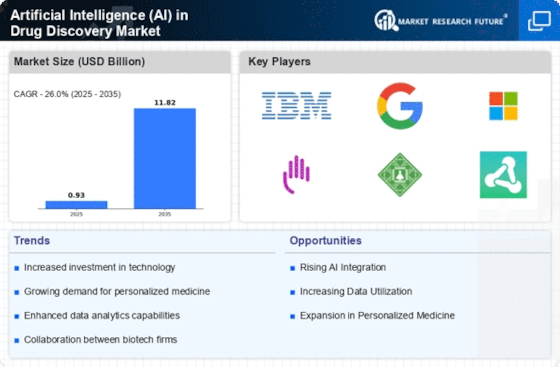
As per Market Research Future analysis, the Artificial Intelligence (AI) in Drug Discovery Market was estimated at 0.93 USD Billion in 2024. The AI in Drug Discovery industry is projected to grow from 1.172 USD Billion in 2025 to 11.82 USD Billion by 2035, exhibiting a compound annual growth rate (CAGR) of 26% during the forecast period 2025 - 2035

Key Market Trends & Highlights

The Artificial Intelligence in Drug Discovery Market is poised for substantial growth driven by technological advancements and increasing collaboration across sectors.

  • North America remains the largest market for AI in drug discovery, reflecting robust investment and innovation in biotechnology. The Asia-Pacific region is emerging as the fastest-growing market, fueled by increasing demand for advanced healthcare solutions. Lead optimization continues to dominate the market, while drug repurposing is rapidly gaining traction as a cost-effective strategy. Rising demand for personalized medicine and advancements in machine learning algorithms are key drivers propelling market expansion.

Market Size & Forecast

2024 Market Size 0.93 (USD Billion)
2035 Market Size 11.82 (USD Billion)
CAGR (2025 - 2035) 26.0%
Largest Regional Market Share in 2024 North America

Major Players

IBM (US), Google (US), Microsoft (US), Bristol-Myers Squibb (US), Insilico Medicine (HK), Atomwise (US), Exscientia (GB), Recursion Pharmaceuticals (US), Zebra Medical Vision (IL), all actively shaping competitive dynamics within the artificial intelligence in drug discovery market.

Market Trends

The Artificial Intelligence (AI) in Drug Discovery Market is currently experiencing a transformative phase, driving rapid expansion of the artificial intelligence in drug discovery market. This market appears to be characterized by a growing integration of machine learning algorithms and data analytics, which facilitate the identification of potential drug candidates more efficiently than traditional methods. As pharmaceutical companies seek to reduce development timelines and costs, the adoption of AI technologies seems to be accelerating, leading to a paradigm shift in how drugs are discovered and developed. Furthermore, collaborations between tech firms and biopharmaceutical companies are likely to enhance innovation, fostering an environment where novel therapeutic solutions can emerge more rapidly.

In addition, regulatory bodies are beginning to recognize the potential of AI in drug discovery, which may lead to more streamlined approval processes for AI-driven solutions. This evolving landscape suggests that the Artificial Intelligence (AI) in Drug Discovery Market is poised for substantial growth, as stakeholders increasingly acknowledge the value of integrating AI into their research and development pipelines, positively influencing long-term artificial intelligence in drug discovery market analysis. The future may hold even greater advancements, as ongoing research continues to unlock new possibilities in drug discovery, potentially revolutionizing the industry as a whole.

Increased Collaboration Between Sectors

The trend of collaboration between technology companies and pharmaceutical firms is becoming more pronounced within the artificial intelligence in drug discovery market. This partnership aims to leverage AI capabilities to enhance drug discovery processes, combining expertise in software development with deep knowledge of biological sciences.

Enhanced Data Utilization

There is a growing emphasis on the utilization of vast datasets in drug discovery, significantly contributing to the expansion of the artificial intelligence in drug discovery market size. AI technologies are increasingly employed to analyze complex biological data, which may lead to more accurate predictions of drug efficacy and safety.

Regulatory Adaptation

Regulatory agencies are adapting to the rise of AI in drug discovery, supporting favorable frameworks that could positively impact the overall artificial intelligence in drug discovery market analysis and accelerate therapy development.

AI Drug Discovery Market Market Drivers

Increased Investment in Biotechnology

The surge in investment within the biotechnology sector is propelling the Artificial Intelligence (AI) in Drug Discovery Market forward. Venture capital funding and government grants are increasingly directed towards AI-driven biotech firms, facilitating the development of innovative drug discovery solutions. In 2023, investments in AI-focused biotech companies reached approximately USD 1.2 billion, underscoring the growing confidence in AI's potential to revolutionize drug development. This influx of capital not only accelerates research and development but also fosters collaboration between tech companies and pharmaceutical firms, enhancing the overall landscape of drug discovery.

Regulatory Support for AI Integration

Regulatory bodies are increasingly recognizing the potential of AI in drug discovery, providing support that drives the Artificial Intelligence (AI) in Drug Discovery Market. Initiatives aimed at establishing guidelines for the use of AI in clinical trials and drug approval processes are emerging. This regulatory support not only enhances the credibility of AI-driven solutions but also encourages pharmaceutical companies to adopt these technologies. As regulations evolve to accommodate AI innovations, the market is expected to benefit from increased trust and acceptance, facilitating the integration of AI into mainstream drug discovery practices.

Rising Demand for Personalized Medicine

The increasing emphasis on personalized medicine is a key driver in the Artificial Intelligence (AI) in Drug Discovery Market. As healthcare shifts towards tailored treatments, AI technologies are being leveraged to analyze vast datasets, including genetic information, to identify potential drug candidates that are more effective for specific patient populations. This trend is reflected in the projected growth of the market, which is expected to reach USD 3.5 billion by 2026. The ability of AI to predict patient responses to drugs enhances the efficiency of drug development processes, thereby reducing time and costs associated with bringing new therapies to market.

Advancements in Machine Learning Algorithms

Recent advancements in machine learning algorithms are significantly influencing the Artificial Intelligence (AI) in Drug Discovery Market. These algorithms enable researchers to process and analyze complex biological data more efficiently, leading to the identification of novel drug candidates. For instance, deep learning techniques have shown promise in predicting molecular interactions and optimizing drug design. The market is anticipated to grow at a compound annual growth rate (CAGR) of 40% from 2023 to 2030, driven by these technological innovations. As machine learning continues to evolve, its applications in drug discovery are likely to expand, further enhancing the industry's capabilities.

Growing Need for Cost-Effective Drug Development

The pressing need for cost-effective drug development is a significant driver in the Artificial Intelligence (AI) in Drug Discovery Market. Traditional drug discovery processes are often lengthy and expensive, with high failure rates. AI technologies offer solutions to streamline these processes, potentially reducing costs by up to 30%. By utilizing predictive analytics and simulations, AI can identify promising drug candidates earlier in the development pipeline, thereby minimizing resource expenditure. As pharmaceutical companies seek to optimize their R&D budgets, the adoption of AI in drug discovery is likely to increase, further driving market growth.

Market Segment Insights

By Application: Lead Optimization (Largest) vs. Drug Repurposing (Fastest-Growing)

In the Artificial Intelligence in Drug Discovery Market, the application segment is prominently represented by categories such as Target Identification, Lead Optimization, Drug Repurposing, Clinical Trials, and Preclinical Testing. Among these, Lead Optimization holds the largest market share, showcasing its crucial role in refining drug candidates. Drug Repurposing is gaining traction as a significant player, reflecting its innovative approach to utilizing existing drugs for new therapeutic purposes.

Lead Optimization (Dominant) vs. Drug Repurposing (Emerging)

Lead Optimization serves as a dominant application in AI-driven drug discovery, acting as a pivotal phase where computational techniques refine promising drug candidates into viable products. It leverages extensive databases and predictive modeling to enhance selectivity and efficacy, which reduces time and resources. In contrast, Drug Repurposing emerges as a rapidly growing segment, utilizing AI to analyze existing medications for new uses. This approach benefits from lower costs and shortened timelines, appealing to biotech firms under budget constraints and urgent market demands. Both applications reflect trends in efficiency and innovation within the pharmaceutical industry.

By Technology: Machine Learning (Largest) vs. Deep Learning (Fastest-Growing)

The Artificial Intelligence (AI) in Drug Discovery Market showcases a competitive landscape dominated by Machine Learning, which captures the largest market share among the various technology segments. <a href="../../../reports/natural-language-processing-market-1288">Natural Language Processing</a> and <a href="../../../reports/knowledge-graph-market-23387">Knowledge Graphs</a> follow, showing significant contributions to overall market dynamics. Meanwhile, Robotic Process Automation, although smaller in terms of market share, plays an essential role in enhancing efficiency in drug discovery processes, thus solidifying its presence in the market.

Technology: Machine Learning (Dominant) vs. Deep Learning (Emerging)

Machine Learning stands out as the dominant technology in the AI-driven drug discovery landscape due to its proven capabilities in analyzing vast datasets and extracting crucial insights. It enables pharmaceutical companies to expedite the drug development process by identifying potential candidates and predicting their efficacy. On the other hand, Deep Learning, which is rapidly emerging, leverages neural networks to improve accuracy in drug target identification and molecular prediction. Its adaptive nature allows it to learn from complex data structures, making it essential for innovative approaches in drug design. Together, these technologies are reshaping the traditional drug discovery paradigms.

By End Use: Pharmaceutical Companies (Largest) vs. Biotechnology Firms (Fastest-Growing)

The Artificial Intelligence (AI) in Drug Discovery Market exhibits a diverse segmentation by end use, prominently featuring Pharmaceutical Companies, Biotechnology Firms, Research Institutions, and Academic Institutions. Among these, Pharmaceutical Companies hold the largest market share, leveraging advanced AI technologies to enhance drug discovery processes, streamline research, and improve efficiency. Following closely, Biotechnology Firms represent a significant portion of the market as they accelerate innovation through AI and focus on personalized medicine, making them vital players in this dynamic landscape.

Pharmaceutical Companies (Dominant) vs. Biotechnology Firms (Emerging)

Pharmaceutical Companies are currently the dominant segment in the AI in Drug Discovery Market, adopting cutting-edge technologies to optimize drug development timelines and reduce costs. These companies utilize AI for various applications, such as predicting drug interactions and analyzing complex biological data, which facilitates faster decision-making in drug research. In contrast, Biotechnology Firms are emerging as key players, particularly in the realm of bespoke therapies. With a heavy focus on precision medicine and gene editing, they harness AI to design more effective therapies tailored to individual patient needs, positioning themselves uniquely in the evolving market.

By Workflow: Data Mining (Largest) vs. Predictive Modeling (Fastest-Growing)

In the Artificial Intelligence (AI) in Drug Discovery Market, Data Mining is currently the largest segment, accounting for a significant portion of the overall market share. This segment focuses on extracting valuable insights from vast datasets, enabling researchers to make data-driven decisions. Closely following is Predictive Modeling, which is witnessing rapid growth as it enhances the ability to forecast outcomes based on historical data, allowing for more effective drug discovery processes. The growth trends for these segments are driven by the increasing volume of biological data generated from various sources, including clinical trials and genomic studies. As pharmaceutical companies strive for efficiency in drug development, the adoption of AI-driven Data Mining and Predictive Modeling tools continues to rise. This trend is further supported by advancements in machine learning algorithms that improve the accuracy and speed of data analysis, making these workflows indispensable in modern drug discovery.

Data Mining (Dominant) vs. Clinical Data Management (Emerging)

In the context of the Artificial Intelligence (AI) in Drug Discovery Market, Data Mining is recognized as the dominant workflow due to its pivotal role in synthesizing complex datasets into actionable insights. It facilitates the identification of potential drug candidates by uncovering patterns and relationships within the data. Meanwhile, Clinical Data Management is emerging as an important segment, focusing on maintaining the quality and integrity of clinical trial data. This workflow is increasingly incorporating AI tools to streamline the handling and analysis of clinical data, reducing errors and improving the efficiency of drug development. The synergy between these two workflows highlights the evolving landscape of AI in drug discovery, where Data Mining leads while Clinical Data Management positions itself as an essential component of the process.

Get more detailed insights about Artificial Intelligence (AI) in Drug Discovery Market Research Report - Forecast to 2035

Regional Insights

North America : Innovation and Investment Hub

North America is the largest market for AI in drug discovery, holding approximately 45% of the global share. The region benefits from significant investments in technology and healthcare, driven by a robust pharmaceutical industry and supportive regulatory frameworks. The demand for faster drug development processes and personalized medicine is propelling growth, with government initiatives promoting AI integration in healthcare. The United States is the dominant player, home to major companies like IBM, Google, and Bristol-Myers Squibb. The competitive landscape is characterized by a mix of established pharmaceutical giants and innovative startups. Canada is also emerging as a key player, leveraging its strong research institutions and favorable policies to foster AI advancements in drug discovery.

Europe : Regulatory Support and Growth

Europe is the second-largest market for AI in drug discovery, accounting for around 30% of the global market share. The region is witnessing a surge in demand for AI technologies, driven by increasing investments in healthcare innovation and supportive regulatory frameworks. The European Medicines Agency is actively promoting the use of AI in drug development, which is expected to further accelerate market growth. Leading countries include Germany, the UK, and France, which are at the forefront of AI research and development. The competitive landscape features a mix of established pharmaceutical companies and innovative tech firms, such as Exscientia and Insilico Medicine. Collaborative efforts between academia and industry are fostering advancements in AI applications for drug discovery.

Asia-Pacific : Rapid Growth and Innovation

Asia-Pacific is rapidly emerging as a significant player in the AI in drug discovery market, holding approximately 20% of the global share. The region is driven by increasing investments in healthcare technology, a growing number of biotech firms, and supportive government initiatives aimed at enhancing drug development processes. Countries like China and India are leading the charge, with a focus on leveraging AI to address healthcare challenges and improve patient outcomes. China is particularly notable for its aggressive investment in AI and biotechnology, with companies like Atomwise and Recursion Pharmaceuticals making strides in drug discovery. India is also gaining traction, supported by a burgeoning startup ecosystem and collaborations with global firms. The competitive landscape is characterized by a mix of local and international players, fostering innovation and growth in the sector.

Middle East and Africa : Emerging Market Potential

The Middle East and Africa region is in the early stages of developing its AI in drug discovery market, currently holding about 5% of the global share. The market is driven by increasing healthcare investments, a growing focus on research and development, and the need for innovative solutions to address local health challenges. Governments are beginning to recognize the potential of AI in enhancing drug discovery processes, which is expected to catalyze growth in the coming years. Countries like South Africa and the UAE are leading the way, with initiatives aimed at fostering AI adoption in healthcare. The competitive landscape is still developing, with a mix of local startups and international firms exploring opportunities in the region. Collaborative efforts between governments, academia, and industry are essential for driving innovation and establishing a robust AI ecosystem in drug discovery.

Key Players and Competitive Insights

The global market for artificial intelligence in drug development has emerged as a crucial priority for prominent pharmaceutical and technology businesses aiming to optimize their drug discovery processes and reduce time to market. This sector leverages advanced machine learning algorithms and data analytics, significantly improving the efficiency of identifying potential drug candidates. As the demand for customized medicine and new medicines escalates, competition in this sector intensifies, emphasizing strategic collaborations, technological improvements, and the development of intellectual property.Companies are currently exploring the integration of AI for medication identification, as well as for the optimization of clinical trials and post-market surveillance. The environment features significant investments in research and development, focused on developing advanced AI platforms that can predict medication interactions and side effects, with the goal of optimizing each phase of the drug development process. Novartis stands out in the Artificial Intelligence in Drug Discovery Market due to its commitment to innovation and technological adoption. With a robust research and development pipeline, Novartis has integrated AI into various aspects of its drug discovery activities, allowing for more efficient screening and optimizing molecular drug design. It’s strategic collaborations with tech firms and academic institutions fortify its market presence, enabling Novartis to leverage state-of-the-art AI solutions. Novartis's strengths lie in its extensive portfolio covering a diverse range of therapeutic areas and its capability to utilize AI in repurposing existing drugs, potentially speeding up the drug discovery process. This forward-thinking approach combined with Novartis's established industry reputation solidifies its competitive edge in leveraging AI technologies within drug discovery for global applications. Atomwise is another key player in the Artificial Intelligence in Drug Discovery Market, recognized for its innovative use of AI in drug design and development. The company’s proprietary technology utilizes deep learning algorithms to predict the effectiveness of potential drug molecules, substantially accelerating the initial phases of drug discovery. Atomwise has made significant strides in creating strategic partnerships with various pharmaceutical companies and research institutions globally, allowing for extensive application of its technology in diverse therapeutic areas. The company's strength lies in its unique AI platform, which offers efficient virtual screening services, yielding a high success rate in drug candidates' identification. Atomwise has also engaged in notable collaborations and mergers that have bolstered its market presence, enhancing its product offerings and capabilities in drug discovery. This focus on AI and strategic expansion allows Atomwise to maintain a competitive position in the rapidly evolving landscape of drug discovery, driving innovation and efficiency on a global scale.

Key Companies in the AI Drug Discovery Market include

Industry Developments

DEC 2025 - AI-driven drug discovery continues to gain momentum as pharmaceutical companies adopt machine-learning platforms for target identification, lead optimization, and predictive modeling. Several AI-designed molecules have progressed into clinical stages, accelerating timelines and reducing R&D cost. Strategic collaborations between biotech companies and cloud-AI vendors are rising sharply. Regulators are beginning to define clearer frameworks for AI-assisted drug development, supporting industry-wide adoption.

The global market for artificial intelligence in drug discovery is experiencing significant growth, as leading pharmaceutical firms such as Novartis, Pfizer, and AstraZeneca utilize AI to enhance the efficiency of drug development. Atomwise continues to be a prominent entity, recognized for its AtomNet® platform that facilitates the virtual screening of billions of compounds, greatly enhancing the process of early-stage drug identification. Other firms like Insilico Medicine and DeepMind (through Isomorphic Labs) have secured significant funding, highlighting the industry's innovative capabilities and growing investor trust.

Exscientia’s collaboration with Bristol Myers Squibb, announced in May 2021, represented a significant milestone in their partnerships. The agreement, worth more than $1.2 billion, focuses on leveraging AI to enhance the efficiency of drug development across various therapeutic targets. The collaboration has successfully produced a first-in-human trial for a PKC-theta inhibitor (EXS4318), highlighting the tangible benefits of AI-driven innovation in clinical development.

Despite the prevailing market optimism, it is crucial to clarify that IBM did not acquire any AI drug discovery firm in August 2023, contrary to certain reports. In 2022, the organization restructured its earlier healthcare AI initiatives, leading to the formation of Merative. Overall, the advancements in AI within the drug discovery sector are set for ongoing growth, fueled by strategic partnerships, evolving platforms, and a significant focus on technology integration.

Future Outlook

AI Drug Discovery Market Future Outlook

The Artificial Intelligence in Drug Discovery Market is projected to grow at a 26.0% CAGR from 2025 to 2035, driven by advancements in machine learning, data analytics, and increased R&amp;D investments.

New opportunities lie in:

  • <p>Integration of AI-driven predictive analytics in clinical trials Development of AI platforms for personalized medicine Partnerships with biotech firms for AI-enhanced drug design</p>

By 2035, the market is expected to be a pivotal component of pharmaceutical innovation.

Market Segmentation

AI Drug Discovery Market End Use Outlook

  • Pharmaceutical Companies
  • Biotechnology Firms
  • Research Institutions
  • Academic Institutions

AI Drug Discovery Market Workflow Outlook

  • Data Mining
  • Predictive Modeling
  • Clinical Data Management
  • Assay Development

AI Drug Discovery Market Technology Outlook

  • Machine Learning
  • Natural Language Processing
  • Deep Learning
  • Knowledge Graphs
  • Robotic Process Automation

AI Drug Discovery Market Application Outlook

  • Target Identification
  • Lead Optimization
  • Drug Repurposing
  • Clinical Trials
  • Preclinical Testing

Report Scope

MARKET SIZE 2024 0.93(USD Billion)
MARKET SIZE 2025 1.172(USD Billion)
MARKET SIZE 2035 11.82(USD Billion)
COMPOUND ANNUAL GROWTH RATE (CAGR) 26.0% (2025 - 2035)
REPORT COVERAGE Revenue Forecast, Competitive Landscape, Growth Factors, and Trends
BASE YEAR 2024
Market Forecast Period 2025 - 2035
Historical Data 2019 - 2024
Market Forecast Units USD Billion
Key Companies Profiled IBM (US), Google (US), Microsoft (US), Bristol-Myers Squibb (US), Insilico Medicine (HK), Atomwise (US), Exscientia (GB), Recursion Pharmaceuticals (US), Zebra Medical Vision (IL)
Segments Covered Applications, Technology, End Use, Workflow
Key Market Opportunities Integration of advanced machine learning algorithms enhances drug candidate identification and accelerates Research and Development processes.
Key Market Dynamics Rising integration of Artificial Intelligence in drug discovery enhances efficiency and accelerates the Research and Development process.
Countries Covered North America, Europe, APAC, South America, MEA

FAQs

What is the projected market valuation for the Artificial Intelligence (AI) in Drug Discovery Market by 2035?

<p>The projected market valuation for the AI in Drug Discovery Market is expected to reach 11.82 USD Billion by 2035.</p>

What was the market valuation for the AI in Drug Discovery Market in 2024?

<p>The market valuation for the AI in Drug Discovery Market was 0.93 USD Billion in 2024.</p>

What is the expected compound annual growth rate (CAGR) for the AI in Drug Discovery Market from 2025 to 2035?

<p>The expected CAGR for the AI in Drug Discovery Market during the forecast period 2025 - 2035 is 26.0%.</p>

Which companies are considered key players in the AI in Drug Discovery Market?

<p>Key players in the AI in Drug Discovery Market include IBM, Google, Microsoft, Bristol-Myers Squibb, Insilico Medicine, Atomwise, Exscientia, Recursion Pharmaceuticals, and Zebra Medical Vision.</p>

What are the main application segments of the AI in Drug Discovery Market?

<p>The main application segments include Target Identification, Lead Optimization, Drug Repurposing, Clinical Trials, and Preclinical Testing.</p>

How much is the Lead Optimization segment projected to be valued by 2035?

<p>The Lead Optimization segment is projected to be valued at 3.0 USD Billion by 2035.</p>

What technologies are driving the AI in Drug Discovery Market?

<p>Driving technologies in the AI in Drug Discovery Market include Machine Learning, Natural Language Processing, Deep Learning, Knowledge Graphs, and Robotic Process Automation.</p>

What is the projected valuation for the Machine Learning segment by 2035?

<p>The Machine Learning segment is projected to reach a valuation of 3.8 USD Billion by 2035.</p>

Which end-use sectors are contributing to the AI in Drug Discovery Market?

<p>The end-use sectors contributing to the market include Pharmaceutical Companies, Biotechnology Firms, Research Institutions, and Academic Institutions.</p>

What is the expected valuation for the Assay Development workflow segment by 2035?

<p>The Assay Development workflow segment is expected to be valued at 3.82 USD Billion by 2035.</p>

  1. SECTION I: EXECUTIVE SUMMARY AND KEY HIGHLIGHTS
    1. | 1.1 EXECUTIVE SUMMARY
    2. | | 1.1.1 Market Overview
    3. | | 1.1.2 Key Findings
    4. | | 1.1.3 Market Segmentation
    5. | | 1.1.4 Competitive Landscape
    6. | | 1.1.5 Challenges and Opportunities
    7. | | 1.1.6 Future Outlook
  2. SECTION II: SCOPING, METHODOLOGY AND MARKET STRUCTURE
    1. | 2.1 MARKET INTRODUCTION
    2. | | 2.1.1 Definition
    3. | | 2.1.2 Scope of the study
    4. | | | 2.1.2.1 Research Objective
    5. | | | 2.1.2.2 Assumption
    6. | | | 2.1.2.3 Limitations
    7. | 2.2 RESEARCH METHODOLOGY
    8. | | 2.2.1 Overview
    9. | | 2.2.2 Data Mining
    10. | | 2.2.3 Secondary Research
    11. | | 2.2.4 Primary Research
    12. | | | 2.2.4.1 Primary Interviews and Information Gathering Process
    13. | | | 2.2.4.2 Breakdown of Primary Respondents
    14. | | 2.2.5 Forecasting Model
    15. | | 2.2.6 Market Size Estimation
    16. | | | 2.2.6.1 Bottom-Up Approach
    17. | | | 2.2.6.2 Top-Down Approach
    18. | | 2.2.7 Data Triangulation
    19. | | 2.2.8 Validation
  3. SECTION III: QUALITATIVE ANALYSIS
    1. | 3.1 MARKET DYNAMICS
    2. | | 3.1.1 Overview
    3. | | 3.1.2 Drivers
    4. | | 3.1.3 Restraints
    5. | | 3.1.4 Opportunities
    6. | 3.2 MARKET FACTOR ANALYSIS
    7. | | 3.2.1 Value chain Analysis
    8. | | 3.2.2 Porter's Five Forces Analysis
    9. | | | 3.2.2.1 Bargaining Power of Suppliers
    10. | | | 3.2.2.2 Bargaining Power of Buyers
    11. | | | 3.2.2.3 Threat of New Entrants
    12. | | | 3.2.2.4 Threat of Substitutes
    13. | | | 3.2.2.5 Intensity of Rivalry
    14. | | 3.2.3 COVID-19 Impact Analysis
    15. | | | 3.2.3.1 Market Impact Analysis
    16. | | | 3.2.3.2 Regional Impact
    17. | | | 3.2.3.3 Opportunity and Threat Analysis
  4. SECTION IV: QUANTITATIVE ANALYSIS
    1. | 4.1 Healthcare, BY Application (USD Billion)
    2. | | 4.1.1 Target Identification
    3. | | 4.1.2 Lead Optimization
    4. | | 4.1.3 Drug Repurposing
    5. | | 4.1.4 Clinical Trials
    6. | | 4.1.5 Preclinical Testing
    7. | 4.2 Healthcare, BY Technology (USD Billion)
    8. | | 4.2.1 Machine Learning
    9. | | 4.2.2 Natural Language Processing
    10. | | 4.2.3 Deep Learning
    11. | | 4.2.4 Knowledge Graphs
    12. | | 4.2.5 Robotic Process Automation
    13. | 4.3 Healthcare, BY End Use (USD Billion)
    14. | | 4.3.1 Pharmaceutical Companies
    15. | | 4.3.2 Biotechnology Firms
    16. | | 4.3.3 Research Institutions
    17. | | 4.3.4 Academic Institutions
    18. | 4.4 Healthcare, BY Workflow (USD Billion)
    19. | | 4.4.1 Data Mining
    20. | | 4.4.2 Predictive Modeling
    21. | | 4.4.3 Clinical Data Management
    22. | | 4.4.4 Assay Development
    23. | 4.5 Healthcare, BY Region (USD Billion)
    24. | | 4.5.1 North America
    25. | | | 4.5.1.1 US
    26. | | | 4.5.1.2 Canada
    27. | | 4.5.2 Europe
    28. | | | 4.5.2.1 Germany
    29. | | | 4.5.2.2 UK
    30. | | | 4.5.2.3 France
    31. | | | 4.5.2.4 Russia
    32. | | | 4.5.2.5 Italy
    33. | | | 4.5.2.6 Spain
    34. | | | 4.5.2.7 Rest of Europe
    35. | | 4.5.3 APAC
    36. | | | 4.5.3.1 China
    37. | | | 4.5.3.2 India
    38. | | | 4.5.3.3 Japan
    39. | | | 4.5.3.4 South Korea
    40. | | | 4.5.3.5 Malaysia
    41. | | | 4.5.3.6 Thailand
    42. | | | 4.5.3.7 Indonesia
    43. | | | 4.5.3.8 Rest of APAC
    44. | | 4.5.4 South America
    45. | | | 4.5.4.1 Brazil
    46. | | | 4.5.4.2 Mexico
    47. | | | 4.5.4.3 Argentina
    48. | | | 4.5.4.4 Rest of South America
    49. | | 4.5.5 MEA
    50. | | | 4.5.5.1 GCC Countries
    51. | | | 4.5.5.2 South Africa
    52. | | | 4.5.5.3 Rest of MEA
  5. SECTION V: COMPETITIVE ANALYSIS
    1. | 5.1 Competitive Landscape
    2. | | 5.1.1 Overview
    3. | | 5.1.2 Competitive Analysis
    4. | | 5.1.3 Market share Analysis
    5. | | 5.1.4 Major Growth Strategy in the Healthcare
    6. | | 5.1.5 Competitive Benchmarking
    7. | | 5.1.6 Leading Players in Terms of Number of Developments in the Healthcare
    8. | | 5.1.7 Key developments and growth strategies
    9. | | | 5.1.7.1 New Product Launch/Service Deployment
    10. | | | 5.1.7.2 Merger & Acquisitions
    11. | | | 5.1.7.3 Joint Ventures
    12. | | 5.1.8 Major Players Financial Matrix
    13. | | | 5.1.8.1 Sales and Operating Income
    14. | | | 5.1.8.2 Major Players R&D Expenditure. 2023
    15. | 5.2 Company Profiles
    16. | | 5.2.1 IBM (US)
    17. | | | 5.2.1.1 Financial Overview
    18. | | | 5.2.1.2 Products Offered
    19. | | | 5.2.1.3 Key Developments
    20. | | | 5.2.1.4 SWOT Analysis
    21. | | | 5.2.1.5 Key Strategies
    22. | | 5.2.2 Google (US)
    23. | | | 5.2.2.1 Financial Overview
    24. | | | 5.2.2.2 Products Offered
    25. | | | 5.2.2.3 Key Developments
    26. | | | 5.2.2.4 SWOT Analysis
    27. | | | 5.2.2.5 Key Strategies
    28. | | 5.2.3 Microsoft (US)
    29. | | | 5.2.3.1 Financial Overview
    30. | | | 5.2.3.2 Products Offered
    31. | | | 5.2.3.3 Key Developments
    32. | | | 5.2.3.4 SWOT Analysis
    33. | | | 5.2.3.5 Key Strategies
    34. | | 5.2.4 Bristol-Myers Squibb (US)
    35. | | | 5.2.4.1 Financial Overview
    36. | | | 5.2.4.2 Products Offered
    37. | | | 5.2.4.3 Key Developments
    38. | | | 5.2.4.4 SWOT Analysis
    39. | | | 5.2.4.5 Key Strategies
    40. | | 5.2.5 Insilico Medicine (HK)
    41. | | | 5.2.5.1 Financial Overview
    42. | | | 5.2.5.2 Products Offered
    43. | | | 5.2.5.3 Key Developments
    44. | | | 5.2.5.4 SWOT Analysis
    45. | | | 5.2.5.5 Key Strategies
    46. | | 5.2.6 Atomwise (US)
    47. | | | 5.2.6.1 Financial Overview
    48. | | | 5.2.6.2 Products Offered
    49. | | | 5.2.6.3 Key Developments
    50. | | | 5.2.6.4 SWOT Analysis
    51. | | | 5.2.6.5 Key Strategies
    52. | | 5.2.7 Exscientia (GB)
    53. | | | 5.2.7.1 Financial Overview
    54. | | | 5.2.7.2 Products Offered
    55. | | | 5.2.7.3 Key Developments
    56. | | | 5.2.7.4 SWOT Analysis
    57. | | | 5.2.7.5 Key Strategies
    58. | | 5.2.8 Recursion Pharmaceuticals (US)
    59. | | | 5.2.8.1 Financial Overview
    60. | | | 5.2.8.2 Products Offered
    61. | | | 5.2.8.3 Key Developments
    62. | | | 5.2.8.4 SWOT Analysis
    63. | | | 5.2.8.5 Key Strategies
    64. | | 5.2.9 Zebra Medical Vision (IL)
    65. | | | 5.2.9.1 Financial Overview
    66. | | | 5.2.9.2 Products Offered
    67. | | | 5.2.9.3 Key Developments
    68. | | | 5.2.9.4 SWOT Analysis
    69. | | | 5.2.9.5 Key Strategies
    70. | 5.3 Appendix
    71. | | 5.3.1 References
    72. | | 5.3.2 Related Reports
  6. LIST OF FIGURES
    1. | 6.1 MARKET SYNOPSIS
    2. | 6.2 NORTH AMERICA MARKET ANALYSIS
    3. | 6.3 US MARKET ANALYSIS BY APPLICATION
    4. | 6.4 US MARKET ANALYSIS BY TECHNOLOGY
    5. | 6.5 US MARKET ANALYSIS BY END USE
    6. | 6.6 US MARKET ANALYSIS BY WORKFLOW
    7. | 6.7 CANADA MARKET ANALYSIS BY APPLICATION
    8. | 6.8 CANADA MARKET ANALYSIS BY TECHNOLOGY
    9. | 6.9 CANADA MARKET ANALYSIS BY END USE
    10. | 6.10 CANADA MARKET ANALYSIS BY WORKFLOW
    11. | 6.11 EUROPE MARKET ANALYSIS
    12. | 6.12 GERMANY MARKET ANALYSIS BY APPLICATION
    13. | 6.13 GERMANY MARKET ANALYSIS BY TECHNOLOGY
    14. | 6.14 GERMANY MARKET ANALYSIS BY END USE
    15. | 6.15 GERMANY MARKET ANALYSIS BY WORKFLOW
    16. | 6.16 UK MARKET ANALYSIS BY APPLICATION
    17. | 6.17 UK MARKET ANALYSIS BY TECHNOLOGY
    18. | 6.18 UK MARKET ANALYSIS BY END USE
    19. | 6.19 UK MARKET ANALYSIS BY WORKFLOW
    20. | 6.20 FRANCE MARKET ANALYSIS BY APPLICATION
    21. | 6.21 FRANCE MARKET ANALYSIS BY TECHNOLOGY
    22. | 6.22 FRANCE MARKET ANALYSIS BY END USE
    23. | 6.23 FRANCE MARKET ANALYSIS BY WORKFLOW
    24. | 6.24 RUSSIA MARKET ANALYSIS BY APPLICATION
    25. | 6.25 RUSSIA MARKET ANALYSIS BY TECHNOLOGY
    26. | 6.26 RUSSIA MARKET ANALYSIS BY END USE
    27. | 6.27 RUSSIA MARKET ANALYSIS BY WORKFLOW
    28. | 6.28 ITALY MARKET ANALYSIS BY APPLICATION
    29. | 6.29 ITALY MARKET ANALYSIS BY TECHNOLOGY
    30. | 6.30 ITALY MARKET ANALYSIS BY END USE
    31. | 6.31 ITALY MARKET ANALYSIS BY WORKFLOW
    32. | 6.32 SPAIN MARKET ANALYSIS BY APPLICATION
    33. | 6.33 SPAIN MARKET ANALYSIS BY TECHNOLOGY
    34. | 6.34 SPAIN MARKET ANALYSIS BY END USE
    35. | 6.35 SPAIN MARKET ANALYSIS BY WORKFLOW
    36. | 6.36 REST OF EUROPE MARKET ANALYSIS BY APPLICATION
    37. | 6.37 REST OF EUROPE MARKET ANALYSIS BY TECHNOLOGY
    38. | 6.38 REST OF EUROPE MARKET ANALYSIS BY END USE
    39. | 6.39 REST OF EUROPE MARKET ANALYSIS BY WORKFLOW
    40. | 6.40 APAC MARKET ANALYSIS
    41. | 6.41 CHINA MARKET ANALYSIS BY APPLICATION
    42. | 6.42 CHINA MARKET ANALYSIS BY TECHNOLOGY
    43. | 6.43 CHINA MARKET ANALYSIS BY END USE
    44. | 6.44 CHINA MARKET ANALYSIS BY WORKFLOW
    45. | 6.45 INDIA MARKET ANALYSIS BY APPLICATION
    46. | 6.46 INDIA MARKET ANALYSIS BY TECHNOLOGY
    47. | 6.47 INDIA MARKET ANALYSIS BY END USE
    48. | 6.48 INDIA MARKET ANALYSIS BY WORKFLOW
    49. | 6.49 JAPAN MARKET ANALYSIS BY APPLICATION
    50. | 6.50 JAPAN MARKET ANALYSIS BY TECHNOLOGY
    51. | 6.51 JAPAN MARKET ANALYSIS BY END USE
    52. | 6.52 JAPAN MARKET ANALYSIS BY WORKFLOW
    53. | 6.53 SOUTH KOREA MARKET ANALYSIS BY APPLICATION
    54. | 6.54 SOUTH KOREA MARKET ANALYSIS BY TECHNOLOGY
    55. | 6.55 SOUTH KOREA MARKET ANALYSIS BY END USE
    56. | 6.56 SOUTH KOREA MARKET ANALYSIS BY WORKFLOW
    57. | 6.57 MALAYSIA MARKET ANALYSIS BY APPLICATION
    58. | 6.58 MALAYSIA MARKET ANALYSIS BY TECHNOLOGY
    59. | 6.59 MALAYSIA MARKET ANALYSIS BY END USE
    60. | 6.60 MALAYSIA MARKET ANALYSIS BY WORKFLOW
    61. | 6.61 THAILAND MARKET ANALYSIS BY APPLICATION
    62. | 6.62 THAILAND MARKET ANALYSIS BY TECHNOLOGY
    63. | 6.63 THAILAND MARKET ANALYSIS BY END USE
    64. | 6.64 THAILAND MARKET ANALYSIS BY WORKFLOW
    65. | 6.65 INDONESIA MARKET ANALYSIS BY APPLICATION
    66. | 6.66 INDONESIA MARKET ANALYSIS BY TECHNOLOGY
    67. | 6.67 INDONESIA MARKET ANALYSIS BY END USE
    68. | 6.68 INDONESIA MARKET ANALYSIS BY WORKFLOW
    69. | 6.69 REST OF APAC MARKET ANALYSIS BY APPLICATION
    70. | 6.70 REST OF APAC MARKET ANALYSIS BY TECHNOLOGY
    71. | 6.71 REST OF APAC MARKET ANALYSIS BY END USE
    72. | 6.72 REST OF APAC MARKET ANALYSIS BY WORKFLOW
    73. | 6.73 SOUTH AMERICA MARKET ANALYSIS
    74. | 6.74 BRAZIL MARKET ANALYSIS BY APPLICATION
    75. | 6.75 BRAZIL MARKET ANALYSIS BY TECHNOLOGY
    76. | 6.76 BRAZIL MARKET ANALYSIS BY END USE
    77. | 6.77 BRAZIL MARKET ANALYSIS BY WORKFLOW
    78. | 6.78 MEXICO MARKET ANALYSIS BY APPLICATION
    79. | 6.79 MEXICO MARKET ANALYSIS BY TECHNOLOGY
    80. | 6.80 MEXICO MARKET ANALYSIS BY END USE
    81. | 6.81 MEXICO MARKET ANALYSIS BY WORKFLOW
    82. | 6.82 ARGENTINA MARKET ANALYSIS BY APPLICATION
    83. | 6.83 ARGENTINA MARKET ANALYSIS BY TECHNOLOGY
    84. | 6.84 ARGENTINA MARKET ANALYSIS BY END USE
    85. | 6.85 ARGENTINA MARKET ANALYSIS BY WORKFLOW
    86. | 6.86 REST OF SOUTH AMERICA MARKET ANALYSIS BY APPLICATION
    87. | 6.87 REST OF SOUTH AMERICA MARKET ANALYSIS BY TECHNOLOGY
    88. | 6.88 REST OF SOUTH AMERICA MARKET ANALYSIS BY END USE
    89. | 6.89 REST OF SOUTH AMERICA MARKET ANALYSIS BY WORKFLOW
    90. | 6.90 MEA MARKET ANALYSIS
    91. | 6.91 GCC COUNTRIES MARKET ANALYSIS BY APPLICATION
    92. | 6.92 GCC COUNTRIES MARKET ANALYSIS BY TECHNOLOGY
    93. | 6.93 GCC COUNTRIES MARKET ANALYSIS BY END USE
    94. | 6.94 GCC COUNTRIES MARKET ANALYSIS BY WORKFLOW
    95. | 6.95 SOUTH AFRICA MARKET ANALYSIS BY APPLICATION
    96. | 6.96 SOUTH AFRICA MARKET ANALYSIS BY TECHNOLOGY
    97. | 6.97 SOUTH AFRICA MARKET ANALYSIS BY END USE
    98. | 6.98 SOUTH AFRICA MARKET ANALYSIS BY WORKFLOW
    99. | 6.99 REST OF MEA MARKET ANALYSIS BY APPLICATION
    100. | 6.100 REST OF MEA MARKET ANALYSIS BY TECHNOLOGY
    101. | 6.101 REST OF MEA MARKET ANALYSIS BY END USE
    102. | 6.102 REST OF MEA MARKET ANALYSIS BY WORKFLOW
    103. | 6.103 KEY BUYING CRITERIA OF HEALTHCARE
    104. | 6.104 RESEARCH PROCESS OF MRFR
    105. | 6.105 DRO ANALYSIS OF HEALTHCARE
    106. | 6.106 DRIVERS IMPACT ANALYSIS: HEALTHCARE
    107. | 6.107 RESTRAINTS IMPACT ANALYSIS: HEALTHCARE
    108. | 6.108 SUPPLY / VALUE CHAIN: HEALTHCARE
    109. | 6.109 HEALTHCARE, BY APPLICATION, 2024 (% SHARE)
    110. | 6.110 HEALTHCARE, BY APPLICATION, 2024 TO 2035 (USD Billion)
    111. | 6.111 HEALTHCARE, BY TECHNOLOGY, 2024 (% SHARE)
    112. | 6.112 HEALTHCARE, BY TECHNOLOGY, 2024 TO 2035 (USD Billion)
    113. | 6.113 HEALTHCARE, BY END USE, 2024 (% SHARE)
    114. | 6.114 HEALTHCARE, BY END USE, 2024 TO 2035 (USD Billion)
    115. | 6.115 HEALTHCARE, BY WORKFLOW, 2024 (% SHARE)
    116. | 6.116 HEALTHCARE, BY WORKFLOW, 2024 TO 2035 (USD Billion)
    117. | 6.117 BENCHMARKING OF MAJOR COMPETITORS
  7. LIST OF TABLES
    1. | 7.1 LIST OF ASSUMPTIONS
    2. | | 7.1.1
    3. | 7.2 North America MARKET SIZE ESTIMATES; FORECAST
    4. | | 7.2.1 BY APPLICATION, 2025-2035 (USD Billion)
    5. | | 7.2.2 BY TECHNOLOGY, 2025-2035 (USD Billion)
    6. | | 7.2.3 BY END USE, 2025-2035 (USD Billion)
    7. | | 7.2.4 BY WORKFLOW, 2025-2035 (USD Billion)
    8. | 7.3 US MARKET SIZE ESTIMATES; FORECAST
    9. | | 7.3.1 BY APPLICATION, 2025-2035 (USD Billion)
    10. | | 7.3.2 BY TECHNOLOGY, 2025-2035 (USD Billion)
    11. | | 7.3.3 BY END USE, 2025-2035 (USD Billion)
    12. | | 7.3.4 BY WORKFLOW, 2025-2035 (USD Billion)
    13. | 7.4 Canada MARKET SIZE ESTIMATES; FORECAST
    14. | | 7.4.1 BY APPLICATION, 2025-2035 (USD Billion)
    15. | | 7.4.2 BY TECHNOLOGY, 2025-2035 (USD Billion)
    16. | | 7.4.3 BY END USE, 2025-2035 (USD Billion)
    17. | | 7.4.4 BY WORKFLOW, 2025-2035 (USD Billion)
    18. | 7.5 Europe MARKET SIZE ESTIMATES; FORECAST
    19. | | 7.5.1 BY APPLICATION, 2025-2035 (USD Billion)
    20. | | 7.5.2 BY TECHNOLOGY, 2025-2035 (USD Billion)
    21. | | 7.5.3 BY END USE, 2025-2035 (USD Billion)
    22. | | 7.5.4 BY WORKFLOW, 2025-2035 (USD Billion)
    23. | 7.6 Germany MARKET SIZE ESTIMATES; FORECAST
    24. | | 7.6.1 BY APPLICATION, 2025-2035 (USD Billion)
    25. | | 7.6.2 BY TECHNOLOGY, 2025-2035 (USD Billion)
    26. | | 7.6.3 BY END USE, 2025-2035 (USD Billion)
    27. | | 7.6.4 BY WORKFLOW, 2025-2035 (USD Billion)
    28. | 7.7 UK MARKET SIZE ESTIMATES; FORECAST
    29. | | 7.7.1 BY APPLICATION, 2025-2035 (USD Billion)
    30. | | 7.7.2 BY TECHNOLOGY, 2025-2035 (USD Billion)
    31. | | 7.7.3 BY END USE, 2025-2035 (USD Billion)
    32. | | 7.7.4 BY WORKFLOW, 2025-2035 (USD Billion)
    33. | 7.8 France MARKET SIZE ESTIMATES; FORECAST
    34. | | 7.8.1 BY APPLICATION, 2025-2035 (USD Billion)
    35. | | 7.8.2 BY TECHNOLOGY, 2025-2035 (USD Billion)
    36. | | 7.8.3 BY END USE, 2025-2035 (USD Billion)
    37. | | 7.8.4 BY WORKFLOW, 2025-2035 (USD Billion)
    38. | 7.9 Russia MARKET SIZE ESTIMATES; FORECAST
    39. | | 7.9.1 BY APPLICATION, 2025-2035 (USD Billion)
    40. | | 7.9.2 BY TECHNOLOGY, 2025-2035 (USD Billion)
    41. | | 7.9.3 BY END USE, 2025-2035 (USD Billion)
    42. | | 7.9.4 BY WORKFLOW, 2025-2035 (USD Billion)
    43. | 7.10 Italy MARKET SIZE ESTIMATES; FORECAST
    44. | | 7.10.1 BY APPLICATION, 2025-2035 (USD Billion)
    45. | | 7.10.2 BY TECHNOLOGY, 2025-2035 (USD Billion)
    46. | | 7.10.3 BY END USE, 2025-2035 (USD Billion)
    47. | | 7.10.4 BY WORKFLOW, 2025-2035 (USD Billion)
    48. | 7.11 Spain MARKET SIZE ESTIMATES; FORECAST
    49. | | 7.11.1 BY APPLICATION, 2025-2035 (USD Billion)
    50. | | 7.11.2 BY TECHNOLOGY, 2025-2035 (USD Billion)
    51. | | 7.11.3 BY END USE, 2025-2035 (USD Billion)
    52. | | 7.11.4 BY WORKFLOW, 2025-2035 (USD Billion)
    53. | 7.12 Rest of Europe MARKET SIZE ESTIMATES; FORECAST
    54. | | 7.12.1 BY APPLICATION, 2025-2035 (USD Billion)
    55. | | 7.12.2 BY TECHNOLOGY, 2025-2035 (USD Billion)
    56. | | 7.12.3 BY END USE, 2025-2035 (USD Billion)
    57. | | 7.12.4 BY WORKFLOW, 2025-2035 (USD Billion)
    58. | 7.13 APAC MARKET SIZE ESTIMATES; FORECAST
    59. | | 7.13.1 BY APPLICATION, 2025-2035 (USD Billion)
    60. | | 7.13.2 BY TECHNOLOGY, 2025-2035 (USD Billion)
    61. | | 7.13.3 BY END USE, 2025-2035 (USD Billion)
    62. | | 7.13.4 BY WORKFLOW, 2025-2035 (USD Billion)
    63. | 7.14 China MARKET SIZE ESTIMATES; FORECAST
    64. | | 7.14.1 BY APPLICATION, 2025-2035 (USD Billion)
    65. | | 7.14.2 BY TECHNOLOGY, 2025-2035 (USD Billion)
    66. | | 7.14.3 BY END USE, 2025-2035 (USD Billion)
    67. | | 7.14.4 BY WORKFLOW, 2025-2035 (USD Billion)
    68. | 7.15 India MARKET SIZE ESTIMATES; FORECAST
    69. | | 7.15.1 BY APPLICATION, 2025-2035 (USD Billion)
    70. | | 7.15.2 BY TECHNOLOGY, 2025-2035 (USD Billion)
    71. | | 7.15.3 BY END USE, 2025-2035 (USD Billion)
    72. | | 7.15.4 BY WORKFLOW, 2025-2035 (USD Billion)
    73. | 7.16 Japan MARKET SIZE ESTIMATES; FORECAST
    74. | | 7.16.1 BY APPLICATION, 2025-2035 (USD Billion)
    75. | | 7.16.2 BY TECHNOLOGY, 2025-2035 (USD Billion)
    76. | | 7.16.3 BY END USE, 2025-2035 (USD Billion)
    77. | | 7.16.4 BY WORKFLOW, 2025-2035 (USD Billion)
    78. | 7.17 South Korea MARKET SIZE ESTIMATES; FORECAST
    79. | | 7.17.1 BY APPLICATION, 2025-2035 (USD Billion)
    80. | | 7.17.2 BY TECHNOLOGY, 2025-2035 (USD Billion)
    81. | | 7.17.3 BY END USE, 2025-2035 (USD Billion)
    82. | | 7.17.4 BY WORKFLOW, 2025-2035 (USD Billion)
    83. | 7.18 Malaysia MARKET SIZE ESTIMATES; FORECAST
    84. | | 7.18.1 BY APPLICATION, 2025-2035 (USD Billion)
    85. | | 7.18.2 BY TECHNOLOGY, 2025-2035 (USD Billion)
    86. | | 7.18.3 BY END USE, 2025-2035 (USD Billion)
    87. | | 7.18.4 BY WORKFLOW, 2025-2035 (USD Billion)
    88. | 7.19 Thailand MARKET SIZE ESTIMATES; FORECAST
    89. | | 7.19.1 BY APPLICATION, 2025-2035 (USD Billion)
    90. | | 7.19.2 BY TECHNOLOGY, 2025-2035 (USD Billion)
    91. | | 7.19.3 BY END USE, 2025-2035 (USD Billion)
    92. | | 7.19.4 BY WORKFLOW, 2025-2035 (USD Billion)
    93. | 7.20 Indonesia MARKET SIZE ESTIMATES; FORECAST
    94. | | 7.20.1 BY APPLICATION, 2025-2035 (USD Billion)
    95. | | 7.20.2 BY TECHNOLOGY, 2025-2035 (USD Billion)
    96. | | 7.20.3 BY END USE, 2025-2035 (USD Billion)
    97. | | 7.20.4 BY WORKFLOW, 2025-2035 (USD Billion)
    98. | 7.21 Rest of APAC MARKET SIZE ESTIMATES; FORECAST
    99. | | 7.21.1 BY APPLICATION, 2025-2035 (USD Billion)
    100. | | 7.21.2 BY TECHNOLOGY, 2025-2035 (USD Billion)
    101. | | 7.21.3 BY END USE, 2025-2035 (USD Billion)
    102. | | 7.21.4 BY WORKFLOW, 2025-2035 (USD Billion)
    103. | 7.22 South America MARKET SIZE ESTIMATES; FORECAST
    104. | | 7.22.1 BY APPLICATION, 2025-2035 (USD Billion)
    105. | | 7.22.2 BY TECHNOLOGY, 2025-2035 (USD Billion)
    106. | | 7.22.3 BY END USE, 2025-2035 (USD Billion)
    107. | | 7.22.4 BY WORKFLOW, 2025-2035 (USD Billion)
    108. | 7.23 Brazil MARKET SIZE ESTIMATES; FORECAST
    109. | | 7.23.1 BY APPLICATION, 2025-2035 (USD Billion)
    110. | | 7.23.2 BY TECHNOLOGY, 2025-2035 (USD Billion)
    111. | | 7.23.3 BY END USE, 2025-2035 (USD Billion)
    112. | | 7.23.4 BY WORKFLOW, 2025-2035 (USD Billion)
    113. | 7.24 Mexico MARKET SIZE ESTIMATES; FORECAST
    114. | | 7.24.1 BY APPLICATION, 2025-2035 (USD Billion)
    115. | | 7.24.2 BY TECHNOLOGY, 2025-2035 (USD Billion)
    116. | | 7.24.3 BY END USE, 2025-2035 (USD Billion)
    117. | | 7.24.4 BY WORKFLOW, 2025-2035 (USD Billion)
    118. | 7.25 Argentina MARKET SIZE ESTIMATES; FORECAST
    119. | | 7.25.1 BY APPLICATION, 2025-2035 (USD Billion)
    120. | | 7.25.2 BY TECHNOLOGY, 2025-2035 (USD Billion)
    121. | | 7.25.3 BY END USE, 2025-2035 (USD Billion)
    122. | | 7.25.4 BY WORKFLOW, 2025-2035 (USD Billion)
    123. | 7.26 Rest of South America MARKET SIZE ESTIMATES; FORECAST
    124. | | 7.26.1 BY APPLICATION, 2025-2035 (USD Billion)
    125. | | 7.26.2 BY TECHNOLOGY, 2025-2035 (USD Billion)
    126. | | 7.26.3 BY END USE, 2025-2035 (USD Billion)
    127. | | 7.26.4 BY WORKFLOW, 2025-2035 (USD Billion)
    128. | 7.27 MEA MARKET SIZE ESTIMATES; FORECAST
    129. | | 7.27.1 BY APPLICATION, 2025-2035 (USD Billion)
    130. | | 7.27.2 BY TECHNOLOGY, 2025-2035 (USD Billion)
    131. | | 7.27.3 BY END USE, 2025-2035 (USD Billion)
    132. | | 7.27.4 BY WORKFLOW, 2025-2035 (USD Billion)
    133. | 7.28 GCC Countries MARKET SIZE ESTIMATES; FORECAST
    134. | | 7.28.1 BY APPLICATION, 2025-2035 (USD Billion)
    135. | | 7.28.2 BY TECHNOLOGY, 2025-2035 (USD Billion)
    136. | | 7.28.3 BY END USE, 2025-2035 (USD Billion)
    137. | | 7.28.4 BY WORKFLOW, 2025-2035 (USD Billion)
    138. | 7.29 South Africa MARKET SIZE ESTIMATES; FORECAST
    139. | | 7.29.1 BY APPLICATION, 2025-2035 (USD Billion)
    140. | | 7.29.2 BY TECHNOLOGY, 2025-2035 (USD Billion)
    141. | | 7.29.3 BY END USE, 2025-2035 (USD Billion)
    142. | | 7.29.4 BY WORKFLOW, 2025-2035 (USD Billion)
    143. | 7.30 Rest of MEA MARKET SIZE ESTIMATES; FORECAST
    144. | | 7.30.1 BY APPLICATION, 2025-2035 (USD Billion)
    145. | | 7.30.2 BY TECHNOLOGY, 2025-2035 (USD Billion)
    146. | | 7.30.3 BY END USE, 2025-2035 (USD Billion)
    147. | | 7.30.4 BY WORKFLOW, 2025-2035 (USD Billion)
    148. | 7.31 PRODUCT LAUNCH/PRODUCT DEVELOPMENT/APPROVAL
    149. | | 7.31.1
    150. | 7.32 ACQUISITION/PARTNERSHIP
    151. | | 7.32.1

Healthcare Market Segmentation

Healthcare By Application (USD Billion, 2025-2035)

  • Target Identification
  • Lead Optimization
  • Drug Repurposing
  • Clinical Trials
  • Preclinical Testing

Healthcare By Technology (USD Billion, 2025-2035)

  • Machine Learning
  • Natural Language Processing
  • Deep Learning
  • Knowledge Graphs
  • Robotic Process Automation

Healthcare By End Use (USD Billion, 2025-2035)

  • Pharmaceutical Companies
  • Biotechnology Firms
  • Research Institutions
  • Academic Institutions

Healthcare By Workflow (USD Billion, 2025-2035)

  • Data Mining
  • Predictive Modeling
  • Clinical Data Management
  • Assay Development
Infographic

Free Sample Request

Kindly complete the form below to receive a free sample of this Report

Get Free Sample

Customer Strories

Compare Licence

×
Features License Type
Single User Multiuser License Enterprise User
Price $4,950 $5,950 $7,250
Maximum User Access Limit 1 User Upto 10 Users Unrestricted Access Throughout the Organization
Free Customization
Direct Access to Analyst
Deliverable Format
Platform Access
Discount on Next Purchase 10% 15% 15%
Printable Versions