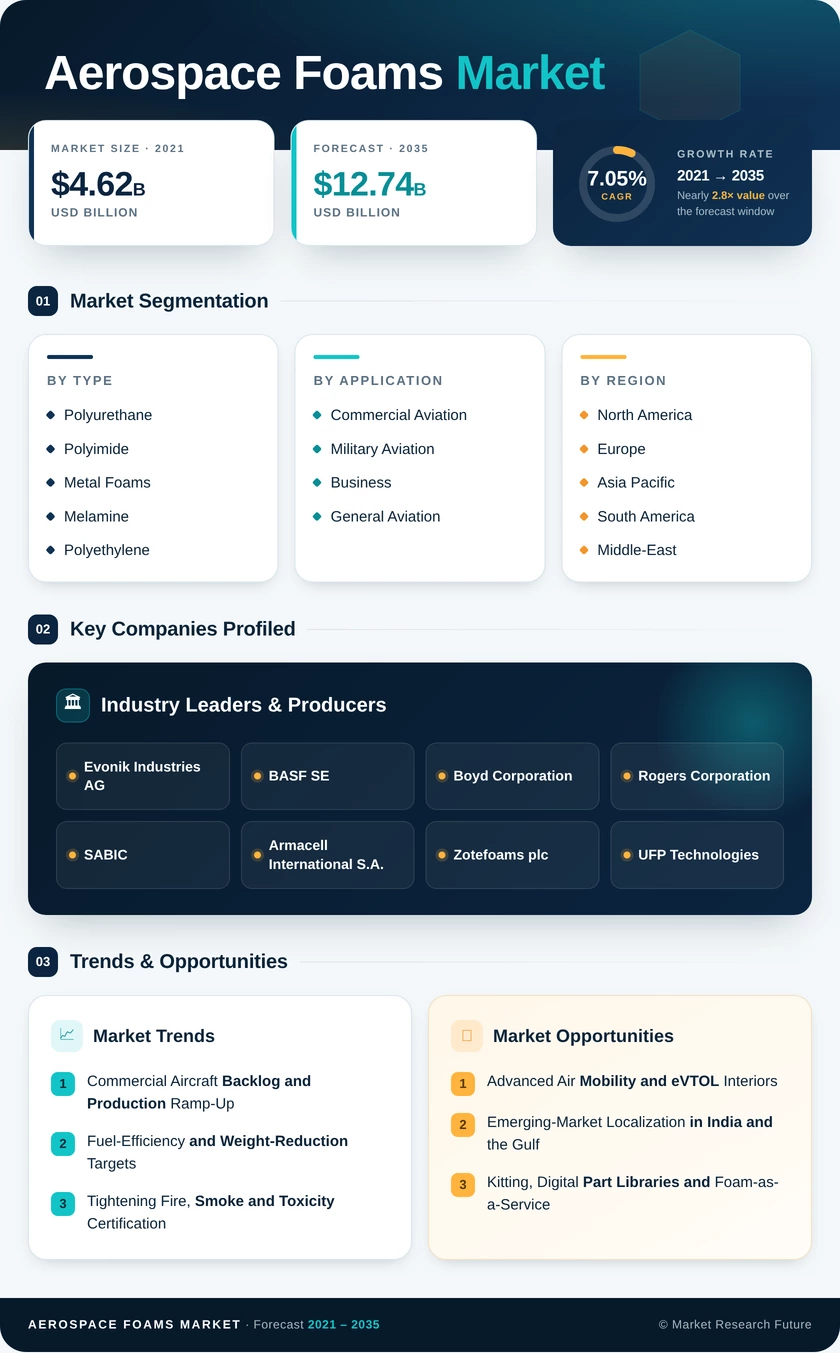
Aerospace Foams Market (2026 - 2035)

ID: MRFR/CnM/7020-HCR 111 Pages Chitranshi Jaiswal Last Updated: November 04, 2026
Aerospace Foams Market Research Report Information By Type (Polyurethane, Polyimide, Metal Foams, Melamine, Polyethylene, and Other Types (PMI, PVDF, and Silicone Specialty Foams)), By Application (Commercial Aviation, Military Aviation, and Business and General Aviation), And By Region (North America, Europe, Asia-Pacific, and Rest of the World) โ€“ Market Forecast Till 2035.
Aerospace Foams Market
Market Size
Forecast Period2026-2035
CAGR (2026-2035)7.05%
2025 Market SizeUSD 6.45 Billion
2035 Market SizeUSD 12.74 Billion
Key Players
Evonik Industries AG
BASF SE
Boyd Corporation
Rogers Corporation
SABIC
Armacell International S.A.
Opportunities
  • Advanced Air Mobility and eVTOL Interiors
  • Emerging-Market Localization in India and the Gulf
  • Kitting, Digital Part Libraries and Foam-as-a-Service
  1. 1 Market Summary | |
  2. 2 Key Report Takeaways | |
    1. 2.1 By Type | |
    2. 2.2 By Application | |
    3. 2.3 By Region | |
  3. 3 Market Size and Forecast (2021โ€“2035) | |
    1. 3.1 Historical Market Size (2021โ€“2025) | |
    2. 3.2 Forecast Market Size (2026โ€“2035) | |
    3. 3.3 Year-over-Year Growth Analysis | |
  4. 4 Driver Impact Analysis | |
    1. 4.1 Commercial Aircraft Backlog and Production Ramp-Up | |
    2. 4.2 Fuel-Efficiency and Weight-Reduction Targets | |
    3. 4.3 Tightening Fire, Smoke and Toxicity Certification | |
    4. 4.4 Defense Modernization Budgets | |
    5. 4.5 Cabin Retrofit and Refurbishment Cycles | |
    6. 4.6 Space Launch and Satellite Structures | |
    7. 4.7 Fleet Growth in Emerging Aviation Markets | |
  5. 5 Restraints Impact Analysis | |
    1. 5.1 Raw Material Price Volatility | |
    2. 5.2 Lengthy Qualification and Certification Costs | |
    3. 5.3 PFAS and Diisocyanate Chemical Regulation | |
    4. 5.4 OEM Supply-Chain and Delivery Bottlenecks | |
    5. 5.5 Limited End-of-Life Recyclability | |
  6. 6 Opportunities | |
    1. 6.1 Advanced Air Mobility and eVTOL Interiors | |
    2. 6.2 Emerging-Market Localization in India and the Gulf | |
    3. 6.3 Kitting, Digital Part Libraries and Foam-as-a-Service | |
    4. 6.4 Recyclable and Bio-Based Foam Chemistries | |
    5. 6.5 Space and Defense Thermal Protection | |
  7. 7 Regional Market Share and Country-Level Analysis | |
    1. 7.1 North America | | |
      1. 7.1.1 United States | | |
      2. 7.1.2 Canada | | |
      3. 7.1.3 Mexico | |
    2. 7.2 Europe | | |
      1. 7.2.1 Germany | | |
      2. 7.2.2 United Kingdom | | |
      3. 7.2.3 France | | |
      4. 7.2.4 Italy | | |
      5. 7.2.5 Rest of Europe | |
    3. 7.3 Asia Pacific | | |
      1. 7.3.1 China | | |
      2. 7.3.2 India | | |
      3. 7.3.3 Japan | | |
      4. 7.3.4 South Korea | | |
      5. 7.3.5 Rest of Asia-Pacific | |
    4. 7.4 South America | | |
      1. 7.4.1 Brazil | | |
      2. 7.4.2 Argentina | | |
      3. 7.4.3 Rest of South America | |
    5. 7.5 Middle-East and Africa | | |
      1. 7.5.1 Saudi Arabia | | |
      2. 7.5.2 South Africa | | |
      3. 7.5.3 Rest of Middle-East and Africa | |
  8. 8 Future Outlook (2026โ€“2035) | |
    1. 8.1 Next-Generation Narrowbody and Decarbonization | |
    2. 8.2 Automated and Additive Foam Manufacturing | |
    3. 8.3 Defense and Space Convergence | |
    4. 8.4 ESG Reporting and Circular Materials | |
  9. 9 Segmentation Analysis | |
    1. 9.1 By Type | | |
      1. 9.1.1 Polyurethane | | |
      2. 9.1.2 Polyimide | | |
      3. 9.1.3 Metal Foams | | |
      4. 9.1.4 Melamine | | |
      5. 9.1.5 Polyethylene | | |
      6. 9.1.6 Other Types | |
    2. 9.2 By Application | | |
      1. 9.2.1 Commercial Aviation | | |
      2. 9.2.2 Military Aviation | | |
      3. 9.2.3 Business and General Aviation | |
  10. 10 Competitive Landscape | |
    1. 10.1 Market Concentration Analysis | |
    2. 10.2 Competitive Benchmarking Table | |
    3. 10.3 Company Profiles | | |
      1. 10.3.1 Evonik Industries AG | | |
      2. 10.3.2 BASF SE | | |
      3. 10.3.3 Boyd Corporation | | |
      4. 10.3.4 Rogers Corporation | | |
      5. 10.3.5 SABIC | | |
      6. 10.3.6 Armacell International S.A. | | |
      7. 10.3.7 Zotefoams plc | | |
      8. 10.3.8 UFP Technologies, Inc. | | |
      9. 10.3.9 Greiner AG | | |
      10. 10.3.10 General Plastics Manufacturing Company | | |
      11. 10.3.11 ERG Aerospace Corporation | |
  11. 11 Recent News & Developments | |
  12. 12 Report Scope and Methodology | |
  13. 13 Detailed Sources and Citations | |
  14. 14 Frequently Asked Questions (FAQs) | | LIST OF TABLES | |
  15. TABLE 1 Global Market Size and Forecast, by Revenue (USD Billion), 2021โ€“2035 | |
  16. TABLE 2 Driver Impact Analysis on CAGR, 2026โ€“2035 | |
  17. TABLE 3 Restraints Impact Analysis on CAGR, 2026โ€“2035 | |
  18. TABLE 4 Regional Summary, 2025 | |
  19. TABLE 5 North America Market, by Country, 2025 | |
  20. TABLE 6 Europe Market, by Country, 2025 | |
  21. TABLE 7 Asia Pacific Market, by Country, 2025 | |
  22. TABLE 8 South America Market, by Country, 2025 | |
  23. TABLE 9 Middle-East and Africa Market, by Country, 2025 | |
  24. TABLE 10 Global Market, by Type, 2025 | |
  25. TABLE 11 Global Market, by Application, 2025 | |
  26. TABLE 12 Competitive Benchmarking of Key Players | |
  27. TABLE 13 Report Scope and Methodology | |
  28. TABLE 14 Detailed Sources and Citations | | LIST OF FIGURES | |
  29. FIGURE 1 Market Dynamics Overview โ€” Drivers, Restraints and Opportunities | |
  30. FIGURE 2 Industry Value Chain Analysis | |
  31. FIGURE 3 Porter's Five Forces Analysis | |
  32. FIGURE 4 Global Market Size Trend (USD Billion), 2021โ€“2035 | |
  33. FIGURE 5 Market Share, by Type, 2025 | |
  34. FIGURE 6 Market Share, by Application, 2025 | |
  35. FIGURE 7 Regional Market Share, 2025 | |
  36. FIGURE 8 Country-Level Market Snapshot, by Region, 2025 | |
  37. FIGURE 9 Competitive Landscape โ€” Estimated Revenue Share Ranges of Key Players

Segmentation Quick Reference

DimensionSub-SegmentsDominant SegmentFastest Growing Segment
By TypePolyurethane, Polyimide, Metal Foams, Melamine, Polyethylene, Other TypesPolyurethane (41.5% share)Metal Foams (8.6% CAGR)
By ApplicationCommercial Aviation, Military Aviation, Business and General AviationCommercial Aviation (62.3% share)Business and General Aviation (7.8% CAGR)
By RegionNorth America, Europe, Asia Pacific, South America, Middle-East and AfricaNorth America (38.6% share)Asia Pacific (8.1% CAGR)

Market Segmentation Overview

By Type

Sub-SegmentKey Trend
PolyurethaneFire-blocked cushion foams for slimline and premium seats
PolyimideReplacement of fiberglass blankets in duct and fuselage insulation
Metal FoamsAdoption in crash structures, nacelles and launch-vehicle thermal shields
MelamineLightweight thermal-acoustic blankets for sidewalls
PolyethyleneClosed-cell padding for galleys, lavatories and floors
Other TypesPMI and PVDF foams for structural cores and FST-critical interiors

Polyurethane leads this dimension with a 41.5% share because seat cushions consume more foam volume than any other cabin component, and fire-blocking layers let it meet FST rules at low cost. Metal Foams grow fastest at an 8.6% CAGR, as aluminum and titanium foams win structural and thermal-protection roles where polymers cannot survive. Polyimide follows close behind on its inherent flame resistance in insulation.

By Application

Sub-SegmentKey Trend
Commercial AviationNarrowbody rate increases and premium-cabin retrofits
Military AviationHigh-temperature foams for radomes, fighters and rotorcraft
Business and General AviationBespoke large-cabin interiors with high foam content per seat

Commercial Aviation leads with a 62.3% share, driven by OEM backlogs and the retrofit cycle of the 2015โ€“2018 delivery cohort. Business and General Aviation grows fastest at a 7.8% CAGR because large-cabin business jets specify custom seating and acoustic packages that use more foam per passenger than airliners. Military Aviation adds stable, high-value demand tied to multi-year defense budgets.


Download PDF ×

We do not share your information with anyone. However, we may send you emails based on your report interest from time to time. You may contact us at any time to opt-out.