
×
Request Free Sample ×

Kindly complete the form below to receive a free sample of this Report

* Please use a valid business email

Leading companies partner with us for data-driven Insights

clients tt-cursor
Hero Background
English
Chinese
French
Japanese
Korean
German
Spanish

Aerospace Bearing Market Trends

ID: MRFR/AD/6515-HCR
133 Pages
Sejal Akre
October 2025

Aerospace Bearing Market Size, Share, Industry Trend & Analysis Research Report Information by Platform (Commercial and Military), Type (Ball Bearing, Roller Bearing and others), Application (Engine, Flight Control Systems, Aerostructure, Landing Gear and others), Material (Stainless Steel, Fiber-Reinforced Composites, Engineered Plastics, Aluminum Alloys and others) and Region (North America, Middle East Africa, Europe, Asia-Pacific and Latin America) - Forecast till 2035

Share:
Download PDF ×

We do not share your information with anyone. However, we may send you emails based on your report interest from time to time. You may contact us at any time to opt-out.

Aerospace Bearing Market Infographic
Purchase Options

Market Trends

Key Emerging Trends in the Aerospace Bearing Market

The aerospace bearing market is going through powerful pattern changes, which are demonstrative of the business' continuous advancement. An eminent improvement in the aeronautic trade is the rising requirement for solid and lightweight courses, which are used to further develop eco-friendliness and general execution. Considering the flying business' impressive distraction with fuel costs, there is a developing accentuation among producers on the improvement of orientation that successfully moderate load while keeping up with strength.

Besides, mechanical headways essentially impact the direction of the aerospace bearing market. There is a developing pattern toward the joining of smart innovations, including condition observing frameworks and sensors. These progressions license the observing of bearing wellbeing continuously, providing vital data for proactive support. Such savvy bearing arrangements are profoundly wanted via aircraft and aviation administrators with an end goal to work on the constancy and functional adequacy of their armadas, in this way diminishing personal time and support costs.

Because of the extension of the airplane business and globalization, cooperation and association development among significant market members have expanded. The requirement for mastery sharing, asset advancement, and an accentuation on innovative work are the main thrusts behind this pattern. By joining their abilities and resources, organizations can foster creative bearing arrangements that meet the thorough particulars of contemporary aviation applications through cooperative endeavors.

Manageability of the climate is an extending worry in all areas, including aviation. Thus, a rising spotlight is being put on the execution of earth cognizant strategies and the progression of practical materials. Inside the aerospace bearing market, this requires the examination of elective materials that moderate environmental repercussions as well as give worked on functional capacities. The usage of ecologically ideal ointments and composite material heading is turning out to be progressively conspicuous in the business' interest to adjust to overall supportability goals.

Further, market patterns exhibit the secondary selling portion's developing significance. The rising worldwide armada of airplane has prompted a comparing flood in the requirement for substitution and upkeep parts, like orientation. Aerospace bearing market makers are putting accentuation on offering broad reseller's exchange administrations, for example, fix and upkeep, to fulfill the requests of administrators who want to draw out the functional existence of their airplane parts.

Tremendous changes are happening in the aerospace bearing market concerning topography. Arising as a significant member in the avionic business is the Asia-Pacific locale, where countries, for example, China and India are making significant headways in flying. As a result, there has been a flood of local interest for the aerospace bearing market. Thus, industry members are growing their creation limits and market presence decisively to gain by the extending possibilities in the Asia-Pacific locale.

As expressed in the end, the aerospace bearing market is encountering a groundbreaking period described by the interest for lightweight arrangements, mechanical advancement, organizations, natural cordiality, post-buy support, and a moving geographic accentuation. By featuring the business' devotion to proficiency, ecological awareness, and advancement, these patterns ensure the proceeded with meaning of aviation orientation in the powerful domain of avionics.


Author
Sejal Akre
Senior Research Analyst

She has over 5 years of rich experience, in market research and consulting providing valuable market insights to client. Hands on expertise in management consulting, and extensive knowledge in domain including ICT, Automotive & Transportation and Aerospace & Defense. She is skilled in Go-to market strategy, industry analysis, market sizing, in depth company profiling, competitive intelligence & benchmarking and value chain amongst others.

Leave a Comment

FAQs

What is the estimated growth rate of the aerospace bearing market?

Global aerospace bearing market Market Grow at a CAGR Of 8% by 2023 -2030

Who are the significant players operative in the global aerospace bearing market?

A few eminent market players operating in the global aerospace bearing market are The Timken Company (US), SKF Group (Sweden), GGB Bearings Technology (US), among others

Which type is expected to witness the highest growth?

The ball bearing segment is expected to observe substantial demand over the review period.

What is the application segment of the global aerospace bearing market expected to witness the highest growth?

The engine segment is slated to expand as the fastest-growing segment.

Market Summary

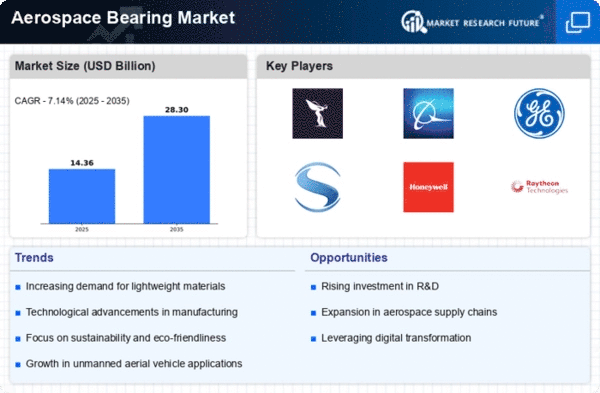
As per MRFR analysis, the Aerospace Bearing Market Size was estimated at 13.4 USD Billion in 2024. The Aerospace Bearing industry is projected to grow from 14.2 USD Billion in 2025 to 28.3 USD Billion by 2035, exhibiting a compound annual growth rate (CAGR) of 7.14 during the forecast period 2025 - 2035.

Key Market Trends & Highlights

The Aerospace Bearing Market is poised for substantial growth driven by technological advancements and sustainability initiatives.

  • North America remains the largest market for aerospace bearings, driven by a robust aerospace industry.
  • The Asia-Pacific region is emerging as the fastest-growing market, fueled by increasing air travel and military investments.
  • Commercial aviation continues to dominate the market, while military aviation is experiencing rapid growth due to rising defense budgets.
  • Key market drivers include the increasing demand for lightweight materials and technological advancements in bearing design.

Market Size & Forecast

2024 Market Size 13.4 (USD Billion)
2035 Market Size 28.3 (USD Billion)
CAGR (2025 - 2035) 7.14%
Largest Regional Market Share in 2024 North America

Major Players

Rolls-Royce (GB), Boeing (US), General Electric (US), Safran (FR), Honeywell (US), Raytheon Technologies (US), Thales Group (FR), SKF (SE), NTN Corporation (JP), Schaeffler (DE)

Market Trends

The Aerospace Bearing Market is currently experiencing a dynamic evolution, driven by advancements in technology and increasing demand for lightweight materials. Manufacturers are focusing on enhancing the performance and durability of bearings to meet the rigorous standards of the aerospace industry. This sector is characterized by a growing emphasis on sustainability, with companies exploring eco-friendly materials and production processes. Furthermore, the integration of smart technologies into bearing systems is becoming more prevalent, potentially leading to improved monitoring and predictive maintenance capabilities. As the industry progresses, collaboration between manufacturers and aerospace companies appears to be crucial for fostering innovation and addressing emerging challenges. In addition, the Aerospace Bearing Market is witnessing a shift towards the adoption of additive manufacturing techniques. This approach allows for the creation of complex geometries that traditional methods may not achieve, thereby enhancing the efficiency of bearing components. The increasing focus on reducing operational costs and improving fuel efficiency in aircraft design is likely to further propel the demand for advanced bearing solutions. Overall, the Aerospace Bearing Market seems poised for substantial growth, driven by technological advancements and a commitment to sustainability in aerospace applications.

Sustainability Initiatives

The Aerospace Bearing Market is increasingly prioritizing sustainability, with manufacturers exploring eco-friendly materials and processes. This trend reflects a broader industry commitment to reducing environmental impact and enhancing the lifecycle of products.

Smart Technology Integration

The integration of smart technologies into bearing systems is gaining traction. This development may lead to enhanced monitoring capabilities, allowing for predictive maintenance and improved performance in aerospace applications.

Additive Manufacturing Adoption

Additive manufacturing is emerging as a transformative force within the Aerospace Bearing Market. This technique enables the production of complex geometries, potentially improving the efficiency and performance of bearing components.

Aerospace Bearing Market Market Drivers

Market Growth Projections

The Global Aerospace Bearing Market Industry is poised for substantial growth, with projections indicating a market size of 18.2 USD Billion in 2024 and an anticipated increase to 42.5 USD Billion by 2035. This growth trajectory suggests a robust compound annual growth rate (CAGR) of 8.0% from 2025 to 2035. Such figures reflect the industry's resilience and adaptability in response to evolving technological advancements, regulatory requirements, and market demands. The increasing focus on lightweight materials, safety standards, and sustainability further underscores the potential for expansion within the aerospace bearing sector.

Growing Focus on Sustainability

The growing focus on sustainability significantly influences the Global Aerospace Bearing Market Industry, as manufacturers strive to reduce their environmental footprint. This trend encompasses the development of eco-friendly materials and manufacturing processes that minimize waste and energy consumption. Aerospace companies are increasingly prioritizing sustainability in their supply chains, leading to a demand for bearings that align with these values. As the industry moves towards greener practices, the market is projected to reach 42.5 USD Billion by 2035. This shift not only addresses environmental concerns but also enhances the reputation of companies committed to sustainable development.

Expansion of Commercial Aviation

The expansion of commercial aviation significantly impacts the Global Aerospace Bearing Market Industry, as increasing air travel demand necessitates the production of more aircraft. This trend is particularly pronounced in emerging markets, where rising disposable incomes and urbanization contribute to a burgeoning middle class eager to travel. Consequently, aircraft manufacturers are ramping up production rates, leading to heightened demand for aerospace bearings. The market is poised for substantial growth, with projections indicating a rise to 18.2 USD Billion in 2024. This expansion not only supports the aerospace sector but also stimulates related industries, creating a ripple effect throughout the global economy.

Regulatory Compliance and Safety Standards

Regulatory compliance and safety standards play a crucial role in shaping the Global Aerospace Bearing Market Industry. Stringent regulations imposed by aviation authorities necessitate the use of high-quality bearings that meet specific performance criteria. Manufacturers must ensure that their products comply with these regulations to maintain market access and consumer trust. As safety becomes increasingly paramount, the demand for reliable and durable aerospace bearings is expected to rise. This trend is likely to contribute to the market's growth, with projections indicating a CAGR of 8.0% from 2025 to 2035. Compliance with evolving regulations will be a key driver for innovation and quality assurance in the industry.

Increasing Demand for Lightweight Materials

The Global Aerospace Bearing Market Industry experiences a notable surge in demand for lightweight materials, driven by the aerospace sector's ongoing efforts to enhance fuel efficiency and reduce emissions. Manufacturers are increasingly adopting advanced materials such as titanium and composite materials in bearing production. This shift not only contributes to weight reduction but also improves performance and durability. As a result, the market is projected to reach 18.2 USD Billion in 2024, reflecting a growing trend towards sustainable aviation practices. The integration of lightweight bearings is likely to play a pivotal role in meeting regulatory standards and consumer expectations for greener aircraft.

Technological Advancements in Bearing Design

Technological innovations significantly influence the Global Aerospace Bearing Market Industry, as advancements in design and manufacturing processes lead to improved performance and reliability. The introduction of computer-aided design (CAD) and simulation tools allows for the creation of bearings that can withstand extreme conditions while minimizing friction and wear. These innovations are essential for modern aircraft, which demand high-performance components. As the industry evolves, the market is expected to grow at a CAGR of 8.0% from 2025 to 2035, reaching an estimated 42.5 USD Billion by 2035. This growth underscores the importance of continuous investment in research and development to maintain competitive advantages.

Market Segment Insights

By Application: Commercial Aviation (Largest) vs. Military Aviation (Fastest-Growing)

In the Aerospace Bearing Market, the application segment is characterized by significant variations in market share. Commercial aviation holds the largest portion, primarily driven by the increasing demand for air travel and the expansion of the global aviation fleet. In contrast, military aviation represents a smaller share but is gaining momentum as nations invest heavily in modernizing their defense capabilities and upgrading their aircraft fleets. The interest in advanced technologies and the growing focus on operational efficiency also play crucial roles in shaping this segment. Growth trends in the aerospace bearing application segment indicate a robust upward trajectory, particularly in military aviation. Advancements in aerospace technology, alongside heightened geopolitical tensions, are catalysts for increased spending in military sectors. Meanwhile, the commercial aviation segment is also growing steadily, bolstered by post-pandemic recovery in air travel demand and the shift towards more fuel-efficient aircraft designs. The space exploration and unmanned aerial vehicles sectors, while smaller, are being recognized as burgeoning markets due to the ongoing innovations in aerospace engineering and increasing interest in space missions, presenting new opportunities for growth in the bearing market.

Commercial Aviation (Dominant) vs. General Aviation (Emerging)

Commercial aviation is the dominant force in the aerospace bearing market, representing a core area of growth due to the significant number of commercial flights and advancing technologies. The emphasis on fuel efficiency and passenger comfort directly impacts the design and functionality of bearings used in commercial aircraft. Conversely, general aviation is an emerging segment that caters to smaller aircraft, including private planes and regional flights. As this sector grows, driven by increasing personal travel preferences and business aviation, demand for specialized bearings that can accommodate a variety of aircraft designs is on the rise. The distinctions between these two segments highlight the challenges and innovations in bearing technology required to meet diverse operational conditions and performance expectations.

By Material Type: Steel (Largest) vs. Ceramic (Fastest-Growing)

In the Aerospace Bearing Market, the material type segment showcases a diverse distribution among various materials like Steel, Ceramic, Plastic, Composite, and Titanium. Steel continues to hold the largest market share due to its strength and reliability, which are crucial for aerospace applications. Meanwhile, Ceramic bearings are emerging rapidly, gaining traction due to their lightweight nature and outstanding resistance to heat and wear. Other materials such as Plastic, Composite, and Titanium also play significant roles, catering to specific requirements within aerospace engineering.

Steel (Dominant) vs. Ceramic (Emerging)

Steel bearings dominate the Aerospace Bearing Market with their unmatched strength, durability, and cost-effectiveness. They are widely used in various aerospace applications, from commercial aviation to military uses, due to their reliable performance under high-stress conditions. Conversely, ceramic bearings are the emerging material in this segment, offering advantages like reduced weight and lower friction, which enhance fuel efficiency and performance. As the aerospace industry increasingly seeks lighter and more efficient components, ceramic bearings are expected to grow significantly. The shift towards advanced materials reflects a trend in aerospace engineering that emphasizes performance, sustainability, and innovation.

By Bearing Type: Ball Bearing (Largest) vs. Roller Bearing (Fastest-Growing)

In the Aerospace Bearing Market, the distribution of market share among different bearing types shows a clear leader in ball bearings, which are favored for their versatility and robustness in various aerospace applications. These bearings account for a significant portion of the market, attributed to their ability to withstand high speeds and loads, making them essential in both commercial and military aircraft designs. Roller bearings follow as a notable segment, experiencing substantial traction due to their enhanced load-carrying capacity, which is critical for larger aircraft designs.

Ball Bearing (Dominant) vs. Roller Bearing (Emerging)

Ball bearings reign as the dominant force in the aerospace sector, effectively meeting the rigorous demands of aviation applications with their high-speed performance and durability under extreme conditions. Their widespread usage across commercial and military aircraft makes them a reliable choice for manufacturers. On the other hand, roller bearings are emerging steadily in the market due to their ability to handle higher radial loads and their compact design, making them particularly advantageous in new aerospace innovations. As these bearings are increasingly integrated into advanced aerospace systems, their growth is expected to accelerate, driven by an expanding demand for efficient and lightweight solutions.

By End Use: Aircraft Manufacturing (Largest) vs. Maintenance Repair and Overhaul (Fastest-Growing)

The Aerospace Bearing Market is primarily segmented into four key end-use categories: Aircraft Manufacturing, Maintenance Repair and Overhaul (MRO), Aerospace Component Manufacturing, and Aerospace Research and Development. Among these segments, Aircraft Manufacturing holds the largest share, as it represents a significant portion of overall aerospace production activities. MRO is notably contributing to the growth of the market, reflecting its essential role in sustaining aircraft operations and ensuring safety and compliance. The growth of the MRO segment is driven by ongoing advancements in aviation technology and increasing regulations for aircraft safety. The demand for highly durable and efficient bearings in both new aircraft and their maintenance activities is enhancing the growth potential of this segment. Furthermore, the exponential growth in air travel and the extending lifespan of existing aircraft are also propelling the necessity for regular maintenance, ultimately benefiting the bearing market.

Aircraft Manufacturing (Dominant) vs. Aerospace Component Manufacturing (Emerging)

Aircraft Manufacturing remains the dominant force in the Aerospace Bearing Market due to the high demand for lightweight and high-performance bearings that meet stringent aerospace standards. This segment is characterized by a focus on innovative materials and designs that enhance fuel efficiency and reduce operational costs. In contrast, Aerospace Component Manufacturing is an emerging segment, driven by increased outsourcing and partnerships between component manufacturers and aerospace companies. This segment emphasizes specialized bearings engineered for specific components, broadening the application areas and creating new opportunities. While Aircraft Manufacturing relies on established relationships and regulatory compliance, Aerospace Component Manufacturing is rapidly adapting to new technologies, thereby offering a diverse range of products that cater to modern aerospace applications.

By Load Type: Radial Load (Largest) vs. Thrust Load (Fastest-Growing)

In the Aerospace Bearing Market, the load type segment is primarily dominated by Radial Load, which constitutes the largest share. This load type is crucial for applications where the primary stress is perpendicular to the shaft, making it essential for most aircraft designs and engine applications. Following Radial Load, Thrust Load is positioned as a significant player, contributing notably to the market as well, owing to its necessity in heavy-duty aircraft components where axial forces are prevalent. The growth trends for the load types show a distinct shift towards Thrust Load as the fastest-growing segment. This surge can be attributed to advancements in aerospace technologies and increasing demand for components that can handle higher axial loads. Factors such as the expansion of the aerospace industry and innovations in bearing materials have further propelled the adoption of Thrust Load bearings, leading to exponential growth in this category.

Load Types: Radial Load (Dominant) vs. Combined Load (Emerging)

Radial Load bearings are recognized for their capability to manage radial forces effectively, making them the most dominant type in the Aerospace Bearing Market. Their extensive application in engines, landing gears, and wing structures demonstrates their critical role in ensuring the safety and performance of aircraft. In contrast, Combined Load bearings, though considered an emerging segment, are gaining traction due to their versatility in accommodating both radial and axial loads. As aviation technology progresses, the ability to integrate multiple load types into a single bearing system becomes increasingly valuable, leading to enhanced efficiency and reduced weight in aircraft designs. This positions Combined Load bearings favorably as manufacturers seek innovative solutions for modern aerospace challenges.

Get more detailed insights about Aerospace Bearing Market Research Report - Global Forecast till 2035

Regional Insights

North America : Aerospace Innovation Leader

North America continues to lead the aerospace bearing market, holding a significant share of 6.72 billion in 2024. The region's growth is driven by robust demand from commercial and military aviation sectors, alongside advancements in aerospace technology. Regulatory support from agencies like the FAA fosters innovation and safety standards, further propelling market expansion. The increasing focus on fuel efficiency and lightweight materials also contributes to the rising demand for high-performance bearings. The competitive landscape in North America is characterized by the presence of major players such as Boeing, General Electric, and Honeywell. These companies are at the forefront of technological advancements, ensuring high-quality products that meet stringent regulatory requirements. The U.S. is the leading country in this region, with a well-established aerospace industry that continues to attract investments. The collaboration between government and private sectors enhances research and development, solidifying North America's position as a global aerospace hub.

Europe : Emerging Aerospace Market

Europe's aerospace bearing market is projected to reach 3.92 billion by 2025, driven by increasing air travel and the demand for advanced aerospace technologies. The region benefits from strong regulatory frameworks that promote safety and innovation, such as the European Union Aviation Safety Agency (EASA) regulations. These regulations encourage manufacturers to adopt cutting-edge technologies, enhancing the performance and reliability of aerospace bearings. Leading countries in Europe include France, Germany, and the UK, where key players like Safran and Rolls-Royce are headquartered. The competitive landscape is marked by a mix of established companies and innovative startups, fostering a dynamic market environment. The collaboration between industry and academia in Europe further supports research initiatives, ensuring that the region remains competitive in the global aerospace sector. The focus on sustainability and reducing carbon emissions is also shaping the future of aerospace bearings in Europe.

Asia-Pacific : Rapidly Growing Aerospace Sector

The Asia-Pacific aerospace bearing market is expected to grow significantly, reaching 2.68 billion by 2025. This growth is fueled by increasing air traffic, rising disposable incomes, and expanding aerospace manufacturing capabilities in countries like China and India. Government initiatives aimed at boosting domestic production and reducing reliance on imports are also key drivers of market expansion. Regulatory bodies are enhancing safety standards, which further stimulates demand for high-quality aerospace bearings. China is the leading country in this region, with a rapidly growing aerospace industry supported by major investments in technology and infrastructure. The competitive landscape features both domestic and international players, including NTN Corporation and SKF, who are actively expanding their presence. The collaboration between government and private sectors is crucial for fostering innovation and ensuring compliance with international standards, positioning Asia-Pacific as a vital player in The Aerospace Bearing.

Middle East and Africa : Emerging Aerospace Frontier

The Middle East and Africa aerospace bearing market is in its nascent stages, with a market size of 0.08 billion projected for 2025. The growth in this region is primarily driven by increasing investments in aviation infrastructure and the rising demand for air travel. Governments are focusing on enhancing their aerospace capabilities, which is expected to create opportunities for aerospace bearing manufacturers. Regulatory frameworks are being developed to ensure safety and quality standards in the industry. Countries like the UAE and South Africa are leading the way in aerospace development, with initiatives aimed at attracting foreign investments. The competitive landscape is gradually evolving, with both local and international players looking to establish a foothold in this emerging market. The collaboration between governments and private sectors is essential for fostering growth and innovation in the aerospace bearing sector in the Middle East and Africa.

Key Players and Competitive Insights

The Aerospace Bearing Market is currently characterized by a dynamic competitive landscape, driven by technological advancements, increasing demand for fuel-efficient aircraft, and a growing emphasis on sustainability. Major players such as Rolls-Royce (GB), Boeing (US), and General Electric (US) are strategically positioned to leverage innovation and partnerships to enhance their market presence. Rolls-Royce (GB) focuses on developing advanced materials and manufacturing techniques, while Boeing (US) emphasizes digital transformation and supply chain optimization. General Electric (US) is investing heavily in AI and predictive maintenance technologies, collectively shaping a competitive environment that prioritizes efficiency and performance.Key business tactics within the Aerospace Bearing Market include localizing manufacturing to reduce costs and enhance supply chain resilience. The market structure appears moderately fragmented, with a mix of established players and emerging companies. The collective influence of key players is significant, as they engage in strategic collaborations and mergers to consolidate their positions and expand their technological capabilities.

In November Rolls-Royce (GB) announced a partnership with a leading materials science company to develop next-generation bearing materials aimed at improving performance and reducing weight. This strategic move is likely to enhance Rolls-Royce's competitive edge by enabling the production of lighter, more efficient components, which is crucial in the aerospace sector where weight reduction directly correlates with fuel efficiency.

In October Boeing (US) unveiled a new digital platform designed to optimize the supply chain for aerospace components, including bearings. This initiative is expected to streamline operations and reduce lead times, thereby enhancing Boeing's ability to respond to market demands swiftly. The integration of digital tools into supply chain management signifies a shift towards more agile and responsive manufacturing processes.

In September General Electric (US) launched a new AI-driven predictive maintenance system for aerospace bearings, aimed at minimizing downtime and extending the lifespan of critical components. This innovation not only positions General Electric as a leader in technological integration but also reflects the industry's broader trend towards leveraging AI for operational efficiency.

As of December current competitive trends in the Aerospace Bearing Market are heavily influenced by digitalization, sustainability initiatives, and the integration of AI technologies. Strategic alliances are increasingly shaping the landscape, as companies recognize the need for collaboration to drive innovation. The competitive differentiation is likely to evolve from traditional price-based competition to a focus on technological advancements, reliability in supply chains, and sustainable practices, indicating a transformative shift in how companies position themselves in the market.

Key Companies in the Aerospace Bearing Market include

Industry Developments

  • Q2 2024: SKF inaugurates new aerospace bearing manufacturing facility in France SKF opened a state-of-the-art aerospace bearing plant in Saint-Vallier, France, aimed at expanding production capacity for advanced bearings used in commercial and military aircraft.
  • Q2 2024: Timken wins multi-year contract to supply bearings for Boeing 787 Dreamliner program Timken announced a multi-year agreement to provide specialized aerospace bearings for Boeing’s 787 Dreamliner, strengthening its position as a key supplier to major aircraft manufacturers.
  • Q3 2024: Schaeffler acquires minority stake in aerospace startup AeroMotion Schaeffler invested in AeroMotion, a startup developing next-generation bearing technologies for electric propulsion systems, marking its entry into the emerging eVTOL aerospace segment.
  • Q3 2024: NTN launches hybrid ceramic ball bearings for commercial jet engines NTN introduced a new line of hybrid ceramic ball bearings designed to improve fuel efficiency and reduce maintenance intervals in commercial jet engines.
  • Q4 2024: Rolls-Royce signs strategic partnership with NSK for advanced aerospace bearing R&D Rolls-Royce and NSK entered a multi-year partnership to co-develop high-performance bearings for next-generation aircraft engines, focusing on durability and weight reduction.
  • Q4 2024: Kaman Aerospace secures $120M contract for bearing assemblies on U.S. Air Force fighter jets Kaman Aerospace was awarded a $120 million contract to supply bearing assemblies for the F-35 and F-22 fighter jet programs, supporting U.S. defense modernization efforts.
  • Q1 2025: SKF appoints new head of aerospace division SKF named Dr. Anna Müller as the new president of its aerospace division, tasking her with driving innovation and expanding the company’s global aerospace bearing footprint.
  • Q1 2025: Timken opens R&D center for aerospace bearing materials in Ohio Timken inaugurated a research and development center in Ohio dedicated to advanced materials and coatings for aerospace bearings, aiming to accelerate product innovation.
  • Q2 2025: Schaeffler wins contract to supply bearings for Airbus A320neo family Schaeffler secured a contract to provide precision bearings for the Airbus A320neo program, expanding its footprint in the commercial aviation sector.
  • Q2 2025: NSK receives regulatory approval for new aerospace bearing plant in Japan NSK obtained government approval to construct a new manufacturing facility in Nagoya, Japan, dedicated to producing aerospace-grade bearings for global export.
  • Q3 2025: NTN partners with Safran to develop bearings for hydrogen-powered aircraft NTN and Safran announced a partnership to co-develop specialized bearings for hydrogen propulsion systems, targeting the next generation of sustainable aircraft.
  • Q3 2025: Rolls-Royce launches new bearing technology for ultra-high bypass engines Rolls-Royce unveiled a proprietary bearing design for its upcoming ultra-high bypass turbofan engines, promising improved efficiency and longer service intervals.


Future Outlook

Aerospace Bearing Market Future Outlook

The Aerospace Bearing Market is projected to grow at a 7.14% CAGR from 2025 to 2035, driven by advancements in aerospace technology, increasing aircraft production, and rising demand for lightweight materials.

New opportunities lie in:

  • Development of advanced ceramic bearings for enhanced performance
  • Integration of IoT for predictive maintenance solutions
  • Expansion into emerging markets with tailored aerospace bearing solutions

By 2035, the Aerospace Bearing Market is expected to achieve substantial growth and innovation.

Market Segmentation

Aerospace Bearing Market End Use Outlook

  • Aircraft Manufacturing
  • Maintenance Repair and Overhaul
  • Aerospace Component Manufacturing
  • Aerospace Research and Development

Aerospace Bearing Market Load Type Outlook

  • Radial Load
  • Axial Load
  • Thrust Load
  • Combined Load

Aerospace Bearing Market Application Outlook

  • Commercial Aviation
  • Military Aviation
  • Space Exploration
  • Unmanned Aerial Vehicles
  • General Aviation

Aerospace Bearing Market Bearing Type Outlook

  • Ball Bearing
  • Roller Bearing
  • Magnetic Bearing
  • Fluid Bearing
  • Sleeve Bearing

Aerospace Bearing Market Material Type Outlook

  • Steel
  • Ceramic
  • Plastic
  • Composite
  • Titanium

Report Scope

MARKET SIZE 202413.4(USD Billion)
MARKET SIZE 202514.2(USD Billion)
MARKET SIZE 203528.3(USD Billion)
COMPOUND ANNUAL GROWTH RATE (CAGR)7.14% (2025 - 2035)
REPORT COVERAGERevenue Forecast, Competitive Landscape, Growth Factors, and Trends
BASE YEAR2024
Market Forecast Period2025 - 2035
Historical Data2019 - 2024
Market Forecast UnitsUSD Billion
Key Companies ProfiledRolls-Royce (GB), Boeing (US), General Electric (US), Safran (FR), Honeywell (US), Raytheon Technologies (US), Thales Group (FR), SKF (SE), NTN Corporation (JP), Schaeffler (DE)
Segments CoveredApplication, Material Type, Bearing Type, End Use, Load Type
Key Market OpportunitiesIntegration of advanced materials and technologies enhances performance in the Aerospace Bearing Market.
Key Market DynamicsTechnological advancements and regulatory changes drive innovation and competition in the Aerospace Bearing Market.
Countries CoveredNorth America, Europe, APAC, South America, MEA

FAQs

What is the estimated growth rate of the aerospace bearing market?

Global aerospace bearing market Market Grow at a CAGR Of 8% by 2023 -2030

Who are the significant players operative in the global aerospace bearing market?

A few eminent market players operating in the global aerospace bearing market are The Timken Company (US), SKF Group (Sweden), GGB Bearings Technology (US), among others

Which type is expected to witness the highest growth?

The ball bearing segment is expected to observe substantial demand over the review period.

What is the application segment of the global aerospace bearing market expected to witness the highest growth?

The engine segment is slated to expand as the fastest-growing segment.

  1. SECTION I: EXECUTIVE SUMMARY AND KEY HIGHLIGHTS
    1. | 1.1 EXECUTIVE SUMMARY
    2. | 1.1.1 Market Overview
    3. | 1.1.2 Key Findings
    4. | 1.1.3 Market Segmentation
    5. | 1.1.4 Competitive Landscape
    6. | 1.1.5 Challenges and Opportunities
    7. | 1.1.6 Future Outlook
  2. SECTION II: SCOPING, METHODOLOGY AND MARKET STRUCTURE
    1. | 2.1 MARKET INTRODUCTION
    2. | 2.1.1 Definition
    3. | 2.1.2 Scope of the study
    4. |-- 2.1.2.1 Research Objective
    5. |-- 2.1.2.2 Assumption
    6. |-- 2.1.2.3 Limitations
    7. | 2.2 RESEARCH METHODOLOGY
    8. | 2.2.1 Overview
    9. | 2.2.2 Data Mining
    10. | 2.2.3 Secondary Research
    11. | 2.2.4 Primary Research
    12. |-- 2.2.4.1 Primary Interviews and Information Gathering Process
    13. |-- 2.2.4.2 Breakdown of Primary Respondents
    14. | 2.2.5 Forecasting Model
    15. | 2.2.6 Market Size Estimation
    16. |-- 2.2.6.1 Bottom-Up Approach
    17. |-- 2.2.6.2 Top-Down Approach
    18. | 2.2.7 Data Triangulation
    19. | 2.2.8 Validation
  3. SECTION III: QUALITATIVE ANALYSIS
    1. | 3.1 MARKET DYNAMICS
    2. | 3.1.1 Overview
    3. | 3.1.2 Drivers
    4. | 3.1.3 Restraints
    5. | 3.1.4 Opportunities
    6. | 3.2 MARKET FACTOR ANALYSIS
    7. | 3.2.1 Value chain Analysis
    8. | 3.2.2 Porter's Five Forces Analysis
    9. |-- 3.2.2.1 Bargaining Power of Suppliers
    10. |-- 3.2.2.2 Bargaining Power of Buyers
    11. |-- 3.2.2.3 Threat of New Entrants
    12. |-- 3.2.2.4 Threat of Substitutes
    13. |-- 3.2.2.5 Intensity of Rivalry
    14. | 3.2.3 COVID-19 Impact Analysis
    15. |-- 3.2.3.1 Market Impact Analysis
    16. |-- 3.2.3.2 Regional Impact
    17. |-- 3.2.3.3 Opportunity and Threat Analysis
  4. SECTION IV: QUANTITATIVE ANALYSIS
    1. | 4.1 Aerospace & Defense, BY Application (USD Billion)
    2. | 4.1.1 Commercial Aviation
    3. | 4.1.2 Military Aviation
    4. | 4.1.3 Space Exploration
    5. | 4.1.4 Unmanned Aerial Vehicles
    6. | 4.1.5 General Aviation
    7. | 4.2 Aerospace & Defense, BY Material Type (USD Billion)
    8. | 4.2.1 Steel
    9. | 4.2.2 Ceramic
    10. | 4.2.3 Plastic
    11. | 4.2.4 Composite
    12. | 4.2.5 Titanium
    13. | 4.3 Aerospace & Defense, BY Bearing Type (USD Billion)
    14. | 4.3.1 Ball Bearing
    15. | 4.3.2 Roller Bearing
    16. | 4.3.3 Magnetic Bearing
    17. | 4.3.4 Fluid Bearing
    18. | 4.3.5 Sleeve Bearing
    19. | 4.4 Aerospace & Defense, BY End Use (USD Billion)
    20. | 4.4.1 Aircraft Manufacturing
    21. | 4.4.2 Maintenance Repair and Overhaul
    22. | 4.4.3 Aerospace Component Manufacturing
    23. | 4.4.4 Aerospace Research and Development
    24. | 4.5 Aerospace & Defense, BY Load Type (USD Billion)
    25. | 4.5.1 Radial Load
    26. | 4.5.2 Axial Load
    27. | 4.5.3 Thrust Load
    28. | 4.5.4 Combined Load
    29. | 4.6 Aerospace & Defense, BY Region (USD Billion)
    30. | 4.6.1 North America
    31. |-- 4.6.1.1 US
    32. |-- 4.6.1.2 Canada
    33. | 4.6.2 Europe
    34. |-- 4.6.2.1 Germany
    35. |-- 4.6.2.2 UK
    36. |-- 4.6.2.3 France
    37. |-- 4.6.2.4 Russia
    38. |-- 4.6.2.5 Italy
    39. |-- 4.6.2.6 Spain
    40. |-- 4.6.2.7 Rest of Europe
    41. | 4.6.3 APAC
    42. |-- 4.6.3.1 China
    43. |-- 4.6.3.2 India
    44. |-- 4.6.3.3 Japan
    45. |-- 4.6.3.4 South Korea
    46. |-- 4.6.3.5 Malaysia
    47. |-- 4.6.3.6 Thailand
    48. |-- 4.6.3.7 Indonesia
    49. |-- 4.6.3.8 Rest of APAC
    50. | 4.6.4 South America
    51. |-- 4.6.4.1 Brazil
    52. |-- 4.6.4.2 Mexico
    53. |-- 4.6.4.3 Argentina
    54. |-- 4.6.4.4 Rest of South America
    55. | 4.6.5 MEA
    56. |-- 4.6.5.1 GCC Countries
    57. |-- 4.6.5.2 South Africa
    58. |-- 4.6.5.3 Rest of MEA
  5. SECTION V: COMPETITIVE ANALYSIS
    1. | 5.1 Competitive Landscape
    2. | 5.1.1 Overview
    3. | 5.1.2 Competitive Analysis
    4. | 5.1.3 Market share Analysis
    5. | 5.1.4 Major Growth Strategy in the Aerospace & Defense
    6. | 5.1.5 Competitive Benchmarking
    7. | 5.1.6 Leading Players in Terms of Number of Developments in the Aerospace & Defense
    8. | 5.1.7 Key developments and growth strategies
    9. |-- 5.1.7.1 New Product Launch/Service Deployment
    10. |-- 5.1.7.2 Merger & Acquisitions
    11. |-- 5.1.7.3 Joint Ventures
    12. | 5.1.8 Major Players Financial Matrix
    13. |-- 5.1.8.1 Sales and Operating Income
    14. |-- 5.1.8.2 Major Players R&D Expenditure. 2023
    15. | 5.2 Company Profiles
    16. | 5.2.1 Rolls-Royce (GB)
    17. |-- 5.2.1.1 Financial Overview
    18. |-- 5.2.1.2 Products Offered
    19. |-- 5.2.1.3 Key Developments
    20. |-- 5.2.1.4 SWOT Analysis
    21. |-- 5.2.1.5 Key Strategies
    22. | 5.2.2 Boeing (US)
    23. |-- 5.2.2.1 Financial Overview
    24. |-- 5.2.2.2 Products Offered
    25. |-- 5.2.2.3 Key Developments
    26. |-- 5.2.2.4 SWOT Analysis
    27. |-- 5.2.2.5 Key Strategies
    28. | 5.2.3 General Electric (US)
    29. |-- 5.2.3.1 Financial Overview
    30. |-- 5.2.3.2 Products Offered
    31. |-- 5.2.3.3 Key Developments
    32. |-- 5.2.3.4 SWOT Analysis
    33. |-- 5.2.3.5 Key Strategies
    34. | 5.2.4 Safran (FR)
    35. |-- 5.2.4.1 Financial Overview
    36. |-- 5.2.4.2 Products Offered
    37. |-- 5.2.4.3 Key Developments
    38. |-- 5.2.4.4 SWOT Analysis
    39. |-- 5.2.4.5 Key Strategies
    40. | 5.2.5 Honeywell (US)
    41. |-- 5.2.5.1 Financial Overview
    42. |-- 5.2.5.2 Products Offered
    43. |-- 5.2.5.3 Key Developments
    44. |-- 5.2.5.4 SWOT Analysis
    45. |-- 5.2.5.5 Key Strategies
    46. | 5.2.6 Raytheon Technologies (US)
    47. |-- 5.2.6.1 Financial Overview
    48. |-- 5.2.6.2 Products Offered
    49. |-- 5.2.6.3 Key Developments
    50. |-- 5.2.6.4 SWOT Analysis
    51. |-- 5.2.6.5 Key Strategies
    52. | 5.2.7 Thales Group (FR)
    53. |-- 5.2.7.1 Financial Overview
    54. |-- 5.2.7.2 Products Offered
    55. |-- 5.2.7.3 Key Developments
    56. |-- 5.2.7.4 SWOT Analysis
    57. |-- 5.2.7.5 Key Strategies
    58. | 5.2.8 SKF (SE)
    59. |-- 5.2.8.1 Financial Overview
    60. |-- 5.2.8.2 Products Offered
    61. |-- 5.2.8.3 Key Developments
    62. |-- 5.2.8.4 SWOT Analysis
    63. |-- 5.2.8.5 Key Strategies
    64. | 5.2.9 NTN Corporation (JP)
    65. |-- 5.2.9.1 Financial Overview
    66. |-- 5.2.9.2 Products Offered
    67. |-- 5.2.9.3 Key Developments
    68. |-- 5.2.9.4 SWOT Analysis
    69. |-- 5.2.9.5 Key Strategies
    70. | 5.2.10 Schaeffler (DE)
    71. |-- 5.2.10.1 Financial Overview
    72. |-- 5.2.10.2 Products Offered
    73. |-- 5.2.10.3 Key Developments
    74. |-- 5.2.10.4 SWOT Analysis
    75. |-- 5.2.10.5 Key Strategies
    76. | 5.3 Appendix
    77. | 5.3.1 References
    78. | 5.3.2 Related Reports

Aerospace & Defense Market Segmentation

Aerospace & Defense By Application (USD Billion, 2025-2035)

  • Commercial Aviation
  • Military Aviation
  • Space Exploration
  • Unmanned Aerial Vehicles
  • General Aviation

Aerospace & Defense By Material Type (USD Billion, 2025-2035)

  • Steel
  • Ceramic
  • Plastic
  • Composite
  • Titanium

Aerospace & Defense By Bearing Type (USD Billion, 2025-2035)

  • Ball Bearing
  • Roller Bearing
  • Magnetic Bearing
  • Fluid Bearing
  • Sleeve Bearing

Aerospace & Defense By End Use (USD Billion, 2025-2035)

  • Aircraft Manufacturing
  • Maintenance Repair and Overhaul
  • Aerospace Component Manufacturing
  • Aerospace Research and Development

Aerospace & Defense By Load Type (USD Billion, 2025-2035)

  • Radial Load
  • Axial Load
  • Thrust Load
  • Combined Load
Infographic

Free Sample Request

Kindly complete the form below to receive a free sample of this Report

Get Free Sample

Customer Strories

Compare Licence

×
Features License Type
Single User Multiuser License Enterprise User
Price $4,950 $5,950 $7,250
Maximum User Access Limit 1 User Upto 10 Users Unrestricted Access Throughout the Organization
Free Customization
Direct Access to Analyst
Deliverable Format
Platform Access
Discount on Next Purchase 10% 15% 15%
Printable Versions